

Physics-informed neural network for lithium-ion battery degradation stable modeling and prognosis
Open accessThe DOI matches its Crossref record; 55 of the 56 references it cites were found in a registry or an index.
Abstract
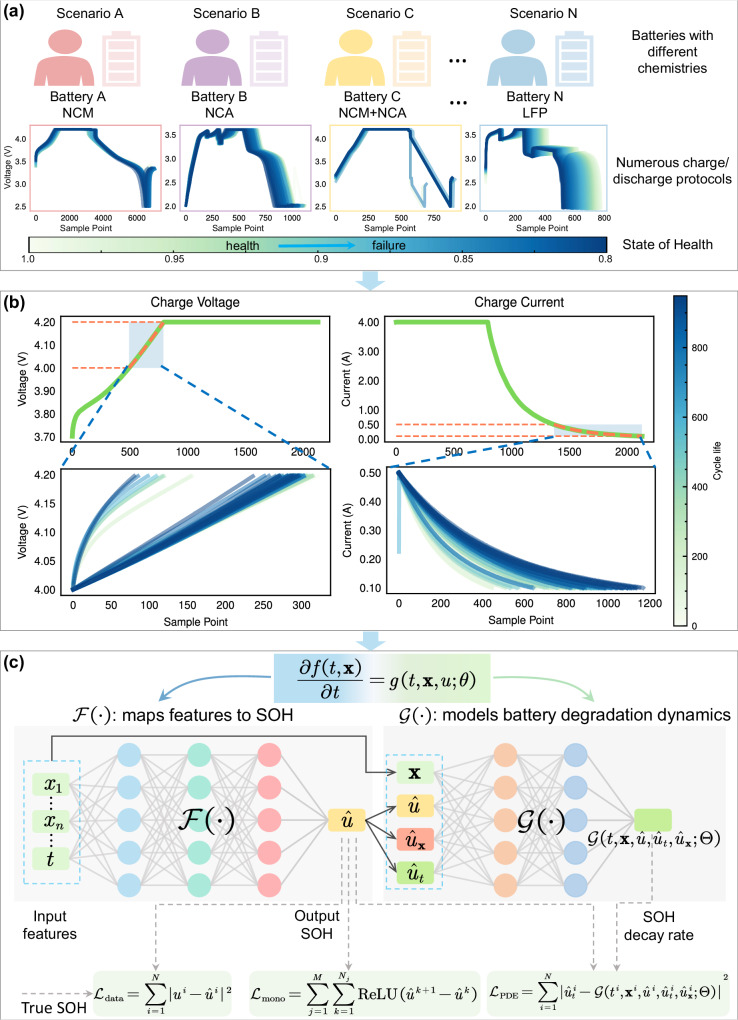
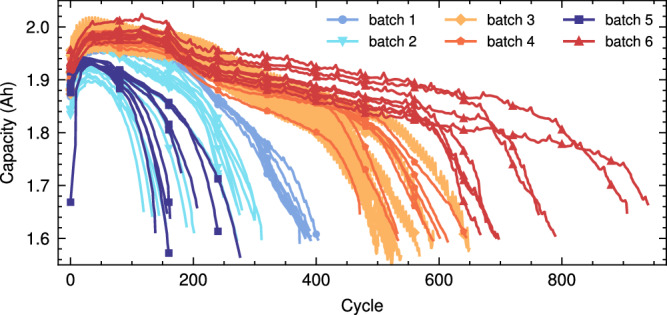
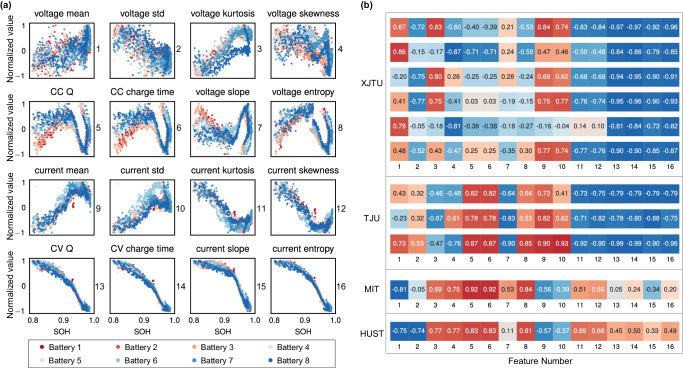
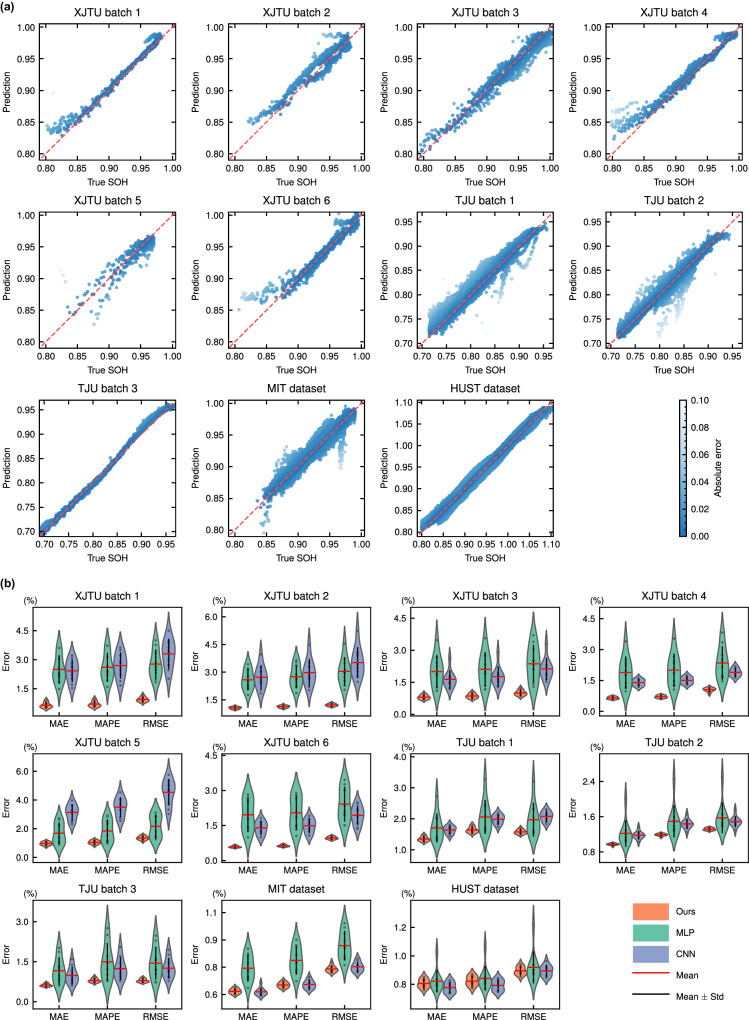
Accurate state-of-health (SOH) estimation is critical for reliable and safe operation of lithium-ion batteries. However, reliable and stable battery SOH estimation remains challenging due to diverse battery types and operating conditions. In this paper, we propose a physics-informed neural network (PINN) for accurate and stable estimation of battery SOH. Specifically, we model the attributes that affect the battery degradation from the perspective of empirical degradation and state space equations, and utilize neural networks to capture battery degradation dynamics. A general feature extraction method is designed to extract statistical features from a short period of data before the battery is fully charged, enabling our method applicable to different battery types and charge/discharge protocols. Additionally, we generate a comprehensive dataset consisting of 55 lithium-nickel-cobalt-manganese-oxide (NCM) batteries. Combined with three other datasets from different manufacturers, we use a total of 387 batteries with 310,705 samples to validate our method. The mean absolute percentage error (MAPE) is 0.87%. Our proposed PINN has demonstrated remarkable performance in regular experiments, small sample experiments, and transfer experiments when compared to alternative neural networks. This study highlights the promise of physics-informed machine learning for battery degradation modeling and SOH estimation.
Overview
The claims and statistics of this paper haven’t been checked yet.
Free: it reads the open-access text and checks the first 5 claims that cite a source we can check. Create a free account to check every claim.
Integrity signals
Registry
Cites
Statistics
Figures
Verification
Claims the paper makes
The claims and statistics of this paper haven’t been checked yet.
Free: it reads the open-access text and checks the first 5 claims that cite a source we can check. Create a free account to check every claim.
Claims other papers make about this one
Each is checked against this paper’s own text: does it say what the citing paper says it does?
The cited source says what the claim attributes to it.
In the citing paper
“Battery aging is a complex, multi-factor process involving the loss of active materials, lithium-ion depletion, increased internal resistance, and changes in the solid electrolyte interphase (SEI) layer [17-23]”
From The State of Health Estimation of Lithium-Ion Batteries: A Review of Health Indicators, Estimation Methods, Development Trends and Challenges (2025) · cites this paper as [17]
Self-check
Percentages, sums and reported differences re-computed from the paper’s own numbers.
The self-check needs the paper’s full text.
Citations
Cites
Raissi, M., Perdikaris, P., & Karniadakis, G. E. (2019) · Journal of Computational Physics · doi:10.1016/j.jcp.2018.10.045 · Cited by 20,384 · cited 2×
“Inspired by 54,55 , we propose to use a more generalized function approximator g 0 ð(cid:2)Þ with parameters θ 0 to represent the non-linear dynamics g ( ⋅ ).”
Physics-informed machine learning
Karniadakis, G. E., Kevrekidis, I. G., Lu, L., Perdikaris, P., Wang, S., & Yang, L. (2021) · Nature Reviews Physics · doi:10.1038/s42254-021-00314-5 · Cited by 8,718 · cited 2×
“The promising prospect of physics-informed neural network (PINN) 36,37 lies in amalgamating the strengths of physics-based and data-driven approaches, potentially addressing the aforementioned challenges.”
Recycling lithium-ion batteries from electric vehicles
Harper, G., Sommerville, R., Kendrick, E., Driscoll, L., Slater, P., Stolkin, R., Walton, A., Christensen, P., Heidrich, O., Lambert, S., et al. (2019) · Nature · doi:10.1038/s41586-019-1682-5 · Cited by 3,890 · cited 1×
“With the advantages of high energy density, low self-discharge rate, and long service life 1 , lithium-ion batteries have become the main energy storage devices in portable electronic devices, electric vehicles, aero-space, and many other fi elds 2 – 8 .”
Performance and cost of materials for lithium-based rechargeable automotive batteries
Schmuch, R., Wagner, R., Hörpel, G., Placke, T., & Winter, M. (2018) · Nature Energy · doi:10.1038/s41560-018-0107-2 · Cited by 3,233 · cited 1×
“With the advantages of high energy density, low self-discharge rate, and long service life 1 , lithium-ion batteries have become the main energy storage devices in portable electronic devices, electric vehicles, aero-space, and many other fi elds 2 – 8 .”
Data-driven prediction of battery cycle life before capacity degradation
Severson, K. A., Attia, P. M., Jin, N., Perkins, N., Jiang, B., Yang, Z., Chen, M. H., Aykol, M., Herring, P. K., Fraggedakis, D., et al. (2019) · Nature Energy · doi:10.1038/s41560-019-0356-8 · Cited by 3,228 · cited 3×
“For convenience, we refer to the four datasets as the XJTU battery dataset, TJU dataset 44 , HUST dataset 45 , and MIT dataset 25 .”
Simulation and Optimization of the Dual Lithium Ion Insertion Cell
Fuller, T. F., Doyle, M., & Newman, J. (1994) · Journal of The Electrochemical Society · doi:10.1149/1.2054684 · Cited by 2,057 · cited 1×
“Physics-based models are stable and accurate, but batteries with different chemical compositions require different model parameters, and the models have high computational costs 32 .”
Closed-loop optimization of fast-charging protocols for batteries with machine learning
Attia, P. M., Grover, A., Jin, N., Severson, K. A., Markov, T. M., Liao, Y.-H., Chen, M. H., Cheong, B., Perkins, N., Yang, Z., et al. (2020) · Nature · doi:10.1038/s41586-020-1994-5 · Cited by 1,180 · cited 1×
“Given the dif fi culty in establishing physical models and the dif fi - culty in obtaining complete discharge capacity, many studies have used data-driven methods 20 – 24 to estimate SOH based on current and voltage curves during charge and discharge.”
A review of rechargeable batteries for portable electronic devices
Liang, Y., Zhao, C., Yuan, H., Chen, Y., Zhang, W., Huang, J., Yu, D., Liu, Y., Titirici, M., Chueh, Y., et al. (2019) · InfoMat · doi:10.1002/inf2.12000 · Cited by 1,174
Modeling of Lithium-Ion Battery Degradation for Cell Life Assessment
Xu, B., Oudalov, A., Ulbig, A., Andersson, G., & Kirschen, D. S. (2018) · IEEE Transactions on Smart Grid · doi:10.1109/tsg.2016.2578950 · Cited by 1,162
Critical review of state of health estimation methods of Li-ion batteries for real applications
Berecibar, M., Gandiaga, I., Villarreal, I., Omar, N., Van Mierlo, J., & Van den Bossche, P. (2016) · Renewable and Sustainable Energy Reviews · doi:10.1016/j.rser.2015.11.042 · Cited by 1,126 · cited 1×
“In recent years, various SOH estimation methods of lithium-ion batterieshavebeenproposed,whichgreatlyadvancethedevelopment of this fi eld 12 – 15 .”
Research works printed but not linked: 1
- Raissi M Deep hidden physics models: deep learning of nonlinear partial differential equations J. Mach. Learn. Res. 2018 19 932 955
Cited by
Items 601–700 of 1,001
A Dual-Stream Physics-informed Network with Transfer Learning in Battery SOC Estimation
Zhou, Y., Zhao, Z., Wang, C., Hu, J., Tao, Z., Gu, T., & See, K. Y. (2025) · IEEE International Electrical and Energy Conference (CIEEC) · doi:10.1109/cieec64805.2025.11116627
Self-citationOlugbade, E. (2025) · The Conversation · doi:10.64628/aai.3nrkkkw55
LLM-BAS: Large Language Model-Based Battery Health-Aware Scheduling in Building Energy Systems
Yang, Y., Hu, R., Liu, S., Jin, B., Li, J., Li, D., Yang, Q., & Sun, L. (2025) · IEEE China Conference on System Simulation Technology and its Applications (CCSSTA) · doi:10.1109/ieeeconf65522.2025.11137012
“Existing SOH estimation techniques rely primarily on physics-based models [7], signal processing or data-driven learning [1], [3], [8].”
Study on Double Threholds SOC for LifePO4 Batteries
Liu, X., Peng, W., & Zhang, L. (2025) · IEEE International Conference on Image Processing and Computer Applications (ICIPCA) · doi:10.1109/icipca65645.2025.11138950
Xiang, Y., Song, Z., & Srinivasan, D. (2026) · eTransportation · doi:10.1016/j.etran.2026.100632 · Cited by 1
Data-Driven Modeling of Magnetic Bearing Rotor Systems Using LCTF-Net
Chen, Q., Yang, J., Cheng, Y. L., Wang, L., Ji, J., & Peng, C. (2025) · International Conference on Intelligent Robotics and Control Engineering (IRCE) · doi:10.1109/irce66030.2025.11203042
“In addressing the prevalent challenge of small-sample learning in engineering practice, Wang et al. developed a PINN-based model that exhibited remarkable efficacy in estimating the state of health (SOH) of lithium-ion batteries[9].”
Liu, P., Li, D., Shao, J., Cheng, B., Qi, Y., & Li, W. (2026) · Applied Energy · doi:10.1016/j.apenergy.2026.129161
Probabilistic Prediction of Li-ion Battery RUL using Large Time-Series Model
Zhang, X., Luo, H., Chen, X., Deng, W., Li, H., & Liu, W. (2025) · Annual Conference of the IEEE Industrial Electronics Society (IECON) · doi:10.1109/iecon58223.2025.11221621
“The datasets include cycle aging data for ”Lishen” NCM batteries from Xi’an Jiaotong University [15], Sanyo/Panasonic 18650 NMC/Graphite batteries from RWTH Aachen University [16], LFP/Graphite batteries from Huazhong University of Science and Technology [17], and three types of commercial 18650…”
Self-citationPhysics-informed SOH estimation of lithium-ion battery with spatio-temporal attention
Peng, J., Duan, T., Yan, L., Li, H., Yang, Y., & Liu, Z. (2025) · Annual Conference of the IEEE Industrial Electronics Society (IECON) · doi:10.1109/iecon58223.2025.11221306
“They further improved their model by incorporating empirical degradation dynamics and state-space equations, using partial derivatives of SOH as inputs to capture degradation rates [14].”
KUformer: KAN-UKF-Based Transformer for Battery SoH Prediction
Zhang, J., Dai, X., Zhou, R., Zhang, W., & Ma, H. (2025) · Annual Conference of the IEEE Industrial Electronics Society (IECON) · doi:10.1109/iecon58223.2025.11221982
“More than that, other models like Graph Neural Networks (GNNs) [16] and Physics-Informed Neural Networks (PINN) [17] have recently been introduced and employed in this field.”
Aydogan, A. K., Karaki, A., Bayhan, S., Abu‐Rub, H., & Ehsani, M. (2025) · Annual Conference of the IEEE Industrial Electronics Society (IECON) · doi:10.1109/iecon58223.2025.11221469 · Cited by 1
“Physics-Informed Neural Networks (PINNs) integrate degradation dynamics with neural architectures, achieving MAPE of 0.65-1.21% across multiple datasets while maintaining superior generalization capabilities [26].”
InfluentialKarnehm, D., & Neve, A. (2025) · Annual Conference of the IEEE Industrial Electronics Society (IECON) · doi:10.1109/iecon58223.2025.11221787
“Previous studies have shown promising re-sults employing PINN to estimate battery states [8], [9].”
Sabbaghi, M., & Behdad, S. (2025) · Journal of Industrial Ecology · doi:10.1111/jiec.70126
Altalbawy, F. M. A., Sapaev, I. B., Saied, F. A. E., Rodrigues, P., Rekha, M. M., Maharana, L., Prince, P. G. K., Kaur, G., Alazzam, M. B., & Arsalanirad, A. (2025) · Composite Interfaces · doi:10.1080/09276440.2025.2585589
“Recent advances in lithium-ion battery modeling highlight two major directions: mechanism-based multiphysics approaches and data-driven frameworks [32,33].”
Hossen, M. S., & Sahoo, A. (2025) · International Joint Conference on Neural Networks (IJCNN) · doi:10.1109/ijcnn64981.2025.11227393
“The physics-informed neural network (PINN) is an approach for incorporating physical laws with a data-driven methodology to construct a comprehensive model that solves the governing PDEs or ODEs [7].”
Transformer-Based End-to-End ECM Parameter Inference for Online Battery Voltage Prediction
Kim, D., Park, J., Baek, I., & Kim, T. (2025) · IEEE Electrical Power and Energy Conference (EPEC) · doi:10.1109/epec65543.2025.11230371
“Therefore, recent studies have focused on hybrid models combining the strengths of data-driven and model-based approaches [17]―[20].”
Coronado, A. M., & Zegarra, F. C. (2025) · IEEE International Conference on Electronics, Electrical Engineering and Computing (INTERCON) · doi:10.1109/intercon67304.2025.11244713
“The preprocessing phase began with reading the complete XJTU Battery Dataset, containing 55 batteries across 6 batches [2, 6].”
Battery degradation prognosis and its health management based on grey iterative modeling
Li, K., Xie, N., Chen, N., Dong, W., & Gu, L. (2025) · Engineering Failure Analysis · doi:10.1016/j.engfailanal.2025.110384 · Cited by 1
Li, C., Cheng, J., Zhu, H., Wen, B., Cai, X., Zhao, X., & Kang, W. (2026) · Measurement · doi:10.1016/j.measurement.2026.123850
Remaining Useful Life Prediction of Lithium Battery Based on Multi-Wiener Process
Xue, F., Jin, G., Tan, L., & Xue, Y. (2025) · Chinese Control Conference (CCC) · doi:10.23919/ccc64809.2025.11179136
Macedo, L. S. S., Nunes, R. D. S., Silva, L. E. S. E., de Bessa, I. V., & de Medeiros, R. L. P. (2025) · Workshop on Communication Networks and Power Systems (WCNPS) · doi:10.1109/wcnps69127.2025.11295907
“How a battery ages varies markedly with its use context and is primarily accelerated by four major factors: temperature, discharge current, charge current, and state of charge (SoC) [13].”
Computational and artificial intelligence-driven battery design of solid-state batteries
Alen Rufus, P., Gunasekaran, K., Samikannu, R., Begam, K. M., & Murugan, S. (2025) · Energy Exploration & Exploitation · doi:10.1177/01445987251400457
“Best-suited NN types for each SSB computational model are listed in Table 7 (Choudhary et al., 2022; Darbar and Bhattacharya, 2022; Guo et al., 2024; Menon and Ranganathan, 2022; Schmitt et al., 2023; Tang et al., 2023; Wang et al., 2024; Yao et al., 2022).”
He, Y., Deng, Z., Wang, J., Jiang, C., & Nie, W. (2026) · Lecture notes in electrical engineering · doi:10.1007/978-981-95-4274-1_31
Zhao, Y., Wang, P., Cao, H., Han, Q., Zhu, Y., & Liu, Z. (2025) · IEEE International Conference on Industrial Informatics (INDIN) · doi:10.1109/indin64977.2025.11279554
“Physics-Informed Machine Learning (PIML) integrates physical laws with data-driven models, enhancing generalizability in fields like atomistic modelling [12], earthquake prediction [13] , and performance prognosis [14].”
Lithium Battery SOH Estimation Using the LPE_BiGRU_EBAM Model Based on the WMA
Liu, H., & Yang, H. (2026) · Journal of The Electrochemical Society · doi:10.1149/1945-7111/ae385d
A Comparative Analysis of Battery Performance Prediction Models
Stoynova, A. V., Mihov, G. S., Kafadarova, N. M., & Sotirov, S. (2026) · Engineering Sciences · doi:10.7546/engsci.lxii.25.04.08
Han, B., & Yang, Y. (2026) · Measurement Science and Technology · doi:10.1088/1361-6501/ae39f9
A PINN-Centric Approach to Battery SOH: Harmonizing LSTM Dynamics with Kalman Filter Precision
Xu, K., Guo, F., Wang, R., Zhang, R., & Mo, H. (2025) · Conference proceedings/Conference proceedings - IEEE International Conference on Systems, Man, and Cybernetics · doi:10.1109/smc58881.2025.11343412
“By encoding differential equations directly into the loss function, PINNs can learn complex mappings while respecting fundamental physical principles [20], [21].”
Accurate State of Health Estimation of Lithium-Ion Batteries Based on L-BERT Large Model
Ren, X., Zhang, Z. K., Zhang, X., Li, X., & Shang, Y. (2025) · CAA International Conference on Vehicular Control and Intelligence (CVCI) · doi:10.1109/cvci66304.2025.11348278
“To validate L-BERT, This paper uses the publicly available Xi’an Jiao tong University (XJTU) battery degradation dataset [14].”
Xuyang, L., Jian, L., Bingyu, X., Lei, S., Xuzhi, L., & Hongfei, W. (2025) · International Conference on Robotics, Control and Automation Engineering (RCAE) · doi:10.1109/rcae66389.2025.11355192
“This provides a high-accuracy and high-reliability solution for equipment RUL prediction [9].”
InfluentialNi, Z., Jin, Y., Liu, P., Zhao, W., & Tao, S. (2026) · Neurocomputing · doi:10.1016/j.neucom.2026.132810
Battery Capacity Estimation Based on Optimal Feature Selection Under Small Sample Conditions
Xiang, H., Zhao, T., Xiong, X., Wang, M. C., Feng, W., & Zhang, Y. (2025) · IEEE International Conference on Industrial Electronics for Sustainable Energy Systems (IESES) · doi:10.1109/ieses66335.2025.11359936
“While the charging procedure was identical for all, the discharge protocols varied, with cycling continued until failure occurred [22].”
Peng, J., & Zhu, S. (2026) · Journal of the Mechanics and Physics of Solids · doi:10.1016/j.jmps.2026.106897
Shen, H., Chen, F., & Pei, Y. (2025) · International Conference on Automation, Robotics and Computer Engineering (ICARCE) · doi:10.1109/icarce67182.2025.11361694
“These networks have achieved promising results in battery state-of-health prediction [13], capacitor degradation prediction [14], vehicle state estimation [15], and other applications [16].”
Ding, S., Cai, Z., & Zhang, H. (2026) · IEEE Transactions on Engineering Management · doi:10.1109/tem.2026.3662135
“Lastly, the PINN technology [42] enables solving differential equations that lack analytical solutions by leveraging the neural network [43].”
CDadam: Central difference adam algorithm for physics-informed neural networks
Zhao, M., Shen, Y., Khan, M. A., Lou, Y., Dai, F., Weng, J., & Wang, J. (2026) · Neurocomputing · doi:10.1016/j.neucom.2026.132969
Arief, H. A., Krakhella, K. W., Ahmed, J. S., & Bokach, D. (2026) · Journal of The Electrochemical Society · doi:10.1149/1945-7111/aebeff
Sasikumar, M. S. S., Ponkumar, D. D. N., Krishnan, S. B., Chakrabarti, P. D. P., & Mallick, M. S. M. (2025) · International Conference on Science Technology Engineering and Mathematics (ICONSTEM) · doi:10.1109/iconstem65670.2025.11374906
“These shortcomings have led to the investigation of quantum computing as a complementary system to improve classical deep learning systems [7].”
An Llm-Enhanced Physics-Informed Spatiotemporal Neural Network for Lithium-Ion Battery Modeling
Wang, F., Feng, H., Ren, M., Zhang, J., & Zhang, W. (2025) · International Conference on Cyber-Energy Systems and Intelligent Energy (ICCSIE) · doi:10.1109/iccsie67394.2025.11378610
“Meanwhile, Wang et al. [12] employed PINNs to construct a stable degradation model for lithium-ion batteries, integrating data loss, physical constraint loss, and monotonicity loss during training.”
Self-citationWang, J., Wang, T., Zhao, J., Wang, W., & Wang, L. (2025) · IEEE Smart World Congress (SWC) · doi:10.1109/swc65939.2025.00219
“In addition, research on PINN has also been conducted in [9]-[12].”
Popović, N. (2025) · IJEEC - INTERNATIONAL JOURNAL OF ELECTRICAL ENGINEERING AND COMPUTING · doi:10.7251/ijeec2502089p
Non-Hermitian shortcuts to adiabaticity based on physics-informed neural networks
Li, H., Liu, M., Yang, F., Huang, F. X., Chen, L., Zhang, S., & Shen, H. Z. (2026) · Optics Express · doi:10.1364/oe.589351
Li, J., Zhan, Z., Li, W., Wang, Y., Liang, Y., Zhang, J., Yang, L., & Yang, D. (2026) · Electronics · doi:10.3390/electronics15050945
Ali, H. M., Tripathi, K., Marapelli, B., Smerat, A., Ayasrah, F. T., Dhas, G. J. J. C. M., Madaminov, B., & Sengan, S. (2026) · Clean Energy Science and Technology · doi:10.18686/cest636
Interpretable Multi-View Feature Representation via Physical Partial Differential Equation
Chen, W., Wu, C., Lin, R., Xu, L., Zhang, L., & Wang, S. (2026) · IEEE Transactions on Multimedia · doi:10.1109/tmm.2026.3668510
“In system identification, Wang et al. [32] modeled battery degradation using empirical laws and state-space equations, and employed neural networks to capture its dynamic behavior.”
Wang, Z., Du, X., Han, X., Qian, G., Zhou, X., Mao, S., Wang, D., Hua, J., & Ouyang, M. (2026) · Applied Energy · doi:10.1016/j.apenergy.2026.128785
Almaetah, Y., Alalul, K., & Santos, D. L. (2026) · Pan Pacific Symposium · doi:10.23919/panpacific70217.2026.11413902
“For instance, Wang et al. (2024) built a PINN for lithium-ion battery aging that combines empirical degradation equations with neural network components, yielding highly accurate state-of-health estimation across different battery types [13].”
Li, H., Jing, L. I. N., Jiao, J., & Liu, Z. (2026) · Scientia Sinica Technologica · doi:10.1360/sst-2025-0452
“Wang 等 [20] 进一步提出一种基于物理信息神经网络的 电池退化建模与性能评估方法 , 能够适应不同的电 池类型、使用场景和充放电协议的锂电池运行特性 .”
World Model for Battery Degradation Prediction Under Non-Stationary AgingPreprint
Lim, K. C., & See, K. W. (2026) · arXiv (Cornell University) · doi:10.48550/arxiv.2603.10527
Lu, Q., Peng, W., Chen, H., Hu, R., Dong, G., Huang, W. M., Han, Q., Guo, H., Yuan, B., & Lou, Y. (2026) · Journal of Power Sources · doi:10.1016/j.jpowsour.2026.239836
Data-Driven Distribution Network Modeling Using Shallow Physics-Informed Neural Network
Yang, Y., Cheng, R., Liu, W., & Liu, G. (2026) · IEEE Transactions on Smart Grid · doi:10.1109/tsg.2026.3675654
“Numerous studies have validated the power of PINN across diverse engineering domains [39], [40], [41].”
An LLM-based framework for state of health estimation of lithium-ion batteries
Huang, S., Jiao, J., Li, H., & Zhao, Z. (2026) · Chinese Journal of Mechanical Engineering · doi:10.1016/j.cjme.2026.100272
Self-citationLu, X., Du, G., Zou, Y., Li, C., Liu, H., & Zhang, X. (2026) · Displays · doi:10.1016/j.displa.2026.103437
Wang, X., Gao, Z. J., Guo, X., Ning, Y., & Liu, Y. (2026) · Batteries · doi:10.3390/batteries12040114
Min, F., Cui, B., Wang, H., Zheng, W., Qu, Z., Luo, Y. M., Lu, T., Zhang, Q., Wang, H., Gao, Y., et al. (2026) · Energy & Fuels · doi:10.1021/acs.energyfuels.5c06154
Fuzzy Manifold Transfer Learning for Remaining Useful Life Prediction of Li-Ion Batteries
Kwon, S.-H., Kim, Y.-J., Jang, H.-J., Goh, Y.-J., & Kim, K.-M. (2025) · Intelligent Autonomous Systems · doi:10.1109/icoias69065.2025.00029
Tian, X., Niu, Z., & Li, Y. (2025) · International Conference on Clean Energy Storage and Power Engineering (CESPE) · doi:10.1109/cespe68033.2025.00101
“To address this, methods combining physical information with machine learning have gained widespread attention in recent years [10].”
Pratama, D. A., Khalid, A. A., Roslan, U. A. M., Ibrahim, Y. S., & Jaafar, M. (2026) · Marine Pollution Bulletin · doi:10.1016/j.marpolbul.2026.119640
Ensemble CNN-BiGRU Based Lithium-ion Battery State of Health Estimation with Charge-Discharge Data
Cao, Y., Liang, H., & Wen, X. (2026) · International Conference on Electrical Automation and Artificial Intelligence (ICEAAI) · doi:10.1109/iceaai68945.2026.11442306
“Wang et al . proposed a physics-informed neural network (PINN) that incorporates physical principles into the learning process, resulting in stable and accurate SOH predictions [3].”
Toom, N. C., Perinpanayagam, S., & Hosseinzadeh, E. (2026) · Journal of Power Sources · doi:10.1016/j.jpowsour.2026.239987
Liu, Z., Jiang, F., Wu, Y., Liu, W., & Li, H. (2026) · IEEE Transactions on Transportation Electrification · doi:10.1109/tte.2026.3680995 · Cited by 1
“Typical methods include extracting statistical features from the current and voltage sequences in the constant current and constant voltage stages [18], [19], constructing statistical indicators based on the relaxation voltage curve as health factors [20], and building feature indicators related to…”
Gao, W., Lv, Z., & Ou, S. S. (2026) · SAE technical papers on CD-ROM/SAE technical paper series · doi:10.4271/2026-01-0460
MSFF-DM-Based SOH Estimation for Lithium-Ion Battery Packs Utilizing System and Cell Features
Zhang, C., Wu, Y., Wang, A., Xie, M., Yin, P., Hua, G., Cheng, K., & Shao, K. (2026) · Chinese Journal of Electrical Engineering · doi:10.23919/cjee.2026.000011
Bigouraux, Q., Heiries, V., Aloui, S., Laurin, A., & Chandesris, M. (2025) · International Conference on Machine Learning and Applications · doi:10.1109/icmla66185.2025.00024
“Model A, trained exclusively on synthetic data, achieved optimal performance in Experiments 5, 4, and 1.”
Huang, Y., Mao, Y., Zhang, E., Li, P., & Xu, L. (2026) · Journal of Energy Storage · doi:10.1016/j.est.2026.124203
Data-and-Physics Fusion Using PINNs for Lithium-Ion Battery Health Monitoring
Aswani, T., Chandana, M., Harish, M., Abhiram, M., Nandini, M., & Meena, T. (2026) · International Conference on Visual Analytics and Data Visualization (ICVADV) · doi:10.1109/icvadv67766.2026.11470440
“Similarly, Wang et al. [3] developed a PINN-based degradation modeling framework for stable prognosis, while Yang et al. [10] extended this approach for co-estimation of SoH, RUL, and short-term degradation trajectories.”
Long-Term Prediction for EV Battery Aging Trend: A Deep Learning Approach
Lin, Z., Ouyang, H., Zou, Y., Liu, Z., & Li, D. (2026) · IEEE Transactions on Transportation Electrification · doi:10.1109/tte.2026.3686259
“In battery health research [7], SOC [8], [9], SOH [10], [11], and useful remaining life (URL) [12] are widely recognized as key indicators.”
Luo, L., Wang, Y., Li, Y., & Cui, Q. (2026) · IEEE Transactions on Transportation Electrification · doi:10.1109/tte.2026.3686077
“For instance, Wang et al. [25] developed an interpretable PINN-based SOH estimation approach, leveraging MLPs to model degradation features and dynamics, and integrating physical knowledge into the loss function for improved interpretability and accuracy.”
Zou, Y., Hu, H., Cai, Y., Yang, L., Wei, G., & Guo, Y. (2026) · Metallurgical and Materials Transactions B · doi:10.1007/s11663-026-04061-9
A data-driven review of lithium-ion battery performance improvement and management techniques
Sasikala, R., & Geetha, M. N. (2026) · Engineering Research Express · doi:10.1088/2631-8695/ae63a7
Ma, J., Ma, D., Han, Y., & Hu, X. (2026) · IEEE Transactions on Industrial Informatics · doi:10.1109/tii.2026.3680683
“…quantities including mean, standard deviation, kurtosis, skewness, charging time, accumulated charge, curve slope, and curve entropy are extracted from U and I , respectively, where they are denoted as υ to characterize the aging information in the charging data from different aspects [27].”
Li, P., Chen, J., Jiang, G., & Wu, L. (2026) · Energy · doi:10.1016/j.energy.2026.141148
Wu, J., Lei, D., Liu, Z., Zhang, Y., Wang, Y., & Lv, J. (2026) · Journal of Energy Storage · doi:10.1016/j.est.2026.122342 · Cited by 1
Physics-Informed Orthogonal Dynamics Network for Remaining Useful Life Prediction of Machinery
Che, S., Kuang, F., Hou, P., & Yi, X. (2026) · Lecture notes in electrical engineering · doi:10.1007/978-981-95-7656-2_19
Selis, L. A., & Galvez-Aranda, D. E. (2026) · IGI Global eBooks · doi:10.4018/979-8-3373-4402-7.ch005
Nie, Y., Yu, Z., & Yang, F. (2026) · IEEE International Conference on Industrial Technology (ICIT) · doi:10.1109/icit64854.2026.11491051
GridPINN: Stability Estimation in Decentralized Power Systems via Physics-Informed Deep Learning
Sabyasachi, A. S., Sahoo, B. M., Singh, B. K., Dixit, P., & Singh, M. (2026) · International Conference on Advancements and Key Challenges in Green Energy and Computing (AKGEC) · doi:10.1109/akgec68790.2026.11485688
“PINNs have been successful in fluid dynamics, battery modeling, and material deformation [12], [13], and [14], and are still poorly used in the dynamics of power systems.”
Ye, Y., An, D., Li, H., Wang, W., Li, X., & Shi, P. (2026) · Cell Reports Methods · doi:10.1016/j.crmeth.2026.101424
Yang, T., Hu, Y., Ma, X. F., Cheng, X., & Zhu, Q. (2026) · Energy & Fuels · doi:10.1021/acs.energyfuels.6c00543
Karedla, P. K., Ruksana, S., Shaik, M. R., & Borusu, V. (2026) · IEEE International Conference on Emerging Computing and Intelligent Technologies (ICoECIT) · doi:10.1109/icoecit68303.2026.11496955
A multi-stage modelling framework for accurate early-life SoH and EOL prediction
Abdelrahman, A. S., & Liu, J. (2026) · EES batteries. · doi:10.1039/d6eb00042h
Lee, K.-W., Lee, D.-H., & Kwon, D.-I. (2026) · Computers, materials & continua/Computers, materials & continua (Print) · doi:10.32604/cmc.2026.081667
“Physics-informed machine learning (PIML) embeds electrochemical knowledge and degradation constraints into learning pipelines to improve physical consistency [7–10].”
A hybrid A-UKF-PINN digital twin architecture for real-time state estimation in Smart Grids
Vychuzhanin, V., & Vychuzhanin, A. (2026) · Information Technology and Computer Engineering · doi:10.31649/vitce/1.2026.140
Physics-motivated dynamic ripple measurement for early system degradation detection
Hireshkumaran, G., Vinurajkumar, S., Arulananth, T. S., & Pandimeena, R. (2026) · Measurement · doi:10.1016/j.measurement.2026.121813
Learning When Not to Use a Battery: Multihorizon Failure Intelligence
Shikdar, T. A., & Laaksonen, H. (2026) · International Transactions on Electrical Energy Systems · doi:10.1155/etep/6000810
Chen, W. C., & Xiong, R. (2026) · Journal of Physics Conference Series · doi:10.1088/1742-6596/3214/1/012075
Li, T., Liu, Z., Zhang, X., Qiao, Y., & Wu, W. (2026) · Journal of Physics Conference Series · doi:10.1088/1742-6596/3214/1/012086
Lv, H., Yang, D., & Chen, X. (2026) · Journal of Physics Conference Series · doi:10.1088/1742-6596/3214/1/012034
“A frontier trend in this area is the Physics-Informed Neural Network (PINN), as seen in the work of Wang[8] and Yang[9].”
Self-citationZhang, Z., Zhang, L., Hou, L., & Zhang, C. (2026) · Journal of Physics Conference Series · doi:10.1088/1742-6596/3214/1/012089
Ding, Y., Zhu, J., Su, T., Lv, D., Feng, W., & Wang, C. (2026) · Lecture notes in computer science · doi:10.1007/978-981-92-0369-7_26
An Online EIS-Based Method for External Short Circuit Fault Diagnosis in Lithium-Ion Batteries
Hong, Z., Ruan, H., Cheng, H., Lv, T., & Wang, Y. (2026) · Journal of Physics Conference Series · doi:10.1088/1742-6596/3214/1/012096
Wang, Z., Du, X., Han, X., Wang, H., & Ouyang, M. (2026) · Journal of Physics Conference Series · doi:10.1088/1742-6596/3214/1/012066
Jinyi, S. H. I., Hui, X. I. A. O., Liang, W., & Rui, P. E. N. G. (2026) · Scientia Sinica Informationis · doi:10.1360/ssi-2025-0356
Delta-aware sparse identification with expert-gated residuals for interpretable dynamical systems
Yin, M., Qiu, C., Ren, W., & Jiang, J. (2026) · Neurocomputing · doi:10.1016/j.neucom.2026.133890
AI for quality management: A review
Huang, Y., Tan, Y., Li, Y., Li, Y., & Tsui, K.-L. (2026) · ENGINEERING Management · doi:10.1007/s42524-026-5394-x · Cited by 1
“PINNs are particularly advantageous when labeled data are scarce but domain knowledge is abundant, and they have shown significant promise in lifetime prediction, health monitoring, and other quality-centric tasks (Xu et al., 2023; Lu et al., 2023b; Wang et al., 2024; Al-Adly and Kripakaran, 2024).”
Du, Y., Song, Y., & Liu, D. (2026) · Journal of Energy Storage · doi:10.1016/j.est.2026.122657
Yan, Z., Han, X., & Zhang, D. (2026) · Journal of Energy Storage · doi:10.1016/j.est.2026.122648
Luo, Y., & Fang, S. (2026) · Springer eBooks · doi:10.1007/978-981-95-7892-4_1
Physics-Informed RetNet for Joint Battery RUL, SoC, and SoH Prediction
Almasoudi, F. M. (2026) · International Conference on Advances in Electrical, Electronics and Computing Technology (EECT) · doi:10.1109/eect68756.2026.11517819
“Moreover, it does not aim at comprehensive multi-task system but at single-task health degradation prediction [6].”
Metadata
- Authors
- Wang, F., Zhai, Z., Zhao, Z., Di, Y., & Chen, X.
- Affiliations
- Xi'an Jiaotong University (CN)
- Corresponding author
- Zhao, Zhibin
- Chen, Xuefeng
- Venue
- Nature Communications
- Published
- 2024-05-21
- Volume
- 15
- Issue
- 1
- Pages
- 4332-4332
- ISSN
- 2041-1723 (ISSN-L)
- PMC
- PMC11109204
- OpenAlex
- W4398164319
- Cited by
- 897
- References
- 56
- Citations by year
- 2026: 532 · 2025: 322 · 2024: 43
- FWCI
- 96.71
- Type
- journal article
- Language
- en
- Open access
- gold
- doi.org
- Licence
- cc-by
- creativecommons.org/licenses/by/4.0 (tdm)
- creativecommons.org/licenses/by/4.0 (vor)
- Locations
- Nature Communications (publishedVersion, cc-by)
- PubMed Central (publishedVersion, cc-by)
- PubMed (publishedVersion)
- RePEc: Research Papers in Economics (submittedVersion)
- DOAJ (DOAJ: Directory of Open Access Journals) (submittedVersion, cc-by-sa)
- Funders
- Fundamental Research Funds for the Central Universities
- National Natural Science Foundation of China (52105113, U22B2013)
- China Postdoctoral Science Foundation (2021M692557, 2021TQ0263)
- Topics
- Physical Sciences › Engineering › Automotive Engineering › Battery Modeling and Management
- Physical Sciences › Engineering › Electrical and Electronic Engineering › Advancements in Battery Materials
- Physical Sciences › Engineering › Civil and Structural Engineering › Structural Health Monitoring Techniques
- Keywords
- lithium-ion batteries, state of health estimation, battery degradation modeling, physics-informed neural networks, NCM batteries, statistical feature extraction, transfer learning, small sample learning, battery datasets
About these checks
Registry, retraction, Cites and statistics results are computed, not judged, with one exception: a printed reference that no index lists is read once by a model before it counts as a citation error. Claims are extracted by a model and kept only when their quote appears verbatim in the text; each cited source is then checked, with a model’s help, for whether it says what the claim relies on. Those verdicts can be wrong — read the claim’s quote and the cited source before relying on one.
Statistics and arithmetic are recomputed, not judged.
Confidence bands are shown only for fields calibrated on our annotated test set. None is calibrated yet, so no band is shown.
What counts as a claim ›How we measure confidence ›How we check this ›
Are you an author, or do you see a problem with this page? Request a review
Data sources
Bibliographic data: Semantic Scholar, OpenAlex, Crossref.
Contains information from the Semantic Scholar Academic Graph Datasets, made available under the ODC Attribution License (ODC-BY 1.0).
Semantic Scholar’s data is described in: Kinney, R., et al. (2023). The Semantic Scholar Open Data Platform. arXiv:2301.10140.
