

Physics-informed neural network for lithium-ion battery degradation stable modeling and prognosis
Open accessThe DOI matches its Crossref record; 55 of the 56 references it cites were found in a registry or an index.
Abstract
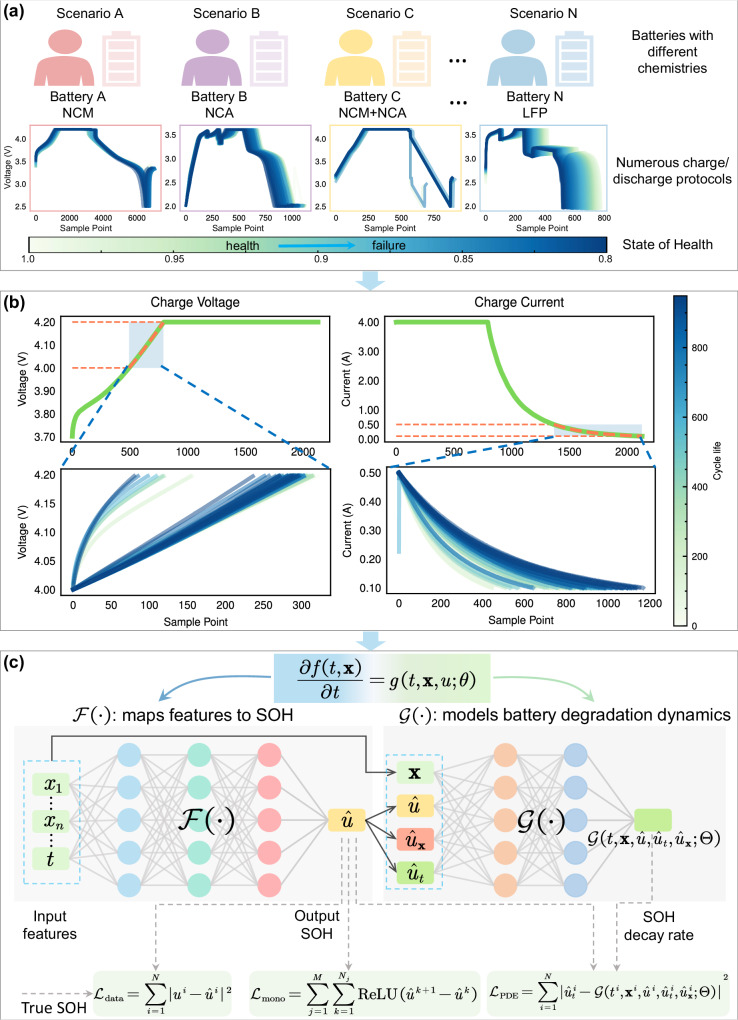
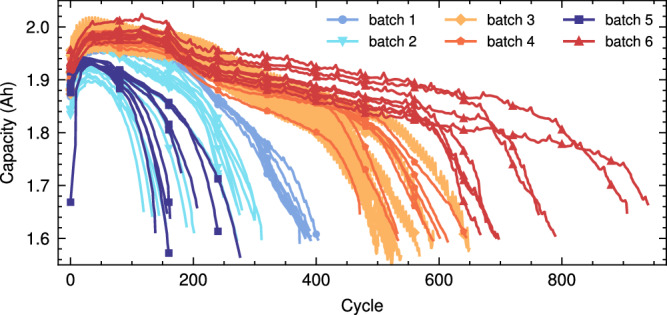
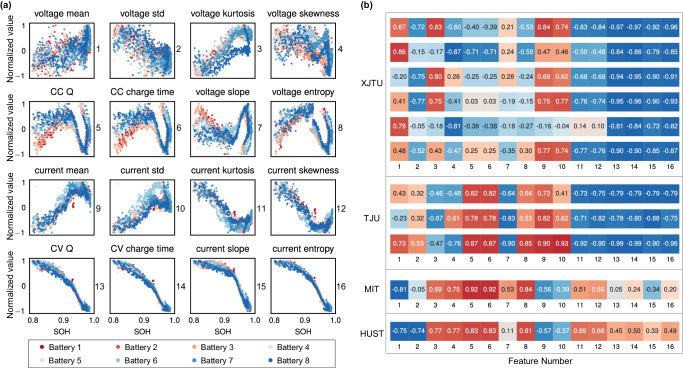
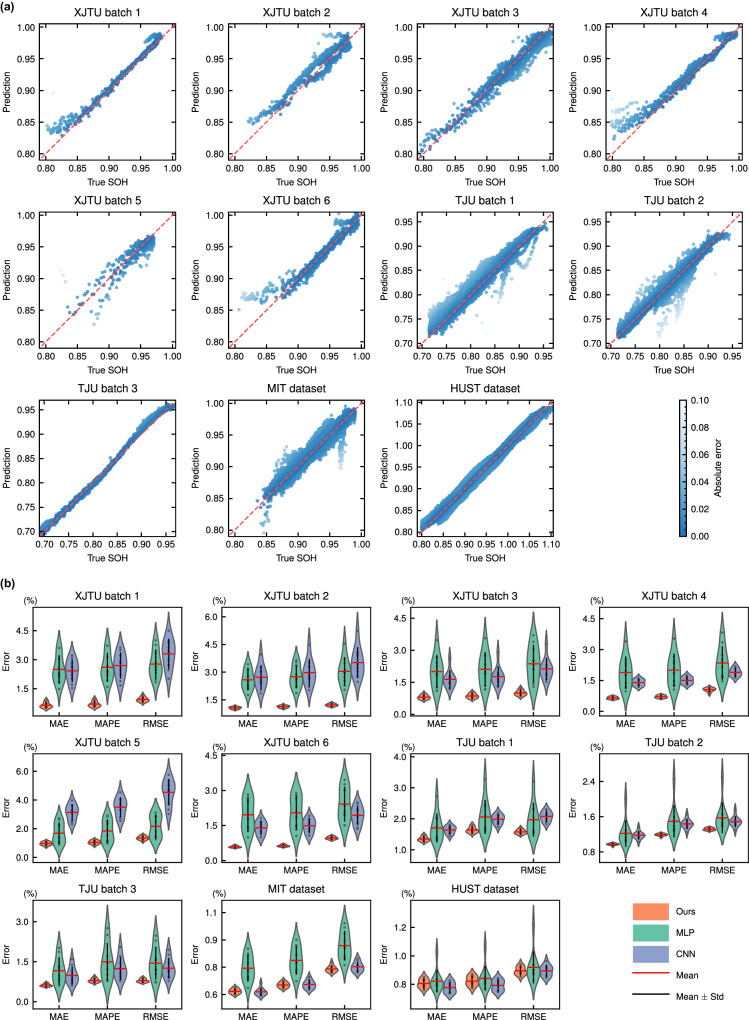
Accurate state-of-health (SOH) estimation is critical for reliable and safe operation of lithium-ion batteries. However, reliable and stable battery SOH estimation remains challenging due to diverse battery types and operating conditions. In this paper, we propose a physics-informed neural network (PINN) for accurate and stable estimation of battery SOH. Specifically, we model the attributes that affect the battery degradation from the perspective of empirical degradation and state space equations, and utilize neural networks to capture battery degradation dynamics. A general feature extraction method is designed to extract statistical features from a short period of data before the battery is fully charged, enabling our method applicable to different battery types and charge/discharge protocols. Additionally, we generate a comprehensive dataset consisting of 55 lithium-nickel-cobalt-manganese-oxide (NCM) batteries. Combined with three other datasets from different manufacturers, we use a total of 387 batteries with 310,705 samples to validate our method. The mean absolute percentage error (MAPE) is 0.87%. Our proposed PINN has demonstrated remarkable performance in regular experiments, small sample experiments, and transfer experiments when compared to alternative neural networks. This study highlights the promise of physics-informed machine learning for battery degradation modeling and SOH estimation.
Overview
The claims and statistics of this paper haven’t been checked yet.
Free: it reads the open-access text and checks the first 5 claims that cite a source we can check. Create a free account to check every claim.
Integrity signals
Registry
Cites
Statistics
Figures
Verification
Claims the paper makes
The claims and statistics of this paper haven’t been checked yet.
Free: it reads the open-access text and checks the first 5 claims that cite a source we can check. Create a free account to check every claim.
Claims other papers make about this one
Each is checked against this paper’s own text: does it say what the citing paper says it does?
The cited source says what the claim attributes to it.
In the citing paper
“Battery aging is a complex, multi-factor process involving the loss of active materials, lithium-ion depletion, increased internal resistance, and changes in the solid electrolyte interphase (SEI) layer [17-23]”
From The State of Health Estimation of Lithium-Ion Batteries: A Review of Health Indicators, Estimation Methods, Development Trends and Challenges (2025) · cites this paper as [17]
Self-check
Percentages, sums and reported differences re-computed from the paper’s own numbers.
The self-check needs the paper’s full text.
Citations
Cites
Raissi, M., Perdikaris, P., & Karniadakis, G. E. (2019) · Journal of Computational Physics · doi:10.1016/j.jcp.2018.10.045 · Cited by 20,384 · cited 2×
“Inspired by 54,55 , we propose to use a more generalized function approximator g 0 ð(cid:2)Þ with parameters θ 0 to represent the non-linear dynamics g ( ⋅ ).”
Physics-informed machine learning
Karniadakis, G. E., Kevrekidis, I. G., Lu, L., Perdikaris, P., Wang, S., & Yang, L. (2021) · Nature Reviews Physics · doi:10.1038/s42254-021-00314-5 · Cited by 8,718 · cited 2×
“The promising prospect of physics-informed neural network (PINN) 36,37 lies in amalgamating the strengths of physics-based and data-driven approaches, potentially addressing the aforementioned challenges.”
Recycling lithium-ion batteries from electric vehicles
Harper, G., Sommerville, R., Kendrick, E., Driscoll, L., Slater, P., Stolkin, R., Walton, A., Christensen, P., Heidrich, O., Lambert, S., et al. (2019) · Nature · doi:10.1038/s41586-019-1682-5 · Cited by 3,890 · cited 1×
“With the advantages of high energy density, low self-discharge rate, and long service life 1 , lithium-ion batteries have become the main energy storage devices in portable electronic devices, electric vehicles, aero-space, and many other fi elds 2 – 8 .”
Performance and cost of materials for lithium-based rechargeable automotive batteries
Schmuch, R., Wagner, R., Hörpel, G., Placke, T., & Winter, M. (2018) · Nature Energy · doi:10.1038/s41560-018-0107-2 · Cited by 3,233 · cited 1×
“With the advantages of high energy density, low self-discharge rate, and long service life 1 , lithium-ion batteries have become the main energy storage devices in portable electronic devices, electric vehicles, aero-space, and many other fi elds 2 – 8 .”
Data-driven prediction of battery cycle life before capacity degradation
Severson, K. A., Attia, P. M., Jin, N., Perkins, N., Jiang, B., Yang, Z., Chen, M. H., Aykol, M., Herring, P. K., Fraggedakis, D., et al. (2019) · Nature Energy · doi:10.1038/s41560-019-0356-8 · Cited by 3,228 · cited 3×
“For convenience, we refer to the four datasets as the XJTU battery dataset, TJU dataset 44 , HUST dataset 45 , and MIT dataset 25 .”
Simulation and Optimization of the Dual Lithium Ion Insertion Cell
Fuller, T. F., Doyle, M., & Newman, J. (1994) · Journal of The Electrochemical Society · doi:10.1149/1.2054684 · Cited by 2,057 · cited 1×
“Physics-based models are stable and accurate, but batteries with different chemical compositions require different model parameters, and the models have high computational costs 32 .”
Closed-loop optimization of fast-charging protocols for batteries with machine learning
Attia, P. M., Grover, A., Jin, N., Severson, K. A., Markov, T. M., Liao, Y.-H., Chen, M. H., Cheong, B., Perkins, N., Yang, Z., et al. (2020) · Nature · doi:10.1038/s41586-020-1994-5 · Cited by 1,180 · cited 1×
“Given the dif fi culty in establishing physical models and the dif fi - culty in obtaining complete discharge capacity, many studies have used data-driven methods 20 – 24 to estimate SOH based on current and voltage curves during charge and discharge.”
A review of rechargeable batteries for portable electronic devices
Liang, Y., Zhao, C., Yuan, H., Chen, Y., Zhang, W., Huang, J., Yu, D., Liu, Y., Titirici, M., Chueh, Y., et al. (2019) · InfoMat · doi:10.1002/inf2.12000 · Cited by 1,174
Modeling of Lithium-Ion Battery Degradation for Cell Life Assessment
Xu, B., Oudalov, A., Ulbig, A., Andersson, G., & Kirschen, D. S. (2018) · IEEE Transactions on Smart Grid · doi:10.1109/tsg.2016.2578950 · Cited by 1,162
Critical review of state of health estimation methods of Li-ion batteries for real applications
Berecibar, M., Gandiaga, I., Villarreal, I., Omar, N., Van Mierlo, J., & Van den Bossche, P. (2016) · Renewable and Sustainable Energy Reviews · doi:10.1016/j.rser.2015.11.042 · Cited by 1,126 · cited 1×
“In recent years, various SOH estimation methods of lithium-ion batterieshavebeenproposed,whichgreatlyadvancethedevelopment of this fi eld 12 – 15 .”
Research works printed but not linked: 1
- Raissi M Deep hidden physics models: deep learning of nonlinear partial differential equations J. Mach. Learn. Res. 2018 19 932 955
Cited by
Items 701–800 of 1,001
Explainable Agentic AI for Autonomous Battery Health Prediction and Management
J, H. R. A., Priyanka, M., Subhashini, M., Selvan, G. S. R. E., & Ramkumar, M. P. (2026) · International Conference on Networking and Communications (ICNWC) · doi:10.1109/icnwc68145.2026.11518403 · Cited by 1
Zhang, J., Wang, M., Wang, F., Ren, L., & Dai, F. (2026) · International Journal of Mining Science and Technology · doi:10.1016/j.ijmst.2026.05.002
Self-citationChen, Y. N., Yin, A., Wei, Y., Qiao, Z., & Chen, C. (2026) · Computers & Chemical Engineering · doi:10.1016/j.compchemeng.2026.109713
WD-PINN-based remaining life prediction method for dry-type transformers
Dong, Y., Wang, Y., Li, Z., Lei, N., Jiang, H., Wei, W., Li, Y., & Wei, Y. (2026) · Frontiers in Energy Research · doi:10.3389/fenrg.2026.1768075
Le, H. H., & Nguyen, K. A. (2026) · Measurement Science and Technology · doi:10.1088/1361-6501/ae7109
“Author et al”
范琳煊, Li, P. H., Wang, Q., Zhang, J., Wang, S., Liu, Y., & Wan, J. (2026) · Progress in Natural Science Materials International · doi:10.1016/j.pnsc.2026.04.008
Reverse causation: Lithium-ion battery degradation
Okita, T. (2026) · Journal of Power Sources · doi:10.1016/j.jpowsour.2026.240306
Interpretable PINN for SOH Estimation in LFP Batteries
Qaadan, S., Alhendawy, Y., Ahmed, A., Alshare, A., Popp, A., & Schmuelling, B. (2026) · Lecture notes in computer science · doi:10.1007/978-3-032-21480-5_1
Yi, X., Xiao, J., Lei, G., Hu, X., Wu, M., Xu, B., & Ouyang, C. (2026) · IEEE Transactions on Transportation Electrification · doi:10.1109/tte.2026.3697742
Zhang, Y., Xie, J., Wang, R., Wang, C., Xie, Q., Xu, D., Yu, D., & Wang, N. (2026) · Journal of The Electrochemical Society · doi:10.1149/1945-7111/ae764a
Sun, J., Xu, Y., & Kainz, J. (2026) · Journal of Materials Chemistry A · doi:10.1039/d6ta03434a
Accurate Battery Lifetime Estimation for Electric Vehicle Using Machine Learning Models
Rayhan, A., Bushra, Z. I., Siddique, M. A., Sohag, M. S. H., Mansur, A. A., Rahman, M. M., & Ali, A. B. M. S. (2026) · Advances in intelligent systems research/Advances in Intelligent Systems Research · doi:10.2991/978-94-6239-664-7_93
Li, S., Liao, C., Wang, L., & Wang, L. (2026) · Reliability Engineering & System Safety · doi:10.1016/j.ress.2026.112875
Hu, J., Wang, X., Wang, Z., & Deng, K. (2026) · Ionics · doi:10.1007/s11581-026-07240-5
“The central architecture introduces physical constraints of the system into the neural network training process, thereby leveraging the complementary strengths of both physics-based and data-driven models [153].”
Gao, J., Wang, P., Wang, X., Duan, W., Yue, Y., Yang, X., Miao, Z., & Cui, X. (2026) · Electrochimica Acta · doi:10.1016/j.electacta.2026.149318
Deep Recurrent Framework for Accurate Estimation of SOC and SOH in Lithium-Ion Battery
Harinarayanan, J., & Balamurugan, P. (2026) · IEEE Access · doi:10.1109/access.2026.3702303
“Physics-informed machine learning has gained traction in various scientific domains, demonstrating that incorporating domain knowledge can significantly improve model performance and generalization [12], [13], [14], [15], [16], [17], [18], [19].”
Tan, Y., Ma, C., Bao, Y., & Qi, Y. (2026) · IEEE Transactions on Transportation Electrification · doi:10.1109/tte.2026.3702546
“Furthermore, Wang et al. [37] proposed a physics-informed neural network (PINN), in which the degradation is reformulated as a partial di ff erential equation by empirical degradation and state-space equations.”
Electrochemical-mechanical-thermal modeling for lithium-ion batteries
Mei, W., Cheng, Z., She, C., Liu, C., Sun, J., & Wang, Q. (2026) · The Innovation · doi:10.1016/j.xinn.2026.101472 · Cited by 5
“196 By incorporating physical constraints, these approaches facilitate a 16 (C) The morphology of lithium dendrites at different temperatures.”
Liu, T., Li, W., Li, Z. K., & Wu, S. (2026) · Applied Energy · doi:10.1016/j.apenergy.2026.128211 · Cited by 1
Survey of energy management systems in hybrid electric vehicles
Boopathi, T., & Raglend, I. J. (2026) · Discover Sustainability · doi:10.1007/s43621-026-03469-2
“Integrating physical constraints and pre-existing knowledge into the learning process enables the creation of models that are more resilient and comprehensible [110, 111].”
Wen, J., Li, D., Quan, Q., Wang, X., Yang, H., Meng, Z., Jiang, Z., Yang, C., Liu, T., Muñoz‐Carpintero, D., et al. (2026) · arXiv (Cornell University) · doi:10.48550/arxiv.2606.16434
Learning battery aging from early electrochemical signals
Du, X., & Meng, J. (2026) · Joule · doi:10.1016/j.joule.2026.102498
Liang, C., Tao, S., Xia, C., Huang, X., Hu, H., Wang, R., Dong, D., Lyu, Z., Zhou, G., & Mo, H. (2026) · Energy & Environmental Science · doi:10.1039/d6ee02209j
Yuga, H., Hariprakash, S. R., Abdallah, A. B., Wang, Z., & Dang, K. N. (2026) · IEEE International Symposium on Circuits and Systems proceedings · doi:10.1109/iscas66217.2026.11562707
“Furthermore, as energy is stored in batteries, their capacity and voltage degrade over time, further reducing the reliability of the power supply [15] (see Figure 1 (b)).”
Li, M., Liu, Y., & Han, Y. (2026) · Chinese Physics B · doi:10.1088/1674-1056/ae8003
Liu, Y., Xia, J., Fan, D., Zhao, F., & Wang, B. (2026) · Energy & Fuels · doi:10.1021/acs.energyfuels.6c01419
Prompt-Driven Fine-Tuning Large Language Model for Multistate Coestimation of Lithium-Ion Batteries
Hou, L., Shang, Y., Qiu, T., Zhang, X. Y., Zhu, Y., & Gu, X. (2026) · IEEE Transactions on Industrial Informatics · doi:10.1109/tii.2025.3631017
“[7]proposedanSOHestimationmethod basedonthecombinationoftheelectrothermalagingcoupling modelandneuralnetwork.”
Li, Y., Xue, C., Zhao, Y., Li, Z. K., Ning, P., & Cao, H. (2026) · Environmental Science & Technology · doi:10.1021/acs.est.6c01670
Simultaneous prediction of three key Li-ion battery indicators through multi-task learning
Gong, M., Choi, Y., Yang, H. M., Ma, S. B., & Seo, D. (2026) · EES batteries. · doi:10.1039/d6eb00066e · Cited by 1
Jin, S., Wang, Z., Li, M., & Deng, Z. (2026) · Small Structures · doi:10.1002/sstr.70446 · Cited by 3
“…with model-predictive control symbolic or surrogate models that distill complex predictors into human-interpretable relationships provide promising avenues, but a broadly applicable framework that combines interpretability, efficiency, and robustness across chemistries has yet to emerge [178].”
Xiong, J., Cheng, X., Zhou, J., Ma, Y. Q., & Zhao, M. (2026) · Reliability Engineering & System Safety · doi:10.1016/j.ress.2026.113079 · Cited by 3
Lithium-Ion Battery SOH Estimation Employing Pre-Trained Regularized BiGRU-Attention Enhanced PINN
Wei, C., Liu, S., Pang, X., Zhu, Y., Yin, C., & Li, H. (2026) · Chinese Control and Decision Conference (CCDC) · doi:10.1109/ccdc69976.2026.11559962
“Challenges include difficulty in balancing loss function weights, insufficient capture of temporal features, overfitting during training, and inadequate suppression of long-term noise, resulting in compromised generalization and real-time performance [10].”
Physically Constrained Dual-Channel Neural Network Framework for MEMS Frequency Prediction
Yang, Z. J., Zhao, W., Liu, Y., Lyu, H., & Gu, Y. (2026) · IEEE Transactions on Semiconductor Manufacturing · doi:10.1109/tsm.2026.3707110
“While physically informed neural networks (PINNs) have shown exceptional data e ffi - ciency and generalization by embedding governing equations [16], [17], [18], [19], their direct application to complex 3D MEMS structures is hindered by the di ffi culty or prohibitive cost of obtaining precise…”
Ren, C., Han, J., Lei, Y., & Yang, C. (2026) · IEEE Transactions on Industrial Informatics · doi:10.1109/tii.2026.3700271
“In many practical processes, governing equations involve multiphysics coupling, complex boundary conditions, and numerous hard-to-identify parameters, making precise physical constraints difficult to obtain [25], [26].”
Shu, W., Wang, X., Zhuang, X., & Yu, T. (2026) · Engineering Failure Analysis · doi:10.1016/j.engfailanal.2026.111187
Chen, C., Deng, L., Li, H., & Zhou, J. (2026) · Batteries · doi:10.3390/batteries12070232
“The positive R 2 values therefore provide a stricter baseline for generalization, while the remaining cross-chemistry gap indicates where physics-informed constraints, domain adaptation, or target-domain calibration may be beneficial [33,34].”
A Physics- Informed Neural Network Framework for State-of-Health Estimation of Lithium-Ion Batteries
Fu, Y., Wu, H., & Li, Y. (2026) · IEEE International Electrical and Energy Conference (CIEEC) · doi:10.1109/cieec69682.2026.11571989
“This study utilizes the MIT battery dataset for model validation [21].”
Recent Advances in Physics-Informed Machine Learning for Lithium-Ion Battery Hybrid Modeling
Sui, X., He, S., Qin, P., Eidnes, S., Raynaud, X., & Ding, L. (2026) · IEEE International Electrical and Energy Conference (CIEEC) · doi:10.1109/cieec69682.2026.11572529
Deep Reinforcement Learning for Adaptive Start-Stop Battery Management Using Digital Twin Simulation
Flutur, G., Chindriș, G., Miclea, L. C., & Stan, O. P. (2026) · IEEE International Conference on Automation, Quality and Testing, Robotics (AQTR) · doi:10.1109/aqtr70159.2026.11577950
“Data-driven SOH estimation has shifted toward deep learning: physics-informed networks [16], cross-domain transfer [17], attention-CNN/LSTM fusion [18], [19], and fleet-scale estimation [20].”
Multi-feature group-wise gated fusion for state-of-health estimation of lithium-ion batteries
Zhang, Z. N., Wang, W. W., Liu, X., Zheng, X., Wang, M., & Xu, L. (2026) · Journal of Energy Storage · doi:10.1016/j.est.2026.123323
Bisht, P., Shrivastava, V., & Kumar, R. (2026) · DMPedia Lecture Notes in Multidisciplinary Research · doi:10.65890/dmp.lnmr.impact26.103
“Recent work also quantifies communication-delay impacts in hierarchical schemes and proposes mitigation via local learning at the edge to preserve coordination under 200–400 ms link latencies [20],[21].”
Interactive Data-driven and Model-driven Fault Prediction Method for Spaceborne Solid-state Drives
LIANG, J., Lei, S. O. N. G., Wang, Y., Yonghua, M. A., Wu, P., Hongfei, W. A. N. G., & Lili, G. U. O. (2026) · Manned Spaceflight · doi:10.3724/zrht.1674-5825.2026062
Cross-Modal Time-Series–Text Contrastive Pretraining for Few-Shot Battery SOH Estimation
Fan, Z., Guo, Y., Gui, X., Du, J., Song, 吕. L., & Li, X. (2026) · International Conference on Computer Supported Cooperative Work in Design (CSCWD) · doi:10.1109/cscwd68734.2026.11581747
“We conduct experiments on two publicly available lithium-ion battery datasets from TJU [17] and XJTU [18], each of which is organized into multiple subsets (batches) with batch-specific charge–discharge protocols.”
Wang, H., Gao, M., & Huang, Q. (2026) · Mechanisms and machine science · doi:10.1007/978-3-032-11165-4_84
Chen, P. C. (2026) · Journal of the Chinese Institute of Engineers · doi:10.1080/02533839.2026.2695050
Shelkes, R. D., Agarwal, A. K., Gautam, J., Garg, R., Katake, S. P., & Thakur, S. (2026) · International Conference on AI, Data Science, Cyber Security and Smart Manufacturing for Sustainable Development (ICADCS) · doi:10.1109/icadcs70036.2026.11583249
Xiong, Z., Wang, X., Qiu, Z., Hu, Z., Song, J., Zhang, H., Shi, H., & Lu, S. (2026) · IEEE Sensors Journal · doi:10.1109/jsen.2026.3709118
“I N MODERN industrial and scientific research fields, the quality and operating status of batteries, as important energy storage units, directly a ff ect the stability and reliability of systems [1], [2], [3].”
Chen, F., Wang, X., Lyu, Y., Jiang, X., Liu, H., & Jin, Y. (2026) · eTransportation · doi:10.1016/j.etran.2026.100621
Cheikh, K., & Boudi, E. M. (2026) · Social Sciences & Humanities Open · doi:10.1016/j.ssaho.2026.103248
Ren, P., Wang, J., Ye, S., Wang, H., & Xie, M. (2026) · Journal of Energy Chemistry · doi:10.1016/j.jechem.2026.06.071
A Novel State of Health Estimation Framework for Lithium Iron Phosphate Batteries in DC Microgrids
Huang, B., Zeng, Y., Zhou, D., Cheng, G., Xiao, Z., Han, X., Zou, J., & Pou, J. (2026) · IEEE International Conference on DC Microgrids · doi:10.1109/icdcm67837.2026.11594536
“Evaluations on a public dataset [19] confirm its superior precision and robust stability over the comparative baseline [20].”
Sun, L., Wang, S., Yu, C., Liu, D., Cheng, L., Shi, H., & Fernandez, C. (2026) · Ionics · doi:10.1007/s11581-026-07337-x
“This limitation not only constrains the broader deployment of online SOC/SOH estimation and lifetime prognostics [23, 24], but also prevents thermal management systems from obtaining sufficient physics-based guidance to formulate optimized control strategies suitable for wide temperature…”
A physics-enhanced multimodal neural network for lithium-ion battery state of health estimation
Yang, Y., & Ling, Q. (2026) · Journal of Energy Storage · doi:10.1016/j.est.2026.123497
A physics-guided multi-scale Mamba network for lithium-ion battery health prediction
Wu, J., Tian, L., & Guo, M. (2026) · Journal of Energy Storage · doi:10.1016/j.est.2026.123471
Wang, S., Zhou, X., Cheng, Y., Li, C., Chen, G., Jiang, T., Li, B., Ye, F., & Sun, X. (2026) · Batteries · doi:10.3390/batteries12070253
“Wang et al. [24] put forward a cross-protocol PINN architecture consisting of two sub-networks.”
Yin, Y., Huang, D., Qin, N., Li, K., Guo, J., & Zhang, X. (2026) · Journal of Energy Storage · doi:10.1016/j.est.2026.123525
Cheikh, K., Boudi, E. M., Rabi, R., & Mokhliss, H. (2026) · Results in Engineering · doi:10.1016/j.rineng.2026.111949
UA-PINN: Uncertainty-Aware Physics-Informed Neural Network for Spacecraft Battery SOH Prediction
Cui, Y., Zhan, Y., Fu, L., & Guo, X. (2026) · IEEE Transactions on Instrumentation and Measurement · doi:10.1109/tim.2026.3712950
“Existing PINN-based battery SOH prediction methods [16] typically embed solid electrolyte interphase (SEI) film growth equations or equivalent circuit models into the loss function to constrain network outputs, thereby improving physical consistency.”
Lévy Jump Nonlocal SPDE and BA-PINN Modeling for Battery Fracture and Thermal-Runaway Warning
Zhu, Y., Xie, Q., & Jia, J. (2026) · Batteries · doi:10.3390/batteries12070249
He, B., & Tian, H. (2026) · ACS Energy Letters · doi:10.1021/acsenergylett.6c01583
Long-horizon battery lifetime prediction using a multiwindow autoregressive framework
Cao, Y., Tian, L., Miao, N., Qi, J., Wang, C., Pang, J., & Zhou, J. (2026) · Journal of Energy Storage · doi:10.1016/j.est.2026.123422
Li, R., Wu, Z., Mao, N., Wei, Z., Su, W., Wang, M., Cui, X., & Zhou, X. (2026) · IEEE Transportation Electrification Conference and Expo · doi:10.1109/iteceats66641.2026.11593080
“These methods show the ability to learn the mapping between external measurement signals (including voltage, current, temperature, and impedance spectra) and the capacity fading behavior, therefore could the dependence on mechanistic assumptions [4], [5].”
Qian, C., Guan, H., Xiao, Y., Wang, L., Ren, Y., Xia, Q., Yang, D., & Wang, Z. (2026) · eTransportation · doi:10.1016/j.etran.2026.100623
Wu, J., He, D., Zhao, M., Jin, Z., Sun, H., & Liang, M. (2026) · Journal of Energy Storage · doi:10.1016/j.est.2026.123507
Vafamand, A., Chellapandi, V. P., Borhan, H., & Shahbakhti, M. (2026) · Measurement · doi:10.1016/j.measurement.2026.122530
Jia, K., & Zhao, L. (2026) · Applied Energy · doi:10.1016/j.apenergy.2026.128357 · Cited by 1
Yao, J., Hu, R. Z., Liang, Y., & Liu, K. (2026) · International Journal of Electrochemical Science · doi:10.1016/j.ijoes.2026.101452
Ren, G. (2026) · International Journal of Information and Communication Technology · doi:10.1504/ijict.2026.155637
An Enhanced Physics-Informed Neural Network for Lithium-Ion Battery State-of-Health Prediction
Huang, B., Zeng, Y., Zhou, D., Xu, C., Han, X., Shen, Z., Zou, J., & Pou, J. (2026) · International Power Electronics Conference (IPEC) · doi:10.23919/ipec-nagasaki2026-ec64663.2026.11597342
“To integrate the strengths of both paradigms, physics-informed neural networks (PINNs) have emerged [19].”
Learning from Fragments: A Time-Ordered Timeslice Representation for Cross-Battery SOH Estimation
Liu, X., Li, S. Y., Gao, S., & Zhang, S. (2026) · Lecture notes in computer science · doi:10.1007/978-981-92-3501-8_11
Mustafa, R., Sander, M., Sturm, A. W., & Henze, R. (2026) · Energy Conversion and Management X · doi:10.1016/j.ecmx.2026.102156 · Cited by 1
Liu, Y., Yang, N., & Yang, Z. (2026) · Green Energy and Intelligent Transportation · doi:10.1016/j.geits.2026.100448
Ke, L., Zhang, X., & Dang, L. (2026) · Energies · doi:10.3390/en19143417
TASoH: An End-to-End TCN-Attention Framework for eVTOL Battery State-of-Health Estimation
Jin, Y. (2026) · International Conference on Image Processing and Artificial Intelligence (ICIPAI) · doi:10.1109/icipai70034.2026.11605624
“More complex frameworks have proposed concurrent estimation of multiple aging parameters using ResNet architectures based on flight data [4] or integrating physics-informed health features to enhance online estimation [5].”
A flexible interface learning framework for collaborative physics-informed neural network
Li, S., Xin, L., Sheng, B., Kong, H., Liu, Y., Peng, J., & Dai, H. (2026) · Computers & Mathematics with Applications · doi:10.1016/j.camwa.2026.07.006
Liu, K., Li, W., Peng, Q., Zhao, C., Zhou, H., Duan, B., Li, X., & Zhang, C. (2026) · Global Energy Interconnection · doi:10.1016/j.gloei.2026.07.001
Xiao, H., Luo, G., Ma, W., Wu, J., Lin, M., Liu, B., & Song, Q. (2026) · Journal of Energy Storage · doi:10.1016/j.est.2026.123818
Chen, J., Gao, Y., Liu, W., Yin, C., Li, K., Zhu, Q., & Tang, H. (2026) · Journal of Energy Storage · doi:10.1016/j.est.2026.123666
Hu, H., & He, K. (2026) · International Conference on Energy Systems and Electrical Power (ICESEP) · doi:10.1109/icesep70386.2026.11607839
“In the battery domain, Wang et al. [10] reported 0.87% MAPE across 387 batteries.”
InfluentialPI-VP: A Physics-Informed Voltage Prediction Network for Electric Bus Batteries
Zhang, C., Wu, Y., Yan, S., & Cai, R. (2026) · International Conference on Energy Systems and Electrical Power (ICESEP) · doi:10.1109/icesep70386.2026.11607935
State of health estimation for lithium-ion batteries using graph-structured micro-voltage segments
Wang, H., Qiao, B., Wang, X., Hu, Z., Zhai, Z., Liu, Y., & Lu, S. (2026) · Journal of Energy Storage · doi:10.1016/j.est.2026.123797
Self-citationBayesian neural networks with physics-based priors for robust battery health assessment
Alcibar, J., Aguirre-Ortuzar, A., Zugasti, E., Kulkarni, C. S., Fernandez, J., & Aizpurua, J. I. (2026) · Scientific Reports · doi:10.1038/s41598-026-63104-y · Cited by 1
Zhang, P., Wang, Q., Zhang, F., & Wang, D. (2026) · IEEE Transactions on Industrial Cyber-Physical Systems · doi:10.1109/ticps.2026.3716614
“However, these methods are mainly data-driven, and their performance is highly dependent on data quality and label reliability [13].”
Capacity Prediction for Lithium-Ion Batteries Using Fragmented Charging Data
Jiang, F., Zhang, Z., Pei, H., Zhang, J., & Si, X. (2026) · IEEE Sensors Journal · doi:10.1109/jsen.2026.3715138
“Validation of the proposed method is performed using lithium-ion battery degradation datasets from NASA Ames Research Center and Xi’an Jiaotong University (XJTU) [38], [39].”
Enguéléguélé, S. J.-L. B. (2026) · Zenodo (CERN European Organization for Nuclear Research) · doi:10.5281/zenodo.21602808
Tian, A., Wang, R., Gong, C., HU, Y., Wang, Y., Tang, S., Wu, T., Chang, C., Lv, L., Li, L., et al. (2026) · Journal of Energy Storage · doi:10.1016/j.est.2026.123793
A PINN-Based Fault Diagnosis Method for Crack Damage in Wind Turbine Blades
Wang, M., Qin, G.-J., & Zhang, X. (2026) · Machines · doi:10.3390/machines14080857
Physics-guided semantic source free adaptation for fast-charging batteries degradation prognosis
Xiao, Y., Zhu, X., Shen, C., Wang, P., Sun, Y., & Xiong, R. (2026) · Applied Energy · doi:10.1016/j.apenergy.2026.128504
Zhang, J., Zhang, P., Zhu, K., Li, J., Li, X., & Wang, Y. (2026) · Expert Systems with Applications · doi:10.1016/j.eswa.2026.133786
Zhang, Y., Zhang, S., Yuan, Y., & Fan, Y. (2026) · Ionics · doi:10.1007/s11581-026-07396-0
“…the proposed framework under both benchmark and transfer settings, three data sources were used in this study: the public Tongji University (TJU) datasett [ 27], the public Xi’an Jiaotong University (XJTU) datase [28 – 30], and an in-house dataset collected using our laboratory platform(Ours).”
Pietrocola, G., Molinara, M., Porpora, F., Gerevini, L., Vitelli, M., & Marrocco, C. (2026) · IEEE International Conference on Smart Computing · doi:10.1109/smartcomp69968.2026.00033
“The feature extraction framework developed in this work takes inspiration from the methodology introduced in [8], which demonstrated that descriptors based on statistical and geometric properties of charging curves can effectively capture the evolution of cell degradation.”
InfluentialFrom Task-Specific AI to Battery Foundation Models
Zhao, J., Cai, M., Li, Y., Tao, S., Burke, A. F., & Harris, S. J. (2026) · Journal of The Electrochemical Society · doi:10.1149/1945-7111/ae9406
Ott, L., Gräber, T., Unterreiner, M., Edelmann, J., & Plöchl, M. (2026) · IEEE Access · doi:10.1109/access.2026.3719349
“These approaches have been applied across domains, including structural health monitoring, battery degradation [28], and bearing prognosis [29].”
Zhang, T., Liu, Z., & Xu, J. (2026) · Energies · doi:10.3390/en19153639
Ma, S., Xu, D., Zhang, C., Xu, F., Liu, S., & Hua, W. (2026) · Journal of Energy Storage · doi:10.1016/j.est.2026.123805
Zhang, K., Xu, N., Hu, Y., Cai, L., Zhang, Y., & Jia, B. (2026) · Integration · doi:10.1016/j.vlsi.2026.102838
A physics-informed neural networks method for remaining useful life prediction of lubricating oil
Du, Y., Chen, S., Shao, T., Hu, K., Wei, H., Zhou, C., & Wang, S. (2026) · Wear · doi:10.1016/j.wear.2026.206931
Zhang, S., Sun, Y.-F., Wang, J., Lu, J., Yan, B. S., Zhao, J.-H., Zhang, B.-W., & Fu, J.-Y. (2026) · Journal of Energy Storage · doi:10.1016/j.est.2026.123943
Life cycle intelligence for solid-state batteries
Chen, Y., Qian, J., Li, Y., Li, L., Xiao, C., Wu, F., & Chen, R. (2026) · Nature Reviews Electrical Engineering · doi:10.1038/s44287-026-00318-2 · Cited by 1
Memristor-based modeling for lithium-ion battery aging under real driving conditions
Wu, X., Chen, L., Lopes, A. M., Peng, Q., & Chai, Y. (2026) · Journal of Power Sources · doi:10.1016/j.jpowsour.2026.241093
Metadata
- Authors
- Wang, F., Zhai, Z., Zhao, Z., Di, Y., & Chen, X.
- Affiliations
- Xi'an Jiaotong University (CN)
- Corresponding author
- Zhao, Zhibin
- Chen, Xuefeng
- Venue
- Nature Communications
- Published
- 2024-05-21
- Volume
- 15
- Issue
- 1
- Pages
- 4332-4332
- ISSN
- 2041-1723 (ISSN-L)
- PMC
- PMC11109204
- OpenAlex
- W4398164319
- Cited by
- 897
- References
- 56
- Citations by year
- 2026: 532 · 2025: 322 · 2024: 43
- FWCI
- 96.71
- Type
- journal article
- Language
- en
- Open access
- gold
- doi.org
- Licence
- cc-by
- creativecommons.org/licenses/by/4.0 (tdm)
- creativecommons.org/licenses/by/4.0 (vor)
- Locations
- Nature Communications (publishedVersion, cc-by)
- PubMed Central (publishedVersion, cc-by)
- PubMed (publishedVersion)
- RePEc: Research Papers in Economics (submittedVersion)
- DOAJ (DOAJ: Directory of Open Access Journals) (submittedVersion, cc-by-sa)
- Funders
- Fundamental Research Funds for the Central Universities
- National Natural Science Foundation of China (52105113, U22B2013)
- China Postdoctoral Science Foundation (2021M692557, 2021TQ0263)
- Topics
- Physical Sciences › Engineering › Automotive Engineering › Battery Modeling and Management
- Physical Sciences › Engineering › Electrical and Electronic Engineering › Advancements in Battery Materials
- Physical Sciences › Engineering › Civil and Structural Engineering › Structural Health Monitoring Techniques
- Keywords
- lithium-ion batteries, state of health estimation, battery degradation modeling, physics-informed neural networks, NCM batteries, statistical feature extraction, transfer learning, small sample learning, battery datasets
About these checks
Registry, retraction, Cites and statistics results are computed, not judged, with one exception: a printed reference that no index lists is read once by a model before it counts as a citation error. Claims are extracted by a model and kept only when their quote appears verbatim in the text; each cited source is then checked, with a model’s help, for whether it says what the claim relies on. Those verdicts can be wrong — read the claim’s quote and the cited source before relying on one.
Statistics and arithmetic are recomputed, not judged.
Confidence bands are shown only for fields calibrated on our annotated test set. None is calibrated yet, so no band is shown.
What counts as a claim ›How we measure confidence ›How we check this ›
Are you an author, or do you see a problem with this page? Request a review
Data sources
Bibliographic data: Semantic Scholar, OpenAlex, Crossref.
Contains information from the Semantic Scholar Academic Graph Datasets, made available under the ODC Attribution License (ODC-BY 1.0).
Semantic Scholar’s data is described in: Kinney, R., et al. (2023). The Semantic Scholar Open Data Platform. arXiv:2301.10140.
