

Physics-informed neural network for lithium-ion battery degradation stable modeling and prognosis
Open accessThe DOI matches its Crossref record; 55 of the 56 references it cites were found in a registry or an index.
Abstract
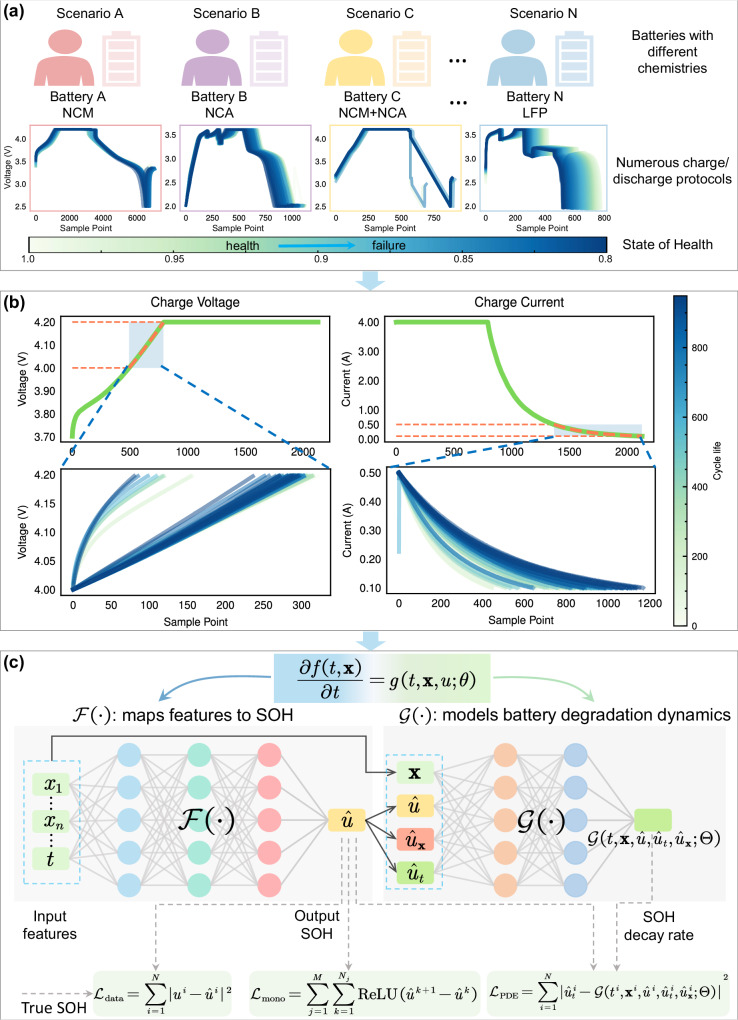
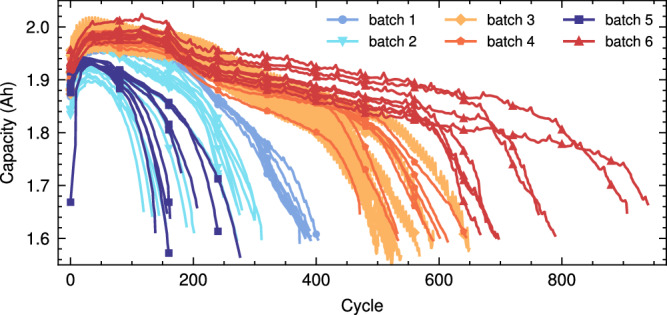
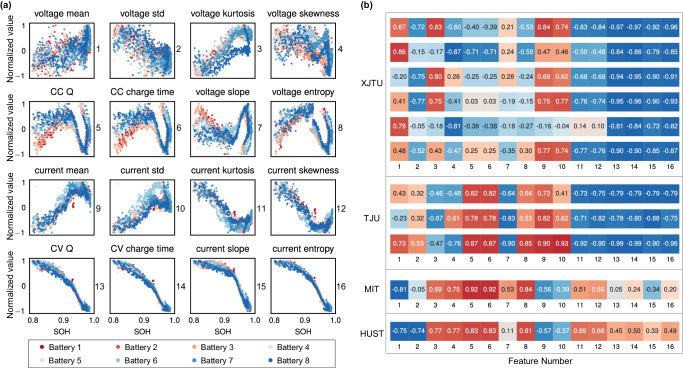
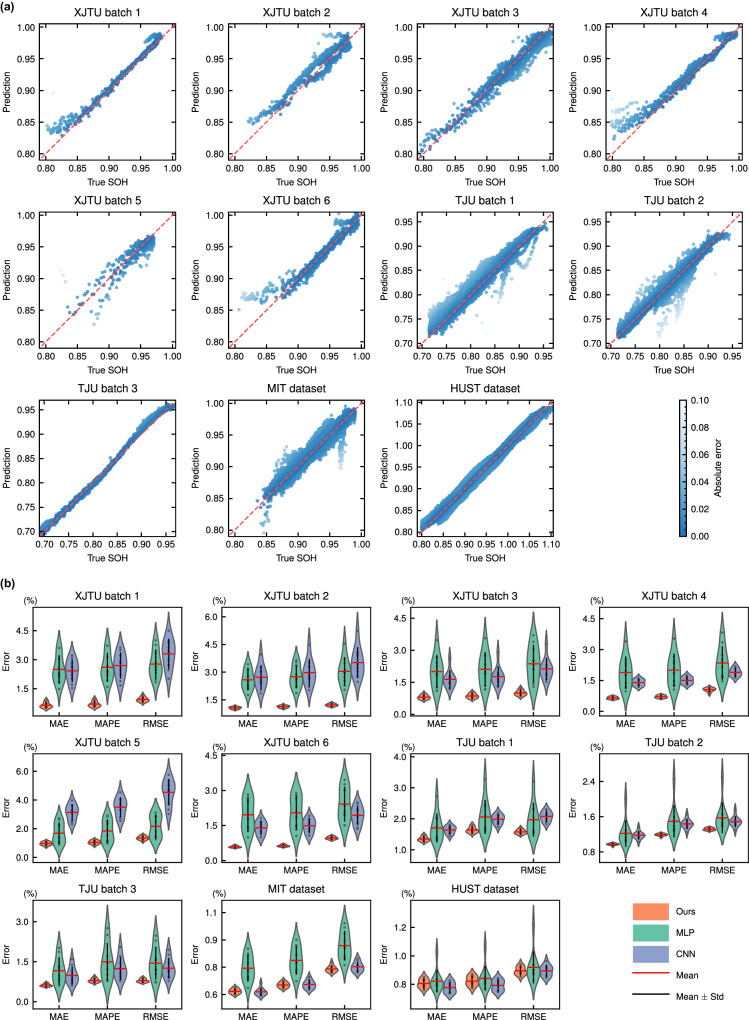
Accurate state-of-health (SOH) estimation is critical for reliable and safe operation of lithium-ion batteries. However, reliable and stable battery SOH estimation remains challenging due to diverse battery types and operating conditions. In this paper, we propose a physics-informed neural network (PINN) for accurate and stable estimation of battery SOH. Specifically, we model the attributes that affect the battery degradation from the perspective of empirical degradation and state space equations, and utilize neural networks to capture battery degradation dynamics. A general feature extraction method is designed to extract statistical features from a short period of data before the battery is fully charged, enabling our method applicable to different battery types and charge/discharge protocols. Additionally, we generate a comprehensive dataset consisting of 55 lithium-nickel-cobalt-manganese-oxide (NCM) batteries. Combined with three other datasets from different manufacturers, we use a total of 387 batteries with 310,705 samples to validate our method. The mean absolute percentage error (MAPE) is 0.87%. Our proposed PINN has demonstrated remarkable performance in regular experiments, small sample experiments, and transfer experiments when compared to alternative neural networks. This study highlights the promise of physics-informed machine learning for battery degradation modeling and SOH estimation.
Overview
The claims and statistics of this paper haven’t been checked yet.
Free: it reads the open-access text and checks the first 5 claims that cite a source we can check. Create a free account to check every claim.
Integrity signals
Registry
Cites
Statistics
Figures
Verification
Claims the paper makes
The claims and statistics of this paper haven’t been checked yet.
Free: it reads the open-access text and checks the first 5 claims that cite a source we can check. Create a free account to check every claim.
Claims other papers make about this one
Each is checked against this paper’s own text: does it say what the citing paper says it does?
The cited source says what the claim attributes to it.
In the citing paper
“Battery aging is a complex, multi-factor process involving the loss of active materials, lithium-ion depletion, increased internal resistance, and changes in the solid electrolyte interphase (SEI) layer [17-23]”
From The State of Health Estimation of Lithium-Ion Batteries: A Review of Health Indicators, Estimation Methods, Development Trends and Challenges (2025) · cites this paper as [17]
Self-check
Percentages, sums and reported differences re-computed from the paper’s own numbers.
The self-check needs the paper’s full text.
Citations
Cites
Raissi, M., Perdikaris, P., & Karniadakis, G. E. (2019) · Journal of Computational Physics · doi:10.1016/j.jcp.2018.10.045 · Cited by 20,384 · cited 2×
“Inspired by 54,55 , we propose to use a more generalized function approximator g 0 ð(cid:2)Þ with parameters θ 0 to represent the non-linear dynamics g ( ⋅ ).”
Physics-informed machine learning
Karniadakis, G. E., Kevrekidis, I. G., Lu, L., Perdikaris, P., Wang, S., & Yang, L. (2021) · Nature Reviews Physics · doi:10.1038/s42254-021-00314-5 · Cited by 8,718 · cited 2×
“The promising prospect of physics-informed neural network (PINN) 36,37 lies in amalgamating the strengths of physics-based and data-driven approaches, potentially addressing the aforementioned challenges.”
Recycling lithium-ion batteries from electric vehicles
Harper, G., Sommerville, R., Kendrick, E., Driscoll, L., Slater, P., Stolkin, R., Walton, A., Christensen, P., Heidrich, O., Lambert, S., et al. (2019) · Nature · doi:10.1038/s41586-019-1682-5 · Cited by 3,890 · cited 1×
“With the advantages of high energy density, low self-discharge rate, and long service life 1 , lithium-ion batteries have become the main energy storage devices in portable electronic devices, electric vehicles, aero-space, and many other fi elds 2 – 8 .”
Performance and cost of materials for lithium-based rechargeable automotive batteries
Schmuch, R., Wagner, R., Hörpel, G., Placke, T., & Winter, M. (2018) · Nature Energy · doi:10.1038/s41560-018-0107-2 · Cited by 3,233 · cited 1×
“With the advantages of high energy density, low self-discharge rate, and long service life 1 , lithium-ion batteries have become the main energy storage devices in portable electronic devices, electric vehicles, aero-space, and many other fi elds 2 – 8 .”
Data-driven prediction of battery cycle life before capacity degradation
Severson, K. A., Attia, P. M., Jin, N., Perkins, N., Jiang, B., Yang, Z., Chen, M. H., Aykol, M., Herring, P. K., Fraggedakis, D., et al. (2019) · Nature Energy · doi:10.1038/s41560-019-0356-8 · Cited by 3,228 · cited 3×
“For convenience, we refer to the four datasets as the XJTU battery dataset, TJU dataset 44 , HUST dataset 45 , and MIT dataset 25 .”
Simulation and Optimization of the Dual Lithium Ion Insertion Cell
Fuller, T. F., Doyle, M., & Newman, J. (1994) · Journal of The Electrochemical Society · doi:10.1149/1.2054684 · Cited by 2,057 · cited 1×
“Physics-based models are stable and accurate, but batteries with different chemical compositions require different model parameters, and the models have high computational costs 32 .”
Closed-loop optimization of fast-charging protocols for batteries with machine learning
Attia, P. M., Grover, A., Jin, N., Severson, K. A., Markov, T. M., Liao, Y.-H., Chen, M. H., Cheong, B., Perkins, N., Yang, Z., et al. (2020) · Nature · doi:10.1038/s41586-020-1994-5 · Cited by 1,180 · cited 1×
“Given the dif fi culty in establishing physical models and the dif fi - culty in obtaining complete discharge capacity, many studies have used data-driven methods 20 – 24 to estimate SOH based on current and voltage curves during charge and discharge.”
A review of rechargeable batteries for portable electronic devices
Liang, Y., Zhao, C., Yuan, H., Chen, Y., Zhang, W., Huang, J., Yu, D., Liu, Y., Titirici, M., Chueh, Y., et al. (2019) · InfoMat · doi:10.1002/inf2.12000 · Cited by 1,174
Modeling of Lithium-Ion Battery Degradation for Cell Life Assessment
Xu, B., Oudalov, A., Ulbig, A., Andersson, G., & Kirschen, D. S. (2018) · IEEE Transactions on Smart Grid · doi:10.1109/tsg.2016.2578950 · Cited by 1,162
Critical review of state of health estimation methods of Li-ion batteries for real applications
Berecibar, M., Gandiaga, I., Villarreal, I., Omar, N., Van Mierlo, J., & Van den Bossche, P. (2016) · Renewable and Sustainable Energy Reviews · doi:10.1016/j.rser.2015.11.042 · Cited by 1,126 · cited 1×
“In recent years, various SOH estimation methods of lithium-ion batterieshavebeenproposed,whichgreatlyadvancethedevelopment of this fi eld 12 – 15 .”
Research works printed but not linked: 1
- Raissi M Deep hidden physics models: deep learning of nonlinear partial differential equations J. Mach. Learn. Res. 2018 19 932 955
Cited by
Items 501–600 of 1,001
The multi-state estimation of lithium-ion batteries based on CNN-LSTM-Transformer hybrid network
Zheng, C., Zhao, H., & Ni, T. (2025) · International Conference on Computer, Big Data and Artificial Intelligence (ICCBD+AI) · doi:10.1109/iccbdai66607.2025.11388613 · Cited by 1
“2) XJTU Dataset: The XJTU dataset is introduced by Wang et al. [20] from Xi’an Jiaotong University, China (XJTU).”
Pang, X., Zhang, X., Guo, Z., Jia, J., Wen, J., Shi, Y., & Zeng, J. (2026) · Engineering Research Express · doi:10.1088/2631-8695/ae43b2 · Cited by 1
SIGS: A Synergistic Information-Guided Sparse Framework for Battery SOH Estimation
Xu, Q., Ma, M., Mo, L., & Jiang, T. (2026) · IEEE Transactions on Instrumentation and Measurement · doi:10.1109/tim.2026.3670521 · Cited by 2
“To validate the method’s e ff ectiveness and generalizability, experiments were conducted on four diverse, public lithium-ion battery aging datasets [34], [35], [36].”
Wei, L., Chen, Z., Xu, H., Liu, T., Xiang, Y., Tan, X., Li, M., & Fan, Y. (2026) · IEEE Transactions on Industrial Electronics · doi:10.1109/tie.2026.3665973 · Cited by 4
“Wang et al. [22] pro-pose a PINN that combines empirical degradation models, state-space equations, and neural networks to estimate battery SOH accurately and robustly using statistical features.”
Xian, J., Luo, S., Shang, X., Luo, M., & Yu, C. (2026) · Engineering Applications of Artificial Intelligence · doi:10.1016/j.engappai.2026.114411 · Cited by 1
Calibration‐free physics‐informed neural networks for adaptive state inference in bioprocesses
Jiang, Q., Lu, Y., Wang, G., Pan, C., Jiang, Q., & Zhong, W. (2026) · AIChE Journal · doi:10.1002/aic.70284 · Cited by 1
Xie, S., Dong, G., Chen, H., & Lou, Y. (2026) · Cell Reports Physical Science · doi:10.1016/j.xcrp.2026.103154 · Cited by 4
Changepoint detection as a light data-driven approach to battery state-of-health prediction
Hamed, H., Reis, A. C., Choobar, B. G., Pang, Q., Killick, R., & Safari, M. (2026) · Cell Reports Physical Science · doi:10.1016/j.xcrp.2026.103157 · Cited by 2
Multi-task learning in battery lifecycle management: From lab to field
Zhang, Y., zheng, J., Pei, H., Zhang, Q., Guo, D., & Han, X. (2026) · Energy storage materials · doi:10.1016/j.ensm.2026.105049 · Cited by 1
Cheikh, K., Boudi, E. M., Rabi, R., & Mokhliss, H. (2026) · Modelling and Simulation in Engineering · doi:10.1155/mse/9227235 · Cited by 1
Ma, C., Wang, L., Wu, J., Liu, C., Wang, L., & Liao, C. (2026) · Energies · doi:10.3390/en19061506 · Cited by 1
Boza, A. B., Montero-Jiménez, J. J., & Vingerhoeds, R. A. (2026) · doi:10.1109/ieeeconf67861.2026.11440915 · Cited by 1
“We use an open source model [10], corresponding to a B2 architecture within the framework proposed by Aykol et al. [19], which estimates SOH using a composite loss function: Here, L data is the mean squared error against true SOH, L mono enforces the physical principle of irreversible degradation…”
Remaining useful life prediction of lithium-ion batteries based on the IDP–BO–ITE framework
Gu, Y., Zhang, W., & Gu, F. (2026) · Physica Scripta · doi:10.1088/1402-4896/ae57de · Cited by 1
Zhu, J., Chen, C., Li, D. H., Han, J., Zhang, Z., & Wang, C. (2025) · International Conference on Clean Energy Storage and Power Engineering (CESPE) · doi:10.1109/cespe68033.2025.00064 · Cited by 1
“Therefore, accurately estimating the battery's state of health (SOH) has emerged as the key challenge on modern battery monitoring and control systems directly impacting battery life prediction and operational safety [2].”
Multiphysics-Embedded Co-Optimization of Data Centers and Energy Storage Systems
Chen, Y., Wan, M., Pan, L., Song, J., Yan, Y., Hong, Q., Booth, C. D., Wang, Z., & Wang, J. (2026) · IEEE Transactions on Industry Applications · doi:10.1109/tia.2026.3676947 · Cited by 4
“…data generation and transfer learning [26]; physics-informed neural networks (PINN) incorporate ,enhancinggeneralizationacrossbatterychemistries [27];priorknowledge-basedneuralnetworks(PKNN)combined withMarkovchainsimproveSOHestimationaccuracyvia…”
Cao, Y., Zhang, X., Liao, Y., Wang, B.-C., & Wang, C. (2026) · IEEE Transactions on Transportation Electrification · doi:10.1109/tte.2026.3679579 · Cited by 1
“The primary dataset originates from proprietary degradation experiments conducted for this research, supplemented by three benchmark public datasets: the MIT dataset (Severson et al. [13]), the TJU dataset (Zhu et al. [14]), and the XJTU dataset (Wang et al. [24]).”
InfluentialWang, K., Jia, T., Wang, M., Bao, C., Li, H., Yang, H., Cen, K., Yan, J., & Bo, Z. (2026) · Journal of Energy Storage · doi:10.1016/j.est.2026.122024 · Cited by 1
He, S., Lin, Z., Yu, B., Gao, X., Long, B., & Yao, J. (2026) · Langmuir · doi:10.1021/acs.langmuir.5c04905 · Cited by 1
Yang, J., Wang, C., Xia, W., Jin, A.-L., Zhu, C., & Zhang, X. (2026) · Journal of Energy Storage · doi:10.1016/j.est.2026.121864 · Cited by 1
Huang, K., Li, M., Guo, Y., & Zhang, X. (2026) · Journal of Energy Storage · doi:10.1016/j.est.2026.122091 · Cited by 1
Karthikeyan, M., & Sugirtha, T. (2026) · Ionics · doi:10.1007/s11581-026-07116-8 · Cited by 1
Yu, G., Cui, Y., Guo, S., Shan, R., Liu, Y., Zhao, L., Wang, Y., Li, J., & Wang, Z.-B. (2026) · Journal of Energy Storage · doi:10.1016/j.est.2026.124487 · Cited by 1
Wang, P., Cheng, L., & Zhou, H. (2026) · Measurement Science and Technology · doi:10.1088/1361-6501/ae5fc0 · Cited by 1
Xiong, J., 夏敏磊, Xu, S., Ding, P., Pan, H., Gao, Q., Guo, W., & Min, Y. (2026) · Ionics · doi:10.1007/s11581-025-06832-x · Cited by 1
Shi, Q., Xu, M., Li, J. J., Zhang, N., Liu, S., Wang, R., Xu, C., He, X., Li, H., Zhou, M., et al. (2026) · Energy storage materials · doi:10.1016/j.ensm.2026.105124 · Cited by 3
Adaptive Neural Network Optimization of Vehicle Start-Stop Systems Using Digital Twin Framework
Flutur, G., Stan, O. P., Chindriș, G., & Miclea, L. C. (2026) · IEEE Latin American Test Symposium (LATS) · doi:10.1109/lats70329.2026.11480359 · Cited by 1
“For context, Wang et al. [8] report 0.87% MAPE for lithium-ion cells with larger computational budgets, while Huang et al. [14] achieve 2.83% MAPE across 300 EVs.”
InfluentialAccurate SOH estimation of lithium-ion batteries based on multimodal fusion features and GECA-CNN
Du, Q., He, F., Yang, G., Zhu, B., Chen, S., Wu, X., Li, Y., Yu, G., & Zhao, Y. (2026) · Measurement · doi:10.1016/j.measurement.2026.121554 · Cited by 2
Wang, N., Zhao, X., Zhou, X., Zhang, W., & Zhao, J. (2026) · National Science Open · doi:10.1360/nso/20250072 · Cited by 1
“Wang et al. [141] proposed a battery aging modeling method based on Physics-Informed Neural Network (PINN), which regards the aging process of lithium-ion batteries as a physical evolution process affected by both time and operating conditions.”
Ren, J., Li, M., Wang, Y., Xin, Y., Yuan, Y., Ye, G., Xu, G., Liu, Y., & Li, Y. Q. (2026) · IEEE Internet of Things Journal · doi:10.1109/jiot.2026.3686511 · Cited by 2
“First, in the temporal dimension, the accumulation of irreversible electrochemical reactions causes a time-varying drift in battery system characteristics [14], [15].”
Zhuang, L., Ma, Y., Wang, J., Pan, R., & Xu, A. (2026) · ENGINEERING Management · doi:10.1007/s42524-026-5388-8 · Cited by 1
Chen, Z., Chen, Z., Zhao, R., Deng, S., Yue, K., He, G., Zhang, X., & Li, W. (2026) · IEEE Sensors Journal · doi:10.1109/jsen.2026.3684923 · Cited by 1
“Its reliability has always been a focus of attention inside and outside the industry, and lithium battery state-of-health (SOH) is one of the important bases for battery management system (BMS) to regulate charging and discharging strategies and issue maintenance recommendations [2], [3], [4].”
Trang, T. T., & Tam, T. N. (2026) · Journal of Energy Storage · doi:10.1016/j.est.2026.124451 · Cited by 1
Zakharov, A., Volovich, V., & Makarov, I. (2026) · IEEE Open Journal of the Industrial Electronics Society · doi:10.1109/ojies.2026.3688098 · Cited by 1
“Physics-informed neural networks have been explored for this purpose [34], but such hybrid models typically rely on electrochemical parameters in the governing equations and are often difficult to train.”
Zhao, J., Zhou, Y., Yuan, Y., Dou, W., Liang, Y., Song, J., & Fan, Y. (2026) · Ionics · doi:10.1007/s11581-026-07150-6 · Cited by 1
Shang, J., Zhao, C., Gao, L., Qiu, H., Jiang, C., & Zio, E. (2026) · Reliability Engineering & System Safety · doi:10.1016/j.ress.2026.112803 · Cited by 1
Xiao, J., Wang, Y., Wang, S., Soo, Y., & Chen, Z. (2026) · IEEE Transactions on Industrial Electronics · doi:10.1109/tie.2026.3682394 · Cited by 3
“To ensure a fair comparison with existing work, our train-test splits for the public benchmark datasets adhere to the methodology established in prior literature [17].”
InfluentialSmall-data machine learning for resolving degradation challenges in energy devices
Cheng, S., Cui, X., Ramesh, H. N., Chueh, W. C., & Sun, S. (2026) · APL Machine Learning · doi:10.1063/5.0330655 · Cited by 1
Physics-informed machine learning for spectrum prediction in phosphorescent OLEDs
Lee, H., Cho, H. S., Na, H., Jeong, K., Park, S. H., Kwon, K., Jang, M., Cho, E. H., Yoo, S., Koo, H., et al. (2026) · npj Computational Materials · doi:10.1038/s41524-026-02078-x · Cited by 1
“Inparticular,PINNshaveshownconsistentperformance across fl uid dynamics, quantum systems, and materials applications by coupling observational data with the governing equations 32 – 36 .”
Wang, C., Wang, C., Wang, W., Cao, Y., & Luo, B. (2026) · Measurement Science and Technology · doi:10.1088/1361-6501/ae6939 · Cited by 1
“The second dataset is from XJTU battery data [32], which includes 6 experimental batches.”
Fang, T., Li, Z., Zhu, X., & Liu, Y. (2026) · Journal of Marine Science and Engineering · doi:10.3390/jmse14100873 · Cited by 1
Liu, Y., Zhou, P., Wang, H., Qin, Z., Wu, J., Zhou, W., Luo, G., Song, Q., & Li, X. (2026) · Data Mining and Knowledge Discovery · doi:10.1007/s10618-026-01204-z · Cited by 2
Jeon, S., Lee, J., & Heo, S. (2026) · Applied Energy · doi:10.1016/j.apenergy.2026.128036 · Cited by 1
AI-enabled cross-scale modeling and parameter transfer for lithium-ion batteries
Hu, Y., Xie, Y., Zhao, L., Zhu, X., Meng, W., Zhu, Z., Chen, X., Qiu, J., Ming, H., & Zhang, H. (2026) · Energy storage materials · doi:10.1016/j.ensm.2026.105222 · Cited by 2
Self-citationSun, Y., Li, Z. L., Tang, J., Wang, Z., Dong, J., & Wang, J. V. (2026) · Batteries · doi:10.3390/batteries12050176 · Cited by 1
“To bridge the gap between these two approaches, physics-informed machine learning (PIML) has gained widespread attention in recent years [15,16].”
Jiang, M., Wang, M., Liu, M., Gao, F., & Su, Y. (2026) · eTransportation · doi:10.1016/j.etran.2026.100606 · Cited by 3
Li, S., Xie, Y., Zhang, S., Zhu, X., Meng, W., Qiu, J., Ming, H., & Zhao, L. (2026) · Journal of Energy Storage · doi:10.1016/j.est.2026.122720 · Cited by 1
Machine learning is rewiring Li-ion battery RUL prediction: A systematic review and outlook
Tu, K., Yuan, W., Wu, X., Zhang, X., & Liu, Q. (2026) · Journal of Energy Chemistry · doi:10.1016/j.jechem.2026.05.023 · Cited by 2
Zhang, X., Shang, Y., Zhu, Y., Li, X., & Che, Y. (2026) · Nano Energy · doi:10.1016/j.nanoen.2026.112063 · Cited by 2
Physics-Informed Spatiotemporal Modeling for UAV Battery SOH Estimation under High-Rate Cycling
Zhang, Y., wu, H., & Liang, Y. (2026) · Journal of The Electrochemical Society · doi:10.1149/1945-7111/ae7646 · Cited by 1
Local balance for energy-based physics-informed neural networks on phase-field models
Shang, L., Zhang, Y., & Wang, J. (2026) · International Journal of Mechanical Sciences · doi:10.1016/j.ijmecsci.2026.111790 · Cited by 1
AI for battery-accelerated discovery of high-voltage electrolytes for advanced lithium batteries
Zhan, Y. Z., Chen, N., Li, L., Wu, F., & Chen, R. (2026) · Chemical Society Reviews · doi:10.1039/d4cs01250j · Cited by 1
Jiang, Q., & Tang, M. (2026) · Systems and Soft Computing · doi:10.1016/j.sasc.2026.200520 · Cited by 1
Physics-guided deep learning for health estimation and prediction of lithium-ion batteries
Lu, J., Li, Y., Guo, M., Dong, H., Wei, W., & Wang, K. (2026) · Journal of Energy Storage · doi:10.1016/j.est.2026.123232 · Cited by 1
Liu, Z., Liu, H., Lu, F., Liu, Y., Pan, G., & Xiao, Y. (2026) · Journal of Energy Storage · doi:10.1016/j.est.2026.123208 · Cited by 1
Li, S., Sun, Y., Zhang, F., Zhang, Z., Han, Y. L., Xiang, W., Gui, G., & Lin, Y. (2026) · IEEE Transactions on Cognitive Communications and Networking · doi:10.1109/tccn.2026.3705813 · Cited by 1
“The evolved parameters θ i → j j are computed via: Inspired by [19], we define a Physics-Informed Neural Network (PINN) H for modeling the evolution of the spectrum prediction model parameters: where dθ t dt represents the derivation of spectrum prediction model parameters with respect to t , and h…”
Jiang, Y., Hou, J., Li, P., Ren, W., Wang, Z., & Hu, C. (2026) · Expert Systems with Applications · doi:10.1016/j.eswa.2026.133425 · Cited by 1
A practical prediction framework for lithium battery health considering non-monotonic regeneration
Wang, S. K., Hu, J., & Zeng, L. (2026) · Journal of Energy Storage · doi:10.1016/j.est.2026.123279 · Cited by 2
Xu, W. (2026) · Measurement Science and Technology · doi:10.1088/1361-6501/ae83d4 · Cited by 1
“Wang et al [27] constructed HFs such as cumulative charge, curve slope, and curve entropy from voltage–current data at the cut-off voltage during the charging stage.”
Rifat, R. A., Chandesris, M., Martin, A., Tran, C. C. H., Bouvet, J., He, J., Berecibar, M., & Hosen, M. S. (2026) · IEEE Open Journal of Vehicular Technology · doi:10.1109/ojvt.2026.3710383 · Cited by 1
“Recent advancements highlight that embedding fundamental degradation physics into fast-executing architectures is essential for reliable battery prognosis [12], strongly validating the PIROL framework’s strategy of coupling micro-scale physics with a real-time BMS feasible model.”
Deep learning-based error compensation for high-precision CNC machining
Song, L., & Gao, G. (2026) · Array · doi:10.1016/j.array.2026.101074 · Cited by 1
A voltage-aligned physically anchored encoding framework for battery capacity estimation
Kong, J., Wang, X., Ma, S., Zhang, S., Wang, D., & Zhen, D. (2026) · Journal of Energy Storage · doi:10.1016/j.est.2026.123403 · Cited by 1
罗兴安, Zhang, Y., Yu, Y., & Liu, W. (2026) · Nano-Micro Letters · doi:10.1007/s40820-026-02275-9 · Cited by 1
“…embedding electrochemical and thermodynamic prior knowledge into data-driven models, which not only enhances generalization capabilities but also provides interpretability to the detection results, allowing for fault pre-simulation and strategy validation in a virtual environment [122–124].”
Lithium-ion battery state-of-health estimation for fragmented charging segments in real-world fleets
Wang, Z., Jiang, J., Song, Y., Wu, D., Liang, F., Li, Y., & Wang, W. (2026) · Applied Energy · doi:10.1016/j.apenergy.2026.128377 · Cited by 1
Miah, M., Song, T., Annis, J. W., Jarvis, A., Driscoll, E. H., Driscoll, L. L., Cornelio, J., Attidekou, P. S., Kendrick, E., Allan, P. K., et al. (2026) · Dalton Transactions · doi:10.1039/d6dt00556j · Cited by 1
A Hybrid Framework of VMD-KPCA and PLO-PINN for Lithium-Ion Battery SOH Estimation
Yang, Z., Dong, Q., Dong, R., & Liu, G. (2026) · World Electric Vehicle Journal · doi:10.3390/wevj17070368 · Cited by 1
Zhang, X., Zhang, B., Wang, S., Kang, H., Huang, S., Ouyang, X., & Ji, Y. (2026) · Applied Energy · doi:10.1016/j.apenergy.2026.128422 · Cited by 1
A coordinate-aware Mamba2 framework for remaining useful life prediction of lithium-ion battery
He, L., Ms, Z., Huang, S., Jing, Z., Wei, W., & Wang, K. (2026) · ENGINEERING Chemical Engineering · doi:10.1007/s11705-026-2687-x · Cited by 1
Battery State of Health Estimation via Federated Learning on Diverse Data from Multiple Sources
Dimitrievska, V., Urgolo, A., Freiberger, M., & Unger, K. (2026) · International Conference on Federated Learning and Intelligent Computing Systems (FLICS) · doi:10.1109/flics70075.2026.11621953 · Cited by 1
“While some approaches [8], [14] use only raw data which are highly influenced by different charging/discharging protocols, others use engineered features [7], [9], [12], [13], [15], [16] which require domain knowledge.”
Sadeq, A. M., Homod, R. Z., Alhasnawi, B. N., Rashid, F. L., Togun, H., Hasan, H. A., Hussein, A. K., & Al-Obaidi, M. A. A. (2026) · Applied Energy · doi:10.1016/j.apenergy.2026.128575 · Cited by 1
Braun, C., Raible, J., & Huber, M. F. (2026) · Journal of Intelligent Manufacturing · doi:10.1007/s10845-026-02930-3 · Cited by 2
Wang, P., Yang, W., & Yang, H. (2026) · Batteries & Supercaps · doi:10.1002/batt.70427 · Cited by 1
Machine learning-assisted health management of retired batteries
Xu, Y., Chen, J., Zeng, T., Peng, W., Guo, R., Tian, J., & Chung, C. Y. (2026) · Journal of Energy Chemistry · doi:10.1016/j.jechem.2026.08.054 · Cited by 1
Benbouhenni, H., & Bizon, N. (2026) · Batteries · doi:10.3390/batteries12090353 · Cited by 1
Djumanov, J. X., & Sobirov, M. A. (2026) · Вестник транспорта - Transport xabarnomasi · doi:10.56143/2181-2438-2026-3-139-147 · Cited by 1
Kim, D., Pyeon, H., Yoon, K., Kim, J., Choi, J., Lee, J., & Han, S. (2026) · Journal of Energy Storage · doi:10.1016/j.est.2026.124865 · Cited by 1
Hasan, A. A., & Koroleva, A. P. (2026) · Computation · doi:10.3390/computation14100242 · Cited by 1
Wang, P., Wang, T., Xu, X., Xiang, J., Zhu, L., Jiang, L., Zhong, Y., & Li, A. (2026) · Batteries · doi:10.3390/batteries12100414 · Cited by 1
Huang, S., Jiao, J., Li, H., & Jing, L. (2026) · Applied Energy · doi:10.1016/j.apenergy.2026.129000 · Cited by 1
Distribution-Aware Chemistry-Informed Reliability Modeling of Lithium-Ion Batteries with RelAI-Net
Qaadan, S., Alshare, A., Alazrai, R., Alkhalaileh, A., Daoud, M. I., Ali, M., Popp, A., & Schmuelling, B. (2025) · Global Power, Energy and Communication Conference · doi:10.1109/gpecom65896.2025.11061985 · Cited by 1
“This gap has raised a growing interest in AI models that are physics-based and distributed, aiming to combine data-driven learning with physically meaningful structures [18]–[20].”
Theory-Guided Seafloor Classification: Joint Acoustic Inversion and Data-Driven Modeling
Zhu, Z., Cui, X., Zhou, J., Yang, F., Zhang, J., & Zhang, G. (2025) · IEEE Transactions on Geoscience and Remote Sensing · doi:10.1109/tgrs.2025.3642313 · Cited by 1
“…(PINNs), a deep learning framework that incorporates physical constraints into the loss function [72], have recently emerged as a cutting-edge methodology in interdisciplinary research and have been extensively reported in leading journals, such as Nature and Science [73], [74], [75], [76].”
Modeling and Control of Battery and Compressed Air Energy Storage Systems
Liu, S., Prasad, J. S., Li, K., & Wang, J. (2025) · Elsevier eBooks · doi:10.1016/b978-0-443-14081-5.00132-x · Cited by 2
Enhanced Battery State of Charge Estimation Using a Physics-Informed Transformer ModelPreprint
Zhao, H., & IZABAYO, I. (2025) · SSRN Electronic Journal · doi:10.2139/ssrn.5262900 · Cited by 1
Ghaderi, E., Bijarchi, M. A., Hannani, S. K., & Boroujerdi, A. N. (2025) · arXiv (Cornell University) · doi:10.48550/arxiv.2510.25925 · Cited by 1
“Recent studies have explored equation discovery using combinations of integer-order derivatives [37-38].”
Evaluating the Exp-Minus-Log Sheffer Operator for Battery CharacterizationPreprint
İpek, E. (2026) · arXiv (Cornell University) · doi:10.48550/arxiv.2604.13873 · Cited by 1
Xu, R., Weng, Q., Cao, Y., Lu, H., & Jiang, P. (2024) · Research Square · doi:10.21203/rs.3.rs-4837236/v1
A Reliable Extrapolative Capacity Estimation Method for Complex Distributed Web Services
Zhou, H., & Kang, R. (2024) · International Conference on Dependable Systems and Their Applications (DSA) · doi:10.1109/dsa63982.2024.00046
“For example, Physics-Informed Neural Networks (PINNs) [18] use physics-based models to improve interpretability and reliability by modifying loss functions to fit differential equations, applied in areas like nuclear reactor modeling [19] and battery RUL prediction [20].”
Lithium-Ion Battery Health Estimation with Incomplete Charging Data and Spiking ResNet
Wang, M., Li, N., Lei, Y., Li, X., & Yang, B. (2024) · Global Reliability and Prognostics and Health Management Conference (PHM) · doi:10.1109/phm-beijing63284.2024.10874651
A Weighted Feature Fusion-Based SOH Assessment for Lithium-Ion Batteries
Xu, J., Zhou, X., Yuan, H., Wang, F., & Zhao, Z. (2024) · International Conference on Sensing, Measurement & Data Analytics in the era of Artificial Intelligence (ICSMD) · doi:10.1109/icsmd64214.2024.10920620
Self-citationLei, X., Xu, Y., Gong, X., & Li, Y. (2026) · Batteries · doi:10.3390/batteries12070251
An Effective Residual Capacity Estimation Method of Batteries Based on Optimal Neural Network
Gu, P., Zhang, Y., Duan, B., & Zhang, C. (2025) · Lecture notes in electrical engineering · doi:10.1007/978-981-96-4675-3_20
He, Y., Hu, R. Z., Jia, Y., Ren, P., Chen, X., & Shi, P. (2025) · International Journal of Electrochemical Science · doi:10.1016/j.ijoes.2025.101102
Self-citationCui, C., Xia, G., Jia, C., & Wen, J. (2025) · World Electric Vehicle Journal · doi:10.3390/wevj16070356
Sahay, R., Park, H., & Raghavan, N. (2025) · IEEE Conference on Prognostics and Health Management · doi:10.1109/icphm65385.2025.11062066
Hou, X., Shang, Y., Wei, C., Zhao, Y., & Lu, Y. (2025) · SSRN Electronic Journal · doi:10.2139/ssrn.5353432
Battery digital twins from the bottom up: Molecular precision at system scale
Zhu, Q., & Zou, C. (2025) · Matter · doi:10.1016/j.matt.2025.102352
NLINEX: A hybrid loss function for artificial neural network optimisation in neuroimaging
Islam, S. (2026) · Intelligence-Based Medicine · doi:10.36227/techrxiv.175459638.83475015/v1
Shen, Y., Lai, X., Qian, L., Guo, D., Li, Z., Li, T., Liu, S., Sun, K., Han, X., Zheng, Y., et al. (2026) · Engineering Applications of Artificial Intelligence · doi:10.1016/j.engappai.2026.114772
Li, C., Cheng, J., Zhu, H., Wen, B., Cai, X., Zhao, X., & Kang, W. (2025) · SSRN Electronic Journal · doi:10.2139/ssrn.5388248
Foundation Model for Degradation Process Prediction of Rotating MachineryPreprint
Liu, X., Li, T., Chen, Z., Zhang, Z., Zhang, J., & Si, X. (2025) · SSRN Electronic Journal · doi:10.2139/ssrn.5397401
Zhao, D., Chen, M., Lin, W., Li, X., Xue, H., Song, W., & Feng, Z. (2025) · IEEE International Electrical and Energy Conference (CIEEC) · doi:10.1109/cieec64805.2025.11116435
Metadata
- Authors
- Wang, F., Zhai, Z., Zhao, Z., Di, Y., & Chen, X.
- Affiliations
- Xi'an Jiaotong University (CN)
- Corresponding author
- Zhao, Zhibin
- Chen, Xuefeng
- Venue
- Nature Communications
- Published
- 2024-05-21
- Volume
- 15
- Issue
- 1
- Pages
- 4332-4332
- ISSN
- 2041-1723 (ISSN-L)
- PMC
- PMC11109204
- OpenAlex
- W4398164319
- Cited by
- 897
- References
- 56
- Citations by year
- 2026: 532 · 2025: 322 · 2024: 43
- FWCI
- 96.71
- Type
- journal article
- Language
- en
- Open access
- gold
- doi.org
- Licence
- cc-by
- creativecommons.org/licenses/by/4.0 (tdm)
- creativecommons.org/licenses/by/4.0 (vor)
- Locations
- Nature Communications (publishedVersion, cc-by)
- PubMed Central (publishedVersion, cc-by)
- PubMed (publishedVersion)
- RePEc: Research Papers in Economics (submittedVersion)
- DOAJ (DOAJ: Directory of Open Access Journals) (submittedVersion, cc-by-sa)
- Funders
- Fundamental Research Funds for the Central Universities
- National Natural Science Foundation of China (52105113, U22B2013)
- China Postdoctoral Science Foundation (2021M692557, 2021TQ0263)
- Topics
- Physical Sciences › Engineering › Automotive Engineering › Battery Modeling and Management
- Physical Sciences › Engineering › Electrical and Electronic Engineering › Advancements in Battery Materials
- Physical Sciences › Engineering › Civil and Structural Engineering › Structural Health Monitoring Techniques
- Keywords
- lithium-ion batteries, state of health estimation, battery degradation modeling, physics-informed neural networks, NCM batteries, statistical feature extraction, transfer learning, small sample learning, battery datasets
About these checks
Registry, retraction, Cites and statistics results are computed, not judged, with one exception: a printed reference that no index lists is read once by a model before it counts as a citation error. Claims are extracted by a model and kept only when their quote appears verbatim in the text; each cited source is then checked, with a model’s help, for whether it says what the claim relies on. Those verdicts can be wrong — read the claim’s quote and the cited source before relying on one.
Statistics and arithmetic are recomputed, not judged.
Confidence bands are shown only for fields calibrated on our annotated test set. None is calibrated yet, so no band is shown.
What counts as a claim ›How we measure confidence ›How we check this ›
Are you an author, or do you see a problem with this page? Request a review
Data sources
Bibliographic data: Semantic Scholar, OpenAlex, Crossref.
Contains information from the Semantic Scholar Academic Graph Datasets, made available under the ODC Attribution License (ODC-BY 1.0).
Semantic Scholar’s data is described in: Kinney, R., et al. (2023). The Semantic Scholar Open Data Platform. arXiv:2301.10140.
