

Physics-informed neural network for lithium-ion battery degradation stable modeling and prognosis
Open accessThe DOI matches its Crossref record; 55 of the 56 references it cites were found in a registry or an index.
Abstract
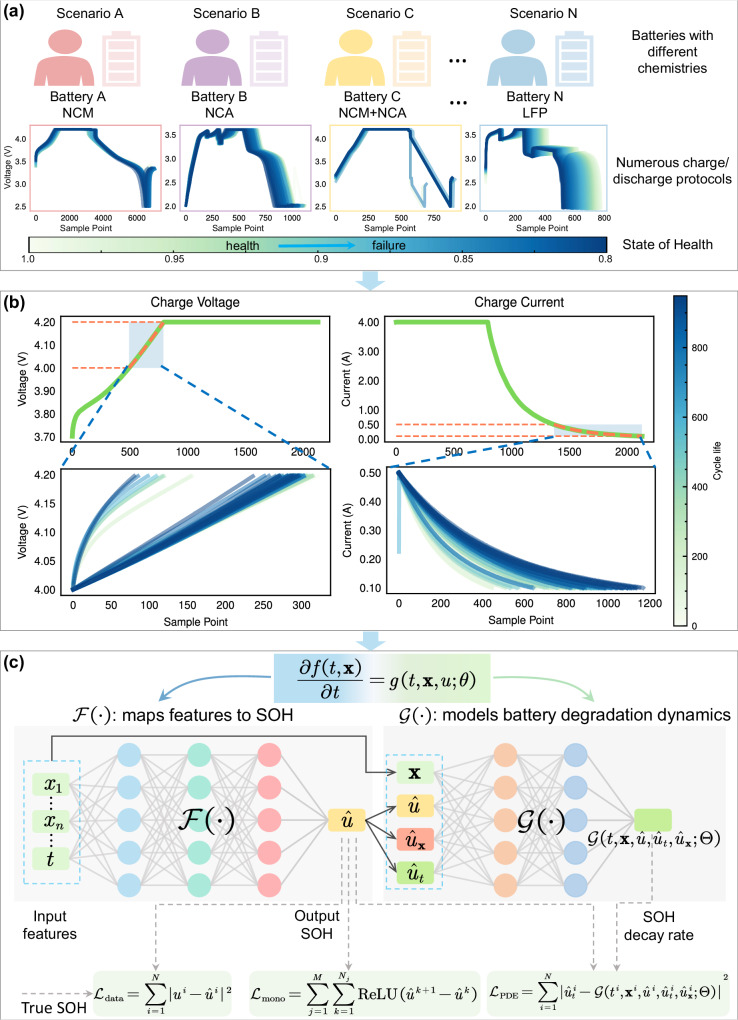
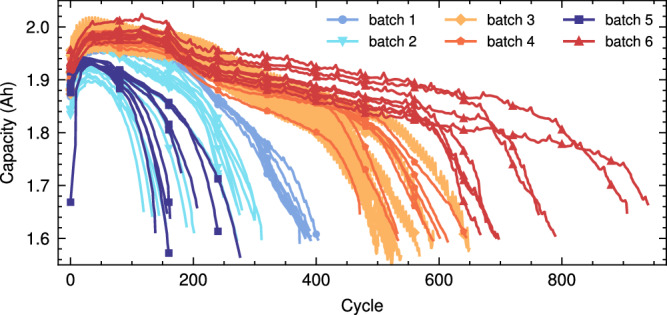
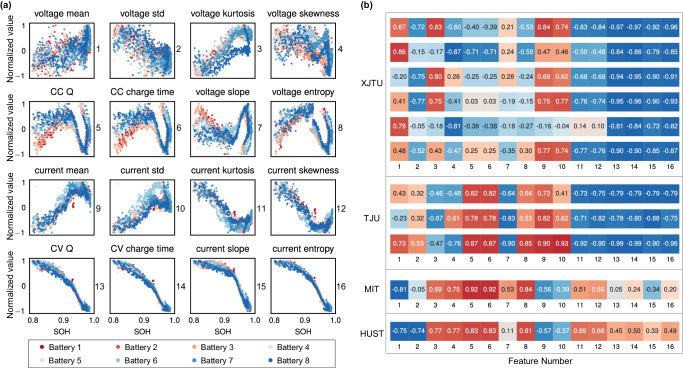
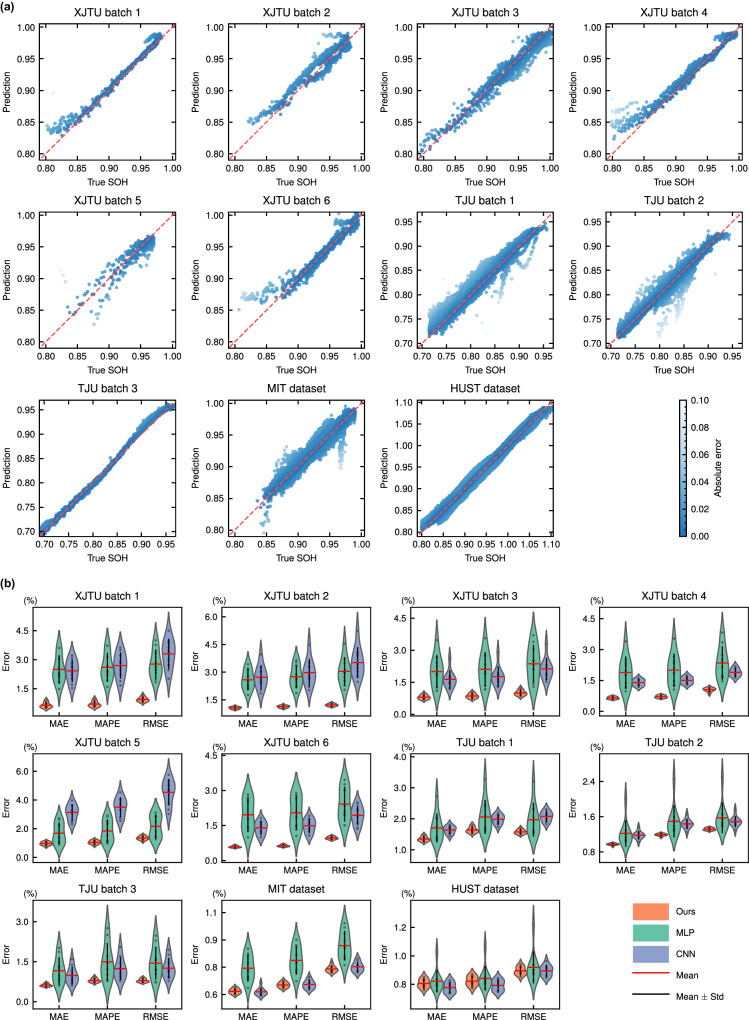
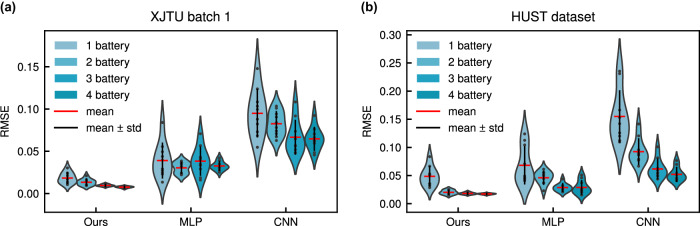
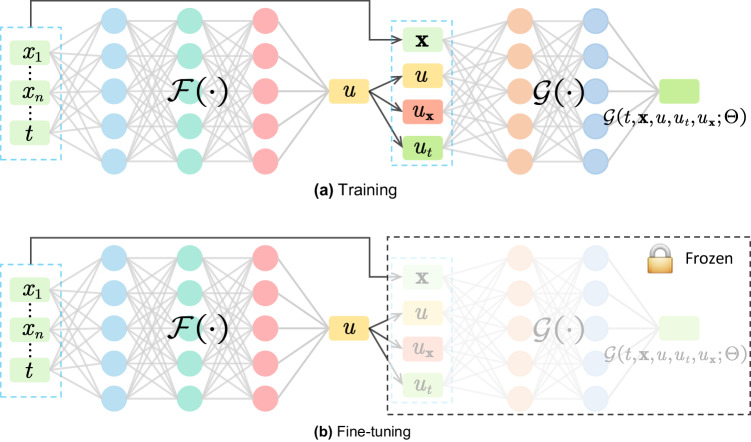
Accurate state-of-health (SOH) estimation is critical for reliable and safe operation of lithium-ion batteries. However, reliable and stable battery SOH estimation remains challenging due to diverse battery types and operating conditions. In this paper, we propose a physics-informed neural network (PINN) for accurate and stable estimation of battery SOH. Specifically, we model the attributes that affect the battery degradation from the perspective of empirical degradation and state space equations, and utilize neural networks to capture battery degradation dynamics. A general feature extraction method is designed to extract statistical features from a short period of data before the battery is fully charged, enabling our method applicable to different battery types and charge/discharge protocols. Additionally, we generate a comprehensive dataset consisting of 55 lithium-nickel-cobalt-manganese-oxide (NCM) batteries. Combined with three other datasets from different manufacturers, we use a total of 387 batteries with 310,705 samples to validate our method. The mean absolute percentage error (MAPE) is 0.87%. Our proposed PINN has demonstrated remarkable performance in regular experiments, small sample experiments, and transfer experiments when compared to alternative neural networks. This study highlights the promise of physics-informed machine learning for battery degradation modeling and SOH estimation.
Overview
The claims and statistics of this paper haven’t been checked yet.
Free: it reads the open-access text and checks the first 5 claims that cite a source we can check. Create a free account to check every claim.
Integrity signals
Registry
Cites
Statistics
Figures
Verification
Claims the paper makes
The claims and statistics of this paper haven’t been checked yet.
Free: it reads the open-access text and checks the first 5 claims that cite a source we can check. Create a free account to check every claim.
Claims other papers make about this one
Each is checked against this paper’s own text: does it say what the citing paper says it does?
The cited source says what the claim attributes to it.
In the citing paper
“Battery aging is a complex, multi-factor process involving the loss of active materials, lithium-ion depletion, increased internal resistance, and changes in the solid electrolyte interphase (SEI) layer [17-23]”
From The State of Health Estimation of Lithium-Ion Batteries: A Review of Health Indicators, Estimation Methods, Development Trends and Challenges (2025) · cites this paper as [17]
Self-check
Percentages, sums and reported differences re-computed from the paper’s own numbers.
The self-check needs the paper’s full text.
Citations
Cites
Raissi, M., Perdikaris, P., & Karniadakis, G. E. (2019) · Journal of Computational Physics · doi:10.1016/j.jcp.2018.10.045 · Cited by 20,384 · cited 2×
“Inspired by 54,55 , we propose to use a more generalized function approximator g 0 ð(cid:2)Þ with parameters θ 0 to represent the non-linear dynamics g ( ⋅ ).”
Physics-informed machine learning
Karniadakis, G. E., Kevrekidis, I. G., Lu, L., Perdikaris, P., Wang, S., & Yang, L. (2021) · Nature Reviews Physics · doi:10.1038/s42254-021-00314-5 · Cited by 8,718 · cited 2×
“The promising prospect of physics-informed neural network (PINN) 36,37 lies in amalgamating the strengths of physics-based and data-driven approaches, potentially addressing the aforementioned challenges.”
Recycling lithium-ion batteries from electric vehicles
Harper, G., Sommerville, R., Kendrick, E., Driscoll, L., Slater, P., Stolkin, R., Walton, A., Christensen, P., Heidrich, O., Lambert, S., et al. (2019) · Nature · doi:10.1038/s41586-019-1682-5 · Cited by 3,890 · cited 1×
“With the advantages of high energy density, low self-discharge rate, and long service life 1 , lithium-ion batteries have become the main energy storage devices in portable electronic devices, electric vehicles, aero-space, and many other fi elds 2 – 8 .”
Performance and cost of materials for lithium-based rechargeable automotive batteries
Schmuch, R., Wagner, R., Hörpel, G., Placke, T., & Winter, M. (2018) · Nature Energy · doi:10.1038/s41560-018-0107-2 · Cited by 3,233 · cited 1×
“With the advantages of high energy density, low self-discharge rate, and long service life 1 , lithium-ion batteries have become the main energy storage devices in portable electronic devices, electric vehicles, aero-space, and many other fi elds 2 – 8 .”
Data-driven prediction of battery cycle life before capacity degradation
Severson, K. A., Attia, P. M., Jin, N., Perkins, N., Jiang, B., Yang, Z., Chen, M. H., Aykol, M., Herring, P. K., Fraggedakis, D., et al. (2019) · Nature Energy · doi:10.1038/s41560-019-0356-8 · Cited by 3,228 · cited 3×
“For convenience, we refer to the four datasets as the XJTU battery dataset, TJU dataset 44 , HUST dataset 45 , and MIT dataset 25 .”
Simulation and Optimization of the Dual Lithium Ion Insertion Cell
Fuller, T. F., Doyle, M., & Newman, J. (1994) · Journal of The Electrochemical Society · doi:10.1149/1.2054684 · Cited by 2,057 · cited 1×
“Physics-based models are stable and accurate, but batteries with different chemical compositions require different model parameters, and the models have high computational costs 32 .”
Closed-loop optimization of fast-charging protocols for batteries with machine learning
Attia, P. M., Grover, A., Jin, N., Severson, K. A., Markov, T. M., Liao, Y.-H., Chen, M. H., Cheong, B., Perkins, N., Yang, Z., et al. (2020) · Nature · doi:10.1038/s41586-020-1994-5 · Cited by 1,180 · cited 1×
“Given the dif fi culty in establishing physical models and the dif fi - culty in obtaining complete discharge capacity, many studies have used data-driven methods 20 – 24 to estimate SOH based on current and voltage curves during charge and discharge.”
A review of rechargeable batteries for portable electronic devices
Liang, Y., Zhao, C., Yuan, H., Chen, Y., Zhang, W., Huang, J., Yu, D., Liu, Y., Titirici, M., Chueh, Y., et al. (2019) · InfoMat · doi:10.1002/inf2.12000 · Cited by 1,174
Modeling of Lithium-Ion Battery Degradation for Cell Life Assessment
Xu, B., Oudalov, A., Ulbig, A., Andersson, G., & Kirschen, D. S. (2018) · IEEE Transactions on Smart Grid · doi:10.1109/tsg.2016.2578950 · Cited by 1,162
Critical review of state of health estimation methods of Li-ion batteries for real applications
Berecibar, M., Gandiaga, I., Villarreal, I., Omar, N., Van Mierlo, J., & Van den Bossche, P. (2016) · Renewable and Sustainable Energy Reviews · doi:10.1016/j.rser.2015.11.042 · Cited by 1,126 · cited 1×
“In recent years, various SOH estimation methods of lithium-ion batterieshavebeenproposed,whichgreatlyadvancethedevelopment of this fi eld 12 – 15 .”
Research works printed but not linked: 1
- Raissi M Deep hidden physics models: deep learning of nonlinear partial differential equations J. Mach. Learn. Res. 2018 19 932 955
Cited by
Items 401–500 of 1,001
Zhou, Z., Li, Y., & Yan, R. (2025) · Journal of Manufacturing Systems · doi:10.1016/j.jmsy.2025.10.002 · Cited by 2
Aliakbari, A., & Masih‐Tehrani, M. (2025) · Energy Conversion and Management X · doi:10.1016/j.ecmx.2025.101341 · Cited by 9
Deep learning model for remaining useful life prediction with reduced labeling data dependency
Chen, J., Wang, Y., Guo, D., Shen, Y., Sun, T., Han, X., Zheng, Y., & Ouyang, M. (2025) · Applied Energy · doi:10.1016/j.apenergy.2025.126885 · Cited by 2
Xu, W., & Yan, D. (2025) · Processes · doi:10.3390/pr13113467 · Cited by 2
A Lightweight Multiscale Signal Learning Framework for Predicting Battery Degradation Trajectory
Shen, Q., Li, J., Nie, J., Bao, Z., & Wang, C. (2025) · IEEE Sensors Journal · doi:10.1109/jsen.2025.3625630 · Cited by 2
“Commonly adopted architectures include convolutional neural networks (CNN) [19], recurrent neural networks (RNN) such as long short-term memory (LSTM) and gated recurrent units (GRU) [20], Transformer-based architectures [21], and physics-informed neural networks (PINN) [22].”
Health evaluation for in-service electric vehicle battery pack with recursive Gaussian process
Liu, H., Zheng, Y., Che, Y., Li, J., Pan, Y., & Hu, X. (2025) · Energy · doi:10.1016/j.energy.2025.139380 · Cited by 2
Chen, S., Wei, C., Han, L., Hou, X., & Guo, L. (2025) · Electrical Engineering · doi:10.1007/s00202-025-03350-x · Cited by 3
Zhou, G., Sun, C., Zeng, X., Wang, Y., Li, Z., & Zhou, Q. (2025) · Journal of Energy Storage · doi:10.1016/j.est.2025.119589 · Cited by 2
Hao, Z., Chu, H., Meng, D., Wang, Y., Gao, B., & Chen, H. (2025) · International Journal of Hydrogen Energy · doi:10.1016/j.ijhydene.2025.153044 · Cited by 2
Tran, K., Trinh, H.-C., Nguyen, R. V., Nguyen-Thoi, T., Nguyen, D.-H., Pham, H. V., & Nguyen, H.-S.-H. (2026) · PLoS ONE · doi:10.2139/ssrn.5565116 · Cited by 2
Multi-frequency excitation enables one-second battery diagnostics across life cycle chain
Tao, S., He, G., & Zou, C. (2025) · Joule · doi:10.1016/j.joule.2025.102230 · Cited by 2
Tong, Z., Su, J., Yang, G., Ali, A., Wang, S., Zhang, J., & Blaabjerg, F. (2025) · IEEE Transactions on Power Electronics · doi:10.1109/tpel.2025.3646695 · Cited by 2
“3) Governing equation embedding methods : For instance, Wang integrated governing equations with neural networks for battery state-of-health prediction [36], demonstrating the notable advantage of PINN in data-limited scenarios.”
Lu, H., Sun, X., Li, G., & Qian, Z. (2025) · Industrial & Engineering Chemistry Research · doi:10.1021/acs.iecr.5c03776 · Cited by 2
Ding, S., Jiang, B., Liang, Y., Fu, L., Qu, C., Wei, X., Xie, H., & Dai, H. (2026) · Energy storage materials · doi:10.1016/j.ensm.2026.104874 · Cited by 2
Hussain, A., & Hussain, T. (2026) · Discover Electronics · doi:10.1007/s44291-025-00152-0 · Cited by 2
“Representative studies include PINN frameworks for PHM and SOH/RUL estimation that incorporate battery dynamics directly into the loss function [52, 56, 58], small-sample SOH estimation where physical constraints mitigate overfitting [9, 12], and generic PINN formulations adaptable to different…”
Chen, W., Sun, X., Han, X., Shen, W., & Xiong, R. (2025) · Chinese Journal of Electrical Engineering · doi:10.23919/cjee.2025.000184 · Cited by 2
Experimental analysis of the effects of aging on impedance dependencies
Rosenmüller, C., Kowal, J., & Bohlen, O. S. (2026) · Future Batteries · doi:10.1016/j.fub.2026.100145 · Cited by 2
Cheikh, K., Boudi, E. M., Rabi, R., & Mokhliss, H. (2025) · Journal Européen des Systèmes Automatisés · doi:10.18280/jesa.581207 · Cited by 2
Dong, X., Wang, Y., Xie, J., & Wu, L. (2026) · Energy · doi:10.1016/j.energy.2026.140203 · Cited by 2
Xu, Y., Zeng, T., Peng, W., Tian, J., Yi, X., Xu, Q., & Zhu, S. (2026) · Energy storage materials · doi:10.1016/j.ensm.2026.104947 · Cited by 2
Pugalenthi, K., Wong, J. C., Yang, Q., Chiu, P.-H., Dao, M. H., Raghavan, N., & Ooi, C. C. (2026) · Journal of Energy Storage · doi:10.1016/j.est.2026.120944 · Cited by 2
“Multiple authors have previously developed physics-informed frameworks with empirical degradation models for predicting state of health and battery management, including across different battery chemistries [29, 30, 31, 32, 33, 34].”
Physics‑Informed LSTM and EKF Fusion for Robust Battery SoC Estimation
Dikmen, I. C., Arı, A., & Karadağ, T. (2026) · Turkish Journal of Science and Technology · doi:10.55525/tjst.1812986 · Cited by 2
Chu, X., Cheng, J., Zhu, H., Li, C., & Wen, B. (2026) · Technologies · doi:10.3390/technologies14020104 · Cited by 2
“[29], which develops a Physical Information Neural Network (PINN) framework to embed device thermo-electrical coupling equations into loss functions for improved extrapolation capability; and ref.”
Physics-informed and interpretable state of health estimation framework for lithium-ion batteries
Liu, L., Huang, J., Peng, B., Li, Y., Wang, P., Wang, X., Zhao, H., & Li, B. (2026) · Journal of Energy Storage · doi:10.1016/j.est.2026.120860 · Cited by 2
Jang, T., Jeong, J., Kwak, E., Yoo, M., Lee, S., & Oh, K. (2026) · Journal of Energy Storage · doi:10.1016/j.est.2026.121117 · Cited by 2
Liu, Z., Zhou, P., Zhang, C., & Liao, Z. (2026) · Journal of Energy Storage · doi:10.1016/j.est.2026.121266 · Cited by 2
Qiu, Y. Y., Wang, Q., Wang, Y., & Chen, Z. (2026) · IEEE Internet of Things Journal · doi:10.1109/jiot.2026.3671742 · Cited by 2
“For lithium-ion battery degradation modeling, a PINN in [183] integrates empirical degradation dynamics and state-space equations to handle sparse cycling data.”
New algorithm for battery knee-onset identification and early prediction of end of life
Garapati, V. K., Huld, F. T., Lee, H., & Lamb, J. J. (2026) · Machine Learning Engineering · doi:10.1088/3049-4761/ae5067 · Cited by 2
“Battery degradation modelling can be approached through physics-based electrochemical methods [7– 9], data-driven techniques utilising machine learning (ML) and deep learning models [10, 11], or hybrid models, such as physics-informed neural networks that combine both methodologies [12–14].”
Zha, Y., Yan, F., Yang, C., & Mao, G. (2026) · Knowledge-Based Systems · doi:10.1016/j.knosys.2026.115785 · Cited by 4
Wang, C., Liu, C., Wu, J., He, X., & Mo, H. (2026) · Journal of Power Sources · doi:10.1016/j.jpowsour.2026.239935 · Cited by 4
Physics-informed neural networks combined with SVR for battery health and charge state diagnostics
Sireesha, K., Deepa, K., Prabhakar, J. R., Mikkilineni, K. K., & Kolhe, M. L. (2026) · Discover Applied Sciences · doi:10.1007/s42452-026-08567-4 · Cited by 3
Wang, C., Yang, Y., Wu, J., He, X., & Mo, H. (2026) · Journal of Energy Storage · doi:10.1016/j.est.2026.121768 · Cited by 2
PIDNN: A Hybrid Intelligent Prediction Model for UAV Battery Degradation
Duan, M., Lu, M., & Jin, H. (2026) · Batteries · doi:10.3390/batteries12040124 · Cited by 2
Guo, Q., Zhang, Y., Grimaccia, F., & Niccolai, A. (2026) · Journal of Energy Storage · doi:10.1016/j.est.2026.122030 · Cited by 2
Liu, J., Wang, Y., & Francesco Ciucci, A. (2026) · ACS Applied Energy Materials · doi:10.1021/acsaem.6c00644 · Cited by 2
Toward Pre-Trained Model-Enabled Intelligent Fault Prognosis for Lithium-Ion Batteries
Liu, C., Li, K., Li, H., & Lyu, B. (2026) · Applied Sciences · doi:10.3390/app16073515 · Cited by 3
GPINND: A deep-learning-based state of health estimation for lithium-ion battery
Lei, Y., & Yu, G. (2026) · Journal of Power Sources · doi:10.1016/j.jpowsour.2026.240053 · Cited by 3
A mesh-free neural approach to fractional diffusion in Li$$^{+}$$-ion battery materials
Kumawat, N., & Bhargava, A. (2026) · Discover Applied Sciences · doi:10.1007/s42452-026-08559-4 · Cited by 2
Wang, S., Huang, W., Lin, Y., Gong, K., Lian, C., & Liu, H. (2026) · Energy & Fuels · doi:10.1021/acs.energyfuels.6c00278 · Cited by 2
Yan, Y., Wang, C., Cao, W., Zhao, D., Wang, B., & Li, N. (2026) · Journal of Energy Chemistry · doi:10.1016/j.jechem.2026.04.015 · Cited by 2
AI for Lithium-ion battery research under data-scarce scenarios
Zhang, J., Zhai, X., Zhang, Q. (., Li, P., Li, M., Wu, K., Yang, L. I. U., & Wan, J. (2026) · The Innovation Materials · doi:10.59717/j.xinn-mater.2026.100209 · Cited by 2
State-of-charge estimation of batteries using parameterized physics-informed neural networks
Jang, Y. S., Kim, Y., & Kim, J. (2026) · Journal of Energy Storage · doi:10.1016/j.est.2026.122235 · Cited by 4
Xu, M., Xing, S., Hong, J., Tian, X., Huang, B., Jin, H., & Li, J. (2026) · Journal of Materials Informatics · doi:10.20517/jmi.2025.80 · Cited by 2
Cheikh, K., & Boudi, E. M. (2026) · Array · doi:10.1016/j.array.2026.100847 · Cited by 2
A Review of Data-Driven Approaches and Datasets for Battery State of Health Estimation
Nyachionjeka, K., & Bayoumi, E. H. E. (2026) · SAE International Journal of Electrified Vehicles · doi:10.4271/14-15-02-0009 · Cited by 5
Zhang, Z., Shang, Y., Zhang, Q., Li, Y., Li, X., & Cheng, Z. (2026) · Green Energy and Intelligent Transportation · doi:10.1016/j.geits.2026.100428 · Cited by 2
Sun, M., Liu, F., Xue, T., Wu, R., Tao, Z., Zhu, J., Zhang, S., & Yan, J. (2026) · Journal of Power Sources · doi:10.1016/j.jpowsour.2026.240366 · Cited by 3
Liang, J., Song, Y., Zhong, H., Hu, T., Du, J., Tao, C., & Zhang, Q. (2026) · Applied Surface Science · doi:10.1016/j.apsusc.2026.167257 · Cited by 2
Battery Health Prognosis Using Physics-Informed Neural Network with Quantum Feature Mapping
Hossain, M. A., Rafy, M. F., Solanki, S. K., & Srivastava, A. K. (2026) · IEEE Texas Power and Energy Conference (TPEC) · doi:10.1109/tpec67884.2026.11513144 · Cited by 2
“To contextualize the performance of QPINN, we compared it against four representative architectures: (i) a standard PINN [4], (ii) a Kolmogorov–Arnold Network–based PINN (PIKAN) [19], (iii) a conventional multilayer perceptron (MLP) [20], and (iv) a convolutional neural network (CNN) [21].”
InfluentialLi, Y., Lin, Q., Fan, Y., Shen, Y., Huang, R., Wang, W., Yan, W. Q., & Zhang, J. (2026) · Energy · doi:10.1016/j.energy.2026.141447 · Cited by 5
Shao, M., Fu, S., Dong, Y., Tao, Y., Wang, Y., & Sun, Y. (2026) · Energy · doi:10.1016/j.energy.2026.141484 · Cited by 2
Chaudhary, V., Saichaemchan, S., Bhadola, P., & Kaushik, A. K. (2026) · Advances in Colloid and Interface Science · doi:10.1016/j.cis.2026.103970 · Cited by 2
AI-driven approaches for navigating battery complexity
Allu, S. G., Hasnain, R., Vos, A., & Flouda, P. (2026) · EES batteries. · doi:10.1039/d6eb00101g · Cited by 2
Dikmen, I. C. (2026) · IEEE Transactions on Transportation Electrification · doi:10.1109/tte.2026.3707653 · Cited by 2
“V nominal) cycled under multiple operating conditions and organized into batch groups [41].”
Chen, J., Qin, N., Pei, F., Zhang, Y., Qiao, Y., Yu, Y., & Huang, Y. (2026) · Energy & Environmental Science · doi:10.1039/d6ee01488g · Cited by 2
Wu, H., Zhang*, Y., & Mu*, D. (2026) · Energy Z · doi:10.20517/energyz.2026.24 · Cited by 2
Nyachionjeka, K., Abd‐Elrady, E., & Bayoumi, E. H. E. (2026) · Batteries · doi:10.3390/batteries12080274 · Cited by 2
An, D. (2024) · Applied Sciences · doi:10.3390/app15010266 · Cited by 2
Bak, G.-M., & Bae, Y.-C. (2025) · Energy and AI · doi:10.1016/j.egyai.2025.100507 · Cited by 2
Prediction of lithium-ion batteries health decline trajectories based on early image features
He, H., Zhang, W., Long, Z., Xie, Y., Zhou, J., & Li, Z. (2025) · Journal of Energy Storage · doi:10.1016/j.est.2025.116820 · Cited by 3
Qaadan, S., Alshare, A., Popp, A., Alazrai, R., Daoud, M. I., Ali, M. Z., & Schmuelling, B. (2025) · Ionics · doi:10.1007/s11581-025-06431-w · Cited by 2
Mu, S., Sun, X., Dong, Z., Yang, H., Liu, Y., Zhang, W., Qu, S. G., Zhao, H., & Zhao, Y. (2025) · Applied Sciences · doi:10.3390/app15116298 · Cited by 2
Capacity Estimation of Lithium-Ion Battery Systems in Fuel Cell Ships Based on Deep Learning Model
Yang, X., Tang, J. L., Song, Q., Liu, Y., Liu, L., Zhou, X., Chen, Y., & Tang, T. (2025) · Journal of Marine Science and Engineering · doi:10.3390/jmse13061168 · Cited by 2
Modeling of Battery Storage of Photovoltaic Power Plants Using Machine Learning Methods
Stanev, R. H., Tanev, T., Efthymiou, V., & Charalambous, C. (2025) · Energies · doi:10.3390/en18123210 · Cited by 3
PyBEP: An Open-Source Tool for Electrode Potential Determination from Battery OCV Measurements
Pišek, J., Katrašnik, T., & Zelič, K. (2025) · Batteries · doi:10.3390/batteries11080295 · Cited by 2
“On the data-driven side, machine learning-based approaches such as PINN4SOH [18] and MambaLithium [19] have emerged for state estimation and health diagnostics.”
Yan, K., Lu, J., Zeng, D., Cheng, L., & Ma, T. (2025) · Journal of Energy Storage · doi:10.1016/j.est.2025.119659 · Cited by 2
Modeling and Forecasting Battery Degradation using Scientific Machine Learning for Sustainability
Murgai, S. (2024) · IEEE MIT Undergraduate Research Technology Conference (URTC) · doi:10.1109/urtc65039.2024.10937563 · Cited by 1
Accelerated development of energy materials through automation and artificial intelligence
Soni, A., Jia, S., Chao, C., & Abate, I. I. (2026) · The Innovation · doi:10.1016/j.xinn.2026.101509 · Cited by 2
Xu, J., & Qian, Q. (2025) · International Conference on Advanced Algorithms and Control Engineering (ICAACE) · doi:10.1109/icaace65325.2025.11019774 · Cited by 1
“…Wen et al. [10] proposed a physics-informed neural network (PINN) approach that incorporates partial differential equations to model battery degradation, while Wang et al. [11] combined state-space equations with data-driven feature extraction to improve adaptability to different battery types.”
Liu, C., Lou, J., Wen, G., Li, G., Wu, R., Liang, X., Yang, C., & Gui, W. (2025) · IEEE China Conference on System Simulation Technology and its Applications (CCSSTA) · doi:10.1109/ieeeconf65522.2025.11137054 · Cited by 1
“The difference between any two adjacent time steps can be expressed as [10], Ideally, ∆ ˆ RUL t = − 1 .”
Robust Physics-Informed Neural Network for State of Health Estimation of Lithium-Ion Battery
Luo, X., & Dong, G. (2025) · IEEE China Conference on System Simulation Technology and its Applications (CCSSTA) · doi:10.1109/ieeeconf65522.2025.11137014 · Cited by 1
“For instance, Wang et al. [10] modeled the attributes that affect the battery degradation from the perspective of empirical degradation and state space equations, and utilized neural networks to capture battery degradation dynamics.”
Hu, H. (2025) · Ionics · doi:10.1007/s11581-025-06682-7 · Cited by 1
“The dataset used in the paper is the open battery data from XJTU Dataset (Batch-2) [52].”
Yu, J., Guo, Y., & Zhang, W. (2025) · Applied Sciences · doi:10.3390/app151810079 · Cited by 1
Saxena, A. K., & Kumar, A. (2025) · Advanced Computing and Communication Technologies for High Performance Applications (ACCTHPA) · doi:10.1109/accthpa65749.2025.11168599 · Cited by 1
“Yan et al. [9] used deep denoising autoencoders (DDA) with regression, while Guo et al. [10] applied recurrent neural networks (RNNs) for feature selection.”
Yang, Z., & Zhang, H. (2025) · Physica Scripta · doi:10.1088/1402-4896/ae03f2 · Cited by 1
Zeng, B., Li, D., Li, Y., Guan, Y., Huang, Y., Chen, Y., & Lai, X. (2025) · International Conference on Control, Robotics and Intelligent System (CCRIS) · doi:10.1109/ccris65764.2025.11192975 · Cited by 1
Physics-Informed Neural Networks for Real-Vehicle Li-ion Battery SOH Estimation
Yang, Y., Sun, Y., Chen, X., Zhuo, S., Wang, S., & Jiang, F. (2025) · Annual Conference of the IEEE Industrial Electronics Society (IECON) · doi:10.1109/iecon58223.2025.11221698 · Cited by 1
“In order to address these challenges, this paper proposes a Physics-Informed Neural Network (PINN)-based methodology for in-vehicle lithium-ion battery pack SOH estimation [11].”
Self-citationNi-MOF@MWCNT core/sheath composites with enhanced lithium storage capacity and cycle stability
Fang, H., Liang, K., Zhang, J., Liu, Q., Liu, L., Zhang, L., Zhang, Z., & Zhang, S. (2025) · Electrochimica Acta · doi:10.1016/j.electacta.2025.147821 · Cited by 1
Li, W., Zhang, W., Xie, Y., Wen, Y., & Yan, Q. (2025) · IEEE Transactions on Transportation Electrification · doi:10.1109/tte.2025.3635187 · Cited by 1
“For instance, Wang et al. [18] introduced a PINN-based approach to degradation prognosis.”
Lin, Y., Guo, S., Ye, M., Qian, W., Chen, H., Chen, Q., & Wu, Z. (2025) · Energies · doi:10.3390/en18236241 · Cited by 2
Li, P., Zheng, Y., Zhang, Y., Hou, J., Xiang, S., & Zhou, J. (2025) · CAA Symposium on Fault Detection, Supervision and Safety for Technical Processes (SAFEPROCESS) · doi:10.1109/safeprocess67117.2025.11268010 · Cited by 1
“We use the PINN [17] and classic LSTM [18] as baseline models, with their network hyperparameters consistent with our PINN.”
Gan, C., Gui, R., Lv, X., Dong, Z., & Gao, M. (2025) · IEEE Transactions on Transportation Electrification · doi:10.1109/tte.2025.3645831 · Cited by 3
“In summary, while deep models achieve high accuracy, challenges such as high labeling cost, poor physical consistency, and limited cross-domain generalization remain [26].”
InfluentialSahu, S., Acharya, S., Dutt, R., & Acharyya, A. (2025) · IEEE Interregional NEWCAS Conference (NEWCAS) · doi:10.1109/newcas64648.2025.11106964 · Cited by 3
Pietrocola, G., Porpora, F., Molinara, M., Gerevini, L., Vitelli, M., Marrocco, C., & Bria, A. (2025) · Lecture notes in computer science · doi:10.1007/978-981-95-4963-4_26 · Cited by 1
Shu, X., Chen, Y., Xue, Q., Guo, F., Chen, Z., & Zhao, H. (2026) · Journal of Energy Storage · doi:10.2139/ssrn.5954615 · Cited by 1
Wang, Z., Zang, T., Ziyu, Y., Zhang, S., Li, G., Liu, X., Wang, Q., & Yuan, S. (2025) · Fundamental Research · doi:10.1016/j.fmre.2025.10.012 · Cited by 1
Learning memristor switching degradation dynamics with neural models
Zhevnenko, D. A., Meshchaninov, F. P., Koryazhkina, M. N., Belov, A. I., Shmakov, V., Gornev, E. S., & Mikhaylov, A. N. (2025) · Chaos Solitons & Fractals · doi:10.1016/j.chaos.2025.117803 · Cited by 1
Data-Driven State-of-Health Estimation by Reconstructing Virtual Full-Charge Segments
Guo, D., Zou, Z., Lai, X., & Zheng, Y. (2025) · Batteries · doi:10.3390/batteries12010010 · Cited by 1
“However, the SOH values reported by onboard BMSs are prone to estimation errors, causing error propagation and limiting the achievable estimation precision of data-driven models [31].”
Physics-informed neural network (PINN) to predict vibrational stability of inorganic semiconductors
Zeb, M. H., & Kabir, M. M. (2026) · Computational Materials Science · doi:10.1016/j.commatsci.2026.115007 · Cited by 1
Dong, W., Xu, X., Shen, J., Xu, Y., Wang, X., & Zhou, F. (2025) · Journal of Energy Storage · doi:10.1016/j.est.2025.120185 · Cited by 1
Xu, H., Yu, T., Feng, E.-L., Zeng, X.-Y., Hu, Y., & Chen, L. (2025) · Journal of Central South University · doi:10.1007/s11771-025-6129-6 · Cited by 1
Machine learning for fuel cell remaining useful life prediction: A review
Allal, Z., Noura, H., Vernier, F., Salman, O., & Chahine, K. (2026) · Energy Conversion and Management X · doi:10.1016/j.ecmx.2026.101597 · Cited by 13
Chen, J., Yin, J., Chen, Z., Zi, Y., Jin, L., & Lv, S. (2026) · IEEE Transactions on Instrumentation and Measurement · doi:10.1109/tim.2026.3654693 · Cited by 1
“For instance, developing physics-informed data-driven methods benefits the improvement of prediction e ffi ciency while reducing the dependence on high-quality data [51], [52].”
Zhang, T., Gao, Z., Chen, R., & Liu, L. (2026) · Reliability Engineering & System Safety · doi:10.1016/j.ress.2026.112291 · Cited by 1
Zhang, Z. K., Shang, Y., Wang, Y., & Li, X. (2026) · IEEE Transactions on Industrial Informatics · doi:10.1109/tii.2026.3654078 · Cited by 1
“These datasets are generated from TJU, HKUST, XJTU, and MIT, with the original data drawn from well-known research papers published in Nature Communications , Advanced Science , and Nature Energy [15], [31], [32], [33].”
TSPINN: Thompson sampling-based adaptive training for physics-informed neural networks
Zhang, F., & Wang, D. (2026) · Statistics and Computing · doi:10.1007/s11222-026-10824-w · Cited by 1
“Following(DongandNi2021; Wang et al. 2024), we employ Fourier feature embeddings to enforce periodic boundary conditions as hard constraints.”
Wang, Y., Yu, H., Ma, T., Wang, J., Zhang, X., & Chen, X. (2026) · IEEE Transactions on Industrial Electronics · doi:10.1109/tie.2026.3654776 · Cited by 1
“Related research includes embedding semiempirical models based on SEI film growth into PINN [14], integrating general features from the perspectives of empirical degradation and state-space equations to develop PINN [15].”
Self-citationAltartouri, H., Qaadan, S., Alazrai, R., & Alshare, A. (2025) · International Conference on Control, Mechatronics and Automation (ICCMA) · doi:10.1109/iccma67641.2025.11369643 · Cited by 1
“The network approximates the physical state evolution as follows [11], [14]: where f θ represents the neural network with parameters θ .”
Stochastic maintenance optimization in additive manufacturing with digital twin integration
Cheikh, K., Boudi, E. M., Rabi, R., & Mokhliss, H. (2026) · The International Journal of Advanced Manufacturing Technology · doi:10.1007/s00170-026-17400-6 · Cited by 1
Adaptive confidence-calibrated semi-supervised ensemble for early-cycle battery lifetime prediction
Bi, J., Fei, Z., & Wang, J. (2026) · Applied Energy · doi:10.1016/j.apenergy.2026.127515 · Cited by 1
Metadata
- Authors
- Wang, F., Zhai, Z., Zhao, Z., Di, Y., & Chen, X.
- Affiliations
- Xi'an Jiaotong University (CN)
- Corresponding author
- Zhao, Zhibin
- Chen, Xuefeng
- Venue
- Nature Communications
- Published
- 2024-05-21
- Volume
- 15
- Issue
- 1
- Pages
- 4332-4332
- ISSN
- 2041-1723 (ISSN-L)
- PMC
- PMC11109204
- OpenAlex
- W4398164319
- Cited by
- 897
- References
- 56
- Citations by year
- 2026: 532 · 2025: 322 · 2024: 43
- FWCI
- 96.71
- Type
- journal article
- Language
- en
- Open access
- gold
- doi.org
- Licence
- cc-by
- creativecommons.org/licenses/by/4.0 (tdm)
- creativecommons.org/licenses/by/4.0 (vor)
- Locations
- Nature Communications (publishedVersion, cc-by)
- PubMed Central (publishedVersion, cc-by)
- PubMed (publishedVersion)
- RePEc: Research Papers in Economics (submittedVersion)
- DOAJ (DOAJ: Directory of Open Access Journals) (submittedVersion, cc-by-sa)
- Funders
- Fundamental Research Funds for the Central Universities
- National Natural Science Foundation of China (52105113, U22B2013)
- China Postdoctoral Science Foundation (2021M692557, 2021TQ0263)
- Topics
- Physical Sciences › Engineering › Automotive Engineering › Battery Modeling and Management
- Physical Sciences › Engineering › Electrical and Electronic Engineering › Advancements in Battery Materials
- Physical Sciences › Engineering › Civil and Structural Engineering › Structural Health Monitoring Techniques
- Keywords
- lithium-ion batteries, state of health estimation, battery degradation modeling, physics-informed neural networks, NCM batteries, statistical feature extraction, transfer learning, small sample learning, battery datasets
About these checks
Registry, retraction, Cites and statistics results are computed, not judged, with one exception: a printed reference that no index lists is read once by a model before it counts as a citation error. Claims are extracted by a model and kept only when their quote appears verbatim in the text; each cited source is then checked, with a model’s help, for whether it says what the claim relies on. Those verdicts can be wrong — read the claim’s quote and the cited source before relying on one.
Statistics and arithmetic are recomputed, not judged.
Confidence bands are shown only for fields calibrated on our annotated test set. None is calibrated yet, so no band is shown.
What counts as a claim ›How we measure confidence ›How we check this ›
Are you an author, or do you see a problem with this page? Request a review
Data sources
Bibliographic data: Semantic Scholar, OpenAlex, Crossref.
Contains information from the Semantic Scholar Academic Graph Datasets, made available under the ODC Attribution License (ODC-BY 1.0).
Semantic Scholar’s data is described in: Kinney, R., et al. (2023). The Semantic Scholar Open Data Platform. arXiv:2301.10140.
