

Physics-informed neural network for lithium-ion battery degradation stable modeling and prognosis
Open accessThe DOI matches its Crossref record; 55 of the 56 references it cites were found in a registry or an index.
Abstract
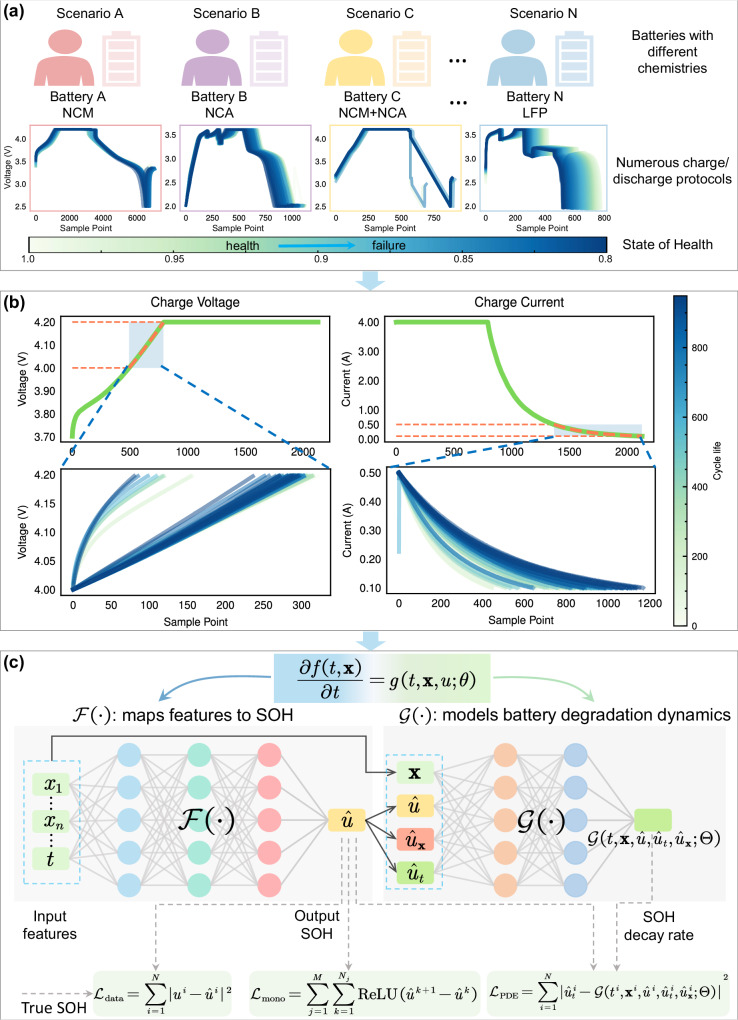
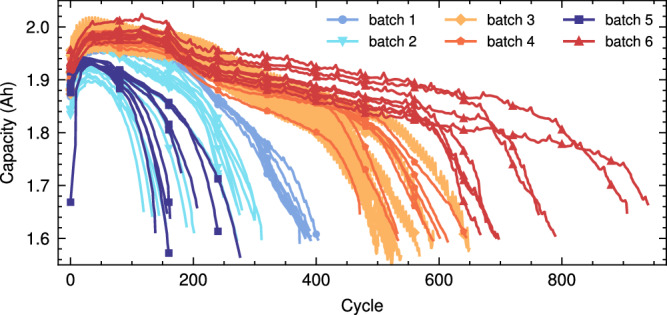
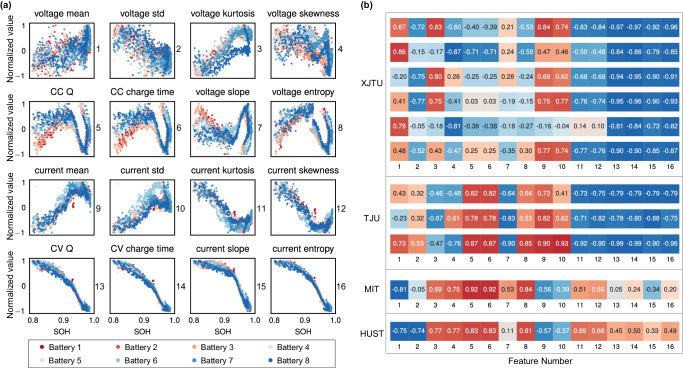
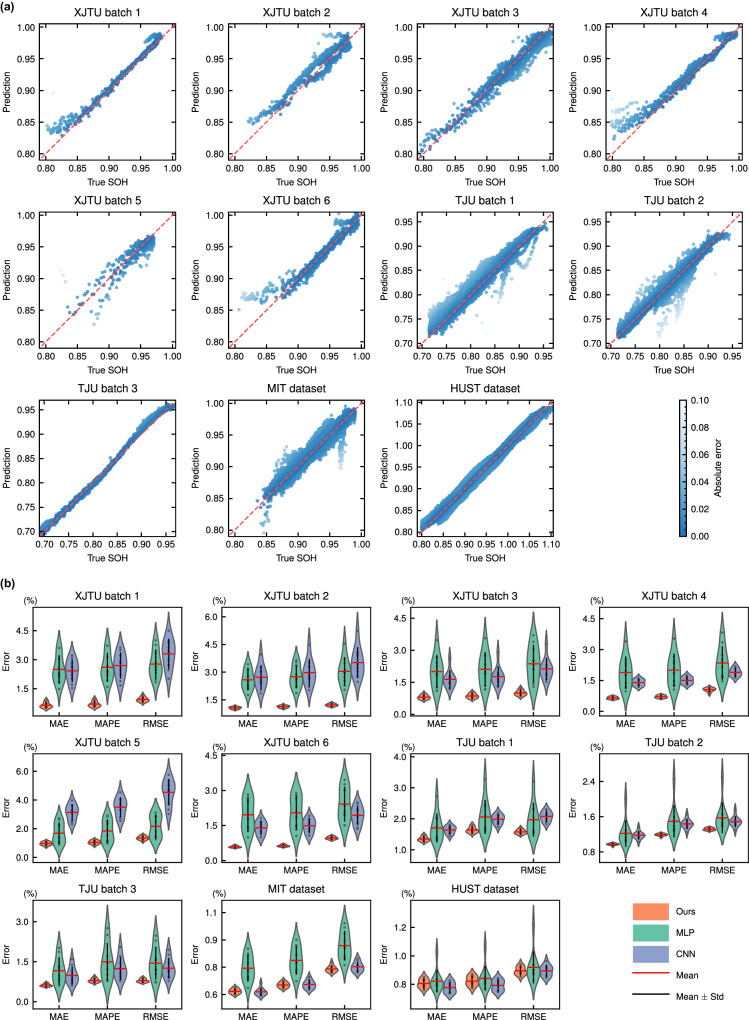
Accurate state-of-health (SOH) estimation is critical for reliable and safe operation of lithium-ion batteries. However, reliable and stable battery SOH estimation remains challenging due to diverse battery types and operating conditions. In this paper, we propose a physics-informed neural network (PINN) for accurate and stable estimation of battery SOH. Specifically, we model the attributes that affect the battery degradation from the perspective of empirical degradation and state space equations, and utilize neural networks to capture battery degradation dynamics. A general feature extraction method is designed to extract statistical features from a short period of data before the battery is fully charged, enabling our method applicable to different battery types and charge/discharge protocols. Additionally, we generate a comprehensive dataset consisting of 55 lithium-nickel-cobalt-manganese-oxide (NCM) batteries. Combined with three other datasets from different manufacturers, we use a total of 387 batteries with 310,705 samples to validate our method. The mean absolute percentage error (MAPE) is 0.87%. Our proposed PINN has demonstrated remarkable performance in regular experiments, small sample experiments, and transfer experiments when compared to alternative neural networks. This study highlights the promise of physics-informed machine learning for battery degradation modeling and SOH estimation.
Overview
The claims and statistics of this paper haven’t been checked yet.
Free: it reads the open-access text and checks the first 5 claims that cite a source we can check. Create a free account to check every claim.
Integrity signals
Registry
Cites
Statistics
Figures
Verification
Claims the paper makes
The claims and statistics of this paper haven’t been checked yet.
Free: it reads the open-access text and checks the first 5 claims that cite a source we can check. Create a free account to check every claim.
Claims other papers make about this one
Each is checked against this paper’s own text: does it say what the citing paper says it does?
The cited source says what the claim attributes to it.
In the citing paper
“Battery aging is a complex, multi-factor process involving the loss of active materials, lithium-ion depletion, increased internal resistance, and changes in the solid electrolyte interphase (SEI) layer [17-23]”
From The State of Health Estimation of Lithium-Ion Batteries: A Review of Health Indicators, Estimation Methods, Development Trends and Challenges (2025) · cites this paper as [17]
Self-check
Percentages, sums and reported differences re-computed from the paper’s own numbers.
The self-check needs the paper’s full text.
Citations
Cites
Raissi, M., Perdikaris, P., & Karniadakis, G. E. (2019) · Journal of Computational Physics · doi:10.1016/j.jcp.2018.10.045 · Cited by 20,384 · cited 2×
“Inspired by 54,55 , we propose to use a more generalized function approximator g 0 ð(cid:2)Þ with parameters θ 0 to represent the non-linear dynamics g ( ⋅ ).”
Physics-informed machine learning
Karniadakis, G. E., Kevrekidis, I. G., Lu, L., Perdikaris, P., Wang, S., & Yang, L. (2021) · Nature Reviews Physics · doi:10.1038/s42254-021-00314-5 · Cited by 8,718 · cited 2×
“The promising prospect of physics-informed neural network (PINN) 36,37 lies in amalgamating the strengths of physics-based and data-driven approaches, potentially addressing the aforementioned challenges.”
Recycling lithium-ion batteries from electric vehicles
Harper, G., Sommerville, R., Kendrick, E., Driscoll, L., Slater, P., Stolkin, R., Walton, A., Christensen, P., Heidrich, O., Lambert, S., et al. (2019) · Nature · doi:10.1038/s41586-019-1682-5 · Cited by 3,890 · cited 1×
“With the advantages of high energy density, low self-discharge rate, and long service life 1 , lithium-ion batteries have become the main energy storage devices in portable electronic devices, electric vehicles, aero-space, and many other fi elds 2 – 8 .”
Performance and cost of materials for lithium-based rechargeable automotive batteries
Schmuch, R., Wagner, R., Hörpel, G., Placke, T., & Winter, M. (2018) · Nature Energy · doi:10.1038/s41560-018-0107-2 · Cited by 3,233 · cited 1×
“With the advantages of high energy density, low self-discharge rate, and long service life 1 , lithium-ion batteries have become the main energy storage devices in portable electronic devices, electric vehicles, aero-space, and many other fi elds 2 – 8 .”
Data-driven prediction of battery cycle life before capacity degradation
Severson, K. A., Attia, P. M., Jin, N., Perkins, N., Jiang, B., Yang, Z., Chen, M. H., Aykol, M., Herring, P. K., Fraggedakis, D., et al. (2019) · Nature Energy · doi:10.1038/s41560-019-0356-8 · Cited by 3,228 · cited 3×
“For convenience, we refer to the four datasets as the XJTU battery dataset, TJU dataset 44 , HUST dataset 45 , and MIT dataset 25 .”
Simulation and Optimization of the Dual Lithium Ion Insertion Cell
Fuller, T. F., Doyle, M., & Newman, J. (1994) · Journal of The Electrochemical Society · doi:10.1149/1.2054684 · Cited by 2,057 · cited 1×
“Physics-based models are stable and accurate, but batteries with different chemical compositions require different model parameters, and the models have high computational costs 32 .”
Closed-loop optimization of fast-charging protocols for batteries with machine learning
Attia, P. M., Grover, A., Jin, N., Severson, K. A., Markov, T. M., Liao, Y.-H., Chen, M. H., Cheong, B., Perkins, N., Yang, Z., et al. (2020) · Nature · doi:10.1038/s41586-020-1994-5 · Cited by 1,180 · cited 1×
“Given the dif fi culty in establishing physical models and the dif fi - culty in obtaining complete discharge capacity, many studies have used data-driven methods 20 – 24 to estimate SOH based on current and voltage curves during charge and discharge.”
A review of rechargeable batteries for portable electronic devices
Liang, Y., Zhao, C., Yuan, H., Chen, Y., Zhang, W., Huang, J., Yu, D., Liu, Y., Titirici, M., Chueh, Y., et al. (2019) · InfoMat · doi:10.1002/inf2.12000 · Cited by 1,174
Modeling of Lithium-Ion Battery Degradation for Cell Life Assessment
Xu, B., Oudalov, A., Ulbig, A., Andersson, G., & Kirschen, D. S. (2018) · IEEE Transactions on Smart Grid · doi:10.1109/tsg.2016.2578950 · Cited by 1,162
Critical review of state of health estimation methods of Li-ion batteries for real applications
Berecibar, M., Gandiaga, I., Villarreal, I., Omar, N., Van Mierlo, J., & Van den Bossche, P. (2016) · Renewable and Sustainable Energy Reviews · doi:10.1016/j.rser.2015.11.042 · Cited by 1,126 · cited 1×
“In recent years, various SOH estimation methods of lithium-ion batterieshavebeenproposed,whichgreatlyadvancethedevelopment of this fi eld 12 – 15 .”
Research works printed but not linked: 1
- Raissi M Deep hidden physics models: deep learning of nonlinear partial differential equations J. Mach. Learn. Res. 2018 19 932 955
Cited by
Items 201–300 of 1,001
Jin, Y., Hou, L., Ge, X., Gao, Q., Yi, H., Li, Z., Feng, Y., & Zhong, S. (2025) · Nonlinear Dynamics · doi:10.1007/s11071-025-11277-y · Cited by 10
“…developedvariousspecificimplementationsofthedata-driven modeling methodology, resulting in a series of distinguished contributions, such as the Physical-Information Neural Network (PINN) [7–9], Sparse Identification of Nonlinear Dynamics (SINDy) [10– 13], and Koopman operator-based methods [14–17].”
Yuan, H., Wang, F., Tang, J., Di, Y., Zhao, Z., & Chen, X. (2025) · IEEE Internet of Things Journal · doi:10.1109/jiot.2025.3581223 · Cited by 13
“However, in practical applications, SOH is difficult to measure directly, and its degradation behavior exhibits strong nonlinearity, randomness, and complexity, posing significant challenges to accurate SOH estimation [7], [8], [9].”
Self-citationCNN-IPINN: a method study on applying physics-informed neural networks to gear fault diagnosis
Zhai, Z., Wan, C., Li, L., Pang, Y., Xiong, G., Zhang, C., Fan, X., & Wang, Y. (2025) · Measurement Science and Technology · doi:10.1088/1361-6501/ae09c9 · Cited by 9
“Wang et al [21] developed a deep hidden physical model integrated into a neural network architecture, constructing a PINN for estimating the state of health of lithium batteries.”
Self-citationA Comparative Review of Age-Aware Fast Charging Techniques for Advanced Battery Management Systems
Qasem, M., Qandil, M., Haddadin, M., Yassin, Y., & Krishnamurthy, M. (2025) · IEEE Access · doi:10.1109/access.2025.3621458 · Cited by 14
“Wang et al. [68] proposed a novel physics-based neural network (PINN) model to accurately estimate the State of Health (SoH) of LIBs.”
Yeregui, J., Lopetegi, I., Fernandez, S., Garayalde, E., & Iraola, U. (2025) · IEEE Transactions on Industrial Informatics · doi:10.1109/tii.2025.3632935 · Cited by 14
“In battery applications, PINNs have been used to estimate SOH, though often relying on empirical, rather than physics-based, principles [13].”
Liu, Q., Sun, H., Chen, R., Zhang, Z., Zhang, W., Zhang, J., & Luo, J. (2025) · Journal of Energy Storage · doi:10.1016/j.est.2025.118756 · Cited by 12
Li, Y., He, M., & Liu, J. (2025) · Journal of Power Sources · doi:10.1016/j.jpowsour.2025.239046 · Cited by 11
Liu, Y., Li, H., Yao, L., Xu, Y., Dai, D., & Wang, Z. (2026) · Process Safety and Environmental Protection · doi:10.1016/j.psep.2026.108919 · Cited by 9
A hybrid transformer masked time-domain denoising network for vibration signals
Huang, X., Qian, W., Zhang, P., Ding, Z., & Li, S. (2024) · Measurement Science and Technology · doi:10.1088/1361-6501/ad99f2 · Cited by 9
Prompt-Driven Fine-Tuning of Large Language Model for Li-ion Battery State Estimation
Qiu, T., Hou, L., & Shang, Y. (2024) · CAA International Conference on Vehicular Control and Intelligence (CVCI) · doi:10.1109/cvci63518.2024.10830087 · Cited by 9
PVDF-HFP nanofiber quasi-solid electrolyte for fast charging and dendrites-free lithium batteries
Wang, L., Chen, Y., Zeng, L., Huang, X., & Lv, W. (2025) · Journal of Power Sources · doi:10.1016/j.jpowsour.2025.236779 · Cited by 9
Saleh, M. A., Alquennah, A. N., Ghrayeb, A., Refaat, S. S., Abu‐Rub, H., Khatri, S. P., & Bayhan, S. (2026) · IEEE Transactions on Transportation Electrification · doi:10.1109/tte.2026.3703913 · Cited by 10
“The four datasets are public datasets from NASA [32], Ma et al. [33], Severson et al. [34], and Wang et al. [17].”
Wang, Y., Liu, S., Lv, S., & Liu, G. (2025) · arXiv (Cornell University) · doi:10.48550/arxiv.2504.13797 · Cited by 9
Li, S.-Y., Liu, Y., Liu, C.-L., Chen, G., & Wang, S. (2025) · International Journal of Electrochemical Science · doi:10.1016/j.ijoes.2025.101012 · Cited by 9
Artificial intelligence-empowered modeling and management of flow batteries: A mini-review
Zheng, Q., Shi, X., Cai, Y., An, L., & Zhang, D. (2025) · Future Batteries · doi:10.1016/j.fub.2025.100107 · Cited by 8
Meng, X., Xu, S., Yu, Y., Zhu, Y., & Gao, F. (2025) · International Journal of Electrical Power & Energy Systems · doi:10.1016/j.ijepes.2025.111146 · Cited by 8
Gu, X., Liu, M., & Tian, J. (2025) · Energies · doi:10.3390/en18205333 · Cited by 11
Large language models for battery prognostics
Zhao, J., Wang, Y., Cai, M., Xie, L., & Wang, H. (2025) · Journal of Energy Chemistry · doi:10.1016/j.jechem.2025.11.021 · Cited by 9
Wang, J. V., Liu, Y., Wang, Q., Kang, J., Meng, P., & Zhu, G. (2025) · iScience · doi:10.1016/j.isci.2025.114234 · Cited by 8
“19 This has become an emerging research direction in recent years.”
Ren, C., Han, J., Sun, L., & Yang, C. (2025) · Energy · doi:10.1016/j.energy.2025.138367 · Cited by 8
Lee, J., Noh, J., Lee, H., Lee, Y., Im, J., & Seo, J. (2026) · InfoMat · doi:10.1002/inf2.70124 · Cited by 8
Li, T., He, J., Liu, T., Wang, F., Zhao, Z., & Che, Y. (2026) · Journal of Energy Storage · doi:10.1016/j.est.2026.121177 · Cited by 10
Self-citationPhysics-informed neural networks for power systems: A systematic review
Xu, X., Qiang, K., Wu, J., Xuan, L., Lu, Y., Ma, W., & Zhang, J. (2026) · Sustainable Energy Grids and Networks · doi:10.1016/j.segan.2026.102261 · Cited by 16
Zhao, X., Wu, W., & Wu, D. (2024) · Journal of Energy Storage · doi:10.1016/j.est.2024.112894 · Cited by 10
Exploration of Imbalanced Regression in state-of-health estimation of Lithium-ion batteries
Zhao, Z., Liu, B., Wang, F., Zheng, S., Yu, Q., Zhai, Z., & Chen, X. (2024) · Journal of Energy Storage · doi:10.1016/j.est.2024.114542 · Cited by 8
Self-citationEfficient Hybrid Deep Learning Model for Battery State of Health Estimation Using Transfer Learning
Ren, J., Cai, M., & Shi, D. (2025) · Energies · doi:10.3390/en18061491 · Cited by 10
Tang, W., Zhao, Y., Fu, Y., Wang, A., Wu, W. H., Li, W., Xue, W., & Lv, J. (2025) · Energy storage materials · doi:10.1016/j.ensm.2025.104356 · Cited by 8
Zhang, K., & Wang, X. (2025) · Energy Science & Engineering · doi:10.1002/ese3.70177 · Cited by 7
“In this study, the LiFePO 4 graphite battery degradation data set collected by the MIT Stanford Toyota Research Center [28] and the nickel – cobalt – manganese (NCM) LIBs aging data collected by XTJU [29] were used to test the model designed in this paper.”
Wu, Y., Wang, T., Zhu, K., Xu, Y., Ma, H., Luo, J., Tang, X., & Huang, Y. (2025) · Energy · doi:10.1016/j.energy.2025.136988 · Cited by 7
Hao, S., Feng, J., Dong, J., Cui, W., Cheng, J., & Gong, M. (2025) · Energy · doi:10.1016/j.energy.2025.138229 · Cited by 7
Two-Stage Optimization of PCBA Placement Route Schedule Based on Deep Reinforcement Learning
Yin, B., Yang, X., Li, Z., Yu, X., Sun, H., Qiu, J., & Rodriguez-Andina, J. J. (2025) · IEEE Transactions on Industrial Informatics · doi:10.1109/tii.2025.3609187 · Cited by 8
“W ITHthedevelopmentofartificialintelligence,intelligentdecision-makingbasedonneuralnetworks(NNs)is being widely used in industrial scenarios [1], [2], [3], [4].”
Li, G., Liu, Q., Chen, Z., Cheng, Y., Wei, M., & Wu, D. (2025) · Measurement Science and Technology · doi:10.1088/1361-6501/ae1159 · Cited by 8
Luan, T., Zhang, H., Ji, Y., Gong, Y., Wang, Z., Wang, S., Xia, Y., Gong, Y., Li, Z., Li, C., et al. (2025) · Advanced Functional Materials · doi:10.1002/adfm.202526239 · Cited by 7
Cao, N., Zhang, Y., Du, L., Gu, X., & Wu, M. (2025) · Energy storage materials · doi:10.1016/j.ensm.2025.104823 · Cited by 17
Zeng, L., Zhong, Y., & Wang, S. (2026) · Journal of Energy Storage · doi:10.1016/j.est.2025.120123 · Cited by 10
Akinwola, A. B., & Alkuhayli, A. A. (2026) · Batteries · doi:10.3390/batteries12020046 · Cited by 8
“By incorporating governing constraints derived from electrochemical behavior, charge conservation, and energy balance, PINNs achieve superior physical consistency and robustness compared with conventional neural networks [31].”
Kumar, P. N., Upadhya, P. R., Nischay, S., Kumar, G. P., Shobana, T. S., & Rashmi, K. B. (2026) · Scientific Reports · doi:10.1038/s41598-026-37850-y · Cited by 9
He, Z., Wang, Z., Dong, Y., Viktorovich, K. A., Hao, S., Yang, C., Liu, Y., & Dong, L. (2026) · Advanced Materials · doi:10.1002/adma.72332 · Cited by 9
“Therefore, many scholars choose to focus on data quality governance [46–52] or create their own datasets [35, 36, 53, 54] to enhance model performance [55–57].”
Wang, C., Wu, J., Yang, Y., Zhu, H., & Mo, H. (2024) · Journal of Energy Storage · doi:10.1016/j.est.2024.114286 · Cited by 7
Physics-informed partitioned coupled neural operator for complex networks
Wu, W., Yon, Z., Hao, L., Chen, Y., Sun, X., & Gong, D. (2025) · Engineering Applications of Artificial Intelligence · doi:10.1016/j.engappai.2025.111567 · Cited by 7
Majeed, F., Batool, D., Rasul, M. J. M. A., Oh, S., Oh, J., & Kim, J. (2026) · Journal of Energy Storage · doi:10.1016/j.est.2026.122916 · Cited by 6
Smart sensing breaks the accuracy barrier in battery state monitoring
Bian, X., Zou, C., Fridholm, B., Sundvall, C., & Wik, T. (2025) · Energy storage materials · doi:10.1016/j.ensm.2025.104410 · Cited by 18
A battery SOH estimation method based on PI-TFT-iDOA driven Li-battery discharge state features
Hu, Y., Yun, Z., Wang, J., & Guan, L. (2025) · Energy · doi:10.1016/j.energy.2025.138239 · Cited by 11
Physics-Informed Koopman Networks for Industrial Process Time-Series Prediction
Liu, H., Yan, G., Cao, L., Ma, S., Zhao, G., & Liu, Z. (2025) · Industrial & Engineering Chemistry Research · doi:10.1021/acs.iecr.5c02217 · Cited by 6
Dynamic predictive maintenance strategy for fatigue damage based on a hybrid predictive framework
Li, B., Zhu, J., Wang, L., & Zhao, X. (2025) · Reliability Engineering & System Safety · doi:10.1016/j.ress.2025.112036 · Cited by 6
Liu, Y., Liu, Y., Ding, L., & Wang, C. (2025) · Journal of Energy Storage · doi:10.1016/j.est.2025.119752 · Cited by 8
Hai-wei, W., Liu, J., Wang, Z., & Li, X. (2025) · Energies · doi:10.3390/en18236270 · Cited by 6
Pace: Physics-Aware Attentive Temporal Convolutional Network for Battery Health Estimation
Sameer, S., Zhang, W., Kannan, D., Lou, X., Gao, Y., Goh, T., & Yan, Q. (2026) · ACM Symposium on Applied Computing · doi:10.1145/3748522.3779746 · Cited by 8
Pretrained battery transformer (PBT): a foundation model for battery life prediction
Tan, R., Hong, W., Li, J., Huang, J., & Zhang, T. (2026) · Energy & Environmental Science · doi:10.1039/d6ee03446b · Cited by 6
“…data are highly heterogeneous because battery degradation is shaped by diverse specifications, formation histories and operating conditions, spanning electrode and electrolyte materials, 57–59 chemistries, 13 cell formats, 13 formation protocols, 26,60 depths of discharge, 57–59,61 charge and”
Rajamani, N. R., & Banerjee, S. (2025) · Knowledge-Based Systems · doi:10.1016/j.knosys.2025.115198 · Cited by 6
Zhou, K. Q., Qin, Y., Bhattacharjee, A., Tushar, W., Chong, A. C. C., & Yuen, C. (2026) · Journal of Energy Storage · doi:10.1016/j.est.2025.120064 · Cited by 6
Abdalla, A. A., Moursi, M. S. E., EL-Fouly, T. H. M., & Hosani, K. H. A. (2026) · Renewable and Sustainable Energy Reviews · doi:10.1016/j.rser.2025.116687 · Cited by 8
Adaptive estimation of battery pack state of charge with optical fibre strain measurements
Liu, S., Li, K., & Yu, J. J. Q. (2026) · Applied Energy · doi:10.1016/j.apenergy.2025.127330 · Cited by 6
Ren, F., Lu, D., Yuan, H., & Cui, N. (2026) · IEEE Transactions on Industrial Electronics · doi:10.1109/tie.2025.3645428 · Cited by 6
Zeng, J., Yang, Z., Zhu, H., Chen, Y., Huang, T., Tan, P., Zhou, X., Zhou, M., Zhang, Y., & Zhou, H. (2026) · Energy storage materials · doi:10.1016/j.ensm.2026.105002 · Cited by 6
Mo, S., Su, Y. K., Dong, J., Wei, Y., Song, T., Lu, Y., Yan, K., Tang, R., Zhao, G., Liang, J., et al. (2026) · Chinese Journal of Chemistry · doi:10.1002/cjoc.70500 · Cited by 6
On physics-informed fuzzy neural network for the state of health prediction of lithium-ion batteries
Ren, Z., & Wei, Y. (2026) · Journal of Energy Storage · doi:10.1016/j.est.2026.121467 · Cited by 9
Lee, H.-G., Han, J., Kwon, M., Kwon, H., Park, J., Hah, H. J., & Seo, D. (2026) · Digital Discovery · doi:10.1039/d5dd00580a · Cited by 6
Li, X., Reed, D. M., Lim, W., Viswanathan, V., Omenya, F. O., Lucero, M., Li, G., Nambafu, G. S., Fayette, M. R., Crawford, A., et al. (2026) · Batteries & Supercaps · doi:10.1002/batt.202500746 · Cited by 6
Separated-variable physics informed neural operators for solving dynamic PDEs
Wang, Y., Kong, X., Deng, L., & Sun, H. (2026) · Mechanical Systems and Signal Processing · doi:10.1016/j.ymssp.2026.114195 · Cited by 6
Zhang, M., Zhang, L., Li, Y., Zhao, Y., Lu, H., & Liu, C. (2026) · Applied Energy · doi:10.1016/j.apenergy.2026.127758 · Cited by 6
Liu, Y., Shi, Y., Zhou, Q., Bian, X., Wang, K., Fan, W., & Li, Q. (2026) · Journal of Energy Storage · doi:10.1016/j.est.2026.122058 · Cited by 6
Transfer learning for state-of-health prognostics of lithium-ion batteries: A survey
Wang, J., Lu, J., Liu, Y., Li, L., & Wang, K. (2026) · Journal of Energy Storage · doi:10.1016/j.est.2026.122169 · Cited by 6
Equivalent Circuit Models for Lithium-Ion Batteries: A Comprehensive Review
Sun, X. J., Zuo, L., Zhang, M., Su, Y., Fu, Q., & Jiang, J. (2026) · Electronics · doi:10.3390/electronics15091968 · Cited by 12
Zhang, R., Zhu, J., Cai, J., Jiang, B., Chen, Z., Li, D., Li, Y., Wei, C., Jiang, Y., Schade, W., et al. (2026) · Applied Energy · doi:10.1016/j.apenergy.2026.128284 · Cited by 6
VS4 with High Crystallinity and Controlled Morphology Enabling Superior Lithium Storage Performance
Ma, M., Yang, G., Li, J., Yang, H., & Huang, Y. (2025) · ACS Applied Energy Materials · doi:10.1021/acsaem.4c03224 · Cited by 6
Sensitivity analysis for reliable state-of-health estimation based on battery partial charging
Vilsen, S. B., & Stroe, D. (2025) · Cell Reports Physical Science · doi:10.1016/j.xcrp.2025.102646 · Cited by 10
Chen, Y., Yao, S., & Lin, D. (2025) · Industrial & Engineering Chemistry Research · doi:10.1021/acs.iecr.4c03744 · Cited by 7
Artificial Intelligence-Driven Electric Vehicle Battery Lifetime Diagnostics
Zhao, J., & Burke, A. F. (2025) · IntechOpen eBooks · doi:10.5772/intechopen.1009354 · Cited by 6
Lixin, E., Wang, J., Sun, Y., Shen, W., & Xiong, R. (2025) · Journal of The Electrochemical Society · doi:10.1149/1945-7111/addd4e · Cited by 10
Zhang, H., Liu, X., Altaf, F., & Wik, T. (2025) · Journal of Power Sources · doi:10.1016/j.jpowsour.2025.238028 · Cited by 11
“[56], while the histogram-based features, i.e., time spent within specific voltage and/or current ranges, extracted from full charge-discharge data regardless of battery usage, are used as the inputs to the PINN for degradation mode estimation in our work; 3) Outputs: The output of the PINN model…”
InfluentialA Micromesh Multi-Scaled Features Extraction Network for Li-Ion Batteries SOH Estimation
Wang, M., Chen, Y., Guo, D., & Xu, Z. (2025) · IEEE Transactions on Vehicular Technology · doi:10.1109/tvt.2025.3544483 · Cited by 6
“Restrictions apply. stability and interpretability, Wang et al. [19] proposed a physics-informed neural network for accurate and stable estimation of battery SOH.”
A hybrid physics-based and data-driven approach for long-term VRFB aging prediction
Cai, M., Yang, B., Liu, Q., & Zhu, J. (2025) · Journal of Control and Decision · doi:10.1080/23307706.2025.2481899 · Cited by 5
Li, Y., Lei, J., & Ren, S. (2025) · Applied Thermal Engineering · doi:10.1016/j.applthermaleng.2025.127113 · Cited by 5
Li, M., & Yang, Y. (2025) · Computer Physics Communications · doi:10.1016/j.cpc.2025.109762 · Cited by 5
DegradAI: A scalable framework for early battery health diagnosis from limited data
Sudarshan, M., Vajja, J. V. R., & Tomar, V. (2025) · npj Clean Energy · doi:10.1038/s44406-025-00008-2 · Cited by 6
“ML models, such as support vector machines (SVMs) and random forests, have shown potential in extracting key features from voltage pro fi les and electrochemical impedance spectroscopy (EIS) data for early degradation detection 21,22 .”
Li, N., Zhang, H., Zhong, J., & Miao, Q. (2025) · IEEE Transactions on Instrumentation and Measurement · doi:10.1109/tim.2025.3602559 · Cited by 15
“However, these methods rely heavily on specific working conditions, charge / discharge protocols, and datasets, limiting their generalization capabilities [16].”
A Physics-Informed Dual-Branch Architecture for Lithium-Ion Battery Modeling and Prognostics
Zhao, R., Jiang, X., Du, Y., Du, G., & Zhu, Z. (2025) · IEEE Transactions on Instrumentation and Measurement · doi:10.1109/tim.2025.3628427 · Cited by 6
“Wang et al. [20] extracted health factors from short-term charging data and employed them as inputs to PINNs, modeling battery degradation through empirical models and state-space equations.”
AI-driven next-generation lithium-ion battery design automation (BDA) software
Liu, Z., Lai, G., Zuo, Y., Song, X., Liu, Q., Zhang, F., Wang, Z., Ji, Q., Zheng, J., Gong, J., et al. (2025) · National Science Open · doi:10.1360/nso/20250062 · Cited by 6
Remaining useful life prediction of lithium-ion batteries based on MWASFormer network
Zeng, L., Jiang, Z., & Wang, S. (2025) · Ionics · doi:10.1007/s11581-025-06794-0 · Cited by 5
“To cover different battery types and operating conditions, this study validates the model using 16 batteries from three datasets of varying scales, namely the XJTU Battery Data-set [27], MIT Dataset [28] and CALCE Dataset [29].”
Multi-level feature-based cross-domain SOH prediction for lithium-ion batteries with dual-stage loss
Cao, D., Zheng, Z., Zheng, G., Wang, K., Zhu, X., Huang, Y., Zheng, Z., Huang, G., & Li, W. (2025) · Electric Power Systems Research · doi:10.1016/j.epsr.2025.112550 · Cited by 5
Liu, J., Qin, Y., Dai, W., & Yuen, C. (2025) · IEEE Transactions on Industrial Informatics · doi:10.1109/tii.2025.3631012 · Cited by 5
“It should be noted that the mentioned inter-pretability, which highlights the clarity of the model’s theoretical construction process, differs from the physical interpretability of the battery degradation mechanism [22].”
PhyGNN: Physics guided graph neural network for complex industrial power system modeling
Di, Y., Wang, F., Zhai, Z., Zhao, Z., & Chen, X. (2025) · Mechanical Systems and Signal Processing · doi:10.1016/j.ymssp.2025.113380 · Cited by 5
Self-citationGuo, S., Wang, Y., Cui, Y., Deng, L., Zhao, L., Li, J., & Wang, Z. (2025) · Journal of Energy Storage · doi:10.1016/j.est.2025.118493 · Cited by 5
Feature Selection for Battery Lifetime Prediction Using Explainable Machine Learning
Wang, Y., Wang, J., Chen, X., Wang, Y., & Song, J. (2025) · IEEE Transactions on Industry Applications · doi:10.1109/tia.2025.3618235 · Cited by 5
“Another strategyextractskeystatisticalfeatureslikemeanandskewness fromstandardizedchargingsegmentstoenablegeneralizable, physics-informedbatterymodeling[8].”
Self-citationLin, Z., Wang, Y., Fu, X., Zou, Z., Feng, L., Fang, L., & Qing, X. (2025) · Energy · doi:10.1016/j.energy.2025.139879 · Cited by 5
Wu, X., Chen, D., Wang, D., Wang, S., Chen, Z. J., Yi, S., Hu, S., Hua, P., & Xu, X. (2026) · International Journal of Hydrogen Energy · doi:10.1016/j.ijhydene.2025.153305 · Cited by 6
Zhang, Q., Yang, M., Sun, G., Xiang, Y., Wang, S., Zhang, J., & Li, S. (2026) · Energy storage materials · doi:10.1016/j.ensm.2026.104897 · Cited by 21
From hype to impact: A roadmap for trustworthy battery AI
Zhao, J., Che, Y., Li, Y., & Harris, S. J. (2026) · eTransportation · doi:10.1016/j.etran.2026.100546 · Cited by 5
Gao, Z. J., Wang, X., Guo, X., & Cui, Z. (2026) · Journal of Energy Storage · doi:10.1016/j.est.2026.120840 · Cited by 7
Mousavi, E. S. A., Abdollahi, F., Barazandeh, F., Torabi, F., & Hajizadeh, A. (2026) · International Journal of Energy Research · doi:10.1155/er/9923180 · Cited by 6
Zhou, X., Xu, J., Sun, Y., Yuan, H., Feng, M., Wang, F., & Zhao, Z. (2026) · Journal of Energy Storage · doi:10.1016/j.est.2026.121188 · Cited by 5
Self-citationZhuo, S., Zou, F., Liao, L., & Cai, X. (2026) · Scientific Reports · doi:10.1038/s41598-026-39986-3 · Cited by 6
“Wang et al. 17 proposed a physics-informed neural network integrating empirical degradation and state-space equations, validated on 387 batteries from four manufacturers with Mean Absolute Percentage Error (MAPE) of 0.87%.”
InfluentialHua, H., & Wu, L. (2026) · Journal of Energy Storage · doi:10.1016/j.est.2026.121689 · Cited by 5
Wang, R., Shen, J., Liu, S., & Rong, H. (2026) · Batteries · doi:10.3390/batteries12040115 · Cited by 5
Machine learning toward electrochemical energy storage materials and devices: A review
Ma, C., Yao, C., Xu, J., & Xie, Y. (2026) · Sustainable materials and technologies · doi:10.1016/j.susmat.2026.e01990 · Cited by 6
Wang, B., Cao, W., Li, M., Wang, J., Zhao, F., Yan, Y., & Wang, C. (2026) · Energy & Fuels · doi:10.1021/acs.energyfuels.5c06708 · Cited by 5
MM-NO: Learning Physical Operators from Heterogeneous Data Via Cross-Modal Attention Fusion
Liu, N., Chu, J., Yan, X., Li, Y., Chen, S.-Y., Dong, Z., & Yang, C. (2026) · IEEE International Conference on Acoustics Speech and Signal Processing · doi:10.1109/icassp55912.2026.11461669 · Cited by 8
Lu, J., Huang, X., (95310), R. C., Yu, Q., Xu, Y., & Li, J. (2026) · Journal of Energy Chemistry · doi:10.1016/j.jechem.2026.05.054 · Cited by 5
Kim, Y., Lee, J., Kang, C., & Byun, Y.-C. (2026) · Applied Energy · doi:10.1016/j.apenergy.2026.128220 · Cited by 5
Metadata
- Authors
- Wang, F., Zhai, Z., Zhao, Z., Di, Y., & Chen, X.
- Affiliations
- Xi'an Jiaotong University (CN)
- Corresponding author
- Zhao, Zhibin
- Chen, Xuefeng
- Venue
- Nature Communications
- Published
- 2024-05-21
- Volume
- 15
- Issue
- 1
- Pages
- 4332-4332
- ISSN
- 2041-1723 (ISSN-L)
- PMC
- PMC11109204
- OpenAlex
- W4398164319
- Cited by
- 897
- References
- 56
- Citations by year
- 2026: 532 · 2025: 322 · 2024: 43
- FWCI
- 96.71
- Type
- journal article
- Language
- en
- Open access
- gold
- doi.org
- Licence
- cc-by
- creativecommons.org/licenses/by/4.0 (tdm)
- creativecommons.org/licenses/by/4.0 (vor)
- Locations
- Nature Communications (publishedVersion, cc-by)
- PubMed Central (publishedVersion, cc-by)
- PubMed (publishedVersion)
- RePEc: Research Papers in Economics (submittedVersion)
- DOAJ (DOAJ: Directory of Open Access Journals) (submittedVersion, cc-by-sa)
- Funders
- Fundamental Research Funds for the Central Universities
- National Natural Science Foundation of China (52105113, U22B2013)
- China Postdoctoral Science Foundation (2021M692557, 2021TQ0263)
- Topics
- Physical Sciences › Engineering › Automotive Engineering › Battery Modeling and Management
- Physical Sciences › Engineering › Electrical and Electronic Engineering › Advancements in Battery Materials
- Physical Sciences › Engineering › Civil and Structural Engineering › Structural Health Monitoring Techniques
- Keywords
- lithium-ion batteries, state of health estimation, battery degradation modeling, physics-informed neural networks, NCM batteries, statistical feature extraction, transfer learning, small sample learning, battery datasets
About these checks
Registry, retraction, Cites and statistics results are computed, not judged, with one exception: a printed reference that no index lists is read once by a model before it counts as a citation error. Claims are extracted by a model and kept only when their quote appears verbatim in the text; each cited source is then checked, with a model’s help, for whether it says what the claim relies on. Those verdicts can be wrong — read the claim’s quote and the cited source before relying on one.
Statistics and arithmetic are recomputed, not judged.
Confidence bands are shown only for fields calibrated on our annotated test set. None is calibrated yet, so no band is shown.
What counts as a claim ›How we measure confidence ›How we check this ›
Are you an author, or do you see a problem with this page? Request a review
Data sources
Bibliographic data: Semantic Scholar, OpenAlex, Crossref.
Contains information from the Semantic Scholar Academic Graph Datasets, made available under the ODC Attribution License (ODC-BY 1.0).
Semantic Scholar’s data is described in: Kinney, R., et al. (2023). The Semantic Scholar Open Data Platform. arXiv:2301.10140.
