

Physics-informed neural network for lithium-ion battery degradation stable modeling and prognosis
Open accessThe DOI matches its Crossref record; 55 of the 56 references it cites were found in a registry or an index.
Abstract
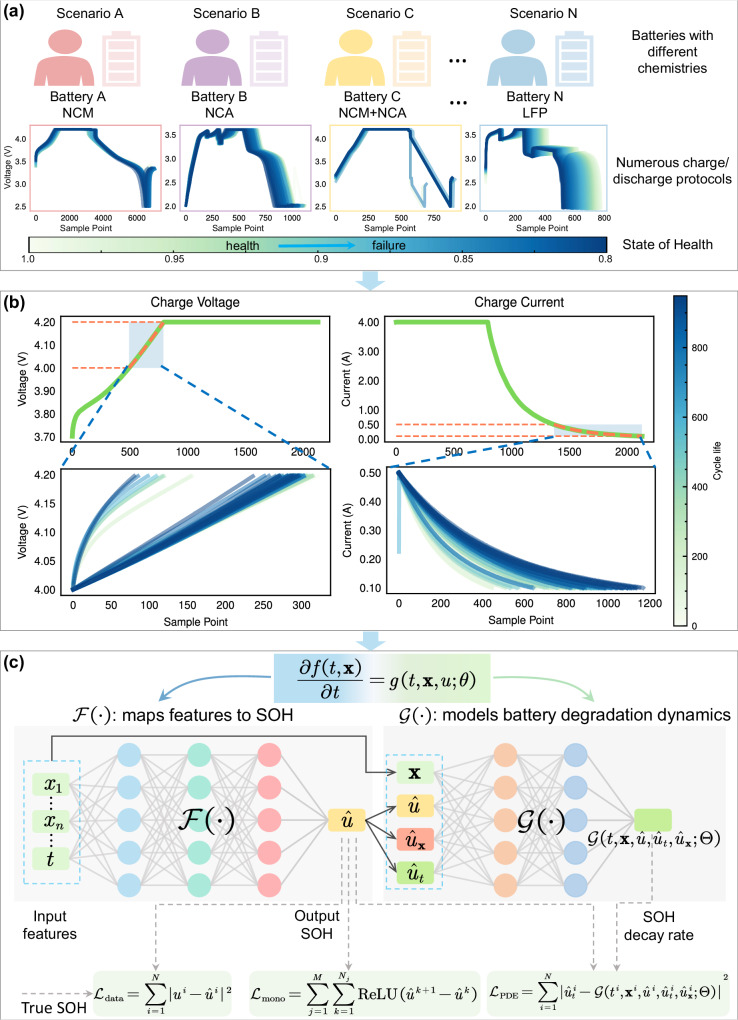
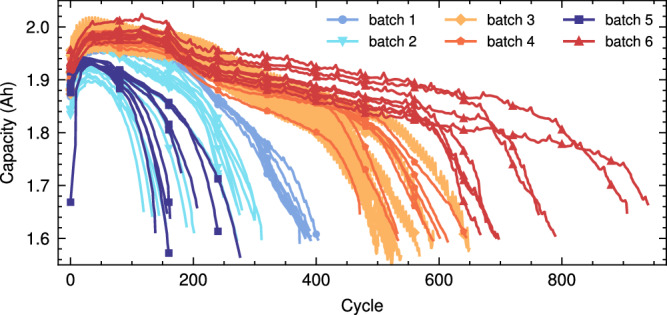
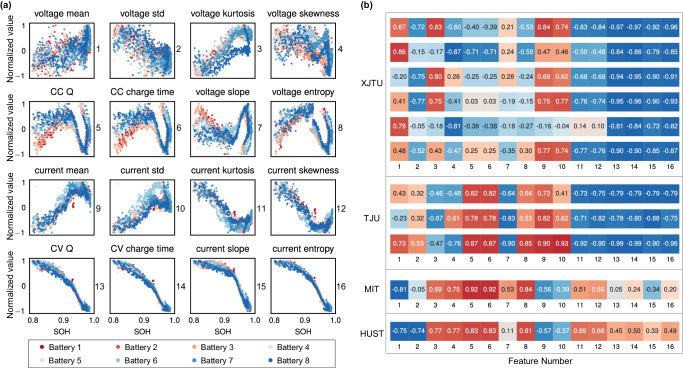
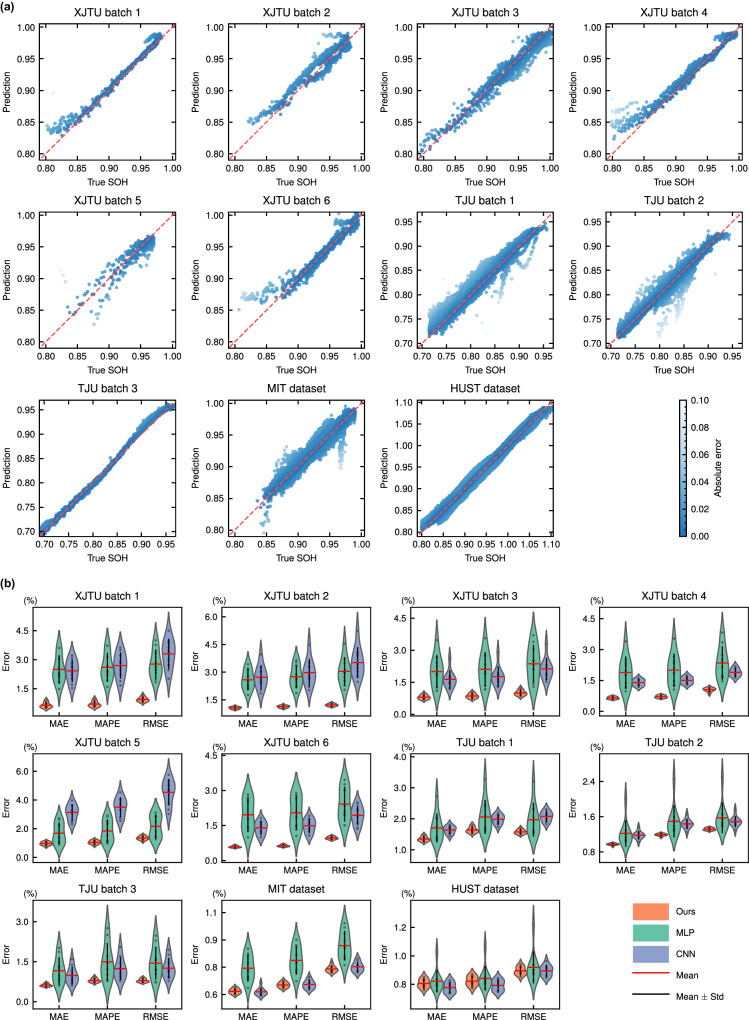
Accurate state-of-health (SOH) estimation is critical for reliable and safe operation of lithium-ion batteries. However, reliable and stable battery SOH estimation remains challenging due to diverse battery types and operating conditions. In this paper, we propose a physics-informed neural network (PINN) for accurate and stable estimation of battery SOH. Specifically, we model the attributes that affect the battery degradation from the perspective of empirical degradation and state space equations, and utilize neural networks to capture battery degradation dynamics. A general feature extraction method is designed to extract statistical features from a short period of data before the battery is fully charged, enabling our method applicable to different battery types and charge/discharge protocols. Additionally, we generate a comprehensive dataset consisting of 55 lithium-nickel-cobalt-manganese-oxide (NCM) batteries. Combined with three other datasets from different manufacturers, we use a total of 387 batteries with 310,705 samples to validate our method. The mean absolute percentage error (MAPE) is 0.87%. Our proposed PINN has demonstrated remarkable performance in regular experiments, small sample experiments, and transfer experiments when compared to alternative neural networks. This study highlights the promise of physics-informed machine learning for battery degradation modeling and SOH estimation.
Overview
The claims and statistics of this paper haven’t been checked yet.
Free: it reads the open-access text and checks the first 5 claims that cite a source we can check. Create a free account to check every claim.
Integrity signals
Registry
Cites
Statistics
Figures
Verification
Claims the paper makes
The claims and statistics of this paper haven’t been checked yet.
Free: it reads the open-access text and checks the first 5 claims that cite a source we can check. Create a free account to check every claim.
Claims other papers make about this one
Each is checked against this paper’s own text: does it say what the citing paper says it does?
The cited source says what the claim attributes to it.
In the citing paper
“Battery aging is a complex, multi-factor process involving the loss of active materials, lithium-ion depletion, increased internal resistance, and changes in the solid electrolyte interphase (SEI) layer [17-23]”
From The State of Health Estimation of Lithium-Ion Batteries: A Review of Health Indicators, Estimation Methods, Development Trends and Challenges (2025) · cites this paper as [17]
Self-check
Percentages, sums and reported differences re-computed from the paper’s own numbers.
The self-check needs the paper’s full text.
Citations
Cites
Raissi, M., Perdikaris, P., & Karniadakis, G. E. (2019) · Journal of Computational Physics · doi:10.1016/j.jcp.2018.10.045 · Cited by 20,384 · cited 2×
“Inspired by 54,55 , we propose to use a more generalized function approximator g 0 ð(cid:2)Þ with parameters θ 0 to represent the non-linear dynamics g ( ⋅ ).”
Physics-informed machine learning
Karniadakis, G. E., Kevrekidis, I. G., Lu, L., Perdikaris, P., Wang, S., & Yang, L. (2021) · Nature Reviews Physics · doi:10.1038/s42254-021-00314-5 · Cited by 8,718 · cited 2×
“The promising prospect of physics-informed neural network (PINN) 36,37 lies in amalgamating the strengths of physics-based and data-driven approaches, potentially addressing the aforementioned challenges.”
Recycling lithium-ion batteries from electric vehicles
Harper, G., Sommerville, R., Kendrick, E., Driscoll, L., Slater, P., Stolkin, R., Walton, A., Christensen, P., Heidrich, O., Lambert, S., et al. (2019) · Nature · doi:10.1038/s41586-019-1682-5 · Cited by 3,890 · cited 1×
“With the advantages of high energy density, low self-discharge rate, and long service life 1 , lithium-ion batteries have become the main energy storage devices in portable electronic devices, electric vehicles, aero-space, and many other fi elds 2 – 8 .”
Performance and cost of materials for lithium-based rechargeable automotive batteries
Schmuch, R., Wagner, R., Hörpel, G., Placke, T., & Winter, M. (2018) · Nature Energy · doi:10.1038/s41560-018-0107-2 · Cited by 3,233 · cited 1×
“With the advantages of high energy density, low self-discharge rate, and long service life 1 , lithium-ion batteries have become the main energy storage devices in portable electronic devices, electric vehicles, aero-space, and many other fi elds 2 – 8 .”
Data-driven prediction of battery cycle life before capacity degradation
Severson, K. A., Attia, P. M., Jin, N., Perkins, N., Jiang, B., Yang, Z., Chen, M. H., Aykol, M., Herring, P. K., Fraggedakis, D., et al. (2019) · Nature Energy · doi:10.1038/s41560-019-0356-8 · Cited by 3,228 · cited 3×
“For convenience, we refer to the four datasets as the XJTU battery dataset, TJU dataset 44 , HUST dataset 45 , and MIT dataset 25 .”
Simulation and Optimization of the Dual Lithium Ion Insertion Cell
Fuller, T. F., Doyle, M., & Newman, J. (1994) · Journal of The Electrochemical Society · doi:10.1149/1.2054684 · Cited by 2,057 · cited 1×
“Physics-based models are stable and accurate, but batteries with different chemical compositions require different model parameters, and the models have high computational costs 32 .”
Closed-loop optimization of fast-charging protocols for batteries with machine learning
Attia, P. M., Grover, A., Jin, N., Severson, K. A., Markov, T. M., Liao, Y.-H., Chen, M. H., Cheong, B., Perkins, N., Yang, Z., et al. (2020) · Nature · doi:10.1038/s41586-020-1994-5 · Cited by 1,180 · cited 1×
“Given the dif fi culty in establishing physical models and the dif fi - culty in obtaining complete discharge capacity, many studies have used data-driven methods 20 – 24 to estimate SOH based on current and voltage curves during charge and discharge.”
A review of rechargeable batteries for portable electronic devices
Liang, Y., Zhao, C., Yuan, H., Chen, Y., Zhang, W., Huang, J., Yu, D., Liu, Y., Titirici, M., Chueh, Y., et al. (2019) · InfoMat · doi:10.1002/inf2.12000 · Cited by 1,174
Modeling of Lithium-Ion Battery Degradation for Cell Life Assessment
Xu, B., Oudalov, A., Ulbig, A., Andersson, G., & Kirschen, D. S. (2018) · IEEE Transactions on Smart Grid · doi:10.1109/tsg.2016.2578950 · Cited by 1,162
Critical review of state of health estimation methods of Li-ion batteries for real applications
Berecibar, M., Gandiaga, I., Villarreal, I., Omar, N., Van Mierlo, J., & Van den Bossche, P. (2016) · Renewable and Sustainable Energy Reviews · doi:10.1016/j.rser.2015.11.042 · Cited by 1,126 · cited 1×
“In recent years, various SOH estimation methods of lithium-ion batterieshavebeenproposed,whichgreatlyadvancethedevelopment of this fi eld 12 – 15 .”
Research works printed but not linked: 1
- Raissi M Deep hidden physics models: deep learning of nonlinear partial differential equations J. Mach. Learn. Res. 2018 19 932 955
Cited by
Items 801–900 of 1,001
SOHLLM: Multi-Step State of Health Prediction for Lithium-Ion Batteries via Large Language Models
Zheng, Q., Li, C., Zhang, Y., Yang, D., Zhai, Y., & Yang, B. (2026) · Youth Academic Annual Conference of Chinese Association of Automation (YAC) · doi:10.1109/yac71005.2026.11615972
Huang, G., Li, S., Wang, C., Wang, Y., Jin, M. J., Guo, P., Jia, K., Mai, H., Zang, Y., Zhang, Y., et al. (2026) · Batteries · doi:10.3390/batteries12080285
Zou, Y., Zhang, Y., & Lv, K. (2026) · Batteries · doi:10.3390/batteries12080284
BatteryMFormer: Multi-level Learning for Battery Degradation Trajectory Forecasting
Tan, R., Dong, J., Hong, W., Li, J., Huang, J., & Zhang, T. (2026) · ACM SIGKDD Conference on Knowledge Discovery and Data Mining (KDD) · doi:10.1145/3770855.3818948 · Cited by 2
Song, G., Zhang, Z., Deng, Y.-L., & Zhou, Y. (2026) · Batteries · doi:10.3390/batteries12080289
“To encompass diverse battery types and operating conditions, the proposed model is validated against 8 battery cells from two datasets of different scales, namely the NASA battery dataset [32] and XJTU battery dataset [33].”
Driver-aware battery thermal stress indexing and short-horizon prediction for electric two-wheelers
Kulkarni, A., Ashok, B., & Kavitha, C. (2026) · Journal of Energy Storage · doi:10.1016/j.est.2026.124024
Wang, J., Piao, S., & Tsung, F. (2026) · ACM SIGKDD Conference on Knowledge Discovery and Data Mining (KDD) · doi:10.1145/3770855.3818162
Huang, Y., Huang, J., Yu, W., & Yang, X. (2026) · Scientific Reports · doi:10.1038/s41598-026-65728-6
Cheng, Y., Liu, G., Bian, J., Chen, J., Sun, W., & Liu, B. (2026) · Energy Technology · doi:10.1002/ente.70610
Physically-Informed BiLSTM for Lithium-Ion Battery SoC Estimation
Baccouche, I., & Amara, N. E. B. (2026) · International Conference on Control, Decision and Information Technologies (CoDIT) · doi:10.1109/codit70676.2026.11630830
“To address this issue, physics-informed learning approaches have been proposed to integrate battery physics into deep learning models [10].”
Xiao, R., Xu, J., & Li, J. (2026) · Mathematics · doi:10.3390/math14162873
R, R. G., & Srinivasan, K. (2026) · Batteries · doi:10.3390/batteries12080294
Liu, M., Huang, F., Zhang, S., Yang, F., 赵, W. 微. Z., Liu, J., & Li, H. (2026) · Entropy · doi:10.3390/e28080897
“Chen and colleagues [51–56] investigated classical mathematical physics equations by applying PINNs to the sine-Gordon equation and the nonlinear Schrödinger equation, achieving favorable results.”
Interaction-Aware Graph Learning for State-of-Health Estimation of Sodium-Ion Batteries
Fan, Y., Liang, Y., Li, Y., Wang, L., Guan, Q., & Tan, X. (2026) · Energy & Fuels · doi:10.1021/acs.energyfuels.6c02284
Gao, J., Wang, S., Chen, R., Zio, E., Dui, H., & Zhang, C. (2026) · Measurement Science and Technology · doi:10.1088/1361-6501/ae978b
“Recently, hybrid approaches combining electrochemical models with data-driven algorithms have gained traction for reducing RUL prediction uncertainties via explicit physical constraints [29, 30].”
A Continuous-Time Electrothermal Coupled Model for Smartphone Battery Drain Prediction
Li, J., Yang, B., & Cao, E. (2026) · International Conference on Electronic Engineering and Informatics (EEI) · doi:10.1109/eei70303.2026.11640613
“4(a) shows SOC trajectories: the proposed model tracks measured values most closely, while ECM deviates during high-load periods (no thermal feedback), LSTM exhibits high-frequency oscillations (overfitting) [4], and PINN lags during rapid transitions [7].”
Monotonic Physics-Consistent Regularization for Battery State of Health Estimation
Zhang, X., Wang, J., & Gao, Q. (2026) · IEEE China Conference on System Simulation Technology and its Applications (CCSSTA) · doi:10.1109/ccssta69471.2026.11635512
“PINN was included as a physics-informed baseline following the implementation described in [5].”
Adaptive Physics-Informed Transformer with Dual-Gating for Li-Ion Battery RUL Prediction
Zhang, L., Zhao, D., & Li, Y. (2026) · International Conference on Electronic Engineering and Informatics (EEI) · doi:10.1109/eei70303.2026.11640693
“Physics-Informed Neural Networks (PINNs) bridge data accuracy and interpretability by embedding physical constraints into the loss function [12], [13].”
Reduced-order aging and safety analytics of Li-ion batteries
Patra, S., Sharma, A. K., Kim, M. J., Vishnugopi, B. S., Tewari, D. P., Karmakar, A., Premnath, V., Tang, W. S., Jeevarajan, J. A., & Mukherjee, P. P. (2026) · Energy storage materials · doi:10.1016/j.ensm.2026.105459
Chen, X., Lv, H., Liao, Y., & Yang, D. (2026) · IEEE China Conference on System Simulation Technology and its Applications (CCSSTA) · doi:10.1109/ccssta69471.2026.11635425
“The experimental data used in this paper comes from the publicly available lithium battery aging dataset (hereinafter referred to as XJTU dataset) of the School of Mechanical Engineering, Xi’an Jiaotong University [6].”
Self-citationHuaibin, G., Liu, M., Ma, Y., Xia, B., He, R., & Wei, M. (2026) · Journal of Power Sources · doi:10.1016/j.jpowsour.2026.241217
Gerasimov, G. V., & Gryazina, E. (2026) · International Conference on Electrical, Computer and Energy Technologies (ICECET) · doi:10.1109/icecet65726.2026.11633065
“In the battery field, PINN-based approaches have been applied to SoH estimation to improve stability, generalization, and physical consistency compared to purely black-box models [13].”
Quan, J., Huang, Z., & Feng, N. (2026) · IEEE International Conference on Computational Electromagnetics · doi:10.1109/iccem68495.2026.11628835
“This leads to a drastic expansion of the stiffness matrix scale and high computational costs[3].”
BESS modeling: best available approaches for modeling from measurements
Andreotti, D., Pasqualotto, D., Balbo, L., & Rancilio, G. (2026) · Renewable and Sustainable Energy Reviews · doi:10.1016/j.rser.2026.117397
PRFNet for Fast Soh Estimation of Lithium-Ion Batteries Using a Short Early-Charging Segment
Lin, W., Liu, C., Chen, Y., Zhang, S., Li, Y., & Lin, Q. (2026) · International Conference on Electrical Engineering and Green Energy (CEEGE) · doi:10.1109/ceege70076.2026.11637715
“Even some methods designed for partial charging conditions still require broader charging segments or additional relaxation periods, such as approximately 10 min relaxation data [11].”
InfluentialEner, A. E., Cinar, B., Eyidogan, B., Sen, M. E., Kanak, A., & Atalay, A. S. (2026) · Scientific Reports · doi:10.1038/s41598-026-65888-5
Chen, X., Yang, M., Wang, Z., & Liang, L. (2026) · Computers & Operations Research · doi:10.1016/j.cor.2026.107636
Self-citationLiu, X., Li, Q., Liang, J., Li, Z., Wang, H., & Deng, Y. (2026) · Small · doi:10.1002/smll.74632
Yang, P., Song, Z., Wang, Z., & Wang, J. (2026) · Inventions · doi:10.3390/inventions11040084
“By explicitly embedding model-equation residuals into the loss function, PINNs can constrain the parameter search space under limited measurement data and improve the physical consistency of inversion results [19].”
Li, Z., Dong, G., Chen, H., Luo, X., Sun, L., Wei, J., Chen, C., & Lou, Y. (2026) · Cell Reports Physical Science · doi:10.1016/j.xcrp.2026.103496
Luo, J., Tian, J., Huang, Y., Zhu, L., & Dong, Z. (2026) · IEEE Sensors Journal · doi:10.1109/jsen.2026.3722518
“The approach builds upon the PINN-based SOH estimation paradigm proposed by Wang et al. [17], retaining its paired-sample formulation—which trains on consecutive cycle pairs ( x k , x k + 1 ) to enforce temporal ordering constraints—and core loss structure while introducing three extensions:…”
InfluentialXu, J., & Li, H. (2026) · Electronics · doi:10.3390/electronics15163687
Liang, J., Chen, Z., Long, Y., Deng, Y., & Wang, Y. (2026) · Measurement Science and Technology · doi:10.1088/1361-6501/ae9b36
“In battery applications, degradation-informed constraints, including monotonicity regularisation, have been introduced in recent studies [15, 16] and are reviewed in [32].”
Chen, J., & Li, J. (2026) · arXiv (Cornell University) · doi:10.48550/arxiv.2608.14756
Ispizua, B., Gil-López, S., Arrizabalaga, L., & Laña, I. (2026) · Journal of Power Sources · doi:10.1016/j.jpowsour.2026.241725
Tu, V. T., Hoang, M.-D., & Hoang, T. M. (2026) · International Conference on Green Energy and Applications (ICGEA) · doi:10.1109/icgea69553.2026.11642853
“…under realistic domain shift conditions, two public lithium-ion battery datasets are used with distinct cathode chemists, i.e. Xi’an Jiaotong University (XJTU) with Nickel Cobalt Manganese Oxide (NCM) cells [20] and Tongji University (TJU) with Nickel Cobalt Aluminum Oxide (NCA) cells [21].”
Rapid lithium-ion battery health estimation from short initial charging data
Li, Y., Fan, Y., Lin, Q., Yan, W., & Zhang, J. (2026) · Journal of Energy Storage · doi:10.1016/j.est.2026.124250
Chuang, Q., Huang, S., Yan, T., Shi, J., Chen, B., & Zhang, Y. (2026) · Journal of Energy Storage · doi:10.1016/j.est.2026.124190 · Cited by 1
Wang, Z., Wang, S., Yang, M., Sun, Z., Yang, Q., Guo, D., & Liu, Q. (2026) · Journal of Energy Storage · doi:10.1016/j.est.2026.124181
Liu, Y., Penglong, S., Zhao, K., Zhao, F., & Wang, B. (2026) · AIMS energy · doi:10.3934/energy.2026037
Liu, E., Cheng, L., Wang, P., & Li, B. (2026) · Information Communication Technologies Conference (ICTC) · doi:10.1109/ictc70246.2026.11650007
“In practical applications, the maximum available capacity of the battery is difficult to measure directly[3].”
Guo, F., Chen, Z., Huang, H., Song, M., & Pan, J. (2026) · Journal of Energy Storage · doi:10.1016/j.est.2026.124221
Li, Z., Lin, Q., Liang, S., Gao, J., Song, H., & Ruichao, W. E. I. (2026) · Batteries · doi:10.3390/batteries12090321
Ma, W., Li, Z., Wu, L., Gao, X., Gao, Z., Guo, P., Wang, X., & Hu, M. (2026) · Journal of Energy Storage · doi:10.1016/j.est.2026.124204
Peña, R. A. S., Janos, O.-F., Rahmani, P., Guias, C.-L., Guta, P.-N., Cretu, L., Chakraborty, S., & Hegazy, O. (2026) · World Electric Vehicle Journal · doi:10.3390/wevj17090438
Lv, H., Liu, X., Wang, D., Hou, B., Zhen, D., & Kong, J. (2026) · Journal of Reliability Science and Engineering · doi:10.1088/3050-2454/ae9e30
“The final Bayesian fusion method was compared with SVGMR-O original prediction, historical prior only, and fixed-window fusion [15, 27].”
Wu, C., Yang, J., Liu, P., Li, Y., Xu, G., & Huang, X. (2026) · Journal of Energy Storage · doi:10.1016/j.est.2026.124243
Wang, Z., Zhao, X., Zhu, Y., & Gu, F. (2026) · Journal of Energy Storage · doi:10.1016/j.est.2026.124391
Coupled Quantum Reservoir Features for Multi-Chemistry Battery State-of-Health Estimation
Gunasekar, S. P., & Kumar, R. P. (2026) · IEEE Access · doi:10.1109/access.2026.3727788
“The TCN uses four residual causal-convolution blocks (channels [32 , 32 , 64 , 64], kernel size three, dilations [1 , 2 , 4 , 8]) with GroupNorm, GELU, and dropout 0.1, followed by a 64 → 32 → 1 regression head, for approximately 58,500 trainable parameters.”
InfluentialLiu, Q., Wang, J., Duan, J., Liu, Y., & Chen, Y. (2026) · Energy Conversion and Economics · doi:10.1049/enc2.70046
Lu, J., Zhang, S., Wang, J., Zhang, S., Wang, X., & Zhao, J.-H. (2026) · Journal of Energy Storage · doi:10.1016/j.est.2026.124192
Ju, S., Liu, J., Li, P., & Zhang, H. (2026) · Journal of Energy Storage · doi:10.1016/j.est.2026.124342
Amir, M., Burke, A., Xu, Z., & Bashir, M. (2026) · Journal of Energy Storage · doi:10.1016/j.est.2026.124126
Ma, J., Wang, J., Rong, C., & Liu, C. (2026) · Electronics · doi:10.3390/electronics15173883 · Cited by 1
GLF-Former: Dual-Attention Global–Local Fusion for Battery Remaining Useful Life Prediction
Song, C., Han, D., Li, Z., Cheng, L., Zhang, Z., & Zhang, L. (2026) · Batteries · doi:10.3390/batteries12090329
“More recent studies have incorporated physical degradation dynamics into neural networks for battery SOH and RUL estimation, thereby improving physical consistency, interpretability, and data efficiency [38].”
Abdelkader, M. (2026) · Journal of Solid State Electrochemistry · doi:10.1007/s10008-026-06701-1
Hou, Y., & Zamel, N. (2026) · Electrochimica Acta · doi:10.1016/j.electacta.2026.149878
High-Fidelity State-of-Health Estimation for Li-Ion EV Batteries Using EMA-based Neural Networks
Tulsidas, N., Chawrasia, S. K., Pillai, M. R., & Das, S. (2026) · IEEE North-East India International Energy Conversion Conference and Exhibition (NE-IECCE) · doi:10.1109/ne-iecce69680.2026.11665940
“Capacity regeneration causes stochastic noise spikes and oscillations due to chemical relaxation [16][17], while steepening EUL degradation causes recurrent units to lag behind the true SoH value [14].”
Zhang, G., Zhu, W., Huang, Y., Yin, C., Zhou, M., & Deng, Y. (2026) · ENGINEERING Chemical Engineering · doi:10.1007/s11705-026-2695-x
Physics-Encoded Neural Networks for Enhanced Li-Ion EV Battery Prognostics with EMA Rectification
Pillai, M. R., Chawrasia, S. K., Tulsidas, N., & Das, S. (2026) · IEEE North-East India International Energy Conversion Conference and Exhibition (NE-IECCE) · doi:10.1109/ne-iecce69680.2026.11666356
“By suppressing the high-frequency components of the error signal, the model locks onto the deterministic 10 -5 manifold of the chemical decay [12].”
Ma, M., Lu, M., Zhang, X., Zhang, Y., Zhang, Y., Shabir, T., Lv, H., Xu, X., & Mu, D. (2026) · Journal of Power Sources · doi:10.1016/j.jpowsour.2026.241388
Lan, G., Chen, Y., Yao, D., & Wang, J. (2026) · iScience · doi:10.1016/j.isci.2026.117430
Li, H., Song, Y., & Li, C. (2026) · International Journal of Mechanical Sciences · doi:10.1016/j.ijmecsci.2026.112080
Wang, Z.-Q., Zhou, Y., Song, W., Yao, X.-J., Chen, K.-F., Liu, J., & Xue, D.-F. (2026) · Advanced Functional Materials · doi:10.1002/adfm.78176
Wang, X., Gao, Y., Zhang, J., & Song, M. (2026) · Sustainability · doi:10.3390/su18179064
Kang, M., Park, S., 유동근, Ko, H., Kim, W., Kim, N., & Kang, B.-S. (2026) · Journal of Power Sources · doi:10.1016/j.jpowsour.2026.241430
Zhu, D., Yuan, R., Lv, Y., Wu, H., Li, H., & Lyu, D. (2026) · Journal of Energy Storage · doi:10.1016/j.est.2026.124124
AI‐Driven Detection of Lithium Plating on Graphite Anode
Sheng, C., Wang, X., & Zhao, Y. (2026) · ChemistrySelect · doi:10.1002/slct.74321
Suri, V., Dhundhara, S., Guéniat, F., & Sharma, R. (2026) · Journal of Energy Storage · doi:10.1016/j.est.2026.124330
Wang, Z., Li, Y., Sun, J., Zhang, Y., Liang, F., Wu, D., Yu, P., & Wang, W. (2026) · Journal of Energy Storage · doi:10.1016/j.est.2026.124453
Lin, H., Xu, Y., Lyu, W., Guo, Q., & Wang, C. (2026) · Journal of Energy Storage · doi:10.1016/j.est.2026.124456
QoS-Aware Soft Failure Detection for Drone Swarms via Adaptive Knowledge-Data Fusion
Li, Y., Zhou, Z., Yangui, S., Furutanpey, A., & Dustdar, S. (2026) · IEEE International Conference on Web Services (ICWS) · doi:10.1109/icws72778.2026.00137
“For example, Physics-Informed Machine Learning (PIML) embeds physical constraints into predictive models to improve robustness under limited or noisy data, with applications to battery State-Of-Health (SOH) estimation [7], degradation modeling [8], and fault identification [9].”
A Review of Data-Driven and Hybrid Approaches to Predictive Maintenance for Civil Aircraft
李, 伟. (2026) · Computer Science and Application · doi:10.12677/csa.2026.169288
Xiong, R., Zhao, P., Cao, D., Zhan, W., Tang, M., Zhang, Y., & Hu, W. (2026) · Applied Energy · doi:10.1016/j.apenergy.2026.128788
PILSTM-Based synchronous prediction of internal temperature distribution in hydrogen fuel cells
Wu, Y., Chen, X., Mu, G., Xin, L., & Zhang, W. (2026) · International Journal of Green Energy · doi:10.1080/15435075.2026.2730636
“Wang et al. (2024) improved the prediction of battery state of health and remaining useful life by integrating battery aging mechanisms with operational data.”
Self-citationLiu, T., Li, W., & Li, Z. (2026) · Batteries · doi:10.3390/batteries12090359 · Cited by 1
“…contributes 77 cells showing predominantly knee-point degradation with narrow SOH dispersion (coefficient of variation approximately 0.31), consistent with the knee-point composition reported in Figure 1d, making it suitable for evaluating model performance under predictable fading scenarios [8].”
InfluentialLiu, J., Li, Z., Zeng, J., Zeng, G., Wu, J., & Wang, Q. (2026) · IEEE Sensors Journal · doi:10.1109/jsen.2026.3730423
“Deep learning has been used to estimate SOH without additional degradation experiments [11], while physics-informed neural networks improve degradation modeling and prognosis [12].”
Sun, J., Su, S., Wang, G., & Sun, G. (2026) · Journal of The Electrochemical Society · doi:10.1149/1945-7111/aea5a1
A multi-task general model for lithium-ion battery health management
Feng, F., Zhang, Y., Li, H., Xie, J., 范天娥, Chen, B., Chen, M., & Dong, L. (2026) · Reliability Engineering & System Safety · doi:10.1016/j.ress.2026.113398
Liang, F., Zhou, X., Haiqing, Y., Zhang, T., & Liu, Y. (2026) · Journal of Energy Storage · doi:10.1016/j.est.2026.124183
Tan, N. P. G., Soon, K. L., & Soon, L. T. (2026) · Iranian Journal of Science and Technology Transactions of Electrical Engineering · doi:10.1007/s40998-026-01240-x
Bao, Z., Wang, C., Nie, J., Wang, C., Gao, K., He, Z., & Gao, M. (2026) · Applied Energy · doi:10.1016/j.apenergy.2026.128800
Unseen-Cell SOH Prediction via Energy-Aware Warm-Up and Degradation-Consistency Constraints
Zhao, J. Q., Qian, X., Zhang, Y., Mu, Y., Wang, B., & Xiao, H. (2026) · Energies · doi:10.3390/en19184326
Eltamaly, A. M., & Al-Senaidi, S. H. (2026) · Electronics · doi:10.3390/electronics15184177
Zhang, Y., Ying, Z., Zhu, Y., Han, L., Chen, J., Zu, W., & Yang, Y. (2026) · Journal of Energy Storage · doi:10.1016/j.est.2026.124503
From state estimation to active intelligence: safety-aware battery management for electric vehicles
Li, F., Li, Y., Wu, W., Qiao, H., & Jiang, L. (2026) · Frontiers in Chemistry · doi:10.3389/fchem.2026.1960882
“Physics-informed approaches are most useful when the roles are explicit—conservation laws and feasible states are imposed by physics, while learning estimates uncertain parameters or residual effects (Wang et al., 2024).”
Gui, J., Qin, S., Hou, Y., Si, L., & Si, Y. (2026) · Batteries · doi:10.3390/batteries12090365
Ren, Y.-Z., Liu, X., Chen, H.-Y., & Niu, X.-B. (2026) · Journal of Electronic Science and Technology · doi:10.1016/j.jnlest.2026.100374
Wang, R., Xi, Q., Wang, C., Ma, Y., Ma, X., & Ding, H. (2026) · International Conference on Image, Vision and Computing (ICIVC) · doi:10.1109/icivc70586.2026.11686771
“Following the feature-construction logic of Wang et al. (2024), the charging curve of each cycle is first divided into the constant-current (CC) phase and the constant-voltage (CV) phase at the voltage threshold of 4.2 V.”
InfluentialShashwat, Tiwari, V. K., Vishwakarma, V. K., Banerjee, C., Kaustuv, Dhuriya, V., Jaiswal, S., & Mishra, U. (2026) · International Conference on Green Technologies and Sustainable Solutions (GTSS) · doi:10.1109/gtss68743.2026.11679538
“Ensemble averaging reduces the impact of sensor noise caused by voltage ripple, uncertainty in current measurement and thermal transients [20], resulting in accurate SOC predictions [21].”
Kang, Y., Zhang, Q., Xing, Y., Zhou, Z., Zhu, R., & Duan, B. (2026) · Batteries & Supercaps · doi:10.1002/batt.70467
Wei, L., Chen, Z., Chen, B., Liu, T., Xu, H., Tan, X., Li, M., Fan, Y., & Sun, Y. (2026) · Journal of Energy Storage · doi:10.1016/j.est.2026.124508
Pour, M. M., Ghasemzadeh, A., Bijarchi, M. A., & Shafii, M. B. (2026) · Advanced Engineering Informatics · doi:10.1016/j.aei.2026.105232
“Similar PINN-based prognostics studies have used DeepHPM-type residuals or partial forms of such degradation-aware constraints [22, 24, 31, 32]; however, their joint use with monotonicity, smoothness, and broken-device losses within a unified adaptively weighted objective has not been explicitly…”
Le, S. T., Tuyen, N. D., Nguyen, P. L., Amani, A. M., & Ali, S. M. N. (2026) · Journal of Energy Storage · doi:10.1016/j.est.2026.124669
Li, H., Zhou, H., Wang, J., & Sun, X. (2026) · ChemRxiv · doi:10.26434/chemrxiv.15009054/v1
Guo, Q., Grimaccia, F., Niccolai, A., & Tu, R. (2026) · Applied Energy · doi:10.1016/j.apenergy.2026.128910
Cross-Battery-Type SOH Prediction via a Degradation-Trend-Constrained Physics-Informed LSTM
Sun, Y., Shi, Y., & Zhong, P. (2026) · International Conference on Power System and Energy Technology (ICPSET) · doi:10.1109/icpset70907.2026.11689618
Li, H., Wu, C., Zhang, Y., Zhang, Y., Pan, Y., & Liu, B. (2026) · Applied Energy · doi:10.1016/j.apenergy.2026.128860
Wang, G., Wang, W., Zhang, J., Zhou, J., & Lei, Y. (2026) · International Conference on Machine Learning and Intelligent Computing · doi:10.1145/3829441.3829573
“The public Xi’an Jiaotong University (XJTU) lithium-ion battery aging dataset [10] is utilized.”
Du, H., Ma, S., Xu, C., Xu, X., & Ma, S. (2026) · Journal of Energy Storage · doi:10.1016/j.est.2026.124660
Metadata
- Authors
- Wang, F., Zhai, Z., Zhao, Z., Di, Y., & Chen, X.
- Affiliations
- Xi'an Jiaotong University (CN)
- Corresponding author
- Zhao, Zhibin
- Chen, Xuefeng
- Venue
- Nature Communications
- Published
- 2024-05-21
- Volume
- 15
- Issue
- 1
- Pages
- 4332-4332
- ISSN
- 2041-1723 (ISSN-L)
- PMC
- PMC11109204
- OpenAlex
- W4398164319
- Cited by
- 897
- References
- 56
- Citations by year
- 2026: 532 · 2025: 322 · 2024: 43
- FWCI
- 96.71
- Type
- journal article
- Language
- en
- Open access
- gold
- doi.org
- Licence
- cc-by
- creativecommons.org/licenses/by/4.0 (tdm)
- creativecommons.org/licenses/by/4.0 (vor)
- Locations
- Nature Communications (publishedVersion, cc-by)
- PubMed Central (publishedVersion, cc-by)
- PubMed (publishedVersion)
- RePEc: Research Papers in Economics (submittedVersion)
- DOAJ (DOAJ: Directory of Open Access Journals) (submittedVersion, cc-by-sa)
- Funders
- Fundamental Research Funds for the Central Universities
- National Natural Science Foundation of China (52105113, U22B2013)
- China Postdoctoral Science Foundation (2021M692557, 2021TQ0263)
- Topics
- Physical Sciences › Engineering › Automotive Engineering › Battery Modeling and Management
- Physical Sciences › Engineering › Electrical and Electronic Engineering › Advancements in Battery Materials
- Physical Sciences › Engineering › Civil and Structural Engineering › Structural Health Monitoring Techniques
- Keywords
- lithium-ion batteries, state of health estimation, battery degradation modeling, physics-informed neural networks, NCM batteries, statistical feature extraction, transfer learning, small sample learning, battery datasets
About these checks
Registry, retraction, Cites and statistics results are computed, not judged, with one exception: a printed reference that no index lists is read once by a model before it counts as a citation error. Claims are extracted by a model and kept only when their quote appears verbatim in the text; each cited source is then checked, with a model’s help, for whether it says what the claim relies on. Those verdicts can be wrong — read the claim’s quote and the cited source before relying on one.
Statistics and arithmetic are recomputed, not judged.
Confidence bands are shown only for fields calibrated on our annotated test set. None is calibrated yet, so no band is shown.
What counts as a claim ›How we measure confidence ›How we check this ›
Are you an author, or do you see a problem with this page? Request a review
Data sources
Bibliographic data: Semantic Scholar, OpenAlex, Crossref.
Contains information from the Semantic Scholar Academic Graph Datasets, made available under the ODC Attribution License (ODC-BY 1.0).
Semantic Scholar’s data is described in: Kinney, R., et al. (2023). The Semantic Scholar Open Data Platform. arXiv:2301.10140.
