

A national experiment reveals where a growth mindset improves achievement
Open accessThe DOI matches its Crossref record; 44 of the 44 references it cites were found in a registry or an index; 16 of the 56 sources its claims cite were checked for support.
Abstract
A short online growth mindset intervention improved grades among lower-achieving students and increased advanced mathematics enrollment in a nationally representative U.S. sample.
Overview
CoChat Summary
TL;DR
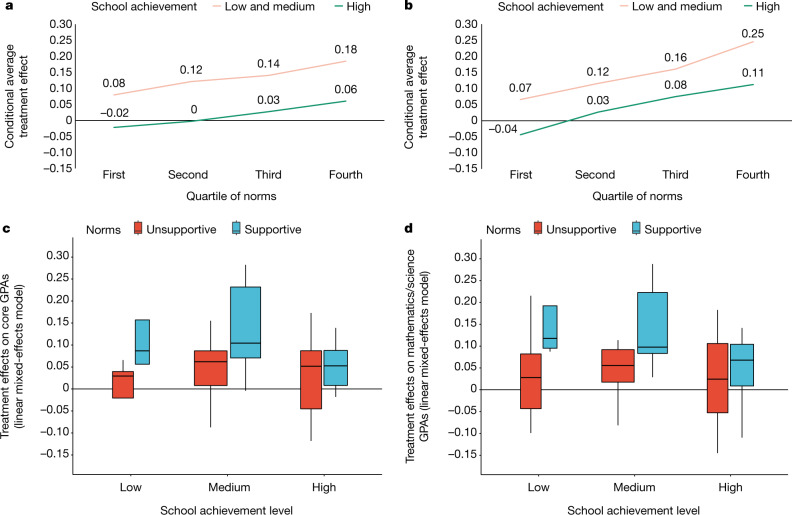
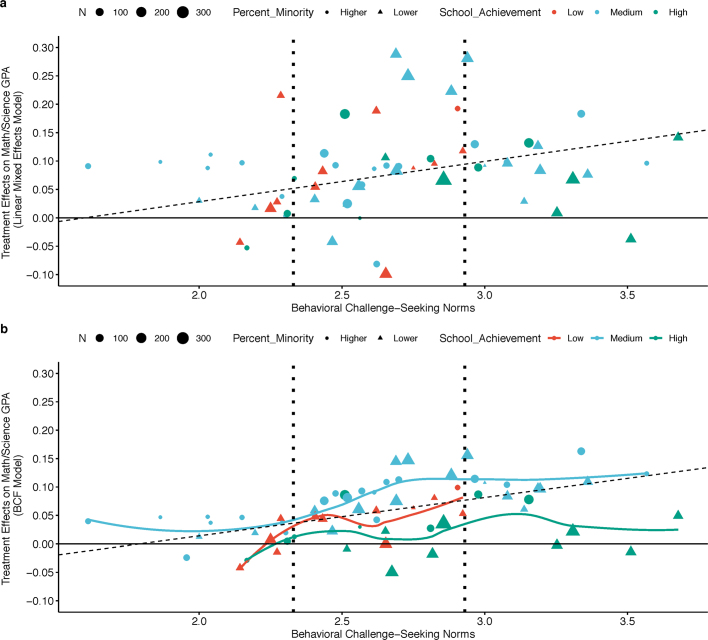
A short, online growth mindset intervention in a nationally representative sample of U.S. secondary students improved outcomes for lower-achieving students and increased advanced mathematics enrollment overall. Its grade effects were strongest in schools whose peer norms supported challenge-seeking, suggesting context matters for sustaining benefits.
Key findings
- Among lower-achieving adolescents, the intervention reduced fixed-mindset beliefs by B = −0.38 and had an effect size of 0.33 (n = 5,650 students, k = 65 schools, P < 0.001).
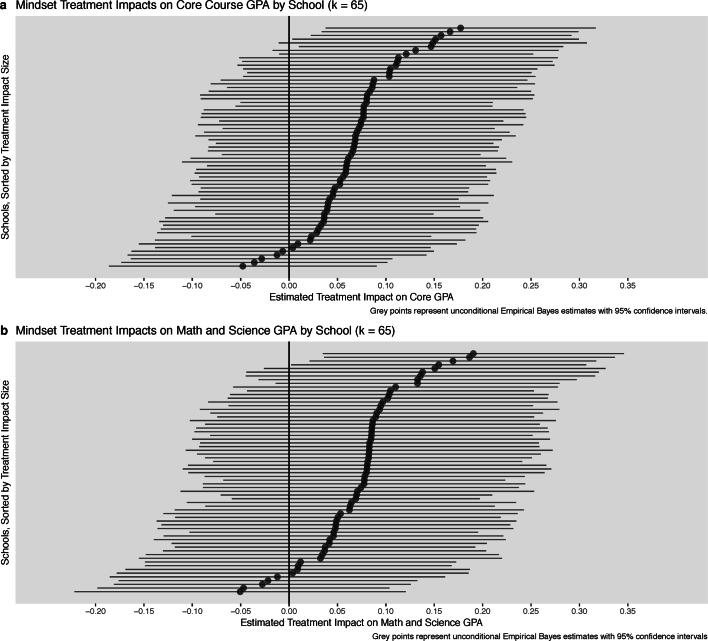
- Lower-achieving adolescents earned higher end-of-year core GPA when assigned to the intervention: B = 0.10 grade points, effect size 0.11, n = 6,320, k = 65, P = 0.001.
- The same GPA conclusion held for mathematics and science GPAs, with B = 0.10.
- Across the full cohort, the intervention increased tenth-grade advanced mathematics enrollment by 3 percentage points, from 33% to 36% (n = 6,690, k = 41, P = 0.001), and overall reduced the share of students below GPA 2.0 from 46% to 41%.
Methods
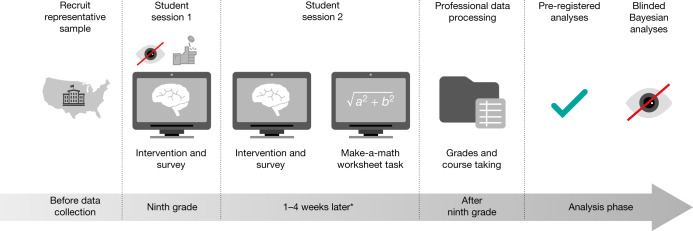
- Randomized, effectiveness-trial design: 12,490 ninth-grade adolescents in 65 regular public schools were individually randomized within schools in the National Study of Learning Mindsets.
- Intervention: two self-administered online sessions of about 25 minutes each, delivered roughly 20 days apart during school hours; control was a similar brain-functions program that did not address intelligence beliefs.
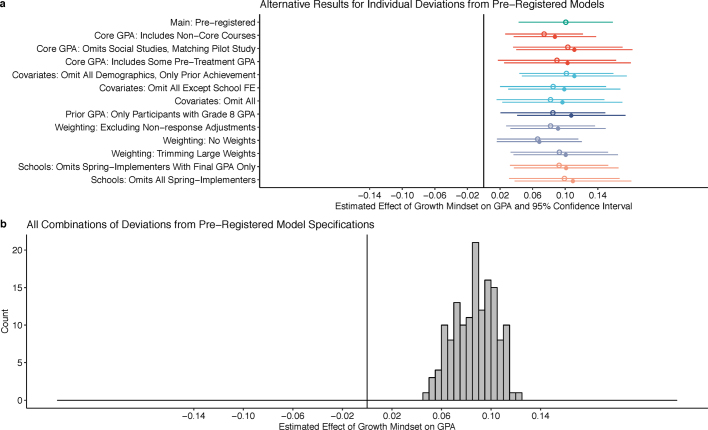
- Main analysis: intention-to-treat cluster-robust fixed-effects linear regression for average effects, mixed-effects models for cross-school heterogeneity, and a blinded Bayesian causal forest robustness analysis.
Limitations
- The paper states that the moderation results cannot support causal conclusions about school norms because norms were measured, not manipulated.
- Advanced mathematics enrollment analyses were exploratory because they were not pre-registered.
- Evident from the text: school-level heterogeneity analyses are limited by the observational nature of the moderators and by only 65 schools contributing to the main analyses.
Model-written summary. Check it against the paper before relying on it.
Integrity signals
Registry
Cites
Statistics
Figures
Verification
Claims the paper makes
15 Valid · 0 Not valid · 17 Not checked · 46 Own results and interpretations
The cited sources support only part of this claim — read each source’s verdict below.
In the paper
“When such students underperform in or opt out of rigorous coursework, they are far less likely to leave secondary school prepared for college or university or for advanced courses in college or university8,9.”
§ A national experiment reveals where a growth mindset improves achievement > Main
What the sources say
- Not checked — no full text of the sourcecites [8] Adelman, C. The Toolbox Revisited: Paths to Degree Completion from High School through College (US Department of Education, 2006).
- Partly supportedcites [9] Schiller KS Schmidt WH Muller C Houang R Hidden disparities: how courses and curricula shape opportunities in mathematics during high school Equity Excell. Educ. 2010 43 414 433 10.1080/10665684.2010.517062 23554547 PMC3612550 sourceExperimental — accuracy not yet measured
The ‘Course Enrollments as Opportunities to Learn’ section (page unavailable) says that mathematics course sequencing affects how far students progress in high school and that mathematics success has consequences for post-secondary schooling. The ‘Dimensions of Learning Opportunities’ section (page unavailable) also discusses undergraduates’ need for remedial courses. But the paper does not establish that students who underperform in or opt out of rigorous coursework are ‘far less likely’ to leave school prepared for college or advanced college courses. (LLM, conf=0.83)
plainstates an association- Asserted: passes — The authors put it forward as true.
- Checkable: passes — It can be checked against evidence.
- Load-bearing: passes — The paper’s conclusions depend on it.
- Based: passes — The paper gives a reason why it holds.
The cited sources support only part of this claim — read each source’s verdict below.
In the paper
“most interventions that are effective in initial efficacy trials go on to show weaker or no effects when they are scaled up in effectiveness trials that deliver treatments under everyday conditions to more heterogeneous samples21–23.”
§ A national experiment reveals where a growth mindset improves achievement > A focus on heterogeneity
What the sources say
- Not checked — no full text of the sourcecites [21] Greenberg MT Abenavoli R Universal interventions: fully exploring their impacts and potential to produce population-level impacts J. Res. Educ. Eff. 2017 10 40 67 source
- Not checked — no full text of the sourcecites [22] Allcott H Site selection bias in program evaluation Q. J. Econ. 2015 130 1117 1165 10.1093/qje/qjv015 source
- Partly supportedcites [23] Singal AG Higgins PDR Waljee AK A primer on effectiveness and efficacy trials Clin. Transl. Gastroenterol. 2014 5 e45 10.1038/ctg.2013.13 24384867 PMC3912314 sourceExperimental — accuracy not yet measured
The Introduction says efficacy trials can overestimate effects in clinical practice, and Study Design describes effectiveness trials as using more heterogeneous populations in routine settings, sometimes without a witnessed effect. The paper does not establish that *most* interventions with positive initial efficacy results subsequently show weaker or no effects in effectiveness trials. (LLM, conf=0.86)
plainstates a cause- Asserted: passes — The authors put it forward as true.
- Checkable: passes — It can be checked against evidence.
- Load-bearing: passes — The paper’s conclusions depend on it.
- Based: passes — The paper gives a reason why it holds.
The cited sources support only part of this claim — read each source’s verdict below.
In the paper
“Beliefs—and particularly beliefs that affect how students make sense of ongoing challenges—are important during high-stakes developmental turning points such as pubertal maturation43,44 or the transition to secondary school6.”
§ A national experiment reveals where a growth mindset improves achievement > Discussion
What the sources say
- Supportedcites [43] Yeager DS Dahl RE Dweck CS Why interventions to influence adolescent behavior often fail but could succeed Perspect. Psychol. Sci. 2018 13 101 122 10.1177/1745691617722620 29232535 PMC5758430 source
The Discussion (page unavailable) says adolescents’ beliefs about whether social traits can change shape how they interpret and cope with social adversity, using a new high school student as an example. The paper also links adolescents’ heightened sensitivity to status and respect to pubertal maturation and school transitions (Abstract, page unavailable). Together, these passages support the attributed point about the importance of beliefs during those developmental turning points. (LLM, conf=0.87)
- Partly supportedcites [44] Dahl RE Allen NB Wilbrecht L Suleiman AB Importance of investing in adolescence from a developmental science perspective Nature 2018 554 441 450 10.1038/nature25770 29469094 sourceExperimental — accuracy not yet measured
The Conclusion (p. 13) describes pubertal maturation as a dynamic period of learning and adaptation, and the Policy and intervention section (p. 10) identifies puberty as an important window for formative learning experiences. This supports the significance of the pubertal turning point, but the paper does not establish the claim about beliefs that shape how students interpret ongoing challenges. The transition to secondary school is attached to a different citation and is not assessed here. (LLM, conf=0.82)
- Not checked — no full text of the sourcecites [6] Crosnoe, R. Fitting In, Standing Out: Navigating the Social Challenges of high School to Get an Education (Cambridge Univ. Press, 2011). source
plainstates an association- Asserted: passes — The authors put it forward as true.
- Checkable: passes — It can be checked against evidence.
- Load-bearing: unclear — It is unclear whether the paper’s conclusions depend on it.
- Based: passes — The paper gives a reason why it holds.
- Supported
The cited sources support only part of this claim — read each source’s verdict below.
In the paper
“previously low-achieving students are the group that shows the steepest decline in grades during the transition to secondary school19”
§ A national experiment reveals where a growth mindset improves achievement > Main
What the sources say
- Partly supportedcites [19] Benner AD The transition to high school: current knowledge, future directions Educ. Psychol. Rev. 2011 23 299 328 10.1007/s10648-011-9152-0 21966178 PMC3182155 sourceExperimental — accuracy not yet measured
The Academic performance and engagement passage (page unavailable) reports that grades generally decline from middle to high school. The feeder-pattern passage (page unavailable) says low-performing students struggled more under a particular transition condition, but it does not establish that previously low-achieving students have the steepest grade decline of all groups. (LLM, conf=0.84)
plainstates an association- Asserted: passes — The authors put it forward as true.
- Checkable: passes — It can be checked against evidence.
- Load-bearing: passes — The paper’s conclusions depend on it.
- Based: passes — The paper gives a reason why it holds.
- Partly supported
The sources with a verdict support this claim; the rest weren’t checked yet, have no full text we could read, or their verdicts aren’t rated yet.
In the paper
“Nonetheless, previous randomized evaluations, including a pre-registered replication, found that online growth mindset interventions improved grades for the targeted group of students in secondary education who previously showed lower achievement13,16,18.”
§ A national experiment reveals where a growth mindset improves achievement > Main
What the sources say
- Supportedcites [13] Yeager DS Using design thinking to improve psychological interventions: the case of the growth mindset during the transition to high school J. Educ. Psychol. 2016 108 374 391 10.1037/edu0000098 27524832 PMC4981081 source
The Focus of the Present Investigation describes a prior randomized online evaluation in which lower-achieving high school students improved their GPA. The Study 2 Results report a pre-registered analysis showing a grade benefit for previously lower-achieving ninth graders, and the General Discussion calls it a rigorous replication. (LLM, conf=0.93)
- Not checked — no full text of the sourcecites [16] Paunesku D Mind-set interventions are a scalable treatment for academic underachievement Psychol. Sci. 2015 26 784 793 10.1177/0956797615571017 25862544 source
- Not checked — no full text of the sourcecites [18] Good C Aronson J Inzlicht M Improving adolescents’ standardized test performance: an intervention to reduce the effects of stereotype threat J. Appl. Dev. Psychol. 2003 24 645 662 10.1016/j.appdev.2003.09.002 source
plainstates a cause- Asserted: passes — The authors put it forward as true.
- Checkable: passes — It can be checked against evidence.
- Load-bearing: passes — The paper’s conclusions depend on it.
- Based: passes — The paper gives a reason why it holds.
- Supported
25 more claims · 2 with their cited sources checked
Create a free account to see all 78 claims and to verify the 6 references still open.
- Probably not a substantial claim. 38
- It may state two separate claims as one. 23
Claims other papers make about this one
Each is checked against this paper’s own text: does it say what the citing paper says it does?
The cited source doesn’t support the claim as written.
In the citing paper
“As another example, Yeager et al. (2019) only reported the results of the 50% of students performing below their school's median.They stated this was in part because lower-achieving students may have more academic difficulties and therefore may benefit more from a growth mindset intervention than higher-achieving students.Yet, they did not report a test of whether the treatment effect for lower-”
From Do growth mindset interventions impact students’ academic achievement? A systematic review and meta-analysis with recommendations for best practices. (2023) · cites this paper as Yeager et al. (2019)
Checked by a reasoning model — may be wrong.
Experimental — accuracy not yet measuredThe source backs part of the claim, not all of it — or backs it for a different population, condition or comparison.
In the citing paper
“For example, growth mindset interventions have been shown to help students alter their fixed mindset in a way that allows them to take a longer term perspective (Cassidy, 2015;Rhew et al., 2018;Yeager et al., 2019).”
From The impact of growth mindset training on entrepreneurial action among necessity entrepreneurs: Evidence from a randomized control trial (2023) · cites this paper as Yeager et al., 2019
Experimental — accuracy not yet measuredThe source backs part of the claim, not all of it — or backs it for a different population, condition or comparison.
In the citing paper
“The intervention offered greater benefits to lower achieving students if they attended schools whose students had an overall higher orientation towards growth mindset”
From Tackling Educational Inequalities with Social Psychology: Identities, Contexts, and Interventions (2021) · cites this paper as Yeager et al., 2019
Experimental — accuracy not yet measuredThe source backs part of the claim, not all of it — or backs it for a different population, condition or comparison.
In the citing paper
“Studies have shown that a growth mindset is associated with improved achievement; moreover, even short interventions can foster an increased growth mindset (Blackwell et al., 2007;Yeager et al., 2019).”
From Impacts of Standards-Based Grading on Students’ Mindset and Test Anxiety (2022) · cites this paper as Yeager et al., 2019
Experimental — accuracy not yet measuredThe source backs part of the claim, not all of it — or backs it for a different population, condition or comparison.
In the citing paper
“While scholars have examined growth mindset in both a poverty context (e.g., Burnette et al., 2018;Yeager et al., 2019) and an entrepreneurship context (e.g., Burnette et al., 2019), to the best of our knowledge none of these studies have examined both of these contexts together, nor have they been studied outside of the context of formal education settings.”
From The impact of growth mindset training on entrepreneurial action among necessity entrepreneurs: Evidence from a randomized control trial (2023) · cites this paper as Yeager et al., 2019
Experimental — accuracy not yet measured
5 more claims about this paper
Create a free account to see every claim other papers make about this one.
Statistics that don’t add up
Each reported p-value recomputed from its test statistic and degrees of freedom, each partial η² from its F, and each ratio, mean difference or B printed with a p checked against its own confidence interval.
Rated minor: it would not touch a result — a value no result rests on, a p-value that stays on the same side of the significance level, or a conflict that is clerical, resolved elsewhere in the paper, or outside its own findings.
In the paper
“B = −0.07 (95% confidence interval = 0.02, 0.13), s.e. = 0.03, z = −2.76, n = 6,320, k = 65, P = 0.006”
§ A national experiment reveals where a growth mindset improves achievement > Moderation by school achievement level
Statistics recomputed
Every reported test result, recomputed from its test statistic and degrees of freedom. A result shows as not adding up only once an independent check has confirmed it.
- Consistentz = 2.26reported p = .024 · recomputed p = .024
“z = 2.26, p = .024”
Self-check
Percentages, sums and reported differences re-computed from the paper’s own numbers.
Self-check results appear here once an independent check has confirmed them.
Citations
Cites
Our future: a Lancet commission on adolescent health and wellbeing
Patton, G. C., Sawyer, S. M., Santelli, J. S., Ross, D. A., Afifi, R., Allen, N. B., Arora, M., Azzopardi, P., Baldwin, W., Bonell, C., et al. (2016) · The Lancet · doi:10.1016/s0140-6736(16)00579-1 · Cited by 3,785
Blackwell, L. S., Trzesniewski, K. H., & Dweck, C. S. (2007) · Child Development · doi:10.1111/j.1467-8624.2007.00995.x · Cited by 3,784
Self-citationAronson, J., Fried, C. B., & Good, C. (2002) · Journal of Experimental Social Psychology · doi:10.1006/jesp.2001.1491 · Cited by 1,889
(2006) · US Department of Education · Cited by 1,586
Expectations of brilliance underlie gender distributions across academic disciplines
Leslie, S.-J., Cimpian, A., Meyer, M., & Freeland, E. (2015) · Science · doi:10.1126/science.1261375 · Cited by 1,516
Mind-sets matter: A meta-analytic review of implicit theories and self-regulation.
Burnette, J. L., O'Boyle, E. H., VanEpps, E. M., Pollack, J. M., & Finkel, E. J. (2013) · Psychological Bulletin · doi:10.1037/a0029531 · Cited by 1,367
Social-Psychological Interventions in Education: They’re Not Magic
Yeager, D. S., & Walton, G. M. (2011) · Review of Educational Research · doi:10.3102/0034654311405999 · Cited by 1,345
Self-citationMindsets: A View From Two Eras
Dweck, C. S., & Yeager, D. S. (2019) · Perspectives on Psychological Science · doi:10.1177/1745691618804166 · Cited by 1,259
Self-citationImportance of investing in adolescence from a developmental science perspective
Dahl, R. E., Allen, N. B., Wilbrecht, L., & Suleiman, A. B. (2018) · Nature · doi:10.1038/nature25770 · Cited by 1,196
Skills, education, and the rise of earnings inequality among the “other 99 percent”
Autor, D. H. (2014) · Science · doi:10.1126/science.1251868 · Cited by 1,160
Good, C., Aronson, J., & Inzlicht, M. (2003) · Journal of Applied Developmental Psychology · doi:10.1016/j.appdev.2003.09.002 · Cited by 1,096
Mind-Set Interventions Are a Scalable Treatment for Academic Underachievement
Paunesku, D., Walton, G. M., Romero, C., Smith, E. N., Yeager, D. S., & Dweck, C. S. (2015) · Psychological Science · doi:10.1177/0956797615571017 · Cited by 981
Self-citationEmpirical Benchmarks for Interpreting Effect Sizes in Research
Hill, C. J., Bloom, H. S., Black, A. R., & Lipsey, M. W. (2008) · Child Development Perspectives · doi:10.1111/j.1750-8606.2008.00061.x · Cited by 950
Reducing intergroup prejudice and conflict using the media: A field experiment in Rwanda.
Paluck, E. L. (2009) · Journal of Personality and Social Psychology · doi:10.1037/a0011989 · Cited by 902
Should Governments Invest More in Nudging?
Benartzi, S., Beshears, J., Milkman, K. L., Sunstein, C. R., Thaler, R. H., Shankar, M., Tucker-Ray, W., Congdon, W. J., & Galing, S. (2017) · Psychological Science · doi:10.1177/0956797617702501 · Cited by 861
Recursive Processes in Self-Affirmation: Intervening to Close the Minority Achievement Gap
Cohen, G. L., Garcia, J., Purdie-Vaughns, V., Apfel, N., & Brzustoski, P. (2009) · Science · doi:10.1126/science.1170769 · Cited by 800
A Primer on Effectiveness and Efficacy Trials
Singal, A. G., Higgins, P. D. R., & Waljee, A. K. (2014) · Clinical and Translational Gastroenterology · doi:10.1038/ctg.2013.13 · Cited by 698
Best-Evidence Synthesis: An Alternative to Meta-Analytic and Traditional Reviews
Slavin, R. E. (1986) · Educational Researcher · doi:10.2307/1174711 · Cited by 698
Yeager, D. S., Romero, C., Paunesku, D., Hulleman, C. S., Schneider, B., Hinojosa, C., Lee, H. Y., O'Brien, J., Flint, K., Roberts, A., et al. (2016) · Journal of Educational Psychology · doi:10.1037/edu0000098 · Cited by 691 · cited 1×
“Neither the self-reported mindsets, reported below, nor self-reported challenge-seeking, which is a single item reported in Yeager et al., 2016 and not discussed here for parsimony), showed significant variability.”
BackgroundSelf-citationRobins, R. W., & Pals, J. L. (2002) · Self and Identity · doi:10.1080/15298860290106805 · Cited by 644
Wise interventions: Psychological remedies for social and personal problems.
Walton, G. M., & Wilson, T. D. (2018) · Psychological Review · doi:10.1037/rev0000115 · Cited by 617
Self-citationWhy Interventions to Influence Adolescent Behavior Often Fail but Could Succeed
Yeager, D. S., Dahl, R. E., & Dweck, C. S. (2018) · Perspectives on Psychological Science · doi:10.1177/1745691617722620 · Cited by 512
Self-citationSite Selection Bias in Program Evaluation *
Allcott, H. (2015) · The Quarterly Journal of Economics · doi:10.1093/qje/qjv015 · Cited by 426
The transition to high school: Current knowledge, future directions
Benner, A. D. (2011) · Educational Psychology Review · doi:10.1007/s10648-011-9152-0 · Cited by 333
The Effect of High School Courses on Earnings
Rose, H., & Betts, J. R. (2004) · Review of Economics and Statistics · doi:10.1162/003465304323031076 · Cited by 317
Greenberg, M. T., & Abenavoli, R. (2017) · Journal of Research on Educational Effectiveness · doi:10.1080/19345747.2016.1246632 · Cited by 255
Dorie, V., Hill, J., Shalit, U., Scott, M., & Cervone, D. (2019) · Statistical Science · doi:10.1214/18-sts667 · Cited by 251
Fitting In, Standing Out: Navigating the Social Challenges of High School to Get an Education
Crosnoe, R. (2011) · doi:10.1017/cbo9780511793264 · Cited by 186
Self-citationHow Generalizable Is Your Experiment? An Index for Comparing Experimental Samples and Populations
Tipton, E. (2014) · Journal of Educational and Behavioral Statistics · doi:10.3102/1076998614558486 · Cited by 134 · cited 4×
“The generalizability index (Tipton, 2014) is a summary measure that provides the degree of distributional similarity between the schools in the analytic sample and the inference population, conditional on a set of covariates.”
BackgroundMethodInfluentialSelf-citationBloom, H. S., & Michalopoulos, C. (2013) · Prevention Science · doi:10.1007/s11121-010-0198-x · Cited by 83
Valuing Teachers: How Much Is a Good Teacher Worth?.
Hanushek, E. A. (2011) · Education next · Cited by 61
Bloom, H. S., Raudenbush, S. W., Weiss, M. J., & Porter, K. (2017) · Journal of Research on Educational Effectiveness · doi:10.1080/19345747.2016.1264518 · Cited by 54
Hidden Disparities: How Courses and Curricula Shape Opportunities in Mathematics During High School
Schiller, K. S., Schmidt, W. H., Muller, C., & Houang, R. T. (2010) · Equity & Excellence in Education · doi:10.1080/10665684.2010.517062 · Cited by 53
Self-citationCharacteristics of School Districts That Participate in Rigorous National Educational Evaluations
Stuart, E. A., Bell, S. H., Ebnesajjad, C. F., Olsen, R. B., & Orr, L. L. (2016) · Journal of Research on Educational Effectiveness · doi:10.1080/19345747.2016.1205160 · Cited by 49
The Investing in Innovation Fund: Summary of 67 Evaluations. Final Report. NCEE 2018-4013.
Boulay, B. A., Goodson, B. D., Olsen, R., McCormick, R., Darrow, C. L., Frye, M., Gan, K., Harvill, E. L., & Sarna, M. (2018) · National Center for Education Evaluation and Regional Assistance · Cited by 40
Tracking Health Inequalities from High School to Midlife
Carroll, J. M., Muller, C., Grodsky, E., & Warren, J. R. (2017) · Social Forces · doi:10.1093/sf/sox065 · Cited by 35
Self-citationSutton, A., Langenkamp, A. G., Muller, C., & Schiller, K. S. (2018) · Social Problems · doi:10.1093/socpro/spx044 · Cited by 31
Self-citationMore than Medicine: The Broken Promise of American Health
Kaplan, R. M. (2019) · doi:10.4159/9780674989207 · Cited by 19
Valentine, J. C., Aloe, A. M., & Wilson, S. J. (2019) · Russell Sage Foundation eBooks · doi:10.7758/9781610448864.22 · Cited by 19
Is the National Study of Learning Mindsets Nationally-Representative?Preprint
Gopalan, M., & Tipton, E. (2018) · PsyArXiv (OSF Preprints) · doi:10.31234/osf.io/dvmr7 · Cited by 14
Self-citationEditors’ Introduction: Theme Issue on Variation in Treatment Effects
Reardon, S. F., & Stuart, E. A. (2017) · Journal of Research on Educational Effectiveness · doi:10.1080/19345747.2017.1386037 · Cited by 11
More than Medicine: The Broken Promise of American Health
Kaplan, R. M. (2019) · Cited by 10
Hahn, P. R., Murray, J. S., & Carvalho, C. (2017) · arXiv · doi:10.48550/arxiv.1706.09523
Self-citationThe National Study of Learning Mindsets, [United States], 2015-2016: Version 1
Yeager, D. S. (2019) · ICPSR - Interuniversity Consortium for Political and Social Research · doi:10.3886/icpsr37353.v1
Self-citation
Research works printed but not linked: 1
- Tipton, E., Yeager, D. S., Iachan, R. & Schneider, B. in Experimental Methods in Survey Research: Techniques that Combine Random Sampling with Random Assignment (ed. Lavrakas, P. J.) (Wiley, 2019).
Cited by
Eccles, J. S., & Wigfield, A. (2020) · Contemporary Educational Psychology · doi:10.1016/j.cedpsych.2020.101859 · Cited by 2,368
Interpreting Effect Sizes of Education Interventions
Kraft, M. (2019) · Annenberg Institute for School Reform at Brown University · doi:10.26300/8pjp-2z74 · Cited by 1,286
Interpreting effect sizes of education interventions
Kraft, M. A. (2020) · Educational Researcher · doi:10.3102/0013189x20912798 · Cited by 1,281
What can be learned from growth mindset controversies?
Yeager, D. S., & Dweck, C. S. (2020) · American Psychologist · doi:10.1037/amp0000794 · Cited by 868
“…studies with a total of over 23,000 participants have replicated the meaning system correlations (see Figure 2 and Table 1), two of which were generalizable to entire populations of students, either to the U.S. overall, (Yeager et al., 2019) or to entire parts of Norway (Rege et al., in press).”
BackgroundMethodResultInfluentialSelf-citationBehavioural science is unlikely to change the world without a heterogeneity revolution
Bryan, C. J., Tipton, E., & Yeager, D. S. (2021) · Nature Human Behaviour · doi:10.1038/s41562-021-01143-3 · Cited by 537
Self-citation
Metadata
- Authors
- Yeager, D. S., Hanselman, P., Walton, G. M., Murray, J. S., Crosnoe, R., Muller, C., Tipton, E., Schneider, B., Hulleman, C. S., Hinojosa, C. P., Paunesku, D., Romero, C., Flint, K., Roberts, A., Trott, J., Iachan, R., Buontempo, J., Yang, S. M., Carvalho, C. M., Hahn, P. R., Gopalan, M., Mhatre, P., Ferguson, R., Duckworth, A. L., & Dweck, C. S.
- Affiliations
- The University of Texas at Austin (US)
- University of California, Irvine (US)
- Stanford University (US)
- Northwestern University (US)
- Michigan State University (US)
- University of Virginia (US)
- University of Chicago (US)
- ICF International (United States) (US)
- Arizona State University (US)
- Pennsylvania State University (US)
- Harvard University (US)
- University of Pennsylvania (US)
- Corresponding author
- Yeager, David S.
- Hanselman, Paul
- ORCID
- Yeager, David S.
- Hanselman, Paul
- Walton, Gregory M.
- Murray, Jared S.
- Crosnoe, Robert
- Muller, Chandra
- Tipton, Elizabeth
- Schneider, Barbara
- Hulleman, Chris S.
- Hinojosa, Cintia P.
- Paunesku, David
- Roberts, Alice
- Iachan, Ronaldo
- Buontempo, Jenny
- Carvalho, Carlos M.
- Gopalan, Maithreyi
- Mhatre, Pratik
- Duckworth, Angela L.
- Dweck, Carol S.
- Venue
- Nature
- Published
- 2019-08-07
- Volume
- 573
- Issue
- 7774
- Pages
- 364-369
- ISSN
- 0028-0836 (ISSN-L)
- 1476-4687
- PMC
- PMC6786290
- OpenAlex
- W2964722401
- Cited by
- 1,513
- References
- 43
- Citations by year
- 2026: 203 · 2025: 211 · 2024: 219 · 2023: 325 · 2022: 202 · 2021: 200 · 2020: 131 · 2019: 20
- FWCI
- 163.13
- Type
- journal article
- Language
- en
- Open access
- hybrid
- doi.org
- Licence
- cc-by
- creativecommons.org/licenses/by/4.0 (tdm)
- creativecommons.org/licenses/by/4.0 (vor)
- Locations
- Nature (publishedVersion, cc-by)
- PubMed Central (publishedVersion, cc-by)
- PubMed (publishedVersion)
- RePEc: Research Papers in Economics (submittedVersion)
- eScholarship (California Digital Library) (submittedVersion, cc-by)
- Funders
- National Science Foundation (1761179)
- William T. Grant Foundation
- Houston Endowment
- Spencer Foundation
- University of Texas at Austin
- Raikes Foundation
- National Institutes of Health
- Center for Advanced Study in the Behavioral Sciences, Stanford University
- National Institute of Child Health and Human Development (10.13039/100000071, HD042849)
- Center for Advanced Study, University of Illinois at Urbana-Champaign
- Eunice Kennedy Shriver National Institute of Child Health and Human Development (R24HD042849, R01HD084772, P2CHD042849)
- Topics
- Social Sciences › Psychology › Developmental and Educational Psychology › Education, Achievement, and Giftedness
- Social Sciences › Psychology › Social Psychology › Grit, Self-Efficacy, and Motivation
- Social Sciences › Education › School Choice and Performance
- Keywords
- growth mindset, academic performance, adolescents, online intervention, peer norms, secondary education, school context, scalable interventions, preregistration, Bayesian analysis
- MeSH terms
- Psychosocial Support Systems, Academic Success, Adolescent, United Kingdom, Humans, Students
About these checks
Registry, retraction, Cites and statistics results are computed, not judged, with one exception: a printed reference that no index lists is read once by a model before it counts as a citation error. Claims are extracted by a model and kept only when their quote appears verbatim in the text; each cited source is then checked, with a model’s help, for whether it says what the claim relies on. Those verdicts can be wrong — read the claim’s quote and the cited source before relying on one.
The claim verdicts this report counts are experimental: their accuracy is not yet measured.
A language model drew the claims from the paper on 2026-09-28, under version 3 of the claim definition (model deepseek-v4.1-flash, prompt extract-v3).
A second model labelled each claim on 2026-09-28 (model jev-1.13-20260917, definition revision gold-guideline-v0.2).
Cited sources are checked with a language model’s help (gpt-6-sol).
Statistics and arithmetic are recomputed, not judged.
Confidence bands are shown only for fields calibrated on our annotated test set. None is calibrated yet, so no band is shown.
What counts as a claim ›How we measure confidence ›How we check this ›
Are you an author, or do you see a problem with this page? Request a review
Data sources
Bibliographic data: Semantic Scholar, OpenAlex, Crossref.
Contains information from the Semantic Scholar Academic Graph Datasets, made available under the ODC Attribution License (ODC-BY 1.0).
Semantic Scholar’s data is described in: Kinney, R., et al. (2023). The Semantic Scholar Open Data Platform. arXiv:2301.10140.
