

A national experiment reveals where a growth mindset improves achievement
Open accessThe DOI matches its Crossref record; 44 of the 44 references it cites were found in a registry or an index; 16 of the 56 sources its claims cite were checked for support.
Abstract
A short online growth mindset intervention improved grades among lower-achieving students and increased advanced mathematics enrollment in a nationally representative U.S. sample.
Overview
CoChat Summary
TL;DR
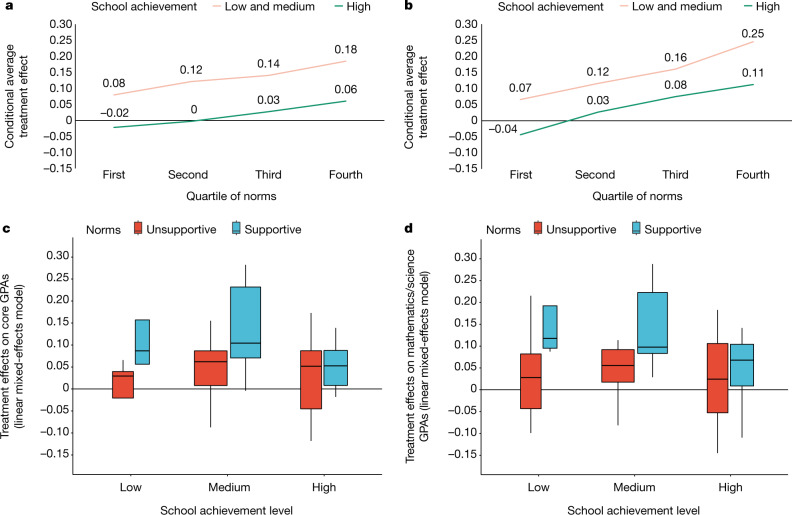
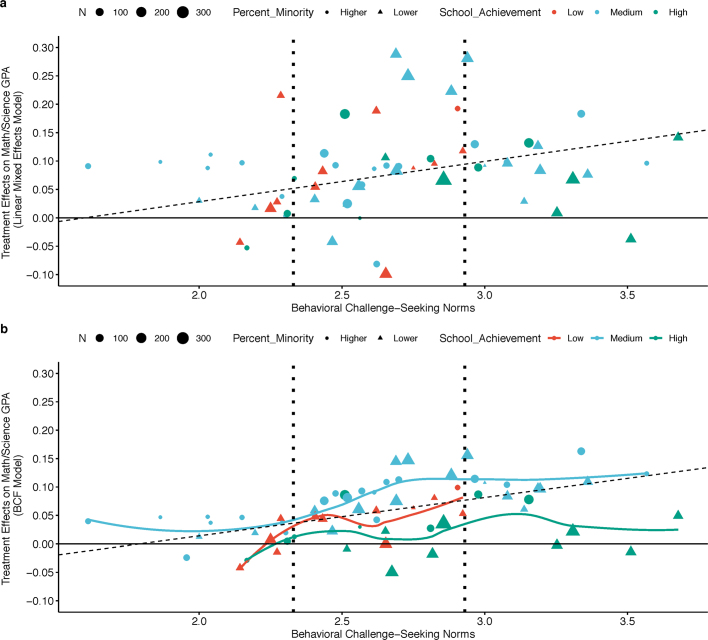
A short, online growth mindset intervention in a nationally representative sample of U.S. secondary students improved outcomes for lower-achieving students and increased advanced mathematics enrollment overall. Its grade effects were strongest in schools whose peer norms supported challenge-seeking, suggesting context matters for sustaining benefits.
Key findings
- Among lower-achieving adolescents, the intervention reduced fixed-mindset beliefs by B = −0.38 and had an effect size of 0.33 (n = 5,650 students, k = 65 schools, P < 0.001).
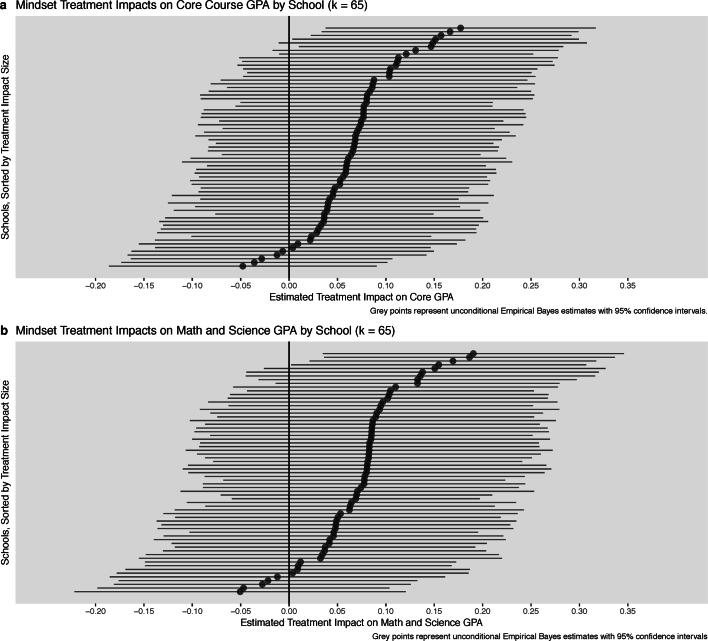
- Lower-achieving adolescents earned higher end-of-year core GPA when assigned to the intervention: B = 0.10 grade points, effect size 0.11, n = 6,320, k = 65, P = 0.001.
- The same GPA conclusion held for mathematics and science GPAs, with B = 0.10.
- Across the full cohort, the intervention increased tenth-grade advanced mathematics enrollment by 3 percentage points, from 33% to 36% (n = 6,690, k = 41, P = 0.001), and overall reduced the share of students below GPA 2.0 from 46% to 41%.
Methods
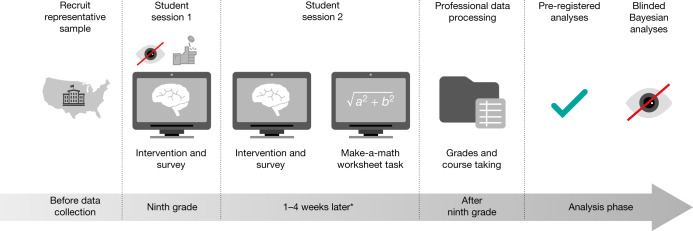
- Randomized, effectiveness-trial design: 12,490 ninth-grade adolescents in 65 regular public schools were individually randomized within schools in the National Study of Learning Mindsets.
- Intervention: two self-administered online sessions of about 25 minutes each, delivered roughly 20 days apart during school hours; control was a similar brain-functions program that did not address intelligence beliefs.
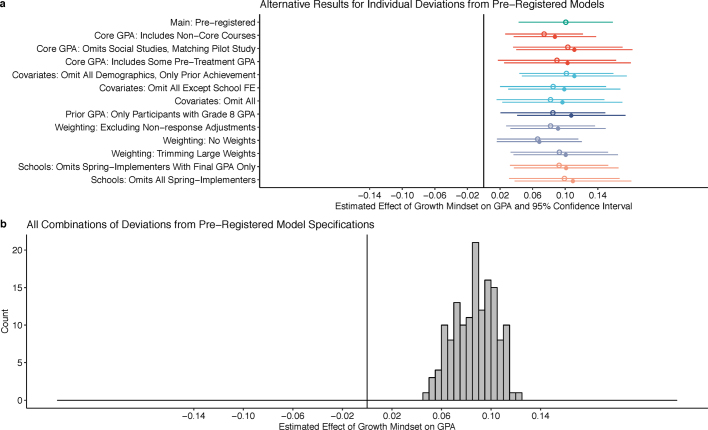
- Main analysis: intention-to-treat cluster-robust fixed-effects linear regression for average effects, mixed-effects models for cross-school heterogeneity, and a blinded Bayesian causal forest robustness analysis.
Limitations
- The paper states that the moderation results cannot support causal conclusions about school norms because norms were measured, not manipulated.
- Advanced mathematics enrollment analyses were exploratory because they were not pre-registered.
- Evident from the text: school-level heterogeneity analyses are limited by the observational nature of the moderators and by only 65 schools contributing to the main analyses.
Model-written summary. Check it against the paper before relying on it.
Integrity signals
Registry
Cites
Statistics
Figures
Verification
Claims the paper makes
15 Valid · 0 Not valid · 17 Not checked · 46 Own results and interpretations
The cited sources support only part of this claim — read each source’s verdict below.
In the paper
“When such students underperform in or opt out of rigorous coursework, they are far less likely to leave secondary school prepared for college or university or for advanced courses in college or university8,9.”
§ A national experiment reveals where a growth mindset improves achievement > Main
What the sources say
- Not checked — no full text of the sourcecites [8] Adelman, C. The Toolbox Revisited: Paths to Degree Completion from High School through College (US Department of Education, 2006).
- Partly supportedcites [9] Schiller KS Schmidt WH Muller C Houang R Hidden disparities: how courses and curricula shape opportunities in mathematics during high school Equity Excell. Educ. 2010 43 414 433 10.1080/10665684.2010.517062 23554547 PMC3612550 sourceExperimental — accuracy not yet measured
The ‘Course Enrollments as Opportunities to Learn’ section (page unavailable) says that mathematics course sequencing affects how far students progress in high school and that mathematics success has consequences for post-secondary schooling. The ‘Dimensions of Learning Opportunities’ section (page unavailable) also discusses undergraduates’ need for remedial courses. But the paper does not establish that students who underperform in or opt out of rigorous coursework are ‘far less likely’ to leave school prepared for college or advanced college courses. (LLM, conf=0.83)
plainstates an association- Asserted: passes — The authors put it forward as true.
- Checkable: passes — It can be checked against evidence.
- Load-bearing: passes — The paper’s conclusions depend on it.
- Based: passes — The paper gives a reason why it holds.
The cited sources support only part of this claim — read each source’s verdict below.
In the paper
“most interventions that are effective in initial efficacy trials go on to show weaker or no effects when they are scaled up in effectiveness trials that deliver treatments under everyday conditions to more heterogeneous samples21–23.”
§ A national experiment reveals where a growth mindset improves achievement > A focus on heterogeneity
What the sources say
- Not checked — no full text of the sourcecites [21] Greenberg MT Abenavoli R Universal interventions: fully exploring their impacts and potential to produce population-level impacts J. Res. Educ. Eff. 2017 10 40 67 source
- Not checked — no full text of the sourcecites [22] Allcott H Site selection bias in program evaluation Q. J. Econ. 2015 130 1117 1165 10.1093/qje/qjv015 source
- Partly supportedcites [23] Singal AG Higgins PDR Waljee AK A primer on effectiveness and efficacy trials Clin. Transl. Gastroenterol. 2014 5 e45 10.1038/ctg.2013.13 24384867 PMC3912314 sourceExperimental — accuracy not yet measured
The Introduction says efficacy trials can overestimate effects in clinical practice, and Study Design describes effectiveness trials as using more heterogeneous populations in routine settings, sometimes without a witnessed effect. The paper does not establish that *most* interventions with positive initial efficacy results subsequently show weaker or no effects in effectiveness trials. (LLM, conf=0.86)
plainstates a cause- Asserted: passes — The authors put it forward as true.
- Checkable: passes — It can be checked against evidence.
- Load-bearing: passes — The paper’s conclusions depend on it.
- Based: passes — The paper gives a reason why it holds.
The cited sources support only part of this claim — read each source’s verdict below.
In the paper
“Beliefs—and particularly beliefs that affect how students make sense of ongoing challenges—are important during high-stakes developmental turning points such as pubertal maturation43,44 or the transition to secondary school6.”
§ A national experiment reveals where a growth mindset improves achievement > Discussion
What the sources say
- Supportedcites [43] Yeager DS Dahl RE Dweck CS Why interventions to influence adolescent behavior often fail but could succeed Perspect. Psychol. Sci. 2018 13 101 122 10.1177/1745691617722620 29232535 PMC5758430 source
The Discussion (page unavailable) says adolescents’ beliefs about whether social traits can change shape how they interpret and cope with social adversity, using a new high school student as an example. The paper also links adolescents’ heightened sensitivity to status and respect to pubertal maturation and school transitions (Abstract, page unavailable). Together, these passages support the attributed point about the importance of beliefs during those developmental turning points. (LLM, conf=0.87)
- Partly supportedcites [44] Dahl RE Allen NB Wilbrecht L Suleiman AB Importance of investing in adolescence from a developmental science perspective Nature 2018 554 441 450 10.1038/nature25770 29469094 sourceExperimental — accuracy not yet measured
The Conclusion (p. 13) describes pubertal maturation as a dynamic period of learning and adaptation, and the Policy and intervention section (p. 10) identifies puberty as an important window for formative learning experiences. This supports the significance of the pubertal turning point, but the paper does not establish the claim about beliefs that shape how students interpret ongoing challenges. The transition to secondary school is attached to a different citation and is not assessed here. (LLM, conf=0.82)
- Not checked — no full text of the sourcecites [6] Crosnoe, R. Fitting In, Standing Out: Navigating the Social Challenges of high School to Get an Education (Cambridge Univ. Press, 2011). source
plainstates an association- Asserted: passes — The authors put it forward as true.
- Checkable: passes — It can be checked against evidence.
- Load-bearing: unclear — It is unclear whether the paper’s conclusions depend on it.
- Based: passes — The paper gives a reason why it holds.
- Supported
The cited sources support only part of this claim — read each source’s verdict below.
In the paper
“previously low-achieving students are the group that shows the steepest decline in grades during the transition to secondary school19”
§ A national experiment reveals where a growth mindset improves achievement > Main
What the sources say
- Partly supportedcites [19] Benner AD The transition to high school: current knowledge, future directions Educ. Psychol. Rev. 2011 23 299 328 10.1007/s10648-011-9152-0 21966178 PMC3182155 sourceExperimental — accuracy not yet measured
The Academic performance and engagement passage (page unavailable) reports that grades generally decline from middle to high school. The feeder-pattern passage (page unavailable) says low-performing students struggled more under a particular transition condition, but it does not establish that previously low-achieving students have the steepest grade decline of all groups. (LLM, conf=0.84)
plainstates an association- Asserted: passes — The authors put it forward as true.
- Checkable: passes — It can be checked against evidence.
- Load-bearing: passes — The paper’s conclusions depend on it.
- Based: passes — The paper gives a reason why it holds.
- Partly supported
The sources with a verdict support this claim; the rest weren’t checked yet, have no full text we could read, or their verdicts aren’t rated yet.
In the paper
“Nonetheless, previous randomized evaluations, including a pre-registered replication, found that online growth mindset interventions improved grades for the targeted group of students in secondary education who previously showed lower achievement13,16,18.”
§ A national experiment reveals where a growth mindset improves achievement > Main
What the sources say
- Supportedcites [13] Yeager DS Using design thinking to improve psychological interventions: the case of the growth mindset during the transition to high school J. Educ. Psychol. 2016 108 374 391 10.1037/edu0000098 27524832 PMC4981081 source
The Focus of the Present Investigation describes a prior randomized online evaluation in which lower-achieving high school students improved their GPA. The Study 2 Results report a pre-registered analysis showing a grade benefit for previously lower-achieving ninth graders, and the General Discussion calls it a rigorous replication. (LLM, conf=0.93)
- Not checked — no full text of the sourcecites [16] Paunesku D Mind-set interventions are a scalable treatment for academic underachievement Psychol. Sci. 2015 26 784 793 10.1177/0956797615571017 25862544 source
- Not checked — no full text of the sourcecites [18] Good C Aronson J Inzlicht M Improving adolescents’ standardized test performance: an intervention to reduce the effects of stereotype threat J. Appl. Dev. Psychol. 2003 24 645 662 10.1016/j.appdev.2003.09.002 source
plainstates a cause- Asserted: passes — The authors put it forward as true.
- Checkable: passes — It can be checked against evidence.
- Load-bearing: passes — The paper’s conclusions depend on it.
- Based: passes — The paper gives a reason why it holds.
- Supported
25 more claims · 2 with their cited sources checked
Create a free account to see all 78 claims and to verify the 6 references still open.
- Probably not a substantial claim. 38
- It may state two separate claims as one. 23
Claims other papers make about this one
Each is checked against this paper’s own text: does it say what the citing paper says it does?
The cited source doesn’t support the claim as written.
In the citing paper
“As another example, Yeager et al. (2019) only reported the results of the 50% of students performing below their school's median.They stated this was in part because lower-achieving students may have more academic difficulties and therefore may benefit more from a growth mindset intervention than higher-achieving students.Yet, they did not report a test of whether the treatment effect for lower-”
From Do growth mindset interventions impact students’ academic achievement? A systematic review and meta-analysis with recommendations for best practices. (2023) · cites this paper as Yeager et al. (2019)
Checked by a reasoning model — may be wrong.
Experimental — accuracy not yet measuredThe source backs part of the claim, not all of it — or backs it for a different population, condition or comparison.
In the citing paper
“For example, growth mindset interventions have been shown to help students alter their fixed mindset in a way that allows them to take a longer term perspective (Cassidy, 2015;Rhew et al., 2018;Yeager et al., 2019).”
From The impact of growth mindset training on entrepreneurial action among necessity entrepreneurs: Evidence from a randomized control trial (2023) · cites this paper as Yeager et al., 2019
Experimental — accuracy not yet measuredThe source backs part of the claim, not all of it — or backs it for a different population, condition or comparison.
In the citing paper
“The intervention offered greater benefits to lower achieving students if they attended schools whose students had an overall higher orientation towards growth mindset”
From Tackling Educational Inequalities with Social Psychology: Identities, Contexts, and Interventions (2021) · cites this paper as Yeager et al., 2019
Experimental — accuracy not yet measuredThe source backs part of the claim, not all of it — or backs it for a different population, condition or comparison.
In the citing paper
“Studies have shown that a growth mindset is associated with improved achievement; moreover, even short interventions can foster an increased growth mindset (Blackwell et al., 2007;Yeager et al., 2019).”
From Impacts of Standards-Based Grading on Students’ Mindset and Test Anxiety (2022) · cites this paper as Yeager et al., 2019
Experimental — accuracy not yet measuredThe source backs part of the claim, not all of it — or backs it for a different population, condition or comparison.
In the citing paper
“While scholars have examined growth mindset in both a poverty context (e.g., Burnette et al., 2018;Yeager et al., 2019) and an entrepreneurship context (e.g., Burnette et al., 2019), to the best of our knowledge none of these studies have examined both of these contexts together, nor have they been studied outside of the context of formal education settings.”
From The impact of growth mindset training on entrepreneurial action among necessity entrepreneurs: Evidence from a randomized control trial (2023) · cites this paper as Yeager et al., 2019
Experimental — accuracy not yet measured
5 more claims about this paper
Create a free account to see every claim other papers make about this one.
Statistics that don’t add up
Each reported p-value recomputed from its test statistic and degrees of freedom, each partial η² from its F, and each ratio, mean difference or B printed with a p checked against its own confidence interval.
Rated minor: it would not touch a result — a value no result rests on, a p-value that stays on the same side of the significance level, or a conflict that is clerical, resolved elsewhere in the paper, or outside its own findings.
In the paper
“B = −0.07 (95% confidence interval = 0.02, 0.13), s.e. = 0.03, z = −2.76, n = 6,320, k = 65, P = 0.006”
§ A national experiment reveals where a growth mindset improves achievement > Moderation by school achievement level
Statistics recomputed
Every reported test result, recomputed from its test statistic and degrees of freedom. A result shows as not adding up only once an independent check has confirmed it.
- Consistentz = 2.26reported p = .024 · recomputed p = .024
“z = 2.26, p = .024”
Self-check
Percentages, sums and reported differences re-computed from the paper’s own numbers.
Self-check results appear here once an independent check has confirmed them.
Citations
Cites
Our future: a Lancet commission on adolescent health and wellbeing
Patton, G. C., Sawyer, S. M., Santelli, J. S., Ross, D. A., Afifi, R., Allen, N. B., Arora, M., Azzopardi, P., Baldwin, W., Bonell, C., et al. (2016) · The Lancet · doi:10.1016/s0140-6736(16)00579-1 · Cited by 3,785
Blackwell, L. S., Trzesniewski, K. H., & Dweck, C. S. (2007) · Child Development · doi:10.1111/j.1467-8624.2007.00995.x · Cited by 3,784
Self-citationAronson, J., Fried, C. B., & Good, C. (2002) · Journal of Experimental Social Psychology · doi:10.1006/jesp.2001.1491 · Cited by 1,889
(2006) · US Department of Education · Cited by 1,586
Expectations of brilliance underlie gender distributions across academic disciplines
Leslie, S.-J., Cimpian, A., Meyer, M., & Freeland, E. (2015) · Science · doi:10.1126/science.1261375 · Cited by 1,516
Mind-sets matter: A meta-analytic review of implicit theories and self-regulation.
Burnette, J. L., O'Boyle, E. H., VanEpps, E. M., Pollack, J. M., & Finkel, E. J. (2013) · Psychological Bulletin · doi:10.1037/a0029531 · Cited by 1,367
Social-Psychological Interventions in Education: They’re Not Magic
Yeager, D. S., & Walton, G. M. (2011) · Review of Educational Research · doi:10.3102/0034654311405999 · Cited by 1,345
Self-citationMindsets: A View From Two Eras
Dweck, C. S., & Yeager, D. S. (2019) · Perspectives on Psychological Science · doi:10.1177/1745691618804166 · Cited by 1,259
Self-citationImportance of investing in adolescence from a developmental science perspective
Dahl, R. E., Allen, N. B., Wilbrecht, L., & Suleiman, A. B. (2018) · Nature · doi:10.1038/nature25770 · Cited by 1,196
Skills, education, and the rise of earnings inequality among the “other 99 percent”
Autor, D. H. (2014) · Science · doi:10.1126/science.1251868 · Cited by 1,160
Research works printed but not linked: 1
- Tipton, E., Yeager, D. S., Iachan, R. & Schneider, B. in Experimental Methods in Survey Research: Techniques that Combine Random Sampling with Random Assignment (ed. Lavrakas, P. J.) (Wiley, 2019).
Cited by
Eccles, J. S., & Wigfield, A. (2020) · Contemporary Educational Psychology · doi:10.1016/j.cedpsych.2020.101859 · Cited by 2,368
Interpreting Effect Sizes of Education Interventions
Kraft, M. (2019) · Annenberg Institute for School Reform at Brown University · doi:10.26300/8pjp-2z74 · Cited by 1,286
Interpreting effect sizes of education interventions
Kraft, M. A. (2020) · Educational Researcher · doi:10.3102/0013189x20912798 · Cited by 1,281
What can be learned from growth mindset controversies?
Yeager, D. S., & Dweck, C. S. (2020) · American Psychologist · doi:10.1037/amp0000794 · Cited by 868
“…studies with a total of over 23,000 participants have replicated the meaning system correlations (see Figure 2 and Table 1), two of which were generalizable to entire populations of students, either to the U.S. overall, (Yeager et al., 2019) or to entire parts of Norway (Rege et al., in press).”
BackgroundMethodResultInfluentialSelf-citationBehavioural science is unlikely to change the world without a heterogeneity revolution
Bryan, C. J., Tipton, E., & Yeager, D. S. (2021) · Nature Human Behaviour · doi:10.1038/s41562-021-01143-3 · Cited by 537
Self-citationSmall Effects: The Indispensable Foundation for a Cumulative Psychological Science
Götz, F. M., Gosling, S. D., & Rentfrow, P. J. (2022) · Perspectives on Psychological Science · doi:10.1177/1745691620984483 · Cited by 538
L2 grit: passion and perseverance for second-language learning
Teimouri, Y., Plonsky, L., & Tabandeh, F. (2022) · Language Teaching Research · doi:10.1177/1362168820921895 · Cited by 503
“What do gritty students think about their intelligence? As noted, the findings of achievement motivation research (see Dweck, 2006; Yeager et al., 2019) favor a growth mindset because it is closely related to perseverance of effort.”
BackgroundMacnamara, B. N., & Burgoyne, A. P. (2023) · Psychological Bulletin · doi:10.1037/bul0000352 · Cited by 415
“…scores or factors associated with baseline scores could interact with the effect of the intervention — for example, some mindset proponents have suggested that growth mindset interventions may be more effective for lower-achieving students than higher-achieving students (e.g., Yeager et al., 2019).”
BackgroundMethodResultInfluentialUsing large language models in psychology
Demszky, D., Yang, D., Yeager, D. S., Bryan, C. J., Clapper, M., Chandhok, S., Eichstaedt, J. C., Hecht, C., Jamieson, J., Johnson, M., et al. (2023) · Nature Reviews Psychology · doi:10.1038/s44159-023-00241-5 · Cited by 369
“The interpretability of LLM output increases access to these tools for non-technical users and enables powerful applications, such as coaching tools for teachers, therapists and peers 65–67 or for students who are writing self-persuasion essays as part of ‘wise’ psychological interventions 68–71 .”
Self-citationTeacher Mindsets Help Explain Where a Growth-Mindset Intervention Does and Doesn’t Work
Yeager, D. S., Carroll, J. M., Buontempo, J., Cimpian, A., Woody, S., Crosnoe, R., Muller, C., Murray, J., Mhatre, P., Kersting, N., et al. (2022) · Psychological Science · doi:10.1177/09567976211028984 · Cited by 356
Self-citationTesting (quizzing) boosts classroom learning: a systematic and meta-analytic review
Yang, C., Luo, L., Vadillo, M. A., Yu, R., & Shanks, D. R. (2021) · Psychological Bulletin · doi:10.1037/bul0000309 · Cited by 333
“In addition, as noted by many educators and researchers, “in real-world [educational] settings, a fifth of a standard deviation [0.20 SD] is a large effect” (Dynarski, 2017; Yeager et al., 2019).”
BackgroundInfluentialHahn, P. R., Murray, J. S., & Carvalho, C. M. (2020) · Bayesian Analysis · doi:10.1214/19-ba1195 · Cited by 304
“This has been important in applications of the methods outlined in this paper (Yeager et al., 2019).”
Self-citationWalton, G. M., & Yeager, D. S. (2020) · Current Directions in Psychological Science · doi:10.1177/0963721420904453 · Cited by 298
“But if the norm in your school means that you would sacrifice your social status if you chose harder school work, would you hold on to this belief? Would you still pursue challenges (Yeager et al., 2019)? • • You learn that it is normal, at first, to worry whether you belong in college and that this gets better with t…”
BackgroundSelf-citationPersistence and Fade-Out of Educational-Intervention Effects: Mechanisms and Potential Solutions
Bailey, D. H., Duncan, G. J., Cunha, F., Foorman, B. R., & Yeager, D. S. (2020) · Psychological Science in the Public Interest · doi:10.1177/1529100620915848 · Cited by 284
Self-citationLou, N. M., & Noels, K. A. (2019) · System · doi:10.1016/j.system.2019.102126 · Cited by 264
Growing a growth mindset: characterizing how and why undergraduate students’ mindsets change
Limeri, L. B., Carter, N. T., Choe, J., Harper, H. G., Martin, H. R., Benton, A., & Dolan, E. L. (2020) · International Journal of STEM Education · doi:10.1186/s40594-020-00227-2 · Cited by 240
Knowing Ourselves Together: The Cultural Origins of Metacognition
Heyes, C., Bang, D., Shea, N., Frith, C. D., & Fleming, S. M. (2020) · Trends in Cognitive Sciences · doi:10.1016/j.tics.2020.02.007 · Cited by 232
A synergistic mindsets intervention protects adolescents from stress
Yeager, D. S., Bryan, C. J., Gross, J. J., Murray, J. S., Krettek Cobb, D., H. F. Santos, P., Gravelding, H., Johnson, M., & Jamieson, J. P. (2022) · Nature · doi:10.1038/s41586-022-04907-7 · Cited by 225
Self-citationGladstone, J. R., & Cimpian, A. (2021) · International Journal of STEM Education · doi:10.1186/s40594-021-00315-x · Cited by 227
“…the sparsity of the research on each moderator meant that we could not feasibly analyze the data separately by outcome—and by theoretical considerations, insofar as motivation is a causal antecedent of achievement (e.g., Eccles & Wigfield, 2020; Schunk & Usher, 2019; Yeager et al., 2019).”
BackgroundMotivation-Achievement Cycles in Learning: a Literature Review and Research Agenda
Vu, T., Magis-Weinberg, L., Jansen, B. R. J., van Atteveldt, N., Janssen, T. W. P., Lee, N. C., van der Maas, H. L. J., Raijmakers, M. E. J., Sachisthal, M. S. M., & Meeter, M. (2022) · Educational Psychology Review · doi:10.1007/s10648-021-09616-7 · Cited by 224
Power to Detect What? Considerations for Planning and Evaluating Sample Size
Giner-Sorolla, R., Montoya, A. K., Reifman, A., Carpenter, T., Lewis, N. A., Aberson, C. L., Bostyn, D. H., Conrique, B. G., Ng, B. W., Schoemann, A. M., et al. (2024) · Personality and Social Psychology Review · doi:10.1177/10888683241228328 · Cited by 221
“…it as worthwhile to invest student time resources (say, 1 hr a week) into a growth mindset exercise that translates into a 0.10 GPA increase in student performance (cf. Yeager et al., 2019), and if so, at what minimal point in GPA improvement the intervention would cease to be seen as worthwhile.”
BackgroundInfluentialMurphy, M. C., Gopalan, M., Carter, E. R., Emerson, K. T. U., Bottoms, B. L., & Walton, G. M. (2020) · Science Advances · doi:10.1126/sciadv.aba4677 · Cited by 214
“Societal investments can mean that even relatively low-performing schools offer untapped opportunity (17).”
Self-citationScaling up behavioral science interventions in online education
Kizilcec, R. F., Reich, J., Yeomans, M., Dann, C., Brunskill, E., Lopez, G., Turkay, S., Williams, J. J., & Tingley, D. (2020) · Proceedings of the National Academy of Sciences · doi:10.1073/pnas.1921417117 · Cited by 208
The development of grit and growth mindset during adolescence
Park, D., Tsukayama, E., Yu, A., & Duckworth, A. L. (2020) · Journal of Experimental Child Psychology · doi:10.1016/j.jecp.2020.104889 · Cited by 195
“, 2016), and these benefits have been replicated in a preregistered, nationally representative sample (Yeager et al., 2019).”
BackgroundSelf-citationThe cognitive challenges of effective teaching
Chew, S. L., & Cerbin, W. J. (2021) · The Journal of Economic Education · doi:10.1080/00220485.2020.1845266 · Cited by 189
The Past, Present, and Future of Ego Depletion
Inzlicht, M., & Friese, M. (2019) · Social Psychology · doi:10.1027/1864-9335/a000398 · Cited by 170
“…Wagenmakers et al., 2016), money priming (Lodder, Ong, Grasman, & Wicherts, 2019), candidate genes (Border et al., 2019), and mindset interventions (Glerum, Loyens, Wijnia, & Rikers, 2019; Sisk, Burgoyne, Sun, Butler, & Macnamara, 2018; but see, Yeager et al., 2019) have each suffered similarly.”
Rosenzweig, E. Q., Wigfield, A., & Eccles, J. S. (2022) · Educational Psychologist · doi:10.1080/00461520.2021.1984242 · Cited by 165
“One example illustrating this phenomenon is Yeager et al.’s (2019) large national study of mindset interventions; they reported that an intervention promoting a growth mindset was more effective in schools with growth-mindset-supportive classroom norms.”
BackgroundConformal Inference of Counterfactuals and Individual Treatment Effects
Lei, L., & Candès, E. J. (2021) · Journal of the Royal Statistical Society Series B: Statistical Methodology · doi:10.1111/rssb.12445 · Cited by 166
“The blue curves correspond to the median and the blue confidence bands are the 5% and 95% quantiles of these estimates across 100 replicates [Colour figure can be viewed at wileyonlinelibrary.com] BART (Naive) BART (Inexact) CQR (Naive) CQR (Exact) CQR (Inexact) C ATE Var(ITE | X ) 0.1 0.3 0.5 0.7 0.9 0.1 0.3 0.5 0.7…”
MethodInfluentialA Cumulative Risk and Resilience Model of Dyslexia
Catts, H. W., & Petscher, Y. (2022) · Journal of Learning Disabilities · doi:10.1177/00222194211037062 · Cited by 160
Instructor Strategies to Alleviate Stress and Anxiety among College and University STEM Students
Hsu, J. L., & Goldsmith, G. R. (2021) · CBE—Life Sciences Education · doi:10.1187/cbe.20-08-0189 · Cited by 158
“Language that promotes a growth mindset, or the belief that skills, personality, and intelligence can change and be improved, has been linked to greater academic achievement and improved grades (Claro et al., 2016; Yeager et al., 2019).”
BackgroundLou, N. M., & Noels, K. A. (2020) · Contemporary Educational Psychology · doi:10.1016/j.cedpsych.2020.101847 · Cited by 158
Turnwald, B. P., Bertoldo, J. D., Perry, M. A., Policastro, P., Timmons, M., Bosso, C., Connors, P., Valgenti, R. T., Pine, L., Challamel, G., et al. (2019) · Psychological Science · doi:10.1177/0956797619872191 · Cited by 147
Linden, A. H., & Hönekopp, J. (2021) · Perspectives on Psychological Science · doi:10.1177/1745691620964193 · Cited by 180
A review to characterise and map the growth mindset theory in health professions education
Wolcott, M. D., McLaughlin, J. E., Hann, A., Miklavec, A., Dallaghan, G. L. B., Rhoney, D. H., & Zomorodi, M. G. (2020) · Medical Education · doi:10.1111/medu.14381 · Cited by 195
“24-50 ALL (n = 27) RSH (n = 14) COM (n = 13) 24 25 26 27 28 29 30 31 32 33 34 35 36 37 38 39 40 41 42 43 44 45 46 47 48 49 50 Resiliency & perseverance 19 (70) 11 (79) 8 (62) • • • • • • • • • • • • • • • • • • • Seek & be recep ve to feedback 18 (67) 8 (57) 10 (77) • • • • • • • • • • • • • • • • • • Openness to fail…”
Persistence and Disengagement in Personal Goal Pursuit
Brandstätter, V., & Bernecker, K. (2021) · Annual Review of Psychology · doi:10.1146/annurev-psych-020821-110710 · Cited by 188
A brief social-belonging intervention in college improves adult outcomes for black Americans
Brady, S. T., Cohen, G. L., Jarvis, S. N., & Walton, G. M. (2020) · Science Advances · doi:10.1126/sciadv.aay3689 · Cited by 145
“An open question, and an important direction for future research, involves boundary conditions: In what kinds of school contexts are treatment benefits more or less likely ( 16 , 33 )?”
BackgroundSelf-citationStudents’ growth mindset: Relation to teacher beliefs, teaching practices, and school climate
Yu, J., Kreijkes, P., & Salmela-Aro, K. (2022) · Learning and Instruction · doi:10.1016/j.learninstruc.2022.101616 · Cited by 144
Lou, N. M., Chaffee, K. E., & Noels, K. A. (2021) · Studies in Second Language Acquisition · doi:10.1017/s0272263121000401 · Cited by 189
“…models, including longitudinal (e.g., Blackwell et al., 2007; Lee & Seo, 2019) and experimental or intervention studies (e.g., Lou & Noels, 2016; Yeager et al., 2019) to examine the role of mindsets in shaping learning outcomes through other constructs in the mindset systems (Dweck & Yeager,…”
Binning, K. R., Kaufmann, N., McGreevy, E. M., Fotuhi, O., Chen, S., Marshman, E., Kalender, Z. Y., Limeri, L., Betancur, L., & Singh, C. (2020) · Psychological Science · doi:10.1177/0956797620929984 · Cited by 135
“Moreover, benefits of interventions may persist over time when they are reinforced by others in the social context (Cohen & Sherman, 2014; Yeager et al., 2019).”
BackgroundWhere and with whom does a brief social-belonging intervention promote progress in college?
Walton, G. M., Murphy, M. C., Logel, C., Yeager, D. S., Goyer, J. P., Brady, S. T., Emerson, K. T. U., Paunesku, D., Fotuhi, O., Blodorn, A., et al. (2023) · Science · doi:10.1126/science.ade4420 · Cited by 131
Self-citationZhao, H. M., Jian-ping, X., Zhang, Z., & Qi, C. (2021) · Frontiers in Psychology · doi:10.3389/fpsyg.2021.621094 · Cited by 148
“Growth mindset cannot only increase students’ effort, energy, and perseverance to complete learning tasks but also encourage learners to achieve higher academic achievement (Yeager et al., 2019).”
Background“Reports of My Death Were Greatly Exaggerated”: Behavior Genetics in the Postgenomic Era
Harden, K. P. (2020) · Annual Review of Psychology · doi:10.1146/annurev-psych-052220-103822 · Cited by 134
Using design thinking to cultivate the next generation of female STEAM thinkers
Kijima, R., Yang-Yoshihara, M., & Maekawa, M. S. (2021) · International Journal of STEM Education · doi:10.1186/s40594-021-00271-6 · Cited by 199
Rege, M., Hanselman, P., Solli, I. F., Dweck, C. S., Ludvigsen, S., Bettinger, E., Crosnoe, R., Muller, C., Walton, G., Duckworth, A., et al. (2021) · American Psychologist · doi:10.1037/amp0000647 · Cited by 117
“To replicate the results from Yeager et al. (2019), our primary measure focused on students’ enrollment in the more advanced math course over the entire first year of high school.”
InfluentialSelf-citationTeacher mindset is associated with development of students' growth mindset
Mesler, R. M., Corbin, C. M., & Martin, B. H. (2021) · Journal of Applied Developmental Psychology · doi:10.1016/j.appdev.2021.101299 · Cited by 179
“…from primary school to junior high), students' mindsets influence whether students perceive their struggles as evidence of their own incompetence (fixed mindset) or their maturation (growth mindset), and can shape various aspects of their school experience (Rege et al., 2020; Yeager et al., 2019).”
BackgroundPrice, M. A., Weisz, J. R., McKetta, S., Hollinsaid, N. L., Lattanner, M. R., Reid, A. E., & Hatzenbuehler, M. L. (2022) · Journal of the American Academy of Child & Adolescent Psychiatry · doi:10.1016/j.jaac.2021.07.808 · Cited by 115
“mindset interventions (which teach that intelligence is malleable) in nationally representative samples across numerous treatment sites and found that these interventions are more likely to improve grades in classrooms where the peer norms are supportive of growth mindsets.(39) Jo urn al Pr e-p roo f”
BackgroundGrowth mindset and academic outcomes: a comparison of US and Chinese students
Sun, X., Nancekivell, S. E., Gelman, S. A., & Shah, P. (2021) · npj Science of Learning · doi:10.1038/s41539-021-00100-z · Cited by 148
Tackling Educational Inequalities with Social Psychology: Identities, Contexts, and Interventions
Easterbrook, M. J., & Hadden, I. R. (2021) · Social Issues and Policy Review · doi:10.1111/sipr.12070 · Cited by 110
“These are undoubtedly essential developments that progress the science of wise interventions, which are now being empirically tested and validated by large-scale studies (e.g., Borman et al., 2018; Yeager et al., 2019).”
BackgroundEthnic studies increases longer-run academic engagement and attainment
Bonilla, S., Dee, T. S., & Penner, E. K. (2021) · Proceedings of the National Academy of Sciences · doi:10.1073/pnas.2026386118 · Cited by 143
Cognitive ability, cognitive self-awareness, and school performance: From childhood to adolescence
Δημητρίου, Α., Kazi, S., Makris, Ν., & Spanoudis, G. C. (2020) · Intelligence · doi:10.1016/j.intell.2020.101432 · Cited by 145
Developing a Scalable Dynamic Norm Menu-Based Intervention to Reduce Meat Consumption
Sparkman, G., Weitz, E., Robinson, T. N., Malhotra, N., & Walton, G. M. (2020) · Sustainability · doi:10.3390/su12062453 · Cited by 105
“Given the diversity of contexts and populations examined here, what kind of heterogeneity could exist in such an intervention? Behavioral interventions are not magic bullets with invariant effects [24]; rather, their effectiveness depends on qualities that vary in real-world contexts [25].”
BackgroundSelf-citationKroeper, K. M., Fried, A. C., & Murphy, M. C. (2022) · Social Psychology of Education · doi:10.1007/s11218-022-09689-4 · Cited by 159
“…effective in yielding desirable motivational and achievement outcomes when the broader classroom context is incompatible with or unsupportive of the growth mindset messages (Canning et al., 2019, 2021; LaCosse et al., 2021; Muenks et al., 2020; Walton & Yeager, 2020; Yeager et al., 2019, 2021).”
BackgroundAchievement Motivation: What We Know and Where We Are Going
Wigfield, A., Muenks, K. M., & Eccles, J. S. (2021) · Annual Review of Developmental Psychology · doi:10.1146/annurev-devpsych-050720-103500 · Cited by 171
Reparations: theorising just futures of education
Sriprakash, A. (2022) · Discourse Studies in the Cultural Politics of Education · doi:10.1080/01596306.2022.2144141 · Cited by 146
“school attainment or outcome are often attributed to student motivation, teacher expectations, or ‘cultural’ or behavioural attributes of groups (Chowdry, Crawford, & Goodman, 2011; Marsh & Martin, 2011; Strand, 2012; Yeager et al., 2019).”
BackgroundPassion, grit and mindset in young adults: Exploring the relationship and gender differences
Sigmundsson, H., Haga, M., & Hermundsdottir, F. (2020) · New Ideas in Psychology · doi:10.1016/j.newideapsych.2020.100795 · Cited by 136
Rakesh, D., Lee, P. A., Gaikwad, A., & McLaughlin, K. A. (2024) · Journal of Child Psychology and Psychiatry · doi:10.1111/jcpp.14082 · Cited by 197
“Additionally, it resulted in increased enrollment in advanced mathematics courses across a nationally representative sample of secondary education students (Yeager et al., 2019).”
King, R. B., & Trinidad, J. E. (2021) · Social Psychology of Education · doi:10.1007/s11218-021-09616-z · Cited by 136
Systems Thinking in Science Education and Outreach toward a Sustainable Future
Blatti, J. L., Garcia, J. A. S., Cave, D., Monge, F., Cuccinello, A., Portillo, J., Juarez, B. M., Chan, E., & Schwebel, F. (2019) · Journal of Chemical Education · doi:10.1021/acs.jchemed.9b00318 · Cited by 118
Anvari, F., Kievit, R., Lakens, D., Pennington, C. R., Przybylski, A. K., Tiokhin, L., Wiernik, B. M., & Orben, A. C. (2022) · Perspectives on Psychological Science · doi:10.1177/17456916221091565 · Cited by 136
Energization and Direction Are Both Essential Parts of Motivation
Elliot, A. J. (2023) · Oxford University Press eBooks · doi:10.1093/oso/9780197662359.003.0002 · Cited by 94
The Psychology of Framing: How Everyday Language Shapes the Way We Think, Feel, and Act
Flusberg, S. J., Holmes, K. J., Thibodeau, P. H., Nabi, R. L., & Matlock, T. (2024) · Gothic.net · doi:10.1177/15291006241246966 · Cited by 154
Lou, N. M., & Li, L. M. W. (2022) · British Journal of Educational Psychology · doi:10.1111/bjep.12544 · Cited by 104
Ren, X., Tong, Y., Peng, P., & Wang, T. (2020) · Intelligence · doi:10.1016/j.intell.2020.101487 · Cited by 87
Sadoughi, M., Hejazi, S. Y., & Lou, N. M. (2022) · Social Psychology of Education · doi:10.1007/s11218-022-09744-0 · Cited by 111
“Accordingly, growing research has examined the mediation and moderation mechanisms through which growth mindsets might affect educational outcomes (e.g., Qin et al., 2021; Rege et al., 2021; Yeager et al., 2019).”
BackgroundAlgan, Y., Beasley, E., Côté, S. M., Park, J., Tremblay, R. E., & Vitaro, F. (2022) · American Economic Review · doi:10.1257/aer.20200224 · Cited by 104
Social media mindsets: a new approach to understanding social media use and psychological well-being
Lee, A. Y., & Hancock, J. T. (2023) · Journal of Computer-Mediated Communication · doi:10.1093/jcmc/zmad048 · Cited by 82
Hecht, C. A., Yeager, D. S., Dweck, C. S., & Murphy, M. C. (2021) · Advances in child development and behavior · doi:10.1016/bs.acdb.2021.04.004 · Cited by 127
Self-citationKanopka, K., Claro, S., Loeb, S., West, M. R., & Fricke, H. (2024) · AERA Open · doi:10.1177/23328584241233277 · Cited by 77
“The relationship between changes in SEL and achievement may differ depending on students’ learning opportunities (Yeager et al., 2019), academic level (Yeager et al., 2019), previous levels of SEL, or other student characteristics.”
Bostwick, K. C. P., Collie, R. J., Martin, A. J., & Durksen, T. L. (2020) · Teaching and Teacher Education · doi:10.1016/j.tate.2020.103100 · Cited by 94
Personal and organizational mindsets at work
Murphy, M. C., & Reeves, S. L. (2019) · Research in Organizational Behavior · doi:10.1016/j.riob.2020.100121 · Cited by 107
“A large amount of empirical research in the education domain has focused on direct-to-student growth mindset interventions (for a review, see Dweck & Yeager, 2019) to help students adopt a growth mindset in school.”
BackgroundSparkman, G., Macdonald, B. N. J., Caldwell, K., Kateman, B., & Boese, G. D. B. (2021) · Journal of Environmental Psychology · doi:10.1016/j.jenvp.2021.101592 · Cited by 91
Wrestling with Social and Behavioral Genomics: Risks, Potential Benefits, and Ethical Responsibility
Meyer, M. N., Appelbaum, P. S., Benjamin, D. J., Callier, S., Comfort, N., Conley, D., Freese, J., Garrison, N. A., Hammonds, E. M., Harden, K. P., et al. (2023) · The Hastings Center Report · doi:10.1002/hast.1477 · Cited by 88
Tipton, E., Bryan, C. J., Murray, J. S., McDaniel, M. A., Schneider, B., & Yeager, D. S. (2023) · Psychological Bulletin · doi:10.1037/bul0000384 · Cited by 102
Self-citationBernardo, A. B. I. (2020) · International Journal of School & Educational Psychology · doi:10.1080/21683603.2020.1832635 · Cited by 102
Metacognition: History, measurements, and the role in early childhood development and education
Chen, S., & McDunn, B. A. (2022) · Learning and Motivation · doi:10.1016/j.lmot.2022.101786 · Cited by 106
Lam, K. K. L., & Zhou, M. (2020) · Personality and Individual Differences · doi:10.1016/j.paid.2020.110262 · Cited by 85
Rammstedt, B., Grüning, D. J., & Lechner, C. M. (2022) · European Journal of Psychological Assessment · doi:10.1027/1015-5759/a000735 · Cited by 109
Kroeper, K. M., Muenks, K. M., Canning, E. A., & Murphy, M. C. (2022) · Teaching and Teacher Education · doi:10.1016/j.tate.2022.103717 · Cited by 76
Language Mindsets, Meaning-Making, and Motivation
Lou, N. M., & Noels, K. A. (2019) · Springer eBooks · doi:10.1007/978-3-030-28380-3_26 · Cited by 119
Reilly, D., Neumann, D. L., & Andrews, G. (2022) · Frontiers in Psychology · doi:10.3389/fpsyg.2022.812483 · Cited by 66
Scherer, R., & Campos, D. G. (2022) · Educational Research Review · doi:10.1016/j.edurev.2022.100479 · Cited by 63
Enhancing children's math motivation with a joint intervention on mindset and gender stereotypes
Lee, J., Lee, H. J., Song, J., & Bong, M. (2021) · Learning and Instruction · doi:10.1016/j.learninstruc.2020.101416 · Cited by 93
Passion, grit and mindset: Exploring gender differences
Sigmundsson, H., Guðnason, S., & Jóhannsdóttir, S. (2021) · New Ideas in Psychology · doi:10.1016/j.newideapsych.2021.100878 · Cited by 84
Levine, S. C., & Pantoja, N. (2021) · Developmental Review · doi:10.1016/j.dr.2021.100997 · Cited by 97
Optimally generate policy-based evidence before scaling
List, J. A. (2024) · Nature · doi:10.1038/s41586-023-06972-y · Cited by 121
“Beyond medical trials, one area in which this approach has been carried out is the exploration by social scientists of the effects of growth mindset and social belonging using multisite trials 58,60,74,80 .”
Sánchez‐Cardona, I., Ortega‐Maldonado, A., Salanova, M., & Martínez, I. M. (2021) · Psychology in the Schools · doi:10.1002/pits.22505 · Cited by 83
Developmental shifts toward structural explanations and interventions for social status disparities
Peretz‐Lange, R., Perry, J., & Muentener, P. (2021) · Cognitive Development · doi:10.1016/j.cogdev.2021.101042 · Cited by 70
Niebaum, J. C., & Munakata, Y. (2022) · Journal of Cognition and Development · doi:10.1080/15248372.2022.2160723 · Cited by 89
“…national intervention in the United States designed to teach ninth-grade students that cognitive skills can be developed through practice observed the strongest effects on improving GPA when students were surrounded by peers who supported taking on challenging cognitive tasks (Yeager et al., 2019).”
BackgroundPower to Detect What? Considerations for Planning and Evaluating Sample SizePreprint
Giner‐Sorolla, R., Montoya, A. K., Aberson, C. L., Carpenter, T., Lewis, N. A., Bostyn, D. H., Conrique, B. G., Ng, B., Reifman, A. S., Schoemann, A. M., et al. (2023) · doi:10.31234/osf.io/rv3kw · Cited by 62
West, M. R., Pier, L., Fricke, H., Hough, H. J., Loeb, S., Meyer, R. H., & Rice, A. B. (2020) · Educational Evaluation and Policy Analysis · doi:10.3102/0162373720912236 · Cited by 84
Cognitive control persistently enhances hippocampal information processing
Chung, A., Jou, C., Grau-Perales, A. B., Levy, E. R. J., Dvořák, D., Hussain, N., & Fenton, A. A. (2021) · Nature · doi:10.1038/s41586-021-04070-5 · Cited by 73
“09), which are all significant after Bonferroni corrections for the multiple (3) tests.”
BackgroundHeyder, A., Weidinger, A. F., & Steinmayr, R. (2020) · Journal of Youth and Adolescence · doi:10.1007/s10964-020-01345-4 · Cited by 82
“General and Domain-Specific Mindsets Mindsets can be defined as a person’s subjective beliefs about whether a particular attribute, such as intelligence or math ability, is fixed or can be shaped and developed (e.g., Dweck and Yeager 2019).”
BackgroundMindsets in the clinic: Applying mindset theory to clinical psychology
Schroder, H. S. (2020) · Clinical Psychology Review · doi:10.1016/j.cpr.2020.101957 · Cited by 83
Examining the domain-specificity of language mindset: a case of L2 reading comprehension
Khajavy, G. H., Pourtahmasb, F., & Li, C. (2021) · Innovation in Language Learning and Teaching · doi:10.1080/17501229.2021.1956936 · Cited by 74
“This can also be similar to the short ‘online growth mindset intervention’ program that Yeager et al. (2019) implemented among a large sample of American students.”
BackgroundResultInfluentialYou Think Failure Is Hard? So Is Learning From It
Eskreis-Winkler, L., & Fishbach, A. (2022) · Perspectives on Psychological Science · doi:10.1177/17456916211059817 · Cited by 81
Efficiently exploring the causal role of contextual moderators in behavioral science
Hecht, C. A., Dweck, C. S., Murphy, M. C., Kroeper, K. M., & Yeager, D. S. (2022) · Proceedings of the National Academy of Sciences · doi:10.1073/pnas.2216315120 · Cited by 82
“Growth mindset beliefs have been associated with academic outcomes such as performance and advanced course-taking in the long term (16, 18, 20), as well as learning-oriented choices in the short term—the focal outcome of the present research— such as the selection of more challenging academic tasks (18, 22).”
BackgroundMethodInfluentialSelf-citationBeatson, R. M., Quach, J., Canterford, L. D., Farrow, P., Bagnall, C. L., Hockey, P., Phillips, E., Patton, G. C., Olsson, C. A., Ride, J., et al. (2023) · Educational Research Review · doi:10.1016/j.edurev.2023.100553 · Cited by 105
Wu, D. J., Thiem, K. C., & Dasgupta, N. (2022) · Nature Communications · doi:10.1038/s41467-022-34508-x · Cited by 77
Knowledge or Abilities? How Undergraduates Define Intelligence
Limeri, L. B., Choe, J., Harper, H. G., Martin, H. R., Benton, A., & Dolan, E. L. (2020) · CBE—Life Sciences Education · doi:10.1187/cbe.19-09-0169 · Cited by 59
“…have benefited students—improving academic performance, increasing persistence in science, technology, engineering, and mathematics (STEM), and eliminating gender and racial achievement gaps (e.g., Blackwell et al. , 2007; Good et al. , 2003; Yeager et al. , 2014, 2019; Fink et al. , 2018).”
Motivational strategies to engage learners in desirable difficulties.
Zepeda, C. D., Martin, R. S., & Butler, A. C. (2020) · Journal of Applied Research in Memory and Cognition · doi:10.1016/j.jarmac.2020.08.007 · Cited by 58
Metadata
- Authors
- Yeager, D. S., Hanselman, P., Walton, G. M., Murray, J. S., Crosnoe, R., Muller, C., Tipton, E., Schneider, B., Hulleman, C. S., Hinojosa, C. P., Paunesku, D., Romero, C., Flint, K., Roberts, A., Trott, J., Iachan, R., Buontempo, J., Yang, S. M., Carvalho, C. M., Hahn, P. R., Gopalan, M., Mhatre, P., Ferguson, R., Duckworth, A. L., & Dweck, C. S.
- Affiliations
- The University of Texas at Austin (US)
- University of California, Irvine (US)
- Stanford University (US)
- Northwestern University (US)
- Michigan State University (US)
- University of Virginia (US)
- University of Chicago (US)
- ICF International (United States) (US)
- Arizona State University (US)
- Pennsylvania State University (US)
- Harvard University (US)
- University of Pennsylvania (US)
- Corresponding author
- Yeager, David S.
- Hanselman, Paul
- ORCID
- Yeager, David S.
- Hanselman, Paul
- Walton, Gregory M.
- Murray, Jared S.
- Crosnoe, Robert
- Muller, Chandra
- Tipton, Elizabeth
- Schneider, Barbara
- Hulleman, Chris S.
- Hinojosa, Cintia P.
- Paunesku, David
- Roberts, Alice
- Iachan, Ronaldo
- Buontempo, Jenny
- Carvalho, Carlos M.
- Gopalan, Maithreyi
- Mhatre, Pratik
- Duckworth, Angela L.
- Dweck, Carol S.
- Venue
- Nature
- Published
- 2019-08-07
- Volume
- 573
- Issue
- 7774
- Pages
- 364-369
- ISSN
- 0028-0836 (ISSN-L)
- 1476-4687
- PMC
- PMC6786290
- OpenAlex
- W2964722401
- Cited by
- 1,513
- References
- 43
- Citations by year
- 2026: 203 · 2025: 211 · 2024: 219 · 2023: 325 · 2022: 202 · 2021: 200 · 2020: 131 · 2019: 20
- FWCI
- 163.13
- Type
- journal article
- Language
- en
- Open access
- hybrid
- doi.org
- Licence
- cc-by
- creativecommons.org/licenses/by/4.0 (tdm)
- creativecommons.org/licenses/by/4.0 (vor)
- Locations
- Nature (publishedVersion, cc-by)
- PubMed Central (publishedVersion, cc-by)
- PubMed (publishedVersion)
- RePEc: Research Papers in Economics (submittedVersion)
- eScholarship (California Digital Library) (submittedVersion, cc-by)
- Funders
- National Science Foundation (1761179)
- William T. Grant Foundation
- Houston Endowment
- Spencer Foundation
- University of Texas at Austin
- Raikes Foundation
- National Institutes of Health
- Center for Advanced Study in the Behavioral Sciences, Stanford University
- National Institute of Child Health and Human Development (10.13039/100000071, HD042849)
- Center for Advanced Study, University of Illinois at Urbana-Champaign
- Eunice Kennedy Shriver National Institute of Child Health and Human Development (R24HD042849, R01HD084772, P2CHD042849)
- Topics
- Social Sciences › Psychology › Developmental and Educational Psychology › Education, Achievement, and Giftedness
- Social Sciences › Psychology › Social Psychology › Grit, Self-Efficacy, and Motivation
- Social Sciences › Education › School Choice and Performance
- Keywords
- growth mindset, academic performance, adolescents, online intervention, peer norms, secondary education, school context, scalable interventions, preregistration, Bayesian analysis
- MeSH terms
- Psychosocial Support Systems, Academic Success, Adolescent, United Kingdom, Humans, Students
About these checks
Registry, retraction, Cites and statistics results are computed, not judged, with one exception: a printed reference that no index lists is read once by a model before it counts as a citation error. Claims are extracted by a model and kept only when their quote appears verbatim in the text; each cited source is then checked, with a model’s help, for whether it says what the claim relies on. Those verdicts can be wrong — read the claim’s quote and the cited source before relying on one.
The claim verdicts this report counts are experimental: their accuracy is not yet measured.
A language model drew the claims from the paper on 2026-09-28, under version 3 of the claim definition (model deepseek-v4.1-flash, prompt extract-v3).
A second model labelled each claim on 2026-09-28 (model jev-1.13-20260917, definition revision gold-guideline-v0.2).
Cited sources are checked with a language model’s help (gpt-6-sol).
Statistics and arithmetic are recomputed, not judged.
Confidence bands are shown only for fields calibrated on our annotated test set. None is calibrated yet, so no band is shown.
What counts as a claim ›How we measure confidence ›How we check this ›
Are you an author, or do you see a problem with this page? Request a review
Data sources
Bibliographic data: Semantic Scholar, OpenAlex, Crossref.
Contains information from the Semantic Scholar Academic Graph Datasets, made available under the ODC Attribution License (ODC-BY 1.0).
Semantic Scholar’s data is described in: Kinney, R., et al. (2023). The Semantic Scholar Open Data Platform. arXiv:2301.10140.
