

A multimodal cell census and atlas of the mammalian primary motor cortex
Open accessPublished version of a preprint
The DOI matches its Crossref record; 124 of the 124 references it cites were found in a registry or an index; 33 of the 113 sources its claims cite were checked for support.
Abstract
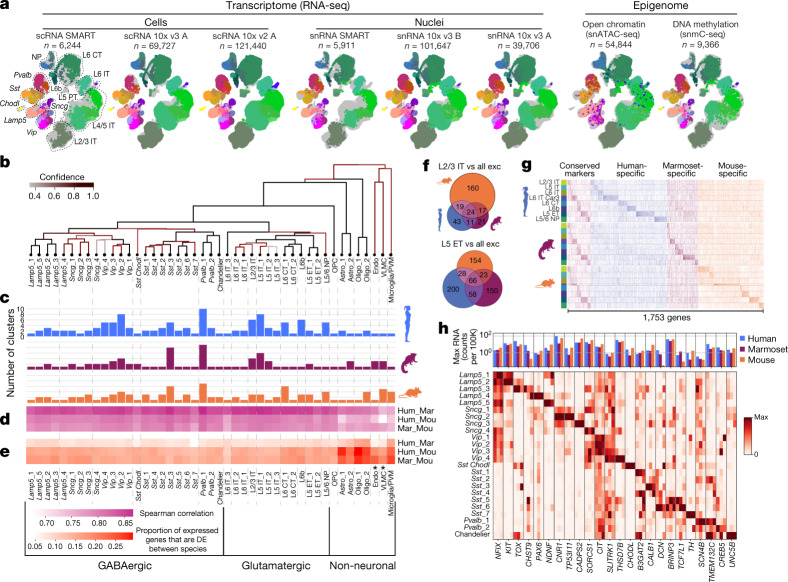
Here we report the generation of a multimodal cell census and atlas of the mammalian primary motor cortex as the initial product of the BRAIN Initiative Cell Census Network (BICCN). This was achieved by coordinated large-scale analyses of single-cell transcriptomes, chromatin accessibility, DNA methylomes, spatially resolved single-cell transcriptomes, morphological and electrophysiological properties and cellular resolution input–output mapping, integrated through cross-modal computational analysis. Our results advance the collective knowledge and understanding of brain cell-type organization 1–5 . First, our study reveals a unified molecular genetic landscape of cortical cell types that integrates their transcriptome, open chromatin and DNA methylation maps. Second, cross-species analysis achieves a consensus taxonomy of transcriptomic types and their hierarchical organization that is conserved from mouse to marmoset and human. Third, in situ single-cell transcriptomics provides a spatially resolved cell-type atlas of the motor cortex. Fourth, cross-modal analysis provides compelling evidence for the transcriptomic, epigenomic and gene regulatory basis of neuronal phenotypes such as their physiological and anatomical properties, demonstrating the biological validity and genomic underpinning of neuron types. We further present an extensive genetic toolset for targeting glutamatergic neuron types towards linking their molecular and developmental identity to their circuit function. Together, our results establish a unifying and mechanistic framework of neuronal cell-type organization that integrates multi-layered molecular genetic and spatial information with multi-faceted phenotypic properties.
Overview
CoChat Summary
TL;DR
The BICCN reports a multimodal cell census and atlas of mammalian primary motor cortex (mouse MOp, marmoset and human M1), integrating single-cell transcriptomes, epigenomes, spatial transcriptomics, morphology, electrophysiology and connectivity. It defines a conserved hierarchical cell-type taxonomy anchored on mouse MOp and links molecular types to anatomical, physiological and gene-regulatory features.
Key findings
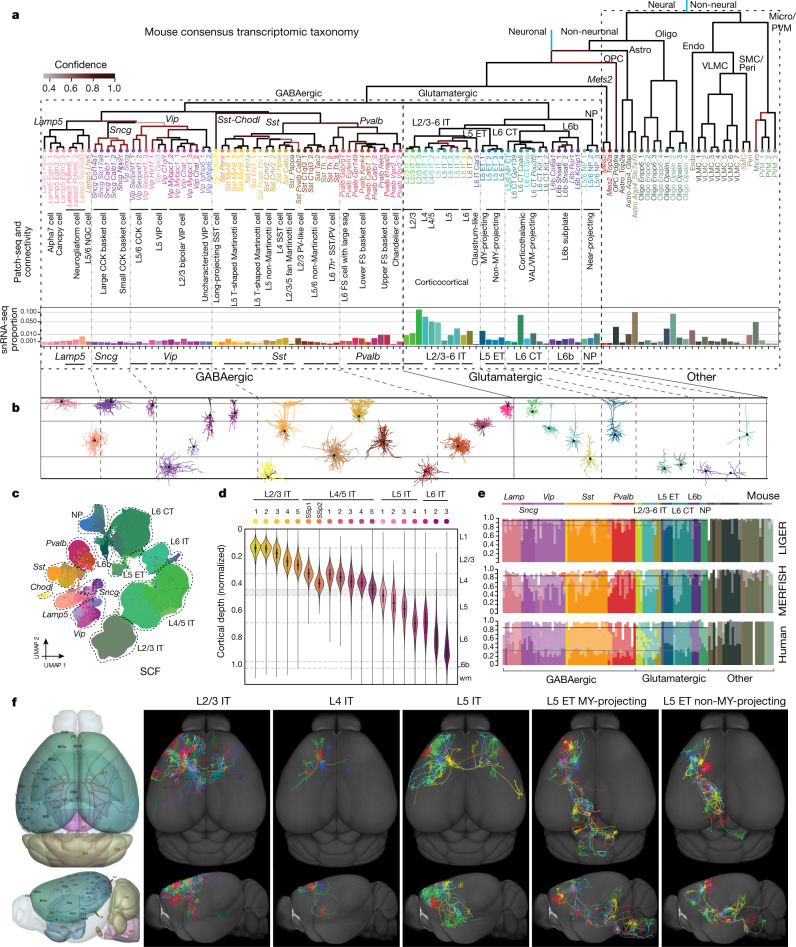
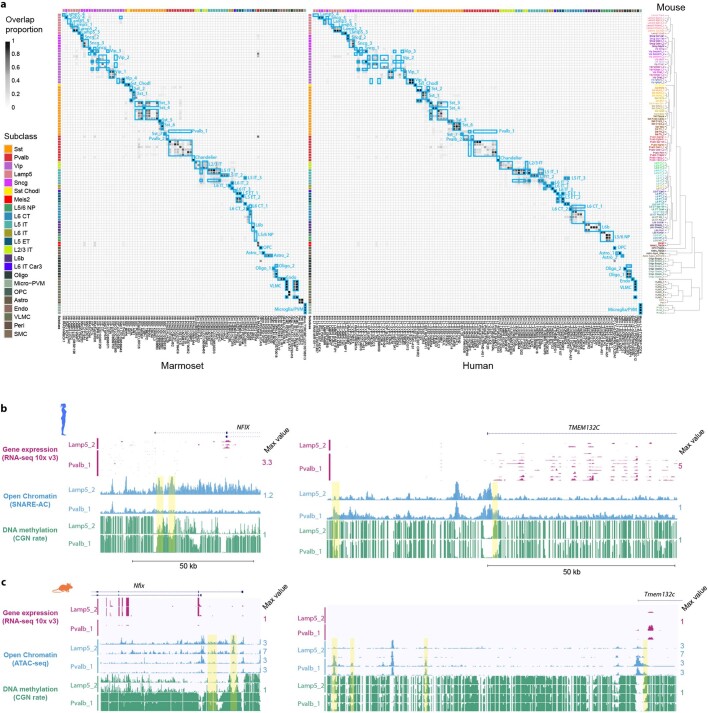
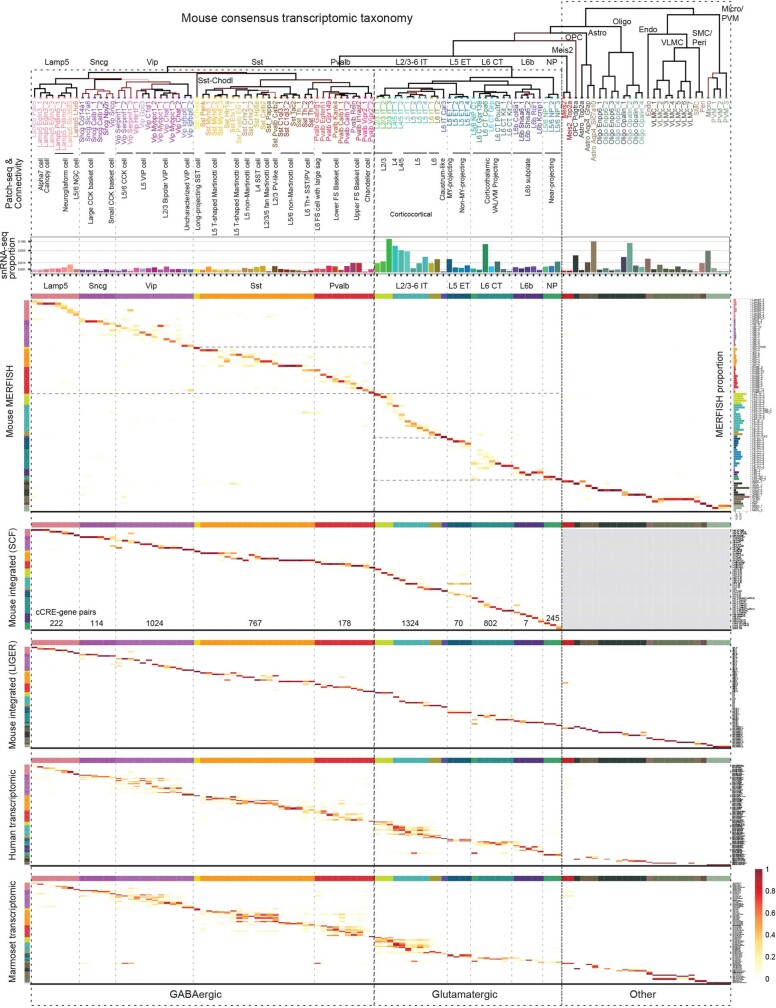
- Mouse MOp yielded a consensus transcriptomic taxonomy of 90 neuronal and 116 total clusters/t-types; integration with epigenomic data produced 56 neuronal cell types corresponding to the 90 transcriptomic neuronal types. Human M1 had 127 t-types and marmoset 94 t-types; cross-species integration identified 45 conserved t-types (24 GABAergic, 13 glutamatergic, 8 non-neuronal).
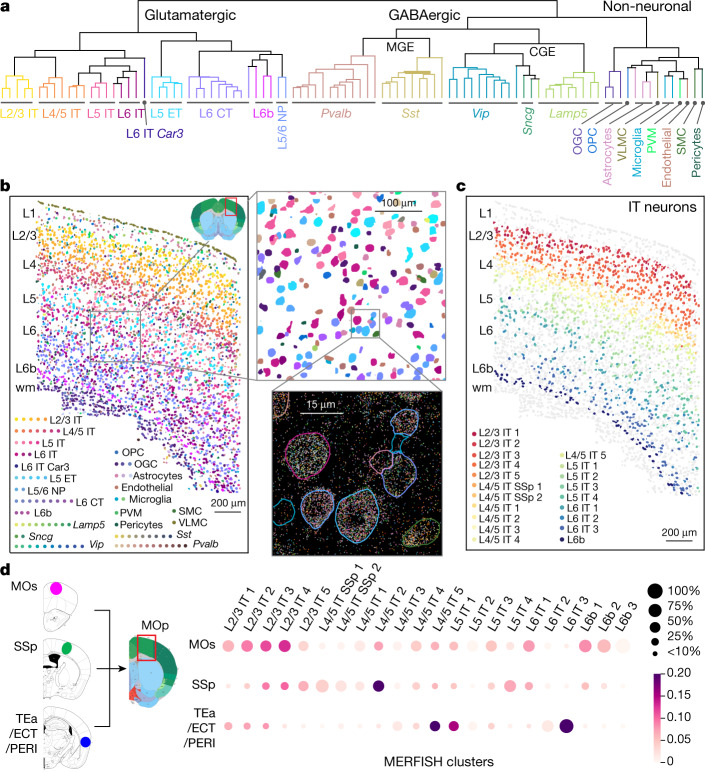
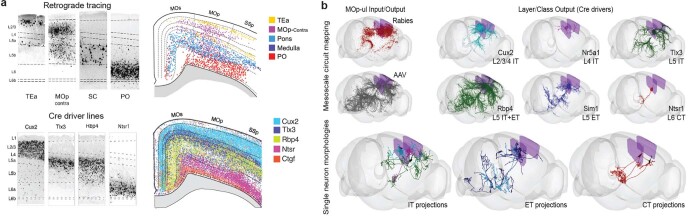
- MERFISH with a 258-gene panel (254 passing QC) imaged approximately 300,000 cells and resolved 95 MOp clusters (42 GABAergic, 39 glutamatergic, 14 non-neuronal); Retro-MERFISH imaged approximately 190,000 cells and showed that MOp projections to MOs, SSp and TEa–ECT–PERI form a multiple-to-multiple network rather than one-type-to-one-target mapping.
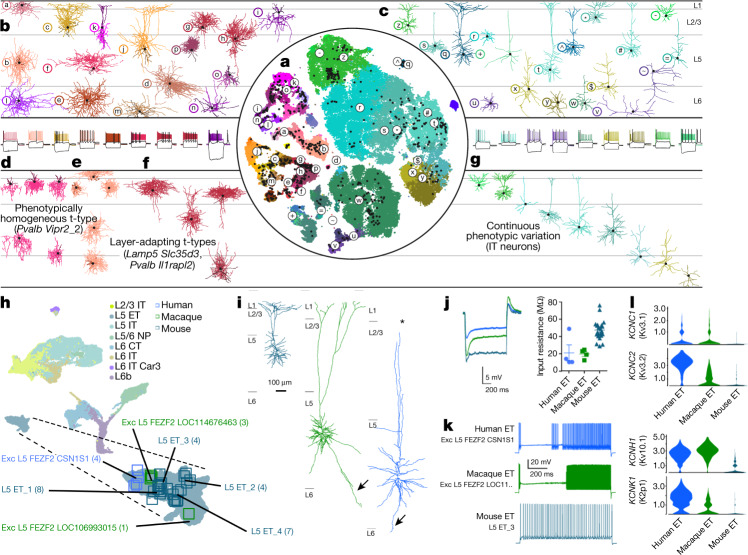
- Patch-seq profiled more than 1,300 neurons, recovered morphologies for around 50% and assigned cells to 77 t-types; morpho-electric phenotypes were largely determined by transcriptomic subclasses, with continuous variation within IT, Sst and Pvalb populations. L5 ET Betz cells were homologous across mouse, macaque and human but showed species specializations in morphology, physiology and ion-channel gene expression.
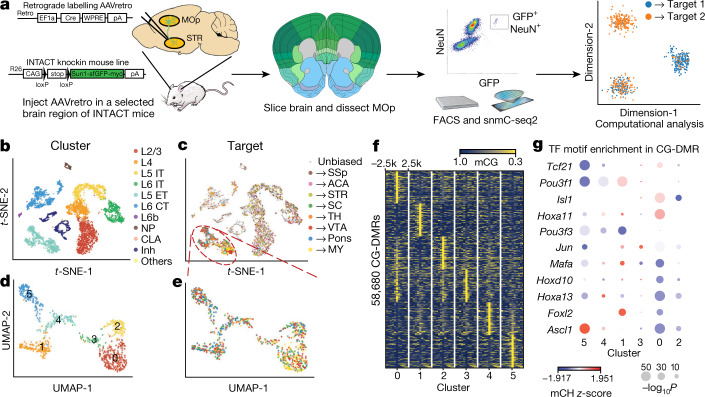
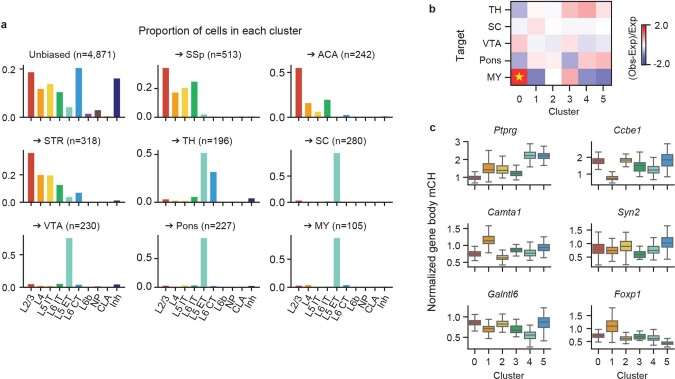
- Epi-retro-seq profiled 2,115 MOp projection neurons; 848 L5 ET neurons segregated into 6 clusters, with MY-projecting neurons enriched in cluster 0. The study identified 511 differentially CH-methylated genes and 58,680 CG-DMRs across L5 ET clusters and generated new Cre/Flp driver lines targeting glutamatergic subpopulations.
Methods
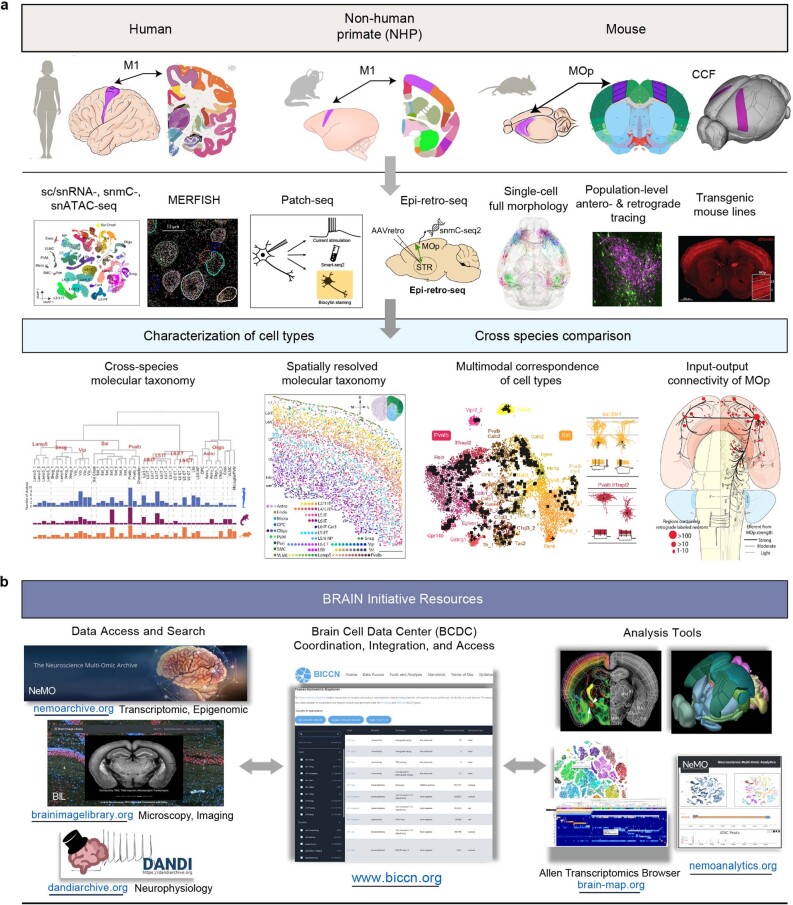
- Coordinated multi-laboratory BICCN synthesis of 11 companion studies across mouse MOp and marmoset/human M1, combining sc/snRNA-seq, snmC-seq2, snATAC-seq, MERFISH, Patch-seq, anterograde/retrograde tracing, Epi-retro-seq, single-neuron reconstruction and transgenic driver lines.
- Cross-species snRNA-seq integration used Seurat SCTransform on 14,870 one-to-one orthologues, tree-based clustering with 10,000 bootstrap iterations, and pseudobulk DESeq2 Wald tests for differential expression (adjusted P < 0.05, log2 fold-change > 2).
- Spatial and regulatory analyses included MERFISH with a 258-gene panel, Retro-MERFISH, Patch-seq with Smart-seq2, Epi-retro-seq with snmC-seq2, and cCRE/enhancer–promoter prediction using MACS2, Cicero and nonnegative matrix factorization.
Limitations
- The paper states that the cross-species consensus taxonomy had lower resolution than species-alone taxonomies because of gene expression variation; some types aligned one-to-one, whereas others aligned several-to-several, and ambiguities increased at cluster level and in cross-species comparisons. Rare human non-neuronal cells were under-sampled (VLMC n = 40 in human versus n = 463 in marmoset and n = 2,329 in mouse).
- The paper states that many finer-level cell properties do not neatly segregate into discrete, consistent types; continuous distributions, species specializations and mismatches between molecular and anatomical phenotypes remain, and different methods yield different granularity and numbers of putative cell types. Technical factors may also contribute to continuous variation.
- Evident from the text: coverage is incomplete for some modalities and types—for example, no Patch-seq data were collected for the “uncharacterized” Vip types, morphology recovery in Patch-seq was around 50%, and L5 ET morphological/projectional variability was not directly linked to t-types.
Model-written summary. Check it against the paper before relying on it.
Integrity signals
Registry
Cites
Statistics
Figures
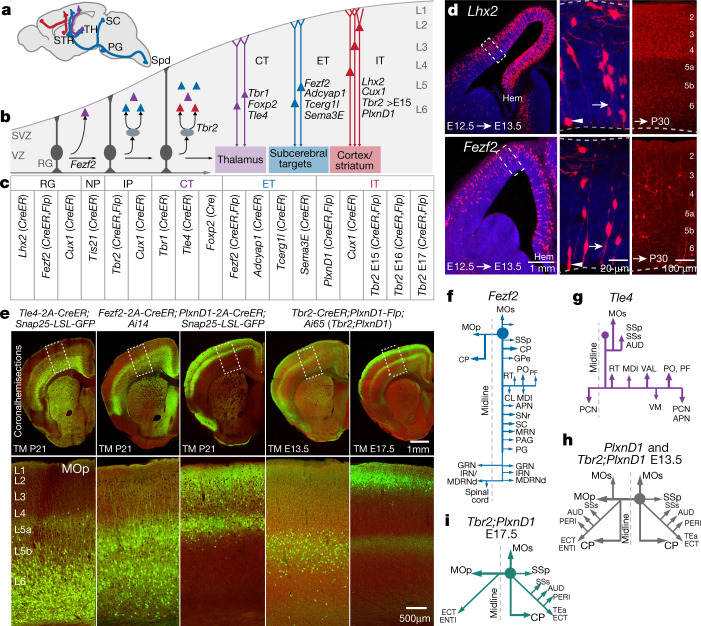
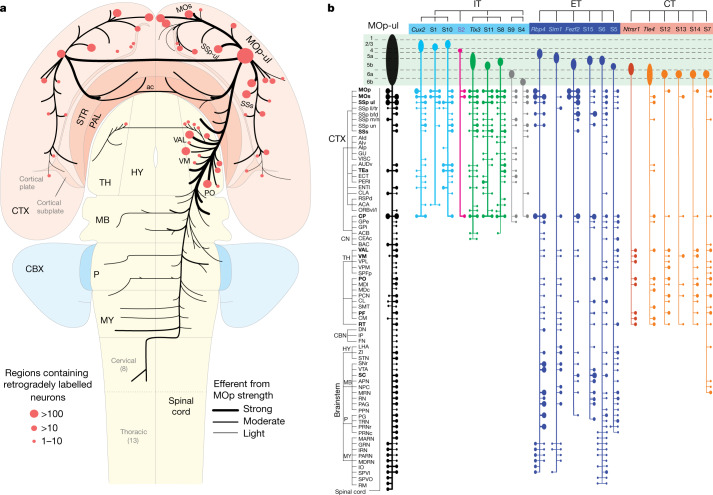
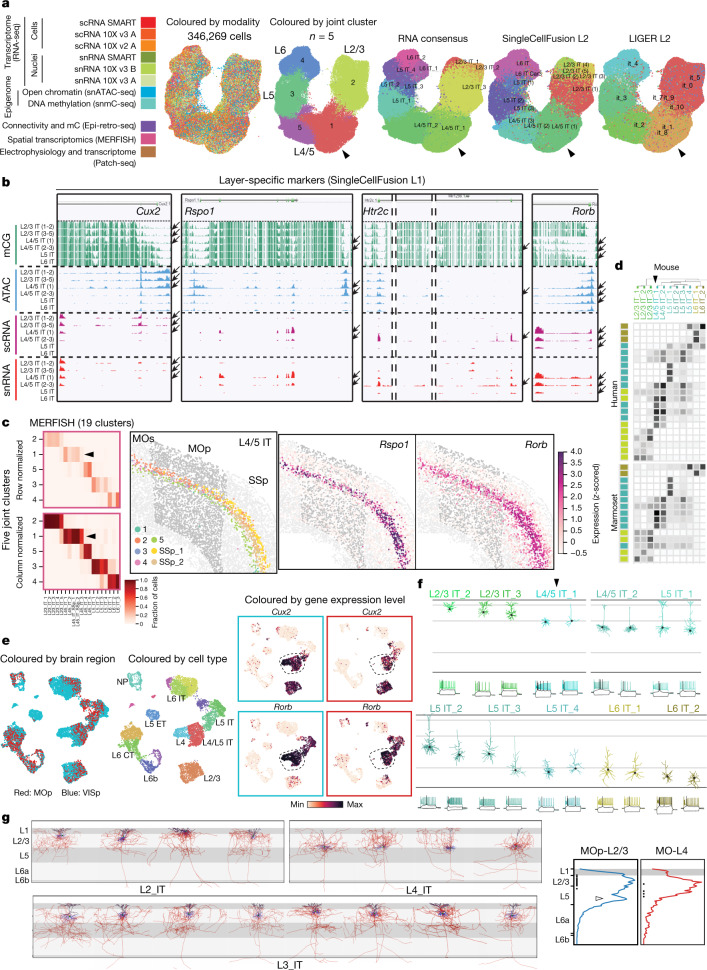
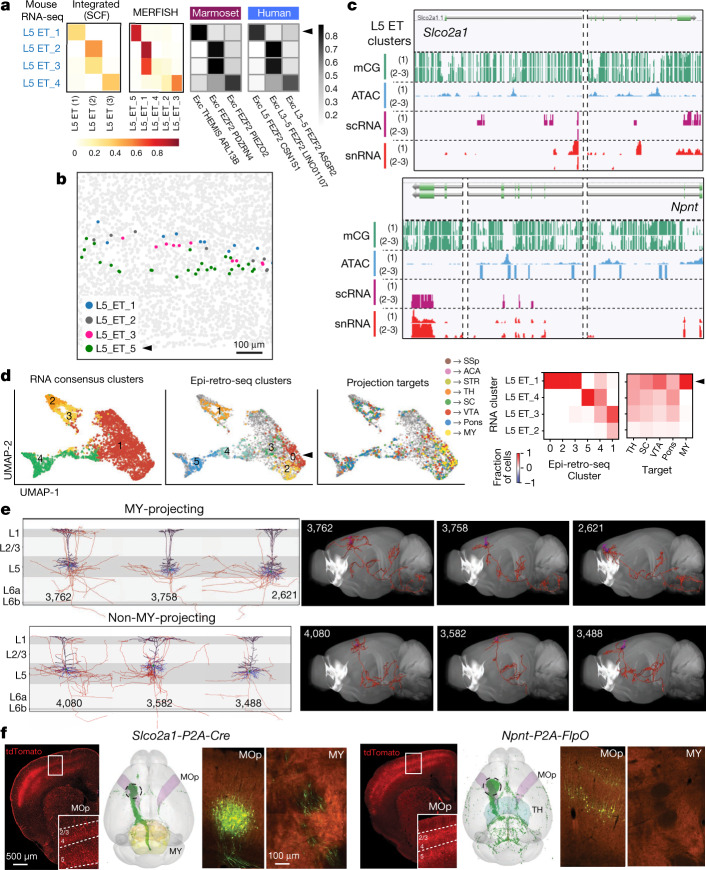
Verification
Claims the paper makes
20 Valid · 0 Not valid · 48 Not checked · 161 Own results and interpretations
Every source the paper cites for this claim was checked and supports it.
In the paper
“A mouse MOp molecular taxonomy was derived from seven scRNA-seq and snRNA-seq (sc/snRNA-seq) datasets and single-nucleus methylcytosine sequencing (snmC-seq2) and single-nucleus assay for transposase-accessible chromatin using sequencing (snATAC-seq) datasets37.”
§ A multimodal cell census and atlas of the mammalian primary motor cortex > Results > Molecular definition of cell types in MOp
What the sources say
- Supportedcites [37] Yao, Z. et al. An integrated transcriptomic and epigenomic atlas of mouse primary motor cortex cell types. Preprint at 10.1101/2020.02.29.970558 (2020). source
The multimodal-approach section says the mouse MOp atlas brought together seven sc/snRNA-seq datasets, one snmC-Seq2 dataset, and one snATAC-Seq dataset. The Discussion confirms that the transcriptomic and epigenomic datasets were integrated into a unified cell-type atlas. Page numbers are unavailable in our copy. (LLM, conf=0.94)
plainstates a cause- Asserted: passes — The authors put it forward as true.
- Checkable: passes — It can be checked against evidence.
- Load-bearing: passes — The paper’s conclusions depend on it.
- Based: passes — The paper gives a reason why it holds.
- Supported
The cited sources support only part of this claim — read each source’s verdict below.
In the paper
“Similarly, we established M1 cell-type taxonomies for human (127 t-types) and marmoset (94 t-types) by unsupervised clustering of snRNA-seq data, followed by integration with epigenomic datasets38.”
§ A multimodal cell census and atlas of the mammalian primary motor cortex > Results > Molecular definition of cell types in MOp
What the sources say
- Partly supportedcites [38] Bakken, T. E. et al. Evolution of cellular diversity in primary motor cortex of human, marmoset monkey, and mouse. Preprint at 10.1101/2020.03.31.016972 (2020). sourceExperimental — accuracy not yet measured
Our copy supports the methodological core: it defines a human M1 consensus transcriptomic cell-type taxonomy by integration/overclustering of snRNA-seq (Cv3 and SSv4) data (Methods, 'Integrating and clustering human Cv3 and SSv4 snRNA-seq datasets'), a marmoset M1 taxonomy defined by RNA-seq (Cv3) ('Additional information', NS-Forest line), and subsequent alignment/integration with epigenomic modalities (snmC-seq2 methylome and SNARE-seq2 accessible chromatin; Discussion and 'Methylomic profiling reveals conserved gene regulation'). However, the specific counts attributed here — 127 human t-types and 94 marmoset t-types — are nowhere stated in our copy; the only cluster counts given are sub-taxonomy figures (e.g., 72 final human consensus GABAergic clusters, 13 cross-species glutamatergic consensus types). Searches for '127', '94', 'transcriptome-based cell types', and total taxonomy sizes returned no such totals, so the numeric part of the claim is not supported by this source. (LLM, conf=0.70)
plainstates a cause- Asserted: passes — The authors put it forward as true.
- Checkable: passes — It can be checked against evidence.
- Load-bearing: passes — The paper’s conclusions depend on it.
- Based: passes — The paper gives a reason why it holds.
- Partly supported
The cited sources support only part of this claim — read each source’s verdict below.
In the paper
“In these studies, we derive a cross-species consensus molecular taxonomy of cell types using scRNA-seq or single-nucleus RNA sequencing (snRNA-seq), DNA methylation and chromatin accessibility data37–40.”
§ A multimodal cell census and atlas of the mammalian primary motor cortex > Main
What the sources say
- Partly supportedcites [37] Yao, Z. et al. An integrated transcriptomic and epigenomic atlas of mouse primary motor cortex cell types. Preprint at 10.1101/2020.02.29.970558 (2020). sourceExperimental — accuracy not yet measured
The consensus transcriptomic atlas section describes integrating scRNA-seq and snRNA-seq datasets, and the Discussion describes integration with DNA methylation and chromatin accessibility data. But the taxonomy in this paper is of mouse primary motor cortex cells; these passages do not support the claim that this study derived a cross-species taxonomy. No page numbers are available in our copy. (LLM, conf=0.88)
- Supportedcites [38] Bakken, T. E. et al. Evolution of cellular diversity in primary motor cortex of human, marmoset monkey, and mouse. Preprint at 10.1101/2020.03.31.016972 (2020). source
The Discussion identifies a consensus classification of cell types across human, marmoset and mouse and says the molecular classifications aligned across methods. The methylomic and open-chromatin sections describe integrating DNA methylation and chromatin-accessibility data with RNA-defined cell types, supporting the attributed account of how the taxonomy was derived. (LLM, conf=0.92)
- Not checked yetcites [39] Liu, H. et al. DNA methylation atlas of the mouse brain at single-cell resolution. Preprint at 10.1101/2020.04.30.069377 (2020). PMC8494641 34616061 source
- Partly supportedcites [40] Li, Y. E. et al. An atlas of gene regulatory elements in adult mouse cerebrum. Preprint at 10.1101/2020.05.10.087585 (2020). PMC8494637 34616068 sourceExperimental — accuracy not yet measured
In “Clustering and annotation of mouse brain cells based on open chromatin landscapes” (page unavailable), the paper reports integrating mouse-brain scRNA-seq and chromatin-accessibility data and comparing the resulting cell types with a previously reported DNA-methylation taxonomy. It does not report deriving a cross-species consensus taxonomy or deriving its taxonomy from all three data types. (LLM, conf=0.88)
plain- Asserted: passes — The authors put it forward as true.
- Checkable: passes — It can be checked against evidence.
- Load-bearing: passes — The paper’s conclusions depend on it.
- Based: passes — The paper gives a reason why it holds.
- Partly supported
Every source the paper cites for this claim was checked and supports it.
In the paper
“Similarly, electrophysiological properties of Sst interneurons varied continuously across the transcriptomic landscape42.”
§ A multimodal cell census and atlas of the mammalian primary motor cortex > Results > Multimodal analysis of cell types with Patch-seq
What the sources say
- Supportedcites [42] Scala, F. et al. Phenotypic variation of transcriptomic cell types in mouse motor cortex. Nature10.1038/s41586-020-2907-3 (2020). PMC8113357 33184512 source
The Continuous phenotypic variation section reports that morpho-electric properties of Sst neurons varied continuously across the transcriptomic landscape, with neighbouring transcriptomic types showing similar rebound values. The reported Sst analysis concerns layer 5 of mouse motor cortex. (LLM, conf=0.93)
plainstates an association- Asserted: passes — The authors put it forward as true.
- Checkable: passes — It can be checked against evidence.
- Load-bearing: passes — The paper’s conclusions depend on it.
- Based: passes — The paper gives a reason why it holds.
- Supported
The cited sources support only part of this claim — read each source’s verdict below.
In the paper
“MY-projecting neurons showed clear enrichment for L5 ET cluster 0 (Fig. 4e, Extended Data Fig. 3b), in agreement with scRNA-seq data for anterolateral motor cortex (ALM), part of MOs9,53.”
§ A multimodal cell census and atlas of the mammalian primary motor cortex > Results > Multimodal correspondence by Epi-retro-seq
What the sources say
- Partly supportedcites [9] Tasic, B. et al. Shared and distinct transcriptomic cell types across neocortical areas. Nature 563, 72–78 (2018). 30382198 PMC6456269 sourceExperimental — accuracy not yet measured
In “Glutamatergic taxonomy by scRNA-seq and projections” (page unavailable), the paper reports that one of three ALM layer-5 pyramidal-tract transcriptomic types projects to the medulla. This supports the connection between medulla-projecting neurons and an ALM transcriptomic type, but our copy does not identify that type as “L5 ET cluster 0” or report enrichment for that numbered cluster. (LLM, conf=0.84)
- Supportedcites [53] Economo, M. N. et al. Distinct descending motor cortex pathways and their roles in movement. Nature 563, 79–84 (2018). 30382200 source
The citation supports the stated agreement with ALM data, not the citing paper’s own cluster-0 result. In ‘Two types of PT neurons in Layer 5’ (p. 3), the source reports that all 63 medulla-projecting PT neurons examined mapped to the Rgs8 transcriptomic cluster, supporting enrichment of a distinct L5 projection-neuron type. (LLM, conf=0.88)
boostedstates an association- Asserted: passes — The authors put it forward as true.
- Checkable: passes — It can be checked against evidence.
- Load-bearing: passes — The paper’s conclusions depend on it.
- Based: passes — The paper gives a reason why it holds.
- Partly supported
133 more claims · 6 with their cited sources checked
Create a free account to see all 229 claims and to verify the 80 references still open.
- Probably not a substantial claim. 36
- It may state two separate claims as one. 63
- The quote only partly states this claim. 1
Claims other papers make about this one
Each is checked against this paper’s own text: does it say what the citing paper says it does?
The source backs part of the claim, not all of it — or backs it for a different population, condition or comparison.
In the citing paper
“We also observed that the NP–CT–L6b-like (NP, near-projecting; CT, corticothalamic; L6b, layer 6b) subclasses emerge as a group highly distinct from the IT–ET-like (IT, intratelencephalic; ET, extratelencephalic) subclasses13,23,26,27, forming two distinct classes, IT–ET Glut and NP–CT–L6b Glut.”
From A high-resolution transcriptomic and spatial atlas of cell types in the whole mouse brain (2023) · cites this paper as [13]
Experimental — accuracy not yet measuredThe source backs part of the claim, not all of it — or backs it for a different population, condition or comparison.
In the citing paper
“These reference classifications provide an extremely powerful foundational reference to understand the cellular, molecular and epigenomic underpinnings of AD.”
From Integrated multimodal cell atlas of Alzheimer’s disease (2024) · cites this paper as [16]
Experimental — accuracy not yet measuredIn the citing paper
“Transcriptomics with single cell resolution is being applied to mammalian brains131, and to the Drosophila brain as well.”
From Neuronal wiring diagram of an adult brain (2023) · cites this paper as [131]
Citations
Cites
Moderated estimation of fold change and dispersion for RNA-seq data with DESeq2
Love, M. I., Huber, W., & Anders, S. (2014) · Genome Biology · doi:10.1186/s13059-014-0550-8 · Cited by 95,106
Model-based Analysis of ChIP-Seq (MACS)
Zhang, Y., Liu, T., Meyer, C. A., Eeckhoute, J., Johnson, D. S., Bernstein, B. E., Nusbaum, C., Myers, R. M., Brown, M., Li, W., et al. (2008) · Genome Biology · doi:10.1186/gb-2008-9-9-r137 · Cited by 18,386
Comprehensive Integration of Single-Cell Data
Stuart, T., Butler, A., Hoffman, P., Hafemeister, C., Papalexi, E., Mauck, W. M., Hao, Y., Stoeckius, M., Smibert, P., & Satija, R. (2019) · Cell · doi:10.1016/j.cell.2019.05.031 · Cited by 15,453
SCANPY: large-scale single-cell gene expression data analysis
Wolf, F. A., Angerer, P., & Theis, F. J. (2018) · Genome Biology · doi:10.1186/s13059-017-1382-0 · Cited by 8,881
From Louvain to Leiden: guaranteeing well-connected communities
Traag, V. A., Waltman, L., & van Eck, N. J. (2019) · Scientific Reports · doi:10.1038/s41598-019-41695-z · Cited by 5,635
Spatially resolved, highly multiplexed RNA profiling in single cells
Chen, K. H., Boettiger, A. N., Moffitt, J. R., Wang, S., & Zhuang, X. (2015) · Science · doi:10.1126/science.aaa6090 · Cited by 2,969
Self-citationA mesoscale connectome of the mouse brain
Oh, S. W., Harris, J. A., Ng, L., Winslow, B., Cain, N., Mihalas, S., Wang, Q., Lau, C., Kuan, L., Henry, A. M., et al. (2014) · Nature · doi:10.1038/nature13186 · Cited by 2,612
Self-citationMolecular Architecture of the Mouse Nervous System
Zeisel, A., Hochgerner, H., Lönnerberg, P., Johnsson, A., Memic, F., van der Zwan, J., Häring, M., Braun, E., Borm, L. E., La Manno, G., et al. (2018) · Cell · doi:10.1016/j.cell.2018.06.021 · Cited by 2,552
Self-citationBatch effects in single-cell RNA-sequencing data are corrected by matching mutual nearest neighbors
Haghverdi, L., Lun, A. T. L., Morgan, M. D., & Marioni, J. C. (2018) · Nature Biotechnology · doi:10.1038/nbt.4091 · Cited by 2,416
fitdistrplus: An R Package for Fitting Distributions
Delignette-Muller, M. L., & Dutang, C. (2015) · Journal of Statistical Software · doi:10.18637/jss.v064.i04 · Cited by 2,383
Research works printed but not linked: 1
- Hoyer, P. O. Non-negative matrix factorization with sparseness constraints. J. Mach. Learn. Res. 5, 1457–1469 (2004).
Cited by
Items 401–500 of 557
Enrichment on steps, not genes, improves inference of differentially expressed pathways
Markarian, N., Auken, K. M. V., Ebert, D., & Sternberg, P. W. (2024) · PLoS Computational Biology · doi:10.1371/journal.pcbi.1011968 · Cited by 2
Oldre, E. N., Webb, B. D., Sperringer, J. E., & Maness, P. F. (2025) · Current Research in Neurobiology · doi:10.1016/j.crneur.2025.100150 · Cited by 2
“For example, transcriptomic studies in mouse motor cortex [44] identified 6 distinct subclasses of Sncg+ large and small basket cells, most of which have not been characterized for NECAB1 expression.”
Unveiling cell-type-specific mode of evolution in comparative single-cell expression data
Qin, T., Zhang, H., & Zou, Z. (2025) · Journal of genetics and genomics/Journal of Genetics and Genomics · doi:10.1016/j.jgg.2025.04.022 · Cited by 3
The Use of Single-Cell and Spatial Omics to Study Copy Number Variants
Malwade, S., Ingason, A., & Khodosevich, K. (2025) · Biological Psychiatry · doi:10.1016/j.biopsych.2025.06.010 · Cited by 2
Bruzelius, A., Stamouli, C. A., Hölldobler, A.-L., Aretio-Medina, C., Cepeda-Prado, E., Sozzi, E., Passarello, G. R., Nocera, G., Giacomoni, J., Olariu, V., et al. (2025) · Stem Cell Reports · doi:10.1016/j.stemcr.2025.102634 · Cited by 2
Single Cell Multiomic Approaches to Disentangle T Cell Heterogeneity
Abondio, P., Intinis, C. D., Júnior, J. L. D. S. G. V., & Pace, L. (2022) · Immunology Letters · doi:10.1016/j.imlet.2022.04.008 · Cited by 2
Riding brain “waves” to identify human memory genes
Moore, H. C., Lega, B. C., & Konopka, G. (2022) · Current Opinion in Cell Biology · doi:10.1016/j.ceb.2022.102118 · Cited by 2
Sketch of a Novel Approach to a Neural Model
Scheler, G. (2026) · F1000Research · doi:10.12688/f1000research.161106.2 · Cited by 2
Fenster, R. J., McCullough, K. M., Naumenko, S., Thompson, A., Klengel, C., Rodgers, A., Otten, J., Shu, D., Harris, N., Klengel, T., et al. (2021) · bioRxiv (Cold Spring Harbor Laboratory) · doi:10.1101/2021.10.10.463815 · Cited by 2
Incident Cognitive Dysfunction Is Associated With Ischemic Heart Disease
Arai, A. E., & Arai, A. L. (2023) · JACC. Cardiovascular imaging · doi:10.1016/j.jcmg.2023.02.020 · Cited by 2
Bierman, R., Dave, J. M., Greif, D. M., & Salzman, J. (2023) · eLife · doi:10.7554/elife.87517.1 · Cited by 4
Spyglass: a framework for reproducible and shareable neuroscience researchPreprint
Lee, K. H., Denovellis, E. L., Ly, R., Magland, J. F., Soules, J., Comrie, A. E., Gramling, D. P., Guidera, J. A., Nevers, R., Adenekan, P., et al. (2025) · eLife · doi:10.7554/elife.108089.1 · Cited by 2
Self-citationMouse sensorimotor cortex reflects complex kinematic details during reaching and graspingPreprint
Grier, H. A., Salimian, S., & Kaufman, M. T. (2026) · eLife · doi:10.7554/elife.106270.2 · Cited by 4
A Community Standard Multispecies Cell Atlas of the Basal GangliaPreprint
Ecker, J. R., Hawrylycz, M., Lein, E. S., Ren, B., Thompson, C. L., Zeng, H., White, O. R., & Zhang, G. (2026) · bioRxiv (Cold Spring Harbor Laboratory) · doi:10.64898/2026.04.14.717814 · Cited by 5
Self-citationSingle-cell joint analysis of gene expression and histone modifications in droplets
(2023) · Nature Structural & Molecular Biology · doi:10.1038/s41594-023-01076-7 · Cited by 1
Probing molecular diversity and ultrastructure of brain cells with fluorescent aptamers
Lu, X., Wu, Y., Li, P. H., Fang, T., Schalek, R. L., Su, Y., Berger, D. R., Carter, J. D., Lynch, S., Schneider, D. J., et al. (2026) · Nature Communications · doi:10.1038/s41467-026-72180-7 · Cited by 1
Connectivity of Motor Cortex, Motor Thalamus, and Striatum
Hooks, B. M. (2023) · Oxford University Press eBooks · doi:10.1093/med/9780197676158.003.0033 · Cited by 1
Merkler, M., Ip, N. Y., & Sakata, S. (2025) · Scientific Reports · doi:10.1038/s41598-025-95968-x · Cited by 1
Diversification of dentate gyrus granule cell subtypes is regulated by Nrg1 nuclear back-signaling
Rajebhosale, P., Jiang, L., Ressa, H. J., Johnson, K. R., Desai, N. S., Jone, A., Role, L. W., & Talmage, D. A. (2025) · Life Science Alliance · doi:10.26508/lsa.202403169 · Cited by 1
Nr4a2, A Key Factor Controlling the Development and Functional Maintenance of Forebrain Car3 Neurons
Tao, Y.-C., Zhao, L., Zhang, Q., Liu, X.-Y., Liu, W., Li, Z.-X., Hu, L., Zhang, L., Chen, J., Ding, Y., et al. (2025) · Neuroscience Bulletin · doi:10.1007/s12264-025-01496-z · Cited by 2
Self-citationEvidence from spatial transcriptomics for the mosaic hypothesis and pure cell types in the cortex
Wang, Y., Koch, C., & Sümbül, U. (2025) · Cell Reports · doi:10.1016/j.celrep.2025.116363 · Cited by 1
Self-citationXu, L., & Herculano‐Houzel, S. (2025) · Scientific Reports · doi:10.1038/s41598-025-27680-9 · Cited by 1
An integrative single-cell epigenomic atlas annotates the regulatory genome of the adult mouse brain
Wang, Z., Zu, S., Armand, E. J., Loe, T. H., Rink, J. A., Wu, W., Xie, Y., Chang, L., Zhu, C., Johnson, N. D., et al. (2026) · Cell · doi:10.64898/2026.02.07.704075 · Cited by 2
Self-citationGorkowska, M., Drwiȩga, G., Szumiec, Ł., Parkitna, J. M. R., & Cieślak, P. E. (2026) · iScience · doi:10.1016/j.isci.2026.114983 · Cited by 1
20 lessons in team science: Learning from the experience of the International Brain Laboratory
Laboratory, I. B., Bayer, H. M., Birman, D., Chapuis, G., DeWitt, E., Freitas-Silva, L., Langdon, C., Laranjeira, I., Lau, P., Paninski, L., et al. (2026) · Neuron · doi:10.1016/j.neuron.2026.01.012 · Cited by 1
Tendon Omics: A Survey‐Based Perspective on Obstacles and Opportunities
Nichols, A. E. C., Dakin, S. G., Little, D., Snelling, S. J. B., & Loiselle, A. E. (2026) · Journal of Orthopaedic Research® · doi:10.1002/jor.70174 · Cited by 1
“Additionally, the Brain Initiative Cell Census Network (BICCN; https://biccn.org/) has compiled a multimodal cell atlas of the mammalian primary motor cortex, the result of a coordinated effort among neuro-science researchers [17].”
Insights gained from single-cell sequencing analysis of ischemic stroke
梅艳琴, Guan, T., Fu, L., Kong, J., & Lv, Y. (2026) · Frontiers in Cell and Developmental Biology · doi:10.3389/fcell.2026.1784660 · Cited by 1
“Thus, the number of identified brain cell types has increased fivefold, and the identification of cell subtypes rises to a higher step than before (BRAIN Initiative Cell Census Network BICCN, 2021; Muñoz-Castañeda et al., 2021).”
Insights Gained From the PPMI Brain Donation Program
Foroud, T., Heathers, L., Bukhari, S. A., Poston, K. L., Antonopoulos, G., Mantravadi, K., Rumbaugh, M. C., Donald, C. L. M., Latimer, C. S., Tropea, T. F., et al. (2026) · Annals of Neurology · doi:10.1002/ana.78229 · Cited by 1
Self-citationRobust integration of single-cell datasets with imbalanced modality composition
Sheng, Q., Zhou, Y., Zhu, F., Xu, L., & Jin, S. (2026) · Nature Communications · doi:10.1038/s41467-026-72933-4 · Cited by 1
“Moreover, marker expressions were speci fi cally expressed in the corresponding cell types 93,95 (Supplementary Fig.”
Singh, K., Samanta, S., Kalita, R. C., Kumar, S., & Sharma, S. (2025) · Neuroscience Research and Clinical Practice · doi:10.64229/84x8kg24 · Cited by 1
Zhao, T.-Y., Zhu, H., Zhang, Y., Ren, X., Ye, X.-N., Li, F., Lei, L.-J., Zhang, M., Li, Y., & Zhang, F. (2026) · Brain Research Bulletin · doi:10.1016/j.brainresbull.2026.112013 · Cited by 1
Self-citationHe, Y., Wei, Y., Zhi, J., Huang, C. J., Han, L., Liu, S., & Wang, L. (2026) · GigaScience · doi:10.1093/gigascience/giag075 · Cited by 1
“National-level projects such as the US BICCN [ 91 , 261 ], the European Union’s Human Brain Project [ 262 ], China Brain Project [ 263 ], and Japan’s Brain/MINDS [ 264 ] have been underway for many years, yielding important results.”
InfluentialDevelopmental and cellular vulnerabilities underlie genetic architecture of schizophrenia
Wu, Y., Gao, Y., Li, M., Zhang, C., Qu, Y., & Xiao, X. (2026) · Molecular Psychiatry · doi:10.1038/s41380-026-03862-3 · Cited by 1
Hao, Y., Park, C. Y., Theesfeld, C. L., & Troyanskaya, O. G. (2026) · Nature Neuroscience · doi:10.1038/s41593-026-02470-2 · Cited by 1
Arocas, O. P., & Branco, T. (2022) · PLoS ONE · doi:10.1371/journal.pone.0271832 · Cited by 1
Cell-Specific Gene Expression in the Prenatal Brain and Schizophrenia Risk
Morris, D. W. (2022) · Biological Psychiatry · doi:10.1016/j.biopsych.2022.10.008 · Cited by 1
From single cells to neural circuits
Skinnider, M. A. (2023) · Science · doi:10.1126/science.adk3912 · Cited by 1
Combinatorial quantification of distinct neural projections from retrograde tracing
Venkadesh, S., Santarelli, A., Boesen, T., Dong, H., & Ascoli, G. A. (2023) · Nature Communications · doi:10.1038/s41467-023-43124-2 · Cited by 2
Self-citationApplication of Multimodal Information Analysis in Learning Early Warning Model
Jun, G. (2023) · Procedia Computer Science · doi:10.1016/j.procs.2023.11.084 · Cited by 1
Epigenetics and multiple sclerosis
Kular, L., Castelo‐Branco, G., & Jagodic, M. (2024) · Elsevier eBooks · doi:10.1016/b978-0-443-18516-8.00001-6 · Cited by 1
Systems biology study of Huntington's disease
Dionisio, L. E., Langfelder, P., Aaronson, J. S., Rosinski, J., & Yang, X. W. (2024) · Elsevier eBooks · doi:10.1016/b978-0-323-95672-7.00006-6 · Cited by 1
Self-citationA novel method for clustering cellular data to improve classification
Wheeler, D. W., & Ascoli, G. A. (2024) · Neural Regeneration Research · doi:10.4103/nrr.nrr-d-24-00532 · Cited by 2
Self-citationT-CLEARE: a pilot community-driven tissue clearing protocol repository
Weiss, K. R., Huisken, J., Khanjani, N., Bakalov, V., Engle, M. L., Krzyzanowski, M. C., Madden, T., Maiese, D. R., Waterfield, J., Williams, D. N., et al. (2024) · Frontiers in Bioengineering and Biotechnology · doi:10.3389/fbioe.2024.1304622 · Cited by 1
“…et al., 2015; Stefaniuk et al., 2016; Fretaud et al., 2017; Greenbaum et al., 2017; Affaticati et al., 2018; Mzinza et al., 2018; Xu et al., 2019; BRAIN Initiative Cell Census Network, 2020; Kirchner et al., 2020; Woo et al., 2020; Moatti et al., 2022), and large, intact sections of human tissue…”
BackgroundHigher-Order Genome Organization in the Control of Neuronal Identity and Neural Circuit Plasticity
Yamada, T., Valnegri, P., & Yang, Y. (2024) · Springer eBooks · doi:10.1007/978-3-031-68550-7_8 · Cited by 1
Mätlik, K., Pressl, C., & Heintz, N. (2025) · Annual Review of Neuroscience · doi:10.1146/annurev-neuro-112723-025516 · Cited by 1
Verasztó, C., Roussel, Y., Kanari, L., Piluso, S., Markram, H., & Keller, D. X. (2026) · PLoS Computational Biology · doi:10.1371/journal.pcbi.1014106 · Cited by 1
Suryanarayana, S. M., An, X., Qian, Y., Zhao, S., Mohan, H., & Huang, Z. J. (2026) · Neuron · doi:10.1016/j.neuron.2026.02.011 · Cited by 2
Self-citationNeuroscientists make strides towards deciphering the human brain
(2021) · Nature · doi:10.1038/d41586-021-02660-x · Cited by 2
Genetics of cortical development
Bella, D. J. D., & Habibi, E. (2022) · Elsevier eBooks · doi:10.1016/b978-0-12-818872-9.00108-4 · Cited by 3
Xu, Y., & Hayat, S. (2023) · bioRxiv (Cold Spring Harbor Laboratory) · doi:10.1101/2023.05.15.540808 · Cited by 1
“Finally, we demonstrate that MASIv2 can scale to integrate multiple modalities at once, including gene expression, chromatin accessibility, DNA methylation, and chromatin structure (BICCN, 2021; Tan et al., 2021).”
Li, Y., An, X., Qian, Y., Xu, X. H., Zhao, S., Mohan, H., Bachschmid-Romano, L., Brunel, N., Whishaw, I. Q., & Huang, Z. J. (2023) · SSRN Electronic Journal · doi:10.2139/ssrn.4624961 · Cited by 1
Self-citationFurumichi, K., Kojima, Y., Nomura, S., & Shimamura, T. (2024) · bioRxiv (Cold Spring Harbor Laboratory) · doi:10.1101/2024.03.29.587341 · Cited by 1
Ackerman, J. E., & Dakin, S. G. (2024) · Journal of Orthopaedic Research® · doi:10.1002/jor.25928 · Cited by 1
A Multi-Scale Neuron Morphometry Dataset from Peta-voxel Mouse Whole-Brain Images
Jiang, S., Zhao, S., Li, Y., Yun, Z., Zhang, L., Liu, Y., & Peng, H. (2025) · Scientific Data · doi:10.1038/s41597-025-04379-0 · Cited by 2
“With the focus on collecting and analyzing such data, BICCN has already made significant contributions by publishing thousands of invaluable whole-brain datasets 5,32,41 .”
Self-citationWang, Y., Kuo, H.-C., Kuang, X., Yao, S., Lesnar, P., Ng, L., Li, Y., El-Hifnawi, L., Chen, N., Zhang, K., et al. (2025) · bioRxiv (Cold Spring Harbor Laboratory) · doi:10.1101/2025.05.08.652699 · Cited by 1
“They were subclassified based on distal projections to the medulla into L5ET_TPC_MYproj and L5ET_TPC_NoMYproj [38].”
Self-citationWhy, where and how do top-down and bottom-up signals interact in the primate brain?Preprint
Hou, Y., Vezoli, J., Knoblauch, K., Goebel, R., Vinck, M. A., & Kennedy, H. (2025) · PsyArXiv (OSF Preprints) · doi:10.31234/osf.io/7mryq_v4 · Cited by 1
Sun, Y., Roth, R. H., Hwang, F.-J., Wang, S., & Ding, J. (2025) · bioRxiv (Cold Spring Harbor Laboratory) · doi:10.1101/2025.07.11.664268 · Cited by 1
Spyglass is a framework for reproducible and shareable neuroscience researchPreprint
Lee, K. H., Denovellis, E. L., Ly, R., Magland, J. F., Soules, J., Comrie, A. E., Gramling, D. P., Guidera, J. A., Nevers, R., Adenekan, P., et al. (2025) · eLife · doi:10.7554/elife.108089 · Cited by 1
Self-citationA novel architecture of PT neuron-based corticothalamic connectivity in the auditory systemPreprint
Xie, F., Gao, Y., Wang, T., Liu, M., & Yuan, K. (2023) · bioRxiv (Cold Spring Harbor Laboratory) · doi:10.1101/2023.08.08.552413 · Cited by 1
Self-citationMouse sensorimotor cortex reflects complex kinematic details during reaching and graspingPreprint
Grier, H. A., Salimian, S., & Kaufman, M. T. (2025) · eLife · doi:10.7554/elife.106270.1 · Cited by 1
Kana, O. Z., Postupna, N. O., Agrawal, A., Long, B., Travaglini, K. J., Gabitto, M. I., Lai, H.-Y., Mahoney, J. T., Xiao, M., Bajwa, T. S., et al. (2026) · bioRxiv (Cold Spring Harbor Laboratory) · doi:10.64898/2026.01.10.694705 · Cited by 3
Self-citationXu, H., Chien, J.-F., Kozlenkov, A., Vadukapuram, R., Li, J., Wei, Y., Dwork, A. J., Liu, C., Dracheva, S. M., & Mukamel, E. A. (2026) · bioRxiv (Cold Spring Harbor Laboratory) · doi:10.64898/2026.02.18.706675 · Cited by 1
Self-citationVenkatesan, S., Nano, P. R., Werner, J. M., Malaiya, S., Herb, B. R., Gao, Y., Wang, L., Bhaduri, A., Nowakowski, T. J., Colantuoni, C., et al. (2026) · bioRxiv (Cold Spring Harbor Laboratory) · doi:10.64898/2026.07.16.738788 · Cited by 2
Self-citationMajeed, M., Rue, M. C. P., Zhang, A., Cheng, S., Wang, J., Khem, S., Ayala, A. P., Ariza, J., Helback, O., Nguyen, K., et al. (2026) · bioRxiv (Cold Spring Harbor Laboratory) · doi:10.64898/2026.09.01.748541 · Cited by 1
Sex and autism share cell type-specific effects on cortical gene expressionPreprint
Dugan, G., DeCasien, A. R., Ghoddousi, R. A. M., Smith, R. L., Liu, S., Auluck, P. K., Marenco, S., Geschwind, D. H., Lerch, J. P., & Raznahan, A. (2026) · medRxiv · doi:10.64898/2026.10.28.26366315 · Cited by 1
Arlotta, P., Chen, F., Lodato, S., Margrie, T. W., Nowakowski, T. J., Pederson, T., & Rico, B. (2022) · Faculty Reviews · doi:10.12703/r-01-000009
(2022) · Elsevier eBooks · doi:10.1016/b978-0-323-91659-2.16001-6
OPTIMIZED NEURON TRACING USING POST HOC REANALYSISPreprint
Azzouz, S., Walker, L. A., Doerner, A., Geisel, K. L., Rivera, A. K. R., Li, Y., Roossien, D. H., & Cai, D. (2022) · bioRxiv (Cold Spring Harbor Laboratory) · doi:10.1101/2022.10.10.511642
Self-citationHighly expressed genes may buffer against autism-linked mutations in girls
Katsnelson, A. (2022) · The Transmitter · doi:10.53053/nmki2770
Editorial: Image and geometry analysis for brain informatics
Wang, Y., Zhou, Z., & Liu, M. (2023) · Frontiers in Neuroinformatics · doi:10.3389/fninf.2023.1174531
“Advancements in brain science research have led to the high-throughput generation of vast amounts of data, with the multi-modality, multi-resolution imaging and geometry data being a vital part (Peng et al., 2015, 2021; Ecker et al., 2017; Regev et al., 2017;Winnubst et al., 2019; Callaway et al., 2021).”
BackgroundSelf-citationReconstructing emergent biological phenomena through comparative functional architectonicsPreprint
Pérez, V., & Lyubarsky, G. Y. (2023) · Qeios · doi:10.32388/uri5sf · Cited by 1
Moore, H. C., Konopka, G., & Lega, B. C. (2023) · Studies in neuroscience, psychology and behavioral economics · doi:10.1007/978-3-031-20910-9_26
Optimized Neuron Tracing Using Post Hoc Reanalysis
Azzouz, S., Walker, L. A., Doerner, A., Geisel, K. L., Rivera, A. K. R., Li, Y., Roossien, D. H., & Cai, D. (2023) · IEEE International Symposium on Biomedical Imaging (ISBI) · doi:10.1109/isbi53787.2023.10230710
Self-citationPreserving Derivative Information while Transforming Neuronal Curves
Athey, T. L., Tward, D. J., Mueller, U., Younes, L., Vogelstein, J. T., & Miller, M. I. (2023) · Neuroinformatics · doi:10.1007/s12021-023-09648-0
“This question is relevant to the ongoing work of the international neuroscience community, including the Brain Initiative Cell Census Network (BICCN), to establish comprehensive neuronal atlases of the mammalian brain (BRAIN Initiative Cell Census Network, 2021).”
Wehbe, F., Adams, L., Yuen, S., Kim, Y., & Tanaka, Y. (2023) · bioRxiv (Cold Spring Harbor Laboratory) · doi:10.1101/2023.12.01.569595
Wang, W. Y., Liu, X., & Wang, D. C. (2024) · Clinical and Translational Discovery · doi:10.1002/ctd2.298
Reviewer #2 (Public Review): Sleep need driven oscillation of glutamate synaptic phenotype
Vogt, K. E., Kulkarni, A., Pandey, R., et al. (2024) · eLife · doi:10.7554/elife.98280.1.sa0
eLife Assessment: Sleep need driven oscillation of glutamate synaptic phenotype
Sehgal, A. (2024) · eLife · doi:10.7554/elife.98280.1.sa2
Reviewer #1 (Public Review): Sleep need driven oscillation of glutamate synaptic phenotype
Vogt, K. E., Kulkarni, A., Pandey, R., et al. (2024) · eLife · doi:10.7554/elife.98280.1.sa1
Sleep need driven oscillation of glutamate synaptic phenotypePreprint
Vogt, K. E., Kulkarni, A., Pandey, R., Dehnad, M., Konopka, G., & Greene, R. W. (2024) · eLife · doi:10.7554/elife.98280.1
Identités et spécification des neurones de Cajal-Retzius dans le cortex murin
Moreau, M. X. (2022) · theses.fr (ABES) · doi:10.70675/bae08c46ze53bz4d26za547z0c7e6fe9d5e2
Brain cell types and distribution
Kooijmans, R. N. (2024) · Elsevier eBooks · doi:10.1016/b978-0-12-820480-1.00198-4
A cellular reference atlas across human brain regions
(2024) · Nature Medicine · doi:10.1038/s41591-024-03151-y
Sleep need driven oscillation of glutamate synaptic phenotypePreprint
Vogt, K. E., Kulkarni, A., Pandey, R., Dehnad, M., Konopka, G., & Greene, R. W. (2024) · eLife · doi:10.7554/elife.98280.2
Exploring gene expression in the maturing human brain at the single-cell level
(2024) · Nature Genetics · doi:10.1038/s41588-024-01991-5
Endogenous gene tagging with FnCas9 to track and sort neural lineages from 3D cortical organoidsPreprint
Kumar, M., Terré, B., Guillemot, F., & Chakraborty, D. (2025) · bioRxiv (Cold Spring Harbor Laboratory) · doi:10.1101/2025.01.09.631995
Sleep need driven oscillation of glutamate synaptic phenotypePreprint
Vogt, K. E., Kulkarni, A., Pandey, R., Dehnad, M., Konopka, G., & Greene, R. W. (2025) · eLife · doi:10.7554/elife.98280.3 · Cited by 2
New insights into fate specification and impact of Cajal-Retzius cells on cortical development
Elorriaga, V. (2024) · theses.fr (ABES) · doi:10.70675/de756d18z5dacz40fdz81d6zf32c06eefd64
Author response: Sleep need driven oscillation of glutamate synaptic phenotype
Vogt, K. E., Kulkarni, A., Pandey, R., Dehnad, M., Konopka, G., & Greene, R. W. (2025) · eLife · doi:10.7554/elife.98280.4.sa2
Intelligent Multimodal Music Style Classification Method for Vocal Stage
Guan, P. (2024) · Asian Conference on Artificial Intelligence Technology (ACAIT) · doi:10.1109/acait63902.2024.11022110
JointMap identified SERPINA3 + chondrocytes as a therapeutic target for osteoarthritisPreprint
Wu, H., Yan, W., Sun, M. J., Fan, Y., Jia, S., Wang, J., Xu, B., Lu, B., Du, Y., Chen, L., et al. (2025) · bioRxiv (Cold Spring Harbor Laboratory) · doi:10.1101/2025.09.09.675251
Xiong, M., Miosge, L. A., Correa-Ospina, C., Yan, C. M. Y., Cripps, T., Bauernfried, S., Wang, Y., Crow, M., Morris, L. X., Andrews, T. D., et al. (2025) · Journal of Neuroinflammation · doi:10.1186/s12974-025-03556-7
“For the Mature Oligodendrocyte gene set, genes were selected based on high cell-type specificity in a large brain scRNA-seq dataset analysis [71].”
Self-citationGe, Q., Jia, E., Wen, T., Zhao, R., & Zhao, X. (2025) · ACS Omega · doi:10.1021/acsomega.5c05379
Self-citationNeuronal architecture of the mouse insular cortex underlying its diverse functionsPreprint
Jongbloets, B. C., Chen, Y., Gingerich, I. K., Muniak, M. A., & Mao, T. (2025) · bioRxiv (Cold Spring Harbor Laboratory) · doi:10.1101/2025.10.23.683697
Genomic basis of human-specific brain features
Mosti, F., & Silver, D. L. (2025) · Elsevier eBooks · doi:10.1016/b978-0-443-27380-3.00062-2 · Cited by 1
Comment progresse la connaissance du cerveau
Henry, J. (2025) · médecine/sciences · doi:10.1051/medsci/2025164
Metadata
- Authors
- BRAIN Initiative Cell Census Network (BICCN), BRAIN Initiative Cell Census Network (BICCN) Corresponding authors, Callaway, E. M., Dong, H.-W., Ecker, J. R., Hawrylycz, M. J., Huang, Z. J., Lein, E. S., Ngai, J., Osten, P., Ren, B., Tolias, A. S., White, O., Zeng, H., Zhuang, X., BICCN contributing principal investigators, Ascoli, G. A., Behrens, M. M., Chun, J., Feng, G., Gee, J. C., Ghosh, S. S., Halchenko, Y. O., Hertzano, R., Lim, B. K., Martone, M. E., Ng, L., Pachter, L., Ropelewski, A. J., Tickle, T. L., Yang, X. W., Zhang, K., editors, P. M., generation, M. W. A. F., Bakken, T. E., Berens, P., Daigle, T. L., Harris, J. A., Jorstad, N. L., Kalmbach, B. E., Kobak, D., Li, Y. E., Liu, H., Matho, K. S., Mukamel, E. A., Naeemi, M., Scala, F., Tan, P., Ting, J. T., Xie, F., Zhang, M., Zhang, Z., Zhou, J., Zingg, B., coordination, A., analysis, I. D., Armand, E., Yao, Z., processing, S.-S. A. S.-S. D. G. A., Bertagnolli, D., Casper, T., Crichton, K., Dee, N., Diep, D., Ding, S.-L., Dong, W., Dougherty, E. L., Fong, O., Goldman, M., Goldy, J., Hodge, R. D., Hu, L., Keene, C. D., Krienen, F. M., Kroll, M., Lake, B. B., Lathia, K., Linnarsson, S., Liu, C. S., Macosko, E. Z., McCarroll, S. A., McMillen, D., Nadaf, N. M., Nguyen, T. N., Palmer, C. R., Pham, T., Plongthongkum, N., Reed, N. M., Regev, A., Rimorin, C., Romanow, W. J., Savoia, S., Siletti, K., Smith, K., Sulc, J., Tasic, B., Tieu, M., Torkelson, A., Tung, H., van Velthoven, C. T. J., Vanderburg, C. R., Yanny, A. M., processing, A.-S. D. G. A., Fang, R., Hou, X., Lucero, J. D., Osteen, J. K., Pinto-Duarte, A., Poirion, O., Preissl, S., Wang, X., analysis, M. D. P. A., Aldridge, A. I., Bartlett, A., Boggeman, L., O’Connor, C., Castanon, R. G., Chen, H., Fitzpatrick, C., Luo, C., Nery, J. R., Nunn, M., Rivkin, A. C., Tian, W., processing, E.-R.-S. D. G. A., Dominguez, B., Ito-Cole, T., Jacobs, M., Jin, X., Lee, C.-T., Lee, K.-F., Miyazaki, P. A., Pang, Y., Rashid, M., Smith, J. B., Vu, M., Williams, E., analysis, ‘. D., Biancalani, T., Booeshaghi, A. S., Crow, M., Dudoit, S., Fischer, S., Gillis, J., Hu, Q., Kharchenko, P. V., Niu, S.-Y., Ntranos, V., Purdom, E., Risso, D., de Bézieux, H. R., Somasundaram, S., Street, K., Svensson, V., Vaishnav, E. D., Van den Berge, K., Welch, J. D., generation, T. A. C. D., An, X., Bateup, H. S., Bowman, I., Chance, R. K., Foster, N. N., Galbavy, W., Gong, H., Gou, L., Hatfield, J. T., Hintiryan, H., Hirokawa, K. E., Kim, G., Kramer, D. J., Li, A., Li, X., Luo, Q., Muñoz-Castañeda, R., Stafford, D. A., reconstruction, M. D. G. A., Feng, Z., Jia, X., Jiang, S., Jiang, T., Kuang, X., Larsen, R., Lesnar, P., Li, Y., Li, Y., Liu, L., Peng, H., Qu, L., Ren, M., Ruan, Z., Shen, E., Song, Y., Wakeman, W., Wang, P., Wang, Y., Wang, Y., Yin, L., Yuan, J., Zhao, S., Zhao, X., generation, O. A. O. D., Narasimhan, A., Palaniswamy, R., Morphology, C. A. I. A., Banerjee, S., Ding, L., Huilgol, D., Huo, B., Kuo, H.-C., Laturnus, S., Li, X., Mitra, P. P., Mizrachi, J., Wang, Q., Xie, P., Xiong, F., Yu, Y., (MERFISH), S. R. S.-C. T., Eichhorn, S. W., (Patch-seq), M. P., Berg, J., Bernabucci, M., Bernaerts, Y., Cadwell, C. R., Castro, J. R., Dalley, R., Hartmanis, L., Horwitz, G. D., Jiang, X., Ko, A. L., Miranda, E., Mulherkar, S., Nicovich, P. R., Owen, S. F., Sandberg, R., Sorensen, S. A., Tan, Z. H., tools, T., Allen, S., Hockemeyer, D., Lee, A. Y., Veldman, M. B., analytics, N. A. A., Adkins, R. S., Ament, S. A., Bravo, H. C., Carter, R., Chatterjee, A., Colantuoni, C., Crabtree, J., Creasy, H., Felix, V., Giglio, M., Herb, B. R., Kancherla, J., Mahurkar, A., McCracken, C., Nickel, L., Olley, D., Orvis, J., Schor, M., archive, B. I. L. (., Hood, G., archive, D., Dichter, B., Grauer, M., Helba, B., Brain Cell Data Center (BCDC), Bandrowski, A., Barkas, N., Carlin, B., D’Orazi, F. D., Degatano, K., Gillespie, T. H., Khajouei, F., Konwar, K., Thompson, C., Project management, Kelly, K., Mok, S., & Sunkin, S.
- Affiliations
- Salk Institute for Biological Studies (US)
- University of California, Los Angeles (US)
- University of Southern California (US)
- Allen Institute for Brain Science (US)
- Duke University (US)
- University of California San Diego (US)
- Baylor College of Medicine (US)
- University of Maryland, Baltimore (US)
- Sanford Burnham Prebys Medical Discovery Institute (US)
- McGovern Institute for Brain Research (US)
- Broad Institute (US)
- Dartmouth College (US)
- California Institute of Technology (US)
- Pittsburgh Supercomputing Center (US)
- Bernstein Center for Computational Neuroscience Tübingen (DE)
- Anhui University (CN)
- Karolinska Institutet (SE)
- Harvard University (US)
- University of Padua (IT)
- Cold Spring Harbor Laboratory (US)
- University of California, Berkeley (US)
- Chan Zuckerberg Biohub San Francisco (US)
- Wuhan National Laboratory for Optoelectronics (CN)
- Wenzhou Medical University (CN)
- Hainan University (CN)
- Southeast University (CN)
- Shanghai University (CN)
- Stanford Medicine (US)
- Howard Hughes Medical Institute (US)
- University of California, San Francisco (US)
- University of Washington (US)
- Johns Hopkins University (US)
- CatalystNeuro (US)
- Kitware (United States) (US)
- Corresponding author
- Callaway, Edward M.
- Dong, Hong-Wei
- Ecker, Joseph R.
- Hawrylycz, Michael J.
- Huang, Z. Josh
- Lein, Ed S.
- Ngai, John
- Osten, Pavel
- Ren, Bing
- Tolias, Andreas Savas
- White, Owen
- Zeng, Hongkui
- Zhuang, Xiaowei
- ORCID
- Callaway, Edward M.
- Dong, Hong-Wei
- Ecker, Joseph R.
- Hawrylycz, Michael J.
- Huang, Z. Josh
- Lein, Ed S.
- Ngai, John
- Osten, Pavel
- Ren, Bing
- Tolias, Andreas Savas
- White, Owen
- Zeng, Hongkui
- Zhuang, Xiaowei
- Ascoli, Giorgio A.
- Behrens, M. Margarita
- Chun, Jerold
- Feng, Guoping
- Gee, James C.
- Ghosh, Satrajit S.
- Halchenko, Yaroslav O.
- Hertzano, Ronna
- Lim, Byung Kook
- Martone, Maryann E.
- Ng, Lydia
- Pachter, Lior
- Ropelewski, Alexander J.
- Tickle, Timothy L.
- Yang, X. William
- Zhang, Kun
- Bakken, Trygve E.
- Berens, Philipp
- Daigle, Tanya L.
- Harris, Julie A.
- Jorstad, Nikolas L.
- Kalmbach, Brian E.
- Kobak, Dmitry
- Li, Yang Eric
- Liu, Hanqing
- Matho, Katherine S.
- Mukamel, Eran A.
- Naeemi, Maitham
- Scala, Federico
- Tan, Pengcheng
- Ting, Jonathan T.
- Xie, Fangming
- Zhang, Meng
- Zhou, Jingtian
- Zingg, Brian
- Armand, Ethan
- Yao, Zizhen
- Bertagnolli, Darren
- Casper, Tamara
- Crichton, Kirsten
- Dee, Nick
- Diep, Dinh
- Ding, Song-Lin
- Dong, Weixiu
- Dougherty, Elizabeth L.
- Fong, Olivia
- Goldman, Melissa
- Goldy, Jeff
- Hodge, Rebecca D.
- Hu, Lijuan
- Keene, C. Dirk
- Krienen, Fenna M.
- Kroll, Matthew
- Lake, Blue B.
- Lathia, Kanan
- Linnarsson, Sten
- Liu, Christine S.
- Macosko, Evan Z.
- McCarroll, Steven A.
- McMillen, Delissa
- Nadaf, Naeem M.
- Nguyen, Thuc Nghi
- Palmer, Carter R.
- Plongthongkum, Nongluk
- Reed, Nora M.
- Regev, Aviv
- Rimorin, Christine
- Romanow, William J.
- Siletti, Kimberly
- Smith, Kimberly
- Tasic, Bosiljka
- Tieu, Michael
- Torkelson, Amy
- Tung, Herman
- Vanderburg, Charles R.
- Yanny, Anna Marie
- Fang, Rongxin
- Hou, Xiaomeng
- Lucero, Jacinta D.
- Osteen, Julia K.
- Poirion, Olivier
- Preissl, Sebastian
- Wang, Xinxin
- Aldridge, Andrew I.
- Bartlett, Anna
- O’Connor, Carolyn
- Castanon, Rosa G.
- Chen, Huaming
- Fitzpatrick, Conor
- Luo, Chongyuan
- Nery, Joseph R.
- Nunn, Michael
- Rivkin, Angeline C.
- Dominguez, Bertha
- Ito-Cole, Tony
- Jacobs, Matthew
- Jin, Xin
- Lee, Cheng-Ta
- Lee, Kuo-Fen
- Miyazaki, Paula Assakura
- Pang, Yan
- Rashid, Mohammad
- Smith, Jared B.
- Vu, Minh
- Williams, Elora
- Biancalani, Tommaso
- Booeshaghi, A. Sina
- Crow, Megan
- Dudoit, Sandrine
- Fischer, Stephan
- Gillis, Jesse
- Hu, Qiwen
- Kharchenko, Peter V.
- Niu, Sheng-Yong
- Ntranos, Vasilis
- Purdom, Elizabeth
- Risso, Davide
- Somasundaram, Saroja
- Street, Kelly
- Svensson, Valentine
- Vaishnav, Eeshit Dhaval
- Welch, Joshua D.
- An, Xu
- Bateup, Helen S.
- Bowman, Ian
- Chance, Rebecca K.
- Foster, Nicholas N.
- Galbavy, William
- Gong, Hui
- Hatfield, Joshua T.
- Hintiryan, Houri
- Hirokawa, Karla E.
- Kim, Gukhan
- Li, Anan
- Li, Xiangning
- Luo, Qingming
- Muñoz-Castañeda, Rodrigo
- Stafford, David A.
- Feng, Zhao
- Jia, Xueyan
- Jiang, Shengdian
- Jiang, Tao
- Kuang, Xiuli
- Larsen, Rachael
- Lesnar, Phil
- Li, Yaoyao
- Li, Yuanyuan
- Liu, Lijuan
- Qu, Lei
- Ren, Miao
- Ruan, Zongcai
- Shen, Elise
- Song, Yuanyuan
- Wakeman, Wayne
- Wang, Peng
- Wang, Yimin
- Wang, Yun
- Yin, Lulu
- Yuan, Jing
- Zhao, Sujun
- Zhao, Xuan
- Narasimhan, Arun
- Palaniswamy, Ramesh
- Banerjee, Samik
- Ding, Liya
- Huilgol, Dhananjay
- Laturnus, Sophie
- Mitra, Partha P.
- Mizrachi, Judith
- Wang, Quanxin
- Xie, Peng
- Xiong, Feng
- Yu, Yang
- Eichhorn, Stephen W.
- Berg, Jim
- Bernabucci, Matteo
- Bernaerts, Yves
- Cadwell, Cathryn René
- Castro, Jesus Ramon
- Dalley, Rachel
- Hartmanis, Leonard
- Horwitz, Gregory D.
- Jiang, Xiaolong
- Ko, Andrew L.
- Miranda, Elanine
- Mulherkar, Shalaka
- Nicovich, Philip R.
- Owen, Scott F.
- Sandberg, Rickard
- Sorensen, Staci A.
- Tan, Zheng Huan
- Allen, Shona
- Hockemeyer, Dirk
- Veldman, Matthew B.
- Adkins, Ricky S.
- Ament, Seth A.
- Bravo, Héctor Corrada
- Chatterjee, Apaala
- Colantuoni, Carlo
- Crabtree, Jonathan
- Creasy, Heather
- Felix, Victor
- Giglio, Michelle
- Herb, Brian R.
- Kancherla, Jayaram
- Mahurkar, Anup
- McCracken, Carrie
- Nickel, Lance
- Olley, Dustin
- Orvis, Joshua
- Schor, Michael
- Hood, Greg
- Grauer, Michael
- Helba, Brian
- Bandrowski, Anita
- Barkas, Nikolaos
- Carlin, Benjamin
- D’Orazi, Florence D.
- Degatano, Kylee
- Khajouei, Farzaneh
- Konwar, Kishori
- Thompson, Carol
- Kelly, Kathleen
- Mok, Stephanie
- Sunkin, Susan
- Venue
- Nature
- Published
- 2021-10-06
- Volume
- 598
- Issue
- 7879
- Pages
- 86-102
- ISSN
- 0028-0836 (ISSN-L)
- 1476-4687
- PMC
- PMC8494634
- OpenAlex
- W4242111955
- Semantic Scholar
- e0def1612c5ed40196a933193c7474ddbc1ffa3a
- Cited by
- 522
- References
- 111
- Citations by year
- 2026: 66 · 2025: 85 · 2024: 114 · 2023: 122 · 2022: 109 · 2021: 26
- FWCI
- 29.12
- Type
- journal article
- Language
- en
- Open access
- hybrid
- doi.org
- Licence
- cc-by
- creativecommons.org/licenses/by/4.0 (tdm)
- creativecommons.org/licenses/by/4.0 (vor)
- Locations
- Nature (publishedVersion, cc-by)
- PubMed Central (publishedVersion, cc-by)
- PubMed (publishedVersion)
- Cold Spring Harbor Laboratory Institutional Repository (Cold Spring Harbor Laboratory) (acceptedVersion)
- CaltechAUTHORS (California Institute of Technology) (submittedVersion, cc-by)
- Ghent University Academic Bibliography (Ghent University) (submittedVersion, cc-by)
- DSpace@MIT (Massachusetts Institute of Technology) (submittedVersion, cc-by-nc)
- eScholarship (California Digital Library) (submittedVersion, cc-by)
- Padua Research Archive (University of Padova) (submittedVersion, cc-by)
- Funders
- National Science Foundation (U01MH114819)
- Howard Hughes Medical Institute
- Hearing Health Foundation
- Institute of Translational Health Sciences (UL1 TR000423)
- Deutsche Forschungsgemeinschaft (EXC2064, (BE5601/4-1, 276693517, 390727645)
- National Natural Science Foundation of China (GXXT-2019-008, 81827901, 32071367, 61890953, 61871411)
- Bundesministerium für Bildung und Forschung (FKZ 01GQ1601, FKZ 01GQ1601 and 01IS18039A, 01IS18039A, 01GQ1601)
- National Institutes of Health (5u01mh114812-03, 5u01mh114824-05, NCI CCSG: P30 014195, UL1TR000423, P30 014195, 1s10od023689-01a1, OD010425, U01MH114812, P51OD010425)
- Klarman Cell Observatory, Broad Institute
- National Institute on Aging (R24AG073205, P30AG066509)
- National Institute of Mental Health (U24MH114827, U01MH114828, U01MH121260, U01 MH114824, U01MH116990, R01NS86082, U01MH117072, U19MH114821, U01MH117079, RF1MH123199, R01MH120404, R01MH122169, U19MH114831, U01MH105982, U01MH114812, U01MH114819, R01MH094360, RF1MH114126, U01MH114829, U01MH121282, R24MH114815, U01MH114825, U19MH114830, U01MH117023, R24MH114793, R24MH117295, R24MH114788)
- National Eye Institute (R01EY023173)
- National Cancer Institute (S10-OD023689, CCSG:P30 014195, NIH-NCI CCSG: P30 014195, P30014195, P30CA014195)
- National Institute on Deafness and Other Communication Disorders (R01DC019370)
- National Institute of Neurological Disorders and Stroke (R61NS115183, R01NS039600, R01NS086082, R33NS115183, R01NS110767)
- National Center for Advancing Translational Sciences
- Office of Research Infrastructure Programs, National Institutes of Health (P51OD010425)
- Topics
- Life Sciences › Biochemistry, Genetics and Molecular Biology › Molecular Biology › Single-cell and spatial transcriptomics
- Life Sciences › Biochemistry, Genetics and Molecular Biology › Molecular Biology › Genomics and Chromatin Dynamics
- Life Sciences › Neuroscience › Cellular and Molecular Neuroscience › Neuroscience and Neuropharmacology Research
- Keywords
- primary motor cortex, cell type atlas, neuronal cell types, single-cell transcriptomics, chromatin accessibility, DNA methylation, glutamatergic neurons, neuronal phenotype, input-output mapping, mice, marmoset, human
- MeSH terms
- Animals, Atlases as Topic, Callithrix, Female, Glutamates, Humans, Male, Motor Cortex, Neurons, Organ Specificity, Phylogeny, Species Specificity, In Situ Hybridization, Fluorescence, Gene Expression Profiling, Mice, Epigenomics, Single-Cell Analysis, Transcriptome
About these checks
Registry, retraction, Cites and statistics results are computed, not judged, with one exception: a printed reference that no index lists is read once by a model before it counts as a citation error. Claims are extracted by a model and kept only when their quote appears verbatim in the text; each cited source is then checked, with a model’s help, for whether it says what the claim relies on. Those verdicts can be wrong — read the claim’s quote and the cited source before relying on one.
The claim verdicts this report counts are experimental: their accuracy is not yet measured.
A language model drew the claims from the paper on 2026-10-07, under version 3 of the claim definition (model deepseek-v4.1-flash, prompt extract-v3).
A second model labelled each claim on 2026-10-07 (model jev-1.13-20260917, definition revision gold-guideline-v0.2).
Cited sources are checked with a language model’s help (gpt-6-sol and qwen3.8-omni-flash).
Statistics and arithmetic are recomputed, not judged.
Confidence bands are shown only for fields calibrated on our annotated test set. None is calibrated yet, so no band is shown.
What counts as a claim ›How we measure confidence ›How we check this ›
Are you an author, or do you see a problem with this page? Request a review
Data sources
Bibliographic data: Semantic Scholar, OpenAlex, Crossref.
Contains information from the Semantic Scholar Academic Graph Datasets, made available under the ODC Attribution License (ODC-BY 1.0).
Semantic Scholar’s data is described in: Kinney, R., et al. (2023). The Semantic Scholar Open Data Platform. arXiv:2301.10140.
