

The DOI matches its Crossref record; 56 of the 58 references it cites were found in a registry or an index.
Critical assessment of protein intrinsic disorder prediction
Open accessPublished version of a preprint
Abstract
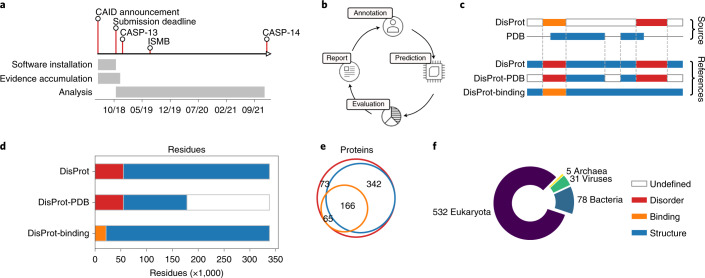
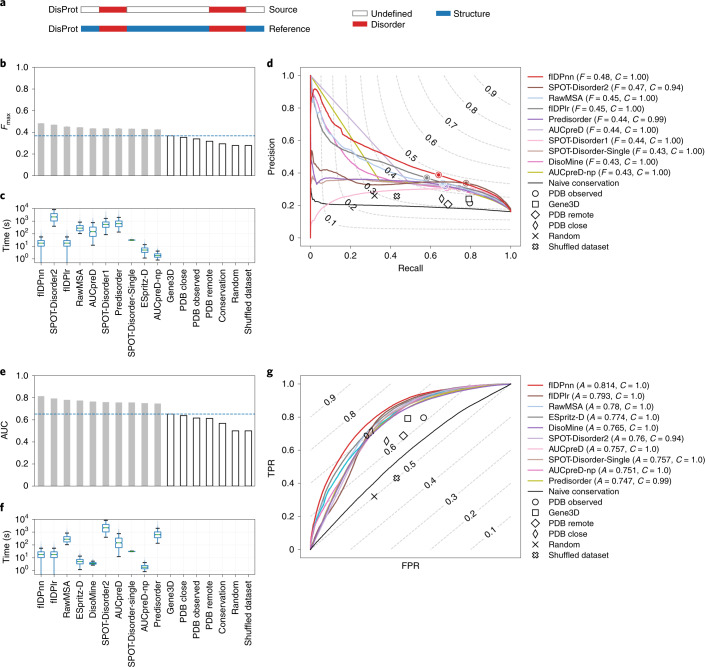
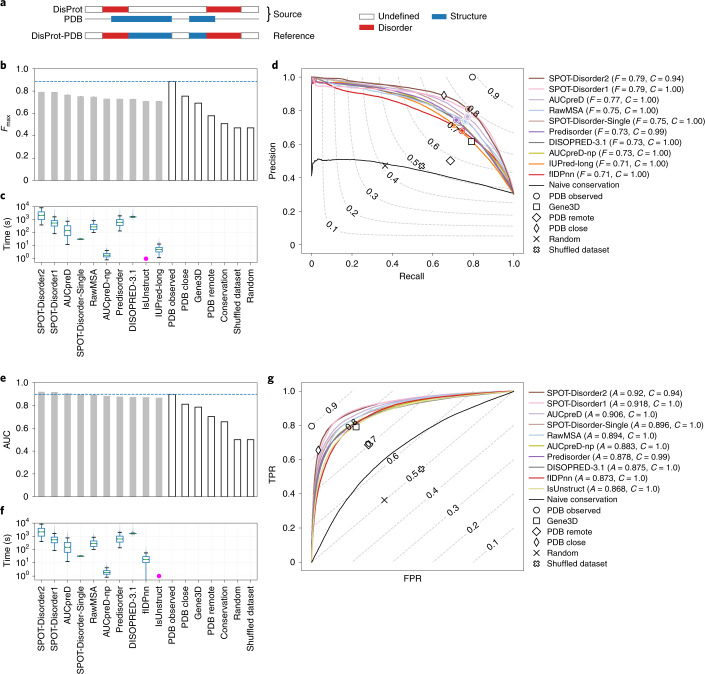
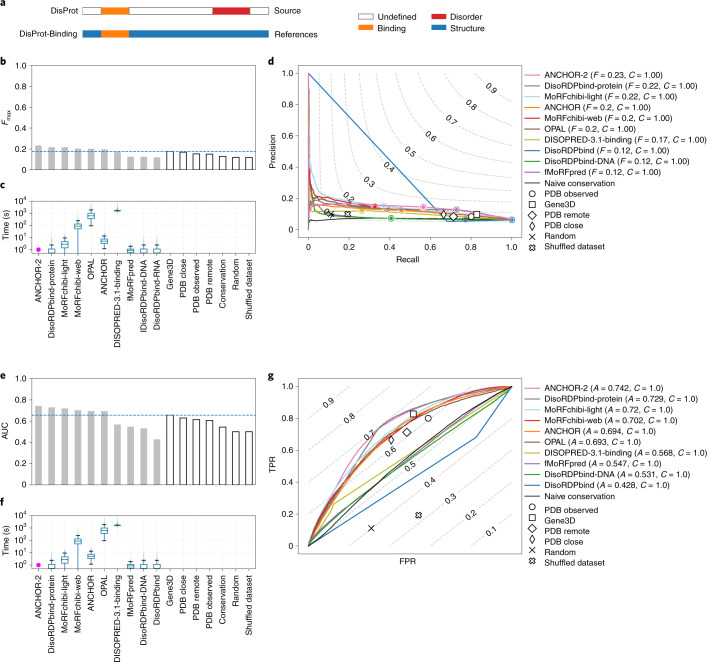
Abstract Intrinsically disordered proteins, defying the traditional protein structure–function paradigm, are a challenge to study experimentally. Because a large part of our knowledge rests on computational predictions, it is crucial that their accuracy is high. The Critical Assessment of protein Intrinsic Disorder prediction (CAID) experiment was established as a community-based blind test to determine the state of the art in prediction of intrinsically disordered regions and the subset of residues involved in binding. A total of 43 methods were evaluated on a dataset of 646 proteins from DisProt. The best methods use deep learning techniques and notably outperform physicochemical methods. The top disorder predictor has F max = 0.483 on the full dataset and F max = 0.792 following filtering out of bona fide structured regions. Disordered binding regions remain hard to predict, with F max = 0.231. Interestingly, computing times among methods can vary by up to four orders of magnitude.
Overview
The claims and statistics of this paper haven’t been checked yet.
Run the check — free, no account needed. It reads the open-access text and checks the sources it cites.
Integrity signals
Registry
Cites
Statistics
Figures
Verification
Claims the paper makes
The claims and statistics of this paper haven’t been checked yet.
Run the check — free, no account needed. It reads the open-access text and checks the sources it cites.
Claims other papers make about this one
Each is checked against this paper’s own text: does it say what the citing paper says it does?
The check wasn’t confident either way, so it gives no verdict — never disputed.
In the citing paper
“Conservative estimates indicate that roughly 30% of sequences, 30residues or longer, drawn at random from the human proteome, are likely to be IDRs. 3,5”
From AlphaFold and Implications for Intrinsically Disordered Proteins (2021) · cites this paper as [5]
Experimental — accuracy not yet measuredIn the citing paper
“pLDDT scores have been shown to be a competitive disorder predictor compared to standards in disorder prediction.5”
From AlphaFold and Implications for Intrinsically Disordered Proteins (2021) · cites this paper as [5]
Self-check
Percentages, sums and reported differences re-computed from the paper’s own numbers.
The self-check needs the paper’s full text.
Citations
Cites
Gapped BLAST and PSI-BLAST: a new generation of protein database search programs
Altschul, S. (1997) · Nucleic Acids Research · doi:10.1093/nar/25.17.3389 · Cited by 73,302
UniProt: the Universal Protein knowledgebase
Apweiler, R. (2003) · Nucleic Acids Research · doi:10.1093/nar/gkh131 · Cited by 7,593
UniProt: the universal protein knowledgebase
The UniProt Consortium (2017) · Nucleic Acids Research · doi:10.1093/nar/gkw1099 · Cited by 4,436
Intrinsically disordered proteins in cellular signalling and regulation
Wright, P. E., & Dyson, H. J. (2014) · Nature Reviews Molecular Cell Biology · doi:10.1038/nrm3920 · Cited by 2,482
Prediction and Functional Analysis of Native Disorder in Proteins from the Three Kingdoms of Life
Ward, J. J., Sodhi, J. S., McGuffin, L. J., Buxton, B. F., & Jones, D. T. (2004) · Journal of Molecular Biology · doi:10.1016/j.jmb.2004.02.002 · Cited by 2,010
Mészáros, B., Erdős, G., & Dosztányi, Z. (2018) · Nucleic Acids Research · doi:10.1093/nar/gky384 · Cited by 1,454
InterPro in 2019: improving coverage, classification and access to protein sequence annotations
Mitchell, A. L., Attwood, T. K., Babbitt, P. C., Blum, M., Bork, P., Bridge, A., Brown, S. D., Chang, H.-Y., El-Gebali, S., Fraser, M. I., et al. (2019) · Nucleic Acids Research · doi:10.1093/nar/gky1100 · Cited by 1,426
Coupling of folding and binding for unstructured proteins
Dyson, H. J., & Wright, P. E. (2002) · Current Opinion in Structural Biology · doi:10.1016/s0959-440x(02)00289-0 · Cited by 1,327
Linding, R., Jensen, L. J., Diella, F., Bork, P., Gibson, T. J., & Russell, R. B. (2003) · Structure · doi:10.1016/j.str.2003.10.002 · Cited by 1,235
Intrinsic Disorder in Cell-signaling and Cancer-associated Proteins
Iakoucheva, L. M., Brown, C. J., Lawson, J. D., Obradović, Z., & Dunker, A. K. (2002) · Journal of Molecular Biology · doi:10.1016/s0022-2836(02)00969-5 · Cited by 1,214
A large-scale evaluation of computational protein function prediction
Radivojac, P., Clark, W. T., Oron, T. R., Schnoes, A. M., Wittkop, T., Sokolov, A., Graim, K., Funk, C., Verspoor, K., Ben-Hur, A., et al. (2013) · Nature Methods · doi:10.1038/nmeth.2340 · Cited by 1,028
Length-dependent prediction of protein intrinsic disorder
Peng, K., Predrag Radivojac, A., Vučetić, S., Dunker, A. K., & Zoran Obradovic, A. (2006) · BMC Bioinformatics · doi:10.1186/1471-2105-7-208 · Cited by 940
DISOPRED3: precise disordered region predictions with annotated protein-binding activity
Jones, D. T., & Cozzetto, D. (2014) · Bioinformatics · doi:10.1093/bioinformatics/btu744 · Cited by 877
Predicting functionally important residues from sequence conservation
Capra, J. A., & Singh, M. (2007) · Bioinformatics · doi:10.1093/bioinformatics/btm270 · Cited by 693
Cell Signaling in Space and Time: Where Proteins Come Together and When They’re Apart
Scott, J. D., & Pawson, T. J. (2009) · Science · doi:10.1126/science.1175668 · Cited by 649
ESpritz: accurate and fast prediction of protein disorder
Walsh, I., Martín, A. J. M., Domenico, T. D., & Tosatto, S. C. E. (2011) · Bioinformatics · doi:10.1093/bioinformatics/btr682 · Cited by 523
Roey, K. V., Uyar, B., Weatheritt, R. J., Dinkel, H., Seiler, M., Budd, A., Gibson, T. J., & Davey, N. E. (2014) · Chemical Reviews · doi:10.1021/cr400585q · Cited by 513
Structure and Function of Intrinsically Disordered Proteins
Tompa, P., & Fersht, A. (2009) · Chapman & Hall/CRC eBooks · doi:10.1201/9781420078930 · Cited by 330
Local Structural Elements in the Mostly Unstructured Transcriptional Activation Domain of Human p53
Lee, H., Mok, K. H., Muhandiram, R., Park, K.-H., Suk, J.-E., Kim, D., Chang, J., Sung, Y. C., Choi, K. Y., & Han, K. (2000) · Journal of Biological Chemistry · doi:10.1074/jbc.m003107200 · Cited by 329
Intrinsic dynamics of enzymes in the unbound state and relation to allosteric regulation
Bahar, I., Chennubhotla, C., & Tobi, D. (2007) · Current Opinion in Structural Biology · doi:10.1016/j.sbi.2007.09.011 · Cited by 306
Unstructural biology coming of age
Tompa, P. (2011) · Current Opinion in Structural Biology · doi:10.1016/j.sbi.2011.03.012 · Cited by 292
ELM—the eukaryotic linear motif resource in 2020
Kumar, M., Gouw, M., Michael, S., Sámano‐Sánchez, H., Pancsa, R., Glavina, J., Diakogianni, A., Alvarado-Valverde, J., Bukirova, D., Čalyševa, J., et al. (2019) · Nucleic Acids Research · doi:10.1093/nar/gkz1030 · Cited by 278
Part II: α-synuclein and its molecular pathophysiological role in neurodegenerative disease
Dev, K. K. (2003) · Neuropharmacology · doi:10.1016/s0028-3908(03)00140-0 · Cited by 267
From Sequence and Forces to Structure, Function, and Evolution of Intrinsically Disordered Proteins
Forman-Kay, J. D., & Mittag, T. (2013) · Structure · doi:10.1016/j.str.2013.08.001 · Cited by 259
Rational drug design via intrinsically disordered protein
Cheng, Y., LeGall, T., Oldfield, C. J., Mueller, J. P., Van, Y.-Y. J., Romero, P. R., Cortese, M. S., Uversky, V. N., & Dunker, A. K. (2006) · Trends in biotechnology · doi:10.1016/j.tibtech.2006.07.005 · Cited by 248
DisProt: intrinsic protein disorder annotation in 2020
Hatos, A., Hajdu-Soltész, B., Monzón, A. M., Palópoli, N., Álvarez, L., Fas, B. A., Bassot, C., Benítez, G. I., Bevilacqua, M., Chasapi, A., et al. (2019) · Nucleic Acids Research · doi:10.1093/nar/gkz975 · Cited by 231
Jakob, U., Kriwacki, R. W., & Uversky, V. N. (2014) · Chemical Reviews · doi:10.1021/cr400459c · Cited by 218
Piovesan, D., Tabaro, F., Paladin, L., Necci, M., Mičetić, I., Camilloni, C., Davey, N. E., Dosztányi, Z., Mészáros, B., Monzón, A. M., et al. (2017) · Nucleic Acids Research · doi:10.1093/nar/gkx1071 · Cited by 208
Gene3D: Extensive prediction of globular domains in proteins
Lewis, T. E., Sillitoe, I., Dawson, N., Lam, S., Clarke, T., Lee, D. A., Orengo, C., & Lees, J. (2017) · Nucleic Acids Res. · doi:10.1093/nar/gkx1069 · Cited by 195
MoRFchibi SYSTEM: software tools for the identification of MoRFs in protein sequences
Malhis, N., Jacobson, M., & Gsponer, J. A. (2016) · Nucleic Acids Research · doi:10.1093/nar/gkw409 · Cited by 179
High-throughput prediction of RNA, DNA and protein binding regions mediated by intrinsic disorder
Peng, Z., & Kurgan, L. (2015) · Nucleic Acids Research · doi:10.1093/nar/gkv585 · Cited by 169
Liu, Y., Wang, X., & Liu, B. (2017) · Briefings in Bioinformatics · doi:10.1093/bib/bbx126 · Cited by 163
Assessment of protein disorder region predictions in CASP10
Monastyrskyy, B., Kryshtafovych, A., Moult, J., Tramontano, A. L., & Fidelis, K. A. (2013) · Proteins Structure Function and Bioinformatics · doi:10.1002/prot.24391 · Cited by 160
Increasing specificity in high-throughput yeast two-hybrid experiments
Vidalain, P., Boxem, M., Ge, H., Li, S., & Vidal, M. (2004) · Methods · doi:10.1016/j.ymeth.2003.10.001 · Cited by 158
Intrinsically disordered proteins and multicellular organisms
Dunker, A. K., Bondos, S. E., Huang, F., & Oldfield, C. J. (2015) · Seminars in Cell & Developmental Biology · doi:10.1016/j.semcdb.2014.09.025 · Cited by 150
PDBe: improved accessibility of macromolecular structure data from PDB and EMDB
Velankar, S. S., van Ginkel, G., Alhroub, Y., Battle, G. M., Berrisford, J. M., Conroy, M. J., Dana, J. M., Gore, S. P., Gutmanas, A., Haslam, P., et al. (2015) · Nucleic Acids Research · doi:10.1093/nar/gkv1047 · Cited by 148
Deiana, A., Forcelloni, S., Porrello, A., & Giansanti, A. (2019) · PLoS ONE · doi:10.1371/journal.pone.0217889 · Cited by 140
Fukuchi, S., Amemiya, T., Sakamoto, S., Nobe, Y., Hosoda, K., Kado, Y., Murakami, S. D., Koike, R., Hiroaki, H., & Ota, M. (2013) · Nucleic Acids Research · doi:10.1093/nar/gkt1010 · Cited by 122
Intrinsically disordered proteins and novel strategies for drug discovery
Uversky, V. N. (2012) · Expert Opinion on Drug Discovery · doi:10.1517/17460441.2012.686489 · Cited by 120
Simultaneous quantification of protein order and disorder
Sormanni, P., Piovesan, D., Heller, G. T., Bonomi, M., Kukić, P., Camilloni, C., Fuxreiter, M., Dosztányi, Z., Pappu, R. V., Babu, M. M., et al. (2017) · Nature Chemical Biology · doi:10.1038/nchembio.2331 · Cited by 120
A functional role for intrinsic disorder in the tau-tubulin complex
Melo, A. M., Coraor, J., Cobb, G., Elbaum‐Garfinkle, S., Nath, A., & Rhoades, E. R. (2016) · Proceedings of the National Academy of Sciences · doi:10.1073/pnas.1610137113 · Cited by 97
DIBS: a repository of disordered binding sites mediating interactions with ordered proteins
Schád, É., Fichó, E., Pancsa, R., Simon, I., Dosztányi, Z., & Mészáros, B. (2017) · Bioinformatics · doi:10.1093/bioinformatics/btx640 · Cited by 93
Structural Biology outside the box — inside the cell
Plitzko, J. M., Schuler, B., & Selenko, P. (2017) · Current Opinion in Structural Biology · doi:10.1016/j.sbi.2017.06.007 · Cited by 90
Intrinsically Disordered Proteins Studied by NMR Spectroscopy
Felli, I. C., & Pierattelli, R. (2015) · Advances in experimental medicine and biology · doi:10.1007/978-3-319-20164-1 · Cited by 83
OPAL: prediction of MoRF regions in intrinsically disordered protein sequences
Sharma, R., Raicar, G., Tsunoda, T., Patil, A., & Sharma, A. K. (2018) · Bioinformatics · doi:10.1093/bioinformatics/bty032 · Cited by 77
Highlight negative results to improve science
Mehta, D. (2019) · Nature · doi:10.1038/d41586-019-02960-3 · Cited by 73
MFIB: a repository of protein complexes with mutual folding induced by binding
Fichó, E., Reményi, I., Simon, I., & Mészáros, B. (2017) · Bioinformatics · doi:10.1093/bioinformatics/btx486 · Cited by 70
Blikstad, C., & Ivarsson, Y. (2015) · Cell Communication and Signaling · doi:10.1186/s12964-015-0116-8 · Cited by 59
Necci, M., Piovesan, D., & Tosatto, S. C. E. (2016) · Protein Science · doi:10.1002/pro.3041 · Cited by 56
Influence of Sequence Changes and Environment on Intrinsically Disordered Proteins
Mohan, A., Uversky, V. N., & Predrag Radivojac, A. (2009) · PLoS Computational Biology · doi:10.1371/journal.pcbi.1000497 · Cited by 50
Monzón, A. M., Necci, M., Quaglia, F., Walsh, I., Piovesan, D., Zanotti, G., & Tosatto, S. C. E. (2020) · International Journal of Molecular Sciences · doi:10.3390/ijms21124496 · Cited by 35
Identification of Intrinsic Disorder in Complexes from the Protein Data Bank
Jianhong, Z., Oldfield, C. J., Yan, W., Shen, B., & Dunker, A. K. (2020) · ACS Omega · doi:10.1021/acsomega.9b03927 · Cited by 29
The Conformational Mobility of Proteins and its Functional Significance
Williams, R. J. P. (1978) · Biochemical Society Transactions · doi:10.1042/bst0061123 · Cited by 26
Holmstrom, E. D., Nettels, D., & Schuler, B. (2017) · Journal of Molecular Biology · doi:10.1016/j.jmb.2017.10.010 · Cited by 26
Piovesan, D., & Tosatto, S. C. E. (2017) · Bioinformatics · doi:10.1093/bioinformatics/btx592 · Cited by 25
Identification of intrinsic disorder in complexes from Protein Data Bank
Jianhong, Z., Oldfield, C. J., Huang, F., Yan, W., Shen, B., & Dunker, A. K. (2018) · IEEE International Conference on Computational Advances in Bio and Medical Sciences · doi:10.1109/iccabs.2018.8541994 · Cited by 2
Cited by
Sorted by citations
Highly accurate protein structure prediction for the human proteome
Tunyasuvunakool, K., Adler, J., Wu, Z., Green, T., Zielinski, M., Žídek, A., Bridgland, A., Cowie, A., Meyer, C., Laydon, A., et al. (2021) · Nature · doi:10.1038/s41586-021-03828-1 · Cited by 3,025
A structural biology community assessment of AlphaFold2 applications
Akdel, M., Pires, D. E. V., Pardo, E. P., Jänes, J., Zalevsky, A. O., Mészáros, B., Bryant, P., Good, L. L., Laskowski, R. A., Pozzati, G., et al. (2022) · Nature Structural & Molecular Biology · doi:10.1038/s41594-022-00849-w · Cited by 675
The molecular basis for cellular function of intrinsically disordered protein regions
Holehouse, A. S., & Kragelund, B. B. (2023) · Nature Reviews Molecular Cell Biology · doi:10.1038/s41580-023-00673-0 · Cited by 741
AlphaFold and Implications for Intrinsically Disordered Proteins
Ruff, K. M., & Pappu, R. V. (2021) · Journal of Molecular Biology · doi:10.1016/j.jmb.2021.167208 · Cited by 635
Erdős, G., Pajkos, M., & Dosztányi, Z. (2021) · Nucleic Acids Res. · doi:10.1093/nar/gkab408 · Cited by 560
Metadata
- Authors
- Necci, M., Piovesan, D., Predictors, C., Hoque, M. T., Walsh, I., Iqbal, S., Vendruscolo, M., Sormanni, P., Wang, C., Raimondi, D., Sharma, R., Zhou, Y., Litfin, T., Galzitskaya, O. V., Lobanov, M. Y., Vranken, W., Wallner, B., Mirabello, C., Malhis, N., Dosztányi, Z., Erdős, G., Mészáros, B., Gao, J., Wang, K., Hu, G., Wu, Z., Sharma, A., Hanson, J., Paliwal, K., Callebaut, I., Bitard-Feildel, T., Orlando, G., Peng, Z., Xu, J., Wang, S., Jones, D. T., Cozzetto, D., Meng, F., Yan, J., Gsponer, J., Cheng, J., Wu, T., Kurgan, L., Curators, D., Promponas, V. J., Tamana, S., Marino-Buslje, C., Martínez-Pérez, E., Chasapi, A., Ouzounis, C., Dunker, A. K., Kajava, A. V., Leclercq, J. Y., Aykac-Fas, B., Lambrughi, M., Maiani, E., Papaleo, E., Chemes, L. B., Álvarez, L., González-Foutel, N. S., Iglesias, V., Pujols, J., Ventura, S., Palopoli, N., Benítez, G. I., Parisi, G., Bassot, C., Elofsson, A., Govindarajan, S., Lamb, J., Salvatore, M., Hatos, A., Monzon, A. M., Bevilacqua, M., Mičetić, I., Minervini, G., Paladin, L., Quaglia, F., Leonardi, E., Davey, N., Horvath, T., Kovacs, O. P., Murvai, N., Pancsa, R., Schad, E., Szabo, B., Tantos, A., Macedo-Ribeiro, S., Manso, J. A., Pereira, P. J. B., Davidović, R., Veljkovic, N., Hajdu-Soltész, B., Pajkos, M., Szaniszló, T., Guharoy, M., Lazar, T., Macossay-Castillo, M., Tompa, P., & Tosatto, S. C. E.
- Affiliations
- University of Padua (IT)
- LSU New Orleans (US)
- Agency for Science, Technology and Research (SG)
- Broad Institute (US)
- University of Cambridge (GB)
- Columbia University (US)
- Fiji National University (FJ)
- Griffith University (AU)
- Russian Academy of Sciences (RU)
- Linköping University (SE)
- Eötvös Loránd University (HU)
- Nankai University (CN)
- Sorbonne Université (FR)
- Tianjin University (CN)
- Toyota Technological Institute at Chicago (US)
- University College London (GB)
- University of Alberta (CA)
- University of British Columbia (CA)
- University of Missouri (US)
- Virginia Commonwealth University (US)
- University of Cyprus (CY)
- Fundación Instituto Leloir (AR)
- Centre for Research and Technology Hellas (GR)
- Université de Montpellier (FR)
- Danish Cancer Society (DK)
- Consejo Nacional de Investigaciones Científicas y Técnicas (AR)
- Universitat Autònoma de Barcelona (ES)
- National University of Quilmes (AR)
- Stockholm University (SE)
- University of Copenhagen (DK)
- Institute of Cancer Research (GB)
- Institute of Molecular Life Sciences (HU)
- Universidade do Porto (PT)
- Vrije Universiteit Brussel (BE)
- Corresponding author
- Tosatto, Silvio C. E.
- ORCID
- Necci, Marco
- Piovesan, Damiano
- Hoque, Md Tamjidul
- Walsh, Ian
- Iqbal, Sumaiya
- Vendruscolo, Michele
- Sormanni, Pietro
- Wang, Chen
- Raimondi, Daniele
- Sharma, Ronesh
- Zhou, Yaoqi
- Litfin, Thomas
- Galzitskaya, Oxana Valerianovna
- Vranken, Wim
- Wallner, Björn
- Mirabello, Claudio
- Malhis, Nawar
- Dosztányi, Zsuzsanna
- Mészáros, Bálint
- Gao, Jianzhao
- Wang, Kui
- Hu, Gang
- Wu, Zhonghua
- Sharma, Alok
- Hanson, Jack
- Paliwal, Kuldip
- Callebaut, Isabelle
- Orlando, Gabriele
- Peng, Zhenling
- Xu, Jinbo
- Wang, Sheng
- Jones, David T.
- Cozzetto, Domenico
- Yan, Jing
- Gsponer, Jörg
- Cheng, Jianlin
- Wu, Tianqi
- Kurgan, Lukasz
- Promponas, Vasilis J.
- Tamana, Stella
- Chasapi, Anastasia
- Ouzounis, Christos
- Dunker, A. Keith
- Kajava, Andrey V.
- Leclercq, Jeremy Y.
- Lambrughi, Matteo
- Maiani, Emiliano
- Papaleo, Elena
- Chemes, Lucia Beatriz
- Pujols, Jordi
- Ventura, Salvador
- Parisi, Gustavo
- Bassot, Claudio
- Elofsson, Arne
- Lamb, John
- Salvatore, Marco
- Hatos, András
- Bevilacqua, Martina
- Mičetić, Ivan
- Minervini, Giovanni
- Paladin, Lisanna
- Quaglia, Federica
- Leonardi, Emanuela
- Davey, Norman
- Murvai, Nikoletta
- Pancsa, Rita
- Pereira, Pedro José Barbosa
- Davidović, Radoslav
- Pajkos, Mátyás
- Szaniszló, Tamás
- Guharoy, Mainak
- Tosatto, Silvio C. E.
- Venue
- Nature Methods
- Published
- 2021-04-19
- Volume
- 18
- Issue
- 5
- Pages
- 472-481
- ISSN
- 1548-7091 (ISSN-L)
- 1548-7105
- PMC
- PMC8105172
- OpenAlex
- W3156051371
- Cited by
- 343
- References
- 58
- Citations by year
- 2026: 35 · 2025: 64 · 2024: 68 · 2023: 72 · 2022: 69 · 2021: 32
- FWCI
- 18.99
- Type
- journal article
- Language
- en
- Open access
- hybrid
- doi.org
- Locations
- Nature Methods (publishedVersion, cc-by)
- bioRxiv (Cold Spring Harbor Laboratory) (acceptedVersion, cc-by-nc-nd)
- PubMed Central (publishedVersion, cc-by)
- PubMed (publishedVersion)
- HAL (submittedVersion, other-oa)
- Dipòsit Digital de Documents de la UAB (Universitat Autònoma de Barcelona) (submittedVersion, cc-by)
- Griffith Research Online (submittedVersion, cc-by)
- CONICET Digital (CONICET) (submittedVersion, cc-by)
- Apollo (University of Cambridge) (submittedVersion, cc-by)
- ELTE Digital Institutional Repository (EDIT) (Eötvös Loránd University) (submittedVersion, other-oa)
- UCL Discovery (University College London) (submittedVersion)
- IUScholarWorks (Indiana University) (submittedVersion, cc-by)
- VinaR (Institute of Nuclear Sciences "Vinča") (submittedVersion, cc-by)
- VUBIR (Vrije Universiteit Brussel) (submittedVersion)
- Padua Research Archive (University of Padova) (submittedVersion, cc-by)
- Apollo
- Apollo (cc-by)
- Funders
- EC | Horizon 2020 Framework Programme (778247)
- Ministero dell’Istruzione, dell’Università e della Ricerca (2017483NH8)
- Topics
- Life Sciences › Biochemistry, Genetics and Molecular Biology › Molecular Biology › Protein Structure and Dynamics
- Life Sciences › Biochemistry, Genetics and Molecular Biology › Molecular Biology › Machine Learning in Bioinformatics
- Life Sciences › Pharmacology, Toxicology and Pharmaceutics › Drug Discovery › Computational Drug Discovery Methods
- Keywords
- intrinsically disordered proteins, CAID, blind test, deep learning, physicochemical methods, DisProt, prediction accuracy, benchmarking
- MeSH terms
- Amino Acid Sequence, Protein Binding, Protein Conformation, Software, Protein Folding, Computational Biology, Databases, Protein, Intrinsically Disordered Proteins
About these checks
Registry, retraction, Cites and statistics results are computed, not judged, with one exception: a printed reference that no index lists is read once by a model before it counts as a citation error. Claims are extracted by a model and kept only when their quote appears verbatim in the text; each cited source is then checked, with a model’s help, for whether it says what the claim relies on. Those verdicts can be wrong — read the claim’s quote and the cited source before relying on one.
Statistics and arithmetic are recomputed, not judged.
Confidence bands are shown only for fields calibrated on our annotated test set. None is calibrated yet, so no band is shown.
What counts as a claim ›How we measure confidence ›How we check this ›
Are you an author, or do you see a problem with this page? Request a review
