

The DOI matches its Crossref record; 56 of the 58 references it cites were found in a registry or an index.
Critical assessment of protein intrinsic disorder prediction
Open accessPublished version of a preprint
Abstract
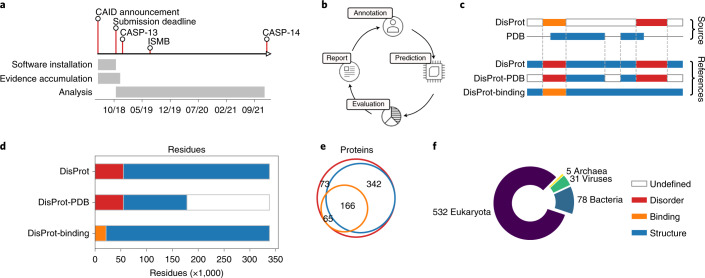
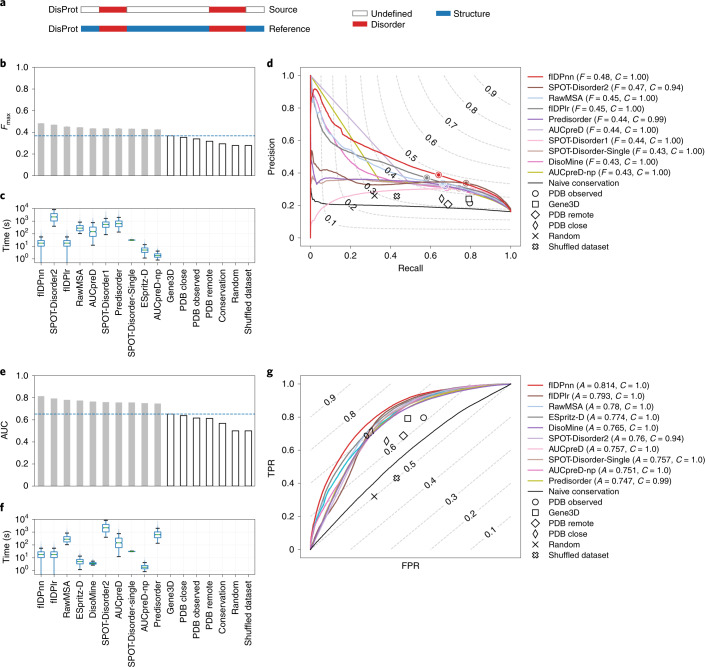
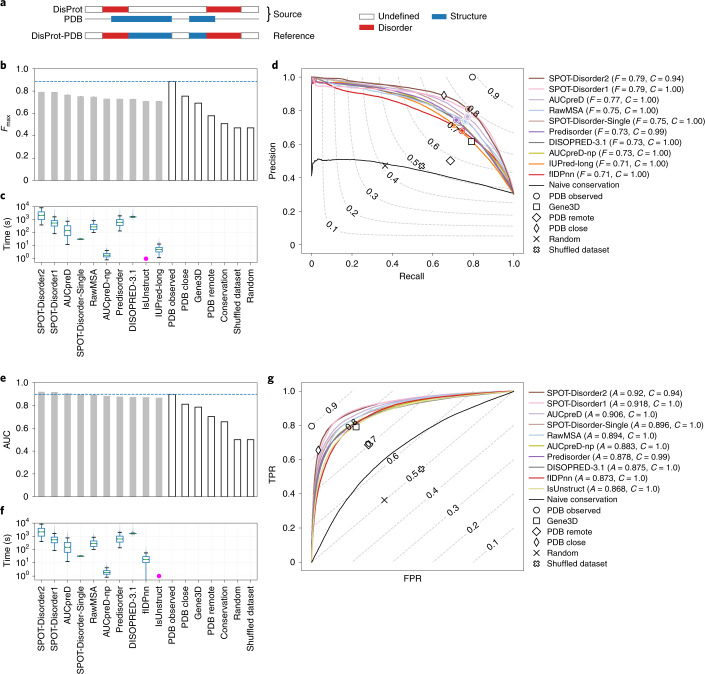
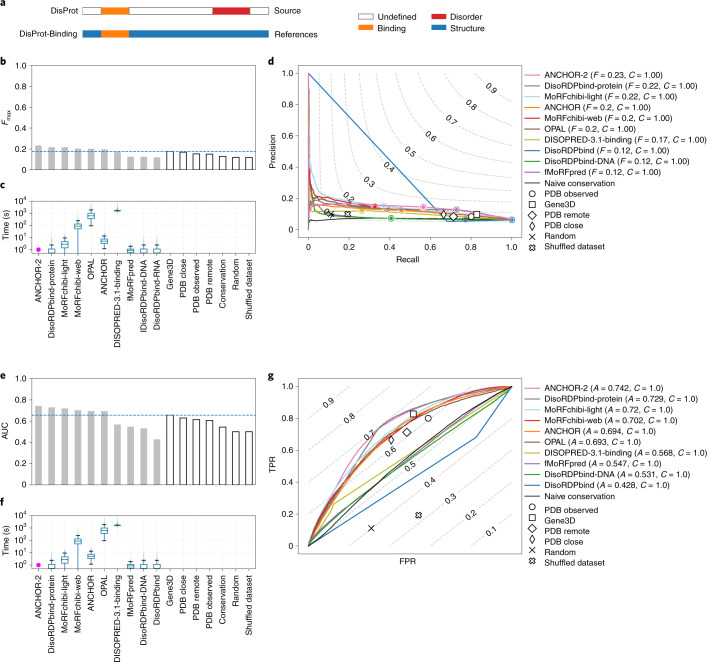
Abstract Intrinsically disordered proteins, defying the traditional protein structure–function paradigm, are a challenge to study experimentally. Because a large part of our knowledge rests on computational predictions, it is crucial that their accuracy is high. The Critical Assessment of protein Intrinsic Disorder prediction (CAID) experiment was established as a community-based blind test to determine the state of the art in prediction of intrinsically disordered regions and the subset of residues involved in binding. A total of 43 methods were evaluated on a dataset of 646 proteins from DisProt. The best methods use deep learning techniques and notably outperform physicochemical methods. The top disorder predictor has F max = 0.483 on the full dataset and F max = 0.792 following filtering out of bona fide structured regions. Disordered binding regions remain hard to predict, with F max = 0.231. Interestingly, computing times among methods can vary by up to four orders of magnitude.
Overview
The claims and statistics of this paper haven’t been checked yet.
Run the check — free, no account needed. It reads the open-access text and checks the sources it cites.
Integrity signals
Registry
Cites
Statistics
Figures
Verification
Claims the paper makes
The claims and statistics of this paper haven’t been checked yet.
Run the check — free, no account needed. It reads the open-access text and checks the sources it cites.
Claims other papers make about this one
Each is checked against this paper’s own text: does it say what the citing paper says it does?
The check wasn’t confident either way, so it gives no verdict — never disputed.
In the citing paper
“Conservative estimates indicate that roughly 30% of sequences, 30residues or longer, drawn at random from the human proteome, are likely to be IDRs. 3,5”
From AlphaFold and Implications for Intrinsically Disordered Proteins (2021) · cites this paper as [5]
Experimental — accuracy not yet measuredIn the citing paper
“pLDDT scores have been shown to be a competitive disorder predictor compared to standards in disorder prediction.5”
From AlphaFold and Implications for Intrinsically Disordered Proteins (2021) · cites this paper as [5]
Self-check
Percentages, sums and reported differences re-computed from the paper’s own numbers.
The self-check needs the paper’s full text.
Citations
Cites
Gapped BLAST and PSI-BLAST: a new generation of protein database search programs
Altschul, S. (1997) · Nucleic Acids Research · doi:10.1093/nar/25.17.3389 · Cited by 73,302
UniProt: the Universal Protein knowledgebase
Apweiler, R. (2003) · Nucleic Acids Research · doi:10.1093/nar/gkh131 · Cited by 7,593
UniProt: the universal protein knowledgebase
The UniProt Consortium (2017) · Nucleic Acids Research · doi:10.1093/nar/gkw1099 · Cited by 4,436
Intrinsically disordered proteins in cellular signalling and regulation
Wright, P. E., & Dyson, H. J. (2014) · Nature Reviews Molecular Cell Biology · doi:10.1038/nrm3920 · Cited by 2,482
Prediction and Functional Analysis of Native Disorder in Proteins from the Three Kingdoms of Life
Ward, J. J., Sodhi, J. S., McGuffin, L. J., Buxton, B. F., & Jones, D. T. (2004) · Journal of Molecular Biology · doi:10.1016/j.jmb.2004.02.002 · Cited by 2,010
Mészáros, B., Erdős, G., & Dosztányi, Z. (2018) · Nucleic Acids Research · doi:10.1093/nar/gky384 · Cited by 1,454
InterPro in 2019: improving coverage, classification and access to protein sequence annotations
Mitchell, A. L., Attwood, T. K., Babbitt, P. C., Blum, M., Bork, P., Bridge, A., Brown, S. D., Chang, H.-Y., El-Gebali, S., Fraser, M. I., et al. (2019) · Nucleic Acids Research · doi:10.1093/nar/gky1100 · Cited by 1,426
Coupling of folding and binding for unstructured proteins
Dyson, H. J., & Wright, P. E. (2002) · Current Opinion in Structural Biology · doi:10.1016/s0959-440x(02)00289-0 · Cited by 1,327
Linding, R., Jensen, L. J., Diella, F., Bork, P., Gibson, T. J., & Russell, R. B. (2003) · Structure · doi:10.1016/j.str.2003.10.002 · Cited by 1,235
Intrinsic Disorder in Cell-signaling and Cancer-associated Proteins
Iakoucheva, L. M., Brown, C. J., Lawson, J. D., Obradović, Z., & Dunker, A. K. (2002) · Journal of Molecular Biology · doi:10.1016/s0022-2836(02)00969-5 · Cited by 1,214
Cited by
Sorted by citations
Highly accurate protein structure prediction for the human proteome
Tunyasuvunakool, K., Adler, J., Wu, Z., Green, T., Zielinski, M., Žídek, A., Bridgland, A., Cowie, A., Meyer, C., Laydon, A., et al. (2021) · Nature · doi:10.1038/s41586-021-03828-1 · Cited by 3,025
A structural biology community assessment of AlphaFold2 applications
Akdel, M., Pires, D. E. V., Pardo, E. P., Jänes, J., Zalevsky, A. O., Mészáros, B., Bryant, P., Good, L. L., Laskowski, R. A., Pozzati, G., et al. (2022) · Nature Structural & Molecular Biology · doi:10.1038/s41594-022-00849-w · Cited by 675
The molecular basis for cellular function of intrinsically disordered protein regions
Holehouse, A. S., & Kragelund, B. B. (2023) · Nature Reviews Molecular Cell Biology · doi:10.1038/s41580-023-00673-0 · Cited by 741
AlphaFold and Implications for Intrinsically Disordered Proteins
Ruff, K. M., & Pappu, R. V. (2021) · Journal of Molecular Biology · doi:10.1016/j.jmb.2021.167208 · Cited by 635
Erdős, G., Pajkos, M., & Dosztányi, Z. (2021) · Nucleic Acids Res. · doi:10.1093/nar/gkab408 · Cited by 560
flDPnn: Accurate intrinsic disorder prediction with putative propensities of disorder functions
Hu, G., Katuwawala, A., Wang, K., Wu, Z., Ghadermarzi, S., Gao, J., & Kurgan, L. (2021) · Nature Communications · doi:10.1038/s41467-021-24773-7 · Cited by 292
Metapredict: a fast, accurate, and easy-to-use predictor of consensus disorder and structure
Emenecker, R. J., Griffith, D., & Holehouse, A. S. (2021) · Biophysical Journal · doi:10.1016/j.bpj.2021.08.039 · Cited by 262
Intrinsically Disordered Proteins: An Overview
Trivedi, R., & Nagarajaram, H. A. (2022) · International Journal of Molecular Sciences · doi:10.3390/ijms232214050 · Cited by 277
Systematic identification of conditionally folded intrinsically disordered regions by AlphaFold2
Alderson, T. R., Pritišanac, I., Kolarić, Đ., Moses, A. M., & Forman-Kay, J. D. (2023) · Proceedings of the National Academy of Sciences · doi:10.1073/pnas.2304302120 · Cited by 240
Intrinsically disordered proteins play diverse roles in cell signaling
Bondos, S. E., Dunker, A. K., & Uversky, V. N. (2022) · Cell Communication and Signaling · doi:10.1186/s12964-022-00821-7 · Cited by 222
Self-citationAlphaFold2: A Role for Disordered Protein/Region Prediction?
Wilson, C. J., Choy, W.-Y., & Karttunen, M. (2022) · International Journal of Molecular Sciences · doi:10.3390/ijms23094591 · Cited by 173
Intrinsic protein disorder and conditional folding in AlphaFoldDB
Piovesan, D., Monzon, A. M., & Tosatto, S. C. E. (2022) · Protein Science · doi:10.1002/pro.4466 · Cited by 160
DisProt in 2022: improved quality and accessibility of protein intrinsic disorder annotation
Quaglia, F., Mészáros, B., Salladini, E., Hatos, A., Pancsa, R., Chemes, L. B., Pajkos, M., Lázár, T., Peña‐Díaz, S., Santos, J., et al. (2021) · Nucleic Acids Research · doi:10.1093/nar/gkab1082 · Cited by 161
MobiDB: 10 years of intrinsically disordered proteins
Piovesan, D., Conte, A. D., Clementel, D., Monzón, A. M., Bevilacqua, M., Aspromonte, M. C., Iserte, J., Orti, F., Marino‐Buslje, C., & Tosatto, S. C. E. (2022) · Nucleic Acids Research · doi:10.1093/nar/gkac1065 · Cited by 158
Rapid prediction and analysis of protein intrinsic disorder
Dayhoff, G. W., & Uversky, V. N. (2022) · Protein Science · doi:10.1002/pro.4496 · Cited by 141
Homology modeling in the time of collective and artificial intelligence
Hameduh, T., Haddad, Y., Adam, V., & Heger, Z. (2020) · Computational and Structural Biotechnology Journal · doi:10.1016/j.csbj.2020.11.007 · Cited by 146
DisProt in 2024: improving function annotation of intrinsically disordered proteins
Aspromonte, M. C., Nugnes, M. V., Quaglia, F., Bouharoua, A., Sagris, V., Promponas, V. J., Chasapi, A., Fichó, E., Balatti, G. E., Parisi, G. D., et al. (2023) · Nucleic Acids Research · doi:10.1093/nar/gkad928 · Cited by 147
The structural coverage of the human proteome before and after AlphaFold
Porta-Pardo, E., Ruiz-Serra, V., Valentini, S., & Valencia, A. (2022) · PLOS Computational Biology · doi:10.1371/journal.pcbi.1009818 · Cited by 131
On the roles of intrinsically disordered proteins and regions in cell communication and signaling
Bondos, S. E., Dunker, A. K., & Uversky, V. N. (2021) · Cell Communication and Signaling · doi:10.1186/s12964-021-00774-3 · Cited by 113
Ferritin self-assembly, structure, function, and biotechnological applications
Sudarev, V. V., Dolotova, S. M., Bukhalovich, S. M., Bazhenov, S. V., Ryzhykau, Y. L., Uversky, V. N., Bondarev, N. A., Osipov, S. D., Mikhailov, A. E., Kuklina, D. D., et al. (2022) · International Journal of Biological Macromolecules · doi:10.1016/j.ijbiomac.2022.10.126 · Cited by 106
Intrinsically disordered proteins: modes of binding with emphasis on disordered domains
Morris, O. M., Torpey, J. H., & Isaacson, R. L. (2021) · Open Biology · doi:10.1098/rsob.210222 · Cited by 104
Intrinsically disordered proteins/regions and insight into their biomolecular interactions
Chakrabarti, P., & Chakravarty, D. (2022) · Biophysical Chemistry · doi:10.1016/j.bpc.2022.106769 · Cited by 101
Effector Identification in Plant Pathogens
Lovelace, A. H., Dorhmi, S., Hulin, M. T., Li, Y., Mansfıeld, J. W., & Ma, W. (2023) · Phytopathology · doi:10.1094/phyto-09-22-0337-kd · Cited by 100
Machine Learning Approaches in Polymer Science: Progress and Fundamental for a New Paradigm
Xie, C., Qiu, H., Liu, L., You, Y., Li, H., Li, Y., Sun, Z., Lin, J., & An, L. (2025) · SmartMat · doi:10.1002/smm2.1320 · Cited by 96
Zhang, F., Zhao, B., Shi, W., Li, M., & Kurgan, L. (2021) · Briefings in Bioinformatics · doi:10.1093/bib/bbab521 · Cited by 89
Critical assessment of protein intrinsic disorder prediction ( CAID ) ‐ Results of round 2
Conte, A. D., Mehdiabadi, M., Bouhraoua, A., Miguel Monzon, A., Tosatto, S. C. E., & Piovesan, D. (2023) · Proteins: Structure, Function, and Bioinformatics · doi:10.1002/prot.26582 · Cited by 86
Self-citationLindorff-Larsen, K., & Kragelund, B. B. (2021) · Journal of Molecular Biology · doi:10.1016/j.jmb.2021.167196 · Cited by 85
Ghafouri, H., Lázár, T., Conte, A. D., Tenorio, L., Aspromonte, M. C., Bernadó, P., Chaves‐Arquero, B., Chemes, L. B., Clementel, D., Cordeiro, T. N., et al. (2023) · Nucleic Acids Research · doi:10.1093/nar/gkad947 · Cited by 73
Katuwawala, A., Zhao, B., & Kurgan, L. (2021) · Bioinformatics · doi:10.1093/bioinformatics/btab640 · Cited by 71
The origin and structural evolution of de novo genes in Drosophila
Peng, J., & Zhao, L. (2024) · Nature Communications · doi:10.1038/s41467-024-45028-1 · Cited by 77
Disordered–Ordered Protein Binary Classification by Circular Dichroism Spectroscopy
Micsonai, A., Moussong, É., Murvai, N., Tantos, Á., Tőke, O., Réfrégiers, M., Wien, F., & Kardos, J. (2022) · Frontiers in Molecular Biosciences · doi:10.3389/fmolb.2022.863141 · Cited by 69
Zheng, L., Shi, S., Lu, M., Fang, P., Pan, Z., Zhang, H., Zhou, Z., Zhang, H., Mou, M., Huang, S., et al. (2024) · Genome biology · doi:10.1186/s13059-024-03166-1 · Cited by 73
Intrinsic Disorder in Human RNA-Binding Proteins
Zhao, B., Katuwawala, A., Oldfield, C. J., Hu, G., Wu, Z., Uversky, V. N., & Kurgan, L. (2021) · Journal of Molecular Biology · doi:10.1016/j.jmb.2021.167229 · Cited by 64
Real-time structure search and structure classification for AlphaFold protein models
Aderinwale, T., Bharadwaj, V., Christoffer, C., Terashi, G., Zhang, Z., Jahandideh, R., Kagaya, Y., & Kihara, D. (2022) · Communications Biology · doi:10.1038/s42003-022-03261-8 · Cited by 61
Multifunctional Intrinsically Disordered Regions in Transcription Factors
Valdimarsson, M., Nitsenko, K., & Heidarsson, P. O. (2023) · Chemistry - A European Journal · doi:10.1002/chem.202203369 · Cited by 71
Karakoyun, H. K., Yüksel, Ş., Amanoglu, I., Naserikhojasteh, L., Yeşilyurt, A., Yakıcıer, C., Timuçin, E., & Akyerli, C. B. (2023) · Frontiers in Genetics · doi:10.3389/fgene.2023.1052383 · Cited by 66
Conte, A. D., Bouhraoua, K. E. A., Mehdiabadi, M., Clementel, D., Monzón, A. M., predictors, C., Holehouse, A. S., Griffith, D., Emenecker, R. J., Patil, A., et al. (2023) · Nucleic Acids Research · doi:10.1093/nar/gkad430 · Cited by 61
Prediction of Disordered Regions in Proteins with Recurrent Neural Networks and Protein Dynamics
Orlando, G., Raimondi, D., Codicè, F., Tabaro, F., & Vranken, W. (2022) · Journal of Molecular Biology · doi:10.1016/j.jmb.2022.167579 · Cited by 56
SETH predicts nuances of residue disorder from protein embeddings
Ilzhöfer, D., Heinzinger, M., & Rost, B. (2022) · Frontiers in Bioinformatics · doi:10.3389/fbinf.2022.1019597 · Cited by 52
Lu, A. X., Lu, A. X., Pritišanac, I., Zarin, T., Forman-Kay, J. D., & Moses, A. M. (2022) · PLoS Computational Biology · doi:10.1371/journal.pcbi.1010238 · Cited by 56
Deep learning in prediction of intrinsic disorder in proteins
Zhao, B., & Kurgan, L. (2022) · Computational and Structural Biotechnology Journal · doi:10.1016/j.csbj.2022.03.003 · Cited by 50
Assessing PDB macromolecular crystal structure confidence at the individual amino acid residue level
Shao, C., Bittrich, S., Wang, S., & Burley, S. K. (2022) · Structure · doi:10.1016/j.str.2022.08.004 · Cited by 45
Kurgan, L., Hu, G., Wang, K., Ghadermarzi, S., Zhao, B., Malhis, N., Erdős, G., Gsponer, J. A., Uversky, V. N., & Dosztányi, Z. (2023) · Nature Protocols · doi:10.1038/s41596-023-00876-x · Cited by 49
Permyakov, E. A., & Uversky, V. N. (2022) · Biomolecules · doi:10.3390/biom12050656 · Cited by 52
Waman, V., Sen, N., Váradi, M., Daina, A., Wodak, S. J., Zoete, V., Velankar, S. S., & Orengo, C. A. (2020) · Briefings in Bioinformatics · doi:10.1093/bib/bbaa362 · Cited by 45
Computational prediction of disordered binding regions
Basu, S., Kihara, D., & Kurgan, L. (2023) · Computational and Structural Biotechnology Journal · doi:10.1016/j.csbj.2023.02.018 · Cited by 48
Pei, H., Guo, W., Peng, Y., Xiong, H., & Chen, Y. (2022) · Medicinal Research Reviews · doi:10.1002/med.21886 · Cited by 45
Pang, Y.-H., & Liu, B. (2024) · BMC Biology · doi:10.1186/s12915-023-01803-y · Cited by 38
Fast, sensitive detection of protein homologs using deep dense retrieval
Hong, L., Hu, Z., Sun, S., Tang, X., Wang, J., Tan, Q., Zheng, L., Wang, S., Xu, S. Y., King, I., et al. (2024) · Nature Biotechnology · doi:10.1038/s41587-024-02353-6 · Cited by 46
ADOPT: intrinsic protein disorder prediction through deep bidirectional transformers
Redl, I., Fisicaro, C., Dutton, O., Hoffmann, F., Henderson, L. D., Owens, B. M. J., Heberling, M. M., Paci, E., & Tamiola, K. (2023) · NAR Genomics and Bioinformatics · doi:10.1093/nargab/lqad041 · Cited by 42
Emenecker, R. J., Griffith, D., & Holehouse, A. S. (2022) · bioRxiv (Cold Spring Harbor Laboratory) · doi:10.1101/2022.06.06.494887 · Cited by 42
Surveying over 100 predictors of intrinsic disorder in proteins
Zhao, B., & Kurgan, L. (2021) · Expert Review of Proteomics · doi:10.1080/14789450.2021.2018304 · Cited by 43
Malhotra, Y., John, J., Yadav, D., Sharma, D., Vanshika, Rawal, K., Mishra, V., & Chaturvedi, N. (2025) · Computers in Biology and Medicine · doi:10.1016/j.compbiomed.2025.109842 · Cited by 42
Tamburrini, K. C., Terrapon, N., Lombard, V., Bissaro, B., Longhi, S., & Berrin, J. (2021) · Biomolecules · doi:10.3390/biom11111632 · Cited by 40
Targeting protein disorder: the next hurdle in drug discovery
Lázár, T., Connor, A., DeLisle, C. F., Burger, V., & Tompa, P. (2025) · Nature Reviews Drug Discovery · doi:10.1038/s41573-025-01220-6 · Cited by 45
A functional map of the human intrinsically disordered proteome
Pritišanac, I., Alderson, T. R., Kolarić, Đ., Zarin, T., Xie, S., Lu, A. X., Alam, A., Maqsood, A., Youn, J., Forman-Kay, J. D., et al. (2026) · Proceedings of the National Academy of Sciences · doi:10.1073/pnas.2604562123 · Cited by 38
Digging into the 3D Structure Predictions of AlphaFold2 with Low Confidence: Disorder and Beyond
Bruley, A., Mornon, J., Duprat, É., & Callebaut, I. (2022) · Biomolecules · doi:10.3390/biom12101467 · Cited by 37
Challenges in bridging the gap between protein structure prediction and functional interpretation
Varadi, M., Tsenkov, M., & Velankar, S. (2025) · Proteins: Structure, Function, and Bioinformatics · doi:10.1002/prot.26614 · Cited by 36
Towards sequence-based principles for protein phase separation predictions
Vendruscolo, M., & Fuxreiter, M. (2023) · Current Opinion in Chemical Biology · doi:10.1016/j.cbpa.2023.102317 · Cited by 38
Zhang, J., Basu, S., & Kurgan, L. (2023) · Nucleic Acids Research · doi:10.1093/nar/gkad1131 · Cited by 35
A Perspective on the Prospective Use of AI in Protein Structure Prediction
Versini, R., Sritharan, S., Fas, B. A., Tubiana, T., Aimeur, S., Henri, J., Erard, M., Nüße, O., Andréani, J., Baaden, M., et al. (2023) · Journal of Chemical Information and Modeling · doi:10.1021/acs.jcim.3c01361 · Cited by 34
Compositional Bias of Intrinsically Disordered Proteins and Regions and Their Predictions
Zhao, B., & Kurgan, L. (2022) · Biomolecules · doi:10.3390/biom12070888 · Cited by 36
Zhao, B., Ghadermarzi, S., & Kurgan, L. (2023) · Computational and Structural Biotechnology Journal · doi:10.1016/j.csbj.2023.06.001 · Cited by 33
Characterization of intrinsically disordered regions in proteins informed by human genetic diversity
Ahmed, S. S., Rifat, Z. T., Lohia, R., Campbell, A. J., Dunker, A. K., Rahman, M. S., & Iqbal, S. (2022) · PLoS Computational Biology · doi:10.1371/journal.pcbi.1009911 · Cited by 36
fLPS 2.0: rapid annotation of compositionally-biased regions in biological sequences
Harrison, P. M. (2021) · PeerJ · doi:10.7717/peerj.12363 · Cited by 32
Quiroga, I. Y., Ahn, J. H., Wang, G. G., & Phanstiel, D. H. (2022) · Current Opinion in Genetics & Development · doi:10.1016/j.gde.2022.101901 · Cited by 32
DEPICTER2: a comprehensive webserver for intrinsic disorder and disorder function prediction
Basu, S., Gsponer, J. A., & Kurgan, L. (2023) · Nucleic Acids Research · doi:10.1093/nar/gkad330 · Cited by 31
Peng, Z., Li, Z., Meng, Q., Zhao, B., & Kurgan, L. (2022) · Briefings in Bioinformatics · doi:10.1093/bib/bbac502 · Cited by 32
dSCOPE: a software to detect sequences critical for liquid–liquid phase separation
Yu, K., Liu, Z., Cheng, H., Li, S., Zhang, Q., Liu, J., Ju, H., Zuo, Z., Zhao, Q., Kang, S., et al. (2022) · Briefings in Bioinformatics · doi:10.1093/bib/bbac550 · Cited by 31
Assembly of JAZ–JAZ and JAZ–NINJA complexes in jasmonate signaling
Zhou, X. E., Zhang, Y., Yao, J., Zheng, J., Zhou, Y., He, Q., Moreno, J. E., Lam, V. Q., Cao, X., Sugimoto, K., et al. (2023) · Plant Communications · doi:10.1016/j.xplc.2023.100639 · Cited by 33
Advanced computational approaches to understand protein aggregation
Ghosh, D., Biswas, A., & Radhakrishna, M. (2024) · Biophysics Reviews · doi:10.1063/5.0180691 · Cited by 32
Extremophiles in a changing world
Cowan, D. A., Albers, S., Antranikian, G., Atomi, H., Averhoff, B., Basen, M., Driessen, A. J. M., Jebbar, M., Kelman, Z., Kerou, M., et al. (2024) · Extremophiles · doi:10.1007/s00792-024-01341-7 · Cited by 33
Katuwawala, A., & Kurgan, L. (2020) · Biomolecules · doi:10.3390/biom10121636 · Cited by 32
Protein Function Analysis through Machine Learning
Avery, C., Patterson, J., Grear, T. J., Frater, T. D., & Jacobs, D. J. (2022) · Biomolecules · doi:10.3390/biom12091246 · Cited by 30
Bhopatkar, A. A., & Kayed, R. (2023) · Journal of Biological Chemistry · doi:10.1016/j.jbc.2023.105122 · Cited by 28
Evolutionary analyses of intrinsically disordered regions reveal widespread signals of conservation
Singleton, M. D., & Eisen, M. B. (2024) · PLoS Computational Biology · doi:10.1371/journal.pcbi.1012028 · Cited by 33
Intrinsically Disordered Proteins: Perspective on COVID-19 Infection and Drug Discovery
Tenchov, R., & Zhou, Q. A. (2022) · ACS Infectious Diseases · doi:10.1021/acsinfecdis.2c00031 · Cited by 29
Resources for computational prediction of intrinsic disorder in proteins
Kurgan, L. (2022) · Methods · doi:10.1016/j.ymeth.2022.03.018 · Cited by 29
flDPnn2: Accurate and Fast Predictor of Intrinsic Disorder in Proteins
Wang, K., Hu, G., Basu, S., & Kurgan, L. (2024) · Journal of Molecular Biology · doi:10.1016/j.jmb.2024.168605 · Cited by 31
Zhang, F., Li, M., Zhang, J., & Kurgan, L. (2022) · Nucleic Acids Research · doi:10.1093/nar/gkac1253 · Cited by 26
Metapredict Enables Accurate Disorder Prediction Across the Tree of LifePreprint
Lotthammer, J. M., Hernández‐García, J., Griffith, D., Weijers, D., Holehouse, A. S., & Emenecker, R. J. (2024) · SSRN Electronic Journal · doi:10.1101/2024.11.05.622168 · Cited by 31
Xu, S., & Onoda, A. (2023) · Journal of Chemical Information and Modeling · doi:10.1021/acs.jcim.3c01202 · Cited by 26
AIUPred – Binding: Energy Embedding to Identify Disordered Binding Regions
Erdős, G., Deutsch, N., & Dosztányi, Z. (2025) · Journal of Molecular Biology · doi:10.1016/j.jmb.2025.169071 · Cited by 26
A community effort to bring structure to disorder
Lang, B., & Babu, M. M. (2021) · Nature Methods · doi:10.1038/s41592-021-01123-5 · Cited by 25
Aubel, M., Eicholt, L. A., & Bornberg‐Bauer, E. (2023) · F1000Research · doi:10.12688/f1000research.130443.1 · Cited by 24
DR-BERT: A protein language model to annotate disordered regions
Nambiar, A., Forsyth, J. M., Liu, S., & Maslov, S. (2024) · Structure · doi:10.1016/j.str.2024.04.010 · Cited by 30
Han, B., Ren, C., Wang, W., Li, J., & Gong, X. (2023) · Genes · doi:10.3390/genes14020432 · Cited by 26
AlphaFold and what is next: bridging functional, systems and structural biology
Szczepski, K., & Jaremko, Ł. (2025) · Expert Review of Proteomics · doi:10.1080/14789450.2025.2456046 · Cited by 25
Erdős, G., & Dosztányi, Z. (2024) · Current Opinion in Structural Biology · doi:10.1016/j.sbi.2024.102950 · Cited by 28
Random, de novo, and conserved proteins: How structure and disorder predictors perform differently
Middendorf, L., & Eicholt, L. A. (2024) · Proteins Structure Function and Bioinformatics · doi:10.1002/prot.26652 · Cited by 24
Functional Tuning of Intrinsically Disordered Regions in Human Proteins by Composition Bias
Kastano, K., Mier, P., Dosztányi, Z., Promponas, V. J., & Andrade-Navarro, M. A. (2022) · Biomolecules · doi:10.3390/biom12101486 · Cited by 22
ParSe 2.0: A web tool to identify drivers of protein phase separation at the proteome level
Wilson, C., Lewis, K. A., Fitzkee, N. C., Hough, L. E., & Whitten, S. T. (2023) · Protein Science · doi:10.1002/pro.4756 · Cited by 22
Soh, T. K., Ognibene, S., Sanders, S., Schäper, R., Kaufer, B. B., & Bosse, J. B. (2024) · Nature Communications · doi:10.1038/s41467-024-54668-2 · Cited by 20
b2bTools: online predictions for protein biophysical features and their conservation
Kagami, L. P., Orlando, G., Raimondi, D., Ancien, F., Dixit, B., Gavaldá-García, J., Ramasamy, P., Roca‐Martínez, J., Tzavella, K., & Vranken, W. (2021) · Nucleic Acids Research · doi:10.1093/nar/gkab425 · Cited by 20
MemDis: Predicting Disordered Regions in Transmembrane Proteins
Dobson, L., & Tusnády, G. (2021) · International Journal of Molecular Sciences · doi:10.3390/ijms222212270 · Cited by 20
Fast and accurate protein intrinsic disorder prediction by using a pretrained language model
Song, Y., Yuan, Q., Chen, S., Chen, K., Zhou, Y., & Yang, Y. (2023) · Briefings in Bioinformatics · doi:10.1093/bib/bbad173 · Cited by 21
AlphaFold2 as a replacement for solution NMR structure determination of small proteins: Not so fast!
Bonin, J. P., Aramini, J. M., Dong, Y., Wu, H., & Kay, L. E. (2024) · Journal of Magnetic Resonance · doi:10.1016/j.jmr.2024.107725 · Cited by 21
IDP-LM: Prediction of protein intrinsic disorder and disorder functions based on language models
Pang, Y., & Liu, B. (2023) · PLoS Computational Biology · doi:10.1371/journal.pcbi.1011657 · Cited by 19
TransDFL: Identification of Disordered Flexible Linkers in Proteins by Transfer Learning
Pang, Y., & Liu, B. (2022) · Genomics Proteomics & Bioinformatics · doi:10.1016/j.gpb.2022.10.004 · Cited by 18
Metadata
- Authors
- Necci, M., Piovesan, D., Predictors, C., Hoque, M. T., Walsh, I., Iqbal, S., Vendruscolo, M., Sormanni, P., Wang, C., Raimondi, D., Sharma, R., Zhou, Y., Litfin, T., Galzitskaya, O. V., Lobanov, M. Y., Vranken, W., Wallner, B., Mirabello, C., Malhis, N., Dosztányi, Z., Erdős, G., Mészáros, B., Gao, J., Wang, K., Hu, G., Wu, Z., Sharma, A., Hanson, J., Paliwal, K., Callebaut, I., Bitard-Feildel, T., Orlando, G., Peng, Z., Xu, J., Wang, S., Jones, D. T., Cozzetto, D., Meng, F., Yan, J., Gsponer, J., Cheng, J., Wu, T., Kurgan, L., Curators, D., Promponas, V. J., Tamana, S., Marino-Buslje, C., Martínez-Pérez, E., Chasapi, A., Ouzounis, C., Dunker, A. K., Kajava, A. V., Leclercq, J. Y., Aykac-Fas, B., Lambrughi, M., Maiani, E., Papaleo, E., Chemes, L. B., Álvarez, L., González-Foutel, N. S., Iglesias, V., Pujols, J., Ventura, S., Palopoli, N., Benítez, G. I., Parisi, G., Bassot, C., Elofsson, A., Govindarajan, S., Lamb, J., Salvatore, M., Hatos, A., Monzon, A. M., Bevilacqua, M., Mičetić, I., Minervini, G., Paladin, L., Quaglia, F., Leonardi, E., Davey, N., Horvath, T., Kovacs, O. P., Murvai, N., Pancsa, R., Schad, E., Szabo, B., Tantos, A., Macedo-Ribeiro, S., Manso, J. A., Pereira, P. J. B., Davidović, R., Veljkovic, N., Hajdu-Soltész, B., Pajkos, M., Szaniszló, T., Guharoy, M., Lazar, T., Macossay-Castillo, M., Tompa, P., & Tosatto, S. C. E.
- Affiliations
- University of Padua (IT)
- LSU New Orleans (US)
- Agency for Science, Technology and Research (SG)
- Broad Institute (US)
- University of Cambridge (GB)
- Columbia University (US)
- Fiji National University (FJ)
- Griffith University (AU)
- Russian Academy of Sciences (RU)
- Linköping University (SE)
- Eötvös Loránd University (HU)
- Nankai University (CN)
- Sorbonne Université (FR)
- Tianjin University (CN)
- Toyota Technological Institute at Chicago (US)
- University College London (GB)
- University of Alberta (CA)
- University of British Columbia (CA)
- University of Missouri (US)
- Virginia Commonwealth University (US)
- University of Cyprus (CY)
- Fundación Instituto Leloir (AR)
- Centre for Research and Technology Hellas (GR)
- Université de Montpellier (FR)
- Danish Cancer Society (DK)
- Consejo Nacional de Investigaciones Científicas y Técnicas (AR)
- Universitat Autònoma de Barcelona (ES)
- National University of Quilmes (AR)
- Stockholm University (SE)
- University of Copenhagen (DK)
- Institute of Cancer Research (GB)
- Institute of Molecular Life Sciences (HU)
- Universidade do Porto (PT)
- Vrije Universiteit Brussel (BE)
- Corresponding author
- Tosatto, Silvio C. E.
- ORCID
- Necci, Marco
- Piovesan, Damiano
- Hoque, Md Tamjidul
- Walsh, Ian
- Iqbal, Sumaiya
- Vendruscolo, Michele
- Sormanni, Pietro
- Wang, Chen
- Raimondi, Daniele
- Sharma, Ronesh
- Zhou, Yaoqi
- Litfin, Thomas
- Galzitskaya, Oxana Valerianovna
- Vranken, Wim
- Wallner, Björn
- Mirabello, Claudio
- Malhis, Nawar
- Dosztányi, Zsuzsanna
- Mészáros, Bálint
- Gao, Jianzhao
- Wang, Kui
- Hu, Gang
- Wu, Zhonghua
- Sharma, Alok
- Hanson, Jack
- Paliwal, Kuldip
- Callebaut, Isabelle
- Orlando, Gabriele
- Peng, Zhenling
- Xu, Jinbo
- Wang, Sheng
- Jones, David T.
- Cozzetto, Domenico
- Yan, Jing
- Gsponer, Jörg
- Cheng, Jianlin
- Wu, Tianqi
- Kurgan, Lukasz
- Promponas, Vasilis J.
- Tamana, Stella
- Chasapi, Anastasia
- Ouzounis, Christos
- Dunker, A. Keith
- Kajava, Andrey V.
- Leclercq, Jeremy Y.
- Lambrughi, Matteo
- Maiani, Emiliano
- Papaleo, Elena
- Chemes, Lucia Beatriz
- Pujols, Jordi
- Ventura, Salvador
- Parisi, Gustavo
- Bassot, Claudio
- Elofsson, Arne
- Lamb, John
- Salvatore, Marco
- Hatos, András
- Bevilacqua, Martina
- Mičetić, Ivan
- Minervini, Giovanni
- Paladin, Lisanna
- Quaglia, Federica
- Leonardi, Emanuela
- Davey, Norman
- Murvai, Nikoletta
- Pancsa, Rita
- Pereira, Pedro José Barbosa
- Davidović, Radoslav
- Pajkos, Mátyás
- Szaniszló, Tamás
- Guharoy, Mainak
- Tosatto, Silvio C. E.
- Venue
- Nature Methods
- Published
- 2021-04-19
- Volume
- 18
- Issue
- 5
- Pages
- 472-481
- ISSN
- 1548-7091 (ISSN-L)
- 1548-7105
- PMC
- PMC8105172
- OpenAlex
- W3156051371
- Cited by
- 343
- References
- 58
- Citations by year
- 2026: 35 · 2025: 64 · 2024: 68 · 2023: 72 · 2022: 69 · 2021: 32
- FWCI
- 18.99
- Type
- journal article
- Language
- en
- Open access
- hybrid
- doi.org
- Locations
- Nature Methods (publishedVersion, cc-by)
- bioRxiv (Cold Spring Harbor Laboratory) (acceptedVersion, cc-by-nc-nd)
- PubMed Central (publishedVersion, cc-by)
- PubMed (publishedVersion)
- HAL (submittedVersion, other-oa)
- Dipòsit Digital de Documents de la UAB (Universitat Autònoma de Barcelona) (submittedVersion, cc-by)
- Griffith Research Online (submittedVersion, cc-by)
- CONICET Digital (CONICET) (submittedVersion, cc-by)
- Apollo (University of Cambridge) (submittedVersion, cc-by)
- ELTE Digital Institutional Repository (EDIT) (Eötvös Loránd University) (submittedVersion, other-oa)
- UCL Discovery (University College London) (submittedVersion)
- IUScholarWorks (Indiana University) (submittedVersion, cc-by)
- VinaR (Institute of Nuclear Sciences "Vinča") (submittedVersion, cc-by)
- VUBIR (Vrije Universiteit Brussel) (submittedVersion)
- Padua Research Archive (University of Padova) (submittedVersion, cc-by)
- Apollo
- Apollo (cc-by)
- Funders
- EC | Horizon 2020 Framework Programme (778247)
- Ministero dell’Istruzione, dell’Università e della Ricerca (2017483NH8)
- Topics
- Life Sciences › Biochemistry, Genetics and Molecular Biology › Molecular Biology › Protein Structure and Dynamics
- Life Sciences › Biochemistry, Genetics and Molecular Biology › Molecular Biology › Machine Learning in Bioinformatics
- Life Sciences › Pharmacology, Toxicology and Pharmaceutics › Drug Discovery › Computational Drug Discovery Methods
- Keywords
- intrinsically disordered proteins, CAID, blind test, deep learning, physicochemical methods, DisProt, prediction accuracy, benchmarking
- MeSH terms
- Amino Acid Sequence, Protein Binding, Protein Conformation, Software, Protein Folding, Computational Biology, Databases, Protein, Intrinsically Disordered Proteins
About these checks
Registry, retraction, Cites and statistics results are computed, not judged, with one exception: a printed reference that no index lists is read once by a model before it counts as a citation error. Claims are extracted by a model and kept only when their quote appears verbatim in the text; each cited source is then checked, with a model’s help, for whether it says what the claim relies on. Those verdicts can be wrong — read the claim’s quote and the cited source before relying on one.
Statistics and arithmetic are recomputed, not judged.
Confidence bands are shown only for fields calibrated on our annotated test set. None is calibrated yet, so no band is shown.
What counts as a claim ›How we measure confidence ›How we check this ›
Are you an author, or do you see a problem with this page? Request a review
