

Large-scale foundation model on single-cell transcriptomics
Open accessThe DOI matches its Crossref record; 117 of the 117 references it cites were found in a registry or an index; 11 of the 16 sources its claims cite were checked for support.
Abstract
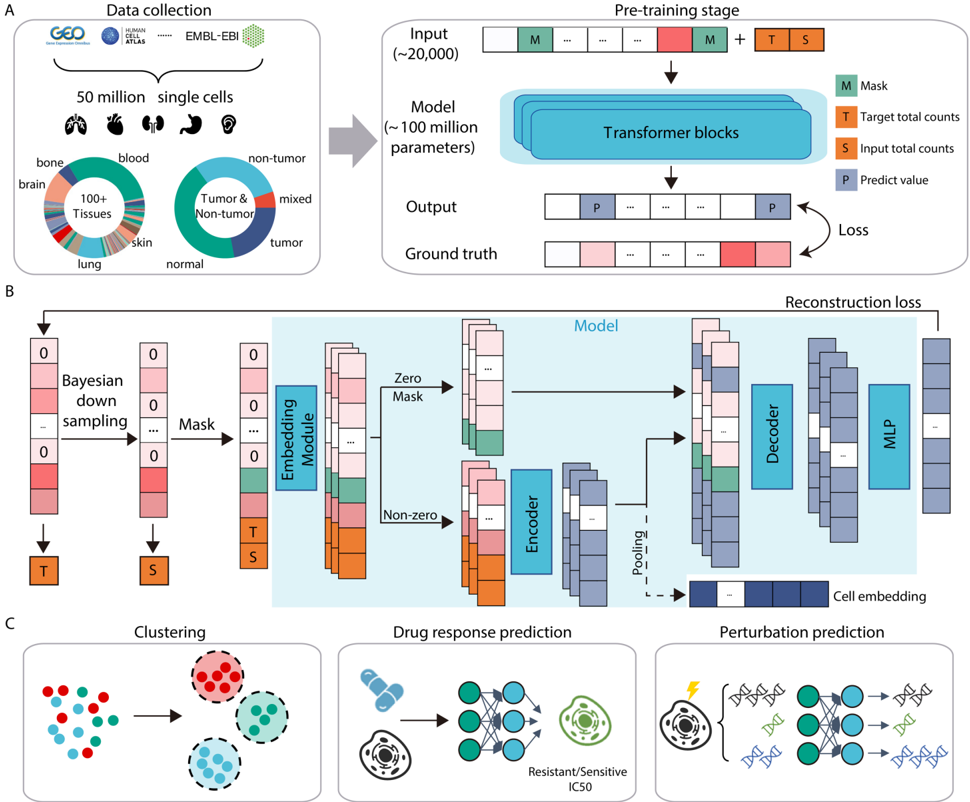
Large pretrained models have become foundation models leading to breakthroughs in natural language processing and related fields. Developing foundation models for deciphering the 'languages' of cells and facilitating biomedical research is promising yet challenging. Here we developed a large pretrained model scFoundation, also named 'xTrimoscFoundation α ', with 100 million parameters covering about 20,000 genes, pretrained on over 50 million human single-cell transcriptomic profiles. scFoundation is a large-scale model in terms of the size of trainable parameters, dimensionality of genes and volume of training data. Its asymmetric transformer-like architecture and pretraining task design empower effectively capturing complex context relations among genes in a variety of cell types and states. Experiments showed its merit as a foundation model that achieved state-of-the-art performances in a diverse array of single-cell analysis tasks such as gene expression enhancement, tissue drug response prediction, single-cell drug response classification, single-cell perturbation prediction, cell type annotation and gene module inference.
Overview
CoChat Summary
TL;DR
scFoundation is a 100M-parameter foundation model pretrained on over 50 million human single-cell transcriptomics profiles covering 19,264 genes. It achieves improved or state-of-the-art performance across gene expression enhancement, cancer drug response prediction, single-cell drug response classification, and perturbation prediction without fine-tuning the pretrained model.
Key findings
- Pretrained on >50 million human scRNA-seq profiles and 19,264 genes with 100M parameters, scFoundation is described as the largest model in parameter size, gene coverage, and data scale in the single-cell field.
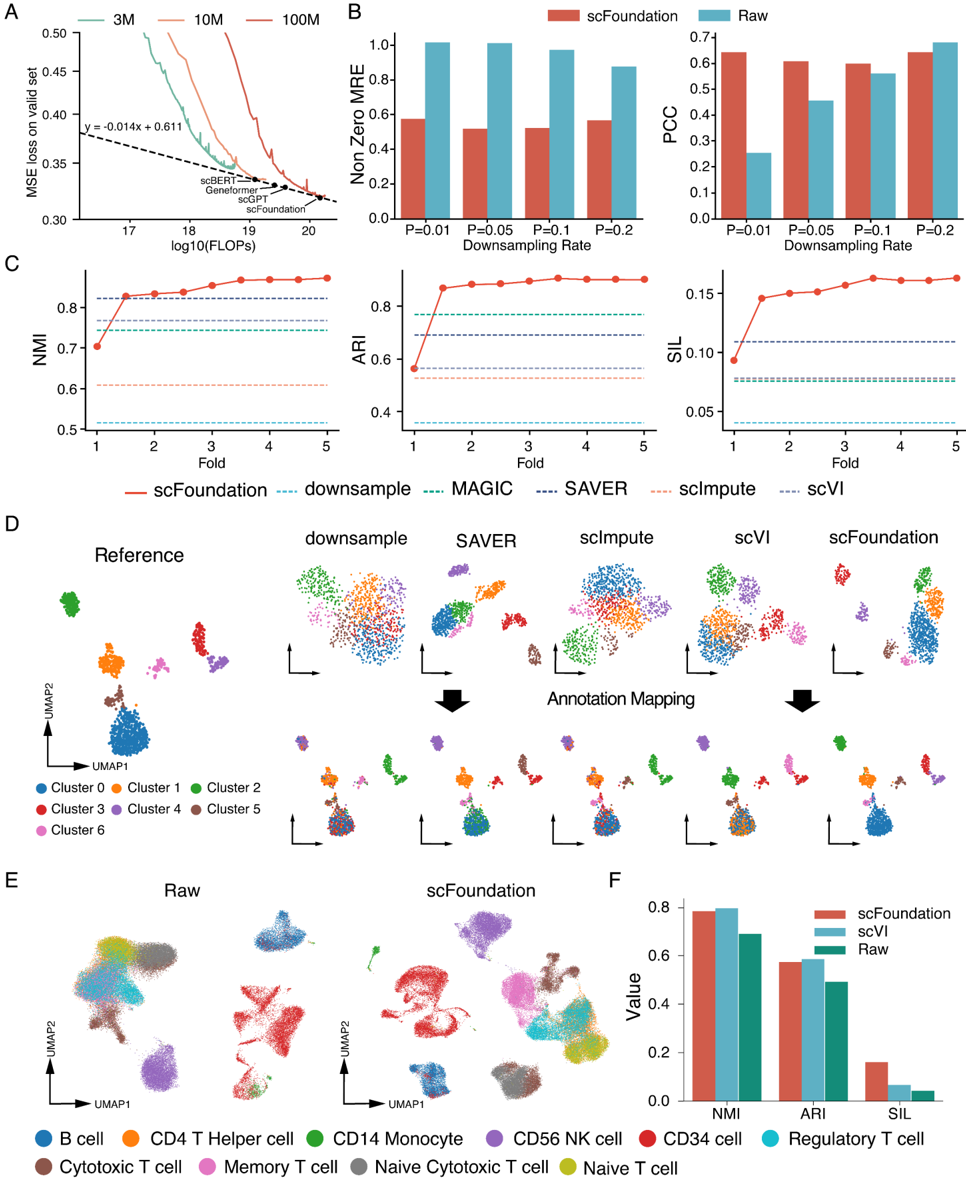
- For read-depth enhancement without fine-tuning, scFoundation reduced MAE and MRE by half versus the non-enhanced baseline; when downsampling was below 10%, baseline MRE was 97.5% while scFoundation maintained an MRE of 60%. On the Zheng68K PBMC dataset (~600,000 cells), scFoundation embeddings had comparable NMI and ARI to scVI and a higher SIL score.
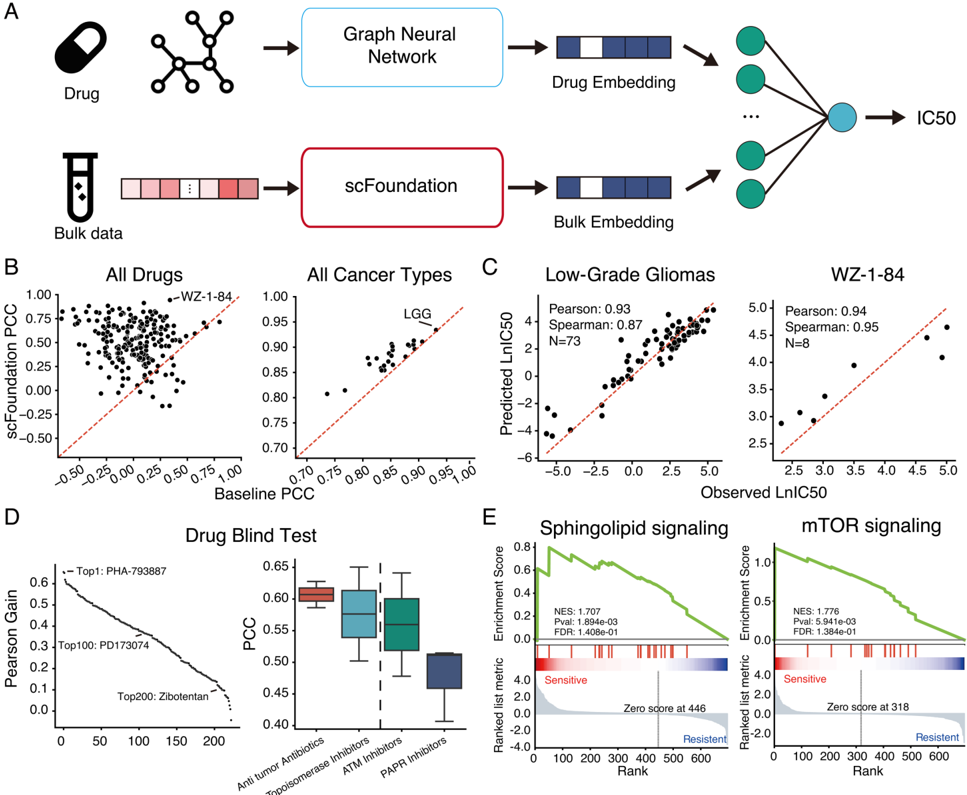
- In cancer drug response prediction with DeepCDR, scFoundation embeddings improved PCC for most drugs and all cancer types; in leave-one-drug-out blind tests, PHA-793887 improved from PCC 0.07 to 0.73 and Zobotentan from 0.49 to 0.64, with the best case achieving PCC above 0.93.
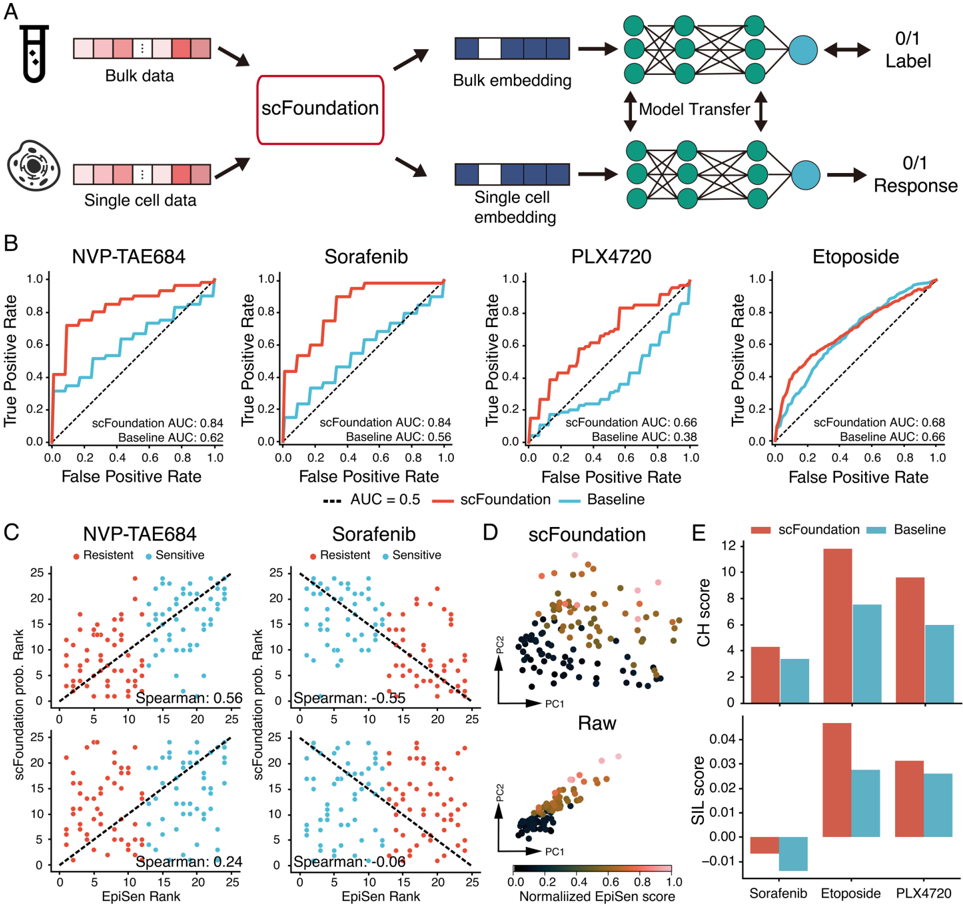
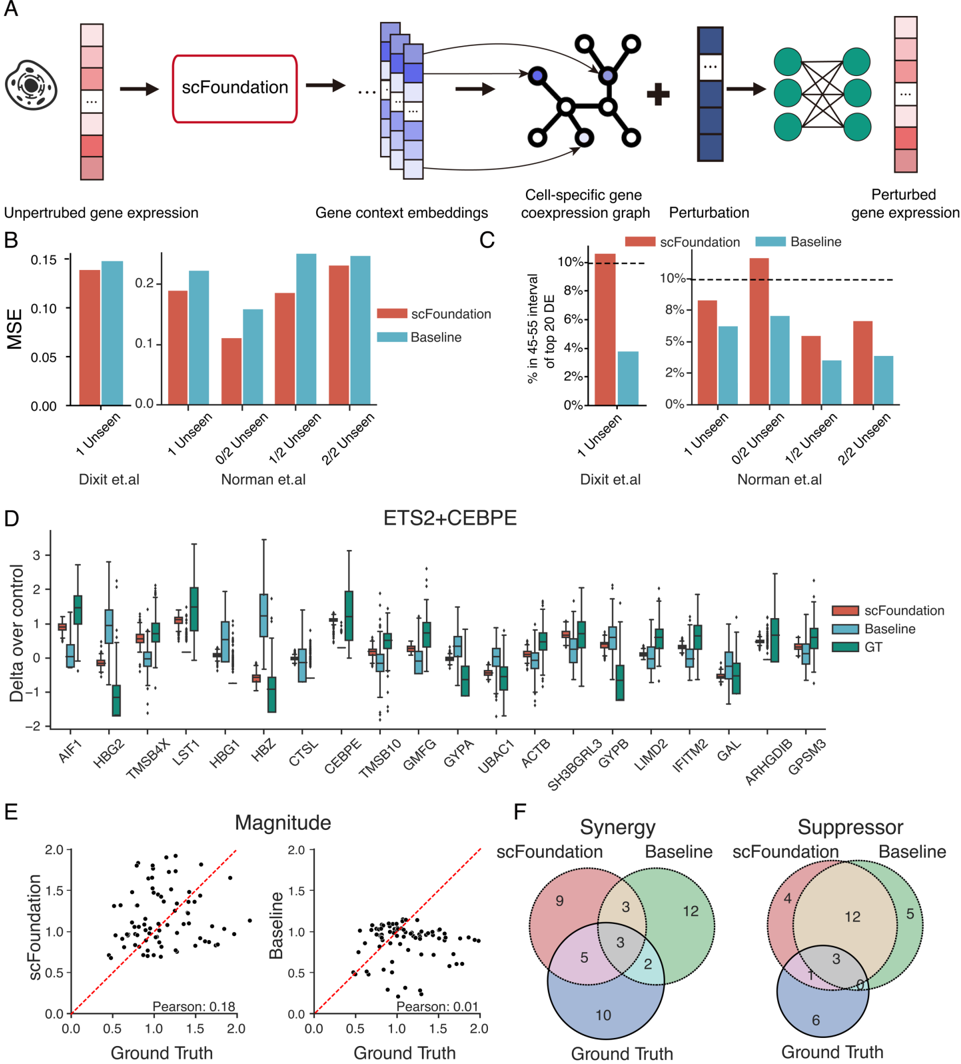
- In single-cell drug response classification, scFoundation embeddings achieved higher AUROC for all four tested drugs; for NVP-TAE684 and Sorafenib, AUROC improved by above 0.2, and Spearman correlations with EpiSen scores were 0.56 and −0.55 versus baseline 0.24 and −0.06. In perturbation prediction, scFoundation-combined GEARS achieved lower MSE on all 1-gene perturbation datasets and the lowest MSE in the 0/2 unseen 2-gene case.
Methods
- Model architecture: xTrimoGene, an asymmetric encoder-decoder transformer with an embedding module that converts continuous gene expression scalars into learnable embeddings; the encoder processes only non-zero and non-masked expressed genes, while the decoder integrates all genes.
- Pretraining data and task: over 50 million human scRNA-seq profiles collected from GEO, Single Cell Portal, HCA, EMBL-EBI, and other resources, aligned to 19,264 genes and filtered for cells with >200 expressed genes; read-depth-aware modeling used hierarchical Bayesian downsampling, 30% masking, and MSE regression loss with total count indicators T and S.
- Downstream evaluation: pretrained cell or gene embeddings were fed into DeepCDR, SCAD, and GEARS without fine-tuning the pretrained model; metrics included MAE, MRE, PCC, NMI, ARI, SIL, AUROC, MSE, and Spearman correlation.
Limitations
- The paper does not include an explicit limitations section.
- Evident from the text: pretraining used only human scRNA-seq data, so generalization to other species or multi-omics settings is not demonstrated.
- Evident from the text: downstream performance depends on existing task-specific models (DeepCDR, SCAD, GEARS) and public datasets, and the paper does not quantify residual batch effects or technical noise beyond describing read-depth-aware pretraining as a mitigation.
Model-written summary. Check it against the paper before relying on it.
Integrity signals
Registry
Cites
Statistics
Figures
Verification
Claims the paper makes
2 Valid · 6 Not valid · 3 Not checked · 74 Own results and interpretations
The cited sources that could be checked couldn’t confirm or dispute this claim.
In the paper
“We developed a new pre-training task called the read-depth-aware (RDA) modeling, which was an extension of masked language modeling 16 , considering single-cell gene expression data had a high variance in read depth, especially in the large-scale pre-training data.”
§ Large Scale Foundation Model on Single-cell Transcriptomics > The scFoundation pre-training framework
What the sources say
- Could not verifycites [16] Choromanski, K. et al. Rethinking Attention with Performers. Preprint at https://doi.org/10.48550/arXiv.2009.14794 (2022). sourceExperimental — accuracy not yet measured
The Experiments section (p. 6) mentions masked language modelling as a task used to evaluate Performers, but does not describe read-depth-aware modelling or an extension of that task. Searches for RDA, read depth, and single-cell gene expression found no passage addressing the attributed claim. (LLM, conf=0.75)
plain- Asserted: passes — The authors put it forward as true.
- Checkable: passes — It can be checked against evidence.
- Load-bearing: passes — The paper’s conclusions depend on it.
- Based: passes — The paper gives a reason why it holds.
- Could not verify
None of the sources cited for this claim have been checked yet.
In the paper
“Existing work had to restrict their models to a small list of selected genes.”
§ Large Scale Foundation Model on Single-cell Transcriptomics > Introduction
What the sources say
- Could not verifycites [8] Papatheodorou, I. et al. Expression Atlas update: from tissues to single cells. Nucleic Acids Research 48, D77-D83 (2020). sourceExperimental — accuracy not yet measured
The Introduction describes Single Cell Expression Atlas as a source of expression matrices for downstream computational methods, and the Data analysis section describes its quantification pipeline. Neither addresses whether earlier pre-training models had to use a small, selected gene list. Searches for pre-training, model limitations, and gene selection found no passage supporting that claim. (LLM, conf=0.76)
- Not checked yetcites [9] Svensson, V., Vento-Tormo, R. & Teichmann, S. A. Exponential scaling of single-cell RNA-seq in the past decade. Nature Protocols 13, 599-604 (2018). source
Checked before — its earlier verdict is held back until a new check runs.
- Could not verifycites [10] Brown, T. B. et al. Language Models are Few-Shot Learners. Preprint at https://doi.org/10.48550/arXiv.2005.14165 (2020). sourceExperimental — accuracy not yet measured
The Introduction (p. 3) discusses pre-trained language models and task-specific datasets, not single-cell gene expression. Searches for single-cell gene expression, selected genes, and restrictions to a small gene list found no passage addressing the claim. (LLM, conf=0.78)
- Could not verifycites [11] Zhao, W. X. et al. A Survey of Large Language Models. Preprint at https://doi.org/10.48550/arXiv.2303.18223 (2023). sourceExperimental — accuracy not yet measured
The Pre-training section (p. 4) discusses language-model training corpora, not single-cell gene-expression data. Searches for “single-cell gene expression selected genes” and “gene expression genes” found no passage addressing whether earlier models were restricted to a small list of genes. (LLM, conf=0.76)
plainstates a cause- Asserted: passes — The authors put it forward as true.
- Checkable: passes — It can be checked against evidence.
- Load-bearing: passes — The paper’s conclusions depend on it.
- Based: passes — The paper gives a reason why it holds.
- Could not verify
The cited sources support only part of this claim — read each source’s verdict below.
In the paper
“We constructed a comprehensive single-cell gene expression data set by collecting data from all publicly available single-cell resources, including GEO 17 , Single Cell Portal, HCA 4 , EMBL-EBI 18 , etc.”
§ Large Scale Foundation Model on Single-cell Transcriptomics > The scFoundation pre-training framework
What the sources say
- Could not verifycites [17] Ma, X. et al. Luna: Linear Unified Nested Attention. Preprint at http://arxiv.org/abs/2106.01540 (2021). sourceExperimental — accuracy not yet measured
Our copy of Luna (arXiv 2106.01540) is entirely about linear nested attention for sequence modelling; every data passage concerns NLP/vision benchmarks — the Abstract's three benchmarks, §4.1's Long Range Arena tasks (ListOps, Text, Retrieval, Image, Pathfinder), WMT'14 English-German (4.5M sentence pairs, Additional information), GLUE/QA (Table 6), and MLM pre-training on BookCorpus/Wikipedia/CC-News/OpenWebText/Stories. Nothing in it addresses single-cell gene expression, GEO, Single Cell Portal, HCA or EMBL-EBI (searched: 'single-cell gene expression dataset collection from public resources', 'scRNA-seq single cell RNA sequencing gene expression GEO Human Cell Atlas EMBL-EBI'). The cited sentence therefore cannot be checked against this source; our copy neither supports nor contradicts it. (LLM, conf=0.72)
- Partly supportedcites [4] Chen, S. et al. hECA: The cell-centric assembly of a cell atlas. iScience 25, 104318 (2022). sourceExperimental — accuracy not yet measured
The hECA 'Dataset collection' section (STAR Methods > Method details) does state the same ambition as the claim — 'collecting all accessible human single-cell data into a unified atlas' — and the Abstract/Introduction confirm it assembled a single-cell gene expression resource (1,093,299 cells, 116 published datasets, 38 organs) from scattered public data. But the realized scope is narrower than 'all publicly available single-cell resources': they selected 20–21 peer-reviewed studies, transcriptomic data of healthy donors only, and the Discussion concedes 'the number of cells in hECA v1.0 is still small and the coverage of organs and cell types is very limited'. Our copy also never lists Single Cell Portal, HCA, or EMBL-EBI as the repositories collected from (only GEO accessions and an NCBI BioProject appear, in the COVID-19 validation experiments), so that enumeration is not supported by this source. (LLM, conf=0.72)
- Partly supportedcites [18] Gong, J. et al. xTrimoGene: An Efficient and Scalable Representation Learner for Single-Cell RNA-Seq Data. 2023.03.24.534055 Preprint at https://doi.org/10.1101/2023.03.24.534055 (2023). sourceExperimental — accuracy not yet measured
Our copy confirms the large curated pre-training data set: the Additional information section states 'we curated about 5 million scRNA-seq data for training' processed with a unified pipeline. However, it attributes collection to a single repository, not 'all publicly available single-cell resources': 'Recently, scRNA-seq data ... mostly has been uploaded to the Gene Expression Omnibus (GEO) repository ... We collected data from GEO' and 'all the scRNA-seq data are collected from the Gene Expression Omnibus (GEO) repository with a keyword searching and data retrieval process.' Searches for HCA / Human Cell Atlas, EMBL-EBI and Single Cell Portal returned no data-source passage in our copy, so the multi-resource scope the citing sentence claims is not supported by this paper. (LLM, conf=0.82)
plain- Asserted: passes — The authors put it forward as true.
- Checkable: passes — It can be checked against evidence.
- Load-bearing: passes — The paper’s conclusions depend on it.
- Based: passes — The paper gives a reason why it holds.
- Could not verify
A result the paper reports from its own data — it cites no other source for it, so there is none to check. The quote shows it is in the paper.
In the paper
“From a cell ontology perspective, the data encompassed almost all known human cell types and cell states.”
§ Large Scale Foundation Model on Single-cell Transcriptomics > The scFoundation pre-training framework
plain- Asserted: passes — The authors put it forward as true.
- Checkable: passes — It can be checked against evidence.
- Load-bearing: passes — The paper’s conclusions depend on it.
- Based: passes — The paper gives a reason why it holds.
A result the paper states — it cites no source for it, so there is none to check. The quote shows it is in the paper.
In the paper
“We observed that, based on scFoundation-predicted results, drugs belonging to chemotherapy, such as anti-tumor antibiotics and topoisomerase inhibitors, had a higher PCC than drugs belonging to targeted therapy, such as ATM and PARP inhibitors (Fig. 3C right).”
§ Large Scale Foundation Model on Single-cell Transcriptomics > scFoundation improves cancer drug response prediction
plainstates an association- Asserted: passes — The authors put it forward as true.
- Checkable: passes — It can be checked against evidence.
- Load-bearing: unclear — It is unclear whether the paper’s conclusions depend on it.
- Based: passes — The paper gives a reason why it holds.
37 more claims
Create a free account to see all 85 claims and to verify the 5 references still open.
- Probably not a substantial claim. 13
- It may state two separate claims as one. 36
- The quote only partly states this claim. 2
Claims other papers make about this one
Each is checked against this paper’s own text: does it say what the citing paper says it does?
The source backs part of the claim, not all of it — or backs it for a different population, condition or comparison.
In the citing paper
“Compared to tasks such as cell annotation and batch correction, perturbation prediction offers experimentally generated model input/output with well-defined objectives, making it a more robust benchmark for assessing foundation models (15, 20, 21).”
From A systematic comparison of single-cell perturbation response prediction models (2026) · cites this paper as [21]
Experimental — accuracy not yet measuredThe source backs part of the claim, not all of it — or backs it for a different population, condition or comparison.
In the citing paper
“These models are pre-trained on vast amounts (> 10 M examples) of unlabelled scRNA-seq data, with the aim that such large datasets allow the models to capture general principles of gene regulation and signalling.”
From Benchmarking foundation cell models for post-perturbation RNA-seq prediction (2025) · cites this paper as [7]
Experimental — accuracy not yet measuredIn the citing paper
“scFoundation [15] strengthens the modular design, aiming to combine different modules to adapt to a variety of single-cell tasks, and is very flexible and scalable.”
From Challenges in AI-driven Biomedical Multimodal Data Fusion and Analysis (2025) · cites this paper as [15]
Self-check
Percentages, sums and reported differences re-computed from the paper’s own numbers.
Each contradiction between two passages listed here was confirmed by an independent check.
Rated minor: it would not touch a result — a value no result rests on, a p-value that stays on the same side of the significance level, or a conflict that is clerical, resolved elsewhere in the paper, or outside its own findings.
In the paper
§ Large Scale Foundation Model on Single-cell Transcriptomics > scFoundation predicts more accurate perturbation responses
“the Adamson dataset 49 with 87 1-gene perturbations”
§ Large Scale Foundation Model on Single-cell Transcriptomics > References
“49. Rood, J. E., Maartens, A., Hupalowska, A., Teichmann, S. A. & Regev, A. Impact of the Human Cell Atlas on medicine. Nat Med 28, 2486-2496 (2022).”
Rated minor: it would not touch a result — a value no result rests on, a p-value that stays on the same side of the significance level, or a conflict that is clerical, resolved elsewhere in the paper, or outside its own findings.
In the paper
§ Large Scale Foundation Model on Single-cell Transcriptomics > scFoundation predicts more accurate perturbation responses
“We combined the scFoundation with an advanced model GEARS 51 for the perturbation prediction task.”
§ Large Scale Foundation Model on Single-cell Transcriptomics > References
“51. Dixit, A. et al. Perturb-Seq: Dissecting Molecular Circuits with Scalable Single-Cell RNA Profiling of Pooled Genetic Screens. Cell 167, 1853-1866.e17 (2016).”
Rated minor: it would not touch a result — a value no result rests on, a p-value that stays on the same side of the significance level, or a conflict that is clerical, resolved elsewhere in the paper, or outside its own findings.
In the paper
§ Large Scale Foundation Model on Single-cell Transcriptomics > scFoundation transfers bulk-level drug sensitivity prediction model to single-cell data
“based on the SCAD 44 downstream model.”
§ Large Scale Foundation Model on Single-cell Transcriptomics > References
“44. Jerby-Arnon, L. et al. A Cancer Cell Program Promotes T Cell Exclusion and Resistance to Checkpoint Blockade. Cell 175, 984-997.e24 (2018).”
Citations
Cites
BERT: Pre-training of Deep Bidirectional Transformers for Language Understanding
Devlin, J., Chang, M.-W., Lee, K., & Toutanova, K. (2018) · arXiv · doi:10.48550/arxiv.1810.04805 · Cited by 73,173
Scikit-learn: Machine Learning in Python
Pedregosa, F., Varoquaux, G., Gramfort, A., Michel, V., Thirion, B., Grisel, O., Blondel, M., Müller, A., Nothman, J., Louppe, G., et al. (2012) · arXiv · doi:10.48550/arxiv.1201.0490 · Cited by 71,016
Subramanian, A., Tamayo, P., Mootha, V. K., Mukherjee, S., Ebert, B. L., Gillette, M. A., Paulovich, A., Pomeroy, S. L., Golub, T. R., Lander, E. S., et al. (2005) · Proceedings of the National Academy of Sciences · doi:10.1073/pnas.0506580102 · Cited by 53,625
KEGG: Kyoto Encyclopedia of Genes and Genomes
Kanehisa, M. (2000) · Nucleic Acids Research · doi:10.1093/nar/28.1.27 · Cited by 37,077
KEGG: Kyoto Encyclopedia of Genes and Genomes
Ogata, H., Goto, S., Sato, K., Fujibuchi, W., Bono, H., & Kanehisa, M. (1999) · Nucleic Acids Research · doi:10.1093/nar/27.1.29 · Cited by 31,232 · cited 1×
“According to the Kyoto Encyclopedia of Genes and Genome database 41 , this pathway was related to sphingomyelin and its metabolism.”
Language Models are Few-Shot Learners
Brown, T. B., Mann, B., Ryder, N., Subbiah, M., Kaplan, J., Dhariwal, P., Neelakantan, A., Shyam, P., Sastry, G., Askell, A., et al. (2020) · arXiv · doi:10.48550/arxiv.2005.14165 · Cited by 23,372 · cited 5×
“Please refer to Supplementary Notes 9 and 10 for details of the sampling strategy and count indicators calculation.”
InfluentialIntegrated analysis of multimodal single-cell data
Hao, Y., Hao, S., Andersen-Nissen, E., Mauck, W. M., Zheng, S., Butler, A., Lee, M. J., Wilk, A. J., Darby, C., Zagar, M., et al. (2020) · doi:10.1101/2020.10.12.335331 · Cited by 15,508
Kaugeranna, R., Kaugeranna, E., & Aion, (. S. 4. 6. (2023) · DROPS (Schloss Dagstuhl – Leibniz Center for Informatics) · doi:10.4230/lipics.giscience.2023.43 · Cited by 13,690
Gene Expression Omnibus: NCBI gene expression and hybridization array data repository
Edgar, R. (2002) · Nucleic Acids Research · doi:10.1093/nar/30.1.207 · Cited by 13,288 · cited 3×
“…a comprehensive single-cell dataset by collecting data from all publicly available single-cell resources, including Gene Expression Omnibus (GEO) 22 , Single Cell Portal, HCA 3 , human Ensemble Cell Atlas (hECA) 4 , Deeply Integrated human Single-Cell Omics data (DISCO) 7 , European Molecular…”
Scaling Laws for Neural Language Models
Kaplan, J., McCandlish, S., Henighan, T., Brown, T. B., Chess, B., Child, R., Gray, S., Radford, A., Wu, J., & Amodei, D. (2020) · arXiv · doi:10.48550/arxiv.2001.08361 · Cited by 9,550 · cited 1×
“This is a large-scale model of large parameter size, gene coverage and data scale in the single-cell field.”
Research works printed but not linked: 1
- He, K. et al. in Proc. IEEE/CVF Conference on Computer Vision and Pattern Recognition 16000–16009 (IEEE, 2022).
Cited by
Items 301–400 of 638
Zhu, H., Asiaee, A., Azinfar, L., Li, J., Liang, H., Irajizad, E., Do, K.-A., & Long, J. P. (2025) · Briefings in Bioinformatics · doi:10.1093/bib/bbaf426 · Cited by 13
GeneRAIN: multifaceted representation of genes via deep learning of gene expression networks
Su, Z., Fang, M., Smolnikov, A., Dinger, M. E., Oates, E. C., & Vafaee, F. (2025) · Genome biology · doi:10.1186/s13059-025-03749-6 · Cited by 3
“Pfam and InterPro protein domains exhibited similar profiles, with contributions from multiple regions, including dimensions 1–47, 57–64, 113–130, 154–169, and 186–200, consistent with shared structural information.”
A novel paradigm for single-cell annotation in stem cell research
Atkeson, T., Wilson, S. B., Ruiz-Morales, E. R., Little, M. H., Vento‐Tormo, R., Neavin, D. R., & Powell, J. E. (2025) · Stem Cell Reports · doi:10.1016/j.stemcr.2025.102707 · Cited by 3
scProtoTransformer: Scalable reference mapping across molecules, cells, and donors
Tang, Z., He, H., Chen, S., Zhu, J., Lv, T., Jiale, Z., Huang, J., Li, Y., Chen, G., You, L., et al. (2026) · Science Advances · doi:10.1126/sciadv.aef0286 · Cited by 5
An expanded role for single-cell chemical genomics profiling in drug discovery
Wyatt, A., Hoffer-Hawlik, K., Giglio, R. M., Azizi, E., & McFaline‐Figueroa, J. L. (2026) · Biochemical Journal · doi:10.1042/bcj20253273 · Cited by 4
From foundation models to autonomous agents in biology
Huang, S., Lang, M., Chen, Z., Yang, C., Huang, X., Mohtashaminia, Z., & Peng, Y. (2026) · Genomics Communications · doi:10.48130/gcomm-0026-0005 · Cited by 5
Discovery of candidate therapeutic targets with Geneformer
Zhang, Y., Venkatesh, M. S., & Theodoris, C. V. (2026) · Nature Protocols · doi:10.1038/s41596-026-01364-8 · Cited by 7
In context learning foundation models for materials property prediction with small datasets
Li, Q., Dong, R., Miklaucic, N., Hu, J., Omee, S. S., Wei, L., Dey, S., Hu, M., & Hu, J. (2026) · npj Computational Materials · doi:10.1038/s41524-026-02089-8 · Cited by 13
“This paradigm has reshaped diverse fi elds such as natural language processing 46 , computer vision 47 , medical imaging 48 , and chemistry 49 .”
From equations to agents: The artificial intelligence virtual cell reshaping precision oncology
Wei, R., Wang, B., Yan, B., Yang, Y., Liu, W., Ding, J., Hu, D., Zhang, W., Sun, S., Peng, Y., et al. (2026) · The Innovation Oncology · doi:10.59717/j.xinn-oncol.2026.100002 · Cited by 2
Multimodal foundation models in colorectal cancer: from prediction to trustworthy clinical insight
Gharaie, D., Feriz, A. M., & Safarpour, H. (2026) · Briefings in Bioinformatics · doi:10.1093/bib/bbag179 · Cited by 4
From cellular heterogeneity to precision medicine: single-cell multi-omics in CNS disease research
Liu, T., Zhang, Y., Hou, W., Hao, H., Geng, A., Zhao, G., & Zhang, Y. (2026) · Frontiers in Cellular Neuroscience · doi:10.3389/fncel.2026.1848558 · Cited by 3
“Regarding single-cell transcriptomics, the single-cell foundation (scFoundation) model developed by Hao et al. (2024) was trained on more than 50 million human single-cell transcriptomes and exhibited excellent performance in drug response prediction, cell type annotation, and other tasks.”
3D multi-omics tumour atlases: from technology to biology and clinical translation
Liu, M., Villazon, J. I., Forjaz, A., Tian, X., Fan, R., Wang, S., Shi, L., Wirtz, D., & Kiemen, A. L. (2026) · Nature reviews. Cancer · doi:10.1038/s41568-026-00940-0 · Cited by 4
“…or spatial transcriptomics gene expression prediction Single-cell foundation models scGPT 233 , Nicheformer 232 , SCimilarity 230 , scFoundation 231 To train foundation models on scRNA-seq and acquire fundamental cell embeddings, with goals to characterize cell states and gene functions and…”
Bao, C., Tan, T., Yang, Y., Gao, C., Liu, K., Lu, C., Guo, R., Wang, Z., Shi, J., Li, J., et al. (2026) · Phenomics · doi:10.1007/s43657-025-00252-7 · Cited by 2
Generative Artificial Intelligence and Large Language Models in Clinical Oncology
Yu, Y., Zhao, Z., Wang, Z., Lin, R., Tan, Y., Chen, Y., Li, T., Baptista‐Hon, D. T., Zhang, X., Wu, C., et al. (2026) · MedComm · doi:10.1002/mco2.70833 · Cited by 4
Self-citationSingle-cell and spatial omics in plants: from cellular atlases to regulatory mechanisms
Li, M., Madrid, G., Morgan, M., Shu, M., Yao, T., Boone, B. A., Tuskan, G. A., Yang, X., Jacobson, D., Chen, J., et al. (2026) · Journal of Experimental Botany · doi:10.1093/jxb/erag328 · Cited by 5
Decoding Cardiac Development and Maturation at Single-Cell and Spatial Transcriptomic Resolution
Li, B., Liu, X., Murphy, S. A., Tampakakis, E., & Kwon, C. (2026) · Circulation Research · doi:10.1161/circresaha.125.327473 · Cited by 4
An operational perturbation proteomics-based virtual cell model
Sun, R., Qian, L., Li, Y., Liu, T., Cheng, H., Zhang, X., Zhou, X., Zhan, Y., zhang, G., Luo, Z., et al. (2026) · Nature · doi:10.1038/s41586-026-11001-9 · Cited by 10
“P 0h and D were concatenated along the feature axis, so that each protein position carried a two-dimensional feature vector with a shape of [5,585, 2].”
InfluentialSelf-citationCell-to-cell distance that combines gene expression and gene embeddings
Guo, F., Gan, D., & Li, J. (2024) · Computational and Structural Biotechnology Journal · doi:10.1016/j.csbj.2024.10.044 · Cited by 2
Yin, D., Cao, Y., Chen, J., Mak, C. L. Y., Yu, K. H. O., Zhang, J., Li, J., Lin, Y., Ho, J. W. K., & Yang, J. Y. H. (2024) · Bioinformatics · doi:10.1093/bioinformatics/btae727 · Cited by 3
“This atlas, where the patient metadata across 20 studies has been carefully standardized through manual effort, also serves as a source of training data for the latest single-cell foundation models (Cui et al. 2024, Hao et al. 2024).”
Biological sequence analysis: Advances, medical applications, and challenges
Wei, H., Shao, J., & Liu, B. (2024) · Fundamental Research · doi:10.1016/j.fmre.2024.12.007 · Cited by 3
“Additionally, foundational models are being developed to decipher single-cell languages, distilling critical cell semantics for further optimization in diverse down-stream applications [ 28 , 29 ].”
Lee, J., Wang, W., Li, Q., Lin, Z., Liu, R., Tang, Z., Aoyama, J., Lee, R. T., Wang, X., & Liu, J. (2026) · Nature Communications · doi:10.1038/s41467-026-73883-7 · Cited by 5
“Longitudinal multimodal generated by in situ graphene-seq will also be well suited for arti fi cial intelligence (AI)-driven analyses, which have already demonstrated strong capabilities in extracting biological and biomedical insights from high-dimensional data 48 – 50 .”
scTrans: Sparse attention powers fast and accurate cell type annotation in single-cell RNA-seq data
Zou, Z., Liu, Y., Bai, Y., Luo, J., & Zhang, Z. (2025) · PLoS Computational Biology · doi:10.1371/journal.pcbi.1012904 · Cited by 4
“…can be fine-tuned for various downstream tasks, such as cell type annotation, multi-batch integration and gene network inference. scFoundation [12] is a large pre-trained model with 100 million parameters, trained on over 50 million human single-cell transcriptomic profiles, capable of…”
A systematic assessment of single-cell language model configurations
Waele, G. D., Menschaert, G., & Waegeman, W. (2026) · NAR Genomics and Bioinformatics · doi:10.1093/nargab/lqag095 · Cited by 5
A perspective on developing foundation models for analyzing spatial transcriptomic data
Liu, T., Hao, M., Liu, X., & Zhao, H. (2025) · Quantitative Biology · doi:10.1002/qub2.70010 · Cited by 4
“Furthermore, scFoundation [11] also showed that incorporating cell embeddings or gene embeddings from pretrained single ‐ cell FMs can help with downstream tasks.”
Self-citationLarge-Scale Multi-omic Biosequence Transformers for Modeling Protein-Nucleic Acid Interactions.Preprint
Chen, S. F., Steele, R. J., Hocky, G. M., Lemeneh, B., Lad, S. P., & Oermann, E. K. (2025) · PubMed Central · doi:10.1371/journal.pone.0341501
Liang, H., Berger, B., & Singh, R. (2026) · Cell Systems · doi:10.1016/j.cels.2026.101675 · Cited by 4
Towards foundation models that learn across biological scales
Kalfon, J., Cantini, L., & Peyré, G. (2026) · Machine Learning Health · doi:10.1088/3049-477x/aea764 · Cited by 5
From cell types to cell states: adapting foundation models for cellular plasticityPreprint
Shi, P., Withnell, E., Celik, C., & Secrier, M. (2024) · bioRxiv (Cold Spring Harbor Laboratory) · doi:10.1101/2024.08.16.608311 · Cited by 2
Reply to: Deeper evaluation of a single-cell foundation model
Yang, F., Wang, F., Huang, L.-K., Liu, L., Huang, J., & Yao, J. (2024) · Nature Machine Intelligence · doi:10.1038/s42256-024-00948-x · Cited by 2
Dong, W., Zhou, M., Wang, F., & Li, Y. (2025) · bioRxiv (Cold Spring Harbor Laboratory) · doi:10.1101/2025.01.24.634773 · Cited by 3
“These pre-trained node2vec embeddings are integrated with the cell-specific embeddings via xTrimoGene [13, 20], which transforms each gene expression scalar value into a latent vector as follows: 1.”
A New Paradigm for Genome-wide DNA Methylation Prediction Without Methylation InputPreprint
Huang, X., Liu, Q., Zhao, Y., Tang, X., Zhou, Y., & Hou, W. (2025) · bioRxiv (Cold Spring Harbor Laboratory) · doi:10.1101/2025.02.05.636730 · Cited by 2
“…data is more readily available across tissues and conditions, and recent advances in large-scale foundation models for genomics suggest that rich biological signals can be learned from such high-dimensional data (Theodoris et al., 2023; Cui et al., 2024a; Yang et al., 2022; Hao et al., 2024a).”
Li, H., Li, Y., Liu, Y., Cooper‐Knock, J., Gao, P., Shen, X., Chen, S., Xing, X., & Zhang, S. (2025) · medRxiv · doi:10.1101/2025.02.19.25322536 · Cited by 5
“1B; Methods), a neural network model known for its ability to model long-range dependencies and interactions 25–27 .”
Consequences of training data composition for deep learning models in single-cell biologyPreprint
Nadig, A., Thoutam, A., Hughes, M., Gupta, A., Navia, A. W., Fusi, N., Raghavan, S., Winter, P. S., Amini, A. P., & Crawford, L. A. (2025) · bioRxiv (Cold Spring Harbor Laboratory) · doi:10.1101/2025.02.19.639127 · Cited by 9
Closing the loop: Teaching single-cell foundation models to learn from perturbationsPreprint
Pershad, Y., Nandi, T., Amburg, J. C. V., Parker, A., Ostrowski, L., Giannini, H. K., Ong, D. E., Heimlich, J. B., Obeng, E. A., Ericson, K. R., et al. (2025) · bioRxiv (Cold Spring Harbor Laboratory) · doi:10.1101/2025.07.08.663754 · Cited by 5
HEIMDALL: Disentangling tokenizer design for robust transfer in single-cell foundation modelsPreprint
Haber, E., Alam, S., Ho, N., Liu, R., Trop, E., Liang, S., Yang, M., Krieger, S., & Ma, J. (2025) · bioRxiv (Cold Spring Harbor Laboratory) · doi:10.1101/2025.11.09.687403 · Cited by 6
“Using this abstraction, we reimplemented tokenizers from five top scFMs – scGPT [4], Gene-former [5], scFoundation [8], scBERT [9], and UCE [10] – denoted with a -tok suffix (e.g., Geneformer-tok) to distinguish them from their pretrained counterparts.”
Self-citationLi, C., Wei, L., & Zhang, X. (2025) · bioRxiv (Cold Spring Harbor Laboratory) · doi:10.1101/2025.11.13.688367 · Cited by 6
“…representative methods, including linear models 41 (Linear, Linear-164 scGPT), deep learning methods (CellOracle 42 , GEARS 22 ), and large cellular foundation models (scGPT 25 , scFoundation 24 ), and the mean predictor (AveKnown) that have been used as a naive baseline in some studies 33, 43 .”
Self-citationPang, J., Qiu, P. S., He, Y., Deng, Y., Tang, W., Huang, Z., Yan, J., Li, B., Lin, A., Cao, L., et al. (2025) · bioRxiv (Cold Spring Harbor Laboratory) · doi:10.64898/2025.12.29.696804 · Cited by 3
A lightweight, ultrafast and general embedding framework for large-scale spatial omics dataPreprint
Dai, B., Liang, Y., Yi, L., Hu, P., Song, Y., Qian, B., He, M., Wang, L., Yuan, Z., & Zuo, Y. (2026) · bioRxiv (Cold Spring Harbor Laboratory) · doi:10.64898/2026.02.04.703814 · Cited by 2
Deep learning representations of human Immune Health for precision immunologyPreprint
Lee, M., Kim, J., Ionita, M., McKeague, M. L., Lee, J., Nam, Y., Jeong, C.-U., Nair, A., Moyo, E. T., Khavin, I., et al. (2026) · bioRxiv (Cold Spring Harbor Laboratory) · doi:10.64898/2026.07.15.724605 · Cited by 3
A systematic comparison of single-cell perturbation response prediction models
Li, L., You, Y., Fu, Y., Liao, W., Fan, X., Lu, S., Cao, Y., Li, B., Ren, W., Kong, J., et al. (2026) · Science Advances · doi:10.1126/sciadv.aed3414 · Cited by 1
GenoHoption: Bridging Gene Network Graphs and Single-Cell Foundation Models
Cheng, J., Li, J., Yang, K., Shen, H., & Yuan, Y. (2024) · IEEE International Conference on Bioinformatics and Biomedicine (BIBM) · doi:10.1109/bibm62325.2024.10822153 · Cited by 3
“Emerging high-quality models in this field such as scBERT [1], scGPT [2], Geneformer [3], sc-Foundation [4], scSimilarity [5] and GeneCompass [6] mainly employ a transformer-inspired architecture [7], viewing each cell as a “sentence” of genes.”
BackgroundMethodLi, Y., Shah, S. R., Ozer, A., Zhu, Y., Pan, X., Xia, T., Zhang, J., Leung, A. K.-Y., Wei, M., Lis, J. T., et al. (2026) · Nature Biotechnology · doi:10.1038/s41587-026-03218-w · Cited by 2
“Current machine learning techniques that use single-cell sequencing data focused on smoothing technical noises in scATAC-seq and snATAC-seq libraries and better representing the clustering structures of the cell population in the sample 61–65 .”
Poyatos, J. F. (2026) · PNAS Nexus · doi:10.1093/pnasnexus/pgag223 · Cited by 1
“These findings indicate a”
The Expanding Landscape of Neural Architectures and Their Impact in Biomedicine
Zhang, Z. F., Zhan, H., Wu, T., Burns, R., Hundal, J., & Costa, H. A. (2025) · Annual Review of Biomedical Data Science · doi:10.1146/annurev-biodatasci-103023-050856 · Cited by 1
scYeast: a biological-knowledge-guided foundation model on yeast single-cell transcriptomics
Fan, X., Liao, W., Xiao, L., Yan, X., & Lu, H. (2026) · Synthetic and Systems Biotechnology · doi:10.1016/j.synbio.2026.05.014 · Cited by 1
Yang, L., Gao, Y. Q., Huang, Y., & Yang, J. (2025) · Scientia Sinica Chimica · doi:10.1360/ssc-2025-0169 · Cited by 2
Ran, M., Zhang, S., & Tam, K. Y. (2025) · Computational Biology and Chemistry · doi:10.1016/j.compbiolchem.2025.108669 · Cited by 4
GLARE: discovering hidden patterns in spaceflight transcriptome using representation learning
Seo, D., Strickland, H. F., Zhou, M., Barker, R. J., Ferl, R. J., Paul, A., & Gilroy, S. (2025) · npj Microgravity · doi:10.1038/s41526-025-00525-5 · Cited by 3
“Similar to our approach, such building of foundation models pre-trained with high-throughput single-cell data has demonstrated great utility in a diverse array of tasks in the life science fi eld, including pattern recognition by incorporating foundational knowledge of the data 65 .”
Feng, G., Qin, X. Y., Zhang, J., Huang, W., Zhang, Y., Cui, W., Yao, C., Li, S., Liu, W., Tian, Y., et al. (2026) · Advanced Science · doi:10.1002/advs.202508697 · Cited by 6
Leveraging AI for cell biology discovery
Simizo, A., de Morais, M., Vesco, M. F. [., & Nakaya, H. I. (2026) · Biochemical Society Transactions · doi:10.1042/bst20253023 · Cited by 1
Minh, L. H. N., Nguyen, T.-H., Li, T., Li, T., Huynh, H. H., Raj, M., Yang, C., Xu, M., Vinh, T., & Le, N. Q. K. (2026) · Briefings in Bioinformatics · doi:10.1093/bib/bbag365 · Cited by 1
“…and the model is trained to reconstruct them, underpins single-cell foundation models such as scGPT, a generative pretrained transformer trained on over 33 million cells that supports batch correction, cell-type annotation, and perturbation prediction after fine-tuning [65], and scFoundation [53].”
InfluentialscPlantAnnotate: an accurate and robust transformer-based model for plant cell type annotation
Lu, C., Immadi, M. S., Chan, Y. O., Dhakal, S., Xu, D., Libault, M., & Joshi, T. (2026) · Journal of Advanced Research · doi:10.1016/j.jare.2026.01.035 · Cited by 2
“Parallel developments in human single-cell analysis have extended this direction with Transformer-based [23] foundation models, such as scGPT [24] and scFoundatio n [25], which leverage large-scale pretraining and contextual embeddings.”
Yan, S., Shang, J., Jiang, S., Zhang, X., Zhang, F., Sun, Y., & Liu, J. (2026) · Journal of Chemical Information and Modeling · doi:10.1021/acs.jcim.5c02735 · Cited by 1
Self-citationModel Synthesizer: Synthesizing Disparate Models to Enhance Single-Cell Transcriptomics Models
Chen, S., Cao, Z., Qin, X. Y., & Yang, X. W. (2025) · IEEE International Conference on Bioinformatics and Biomedicine (BIBM) · doi:10.1109/bibm66473.2025.11356145 · Cited by 3
“Recently, several scRNA-seq foundation models have been proposed, including GeneCompass [2], Geneformer [3], and scFoundation [4].”
Huang, Y., Liu, C., Yang, Z., Liu, B., Zhai, X., Zheng, J., Xiao, J., & Song, T. (2025) · Briefings in Bioinformatics · doi:10.1093/bib/bbaf664 · Cited by 2
Self-citationYao, H., Cao, Z., Wang, Z., Ni, X., Dong, J., Cai, H., Han, Y., & Luo, X. (2025) · Proceedings · doi:10.1109/icdm65498.2025.00179 · Cited by 1
SAD: Sparse-Aware Diffusion Model for Single-Cell Gene Expression Completion
Li, T., Xiang, Y., Wang, Z., Liu, M., Zou, Q., & Zhang, Y. (2026) · IEEE Transactions on Computational Biology and Bioinformatics · doi:10.1109/tcbbio.2026.3674362 · Cited by 1
“Early models such as scBERT [28] and Geneformer [29] demonstrated the feasibility of large-scale pretraining, while more recent approaches including scGPT [2], scFoundation [1], and CellFM [17] have continued to push the boundaries of vocabulary size, parameter scale, and dataset coverage.”
The changing landscape of gene expression analysis
Zhao, Q., Shen, S., Shim, W. J., & Palpant, N. J. (2026) · Briefings in Bioinformatics · doi:10.1093/bib/bbag185 · Cited by 3
Cell-o1 : training LLMs to solve single-cell reasoning puzzles with reinforcement learning
Fang, Y., Jin, Q., Xiong, G., Jin, B., Zhong, X., Ouyang, S., Yang, Y., Zhang, A., Han, J., & Lu, Z. (2026) · Bioinformatics · doi:10.1093/bioinformatics/btag208 · Cited by 16
Wang, Z., Fang, Y., & Li, Q. (2026) · Journal of Translational Medicine · doi:10.1186/s12967-026-08211-0 · Cited by 4
“Large-scale single-cell FMs have progressively expanded the scope of computational cellular analysis [42, 63].”
Foundation model-based generative AI for smart manufacturing: A paradigm shift
Zheng, H., Geng, Z., & Xu, X. W. (2026) · ENGINEERING Management · doi:10.1007/s42524-026-5359-0 · Cited by 7
“It should be noted that the FMs discussed here refer to the general-purpose FMs. Researchers have also been developing FMs in various specific domains such as bioscience (Hao et al., 2024), autonomous driving (Wang et al., 2024c), and robotics (Firoozi et al., 2025).”
Real, K. S. D., Swamy, V. S., Arcagni, J., Wang, E., Rabadan, R., & Rubio, Á. (2026) · Briefings in Bioinformatics · doi:10.1093/bib/bbag225 · Cited by 3
“…embeddings from scFoundation, an asymmetric transformer pretrained on > 50 million single-cell transcriptomes; the resulting 768-dimensional cell representations replace the original omics branch after a 100-dimensional projection, improving IC50 prediction without additional data modalities [18].”
Fu, Z., Liu, Y., Wang, J., & Wang, S. (2026) · Array · doi:10.1016/j.array.2026.100934
Identifying fate-determining transcription factors with single-cell omics
Xi, X., Li, C., Wei, L., & Zhang, X. (2026) · Trends in Genetics · doi:10.1016/j.tig.2026.05.005 · Cited by 1
Self-citationKendiukhov, I. (2026) · Bioinformatics · doi:10.1093/bioinformatics/btag379 · Cited by 8
“…single-cell foundation models (scFMs), beginning with scBERT (Yang et al. 2022) and now including Geneformer (Theodoris et al. 2023), scGPT (Cui et al. 2024), scFoundation (Hao et al. 2024), and UCE (Rosen et al. 2023), encode cellular states in high-dimensional contextual representations.”
He, Y., Wei, Y., Zhi, J., Huang, C. J., Han, L., Liu, S., & Wang, L. (2026) · GigaScience · doi:10.1093/gigascience/giag075 · Cited by 1
“Its asymmetric transformer with 100 million parameters and direct value projection preserves full expression magnitudes rather than binarized rank data, enabling prediction of cell-type-specific drug responses with high area under the precision-recall curve (AUPR) [ 203 ].”
Sajjad, F., Tahir, R. M., Yan, W., Wei, Z., & Zhou, Y. X. (2026) · International Journal of Data Science and Analytics · doi:10.1007/s41060-026-01173-y · Cited by 1
“This scales better to large federated datasets, making it easier to express and can be trained in distributed privacy-preserving models [161].”
Xiao, Z., Wang, W., Long, X., Zhang, W., Zhang, W., Chen, D., Xu, S., Yu, Q., Zhang, X., Huang, S., et al. (2026) · Nucleic Acids Research · doi:10.1093/nar/gkag706 · Cited by 3
“Models such as scGPT [ 10 ], CellFM [ 11 ], scFoundation [ 12 ], and xTrimoGene [ 13 ] treat full expression profiles as sparse sequences, using attention mechanisms or state-space models to capture complex gene-cell dependencies.”
Self-citationHu, D., Zhang, F., Wang, Z., Jing, Y., Yee, P. L., Lu, T., Zhao, Y. Q., Cui, X., Yuan, S., & Wang, C. (2026) · Archives of Computational Methods in Engineering · doi:10.1007/s11831-026-10709-1 · Cited by 1
Artificial intelligence derived virtual oncology
Lyu, C., Yao, D., Yin, F., Liu, Z., Liu, B., Ma, H., & Sun, T. (2026) · The Innovation Oncology · doi:10.59717/j.xinn-oncol.2026.100028 · Cited by 1
Single-Cell and Spatial Omics Technologies in Rice Abiotic Stress Biology: A Methodological Review
Chen, J., Chen, Z., Yin, C., Zhou, L., & Da, Z. (2026) · International Journal of Molecular Sciences · doi:10.3390/ijms27167114 · Cited by 1
“…mapping: Supervised and reference-based models transfer labels from annotated atlases to new datasets; foundation models such as scGPT [133], Geneformer [134], Universal Cell Embeddings [135], and scFoundation [136] propose zero-shot annotation and cross-dataset integration from large pretraining.”
How to build an AI-driven digital organism
Song, L., Segal, E., & Xing, E. P. (2026) · Nature Medicine · doi:10.1038/s41591-026-04595-0 · Cited by 2
Self-citationMulti‐omics–driven precision medicine
Li, H., Zhao, Z., Zhang, Y., Ma, Y., Hu, G., Zeng, M., Yang, Z., Zhao, Z., Zhou, X., Hu, W., et al. (2026) · iMeta · doi:10.1002/imt2.70165 · Cited by 2
A world model of the virtual cell
Xing, E. P., & Song, L. (2026) · Cell · doi:10.1016/j.cell.2026.08.042 · Cited by 7
Self-citationCritical assessment in the age of AI: challenges and opportunities for computational biology
Schwartz, R. S., Zhang, X., Ma, J., Bromberg, Y., Murphy, R. F., Hunter, L., Parida, L., Sáez-Rodríguez, J., Stolovitzky, G. A., Pop, M., et al. (2026) · Bioinformatics Advances · doi:10.1093/bioadv/vbag290 · Cited by 1
“…models pretrained on massive single-cell RNA-seq data show great promise as early prototypes of AI virtual cell modeling (Cui et al., 2024; Hao et al. 2024b; Theodoris et al. 2023), yet they reflect only narrow slices of a massive hyperparameter space (Bian et al. 2024; Hao et al. 2024a;…”
Self-citationRen, J., & Han, H. (2024) · Communications in computer and information science · doi:10.1007/978-3-031-67871-4_1 · Cited by 1
Best holdout assessment is sufficient for cancer transcriptomic model selection
Crawford, J., Chikina, M. D., & Greene, C. S. (2024) · Patterns · doi:10.1016/j.patter.2024.101115 · Cited by 2
scMonica: Single-cell Mosaic Omics Nonlinear Integration and Clustering Analysis
Li, X., Zhang, R., Aslam, S., Li, H., Chen, Y., Zhang, Z., Huang, R. S., & Wu, H. (2024) · IEEE International Conference on Bioinformatics and Biomedicine (BIBM) · doi:10.1109/bibm62325.2024.10822866 · Cited by 1
scKEPLM: Knowledge enhanced large-scale pre-trained language model for single-cell transcriptomicsPreprint
Li, Y., Qiao, G., & Wang, G. (2024) · bioRxiv (Cold Spring Harbor Laboratory) · doi:10.1101/2024.07.09.602633 · Cited by 2
“scFoundation [10] is a large-scale pre-trained model that utilizes the xTrimoGene architecture with 100 million trainable parameters.”
BackgroundScouter: Predicting Transcriptional Responses to Genetic Perturbations with LLM embeddingsPreprint
Zhu, O., & Li, J. (2024) · bioRxiv (Cold Spring Harbor Laboratory) · doi:10.1101/2024.12.06.627290 · Cited by 1
Zhu, H., Asiaee, A., Azinfar, L., Li, J., Liang, H., Irajizad, E., Do, K.-A., & Long, J. P. (2025) · bioRxiv (Cold Spring Harbor Laboratory) · doi:10.1101/2025.03.06.641935 · Cited by 1
ODFormer: a Virtual Organoid for Predicting Personalized Therapeutic Responses in Pancreatic CancerPreprint
Xu, J., Yang, X., Li, Y., Wang, H., Li, Y., Tang, S., Guo, S., Zou, J., Shi, X., Chen, Z., et al. (2025) · bioRxiv (Cold Spring Harbor Laboratory) · doi:10.1101/2025.07.08.663664 · Cited by 7
On Scientific Foundation Models:Rigorous Definitions, Key Applications, and a SurveyPreprint
Menon, S. S., Mondal, T., Brahmachary, S., Panda, A., Joshi, S. M., Kalyanaraman, K., & Jagtap, A. D. (2025) · SSRN Electronic Journal · doi:10.2139/ssrn.5409063 · Cited by 1
Translating clinical gene sequencing into a foundational representation of tumor subtypePreprint
Kong, J., Lee, I., Boecher, D., Singhal, A., Kelly, M. R., Moon, J., Ahn, C. H., Ock, C., Kumar, T., Sears, T. J., et al. (2025) · bioRxiv (Cold Spring Harbor Laboratory) · doi:10.1101/2025.09.08.674723 · Cited by 1
“…successful in natural language processing (e.g. GPT-5) and computer vision ( 29 ) and is being actively investigated in life sciences research, including models that analyze DNA ( 31 , 32 ), RNA ( 33 – 37 ), or protein ( 38 – 40 ) sequences, or microscopy and radiology images ( 41 – 45 ).”
GeneJepa: A Predictive World Model of the TranscriptomePreprint
Litman, E., Myers, T. D., Agarwal, V., Mittal, E., Li, O., Gopinath, A., & Kassis, T. (2025) · bioRxiv · doi:10.1101/2025.10.14.682378 · Cited by 7
“Several groups have proposed transcriptomic “foundation” models, most prominently scGPT and related Transformer-based variants (Cui et al., 2024; Yang et al., 2022a; Theodoris et al., 2023; Hao et al., 2024; Cui et al., 2022).”
Tokenizing single-cell transcriptomes as a native language for large language modelsPreprint
Xiao, C., Ding, Y., Bian, H., Chen, Y., Wei, L., & Zhang, X. (2025) · bioRxiv (Cold Spring Harbor Laboratory) · doi:10.1101/2025.10.22.684047 · Cited by 1
“…fine-tuning of CellTok-base, CellTok (CellTok-annotation) achieved performance competitive with LCMs (Geneformer 9 , scGPT 10 , and scFoundation 11 ) as well as LLM-based analysis methods (CellWhisperer 15 and Cell2Sentence 14 ) across multiple metrics, and notably outperformed substantially…”
Self-citationCao, Z., Guo, T., Cheng, L., Zhang, F., Lü, P., Gu, C., Guo, F., & Gao, G. (2025) · bioRxiv (Cold Spring Harbor Laboratory) · doi:10.1101/2025.11.20.689377 · Cited by 2
Song, Y., Tang, M., Liu, Q., Wang, H., Li, Q., Zou, F., & Hou, W. (2025) · bioRxiv (Cold Spring Harbor Laboratory) · doi:10.1101/2025.11.27.690951 · Cited by 2
“More recently, transformer-based approaches (e.g., scBERT 17 , TOSICA 18 , scGPT 19 , scFoundation 20 , Geneformer 21 ) have leveraged single-cell data at scale in model pretraining and can be fine-tuned for downstream tasks such as cell type annotation.”
Chen, H., Lu, Y., Zhao, Y., Dai, Z., Wang, F. L., Li, Q., Rao, Y., & Li, Y. (2025) · bioRxiv (Cold Spring Harbor Laboratory) · doi:10.1101/2025.11.27.691023 · Cited by 2
Reinforcement learning enables single-cell foundation models to learn cellular differentiationPreprint
Chang, K.-L., Chen, H., & Liu, Z. (2025) · bioRxiv (Cold Spring Harbor Laboratory) · doi:10.64898/2025.12.09.693267 · Cited by 1
“Models such as scFoundation, Geneformer, scGPT, and scBERT learn rich representations of cellular states by encoding gene expression patterns into high-dimensional embeddings 4 – 7 .”
Hou, S., Yang, P., Ma, W., Xiang, J., Wang, J. X., Wan, H., Ma, Y., & Zhou, X. (2026) · bioRxiv (Cold Spring Harbor Laboratory) · doi:10.64898/2026.01.06.698060 · Cited by 7
“Second, we constructed a model zoo comprising CELLama[13], CellFM[14], CellPLM[15], Geneformer[6], GenePT-w[16], LangCell[17], scBERT[18], scCello[19], scFoundation[7], scGPT[4], SCimilarity[20], scPRINT[21] and UCE[22], together with classical baselines.”
Wang, H., Zhang, X., Fang, S., Li, R., Deng, Z., Zhang, Y., Li, Y., & li, S. (2026) · bioRxiv (Cold Spring Harbor Laboratory) · doi:10.64898/2026.01.09.698573 · Cited by 1
Self-citationHow different AI models understand cells differentlyPreprint
Zhao, Y., Sun, D., Hao, M., Xiong, Y., Li, C., Gong, T., Wei, L., & Zhang, X. (2026) · bioRxiv (Cold Spring Harbor Laboratory) · doi:10.64898/2026.01.29.702682 · Cited by 3
Self-citationSimple models outperform single-cell foundation models on downstream benchmarksPreprint
Souza, H., & Mehta, P. (2026) · bioRxiv (Cold Spring Harbor Laboratory) · doi:10.64898/2026.02.11.705358 · Cited by 5
Li, B., Liu, Z., Wang, Z., Xu, Z., Li, Y., Sha, C., & Li, X. (2026) · bioRxiv (Cold Spring Harbor Laboratory) · doi:10.64898/2026.02.17.704943 · Cited by 2
Jacques, M., Göttgens, B., & Marioni, J. C. (2026) · bioRxiv (Cold Spring Harbor Laboratory) · doi:10.64898/2026.02.18.706600 · Cited by 2
“We then normalized each gene’s expression between 0 and 1 on this segment, and smoothed the resulting time-series with a rolling mean of length 20 to facilitate the fitting of a logistic (sigmoid) function.”
ARCH3D: A foundation model for global genome architecturePreprint
Galioto, N., Stansbury, C. M., Gorodetsky, A., & Rajapakse, I. (2026) · bioRxiv (Cold Spring Harbor Laboratory) · doi:10.64898/2026.02.23.707580 · Cited by 1
McConnell, N., Kelly, J., Tadikonda, R., Mulligan, N., Bettencourt‐Silva, J. H., Madgwick, M., Krishna, R. V., Strudwick, J., Evans, A. J., Checkley, S., et al. (2026) · bioRxiv (Cold Spring Harbor Laboratory) · doi:10.64898/2026.02.24.707424 · Cited by 1
“…evaluation pipeline to test the domain generalizability of FM embeddings using five state-of-97 the-art RNA FMs; Geneformer (15), scFoundation (17), scGPT (16), BulkRNABERT (18) and BMFM-98 RNA (19) and a frozen-encoder paradigm (pretrained RNA encoders are kept fixed and used to compute…”
Bohl, M., Esteban‐Medina, M., Beerenwinkel, N., & Lenhof, K. (2026) · bioRxiv (Cold Spring Harbor Laboratory) · doi:10.64898/2026.02.24.707713 · Cited by 2
“Representing the emerging use of foundation models, scATD leverages pretrained scFoundation embeddings and knowledge distillation to guide MMD-based domain alignment [24, 25].”
MAP: A Knowledge-driven Framework for Predicting Single-cell Responses for Unprofiled DrugsPreprint
Feng, J., Zhao, Z., Zhang, X., Liu, M., Chen, J., Quan, X., Zhang, J., Wang, Y., Zhang, Y. P., & Xie, W. (2026) · bioRxiv (Cold Spring Harbor Laboratory) · doi:10.64898/2026.02.25.708091 · Cited by 1
“Consequently, current models [10,12,17–21] still struggle to systematically transfer such knowledge to the setting that matters most for discovery: predicting transcriptional responses for novel compounds outside the profiled atlas [22].”
Self-citation
Metadata
- Authors
- Hao, M., Gong, J., Zeng, X., Liu, C., Guo, Y., Cheng, X., Wang, T., Ma, J., Zhang, X., & Song, L.
- Affiliations
- Tsinghua University (CN)
- Beijing National Research Center for Information Science and Technology (CN)
- Mohamed bin Zayed University of Artificial Intelligence (AE)
- Corresponding author
- Ma, Jianzhu
- Zhang, Xuegong
- Song, Le
- ORCID
- Venue
- Nature Methods
- Published
- 2024-06-06
- Volume
- 21
- Issue
- 8
- Pages
- 1481-1491
- ISSN
- 1548-7091 (ISSN-L)
- 1548-7105
- OpenAlex
- W4399387478
- Semantic Scholar
- c520d8a888355f7abb7728b2e2510fe7bc63f814
- Cited by
- 988
- References
- 93
- Citations by year
- 2026: 597 · 2025: 294 · 2024: 93
- FWCI
- 93.98
- Type
- journal article
- Language
- en
- Open access
- green
- doi.org
- Licence
- cc-by
- www.springernature.com/gp/researchers/text-and-data-mining (tdm)
- www.springernature.com/gp/researchers/text-and-data-mining (vor)
- Locations
- Nature Methods (publishedVersion)
- bioRxiv (Cold Spring Harbor Laboratory) (submittedVersion, cc-by)
- PubMed (publishedVersion)
- Funders
- National Natural Science Foundation of China (61721003, 62250005)
- Tsinghua University
- National Key Research and Development Program of China (2021YFF1200901, 61721003)
- Topics
- Life Sciences › Biochemistry, Genetics and Molecular Biology › Molecular Biology › Single-cell and spatial transcriptomics
- Life Sciences › Biochemistry, Genetics and Molecular Biology › Molecular Biology › Gene expression and cancer classification
- Life Sciences › Biochemistry, Genetics and Molecular Biology › Molecular Biology › Gene Regulatory Network Analysis
- Keywords
- single-cell transcriptomics, foundation models, pre-trained models, gene expression enhancement, drug response prediction, cell type annotation
- MeSH terms
- Algorithms, Humans, Computational Biology, Gene Expression Profiling, Single-Cell Analysis, Transcriptome
About these checks
Registry, retraction, Cites and statistics results are computed, not judged, with one exception: a printed reference that no index lists is read once by a model before it counts as a citation error. Claims are extracted by a model and kept only when their quote appears verbatim in the text; each cited source is then checked, with a model’s help, for whether it says what the claim relies on. Those verdicts can be wrong — read the claim’s quote and the cited source before relying on one.
The claim verdicts this report counts are experimental: their accuracy is not yet measured.
A language model drew the claims from the paper on 2026-11-10, under version 3 of the claim definition (model deepseek-v4.1-flash, prompt extract-v3).
A second model labelled each claim on 2026-11-10 (model jev-1.13-20260917, definition revision gold-guideline-v0.2).
Cited sources are checked with a language model’s help (gpt-6-sol and qwen3.8-omni-flash).
Statistics and arithmetic are recomputed, not judged.
Confidence bands are shown only for fields calibrated on our annotated test set. None is calibrated yet, so no band is shown.
What counts as a claim ›How we measure confidence ›How we check this ›
Are you an author, or do you see a problem with this page? Request a review
Data sources
Bibliographic data: Semantic Scholar, OpenAlex, Crossref.
Contains information from the Semantic Scholar Academic Graph Datasets, made available under the ODC Attribution License (ODC-BY 1.0).
Semantic Scholar’s data is described in: Kinney, R., et al. (2023). The Semantic Scholar Open Data Platform. arXiv:2301.10140.
