

Large-scale foundation model on single-cell transcriptomics
Open accessThe DOI matches its Crossref record; 117 of the 117 references it cites were found in a registry or an index; 11 of the 16 sources its claims cite were checked for support.
Abstract
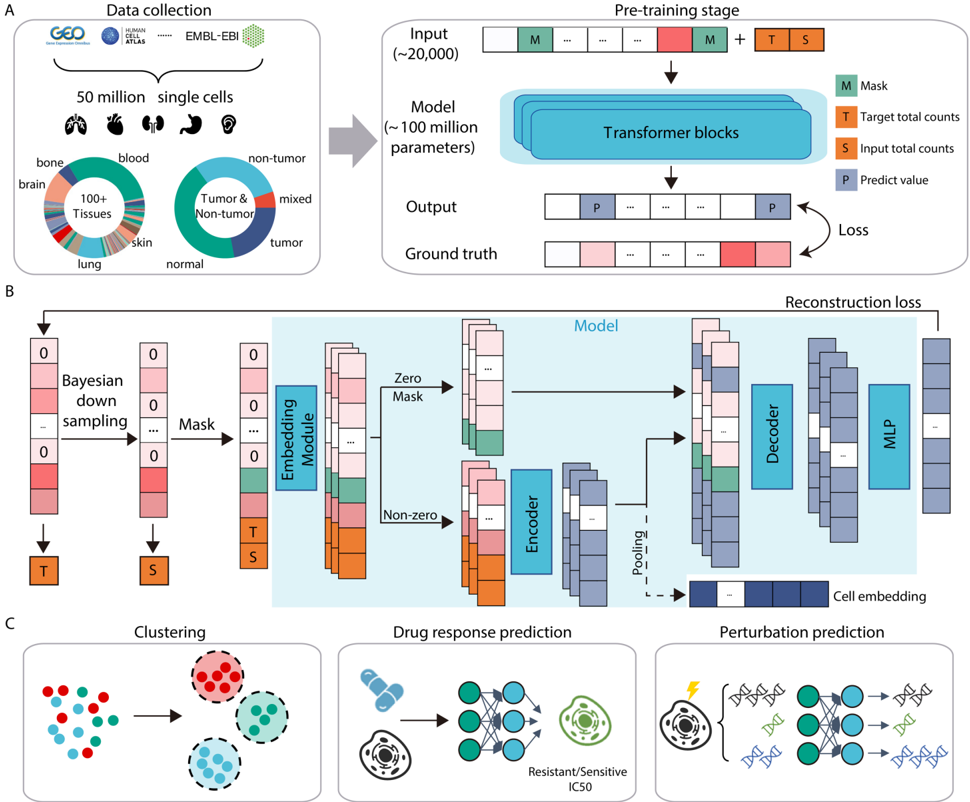
Large pretrained models have become foundation models leading to breakthroughs in natural language processing and related fields. Developing foundation models for deciphering the 'languages' of cells and facilitating biomedical research is promising yet challenging. Here we developed a large pretrained model scFoundation, also named 'xTrimoscFoundation α ', with 100 million parameters covering about 20,000 genes, pretrained on over 50 million human single-cell transcriptomic profiles. scFoundation is a large-scale model in terms of the size of trainable parameters, dimensionality of genes and volume of training data. Its asymmetric transformer-like architecture and pretraining task design empower effectively capturing complex context relations among genes in a variety of cell types and states. Experiments showed its merit as a foundation model that achieved state-of-the-art performances in a diverse array of single-cell analysis tasks such as gene expression enhancement, tissue drug response prediction, single-cell drug response classification, single-cell perturbation prediction, cell type annotation and gene module inference.
Overview
CoChat Summary
TL;DR
scFoundation is a 100M-parameter foundation model pretrained on over 50 million human single-cell transcriptomics profiles covering 19,264 genes. It achieves improved or state-of-the-art performance across gene expression enhancement, cancer drug response prediction, single-cell drug response classification, and perturbation prediction without fine-tuning the pretrained model.
Key findings
- Pretrained on >50 million human scRNA-seq profiles and 19,264 genes with 100M parameters, scFoundation is described as the largest model in parameter size, gene coverage, and data scale in the single-cell field.
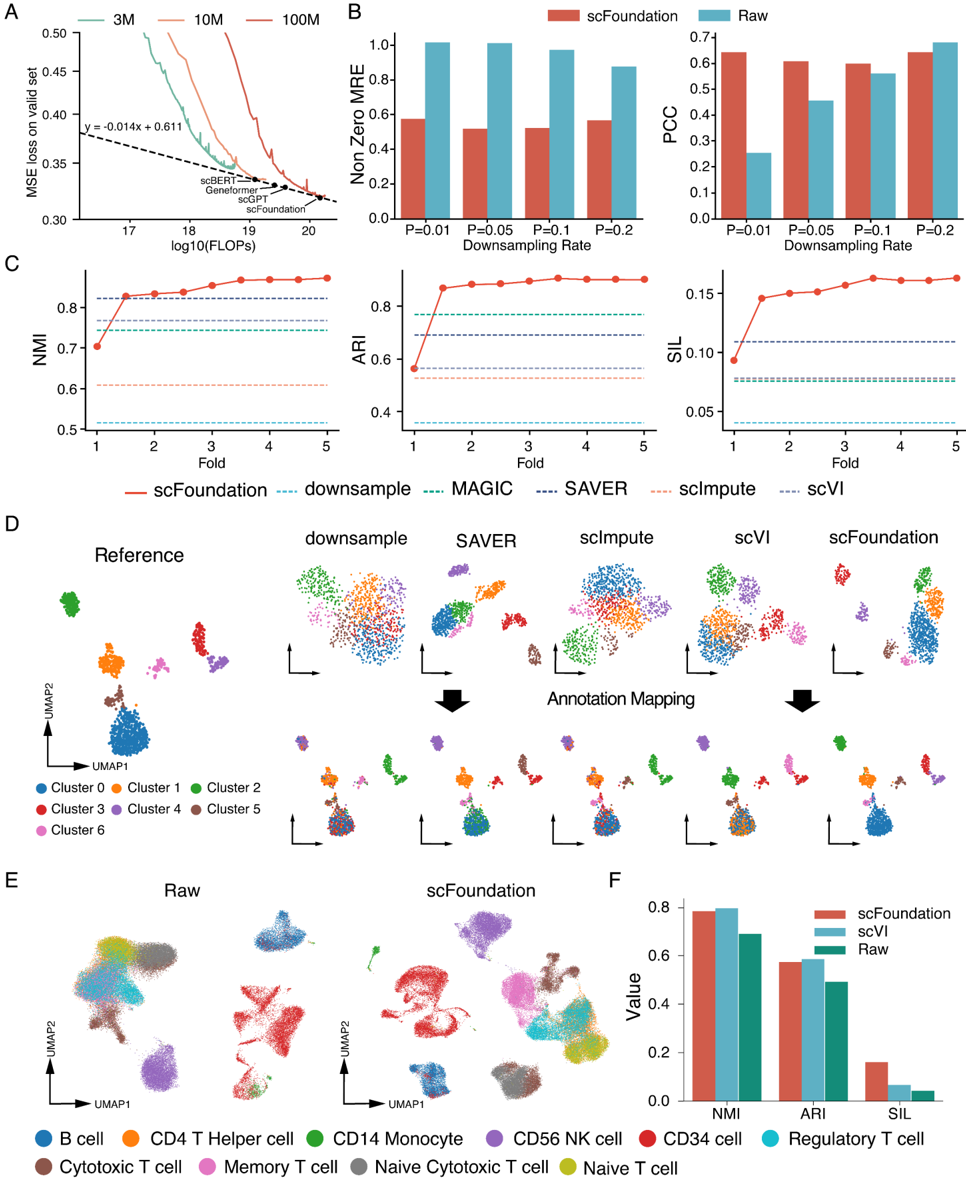
- For read-depth enhancement without fine-tuning, scFoundation reduced MAE and MRE by half versus the non-enhanced baseline; when downsampling was below 10%, baseline MRE was 97.5% while scFoundation maintained an MRE of 60%. On the Zheng68K PBMC dataset (~600,000 cells), scFoundation embeddings had comparable NMI and ARI to scVI and a higher SIL score.
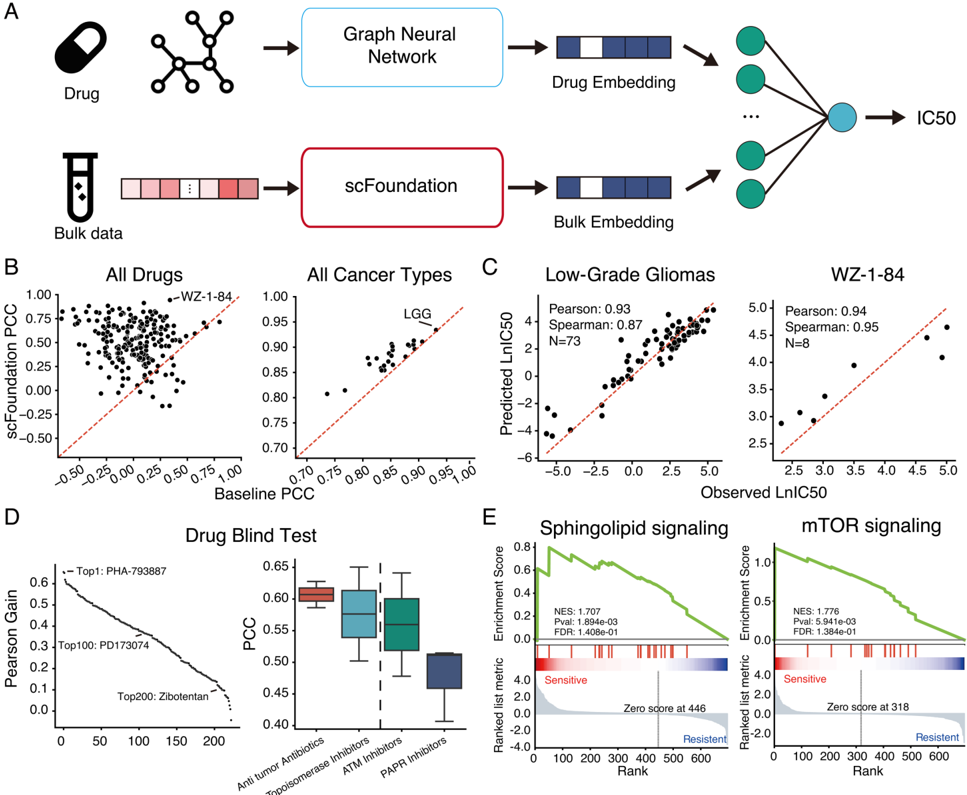
- In cancer drug response prediction with DeepCDR, scFoundation embeddings improved PCC for most drugs and all cancer types; in leave-one-drug-out blind tests, PHA-793887 improved from PCC 0.07 to 0.73 and Zobotentan from 0.49 to 0.64, with the best case achieving PCC above 0.93.
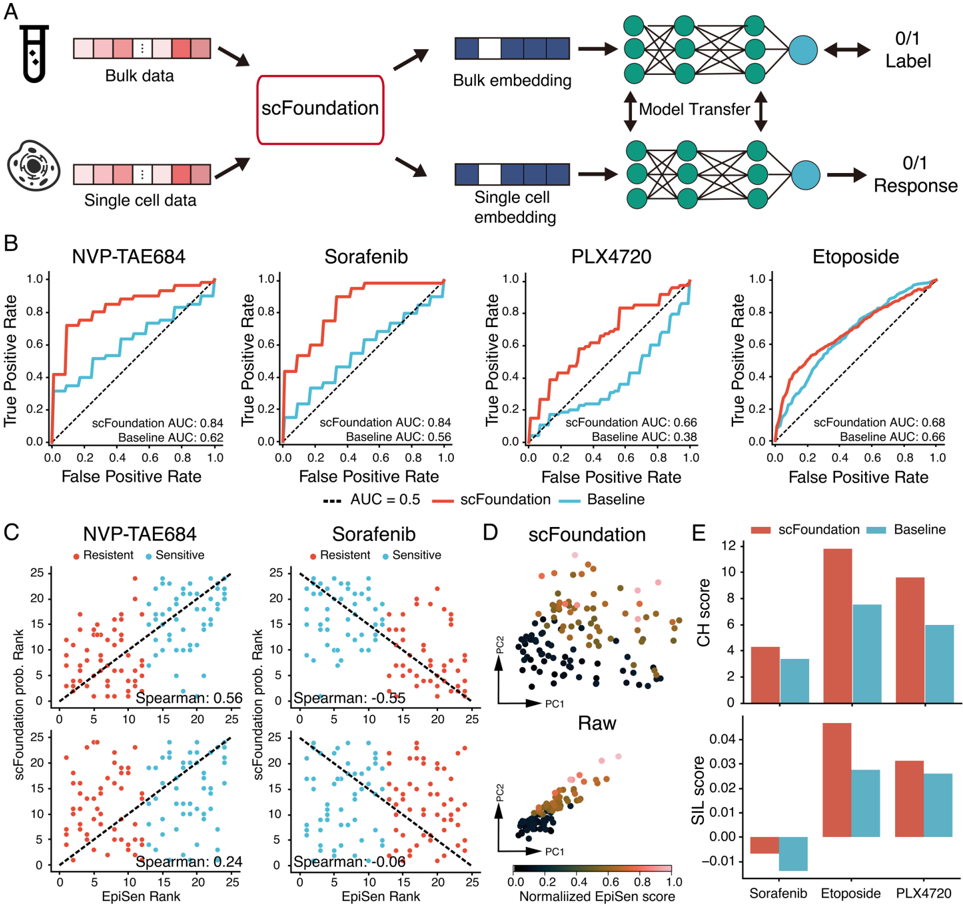
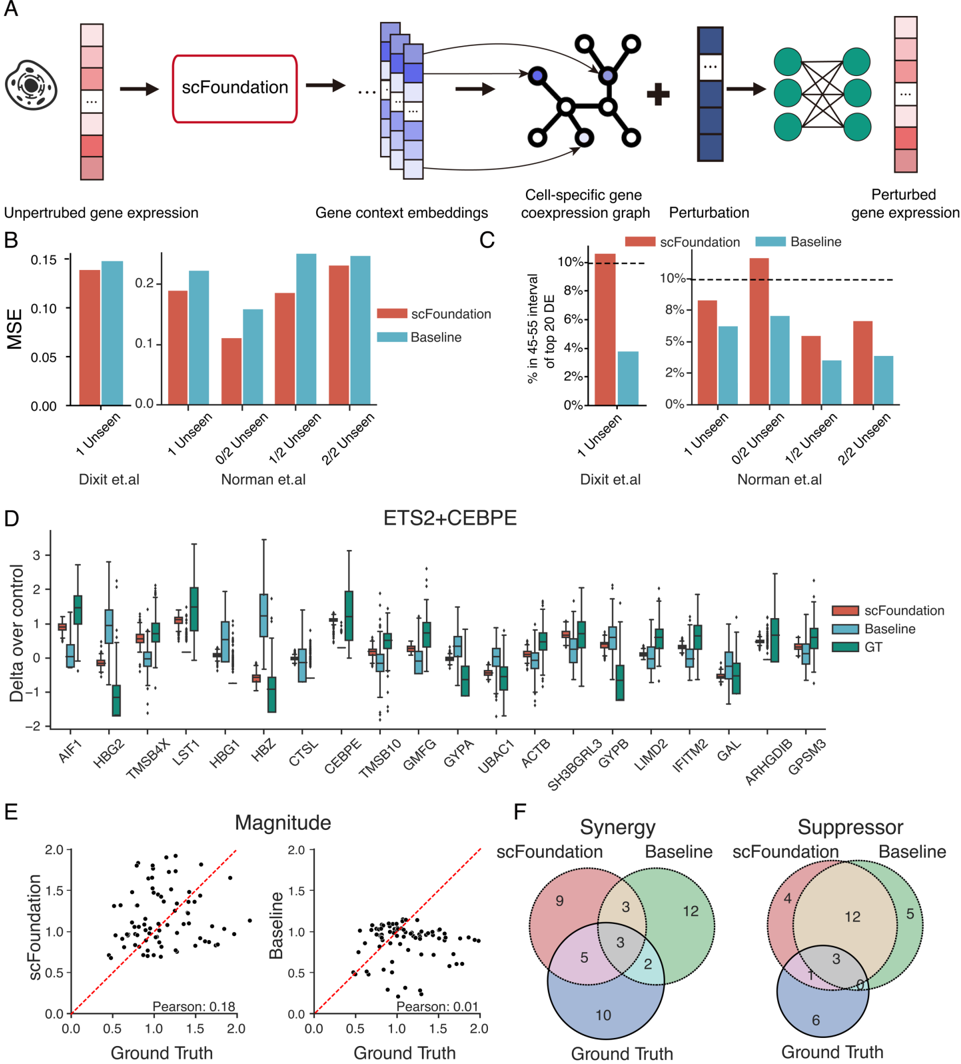
- In single-cell drug response classification, scFoundation embeddings achieved higher AUROC for all four tested drugs; for NVP-TAE684 and Sorafenib, AUROC improved by above 0.2, and Spearman correlations with EpiSen scores were 0.56 and −0.55 versus baseline 0.24 and −0.06. In perturbation prediction, scFoundation-combined GEARS achieved lower MSE on all 1-gene perturbation datasets and the lowest MSE in the 0/2 unseen 2-gene case.
Methods
- Model architecture: xTrimoGene, an asymmetric encoder-decoder transformer with an embedding module that converts continuous gene expression scalars into learnable embeddings; the encoder processes only non-zero and non-masked expressed genes, while the decoder integrates all genes.
- Pretraining data and task: over 50 million human scRNA-seq profiles collected from GEO, Single Cell Portal, HCA, EMBL-EBI, and other resources, aligned to 19,264 genes and filtered for cells with >200 expressed genes; read-depth-aware modeling used hierarchical Bayesian downsampling, 30% masking, and MSE regression loss with total count indicators T and S.
- Downstream evaluation: pretrained cell or gene embeddings were fed into DeepCDR, SCAD, and GEARS without fine-tuning the pretrained model; metrics included MAE, MRE, PCC, NMI, ARI, SIL, AUROC, MSE, and Spearman correlation.
Limitations
- The paper does not include an explicit limitations section.
- Evident from the text: pretraining used only human scRNA-seq data, so generalization to other species or multi-omics settings is not demonstrated.
- Evident from the text: downstream performance depends on existing task-specific models (DeepCDR, SCAD, GEARS) and public datasets, and the paper does not quantify residual batch effects or technical noise beyond describing read-depth-aware pretraining as a mitigation.
Model-written summary. Check it against the paper before relying on it.
Integrity signals
Registry
Cites
Statistics
Figures
Verification
Claims the paper makes
2 Valid · 6 Not valid · 3 Not checked · 74 Own results and interpretations
The cited sources that could be checked couldn’t confirm or dispute this claim.
In the paper
“We developed a new pre-training task called the read-depth-aware (RDA) modeling, which was an extension of masked language modeling 16 , considering single-cell gene expression data had a high variance in read depth, especially in the large-scale pre-training data.”
§ Large Scale Foundation Model on Single-cell Transcriptomics > The scFoundation pre-training framework
What the sources say
- Could not verifycites [16] Choromanski, K. et al. Rethinking Attention with Performers. Preprint at https://doi.org/10.48550/arXiv.2009.14794 (2022). sourceExperimental — accuracy not yet measured
The Experiments section (p. 6) mentions masked language modelling as a task used to evaluate Performers, but does not describe read-depth-aware modelling or an extension of that task. Searches for RDA, read depth, and single-cell gene expression found no passage addressing the attributed claim. (LLM, conf=0.75)
plain- Asserted: passes — The authors put it forward as true.
- Checkable: passes — It can be checked against evidence.
- Load-bearing: passes — The paper’s conclusions depend on it.
- Based: passes — The paper gives a reason why it holds.
- Could not verify
None of the sources cited for this claim have been checked yet.
In the paper
“Existing work had to restrict their models to a small list of selected genes.”
§ Large Scale Foundation Model on Single-cell Transcriptomics > Introduction
What the sources say
- Could not verifycites [8] Papatheodorou, I. et al. Expression Atlas update: from tissues to single cells. Nucleic Acids Research 48, D77-D83 (2020). sourceExperimental — accuracy not yet measured
The Introduction describes Single Cell Expression Atlas as a source of expression matrices for downstream computational methods, and the Data analysis section describes its quantification pipeline. Neither addresses whether earlier pre-training models had to use a small, selected gene list. Searches for pre-training, model limitations, and gene selection found no passage supporting that claim. (LLM, conf=0.76)
- Not checked yetcites [9] Svensson, V., Vento-Tormo, R. & Teichmann, S. A. Exponential scaling of single-cell RNA-seq in the past decade. Nature Protocols 13, 599-604 (2018). source
Checked before — its earlier verdict is held back until a new check runs.
- Could not verifycites [10] Brown, T. B. et al. Language Models are Few-Shot Learners. Preprint at https://doi.org/10.48550/arXiv.2005.14165 (2020). sourceExperimental — accuracy not yet measured
The Introduction (p. 3) discusses pre-trained language models and task-specific datasets, not single-cell gene expression. Searches for single-cell gene expression, selected genes, and restrictions to a small gene list found no passage addressing the claim. (LLM, conf=0.78)
- Could not verifycites [11] Zhao, W. X. et al. A Survey of Large Language Models. Preprint at https://doi.org/10.48550/arXiv.2303.18223 (2023). sourceExperimental — accuracy not yet measured
The Pre-training section (p. 4) discusses language-model training corpora, not single-cell gene-expression data. Searches for “single-cell gene expression selected genes” and “gene expression genes” found no passage addressing whether earlier models were restricted to a small list of genes. (LLM, conf=0.76)
plainstates a cause- Asserted: passes — The authors put it forward as true.
- Checkable: passes — It can be checked against evidence.
- Load-bearing: passes — The paper’s conclusions depend on it.
- Based: passes — The paper gives a reason why it holds.
- Could not verify
The cited sources support only part of this claim — read each source’s verdict below.
In the paper
“We constructed a comprehensive single-cell gene expression data set by collecting data from all publicly available single-cell resources, including GEO 17 , Single Cell Portal, HCA 4 , EMBL-EBI 18 , etc.”
§ Large Scale Foundation Model on Single-cell Transcriptomics > The scFoundation pre-training framework
What the sources say
- Could not verifycites [17] Ma, X. et al. Luna: Linear Unified Nested Attention. Preprint at http://arxiv.org/abs/2106.01540 (2021). sourceExperimental — accuracy not yet measured
Our copy of Luna (arXiv 2106.01540) is entirely about linear nested attention for sequence modelling; every data passage concerns NLP/vision benchmarks — the Abstract's three benchmarks, §4.1's Long Range Arena tasks (ListOps, Text, Retrieval, Image, Pathfinder), WMT'14 English-German (4.5M sentence pairs, Additional information), GLUE/QA (Table 6), and MLM pre-training on BookCorpus/Wikipedia/CC-News/OpenWebText/Stories. Nothing in it addresses single-cell gene expression, GEO, Single Cell Portal, HCA or EMBL-EBI (searched: 'single-cell gene expression dataset collection from public resources', 'scRNA-seq single cell RNA sequencing gene expression GEO Human Cell Atlas EMBL-EBI'). The cited sentence therefore cannot be checked against this source; our copy neither supports nor contradicts it. (LLM, conf=0.72)
- Partly supportedcites [4] Chen, S. et al. hECA: The cell-centric assembly of a cell atlas. iScience 25, 104318 (2022). sourceExperimental — accuracy not yet measured
The hECA 'Dataset collection' section (STAR Methods > Method details) does state the same ambition as the claim — 'collecting all accessible human single-cell data into a unified atlas' — and the Abstract/Introduction confirm it assembled a single-cell gene expression resource (1,093,299 cells, 116 published datasets, 38 organs) from scattered public data. But the realized scope is narrower than 'all publicly available single-cell resources': they selected 20–21 peer-reviewed studies, transcriptomic data of healthy donors only, and the Discussion concedes 'the number of cells in hECA v1.0 is still small and the coverage of organs and cell types is very limited'. Our copy also never lists Single Cell Portal, HCA, or EMBL-EBI as the repositories collected from (only GEO accessions and an NCBI BioProject appear, in the COVID-19 validation experiments), so that enumeration is not supported by this source. (LLM, conf=0.72)
- Partly supportedcites [18] Gong, J. et al. xTrimoGene: An Efficient and Scalable Representation Learner for Single-Cell RNA-Seq Data. 2023.03.24.534055 Preprint at https://doi.org/10.1101/2023.03.24.534055 (2023). sourceExperimental — accuracy not yet measured
Our copy confirms the large curated pre-training data set: the Additional information section states 'we curated about 5 million scRNA-seq data for training' processed with a unified pipeline. However, it attributes collection to a single repository, not 'all publicly available single-cell resources': 'Recently, scRNA-seq data ... mostly has been uploaded to the Gene Expression Omnibus (GEO) repository ... We collected data from GEO' and 'all the scRNA-seq data are collected from the Gene Expression Omnibus (GEO) repository with a keyword searching and data retrieval process.' Searches for HCA / Human Cell Atlas, EMBL-EBI and Single Cell Portal returned no data-source passage in our copy, so the multi-resource scope the citing sentence claims is not supported by this paper. (LLM, conf=0.82)
plain- Asserted: passes — The authors put it forward as true.
- Checkable: passes — It can be checked against evidence.
- Load-bearing: passes — The paper’s conclusions depend on it.
- Based: passes — The paper gives a reason why it holds.
- Could not verify
A result the paper reports from its own data — it cites no other source for it, so there is none to check. The quote shows it is in the paper.
In the paper
“From a cell ontology perspective, the data encompassed almost all known human cell types and cell states.”
§ Large Scale Foundation Model on Single-cell Transcriptomics > The scFoundation pre-training framework
plain- Asserted: passes — The authors put it forward as true.
- Checkable: passes — It can be checked against evidence.
- Load-bearing: passes — The paper’s conclusions depend on it.
- Based: passes — The paper gives a reason why it holds.
A result the paper states — it cites no source for it, so there is none to check. The quote shows it is in the paper.
In the paper
“We observed that, based on scFoundation-predicted results, drugs belonging to chemotherapy, such as anti-tumor antibiotics and topoisomerase inhibitors, had a higher PCC than drugs belonging to targeted therapy, such as ATM and PARP inhibitors (Fig. 3C right).”
§ Large Scale Foundation Model on Single-cell Transcriptomics > scFoundation improves cancer drug response prediction
plainstates an association- Asserted: passes — The authors put it forward as true.
- Checkable: passes — It can be checked against evidence.
- Load-bearing: unclear — It is unclear whether the paper’s conclusions depend on it.
- Based: passes — The paper gives a reason why it holds.
37 more claims
Create a free account to see all 85 claims and to verify the 5 references still open.
- Probably not a substantial claim. 13
- It may state two separate claims as one. 36
- The quote only partly states this claim. 2
Claims other papers make about this one
Each is checked against this paper’s own text: does it say what the citing paper says it does?
The source backs part of the claim, not all of it — or backs it for a different population, condition or comparison.
In the citing paper
“Compared to tasks such as cell annotation and batch correction, perturbation prediction offers experimentally generated model input/output with well-defined objectives, making it a more robust benchmark for assessing foundation models (15, 20, 21).”
From A systematic comparison of single-cell perturbation response prediction models (2026) · cites this paper as [21]
Experimental — accuracy not yet measuredThe source backs part of the claim, not all of it — or backs it for a different population, condition or comparison.
In the citing paper
“These models are pre-trained on vast amounts (> 10 M examples) of unlabelled scRNA-seq data, with the aim that such large datasets allow the models to capture general principles of gene regulation and signalling.”
From Benchmarking foundation cell models for post-perturbation RNA-seq prediction (2025) · cites this paper as [7]
Experimental — accuracy not yet measuredIn the citing paper
“scFoundation [15] strengthens the modular design, aiming to combine different modules to adapt to a variety of single-cell tasks, and is very flexible and scalable.”
From Challenges in AI-driven Biomedical Multimodal Data Fusion and Analysis (2025) · cites this paper as [15]
Self-check
Percentages, sums and reported differences re-computed from the paper’s own numbers.
Each contradiction between two passages listed here was confirmed by an independent check.
Rated minor: it would not touch a result — a value no result rests on, a p-value that stays on the same side of the significance level, or a conflict that is clerical, resolved elsewhere in the paper, or outside its own findings.
In the paper
§ Large Scale Foundation Model on Single-cell Transcriptomics > scFoundation predicts more accurate perturbation responses
“the Adamson dataset 49 with 87 1-gene perturbations”
§ Large Scale Foundation Model on Single-cell Transcriptomics > References
“49. Rood, J. E., Maartens, A., Hupalowska, A., Teichmann, S. A. & Regev, A. Impact of the Human Cell Atlas on medicine. Nat Med 28, 2486-2496 (2022).”
Rated minor: it would not touch a result — a value no result rests on, a p-value that stays on the same side of the significance level, or a conflict that is clerical, resolved elsewhere in the paper, or outside its own findings.
In the paper
§ Large Scale Foundation Model on Single-cell Transcriptomics > scFoundation predicts more accurate perturbation responses
“We combined the scFoundation with an advanced model GEARS 51 for the perturbation prediction task.”
§ Large Scale Foundation Model on Single-cell Transcriptomics > References
“51. Dixit, A. et al. Perturb-Seq: Dissecting Molecular Circuits with Scalable Single-Cell RNA Profiling of Pooled Genetic Screens. Cell 167, 1853-1866.e17 (2016).”
Rated minor: it would not touch a result — a value no result rests on, a p-value that stays on the same side of the significance level, or a conflict that is clerical, resolved elsewhere in the paper, or outside its own findings.
In the paper
§ Large Scale Foundation Model on Single-cell Transcriptomics > scFoundation transfers bulk-level drug sensitivity prediction model to single-cell data
“based on the SCAD 44 downstream model.”
§ Large Scale Foundation Model on Single-cell Transcriptomics > References
“44. Jerby-Arnon, L. et al. A Cancer Cell Program Promotes T Cell Exclusion and Resistance to Checkpoint Blockade. Cell 175, 984-997.e24 (2018).”
Citations
Cites
BERT: Pre-training of Deep Bidirectional Transformers for Language Understanding
Devlin, J., Chang, M.-W., Lee, K., & Toutanova, K. (2018) · arXiv · doi:10.48550/arxiv.1810.04805 · Cited by 73,173
Scikit-learn: Machine Learning in Python
Pedregosa, F., Varoquaux, G., Gramfort, A., Michel, V., Thirion, B., Grisel, O., Blondel, M., Müller, A., Nothman, J., Louppe, G., et al. (2012) · arXiv · doi:10.48550/arxiv.1201.0490 · Cited by 71,016
Subramanian, A., Tamayo, P., Mootha, V. K., Mukherjee, S., Ebert, B. L., Gillette, M. A., Paulovich, A., Pomeroy, S. L., Golub, T. R., Lander, E. S., et al. (2005) · Proceedings of the National Academy of Sciences · doi:10.1073/pnas.0506580102 · Cited by 53,625
KEGG: Kyoto Encyclopedia of Genes and Genomes
Kanehisa, M. (2000) · Nucleic Acids Research · doi:10.1093/nar/28.1.27 · Cited by 37,077
KEGG: Kyoto Encyclopedia of Genes and Genomes
Ogata, H., Goto, S., Sato, K., Fujibuchi, W., Bono, H., & Kanehisa, M. (1999) · Nucleic Acids Research · doi:10.1093/nar/27.1.29 · Cited by 31,232 · cited 1×
“According to the Kyoto Encyclopedia of Genes and Genome database 41 , this pathway was related to sphingomyelin and its metabolism.”
Language Models are Few-Shot Learners
Brown, T. B., Mann, B., Ryder, N., Subbiah, M., Kaplan, J., Dhariwal, P., Neelakantan, A., Shyam, P., Sastry, G., Askell, A., et al. (2020) · arXiv · doi:10.48550/arxiv.2005.14165 · Cited by 23,372 · cited 5×
“Please refer to Supplementary Notes 9 and 10 for details of the sampling strategy and count indicators calculation.”
InfluentialIntegrated analysis of multimodal single-cell data
Hao, Y., Hao, S., Andersen-Nissen, E., Mauck, W. M., Zheng, S., Butler, A., Lee, M. J., Wilk, A. J., Darby, C., Zagar, M., et al. (2020) · doi:10.1101/2020.10.12.335331 · Cited by 15,508
Kaugeranna, R., Kaugeranna, E., & Aion, (. S. 4. 6. (2023) · DROPS (Schloss Dagstuhl – Leibniz Center for Informatics) · doi:10.4230/lipics.giscience.2023.43 · Cited by 13,690
Gene Expression Omnibus: NCBI gene expression and hybridization array data repository
Edgar, R. (2002) · Nucleic Acids Research · doi:10.1093/nar/30.1.207 · Cited by 13,288 · cited 3×
“…a comprehensive single-cell dataset by collecting data from all publicly available single-cell resources, including Gene Expression Omnibus (GEO) 22 , Single Cell Portal, HCA 3 , human Ensemble Cell Atlas (hECA) 4 , Deeply Integrated human Single-Cell Omics data (DISCO) 7 , European Molecular…”
Scaling Laws for Neural Language Models
Kaplan, J., McCandlish, S., Henighan, T., Brown, T. B., Chess, B., Child, R., Gray, S., Radford, A., Wu, J., & Amodei, D. (2020) · arXiv · doi:10.48550/arxiv.2001.08361 · Cited by 9,550 · cited 1×
“This is a large-scale model of large parameter size, gene coverage and data scale in the single-cell field.”
Research works printed but not linked: 1
- He, K. et al. in Proc. IEEE/CVF Conference on Computer Vision and Pattern Recognition 16000–16009 (IEEE, 2022).
Cited by
Items 201–300 of 638
BulkFormer: A large-scale foundation model for bulk transcriptomes
Kang, B. S., Fan, R., Yi, M., Cui, C., & Cui, Q. (2026) · Cell Systems · doi:10.1016/j.cels.2026.101657 · Cited by 23
Robust self-supervised learning strategy to tackle the inherent sparsity in single-cell RNA-seq data
Park, S., & Lee, H. (2024) · Briefings in Bioinformatics · doi:10.1093/bib/bbae586 · Cited by 6
AI: A transformative opportunity in cell biology
Carr, A., Cool, J., Karaletsos, T., Li, D., Lowe, A. R., Otte, S., & Schmid, S. L. (2024) · Molecular Biology of the Cell · doi:10.1091/mbc.e24-09-0415 · Cited by 9
Prioritizing perturbation-responsive gene patterns using interpretable deep learning
Cui, Y., & Yuan, Z. (2025) · Nature Communications · doi:10.1038/s41467-025-61476-9 · Cited by 9
Chiu, H.-H., Varghese, A., Shao, K., Lu, Y., Nahar, R., Chen, H., Deng, Q., Bao, X., & Li, C. (2026) · AIChE Journal · doi:10.1002/aic.70285 · Cited by 15
How Do Large Language Models Understand Genes and Cells
Fang, C., Wang, Y., Song, Y., Long, Q., Wang, L., Chen, L.-H., Wang, P., Feng, G., Zhou, Y., & Li, X. (2025) · ACM Transactions on Intelligent Systems and Technology · doi:10.1145/3702234 · Cited by 10
PULSAR: a Foundation Model for Multi-scale and Multicellular BiologyPreprint
Pang, K., Rosen, Y., Kedzierska, K., He, Z., Rajagopal, A., Gustafson, C. E., Huynh, G. H., & Leskovec, J. (2025) · bioRxiv (Cold Spring Harbor Laboratory) · doi:10.1101/2025.11.24.685470 · Cited by 14
SpatialProp: tissue perturbation modeling with spatially resolved single-cell transcriptomicsPreprint
Sun, E., Buendia, A., Brunet, A., & Zou, J. (2025) · bioRxiv (Cold Spring Harbor Laboratory) · doi:10.64898/2025.11.30.691355 · Cited by 9
“Several computational and machine learning models have been developed to bridge limitations of cost and scale with some success in modeling cell-intrinsic perturbations [7, 8, 9, 10, 11, 12, 13, 14, 15, 16, 17].”
Ha, S. V., Jaensch, S., Kańduła, M. M., Herman, D., Czodrowski, P., & Ceulemans, H. (2025) · Scientific Reports · doi:10.1038/s41598-025-05914-0 · Cited by 10
“These methods range from variational autoencoder 36 , to transformer-based models 37–39 based on BERT 4 and GPT 40 .”
SIGEL: a context-aware genomic representation learning framework for spatial genomics analysis
Li, W., Zhu, M., Xu, Y., Huang, M., Wang, Z., Chen, J., Wu, H., & Sun, X. (2025) · Genome biology · doi:10.1186/s13059-025-03748-7 · Cited by 15
“While recent works, including Gene2Vec [1], scGPT [10], scFoun-dation [12], scBERT [13], and geneFormer [14], have been developed to learn gene embeddings from atlas-scale microarray or scRNA-seq data, they do not extend to ST, overlooking crucial spatial gene expression information.”
Pirhaji, L., Eaton, J. A., Jeewajee, A. K., Zhang, M., Morris, M., & Karasarides, M. (2025) · Communications Chemistry · doi:10.1038/s42004-025-01791-w · Cited by 5
“In fi elds such as single-cell sequencing, standardized data processing methods have already enabled the integration of public datasets to develop pre-trained foundation models 23 – 25 .”
Data-driven discovery of digital twins in biomedical research
Métayer, C., Ballesta, A., & Martinelli, J. (2026) · Briefings in Bioinformatics · doi:10.1093/bib/bbaf722 · Cited by 15
“This field builds on the recent success of specialized FMs like scGPT [209] and scFoundation [210] that generate single-cell transcriptomics, after having been trained on millions of gene expression profiles, which allowed them to implicitly capture biological structures suc h as gene co-expression.”
Toward informed batch correction for single-cell transcriptome integration
Li, S., Luecken, M. D., Marioni, J. C., Teichmann, S. A., & He, P. (2026) · Nature Computational Science · doi:10.1038/s43588-025-00943-1 · Cited by 18
From modality-specific to compositional foundation models for cell biology
Bahrami, M., Richter, T., Schmacke, N. A., Lavandera, A. E., & Theis, F. J. (2026) · Cell Systems · doi:10.1016/j.cels.2026.101534 · Cited by 12
Spatial omics for profiling the dynamic tumor microenvironment
Nguyen, H. N., Eapen, M. M., Nguyen, Q. H., & Sharma, A. (2026) · Clinical & Translational Immunology · doi:10.1002/cti2.70084 · Cited by 8
Tackling the complexity of cancer with generative models
Conard, A. M., Hughes, M., Hall, J., Tenenholtz, N., Zimmermann, E., Crawford, L. A., Amini, A. P., & Severson, K. (2026) · Cell · doi:10.1016/j.cell.2026.03.027 · Cited by 5
Towards the construction of a virtual yeast
Qian, L., Zhou, Z., Zhou, P., Dong, Z., Zhang, X., Dai, Z., Gao, Z., Sun, S., Roy, K. R., Wang, S., et al. (2026) · Nature · doi:10.1038/s41586-026-10574-9 · Cited by 13
“Transcriptome-focused models, including Geneformer 2 , scFoundation 140 , scGPT 141 and GET 142 , encode gene expression patterns, gene–gene interactions and transcriptional dynamics.”
Self-citationLinking transcriptome and morphology in bone cells at cellular resolution with generative AI
Lu, L., Ono, N., & Welch, J. D. (2024) · Journal of Bone and Mineral Research · doi:10.1093/jbmr/zjae151 · Cited by 6
Liu, X., Chapple, R. H., Bennett, D., Wright, W. C., Sanjali, A., Culp, E., Zhang, Y., Pan, M., & Geeleher, P. (2025) · Cell Genomics · doi:10.1016/j.xgen.2024.100739 · Cited by 6
A review of advances in in vitro RNA preparation by ssRNAP
Shen, Y., Yang, D.-Q., Liu, Y., Lao, J.-E., Liu, C., Gao, X., He, Y.-R., & Xia, H. (2025) · International Journal of Biological Macromolecules · doi:10.1016/j.ijbiomac.2025.141002 · Cited by 5
Self-citationDeconstructing the GWAS library: next-generation GWAS
Zhang, W., Koslowski, S., Benzaki, M., Lee, C. J. M., Zhu, Y., Mak, M. C. E., Zhu, Y., Loong, S. S. E., Lettre, G., Anene-Nzelu, C. G., et al. (2025) · Physiological Reviews · doi:10.1152/physrev.00025.2024 · Cited by 5
AI-Empowered Genome Decoding: Applications of Large Language Models in Genomics
Li, S., Fan, W., & Zhou, Y. (2025) · Frontiers of digital education. · doi:10.1007/s44366-025-0051-1 · Cited by 4
Foundation models in molecular biology
Si, Y., Zou, J., Gao, Y., Chuai, G., Liu, Q., & Chen, L. (2024) · Biophysics Reports · doi:10.52601/bpr.2024.240006 · Cited by 14
“…results show that Geneformer can handle batch effects well and performs well on tasks such as network dynamics prediction as well as gene perturbation prediction, suggesting that Geneformer learns the regulatory relationships between genes from the transcriptome well. scFoundation (Hao et al .”
BackgroundFoundation Models for Translational Cancer Biology
Tsang, K. K., Kivelson, S., Cortina, J. M. A., Kuchi, A., Berkowitz, J. S., Liu, H., Srinivasan, A., Friedrich, N. A., Fatapour, Y., & Tatonetti, N. P. (2025) · Annual Review of Biomedical Data Science · doi:10.1146/annurev-biodatasci-103123-095633 · Cited by 6
A Systematic Evaluation of Single-Cell Foundation Models on Cell-Type Classification Task
Steiner, N., Li, Z., Vosoughi, O., Schrader, J., Roy, S., Nejdl, W., & Tang, M. (2025) · ACM International Conference on Web Search and Data Mining (WSDM) · doi:10.1145/3701551.3708811 · Cited by 6
Cell-GraphCompass: modeling single cells with graph structure foundation model
Fang, C., Cui, W., Hu, Z., Liu, W., Chen, S., Chang, S., Long, Q., Li, C., Liu, Y., Jiang, H., et al. (2025) · National Science Review · doi:10.1093/nsr/nwaf255 · Cited by 10
“Gene-former [7 ], scGPT [8 ] and scFoundation [9 ] introduced transfer learning to address data limitations in the single-cell field, while GeneCompass [10 ] achieved breakthroughs across species.”
Modal-NexT: Towards unified heterogeneous cellular data integration
Tang, Z., Chen, G., Chen, S., He, H., Huang, J., Dong, T., Zhou, J., Zhao, L., You, L., & Chen, C. Y. (2025) · Information Fusion · doi:10.1016/j.inffus.2025.103479 · Cited by 8
scEMB: Learning context representation of genes based on large-scale single-cell transcriptomicsPreprint
Hsieh, K., Chu, Y., Li, X., Pilie, P. G., & Dai, Y. (2024) · bioRxiv (Cold Spring Harbor Laboratory) · doi:10.1101/2024.09.24.614685 · Cited by 8
Multimodal foundation model predicts zero-shot functional perturbations and cell fate dynamicsPreprint
Yang, Z., Fan, X., Lan, M., Tang, X., Zheng, Z., Liu, B., You, Y., Tian, L., Church, G. M., Liu, X., et al. (2024) · bioRxiv (Cold Spring Harbor Laboratory) · doi:10.1101/2024.12.19.629561 · Cited by 5
EpiAgent: Foundation model for single-cell epigenomic dataPreprint
Chen, X., Li, K., Cui, X., Wang, Z., Jiang, Q., Lin, J., Li, Z., Gao, Z., & Jiang, R. (2024) · bioRxiv (Cold Spring Harbor Laboratory) · doi:10.1101/2024.12.19.629312 · Cited by 5
GREmLN: A Cellular Graph Structure Aware Transcriptomics Foundation ModelPreprint
Zhang, M., Swamy, V. S., Cassius, R., Dupire, L., Kanatsoulis, C. I., Paull, E., AlQuraishi, M., Karaletsos, T., & Califano, A. (2025) · bioRxiv (Cold Spring Harbor Laboratory) · doi:10.1101/2025.07.03.663009 · Cited by 11
“Newer models such as scFoundation model the read depth of each cell and employ a masked regression objective to better model the continuous nature of RNA expression Hao et al. (2024).”
Sparse Autoencoders Reveal Interpretable Features in Single-Cell Foundation ModelsPreprint
Pedrocchi, F., Barkmann, F., Joudaki, A., & Boeva, V. (2025) · bioRxiv (Cold Spring Harbor Laboratory) · doi:10.1101/2025.10.22.681631 · Cited by 13
“…(Rosen et al., 2023; Heimberg et al., 2025), batch integration (He et al., 2025; Cui et al., 2024) or perturbation prediction, including drug response (Hao et al., 2024; Theus Single-cell foundation models have found growing utility in single-cell analysis, yet many remain difficult to interpret.”
A unified genetic perturbation language for human cellular programmingPreprint
Hartman, A., Takacsi-Nagy, O., Kernick, C., Theberath, N. E., Lu, J., Wu, L., Mantilla, M., Mittra, S., McClellan, A. K., Johnson, N., et al. (2025) · bioRxiv (Cold Spring Harbor Laboratory) · doi:10.1101/2025.11.20.689421 · Cited by 7
He, F., Fei, R., Krull, J. E., Yu, Y., Zhang, X., Wang, X., Cheng, H., Gao, M., Su, L., Chen, Y., et al. (2025) · Nature Machine Intelligence · doi:10.1038/s42256-025-01170-z · Cited by 5
“We investigated the functional interpretations of new subgroups (clusters 3 and 7, 2 and 19, and 10 and 11) identified by scPEFT using a gene set enrichment analysis 26 .”
Self-citationSCREADER: Prompting Large Language Models to Interpret scRNA-seq Data
Li, C., Long, Q., Zhou, Y., & Xiao, M. (2024) · IEEE ... International Conference on Data Mining workshops · doi:10.1109/icdmw65004.2024.00092 · Cited by 11
“…existing research in gene representation [16] and cell-level analysis [8] often fail to leverage the full potential of LLM. Studies [17], [18], [19] have focused mainly on large-scale gene expression data but have not fully incorporated external descriptions and common knowledge…”
PyEvoCell: an LLM-augmented single-cell trajectory analysis dashboard
Mathur, S., Beauvais, M., Giribet, A., Barrero, N. A., Zhang, C., Rahman, T., Wang, S., Huang, J., Nouri, N., Kurlovs, A., et al. (2025) · Bioinformatics · doi:10.1093/bioinformatics/btaf158 · Cited by 5
“Large language models (LLMs) have shown promises in summarizing data in computational biology (Hao et al. 2024) but have not yet been applied to TI.”
Zhang, Z., Qiao, J., Chen, Y., & Zhou, P. (2025) · Advanced Science · doi:10.1002/advs.202412660 · Cited by 6
A message passing framework for precise cell state identification with scClassify2
Ding, W., Cao, Y., Fu, X., Torkel, M., & Yang, J. Y. H. (2025) · Genome biology · doi:10.1186/s13059-025-03722-3 · Cited by 4
“After comprehensively balancing the model performance and computation consumption like memory usage, we pruned the previous dense graph and only kept 16 outgoing edges for each node.”
Shi, P., Chen, J., & Secrier, M. (2025) · Lecture notes in computer science · doi:10.1007/978-3-032-04981-0_57 · Cited by 8
Overcoming barriers to the wide adoption of single-cell large language models in biomedical research
Xie, F., Zhao, B., Xu, S., Wang, Z., Moon, J. J., & Garmire, L. X. (2025) · Nature Biotechnology · doi:10.1038/s41587-025-02846-y · Cited by 8
scKGBERT: a knowledge-enhanced foundation model for single-cell transcriptomics
Li, Y. E., Qiao, G., Du, H., Gao, X., & Wang, G. (2025) · Genome biology · doi:10.1186/s13059-025-03862-6 · Cited by 6
“The model consistently outperformed Geneformer and scFoundation [6] in identifying dosage-sensitive genes, particularly under noisy or heterogeneous expression conditions.”
MobiFM: A Foundation Model for Mobile Data Forecasting
Chai, H., Qi, X., Ma, Y., Wang, Z., Yue, L., & Li, Y. (2025) · IEEE Journal on Selected Areas in Communications · doi:10.1109/jsac.2025.3642851 · Cited by 12
“Numerous vertical domains, including urban systems, finance, and healthcare, have begun to develop their specific foundation models [7], [8].”
Yu, Z., Yang, D., Chen, Q., Zhang, Y., Li, Z., Wang, Y., Wang, C., & Zhang, Y. (2026) · Cell Genomics · doi:10.1016/j.xgen.2025.101130 · Cited by 6
Ngassam, B. T., Niu, H., Pang, S., Shydlouskaya, V., & Andrews, T. S. (2026) · Frontiers in Bioinformatics · doi:10.3389/fbinf.2025.1715821 · Cited by 5
Driessen, A., Born, J., Castellanos-Rueda, R., Reddy, S. T., & Rapsomaniki, M. (2026) · Cell Systems · doi:10.1016/j.cels.2026.101591 · Cited by 4
Computational approaches for multimodal lineage tracing
Wang, K., He, X., & Hu, Z. (2026) · Nature Reviews Genetics · doi:10.1038/s41576-026-00969-9 · Cited by 7
“Although current deep learning frameworks 154–159 have begun to capture general principles of cell identity, they fundamentally learn high-dimensional correlations rather than causal mechanisms; a model that predicts cell fate does not thereby explain why cells adopt particular fates.”
Scoring gene importance by interpreting single-cell foundation models
Gold, M. P., Reyes, M., Diamant, N., Kuo, T. C.-Y., Hajiramezanali, E., Newburger, J. W., Son, M. B. F., Lee, P. Y., Scalia, G., BenTaieb, A., et al. (2026) · Nature Biotechnology · doi:10.1038/s41587-026-03112-5 · Cited by 9
Conditional Monge Gap enables generalizable single-cell perturbation modelling
Driessen, A., Rajwade, D. A., Harsanyi, B., Rapsomaniki, M., & Born, J. (2026) · Nature Machine Intelligence · doi:10.1038/s42256-026-01242-8 · Cited by 17
“This frugality, grounded in an OT framework tailored to the nature of the perturbation prediction problem, makes CMonge an attractive alternative to emerging foundation models that, despite having 100 million or more parameters 17,18,37 , still face challenges in perturbation prediction 20,21,38 .”
Single-cell T-cell landscape in atherosclerosis: implications for targeted therapy and beyond
Luo, R., Liu, S., Ouyang, X., Zhou, E., & Jiang, L. (2026) · Journal of Translational Medicine · doi:10.1186/s12967-026-08334-4 · Cited by 5
“…covering multiple aspects of multiomics integration, cell type annotation, gene expression enhancement, gene module inference, protein interaction network analysis, prediction of tissue drug response, and single-cell perturbation, such as scFoundation [96], ScGPT [97], and PINNACLE [98] models.”
PlantCAD2: A DNA foundation model for interpreting genomes across flowering plants
Zhai, J., Gokaslan, A., Hsu, S.-K., Chen, S.-P., Liu, Z.-Y., Marroquin, E., Czech, E., Cannon, B. R., Berthel, A., Romay, M. C., et al. (2026) · Cell Genomics · doi:10.1016/j.xgen.2026.101329 · Cited by 31
Adopting Generative AI with Precaution in Dentistry: A Review and Reflection
Xu, M., Ye, C., Zeng, Z., Chang, C., Qi, S., Wu, Y., Yang, H., Chen, Y., Huang, H., Liu, L., et al. (2024) · IEEE International Conference on Digital Health (ICDH) · doi:10.1109/icdh62654.2024.00047 · Cited by 7
“It can be used to swiftly extract information from various types of medical data, including patient records, treatment outcomes, biomarker data and epidemiological data [51].”
BackgroundKommu, S., Wang, Y., Wang, Y., & Wang, X. (2025) · Bioinformatics · doi:10.1093/bioinformatics/btaf217 · Cited by 11
ScaleSC : a superfast and scalable single-cell RNA-seq data analysis pipeline powered by GPU
Hu, W., Zhang, H., Sun, Y. H., Cao, S., Gagnon, J., Moroishi, Y., Chen, Y., Ouyang, Z., & Zhang, B. (2024) · Bioinformatics Advances · doi:10.1093/bioadv/vbaf167 · Cited by 5
“We evaluated the performance of ScaleSC against Scanpy and Seurat (v5) (Hao et al. 2024b) on a public multiple sclerosis (MS) dataset (Absinta et al. 2021) comprising 66 432 cells with seven predefined cell types: Astrocytes, Immune, Lymphocytes, Neurons, Oligodendrocytes, OPC, and Vascular Cells.”
Large Language Models for Translational Cancer Informatics
Pan, Y., Wang, Y., Wang, G., Su, J., Topaloĝlu, Ü., & Song, Q. (2025) · JCO Clinical Cancer Informatics · doi:10.1200/cci-25-00108 · Cited by 5
Chen, H., Zhong, J., Zhang, X., Chen, J., Guo, L., Xiong, X., Zhang, X., Liu, X., Xiao, B., & Tian, B. (2026) · Advanced Science · doi:10.1002/advs.202521970 · Cited by 7
“We therefore anticipate that our general approach should be applicable for other foundational biological large language models, such as DNA [ 65 ], RNA [ 66 ], and transcriptomics [ 67 ], to discover the “words” for DNA, RNA, and for molecular genetics pathways.”
Self-citationArtificial intelligence and biological research
Wu, C., & Li, C. (2024) · National Science Review · doi:10.1093/nsr/nwae415 · Cited by 4
Unified Integration of Spatial Transcriptomics Across Platforms
Haber, E., Deshpande, A., Ma, J., & Krieger, S. (2025) · Genome Research · doi:10.1007/978-3-031-90252-9_42 · Cited by 10
Self-citationA law of next-token prediction in large language models
He, H., & Su, W. (2025) · Physical review. E · doi:10.1103/5rn3-49lc · Cited by 27
Hoffmann, C. (2025) · bioRxiv (Cold Spring Harbor Laboratory) · doi:10.1101/2025.05.15.654189 · Cited by 4
Nephrobase Cell+: Multimodal Single-Cell Foundation Model for Decoding Kidney BiologyPreprint
Li, C., Ziyadeh, E. M., Sharma, Y., Dumoulin, B., Levinsohn, J. L., Ha, E., Pan, S., Rao, V., Subramaniyam, M., Szegedy, M., et al. (2025) · bioRxiv (Cold Spring Harbor Laboratory) · doi:10.1101/2025.09.30.679471 · Cited by 8
annATAC: automatic cell type annotation for scATAC-seq data based on language model
Cui, L., Wang, F., Li, H., Liu, Q., Zhou, M., & Wang, G. (2025) · BMC Biology · doi:10.1186/s12915-025-02244-5 · Cited by 3
Zhang, H., Jiang, Z., Zhang, S., Tu, L., & Carlson, D. (2025) · Pattern Recognition · doi:10.1016/j.patcog.2025.111724 · Cited by 5
FR-BINN: Biologically Informed Neural Networks for Enhanced Biomarker Discovery and Pathway Analysis
Cao, Y., Yin, C., Zhou, X., & Zhao, Y. (2025) · International Journal of Molecular Sciences · doi:10.3390/ijms26146670 · Cited by 4
Omics-based large language models: A new engine for drug discovery innovation
Sheng, X., Zhang, X., Xing, Y., Shi, Y., Zeng, C., Tong, X., Zheng, M., & Li, X. (2025) · Acta Pharmaceutica Sinica B · doi:10.1016/j.apsb.2025.10.034 · Cited by 7
“4), along with the training data, framework and deficiencies of representative models (Table 3 44,45,75,76 ).”
Self-citationMethodologies for Sample Multiplexing and Computational Deconvolution in Single‐Cell Sequencing
Gao, Y., Yin, W., Hu, W., & Chen, W. (2025) · Advanced Science · doi:10.1002/advs.202513396 · Cited by 6
Artificial intelligence in bone biology: Transforming basic research into advanced therapeutics
Li, C., Zhong, Z., Zhang, N., Yuan, S., Fang, R., Ge, F., Yan, W., Zhang, D., & Xie, D. (2026) · The Innovation Life · doi:10.59717/j.xinn-life.2026.100186 · Cited by 4
Liu, Z., Jiang, S., Hu, T., Xue, Z., Chen, Y., Ruan, D., Xia, H., Feng, Y., Hao, J., Li, W., et al. (2026) · Patterns · doi:10.1016/j.patter.2025.101471 · Cited by 5
“14,32 37 On the other hand, the rapid advancement of pretrained large-scale models (PLMs) and large language models (LLMs) 38–41 encourages the development of foundation models specifically for LT-scSeq.”
Gindra, R. H., Palla, G., Nguyen, M., Wagner, S., Tran, M., Theis, F. J., Saur, D., Crawford, L., & Peng, T. (2025) · 2025 IEEE/CVF International Conference on Computer Vision Workshops (ICCVW) · doi:10.1109/iccvw69036.2025.00128 · Cited by 14
“Since scFoun-dation has shown its generalizable feature representations extend to other modalities like bulk RNA-seq data, we apply the scFoundation model directly without additional spatial fine-tuning [14].”
Illuminating cell states by a comprehensive and interpretable single cell foundation model
Wang, J., Tan, C., Gao, Z., Shao, S., Liu, S., & Li, S. Z. (2026) · Nature Communications · doi:10.1038/s41467-026-70071-5 · Cited by 9
“…pretrained transformer trained on a repository of over 33 million cells, demonstrating robust performance in both generative and representation tasks. scFoundation 15 adoptsanasymmetricencoder-decodertransformerto conduct read-depth-aware modeling pretraining on 50 million transcriptomic pro fi les.”
Cross-species plant single-cell analysis: community challenges and shared solutions
Haghani, M., Chau, T. N., Alajoleen, R. M., Chen, C., Dip, S. A., Gurung, V., Hsu, C., Kittivorawong, C., Kundu, S., Li, X., et al. (2026) · Journal of Experimental Botany · doi:10.1093/jxb/erag218 · Cited by 4
Zhu, L., Jiang, N., & Zhang, Z. (2026) · Immunity & Inflammation · doi:10.1007/s44466-026-00043-3 · Cited by 3
“…in immunotherapy, we have compiled emerging bioinformatic tools for TME analysis (Table 1), including foundation models (scGPT [214], scFoundation [215], Nicheformer [216], EpiAgent [217]) leveraging large-scale pretraining for single-cell and spatial representation learning; spatial…”
AI proteomics: from protein identification to virtual cells
Sun, Y., Jun, A., Liu, Z., Sun, R., Qian, L., Payne, S., Bittremieux, W., Ralser, M., Li, C., Chen, Y., et al. (2026) · Nature Methods · doi:10.1038/s41592-026-03085-y · Cited by 10
“RNA-based foundation models such as GeneFormer 75 and scFoundation 76 lack spatial and temporal resolution, constraining their ability to capture true dynamics.”
Self-citationscBaseCount: An AI agent-curated, standardized, auto-updated single-cell data repository
Youngblut, N. D., Carpenter, C., Nayebnazar, A., Adduri, A., Shah, R., Ricci-Tam, C., Prashar, J., Ilango, R., Teyssier, N., Konermann, S., et al. (2026) · Cell · doi:10.1016/j.cell.2026.08.025 · Cited by 56
Construction and application of materials database under data-driven research paradigm
Feng, J., Zhou, K., Li, M., Wang, X., & Zhang, L. (2024) · Chinese Science Bulletin (Chinese Version) · doi:10.1360/tb-2024-0946 · Cited by 4
A semi-supervised non-negative matrix factorization model for scRNA-seq data analysis
Lan, J., Zhuo, X., Ye, S., & Deng, J. (2025) · Applied Soft Computing · doi:10.1016/j.asoc.2025.112982 · Cited by 3
Foundation Model: A New Era for Plant Single-cell Genomics
Zeng, Y., & Yang, Y. (2025) · Genomics Proteomics & Bioinformatics · doi:10.1093/gpbjnl/qzaf059 · Cited by 5
Precision medicine: Crossing the biomedical scales with AI
Israni, S., Bader, G. D., Baranzini, S. E., Capra, J. A., Sirota, M., Theodoris, C. V., & Ye, C. (2025) · The Journal of Precision Medicine Health and Disease · doi:10.1016/j.premed.2025.100010 · Cited by 7
Development and application of meta-analysis in environmental health research
Li, Q., Liang, X., Yang, R., Yin, N., & Faiola, F. (2025) · Critical Reviews in Toxicology · doi:10.1080/10408444.2025.2530972 · Cited by 4
“This facilitates comprehensive monitoring of chemical effects on biological processes and signaling pathways at the whole-transcriptome level (Shi et al. 2017; Du et al. 2024; Hao et al. 2024; Davis et al. 2025; Meier et al. 2025).”
Decoding cell fate: integrated experimental and computational analysis at the single-cell level
Zhou, Y., Hou, S., Miao, X., Zhang, G., Li, Z., Zhang, D., Lin, Y., & Lin, Y. (2025) · Bioinformatics · doi:10.1093/bioinformatics/btaf603 · Cited by 4
“Typified by scFoundation (Hao et al. 2024a), some models (Gong et al. 2023, Liu et al. 2023a, Yang et al. 2024, Hao et al. 2024a) adopt a straightforward approach by directly inputting embeddings into other advanced perturbation prediction models like GEARS.”
Zhang, Y., Wang, Y., Liu, X., & Feng, X. (2024) · Briefings in Bioinformatics · doi:10.1093/bib/bbae668 · Cited by 5
AI learns from chromatin data to uncover gene interactions
Brożek, A., & Theodoris, C. V. (2025) · Nature · doi:10.1038/d41586-024-04107-5 · Cited by 4
Joas, M. J., Jurenaite, N., Praščević, D., Scherf, N., & Ewald, J. (2025) · Nature Computational Science · doi:10.1038/s43588-025-00916-4 · Cited by 5
“Finally, we see AUTOENCODIX as a foundation for large-scale and pretrained AE models, the emerging trend in representation learning with single-cell multi-omics 45–48 .”
Liang, Y., Li, D., Xu, A. G., Shao, Y., & Tang, K. (2024) · bioRxiv (Cold Spring Harbor Laboratory) · doi:10.1101/2024.06.27.601098 · Cited by 3
SC-MAMBA2: Leveraging State-Space Models for Efficient Single-Cell Ultra-Long Transcriptome ModelingPreprint
Zhao, Y., Zhao, B., Zhang, F., He, C., Wu, W., & Lai, L. (2024) · bioRxiv (Cold Spring Harbor Laboratory) · doi:10.1101/2024.09.30.615775 · Cited by 7
“In the single-cell field, various foundation models have already been developed[5, 6, 7, 8, 9].”
BackgroundscPlantFormer: A Lightweight Foundation Model for Plant Single-Cell Omics AnalysisPreprint
Zhang, X., Xu, J., Chen, D., & Chen, L. (2024) · Research Square · doi:10.21203/rs.3.rs-5219487/v1 · Cited by 7
Self-citationYin, J., Zheng, Y., Huang, Z., Zhou, W., Yuan, Y., Cai, P., Bai, Y., Yang, S., Gao, Y., Duan, S., et al. (2025) · bioRxiv (Cold Spring Harbor Laboratory) · doi:10.1101/2025.01.26.634963 · Cited by 3
Self-citationLiang, C., Ye, P., Yan, H., Zheng, P., Sun, J., Wang, Y., Li, Y., Ren, Y., Jiang, Y., Wei, R., et al. (2025) · bioRxiv (Cold Spring Harbor Laboratory) · doi:10.1101/2025.02.19.638959 · Cited by 4
Tang, Z., Wang, F., Yang, F., Song, J., Chen, C. Y., & Yao, J. (2025) · bioRxiv (Cold Spring Harbor Laboratory) · doi:10.1101/2025.04.22.649948 · Cited by 3
PerTurboAgent: A Self-Planning Agent for Boosting Sequential Perturb-seq ExperimentsPreprint
Hao, M., Lee, Y., Wang, H., Scalia, G., & Regev, A. (2025) · bioRxiv (Cold Spring Harbor Laboratory) · doi:10.1101/2025.05.25.656020 · Cited by 3
“Future work on PerTurboAgent could include integrating advanced perturbation prediction models, such as GEARS, or fine-tuning the pre-trained foundation models (e.g., scGPT, scFoundation) to improve phenotype effect estimation (Roohani et al., 2024a; Hao et al., 2024; Cui et al., 2024).”
Self-citationUniCure: A Foundation Model for Predicting Personalized Cancer Therapy ResponsePreprint
Chen, Z., Tian, S., Pei, J., Gu, R., Li, Y., Ding, S., Xu, Y., Zheng, X., Liu, M., Du, X., et al. (2025) · bioRxiv (Cold Spring Harbor Laboratory) · doi:10.1101/2025.06.14.658531 · Cited by 3
Predicting Spatial Transcriptomics from H&E Image by Pretrained Contrastive Alignment LearningPreprint
Zou, J., Xiao, K., Chen, Z., Pei, J., Xu, J. L., Chen, T., Hou, L., Wu, C., She, Y., Yuan, Z., et al. (2025) · bioRxiv (Cold Spring Harbor Laboratory) · doi:10.1101/2025.06.15.659438 · Cited by 3
“Recent advancements in foundation models (e.g., scGPT 21 , scFoundation 22 , GMAI 23 and Prov-GigaPath 24 ) have provided powerful tools for feature extraction from both gene expression data and H&E images, providing an opportunity to address these limitations and develop a more comprehensive gene…”
Jin, R., Guo, Y., Qu, Y., Yang, M., Shang, C., Yang, Q., Chao, L., Zhou, Y., Xu, R. M., Xu, Z., et al. (2025) · bioRxiv (Cold Spring Harbor Laboratory) · doi:10.1101/2025.09.03.674085 · Cited by 16
Self-citationBahrami, M., Tejada-Lapuerta, A., Becker, S., G., F. S. H., & Theis, F. J. (2025) · bioRxiv (Cold Spring Harbor Laboratory) · doi:10.1101/2025.10.14.682419 · Cited by 17
“Motivated by the success of self-supervised pre-training in large language models 1–4 , recent efforts 5–11 have focused on developing analogous large-scale models for single-cell omics, commonly referred to as foundation models.”
Language may be all omics needs: Harmonizing multimodal data for omics understanding with CellHermesPreprint
Gao, Y., Wang, W., Zhao, Y., Dong, K., Shan, C., Zheng, W., Richter, T., Li, Z., Chen, S., Theis, F. J., et al. (2025) · bioRxiv (Cold Spring Harbor Laboratory) · doi:10.1101/2025.11.07.687322 · Cited by 7
“This includes adapting BERT or GPT architectures 5,20–25 for single-cell transcriptomic data using masked language modeling (MLM) or autoregressive learning.”
InfluentialEvaluating Single-Cell Perturbation Response Models Is Far from StraightforwardPreprint
Heidari, M., Karimpour, M., Srivatsa, S., & Montazeri, H. (2026) · bioRxiv (Cold Spring Harbor Laboratory) · doi:10.64898/2026.02.14.705879 · Cited by 7
“…generative models 4 , graph-based methods leveraging gene-gene interaction networks 5 , optimal transport-based frameworks for modeling cell-state transitions 6,7 , and more recent foundation models that adopt large-scale pretraining and large language model-inspired architectures 8,9 .”
Wang, J., Huang, Y., & Winther, O. (2026) · Nature Computational Science · doi:10.1038/s43588-026-01016-7 · Cited by 6
“By contrast, existing models such as scGPT 14 , scFoundation 16 and Gen-eformer 13 have been pretrained on extensive single-cell RNA-seq data-sets featuring tens of thousands of assessed genes.”
Liu, W., & Zhao, Z. (2025) · Bioinformatics · doi:10.1093/bioinformatics/btaf090 · Cited by 3
“These models were trained on vast amounts of scRNA-seq data with millions of cells across all the representative human organs and learned cell representations within a unified biological latent space (Rosen et al. 2023, Cui et al. 2024, Hao et al. 2024).”
Ding, D., Yao, T., Feng, G., Gao, X., Sun, X., & Luo, R. (2025) · Advanced Intelligent Systems · doi:10.1002/aisy.202500154 · Cited by 2
(2025) · Nature Methods · doi:10.1038/s41592-025-02759-3 · Cited by 2
SmartImpute is a targeted imputation framework for single-cell transcriptome data
Yao, S., Li, T., Davis, J. T., Shaw, T. I., Yu, X., & Wang, X. (2025) · Cell Reports Methods · doi:10.1016/j.crmeth.2025.101122 · Cited by 3
“Emerging single-cell foundation models, such as scFounda-tion 56 and scGPT, 57 offer promising advantages for imputation in single-cell transcriptomics.”
Metadata
- Authors
- Hao, M., Gong, J., Zeng, X., Liu, C., Guo, Y., Cheng, X., Wang, T., Ma, J., Zhang, X., & Song, L.
- Affiliations
- Tsinghua University (CN)
- Beijing National Research Center for Information Science and Technology (CN)
- Mohamed bin Zayed University of Artificial Intelligence (AE)
- Corresponding author
- Ma, Jianzhu
- Zhang, Xuegong
- Song, Le
- ORCID
- Venue
- Nature Methods
- Published
- 2024-06-06
- Volume
- 21
- Issue
- 8
- Pages
- 1481-1491
- ISSN
- 1548-7091 (ISSN-L)
- 1548-7105
- OpenAlex
- W4399387478
- Semantic Scholar
- c520d8a888355f7abb7728b2e2510fe7bc63f814
- Cited by
- 988
- References
- 93
- Citations by year
- 2026: 597 · 2025: 294 · 2024: 93
- FWCI
- 93.98
- Type
- journal article
- Language
- en
- Open access
- green
- doi.org
- Licence
- cc-by
- www.springernature.com/gp/researchers/text-and-data-mining (tdm)
- www.springernature.com/gp/researchers/text-and-data-mining (vor)
- Locations
- Nature Methods (publishedVersion)
- bioRxiv (Cold Spring Harbor Laboratory) (submittedVersion, cc-by)
- PubMed (publishedVersion)
- Funders
- National Natural Science Foundation of China (61721003, 62250005)
- Tsinghua University
- National Key Research and Development Program of China (2021YFF1200901, 61721003)
- Topics
- Life Sciences › Biochemistry, Genetics and Molecular Biology › Molecular Biology › Single-cell and spatial transcriptomics
- Life Sciences › Biochemistry, Genetics and Molecular Biology › Molecular Biology › Gene expression and cancer classification
- Life Sciences › Biochemistry, Genetics and Molecular Biology › Molecular Biology › Gene Regulatory Network Analysis
- Keywords
- single-cell transcriptomics, foundation models, pre-trained models, gene expression enhancement, drug response prediction, cell type annotation
- MeSH terms
- Algorithms, Humans, Computational Biology, Gene Expression Profiling, Single-Cell Analysis, Transcriptome
About these checks
Registry, retraction, Cites and statistics results are computed, not judged, with one exception: a printed reference that no index lists is read once by a model before it counts as a citation error. Claims are extracted by a model and kept only when their quote appears verbatim in the text; each cited source is then checked, with a model’s help, for whether it says what the claim relies on. Those verdicts can be wrong — read the claim’s quote and the cited source before relying on one.
The claim verdicts this report counts are experimental: their accuracy is not yet measured.
A language model drew the claims from the paper on 2026-11-10, under version 3 of the claim definition (model deepseek-v4.1-flash, prompt extract-v3).
A second model labelled each claim on 2026-11-10 (model jev-1.13-20260917, definition revision gold-guideline-v0.2).
Cited sources are checked with a language model’s help (gpt-6-sol and qwen3.8-omni-flash).
Statistics and arithmetic are recomputed, not judged.
Confidence bands are shown only for fields calibrated on our annotated test set. None is calibrated yet, so no band is shown.
What counts as a claim ›How we measure confidence ›How we check this ›
Are you an author, or do you see a problem with this page? Request a review
Data sources
Bibliographic data: Semantic Scholar, OpenAlex, Crossref.
Contains information from the Semantic Scholar Academic Graph Datasets, made available under the ODC Attribution License (ODC-BY 1.0).
Semantic Scholar’s data is described in: Kinney, R., et al. (2023). The Semantic Scholar Open Data Platform. arXiv:2301.10140.
