

Large-scale foundation model on single-cell transcriptomics
Open accessThe DOI matches its Crossref record; 117 of the 117 references it cites were found in a registry or an index; 11 of the 16 sources its claims cite were checked for support.
Abstract
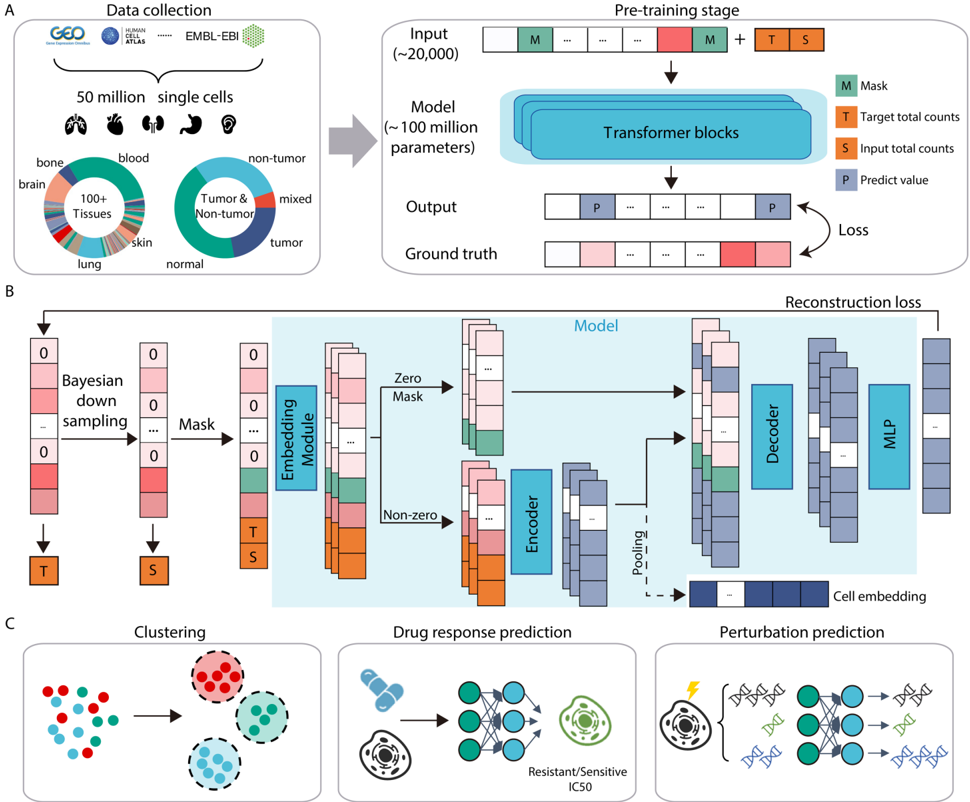
Large pretrained models have become foundation models leading to breakthroughs in natural language processing and related fields. Developing foundation models for deciphering the 'languages' of cells and facilitating biomedical research is promising yet challenging. Here we developed a large pretrained model scFoundation, also named 'xTrimoscFoundation α ', with 100 million parameters covering about 20,000 genes, pretrained on over 50 million human single-cell transcriptomic profiles. scFoundation is a large-scale model in terms of the size of trainable parameters, dimensionality of genes and volume of training data. Its asymmetric transformer-like architecture and pretraining task design empower effectively capturing complex context relations among genes in a variety of cell types and states. Experiments showed its merit as a foundation model that achieved state-of-the-art performances in a diverse array of single-cell analysis tasks such as gene expression enhancement, tissue drug response prediction, single-cell drug response classification, single-cell perturbation prediction, cell type annotation and gene module inference.
Overview
CoChat Summary
TL;DR
scFoundation is a 100M-parameter foundation model pretrained on over 50 million human single-cell transcriptomics profiles covering 19,264 genes. It achieves improved or state-of-the-art performance across gene expression enhancement, cancer drug response prediction, single-cell drug response classification, and perturbation prediction without fine-tuning the pretrained model.
Key findings
- Pretrained on >50 million human scRNA-seq profiles and 19,264 genes with 100M parameters, scFoundation is described as the largest model in parameter size, gene coverage, and data scale in the single-cell field.
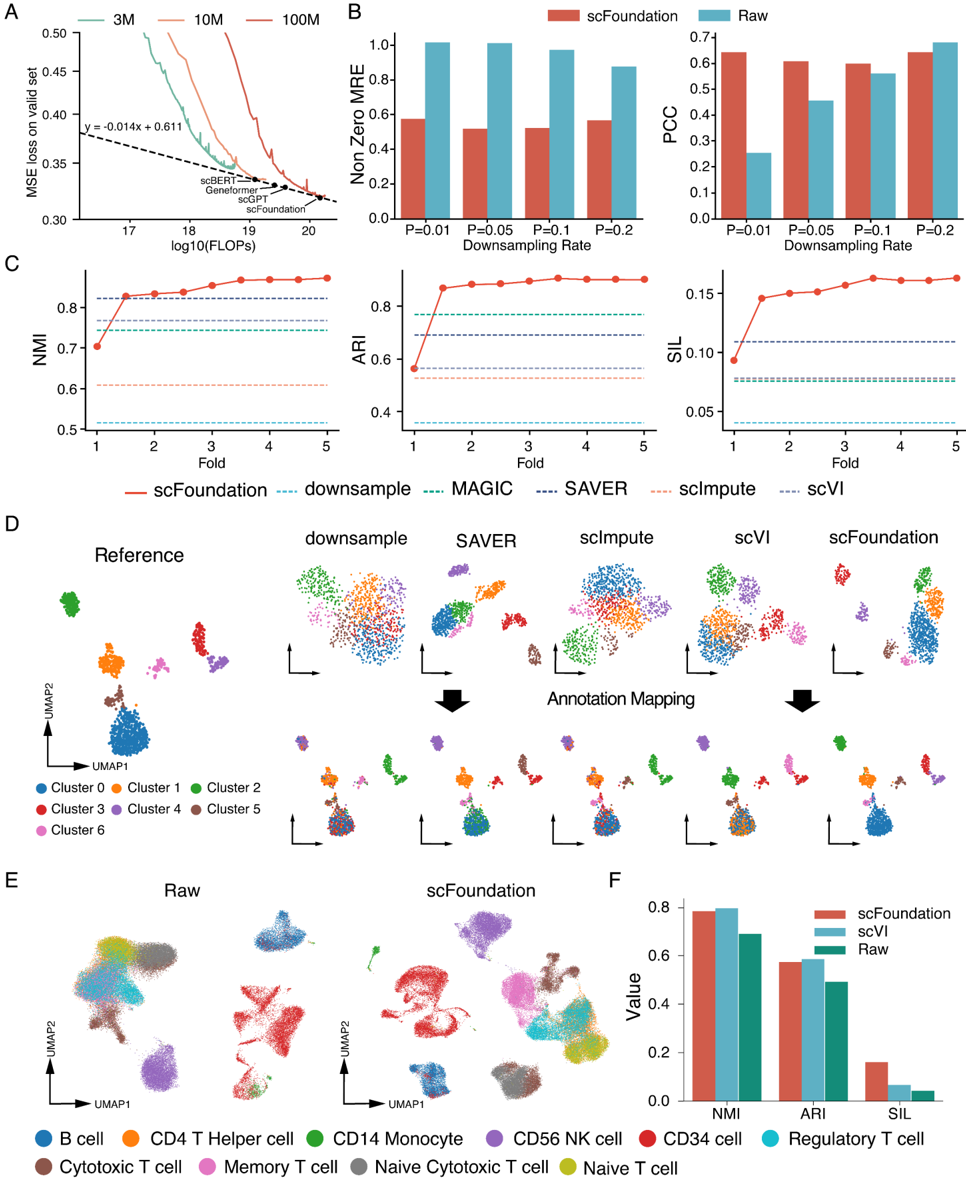
- For read-depth enhancement without fine-tuning, scFoundation reduced MAE and MRE by half versus the non-enhanced baseline; when downsampling was below 10%, baseline MRE was 97.5% while scFoundation maintained an MRE of 60%. On the Zheng68K PBMC dataset (~600,000 cells), scFoundation embeddings had comparable NMI and ARI to scVI and a higher SIL score.
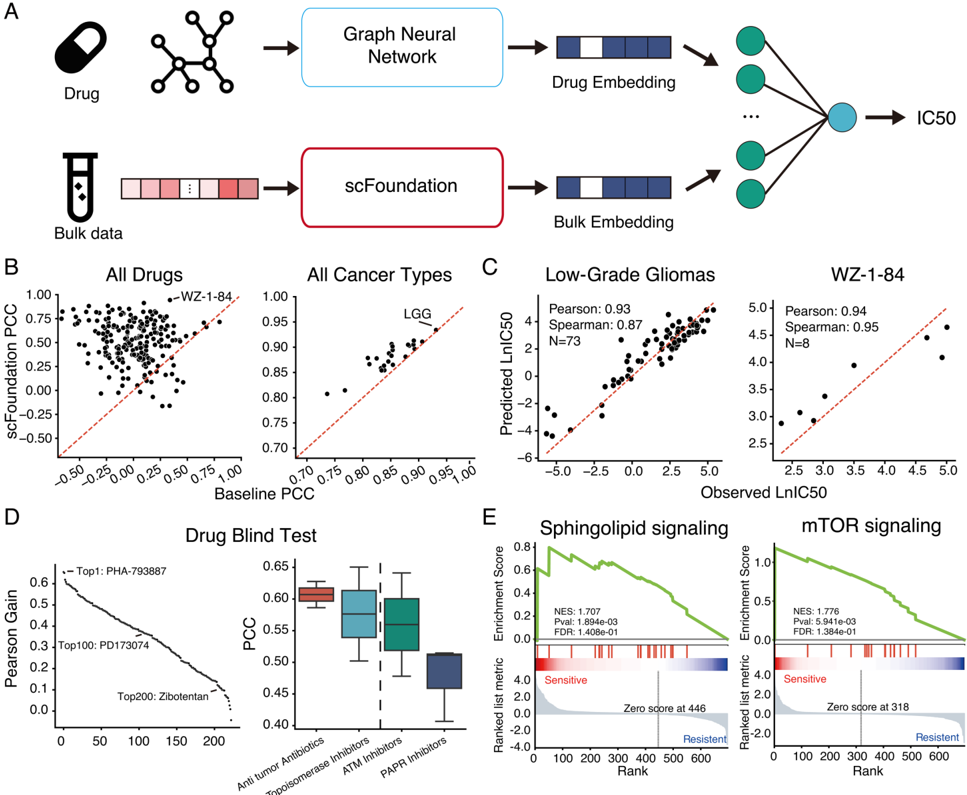
- In cancer drug response prediction with DeepCDR, scFoundation embeddings improved PCC for most drugs and all cancer types; in leave-one-drug-out blind tests, PHA-793887 improved from PCC 0.07 to 0.73 and Zobotentan from 0.49 to 0.64, with the best case achieving PCC above 0.93.
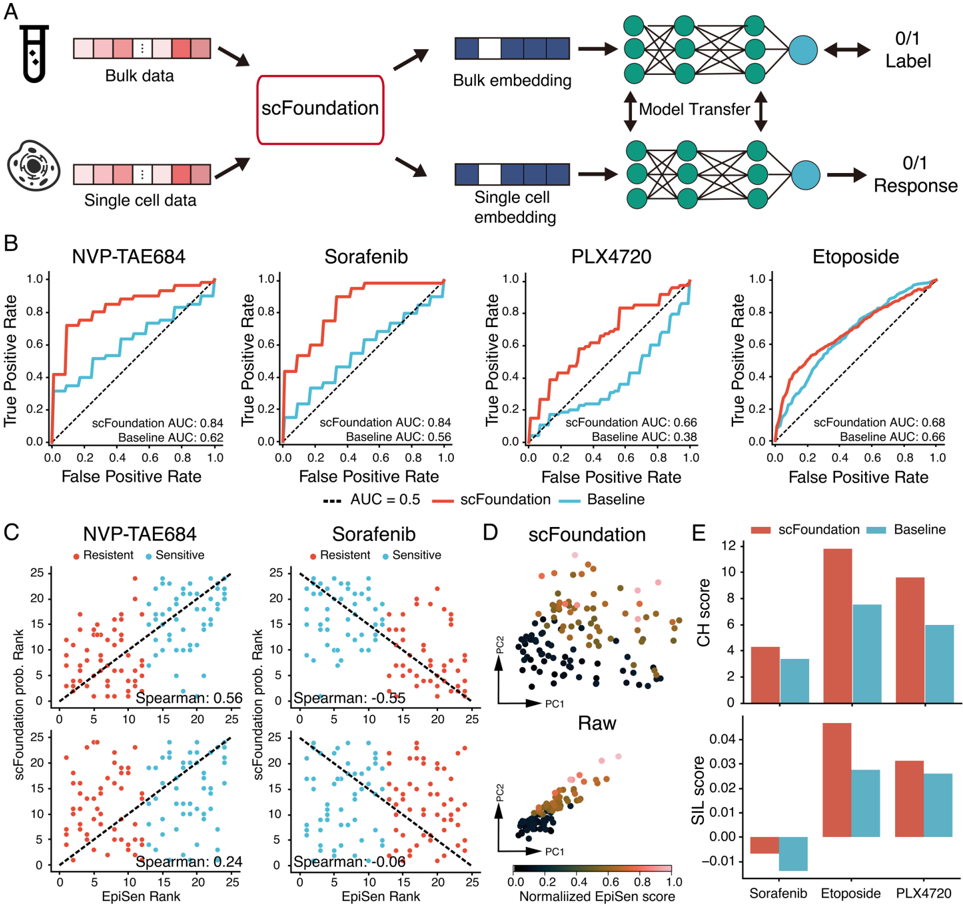
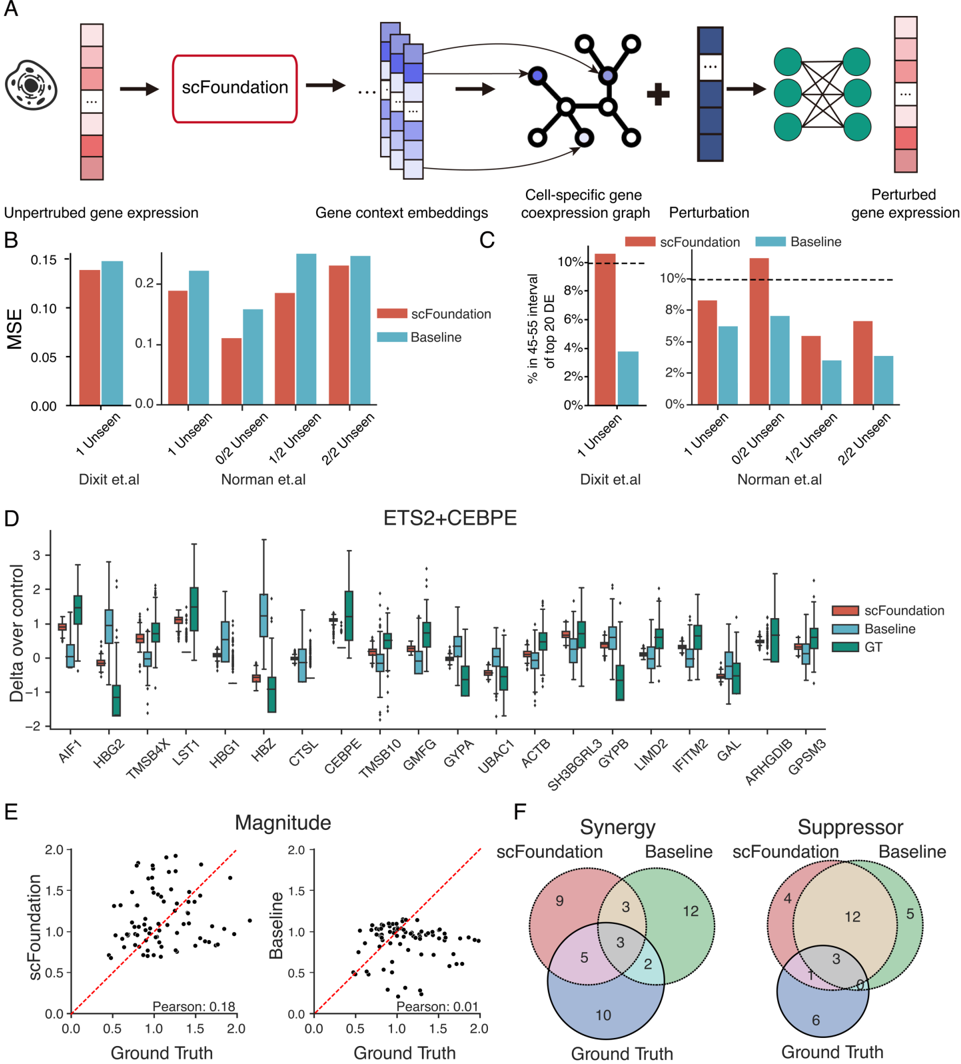
- In single-cell drug response classification, scFoundation embeddings achieved higher AUROC for all four tested drugs; for NVP-TAE684 and Sorafenib, AUROC improved by above 0.2, and Spearman correlations with EpiSen scores were 0.56 and −0.55 versus baseline 0.24 and −0.06. In perturbation prediction, scFoundation-combined GEARS achieved lower MSE on all 1-gene perturbation datasets and the lowest MSE in the 0/2 unseen 2-gene case.
Methods
- Model architecture: xTrimoGene, an asymmetric encoder-decoder transformer with an embedding module that converts continuous gene expression scalars into learnable embeddings; the encoder processes only non-zero and non-masked expressed genes, while the decoder integrates all genes.
- Pretraining data and task: over 50 million human scRNA-seq profiles collected from GEO, Single Cell Portal, HCA, EMBL-EBI, and other resources, aligned to 19,264 genes and filtered for cells with >200 expressed genes; read-depth-aware modeling used hierarchical Bayesian downsampling, 30% masking, and MSE regression loss with total count indicators T and S.
- Downstream evaluation: pretrained cell or gene embeddings were fed into DeepCDR, SCAD, and GEARS without fine-tuning the pretrained model; metrics included MAE, MRE, PCC, NMI, ARI, SIL, AUROC, MSE, and Spearman correlation.
Limitations
- The paper does not include an explicit limitations section.
- Evident from the text: pretraining used only human scRNA-seq data, so generalization to other species or multi-omics settings is not demonstrated.
- Evident from the text: downstream performance depends on existing task-specific models (DeepCDR, SCAD, GEARS) and public datasets, and the paper does not quantify residual batch effects or technical noise beyond describing read-depth-aware pretraining as a mitigation.
Model-written summary. Check it against the paper before relying on it.
Integrity signals
Registry
Cites
Statistics
Figures
Verification
Claims the paper makes
2 Valid · 6 Not valid · 3 Not checked · 74 Own results and interpretations
The cited sources that could be checked couldn’t confirm or dispute this claim.
In the paper
“We developed a new pre-training task called the read-depth-aware (RDA) modeling, which was an extension of masked language modeling 16 , considering single-cell gene expression data had a high variance in read depth, especially in the large-scale pre-training data.”
§ Large Scale Foundation Model on Single-cell Transcriptomics > The scFoundation pre-training framework
What the sources say
- Could not verifycites [16] Choromanski, K. et al. Rethinking Attention with Performers. Preprint at https://doi.org/10.48550/arXiv.2009.14794 (2022). sourceExperimental — accuracy not yet measured
The Experiments section (p. 6) mentions masked language modelling as a task used to evaluate Performers, but does not describe read-depth-aware modelling or an extension of that task. Searches for RDA, read depth, and single-cell gene expression found no passage addressing the attributed claim. (LLM, conf=0.75)
plain- Asserted: passes — The authors put it forward as true.
- Checkable: passes — It can be checked against evidence.
- Load-bearing: passes — The paper’s conclusions depend on it.
- Based: passes — The paper gives a reason why it holds.
- Could not verify
None of the sources cited for this claim have been checked yet.
In the paper
“Existing work had to restrict their models to a small list of selected genes.”
§ Large Scale Foundation Model on Single-cell Transcriptomics > Introduction
What the sources say
- Could not verifycites [8] Papatheodorou, I. et al. Expression Atlas update: from tissues to single cells. Nucleic Acids Research 48, D77-D83 (2020). sourceExperimental — accuracy not yet measured
The Introduction describes Single Cell Expression Atlas as a source of expression matrices for downstream computational methods, and the Data analysis section describes its quantification pipeline. Neither addresses whether earlier pre-training models had to use a small, selected gene list. Searches for pre-training, model limitations, and gene selection found no passage supporting that claim. (LLM, conf=0.76)
- Not checked yetcites [9] Svensson, V., Vento-Tormo, R. & Teichmann, S. A. Exponential scaling of single-cell RNA-seq in the past decade. Nature Protocols 13, 599-604 (2018). source
Checked before — its earlier verdict is held back until a new check runs.
- Could not verifycites [10] Brown, T. B. et al. Language Models are Few-Shot Learners. Preprint at https://doi.org/10.48550/arXiv.2005.14165 (2020). sourceExperimental — accuracy not yet measured
The Introduction (p. 3) discusses pre-trained language models and task-specific datasets, not single-cell gene expression. Searches for single-cell gene expression, selected genes, and restrictions to a small gene list found no passage addressing the claim. (LLM, conf=0.78)
- Could not verifycites [11] Zhao, W. X. et al. A Survey of Large Language Models. Preprint at https://doi.org/10.48550/arXiv.2303.18223 (2023). sourceExperimental — accuracy not yet measured
The Pre-training section (p. 4) discusses language-model training corpora, not single-cell gene-expression data. Searches for “single-cell gene expression selected genes” and “gene expression genes” found no passage addressing whether earlier models were restricted to a small list of genes. (LLM, conf=0.76)
plainstates a cause- Asserted: passes — The authors put it forward as true.
- Checkable: passes — It can be checked against evidence.
- Load-bearing: passes — The paper’s conclusions depend on it.
- Based: passes — The paper gives a reason why it holds.
- Could not verify
The cited sources support only part of this claim — read each source’s verdict below.
In the paper
“We constructed a comprehensive single-cell gene expression data set by collecting data from all publicly available single-cell resources, including GEO 17 , Single Cell Portal, HCA 4 , EMBL-EBI 18 , etc.”
§ Large Scale Foundation Model on Single-cell Transcriptomics > The scFoundation pre-training framework
What the sources say
- Could not verifycites [17] Ma, X. et al. Luna: Linear Unified Nested Attention. Preprint at http://arxiv.org/abs/2106.01540 (2021). sourceExperimental — accuracy not yet measured
Our copy of Luna (arXiv 2106.01540) is entirely about linear nested attention for sequence modelling; every data passage concerns NLP/vision benchmarks — the Abstract's three benchmarks, §4.1's Long Range Arena tasks (ListOps, Text, Retrieval, Image, Pathfinder), WMT'14 English-German (4.5M sentence pairs, Additional information), GLUE/QA (Table 6), and MLM pre-training on BookCorpus/Wikipedia/CC-News/OpenWebText/Stories. Nothing in it addresses single-cell gene expression, GEO, Single Cell Portal, HCA or EMBL-EBI (searched: 'single-cell gene expression dataset collection from public resources', 'scRNA-seq single cell RNA sequencing gene expression GEO Human Cell Atlas EMBL-EBI'). The cited sentence therefore cannot be checked against this source; our copy neither supports nor contradicts it. (LLM, conf=0.72)
- Partly supportedcites [4] Chen, S. et al. hECA: The cell-centric assembly of a cell atlas. iScience 25, 104318 (2022). sourceExperimental — accuracy not yet measured
The hECA 'Dataset collection' section (STAR Methods > Method details) does state the same ambition as the claim — 'collecting all accessible human single-cell data into a unified atlas' — and the Abstract/Introduction confirm it assembled a single-cell gene expression resource (1,093,299 cells, 116 published datasets, 38 organs) from scattered public data. But the realized scope is narrower than 'all publicly available single-cell resources': they selected 20–21 peer-reviewed studies, transcriptomic data of healthy donors only, and the Discussion concedes 'the number of cells in hECA v1.0 is still small and the coverage of organs and cell types is very limited'. Our copy also never lists Single Cell Portal, HCA, or EMBL-EBI as the repositories collected from (only GEO accessions and an NCBI BioProject appear, in the COVID-19 validation experiments), so that enumeration is not supported by this source. (LLM, conf=0.72)
- Partly supportedcites [18] Gong, J. et al. xTrimoGene: An Efficient and Scalable Representation Learner for Single-Cell RNA-Seq Data. 2023.03.24.534055 Preprint at https://doi.org/10.1101/2023.03.24.534055 (2023). sourceExperimental — accuracy not yet measured
Our copy confirms the large curated pre-training data set: the Additional information section states 'we curated about 5 million scRNA-seq data for training' processed with a unified pipeline. However, it attributes collection to a single repository, not 'all publicly available single-cell resources': 'Recently, scRNA-seq data ... mostly has been uploaded to the Gene Expression Omnibus (GEO) repository ... We collected data from GEO' and 'all the scRNA-seq data are collected from the Gene Expression Omnibus (GEO) repository with a keyword searching and data retrieval process.' Searches for HCA / Human Cell Atlas, EMBL-EBI and Single Cell Portal returned no data-source passage in our copy, so the multi-resource scope the citing sentence claims is not supported by this paper. (LLM, conf=0.82)
plain- Asserted: passes — The authors put it forward as true.
- Checkable: passes — It can be checked against evidence.
- Load-bearing: passes — The paper’s conclusions depend on it.
- Based: passes — The paper gives a reason why it holds.
- Could not verify
A result the paper reports from its own data — it cites no other source for it, so there is none to check. The quote shows it is in the paper.
In the paper
“From a cell ontology perspective, the data encompassed almost all known human cell types and cell states.”
§ Large Scale Foundation Model on Single-cell Transcriptomics > The scFoundation pre-training framework
plain- Asserted: passes — The authors put it forward as true.
- Checkable: passes — It can be checked against evidence.
- Load-bearing: passes — The paper’s conclusions depend on it.
- Based: passes — The paper gives a reason why it holds.
A result the paper states — it cites no source for it, so there is none to check. The quote shows it is in the paper.
In the paper
“We observed that, based on scFoundation-predicted results, drugs belonging to chemotherapy, such as anti-tumor antibiotics and topoisomerase inhibitors, had a higher PCC than drugs belonging to targeted therapy, such as ATM and PARP inhibitors (Fig. 3C right).”
§ Large Scale Foundation Model on Single-cell Transcriptomics > scFoundation improves cancer drug response prediction
plainstates an association- Asserted: passes — The authors put it forward as true.
- Checkable: passes — It can be checked against evidence.
- Load-bearing: unclear — It is unclear whether the paper’s conclusions depend on it.
- Based: passes — The paper gives a reason why it holds.
37 more claims
Create a free account to see all 85 claims and to verify the 5 references still open.
- Probably not a substantial claim. 13
- It may state two separate claims as one. 36
- The quote only partly states this claim. 2
Claims other papers make about this one
Each is checked against this paper’s own text: does it say what the citing paper says it does?
The source backs part of the claim, not all of it — or backs it for a different population, condition or comparison.
In the citing paper
“Compared to tasks such as cell annotation and batch correction, perturbation prediction offers experimentally generated model input/output with well-defined objectives, making it a more robust benchmark for assessing foundation models (15, 20, 21).”
From A systematic comparison of single-cell perturbation response prediction models (2026) · cites this paper as [21]
Experimental — accuracy not yet measuredThe source backs part of the claim, not all of it — or backs it for a different population, condition or comparison.
In the citing paper
“These models are pre-trained on vast amounts (> 10 M examples) of unlabelled scRNA-seq data, with the aim that such large datasets allow the models to capture general principles of gene regulation and signalling.”
From Benchmarking foundation cell models for post-perturbation RNA-seq prediction (2025) · cites this paper as [7]
Experimental — accuracy not yet measuredIn the citing paper
“scFoundation [15] strengthens the modular design, aiming to combine different modules to adapt to a variety of single-cell tasks, and is very flexible and scalable.”
From Challenges in AI-driven Biomedical Multimodal Data Fusion and Analysis (2025) · cites this paper as [15]
Self-check
Percentages, sums and reported differences re-computed from the paper’s own numbers.
Each contradiction between two passages listed here was confirmed by an independent check.
Rated minor: it would not touch a result — a value no result rests on, a p-value that stays on the same side of the significance level, or a conflict that is clerical, resolved elsewhere in the paper, or outside its own findings.
In the paper
§ Large Scale Foundation Model on Single-cell Transcriptomics > scFoundation predicts more accurate perturbation responses
“the Adamson dataset 49 with 87 1-gene perturbations”
§ Large Scale Foundation Model on Single-cell Transcriptomics > References
“49. Rood, J. E., Maartens, A., Hupalowska, A., Teichmann, S. A. & Regev, A. Impact of the Human Cell Atlas on medicine. Nat Med 28, 2486-2496 (2022).”
Rated minor: it would not touch a result — a value no result rests on, a p-value that stays on the same side of the significance level, or a conflict that is clerical, resolved elsewhere in the paper, or outside its own findings.
In the paper
§ Large Scale Foundation Model on Single-cell Transcriptomics > scFoundation predicts more accurate perturbation responses
“We combined the scFoundation with an advanced model GEARS 51 for the perturbation prediction task.”
§ Large Scale Foundation Model on Single-cell Transcriptomics > References
“51. Dixit, A. et al. Perturb-Seq: Dissecting Molecular Circuits with Scalable Single-Cell RNA Profiling of Pooled Genetic Screens. Cell 167, 1853-1866.e17 (2016).”
Rated minor: it would not touch a result — a value no result rests on, a p-value that stays on the same side of the significance level, or a conflict that is clerical, resolved elsewhere in the paper, or outside its own findings.
In the paper
§ Large Scale Foundation Model on Single-cell Transcriptomics > scFoundation transfers bulk-level drug sensitivity prediction model to single-cell data
“based on the SCAD 44 downstream model.”
§ Large Scale Foundation Model on Single-cell Transcriptomics > References
“44. Jerby-Arnon, L. et al. A Cancer Cell Program Promotes T Cell Exclusion and Resistance to Checkpoint Blockade. Cell 175, 984-997.e24 (2018).”
Citations
Cites
BERT: Pre-training of Deep Bidirectional Transformers for Language Understanding
Devlin, J., Chang, M.-W., Lee, K., & Toutanova, K. (2018) · arXiv · doi:10.48550/arxiv.1810.04805 · Cited by 73,173
Scikit-learn: Machine Learning in Python
Pedregosa, F., Varoquaux, G., Gramfort, A., Michel, V., Thirion, B., Grisel, O., Blondel, M., Müller, A., Nothman, J., Louppe, G., et al. (2012) · arXiv · doi:10.48550/arxiv.1201.0490 · Cited by 71,016
Subramanian, A., Tamayo, P., Mootha, V. K., Mukherjee, S., Ebert, B. L., Gillette, M. A., Paulovich, A., Pomeroy, S. L., Golub, T. R., Lander, E. S., et al. (2005) · Proceedings of the National Academy of Sciences · doi:10.1073/pnas.0506580102 · Cited by 53,625
KEGG: Kyoto Encyclopedia of Genes and Genomes
Kanehisa, M. (2000) · Nucleic Acids Research · doi:10.1093/nar/28.1.27 · Cited by 37,077
KEGG: Kyoto Encyclopedia of Genes and Genomes
Ogata, H., Goto, S., Sato, K., Fujibuchi, W., Bono, H., & Kanehisa, M. (1999) · Nucleic Acids Research · doi:10.1093/nar/27.1.29 · Cited by 31,232 · cited 1×
“According to the Kyoto Encyclopedia of Genes and Genome database 41 , this pathway was related to sphingomyelin and its metabolism.”
Language Models are Few-Shot Learners
Brown, T. B., Mann, B., Ryder, N., Subbiah, M., Kaplan, J., Dhariwal, P., Neelakantan, A., Shyam, P., Sastry, G., Askell, A., et al. (2020) · arXiv · doi:10.48550/arxiv.2005.14165 · Cited by 23,372 · cited 5×
“Please refer to Supplementary Notes 9 and 10 for details of the sampling strategy and count indicators calculation.”
InfluentialIntegrated analysis of multimodal single-cell data
Hao, Y., Hao, S., Andersen-Nissen, E., Mauck, W. M., Zheng, S., Butler, A., Lee, M. J., Wilk, A. J., Darby, C., Zagar, M., et al. (2020) · doi:10.1101/2020.10.12.335331 · Cited by 15,508
Kaugeranna, R., Kaugeranna, E., & Aion, (. S. 4. 6. (2023) · DROPS (Schloss Dagstuhl – Leibniz Center for Informatics) · doi:10.4230/lipics.giscience.2023.43 · Cited by 13,690
Gene Expression Omnibus: NCBI gene expression and hybridization array data repository
Edgar, R. (2002) · Nucleic Acids Research · doi:10.1093/nar/30.1.207 · Cited by 13,288 · cited 3×
“…a comprehensive single-cell dataset by collecting data from all publicly available single-cell resources, including Gene Expression Omnibus (GEO) 22 , Single Cell Portal, HCA 3 , human Ensemble Cell Atlas (hECA) 4 , Deeply Integrated human Single-Cell Omics data (DISCO) 7 , European Molecular…”
Scaling Laws for Neural Language Models
Kaplan, J., McCandlish, S., Henighan, T., Brown, T. B., Chess, B., Child, R., Gray, S., Radford, A., Wu, J., & Amodei, D. (2020) · arXiv · doi:10.48550/arxiv.2001.08361 · Cited by 9,550 · cited 1×
“This is a large-scale model of large parameter size, gene coverage and data scale in the single-cell field.”
Research works printed but not linked: 1
- He, K. et al. in Proc. IEEE/CVF Conference on Computer Vision and Pattern Recognition 16000–16009 (IEEE, 2022).
Cited by
Items 501–600 of 638
Spatio-temporal mapping of immune cell dynamics during human sequential lymph node metastasisPreprint
Zhao, Q., Lu, Y., Shi, Z., Zhang, H., Li, C. S., Zhao, R., Ling, Y., Gao, Y., Zhang, Z., Sun, X., et al. (2026) · bioRxiv (Cold Spring Harbor Laboratory) · doi:10.64898/2026.03.17.712495
Abassi, N., Schwarz, L., Filippi, E., & Marini, F. (2026) · Bioinformatics · doi:10.1093/bioinformatics/btag157 · Cited by 1
“Looking ahead, such contextual metadata could also be leveraged by large language models (LLMs) to enhance machine-assisted interpretation (Hao et al. 2024), opening opportunities for integrating DeeDeeExperiment objects with emerging AI-driven tools.”
GRIP-Lung: Generative Model of Response to Drug-Induced Perturbation in Lung Cancer
Fu, Z., Li, Y., Du, Z., Zhang, D. X., Liu, L., Jin, Q., Chen, X., & Xie, H. (2026) · International Journal of Molecular Sciences · doi:10.3390/ijms27073264
“The decoder of scFoundation generated gene-level contextual embeddings and demonstrated strong performance across various tasks, including read-depth enhancement, drug response and sensitivity prediction at the single-cell level, perturbation modeling, and cell type annotation [8].”
Li, F., Zhang, Z., Diao, Y., Wang, S., Guo, R., Zhang, Y., Chen, L., Jiang, L., Wang, Z., Bao, C., et al. (2026) · Science China Life Sciences · doi:10.1007/s11427-025-3212-1
“…artificial intelligence-driven approaches (Adeli, 2025), particularly emerging language models such as the BioMap foundational model ‘ xTrimo ’ (Hao et al., 2024) — a general-purpose multimodal large language model capable of processing five core biological modalities (protein, gene,…”
Multiscale transcriptomic organization of the human brain with DigitalBrainPreprint
An, J., Hu, X., Jiang, Y., Jiang, M., Qiu, S., Liu, G., Wei, X., Wang, Y., Lin, J. Q., Wang, C., et al. (2026) · bioRxiv (Cold Spring Harbor Laboratory) · doi:10.64898/2026.04.14.718492
Perspective on Bias in Biomedical AI: Preventing Downstream Healthcare Disparities
Rosen‐Zvi, M., Kan‐Tor, Y., Danziger, M. M., Ferretti, A., Aula-Blasco, J., Falcão, J., Shamir, R., Marcus-Kalish, M., & Muszkat, M. (2026) · IEEE International Conference on Digital Health (ICDH) · doi:10.1109/icdh72779.2026.00018
“For example, in single-cell RNA-seq, read depth, a key technical variable, is explicitly modeled [23].”
Xie, H., Qiao, Z., Zheng, X., & Luo, X. (2026) · IEEE International Conference on Acoustics Speech and Signal Processing · doi:10.1109/icassp55912.2026.11462727 · Cited by 1
Benchmarking single-cell foundation models for real-world RNA-seq data integrationPreprint
Han, S., Sztanka-Toth, T. R., Senel, E., Elnaggar, A., Patel, J., Mansi, T., Smirnov, D. A., Greshock, J., & Javidi, A. (2026) · bioRxiv (Cold Spring Harbor Laboratory) · doi:10.64898/2026.04.17.719314 · Cited by 3
“Despite advances We evaluated the widely used scGPT 8 and scFoundation 9 , as well as three models not assessed in earlier benchmarks: scMulan 10 , CellFM 11 , and scGPT_CP (a continually pretrained scGPT checkpoint released by the original authors) 8 .”
Fusing imaging and metabolic modeling via multimodal deep learning in ovarian cancer
Eftekhari, N., Verma, S., Saha, A., Zampieri, G., Sawan, S., Occhipinti, A., & Angione, C. (2026) · Cell Systems · doi:10.1016/j.cels.2026.101594
李光鹏, You, Y., Fu, Y., Zhou, W., Tang, F., Kong, J., & Tian, L. (2026) · bioRxiv (Cold Spring Harbor Laboratory) · doi:10.64898/2026.04.20.719773
“Modern single-cell foundation models learn increasingly expressive continuous representations from large transcriptomic corpora [5, 6, 7, 8].”
Chen, J., Lin, L., Wang, Y., Lin, Y., Li, Y., Zhang, W., Fu, Y., Xie, J., Zhu, J., Sun, C., et al. (2026) · bioRxiv (Cold Spring Harbor Laboratory) · doi:10.64898/2026.04.22.719826
Computational Approaches to Cancer Cell Dormancy: From Detection to Dynamic Modelling
Spink, L. G. N., Shi, P., Kim, M., Yener, B., Banfalvi, B., & Secrier, M. (2026) · Biomolecules · doi:10.3390/biom16050633
“…that is based on a generative pretrained transformer on approximately 33 million scRNA transcriptomes [102]; scFoundation, a foundation model pre-trained on 50 million human scRNA-seq profiles [103]; or scBERT, a pre-trained deep neural network-based model focused on cell type annotation [104].”
Xiao, Y., Sun, J., Hao, Y., Xie, L., Duo, H., Zou, Y., Li, Y., Qin, D., Yang, Q., & Li, B. (2026) · TrAC Trends in Analytical Chemistry · doi:10.1016/j.trac.2026.118880
Dhaka, B., Gao, J., & Ideker, T. (2026) · bioRxiv (Cold Spring Harbor Laboratory) · doi:10.64898/2026.04.23.720505 · Cited by 2
“A complementary approach is single-cell foundation modelling, in which training is performed on millions of cells across diverse tissues and perturbation conditions 15,16 .”
scFNSA: A Factorized Node-Set Attentive Framework for Single-Cell Multi-Omics Integration
Jiang, S., Shang, J., Qiu, D., Wang, H., & Liu, J. (2026) · Journal of Chemical Information and Modeling · doi:10.1021/acs.jcim.6c00448
Zhao, Y., Pan, X., Luo, Z., & Liu, Q. (2026) · BMC Biology · doi:10.1186/s12915-026-02613-8 · Cited by 2
“Notably, transcriptomics-oriented PFMs such as Geneformer [22] and scFoundation [23], pretrained on millions of single-cell transcriptomes, generate transferable representations that substantially advance single-cell transcriptomic analysis and broaden its applications to disease modeling.”
Li, L., Dong, L., Yu, B., Li, D., Liu, H., Zhu, Y., Mei, X., Zhang, H., & Xu, D. (2026) · IEEE Transactions on Computational Biology and Bioinformatics · doi:10.1109/tcbbio.2026.3689143 · Cited by 1
“Single-cell Large Language Models (scLLMs) such as scGPT [45], sc-Foundation [46], and Geneformer [47] are pretrained on single-cell transcriptomes to capture fine-grained cellular signatures, while reasoning engines like DeepSeek [48], ChatGPT [49], and Qwen [50] demonstrate broad capabilities in…”
DoFormer: Causal Transformer for Gene PerturbationPreprint
Karbalayghareh, A., Paull, E., & Califano, A. (2026) · bioRxiv (Cold Spring Harbor Laboratory) · doi:10.64898/2026.05.02.722054
A Multi-modal LLM-Knowledge Fusion Framework for Predicting Single-cell Genetic Perturbation EffectsPreprint
Lu, M., You, N., Zhang, H., Zheng, L., Li, B., Jiang, W., Zhang, Y., Sun, H., & Zhou, Y. (2026) · bioRxiv (Cold Spring Harbor Laboratory) · doi:10.64898/2026.04.24.720560 · Cited by 1
“Foundation model-based methods leverage large-scale pre-trained models on single-cell transcriptomic data, including transformer-based architectures such as scGPT 19 , scFoundation 20 , and GeneCompass 21 .”
Guidance for high-quality functional gene embeddings from large language modelsPreprint
Huang, R., Hou, Y., Zhao, W., Zhang, J., Lu, J., Kong, Y., & Xu, P. (2026) · bioRxiv (Cold Spring Harbor Laboratory) · doi:10.64898/2026.04.30.721875 · Cited by 2
Li, J., Lv, H., Jiang, F., & Yu, B. (2026) · Computational Biology and Chemistry · doi:10.1016/j.compbiolchem.2026.109112 · Cited by 1
Strategies for constructing context-specific protein–protein interaction networks
Nie, S., Kong, X., & Li, D. (2026) · Briefings in Bioinformatics · doi:10.1093/bib/bbag004
MCASynergy: An Integrative Framework for Drug Synergy Prediction
Zhao, H., Huang, Z., Chen, C., Wu, W., Wang, R. L., & Ou-Yang, L. (2025) · International Conference on Biomedical and Bioinformatics Engineering (ICBBE) · doi:10.1145/3794209.3794234
OmniGene-4: A Unified Bio-Language MoE Model with Router-Level InterpretabilityPreprint
Wang, L. (2026) · bioRxiv (Cold Spring Harbor Laboratory) · doi:10.64898/2026.05.12.724542 · Cited by 2
“Single-cell transcriptomics has seen a parallel rise in foundation models such as scGPT [8], scFoundation [22], and Geneformer [56].”
Anderson, A., Chang, R. S., Howard, M., Chen, Z. Z., Nhu, D., Ge, Z., & Kwan, P. (2026) · CNS Drugs · doi:10.1007/s40263-026-01295-8 · Cited by 1
“The scFoundation model was pretrained on over 50 million single-cell RNA sequencing data to model 19,264 genes with ~100 million parameters [71].”
InfluentialUnified representation learning for spatial multi-omics
Li, H., Wan, S., Zhang, H., Wang, Z., & Zeng, Y. (2026) · Bioinformatics · doi:10.1093/bioinformatics/btag629
“Additionally, leveraging single-cell foundation models [e. g. scFoundation (Hao et al. 2024), CellFM (Zeng et al. 2025)] and implementing mechanisms to automatically weight modality contributions or down-weight low-quality data would further re-fine its integrative capabilities and impact.”
Ye, Z., Yang, N., Yang, X., Mao, X., & Tang, C. (2026) · bioRxiv (Cold Spring Harbor Laboratory) · doi:10.64898/2026.05.17.725083
“We used the whole-human scGPT checkpoint pretrained on 33 million normal human cells. scFoundation. scFoundation [23] uses the asymmetric encoder–decoder architecture xTrimoGene to model 19,264 protein-coding genes.”
Decoding heterogeneous aging clocks and disease risk stratification using MetAgeFormerPreprint
Xu, Y., bohao, Z. O. U., Xie, G., Chen, T., Jia, W., Zhang, L., & (ADNI), T. A. D. N. I. (2026) · bioRxiv (Cold Spring Harbor Laboratory) · doi:10.64898/2026.05.18.725977
Deciphering interaction syntax via decoupling intrinsic lineages and niche pressurePreprint
Guo, Q., Zhong, W., Zeng, Z. Q., Nie, Q. H., Zhou, P., & Zhang, L. (2026) · bioRxiv (Cold Spring Harbor Laboratory) · doi:10.64898/2026.05.18.725889
Zhang, J., Schwartz, M. A., Mutaher, M., Olajide, O., Pritykin, Y., Ashenberg, O., Hacohen, N., & Uhler, C. (2026) · bioRxiv (Cold Spring Harbor Laboratory) · doi:10.64898/2026.05.21.726863 · Cited by 1
Computational modelling of cell identity
Shim, W. J., Chow, C. S. Y., Bao, S. C., Zhao, Q., & Palpant, N. J. (2026) · Biochemical Journal · doi:10.1042/bcj20250132
The development and application of deep learning for stem cell research
Li, Z., Zhang, W., Wu, Y., Ye, Y., Chen, Y., Wu, J., & Chen, D. (2026) · Journal of genetics and genomics/Journal of Genetics and Genomics · doi:10.1016/j.jgg.2026.05.008
Niu, Y., Chen, Y., & Ma, W. (2026) · Briefings in Bioinformatics · doi:10.1093/bib/bbag259 · Cited by 1
“More recently, foundation models including scGPT [ 31], scFoundation [ 32], and Geneformer [ 33] have leveraged transformer architectures and large-scale pretraining to learn generalizable representations from millions of single-cell profiles.”
Computational blueprints for cell fate programming
Yang, P. (2026) · Stem Cell Reports · doi:10.1016/j.stemcr.2026.102929
FlowTransOP: Distributional Translation of Omics Signatures via Constrained Deep Flow MatchingPreprint
Meimetis, N., Hoang, T. N., Magliacane, S., & Lauffenburger, D. A. (2026) · bioRxiv (Cold Spring Harbor Laboratory) · doi:10.64898/2026.05.27.728305
Wang, Z., Zhang, X., Tang, K., wu, L., Huang, Y. N., Zhang, N., Wang, B., Wang, X. X., Ruan, Y., & Lin, Q. (2026) · Biosensors · doi:10.3390/bios16060316 · Cited by 1
“Large-scale models trained on gene expression data handle biomedical tasks and adapt to diverse sources [197].”
Self-citationscHILL: deciphering individual-level immune cell heterogeneity with single-cell RNA sequencing data
Wang, Y., Li, H., Li, L., Cao, Y., Duan, Z., & Song, S. (2026) · Briefings in Bioinformatics · doi:10.1093/bib/bbag286
“…from the growth in data volume and inspired by the excellent performance of large language models (LLMs) in natural language understanding [ 4– 7], researchers have developed LLM-based single-cell foundation models, such as scGPT [ 8], Geneformer [ 9], scFoundation [ 10], and GeneCompass [ 11].”
Fang, J., Liu, H., Lei, J., Chen, Y., & Wang, J. (2026) · Cancer Immunology Immunotherapy · doi:10.1007/s00262-026-04449-1
Fu, Z., Fu, J., Zhang, K., Ran, T., & Chen, C. (2026) · Frontiers in Genetics · doi:10.3389/fgene.2026.1838613
“…latent dynamics without spliced/unspliced input) and two state-of-the-art single-cell foundation models, scGPT (Cui et al., 2024) and scFoundation (Hao et al., 2024), across eight trajectory and developmental datasets (GSE116256/cd34, GSE132188/endo, GSE120446, GSE283205, GSE130148, GSE247719,…”
Re-evaluating the benefit of training scale in cell foundation modelsPreprint
Shakeel, M. H., Shen, M., & Mangiola, S. (2026) · bioRxiv (Cold Spring Harbor Laboratory) · doi:10.64898/2026.06.04.730272
Cell-Cell-Seq resolves contact-associated NK cell activation in defined tumor cell dyadsPreprint
Liang, J., Shao, D., Carlo, D. D., & de Rutte, J. M. (2026) · bioRxiv (Cold Spring Harbor Laboratory) · doi:10.64898/2026.06.04.730259
“Geneformer, scGPT, and scFoundation were evaluated using in-experiment singlets as a matched reference, followed by reconstruction analysis of 0-hour and activated Nanovial dyads (Figure 4E) 39,40,41 .”
Zhu, Q. (2026) · BIO Web of Conferences · doi:10.1051/bioconf/202623702016 · Cited by 1
蒋丹凝, An, Z., Zhao, Y., & Lai, L. (2026) · bioRxiv (Cold Spring Harbor Laboratory) · doi:10.64898/2026.06.08.731000 · Cited by 1
“Similarly, scFoundation [18] scaled to 100 million parameters to model large-scale cell atlases.”
Charting the computational landscape of single-cell genetic perturbation
Zhang, Y., Huang, J., Li, Y., Liu, T., Ren, L., Huang, J. H., Lin, H., Feng, J., & Zhang, Y. (2026) · Journal of Advanced Research · doi:10.1016/j.jare.2026.06.012 · Cited by 1
Zhang, L., Pang, J., Yan, J., Tang, W., Deng, Y., & He, Y. (2026) · bioRxiv (Cold Spring Harbor Laboratory) · doi:10.64898/2026.06.11.731508
“Representative systems include scBERT [8], Geneformer [9], scGPT [10], scFoundation [11], CellFM [12], and Nicheformer [13].”
Fu, Z., Fu, J., Chen, C. F., Zhang, K., Wang, J., Ran, T., & Wang, S. (2026) · Frontiers in Genetics · doi:10.3389/fgene.2026.1822168
“scGPT (Cui et al., 2024) and scFoundation (Hao et al., 2024) are pre-trained on tens of millions of cells and exposed via inference paths that are atlas-scoped rather than per-dataset.”
William, D. C., Yu, L., & Kiyoshi, H. (2026) · Bioorganic & Medicinal Chemistry · doi:10.1016/j.bmc.2026.118732
Elucidating the Design Space of Generative Models for Single-Cell Perturbation PredictionPreprint
Bhattacharya, S., Gensbigler, C., Karim, S., & Lees, J. (2026) · bioRxiv (Cold Spring Harbor Laboratory) · doi:10.64898/2026.06.15.732063 · Cited by 2
Hu, C., Xiao, B., & Chen, C. Y. (2026) · bioRxiv (Cold Spring Harbor Laboratory) · doi:10.64898/2026.06.16.732528
“These models can represent cellular states and predict responses to genetic, chemical or environmental perturbations, but screening therapeutic candidates adds a further requirement: the predicted or matched perturbation has to be judged against a treatment-relevant endpoint [1– 5].”
Chen, W., Ye, M., Xu, T., Huang, D., Zhang, H., Li, H., Li, W., Chen, Y., Province, M. A., Payne, P., et al. (2026) · bioRxiv (Cold Spring Harbor Laboratory) · doi:10.64898/2026.06.16.732397
Lu, Y., Xun, D., Xu, C., Zhu, X., Zhang, Z. D., Chen, P., Yang, X., Yan, Z., Rao, J., Huili, H., et al. (2026) · bioRxiv (Cold Spring Harbor Laboratory) · doi:10.64898/2026.06.23.734130
“Meanwhile, foundation models including scGPT [18], scFoundation [19], and Geneformer [20] leverage large-scale pretraining to adapt to perturbation tasks.”
Qi, R., Teng, W., Yang, X., Han, P., Shaytan, A. К., & Liu, B. (2026) · PLoS Computational Biology · doi:10.1371/journal.pcbi.1014392
“In recent years, deep learning has demonstrated remarkable potential in deciphering scRNA-seq profiles [17–22].”
Learning Perturbation Effects Through Contrastive Alignment of Multimodal Biological EmbeddingsPreprint
Long, W., Liu, T., Szałata, A., Theis, F. J., Xue, L., & Zhao, H. (2026) · bioRxiv (Cold Spring Harbor Laboratory) · doi:10.64898/2026.06.23.734145 · Cited by 1
Do Geometric Outliers Identify Important Genes in Single-Cell Foundation Models?Preprint
Whalley, J. P. (2026) · bioRxiv (Cold Spring Harbor Laboratory) · doi:10.64898/2026.06.22.733850
“4 As such, the models differ in their architecture, expression encoding, vocabulary, pretraining objective and training corpus.”
Transformers for single-cell RNA sequencing: a survey
Hu, T., & Wei, Z. (2026) · Briefings in Bioinformatics · doi:10.1093/bib/bbag332
“In this section, we elaborate the technological details of three influential single-cell foundation models: Geneformer [ 3], scGPT [ 4] and scFoundation [ 5].”
InfluentialOmidi, B., Alam, M. M. H., Farahani, A. F., & Barkadehi, A. R. H. P. (2026) · Research Square · doi:10.21203/rs.3.rs-10177310/v1
Raw-count embeddings improve single-cell foundation modelsPreprint
Schlede, S., Muruganandam, T. P., Kantharaju, S. G., Kisis, I., Boecker, M., Carpinteiro, M. K. A., Schmitz, Ä., Buchwald, L. M., Sakthivelu, V., Balta, G. S. G., et al. (2026) · bioRxiv (Cold Spring Harbor Laboratory) · doi:10.64898/2026.06.29.735389
Causal intervention validation of gene regulatory signals in scGPT
Kendiukhov, I. (2026) · Journal of Biomedical Informatics · doi:10.1016/j.jbi.2026.105080 · Cited by 2
Task-adapted biological foundation models uncover perturbation-centric representationsPreprint
Pareja-Lorente, E., & Aloy, P. (2026) · bioRxiv (Cold Spring Harbor Laboratory) · doi:10.64898/2026.06.30.735584
“In biology, transformer-based foundation models, including Geneformer 31 , scGPT 32 , and scFoundation 33 , have been pre-trained on single-cell RNA-seq data coming from millions of cells to learn representations of cellular states.”
scGenoByte: a GenoByte embedding transformer with biological priors for cell type annotation
Yao, J., Xu, Y., Ma, J., Shen, W., & Wu, S. (2026) · Briefings in Bioinformatics · doi:10.1093/bib/bbag369 · Cited by 1
“Particularly, to learn universal cell embeddings, single-cell foundational models such as scBERT [ 16], scGPT [ 17], and scFoundation [ 18] learn the interaction of genes from massive unlabeled data, achieving excellent performance in the cell annotation task.”
Self-citationwang, H., Yang, X., Wang, S., Yang, Z., Yang, X., Yang, Y., Li, Z., Ren, Y., Zhang, Q., Zhao, B., et al. (2026) · iMeta · doi:10.1002/imt2.70146
DELPHAI predicts heterogeneous perturbation responses with learned single-cell fitnessPreprint
Zhang, X., Wu, H., & Liu, H. (2026) · bioRxiv (Cold Spring Harbor Laboratory) · doi:10.64898/2026.07.01.735965
Self-citationCross-dataset annotation harmonization for cell-type hierarchy construction
Zhou, T., Chen, Y., Zhu, Y., Jia, J., Zhang, X., & Wei, L. (2026) · Bioinformatics · doi:10.1093/bioinformatics/btag506
“Recently, large-scale cellular language models have emerged with the capability to effectively integrate data (Yang et al. 2022, Cui et al. 2024, Hao et al. 2024), offering new opportunities for improved annotation harmonization.”
Self-citationKobayashi, H., Watanuki, S., Shiozawa, Y., Oshima, M., Koide, S., Takayama, N., Morikawa, T., Haraguchi, M., Tamaki, S., Asakura, T., et al. (2026) · Science Advances · doi:10.1126/sciadv.aeb1346 · Cited by 1
Virtual cell construction for artificial intelligence‐driven drug discovery
Jia, Y., Xing, X., Han, H., Zhao, Y., Zhou, S., & Chen, J. (2026) · British Journal of Pharmacology · doi:10.1111/bph.70585 · Cited by 1
Jiang, S., Qi, C., Chen, Y., Song, X., & Wei, Z. (2026) · bioRxiv (Cold Spring Harbor Laboratory) · doi:10.64898/2026.07.06.736807
Huang, J., Liu, Y., Wang, M., & Wang, L. (2026) · Lecture notes in computer science · doi:10.1007/978-981-92-3492-9_41
Li, Y.-C., Wei, M., Wang, X.-F., Wang, Z., Pan, J., Wang, L., Huang, Y., Huang, Z.-A., & You, Z.-H. (2026) · Journal of Chemical Information and Modeling · doi:10.1021/acs.jcim.6c01857
Kendiukhov, I. (2026) · PLoS ONE · doi:10.1371/journal.pone.0344826 · Cited by 5
“But an unsettling question lingers beneath these successes: what do these models actually understand about biology?”
Wang, X., Liu, M., Jia, M., Wang, Q., Li, X., Zou, Q., Huang, X., Zhang, L., Lv, X., Wang, J., et al. (2026) · The Innovation Oncology · doi:10.59717/j.xinn-oncol.2026.100027 · Cited by 1
Sun, B., Zheng, H., Chen, J., & Jin, J. (2026) · Genes · doi:10.3390/genes17070816
“That bar applies to foundation models such as scGPT [17] and scFoundation [18], and to optimal-transport approaches such as CellOT [12].”
Organism-scale annotation with Pan-human AzimuthPreprint
Sarkar, S., Li, Z., Molla, G., Shenoy, A., Zhang, B. Y., Collins, D., Vasilevsky, N., Gaut, J. P., Puig-Barbe, A., Bueckle, A., et al. (2026) · bioRxiv (Cold Spring Harbor Laboratory) · doi:10.64898/2026.07.16.738997 · Cited by 4
Wang, B., Wu, T., Shou, Y., Ma, Y. X., Ren, M., Gago-Ferrero, P., Schlenk, D., & Fang, M. (2026) · Environmental Science & Technology · doi:10.1021/acs.est.5c17092
Wagle, M. M., Wang, Y., Samanta, S., Liu, Z., Patrick, E., Yang, P., & Kellis, M. (2026) · bioRxiv (Cold Spring Harbor Laboratory) · doi:10.64898/2026.07.21.738207 · Cited by 1
Zhao, M., Ma, X., Shi, W., & Sun, Y. (2026) · Life Sciences · doi:10.1016/j.lfs.2026.124600 · Cited by 1
Deep learning as a bridge between sequencing-derived biological data and functional interpretation
Hong, H., Liu, L., Liao, W., Zhao, J., Liu, Y., He, X., Li, J., He, R., Jin, Y., Sha, L., et al. (2026) · Discover Artificial Intelligence · doi:10.1007/s44163-026-01739-6
Qiu, Z., Lei, X., & Zhang, X. (2026) · Current Issues in Molecular Biology · doi:10.3390/cimb48080767
Self-citationAhmed, A. K. K., & almutairi, K. (2026) · SSRN Electronic Journal · doi:10.2139/ssrn.7216082
scMaize: A Single-Cell Foundation Model and Integrated Atlas for MaizePreprint
Qian, C., Ying, Z., Wu, T., Zhao, A., Shang, M., Wang, X., & Yan, J. (2026) · bioRxiv (Cold Spring Harbor Laboratory) · doi:10.64898/2026.08.01.742180 · Cited by 2
A confound-diagnostic toolkit for in silico perturbation with single-cell foundation modelsPreprint
Qiu, R., & Zhao, M. M. (2026) · bioRxiv (Cold Spring Harbor Laboratory) · doi:10.64898/2026.08.04.732812
Papadourakis, M., Amaxopoulou, E. E., & Matsoukas, M. (2026) · Expert Opinion on Drug Discovery · doi:10.1080/17460441.2026.2712551
“…MoA deconvolution in complex host– pathogen systems [178]. scFoundation is a ~ 100-million-parameter model pretrained on over 50 million human single-cell transcriptomes, supporting gene expression enhancement and perturbation-response prediction in heterogeneous tissues and infection models [179].”
Integrated inference of cellular compositions and gene expression programs by deconvolution
Zhang, Z., Wang, X., Hong, F., Yu, P., Suo, S., & Chen, Y. (2026) · Cell Regeneration · doi:10.1186/s13619-026-00299-5
“Recent advances in transcriptomic foundation models, such as scGPT (Cui et al. 2024), scFoundation (Hao et al. 2024), and BulkRNA-BERT (Gélard et al. 2024), provide valuable conceptual and technical guidance for the next generation of deconvolution frameworks.”
AI-based multimodal integration of genomics and electronic health records
Venkatesh, R., & Ritchie, M. D. (2026) · Nature Reviews Genetics · doi:10.1038/s41576-026-00992-w
“Single-cell foundation models, such as scGPT 154 and scFoundation 155 , have been pretrained on millions of single-cell transcriptomic profiles to learn transferable representations of gene expression.”
Akter, R., Ryu, S.-W., & Lee, J. (2026) · Diagnostics · doi:10.3390/diagnostics16162531 · Cited by 2
“The combination of AI, single-cell transcriptomics, and CRISPR functional screening has broadened the potential for mechanism-guided precision oncology [156,157].”
Liang, H., Hua, H., Li, S., & Chen, S. (2026) · Briefings in Bioinformatics · doi:10.1093/bib/bbag434
Li, W., Zeng, Y., Huang, R., Chen, Y., Niu, J., Shangguan, N., He, S., & Yang, Y. (2026) · Interdisciplinary Sciences Computational Life Sciences · doi:10.1007/s12539-026-00865-0
Reliable single-cell perturbations explain and improve model performancePreprint
Wang, X., Kuipers, J., Hugi, F., Platt, R. J., & Beerenwinkel, N. (2026) · bioRxiv (Cold Spring Harbor Laboratory) · doi:10.64898/2026.08.11.744177 · Cited by 5
PerturbLDM: conditional latent diffusion for modelling single-cell perturbation responsesPreprint
Yu, L., Hsieh, K., Chu, Y., Lan, Q., Zhao, X., Hsu, Y.-C., Wood, C. S., Rasmy, L., Pilie, P. G., Zhi, D., et al. (2026) · bioRxiv (Cold Spring Harbor Laboratory) · doi:10.64898/2026.08.07.743610
“In parallel, foundation models such as Geneformer, scGPT and scFoundation use large-scale Transformer pretraining to learn transferable representations for downstream single-cell tasks 18–20 .”
AdaGeneBudget: Cell-Adaptive Gene-Token Allocation for Efficient Single-Cell Foundation ModelsPreprint
Kim, D., & Hwang, U. (2026) · bioRxiv (Cold Spring Harbor Laboratory) · doi:10.64898/2026.08.06.743174
Machine Learning in Stem Cell Research: From Biological Data to Clinical Translation
Nicolaou, A., Hong, Y., Zhou, D., Geukgeuzian, G., Yegneshwaran, V., Ali, N. K., Fraidenraich, D., & Huang, X. (2026) · Computational and Structural Biotechnology Journal · doi:10.34133/csbj.0212
“…deep learning architectures include generative adversarial networks, conditional generative adversarial networks (e.g., pix2pix), variational autoencoders, vision transformers, and transformer-based foundation models such as Geneformer [ 5 ], scGPT [ 6 ], scFoundation [ 7 ], and BioMedGPT [ 32 ].”
Łuniewska‐Bury, J., Leśniak, P., Majchrzak, A., Ciechan, K., Kaminski, T. W., Ząbkowski, T., & Syryło, T. (2026) · Current Oncology · doi:10.3390/curroncol33080479 · Cited by 1
“Models such as Geneformer, scGPT, and scFoundation illustrate the potential of this approach for extracting transferable molecular representations from large-scale single-cell datasets [22,23].”
scE2TM improves single-cell embedding interpretability and reveals cellular perturbation signatures
Chen, H., Lu, Y., Zhao, Y., Dai, Z., Wang, F. L., Li, Q., Rao, Y., & Li, Y. (2026) · Nature Communications · doi:10.1038/s41467-026-76825-5
Lu, Y., Zhang, W., Chen, Y.-J., Yin, J., Chen, L., Fleisher, K., Gornet, J., Liu, R., Wang, Z. J., Poon, Y., et al. (2026) · bioRxiv (Cold Spring Harbor Laboratory) · doi:10.64898/2026.08.12.743536
“Virtual cell models attempt to predict the behavior of cells in isolation[4, 20, 21, 22], leaving emergent tissue dynamics as a future challenge.”
Ashimgaliyev, M., Daribayev, B., Zhumadillayeva, А., Mussabek, M., Lebedev, D. V., Matkarimov, B. T., & Kassymbek, N. (2026) · BioMedInformatics · doi:10.3390/biomedinformatics6040061
“Several foundation models have been proposed for single-cell transcriptomics, among them Geneformer [30], scGPT [31], scBERT [32], scFoundation [33], and UCE [34].”
Zhao, H., & Gu, H. (2026) · International Conference on Bioinformatics and Intelligent Computing (BIC) · doi:10.1145/3809986.3810007
Artificial intelligence in oncology: linking biological discovery to clinical utility
Kuchana, S. K., Alahari, N. V., Kode, R., Jalapu, K. R., & Alahari, S. K. (2026) · Molecular Cancer · doi:10.1186/s12943-026-02771-x
“…scGPT, scFoundation, and scBERT extended foundation pretraining to annotation, integration, gene-network inference, and perturbation tasks [7, 112, 114, 158]. scGen, compositional perturbation autoencoders, and GEARS directly model transcriptional responses to unseen or combinatorial…”
Li, L., Duan, S., Zha, X., Ye, F., Zhang, Y., Zhang, X., Cao, Y., Liu, C., & Fang, B. (2026) · bioRxiv (Cold Spring Harbor Laboratory) · doi:10.64898/2026.08.19.745729
Self-citationTang, H., Li, H., Zhao, Q., Zhou, X., Peng, L., Cai, Y., Lin, R., Li, Y., Yuan, Y., Feng, W., et al. (2026) · BMC Genomics · doi:10.1186/s12864-026-13270-0
A knowledge-driven framework for predicting single-cell responses for unprofiled drugs
Feng, J., Zhao, Z., Zhang, X., Liu, M., Chen, J., Quan, X., Fu, B., Zhang, J., Wang, Y., Zhang, Y., et al. (2026) · Nature Machine Intelligence · doi:10.1038/s42256-026-01286-w · Cited by 6
“On OP3, MAP similarly maintains strong performance across all six immune cell types; even in myeloid cells, where correlations are lower for all models, MAP reaches 0.730, indicating meaningful agreement between the predicted and observed perturbation effects (Supplementary Table 3).”
InfluentialSelf-citationKhaldy, M. A. A., & Gheraibia, Y. (2026) · Advances in computational intelligence and robotics book series · doi:10.4018/979-8-2600-0161-5.ch004
Metadata
- Authors
- Hao, M., Gong, J., Zeng, X., Liu, C., Guo, Y., Cheng, X., Wang, T., Ma, J., Zhang, X., & Song, L.
- Affiliations
- Tsinghua University (CN)
- Beijing National Research Center for Information Science and Technology (CN)
- Mohamed bin Zayed University of Artificial Intelligence (AE)
- Corresponding author
- Ma, Jianzhu
- Zhang, Xuegong
- Song, Le
- ORCID
- Venue
- Nature Methods
- Published
- 2024-06-06
- Volume
- 21
- Issue
- 8
- Pages
- 1481-1491
- ISSN
- 1548-7091 (ISSN-L)
- 1548-7105
- OpenAlex
- W4399387478
- Semantic Scholar
- c520d8a888355f7abb7728b2e2510fe7bc63f814
- Cited by
- 988
- References
- 93
- Citations by year
- 2026: 597 · 2025: 294 · 2024: 93
- FWCI
- 93.98
- Type
- journal article
- Language
- en
- Open access
- green
- doi.org
- Licence
- cc-by
- www.springernature.com/gp/researchers/text-and-data-mining (tdm)
- www.springernature.com/gp/researchers/text-and-data-mining (vor)
- Locations
- Nature Methods (publishedVersion)
- bioRxiv (Cold Spring Harbor Laboratory) (submittedVersion, cc-by)
- PubMed (publishedVersion)
- Funders
- National Natural Science Foundation of China (61721003, 62250005)
- Tsinghua University
- National Key Research and Development Program of China (2021YFF1200901, 61721003)
- Topics
- Life Sciences › Biochemistry, Genetics and Molecular Biology › Molecular Biology › Single-cell and spatial transcriptomics
- Life Sciences › Biochemistry, Genetics and Molecular Biology › Molecular Biology › Gene expression and cancer classification
- Life Sciences › Biochemistry, Genetics and Molecular Biology › Molecular Biology › Gene Regulatory Network Analysis
- Keywords
- single-cell transcriptomics, foundation models, pre-trained models, gene expression enhancement, drug response prediction, cell type annotation
- MeSH terms
- Algorithms, Humans, Computational Biology, Gene Expression Profiling, Single-Cell Analysis, Transcriptome
About these checks
Registry, retraction, Cites and statistics results are computed, not judged, with one exception: a printed reference that no index lists is read once by a model before it counts as a citation error. Claims are extracted by a model and kept only when their quote appears verbatim in the text; each cited source is then checked, with a model’s help, for whether it says what the claim relies on. Those verdicts can be wrong — read the claim’s quote and the cited source before relying on one.
The claim verdicts this report counts are experimental: their accuracy is not yet measured.
A language model drew the claims from the paper on 2026-11-10, under version 3 of the claim definition (model deepseek-v4.1-flash, prompt extract-v3).
A second model labelled each claim on 2026-11-10 (model jev-1.13-20260917, definition revision gold-guideline-v0.2).
Cited sources are checked with a language model’s help (gpt-6-sol and qwen3.8-omni-flash).
Statistics and arithmetic are recomputed, not judged.
Confidence bands are shown only for fields calibrated on our annotated test set. None is calibrated yet, so no band is shown.
What counts as a claim ›How we measure confidence ›How we check this ›
Are you an author, or do you see a problem with this page? Request a review
Data sources
Bibliographic data: Semantic Scholar, OpenAlex, Crossref.
Contains information from the Semantic Scholar Academic Graph Datasets, made available under the ODC Attribution License (ODC-BY 1.0).
Semantic Scholar’s data is described in: Kinney, R., et al. (2023). The Semantic Scholar Open Data Platform. arXiv:2301.10140.
