

Large-scale foundation model on single-cell transcriptomics
Open accessThe DOI matches its Crossref record; 117 of the 117 references it cites were found in a registry or an index; 11 of the 16 sources its claims cite were checked for support.
Abstract
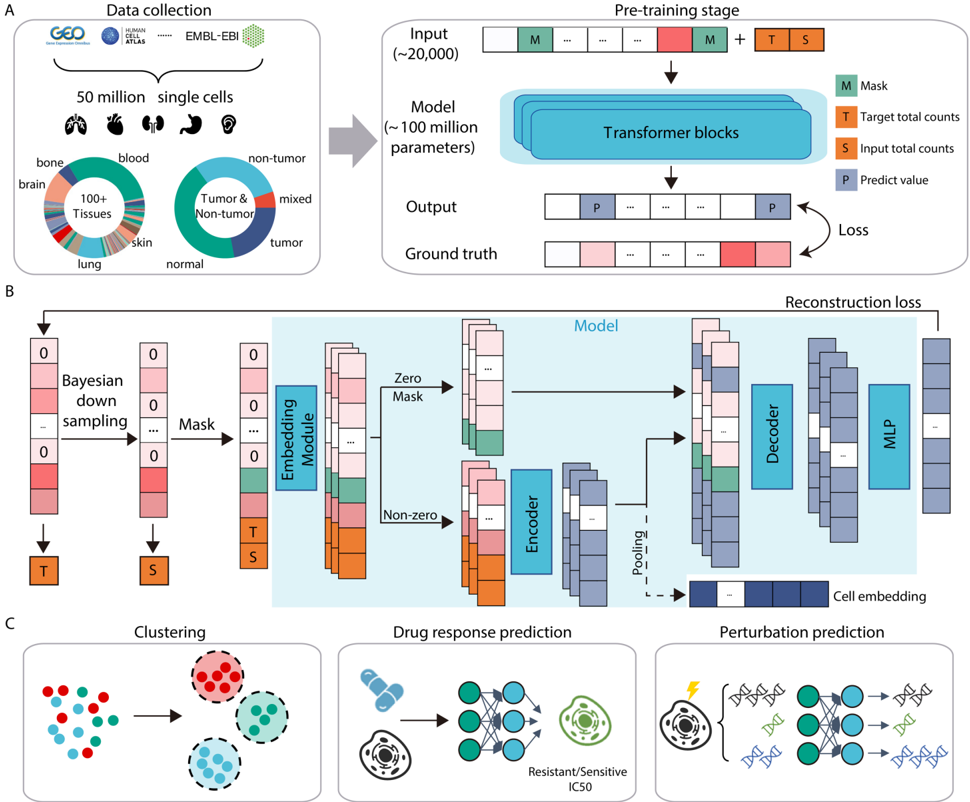
Large pretrained models have become foundation models leading to breakthroughs in natural language processing and related fields. Developing foundation models for deciphering the 'languages' of cells and facilitating biomedical research is promising yet challenging. Here we developed a large pretrained model scFoundation, also named 'xTrimoscFoundation α ', with 100 million parameters covering about 20,000 genes, pretrained on over 50 million human single-cell transcriptomic profiles. scFoundation is a large-scale model in terms of the size of trainable parameters, dimensionality of genes and volume of training data. Its asymmetric transformer-like architecture and pretraining task design empower effectively capturing complex context relations among genes in a variety of cell types and states. Experiments showed its merit as a foundation model that achieved state-of-the-art performances in a diverse array of single-cell analysis tasks such as gene expression enhancement, tissue drug response prediction, single-cell drug response classification, single-cell perturbation prediction, cell type annotation and gene module inference.
Overview
CoChat Summary
TL;DR
scFoundation is a 100M-parameter foundation model pretrained on over 50 million human single-cell transcriptomics profiles covering 19,264 genes. It achieves improved or state-of-the-art performance across gene expression enhancement, cancer drug response prediction, single-cell drug response classification, and perturbation prediction without fine-tuning the pretrained model.
Key findings
- Pretrained on >50 million human scRNA-seq profiles and 19,264 genes with 100M parameters, scFoundation is described as the largest model in parameter size, gene coverage, and data scale in the single-cell field.
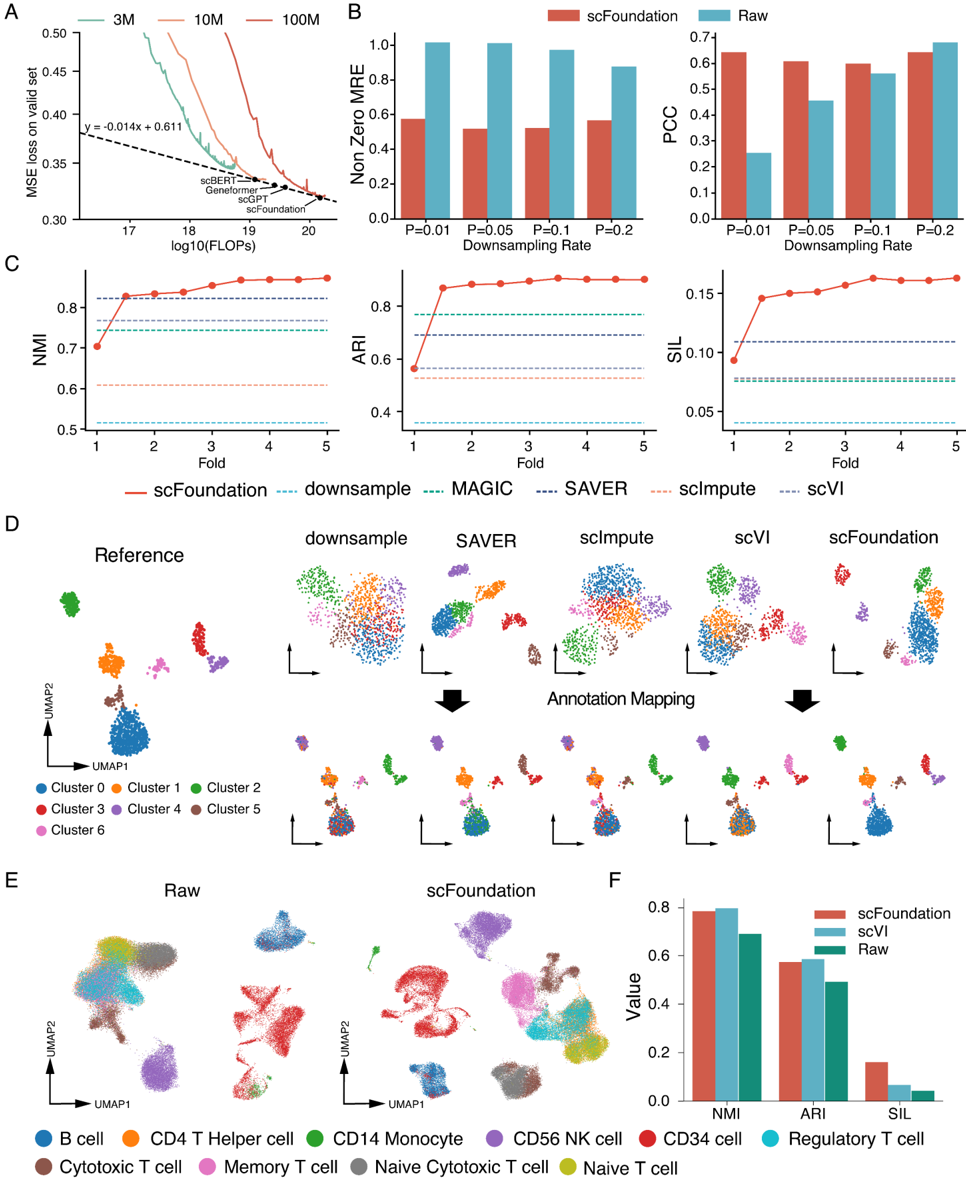
- For read-depth enhancement without fine-tuning, scFoundation reduced MAE and MRE by half versus the non-enhanced baseline; when downsampling was below 10%, baseline MRE was 97.5% while scFoundation maintained an MRE of 60%. On the Zheng68K PBMC dataset (~600,000 cells), scFoundation embeddings had comparable NMI and ARI to scVI and a higher SIL score.
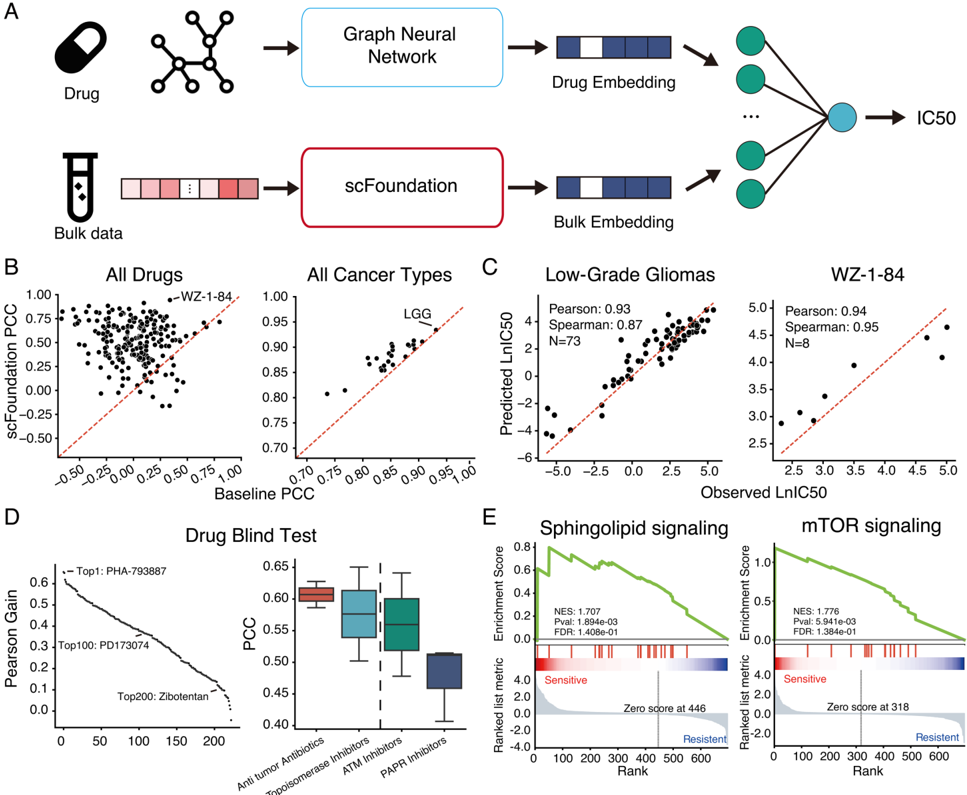
- In cancer drug response prediction with DeepCDR, scFoundation embeddings improved PCC for most drugs and all cancer types; in leave-one-drug-out blind tests, PHA-793887 improved from PCC 0.07 to 0.73 and Zobotentan from 0.49 to 0.64, with the best case achieving PCC above 0.93.
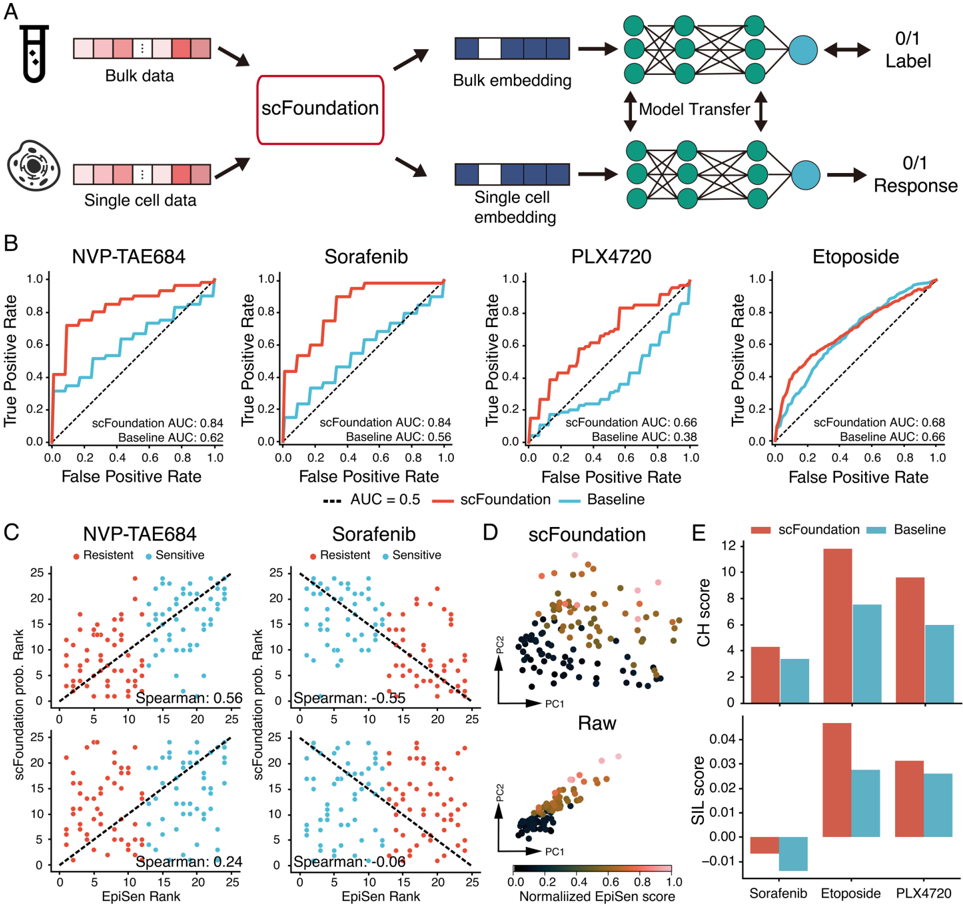
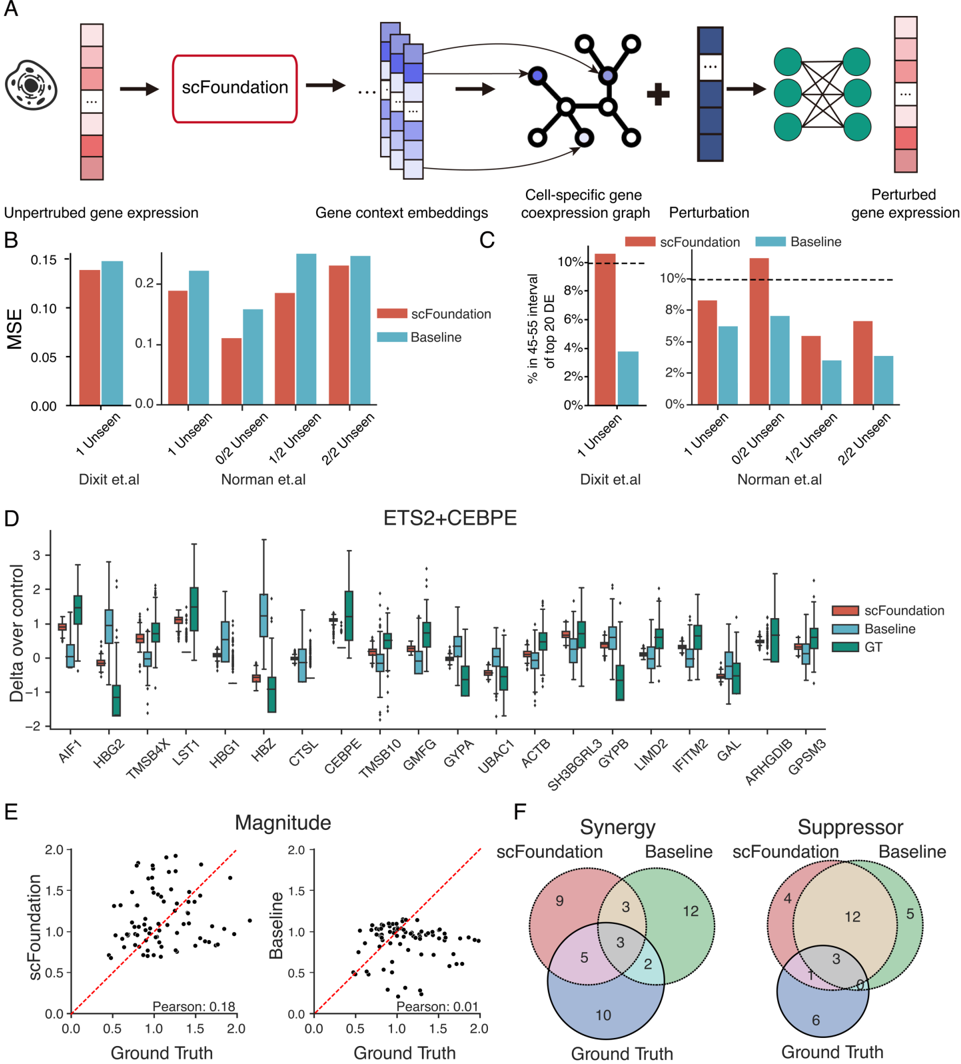
- In single-cell drug response classification, scFoundation embeddings achieved higher AUROC for all four tested drugs; for NVP-TAE684 and Sorafenib, AUROC improved by above 0.2, and Spearman correlations with EpiSen scores were 0.56 and −0.55 versus baseline 0.24 and −0.06. In perturbation prediction, scFoundation-combined GEARS achieved lower MSE on all 1-gene perturbation datasets and the lowest MSE in the 0/2 unseen 2-gene case.
Methods
- Model architecture: xTrimoGene, an asymmetric encoder-decoder transformer with an embedding module that converts continuous gene expression scalars into learnable embeddings; the encoder processes only non-zero and non-masked expressed genes, while the decoder integrates all genes.
- Pretraining data and task: over 50 million human scRNA-seq profiles collected from GEO, Single Cell Portal, HCA, EMBL-EBI, and other resources, aligned to 19,264 genes and filtered for cells with >200 expressed genes; read-depth-aware modeling used hierarchical Bayesian downsampling, 30% masking, and MSE regression loss with total count indicators T and S.
- Downstream evaluation: pretrained cell or gene embeddings were fed into DeepCDR, SCAD, and GEARS without fine-tuning the pretrained model; metrics included MAE, MRE, PCC, NMI, ARI, SIL, AUROC, MSE, and Spearman correlation.
Limitations
- The paper does not include an explicit limitations section.
- Evident from the text: pretraining used only human scRNA-seq data, so generalization to other species or multi-omics settings is not demonstrated.
- Evident from the text: downstream performance depends on existing task-specific models (DeepCDR, SCAD, GEARS) and public datasets, and the paper does not quantify residual batch effects or technical noise beyond describing read-depth-aware pretraining as a mitigation.
Model-written summary. Check it against the paper before relying on it.
Integrity signals
Registry
Cites
Statistics
Figures
Verification
Claims the paper makes
2 Valid · 6 Not valid · 3 Not checked · 74 Own results and interpretations
The cited sources that could be checked couldn’t confirm or dispute this claim.
In the paper
“We developed a new pre-training task called the read-depth-aware (RDA) modeling, which was an extension of masked language modeling 16 , considering single-cell gene expression data had a high variance in read depth, especially in the large-scale pre-training data.”
§ Large Scale Foundation Model on Single-cell Transcriptomics > The scFoundation pre-training framework
What the sources say
- Could not verifycites [16] Choromanski, K. et al. Rethinking Attention with Performers. Preprint at https://doi.org/10.48550/arXiv.2009.14794 (2022). sourceExperimental — accuracy not yet measured
The Experiments section (p. 6) mentions masked language modelling as a task used to evaluate Performers, but does not describe read-depth-aware modelling or an extension of that task. Searches for RDA, read depth, and single-cell gene expression found no passage addressing the attributed claim. (LLM, conf=0.75)
plain- Asserted: passes — The authors put it forward as true.
- Checkable: passes — It can be checked against evidence.
- Load-bearing: passes — The paper’s conclusions depend on it.
- Based: passes — The paper gives a reason why it holds.
- Could not verify
None of the sources cited for this claim have been checked yet.
In the paper
“Existing work had to restrict their models to a small list of selected genes.”
§ Large Scale Foundation Model on Single-cell Transcriptomics > Introduction
What the sources say
- Could not verifycites [8] Papatheodorou, I. et al. Expression Atlas update: from tissues to single cells. Nucleic Acids Research 48, D77-D83 (2020). sourceExperimental — accuracy not yet measured
The Introduction describes Single Cell Expression Atlas as a source of expression matrices for downstream computational methods, and the Data analysis section describes its quantification pipeline. Neither addresses whether earlier pre-training models had to use a small, selected gene list. Searches for pre-training, model limitations, and gene selection found no passage supporting that claim. (LLM, conf=0.76)
- Not checked yetcites [9] Svensson, V., Vento-Tormo, R. & Teichmann, S. A. Exponential scaling of single-cell RNA-seq in the past decade. Nature Protocols 13, 599-604 (2018). source
Checked before — its earlier verdict is held back until a new check runs.
- Could not verifycites [10] Brown, T. B. et al. Language Models are Few-Shot Learners. Preprint at https://doi.org/10.48550/arXiv.2005.14165 (2020). sourceExperimental — accuracy not yet measured
The Introduction (p. 3) discusses pre-trained language models and task-specific datasets, not single-cell gene expression. Searches for single-cell gene expression, selected genes, and restrictions to a small gene list found no passage addressing the claim. (LLM, conf=0.78)
- Could not verifycites [11] Zhao, W. X. et al. A Survey of Large Language Models. Preprint at https://doi.org/10.48550/arXiv.2303.18223 (2023). sourceExperimental — accuracy not yet measured
The Pre-training section (p. 4) discusses language-model training corpora, not single-cell gene-expression data. Searches for “single-cell gene expression selected genes” and “gene expression genes” found no passage addressing whether earlier models were restricted to a small list of genes. (LLM, conf=0.76)
plainstates a cause- Asserted: passes — The authors put it forward as true.
- Checkable: passes — It can be checked against evidence.
- Load-bearing: passes — The paper’s conclusions depend on it.
- Based: passes — The paper gives a reason why it holds.
- Could not verify
The cited sources support only part of this claim — read each source’s verdict below.
In the paper
“We constructed a comprehensive single-cell gene expression data set by collecting data from all publicly available single-cell resources, including GEO 17 , Single Cell Portal, HCA 4 , EMBL-EBI 18 , etc.”
§ Large Scale Foundation Model on Single-cell Transcriptomics > The scFoundation pre-training framework
What the sources say
- Could not verifycites [17] Ma, X. et al. Luna: Linear Unified Nested Attention. Preprint at http://arxiv.org/abs/2106.01540 (2021). sourceExperimental — accuracy not yet measured
Our copy of Luna (arXiv 2106.01540) is entirely about linear nested attention for sequence modelling; every data passage concerns NLP/vision benchmarks — the Abstract's three benchmarks, §4.1's Long Range Arena tasks (ListOps, Text, Retrieval, Image, Pathfinder), WMT'14 English-German (4.5M sentence pairs, Additional information), GLUE/QA (Table 6), and MLM pre-training on BookCorpus/Wikipedia/CC-News/OpenWebText/Stories. Nothing in it addresses single-cell gene expression, GEO, Single Cell Portal, HCA or EMBL-EBI (searched: 'single-cell gene expression dataset collection from public resources', 'scRNA-seq single cell RNA sequencing gene expression GEO Human Cell Atlas EMBL-EBI'). The cited sentence therefore cannot be checked against this source; our copy neither supports nor contradicts it. (LLM, conf=0.72)
- Partly supportedcites [4] Chen, S. et al. hECA: The cell-centric assembly of a cell atlas. iScience 25, 104318 (2022). sourceExperimental — accuracy not yet measured
The hECA 'Dataset collection' section (STAR Methods > Method details) does state the same ambition as the claim — 'collecting all accessible human single-cell data into a unified atlas' — and the Abstract/Introduction confirm it assembled a single-cell gene expression resource (1,093,299 cells, 116 published datasets, 38 organs) from scattered public data. But the realized scope is narrower than 'all publicly available single-cell resources': they selected 20–21 peer-reviewed studies, transcriptomic data of healthy donors only, and the Discussion concedes 'the number of cells in hECA v1.0 is still small and the coverage of organs and cell types is very limited'. Our copy also never lists Single Cell Portal, HCA, or EMBL-EBI as the repositories collected from (only GEO accessions and an NCBI BioProject appear, in the COVID-19 validation experiments), so that enumeration is not supported by this source. (LLM, conf=0.72)
- Partly supportedcites [18] Gong, J. et al. xTrimoGene: An Efficient and Scalable Representation Learner for Single-Cell RNA-Seq Data. 2023.03.24.534055 Preprint at https://doi.org/10.1101/2023.03.24.534055 (2023). sourceExperimental — accuracy not yet measured
Our copy confirms the large curated pre-training data set: the Additional information section states 'we curated about 5 million scRNA-seq data for training' processed with a unified pipeline. However, it attributes collection to a single repository, not 'all publicly available single-cell resources': 'Recently, scRNA-seq data ... mostly has been uploaded to the Gene Expression Omnibus (GEO) repository ... We collected data from GEO' and 'all the scRNA-seq data are collected from the Gene Expression Omnibus (GEO) repository with a keyword searching and data retrieval process.' Searches for HCA / Human Cell Atlas, EMBL-EBI and Single Cell Portal returned no data-source passage in our copy, so the multi-resource scope the citing sentence claims is not supported by this paper. (LLM, conf=0.82)
plain- Asserted: passes — The authors put it forward as true.
- Checkable: passes — It can be checked against evidence.
- Load-bearing: passes — The paper’s conclusions depend on it.
- Based: passes — The paper gives a reason why it holds.
- Could not verify
A result the paper reports from its own data — it cites no other source for it, so there is none to check. The quote shows it is in the paper.
In the paper
“From a cell ontology perspective, the data encompassed almost all known human cell types and cell states.”
§ Large Scale Foundation Model on Single-cell Transcriptomics > The scFoundation pre-training framework
plain- Asserted: passes — The authors put it forward as true.
- Checkable: passes — It can be checked against evidence.
- Load-bearing: passes — The paper’s conclusions depend on it.
- Based: passes — The paper gives a reason why it holds.
A result the paper states — it cites no source for it, so there is none to check. The quote shows it is in the paper.
In the paper
“We observed that, based on scFoundation-predicted results, drugs belonging to chemotherapy, such as anti-tumor antibiotics and topoisomerase inhibitors, had a higher PCC than drugs belonging to targeted therapy, such as ATM and PARP inhibitors (Fig. 3C right).”
§ Large Scale Foundation Model on Single-cell Transcriptomics > scFoundation improves cancer drug response prediction
plainstates an association- Asserted: passes — The authors put it forward as true.
- Checkable: passes — It can be checked against evidence.
- Load-bearing: unclear — It is unclear whether the paper’s conclusions depend on it.
- Based: passes — The paper gives a reason why it holds.
37 more claims
Create a free account to see all 85 claims and to verify the 5 references still open.
- Probably not a substantial claim. 13
- It may state two separate claims as one. 36
- The quote only partly states this claim. 2
Claims other papers make about this one
Each is checked against this paper’s own text: does it say what the citing paper says it does?
The source backs part of the claim, not all of it — or backs it for a different population, condition or comparison.
In the citing paper
“Compared to tasks such as cell annotation and batch correction, perturbation prediction offers experimentally generated model input/output with well-defined objectives, making it a more robust benchmark for assessing foundation models (15, 20, 21).”
From A systematic comparison of single-cell perturbation response prediction models (2026) · cites this paper as [21]
Experimental — accuracy not yet measuredThe source backs part of the claim, not all of it — or backs it for a different population, condition or comparison.
In the citing paper
“These models are pre-trained on vast amounts (> 10 M examples) of unlabelled scRNA-seq data, with the aim that such large datasets allow the models to capture general principles of gene regulation and signalling.”
From Benchmarking foundation cell models for post-perturbation RNA-seq prediction (2025) · cites this paper as [7]
Experimental — accuracy not yet measuredIn the citing paper
“scFoundation [15] strengthens the modular design, aiming to combine different modules to adapt to a variety of single-cell tasks, and is very flexible and scalable.”
From Challenges in AI-driven Biomedical Multimodal Data Fusion and Analysis (2025) · cites this paper as [15]
Self-check
Percentages, sums and reported differences re-computed from the paper’s own numbers.
Each contradiction between two passages listed here was confirmed by an independent check.
Rated minor: it would not touch a result — a value no result rests on, a p-value that stays on the same side of the significance level, or a conflict that is clerical, resolved elsewhere in the paper, or outside its own findings.
In the paper
§ Large Scale Foundation Model on Single-cell Transcriptomics > scFoundation predicts more accurate perturbation responses
“the Adamson dataset 49 with 87 1-gene perturbations”
§ Large Scale Foundation Model on Single-cell Transcriptomics > References
“49. Rood, J. E., Maartens, A., Hupalowska, A., Teichmann, S. A. & Regev, A. Impact of the Human Cell Atlas on medicine. Nat Med 28, 2486-2496 (2022).”
Rated minor: it would not touch a result — a value no result rests on, a p-value that stays on the same side of the significance level, or a conflict that is clerical, resolved elsewhere in the paper, or outside its own findings.
In the paper
§ Large Scale Foundation Model on Single-cell Transcriptomics > scFoundation predicts more accurate perturbation responses
“We combined the scFoundation with an advanced model GEARS 51 for the perturbation prediction task.”
§ Large Scale Foundation Model on Single-cell Transcriptomics > References
“51. Dixit, A. et al. Perturb-Seq: Dissecting Molecular Circuits with Scalable Single-Cell RNA Profiling of Pooled Genetic Screens. Cell 167, 1853-1866.e17 (2016).”
Rated minor: it would not touch a result — a value no result rests on, a p-value that stays on the same side of the significance level, or a conflict that is clerical, resolved elsewhere in the paper, or outside its own findings.
In the paper
§ Large Scale Foundation Model on Single-cell Transcriptomics > scFoundation transfers bulk-level drug sensitivity prediction model to single-cell data
“based on the SCAD 44 downstream model.”
§ Large Scale Foundation Model on Single-cell Transcriptomics > References
“44. Jerby-Arnon, L. et al. A Cancer Cell Program Promotes T Cell Exclusion and Resistance to Checkpoint Blockade. Cell 175, 984-997.e24 (2018).”
Citations
Cites
BERT: Pre-training of Deep Bidirectional Transformers for Language Understanding
Devlin, J., Chang, M.-W., Lee, K., & Toutanova, K. (2018) · arXiv · doi:10.48550/arxiv.1810.04805 · Cited by 73,173
Scikit-learn: Machine Learning in Python
Pedregosa, F., Varoquaux, G., Gramfort, A., Michel, V., Thirion, B., Grisel, O., Blondel, M., Müller, A., Nothman, J., Louppe, G., et al. (2012) · arXiv · doi:10.48550/arxiv.1201.0490 · Cited by 71,016
Subramanian, A., Tamayo, P., Mootha, V. K., Mukherjee, S., Ebert, B. L., Gillette, M. A., Paulovich, A., Pomeroy, S. L., Golub, T. R., Lander, E. S., et al. (2005) · Proceedings of the National Academy of Sciences · doi:10.1073/pnas.0506580102 · Cited by 53,625
KEGG: Kyoto Encyclopedia of Genes and Genomes
Kanehisa, M. (2000) · Nucleic Acids Research · doi:10.1093/nar/28.1.27 · Cited by 37,077
KEGG: Kyoto Encyclopedia of Genes and Genomes
Ogata, H., Goto, S., Sato, K., Fujibuchi, W., Bono, H., & Kanehisa, M. (1999) · Nucleic Acids Research · doi:10.1093/nar/27.1.29 · Cited by 31,232 · cited 1×
“According to the Kyoto Encyclopedia of Genes and Genome database 41 , this pathway was related to sphingomyelin and its metabolism.”
Language Models are Few-Shot Learners
Brown, T. B., Mann, B., Ryder, N., Subbiah, M., Kaplan, J., Dhariwal, P., Neelakantan, A., Shyam, P., Sastry, G., Askell, A., et al. (2020) · arXiv · doi:10.48550/arxiv.2005.14165 · Cited by 23,372 · cited 5×
“Please refer to Supplementary Notes 9 and 10 for details of the sampling strategy and count indicators calculation.”
InfluentialIntegrated analysis of multimodal single-cell data
Hao, Y., Hao, S., Andersen-Nissen, E., Mauck, W. M., Zheng, S., Butler, A., Lee, M. J., Wilk, A. J., Darby, C., Zagar, M., et al. (2020) · doi:10.1101/2020.10.12.335331 · Cited by 15,508
Kaugeranna, R., Kaugeranna, E., & Aion, (. S. 4. 6. (2023) · DROPS (Schloss Dagstuhl – Leibniz Center for Informatics) · doi:10.4230/lipics.giscience.2023.43 · Cited by 13,690
Gene Expression Omnibus: NCBI gene expression and hybridization array data repository
Edgar, R. (2002) · Nucleic Acids Research · doi:10.1093/nar/30.1.207 · Cited by 13,288 · cited 3×
“…a comprehensive single-cell dataset by collecting data from all publicly available single-cell resources, including Gene Expression Omnibus (GEO) 22 , Single Cell Portal, HCA 3 , human Ensemble Cell Atlas (hECA) 4 , Deeply Integrated human Single-Cell Omics data (DISCO) 7 , European Molecular…”
Scaling Laws for Neural Language Models
Kaplan, J., McCandlish, S., Henighan, T., Brown, T. B., Chess, B., Child, R., Gray, S., Radford, A., Wu, J., & Amodei, D. (2020) · arXiv · doi:10.48550/arxiv.2001.08361 · Cited by 9,550 · cited 1×
“This is a large-scale model of large parameter size, gene coverage and data scale in the single-cell field.”
Research works printed but not linked: 1
- He, K. et al. in Proc. IEEE/CVF Conference on Computer Vision and Pattern Recognition 16000–16009 (IEEE, 2022).
Cited by
Items 401–500 of 638
PantheonOS: An Evolvable Multi-Agent Framework for Automatic Genomics DiscoveryPreprint
Xu, W., Poussi, E., Zhong, Q., Zeng, Z., Zou, C., Wang, X., Lu, Y., Cui, M., Okamura, D., Huang, C., et al. (2026) · bioRxiv (Cold Spring Harbor Laboratory) · doi:10.64898/2026.02.26.707870 · Cited by 6
Self-citationWong, D., Piper, M. E., Qiao, J., Russo, M., Jean, P., Clevert, D.-A., Arroyo, J. D., & Pashos, E. E. (2026) · bioRxiv (Cold Spring Harbor Laboratory) · doi:10.64898/2026.03.04.709607 · Cited by 1
“Although tasks such as cell type annotation, prediction of the post-perturbation transcriptome 20,23,27,28 , and forecasting differential gene expression 25,29,30 have all undergone much inquiry, exploring the propensity of scFMs to assist with target nomination has remained a relatively unexplored…”
pertTF: context-aware AI modeling for genome-scale and cross-system perturbation predictionPreprint
Su, Y., Liu, D., Menon, V. K., Song, B., Boccara, S., Zhang, N., Zhao, H., Zhao, J. H., Wang, L., Hu, N., et al. (2026) · bioRxiv (Cold Spring Harbor Laboratory) · doi:10.64898/2026.03.12.711379 · Cited by 3
“A variety of computational strategies have been explored to predict single-cell transcriptomic responses to perturbation, each with distinct strengths and limitations 8–16 .”
Temporal AI model predicts drivers of cell state trajectories across human agingPreprint
Ortega, J. G., Nadadur, R. D., Kunitomi, A., Kothen-Hill, S., Wagner, J. U. G., Kurtoglu, S., Kim, B., Reid, M. M., Lu, T., Washizu, K., et al. (2026) · bioRxiv (Cold Spring Harbor Laboratory) · doi:10.64898/2026.03.30.715396 · Cited by 4
H2O: A Foundation Model Bridging Histopathology to Spatial Multi-Omics ProfilingPreprint
Gu, Y., Wu, Z., Yan, R., Wang, Z., Li, Y., Lin, S., Cui, Y., Lai, H., Luo, X., Zhou, S. K., et al. (2026) · bioRxiv (Cold Spring Harbor Laboratory) · doi:10.64898/2026.04.21.717342 · Cited by 3
MVCBench: A Multimodal Benchmark for Drug-induced Virtual Cell PhenotypesPreprint
Li, B., Wang, Q., Wang, S., Zhang, B., Peng, Y., Zeng, P., Liu, C., Li, M., Tang, Z., Yao, X., et al. (2026) · bioRxiv (Cold Spring Harbor Laboratory) · doi:10.64898/2026.04.22.720110 · Cited by 4
Self-citationPanKbase Integrated Single-Cell Map: A Comprehensive Atlas of Human Pancreatic IsletsPreprint
Vu, H. T. H., Sun, H., Kudtarkar, P., Sharp, S. A., BRUSMAN, L., FENG, F., Bate, T. S. R., Jurgens, J. A., Wang, Y., Huang, Y., et al. (2026) · bioRxiv (Cold Spring Harbor Laboratory) · doi:10.64898/2026.06.02.729719 · Cited by 4
HoloCell: A Generative Foundation Model for Holistic Cellular ModelingPreprint
Jiang, Q., Li, Z., Hu, B., Bie, Y., Li, K., Li, Q., Jin, P., He, Y., Deng, P., Zhenyi, W., et al. (2026) · bioRxiv (Cold Spring Harbor Laboratory) · doi:10.64898/2026.06.07.730684 · Cited by 2
“In transcriptomics, models such as scGPT [14], scFoun-dation [15], and Geneformer [16] demonstrate that pretraining on large-scale gene expression datasets can yield transferable representations for diverse downstream tasks.”
OmicOS: A Comprehensive Omics Ecosystem Infrastructure and Agent System for the AI EraPreprint
Zeng, Z., Meng, X., Hu, L., Li, C., Liu, P., Shi, Y., Ma, X., Gao, L., Wang, X., Luo, Z., et al. (2026) · bioRxiv (Cold Spring Harbor Laboratory) · doi:10.64898/2026.06.11.731775 · Cited by 1
Self-citationCellOS: Learning a World Model of Cellular State through Joint Embedding PredictionPreprint
Zhou, Q., Le, Y., Qi, X., Lu, H., Chang, S., Wu, Y., Wang, H. Z., Ran, R., & Li, X. F. (2026) · bioRxiv (Cold Spring Harbor Laboratory) · doi:10.64898/2026.06.18.733163 · Cited by 2
“…values before masked modelling, as in scBERT and scGPT [5, 12]; direct projection maps continuous counts into the model, as in scFoundation [6]; and gene-as-text or gene-embedding approaches represent genes through learned vectors, natural-language-derived embeddings or protein-sequence…”
Unbalanced Perturbation Dynamics For Cell Fate DesignPreprint
Peng, Q., Wang, Y., Li, J., Wang, X., Xiao, Y., & Zhou, P. (2026) · bioRxiv (Cold Spring Harbor Laboratory) · doi:10.64898/2026.06.30.735555 · Cited by 1
“Recent foundation, language-informed and perturbation-specific models have further expanded the scale and conditioning capacity of response prediction [25–36].”
Dataset structure outweighs method choice in single-cell cell-type annotationPreprint
Wardhana, O. (2026) · bioRxiv (Cold Spring Harbor Laboratory) · doi:10.64898/2026.08.28.747622 · Cited by 1
Evaluating the learnability of single-cell large language models on multiple tasks
Yan, Y., Wang, X., & Song, D. (2026) · BMC Genomics · doi:10.1186/s12864-026-12975-6 · Cited by 1
“Recent years have witnessed an explosion of scFMs, including scGPT [9], Geneformer [10], scFounda-tion [14], scBERT [15], UCE [16], CellPLM [17], GenePT [18], and GeneCompass [19], among others.”
Evaluating the learnability of single-cell large language models on multiple tasks
Yan, Y., Wang, X., & Song, D. (2026) · doi:10.21203/rs.3.rs-8919408/v1 · Cited by 1
Pedoman Peri-operatif Renal Assessment
Sinaga, U. M. (2009)
Learning context-aware, distributed gene representations in spatial transcriptomics with SpaCEXPreprint
Sun, X., Xu, Y., Li, W., Huang, M., Wang, Z., Chen, J., & Wu, H. (2024) · bioRxiv (Cold Spring Harbor Laboratory) · doi:10.1101/2024.06.07.598026
Cui, Y., & Yuan, Z. (2024) · bioRxiv (Cold Spring Harbor Laboratory) · doi:10.1101/2024.08.04.606512
Bioinformatics Copilot 2.0 for Transcriptomic Data AnalysisPreprint
Wang, Y., Zhang, W., Wong, I., Lin, S., Kumar, R., & Wang, A. (2024) · bioRxiv (Cold Spring Harbor Laboratory) · doi:10.1101/2024.08.15.607673
Zhu, H., Yuan, Y., Yang, J., Cai, K., Wei, N., Zhang, S., Wang, L., Jiang, W.-J., Sun, Y., Liu, A., et al. (2024) · bioRxiv (Cold Spring Harbor Laboratory) · doi:10.1101/2024.11.15.623701
Belenguer-Llorens, A., Sevilla-Salcedo, C., Parrado-Hernández, E., & Gómez-Verdejo, V. (2024) · SSRN Electronic Journal · doi:10.2139/ssrn.5050534
Improving Genetic Perturbation Response Prediction with an Enhanced Biological Knowledge Graph
Li, Y., Chen, R., Tan, Y., Zhong, X. Y., Li, B., & Yin, Z. (2024) · IEEE International Conference on Bioinformatics and Biomedicine (BIBM) · doi:10.1109/bibm62325.2024.10822049
“More recently, biological language models pre-trained on an extensive unlabeled biological corpus also focus on predicting perturbation responses as their downstream tasks [19], [20], [21].”
(2025) · Nature Methods · doi:10.1038/s41592-024-02591-1
Pirhaji, L., Eaton, J. A., Jeewajee, A. K., Zhang, M., Morris, M., & Karasarides, M. (2025) · bioRxiv (Cold Spring Harbor Laboratory) · doi:10.1101/2025.01.26.634927
“In fields such as single-cell sequencing, standardized data processing methods have already enabled the integration of public datasets to develop pre-trained foundation models 23–25 .”
Belenguer-Llorens, A., Sevilla-Salcedo, C., Parrado-Hernández, E., & Gómez-Verdejo, V. (2025) · SSRN Electronic Journal · doi:10.2139/ssrn.5104224
A Data Augmentation Method for Disease Diagnosis Based on Single Cell Omics Data
Zhuang, H., & Zhang, Q. (2025) · Communications in computer and information science · doi:10.1007/978-981-96-1907-8_22
Hu, H., Guo, Y., Ge, F., Yin, H. R., Zhang, H., Zhou, Z., Yan, F., Ye, Q., Wu, J., Cao, J., et al. (2025) · Advanced Science · doi:10.1002/advs.202410790
Self-citationTang, K., Liang, Y., Li, D., Luo, D., Xu, A., Luo, P., Shao, Y., Yang, J., & Gong, X. (2025) · Research Square · doi:10.21203/rs.3.rs-5720342/v1
A review on single-cell perturbation data analysis
Fu, Z., Yang, M., & Hou, L. (2025) · Scientia Sinica Mathematica · doi:10.1360/ssm-2024-0315
Liu, Y., Li, C., Shen, L.-C., Yan, H., Wei, G., Gasser, R. B., Hu, X. T., Song, J., & Yu, D. (2025) · Computers in Biology and Medicine · doi:10.1016/j.compbiomed.2025.110068 · Cited by 1
Yu, Z., Yang, D., Chen, Q., Zhang, Y., Li, Z., Wang, Y., Wang, C., & Zhang, Y. (2025) · bioRxiv (Cold Spring Harbor Laboratory) · doi:10.1101/2025.03.29.646077
Primer on machine learning applications in brain immunology
Binder, N., Khavaran, A., & Sankowski, R. (2025) · Frontiers in Bioinformatics · doi:10.3389/fbinf.2025.1554010 · Cited by 1
“Furthermore, the authors report that their model can improve clustering results by enhancing the read depth of cells in a setting without any fine-tuning (Hao et al., 2024).”
Zhao, W., Solaguren-Beascoa, A., Neilson, G., Reynolds, R. H., Muhammed, L., Laaniste, L., & Cakiroglu, S. A. (2025) · bioRxiv (Cold Spring Harbor Laboratory) · doi:10.1101/2025.04.17.649395
“Simultaneously, advanced deep-learning techniques have been applied in the prediction of perturbed single-cell transcriptome data (Roohani et al., 2023; Hao et al., 2024).”
Liu, T., Huang, T., Jin, W., Chu, T., Ying, R., & Zhao, H. (2025) · bioRxiv (Cold Spring Harbor Laboratory) · doi:10.1101/2025.04.22.649977 · Cited by 3
“To use spRefine as a pre-training framework, our idea is to impute the missing gene expression profiles proportion to the magnitude of expression levels, which can be defined as a downsampling strategy used in [71, 72].”
Hu, L., Chen, Q., Qiu, P. S., Qin, H., Zhang, Y., Cao, L., Xia, T., Deng, Z., Zhang, Y., Fang, S., et al. (2025) · bioRxiv (Cold Spring Harbor Laboratory) · doi:10.1101/2025.05.06.652331
“To further extend its capability, we integrated UniCell with emerging single-cell foundation models (scFMs) such as scGPT 39 , GeneFormer 40 , and scFoundation 41 , which learn generalizable cell embeddings from large-scale single-cell data.”
Sun, L., Yang, Q., Zhang, J., Guo, W., & Lin, L. (2025) · bioRxiv (Cold Spring Harbor Laboratory) · doi:10.1101/2025.05.14.654052
“Models such as scBERT [61], Geneformer [62], scGPT [63], and scFoundation [64] leverage large-scale pretraining on diverse single-cell datasets.”
HL-BscPF: Hybrid learning facilitates brain cell auto-identification in multiple pathologies
Suo, Z., Pan, B., Shi, H., Ma, L., Zheng, Y., Xu, W., Lin, L., Zhang, E., Wang, L., Zhang, M., et al. (2025) · Life Sciences · doi:10.1016/j.lfs.2025.123751 · Cited by 1
Subedi, S., & Park, Y. (2025) · medRxiv · doi:10.1101/2025.06.04.25328900
“More efficient transformer architectures will enable us to include ten times more features in the model [69].”
Coreset-based logistic regression for atlas-scale cell type annotationPreprint
Li, D., Ko, Y. K., & Canzar, S. (2025) · bioRxiv (Cold Spring Harbor Laboratory) · doi:10.1101/2025.06.04.655742
“In particular, foundation models such as scFoundation [5] and scGPT [6] which are pre-trained on vast amounts of unlabeled single-cell RNA-seq data and then fine-tuned on a smaller, task-specific dataset have demonstrated enormous success in the predictive analysis of single-cell data.”
Robust self-supervised machine learning for single cell embeddings and annotationsPreprint
Yeh, C., Sun, M.-W., Zhu, D., & Jerby, L. (2025) · bioRxiv · doi:10.1101/2025.06.05.658097
“…compatible with other dimensionality reduction algorithms, including non-linear autoencoders and transformers used in single cell foundation models 71–73 as single cell GPT (scGPT) 72 and scFoundation 71 , where RE can be used in the same way to reorient the model for more balanced view of…”
Geneformer Parallel Adaptation, Training, and Optimization on MLU290
Yu, Z., Luo, Y., & Yang, Y. (2025) · International Journal of High Speed Electronics and Systems · doi:10.1142/s0129156425407193
AIDO.Tissue: Spatial Cell-Guided Pretraining for Scalable Spatial Transcriptomics Foundation ModelPreprint
Gong, J., Wang, Y., Ho, N., Cheng, X., Song, L., & Xing, E. P. (2025) · bioRxiv (Cold Spring Harbor Laboratory) · doi:10.1101/2025.07.04.663102
“Copyright 2025 by the author(s). tens of millions of cells (Theodoris et al., 2023; Cui et al., 2024; Hao et al., 2024; Kalfon et al., 2025).”
Self-citationf-BGM enables fungi-specific genome mining in high accuracy and interpretabilityPreprint
Zhou, Y., Liu, D., Huang, Z., Xie, X., Lin, W., Zhang, L., Fan, A., & Liu, Z. (2025) · bioRxiv (Cold Spring Harbor Laboratory) · doi:10.1101/2025.07.08.662937
“…have been extended to biomedical fields such as prediction of macromolecular folding conformations [16, 17], drug-target interactions [18], conditional drug design [19] and so on [20, 21] due to its context-aware modeling manner by explicit attention weights measuring inter-unit associations.”
Spatia: Multimodal Model for Prediction and Generation of Spatial Cell Phenotypes.Preprint
Kong, Z., Qiu, M., Boesen, J., Lin, X., Yun, S., Chen, T., Kellis, M., & Žitnik, M. (2025) · PubMed Central · Cited by 5
Liu, Y., Zou, Q., Su, R., & Wei, L. (2026) · Nature Communications · doi:10.1101/2025.08.04.668374 · Cited by 1
Semi-automated Systematic Review: Main applications and trends of foundation models
Cuaya-Simbro, G., Romero, E. R., & García, I. O. (2025) · Revista Ingenierías Universidad de Medellín · doi:10.22395/rium.v24n47a3
Schulz, M., & Leha, A. (2025) · medRxiv · doi:10.1101/2025.08.14.25333566
“…published for a lot of applications (Examples listed by application include: Clinical Large Language Models: [10], Single-cell transcriptomics: [16], Medical Image Analysis: [17]) with the explicit intention that they are usable especially as foundation for fine-tuned models in specific…”
Aligning Foundation Models on Encoded Synthetic Omic Data for Patient Stratification
Janakarajan, N., Foncubierta–Rodríguez, A., & Manica, M. (2025) · IEEE International Conference on Digital Health (ICDH) · doi:10.1109/icdh67620.2025.00017
From gene lists to context drift
Lin, Z., & Aran, D. (2025) · Cancer Cell · doi:10.1016/j.ccell.2025.07.025 · Cited by 1
Yi, H., Lu, X., & Chang, Q. (2025) · Nature Computational Science · doi:10.1038/s43588-025-00855-0
“Inspired by recent work using large language models on single-cell profiles, a metagenomic large language model could be trained on large-scale MetaKSSD profiles and applied for tasks such as abundance enhancement, imputation, batch correction and annotation, as shown in single-cell biology 54 .”
Belenguer-Llorens, A., Sevilla-Salcedo, C., Parrado-Hernández, E., & Gómez-Verdejo, V. (2025) · Computers in Biology and Medicine · doi:10.1016/j.compbiomed.2025.110985
Guo, H., Cui, Q., Zhang, X., Chen, C., Zheng, W., Cai, C., Wang, X., & Wang, S. (2026) · Genome biology · doi:10.1186/s13059-026-04193-w
Self-citationGenerative genomics accurately predicts future experimental resultsPreprint
Koytiger, G., Walsh, A. M., Marar, V., Johnson, K. A., Highsmith, M. R., Abbas, A., Stirn, A., Brumbaugh, A. R., David, A., Hui, D., et al. (2025) · bioRxiv (Cold Spring Harbor Laboratory) · doi:10.1101/2025.09.08.674753 · Cited by 1
Advances in single-cell perturbation modeling
Qi, X., Zhao, L., Chen, R., & Zhao, Y. C. (2025) · Chinese Science Bulletin (Chinese Version) · doi:10.1360/csb-2025-0682
Zhong, Y., Zheng, X., Shen, X., Wang, J., Zhao, L., Song, Z., & Zhang, Z. (2025) · Lecture notes in computer science · doi:10.1007/978-3-032-04981-0_59
Gene-Family Encoding Boosts Domain-Adapted Single-Cell Language ModelsPreprint
Ma, H., Xu, C., Ho, S. W. T., Zhao, J. J., Chu, Y., Tan, A. L. K., Sundar, R., & Tan, P. B. O. (2025) · bioRxiv (Cold Spring Harbor Laboratory) · doi:10.1101/2025.09.16.676672
Liu, Y., Hao, Z., Xu, M., Wang, D., Hu, W., Zhang, L., Yang, Y., Pian, C., & Chen, Y. (2025) · bioRxiv (Cold Spring Harbor Laboratory) · doi:10.1101/2025.09.30.679477
“…each perturbation to its corresponding cell, calculating metrics for individual predicted cells, and then averaging the results. scFoundation [28] : A foundation model that integrates perturbation and transcriptomic data to generate comprehensive embeddings, requiring downstream models to be…”
FUSED: Cross-Domain Integration of Foundation Models for Cancer Drug Response PredictionPreprint
Rössner, T., Balke, J., & Tang, M. (2025) · bioRxiv (Cold Spring Harbor Laboratory) · doi:10.1101/2025.09.30.679434
“In the biomedical domain, pre-trained FMs for medical images [1, 2], drug molecules [3, 4], single-cells [5, 6] and many other modalities are increasingly applied and systematically explored.”
Fang, Z., Miao, Z., Lin, J., Xie, Y., Tang, J., Ding, J., & Li, M. (2025) · bioRxiv (Cold Spring Harbor Laboratory) · doi:10.1101/2025.09.30.679123
Sugimoto, H., Tsuyuzaki, K., Zou, Z., Oki, S., Ohta, T., & Kawakami, E. (2025) · bioRxiv (Cold Spring Harbor Laboratory) · doi:10.1101/2025.10.05.680506
Efficient Function Orchestration for Large Language Models
Liu, X., Di, P., Li, C., Sun, J., & Wang, J. (2025) · IEEE Transactions on Software Engineering · doi:10.1109/tse.2025.3619112 · Cited by 3
“Besides programming tasks, LLM-driven agents also led to improvements in intricate real-world challenges, including scientific computations [7], [8], software engineering [9], [10], protein engineering [11], [12], and cellular research [13].”
mCAFoundation: A Single-Cell RNA Sequencing Foundation Model for Mouse Cell Types AnnotationsPreprint
Zheng, C., Wu, X., Zhu, H., Liu, X., Yang, A., He, R., Zhou, X., Wu, T., Xu, G., & Xie, Y. (2025) · SSRN Electronic Journal · doi:10.2139/ssrn.5643031
Empirical Evaluation of Single-Cell Foundation Models for Predicting Cancer OutcomesPreprint
Roman, A., Johri, S., Conci, R., Allen, E. M. V., & Elmarakeby, H. (2025) · bioRxiv (Cold Spring Harbor Laboratory) · doi:10.1101/2025.10.31.685892 · Cited by 6
“…, enabling foundation models to represent cellular profiles analogously to how language models capture structure and meaning in natural language 5 – 7 Despite their potential, an essential question is whether the embedded prior knowledge in these pretrained models translates into demonstrable…”
Chen, J., Schmidt, F., & Henao, R. (2026) · PLoS Computational Biology · doi:10.1371/journal.pcbi.1013701 · Cited by 1
“Emerging models such as scGPT, scFoundation, and SCmilarity [4,15,16] highlight the potential of this paradigm.”
Bakhtiari, M., Elkjaer, M. L., Can, A. O., Theis, F. J., Oubounyt, M., & Baumbach, J. (2026) · BioData Mining · doi:10.1186/s13040-026-00582-w
“Building on these foundations, the emergence of models like scGPT [5], UCE [6], and scFoundation [7] has further solidified this paradigm. scGPT, as a foundation model specifically designed for scRNA-seq data, leverages self-attention transformer architectures and has demonstrated strong…”
Can Lightweight LLM Agents Improve Spatial Transcriptomics Annotation?Preprint
Dip, S. A., & Zhang, L. (2025) · bioRxiv (Cold Spring Harbor Laboratory) · doi:10.1101/2025.11.08.687410
Nazari, P., Arnould, A., Andhari, M. D., Fontecha, M., Martín, J., Moor, B. D., Pey, J., Smet, F. D., Bosisio, F. M., & Antoranz, A. (2026) · Cell Reports Methods · doi:10.1101/2025.11.13.688190 · Cited by 1
Bai, D., Song, L., & Xing, E. P. (2026) · Bioinformatics · doi:10.1093/bioinformatics/btag307 · Cited by 3
“The perturbation encoder is adopted from GEARS (Roohani et al. 2024), a graph neural network (GNN)-based model originally designed to predict post-perturbation expression changes.”
InfluentialSelf-citationJain, A., Pham, T. M., Laidlaw, D. H., Ma, Y., & Singh, R. (2026) · Bioinformatics · doi:10.1093/bioinformatics/btag259 · Cited by 2
“Models such as Geneformer (Theodoris et al. 2023, Chen et al. 2024b), scGPT (Cui et al. 2024), and scFoundation (Hao et al. 2024) learn gene–gene dependencies using transformer-based or masked language-model architectures.”
Melody: Decoding the Sequence Determinants of Locus Specific DNA Methylation Across Human TissuesPreprint
Jin, J., Wang, D., Qiao, J., Gao, W., Liu, Y., Chen, S., Zou, Q., Wu, S., Su, R., & Wei, L. (2025) · bioRxiv (Cold Spring Harbor Laboratory) · doi:10.1101/2025.11.23.689975
TissueNarrator: Generative Modeling of Spatial Transcriptomics with Large Language ModelsPreprint
Liu, S., Tang, J., Ma, J., & Liang, S. (2025) · bioRxiv (Cold Spring Harbor Laboratory) · doi:10.1101/2025.11.24.690325 · Cited by 1
Self-citationscMOBA: A conversational single-cell Multi-Omics Brain Agent across speciesPreprint
Wei, R., Zhang, Z., Sun, J., Sun, Y., Meng, J., Zheng, P., Liang, C., Meng, F., Ouyang, W., Bai, L., et al. (2025) · bioRxiv (Cold Spring Harbor Laboratory) · doi:10.64898/2025.12.01.691565
Xue, B., Jiang, R., Xue, Y., Zhang, H., Liu, S., & Gao, Y. Q. (2025) · bioRxiv (Cold Spring Harbor Laboratory) · doi:10.64898/2025.12.03.692218
mmContext: an open framework for multimodal contrastive learning of omics and text data
Menger, J., Krissmer, S. M., Kreutz, C., Binder, H., & Hackenberg, M. (2026) · Bioinformatics · doi:10.1093/bioinformatics/btag338 · Cited by 1
A Foundation Model for Single-Cell Transcriptomics in Alzheimer's Disease
Balomenos, A., Petrou, C., Siozos, T., Charalampopoulos, I., Calogeropoulou, T., & Kopsinis, Y. (2025) · IEEE International Conference on Bioinformatics and Bioengineering (BIBE) · doi:10.1109/bibe66822.2025.00030 · Cited by 1
Drug Response Prediction Provides a Biologically Relevant Benchmark for Perturbation Response ModelsPreprint
Brouwer, N., Damyanov, M., Argelo, J., Vis, D. J., Reinders, M. J. T., & Wessels, L. F. A. (2025) · bioRxiv (Cold Spring Harbor Laboratory) · doi:10.64898/2025.12.09.693213 · Cited by 1
“Recently proposed perturbation response models (PRMs), such as CPA (Lotfollahi et al. [2023]), GEARS (Roohani et al. [2023]), and scFoundation (Hao et al. [2024]), can predict post-treatment profiles from pre-treatment data, enabling modeling of cellular responses without additional experiments.”
Research Progress on the Treatment of Dentin Hypersensitivity
郭, 万. (2025) · Advances in Clinical Medicine · doi:10.12677/acm.2025.15123615
Harnessing LLMs to decode genetic perturbations
Gao, Z., & Jiang, R. (2025) · Nature Computational Science · doi:10.1038/s43588-025-00910-w
Benchmarking Chemical, Genetic, and Cell Line Encodings for Cancer Perturbation Response PredictionPreprint
Zinchenko, V., Schlicker, A., Kurilov, R., Pouplin, A., Villalba, S., & Horlacher, M. (2025) · bioRxiv (Cold Spring Harbor Laboratory) · doi:10.64898/2025.12.15.694331 · Cited by 1
AI in digital medicine and healthcare
Tao, F., Huang, L., Yi, L., Milner, R., & Luo, M. (2025) · Digital engineering. · doi:10.1016/j.dte.2025.100063
Sadalski, I. (2025) · bioRxiv (Cold Spring Harbor Laboratory) · doi:10.64898/2025.12.05.690830
“Most benchmarking efforts have focused on evaluating downstream applications, such as perturbation prediction (Ahlmann-Eltze et al., 2024; Wenteler et al., 2024), using already pretrained models.”
Applications of large‐scale artificial intelligence models in bioinformatics
Li, M., Shang, Q., Dong, Z., You, Z. S., Zhang, L., & Xiao, M. (2025) · Quantitative Biology · doi:10.1002/qub2.70026
“In single ‐ cell sequencing analysis, scFoundation [103] is pretrained on more than 50 million single ‐ cell transcriptomic datasets, making it widely applicable to tasks such as deep cell sequencing and cell drug response prediction.”
Batch Effects Remain a Fundamental Barrier to Universal Embeddings in Single-Cell Foundation ModelsPreprint
Wang, L., Zhang, C., & Zhang, S. (2025) · bioRxiv (Cold Spring Harbor Laboratory) · doi:10.64898/2025.12.19.695371 · Cited by 3
“For each dataset, we extracted zero-shot cell embeddings from eight scFMs, including Geneformer [16, 17], scGPT [18], scFoundation [19], GeneCompass [21], CellPLM [22], UCE [23], Nicheformer [24], and scCello [26].”
Strope, B., Varghese, D., Bowie, W., Wang, S., & Zhu, Q. (2025) · bioRxiv (Cold Spring Harbor Laboratory) · doi:10.64898/2025.12.22.696102
Zhang, R., Xu, H., Fang, T., Meng, Z., & Wang, X. (2025) · IEEE International Conference on Bioinformatics and Biomedicine (BIBM) · doi:10.1109/bibm66473.2025.11356012 · Cited by 1
“…CellPLM [8] uses spatial transcriptomic data, and GenePT [9] leverages gene embeddings generated from literature-based ChatGPT. scFoundation [10] shows better performance on drug sensitivity prediction and genetic perturbation prediction tasks, while scMulan [11] achieves better performance…”
Graph Neural Networks as a Substitute for Transformers in Single-Cell Transcriptomics
Qi, J., Cui, Y., Ou, J., & Huang, J. (2025) · IEEE International Conference on Bioinformatics and Biomedicine (BIBM) · doi:10.1109/bibm66473.2025.11356560 · Cited by 2
“Subsequent studies have focused on expanding the dataset size [6], enhancing dataset diversity [13], and modifying Transformer architectures [7].”
PRISM: Niche-informed Deciphering of Incomplete Spatial Multi-Omics DataPreprint
Mu, S., Wang, Z., Liao, Y., Liang, J., Zhang, D., Wang, C., Xie, J., Sheng, X., Zhang, T. Q., Huang, W., et al. (2026) · bioRxiv (Cold Spring Harbor Laboratory) · doi:10.64898/2026.02.03.703456
CeLLTra: aligning cell names with gene expression via a pathway-informed transformer
Zhao, L., Zheng, Z., Li, R., Chen, W., Yang, Y., Ali, M. A., Li, J., & Zheng, W. J. (2025) · Bioinformatics · doi:10.1093/bioinformatics/btaf655 · Cited by 2
“Recently, scRNA-Seq foundation models have emerged as promising tools to overcome these annotation challenges by learning extensive gene-expression relationships from large-scale datasets (Yang et al. 2022, Fischer et al. 2024, Hao et al. 2024).”
Identification and Characterization of Metastasis-initiating cellsPreprint
Wu, S., Wei, J., Liu, X., Zhang, J., Wen, J., Huang, L., & Zhou, X. (2026) · bioRxiv (Cold Spring Harbor Laboratory) · doi:10.64898/2026.02.03.703643
Paradigm Shift and Application of Life Science Driven by Big Data and Artificial Intelligence
Li, X., Jiang, H., Liu, W., Fang, C., Li, C., Wang, H., Ma, X., & Wu, H. (2026) · Springer eBooks · doi:10.1007/978-981-96-8252-2_13 · Cited by 2
Forecasting cell state futures from static snapshotsPreprint
Luo, E., Gao, H., Bian, H., Peng, S., Li, C., Li, C., Hao, M., Chen, M., She, Y., Wei, L., et al. (2026) · bioRxiv (Cold Spring Harbor Laboratory) · doi:10.64898/2026.02.08.704720
Self-citationDeep learning for psychiatric genomics: from tools to applications
Liu, J., Xu, S., Sun, D., Wang, C., & Zhang, J. (2026) · Current Opinion in Genetics & Development · doi:10.1016/j.gde.2026.102442 · Cited by 1
Impact of the single cell revolution on neonatology research
Denis, K. S., Rice, T. A., Olaloye, O. O., & Konnikova, L. (2026) · Current Opinion in Pediatrics · doi:10.1097/mop.0000000000001556
Jiang, C., Zheng, R., Ji, Y., Cao, S., Fang, Y., Wang, Z., Wang, R., Liang, S., & Tao, S. (2026) · bioRxiv (Cold Spring Harbor Laboratory) · doi:10.64898/2026.02.17.706490 · Cited by 1
Kim, D., Hong, A., Jeong, K., & Kim, K. (2026) · bioRxiv (Cold Spring Harbor Laboratory) · doi:10.64898/2026.03.01.708392
de la Rosa, L. R., Mouazer, A., NAVIDI, M., Degroodt, E., Künzle, T., Geny, S., Idbaïh, A., Verrault, M., Labrèche, K., Hernández-Verdín, I., et al. (2026) · bioRxiv (Cold Spring Harbor Laboratory) · doi:10.64898/2026.02.28.708740
“…training corpora aggregate diverse studies and where systematic annotation mismatches can become encoded as spurious structure in learned representations [5–7]. h5adify addresses this gap by treating metadata harmonization as a first-class, testable task, rather than as a manual preprocessing step.”
Towards Cross-Sample Alignment for Multi-Modal Representation Learning in Spatial TranscriptomicsPreprint
Dai, J., Nonchev, K., Koelzer, V. H., & Rätsch, G. (2026) · bioRxiv (Cold Spring Harbor Laboratory) · doi:10.64898/2026.03.02.709002 · Cited by 2
“To address some of these limitations, recent transcriptomics foundation models have been developed to generate richer non-linear embeddings that capture subtle transcriptomics patterns Cui et al. (2024a;b); Hao et al. (2024).”
Predicting how perturbations reshape cellular trajectories with PerturbGenPreprint
Ly, K. C. H., Feriz, A. M., Isobe, T., Vahidi, A., Vaghari, D., Rostron, A., Londoño, M. Q., Mende, N., Vijayabaskar, M. S., Moullet, M., et al. (2026) · bioRxiv (Cold Spring Harbor Laboratory) · doi:10.64898/2026.03.04.709254 · Cited by 3
Chromatin unwinding state for in situ identification and lineage tracing of circulating tumor cells
Ye, B., Wang, Z., Bai, Y., Zhang, Y., Zhang, R., Lian, J., Liu, X., Zhang, Y., Xu, Z., Yang, L., et al. (2026) · iMeta · doi:10.1002/imt2.70119
“It demonstrated significantly superior prediction accuracy compared to existing methods (scATOMIC [6], scGPT [8], scFoundation [9], and CTCTracer [10]) (Figure 1H, Figure S6G –”
Self-citationHitAnno: Atlas-level cell type annotation based on scATAC-seq data via a hierarchical language modelPreprint
Wang, Z., Chen, X., Cui, X., Gao, Z., Li, Z., Li, K., & Jiang, R. (2026) · bioRxiv (Cold Spring Harbor Laboratory) · doi:10.64898/2026.03.10.710729
Leveraging single-cell foundation models for accurate survival outcome prediction
Liu, W., Wang, Q., Long, L., & Wang, W. (2026) · Bioinformatics Advances · doi:10.1093/bioadv/vbag076 · Cited by 2
“We evaluated N g 2 f 512, 1024, 2048 g , which are comparable to the effective input lengths used during scFoundation pretraining (Hao et al. 2024) and correspond to < 10% of the full gene set.”
Influential
Metadata
- Authors
- Hao, M., Gong, J., Zeng, X., Liu, C., Guo, Y., Cheng, X., Wang, T., Ma, J., Zhang, X., & Song, L.
- Affiliations
- Tsinghua University (CN)
- Beijing National Research Center for Information Science and Technology (CN)
- Mohamed bin Zayed University of Artificial Intelligence (AE)
- Corresponding author
- Ma, Jianzhu
- Zhang, Xuegong
- Song, Le
- ORCID
- Venue
- Nature Methods
- Published
- 2024-06-06
- Volume
- 21
- Issue
- 8
- Pages
- 1481-1491
- ISSN
- 1548-7091 (ISSN-L)
- 1548-7105
- OpenAlex
- W4399387478
- Semantic Scholar
- c520d8a888355f7abb7728b2e2510fe7bc63f814
- Cited by
- 988
- References
- 93
- Citations by year
- 2026: 597 · 2025: 294 · 2024: 93
- FWCI
- 93.98
- Type
- journal article
- Language
- en
- Open access
- green
- doi.org
- Licence
- cc-by
- www.springernature.com/gp/researchers/text-and-data-mining (tdm)
- www.springernature.com/gp/researchers/text-and-data-mining (vor)
- Locations
- Nature Methods (publishedVersion)
- bioRxiv (Cold Spring Harbor Laboratory) (submittedVersion, cc-by)
- PubMed (publishedVersion)
- Funders
- National Natural Science Foundation of China (61721003, 62250005)
- Tsinghua University
- National Key Research and Development Program of China (2021YFF1200901, 61721003)
- Topics
- Life Sciences › Biochemistry, Genetics and Molecular Biology › Molecular Biology › Single-cell and spatial transcriptomics
- Life Sciences › Biochemistry, Genetics and Molecular Biology › Molecular Biology › Gene expression and cancer classification
- Life Sciences › Biochemistry, Genetics and Molecular Biology › Molecular Biology › Gene Regulatory Network Analysis
- Keywords
- single-cell transcriptomics, foundation models, pre-trained models, gene expression enhancement, drug response prediction, cell type annotation
- MeSH terms
- Algorithms, Humans, Computational Biology, Gene Expression Profiling, Single-Cell Analysis, Transcriptome
About these checks
Registry, retraction, Cites and statistics results are computed, not judged, with one exception: a printed reference that no index lists is read once by a model before it counts as a citation error. Claims are extracted by a model and kept only when their quote appears verbatim in the text; each cited source is then checked, with a model’s help, for whether it says what the claim relies on. Those verdicts can be wrong — read the claim’s quote and the cited source before relying on one.
The claim verdicts this report counts are experimental: their accuracy is not yet measured.
A language model drew the claims from the paper on 2026-11-10, under version 3 of the claim definition (model deepseek-v4.1-flash, prompt extract-v3).
A second model labelled each claim on 2026-11-10 (model jev-1.13-20260917, definition revision gold-guideline-v0.2).
Cited sources are checked with a language model’s help (gpt-6-sol and qwen3.8-omni-flash).
Statistics and arithmetic are recomputed, not judged.
Confidence bands are shown only for fields calibrated on our annotated test set. None is calibrated yet, so no band is shown.
What counts as a claim ›How we measure confidence ›How we check this ›
Are you an author, or do you see a problem with this page? Request a review
Data sources
Bibliographic data: Semantic Scholar, OpenAlex, Crossref.
Contains information from the Semantic Scholar Academic Graph Datasets, made available under the ODC Attribution License (ODC-BY 1.0).
Semantic Scholar’s data is described in: Kinney, R., et al. (2023). The Semantic Scholar Open Data Platform. arXiv:2301.10140.
