

Large-scale foundation model on single-cell transcriptomics
Open accessThe DOI matches its Crossref record; 117 of the 117 references it cites were found in a registry or an index; 11 of the 16 sources its claims cite were checked for support.
Abstract
Large pretrained models have become foundation models leading to breakthroughs in natural language processing and related fields. Developing foundation models for deciphering the 'languages' of cells and facilitating biomedical research is promising yet challenging. Here we developed a large pretrained model scFoundation, also named 'xTrimoscFoundation α ', with 100 million parameters covering about 20,000 genes, pretrained on over 50 million human single-cell transcriptomic profiles. scFoundation is a large-scale model in terms of the size of trainable parameters, dimensionality of genes and volume of training data. Its asymmetric transformer-like architecture and pretraining task design empower effectively capturing complex context relations among genes in a variety of cell types and states. Experiments showed its merit as a foundation model that achieved state-of-the-art performances in a diverse array of single-cell analysis tasks such as gene expression enhancement, tissue drug response prediction, single-cell drug response classification, single-cell perturbation prediction, cell type annotation and gene module inference.
Overview
CoChat Summary
TL;DR
scFoundation is a 100M-parameter foundation model pretrained on over 50 million human single-cell transcriptomics profiles covering 19,264 genes. It achieves improved or state-of-the-art performance across gene expression enhancement, cancer drug response prediction, single-cell drug response classification, and perturbation prediction without fine-tuning the pretrained model.
Key findings
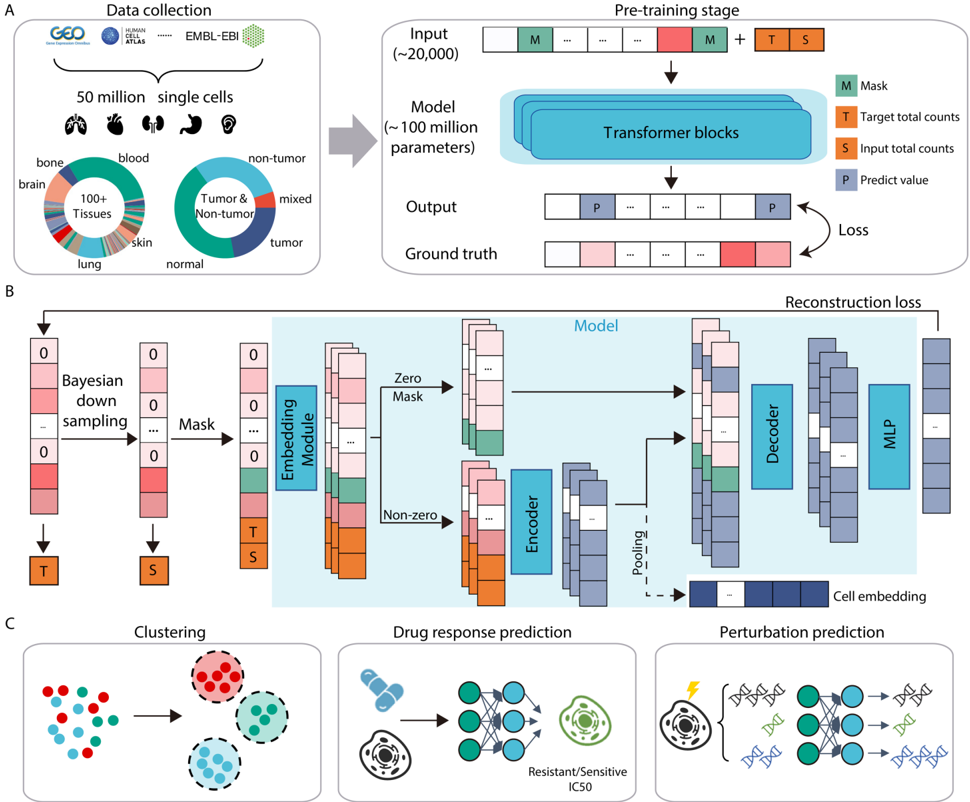
- Pretrained on >50 million human scRNA-seq profiles and 19,264 genes with 100M parameters, scFoundation is described as the largest model in parameter size, gene coverage, and data scale in the single-cell field.
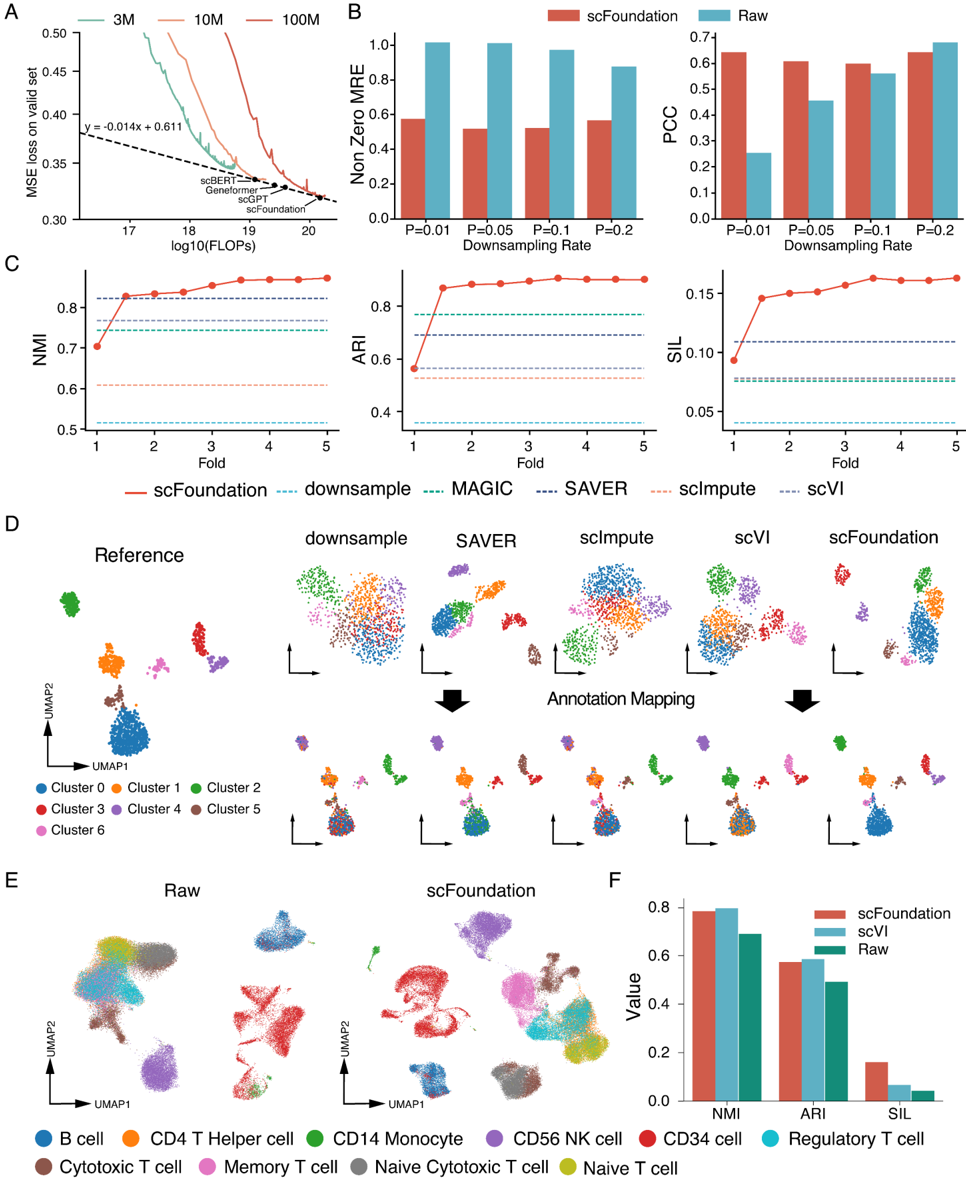
- For read-depth enhancement without fine-tuning, scFoundation reduced MAE and MRE by half versus the non-enhanced baseline; when downsampling was below 10%, baseline MRE was 97.5% while scFoundation maintained an MRE of 60%. On the Zheng68K PBMC dataset (~600,000 cells), scFoundation embeddings had comparable NMI and ARI to scVI and a higher SIL score.
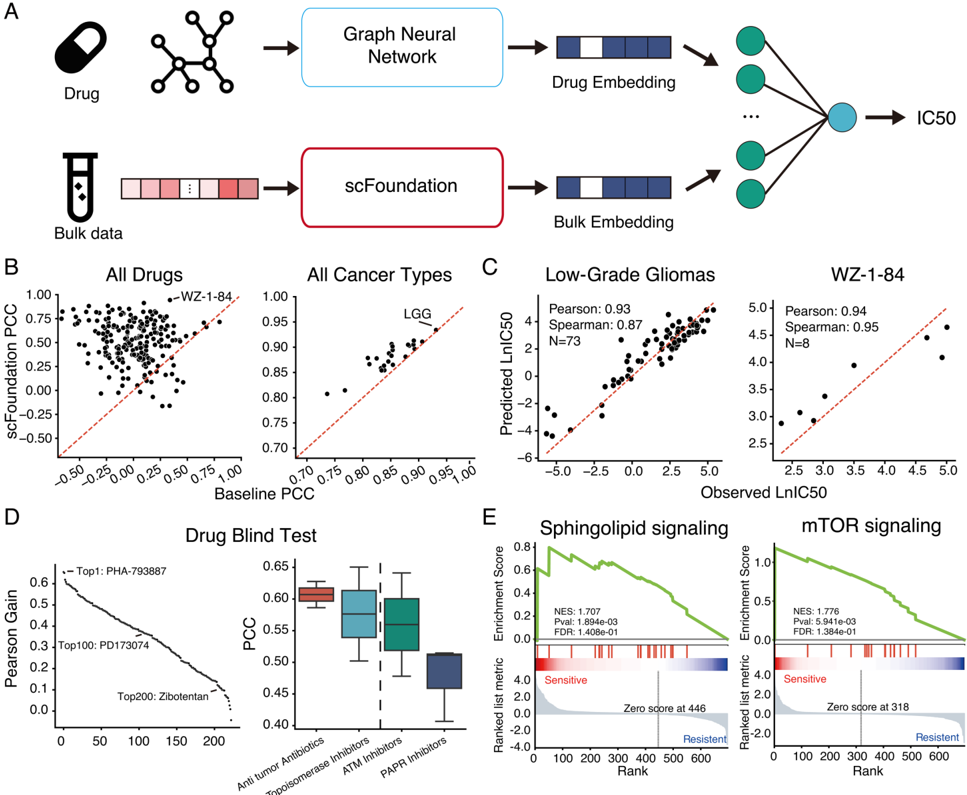
- In cancer drug response prediction with DeepCDR, scFoundation embeddings improved PCC for most drugs and all cancer types; in leave-one-drug-out blind tests, PHA-793887 improved from PCC 0.07 to 0.73 and Zobotentan from 0.49 to 0.64, with the best case achieving PCC above 0.93.
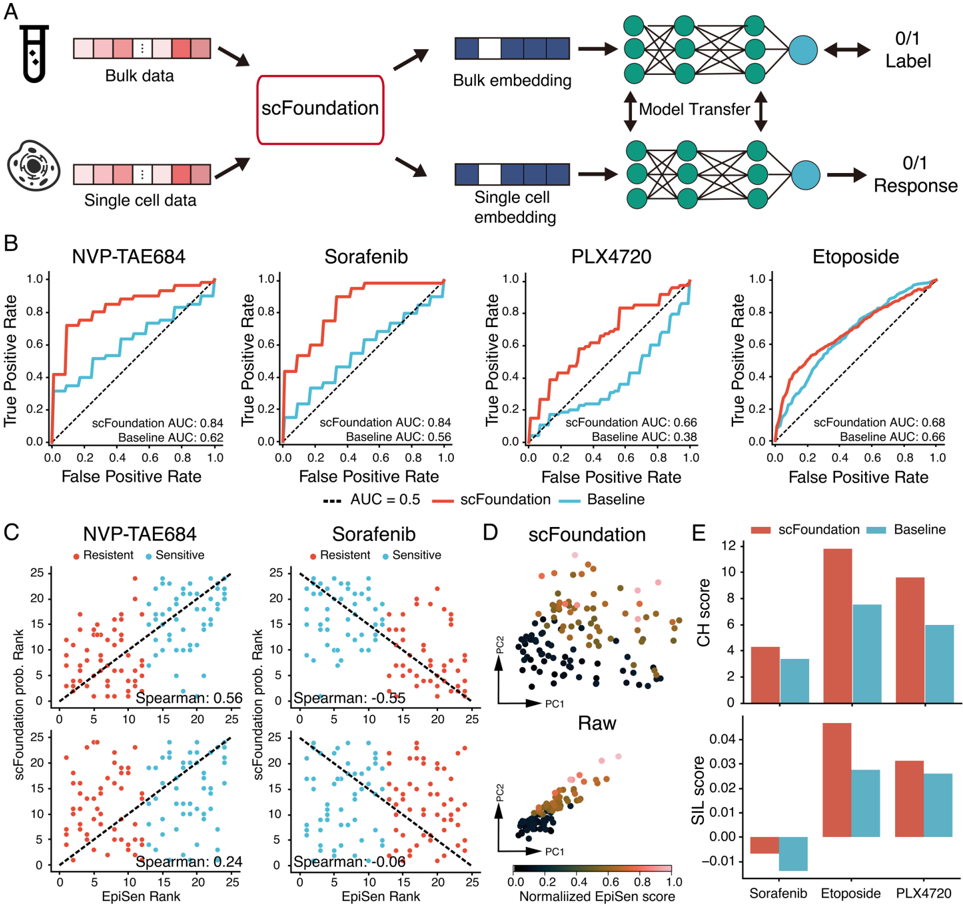
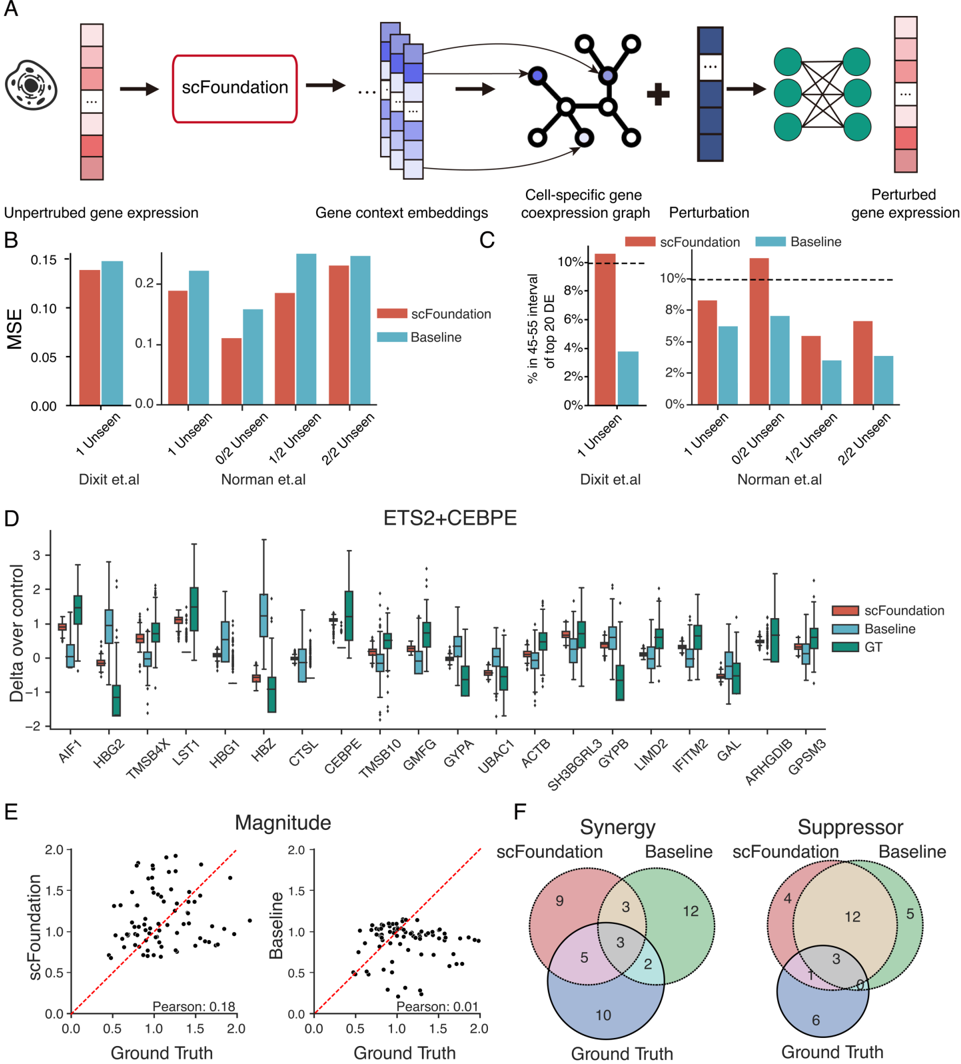
- In single-cell drug response classification, scFoundation embeddings achieved higher AUROC for all four tested drugs; for NVP-TAE684 and Sorafenib, AUROC improved by above 0.2, and Spearman correlations with EpiSen scores were 0.56 and −0.55 versus baseline 0.24 and −0.06. In perturbation prediction, scFoundation-combined GEARS achieved lower MSE on all 1-gene perturbation datasets and the lowest MSE in the 0/2 unseen 2-gene case.
Methods
- Model architecture: xTrimoGene, an asymmetric encoder-decoder transformer with an embedding module that converts continuous gene expression scalars into learnable embeddings; the encoder processes only non-zero and non-masked expressed genes, while the decoder integrates all genes.
- Pretraining data and task: over 50 million human scRNA-seq profiles collected from GEO, Single Cell Portal, HCA, EMBL-EBI, and other resources, aligned to 19,264 genes and filtered for cells with >200 expressed genes; read-depth-aware modeling used hierarchical Bayesian downsampling, 30% masking, and MSE regression loss with total count indicators T and S.
- Downstream evaluation: pretrained cell or gene embeddings were fed into DeepCDR, SCAD, and GEARS without fine-tuning the pretrained model; metrics included MAE, MRE, PCC, NMI, ARI, SIL, AUROC, MSE, and Spearman correlation.
Limitations
- The paper does not include an explicit limitations section.
- Evident from the text: pretraining used only human scRNA-seq data, so generalization to other species or multi-omics settings is not demonstrated.
- Evident from the text: downstream performance depends on existing task-specific models (DeepCDR, SCAD, GEARS) and public datasets, and the paper does not quantify residual batch effects or technical noise beyond describing read-depth-aware pretraining as a mitigation.
Model-written summary. Check it against the paper before relying on it.
Integrity signals
Registry
Cites
Statistics
Figures
Verification
Claims the paper makes
2 Valid · 6 Not valid · 3 Not checked · 74 Own results and interpretations
The cited sources that could be checked couldn’t confirm or dispute this claim.
In the paper
“We developed a new pre-training task called the read-depth-aware (RDA) modeling, which was an extension of masked language modeling 16 , considering single-cell gene expression data had a high variance in read depth, especially in the large-scale pre-training data.”
§ Large Scale Foundation Model on Single-cell Transcriptomics > The scFoundation pre-training framework
What the sources say
- Could not verifycites [16] Choromanski, K. et al. Rethinking Attention with Performers. Preprint at https://doi.org/10.48550/arXiv.2009.14794 (2022). sourceExperimental — accuracy not yet measured
The Experiments section (p. 6) mentions masked language modelling as a task used to evaluate Performers, but does not describe read-depth-aware modelling or an extension of that task. Searches for RDA, read depth, and single-cell gene expression found no passage addressing the attributed claim. (LLM, conf=0.75)
plain- Asserted: passes — The authors put it forward as true.
- Checkable: passes — It can be checked against evidence.
- Load-bearing: passes — The paper’s conclusions depend on it.
- Based: passes — The paper gives a reason why it holds.
- Could not verify
None of the sources cited for this claim have been checked yet.
In the paper
“Existing work had to restrict their models to a small list of selected genes.”
§ Large Scale Foundation Model on Single-cell Transcriptomics > Introduction
What the sources say
- Could not verifycites [8] Papatheodorou, I. et al. Expression Atlas update: from tissues to single cells. Nucleic Acids Research 48, D77-D83 (2020). sourceExperimental — accuracy not yet measured
The Introduction describes Single Cell Expression Atlas as a source of expression matrices for downstream computational methods, and the Data analysis section describes its quantification pipeline. Neither addresses whether earlier pre-training models had to use a small, selected gene list. Searches for pre-training, model limitations, and gene selection found no passage supporting that claim. (LLM, conf=0.76)
- Not checked yetcites [9] Svensson, V., Vento-Tormo, R. & Teichmann, S. A. Exponential scaling of single-cell RNA-seq in the past decade. Nature Protocols 13, 599-604 (2018). source
Checked before — its earlier verdict is held back until a new check runs.
- Could not verifycites [10] Brown, T. B. et al. Language Models are Few-Shot Learners. Preprint at https://doi.org/10.48550/arXiv.2005.14165 (2020). sourceExperimental — accuracy not yet measured
The Introduction (p. 3) discusses pre-trained language models and task-specific datasets, not single-cell gene expression. Searches for single-cell gene expression, selected genes, and restrictions to a small gene list found no passage addressing the claim. (LLM, conf=0.78)
- Could not verifycites [11] Zhao, W. X. et al. A Survey of Large Language Models. Preprint at https://doi.org/10.48550/arXiv.2303.18223 (2023). sourceExperimental — accuracy not yet measured
The Pre-training section (p. 4) discusses language-model training corpora, not single-cell gene-expression data. Searches for “single-cell gene expression selected genes” and “gene expression genes” found no passage addressing whether earlier models were restricted to a small list of genes. (LLM, conf=0.76)
plainstates a cause- Asserted: passes — The authors put it forward as true.
- Checkable: passes — It can be checked against evidence.
- Load-bearing: passes — The paper’s conclusions depend on it.
- Based: passes — The paper gives a reason why it holds.
- Could not verify
The cited sources support only part of this claim — read each source’s verdict below.
In the paper
“We constructed a comprehensive single-cell gene expression data set by collecting data from all publicly available single-cell resources, including GEO 17 , Single Cell Portal, HCA 4 , EMBL-EBI 18 , etc.”
§ Large Scale Foundation Model on Single-cell Transcriptomics > The scFoundation pre-training framework
What the sources say
- Could not verifycites [17] Ma, X. et al. Luna: Linear Unified Nested Attention. Preprint at http://arxiv.org/abs/2106.01540 (2021). sourceExperimental — accuracy not yet measured
Our copy of Luna (arXiv 2106.01540) is entirely about linear nested attention for sequence modelling; every data passage concerns NLP/vision benchmarks — the Abstract's three benchmarks, §4.1's Long Range Arena tasks (ListOps, Text, Retrieval, Image, Pathfinder), WMT'14 English-German (4.5M sentence pairs, Additional information), GLUE/QA (Table 6), and MLM pre-training on BookCorpus/Wikipedia/CC-News/OpenWebText/Stories. Nothing in it addresses single-cell gene expression, GEO, Single Cell Portal, HCA or EMBL-EBI (searched: 'single-cell gene expression dataset collection from public resources', 'scRNA-seq single cell RNA sequencing gene expression GEO Human Cell Atlas EMBL-EBI'). The cited sentence therefore cannot be checked against this source; our copy neither supports nor contradicts it. (LLM, conf=0.72)
- Partly supportedcites [4] Chen, S. et al. hECA: The cell-centric assembly of a cell atlas. iScience 25, 104318 (2022). sourceExperimental — accuracy not yet measured
The hECA 'Dataset collection' section (STAR Methods > Method details) does state the same ambition as the claim — 'collecting all accessible human single-cell data into a unified atlas' — and the Abstract/Introduction confirm it assembled a single-cell gene expression resource (1,093,299 cells, 116 published datasets, 38 organs) from scattered public data. But the realized scope is narrower than 'all publicly available single-cell resources': they selected 20–21 peer-reviewed studies, transcriptomic data of healthy donors only, and the Discussion concedes 'the number of cells in hECA v1.0 is still small and the coverage of organs and cell types is very limited'. Our copy also never lists Single Cell Portal, HCA, or EMBL-EBI as the repositories collected from (only GEO accessions and an NCBI BioProject appear, in the COVID-19 validation experiments), so that enumeration is not supported by this source. (LLM, conf=0.72)
- Partly supportedcites [18] Gong, J. et al. xTrimoGene: An Efficient and Scalable Representation Learner for Single-Cell RNA-Seq Data. 2023.03.24.534055 Preprint at https://doi.org/10.1101/2023.03.24.534055 (2023). sourceExperimental — accuracy not yet measured
Our copy confirms the large curated pre-training data set: the Additional information section states 'we curated about 5 million scRNA-seq data for training' processed with a unified pipeline. However, it attributes collection to a single repository, not 'all publicly available single-cell resources': 'Recently, scRNA-seq data ... mostly has been uploaded to the Gene Expression Omnibus (GEO) repository ... We collected data from GEO' and 'all the scRNA-seq data are collected from the Gene Expression Omnibus (GEO) repository with a keyword searching and data retrieval process.' Searches for HCA / Human Cell Atlas, EMBL-EBI and Single Cell Portal returned no data-source passage in our copy, so the multi-resource scope the citing sentence claims is not supported by this paper. (LLM, conf=0.82)
plain- Asserted: passes — The authors put it forward as true.
- Checkable: passes — It can be checked against evidence.
- Load-bearing: passes — The paper’s conclusions depend on it.
- Based: passes — The paper gives a reason why it holds.
- Could not verify
A result the paper reports from its own data — it cites no other source for it, so there is none to check. The quote shows it is in the paper.
In the paper
“From a cell ontology perspective, the data encompassed almost all known human cell types and cell states.”
§ Large Scale Foundation Model on Single-cell Transcriptomics > The scFoundation pre-training framework
plain- Asserted: passes — The authors put it forward as true.
- Checkable: passes — It can be checked against evidence.
- Load-bearing: passes — The paper’s conclusions depend on it.
- Based: passes — The paper gives a reason why it holds.
A result the paper states — it cites no source for it, so there is none to check. The quote shows it is in the paper.
In the paper
“We observed that, based on scFoundation-predicted results, drugs belonging to chemotherapy, such as anti-tumor antibiotics and topoisomerase inhibitors, had a higher PCC than drugs belonging to targeted therapy, such as ATM and PARP inhibitors (Fig. 3C right).”
§ Large Scale Foundation Model on Single-cell Transcriptomics > scFoundation improves cancer drug response prediction
plainstates an association- Asserted: passes — The authors put it forward as true.
- Checkable: passes — It can be checked against evidence.
- Load-bearing: unclear — It is unclear whether the paper’s conclusions depend on it.
- Based: passes — The paper gives a reason why it holds.
37 more claims
Create a free account to see all 85 claims and to verify the 5 references still open.
- Probably not a substantial claim. 13
- It may state two separate claims as one. 36
- The quote only partly states this claim. 2
Claims other papers make about this one
Each is checked against this paper’s own text: does it say what the citing paper says it does?
The source backs part of the claim, not all of it — or backs it for a different population, condition or comparison.
In the citing paper
“Compared to tasks such as cell annotation and batch correction, perturbation prediction offers experimentally generated model input/output with well-defined objectives, making it a more robust benchmark for assessing foundation models (15, 20, 21).”
From A systematic comparison of single-cell perturbation response prediction models (2026) · cites this paper as [21]
Experimental — accuracy not yet measuredThe source backs part of the claim, not all of it — or backs it for a different population, condition or comparison.
In the citing paper
“These models are pre-trained on vast amounts (> 10 M examples) of unlabelled scRNA-seq data, with the aim that such large datasets allow the models to capture general principles of gene regulation and signalling.”
From Benchmarking foundation cell models for post-perturbation RNA-seq prediction (2025) · cites this paper as [7]
Experimental — accuracy not yet measuredIn the citing paper
“scFoundation [15] strengthens the modular design, aiming to combine different modules to adapt to a variety of single-cell tasks, and is very flexible and scalable.”
From Challenges in AI-driven Biomedical Multimodal Data Fusion and Analysis (2025) · cites this paper as [15]
Self-check
Percentages, sums and reported differences re-computed from the paper’s own numbers.
Each contradiction between two passages listed here was confirmed by an independent check.
Rated minor: it would not touch a result — a value no result rests on, a p-value that stays on the same side of the significance level, or a conflict that is clerical, resolved elsewhere in the paper, or outside its own findings.
In the paper
§ Large Scale Foundation Model on Single-cell Transcriptomics > scFoundation predicts more accurate perturbation responses
“the Adamson dataset 49 with 87 1-gene perturbations”
§ Large Scale Foundation Model on Single-cell Transcriptomics > References
“49. Rood, J. E., Maartens, A., Hupalowska, A., Teichmann, S. A. & Regev, A. Impact of the Human Cell Atlas on medicine. Nat Med 28, 2486-2496 (2022).”
Rated minor: it would not touch a result — a value no result rests on, a p-value that stays on the same side of the significance level, or a conflict that is clerical, resolved elsewhere in the paper, or outside its own findings.
In the paper
§ Large Scale Foundation Model on Single-cell Transcriptomics > scFoundation predicts more accurate perturbation responses
“We combined the scFoundation with an advanced model GEARS 51 for the perturbation prediction task.”
§ Large Scale Foundation Model on Single-cell Transcriptomics > References
“51. Dixit, A. et al. Perturb-Seq: Dissecting Molecular Circuits with Scalable Single-Cell RNA Profiling of Pooled Genetic Screens. Cell 167, 1853-1866.e17 (2016).”
Rated minor: it would not touch a result — a value no result rests on, a p-value that stays on the same side of the significance level, or a conflict that is clerical, resolved elsewhere in the paper, or outside its own findings.
In the paper
§ Large Scale Foundation Model on Single-cell Transcriptomics > scFoundation transfers bulk-level drug sensitivity prediction model to single-cell data
“based on the SCAD 44 downstream model.”
§ Large Scale Foundation Model on Single-cell Transcriptomics > References
“44. Jerby-Arnon, L. et al. A Cancer Cell Program Promotes T Cell Exclusion and Resistance to Checkpoint Blockade. Cell 175, 984-997.e24 (2018).”
Citations
Cites
BERT: Pre-training of Deep Bidirectional Transformers for Language Understanding
Devlin, J., Chang, M.-W., Lee, K., & Toutanova, K. (2018) · arXiv · doi:10.48550/arxiv.1810.04805 · Cited by 73,173
Scikit-learn: Machine Learning in Python
Pedregosa, F., Varoquaux, G., Gramfort, A., Michel, V., Thirion, B., Grisel, O., Blondel, M., Müller, A., Nothman, J., Louppe, G., et al. (2012) · arXiv · doi:10.48550/arxiv.1201.0490 · Cited by 71,016
Subramanian, A., Tamayo, P., Mootha, V. K., Mukherjee, S., Ebert, B. L., Gillette, M. A., Paulovich, A., Pomeroy, S. L., Golub, T. R., Lander, E. S., et al. (2005) · Proceedings of the National Academy of Sciences · doi:10.1073/pnas.0506580102 · Cited by 53,625
KEGG: Kyoto Encyclopedia of Genes and Genomes
Kanehisa, M. (2000) · Nucleic Acids Research · doi:10.1093/nar/28.1.27 · Cited by 37,077
KEGG: Kyoto Encyclopedia of Genes and Genomes
Ogata, H., Goto, S., Sato, K., Fujibuchi, W., Bono, H., & Kanehisa, M. (1999) · Nucleic Acids Research · doi:10.1093/nar/27.1.29 · Cited by 31,232 · cited 1×
“According to the Kyoto Encyclopedia of Genes and Genome database 41 , this pathway was related to sphingomyelin and its metabolism.”
Language Models are Few-Shot Learners
Brown, T. B., Mann, B., Ryder, N., Subbiah, M., Kaplan, J., Dhariwal, P., Neelakantan, A., Shyam, P., Sastry, G., Askell, A., et al. (2020) · arXiv · doi:10.48550/arxiv.2005.14165 · Cited by 23,372 · cited 5×
“Please refer to Supplementary Notes 9 and 10 for details of the sampling strategy and count indicators calculation.”
InfluentialIntegrated analysis of multimodal single-cell data
Hao, Y., Hao, S., Andersen-Nissen, E., Mauck, W. M., Zheng, S., Butler, A., Lee, M. J., Wilk, A. J., Darby, C., Zagar, M., et al. (2020) · doi:10.1101/2020.10.12.335331 · Cited by 15,508
Kaugeranna, R., Kaugeranna, E., & Aion, (. S. 4. 6. (2023) · DROPS (Schloss Dagstuhl – Leibniz Center for Informatics) · doi:10.4230/lipics.giscience.2023.43 · Cited by 13,690
Gene Expression Omnibus: NCBI gene expression and hybridization array data repository
Edgar, R. (2002) · Nucleic Acids Research · doi:10.1093/nar/30.1.207 · Cited by 13,288 · cited 3×
“…a comprehensive single-cell dataset by collecting data from all publicly available single-cell resources, including Gene Expression Omnibus (GEO) 22 , Single Cell Portal, HCA 3 , human Ensemble Cell Atlas (hECA) 4 , Deeply Integrated human Single-Cell Omics data (DISCO) 7 , European Molecular…”
Scaling Laws for Neural Language Models
Kaplan, J., McCandlish, S., Henighan, T., Brown, T. B., Chess, B., Child, R., Gray, S., Radford, A., Wu, J., & Amodei, D. (2020) · arXiv · doi:10.48550/arxiv.2001.08361 · Cited by 9,550 · cited 1×
“This is a large-scale model of large parameter size, gene coverage and data scale in the single-cell field.”
Research works printed but not linked: 1
- He, K. et al. in Proc. IEEE/CVF Conference on Computer Vision and Pattern Recognition 16000–16009 (IEEE, 2022).
Cited by
Items 101–200 of 638
Guo, Y., Zhang, H., Hu, H., Wu, J., Cao, J., Hsieh, C., & Yang, B. (2026) · Nature Machine Intelligence · doi:10.1038/s42256-025-01165-w · Cited by 25
“Although the advent of single-cell large models has advanced the characterization of cellular context 11–13 , they struggle with zero-shot adaptation of the post-treatment space 14,15 .”
InfluentialSelf-citationTranscriptFormer: A generative cell atlas across 1.5 billion years of evolution
Pearce, J. D., Simmonds, S. E., Mahmoudabadi, G., Krishnan, L., Palla, G., Istrate, A.-M., Tarashansky, A. J., Nelson, B. E., Valenzuela, O., Li, D., et al. (2026) · Science · doi:10.1126/science.aec8514 · Cited by 85
Unified modeling of 3D molecular generation via atomic interactions with PocketXMol
Peng, X., Guo, R., Guo, F., Wang, Z., Sun, J., Guan, J., Jia, Y., Xu, Y., Huang, Y., Zhang, M., et al. (2026) · Cell · doi:10.1016/j.cell.2026.01.003 · Cited by 22
Self-citationscPlantLLM: A Foundation Model for Exploring Single-cell Expression Atlases in Plants
Cao, G., Chao, H., Zheng, W., Lan, Y., Lu, K., Wang, Y., Chen, M., Zhang, H., & Chen, D. (2025) · Genomics Proteomics & Bioinformatics · doi:10.1093/gpbjnl/qzaf024 · Cited by 22
BioLLM: A standardized framework for integrating and benchmarking single-cell foundation models
Qiu, P. S., Chen, Q., Qin, H., Fang, S., Zhang, Y., Zhang, Y., Xia, T., Cao, L., Zhang, Y., Fang, X., et al. (2025) · Patterns · doi:10.1016/j.patter.2025.101326 · Cited by 33
“22–26 Leveraging the potential of foundation models to address the complexities of single-cell data analysis, several models, such as scBERT, 10 Geneformer, 11 scGPT, 12 and scFoundation, 13 have been developed to tackle specific challenges in this field.”
Foundation models in drug discovery: Phenomenal growth today, transformative potential tomorrow?
Delile, J., Mukherjee, S., Mueller, J., Khalil, I. G., Евгеньевич, Ж. Л., & Meier, C. (2025) · Drug Discovery Today · doi:10.1016/j.drudis.2025.104518 · Cited by 28
(2024) · Nature Methods · doi:10.1038/s41592-024-02391-7 · Cited by 20
Signals in the Cells: Multimodal and Contextualized Machine Learning Foundations for TherapeuticsPreprint
Velez-Arce, A., Lin, X., Li, M. M., Huang, K., Gao, W., Fu, T., Pentelute, B. L., Kellis, M., & Žitnik, M. (2024) · bioRxiv (Cold Spring Harbor Laboratory) · doi:10.1101/2024.06.12.598655 · Cited by 30
“Additionally, parallel efforts in training foundation models on large single-cell atlases have shown a potential to advance cell type annotation and matching of healthy-disease cells to study cellular signatures of disease [3, 42, 43, 44].”
Li, L., Dong, L., Zhang, H., Xu, D. H., & Li, Y. (2025) · Briefings in Bioinformatics · doi:10.1093/bib/bbaf304 · Cited by 29
“Notable examples include Geneformer [29], pre-trained on approximately 30 million cells using a self-supervised approach, and other ultra-large-scale scRNA-seq-based models such as scBERT [30], scGPT [31], and scFoundation [32].”
Emerging AI approaches for cancer spatial omics
Noorbakhsh, J., pour, A. F., & Chuang, J. H. (2025) · GigaScience · doi:10.1093/gigascience/giaf128 · Cited by 21
“…scBERT [ 43 ] uses gene2vec [ 44 ] to embed coexpression patterns into gene tokens, while binning the expression values. scGPT, scFoundation [ 45 ], and CellPLM [ 46 ] are foundation models whose resultant embeddings, whether fine-tuned or direct, can be used as inputs for various tasks.”
Machine learning to dissect perturbations in complex cellular systems
Monfort‐Lanzas, P., Rungger, K., Madersbacher, L., & Hackl, H. (2025) · Computational and Structural Biotechnology Journal · doi:10.1016/j.csbj.2025.02.028 · Cited by 24
“Foundation models based on transformer architectures have revolutionized scRNA-seq analysis through pretraining on diverse datasets to create scalable, generalized models [31,32].”
InfluentialInsights, opportunities, and challenges provided by large cell atlases
Hemberg, M., Marini, F., Ghazanfar, S., Al-Ajami, A., Abassi, N., Anchang, B., Benayoun, B. A., Cao, Y., Chen, K., Cuesta-Astroz, Y., et al. (2025) · Genome biology · doi:10.1186/s13059-025-03771-8 · Cited by 23
“Several groups have developed foundation models leveraging the large-scale data collected via cell atlas efforts, e.g., Geneformer [60], scGPT [61], scFoundation [62], scBERT [63], CellFM [64], UCE [65], and atlas approximations [66].”
Discovery of predictive biomarkers for cancer therapy through computational approaches
Wang, X., Nguyen, J., Nader, K. M., Miihkinen, M., Wall, P., Singhal, A., Bedard, P. L., Ideker, T., Aittokallio, T. A., & Haibe‐Kains, B. (2026) · Nature Reviews Clinical Oncology · doi:10.1038/s41571-025-01109-8 · Cited by 31
“…102 for EMRs; FMCIB 103 for radiomics; UNI 104 , Prov-GigaPath 105 and CHIEF 106 for pathology; scGPT 107 , Geneformer 108 and scFoundation 109 for single-cell transcriptomics; and scGPT-spatial 110 for spatial transcriptomics. scFoundation has been further fine-tuned on bulk-level gene…”
Cellular neighborhoods in cancer
Ma, L., Xiong, B., Liu, M., & Tan, K. (2026) · Nature Cancer · doi:10.1038/s43018-025-01107-w · Cited by 27
Toward learning a foundational representation of cells and genes
Lotfollahi, M. (2024) · Nature Methods · doi:10.1038/s41592-024-02367-7 · Cited by 14
Application of artificial intelligence large language models in drug target discovery
Liu, X., Zhang, J., Wang, X., Teng, M., Wang, G., & Zhou, X. (2025) · Frontiers in Pharmacology · doi:10.3389/fphar.2025.1597351 · Cited by 29
Scaling Dense Representations for Single Cell with Transcriptome-Scale ContextPreprint
Ho, N., Ellington, C. N., Hou, J., Addagudi, S., Mo, S., Tao, T., Li, D., Zhuang, Y., Wang, H., Cheng, X., et al. (2024) · bioRxiv (Cold Spring Harbor Laboratory) · doi:10.1101/2024.11.28.625303 · Cited by 26
Self-citationMultimodal foundation transformer models for multiscale genomics
Khan, S. A., Martinez‐de‐Morentin, X., Alsabbagh, A. R., Maillo, A., Lagani, V., Gómez-Cabrero, D., Lehmann, R., & Tegner, J. N. (2025) · Nature Methods · doi:10.1038/s41592-025-02918-6 · Cited by 31
“Although it improved annotation, rare cell types remain a challenge 39 . scFoundation, pretrained on 50 million cells 40 , extends beyond annotation to drug response prediction, imputation and clustering.”
A thousand and one tumors: the promise of AI for cancer biology
Fan, J. L., Nazaret, A., & Azizi, E. (2024) · Nature Methods · doi:10.1038/s41592-024-02364-w · Cited by 14
Cheng, J., Pan, X., Fang, Y., Yang, K., Xue, Y., Yan, Q., & Yuan, Y. (2024) · Briefings in Bioinformatics · doi:10.1093/bib/bbae525 · Cited by 27
“High-quality models such as scBERT [14], Geneformer [15], TOSICA [16], scGPT [17], scFoundation [18], SCimilarity [19], and GeneCompass [20] are capable of receiving the flexible input form of gene expression signatures due to their powerful generalization abilities.”
Sheinin, R., Sharan, R., & Madi, A. (2025) · Nature Methods · doi:10.1038/s41592-025-02627-0 · Cited by 31
“Whereas works such as that of Yang et al. 13 focused on specific tasks such as supervised cell annotation, more recent efforts 14–16 have focused on developing foundational models trained on extremely large scRNA-seq atlases, comprising tens of millions of cells.”
Large language models transform biological research: from architecture to utilization
Wang, T., & Luo, Z. (2025) · Science China Information Sciences · doi:10.1007/s11432-024-4466-3 · Cited by 14
“High-quality data are essential for training large models, but obtaining such datasets in biological omics is challenging due to issues like batch effects in RNA-seq data [29] and the impact of sequence mutations on tokenization [72].”
InfluentialSelf-citationSingle-cell gene expression prediction from DNA sequence at large contextsPreprint
Schweßinger, R., Deasy, J., Woodruff, R. T., Young, S., & Branson, K. (2023) · bioRxiv (Cold Spring Harbor Laboratory) · doi:10.1101/2023.07.26.550634 · Cited by 21
Foundation models in plant molecular biology: advances, challenges, and future directions
Xu, F., Wu, T., Qian, C., Wang, X., & Yan, J. (2025) · Frontiers in Plant Science · doi:10.3389/fpls.2025.1611992 · Cited by 24
Advances in plant spatial multi-omics data analysis
Yao, J., Marand, A. P., Bai, Y., Schmitz, R. J., & Fan, L. (2025) · Trends in Plant Science · doi:10.1016/j.tplants.2025.10.005 · Cited by 26
Bu, D., Sun, J., Li, K., He, Z., Huang, W., Hu, J., Zhang, S., Lei, S., Huo, P., Wang, Z., et al. (2026) · Nature Biomedical Engineering · doi:10.1038/s41551-026-01634-6 · Cited by 55
Self-citationApplication of Deep Learning for Single Cell Multi-Omics: A State-of-the-Art Review
Wani, S. A., Khan, S. A., & Quadri, S. (2025) · Archives of Computational Methods in Engineering · doi:10.1007/s11831-025-10230-x · Cited by 15
A platform for multimodal in vivo pooled genetic screens reveals regulators of liver functionPreprint
Saunders, R. A., Allen, W. E., Pan, X., Sandhu, J., Lu, J., Lau, T. K., Smolyar, K., Sullivan, Z. A., Dulac, C. G., Weissman, J. S., et al. (2024) · bioRxiv (Cold Spring Harbor Laboratory) · doi:10.1101/2024.11.18.624217 · Cited by 13
scDrugMap: benchmarking large foundation models for drug response prediction
Wang, Q., Pan, Y., Zhou, M., Tang, Z., Wang, Y., Wang, G., & Song, Q. (2025) · Nature Communications · doi:10.1038/s41467-025-67481-2 · Cited by 12
“Notably, certain models offer specialized capabilities — scFoundation for drug response prediction 15 , scGPT for multi-omics integration (e.g., gene expression and chromatin accessibility) 16 , and Geneformer for predicting gene dosage sensitivity and chromatin dynamics 17 .”
InfluentialPredicting drug responses of unseen cell types through transfer learning with foundation models
Wang, Y., Liu, X., Fan, Y., Xie, B., Cheng, J. S.-C., Wong, K. C., Cheung, P. P., King, I., & Li, Y. (2025) · Nature Computational Science · doi:10.1038/s43588-025-00887-6 · Cited by 20
“Recent single-cell foundation models (scFMs), such as Geneformer 23 , scGPT 24 , scFoundation 25 and SCimilarity 26 , encode biological information using language model frameworks.”
Artificial Intelligence Revolution in Transcriptomics: From Single Cells to Spatial Atlases
Li, S., Xiao, T., Lan, Y., Wu, C., Li, Z., Liu, R., Fang, Q., & Zhang, C. (2025) · Advanced Science · doi:10.1002/advs.202518949 · Cited by 15
Single‐Cell and Spatial Omics: Methods and Applications
Cen, X., Huang, X., Deng, E., Gong, X., Tan, N., Ye, J. T., Wang, Y., Eils, R., Luo, Q., Li, Y., et al. (2026) · MedComm · doi:10.1002/mco2.70713 · Cited by 18
Current opinions on large cellular models
Hao, M., Wei, L., Yang, F., Yao, J., Theodoris, C. V., Wang, B., Li, X., Yang, G., & Zhang, X. (2024) · Quantitative Biology · doi:10.1002/qub2.65 · Cited by 13
“Inspired by those successes, several large cellular models (LCMs) adopting similar structures of LLMs have been developed for single ‐ cell transcriptomics, including (but not limited to) scBERT [5], Geneformer [6], scGPT [7], scFoundation [8], and GeneCompass [9].”
Self-citationStack: In-Context Learning of Single-Cell BiologyPreprint
Dong, M., Adduri, A., Gautam, D., Wu, L., Kernick, C., Coons, M. M., Chih, Y.-C., Carpenter, C., Shah, R. M., Ricci-Tam, C., et al. (2026) · bioRxiv (Cold Spring Harbor Laboratory) · doi:10.64898/2026.01.09.698608 · Cited by 50
“This data explosion has enabled the development of single-cell foundation models that leverage self-supervised learning to extract meaningful cellular representations from massive datasets (Theodoris et al., 2023; Cui et al., 2024; Rosen et al., 2023; Hao et al., 2024; Ding et al., 2025).”
Interpretation, extrapolation and perturbation of single cells
Dimitrov, D., Schrod, S., Rohbeck, M., & Stegle, O. (2026) · Nature Reviews Genetics · doi:10.1038/s41576-025-00920-4 · Cited by 39
On scientific foundation models: Rigorous definitions, key applications, and a comprehensive survey
Menon, S. S., Mondal, T., Brahmachary, S., Panda, A., Joshi, S. M., Kalyanaraman, K., & Jagtap, A. D. (2026) · Neural Networks · doi:10.1016/j.neunet.2026.108567 · Cited by 12
A unified time-frequency foundation model for sleep decoding
Huang, W., Wang, Y., Cheng, H., Xu, W., Li, T., Wu, X., Xu, H., Liao, P., Cui, Z., Zou, Q., et al. (2026) · Nature Communications · doi:10.1038/s41467-025-67970-4 · Cited by 27
Perspectives on benchmarking foundation models for network biology
Theodoris, C. V. (2024) · Quantitative Biology · doi:10.1002/qub2.68 · Cited by 14
Yan, Y., Yang, Y., Tong, Z., Wang, Y., Yang, F., Pan, Z., Liu, C., Bai, M., Xie, Y., Li, Y., et al. (2025) · Journal of Pharmaceutical Analysis · doi:10.1016/j.jpha.2025.101275 · Cited by 15
Self-citationLi, J., Zhang, W., & Dai, Q. (2025) · Computational Biology and Chemistry · doi:10.1016/j.compbiolchem.2025.108483 · Cited by 13
Zhou, M., Luo, Z., Yin, Y.-H., Liu, Q., Wang, G., & Zhao, Y. (2025) · Briefings in Bioinformatics · doi:10.1093/bib/bbaf268 · Cited by 13
“Domain-specific models, such as scFoundation [10] and Geneformer [11], exemplify the power of LLMs in RNA-seq tasks.”
Wang, C., Karimzadeh, M., Ravindra, N. G., Bounds, L. R., Alerasool, N., Huang, A., Ma, S., Gulbranson, D. R., Cui, H., Lee, Y., et al. (2026) · bioRxiv (Cold Spring Harbor Laboratory) · doi:10.64898/2026.03.18.712807 · Cited by 28
Advancing plant single-cell genomics with foundation models
Chau, T. N., Wang, X., McDowell, J. M., & Li, S. (2024) · Current Opinion in Plant Biology · doi:10.1016/j.pbi.2024.102666 · Cited by 17
Tan, Y., Xie, L., Yang, H. T., Zhang, Q., Luo, J., & Zhang, Y. (2024) · Briefings in Bioinformatics · doi:10.1093/bib/bbae617 · Cited by 14
Zhu, O., & Li, J. (2025) · Nature Computational Science · doi:10.1038/s43588-025-00912-8 · Cited by 17
“21, 22 and 23 , respectively) and evaluated all models on the Adamson and Norman datasets.”
PlantCAD2: a DNA foundation model for interpreting genomes across flowering plantsPreprint
Zhai, J., Gokaslan, A., Hsu, S., Chen, S.-P., Liu, Z.-Y., Marroquin, E., Czech, E., Cannon, B. R., Berthel, A., Romay, M. C., et al. (2025) · bioRxiv (Cold Spring Harbor Laboratory) · doi:10.1101/2025.08.27.672609 · Cited by 12
Harnessing omics to decode the mechanisms of symbiotic nitrogen fixation
Ye, K., Zheng, J., Dong, Z., Wang, S., & Huang, S. (2025) · aBIOTECH · doi:10.1007/s42994-025-00208-5 · Cited by 10
“Notably, recent AI tools have made impressive progress in addressing this challenge (Dudnyk et al. 2024; Hao et al. 2024; Kaplow et al. 2023).”
Advancing active compound discovery for novel drug targets: insights from AI-driven approaches
Wang, X.-Y., Chen, Y., Li, Y.-F., Wei, C., Liu, M.-Y., Yuan, C.-X., Zheng, Y.-Y., Qin, M.-H., Sheng, Y.-F., Tong, X., et al. (2025) · Acta Pharmacologica Sinica · doi:10.1038/s41401-025-01591-x · Cited by 18
“Representative models include scBERT [82], Geneformer [83], scFoundation [84], and scGPT [85].”
CAPTAIN: a multimodal foundation model pretrained on co-assayed single-cell RNA and protein
Ji, B., Hu, T., Wang, J., Liu, M., Xu, L., Zhang, Q., Zhong, S., Qiao, L., Zhang, Y., Peng, S., et al. (2026) · Nature Communications · doi:10.1038/s41467-026-72882-y · Cited by 22
Approaching the holistic transcriptome—convolution and deconvolution in transcriptomics
Wolfram-Schauerte, M., Vogel, T., Tuoken, H., Savitski, M. F., Simon, E., & Nieselt, K. (2025) · Briefings in Bioinformatics · doi:10.1093/bib/bbaf388 · Cited by 14
“Now, scientists make use of them in the field of transcriptomics, outperforming state-of-the-art tools in various aspects including scGPT, scFoundation (bothtrainedonscRNA-seqdata),orBulkRNABert(trainedonbulk RNA-seq data) [126–128].”
Decoding immune aging at single-cell resolution
Wang, Y., Ke, D., Chen, Y., Zhang, C., Liu, W., Chen, L., & Pu, J. (2025) · Trends in Immunology · doi:10.1016/j.it.2025.09.001 · Cited by 11
A multimodal cell-free RNA language model for liquid biopsy applications
Karimzadeh, M., Sababi, A. M., Momen-Roknabadi, A., Chen, N.-C., Cavazos, T. B., Sekhon, S., Wang, J., Hanna, R., Huang, A., Nguyen, D. L. T., et al. (2025) · Nature Machine Intelligence · doi:10.1038/s42256-025-01148-x · Cited by 15
“Models such as scBERT 19 , Exceiver 20 , GeneCompass 21 , scFoundation 22 , Geneformer 23 , scGPT 24 and UCE 25 have demonstrated efficacy in tasks such as cell-type classification and gene expression imputation.”
PhenoProfiler: advancing phenotypic learning for image-based drug discovery
Li, B., Zhang, B., Zhang, C., Zhou, M., Huang, W., Wang, S., Wang, Q., Li, M., Zhang, Y., & Song, Q. (2025) · Nature Communications · doi:10.1038/s41467-025-67479-w · Cited by 16
“Second,recentadvancementsinlargebiomedicallanguage models 37 – 40 offer opportunities to integrate extensive domain knowledge into computational frameworks.”
Foundation Models Meet Medical Image Interpretation
Jiao, L., Hao, J., Li, R., Li, L., Liu, X., Liu, F., Ma, W., Chen, P., Huang, Z., Yang, J., et al. (2026) · Research · doi:10.34133/research.1024 · Cited by 20
Generalist biological artificial intelligence in modeling the language of life
Rao, V. M., Zhang, S., Plosky, B. S., Hsu, P. D., Wang, B., Zou, J., Žitnik, M., Topol, E. J., & Rajpurkar, P. (2026) · Nature Biotechnology · doi:10.1038/s41587-026-03064-w · Cited by 21
“…limited in efficacy at their current stage, many single-cell models attempt to simulate genetic perturbations to reveal therapeutic candidates 49,50,51 , and, as more robust and cross-domain GBAI models are developed that can account for multiple abstractions of cellular processing, they can…”
Transfer learning of multicellular organization via single-cell and spatial transcriptomics
Tan, Y., Wang, A., Wang, Z., Lin, W., Yan, Y., Nie, Q., & Shi, J. (2025) · PLoS Computational Biology · doi:10.1371/journal.pcbi.1012991 · Cited by 11
“As large models in the single-cell domain are developing rapidly, models like scGPT [68] and scFoun-dation [69] demonstrate the feasibility and benefits of using large-scale pretrained models in understanding complex biological data.”
Toward mastering the cell language by learning to generatePreprint
Chen, Y., Bian, H., Wei, L., Jia, J., Dong, X., Li, Y., Zhao, Y., Wu, X., Li, C., Luo, E., et al. (2024) · bioRxiv (Cold Spring Harbor Laboratory) · doi:10.1101/2024.01.25.577152 · Cited by 13
Self-citationTheus, A., Barkmann, F., Wissel, D., & Boeva, V. (2024) · bioRxiv (Cold Spring Harbor Laboratory) · doi:10.1101/2024.11.01.621087 · Cited by 13
“…dedicated to extending foundation models beyond text and image data to encompass a wide range of data modalities, including audio (Yang et al., 2023), brain signals (Caro et al., 2024), and, of particular relevance to our work, scRNA-seq (Cui et al., 2023; Rosen et al., 2023; Hao et al., 2023).”
BackgroundMethodInfluentialDing, J., Lin, J., Jiang, S., Wang, Y., Miao, Z., Fang, Z., Tang, J., Li, M., & Qiu, X. (2025) · bioRxiv (Cold Spring Harbor Laboratory) · doi:10.1101/2025.01.06.631427 · Cited by 13
SCARF: Single Cell ATAC-seq and RNA-seq Foundation modelPreprint
Liu, G., Zhao, Y., Zhao, Y., Wang, T., Cai, Q., Wang, X. H., Wen, Z., Lin, L., Yang, G., & Chen, J. (2025) · bioRxiv (Cold Spring Harbor Laboratory) · doi:10.1101/2025.04.07.647689 · Cited by 13
“6c) revealed accuracy, macro F1, recall, and precision scores above 0.75, better than single modality foundation model scFoundation 14 .”
InfluentialSelf-citationVirtual Cells Need Context, Not Just ScalePreprint
Dibaeinia, P., Babu, S., Knudson, M. K., ElSheikh, A., Wen, Y., Liu, H., Perera, J. F., & Khan, A. A. (2026) · bioRxiv (Cold Spring Harbor Laboratory) · doi:10.64898/2026.02.04.703804 · Cited by 28
“Ahlmann-Eltze et al. (2025) systematically compared single cell foundation models (scGPT (Cui et al., 2024), scFoundation Hao et al. (2024), Geneformer (Theodoris et al., 2023), scBERT (Yang et al., 2022), UCE (Rosen et al., 2023)) and deep learning perturbation methods (GEARS Roohani et al.…”
Foundation Models Improve Perturbation Response PredictionPreprint
Cole, E., Huizing, G.-J., Addagudi, S., Ho, N., Hasanaj, E., Kuijs, M., Johnstone, T., Carilli, M., Davi, A., Ellington, C. N., et al. (2026) · bioRxiv (Cold Spring Harbor Laboratory) · doi:10.64898/2026.02.18.706454 · Cited by 19
“Most recently, transformer-based architectures have been adapted from the mainstream ML community, leading to models like Geneformer [28], scFoundation [29], and scGPT [30], which pretrain on massive single-cell atlases and provide schemes to use the FM for perturbation response prediction.”
Self-citationBai, D., Mo, S., Zhang, R., Luo, Y., Gao, J., Yang, J. P., Wu, Q., Rahmani, H., Amariuta, T., Grotjahn, D., et al. (2026) · Nature Communications · doi:10.1038/s41467-026-69102-y · Cited by 15
“Current models 8 – 10 rely predominantly on patterns derived solely from gene expression data, which restricts their ability to capture context related togenefunctionsandregulatoryinteractions.”
InfluentialArtificial intelligence in cell annotation for high-resolution RNA sequencing data
Hou, N., Lin, X., Lin, L., Zeng, X., Zhong, Z., Wang, X., Cheng, R., Lin, X., Yang, C. J., & Song, J. T. (2024) · TrAC Trends in Analytical Chemistry · doi:10.1016/j.trac.2024.117818 · Cited by 10
Self-citationCytometry masked autoencoder: An accurate and interpretable automated immunophenotyper
Kim, J., Ionita, M., Lee, M., McKeague, M. L., Pattekar, A., Painter, M. M., Wagenaar, J., Truong, V., Norton, D. T., Mathew, D., et al. (2024) · Cell Reports Medicine · doi:10.1016/j.xcrm.2024.101808 · Cited by 13
SCassist: an AI based workflow assistant for single-cell analysis
Nagarajan, V., Shi, G., Arunkumar, S., Liu, C., Gopalakrishnan, J., Nath, P. R., Jang, J., & Caspi, R. R. (2025) · Bioinformatics · doi:10.1093/bioinformatics/btaf402 · Cited by 9
Self-citationWang, T., Pan, Y., Ju, F., Zheng, S., Liu, C., Min, Y., Jiang, Q., Liu, X., Xia, H., Liu, G., et al. (2025) · Nature Cell Biology · doi:10.1038/s41556-025-01755-1 · Cited by 12
“Consistent with the previous practices in single-cell foundation models 12,13,17 and cell-type-specific protein representation 77 learning, we expect this filtering to help reduce noise and highlight biologically relevant interactions.”
Self-citationHuman-scATAC-Corpus: a comprehensive database of scATAC-seq data
Chen, X., Gao, Z., Li, K., Wang, Z., Jiang, Q., Cui, X., Li, Z., & Jiang, R. (2025) · Nucleic Acids Research · doi:10.1093/nar/gkaf1216 · Cited by 12
Machine Learning Models for Cancer Research: A Narrative Review of Bulk RNA-Seq Applications
Pudova, E. A., Pavlov, V., Guvatova, Z. G., Fedorova, M., Шегай, П. В., Kudryavtseva, A. V., & Snezhkina, A. V. (2025) · International Journal of Molecular Sciences · doi:10.3390/ijms262412081 · Cited by 12
“Another transformer-based model, scFoundation, was pre-trained on over 50 million gene expression profiles [83].”
Artificial Intelligence agents for biological research: a survey
Qi, C., Wang, W., Jiang, S., Liu, Q., Song, X., Fang, H., & Wei, Z. (2026) · Briefings in Bioinformatics · doi:10.1093/bib/bbag075 · Cited by 24
Cell-free chromatin state tracing reveals disease origin and therapy responses
Chen, X., Meng, X., Zhang, W., Zhang, X., Zhang, Y., Yang, P., Liu, Y., Bao, F., Li, S., Wang, J., et al. (2026) · Nature · doi:10.1038/s41586-026-10224-0 · Cited by 14
Self-citationAI-Driven Chemometrics for Multi-omics Data Integration: Advances, Challenges, and Future Directions
Polu, P. R. (2026) · Critical Reviews in Analytical Chemistry · doi:10.1080/10408347.2026.2657553 · Cited by 14
Kendiukhov, I. (2026) · Journal of Biomedical Informatics · doi:10.1016/j.jbi.2026.105056 · Cited by 17
uniLIVER: a human liver cell atlas for data-driven cellular state mapping
Wu, Y., Fan, Y., Miao, Y., Li, Y., Du, G., Chen, Z., Diao, J., Chen, Y.-A., Ye, M., You, R., et al. (2025) · Journal of genetics and genomics/Journal of Genetics and Genomics · doi:10.1016/j.jgg.2025.01.017 · Cited by 8
Self-citationHe, F., Fei, R., Gao, M., Su, L., Zhang, X., & Xu, D. H. (2024) · bioRxiv (Cold Spring Harbor Laboratory) · doi:10.1101/2024.01.27.577455 · Cited by 9
“It is important to note that we explored multiple hyperparameter configurations for our PEFT strategies and competing approaches, with a comprehensive account of these variations detailed in Supplementary Tables 37-39.”
MethodSelf-citationstFormer: a foundation model for spatial transcriptomicsPreprint
Cao, S., Yang, K., Cheng, J., Li, J., Shen, H., Pan, X., & Yuan, Y. (2024) · bioRxiv (Cold Spring Harbor Laboratory) · doi:10.1101/2024.09.27.615337 · Cited by 8
“Therefore, we tested on a single-26 cell ST data, a CosMx SMI dataset from human pancreas tissue”
Lee, Y., Liu, X., Hao, M., Liu, T., & Regev, A. (2024) · bioRxiv (Cold Spring Harbor Laboratory) · doi:10.1101/2024.12.10.627865 · Cited by 12
Self-citationEpiFoundation: A Foundation Model for Single-Cell ATAC-seq via Peak-to-Gene AlignmentPreprint
Wu, J.-C., Wan, C., Ji, Z., Zhou, Y., & Hou, W. (2025) · bioRxiv (Cold Spring Harbor Laboratory) · doi:10.1101/2025.02.05.636688 · Cited by 16
“Foundation models for scRNA-seq data Geneformer (Theodoris et al., 2023), scGPT (Cui et al., 2024a), scBERT (Yang et al., 2022), and scFoundation (Hao et al., 2024a) are foundation models pre-trained on extensive datasets comprising millions of scRNA-seq profiles.”
Discovering AI adoption patterns from big academic graph data
Kim, S.-Y., Lee, W. K., Jee, S. J., & Sohn, S. Y. (2025) · Scientometrics · doi:10.1007/s11192-024-05228-4 · Cited by 11
“For example, biologists are interested in building foundation models that leverage vast amounts of gene and cell data, as well as innovations in large language models (Hao et al., 2024).”
RegFormer: a single-cell foundation model powered by gene regulatory hierarchies
Hu, L., Qin, H., Zhang, Y. S., Lu, Y., Qiu, P., Guo, Z., Cao, L., Jiang, W., Chen, Q., Chen, Q., et al. (2026) · Nature Communications · doi:10.1038/s41467-026-72198-x · Cited by 21
“To address thisgap, recent advances have led to the development of single-cell foundation models, such as scGPT 11 , Geneformer 12 , scFoundation 13 , and scBERT 14 , which aim to provide a general-purpose solution for the analysis of scRNA-seq data.”
Gao, L., Liu, Y., Zou, J., Deng, F., Liu, Z., Zhang, Z., Zhao, X. O., Chen, L., Tong, H. H. Y., Ji, Y., et al. (2025) · Briefings in Bioinformatics · doi:10.1093/bib/bbaf160 · Cited by 8
Ovarian aging at single-cell resolution: Current paradigms and perspectives
Liang, J., Gai, S., Na, X., Hu, J. M., Zhao, Z., Zi, D., Na, Z., Gao, W., Bi, F., & Li, D. (2025) · Ageing Research Reviews · doi:10.1016/j.arr.2025.102807 · Cited by 13
GPerturb: Gaussian process modelling of single-cell perturbation data
Xing, H., & Yau, C. (2025) · Nature Communications · doi:10.1038/s41467-025-61165-7 · Cited by 19
Small, open-source text-embedding models as substitutes to OpenAI models for gene analysis
Gan, D., & Li, J. (2025) · Computational and Structural Biotechnology Journal · doi:10.1016/j.csbj.2025.07.053 · Cited by 10
Han, C., Lin, S., Wang, Z., Cui, Y., Zou, Q., & Yuan, Z. (2025) · Nature Machine Intelligence · doi:10.1038/s42256-025-01097-5 · Cited by 12
Evaluation of cell type annotation reliability using a large language model-based identifier
Ye, W., Ma, Y., Xiang, J., Liang, H., Luo, J., Li, Y., Wang, T., Xiang, Q., Song, W., Li, W., et al. (2025) · Communications Biology · doi:10.1038/s42003-025-08745-x · Cited by 15
“This issue concerns the definition of a “match.””
Self-citationLiu, T., Brouwer, E. D., Verma, A., Missarova, A., Kuo, T. C.-Y., Diamant, N., Wang, H., Hao, M., Biancalani, T., Bravo, H. C., et al. (2026) · Cell Systems · doi:10.1016/j.cels.2026.101570 · Cited by 15
Self-citationBuilding a learnable universal coordinate system for single-cell atlas with a joint-VAE model
Gao, H., Hua, K., Wu, X., Wei, L., Chen, S., Yin, Q., Jiang, R., & Zhang, X. (2024) · Communications Biology · doi:10.1038/s42003-024-06564-0 · Cited by 8
“Furthermore, as an interpretable model, UniCoord is complemented with the fashionable large-scale pretrained models 42 – 45 .”
Self-citationScaling cross-tissue single-cell annotation modelsPreprint
Fischer, F., Fischer, D. S., Biederstedt, E., Villani, A., & Theis, F. J. (2023) · bioRxiv (Cold Spring Harbor Laboratory) · doi:10.1101/2023.10.07.561331 · Cited by 7
Evaluating the Utilities of Large Language Models in Single-cell Data AnalysisPreprint
Zhao, H., Liu, T., Li, K., Wang, Y., & Li, H. (2023) · Research Square · doi:10.21203/rs.3.rs-3376641/v1 · Cited by 16
Benchmarking a foundational cell model for post-perturbation RNAseq predictionPreprint
Csendes, G., Szalay, K. Z., & Szalai, B. (2024) · bioRxiv (Cold Spring Harbor Laboratory) · doi:10.1101/2024.09.30.615843 · Cited by 7
Littman, R., Levine, J., Maleki, S., Lee, Y., Ermakov, V. Y., Qiu, L., Wu, A. P., Huang, K., Lopez, R., Scalia, G., et al. (2025) · bioRxiv (Cold Spring Harbor Laboratory) · doi:10.1101/2025.06.03.657653 · Cited by 19
A large-scale foundation model for bulk transcriptomesPreprint
Kang, B., Fan, R., Yi, M., Cui, C., & Cui, Q. (2025) · bioRxiv (Cold Spring Harbor Laboratory) · doi:10.1101/2025.06.11.659222 · Cited by 7
Chiu, H.-H., Varghese, A., Shao, K., Lu, Y.-C., Nahar, R., Chen, H., Deng, Q., Bao, X., & Li, C. (2024) · doi:10.1101/2024.10.01.616063 · Cited by 6
“Deep learning methods, particularly those employing transformer-based architectures like scBERT 4 and scGPT 5 , have achieved impressive accuracy in tasks such as cell type annotation.”
Computational modeling of single-cell dynamics data
Guo, W., Chen, Z., & Gu, J. (2025) · Briefings in Bioinformatics · doi:10.1093/bib/bbaf305 · Cited by 10
“Inspired by this success, some foundation models have also been developed for single-cell biology [63, 72], such as Geneformer [73], scGPT [74], and scFoundation [75].”
Wang, B., Pan, B., Zhang, T., Liu, Q., & Li, S. (2025) · Advanced Science · doi:10.1002/advs.202509456 · Cited by 11
“…data from single-compound interventions 46 and the development of numerous deep models focused on single-compound predictions and generation 47-49 , data reflecting the effects of complex system interventions and models capable of predicting or generating complex system-related functions…”
Wang, W., Jiang, Z., Zhao, K., Teng, Y., Wu, L., Yu, T., & Anquan, S. (2025) · Journal of Translational Medicine · doi:10.1186/s12967-025-07625-6 · Cited by 7
Artificial intelligence-enabled multi-scale virtual cell: perspective, challenges, and opportunities
Jiang, H., Huang, X., Bi, X., Ma, W., Ni, H., Wei, Z., Sun, P., Zhang, H., & Zhang, S. (2026) · Briefings in Bioinformatics · doi:10.1093/bib/bbag104 · Cited by 13
Chen, H., Venkatesh, M. S., Ortega, J. G., Mahesh, S. V., Nandi, T. N., Madduri, R., Pelka, K., & Theodoris, C. V. (2026) · Nature Computational Science · doi:10.1038/s43588-026-00972-4 · Cited by 32
Wang, Y., Fan, Y., Wang, X., Yu, T., Zong, Y., Liu, X., Zhong, G., Liu, M., Li, Q., Lee, K. H., et al. (2026) · Nature Communications · doi:10.1038/s41467-026-72570-x · Cited by 12
“We additionally modify UCE 31 , Geneformer 28 , and scFoundation 30 to extend the evaluation to other FMs.”
Metadata
- Authors
- Hao, M., Gong, J., Zeng, X., Liu, C., Guo, Y., Cheng, X., Wang, T., Ma, J., Zhang, X., & Song, L.
- Affiliations
- Tsinghua University (CN)
- Beijing National Research Center for Information Science and Technology (CN)
- Mohamed bin Zayed University of Artificial Intelligence (AE)
- Corresponding author
- Ma, Jianzhu
- Zhang, Xuegong
- Song, Le
- ORCID
- Venue
- Nature Methods
- Published
- 2024-06-06
- Volume
- 21
- Issue
- 8
- Pages
- 1481-1491
- ISSN
- 1548-7091 (ISSN-L)
- 1548-7105
- OpenAlex
- W4399387478
- Semantic Scholar
- c520d8a888355f7abb7728b2e2510fe7bc63f814
- Cited by
- 988
- References
- 93
- Citations by year
- 2026: 597 · 2025: 294 · 2024: 93
- FWCI
- 93.98
- Type
- journal article
- Language
- en
- Open access
- green
- doi.org
- Licence
- cc-by
- www.springernature.com/gp/researchers/text-and-data-mining (tdm)
- www.springernature.com/gp/researchers/text-and-data-mining (vor)
- Locations
- Nature Methods (publishedVersion)
- bioRxiv (Cold Spring Harbor Laboratory) (submittedVersion, cc-by)
- PubMed (publishedVersion)
- Funders
- National Natural Science Foundation of China (61721003, 62250005)
- Tsinghua University
- National Key Research and Development Program of China (2021YFF1200901, 61721003)
- Topics
- Life Sciences › Biochemistry, Genetics and Molecular Biology › Molecular Biology › Single-cell and spatial transcriptomics
- Life Sciences › Biochemistry, Genetics and Molecular Biology › Molecular Biology › Gene expression and cancer classification
- Life Sciences › Biochemistry, Genetics and Molecular Biology › Molecular Biology › Gene Regulatory Network Analysis
- Keywords
- single-cell transcriptomics, foundation models, pre-trained models, gene expression enhancement, drug response prediction, cell type annotation
- MeSH terms
- Algorithms, Humans, Computational Biology, Gene Expression Profiling, Single-Cell Analysis, Transcriptome
About these checks
Registry, retraction, Cites and statistics results are computed, not judged, with one exception: a printed reference that no index lists is read once by a model before it counts as a citation error. Claims are extracted by a model and kept only when their quote appears verbatim in the text; each cited source is then checked, with a model’s help, for whether it says what the claim relies on. Those verdicts can be wrong — read the claim’s quote and the cited source before relying on one.
The claim verdicts this report counts are experimental: their accuracy is not yet measured.
A language model drew the claims from the paper on 2026-11-10, under version 3 of the claim definition (model deepseek-v4.1-flash, prompt extract-v3).
A second model labelled each claim on 2026-11-10 (model jev-1.13-20260917, definition revision gold-guideline-v0.2).
Cited sources are checked with a language model’s help (gpt-6-sol and qwen3.8-omni-flash).
Statistics and arithmetic are recomputed, not judged.
Confidence bands are shown only for fields calibrated on our annotated test set. None is calibrated yet, so no band is shown.
What counts as a claim ›How we measure confidence ›How we check this ›
Are you an author, or do you see a problem with this page? Request a review
Data sources
Bibliographic data: Semantic Scholar, OpenAlex, Crossref.
Contains information from the Semantic Scholar Academic Graph Datasets, made available under the ODC Attribution License (ODC-BY 1.0).
Semantic Scholar’s data is described in: Kinney, R., et al. (2023). The Semantic Scholar Open Data Platform. arXiv:2301.10140.
