

Functional coupling of human pancreatic islets and liver spheroids on-a-chip: Towards a novel human ex vivo type 2 diabetes model
Open accessThe DOI matches its Crossref record; 50 of the 50 references it cites were found in a registry or an index.
Abstract
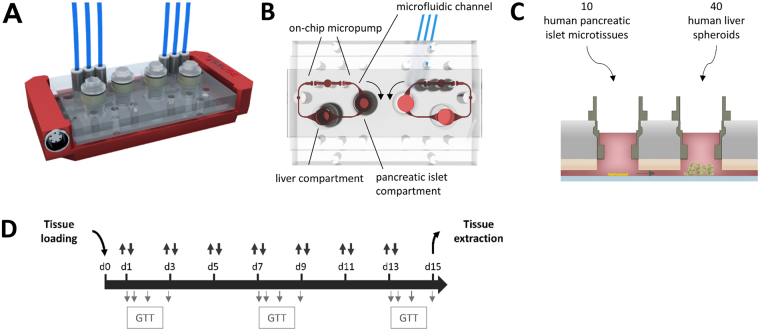
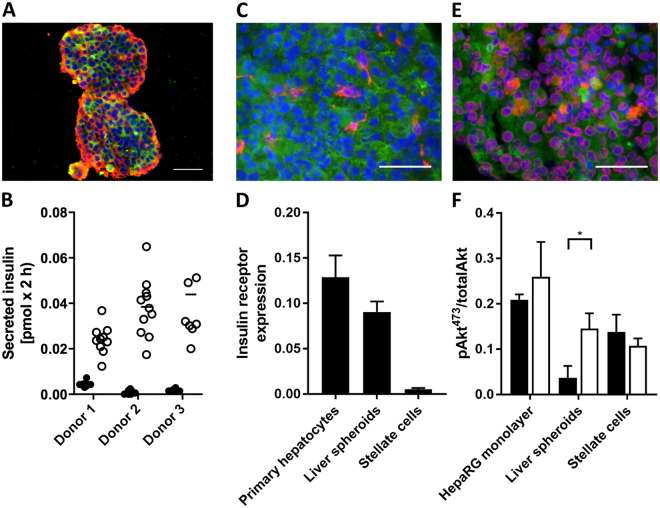
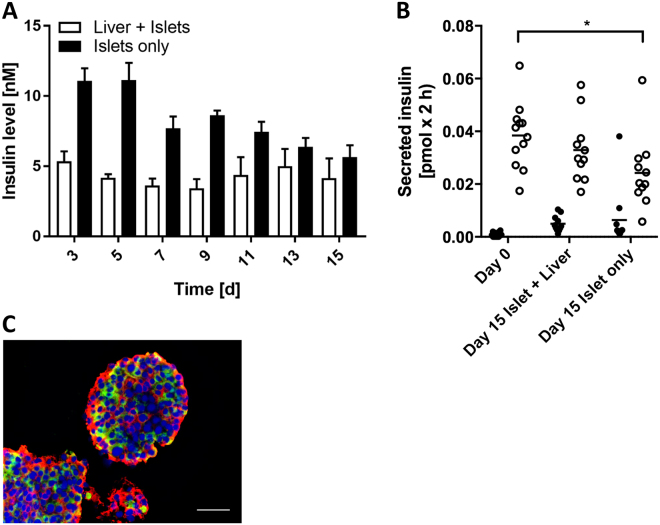
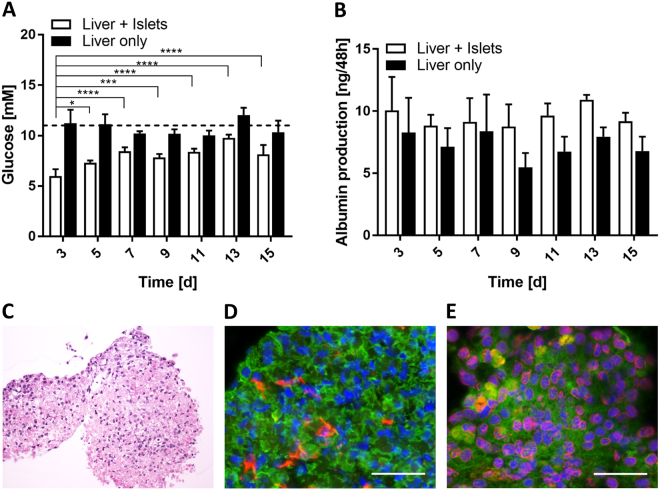
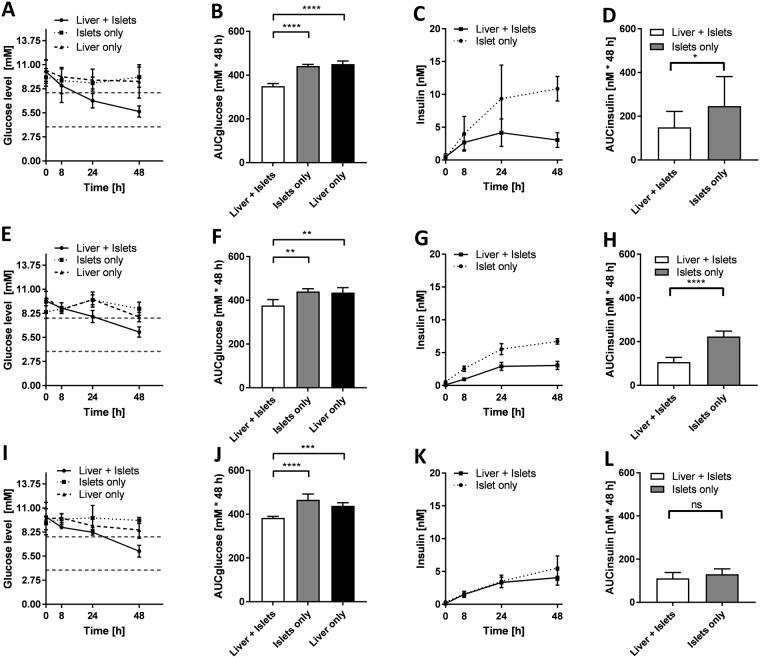
Human in vitro physiological models studying disease and drug treatment effects are urgently needed as more relevant tools to identify new drug targets and therapies. We have developed a human microfluidic two-organ-chip model to study pancreatic islet–liver cross-talk based on insulin and glucose regulation. We have established a robust co-culture of human pancreatic islet microtissues and liver spheroids maintaining functional responses up to 15 days in an insulin-free medium. Functional coupling, demonstrated by insulin released from the islet microtissues in response to a glucose load applied in glucose tolerance tests on different days, promoted glucose uptake by the liver spheroids. Co-cultures maintained postprandial glucose concentrations in the circulation whereas glucose levels remained elevated in both single cultures. Thus, insulin secreted into the circulation stimulated glucose uptake by the liver spheroids, while the latter, in the absence of insulin, did not consume glucose as efficiently. As the glucose concentration fell, insulin secretion subsided, demonstrating a functional feedback loop between the liver and the insulin-secreting islet microtissues. Finally, inter-laboratory validation verified robustness and reproducibility. Further development of this model using tools inducing impaired glucose regulation should provide a unique in vitro system emulating human type 2 diabetes mellitus.
Overview
The claims and statistics of this paper haven’t been checked yet.
Free: it reads the open-access text and checks the first 5 claims that cite a source we can check. Create a free account to check every claim.
Integrity signals
Registry
Cites
Statistics
Figures
Verification
Claims the paper makes
The claims and statistics of this paper haven’t been checked yet.
Free: it reads the open-access text and checks the first 5 claims that cite a source we can check. Create a free account to check every claim.
Claims other papers make about this one
Each is checked against this paper’s own text: does it say what the citing paper says it does?
The source backs part of the claim, not all of it — or backs it for a different population, condition or comparison.
In the citing paper
“Promising disease models of the liver65,66, pancreas67,68, central nervous system35,69,70, skin71, lung72,73, intestine72–76, musculoskeletal system77 and heart78–81 have been developed, but their equivalence or superiority over their animal models needs to be demonstrated.”
From Human disease models in drug development (2023) · cites this paper as [67]
Experimental — accuracy not yet measuredThe source backs part of the claim, not all of it — or backs it for a different population, condition or comparison.
In the citing paper
“The two-organ system has been simulated using connected chambers containing different tissue constructs to mimic liver injury (with intestinal epithelial cells and liver cells)101 and Type-2 diabetes (with human pancreatic islets and liver spheroids)102.”
From Organoids (2022) · cites this paper as [101]
Experimental — accuracy not yet measured
Self-check
Percentages, sums and reported differences re-computed from the paper’s own numbers.
The self-check needs the paper’s full text.
Citations
Cites
Diagnosis and Classification of Diabetes Mellitus
American Diabetes Association (2011) · Diabetes Care · doi:10.2337/dc11-s062 · Cited by 13,988
Diagnosis and classification of diabetes mellitus
American Diabetes Association (2014) · Diabetes Care · doi:10.2337/dc14-s081 · Cited by 5,974
Insulin signalling and the regulation of glucose and lipid metabolism
Saltiel, A. R., & Kahn, C. R. (2001) · Nature · doi:10.1038/414799a · Cited by 5,326
Reconstituting organ-level lung functions on a chip
Huh, D., Matthews, B. D., Mammoto, A., Montoya-Zavala, M., Hsin, H. Y., & Ingber, D. E. (2010) · Science · doi:10.1126/science.1188302 · Cited by 4,250
DeFronzo, R. A., Jacot, E., Jequier, E., Maeder, E., Wahren, J., & Felber, J. P. (1981) · Diabetes · doi:10.2337/diab.30.12.1000 · Cited by 1,770
Impaired Fasting Glucose and Impaired Glucose Tolerance
Nathan, D. M., Davidson, M. B., DeFronzo, R. A., Heine, R. J., Henry, R. R., Pratley, R., & Zinman, B. (2007) · Diabetes Care · doi:10.2337/dc07-9920 · Cited by 1,396
Organs-on-chips at the frontiers of drug discovery
Esch, E. W., Bahinski, A., & Huh, D. (2015) · Nature Reviews Drug Discovery · doi:10.1038/nrd4539 · Cited by 1,185
The role of hepatic lipids in hepatic insulin resistance and type 2 diabetes
Perry, R. J., Samuel, V. T., Petersen, K. F., & Shulman, G. I. (2014) · Nature · doi:10.1038/nature13478 · Cited by 1,136
Maschmeyer, I., Lorenz, A. K., Schimek, K., Hasenberg, T., Ramme, A. P., Hübner, J., Lindner, M., Drewell, C., Bauer, S., Thomas, A., et al. (2015) · Lab on a Chip · doi:10.1039/c5lc00392j · Cited by 861
Self-citationSmall airway-on-a-chip enables analysis of human lung inflammation and drug responses in vitro
Benam, K. H., Villenave, R., Lucchesi, C., Varone, A., Hubeau, C., Lee, H.-H., Alves, S. E., Salmon, M., Ferrante, T. C., Weaver, J. C., et al. (2016) · Nature Methods · doi:10.1038/nmeth.3697 · Cited by 816
Cited by
Human organs-on-chips for disease modelling, drug development and personalized medicine
Ingber, D. E. (2022) · Nature Reviews Genetics · doi:10.1038/s41576-022-00466-9 · Cited by 1,589
A guide to the organ-on-a-chip
Leung, C. M., de Haan, P., Ronaldson-Bouchard, K., Kim, G.-A., Ko, J., Rho, H. S., Chen, Z., Habibovic, P., Jeon, N. L., Takayama, S., et al. (2022) · Nature Reviews Methods Primers · doi:10.1038/s43586-022-00118-6 · Cited by 1,116
Advances in organ-on-a-chip engineering
Zhang, B., Korolj, A., Lai, B. F. L., & Radisic, M. (2018) · Nature Reviews Materials · doi:10.1038/s41578-018-0034-7 · Cited by 1,017
Zhao, Z., Chen, X., Dowbaj, A. M., Sljukic, A., Bratlie, K., Lin, L., Fong, E. L. S., Balachander, G. M., Chen, Z., Soragni, A., et al. (2022) · Nature Reviews Methods Primers · doi:10.1038/s43586-022-00174-y · Cited by 1,082
Organs-on-a-Chip: A Fast Track for Engineered Human Tissues in Drug Development
Ronaldson-Bouchard, K., & Vunjak-Novakovic, G. (2018) · Cell Stem Cell · doi:10.1016/j.stem.2018.02.011 · Cited by 657
Robotic fluidic coupling and interrogation of multiple vascularized organ chips
Novak, R., Ingram, M., Marquez, S., Das, D., Delahanty, A., Herland, A., Maoz, B. M., Jeanty, S. S. F., Somayaji, M. R., Burt, M., et al. (2020) · Nature Biomedical Engineering · doi:10.1038/s41551-019-0497-x · Cited by 427
Challenges of applying multicellular tumor spheroids in preclinical phase
Han, S. J., Kwon, S., & Kim, K. S. (2021) · Cancer Cell International · doi:10.1186/s12935-021-01853-8 · Cited by 428
Multiorgan-on-a-Chip: A Systemic Approach To Model and Decipher Inter-Organ Communication
Picollet-D’hahan, N., Zuchowska, A., Lemeunier, I., & Le Gac, S. (2021) · Trends in Biotechnology · doi:10.1016/j.tibtech.2020.11.014 · Cited by 379
Human disease models in drug development
Loewa, A., Feng, J. J., & Hedtrich, S. (2023) · Nature Reviews Bioengineering · doi:10.1038/s44222-023-00063-3 · Cited by 331
Rethinking organoid technology through bioengineering
Garreta, E., Kamm, R. D., Chuva de Sousa Lopes, S. M., Lancaster, M. A., Weiss, R., Trepat, X., Hyun, I., & Montserrat, N. (2021) · Nature Materials · doi:10.1038/s41563-020-00804-4 · Cited by 324
Ingber, D. E. (2020) · Advanced Science · doi:10.1002/advs.202002030 · Cited by 277
Personalised organs-on-chips: functional testing for precision medicine
van den Berg, A., Mummery, C. L., Passier, R., & van der Meer, A. D. (2019) · Lab on a Chip · doi:10.1039/c8lc00827b · Cited by 270
Recent Advances in Body-on-a-Chip Systems
Sung, J. H., Wang, Y. I., Narasimhan Sriram, N., Jackson, M., Long, C., Hickman, J. J., & Shuler, M. L. (2019) · Analytical Chemistry · doi:10.1021/acs.analchem.8b05293 · Cited by 268
Moshksayan, K., Kashaninejad, N., Warkiani, M. E., Lock, J. G., Moghadas, H., Firoozabadi, B., Saidi, M. S., & Nguyen, N.-T. (2018) · Sensors and Actuators B: Chemical · doi:10.1016/j.snb.2018.01.223 · Cited by 267
Marx, U. (2020) · ALTEX · doi:10.14573/altex.2001241 · Cited by 218
“, 2015), liver and pancreatic islets (Bauer et al., 2017), intestine, vasculature and liver (Maschmeyer et al.”
BackgroundInfluentialSelf-citationOrgans-on-a-chip models for biological research
Vunjak-Novakovic, G., Ronaldson-Bouchard, K., & Radisic, M. (2021) · Cell · doi:10.1016/j.cell.2021.08.005 · Cited by 248
“…is being addressed by inclusion of supporting cells and metabolic and physical regulatory factors (Aleman et al., 2019; Alimperti et al., 2017; Bauer et al., 2017; Benam et al., 2016; Blundell et al., 2016; Keung et al., 2014; Kostrzewski et al., 2019; Lin et al., 2019; Musah et al., 2017;…”
BackgroundInfluentialEngineering Multi‐Cellular Spheroids for Tissue Engineering and Regenerative Medicine
Kim, S., Kim, E. M., Yamamoto, M., Park, H., & Shin, H. (2020) · Advanced Healthcare Materials · doi:10.1002/adhm.202000608 · Cited by 234
Microfluidics for Drug Development: From Synthesis to Evaluation
Liu, Y., Sun, L., Zhang, H., Shang, L., & Zhao, Y. (2021) · Chemical Reviews · doi:10.1021/acs.chemrev.0c01289 · Cited by 202
Tao, T., Deng, P., Wang, Y., Zhang, X., Guo, Y., Chen, W., & Qin, J. (2022) · Advanced Science · doi:10.1002/advs.202103495 · Cited by 178
Trapecar, M., Wogram, E., Svoboda, D., Communal, C., Omer, A., Lungjangwa, T., Sphabmixay, P., Velazquez, J., Schneider, K., Wright, C. W., et al. (2021) · Science Advances · doi:10.1126/sciadv.abd1707 · Cited by 176
Functional assays to assess the therapeutic potential of extracellular vesicles
Nguyen, V. V. T., Witwer, K. W., Verhaar, M. C., Strunk, D., & van Balkom, B. W. M. (2020) · Journal of Extracellular Vesicles · doi:10.1002/jev2.12033 · Cited by 162
“Advanced microfluidic-based in vitromodels Recent developments inmicrofluidics and 2D/3D cell- and organoid-based applications canmodel the complexity of an organism using organoid combinations in ‘multi-organ-on-a-chip’ (MOC) systems (Bauer et al., 2017).”
BackgroundInfluentialMechanical Stimulation: A Crucial Element of Organ-on-Chip Models
Thompson, C. L., Fu, S., Heywood, H. K., Knight, M. M., & Thorpe, S. D. (2020) · Frontiers in Bioengineering and Biotechnology · doi:10.3389/fbioe.2020.602646 · Cited by 178
In vivo–mimicking microfluidic perfusion culture of pancreatic islet spheroids
Jun, Y., Lee, J., Choi, S., Yang, J. H., Sander, M., Chung, S., & Lee, S.-H. (2019) · Science Advances · doi:10.1126/sciadv.aax4520 · Cited by 152
Bioprinting Perfusion-Enabled Liver Equivalents for Advanced Organ-on-a-Chip Applications
Grix, T., Ruppelt, A., Thomas, A., Amler, A.-K., Noichl, B., Lauster, R., & Kloke, L. (2018) · Genes · doi:10.3390/genes9040176 · Cited by 151
Designing stem cell niches for differentiation and self-renewal
Donnelly, H., Salmeron-Sanchez, M., & Dalby, M. J. (2018) · Journal of The Royal Society Interface · doi:10.1098/rsif.2018.0388 · Cited by 139
A critical perspective on 3D liver models for drug metabolism and toxicology studies
Serras, A. S., Rodrigues, J. S., Cipriano, M., Rodrigues, A. V., Oliveira, N. G., & Miranda, J. P. (2021) · Frontiers in Cell and Developmental Biology · doi:10.3389/fcell.2021.626805 · Cited by 138
Decarli, M. C., do Amaral, R. L. F., dos Santos, D. P., Tofani, L. B., Katayama, E. T., Rezende, R. A., da Silva, J. V. L., Swiech, K., Suazo, C. A. T., Mota, C., et al. (2021) · Biofabrication · doi:10.1088/1758-5090/abe6f2 · Cited by 156
Challenges and Opportunities in the Design of Liver-on-Chip Microdevices
Ehrlich, A., Duche, D., Ouedraogo, G., & Nahmias, Y. (2019) · Annual Review of Biomedical Engineering · doi:10.1146/annurev-bioeng-060418-052305 · Cited by 125
Schimek, K. M. S., Frentzel, S., Luettich, K., Bovard, D., Rütschle, I., Boden, L., Rambo, F., Erfurth, H., Dehne, E., Winter, A., et al. (2020) · Scientific Reports · doi:10.1038/s41598-020-64219-6 · Cited by 158
Self-citationMicrofluidic Organ-on-a-Chip System for Disease Modeling and Drug Development
Li, Z., Hui, J., Yang, P., & Mao, H. (2022) · Biosensors · doi:10.3390/bios12060370 · Cited by 120
Advances in Organ-on-a-Chip Materials and Devices
Nahak, B. K., Mishra, A., Preetam, S., & Tiwari, A. (2022) · ACS Applied Bio Materials · doi:10.1021/acsabm.2c00041 · Cited by 134
Human-Derived Organ-on-a-Chip for Personalized Drug Development
Jodat, Y. A., Kang, M., Kiaee, K., Kim, G. J., Martinez, A. F. H., Rosenkranz, A., Bae, H., & Shin, S. R. (2019) · Current Pharmaceutical Design · doi:10.2174/1381612825666190308150055 · Cited by 138
Human biomimetic liver microphysiology systems in drug development and precision medicine
Gough, A., Soto-Gutierrez, A., Vernetti, L., Ebrahimkhani, M. R., Stern, A. M., & Taylor, D. L. (2021) · Nature Reviews Gastroenterology & Hepatology · doi:10.1038/s41575-020-00386-1 · Cited by 117
Baert, Y., Rütschle, I., Cools, W., Oehme, A., Lorenz, A., Marx, U., Goossens, E., & Maschmeyer, I. (2020) · Human Reproduction · doi:10.1093/humrep/deaa057 · Cited by 126
Self-citationFowler, S., Chen, W. L. K., Duignan, D. B., Gupta, A., Hariparsad, N., Kenny, J. R., Lai, W. G., Liras, J., Phillips, J. A., & Gan, J. (2020) · Lab on a Chip · doi:10.1039/c9lc00857h · Cited by 109
Shim, S., Belanger, M. C., Harris, A. R., Munson, J. M., & Pompano, R. R. (2019) · Lab on a Chip · doi:10.1039/c8lc00957k · Cited by 108
Organ-on-a-chip engineering: Toward bridging the gap between lab and industry
Ramadan, Q., & Zourob, M. M. (2020) · Biomicrofluidics · doi:10.1063/5.0011583 · Cited by 113
Nguyen, V. V. T., Ye, S., Gkouzioti, V., van Wolferen, M. E., Yengej, F. Y., Melkert, D., Siti, S., de Jong, B., Besseling, P. J., Spee, B., et al. (2022) · Journal of Extracellular Vesicles · doi:10.1002/jev2.12280 · Cited by 120
Organoid microphysiological system preserves pancreatic islet function within 3D matrix
Patel, S. N., Ishahak, M., Chaimov, D., Velraj, A., LaShoto, D., Hagan, D. W., Buchwald, P., Phelps, E. A., Agarwal, A., & Stabler, C. L. (2021) · Science Advances · doi:10.1126/sciadv.aba5515 · Cited by 97
Spheroid Engineering in Microfluidic Devices
Tevlek, A., Keçili, S., Ozcelik, O. S., Külah, H., & Tekin, H. C. (2023) · ACS Omega · doi:10.1021/acsomega.2c06052 · Cited by 105
Modelling the endocrine pancreas in health and disease
Bakhti, M., Böttcher, A., & Lickert, H. (2018) · Nature Reviews Endocrinology · doi:10.1038/s41574-018-0132-z · Cited by 126
Modelling metabolic diseases and drug response using stem cells and organoids
Hu, W., & Lazar, M. A. (2022) · Nature Reviews Endocrinology · doi:10.1038/s41574-022-00733-z · Cited by 107
Routine Optical Clearing of 3D-Cell Cultures: Simplicity Forward
Nürnberg, E., Vitacolonna, M., Klicks, J., von Molitor, E., Cesetti, T., Keller, F., Bruch, R., Ertongur-Fauth, T., Riedel, K., Scholz, P., et al. (2020) · Frontiers in Molecular Biosciences · doi:10.3389/fmolb.2020.00020 · Cited by 93
“Amongst others, hydrogels, decellularized matrices, porous polymers, and nanofibers might serve as scaffolds in static or dynamic experimental setups can be designed (Das et al., 2015; Carvalho et al., 2017), e.g., in organ-on-a-chip systems (Bauer et al., 2018; Hübner et al., 2018).”
BackgroundChristoffersson, J., Aronsson, C., Jury, M., Selegård, R., Aili, D., & Mandenius, C.-F. (2018) · Biofabrication · doi:10.1088/1758-5090/aaf657 · Cited by 92
Yaribeygi, H., Maleki, M., Sathyapalan, T., Jamialahmadi, T., & Sahebkar, A. (2021) · Journal of Diabetes Research · doi:10.1155/2021/7796727 · Cited by 91
“Therefore, any pathologic factor inducing islet cell dysfunction may be a potential threat to glucose homeostasis [30].”
BackgroundOng, L. J. Y., Ching, T., Chong, L. H., Arora, S., Li, H., Hashimoto, M., DasGupta, R., Yuen, P. K., & Toh, Y. (2019) · Lab on a Chip · doi:10.1039/c9lc00160c · Cited by 90
Recent progress in lab-on-a-chip for pharmaceutical analysis and pharmacological/toxicological test
Ai, Y., Zhang, F., Wang, C., Xie, R., & Liang, Q. (2019) · TrAC Trends in Analytical Chemistry · doi:10.1016/j.trac.2019.06.026 · Cited by 91
Recent advances in microfluidic technologies for organ-on-a-chip
Tian, C., Tu, Q., Liu, W., & Wang, J. (2019) · TrAC Trends in Analytical Chemistry · doi:10.1016/j.trac.2019.06.005 · Cited by 90
Towards a better understanding of diabetes mellitus using organoid models
Beydag-Tasöz, B. S., Yennek, S., & Grapin‐Botton, A. (2023) · Nature Reviews Endocrinology · doi:10.1038/s41574-022-00797-x · Cited by 95
Stem-cell based organ-on-a-chip models for diabetes research
Rogal, J., Zbinden, A., Schenke‐Layland, K., & Loskill, P. (2018) · Advanced Drug Delivery Reviews · doi:10.1016/j.addr.2018.10.010 · Cited by 93
Hübner, J., Raschke, M., Rütschle, I., Gräßle, S., Hasenberg, T., Schirrmann, K., Lorenz, A., Schnurre, S., Lauster, R., Maschmeyer, I., et al. (2018) · Scientific Reports · doi:10.1038/s41598-018-33462-3 · Cited by 75
Self-citationType 1 Diabetes Mellitus: A Review on Advances and Challenges in Creating Insulin Producing Devices
Oliveira, S. M. R., Rebocho, A., Ahmadpour, E., Nissapatorn, V., & Pereira, M. D. L. (2023) · Micromachines · doi:10.3390/mi14010151 · Cited by 103
Does In Vitro Potency Predict Clinically Efficacious Concentrations?
Jansson‐Löfmark, R., Hjorth, S., & Gabrielsson, J. (2020) · Clinical Pharmacology & Therapeutics · doi:10.1002/cpt.1846 · Cited by 72
Maximizing the impact of microphysiological systems with in vitro–in vivo translation
Cirit, M., & Stokes, C. L. (2018) · Lab on a Chip · doi:10.1039/c8lc00039e · Cited by 70
Ekert, J. E., Deakyne, J., Pribul-Allen, P., Terry, R., Schofield, C., Jeong, C. G., Storey, J., Mohamet, L., Francis, J., Naidoo, A., et al. (2020) · SLAS DISCOVERY · doi:10.1177/2472555220923332 · Cited by 68
Shroff, T., Aina, K., Maass, C., Cipriano, M., Lambrecht, J., Tacke, F., Mosig, A., & Loskill, P. (2022) · Open Biology · doi:10.1098/rsob.210333 · Cited by 68
“[70] presented a pancreas–liver MOC which allowed for the co-culture of human pancreatic islet microtissues and liver spheroids in an insulin-free medium.”
BackgroundInfluentialKumar, V., & Varghese, S. (2019) · Advanced Healthcare Materials · doi:10.1002/adhm.201801198 · Cited by 68
Development of a pancreas-liver organ-on-chip coculture model for organ-to-organ interaction studies
Essaouiba, A., Okitsu, T., Kinoshita, R., Jellali, R., Shinohara, M., Danoy, M., Legallais, C., Sakai, Y., & Leclerc, É. (2020) · Biochemical Engineering Journal · doi:10.1016/j.bej.2020.107783 · Cited by 71
Sunildutt, N., Parihar, P., Salih, A. R. C., Lee, S. H., & Choi, K. H. (2023) · Frontiers in Pharmacology · doi:10.3389/fphar.2023.1139229 · Cited by 71
“postprandial glucose levels when grown separately, the glucose levels in both organ modules remained high (Bauer et al., 2017).”
BackgroundInfluentialAshammakhi, N. A., Darabi, M. A., Çelebi‐Saltik, B., Tutar, R., Hartel, M. C., Lee, J., Hussein, S. M., Goudie, M. J., Cornelius, M. B., Dokmeci, M. R., et al. (2019) · Small Methods · doi:10.1002/smtd.201900589 · Cited by 75
Implementing organ-on-chip in a next-generation risk assessment of chemicals: a review
Nitsche, K. S., Müller, I. I., Malcomber, S., Carmichael, P. L., & Bouwmeester, H. (2022) · Archives of Toxicology · doi:10.1007/s00204-022-03234-0 · Cited by 83
Optimizing drug discovery by Investigative Toxicology: Current and future trends
Beilmann, M., Boonen, H., Czich, A., Dear, G., Hewitt, P., Mow, T., Newham, P., Oinonen, T., Pognan, F., Roth, A., et al. (2018) · ALTEX · doi:10.14573/altex.1808181 · Cited by 90
“Finally, the impact of biological feedback loops such as the insulin-glucose regulation of liver performance can be studied using the respective organ combinations (Bauer et al., 2017).”
BackgroundLin, N., Zhou, X., Geng, X., Drewell, C., Hübner, J., Zuo-gang, L., Zhang, Y., Xue, M., Marx, U., & Li, B. (2020) · Scientific Reports · doi:10.1038/s41598-020-65817-0 · Cited by 63
Self-citationEpigenetics of Hepatic Insulin Resistance
Maude, H., Sanchez-Cabanillas, C., & Cebola, I. (2021) · Frontiers in Endocrinology · doi:10.3389/fendo.2021.681356 · Cited by 69
Recent Advances in Microfluidic Platforms for Programming Cell‐Based Living Materials
Zhang, P., Shao, N., & Qin, L. (2021) · Advanced Materials · doi:10.1002/adma.202005944 · Cited by 63
Primary human organoids models: Current progress and key milestones
Calà, G., Sina, B., Coppi, P. D., Giobbe, G. G., & Gerli, M. (2023) · Frontiers in Bioengineering and Biotechnology · doi:10.3389/fbioe.2023.1058970 · Cited by 65
3D Cell Printing of Tissue/Organ-Mimicking Constructs for Therapeutic and Drug Testing Applications
Kim, J., Kong, J. S., Han, W., Kim, B. S., & Cho, D. (2020) · International Journal of Molecular Sciences · doi:10.3390/ijms21207757 · Cited by 54
Youhanna, S. C., Kemas, A. M., Preiss, L. C., Zhou, Y., Shen, J. X., Cakal, S. D., Paqualini, F. S., Goparaju, S. K., Shafagh, R. Z., Lind, J. U., et al. (2022) · Pharmacological Reviews · doi:10.1124/pharmrev.120.000238 · Cited by 67
Hu, C., Yang, S., Zhang, T., Ge, Y., Chen, Z., Zhang, J., Pu, Y., & Liang, G. (2024) · Environment International · doi:10.1016/j.envint.2024.108415 · Cited by 61
Engineering human hepato-biliary-pancreatic organoids from pluripotent stem cells
Koike, H., Iwasawa, K., Ouchi, R., Maezawa, M., Kimura, M., Kodaka, A., Nishii, S., Thompson, W. L., & Takebe, T. (2021) · Nature Protocols · doi:10.1038/s41596-020-00441-w · Cited by 53
Multi-organ-on-a-chip for pharmacokinetics and toxicokinetic study of drugs
Sung, J. H. (2021) · Expert Opinion on Drug Metabolism & Toxicology · doi:10.1080/17425255.2021.1908996 · Cited by 59
Organ-on-a-chip microengineering for bio-mimicking disease models and revolutionizing drug discovery
Ahmed, T. (2022) · Biosensors and Bioelectronics X · doi:10.1016/j.biosx.2022.100194 · Cited by 70
Shafagh, R. Z., Youhanna, S. C., Keulen, J., Shen, J. X., Taebnia, N., Preiss, L. C., Klein, K., Büttner, F., Bergqvist, M., van der Wijngaart, W., et al. (2022) · Advanced Science · doi:10.1002/advs.202203368 · Cited by 60
Rothbauer, M., Bachmann, B., Eilenberger, C., Kratz, S. R. A., Spitz, S., Höll, G., & Ertl, P. (2021) · Micromachines · doi:10.3390/mi12050470 · Cited by 55
“PDMS 3D liver spheroids Flow conditions, low-attachment spheroid microplates HepaRG cells, 3D pancreatic islet microtissues Pancreatic islet–liver crosstalk based on insulin and glucose regulation Insulin, glucacon, cytokeratin 8/18, vimentin, albumin, CYP3A4 Albumin, glucose, insulin Demonstrated a functional feedbac…”
BackgroundBioelectronic organ-based sensor for microfluidic real-time analysis of the demand in insulin
Perrier, R., Pirog, A., Jaffredo, M., Gaitan, J., Catargi, B., Renaud, S., Raoux, M., & Lang, J. (2018) · Biosensors and Bioelectronics · doi:10.1016/j.bios.2018.06.015 · Cited by 63
Gatward, L. F. D., Kennard, M. R., Smith, L. I. F., & King, A. (2021) · Diabetic Medicine · doi:10.1111/dme.14711 · Cited by 65
A human-on-a-chip approach to tackling rare diseases
de Mello, C. P. P., Rumsey, J. W., Slaughter, V. L., & Hickman, J. J. (2019) · Drug Discovery Today · doi:10.1016/j.drudis.2019.08.001 · Cited by 53
Dutta, K., Kanjilal, P., Das, R., & Thayumanavan, S. (2020) · Angewandte Chemie International Edition · doi:10.1002/anie.202010412 · Cited by 51
Human Organs‐on‐Chips: A Review of the State‐of‐the‐Art, Current Prospects, and Future Challenges
Zarrintaj, P., Saeb, M. R., Stadler, F. J., Yazdi, M. K., Nasirinezhad, M., Mohebbi, S., Seidi, F., Ganjali, M. R., & Mozafari, M. (2021) · Advanced Biology · doi:10.1002/adbi.202000526 · Cited by 57
Pancreas-on-a-Chip Technology for Transplantation Applications
Abadpour, S., Aizenshtadt, A., Olsen, P. A., Shoji, K., Wilson, S. R., Krauss, S. J. K., & Scholz, H. (2020) · Current Diabetes Reports · doi:10.1007/s11892-020-01357-1 · Cited by 53
Heart and kidney organoids maintain organ-specific function in a microfluidic system
Gabbin, B., Meraviglia, V., Angenent, M. L., Oostwaard, D. W., Sol, W., Mummery, C. L., Rabelink, T. J., van Meer, B. J., van den Berg, C. W., & Bellin, M. (2023) · Materials Today Bio · doi:10.1016/j.mtbio.2023.100818 · Cited by 59
Cedillo‐Alcantar, D. F., Han, Y. D., Choi, J., Garcia-Cordero, J. L., & Revzin, A. (2019) · Analytical Chemistry · doi:10.1021/acs.analchem.8b05689 · Cited by 52
In Situ LSPR Sensing of Secreted Insulin in Organ-on-Chip
Ortega, M. A., Rodríguez‐Comas, J., Yavas, O., Velasco‐Mallorquí, F., Balaguer-Trias, J., Parra-Monreal, V., Novials, A., Servitja, J., Quidant, R., & Ramón‐Azcón, J. (2021) · Biosensors · doi:10.3390/bios11050138 · Cited by 58
Pancreatic islet organoids-on-a-chip: how far have we gone?
Yin, J., Meng, H., Lin, J., Ji, W., Xu, T., & Liu, H. (2022) · Journal of Nanobiotechnology · doi:10.1186/s12951-022-01518-2 · Cited by 51
“In summary, most commonly used co-culture system to study the impact of organ crosstalk in type 2 DM including duct- and pancreatic islets-on-achip [63], liver- and pancreatic islets-on-a-chip [67, 68].”
BackgroundGarcía-Gutiérrez, E., & Cotter, P. D. (2021) · Critical Reviews in Microbiology · doi:10.1080/1040841x.2021.1979933 · Cited by 50
“of the glucose circulation by the pancreatic islets in the system (Bauer et al. 2017).”
BackgroundOrgan-on-a-chip: the next generation platform for risk assessment of radiobiology
Quan, Y., Sun, M., Tan, Z., Eijkel, J. C. T., van den Berg, A., van der Meer, A. D., & Xie, Y. (2020) · RSC Advances · doi:10.1039/d0ra05173j · Cited by 47
From Single- to Multi-organ-on-a-Chip System for Studying Metabolic Diseases
Jang, M., & Kim, H. N. (2023) · BioChip Journal · doi:10.1007/s13206-023-00098-z · Cited by 46
“[80] developed a human microfluidic pancreatic islet microtissues and liver spheroids-on-a-chip to study islet and liver crosstalk.”
BackgroundConceptual Design of Micro-Bioreactors and Organ-on-Chips for Studies of Cell Cultures
Mandenius, C. (2018) · Bioengineering · doi:10.3390/bioengineering5030056 · Cited by 48
Lee, S. H., & Jun, B. (2018) · Journal of Industrial and Engineering Chemistry · doi:10.1016/j.jiec.2018.11.041 · Cited by 46
Modeling human T1D-associated autoimmune processes
Maharlooei, M. K., Madley, R., Borsotti, C., Ferreira, L. M. R., Sharp, R. C., Brehm, M. A., Greiner, D. L., Parent, A. V., Anderson, M. S., Sykes, M., et al. (2021) · Molecular Metabolism · doi:10.1016/j.molmet.2021.101417 · Cited by 47
“MPS featuring pancreas [75,76], endocrine tissues [77] and pancreatic islets and liver spheroids [78] are of particular relevance to T1D research, and so are inflammation-based MPS, which allow the analysis of the activation of isolated neutrophils, monocytes, and lymphocytes in a proinflammatory environment affecting…”
BackgroundJiang, L., Shen, Y., Liu, Y., Zhang, L. J., & Jiang, W. (2022) · Theranostics · doi:10.7150/thno.66670 · Cited by 49
“A human Theranostics 2022, Vol. 12, Issue 4 https://www.thno.org 1549 microfluidic organ-chip platform was developed to study the connection among thymic epithelia, hematopoietic stem cells, islet β cells in T1D and pancreatic islet-liver cross-talking in type 2 diabetes (T2D) [140].”
Background3D multicellular systems in disease modelling: From organoids to organ-on-chip
Goldrick, C., Guri, I., Herrera-Oropeza, G. E., O’Brien-Gore, C., Roy, E., Wojtynska, M., & Spagnoli, F. M. (2023) · Frontiers in Cell and Developmental Biology · doi:10.3389/fcell.2023.1083175 · Cited by 47
“…possibilities for engineering vascularized and multi-organ systems to model tissue-tissue or even multi-organ interactions to investigate more systemic interactions, rather than just those within one single organ (Bauer et al., 2017; Jin et al., 2018; Homan et al., 2019; Hofer and Lutolf, 2021).”
BackgroundStem cells, organoids, and organ-on-a-chip models for personalized in vitro drug testing
van Berlo, D., Nguyen, V. V. T., Gkouzioti, V., Leineweber, K., Verhaar, M. C., & van Balkom, B. W. M. (2021) · Current Opinion in Toxicology · doi:10.1016/j.cotox.2021.08.006 · Cited by 49
Cancer-on-chip: a 3D model for the study of the tumor microenvironment
Cauli, E., Polidoro, M. A., Marzorati, S., Bernardi, C., Rasponi, M., & Lleò, A. (2023) · Journal of Biological Engineering · doi:10.1186/s13036-023-00372-6 · Cited by 52
“…SARS-CoV-2 [113, 114], asthma [115], ischemia [116, 117], cardiac fibrosis [118, 119], inflammatory bowel disease (IBD) [120], fatty liver disease (FLD) [121, 122], diabetes [123, 124], Alzheimer’s disease [125] and CoC platforms, recapitulating specific primary tumors with their metastatic site.”
BackgroundLohasz, C., Rousset, N., Renggli, K., Hierlemann, A. R., & Frey, O. (2018) · SLAS TECHNOLOGY · doi:10.1177/2472630318802582 · Cited by 44
Organs-on-Chips Platforms Are Everywhere: A Zoom on Biomedical Investigation
Zommiti, M., Connil, N., Tahrioui, A., Groboillot, A., Barbey, C., Konto‐Ghiorghi, Y., Lesouhaitier, O., Chevalier, S., & Feuilloley, M. G. J. (2022) · Bioengineering · doi:10.3390/bioengineering9110646 · Cited by 47
“The OOC, as a state-of-the-art technology, provides a marvelous platform for disease modeling, such as the case of pulmonary edema [187], protein-induced lung inflammation [188], central nervous system (CNS) disease [189] and type 2 diabetes (T2D) [190].”
Organoid-guided precision hepatology for metabolic liver disease
Osonoi, S., & Takebe, T. (2024) · Journal of Hepatology · doi:10.1016/j.jhep.2024.01.002 · Cited by 45
Essaouiba, A., Okitsu, T., Jellali, R., Shinohara, M., Danoy, M., Tauran, Y., Legallais, C., Sakai, Y., & Leclerc, É. (2020) · Molecular and Cellular Endocrinology · doi:10.1016/j.mce.2020.110892 · Cited by 45
Essaouiba, A., Jellali, R., Shinohara, M., Scheidecker, B., Legallais, C., Sakai, Y., & Leclerc, É. (2021) · Journal of Biotechnology · doi:10.1016/j.jbiotec.2021.02.009 · Cited by 43
Organoids meet microfluidics: recent advancements, challenges, and future of organoids-on-chip
Chauhdari, T., Zaidi, S. A., Su, J., & Ding, Y. (2025) · In vitro models · doi:10.1007/s44164-025-00086-7 · Cited by 46
“For instance, Bauer et al. developed a double organoid chip system to investigate type 2 diabetes mellitus by coupling human pancreatic islets spheroids and liver spheroids [112].”
Metadata
- Authors
- Bauer, S., Wennberg Huldt, C., Kanebratt, K. P., Durieux, I., Gunne, D., Andersson, S., Ewart, L., Haynes, W. G., Maschmeyer, I., Winter, A., Ämmälä, C., Marx, U., & Andersson, T. B.
- Affiliations
- AstraZeneca (Sweden) (SE)
- AstraZeneca (United Kingdom) (GB)
- Karolinska Institutet (SE)
- Corresponding author
- Bauer, Sophie
- ORCID
- Venue
- Scientific Reports
- Published
- 2017-11-03
- Volume
- 7
- Issue
- 1
- Pages
- 14620-14620
- ISSN
- 2045-2322 (ISSN-L)
- PMC
- PMC5668271
- OpenAlex
- W2765323542
- Semantic Scholar
- e1d791881ab8e14e85a0929101a1425da0efee9e
- Cited by
- 272
- References
- 50
- Citations by year
- 2026: 17 · 2025: 25 · 2024: 34 · 2023: 31 · 2022: 32 · 2021: 44 · 2020: 40 · 2019: 25 · 2018: 24
- FWCI
- 24.91
- Type
- journal article
- Language
- en
- Update notices
- correction (2018-01-23)
- Open access
- gold
- doi.org
- Licence
- cc-by
- creativecommons.org/licenses/by/4.0 (tdm)
- creativecommons.org/licenses/by/4.0 (vor)
- Locations
- Scientific Reports (publishedVersion, cc-by)
- PubMed Central (publishedVersion, cc-by)
- PubMed (publishedVersion)
- DOAJ (DOAJ: Directory of Open Access Journals) (submittedVersion)
- Funders
- Bundesministerium für Bildung und Forschung (01DJ14010A)
- Topics
- Health Sciences › Medicine › Endocrinology, Diabetes and Metabolism › Pancreatic function and diabetes
- Physical Sciences › Engineering › Biomedical Engineering › 3D Printing in Biomedical Research
- Health Sciences › Medicine › Endocrinology, Diabetes and Metabolism › Diabetes Management and Research
- Keywords
- type 2 diabetes, pancreatic islets, liver spheroids, insulin secretion, glucose uptake, glucose tolerance, co-culture, interlaboratory validation
- MeSH terms
- Cell Line, Culture Media, Diabetes Mellitus, Type 2, Equipment Design, Glucose, Glucose Tolerance Test, Humans, Insulin, Islets of Langerhans, Liver, Models, Biological, Reproducibility of Results, Spheroids, Cellular, Coculture Techniques, Feedback, Physiological, Tissue Culture Techniques
About these checks
Registry, retraction, Cites and statistics results are computed, not judged, with one exception: a printed reference that no index lists is read once by a model before it counts as a citation error. Claims are extracted by a model and kept only when their quote appears verbatim in the text; each cited source is then checked, with a model’s help, for whether it says what the claim relies on. Those verdicts can be wrong — read the claim’s quote and the cited source before relying on one.
Statistics and arithmetic are recomputed, not judged.
Confidence bands are shown only for fields calibrated on our annotated test set. None is calibrated yet, so no band is shown.
What counts as a claim ›How we measure confidence ›How we check this ›
Are you an author, or do you see a problem with this page? Request a review
Data sources
Bibliographic data: Semantic Scholar, OpenAlex, Crossref.
Contains information from the Semantic Scholar Academic Graph Datasets, made available under the ODC Attribution License (ODC-BY 1.0).
Semantic Scholar’s data is described in: Kinney, R., et al. (2023). The Semantic Scholar Open Data Platform. arXiv:2301.10140.
