

Introducing a Bayesian model of selective attention based on active inference
Open accessThe DOI matches its Crossref record; 68 of the 69 references it cites were found in a registry or an index.
Abstract
Information gathering comprises actions whose (sensory) consequences resolve uncertainty (i.e., are salient). In other words, actions that solicit salient information cause the greatest shift in beliefs (i.e., information gain) about the causes of our sensations. However, not all information is relevant to the task at hand: this is especially the case in complex, naturalistic scenes. This paper introduces a formal model of selective attention based on active inference and contextual epistemic foraging. We consider a visual search task with a special emphasis on goal-directed and task-relevant exploration. In this scheme, attention modulates the expected fidelity (precision) of the mapping between observations and hidden states in a state-dependent or context-sensitive manner. This ensures task-irrelevant observations have little expected information gain, and so the agent – driven to reduce expected surprise (i.e., uncertainty) – does not actively seek them out. Instead, it selectively samples task-relevant observations, which inform (task-relevant) hidden states. We further show, through simulations, that the atypical exploratory behaviours in conditions such as autism and anxiety may be due to a failure to appropriately modulate sensory precision in a context-specific way.
Overview
The claims and statistics of this paper haven’t been checked yet.
Free: it reads the open-access text and checks the first 5 claims that cite a source we can check. Create a free account to check every claim.
Integrity signals
Registry
Cites
Statistics
Figures
Verification
Claims the paper makes
The claims and statistics of this paper haven’t been checked yet.
Free: it reads the open-access text and checks the first 5 claims that cite a source we can check. Create a free account to check every claim.
Claims other papers make about this one
Each is checked against this paper’s own text: does it say what the citing paper says it does?
The source backs part of the claim, not all of it — or backs it for a different population, condition or comparison.
In the citing paper
“What the AIF gives us is a detailed framework for interpreting these effects in terms of the minimization of prediction errors by action, the tuning of precision, the role of affect and interoceptive feedback and the automatic shifting between exploit/explore dynamics (e.g. [217,218]).”
From Active inference goes to school: the importance of active learning in the age of large language models (2024) · cites this paper as [218]
Experimental — accuracy not yet measured
Self-check
Percentages, sums and reported differences re-computed from the paper’s own numbers.
The self-check needs the paper’s full text.
Citations
Cites
A Mathematical Theory of Communication
Shannon, C. E. (1948) · Bell System Technical Journal · doi:10.1002/j.1538-7305.1948.tb01338.x · Cited by 88,486
On Information and Sufficiency
Kullback, S., & Leibler, R. A. (1951) · The Annals of Mathematical Statistics · doi:10.1214/aoms/1177729694 · Cited by 20,193
A model of saliency-based visual attention for rapid scene analysis
Itti, L., Koch, C., & Niebur, E. (1998) · IEEE Transactions on Pattern Analysis and Machine Intelligence · doi:10.1109/34.730558 · Cited by 11,271
The free-energy principle: a unified brain theory?
Friston, K. (2010) · Nature Reviews Neuroscience · doi:10.1038/nrn2787 · Cited by 8,120
Self-citationInformation theory and statistics
(1959) · Journal of the Franklin Institute · doi:10.1016/0016-0032(59)90368-0 · Cited by 7,094
Frequency-tuned salient region detection
Achanta, R., Hemami, S., Estrada, F., & Susstrunk, S. (2009) · 2009 IEEE Conference on Computer Vision and Pattern Recognition · doi:10.1109/cvpr.2009.5206596 · Cited by 4,167
Shifts in Selective Visual Attention: Towards the Underlying Neural Circuitry
Koch, C., & Ullman, S. (1987) · Matters of Intelligence · doi:10.1007/978-94-009-3833-5_5 · Cited by 3,722 · cited 1×
“These features include orientation, intensity, colour information 38–41 , luminance 42 , contrast 43 and motion 44 .”
BackgroundGuided Search 2.0 A revised model of visual search
Wolfe, J. M. (1994) · Psychonomic Bulletin & Review · doi:10.3758/bf03200774 · Cited by 3,504 · cited 1×
“…evaluate the similarity (or dissimilarity) of the features of the object of interest, with the features in the scene that is being explored 45 , there are other models that either modulate or select feature outputs – such that the features of the object of interest become more salient 46,47 .”
BackgroundYarbus, A. L. (1967) · doi:10.1007/978-1-4899-5379-7 · Cited by 3,304
A saliency-based search mechanism for overt and covert shifts of visual attention
Itti, L., & Koch, C. (2000) · Vision Research · doi:10.1016/s0042-6989(99)00163-7 · Cited by 3,156 · cited 1×
“These features include orientation, intensity, colour information 38–41 , luminance 42 , contrast 43 and motion 44 .”
BackgroundKapur, S. (2003) · American Journal of Psychiatry · doi:10.1176/appi.ajp.160.1.13 · Cited by 2,813
Contextual Cueing: Implicit Learning and Memory of Visual Context Guides Spatial Attention
Chun, M. M., & Jiang, Y. (1998) · Cognitive Psychology · doi:10.1006/cogp.1998.0681 · Cited by 1,959
Enhanced Perceptual Functioning in Autism: An Update, and Eight Principles of Autistic Perception
Mottron, L., Dawson, M., Soulières, I., Hubert, B., & Burack, J. (2006) · Journal of Autism and Developmental Disorders · doi:10.1007/s10803-005-0040-7 · Cited by 1,957
The free-energy principle: a rough guide to the brain?
Friston, K. (2009) · Trends in Cognitive Sciences · doi:10.1016/j.tics.2009.04.005 · Cited by 1,831 · cited 1×
“In previous work, we have suggested that perception corresponds to inference about hidden states and attention corresponds to optimisation of the precision (i.e., confidence) afforded sensory evidence 3,21 .”
BackgroundSelf-citationRizzolatti, G., Riggio, L., Dascola, I., & Umiltá, C. (1987) · Neuropsychologia · doi:10.1016/0028-3932(87)90041-8 · Cited by 1,812 · cited 1×
“~ = − − F E P o x H Q x [ ln ( , )] [ ( )] (1) Q”
Torralba, A., Oliva, A., Castelhano, M. S., & Henderson, J. M. (2006) · Psychological Review · doi:10.1037/0033-295x.113.4.766 · Cited by 1,639
Modeling the role of salience in the allocation of overt visual attention
Parkhurst, D., Law, K., & Niebur, E. (2002) · Vision Research · doi:10.1016/s0042-6989(01)00250-4 · Cited by 1,388
A free energy principle for the brain
Friston, K., Kilner, J., & Harrison, L. (2006) · Journal of Physiology-Paris · doi:10.1016/j.jphysparis.2006.10.001 · Cited by 1,369
Self-citationAttention, uncertainty, and free-energy
Feldman, H., & Friston, K. J. (2010) · Frontiers in Human Neuroscience · doi:10.3389/fnhum.2010.00215 · Cited by 1,365 · cited 2×
“In previous work, we have suggested that perception corresponds to inference about hidden states and attention corresponds to optimisation of the precision (i.e., confidence) afforded sensory evidence 3,21 .”
BackgroundSelf-citationSUN: A Bayesian framework for saliency using natural statistics
Zhang, L., Tong, M. H., Marks, T. K., Shan, H., & Cottrell, G. W. (2008) · Journal of Vision · doi:10.1167/8.7.32 · Cited by 1,227
Bayesian surprise attracts human attention
Itti, L., & Baldi, P. (2009) · Vision Research · doi:10.1016/j.visres.2008.09.007 · Cited by 1,224 · cited 3×
“Bayesian surprise attracts human attention 15 : in other words, a stimulus attracts attention if it changes an observer’s beliefs significantly.”
BackgroundInfluentialVisual scanning of faces in autism
Pelphrey, K. A., Sasson, N. J., Reznick, J. S., Paul, G., Goldman, B. D., & Piven, J. (2002) · Journal of Autism and Developmental Disorders · doi:10.1023/a:1016374617369 · Cited by 1,187 · cited 1×
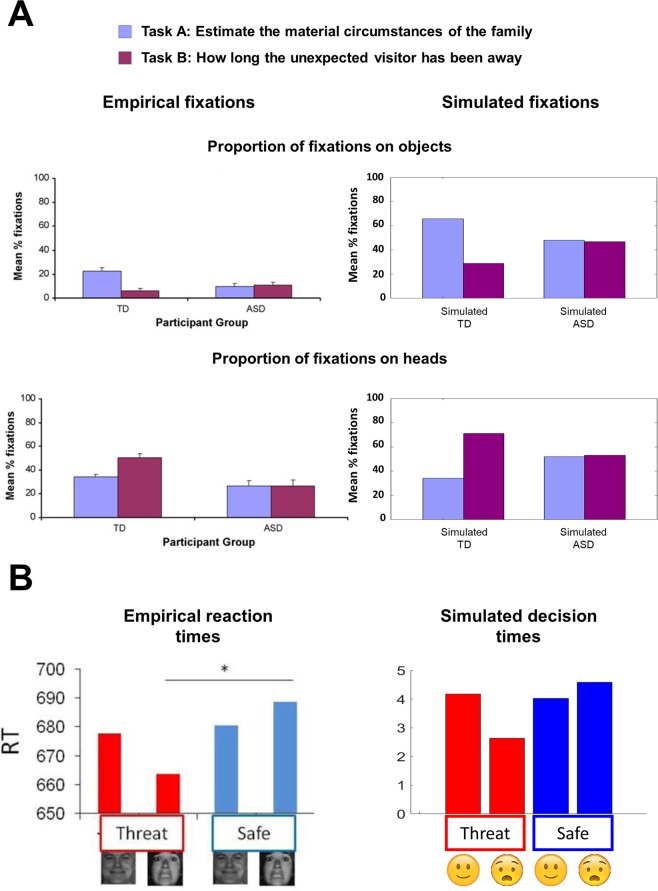
“In free visual search tasks – that contain pictures of faces – people with ASD attend less to the core features of faces (e.g., eye, nose and mouth) and more to other parts of the face 53 and are slower at discriminating faces in face discrimination tasks 54 .”
BackgroundWhen the world becomes ‘too real’: a Bayesian explanation of autistic perception
Pellicano, E., & Burr, D. (2012) · Trends in Cognitive Sciences · doi:10.1016/j.tics.2012.08.009 · Cited by 1,156
Scene perception: Detecting and judging objects undergoing relational violations
Biederman, I., Mezzanotte, R. J., & Rabinowitz, J. C. (1982) · Cognitive Psychology · doi:10.1016/0010-0285(82)90007-x · Cited by 1,056
The N2pc component as an indicator of attentional selectivity
Eimer, M. (1996) · Electroencephalography and Clinical Neurophysiology · doi:10.1016/0013-4694(96)95711-9 · Cited by 1,018
Contextual cueing of visual attention
Chun, M. M. (2000) · Trends in Cognitive Sciences · doi:10.1016/s1364-6613(00)01476-5 · Cited by 732 · cited 1×
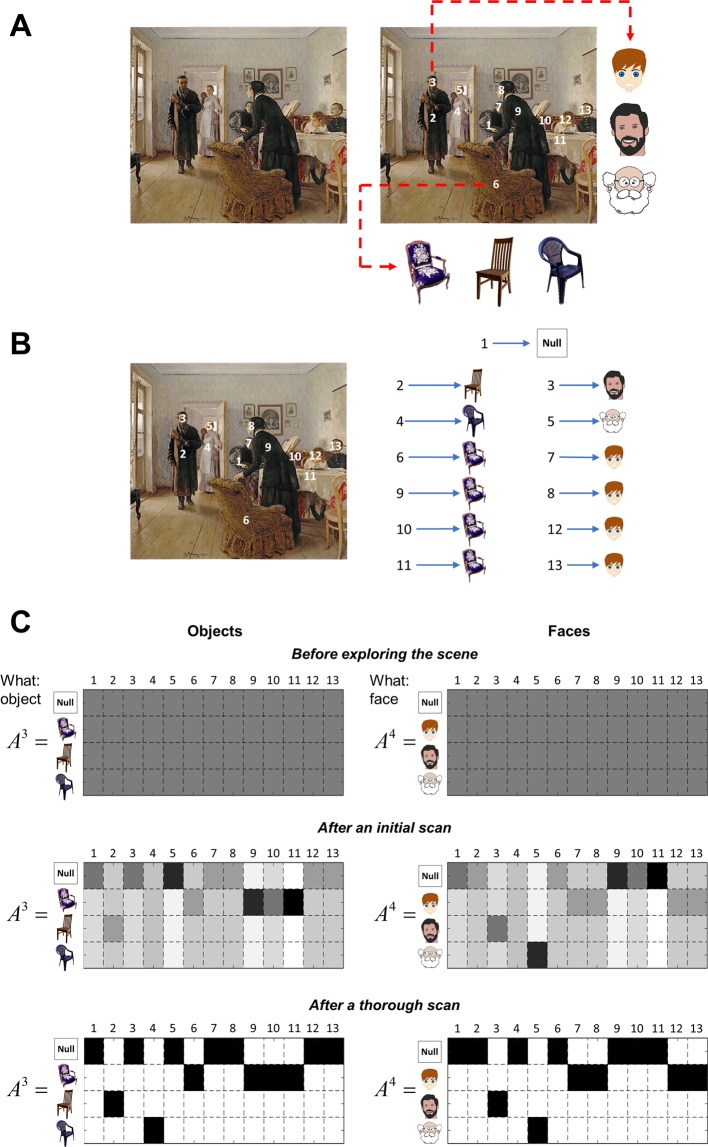
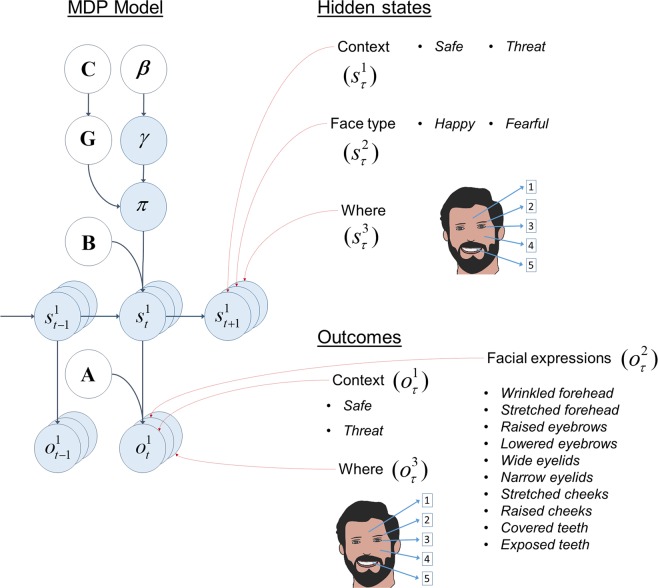
“The furniture and clothes appear in locations 2, 4, 6, 9, 10, 11, whereas the faces appear in locations 3, 5, 7, 8, 12, 13.”
BackgroundActive inference and epistemic value
Friston, K., Rigoli, F., Ognibene, D., Mathys, C., Fitzgerald, T., & Pezzulo, G. (2015) · Cognitive Neuroscience · doi:10.1080/17588928.2015.1020053 · Cited by 731 · cited 1×
“In active inference, perception and action both minimise variational free energy 17 .”
BackgroundSelf-citationAn aberrant precision account of autism
Lawson, R. P., Rees, G., & Friston, K. J. (2014) · Frontiers in Human Neuroscience · doi:10.3389/fnhum.2014.00302 · Cited by 641
Self-citationUltra-rapid object detection with saccadic eye movements: Visual processing speed revisited
Kirchner, H., & Thorpe, S. J. (2006) · Vision Research · doi:10.1016/j.visres.2005.10.002 · Cited by 628 · cited 1×
“In this setting, people are able to locate the target in a few eye movements 10,64–66 , and show electrophysiological responses to these stimuli within hundreds of milliseconds 67 .”
BackgroundThe impact of anxiety upon cognition: perspectives from human threat of shock studies
Robinson, O. J., Vytal, K., Cornwell, B. R., & Grillon, C. (2013) · Frontiers in Human Neuroscience · doi:10.3389/fnhum.2013.00203 · Cited by 613
Cohen, J. D., Barch, D. M., Carter, C., & Servan-Schreiber, D. (1999) · Journal of Abnormal Psychology · doi:10.1037/0021-843x.108.1.120 · Cited by 612
Superior visual search in autism.
O'Riordan, M. A., Plaisted, K. C., Driver, J., & Baron-Cohen, S. (2001) · Journal of Experimental Psychology: Human Perception and Performance · doi:10.1037//0096-1523.27.3.719 · Cited by 557 · cited 1×
“Interestingly, a difficulty in down-modulating precision would also imply a more accurate generative model – consistent with superior (pop-out) visual search performance in autism 57 .”
ResultScene Consistency in Object and Background Perception
Davenport, J. L., & Potter, M. C. (2004) · Psychological Science · doi:10.1111/j.0956-7976.2004.00719.x · Cited by 552 · cited 2×
“The scene context can be a background that is consistent or inconsistent with a foreground object 8–10 , or it can be defined in terms of the spatial layout of the objects 11–13 .”
BackgroundHappé, F. G. E. (1996) · Journal of Child Psychology and Psychiatry · doi:10.1111/j.1469-7610.1996.tb01483.x · Cited by 489
Adults with autism overestimate the volatility of the sensory environment
Lawson, R. P., Mathys, C., & Rees, G. (2017) · Nature Neuroscience · doi:10.1038/nn.4615 · Cited by 470 · cited 1×
“Manifestations of these computational deficits include resistance to visual illusions, attenuated pupillary responses to a priori surprising stimuli 34 and, crucially, abnormalities of visual search behaviour.”
BackgroundCerebral hierarchies: predictive processing, precision and the pulvinar
Kanai, R., Komura, Y., Shipp, S., & Friston, K. (2015) · Philosophical Transactions of the Royal Society B: Biological Sciences · doi:10.1098/rstb.2014.0169 · Cited by 432
Self-citationThe graphical brain: Belief propagation and active inference
Friston, K. J., Parr, T., & de Vries, B. (2017) · Network Neuroscience · doi:10.1162/netn_a_00018 · Cited by 415 · cited 1×
“While we have not addressed the contributions of early visual pathways here, we could interpret our sensory outcomes as alternative hypotheses about continuous attributes of visual objects 52 .”
MethodSelf-citationEnhanced visual search for a conjunctive target in autism: a research note
Plaisted, K., O'Riordan, M., & Baron-Cohen, S. (1998) · Journal of Child Psychology and Psychiatry · doi:10.1017/s0021963098002613 · Cited by 405 · cited 1×
“In contrast, people with ASD have been shown to be superior to controls on visual search tasks that involve visual illusions 55 and faster on tasks that involve spotting a target object that shares certain features with distractors 56 .”
BackgroundViewing task influences eye movement control during active scene perception
Castelhano, M. S., Mack, M. L., & Henderson, J. M. (2009) · Journal of Vision · doi:10.1167/9.3.6 · Cited by 378 · cited 2×
“The furniture and clothes appear in locations 2, 4, 6, 9, 10, 11, whereas the faces appear in locations 3, 5, 7, 8, 12, 13.”
BackgroundActive Inference, Curiosity and Insight
Friston, K. J., Lin, M., Frith, C. D., Pezzulo, G., Hobson, J. A., & Ondobaka, S. (2017) · Neural Computation · doi:10.1162/neco_a_00999 · Cited by 351 · cited 2×
“Novelty is the information that can be gained about the parameters of the generative model 19 .”
BackgroundSelf-citationScene context guides eye movements during visual search
Neider, M. B., & Zelinsky, G. J. (2006) · Vision Research · doi:10.1016/j.visres.2005.08.025 · Cited by 335 · cited 3×
“The scene context can be a background that is consistent or inconsistent with a foreground object 8–10 , or it can be defined in terms of the spatial layout of the objects 11–13 .”
BackgroundConfigural processing in autism and its relationship to face processing
Behrmann, M., Avidan, G., Leonard, G. L., Kimchi, R., Luna, B., Humphreys, K., & Minshew, N. (2006) · Neuropsychologia · doi:10.1016/j.neuropsychologia.2005.04.002 · Cited by 334
The Construct of Attention in Schizophrenia
Luck, S. J., & Gold, J. M. (2008) · Biological Psychiatry · doi:10.1016/j.biopsych.2008.02.014 · Cited by 305 · cited 1×
“Aberrant attribution of salience may be exacerbated by deficits in context processing 59 , but there is thought to be a predominant impairment in the control of attention (i.e., feature selection) in schizophrenia than in the subsequent inference using those features 60 .”
BackgroundBotvinick, M., & Toussaint, M. (2012) · Trends in Cognitive Sciences · doi:10.1016/j.tics.2012.08.006 · Cited by 292 · cited 1×
“~ ~ = − | + | P o m D Q x P x o ln ( ) [ ( ) ( )] (2) KL”
Eye movements in iconic visual search
Rao, R. P. N., Zelinsky, G. J., Hayhoe, M. M., & Ballard, D. H. (2002) · Vision Research · doi:10.1016/s0042-6989(02)00040-8 · Cited by 253
Uncertainty, epistemics and active inference
Parr, T., & Friston, K. J. (2017) · Journal of The Royal Society Interface · doi:10.1098/rsif.2017.0376 · Cited by 252 · cited 1×
“The furniture and clothes appear in locations 2, 4, 6, 9, 10, 11, whereas the faces appear in locations 3, 5, 7, 8, 12, 13.”
BackgroundSelf-citationA simple saliency model predicts a number of motion popout phenomena
Rosenholtz, R. (1999) · Vision Research · doi:10.1016/s0042-6989(99)00077-2 · Cited by 235 · cited 1×
“These features include orientation, intensity, colour information 38–41 , luminance 42 , contrast 43 and motion 44 .”
BackgroundRobinson, O. J., Charney, D. R., Overstreet, C., Vytal, K., & Grillon, C. (2012) · NeuroImage · doi:10.1016/j.neuroimage.2011.11.096 · Cited by 196
Attentional guidance of the eyes by contextual information and abrupt onsets.
Peterson, M. S., & Kramer, A. F. (2001) · Perception & Psychophysics · doi:10.3758/bf03194537 · Cited by 174 · cited 3×
“The scene context can be a background that is consistent or inconsistent with a foreground object 8–10 , or it can be defined in terms of the spatial layout of the objects 11–13 .”
BackgroundWhat Do Imaging Studies Tell Us about the Neural Basis of Autism?
Frith, C. (2003) · Novartis Foundation Symposia · doi:10.1002/0470869380.ch10 · Cited by 168 · cited 1×
“Prominent theoretical accounts of autism spectrum disorder (ASD) call upon a failure to use prior beliefs to contextualise sensory data 30 .”
BackgroundScene Construction, Visual Foraging, and Active Inference
Mirza, M. B., Adams, R. A., Mathys, C. D., & Friston, K. J. (2016) · Frontiers in Computational Neuroscience · doi:10.3389/fncom.2016.00056 · Cited by 165 · cited 4×
“Epistemic value is the information the agent expects to acquire about the hidden states of the environment 4,18 .”
BackgroundInfluentialSelf-citationComputational Neuropsychology and Bayesian Inference
Parr, T., Rees, G., & Friston, K. J. (2018) · Frontiers in Human Neuroscience · doi:10.3389/fnhum.2018.00061 · Cited by 149 · cited 1×
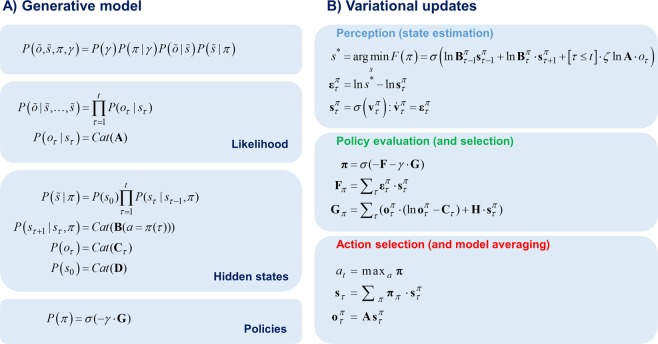
“An agent’s perception of its environment and the actions it takes both suppress variational free energy: For an agent to infer (perceive) the state of its environment, it requires a generative model that describes how observed outcomes are generated by the environment 22,24 .”
BackgroundSelf-citationOn the Semantics of a Glance at a Scene
Biederman, I. (2017) · Perceptual Organization · doi:10.4324/9781315512372-8 · Cited by 120
Robinson, O. J., Letkiewicz, A. M., Overstreet, C., Ernst, M., & Grillon, C. (2011) · Cognitive, Affective, & Behavioral Neuroscience · doi:10.3758/s13415-011-0030-5 · Cited by 114
Active sensing in the categorization of visual patterns
Yang, S. C.-H., Lengyel, M., & Wolpert, D. M. (2016) · eLife · doi:10.7554/elife.12215 · Cited by 107 · cited 1×
“A noteworthy model in this setting defines image categories in terms of visual patterns and approaches the scene categorisation problem by maximising the mutual information between scene categories and pixel values at possible fixation locations 48 .”
BackgroundContingent attentional capture by conceptually relevant images.
Wyble, B., Folk, C., & Potter, M. C. (2013) · Journal of Experimental Psychology: Human Perception and Performance · doi:10.1037/a0030517 · Cited by 101 · cited 1×
“In this setting, people are able to locate the target in a few eye movements 10,64–66 , and show electrophysiological responses to these stimuli within hundreds of milliseconds 67 .”
BackgroundHuman visual exploration reduces uncertainty about the sensed world
Mirza, M. B., Adams, R. A., Mathys, C., & Friston, K. J. (2018) · PLOS ONE · doi:10.1371/journal.pone.0190429 · Cited by 85 · cited 1×
“Epistemic value is the information the agent expects to acquire about the hidden states of the environment 4,18 .”
BackgroundSelf-citationOculomotor inhibition of salient distractors: Voluntary inhibition cannot override selection history
Gaspelin, N., Gaspar, J. M., & Luck, S. J. (2019) · Visual Cognition · doi:10.1080/13506285.2019.1600090 · Cited by 84
Active Inference, Evidence Accumulation, and the Urn Task
FitzGerald, T. H. B., Schwartenbeck, P., Moutoussis, M., Dolan, R. J., & Friston, K. (2015) · Neural Computation · doi:10.1162/neco_a_00699 · Cited by 81 · cited 1×
“Extrinsic value is the expected utility defined in terms of prior preferences over the outcomes 28 .”
BackgroundSelf-citationAtypical scanpaths in schizophrenia: Evidence of a trait- or state-dependent phenomenon?
Beedie, S. A., St. Clair, D. M., & Benson, P. J. (2011) · Journal of Psychiatry and Neuroscience · doi:10.1503/jpn.090169 · Cited by 78 · cited 1×
“Indeed, whilst subjects with schizophrenia may be unimpaired – or even show enhanced performance – in simple attentional cueing tasks 61 , in more complex tasks, such as viewing natural images, they consistently fixate less on informative areas 62 .”
BackgroundParietal neurons encode expected gains in instrumental information
Foley, N. C., Kelly, S. P., Mhatre, H., Lopes, M., & Gottlieb, J. (2017) · Proceedings of the National Academy of Sciences · doi:10.1073/pnas.1613844114 · Cited by 78
Enhanced facilitation of spatial attention in schizophrenia.
Spencer, K., Nestor, P. G., Valdman, O., Niznikiewicz, M. A., Shenton, M. E., & McCarley, R. W. (2011) · Neuropsychology · doi:10.1037/a0020779 · Cited by 54 · cited 1×
“Indeed, whilst subjects with schizophrenia may be unimpaired – or even show enhanced performance – in simple attentional cueing tasks 61 , in more complex tasks, such as viewing natural images, they consistently fixate less on informative areas 62 .”
BackgroundThe Computational Anatomy of Visual Neglect
Parr, T., & Friston, K. J. (2018) · Cerebral Cortex · doi:10.1093/cercor/bhx316 · Cited by 53 · cited 2×
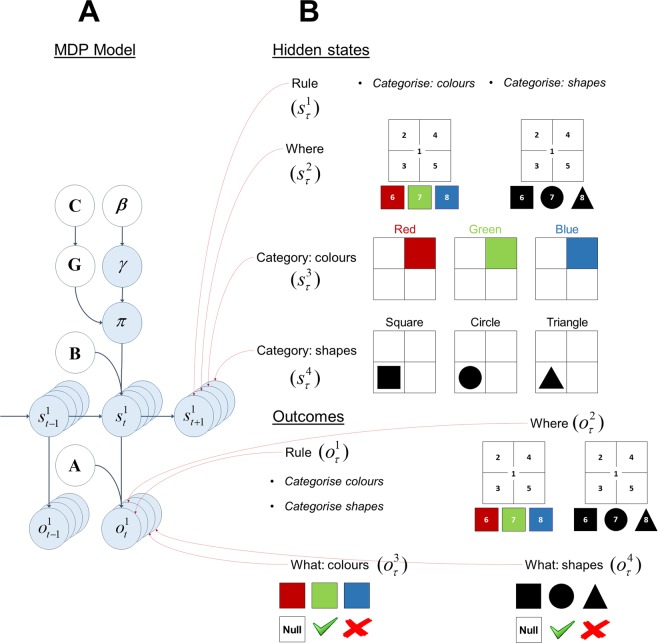
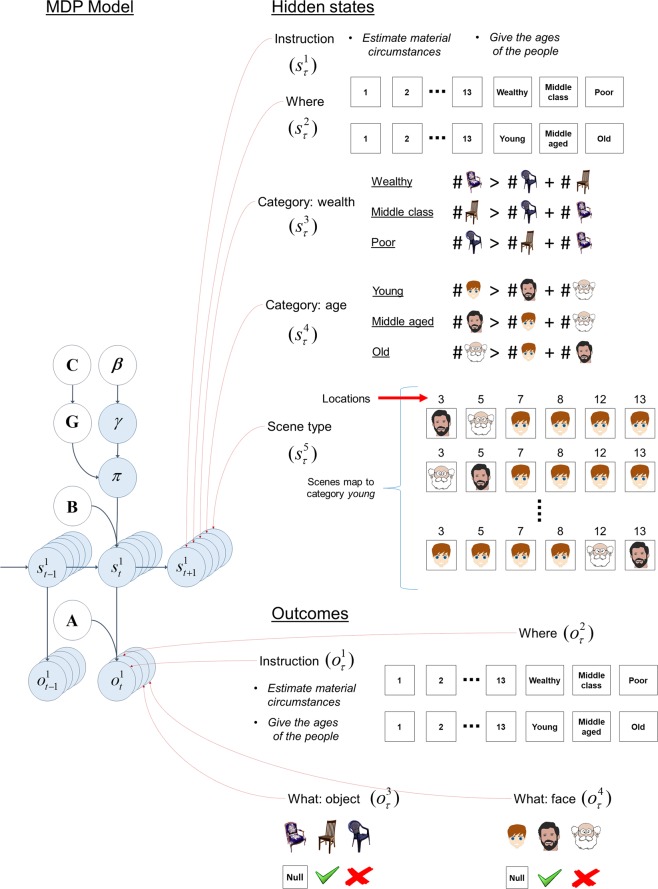
“Markov decision process (MDP) models use a discrete state space to describe how events evolve through time, giving rise to categorical outcomes at each (discrete) time point 27 .”
BackgroundSelf-citationActive inference and the anatomy of oculomotion
Parr, T., & Friston, K. J. (2018) · Neuropsychologia · doi:10.1016/j.neuropsychologia.2018.01.041 · Cited by 51 · cited 1×
“Minimising variational free energy means maximising the evidence for an internal generative model 16 .”
BackgroundSelf-citationAtypical saccadic scanning in autistic spectrum disorder
Benson, V., Piper, J., & Fletcher-Watson, S. (2009) · Neuropsychologia · doi:10.1016/j.neuropsychologia.2008.11.019 · Cited by 26 · cited 2×
“35 and Robinson et al .”
BackgroundA dual foveal-peripheral visual processing model implements efficient saccade selection
Daucé, E., Albiges, P., & Perrinet, L. (2020) · Journal of Vision · doi:10.1167/jov.20.8.22 · Cited by 23
Impulsivity and Active Inference
Mirza, M. B., Adams, R. A., Parr, T., & Friston, K. (2019) · Journal of Cognitive Neuroscience · doi:10.1162/jocn_a_01352 · Cited by 16 · cited 1×
“Nevertheless, this MDP model of active inference has the potential to differentiate between abnormal behaviours with distinct causes 70 .”
BackgroundSelf-citationA dual foveal-peripheral visual processing model implements efficient saccade selectionPreprint
Daucé, E., Albiges, P., & Perrinet, L. (2019) · bioRxiv (Cold Spring Harbor Laboratory) · doi:10.1101/725879 · Cited by 5
Research works printed but not linked: 4
- Achanta, R., Hemami, S., Estrada, F. & Susstrunk, S. In Computer vision and pattern recognition, 2009. cvpr 2009. ieee conference on. 1597–1604 (IEEE).
- Ma, Y.-F. & Zhang, H.-J. In Proceedings of the eleventh ACM international conference on Multimedia. 374–381 (ACM).
- Navalpakkam, V. & Itti, L. In Computer Vision and Pattern Recognition, 2006 IEEE Computer Society Conference on. 2049–2056 (IEEE).
- Gao, D. & Vasconcelos, N. In Advances in neural information processing systems. 481–488 (2005).
Cited by
Attention in Psychology, Neuroscience, and Machine Learning
Lindsay, G. W. (2020) · Frontiers in Computational Neuroscience · doi:10.3389/fncom.2020.00029 · Cited by 309
Smith, R., Badcock, P., & Friston, K. J. (2021) · Psychiatry and Clinical Neurosciences · doi:10.1111/pcn.13138 · Cited by 174
“In this instance, attention can be construed as affording precision to neuronal signals conveying various Bayesian beliefs or prediction errors (38-43); such that they have greater influence on belief updating than other levels of the cortical hierarchy.”
BackgroundSelf-citationPrediction in autism spectrum disorder: A systematic review of empirical evidence
Cannon, J., O'Brien, A. M., Bungert, L., & Sinha, P. (2021) · Autism Research · doi:10.1002/aur.2482 · Cited by 168
Reconsidering autistic ‘camouflaging’ as transactional impression management
Ai, W., Cunningham, W. A., & Lai, M.-C. (2022) · Trends in Cognitive Sciences · doi:10.1016/j.tics.2022.05.002 · Cited by 140
Davis, R., & Crompton, C. J. (2021) · Perspectives on Psychological Science · doi:10.1177/1745691620958010 · Cited by 136
Metadata
- Authors
- Mirza, M. B., Adams, R. A., Friston, K., & Parr, T.
- Affiliations
- Wellcome Centre for Human Neuroimaging (GB)
- University College London (GB)
- Corresponding author
- Mirza, M. Berk
- Venue
- Scientific Reports
- Published
- 2019-09-26
- Volume
- 9
- Issue
- 1
- Pages
- 13915-13915
- ISSN
- 2045-2322 (ISSN-L)
- PMC
- PMC6763492
- OpenAlex
- W2976482801
- Cited by
- 83
- References
- 69
- Citations by year
- 2026: 10 · 2025: 10 · 2024: 14 · 2023: 14 · 2022: 12 · 2021: 12 · 2020: 11
- FWCI
- 5.09
- Type
- journal article
- Language
- en
- Open access
- gold
- doi.org
- Licence
- cc-by
- creativecommons.org/licenses/by/4.0 (tdm)
- creativecommons.org/licenses/by/4.0 (vor)
- Locations
- Scientific Reports (publishedVersion, cc-by)
- Europe PMC (PubMed Central) (publishedVersion, cc-by)
- PubMed Central (publishedVersion, cc-by)
- PubMed (publishedVersion)
- DOAJ (DOAJ: Directory of Open Access Journals) (submittedVersion)
- UCL Discovery (University College London) (submittedVersion)
- MPG.PuRe (Max Planck Society) (submittedVersion)
- Funders
- Wellcome Trust (088130, 088130/Z/09/Z)
- National Institute for Health and Care Research (CL-2013-18-003)
- Academy of Medical Sciences (SGCL13, AMS-SGCL13, AMS‐SGCL13‐Adams)
- European Commission (642961, HORIZON2020)
- Rosetrees Trust (173346)
- University College London Hospitals NHS Foundation Trust
- Medical Research Council (MR/S007806/1)
- Research Executive Agency
- Topics
- Life Sciences › Neuroscience › Cognitive Neuroscience › Embodied and Extended Cognition
- Physical Sciences › Computer Science › Computer Vision and Pattern Recognition › Visual Attention and Saliency Detection
- Life Sciences › Neuroscience › Cognitive Neuroscience › Visual perception and processing mechanisms
- Keywords
- selective attention, active inference, visual search, information gain, goal-directed exploration, autism spectrum disorder, anxiety, Bayesian model
About these checks
Registry, retraction, Cites and statistics results are computed, not judged, with one exception: a printed reference that no index lists is read once by a model before it counts as a citation error. Claims are extracted by a model and kept only when their quote appears verbatim in the text; each cited source is then checked, with a model’s help, for whether it says what the claim relies on. Those verdicts can be wrong — read the claim’s quote and the cited source before relying on one.
Statistics and arithmetic are recomputed, not judged.
Confidence bands are shown only for fields calibrated on our annotated test set. None is calibrated yet, so no band is shown.
What counts as a claim ›How we measure confidence ›How we check this ›
Are you an author, or do you see a problem with this page? Request a review
Data sources
Bibliographic data: Semantic Scholar, OpenAlex, Crossref.
Contains information from the Semantic Scholar Academic Graph Datasets, made available under the ODC Attribution License (ODC-BY 1.0).
Semantic Scholar’s data is described in: Kinney, R., et al. (2023). The Semantic Scholar Open Data Platform. arXiv:2301.10140.
