

Impact of KRAS mutations and co-mutations on clinical outcomes in pancreatic ductal adenocarcinoma
Open accessPublished version of a preprint
The DOI matches its Crossref record; 74 of the 79 references it cites were found in a registry or an index, and 1 are not checked yet; 17 of the 68 sources its claims cite were checked for support.
Abstract
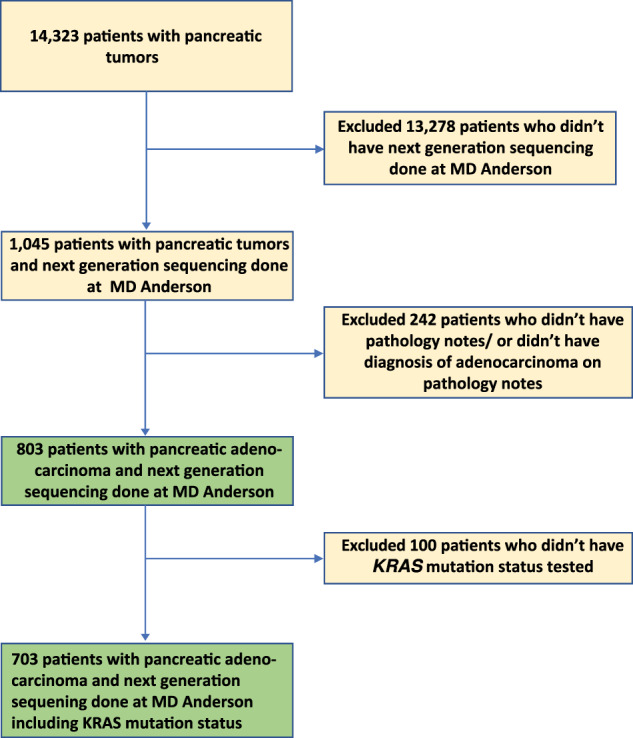
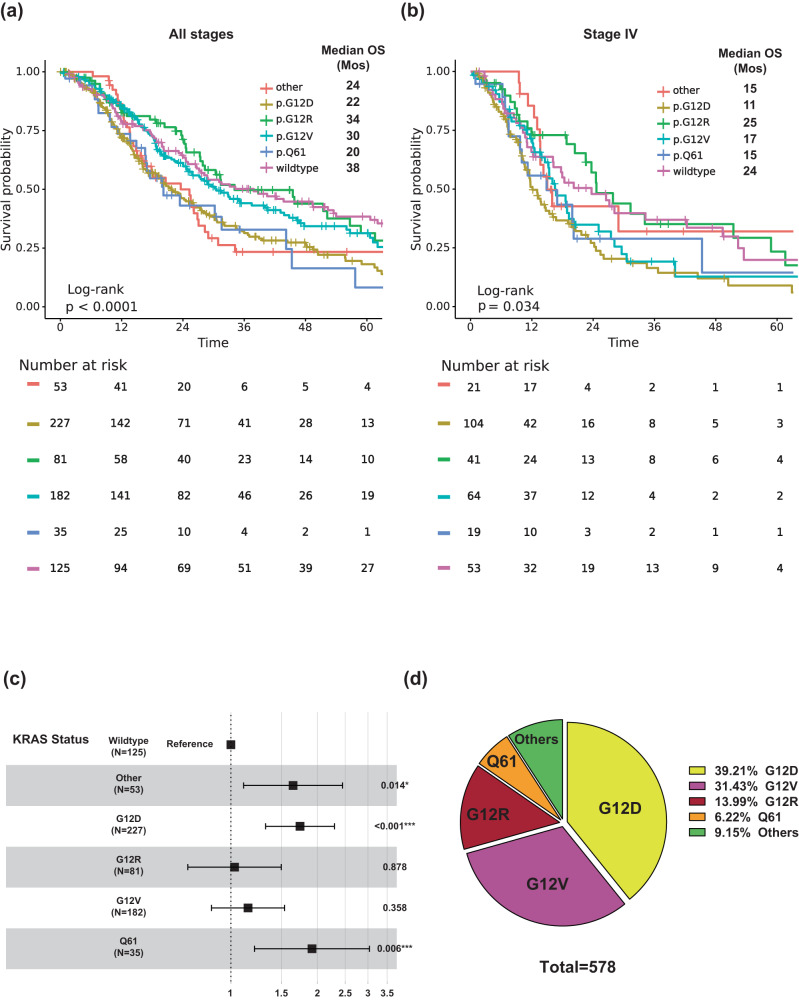
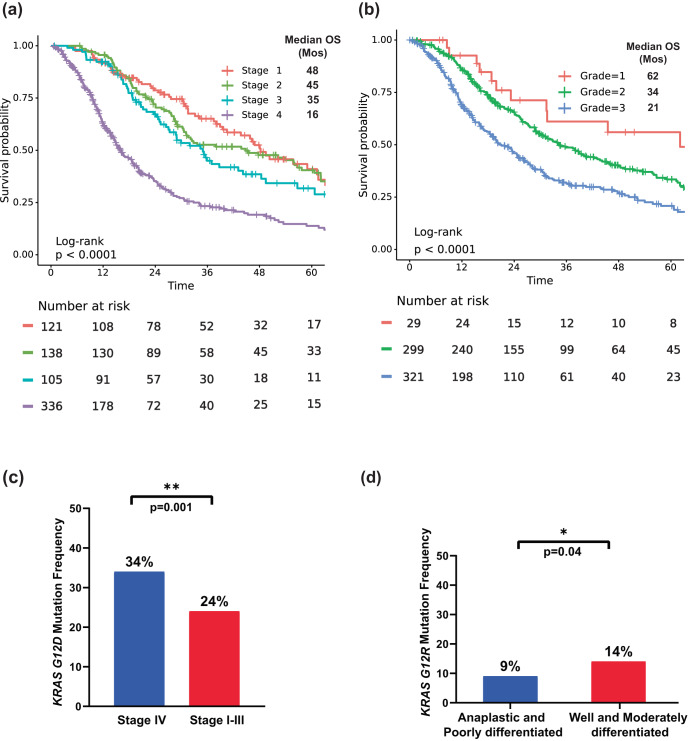
The relevance of KRAS mutation alleles to clinical outcome remains inconclusive in pancreatic adenocarcinoma (PDAC). We conducted a retrospective study of 803 patients with PDAC (42% with metastatic disease) at MD Anderson Cancer Center. Overall survival (OS) analysis demonstrated that KRAS mutation status and subtypes were prognostic ( p < 0.001). Relative to patients with KRAS wildtype tumors (median OS 38 months), patients with KRAS G12R had a similar OS (median 34 months), while patients with KRAS Q61 and KRAS G12D mutated tumors had shorter OS (median 20 months [HR: 1.9, 95% CI 1.2–3.0, p = 0.006] and 22 months [HR: 1.7, 95% CI 1.3–2.3, p < 0.001], respectively). There was enrichment of KRAS G12D mutation in metastatic tumors (34% vs 24%, OR: 1.7, 95% CI 1.2–2.4, p = 0.001) and enrichment of KRAS G12R in well and moderately differentiated tumors (14% vs 9%, OR: 1.7, 95% CI 1.05–2.99, p = 0.04). Similar findings were observed in the external validation cohort (PanCAN’s Know Your Tumor® dataset, n = 408).
Verified 2026-10-06 · 1 reference not checked yet
Overview
CoChat Summary
TL;DR
In a retrospective MD Anderson cohort of 803 patients with pancreatic ductal adenocarcinoma and an external PanCAN Know Your Tumor validation cohort (n = 408), KRAS mutation status and allele subtypes were prognostic for overall survival, with KRASG12R and KRAS wildtype tumors surviving longer than KRASG12D or KRASQ61 tumors. Co-mutations, including ARID1A and SMAD4, and KRAS/TP53/CDKN2A molecular subtypes were also associated with overall survival.
Key findings
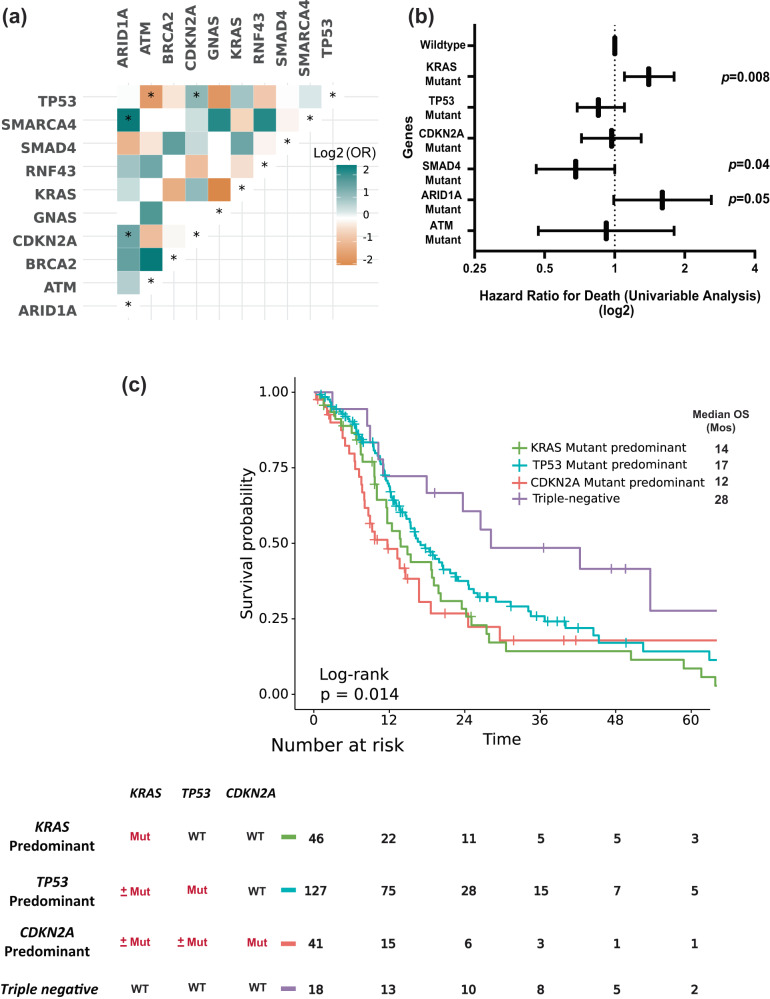
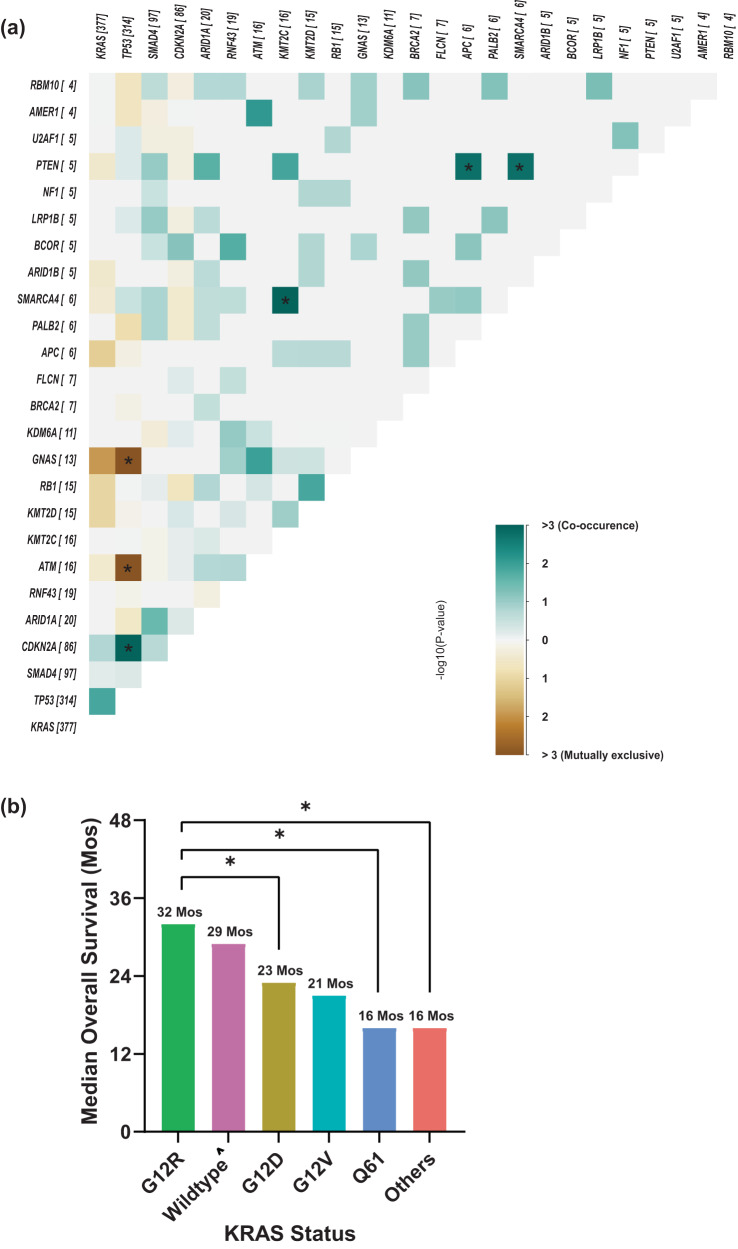
- KRAS mutation status and subtype were prognostic of OS (p < 0.001). Among 703 patients tested for KRAS, 578 (82%) were KRAS-mutant; among KRAS-mutant tumors, KRASG12D was 39%, KRASG12V 31%, KRASG12R 14%, KRASQ61 6%, and other uncommon variants 9%. Median OS was 38 months for KRAS wildtype, 34 months for KRASG12R (HR: 1, 95% CI 0.71–1.5, p = 0.88), 20 months for KRASQ61 (HR: 1.9, 95% CI 1.2–3.0, p = 0.006), and 22 months for KRASG12D (HR: 1.7, 95% CI 1.3–2.3, p < 0.001).
- KRASG12D was enriched in metastatic stage IV versus localized disease (34% vs 24%, OR: 1.7, 95% CI 1.2–2.4, p = 0.001), and KRASG12R was enriched in well/moderately differentiated versus poorly differentiated/anaplastic tumors (14% vs 9%, OR: 1.7, 95% CI 1.05–2.99, p = 0.04).
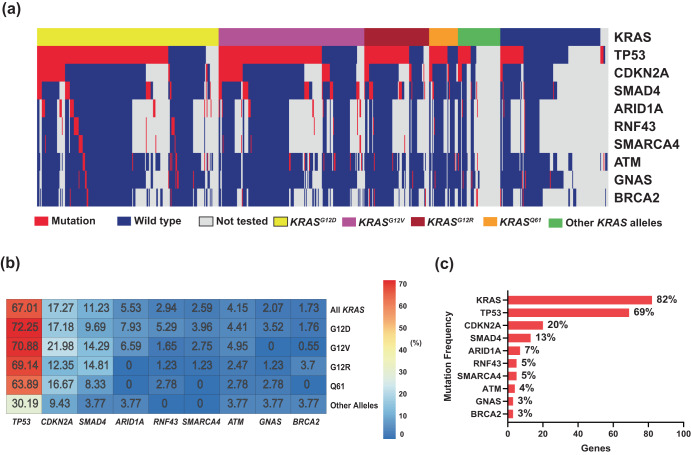
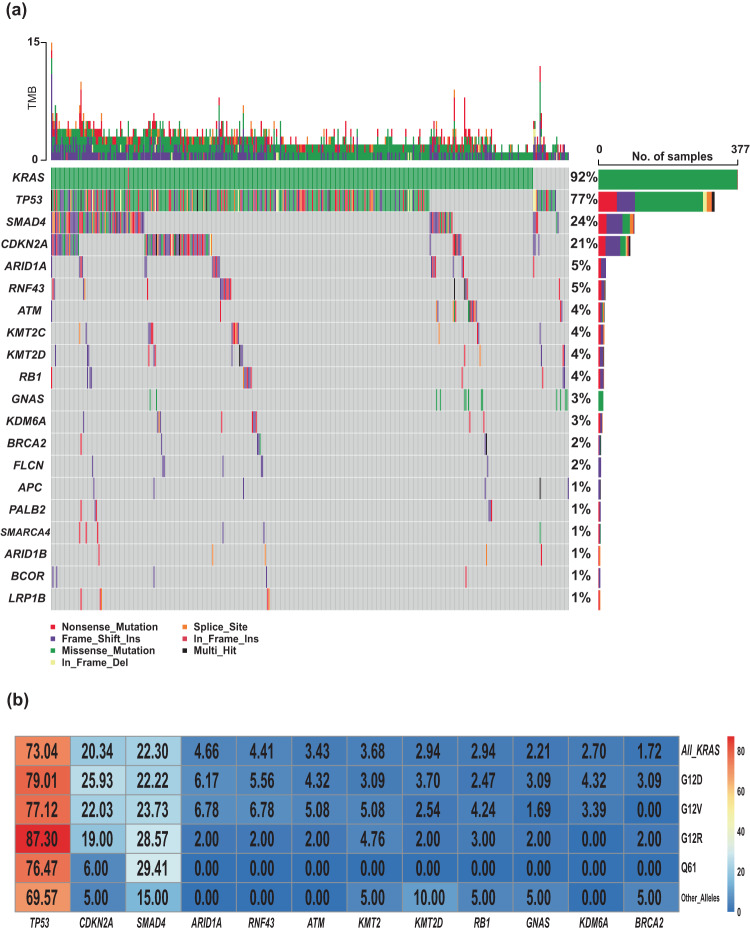
- TP53 was the most frequent KRAS co-mutation (67%), followed by CDKN2A (17%), SMAD4 (11%), and ARID1A (6%). ARID1A mutation was associated with worse OS (median 18 vs 31 months; HR: 1.6, 95% CI 0.99–2.6, p = 0.05), while SMAD4 mutation was associated with better OS (median 35 vs 27 months; HR: 0.67, 95% CI 0.46–0.99, p = 0.046). In metastatic patients with known KRAS, TP53, and CDKN2A status (n = 232), triple-negative tumors had the longest median OS (28 months) and CDKN2A-predominant tumors the worst (12 months; p = 0.014).
- In the PanCAN KYT validation cohort, KRASG12R was associated with longer median OS (32 months) than KRASQ61 (16 months; HR: 2.6, 95% CI 0.88–7.8, p = 0.02) and KRASG12D (23 months; HR: 1.68, 95% CI 1.06–2.65, p = 0.04).
Methods
- Retrospective study of 803 patients with PDAC who had tumor tissue somatic mutation testing at MD Anderson Cancer Center (42% with metastatic disease at diagnosis; median age 63 years; 43% female; median follow-up 41 months; median OS 19 months). External validation used PanCAN’s Know Your Tumor dataset (n = 408).
- Clinical, histopathologic, and molecular data were extracted from the EHR and tumor registry using Palantir Foundry; molecular testing was performed in a CAP-accredited/CLIA-certified laboratory, with gene panels evolving over time. Co-mutation analysis included patients tested with multigene panels (n = 513). KYT samples were sequenced with the Tempus xT NGS panel covering 648 genes.
- OS was calculated from initial diagnosis to death or last contact; Kaplan–Meier curves and log-rank tests were used, and univariate Cox proportional hazards models estimated HRs. Co-occurrence/mutual exclusivity was assessed with Fisher’s exact test and Benjamini–Hochberg FDR correction (FDR-corrected p < 0.1 significant); two-sided p < 0.05 was considered significant.
Limitations
- Stated by the paper: heterogeneities in patient populations and tumor mutation testing methods/gene panels; only patients with tissue molecular testing at MD Anderson were included, and patients tested on other panels were excluded; retrospective single tertiary-institution design with ascertainment bias; external validation cohort had limited clinical information and no treatment history; tumor genomic factors may not be the main contributor to allele-specific outcomes; correlative tissue and blood samples were unavailable to evaluate non-genomic factors.
- Evident from the text: substantial missing data limit interpretation, including stage not available for 59.8%, histology grade for 68.1%, and race/ethnicity for 52.2% of the KYT cohort, with missing data also present in the MD Anderson cohort (e.g., stage 12.7%, grade 18.6%). Rare subtypes were grouped (KRASQ61 variants together; KRASG12C with other uncommon mutations), which may obscure allele-specific effects.
Model-written summary. Check it against the paper before relying on it.
Integrity signals
Registry
Cites
Statistics
Figures
Verification
Claims the paper makes
10 Valid · 2 Not valid · 28 Not checked · 74 Own results and interpretations
The cited sources support only part of this claim — read each source’s verdict below.
In the paper
“Another study comparing KRASG12C (n = 30) and other KRAS mutations reported longer median OS (starting from the first line therapy, p = 0.03) for KRAS wildtype tumors (n = 91) in patients with metastatic PDAC, which was consistent with our findings of better survival in KRAS wildtype patients12”
§ Impact of KRAS mutations and co-mutations on clinical outcomes in pancreatic ductal adenocarcinoma > Discussion
What the sources say
- Partly supportedcites [12] Lee JK Comprehensive pan-cancer genomic landscape of KRAS altered cancers and real-world outcomes in solid tumors NPJ Precis. Oncol. 2022 6 91 10.1038/s41698-022-00334-z 36494601 PMC9734185 sourceExperimental — accuracy not yet measured
The Results 'Clinico-genomic database outcomes analysis' section does report the mPDAC finding the citation is offered for: KRAS G12C tumors had worse OS than KRAS negative tumors (5.9 vs. 8.8 mos, HR 0.59, p = 0.03), i.e. longer median OS for KRAS wildtype, and the Methods ('Statistical considerations'; 'FM-Flatiron CGDB') define rwOS as time from first therapy administration in patients who started 1L after tissue CGP — so the 'starting from the first line therapy' qualifier matches. However, the subgroup sizes attributed (n = 30 for KRAS G12C, n = 91 for KRAS wildtype) are nowhere in our copy (it gives only the 1398 eligible mPDAC patients and refers subgroup counts to Supplemental Table 17/Fig. 5c). The citing sentence also states the OS difference as a plain finding, whereas the source calls it 'statistically worse, though clinically similar' and 'marginally inferior', noting it was not significant in the multivariable model (Fig. 5c). (LLM, conf=0.75)
plainstates an associationn = 91- Asserted: passes — The authors put it forward as true.
- Checkable: passes — It can be checked against evidence.
- Load-bearing: unclear — It is unclear whether the paper’s conclusions depend on it.
- Based: passes — The paper gives a reason why it holds.
- Partly supported
The sources with a verdict support this claim; the rest weren’t checked yet, have no full text we could read, or their verdicts aren’t rated yet.
In the paper
“A therapeutic approach targeting CDKN2A in KRAS-mutated PDAC is under investigation; however, clinical activity of CDK4/6 inhibitors was not seen in early-phase trials55,56.”
§ Impact of KRAS mutations and co-mutations on clinical outcomes in pancreatic ductal adenocarcinoma > Discussion
What the sources say
- Supportedcites [55] Goodwin CM Combination therapies with CDK4/6 inhibitors to treat KRAS-mutant pancreatic cancer Cancer Res. 2023 83 141 157 10.1158/0008-5472.CAN-22-0391 36346366 PMC9812941 source
The Introduction (p. 1) of our copy states that 'the outcomes of clinical evaluation of CDK4/6 inhibitors in PDAC has been disappointing,' citing a phase I evaluation of ribociclib plus everolimus (NCT02985125) that 'resulted in no significant clinical response' and a phase II abemaciclib trial (NCT02981342) with no significant overall-survival improvement. The Abstract likewise states CDK4/6 inhibition 'has shown limited clinical efficacy in PDAC,' and the Results section refers to 'the lack of clinical efficacy seen with single agent CDK4/6 inhibitor treatment in PDAC.' This matches the attributed claim of absent clinical activity in early-phase trials. (LLM, conf=0.90)
- Not checked yetcites [56] Baghdadi TA Palbociclib in patients with pancreatic and biliary cancer with CDKN2A alterations: results from the targeted agent and profiling utilization registry study JCO Precis. Oncol. 2019 3 1 8 10.1200/PO.19.00124 35100714 source
plain- Asserted: passes — The authors put it forward as true.
- Checkable: passes — It can be checked against evidence.
- Load-bearing: unclear — It is unclear whether the paper’s conclusions depend on it.
- Based: passes — The paper gives a reason why it holds.
- Supported
The cited sources support only part of this claim — read each source’s verdict below.
In the paper
“Patients with resected PDAC and somatic CDKN2A loss had worse survival (median DFS 11.5 and OS 19.7) compared to patients with wildtype CDKN2A (median DFS 14.8 and median OS 24.6)39.”
§ Impact of KRAS mutations and co-mutations on clinical outcomes in pancreatic ductal adenocarcinoma > Discussion
What the sources say
- Partly supportedcites [39] Qian Association of alterations in main driver genes with outcomes of patients with resected pancreatic ductal adenocarcinoma JAMA Oncol. 2018 4 e173420 e173420 10.1001/jamaoncol.2017.3420 29098284 PMC5844844 sourceExperimental — accuracy not yet measured
The Abstract (Results) states median OS of 19.7 versus 24.6 months for patients whose tumors lacked vs retained CDKN2A in 356 patients with resected pancreatic adenocarcinoma, and the RESULTS confirm worse DFS and OS with CDKN2A loss (referring to Table 1) — so the OS figures and the direction of effect match. However, the specific median DFS values of 11.5 and 14.8 months do not appear anywhere in our copy (searched: 'median disease-free survival 11.5 14.8', 'CDKN2A median DFS table'); they reside only in Table 1, which our copy references but does not reproduce. Additionally, the claim frames the contrast as 'somatic CDKN2A loss' vs 'wildtype CDKN2A', whereas the METHODS state CDKN2A was classified as intact or lost by IHC protein expression, with the authors noting NGS cannot detect methylation-mediated silencing — so the genotype wording is not what this source measured. (LLM, conf=0.75)
plainstates an association- Asserted: passes — The authors put it forward as true.
- Checkable: passes — It can be checked against evidence.
- Load-bearing: passes — The paper’s conclusions depend on it.
- Based: passes — The paper gives a reason why it holds.
- Partly supported
A result the paper reports from its own data — it cites no other source for it, so there is none to check. The quote shows it is in the paper.
In the paper
“When limited to patients with stage IV metastatic disease (n = 302), KRAS mutation remained significantly associated with OS (p = 0.034) (Fig. 2b).”
§ Impact of KRAS mutations and co-mutations on clinical outcomes in pancreatic ductal adenocarcinoma > Results > KRAS mutation status and allele subtype association with OS
plainstates an associationn = 302- Asserted: passes — The authors put it forward as true.
- Checkable: passes — It can be checked against evidence.
- Load-bearing: passes — The paper’s conclusions depend on it.
- Based: passes — The paper gives a reason why it holds.
A result the paper reports from its own data — it cites no other source for it, so there is none to check. The quote shows it is in the paper.
In the paper
“and GNAS (OR: 0.05, FDR-corrected p = 6.65E-05) mutations.”
§ Impact of KRAS mutations and co-mutations on clinical outcomes in pancreatic ductal adenocarcinoma > Results > KRAS Co-mutations and OS
plainstates an association- Asserted: passes — The authors put it forward as true.
- Checkable: passes — It can be checked against evidence.
- Load-bearing: unclear — It is unclear whether the paper’s conclusions depend on it.
- Based: passes — The paper gives a reason why it holds.
52 more claims
Create a free account to see all 114 claims and to verify the 51 references still open.
- Probably not a substantial claim. 41
- It may state two separate claims as one. 30
Claims other papers make about this one
Each is checked against this paper’s own text: does it say what the citing paper says it does?
The cited source doesn’t support the claim as written.
In the citing paper
“Over 20% of KRAS-mutant NSCLC and PDAC cases have been found to have inactivating CDKN2A co-mutations [122, 123].”
From Differential Response and Resistance to KRAS-Targeted Therapy (2025) · cites this paper as [123]
Checked by a reasoning model — may be wrong.
Experimental — accuracy not yet measured
Self-check
Percentages, sums and reported differences re-computed from the paper’s own numbers.
Each contradiction between two passages listed here was confirmed by an independent check.
Rated minor: it would not touch a result — a value no result rests on, a p-value that stays on the same side of the significance level, or a conflict that is clerical, resolved elsewhere in the paper, or outside its own findings.
In the paper
§ Impact of KRAS mutations and co-mutations on clinical outcomes in pancreatic ductal adenocarcinoma > Results > KRAS Co-mutations and OS
“TP53 (69%, N = 418 of 608)”
§ Impact of KRAS mutations and co-mutations on clinical outcomes in pancreatic ductal adenocarcinoma > Results > Patient characteristics
“TP53 was tested in 604 patients, 418 (69%) of whom were positive”
Rated minor: it would not touch a result — a value no result rests on, a p-value that stays on the same side of the significance level, or a conflict that is clerical, resolved elsewhere in the paper, or outside its own findings.
In the paper
§ Impact of KRAS mutations and co-mutations on clinical outcomes in pancreatic ductal adenocarcinoma > Results > KRAS Co-mutations and OS
“SMARCA4 (OR: 5.17, 95% CI 1.15–8.44, FDR-corrected p = 0.1)”
§ Impact of KRAS mutations and co-mutations on clinical outcomes in pancreatic ductal adenocarcinoma > Discussion
“SMARCA4 (OR: 5.17, 95% CI 1.15–18.44, FDR-corrected p = 0.1)”
Citations
Cites
FOLFIRINOX versus Gemcitabine for Metastatic Pancreatic Cancer
Conroy, T., Desseigne, F., Ychou, M., Bouché, O., Guimbaud, R., Bécouarn, Y., Adenis, A., Raoul, J.-L., Gourgou-Bourgade, S., de la Fouchardière, C., et al. (2011) · New England Journal of Medicine · doi:10.1056/nejmoa1011923 · Cited by 7,810
Increased Survival in Pancreatic Cancer with nab-Paclitaxel plus Gemcitabine
Von Hoff, D. D., Ervin, T., Arena, F. P., Chiorean, E. G., Infante, J., Moore, M., Seay, T., Tjulandin, S. A., Ma, W. W., Saleh, M. N., et al. (2013) · New England Journal of Medicine · doi:10.1056/nejmoa1304369 · Cited by 6,712 · cited 1×
“The median OS for the other available fi rst-line chemotherapy regimen, gemcitabine/nab-paclitaxel, is 8.5 months with an ORR of 23% and median PFS of 5.5 months 5 .”
InfluentialMaftools: efficient and comprehensive analysis of somatic variants in cancer
Mayakonda, A., Lin, D.-C., Assenov, Y., Plass, C., & Koeffler, H. P. (2018) · Genome Research · doi:10.1101/gr.239244.118 · Cited by 4,935
Core Signaling Pathways in Human Pancreatic Cancers Revealed by Global Genomic Analyses
Jones, S., Zhang, X., Parsons, D. W., Lin, J. C.-H., Leary, R. J., Angenendt, P., Mankoo, P., Carter, H., Kamiyama, H., Jimeno, A., et al. (2008) · Science · doi:10.1126/science.1164368 · Cited by 3,969 · cited 1×
“Among the identi fi ed genomic alterations (GAs) in PDAC, oncogenic KRAS mutations are the most common, occurring in close to 90% of patients, followed by TP53 , CDKN2A , and SMAD4 7,8 .”
BackgroundSelf-citationHaplotype-based variant detection from short-read sequencing
Garrison, E., & Marth, G. (2012) · arXiv · doi:10.48550/arxiv.1207.3907 · Cited by 3,700 · cited 1×
“Variants are called from the resulting alignment fi les using an analysis pipeline that detects SNPs and indels using Freebayes and Pindel 72,73 .”
Genomic analyses identify molecular subtypes of pancreatic cancer
Bailey, P., Chang, D. K., Nones, K., Johns, A. L., Patch, A.-M., Gingras, M.-C., Miller, D. K., Christ, A. N., Bruxner, T. J. C., Quinn, M. C., et al. (2016) · Nature · doi:10.1038/nature16965 · Cited by 3,621 · cited 1×
“ARID1A[20] RNF43 [ 19] ATM [ 16] KMT2C [ 16] KMT2D [ 15] RB1 [ 15] GNAS [ 13] KDM6A [ 11] BRCA2 [ 7] FLCN [ 7] APC [ 6] PALB2 [ 6] SMARCA4 [ 6] ARID1B [ 5] BCOR [ 5] LRP1B [ 5] NF1[ 5] PTEN [ 5] U2AF1 [ 5] AMER1 [ 4] In summary, we reported the KRAS mutation allele-speci fi c clinical outcomes in…”
Self-citationMizrahi, J. D., Surana, R., Valle, J. W., & Shroff, R. T. (2020) · The Lancet · doi:10.1016/s0140-6736(20)30974-0 · Cited by 2,559
K-Ras(G12C) inhibitors allosterically control GTP affinity and effector interactions
Ostrem, J. M., Peters, U., Sos, M. L., Wells, J. A., & Shokat, K. M. (2013) · Nature · doi:10.1038/nature12796 · Cited by 2,557
DPC4 , A Candidate Tumor Suppressor Gene at Human Chromosome 18q21.1
Hahn, S. A., Schutte, M., Shamsul Hoque, A. T. M., Moskaluk, C. A., da Costa, L. T., Rozenblum, E., Weinstein, C. L., Fischer, A., Yeo, C. J., Hruban, R. H., et al. (1996) · Science · doi:10.1126/science.271.5247.350 · Cited by 2,337
The Clinical KRAS(G12C) Inhibitor AMG 510 Drives Anti-Tumour Immunity
Canon, J., Rex, K., Saiki, A. Y., Mohr, C., Cooke, K., Bagal, D., Gaida, K., Holt, T., Knutson, C. G., Koppada, N., et al. (2019) · Nature · doi:10.1038/s41586-019-1694-1 · Cited by 2,277 · cited 1×
“Moreover, ef fi cacy of both sotorasib and adagrasib against PDAC has also been observed 14 – 18 .”
BackgroundPancreatic cancer genomes reveal aberrations in axon guidance pathway genes
Initiative, A. P. C. G., Biankin, A. V., Waddell, N., Kassahn, K. S., Gingras, M.-C., Muthuswamy, L. B., Johns, A. L., Miller, D. K., Wilson, P. J., Patch, A.-M., et al. (2012) · Nature · doi:10.1038/nature11547 · Cited by 2,058 · cited 16×
“However, SMAD4 mutant tumors had better OS than SMAD4 wildtype tumors (median OS 35 and 27 months, respectively, HR: 0.67, 95% CI 0.46 – 0.99, p = 0.046) (Fig.”
BackgroundInfluentialSelf-citationYe, K., Schulz, M. H., Long, Q., Apweiler, R., & Ning, Z. (2009) · Bioinformatics · doi:10.1093/bioinformatics/btp394 · Cited by 2,022
Integrated genomic characterization of pancreatic ductal adenocarcinoma
Raphael, B. J., Hruban, R. H., Aguirre, A. J., Moffitt, R. A., Yeh, J. J., Stewart, C., Robertson, A. G., Cherniack, A. D., Gupta, M., Getz, G., et al. (2017) · Cancer Cell · doi:10.1016/j.ccell.2017.07.007 · Cited by 2,019
Sotorasib for Lung Cancers with KRAS p.G12C Mutation
Skoulidis, F., Li, B. T., Dy, G. K., Price, T. J., Falchook, G. S., Wolf, J., Italiano, A., Schuler, M., Borghaei, H., Barlesi, F., et al. (2021) · New England Journal of Medicine · doi:10.1056/nejmoa2103695 · Cited by 1,849 · cited 1×
“Moreover, ef fi cacy of both sotorasib and adagrasib against PDAC has also been observed 14 – 18 .”
KRAS G12C Inhibition with Sotorasib in Advanced Solid Tumors
Hong, D. S., Fakih, M. G., Strickler, J. H., Desai, J., Durm, G. A., Shapiro, G. I., Falchook, G. S., Price, T. J., Sacher, A., Denlinger, C. S., et al. (2020) · New England Journal of Medicine · doi:10.1056/nejmoa1917239 · Cited by 1,733
Estimated Projection of US Cancer Incidence and Death to 2040
Rahib, L., Wehner, M. R., Matrisian, L. M., & Nead, K. T. (2021) · JAMA Network Open · doi:10.1001/jamanetworkopen.2021.4708 · Cited by 1,339
Self-citationPancreatic cancer: Advances and challenges
Halbrook, C. J., Lyssiotis, C. A., Pasca di Magliano, M., & Maitra, A. (2023) · Cell · doi:10.1016/j.cell.2023.02.014 · Cited by 1,321 · cited 1×
“Context-speci fi c tumor suppressive or oncogenic functions of SWI/SNF chromatin regulation was noticed in PDAC 64,65 .”
BackgroundSelf-citationHallin, J., Engstrom, L. D., Hargis, L., Calinisan, A., Aranda, R., Briere, D. M., Sudhakar, N., Bowcut, V., Baer, B. R., Ballard, J. A., et al. (2020) · Cancer Discovery · doi:10.1158/2159-8290.cd-19-1167 · Cited by 1,304
Pancreatic Adenocarcinoma, Version 2.2021, NCCN Clinical Practice Guidelines in Oncology
Tempero, M. A., Malafa, M. P., Al-Hawary, M., Behrman, S. W., Benson, A. B., Cardin, D. B., Chiorean, E. G., Chung, V., Czito, B., Del Chiaro, M., et al. (2021) · Journal of the National Comprehensive Cancer Network · doi:10.6004/jnccn.2021.0017 · Cited by 1,304 · cited 1×
“…(OS) for the current standard of care chemotherapy (oxaliplatin, irinotecan, fl uorouracil, and leucovorin [FOLFIRINOX]) is 11.1 months in the fi rst-line treatment of metastatic disease, with an objective response rate (ORR) of 31.6% and median progression-free survival (PFS) of 6.4 months 3,4 .”
BackgroundInfluentialSelf-citationWang-Gillam, A., Li, C.-P., Bodoky, G., Dean, A., Shan, Y.-S., Jameson, G., Macarulla, T., Lee, K.-H., Cunningham, D., Blanc, J. F., et al. (2016) · The Lancet · doi:10.1016/s0140-6736(15)00986-1 · Cited by 1,222
Self-citationAdagrasib in Non–Small-Cell Lung Cancer Harboring a KRAS G12C Mutation
Jänne, P. A., Riely, G. J., Gadgeel, S. M., Heist, R. S., Ou, S.-H. I., Pacheco, J. M., Johnson, M. L., Sabari, J. K., Leventakos, K., Yau, E., et al. (2022) · New England Journal of Medicine · doi:10.1056/nejmoa2204619 · Cited by 1,061 · cited 1×
“…inhibitors, such as co-mutations of KEAP1/STK11 with KRAS as observed in patients with lung cancer, KEAP1/STK11 co-mutations are rare in pancreatic cancer, and little is known about the landscape of KRAS mutations and co-mutations in pancreatic cancer or their impact on clinical outcomes 12,24,25 .”
Aguirre, A. J., Bardeesy, N., Sinha, M., Lopez, L., Tuveson, D. A., Horner, J., Redston, M. S., & DePinho, R. A. (2003) · Genes & Development · doi:10.1101/gad.1158703 · Cited by 1,033
Co-occurring genomic alterations in non-small-cell lung cancer biology and therapy
Skoulidis, F., & Heymach, J. V. (2019) · Nature Reviews Cancer · doi:10.1038/s41568-019-0179-8 · Cited by 1,019
KRAS: The Critical Driver and Therapeutic Target for Pancreatic Cancer
Waters, A. M., & Der, C. J. (2018) · Cold Spring Harbor Perspectives in Medicine · doi:10.1101/cshperspect.a031435 · Cited by 875
Biochemical and Structural Analysis of Common Cancer-Associated KRAS Mutations
Hunter, J. C., Manandhar, A., Carrasco, M. A., Gurbani, D., Gondi, S., & Westover, K. D. (2015) · Molecular Cancer Research · doi:10.1158/1541-7786.mcr-15-0203 · Cited by 786 · cited 2×
“On the other hand, KRAS Q61 mutant tumors had a decreased GTP hydrolysis rate with high RAF-dependent MEK phosphorylation, and they did not response to SOS1 inhibition 29,44 .”
Maitra, A., & Hruban, R. H. (2008) · Annual Review of Pathology: Mechanisms of Disease · doi:10.1146/annurev.pathmechdis.3.121806.154305 · Cited by 707
Self-citationAnti-tumor efficacy of a potent and selective non-covalent KRASG12D inhibitor
Hallin, J., Bowcut, V., Calinisan, A., Briere, D. M., Hargis, L., Engstrom, L. D., Laguer, J., Medwid, J., Vanderpool, D., Lifset, E., et al. (2022) · Nature Medicine · doi:10.1038/s41591-022-02007-7 · Cited by 553
A renewed model of pancreatic cancer evolution based on genomic rearrangement patterns
Notta, F., Chan-Seng-Yue, M., Lemire, M., Li, Y., Wilson, G. W., Connor, A. A., Denroche, R. E., Liang, S.-B., Brown, A. M. K., Kim, J. C., et al. (2016) · Nature · doi:10.1038/nature19823 · Cited by 528 · cited 1×
“Co-occurrence of other mutations were common in PDAC, and the disease progression model proposed based on observed co-mutation patterns was early KRAS mutation followed by CDKN2A then loss of TP53 and SMAD4 47,48 .”
BackgroundSotorasib in KRAS p.G12C–Mutated Advanced Pancreatic Cancer
Strickler, J. H., Satake, H., George, T. J., Yaeger, R., Hollebecque, A., Garrido-Laguna, I., Schuler, M., Burns, T. F., Coveler, A. L., Falchook, G. S., et al. (2023) · New England Journal of Medicine · doi:10.1056/nejmoa2208470 · Cited by 527 · cited 2×
“Sotorasib had a 21% ORR with a median PFS of 4.0 months in patients with pancreatic cancer who had received chemotherapy previously 19 .”
InfluentialARID1A Deficiency Impairs the DNA Damage Checkpoint and Sensitizes Cells to PARP Inhibitors
Shen, J., Peng, Y., Wei, L., Zhang, W., Yang, L., Lan, L., Kapoor, P., Ju, Z., Mo, Q., Shih, I.-M., et al. (2015) · Cancer Discovery · doi:10.1158/2159-8290.cd-14-0849 · Cited by 522
Self-citationNeoantigen T-Cell Receptor Gene Therapy in Pancreatic Cancer
Leidner, R., Sanjuan Silva, N., Huang, H., Sprott, D., Zheng, C., Shih, Y.-P., Leung, A., Payne, R., Sutcliffe, K., Cramer, J., et al. (2022) · New England Journal of Medicine · doi:10.1056/nejmoa2119662 · Cited by 517 · cited 1×
“Finally, T cell therapy with KRAS G12D - targeting T cell receptors (TCRs) caused tumor regression in a patient with pancreatic cancer, and T cells with TCRs targeting other KRAS mutations, such KRAS G12V , are under development 22,23 .”
Efficacy of a small-molecule inhibitor of KrasG12D in immunocompetent models of pancreatic cancer
Kemp, S. B., Cheng, N., Markosyan, N., Sor, R., Kim, I.-K., Hallin, J., Shoush, J., Quinones, L., Brown, N. V., Bassett, J. B., et al. (2023) · Cancer Discovery · doi:10.1158/2159-8290.cd-22-1066 · Cited by 370
Vasen, H. F. A., Gruis, N. A., Frants, R. R., van der Velden, P. A., Hille, E. T. M., & Bergman, W. (2000) · International Journal of Cancer · doi:10.1002/1097-0215(20000915)87:6<809::aid-ijc8>3.0.co;2-u · Cited by 347 · cited 1×
“Germline CDKN2A mutation is associated with an increased risk of melanoma and pancreatic cancer, and somatic CDKN2A loss is common in pancreatic cancer 49 – 51 .”
Adagrasib in Advanced Solid Tumors Harboring a KRAS G12C Mutation
Bekaii-Saab, T. S., Yaeger, R., Spira, A. I., Pelster, M. S., Sabari, J. K., Hafez, N., Barve, M., Velastegui, K., Yan, X., Shetty, A., et al. (2023) · Journal of Clinical Oncology · doi:10.1200/jco.23.00434 · Cited by 313 · cited 2×
“ARID1A[20] RNF43 [ 19] ATM [ 16] KMT2C [ 16] KMT2D [ 15] RB1 [ 15] GNAS [ 13] KDM6A [ 11] BRCA2 [ 7] FLCN [ 7] APC [ 6] PALB2 [ 6] SMARCA4 [ 6] ARID1B [ 5] BCOR [ 5] LRP1B [ 5] NF1[ 5] PTEN [ 5] U2AF1 [ 5] AMER1 [ 4] In summary, we reported the KRAS mutation allele-speci fi c clinical outcomes in…”
InfluentialSelf-citationQian, Z. R., Rubinson, D. A., Nowak, J. A., Morales-Oyarvide, V., Dunne, R. F., Kozak, M. M., Welch, M. W., Brais, L. K., Da Silva, A., Li, T., et al. (2018) · JAMA Oncology · doi:10.1001/jamaoncol.2017.3420 · Cited by 260
Pishvaian, M. J., Bender, R. J., Halverson, D., Rahib, L., Hendifar, A. E., Mikhail, S., Chung, V., Picozzi, V. J., Sohal, D., Blais, E. M., et al. (2018) · Clinical Cancer Research · doi:10.1158/1078-0432.ccr-18-0531 · Cited by 245 · cited 2×
“In addition, we validated our fi ndings in an external cohort from the Pancreatic Cancer Action Network (PanCAN) ’ s Know Your Tumor ® (KYT) Dataset 38 .”
Self-citationAtypical KRASG12R Mutant Is Impaired in PI3K Signaling and Macropinocytosis in Pancreatic Cancer
Hobbs, G. A., Baker, N. M., Miermont, A. M., Thurman, R. D., Pierobon, M., Tran, T. H., Anderson, A. O., Waters, A. M., Diehl, J. N., Papke, B., et al. (2020) · Cancer Discovery · doi:10.1158/2159-8290.cd-19-1006 · Cited by 231 · cited 1×
“It has distinct biochemical features from KRAS G12D/V including an altered switch-II structure that cannot activate p110 α / PI3K directly 43 .”
Shain, A. H., Giacomini, C. P., Matsukuma, K., Karikari, C. A., Bashyam, M. D., Hidalgo, M., Maitra, A., & Pollack, J. R. (2012) · Proceedings of the National Academy of Sciences · doi:10.1073/pnas.1114817109 · Cited by 221
Self-citationDey, P., Li, J., Zhang, J., Chaurasiya, S., Strom, A., Wang, H., Liao, W.-T., Cavallaro, F., Denz, P., Bernard, V., et al. (2020) · Cancer Discovery · doi:10.1158/2159-8290.cd-19-0297 · Cited by 213
Self-citationSurvival improvement for patients with metastatic colorectal cancer over twenty years
Zeineddine, F. A., Zeineddine, M. A., Yousef, A., Gu, Y., Chowdhury, S., Dasari, A., Huey, R. W., Johnson, B., Kee, B., Lee, M. S., et al. (2023) · npj Precision Oncology · doi:10.1038/s41698-023-00353-4 · Cited by 192
Self-citationLee, J. K., Sivakumar, S., Schrock, A. B., Madison, R., Fabrizio, D., Gjoerup, O., Ross, J. S., Frampton, G. M., Napalkov, P., Montesion, M., et al. (2022) · npj Precision Oncology · doi:10.1038/s41698-022-00334-z · Cited by 187 · cited 6×
“4b) 12 .”
BackgroundResultInfluentialTargeting ARID1A mutations in cancer
Mullen, J., Kato, S., Sicklick, J. K., & Kurzrock, R. (2021) · Cancer Treatment Reviews · doi:10.1016/j.ctrv.2021.102287 · Cited by 186 · cited 1×
“ARID1A regulates DNA damage checkpoints and sensitizes cells to DNA damage response (DDR) targeting agents 67 – 69 .”
BackgroundCombination Therapies with CDK4/6 Inhibitors to Treat KRAS- Mutant Pancreatic Cancer
Goodwin, C. M., Waters, A. M., Klomp, J. E., Javaid, S., Bryant, K. L., Stalnecker, C. A., Drizyte-Miller, K., Papke, B., Yang, R., Amparo, A. M., et al. (2023) · Cancer Research · doi:10.1158/0008-5472.can-22-0391 · Cited by 168 · cited 1×
“A therapeutic approach targeting CDKN2A in KRAS -mutated PDAC is under investigation; however, clinical activity of CDK4/6 inhibitors was not seen in early-phase trials 55,56 .”
Dy, G. K., Govindan, R., Velcheti, V., Falchook, G. S., Italiano, A., Wolf, J., Sacher, A. G., Takahashi, T., Ramalingam, S. S., Dooms, C., et al. (2023) · Journal of Clinical Oncology · doi:10.1200/jco.22.02524 · Cited by 163 · cited 2×
“KEAP1 co-mutation with KRAS in lung cancer was associated with early progression on the KRAS G12C inhibitor sotorasib 25 .”
Chemoselective Covalent Modification of K-Ras(G12R) with a Small Molecule Electrophile
Zhang, Z., Morstein, J., Ecker, A. K., Guiley, K. Z., & Shokat, K. M. (2022) · Journal of the American Chemical Society · doi:10.1021/jacs.2c05377 · Cited by 159
Tumor Microenvironment Remodeling Enables Bypass of Oncogenic KRAS Dependency in Pancreatic Cancer
Hou, P., Kapoor, A., Zhang, Q., Li, J., Wu, C.-J., Li, J., Lan, Z., Tang, M., Ma, X., Ackroyd, J. J., et al. (2020) · Cancer Discovery · doi:10.1158/2159-8290.cd-19-0597 · Cited by 154
Hu, H.-F., Ye, Z., Qin, Y., Xu, X.-W., Yu, X.-J., Zhuo, Q.-F., & Ji, S.-R. (2021) · Acta Pharmacologica Sinica · doi:10.1038/s41401-020-00584-2 · Cited by 149 · cited 15×
“However, SMAD4 mutant tumors had better OS than SMAD4 wildtype tumors (median OS 35 and 27 months, respectively, HR: 0.67, 95% CI 0.46 – 0.99, p = 0.046) (Fig.”
BackgroundInfluentialHustinx, S. R., Leoni, L. M., Yeo, C. J., Brown, P. N., Goggins, M., Kern, S. E., Hruban, R. H., & Maitra, A. (2005) · Modern Pathology · doi:10.1038/modpathol.3800377 · Cited by 125 · cited 1×
“The location of the methylthioa-denosine phosphorylase gene ( MTAP ) is adjacent to CDKN2A and the majority of PDAC tumors with CDKN2A loss also had MTAP loss 57 – 59 .”
BackgroundSelf-citationPostępy Higieny i Medycyny Doświadczalnej
(2021) · Postępy Higieny i Medycyny Doświadczalnej · doi:10.5604/00325449 · Cited by 124
Classification of KRAS -Activating Mutations and the Implications for Therapeutic Intervention
Johnson, C., Burkhart, D. L., & Haigis, K. M. (2022) · Cancer Discovery · doi:10.1158/2159-8290.cd-22-0035 · Cited by 121 · cited 2×
“Each KRAS mutation allele subtype has unique biochemical and clinicopathological features, and the differences between the mutation subtypes and co-mutations in pancreatic cancer have not been well studied 26 – 29 .”
Ricciuti, B., Alessi, J. V., Elkrief, A., Wang, X., Cortellini, A., Li, Y. Y., Vaz, V. R., Gupta, H., Pecci, F., Barrichello, A., et al. (2022) · Annals of Oncology · doi:10.1016/j.annonc.2022.07.005 · Cited by 112
Klatte, D. C. F., Boekestijn, B., Wasser, M. N. J. M., Feshtali Shahbazi, S., Ibrahim, I. S., Mieog, J. S. D., Luelmo, S. A. C., Morreau, H., Potjer, T. P., Inderson, A., et al. (2022) · Journal of Clinical Oncology · doi:10.1200/jco.22.00194 · Cited by 102 · cited 1×
“Germline CDKN2A mutation is associated with an increased risk of melanoma and pancreatic cancer, and somatic CDKN2A loss is common in pancreatic cancer 49 – 51 .”
Al Baghdadi, T., Halabi, S., Garrett-Mayer, E., Mangat, P. K., Ahn, E. R., Sahai, V., Alvarez, R. H., Kim, E. S., Yost, K. J., Rygiel, A. L., et al. (2019) · JCO Precision Oncology · doi:10.1200/po.19.00124 · Cited by 94 · cited 1×
“A therapeutic approach targeting CDKN2A in KRAS -mutated PDAC is under investigation; however, clinical activity of CDK4/6 inhibitors was not seen in early-phase trials 55,56 .”
Somatic Mutations in Exocrine Pancreatic Tumors: Association with Patient Survival
Rachakonda, P. S., Bauer, A. S., Xie, H., Campa, D., Rizzato, C., Canzian, F., Beghelli, S., Greenhalf, W., Costello, E., Schanne, M., et al. (2013) · PLoS ONE · doi:10.1371/journal.pone.0060870 · Cited by 93 · cited 1×
“The KRAS G12D mutation was reported to be more immune suppressive with shorter survival in lung cancer and pancreatic cancer 31,32 .”
BackgroundKimura, Y., Fukuda, A., Ogawa, S., Maruno, T., Takada, Y., Tsuda, M., Hiramatsu, Y., Araki, O., Nagao, M., Yoshikawa, T., et al. (2018) · Gastroenterology · doi:10.1053/j.gastro.2018.03.039 · Cited by 90
Hustinx, S. R., Hruban, R. H., Leoni, L. M., Iacobuzio-Donahue, C., Cameron, J. L., Yeo, C. J., Brown, P. N., Argani, P., Ashfaq, R., Fukushima, N., et al. (2005) · Cancer Biology & Therapy · doi:10.4161/cbt.4.1.1380 · Cited by 90 · cited 1×
“The location of the methylthioa-denosine phosphorylase gene ( MTAP ) is adjacent to CDKN2A and the majority of PDAC tumors with CDKN2A loss also had MTAP loss 57 – 59 .”
BackgroundSelf-citationTreating ARID1A mutated cancers by harnessing synthetic lethality and DNA damage response
Mandal, J., Mandal, P., Wang, T.-L., & Shih, I.-M. (2022) · Journal of Biomedical Science · doi:10.1186/s12929-022-00856-5 · Cited by 84 · cited 1×
“ARID1A regulates DNA damage checkpoints and sensitizes cells to DNA damage response (DDR) targeting agents 67 – 69 .”
BackgroundPrognostic Value of SMAD4 in Pancreatic Cancer: A Meta-Analysis
Shugang, X., Hongfa, Y., Jianpeng, L., Xu, Z., Jingqi, F., Xiangxiang, L., & Wei, L. (2016) · Translational Oncology · doi:10.1016/j.tranon.2015.11.007 · Cited by 72 · cited 1×
“While an association between SMAD4 inactivation in resected PDAC and poor prognosis has been reported, a separately reported meta-analysis did not show association between SMAD4 mutation and OS 61,62 .”
ResultSen, M., Wang, X., Hamdan, F. H., Rapp, J., Eggert, J., Kosinsky, R. L., Wegwitz, F., Kutschat, A. P., Younesi, F. S., Gaedcke, J., et al. (2019) · Clinical Epigenetics · doi:10.1186/s13148-019-0690-5 · Cited by 61
Silent mutations reveal therapeutic vulnerability in RAS Q61 cancers
Kobayashi, Y., Chhoeu, C., Li, J., Price, K. S., Kiedrowski, L. A., Hutchins, J. L., Hardin, A. I., Wei, Z., Hong, F., Bahcall, M., et al. (2022) · Nature · doi:10.1038/s41586-022-04451-4 · Cited by 56 · cited 1×
“The KRAS G12D mutation has an intrinsic wildtype and SOS1 guanine exchange activities while the KRAS Q61 mutation has de fi ciencies in GTP hydrolysis 27,30 .”
BackgroundFunctional and biological heterogeneity of KRAS Q61 mutations
Huynh, M. V., Hobbs, G. A., Schaefer, A., Pierobon, M., Carey, L. M., Diehl, J. N., DeLiberty, J. M., Thurman, R. D., Cooke, A. R., Goodwin, C. M., et al. (2022) · Science Signaling · doi:10.1126/scisignal.abn2694 · Cited by 46
Marečková, A., Malčíková, J., Tom, N., Pál, K., Radová, L., Šálek, D., Janíková, A., Moulis, M., Šmardová, J., Křen, L., et al. (2019) · Leukemia & lymphoma/Leukemia and lymphoma · doi:10.1080/10428194.2018.1542144 · Cited by 45
Targeting DNA damage repair pathways in pancreas cancer
Crowley, F., Park, W., & O’Reilly, E. M. (2021) · Cancer and Metastasis Reviews · doi:10.1007/s10555-021-09983-1 · Cited by 43 · cited 1×
“The ATM-TP53 signaling pathway is critical in DDR targeting in pancreatic cancer 70 .”
BackgroundRicciuti, B., Son, J., Okoro, J. J., Mira, A., Patrucco, E., Eum, Y., Wang, X., Paranal, R., Wang, H., Lin, M., et al. (2022) · Clinical Cancer Research · doi:10.1158/1078-0432.ccr-21-2719 · Cited by 42
Self-citationChe, Y., Liu, Y., Yao, Y., Hill, H. A., Li, Y., Cai, Q., Yan, F., Jain, P., Wang, W., Rui, L., et al. (2023) · Blood Cancer Journal · doi:10.1038/s41408-023-00799-6 · Cited by 41
RAS Mutations Are Not Created Equal
Hobbs, G. A., & Der, C. J. (2019) · Cancer Discovery · doi:10.1158/2159-8290.cd-19-0406 · Cited by 35 · cited 2×
“The KRAS G12R mutation, which accounts for approximately 15% of the KRAS mutations in pancreatic cancer but less than 1% of the KRAS mutations in lung cancer, was reported to be associated with different downstream signaling pathways relative to other KRAS mutations 27 .”
Diehl, A. C., Hannan, L. M., Zhen, D. B., Coveler, A. L., King, G., Cohen, S. A., Harris, W. P., Shankaran, V., Wong, K. M., Green, S., et al. (2022) · The Oncologist · doi:10.1093/oncolo/oyac179 · Cited by 35 · cited 2×
“Compared to KRAS G12R -mutated PDAC, KRAS G12D -mutated PDAC was reported to be associated with worse OS in a single institutional study ( n = 126); however, within the KRAS G12R -mutated PDAC group, those with PI3K pathway co-mutations experienced worse OS 34 .”
ResultInfluentialZhao, D., Li, H., Mambetsariev, I., Mirzapoiazova, T., Chen, C., Fricke, J., Kulkarni, P., Villaflor, V., Arvanitis, L., Hamilton, S., et al. (2022) · Cancers · doi:10.3390/cancers14194933 · Cited by 24 · cited 1×
“In KRAS - mutated lung cancer, CDKN2A mutation was associated with worse survival on imunotherapy 53 .”
BackgroundSelf-citationParadoxical Role of AT-rich Interactive Domain 1A in Restraining Pancreatic Carcinogenesis
Ferri-Borgogno, S., Barui, S., McGee, A. M., Griffiths, T., Singh, P. K., Piett, C. G., Ghosh, B., Bhattacharyya, S., Singhi, A., Pradhan, K., et al. (2020) · Cancers · doi:10.3390/cancers12092695 · Cited by 22 · cited 1×
“Context-speci fi c tumor suppressive or oncogenic functions of SWI/SNF chromatin regulation was noticed in PDAC 64,65 .”
BackgroundSelf-citationThe impact of CDKN2A mutations on overall survival in pancreatic adenocarcinoma.
Doyle, A., Kubler, M. M., Harris, A. C., López, A., Govindaraj, P., Prins, P., & Weinberg, B. A. (2019) · Journal of Clinical Oncology · doi:10.1200/jco.2019.37.4_suppl.278 · Cited by 13 · cited 1×
“In another study of 100 patients with PDAC (both metastatic and nonmetastatic included), CDKN2A mutations were also associated with shorter OS (22 months vs 35 months; P = 0.018) 52 .”
InfluentialTokatlian, T., Asuelime, G. E., Naradikian, M. S., Mock, J., Daris, M. E., Martin, A. D., Warshaviak, D. T., Kamb, A., & Hamburger, A. E. (2022) · Cancer Research Communications · doi:10.1158/2767-9764.crc-21-0165 · Cited by 12 · cited 1×
“Finally, T cell therapy with KRAS G12D - targeting T cell receptors (TCRs) caused tumor regression in a patient with pancreatic cancer, and T cells with TCRs targeting other KRAS mutations, such KRAS G12V , are under development 22,23 .”
Alfaro-Munoz, K. D., Hallatt, G., Sookprasong, J., Groot, J. F. D., Lari, B., Yu, E. J., Jin, J., Futreal, P. A., & Ravi, V. (2019) · Journal of Clinical Oncology · doi:10.1200/jco.2019.37.15_suppl.e18077 · Cited by 8 · cited 1×
“…Palantir Foundry software platform for extraction and analysis of merged clinical and laboratory data across a variety of platforms, including the Electronic Health Record (EHR), molecular testing/ next generation sequencing (NGS), pathology and radiology results, and tumor registry data 35 – 37 .”
Self-citationNgoi, N., Scholefield, E. L., Parini, V., Huang, R. S. P., Janovitz, T., Danziger, N., Levy, M. A., Pant, S., Javle, M. M., Ross, J. S., et al. (2022) · Journal of Clinical Oncology · doi:10.1200/jco.2022.40.4_suppl.604 · Cited by 7
Self-citationTackling "big data" for accelerating cancer research.
Goldstein, J. B., Beird, H. C., Zhang, J. J., Belmont, C., Lari, B., Mynhier, M., Pathak, D., Basu, P., Jin, J., Barbosa, G. R., et al. (2016) · Journal of Clinical Oncology · doi:10.1200/jco.2016.34.15_suppl.e23160 · Cited by 6 · cited 1×
“…Palantir Foundry software platform for extraction and analysis of merged clinical and laboratory data across a variety of platforms, including the Electronic Health Record (EHR), molecular testing/ next generation sequencing (NGS), pathology and radiology results, and tumor registry data 35 – 37 .”
Prognostic value of SMAD4 in resectable pancreatic cancer
Su, H., & Wang, C. (2022) · Postępy Higieny i Medycyny Doświadczalnej · doi:10.2478/ahem-2022-0036 · Cited by 1 · cited 2×
“SMAD4 is a tumor suppressor gene, and reported results about the prognostic value of SMAD4 have been inconsistent 39,60 – 62 .”
BackgroundResult
Research works printed but not linked: 1
- Govindan R Phase 1 study of AMG 510, a novel molecule targeting KRAS G12C mutant solid Ann. Oncol. 2019 860 v159 v193
Cited by
Cancer immune evasion, immunoediting and intratumour heterogeneity
Roerden, M., & Spranger, S. (2025) · Nature Reviews Immunology · doi:10.1038/s41577-024-01111-8 · Cited by 265
“A cancer cell-intrinsic suppression of DC recruitment involves increased WNT–β-catenin signalling 30,38,124 , which can result from a loss of function of the tumour suppressor adenomatous polyposis coli (a negative regulator of WNT signalling) and can also be observed in association with mutations in KRAS or BRAF 125–…”
Frontiers in pancreatic cancer on biomarkers, microenvironment, and immunotherapy
Yu, B., Shao, S., & Ma, W. (2024) · Cancer Letters · doi:10.1016/j.canlet.2024.217350 · Cited by 132
Varghese, A. M., Perry, M., Chou, J. F., Nandakumar, S., Muldoon, D. M., Erakky, A., Zucker, A., Fong, C. J., Mehine, M. M., Nguyen, B., et al. (2025) · Nature Medicine · doi:10.1038/s41591-024-03362-3 · Cited by 144
“4c) 53 .”
MYC and KRAS cooperation: from historical challenges to therapeutic opportunities in cancer
Casacuberta‐Serra, S., González-Larreategui, Í., Capitán-Leo, D., & Soucek, L. (2024) · Signal Transduction and Targeted Therapy · doi:10.1038/s41392-024-01907-z · Cited by 100
“108 Similarly, patients with resectable PDAC harboring a G12D mutation had reduced OS compared to other KRAS mutations and WT. 109 Collectively, these studies, along with others, demonstrate that different mutations in KRAS exhibit disparities in terms of signaling, behavior, and clinical outcomes.”
ResultLaethem, J. V., Borbath, I., Prenen, H., Geboes, K., Lambert, A., Mitry, E., Cassier, P. A., Blanc, J., Pilla, L., Feliú, J., et al. (2024) · The Lancet Oncology · doi:10.1016/s1470-2045(24)00263-8 · Cited by 67
Metadata
- Authors
- Yousef, A., Yousef, M., Chowdhury, S., Abdilleh, K., Knafl, M., Edelkamp, P., Alfaro-Munoz, K., Chacko, R., Peterson, J., Smaglo, B. G., Wolff, R. A., Pant, S., Lee, M. S., Willis, J., Overman, M., Doss, S., Matrisian, L., Hurd, M. W., Snyder, R., Katz, M. H. G., Wang, H., Maitra, A., Shen, J. P., & Zhao, D.
- Affiliations
- The University of Texas MD Anderson Cancer Center (US)
- Pancreatic Cancer Action Network (US)
- Corresponding author
- Zhao, Dan
- ORCID
- Yousef, Abdelrahman
- Yousef, Mahmoud
- Chowdhury, Saikat
- Abdilleh, Kawther
- Knafl, Mark
- Edelkamp, Paul
- Alfaro-Munoz, Kristin
- Smaglo, Brandon G.
- Wolff, Robert A.
- Pant, Shubham
- Lee, Michael S.
- Willis, Jason
- Overman, Michael
- Doss, Sudheer
- Matrisian, Lynn
- Hurd, Mark W.
- Snyder, Rebecca
- Katz, Matthew H. G.
- Wang, Huamin
- Maitra, Anirban
- Shen, John Paul
- Zhao, Dan
- Venue
- npj Precision Oncology
- Published
- 2024-02-03
- Volume
- 8
- Issue
- 1
- Pages
- 27-27
- ISSN
- 2397-768X (ISSN-L)
- PMC
- PMC10838312
- OpenAlex
- W4391514138
- Semantic Scholar
- 915d53dd44f3b22df1a36a3a8bc6c9e8bd6160a7
- Cited by
- 93
- References
- 79
- Citations by year
- 2026: 28 · 2025: 40 · 2024: 25
- FWCI
- 15.92
- Type
- journal article
- Language
- en
- Open access
- gold
- doi.org
- Licence
- cc-by
- creativecommons.org/licenses/by/4.0 (tdm)
- creativecommons.org/licenses/by/4.0 (vor)
- Locations
- npj Precision Oncology (publishedVersion, cc-by)
- Research Square (acceptedVersion, cc-by)
- PubMed Central (publishedVersion, cc-by)
- PubMed (publishedVersion)
- PubMed Central (submittedVersion, cc-by)
- Digital Commons-TMC (Texas Medical Center) (submittedVersion)
- DOAJ (DOAJ: Directory of Open Access Journals) (submittedVersion)
- Funders
- Cancer Prevention and Research Institute of Texas (RR180035)
- U.S. Department of Health & Human Services | NIH | National Cancer Institute (P30 CA016672)
- Topics
- Health Sciences › Medicine › Oncology › Pancreatic and Hepatic Oncology Research
- Life Sciences › Biochemistry, Genetics and Molecular Biology › Cancer Research › Cancer Genomics and Diagnostics
- Health Sciences › Medicine › Surgery › Cholangiocarcinoma and Gallbladder Cancer Studies
- Keywords
- KRAS mutation, pancreatic ductal adenocarcinoma, KRAS G12D, KRAS G12R, prognostic factors, overall survival, metastatic pancreatic cancer, tumor differentiation
About these checks
Registry, retraction, Cites and statistics results are computed, not judged, with one exception: a printed reference that no index lists is read once by a model before it counts as a citation error. Claims are extracted by a model and kept only when their quote appears verbatim in the text; each cited source is then checked, with a model’s help, for whether it says what the claim relies on. Those verdicts can be wrong — read the claim’s quote and the cited source before relying on one.
The claim verdicts this report counts are experimental: their accuracy is not yet measured.
A language model drew the claims from the paper on 2026-10-06, under version 3 of the claim definition (model deepseek-v4.1-flash, prompt extract-v3).
A second model labelled each claim on 2026-10-06 (model jev-1.13-20260917, definition revision gold-guideline-v0.2).
Cited sources are checked with a language model’s help (qwen3.8-omni-flash).
Statistics and arithmetic are recomputed, not judged.
Confidence bands are shown only for fields calibrated on our annotated test set. None is calibrated yet, so no band is shown.
What counts as a claim ›How we measure confidence ›How we check this ›
Are you an author, or do you see a problem with this page? Request a review
Data sources
Bibliographic data: Semantic Scholar, OpenAlex, Crossref.
Contains information from the Semantic Scholar Academic Graph Datasets, made available under the ODC Attribution License (ODC-BY 1.0).
Semantic Scholar’s data is described in: Kinney, R., et al. (2023). The Semantic Scholar Open Data Platform. arXiv:2301.10140.
