

The future of digital health with federated learning
Open accessThe DOI matches its Crossref record; 75 of the 76 references it cites were found in a registry or an index, and 1 are not checked yet; 31 of the 51 sources its claims cite were checked for support.
Abstract
Data-driven machine learning (ML) has emerged as a promising approach for building accurate and robust statistical models from medical data, which is collected in huge volumes by modern healthcare systems. Existing medical data is not fully exploited by ML primarily because it sits in data silos and privacy concerns restrict access to this data. However, without access to sufficient data, ML will be prevented from reaching its full potential and, ultimately, from making the transition from research to clinical practice. This paper considers key factors contributing to this issue, explores how federated learning (FL) may provide a solution for the future of digital health and highlights the challenges and considerations that need to be addressed.
Verified 2026-11-25 · 1 reference not checked yet
Overview
CoChat Summary
TL;DR
This perspective paper argues that federated learning (FL) is a promising way to train medical AI across institutions without centralizing sensitive data, potentially improving accuracy, robustness, and privacy in digital health. It also emphasizes that FL does not remove core challenges such as data heterogeneity, privacy leakage, and the need for standardization and governance.
Key findings
- FL is presented as a learning paradigm that lets multiple parties train collaboratively without exchanging or centralizing datasets, by moving the model to the data rather than the data to the model.
- The paper states that recent research has shown FL models can achieve performance comparable to centrally hosted data sets and superior to models trained on isolated single-institution data.
- Reported application areas already include EHR tasks such as finding clinically similar patients and predicting hospitalizations due to cardiac events, mortality, and ICU stay time, as well as medical imaging tasks such as whole-brain segmentation, brain tumor segmentation, and fMRI classification.
- Concrete initiatives mentioned include a collaboration across 4 hospitals in France (HealthChain), an international federation of 30 healthcare institutions (FeTS), and a project across 10 pharmaceutical companies (Melloddy).
Methods
- Not stated in the paper.
- The article is a perspective/consensus paper rather than an empirical study; it synthesizes prior work and examples to discuss FL’s promise, current uses, and technical considerations.
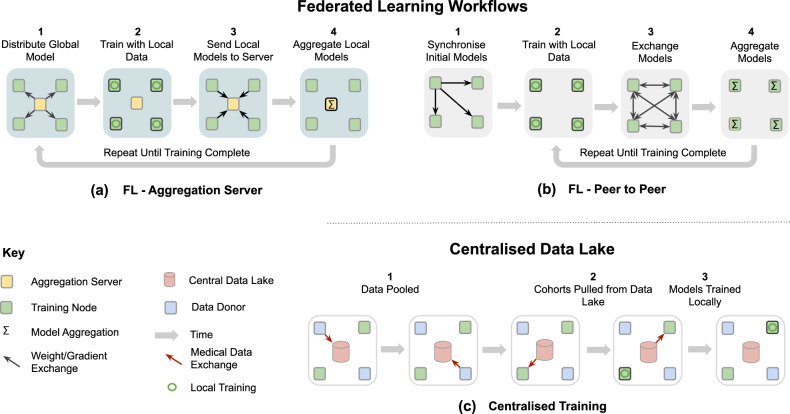
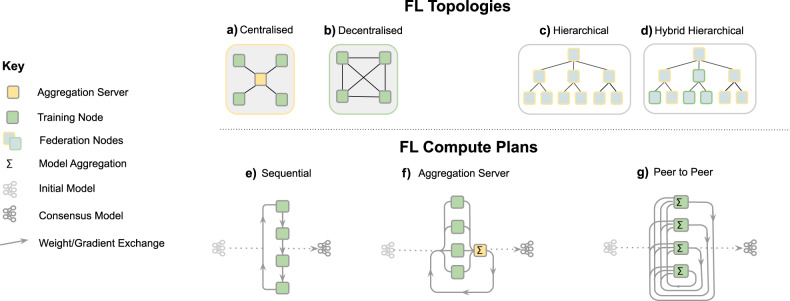
- The text describes FL workflows, including aggregation-server and peer-to-peer topologies, and discusses mechanisms such as FedAvg, FedProx, domain adaptation, and differential privacy at a conceptual level.
Limitations
- The paper explicitly states that FL does not solve all issues inherent to learning on medical data; success still depends on data quality, bias, and standardization.
- It states that FL does not eliminate privacy risks: models can still memorize information, and gradients/model updates may leak private data through inversion or adversarial attacks.
- Evident from the text: this is a perspective article, so it does not report original experimental results, sample sizes, or statistical testing.
Model-written summary. Check it against the paper before relying on it.
Integrity signals
Registry
Cites
Statistics
Figures
Verification
Claims the paper makes
16 Valid · 0 Not valid · 4 Not checked · 19 Own results and interpretations
The cited sources support only part of this claim — read each source’s verdict below.
In the paper
“Modern DL models feature millions of parameters that need to be learned from sufficiently large curated data sets in order to achieve clinical-grade accuracy, while being safe, fair, equitable and generalising well to unseen data2–5.”
§ The future of digital health with federated learning > Introduction
What the sources say
- Not checked — no full text of the sourcecites [2] Wang F Casalino LP Khullar D Deep learning in medicine—promise, progress, and challenges JAMA Intern. Med. 2019 179 293 294 10.1001/jamainternmed.2018.7117 30556825 source
- Not checked — no full text of the sourcecites [3] Chartrand G Deep learning: a primer for radiologists Radiographics 2017 37 2113 2131 10.1148/rg.2017170077 29131760 source
- Partly supportedcites [4] De Fauw J Clinically applicable deep learning for diagnosis and referral in retinal disease Nat. Med. 2018 24 1342 10.1038/s41591-018-0107-6 30104768 sourceExperimental — accuracy not yet measured
Split into 2 atoms — 0 confirmed, 2 partially supported, 0 disputed, 0 misattributed, 0 unverifiable. Expand the claim to see per-atom verdicts.
- Partly supportedcites [5] Sun, C., Shrivastava, A., Singh, S. & Gupta, A. Revisiting unreasonable effectiveness of data in deep learning era. In Proceedings of the IEEE international conference on computer vision, 843–852 (IEEE, 2017). sourceExperimental — accuracy not yet measured
Split into 2 atoms — 0 confirmed, 2 partially supported, 0 disputed, 0 misattributed, 0 unverifiable. Expand the claim to see per-atom verdicts.
plainstates a cause- Asserted: passes — The authors put it forward as true.
- Checkable: passes — It can be checked against evidence.
- Load-bearing: passes — The paper’s conclusions depend on it.
- Based: passes — The paper gives a reason why it holds.
The cited sources support only part of this claim — read each source’s verdict below.
In the paper
“Existing medical data is not fully exploited by ML primarily because it sits in data silos and privacy concerns restrict access to this data.”
§ The future of digital health with federated learning > Abstract
What the sources say
- Partly supportedcites [6] Van Panhuis WG A systematic review of barriers to data sharing in public health BMC Public Health 2014 14 1144 10.1186/1471-2458-14-1144 25377061 PMC4239377 sourceExperimental — accuracy not yet measured
The Background describes routinely collected public-health data as underused, and Results > Legal barriers says privacy concerns can lead to restrictive data-access policies. Results > Technical barriers describes difficulties integrating datasets. The paper does not establish that machine learning is the affected use or that data silos and privacy are the primary reasons medical data is underexploited. (LLM, conf=0.87)
- Partly supportedcites [7] Rocher L Hendrickx JM De Montjoye Y-A Estimating the success of re-identifications in incomplete datasets using generative models Nat. Commun. 2019 10 1 9 10.1038/s41467-019-10933-3 31337762 PMC6650473 sourceExperimental — accuracy not yet measured
The Introduction (page not provided) says medical and other personal data can advance AI, while privacy concerns affect its collection, use, and sharing. It does not say that medical data sits in silos or that silos and privacy restrictions are the primary reasons ML underuses it. (LLM, conf=0.85)
plainstates a cause- Asserted: passes — The authors put it forward as true.
- Checkable: passes — It can be checked against evidence.
- Load-bearing: passes — The paper’s conclusions depend on it.
- Based: passes — The paper gives a reason why it holds.
- Partly supported
The cited sources support only part of this claim — read each source’s verdict below.
In the paper
“The more rounds of local training are performed, the less it is guaranteed that the overall procedure is minimising (Eq. 1)9,12.”
§ The future of digital health with federated learning > Technical considerations > Federated learning definition
What the sources say
- Partly supportedcites [9] McMahan, B., Moore, E., Ramage, D., Hampson, S. & y Arcas, B. A. Communication-efficient learning of deep networks from decentralized data. In Artificial Intelligence and Statistics, 1273–1282. https://scholar.google.de/scholar?hl=de&as_sdt=0%2C5&q=Communicationefficient+learning+of+deep+networks+from+decentralized+data&btnG= (2017). sourceExperimental — accuracy not yet measured
The Experimental Results (p. 7) report that with very many local epochs, FedAvg can plateau or diverge on the Shakespeare LSTM task. But they also report no significant convergence degradation for large numbers of local epochs on the MNIST CNN, so the paper does not establish a general rule that more local training makes minimisation of the global loss less assured. (LLM, conf=0.86)
- Supportedcites [12] Kairouz, P. et al. Advances and open problems in federated learning. arXiv preprint arXiv:1912.04977 (2019). source
Section 3.2.1 states that more local updates increase divergence between client models and slow convergence of the training loss. Section 3.2.2 also reports more restrictive convergence bounds for local updates with non-IID data. Together, these support the claim that increasing local training weakens convergence assurances for the global loss. (LLM, conf=0.86)
plainstates a cause- Asserted: passes — The authors put it forward as true.
- Checkable: passes — It can be checked against evidence.
- Load-bearing: unclear — It is unclear whether the paper’s conclusions depend on it.
- Based: passes — The paper gives a reason why it holds.
- Partly supported
A conclusion the paper draws from its own results — it cites no other source for it, so there is none to check. The quote shows it is in the paper.
In the paper
“By linking healthcare institutions, not restricted to research centres, FL can have direct clinical impact.”
§ The future of digital health with federated learning > Data-driven medicine requires federated efforts > Current FL efforts for digital health
plainstates a possible cause- Asserted: passes — The authors put it forward as true.
- Checkable: passes — It can be checked against evidence.
- Load-bearing: passes — The paper’s conclusions depend on it.
- Based: passes — The paper gives a reason why it holds.
A conclusion the paper draws from its own results — it cites no other source for it, so there is none to check. The quote shows it is in the paper.
In the paper
“FL enables collaborative research for, even competing, companies.”
§ The future of digital health with federated learning > Data-driven medicine requires federated efforts > Current FL efforts for digital health
plainstates a cause- Asserted: passes — The authors put it forward as true.
- Checkable: passes — It can be checked against evidence.
- Load-bearing: unclear — It is unclear whether the paper’s conclusions depend on it.
- Based: passes — The paper gives a reason why it holds.
14 references still to check
A free account verifies the references that are still open.
- Probably not a substantial claim. 19
- It may state two separate claims as one. 32
- The quote only partly states this claim. 1
Claims other papers make about this one
Each is checked against this paper’s own text: does it say what the citing paper says it does?
The source backs part of the claim, not all of it — or backs it for a different population, condition or comparison.
In the citing paper
“This is currently addressed by sharing multi-site data, but such centralization is challenging/infeasible to scale due to various limitations.”
From Federated learning enables big data for rare cancer boundary detection (2022) · cites this paper as [10]
Experimental — accuracy not yet measuredThe source backs part of the claim, not all of it — or backs it for a different population, condition or comparison.
In the citing paper
“However, these methods often come with trade-offs in accuracy and computational efficiency.”
From The role of multimodality in clinical disease diagnosis: advances, challenges, and opportunities (2026) · cites this paper as [34]
Experimental — accuracy not yet measuredThe source backs part of the claim, not all of it — or backs it for a different population, condition or comparison.
In the citing paper
“The experts in healthcare and life sciences can use FL to solve the unique problem of data governance by training algorithms behind the hospital's firewall and only sharing models so that data remain secure [31].”
From A comprehensive survey on federated learning techniques for healthcare informatics (2023) · cites this paper as [31]
Experimental — accuracy not yet measuredThe source backs part of the claim, not all of it — or backs it for a different population, condition or comparison.
In the citing paper
“It also improves patient privacy and reduces low latency during the collaboration of multiple hospitals/entities [7].”
From Handling privacy-sensitive medical data with federated learning: Challenges and future directions (2023) · cites this paper as [7]
Experimental — accuracy not yet measuredThe source backs part of the claim, not all of it — or backs it for a different population, condition or comparison.
In the citing paper
“Enabling privacy protected data sharing across clinical centers is advocated as an essential pathway to promote collaborations internationally yet underexplored so far6,7.”
From Federated deep learning for detecting COVID-19 lung abnormalities in CT: a privacy-preserving multinational validation study (2021) · cites this paper as [7]
Experimental — accuracy not yet measured
27 more claims about this paper
Create a free account to see every claim other papers make about this one.
Citations
Cites
LeCun, Y., Bengio, Y., & Hinton, G. (2015) · Nature · doi:10.1038/nature14539 · Cited by 84,126
Communication-Efficient Learning of Deep Networks from Decentralized Data
McMahan, H. B., Moore, E., Ramage, D., Hampson, S., & Arcas, B. A. Y. (2016) · arXiv · doi:10.48550/arxiv.1602.05629 · Cited by 14,215
Sudlow, C., Gallacher, J., Allen, N., Beral, V., Burton, P., Danesh, J., Downey, P., Elliott, P., Green, J., Landray, M., et al. (2015) · PLOS Medicine · doi:10.1371/journal.pmed.1001779 · Cited by 12,728 · cited 2×
“Substantial, albeit smaller, initiatives include the Human Connectome25, the UK Biobank26, the Cancer Imaging Archive (TCIA)27, NIH CXR828, NIH DeepLesion29, the Cancer Genome Atlas (TCGA)30, the Alzheimer’s Disease Neuroimaging Initiative (ADNI)31, as well as medical grand challenges32 such as the CAMELYON challenge3…”
BackgroundAdvances and Open Problems in Federated Learning
Kairouz, P., McMahan, H. B., Avent, B., Bellet, A., Bennis, M., Bhagoji, A. N., Bonawitz, K., Charles, Z., Cormode, G., Cummings, R., et al. (2019) · arXiv · doi:10.48550/arxiv.1912.04977 · Cited by 7,857
Advances and Open Problems in Federated Learning
Kairouz, P., & McMahan, H. B. (2021) · Foundations and Trends in Machine Learning · doi:10.1561/2200000083 · Cited by 7,772
The multimodal brain tumor image segmentation benchmark (BRATS)
Menze, B. H., Jakab, A., Bauer, S., Kalpathy-Cramer, J., Farahani, K., Kirby, J., Burren, Y., Porz, N., Slotboom, J., Wiest, R., et al. (2015) · IEEE Transactions on Medical Imaging · doi:10.1109/tmi.2014.2377694 · Cited by 6,781
Deep Learning with Differential Privacy
Abadi, M., Chu, A., Goodfellow, I., McMahan, H. B., Mironov, I., Talwar, K., & Zhang, L. (2016) · Proceedings of the 2016 ACM SIGSAC Conference on Computer and Communications Security · doi:10.1145/2976749.2978318 · Cited by 6,578 · cited 2×
“Countermeasures, such as limiting the granularity of the shared model updates and to add specific noise to ensure differential privacy [34, 12, 57] may be needed and is still an active area of research [14].”
BackgroundMethodFederated Machine Learning: Concept and Applications
Yang, Q., Liu, Y., Chen, T., & Tong, Y. (2019) · ACM Transactions on Intelligent Systems and Technology · doi:10.1145/3298981 · Cited by 6,322 · cited 4×
“d FL approaches are still under development. 3 Technical Considerations FL is perhaps best-known from the work of Konecnˇ y` et al. [36], but various other definitions have been proposed in literature [14, 11, 15, 9]. These approaches can be realised via different communication architectures (see Figure 1) and respecti…”
BackgroundInfluentialFederated learning: Challenges, methods, and future directions
Li, T., Sahu, A. K., Talwalkar, A., & Smith, V. (2020) · IEEE Signal Processing Magazine · doi:10.1109/msp.2020.2975749 · Cited by 6,210 · cited 3×
“However, there is a trade-off in terms of performance and these techniques may affect for example the accuracy of the final model [10].”
BackgroundMethodShin, H.-C., Roth, H. R., Gao, M., Lu, L., Xu, Z., Nogues, I., Yao, J., Mollura, D., & Summers, R. M. (2016) · IEEE Transactions on Medical Imaging · doi:10.1109/tmi.2016.2528162 · Cited by 5,759
Self-citation
Cited by
Items 701–800 of 3,132
Guideline for software life cycle in health informatics
Hauschild, A., Martin, R., Holst, S. C., Wienbeck, J., & Heider, D. (2022) · iScience · doi:10.1016/j.isci.2022.105534 · Cited by 22
Federated End-to-End Unrolled Models for Magnetic Resonance Image Reconstruction
Levac, B., Arvinte, M., & Tamir, J. I. (2023) · Bioengineering · doi:10.3390/bioengineering10030364 · Cited by 22
“Federated learning has recently been applied to medical imaging in the context of a synchronous, cross-silo setting, and is foreseen to have an impact on the future of digital health [10].”
Arthi, N. T., Mubin, K. E., Rahman, J. R., Rafi, G. M., Sheja, T. T., Reza, M. T., & Alam, M. A. (2022) · IEEE Asia-Pacific Conference on Computer Science and Data Engineering (CSDE) · doi:10.1109/csde56538.2022.10089344 · Cited by 19
Lee, D. Y., Choi, B., Kim, C., Fridgeirsson, E. A., Reps, J., Kim, M.-S., Kim, J., Jang, J., Rhee, S. Y., Seo, W., et al. (2023) · Journal of Medical Internet Research · doi:10.2196/46165 · Cited by 20
“However, the following obstacles remain in medical FL: (1) absence of a standardized data pipeline, (2) privacy leakage, and (3) hardware limitations [12].”
Archetti, A., & Matteucci, M. (2023) · International Joint Conference on Neural Networks (IJCNN) · doi:10.1109/ijcnn54540.2023.10190999 · Cited by 33
Archetti, A., Ieva, F., & Matteucci, M. (2023) · Future Generation Computer Systems · doi:10.1016/j.future.2023.07.036 · Cited by 28
Exploring Federated Learning for Speech-based Parkinson’s Disease Detection
Sarlas, A., Kalafatelis, A., Alexandridis, G., Kourtis, M., & Trakadas, P. T. (2023) · International Conference on Availability, Reliability and Security (ARES) · doi:10.1145/3600160.3605088 · Cited by 23
“In this way, FL addresses issues of both data governance and privacy [6, 19], while recent”
BackgroundFedAVE: Adaptive data value evaluation framework for collaborative fairness in federated learning
Wang, Z., Peng, Z., Fan, X., Wang, Z., Wu, S., Yu, R., Yang, P., Zheng, C., & Wang, C. (2024) · Neurocomputing · doi:10.1016/j.neucom.2023.127227 · Cited by 28
Siren+: Robust Federated Learning With Proactive Alarming and Differential Privacy
Guo, H., Wang, H., Song, T., Yang, H., Ma, R., Jin, X., Xue, Z., & Guan, H. (2024) · IEEE Transactions on Dependable and Secure Computing · doi:10.1109/tdsc.2024.3362534 · Cited by 27
“Withsuchmerit,FLhasanextensive rangeofapplications[8],[9],includingtraininglanguagemod-els [10], health tracking [11], [12], and fintech [13] with privacy-sensitive data such as user keystrokes, photos, and geo-locations.”
BackgroundFedRDMA: Communication-Efficient Cross-Silo Federated LLM via Chunked RDMA Transmission
Zhang, Z., Cai, D., Zhang, Y., Xu, M., Wang, S., & Zhou, A. (2024) · Workshop on Machine Learning and Systems (EuroMLSys) · doi:10.1145/3642970.3655834 · Cited by 30
“Federated learning has emerged as a prominent topic in recent research [22–24].”
BackgroundA collaborative ensemble construction method for federated random forest
Lim, P. A. E., & Park, C. H. (2024) · Expert Systems with Applications · doi:10.1016/j.eswa.2024.124742 · Cited by 24
A review of AutoML optimization techniques for medical image applications
Ali, M. J., Essaid, M., Moalic, L., & Idoumghar, L. (2024) · Computerized Medical Imaging and Graphics · doi:10.1016/j.compmedimag.2024.102441 · Cited by 21
A scoping review on pediatric sepsis prediction technologies in healthcare
Tennant, R., Graham, J., Kern, J., Mercer, K., Ansermino, J. M., & Burns, C. M. (2024) · npj Digital Medicine · doi:10.1038/s41746-024-01361-9 · Cited by 23
“Future research should prioritize collaboration and develop robust dataset-sharing methods while exploring opportunities to ensure the optimal performance of these data-driven prediction models for all ages 82 .”
Issues and Limitations on the Road to Fair and Inclusive AI Solutions for Biomedical Challenges
Faust, O., Salvi, M., Barua, P. D., Chakraborty, S., Molinari, F., & Acharya, U. R. (2025) · Sensors · doi:10.3390/s25010205 · Cited by 23
“Recent advancements, such as federated learning [44] and privacy-preserving AI [45], allow the training of models across decentralized datasets while preserving privacy.”
AbouGrad, H., & Sankuru, L. (2025) · Mathematics · doi:10.3390/math13132110 · Cited by 40
A Quantitative Paradigm for Decision-Making in Precision Oncology
Engelhardt, D., & Michor, F. (2021) · Trends in cancer · doi:10.1016/j.trecan.2021.01.006 · Cited by 17
“…learning, a paradigm for collaboratively training models on data held securely in individual institutions, has been gaining attention in healthcare informatics as a way to address the need for large and diverse datasets while maintaining the security and privacy of patient information [55,56].”
BackgroundTing, D. S. W., Wong, T. Y., Park, K. H., Cheung, C. Y.-L., Tham, C. C. Y., & Lam, D. S. C. (2021) · Asia-Pacific Journal of Ophthalmology · doi:10.1097/apo.0000000000000421 · Cited by 16
You, S. C., Lee, S., Choi, B., & Park, R. W. (2022) · Korean Circulation Journal · doi:10.4070/kcj.2022.0294 · Cited by 22
Chan, V. T. T., Ran, A. R., Wagner, S. K., Hui, H. Y. H., Hu, X., Ko, H., Fekrat, S., Wang, Y. X., Lee, C. S., Young, A. L., et al. (2024) · Progress in Retinal and Eye Research · doi:10.1016/j.preteyeres.2024.101290 · Cited by 18
Saldanha, O. L., Zhu, J., Müller‐Franzes, G. A., Carrero, Z. I., Payne, N. R., Sánchez, L. E., Varoutas, P.-C., Kyathanahally, S. P., Laleh, N. G., Pfeiffer, K., et al. (2025) · Communications Medicine · doi:10.1038/s43856-024-00722-5 · Cited by 21
Tan, M. J. T., Lichlyter, D. A., Maravilla, N. M. A. T., Schrock, W. J., Ting, F. I. L., Choa-Go, J. M., Francisco, K. K. Y., Byers, M. C., Karim, H. B. A., & AlDahoul, N. (2025) · Frontiers in Digital Health · doi:10.3389/fdgth.2025.1535018 · Cited by 20
Zhao, X., Tanaka, R., Mandour, A. S., Shimada, K., & Hamabe, L. (2025) · Animals · doi:10.3390/ani15071033 · Cited by 23
“(5) Creation of federated learning frameworks that enable collaborative algorithm improvement while maintaining data privacy across veterinary institutions and research facilities [94].”
A machine learning approach for enhancing supply chain visibility with graph-based learning
Zheng, G., & Brintrup, A. M. (2025) · Supply Chain Analytics · doi:10.1016/j.sca.2025.100135 · Cited by 32
Spittle, A. J., Marschik, P. B., Adde, L., Badawi, N. A., Byrne, R., Bos, A. F., Chatelin, A., Coughlan, J., Fedeli, F., Guzzetta, A., et al. (2025) · EClinicalMedicine · doi:10.1016/j.eclinm.2025.103379 · Cited by 30
“43,44 In federated learning AI models are collaboratively trained across multiple data sources without the need to pool or share data itself.”
Peng, J., Khuat, T. T., Musiał, K., & Gabryś, B. (2025) · Biotechnology Advances · doi:10.1016/j.biotechadv.2025.108749 · Cited by 33
Federated Learning in Healthcare: From Research to Real-World Deployment
Bakas, S., Li, X., Shah, P., & Roth, H. R. (2026) · Annual Review of Biomedical Engineering · doi:10.1146/annurev-bioeng-080125-041414 · Cited by 40
Self-citationQuantum Federated Learning for Wireless Communications
Pujahari, R. M., & Tanwar, A. (2022) · EAI/Springer Innovations in Communication and Computing · doi:10.1007/978-3-030-85559-8_14 · Cited by 20
ACR’s Connect and AI-LAB technical framework
Brink, L., Coombs, L. P., Veettil, D. K., Kuchipudi, K., Marella, S., Schmidt, K., Nair, S. S., Tilkin, M., Treml, C., Chang, K., et al. (2022) · JAMIA Open · doi:10.1093/jamiaopen/ooac094 · Cited by 19
“Thus, there exists a need to enable multi-institutional, collaborative approaches for the purpose of creating robust models, while simultaneously ensuring patient privacy.(11,12) In order to create equitable and widely applicable AI tools, more radiology professionals and data scientists need to be involved in every s…”
BackgroundSundari, M. S., & Jadala, V. C. (2023) · Automatika · doi:10.1080/00051144.2023.2194097 · Cited by 19
“However,thisisnotusedinanyprogramme [8] Machine learning SVM and DT Small database used [9–12] Machine learning Classification algorithms They only employed one sample, and in real-time circumstances, classification did not flow dynamically [13,14,15] Machine learning Tree structured algorithm…”
Lyu, J., Tian, Y., Cai, Q., Wang, C., & Qin, J. (2023) · Computers in Biology and Medicine · doi:10.1016/j.compbiomed.2023.107330 · Cited by 17
Patel, M. P., Dayan, I., Fishman, E. K., Flores, M. G., Gilbert, F. J., Guindy, M., Koay, E. J., Rosenthal, M. H., Roth, H. R., & Linguraru, M. G. (2023) · Health Informatics Journal · doi:10.1177/14604582231207744 · Cited by 17
Self-citationShiri, I., Salimi, Y., Sirjani, N., Razeghi, B., Bagherieh, S., Pakbin, M., Mansouri, Z., Hajianfar, G., Avval, A. H., Askari, D., et al. (2024) · Medical Physics · doi:10.1002/mp.16964 · Cited by 16
Zhu, F., Tian, Y., Han, C., Li, Y., Nan, J., Yao, N., & Zhou, W. (2024) · Information Fusion · doi:10.1016/j.inffus.2024.102348 · Cited by 21
Banik, S., Kumar, H., Ganapathy, N., & Swaminathan, R. (2024) · IEEE Access · doi:10.1109/access.2024.3394036 · Cited by 21
“Some privacy-preserving learning approaches such as Federated learning [87], Homomorphic Encryption-based Learning [88], Secure Multi-Party Computation (SMPC) [89] can be explored in future.”
BackgroundGuerreiro, J., Garriga, R., Bagén, T. L., Sharma, B., Karnik, N. S., & Matic, A. (2024) · npj Digital Medicine · doi:10.1038/s41746-024-01203-8 · Cited by 19
“Moreover, onthemachinelearningaspect,theintegrationofmultipleEHRsystemscan beleveragedbyusingprivacy-preservingapproachesthatcantrainasingle modelwhilekeepingdatadecentralized,includingfederatedlearning 42,43 .”
Hausleitner, C., Mueller, H., Holzinger, A., & Pfeifer, B. (2024) · Scientific Reports · doi:10.1038/s41598-024-72748-7 · Cited by 23
Federated Feature Augmentation and Alignment
Zhou, T., Yuan, Y., Wang, B., & Konukoğlu, E. (2024) · IEEE Transactions on Pattern Analysis and Machine Intelligence · doi:10.1109/tpami.2024.3457751 · Cited by 23
“Accordingly, it has garnered great interest in various applications, e.g., health-care [6], [7], finance [8], [9], transportation [10], [11].”
BackgroundConditional generation of medical time series for extrapolation to underrepresented populations
Bing, S., Dittadi, A., Bauer, S., & Schwab, P. (2022) · PLOS Digital Health · doi:10.1371/journal.pdig.0000074 · Cited by 32
“Training a generative model on multiple cohorts in a privacy preserving, federated fashion has been proposed to increase the diversity of the generated data and further catalyze the development of personalized medicine [51, 52].”
BackgroundBUSINESS MODEL CONFIGURATIONS IN DIGITAL HEALTHCARE—A GERMAN CASE STUDY ABOUT DIGITAL TRANSFORMATION
GEHDE, K. M., RAUSCH, F., & Leker, J. (2022) · International Journal of Innovation Management · doi:10.1142/s1363919622400187 · Cited by 18
Nair, A., Ramanathan, S., Sathiadoss, P., Jajodia, A., & Macdonald, D. B. (2022) · Radiología (English Edition) · doi:10.1016/j.rxeng.2022.04.001 · Cited by 27
Personalized federated learning for heterogeneous data: A distributed edge clustering approach
Firdaus, M., Noh, S., Qian, Z., Larasati, H. T., & Rhee, K.-H. (2023) · Mathematical Biosciences & Engineering · doi:10.3934/mbe.2023475 · Cited by 18
“Subsequently, empowered by the success of Gboard, the utilization of FL was promoted in a myriad of applications, such as healthcare [4], industrial IoT [5], vehicular networks [6], finance [7] and so forth.”
BackgroundImplementation of Secure and Privacy-aware AI Hardware using Distributed Federated Learning
Ghimire, A., Asiri, A. N., Hildebrand, B., & Amsaad, F. (2023) · IEEE Dallas Circuits and Systems Conference (DCAS) · doi:10.1109/dcas57389.2023.10130231 · Cited by 16
“In [9], the authors focus on machine learning’s role in the medical sector and examine the potential benefits of federated learning (FL) for the field of digital health while highlighting the issues that need to be considered.”
BackgroundBernasconi, A., Gill, R. S., & Bernasconi, N. (2024) · Epilepsia · doi:10.1111/epi.17989 · Cited by 15
“61,62 As the data corpus diversifies and expands to include more edge cases, performance and confidence of future classifiers will inevitably improve.”
Federated Deep Learning Enables Cancer Subtyping by Proteomics
Cai, Z., Boys, E. L., Noor, Z., Aref, A. T., Xavier, D., Lucas, N., Williams, S. G., Koh, J. M. S., Poulos, R. C., Wu, Y., et al. (2025) · Cancer Discovery · doi:10.1158/2159-8290.cd-24-1488 · Cited by 27
“Federated learning (FL) offers a promising solution to some of these challenges (7).”
Al‐Nusair, J., Lanino, L., Durmaz, A., Porta, M. G. D., Zeidan, A. M., & Kewan, T. Z. (2025) · Blood Reviews · doi:10.1016/j.blre.2025.101340 · Cited by 14
Responsible adoption of multimodal artificial intelligence in health care: promises and challenges
Azarfar, G., Naimimohasses, S., Rambhatla, S., Komorowski, M., Ferro, D., Lewis, P. R., Gates, D., Shara, N. M., Gascon, G. M., Chang, A. C., et al. (2025) · The Lancet Digital Health · doi:10.1016/j.landig.2025.100917 · Cited by 32
Health Risk Assessment with Federated Learning
Diamantoulaki, I., Diamantoulakis, P. D., Bouzinis, P. S., Sarigiannidis, P. G., & Karagiannidis, G. K. (2022) · International Balkan Conference on Communications and Networking (BalkanCom) · doi:10.1109/balkancom55633.2022.9900733 · Cited by 15
“In more details, [12] has investigated the advantages and impact of FL regarding medical applications while highlighting relevant technical considerations as well.”
BackgroundRoth, H. R., Hatamizadeh, A., Xu, Z., Zhao, C., Li, W., Myronenko, A., & Xu, D. (2022) · Lecture notes in computer science · doi:10.1007/978-3-031-18523-6_5 · Cited by 18
Self-citationFedVAE: Communication-Efficient Federated Learning With Non-IID Private Data
Yang, H., Ge, M., Xiang, K.-L., Bai, X., & Li, H.-W. (2023) · IEEE Systems Journal · doi:10.1109/jsyst.2023.3274197 · Cited by 13
“Due to the data privacy issues, this training mode cannot be deployed in the medical/medical field with sensitive patient data [26].”
Zubler, F., & Tzovara, A. (2023) · Frontiers in Neurology · doi:10.3389/fneur.2023.1183810 · Cited by 22
“…training of AI algorithms requires extensive amounts of data, which are not always possible to share across hospitals, future applications could also examine the use of federated learning frameworks, which train AI algorithms locally, using consensus models, without the need to exchange data (46).”
Baumgartner, M., Veeranki, S. P. K., Hayn, D., & Schreier, G. (2023) · Journal of Healthcare Informatics Research · doi:10.1007/s41666-023-00142-5 · Cited by 19
FedScore: A privacy-preserving framework for federated scoring system development
Li, S., Ning, Y., Ong, M. E. H., Chakraborty, B., Hong, C., Xie, F., Yuan, H., Liu, M., Buckland, D. M., Chen, Y., et al. (2023) · Journal of Biomedical Informatics · doi:10.1016/j.jbi.2023.104485 · Cited by 14
“FedScore may encounter problems with heterogeneous medical data because the current ODAL2 algorithm in module 3 requires that the data across different sites are homogeneous, similar to the majority of the FL and distributed methods currently in use[12], [51].”
BackgroundMethodFederated learning based futuristic biomedical big-data analysis and standardization
Fathima, A. S., Basha, S. M., Ahmed, S. T., Mathivanan, S. K., Rajendran, S., Mallik, S., & Zhao, Z. (2023) · PLoS ONE · doi:10.1371/journal.pone.0291631 · Cited by 18
Value of Information: A Comprehensive Metric for Client Selection in Federated Edge Learning
Zou, Y., Shen, S., Xiao, M., Li, P., Yu, D., & Cheng, X. (2024) · IEEE Transactions on Computers · doi:10.1109/tc.2024.3355777 · Cited by 18
“Due to its advantages of scalability, data security and diversity, federated learning has been applied to many fields such as medical data analysis [24], [25], financial crime detection [26], Internet of Things [27] and edge computing [28].”
BackgroundNguyen, C.-H., Saputra, Y. M., Hoang, D. T., Nguyen, D. N., Nguyen, V., Xiao, Y. L., & Dutkiewicz, E. (2024) · IEEE/ACM Transactions on Networking · doi:10.1109/tnet.2024.3365815 · Cited by 16
“…ever-growing number of connected Internet of Things (IoT) devices, machine learning (ML) has been playing a critical role in learning and extracting knowledge from distributed data sources, e.g., from digital healthcare [1], [2], [3], Industry 4.0 [4], [5], [6], and the emerging Metaverse [7], [8].”
BackgroundInfluentialData Science Methods for Real-World Evidence Generation in Real-World Data
Liu, F. (2024) · Annual Review of Biomedical Data Science · doi:10.1146/annurev-biodatasci-102423-113220 · Cited by 17
Artificial Intelligence Algorithms in Flood Prediction: A General Overview
Pandey, M. K. (2024) · Springer eBooks · doi:10.1007/978-3-031-51053-3_12 · Cited by 20
Alsenani, Y. S. (2025) · Scientific Reports · doi:10.1038/s41598-025-94501-4 · Cited by 17
Jin, S., Kim, B., & Han, K. (2025) · CHI Conference on Human Factors in Computing Systems · doi:10.1145/3706598.3713732 · Cited by 28
“Moreover, technologies such as Federated Learning [166] can train models directly on users’ devices without transmitting personal data to a central server, thereby minimizing the risk of personal data leakage while improving model performance.”
GUARDIAN: A Hardware-Assisted Distributed Framework to Enhance Deep Learning Security
Cai, Z., Ren, B., Ma, R., Guan, H., Tian, M., & Wang, Y. (2023) · IEEE Transactions on Computational Social Systems · doi:10.1109/tcss.2023.3262289 · Cited by 15
“Or the leakage of the data may result in ethical or legal consequences, such as medical and clinical data [39].”
BackgroundFabbro, N. D., Dey, S., Rossi, M., & Schenato, L. (2023) · Automatica · doi:10.1016/j.automatica.2023.111460 · Cited by 24
“Direct applications of FL can be found, for example, in the field of healthcare systems (Rieke et al., 2020; Huang et al., 2020) or of smartphone utilities (Hard et al., 2018).”
BackgroundAI Detection of Glottic Neoplasm Using Voice Signals, Demographics, and Structured Medical Records
Wang, C., Chen, T., Lee, N., & Fang, S. (2024) · The Laryngoscope · doi:10.1002/lary.31563 · Cited by 13
“45 This method may facilitate successful collaboration across various institutions, countries, and languages.”
Optimal Rate Region for Key Efficient Hierarchical Secure Aggregation with User Collusion
Zhang, X., Wan, K., Sun, H., Wang, S., Ji, M., & Caire, G. (2024) · IEEE Information Theory Workshop (ITW) · doi:10.1109/itw61385.2024.10806947 · Cited by 22
“Federated learning (FL) has emerged as a powerful decentralized learning paradigm which trains a centralized model using local datasets distributed across many end users [1]–[4].”
Rudroff, T. (2025) · Brain Sciences · doi:10.3390/brainsci15050533 · Cited by 22
“N-of-1 modeling approaches treat each patient as their own reference, enabling the detection of meaningful deviations from personal baselines rather than relying on population norms that may not reflect individual variability [48,49].”
Zhu, R., Dong, Y., Guo, J., He, J., Chen, H., Wang, R., Ren, F., Raben, A., & Martínez, J. A. (2025) · Clinical Nutrition · doi:10.1016/j.clnu.2025.10.009 · Cited by 17
Collaborative AI for precision neurorehabilitation: a roadmap
Liew, S., Cotton, R. J., Burdet, E., Badia, S. B. I., Celnik, P. A., Cole, J. H., Liu, R., Soekadar, S. R., Winstein, C. J., & Schweighofer, N. (2025) · Journal of NeuroEngineering and Rehabilitation · doi:10.1186/s12984-025-01810-w · Cited by 18
“Standardized data will also facilitate federated learning, a technique that utilizes multiple decentralized datasets for model training while keeping data localized [89, 90].”
Leveraging Multi-Task Learning to Cope With Poor and Missing Labels of Mammograms
Tardy, M., & Mateus, D. (2022) · Frontiers in Radiology · doi:10.3389/fradi.2021.796078 · Cited by 18
“Thanks to the MTL approach, our method can ease learning in environments where all the labels are not easily available, for example (if the regulation permits) in a federated learning setup (71, 72).”
MethodA Synergic Approach of Deep Learning towards Digital Additive Manufacturing: A Review
Pratap, A., Sardana, N., Utomo, S., Ayeelyan, J., Karthikeyan, P., & Hsiung, P. (2022) · Algorithms · doi:10.3390/a15120466 · Cited by 16
Class Imbalanced Medical Image Classification Based on Semi-Supervised Federated Learning
Liu, W., Mo, J., & Zhong, F. (2023) · Applied Sciences · doi:10.3390/app13042109 · Cited by 18
“On the difficulty of acquiring balanced data: Due to the large differences in the incidence of disease types among localities [13] and the inability of some hospitals to effectively label the huge amount of data, how to apply a large amount of unlabeled data to federated learning and overcome the…”
BackgroundLee, G. H., Park, J., Kim, J., Kim, Y.-S., Choi, B., Park, R. W., Rhee, S. Y., & Shin, S.-Y. (2023) · Healthcare Informatics Research · doi:10.4258/hir.2023.29.2.168 · Cited by 17
“This method has two advantages: it can (1) reduce the risk of data leakage and (2) achieve privacy protection of data [4,5].”
MethodArtificial Intelligence for Clinical Flow Cytometry
Seifert, R. P., Gorlin, D., & Borkowski, A. (2023) · Clinics in Laboratory Medicine · doi:10.1016/j.cll.2023.04.009 · Cited by 14
Context-aggregator: An approach of loss- and class imbalance-aware aggregation in federated learning
Abbas, Q., Malik, K. M., Saudagar, A. K. J., & Khan, M. B. (2023) · Computers in Biology and Medicine · doi:10.1016/j.compbiomed.2023.107167 · Cited by 15
A Collaborative Multimodal Learning-Based Framework for COVID-19 Diagnosis
Gao, Y., Gong, M., Ong, Y.-S., Qin, A. K., Wu, Y., & Xie, F. (2023) · IEEE Transactions on Neural Networks and Learning Systems · doi:10.1109/tnnls.2023.3290188 · Cited by 16
Yu, H., Cai, L., Min, H., & Su, X. (2023) · The Journal of Supercomputing · doi:10.1007/s11227-023-05825-9 · Cited by 16
FedPIDAvg: A PID Controller Inspired Aggregation Method for Federated Learning
Mächler, L., Ezhov, I., Shit, S., & Paetzold, J. C. (2023) · Lecture notes in computer science · doi:10.1007/978-3-031-44153-0_20 · Cited by 21
Privacy Preserving Federated Learning for Lung Cancer Classification
Hossain, M. M., Ahamed, M. F., Islam, M. R., & Imam, M. R. (2023) · International Conference on Computer and Information Technology (ICCIT) · doi:10.1109/iccit60459.2023.10441464 · Cited by 14
“Decentralized healthcare technology was the subject of an in-depth study published by Nicola et al. [15].”
BackgroundWang, P., Leong, Q. Y., Lau, N. Y., Ng, W. Y., Kwek, S. P., Tan, L. W. J., Song, S.-W., You, K., Chong, L. M., Zhuang, I., et al. (2024) · Singapore Medical Journal · doi:10.4103/singaporemedj.smj-2023-243 · Cited by 16
Review of machine learning solutions for eating disorders
Ghosh, S., Burger, P. C., Simeunovic-Ostojic, M., Maas, J., & Petković, M. (2024) · International Journal of Medical Informatics · doi:10.1016/j.ijmedinf.2024.105526 · Cited by 19
“…of such data, given the low prevalence of AN and the small and dispersed patient community, can be addressed through the joint efforts of researchers and patient communities in centralizing and integrating ED-related data with existing biobanks [129] and a federated learning (FL) framework [161].”
BackgroundChoudhry, I. A., Iqbal, S., Alhussein, M. A., Aurangzeb, K., Qureshi, A. N., Anwar, M. S., & Khan, F. (2024) · Internet of Things · doi:10.1016/j.iot.2024.101296 · Cited by 17
Towards Adaptive Privacy Protection for Interpretable Federated Learning
Li, Z., Chen, H., Ni, Z., Gao, Y., & Lou, W. (2024) · IEEE Transactions on Mobile Computing · doi:10.1109/tmc.2024.3443862 · Cited by 25
“Thus, it has been widely applied to a variety of real-world applications, such as healthcare [6], [7], insurance industry [8], and Internet of Things (IoTs) [9], [10].”
BackgroundBozzo, A., Hollingsworth, A., Chatterjee, S., Apte, A., Deng, J., Sun, S., Tap, W., Aoude, A., Bhatnagar, S., & Healey, J. H. (2024) · npj Precision Oncology · doi:10.1038/s41698-024-00695-7 · Cited by 18
Quantifying Bytes: Understanding Practical Value of Data Assets in Federated Learning
Yao, M., Qi, S., Tian, Z., Li, Q., Han, Y., Li, H., & Qi, Y. (2024) · Tsinghua Science & Technology · doi:10.26599/tst.2024.9010034 · Cited by 18
Machine learning-based delirium prediction in surgical in-patients: a prospective validation study
Jauk, S., Kramer, D., Sumerauer, S., Veeranki, S. P. K., Schrempf, M., & Puchwein, P. (2024) · JAMIA Open · doi:10.1093/jamiaopen/ooae091 · Cited by 17
“43,44 Instead of sharing data, models are trained at each partner location and model parameters are shared.”
BackgroundFederated quantum machine learning for drug discovery and healthcare
Saggi, M. K., Bhatia, A. S., & Kais, S. (2024) · Annual reports in computational chemistry · doi:10.1016/bs.arcc.2024.10.007 · Cited by 16
PILoRA: Prototype Guided Incremental LoRA for Federated Class-Incremental Learning
Guo, H., Zhu, F., Liu, W., Zhang, X.-Y., & Liu, C. (2024) · Lecture notes in computer science · doi:10.1007/978-3-031-73650-6_9 · Cited by 46
“In recent years, with the increasing emphasis on data privacy in society and the refinement of relevant regulations [2], FL has experienced rapid development and has been widely applied in various real-world scenarios [3–5,80,81].”
BackgroundTransition toward Healthcare 5.0: Impact of COVID-19 in the healthcare industry
Raisa, J. F., Rahman, M. S., Mahmud, I., Kaiser, M. S., & Han, D. S. (2025) · ICT Express · doi:10.1016/j.icte.2025.04.002 · Cited by 20
Hähnel, M. (2025) · Discover Artificial Intelligence · doi:10.1007/s44163-025-00266-0 · Cited by 20
“With respect to (5), in a DML ecosystem that can be made applicable to medical contexts while considering the four other ethical values, the following stakeholders might be positively addressed (cf. [8]): clinicians (who can debias their decisions and augment There are two sides of the same coin.”
Angeloni, M., Rizzi, D., Schoen, S., Caputo, A., Merolla, F., Hartmann, A., Ferrazzi, F., & Fraggetta, F. (2025) · Genome Medicine · doi:10.1186/s13073-025-01484-y · Cited by 19
AlMakinah, R., Norcini-Pala, A., Disney, L., & Canbaz, M. A. (2025) · IEEE Conference on Artificial Intelligence (CAI) · doi:10.1109/cai64502.2025.00038 · Cited by 40
“Having multiple parties (hospitals, in our case) collaboratively train local models with their local datasets and push the model parameters to an aggregator minimizes the bias problem and makes the model more generalizable in mental health [22], [23].”
Nageler, G., Gergel, I., Fangerau, M., Breckwoldt, M. O., Şeker, F., Bendszus, M., Möhlenbruch, M. A., & Neuberger, U. (2023) · Clinical Neuroradiology · doi:10.1007/s00062-023-01276-0 · Cited by 16
“The emerging practice of federated learning can be discussed to accomplish performance improvement and generalizability over multicentric data at once [31, 32].”
BackgroundFedDebug: Systematic Debugging for Federated Learning Applications
Gill, W., Anwar, A., & Gulzar, M. A. (2023) · ACM/IEEE International Conference on Software Engineering: Companion Proceedings (ICSE-Companion) · doi:10.1109/icse48619.2023.00053 · Cited by 19
“With the advent of frameworks like FedML [14] and IBMFL [33], FL is actively used in solving real-world problems [19, 32, 41, 59].”
MethodChinni, B. K., & Manlhiot, C. (2024) · Canadian Journal of Cardiology · doi:10.1016/j.cjca.2024.07.026 · Cited by 27
Maschinelles Lernen und multiparametrische MRT in der Früherkennung des Prostatakarzinoms
Bonekamp, D., & Schlemmer, H. (2021) · Der Urologe · doi:10.1007/s00120-021-01492-x · Cited by 13
Cushnan, D., Berka, R., Bertolli, O., Williams, P., Schofield, D., Joshi, I., Favaro, A., Halling‐Brown, M., Imreh, G., Jefferson, E., et al. (2021) · Digital Health · doi:10.1177/20552076211048654 · Cited by 13
“Fair licensing and costing models are also necessary to make data more widely available to the public and commercial companies (the complexities of such commercial models are explored further in the Benefit share models: Defining frameworks to ensure that data sharing directly benefits the NHS system section – Benefit…”
BackgroundKeloth, V., Selek, S., Chen, Q.-Y., Gilman, C., Fu, S.-Y., Dang, Y., Chen, X., Hu, X.-Y., Zhou, Y.-J., He, H., et al. (2024) · medRxiv · doi:10.1101/2024.05.21.24307726 · Cited by 6
Wong, Z. S.-Y., Gong, Y., & Ushiro, S. (2025) · npj Digital Medicine · doi:10.1038/s41746-025-01442-3 · Cited by 14
Artificial Intelligence in the Management of Heart Failure
Cheema, B. S., Hourmozdi, J., Kline, A. S., Ahmad, F. S., & Khera, R. (2025) · Journal of Cardiac Failure · doi:10.1016/j.cardfail.2025.02.020 · Cited by 24
LLM-Driven Medical Report Generation via Communication-Efficient Heterogeneous Federated Learning
Che, H., Jin, H., Guo, Z., Lin, Y., Jin, C., & Chen, H. (2025) · IEEE Transactions on Medical Imaging · doi:10.1109/tmi.2025.3591185 · Cited by 36
“Incorporating federated learning (FL) presents a promising pathway for addressing the data challenges inherent in LLM-driven MRG [19].”
Haq, I., Gong, Z., Liang, H., Zhang, W., Khan, R., Gu, L., Eils, R., Kang, Y., & Huang, B. (2025) · Image and Vision Computing · doi:10.1016/j.imavis.2025.105708 · Cited by 17
The AI revolution: how multimodal intelligence will reshape the oncology ecosystem
Dellamonica, D., Ruau, D., Griffiths, B., Rossi, G., Li, B. T., Razavi, P., Maio, T. D., Gonzalez, T., Remorino, A., Reis-Filho, J. S., et al. (2025) · npj Artificial Intelligence · doi:10.1038/s44387-025-00044-4 · Cited by 17
Metadata
- Authors
- Rieke, N., Hancox, J., Li, W., Milletarì, F., Roth, H. R., Albarqouni, S., Bakas, S., Galtier, M. N., Landman, B. A., Maier-Hein, K., Ourselin, S., Sheller, M., Summers, R. M., Trask, A., Xu, D., Baust, M., & Cardoso, M. J.
- Affiliations
- Technical University of Munich (DE)
- Nvidia (United Kingdom) (GB)
- Nvidia (United States) (US)
- Imperial College London (GB)
- University of Pennsylvania (US)
- Vanderbilt University (US)
- German Cancer Research Center (DE)
- Intel (United States) (US)
- National Institutes of Health (US)
- University of Oxford (GB)
- King's College London (GB)
- Corresponding author
- Rieke, Nicola
- ORCID
- Venue
- npj Digital Medicine
- Published
- 2020-09-14
- Volume
- 3
- Issue
- 1
- Pages
- 119-119
- ISSN
- 2398-6352 (ISSN-L)
- PMC
- PMC7490367
- OpenAlex
- W3012501605
- Semantic Scholar
- b245c5d36702eaae0ff374fad92848024bc99534
- Cited by
- 4,015
- References
- 38
- Citations by year
- 2026: 1453 · 2025: 921 · 2024: 618 · 2023: 473 · 2022: 353 · 2021: 175 · 2020: 18
- FWCI
- 13.36
- Type
- journal article
- Language
- en
- Open access
- gold
- doi.org
- Licence
- cc-by
- creativecommons.org/licenses/by/4.0 (tdm)
- creativecommons.org/licenses/by/4.0 (vor)
- Locations
- npj Digital Medicine (publishedVersion, cc-by)
- PubMed (publishedVersion)
- arXiv (Cornell University) (submittedVersion, other-oa)
- Informationszentrum Lebenswissenschaften (ZB MED) (submittedVersion, cc-by)
- DOAJ (DOAJ: Directory of Open Access Journals) (submittedVersion, cc-by-sa)
- Research Portal (King's College London) (submittedVersion, other-oa)
- mediaTUM – the media and publications repository of the Technical University Munich (Technical University Munich) (submittedVersion, other-oa)
- arXiv (Cornell University)
- Funders
- U.S. Department of Health and Human Services (R01NS042645, U01CA242871)
- Nvidia
- Wellcome Trust
- UK Research and Innovation
- Bpifrance
- Deutscher Akademischer Austauschdienst
- Bundesministerium für Bildung und Forschung
- National Institutes of Health (1s10od023495-01)
- Engineering and Physical Sciences Research Council ([WT203148/Z/16/Z], WT213038/Z/18/Z)
- Centre For Medical Engineering, King’s College London (WT 203148/Z/16/Z)
- National Cancer Institute (U24CA189523, U01CA242871)
- National Institute of Neurological Disorders and Stroke (R01NS042645)
- NIH Clinical Center
- Topics
- Physical Sciences › Computer Science › Artificial Intelligence › Privacy-Preserving Technologies in Data
- Health Sciences › Medicine › Health Informatics › Artificial Intelligence in Healthcare and Education
- Physical Sciences › Computer Science › Artificial Intelligence › Machine Learning in Healthcare
- Keywords
- federated learning, digital health, medical data privacy, data silos, data-driven machine learning, health information access
About these checks
Registry, retraction, Cites and statistics results are computed, not judged, with one exception: a printed reference that no index lists is read once by a model before it counts as a citation error. Claims are extracted by a model and kept only when their quote appears verbatim in the text; each cited source is then checked, with a model’s help, for whether it says what the claim relies on. Those verdicts can be wrong — read the claim’s quote and the cited source before relying on one.
The claim verdicts this report counts are experimental: their accuracy is not yet measured.
A language model drew the claims from the paper on 2026-10-10, under version 3 of the claim definition (model deepseek-v4.1-flash, prompt extract-v3).
A second model labelled each claim on 2026-10-10 (model jev-1.13-20260917, definition revision gold-guideline-v0.2).
Cited sources are checked with a language model’s help (gpt-6-sol and qwen3.8-omni-flash).
Statistics and arithmetic are recomputed, not judged.
Confidence bands are shown only for fields calibrated on our annotated test set. None is calibrated yet, so no band is shown.
What counts as a claim ›How we measure confidence ›How we check this ›
Are you an author, or do you see a problem with this page? Request a review
Data sources
Bibliographic data: Semantic Scholar, OpenAlex, Crossref.
Contains information from the Semantic Scholar Academic Graph Datasets, made available under the ODC Attribution License (ODC-BY 1.0).
Semantic Scholar’s data is described in: Kinney, R., et al. (2023). The Semantic Scholar Open Data Platform. arXiv:2301.10140.
