

The future of digital health with federated learning
Open accessThe DOI matches its Crossref record; 75 of the 76 references it cites were found in a registry or an index, and 1 are not checked yet; 31 of the 51 sources its claims cite were checked for support.
Abstract
Data-driven machine learning (ML) has emerged as a promising approach for building accurate and robust statistical models from medical data, which is collected in huge volumes by modern healthcare systems. Existing medical data is not fully exploited by ML primarily because it sits in data silos and privacy concerns restrict access to this data. However, without access to sufficient data, ML will be prevented from reaching its full potential and, ultimately, from making the transition from research to clinical practice. This paper considers key factors contributing to this issue, explores how federated learning (FL) may provide a solution for the future of digital health and highlights the challenges and considerations that need to be addressed.
Verified 2026-11-25 · 1 reference not checked yet
Overview
CoChat Summary
TL;DR
This perspective paper argues that federated learning (FL) is a promising way to train medical AI across institutions without centralizing sensitive data, potentially improving accuracy, robustness, and privacy in digital health. It also emphasizes that FL does not remove core challenges such as data heterogeneity, privacy leakage, and the need for standardization and governance.
Key findings
- FL is presented as a learning paradigm that lets multiple parties train collaboratively without exchanging or centralizing datasets, by moving the model to the data rather than the data to the model.
- The paper states that recent research has shown FL models can achieve performance comparable to centrally hosted data sets and superior to models trained on isolated single-institution data.
- Reported application areas already include EHR tasks such as finding clinically similar patients and predicting hospitalizations due to cardiac events, mortality, and ICU stay time, as well as medical imaging tasks such as whole-brain segmentation, brain tumor segmentation, and fMRI classification.
- Concrete initiatives mentioned include a collaboration across 4 hospitals in France (HealthChain), an international federation of 30 healthcare institutions (FeTS), and a project across 10 pharmaceutical companies (Melloddy).
Methods
- Not stated in the paper.
- The article is a perspective/consensus paper rather than an empirical study; it synthesizes prior work and examples to discuss FL’s promise, current uses, and technical considerations.
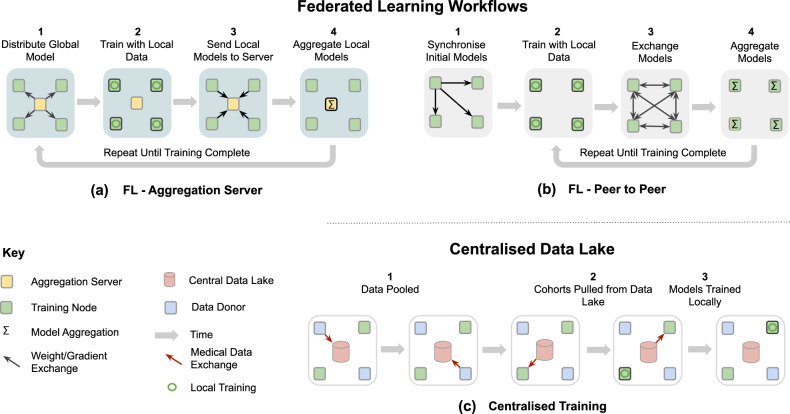
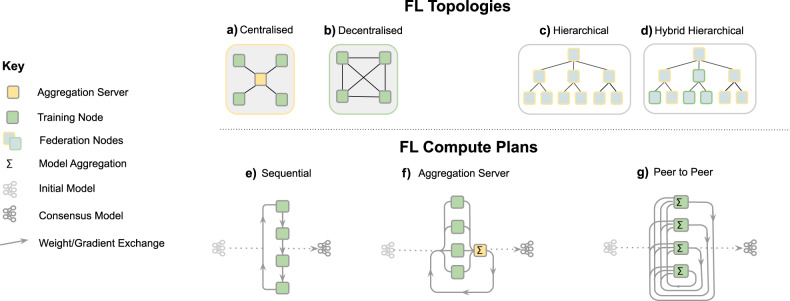
- The text describes FL workflows, including aggregation-server and peer-to-peer topologies, and discusses mechanisms such as FedAvg, FedProx, domain adaptation, and differential privacy at a conceptual level.
Limitations
- The paper explicitly states that FL does not solve all issues inherent to learning on medical data; success still depends on data quality, bias, and standardization.
- It states that FL does not eliminate privacy risks: models can still memorize information, and gradients/model updates may leak private data through inversion or adversarial attacks.
- Evident from the text: this is a perspective article, so it does not report original experimental results, sample sizes, or statistical testing.
Model-written summary. Check it against the paper before relying on it.
Integrity signals
Registry
Cites
Statistics
Figures
Verification
Claims the paper makes
16 Valid · 0 Not valid · 4 Not checked · 19 Own results and interpretations
The cited sources support only part of this claim — read each source’s verdict below.
In the paper
“Modern DL models feature millions of parameters that need to be learned from sufficiently large curated data sets in order to achieve clinical-grade accuracy, while being safe, fair, equitable and generalising well to unseen data2–5.”
§ The future of digital health with federated learning > Introduction
What the sources say
- Not checked — no full text of the sourcecites [2] Wang F Casalino LP Khullar D Deep learning in medicine—promise, progress, and challenges JAMA Intern. Med. 2019 179 293 294 10.1001/jamainternmed.2018.7117 30556825 source
- Not checked — no full text of the sourcecites [3] Chartrand G Deep learning: a primer for radiologists Radiographics 2017 37 2113 2131 10.1148/rg.2017170077 29131760 source
- Partly supportedcites [4] De Fauw J Clinically applicable deep learning for diagnosis and referral in retinal disease Nat. Med. 2018 24 1342 10.1038/s41591-018-0107-6 30104768 sourceExperimental — accuracy not yet measured
Split into 2 atoms — 0 confirmed, 2 partially supported, 0 disputed, 0 misattributed, 0 unverifiable. Expand the claim to see per-atom verdicts.
- Partly supportedcites [5] Sun, C., Shrivastava, A., Singh, S. & Gupta, A. Revisiting unreasonable effectiveness of data in deep learning era. In Proceedings of the IEEE international conference on computer vision, 843–852 (IEEE, 2017). sourceExperimental — accuracy not yet measured
Split into 2 atoms — 0 confirmed, 2 partially supported, 0 disputed, 0 misattributed, 0 unverifiable. Expand the claim to see per-atom verdicts.
plainstates a cause- Asserted: passes — The authors put it forward as true.
- Checkable: passes — It can be checked against evidence.
- Load-bearing: passes — The paper’s conclusions depend on it.
- Based: passes — The paper gives a reason why it holds.
The cited sources support only part of this claim — read each source’s verdict below.
In the paper
“Existing medical data is not fully exploited by ML primarily because it sits in data silos and privacy concerns restrict access to this data.”
§ The future of digital health with federated learning > Abstract
What the sources say
- Partly supportedcites [6] Van Panhuis WG A systematic review of barriers to data sharing in public health BMC Public Health 2014 14 1144 10.1186/1471-2458-14-1144 25377061 PMC4239377 sourceExperimental — accuracy not yet measured
The Background describes routinely collected public-health data as underused, and Results > Legal barriers says privacy concerns can lead to restrictive data-access policies. Results > Technical barriers describes difficulties integrating datasets. The paper does not establish that machine learning is the affected use or that data silos and privacy are the primary reasons medical data is underexploited. (LLM, conf=0.87)
- Partly supportedcites [7] Rocher L Hendrickx JM De Montjoye Y-A Estimating the success of re-identifications in incomplete datasets using generative models Nat. Commun. 2019 10 1 9 10.1038/s41467-019-10933-3 31337762 PMC6650473 sourceExperimental — accuracy not yet measured
The Introduction (page not provided) says medical and other personal data can advance AI, while privacy concerns affect its collection, use, and sharing. It does not say that medical data sits in silos or that silos and privacy restrictions are the primary reasons ML underuses it. (LLM, conf=0.85)
plainstates a cause- Asserted: passes — The authors put it forward as true.
- Checkable: passes — It can be checked against evidence.
- Load-bearing: passes — The paper’s conclusions depend on it.
- Based: passes — The paper gives a reason why it holds.
- Partly supported
The cited sources support only part of this claim — read each source’s verdict below.
In the paper
“The more rounds of local training are performed, the less it is guaranteed that the overall procedure is minimising (Eq. 1)9,12.”
§ The future of digital health with federated learning > Technical considerations > Federated learning definition
What the sources say
- Partly supportedcites [9] McMahan, B., Moore, E., Ramage, D., Hampson, S. & y Arcas, B. A. Communication-efficient learning of deep networks from decentralized data. In Artificial Intelligence and Statistics, 1273–1282. https://scholar.google.de/scholar?hl=de&as_sdt=0%2C5&q=Communicationefficient+learning+of+deep+networks+from+decentralized+data&btnG= (2017). sourceExperimental — accuracy not yet measured
The Experimental Results (p. 7) report that with very many local epochs, FedAvg can plateau or diverge on the Shakespeare LSTM task. But they also report no significant convergence degradation for large numbers of local epochs on the MNIST CNN, so the paper does not establish a general rule that more local training makes minimisation of the global loss less assured. (LLM, conf=0.86)
- Supportedcites [12] Kairouz, P. et al. Advances and open problems in federated learning. arXiv preprint arXiv:1912.04977 (2019). source
Section 3.2.1 states that more local updates increase divergence between client models and slow convergence of the training loss. Section 3.2.2 also reports more restrictive convergence bounds for local updates with non-IID data. Together, these support the claim that increasing local training weakens convergence assurances for the global loss. (LLM, conf=0.86)
plainstates a cause- Asserted: passes — The authors put it forward as true.
- Checkable: passes — It can be checked against evidence.
- Load-bearing: unclear — It is unclear whether the paper’s conclusions depend on it.
- Based: passes — The paper gives a reason why it holds.
- Partly supported
A conclusion the paper draws from its own results — it cites no other source for it, so there is none to check. The quote shows it is in the paper.
In the paper
“By linking healthcare institutions, not restricted to research centres, FL can have direct clinical impact.”
§ The future of digital health with federated learning > Data-driven medicine requires federated efforts > Current FL efforts for digital health
plainstates a possible cause- Asserted: passes — The authors put it forward as true.
- Checkable: passes — It can be checked against evidence.
- Load-bearing: passes — The paper’s conclusions depend on it.
- Based: passes — The paper gives a reason why it holds.
A conclusion the paper draws from its own results — it cites no other source for it, so there is none to check. The quote shows it is in the paper.
In the paper
“FL enables collaborative research for, even competing, companies.”
§ The future of digital health with federated learning > Data-driven medicine requires federated efforts > Current FL efforts for digital health
plainstates a cause- Asserted: passes — The authors put it forward as true.
- Checkable: passes — It can be checked against evidence.
- Load-bearing: unclear — It is unclear whether the paper’s conclusions depend on it.
- Based: passes — The paper gives a reason why it holds.
14 references still to check
A free account verifies the references that are still open.
- Probably not a substantial claim. 19
- It may state two separate claims as one. 32
- The quote only partly states this claim. 1
Claims other papers make about this one
Each is checked against this paper’s own text: does it say what the citing paper says it does?
The source backs part of the claim, not all of it — or backs it for a different population, condition or comparison.
In the citing paper
“This is currently addressed by sharing multi-site data, but such centralization is challenging/infeasible to scale due to various limitations.”
From Federated learning enables big data for rare cancer boundary detection (2022) · cites this paper as [10]
Experimental — accuracy not yet measuredThe source backs part of the claim, not all of it — or backs it for a different population, condition or comparison.
In the citing paper
“However, these methods often come with trade-offs in accuracy and computational efficiency.”
From The role of multimodality in clinical disease diagnosis: advances, challenges, and opportunities (2026) · cites this paper as [34]
Experimental — accuracy not yet measuredThe source backs part of the claim, not all of it — or backs it for a different population, condition or comparison.
In the citing paper
“The experts in healthcare and life sciences can use FL to solve the unique problem of data governance by training algorithms behind the hospital's firewall and only sharing models so that data remain secure [31].”
From A comprehensive survey on federated learning techniques for healthcare informatics (2023) · cites this paper as [31]
Experimental — accuracy not yet measuredThe source backs part of the claim, not all of it — or backs it for a different population, condition or comparison.
In the citing paper
“It also improves patient privacy and reduces low latency during the collaboration of multiple hospitals/entities [7].”
From Handling privacy-sensitive medical data with federated learning: Challenges and future directions (2023) · cites this paper as [7]
Experimental — accuracy not yet measuredThe source backs part of the claim, not all of it — or backs it for a different population, condition or comparison.
In the citing paper
“Enabling privacy protected data sharing across clinical centers is advocated as an essential pathway to promote collaborations internationally yet underexplored so far6,7.”
From Federated deep learning for detecting COVID-19 lung abnormalities in CT: a privacy-preserving multinational validation study (2021) · cites this paper as [7]
Experimental — accuracy not yet measured
27 more claims about this paper
Create a free account to see every claim other papers make about this one.
Citations
Cites
LeCun, Y., Bengio, Y., & Hinton, G. (2015) · Nature · doi:10.1038/nature14539 · Cited by 84,126
Communication-Efficient Learning of Deep Networks from Decentralized Data
McMahan, H. B., Moore, E., Ramage, D., Hampson, S., & Arcas, B. A. Y. (2016) · arXiv · doi:10.48550/arxiv.1602.05629 · Cited by 14,215
Sudlow, C., Gallacher, J., Allen, N., Beral, V., Burton, P., Danesh, J., Downey, P., Elliott, P., Green, J., Landray, M., et al. (2015) · PLOS Medicine · doi:10.1371/journal.pmed.1001779 · Cited by 12,728 · cited 2×
“Substantial, albeit smaller, initiatives include the Human Connectome25, the UK Biobank26, the Cancer Imaging Archive (TCIA)27, NIH CXR828, NIH DeepLesion29, the Cancer Genome Atlas (TCGA)30, the Alzheimer’s Disease Neuroimaging Initiative (ADNI)31, as well as medical grand challenges32 such as the CAMELYON challenge3…”
BackgroundAdvances and Open Problems in Federated Learning
Kairouz, P., McMahan, H. B., Avent, B., Bellet, A., Bennis, M., Bhagoji, A. N., Bonawitz, K., Charles, Z., Cormode, G., Cummings, R., et al. (2019) · arXiv · doi:10.48550/arxiv.1912.04977 · Cited by 7,857
Advances and Open Problems in Federated Learning
Kairouz, P., & McMahan, H. B. (2021) · Foundations and Trends in Machine Learning · doi:10.1561/2200000083 · Cited by 7,772
The multimodal brain tumor image segmentation benchmark (BRATS)
Menze, B. H., Jakab, A., Bauer, S., Kalpathy-Cramer, J., Farahani, K., Kirby, J., Burren, Y., Porz, N., Slotboom, J., Wiest, R., et al. (2015) · IEEE Transactions on Medical Imaging · doi:10.1109/tmi.2014.2377694 · Cited by 6,781
Deep Learning with Differential Privacy
Abadi, M., Chu, A., Goodfellow, I., McMahan, H. B., Mironov, I., Talwar, K., & Zhang, L. (2016) · Proceedings of the 2016 ACM SIGSAC Conference on Computer and Communications Security · doi:10.1145/2976749.2978318 · Cited by 6,578 · cited 2×
“Countermeasures, such as limiting the granularity of the shared model updates and to add specific noise to ensure differential privacy [34, 12, 57] may be needed and is still an active area of research [14].”
BackgroundMethodFederated Machine Learning: Concept and Applications
Yang, Q., Liu, Y., Chen, T., & Tong, Y. (2019) · ACM Transactions on Intelligent Systems and Technology · doi:10.1145/3298981 · Cited by 6,322 · cited 4×
“d FL approaches are still under development. 3 Technical Considerations FL is perhaps best-known from the work of Konecnˇ y` et al. [36], but various other definitions have been proposed in literature [14, 11, 15, 9]. These approaches can be realised via different communication architectures (see Figure 1) and respecti…”
BackgroundInfluentialFederated learning: Challenges, methods, and future directions
Li, T., Sahu, A. K., Talwalkar, A., & Smith, V. (2020) · IEEE Signal Processing Magazine · doi:10.1109/msp.2020.2975749 · Cited by 6,210 · cited 3×
“However, there is a trade-off in terms of performance and these techniques may affect for example the accuracy of the final model [10].”
BackgroundMethodShin, H.-C., Roth, H. R., Gao, M., Lu, L., Xu, Z., Nogues, I., Yao, J., Mollura, D., & Summers, R. M. (2016) · IEEE Transactions on Medical Imaging · doi:10.1109/tmi.2016.2528162 · Cited by 5,759
Self-citation
Cited by
Items 601–700 of 3,132
Cope, H., Willis, C. R. G., MacKay, M. J., Rutter, L. A., Toh, L. S., Williams, P. M., Herranz, R., Borg, J., Bezdan, D., Giacomello, S., et al. (2022) · Patterns · doi:10.1016/j.patter.2022.100550 · Cited by 27
“With the specific security issues of data-sharing strategies in mind, 130,134,135 data storage solutions, such as biobanks housing identifiable astronaut and/or SFP omics data, should meet high standards of security, to prevent issues such as data breaches.”
BackgroundProtecting Sensitive Data in the Information Age: State of the Art and Future Prospects
Stach, C., Gritti, C., Bräcker, J., Behringer, M. H., & Mitschang, B. (2022) · Future Internet · doi:10.3390/fi14110302 · Cited by 25
“This protection combined with its distributed computing renders federated learning well-suited for large-scale analyses, such as the DNA sequence classifications presented in Section 2.7 [166].”
MethodInfluentialActive federated transfer algorithm based on broad learning for fault diagnosis
Liu, G., Shen, W., Gao, L., & Kusiak, A. (2023) · Measurement · doi:10.1016/j.measurement.2023.112452 · Cited by 22
Sparse Personalized Federated Learning
Liu, X., Li, Y., Wang, Q., Zhang, X., Shao, Y., & Geng, Y. (2023) · IEEE Transactions on Neural Networks and Learning Systems · doi:10.1109/tnnls.2023.3250658 · Cited by 36
“F EDERATED learning (FL) [1], [2], [3] has grown rapidly in recent years due to the popularity of handheld devices such as mobile phones and tablets [4], [5], [6], [7].”
BackgroundZhang, Z., Chen, G., Xu, Y. C., Huang, L., Zhang, C., & Xiao, S. (2024) · Decision Support Systems · doi:10.1016/j.dss.2024.114183 · Cited by 27
Saidi, R., Rahmany, I., Dhahri, S., & Moulahi, T. (2024) · IEEE Access · doi:10.1109/access.2024.3419084 · Cited by 36
“…associate editor coordinating the review of this manuscript and approving it for publication was Tony Thomas. and deep learning (DL) technologies, pivotal in healthcare [21], [22], have shown promise in diagnosing COVID-19 and chest diseases from medical images like chest X-rays (CXRs) [23], [24].”
Agbley, B. L. Y., Li, J., Hossin, M. A., Nneji, G. U., Jackson, J. K., Monday, H. N., & James, E. C. (2022) · Diagnostics · doi:10.3390/diagnostics12071669 · Cited by 31
Recent advances in generative biology for biotherapeutic discovery
Mock, M. L., LANGMEAD, C. J., Grandsard, P. J., Edavettal, S. C., & Russell, A. J. (2024) · Trends in Pharmacological Sciences · doi:10.1016/j.tips.2024.01.003 · Cited by 23
Optimizing Healthcare Outcomes through Data-Driven Predictive Modeling
Sunny, M. N. M., Saki, M. B. H., Nahian, A. A., Ahmed, S. W., Shorif, M. N., Atayeva, J., & Rizvi, S. W. A. (2024) · Journal of Intelligent Learning Systems and Applications · doi:10.4236/jilsa.2024.164019 · Cited by 47
A systematic review on federated learning system: a new paradigm to machine learning
Chaudhary, R. K., Kumar, R., & Saxena, N. (2024) · Knowledge and Information Systems · doi:10.1007/s10115-024-02257-6 · Cited by 31
Antonie, N. I., Gheorghe, G., Ionescu, V. A., Tiucă, L.-C., & Diaconu, C. C. (2025) · Antibiotics · doi:10.3390/antibiotics14010060 · Cited by 29
The influence of digital health technology on the allocation of regional medical resources in China
Chen, S., Lai, K., Guo, X., & Zhang, X. (2025) · Health Policy and Technology · doi:10.1016/j.hlpt.2025.101013 · Cited by 27
Transforming mental health research and care through artificial intelligence
Opel, N., & Breakspear, M. J. (2026) · Science · doi:10.1126/science.adz9193 · Cited by 37
Shielding federated learning systems against inference attacks with ARM TrustZone
Messaoud, A. A., Mokhtar, S. B., Nitu, V., & Schiavoni, V. (2022) · International Middleware Conference · doi:10.1145/3528535.3565255 · Cited by 32
“On healthcare domain, FL is claimed to be the turn-key solution for making the transition from research to clinical practice by enabling the privacy-preserving learning from confidential medical analysis [42].”
BackgroundMethods and Impact for Using Federated Learning to Collaborate on Clinical Research
Cheung, A. T. M., Nasir-Moin, M., Kwon, Y. J., Guan, J., Liu, C., Jiang, L. Y., Raimondo, C. D., Chotai, S., Chambless, L. B., Ahmad, H. S., et al. (2022) · Neurosurgery · doi:10.1227/neu.0000000000002198 · Cited by 24
“10 Although we concede that the aforementioned projects could be addressed through a centralized machine learning paradigm, the traditional barriers to centralization of data nonetheless remain.”
BackgroundBlockchain-Enabled Technique for Privacy- Preserved Medical Recommender System
Mantey, E. A., Zhou, C., Anajemba, J. H., Hamid, Y., & Arthur, J. K. (2023) · IEEE Access · doi:10.1109/access.2023.3267431 · Cited by 23
“niques [9], [10], [11], [12], [13], [14], [15], [16], [17] have attempted to tackle this issue of data privacy in smart healthcare systems.”
BackgroundHan, Q., Lucas, C., Aguiar, E., Macêdo, P. L. P., & Wu, Z. (2023) · Electronic Commerce Research · doi:10.1007/s10660-023-09713-5 · Cited by 36
How to Prevent the Poor Performance Clients for Personalized Federated Learning?
Qu, Z., Li, X., HAN, X. J., Duan, R., Shen, C., & Chen, L. (2023) · IEEE Computer Society Conference on Computer Vision and Pattern Recognition/Proceedings - IEEE Computer Society Conference on Computer Vision and Pattern Recognition/Proceedings · doi:10.1109/cvpr52729.2023.01171 · Cited by 34
“This setting has achieved great accomplishments when the local data cannot be shared due to privacy and communication constraints [36].”
BackgroundElectronic health records and stratified psychiatry: bridge to precision treatment?
Grzenda, A. L., & Widge, A. S. (2023) · Neuropsychopharmacology · doi:10.1038/s41386-023-01724-y · Cited by 28
“Automated assessment tools and reporting guidelines and instruments are needed [46], especially given the push toward federated learning that would see models but not data exchanged for external validation to address pressing privacy concerns [47].”
BackgroundChen, M., Jiang, M., Dou, Q., Wang, Z., & Li, X. (2023) · Lecture notes in computer science · doi:10.1007/978-3-031-43895-0_30 · Cited by 47
González, R., Saha, A., Campbell, C. J. V., Nejat, P., Lokker, C., & Norgan, A. P. (2023) · Journal of Pathology Informatics · doi:10.1016/j.jpi.2023.100347 · Cited by 28
zPROBE: Zero Peek Robustness Checks for Federated Learning
Ghodsi, Z., Javaheripi, M., Sheybani, N., Zhang, X., Huang, K., & Koushanfar, F. (2023) · IEEE/CVF International Conference on Computer Vision (ICCV) · doi:10.1109/iccv51070.2023.00448 · Cited by 36
“This lack of privacy prohibits the use of FL in many machine learning applications that involve sensitive data such as healthcare information [31, 44] or financial transactions [45].”
BackgroundADataViewer: exploring semantically harmonized Alzheimer’s disease cohort datasets
Salimi, Y., Domingo‐Fernándéz, D., Bobis-Álvarez, C., Hofmann‐Apitius, M., Initiative, F. T. A. D. N., Initiative, T. J. A. D. N., for the Aging Brain: Vasculature, I., the Alzheimer’s Disease Repository Without Borders Investigators, & Birkenbihl, C. (2022) · Alzheimer s Research & Therapy · doi:10.1186/s13195-022-01009-4 · Cited by 19
“Given the restrictions of sensible personal data, there are multiple initiatives testing and establishing federated learning concepts that aim to facilitate secure remote access to multiple sensible datasets [39].”
BackgroundPan, J., Fan, Z., Smith, G. E., Guo, Y., Bian, J., & Xu, J. (2025) · Alzheimer's & Dementia · doi:10.1002/alz.70128 · Cited by 19
Liu, Y., Huang, J., Chen, J., Chen, W., Pan, Y., & Qiu, J. (2024) · BMC Cancer · doi:10.1186/s12885-024-12456-7 · Cited by 34
“It allows multiple data holders to collaboratively construct machine learning models without sharing raw data [15, 16].”
BackgroundFederated learning model with dynamic scoring-based client selection for diabetes diagnosis
Ahmed, S., Kaiser, M. S., Chaki, S., Aloteibi, S., & Moni, M. A. (2025) · Knowledge-Based Systems · doi:10.1016/j.knosys.2025.113662 · Cited by 29
Advancements in Molecular Property Prediction: A Survey of Single and Multimodal Approaches
Liyaqat, T., Ahmad, T., & Saxena, C. (2025) · Archives of Computational Methods in Engineering · doi:10.1007/s11831-025-10317-5 · Cited by 55
“Additionally, federated learning as highlighted by studies [174] and [175] facilitates collaborative model training across decentralized data sources while preserving data privacy and security.”
Xie, Y., & Tummala, S. P. (2025) · Sensors · doi:10.3390/s25237294 · Cited by 38
Mir, B. A., Abbas, S. R., & Lee, S. W. (2026) · Healthcare · doi:10.3390/healthcare14030306 · Cited by 53
Nature meets machine: the AI renaissance in natural product drug discovery
Muthuraj, R., & Chandrasekaran, J. (2026) · Natural Products and Bioprospecting · doi:10.1007/s13659-025-00589-6 · Cited by 32
“…institutions—such as pharmaceutical companies, academic laboratories, and clinical research centers—to collaboratively train machine learning models without sharing proprietary or sensitive data, FL preserves data privacy while enhancing the analytical reach and robustness of AI models [176] .”
Digital public health leadership in the global fight for health security
Al-Knawy, B., Kozlakidis, Z., Tarkoma, S., Bates, D. W., Honkela, A., Crooks, G., Rhee, K. B. L., & McKillop, M. M. (2023) · BMJ Global Health · doi:10.1136/bmjgh-2022-011454 · Cited by 34
f-FNC: Privacy concerned efficient federated approach for fake news classification
Khullar, V., & Singh, H. P. (2023) · Information Sciences · doi:10.1016/j.ins.2023.119017 · Cited by 25
FEDERATED LEARNING TECHNIQUES APPLIED TO CREDIT RISK MANAGEMENT: A SYSTEMATIC LITERATURE REVIEW
Oualid, A., Maleh, Y., & Moumoun, L. (2023) · EDPACS · doi:10.1080/07366981.2023.2241647 · Cited by 27
The Role of Artificial Intelligence in Digital Health
Chang, A. C. (2023) · Health informatics · doi:10.1007/978-3-031-33902-8_6 · Cited by 28
A Federated Learning Approach to Tumor Detection in Colon Histology Images
Gunesli, G. N., Bilal, M., Raza, S. E. A., & Rajpoot, N. (2023) · Journal of Medical Systems · doi:10.1007/s10916-023-01994-5 · Cited by 27
“The study of FL in the area of medical image analysis is relatively new but it is well acknowledged as a promising solution for the existing data governance and privacy issues in the domain [18].”
Huang, C.-T., Wang, T., Kuo, L., Tsai, M., Cia, C.-T., Chiang, D.-H., Chang, P.-J., Chong, I., Tsai, Y.-S., Chu, Y.-C., et al. (2023) · Health Information Science and Systems · doi:10.1007/s13755-023-00248-5 · Cited by 28
“Currently, these multisite collaborations use centralized learning (CL), whereby data from different locations are shared in a centralized location following inter-site agreements [8].”
BackgroundMethodInfluentialAdeoye, J., & Su, Y. (2023) · International Journal of Surgery · doi:10.1097/js9.0000000000000979 · Cited by 24
“Since the accuracy and generalizability of the AI models may be improved with multicenter development and validation, federated learning may be considered in place of central learning to prevent breaching patient privacy during the use of secondary data for model construction [47,48] .”
Trustworthy machine learning in the context of security and privacy
Upreti, R., Lind, P. G., Elmokashfi, A. M., & Yazidi, A. (2024) · International Journal of Information Security · doi:10.1007/s10207-024-00813-3 · Cited by 32
Qiu, W., Quan, C., Zhu, L., Yu, Y., Wang, Z., Ma, Y., Sun, M., Chang, Y., Qian, K., Hu, B., et al. (2024) · IEEE Transactions on Biomedical Engineering · doi:10.1109/tbme.2024.3393557 · Cited by 26
“At the same time, deep learning models are like “black-boxes” with interpretability challenges [22], [23].”
BackgroundUnderstanding global aggregation and optimization of federated learning
Nanayakkara, S. I., Pokhrel, S. R., & Li, G. (2024) · Future Generation Computer Systems · doi:10.1016/j.future.2024.05.009 · Cited by 33
Challenges and Opportunities for AI in Healthcare
Kan, Y. (2024) · International Journal of Law and Policy · doi:10.59022/ijlp.203 · Cited by 34
Muniasamy, A., & Karunakaran, G. (2025) · IGI Global eBooks · doi:10.4018/979-8-3373-1087-9.ch012 · Cited by 24
Weimann, K., & Conrad, T. O. F. (2024) · IEEE Journal of Biomedical and Health Informatics · doi:10.1109/jbhi.2024.3427787 · Cited by 19
“In the domain of electrocardiography (ECG), institutions tend to create ever larger data silos [7], [8], [9], [10], which often include institutional biases related to race, gender, age, demographic features, socioeconomic status, or medical equipment [11], [12], [13].”
BackgroundWagner, L., Jourdan, S., Mayer, L., Müller, C., Bernhard, L., Kolb, S., Harb, F., Jell, A., Berlet, M., Feußner, H., et al. (2024) · Communications Medicine · doi:10.1038/s43856-024-00581-0 · Cited by 35
Wan, R., Wan, R., Xie, Q., Hu, A., Xie, W., Chen, J., & Liu, Y. (2024) · Behavioral Sciences · doi:10.3390/bs15010027 · Cited by 21
“Technologies such as federated learning and differential privacy could be introduced to ensure data privacy while enabling effective data utilization (Rieke et al., 2020; Martin & Murphy, 2017).”
Artificial Intelligence in Gerontology: Data-Driven Health Management and Precision Medicine
Zhang, S., Wu, L., Zhao, Z., Fernández, J. R., & Chen, M. (2024) · Advances in Gerontology · doi:10.1134/s2079057024600691 · Cited by 24
“As AI technology becomes more widely used, protecting the privacy of elderly patients has become a significant issue [98].”
Methodology for a fully automated pipeline of AI-based body composition tools for abdominal CT
Garrett, J. W., Pickhardt, P. J., & Summers, R. M. (2025) · Abdominal Radiology · doi:10.1007/s00261-025-04951-7 · Cited by 21
“Beyond public datasets, data-sharing agreements between institutions, often governed by regulatory frameworks, enable the aggregation of diverse datasets while adhering to patient privacy requirements [ 26].”
Self-citationMultimodal integration strategies for clinical application in oncology
Zhang, B., Wan, Z., Luo, Y., Zhao, X., Samayoa, J. A., Zhao, W., & Wu, S. (2025) · Frontiers in Pharmacology · doi:10.3389/fphar.2025.1609079 · Cited by 36
Tavakoli, N., Abad, Z. S. H., Gowda, V., Samsel, K., Bedayat, A., Ghasemiesfe, A., Bağcı, U., Hsiao, A., Leiner, T., Carr, J., et al. (2025) · Radiology · doi:10.1148/radiol.242961 · Cited by 38
Federation Opacity and the Promise of Federated Learning in Healthcare
Hatherley, J. J., Søgaard, A., Ballantyne, A., & Pauwels, R. (2026) · The American Journal of Bioethics · doi:10.1080/15265161.2026.2637093 · Cited by 27
“Rieke and coauthors, for example, suggest that FL has “significant potential for enabling precision medicine at largescale, leading to models that yield unbiased decisions, optimally reflect an individual’s physiology, and are sensitive to rare diseases” (Rieke et al. 2020, 1).”
InfluentialWang, X., Xiong, D., Cui, S., Duan, B., Ding, G., Huang, Y., & Wang, Q. (2026) · Frontiers in Immunology · doi:10.3389/fimmu.2026.1732079 · Cited by 29
“Privacy and governance constraints further limit access to the diverse cohorts needed for robust training (120).”
Domain adaptation for segmentation of critical structures for prostate cancer therapy
Meyer, A., Mehrtash, A., Rak, M., Bashkanov, O., Langbein, B. J., Ziaei, A., Kibel, A. S., Tempany, C. M., Hansen, C., & Tokuda, J. (2021) · Scientific Reports · doi:10.1038/s41598-021-90294-4 · Cited by 20
FedCostWAvg: A New Averaging for Better Federated Learning
Mächler, L., Ezhov, I., Kofler, F., Shit, S., Paetzold, J. C., Loehr, T., Zimmer, C., Wiestler, B., & Menze, B. H. (2022) · Lecture notes in computer science · doi:10.1007/978-3-031-09002-8_34 · Cited by 33
“New approaches like Federated learning (FL) [2] allow to separate model training from developer access while also not requiring any pooling of data.”
BackgroundArtificial Intelligence in Critical Care Medicine
Yoon, J. H., Pinsky, M. R., & Clermont, G. (2022) · Annual update in intensive care and emergency medicine · doi:10.1007/978-3-030-93433-0_27 · Cited by 23
Privacy-preserving Speech-based Depression Diagnosis via Federated Learning
Cui, Y., Li, Z., Liu, L., Zhang, J., & Liu, J. (2022) · Annual International Conference of the IEEE Engineering in Medicine and Biology Society (EMBC) · doi:10.1109/embc48229.2022.9871861 · Cited by 25
“[8] summarized several scenarios where FL could be used to provide better digital health.”
BackgroundArtificial intelligence in cardiac magnetic resonance fingerprinting
Velasco, C., Fletcher, T. J., Botnar, R. M., & Prieto, C. (2022) · Frontiers in Cardiovascular Medicine · doi:10.3389/fcvm.2022.1009131 · Cited by 21
“Model-sharing alternatives like the distributed DL techniques proposed by Chang et al. (118) and federated learning (118, 119), where algorithms are trained without exchanging training data from different centers, need to be explored further.”
MethodMulti-Task Distributed Learning Using Vision Transformer With Random Patch Permutation
Park, S. J., & Ye, J. C. (2022) · IEEE Transactions on Medical Imaging · doi:10.1109/tmi.2022.3218783 · Cited by 27
“Accordingly, distributed learning methods, which perform learning tasks at edge devices in a distributed fashion, can be effectively utilized in healthcare research [5], [6].”
BackgroundHatherley, J. J., & Sparrow, R. (2022) · Journal of the American Medical Informatics Association · doi:10.1093/jamia/ocac218 · Cited by 22
“Federated learning, for instance, “require[s] investment in on-premise computing infrastructure or private-cloud service provision and adherence to standardised and synoptic data formats so that ML models can be trained and evaluated seamlessly”.(20) Moreover, if data collected at one hospital cannot easily be transfe…”
Zhou, Z., Gotway, M. B., & Liang, J. (2022) · Cognitive informatics in biomedicine and healthcare · doi:10.1007/978-3-031-09108-7_12 · Cited by 28
Kelly, B. S., Quinn, C., Lawlor, A., Killeen, R. P., & Burrell, J. (2022) · Integrated science · doi:10.1007/978-3-031-11199-0_11 · Cited by 34
Cross-silo heterogeneous model federated multitask learning
Cao, X., Li, Z., Sun, G., Yu, H., & Guizani, M. (2023) · Knowledge-Based Systems · doi:10.1016/j.knosys.2023.110347 · Cited by 25
IHVFL: a privacy-enhanced intention-hiding vertical federated learning framework for medical data
Tang, F., Liang, S., Ling, G., & Shan, J. (2023) · Cybersecurity · doi:10.1186/s42400-023-00166-9 · Cited by 26
“Federated Learning (FL) has many applications in smart healthcare (Rieke et al 2020).”
BackgroundRaimondi, D., Chizari, H., Verplaetse, N., Löscher, B.-S., Franke, A., & Moreau, Y. (2023) · Scientific Reports · doi:10.1038/s41598-023-46887-2 · Cited by 28
Federated Fuzzy Clustering for Decentralized Incomplete Longitudinal Behavioral Data
Ngo, H. T., Fang, H., Rumbut, J., & Wang, H. (2023) · IEEE Internet of Things Journal · doi:10.1109/jiot.2023.3343719 · Cited by 23
“FL traditionally requires the same number of attributes [17], [42].”
BackgroundInfluentialSacca, L., Lobaina, D., Burgoa, S., Lotharius, K. C., Moothedan, E., Gilmore, N., Xie, J. F., Mohler, R., Scharf, G., Knecht, M. K., et al. (2024) · Journal of Clinical Medicine · doi:10.3390/jcm13092525 · Cited by 21
“Until minority groups are considered in the design, development, and implementation of AI systems, these groups are potentially not receiving any benefit from such technologies [54,55].”
BackgroundMethodWittkopp, F., Welsh, J. P., Todd, R., Staby, A., Roush, D. J., Lyall, J. Y., Karkov, H. S., Hunt, S., Griesbach, J., Bertran, M., et al. (2024) · Biotechnology and Bioengineering · doi:10.1002/bit.28768 · Cited by 18
“This gap could potentially be supported via the use of biophysical descriptors to anonymize the datasets to preserve potential proprietary information [ex. amino acid sequence in Kone č ný et al. (2016) and Rieke et al. (2020)].”
Kumar, K. N., Mohan, C. K., Cenkeramaddi, L. R., & Awasthi, N. (2024) · Artificial Intelligence in Medicine · doi:10.1016/j.artmed.2024.103024 · Cited by 27
Loewe, A., Hunter, P. J., & Köhl, P. (2025) · Philosophical Transactions of the Royal Society A Mathematical Physical and Engineering Sciences · doi:10.1098/rsta.2023.0384 · Cited by 32
“…linkage (learning relations rather than manually defining them), federated learning across multiple institutions without the need of data sharing [49], encouraging and facilitating data donation, and incentivising publication of FAIR (findable, accessible, interoperable, reusable) and ideally…”
Evaluation and utilisation of privacy enhancing technologies—A data spaces perspective
Auñón, J. M., Ramírez, D. H., Díaz, L. P., Peña, B. I., Rahmian, S., Al-Khazraji, Y., Soler-Garrido, J., & Kotsev, A. (2024) · Data in Brief · doi:10.1016/j.dib.2024.110560 · Cited by 35
“One of the domains where FL has had a great adoption is the health sector, since the preservation of the privacy of patients is mandatory [ 73 ], but also in more daily applications such as mobile keyboard prediction [ 39 ].”
BackgroundAlbanese, G. A., Bucchieri, A., Podda, J., Tacchino, A., Buccelli, S., Momi, E. D., Laffranchi, M., Mannella, K., Holmes, M. W. R., Zenzeri, J., et al. (2024) · Frontiers in Robotics and AI · doi:10.3389/frobt.2024.1335147 · Cited by 25
“Rieke et al. (2020) proposedtheapproachoffederatedlearning,whichenablesmultiple parties to train collaboratively without the need to exchange or centralize data sets.”
Naz, S., Phan, K. T., & Chen, Y. P. (2024) · IEEE Transactions on Emerging Topics in Computational Intelligence · doi:10.1109/tetci.2024.3371222 · Cited by 18
“3 and explained in [3], FL involves the following: where w k ≥ 0 represents the weights and =1 w k = 1 [12].”
BackgroundPrediction of surgery-first approach orthognathic surgery using deep learning models
Chang, J.-S., Ma, C.-Y., & Ko, E. W.-C. (2024) · International Journal of Oral and Maxillofacial Surgery · doi:10.1016/j.ijom.2024.05.003 · Cited by 19
Thakur, A., Molaei, S., Nganjimi, P. C., Liu, F., Soltan, A. A. S., Schwab, P., Branson, K., & Clifton, D. A. (2024) · npj Digital Medicine · doi:10.1038/s41746-024-01272-9 · Cited by 29
In the Picture: Medical Imaging Datasets, Artifacts, and their Living Review
Jiménez-Sánchez, A., Avlona, N.-R., de Boer, S., Campello, V. M., Feragen, A., Ferrante, E., Ganz, M., Gichoya, J. W., González, C., Groefsema, S., et al. (2025) · ACM Conference on Fairness, Accountability, and Transparency (FAccT) · doi:10.1145/3715275.3732035 · Cited by 36
“We do not cover this in detail in this work, but various methods for federated and privacy-preserving ML have been developed, for example [86, 153].”
Digital twins for personalized treatment in uro-oncology in the era of artificial intelligence
Görtz, M., Brandl, C., Nitschke, A., Riediger, A. L., Stromer, D., Byczkowski, M., Heuveline, V., & Weidemüller, M. (2025) · Nature Reviews Urology · doi:10.1038/s41585-025-01096-6 · Cited by 30
“Federated learning enables algorithms to be trained locally on institutional data without transferring sensitive health data off-site, thereby preserving data locality and substantially reducing the risk of privacy breaches or regulatory non-compliance 70 .”
Multi-scale digital twins for personalized medicine
Vallée, A. (2026) · Frontiers in Digital Health · doi:10.3389/fdgth.2026.1753906 · Cited by 26
“Federated learning architectures allow MSDT models to be trained across distributed datasets while keeping sensitive patient-level data within national or institutional boundaries (13, 42).”
InfluentialOn the Fairness of Swarm Learning in Skin Lesion Classification
Fan, D., Wu, Y., & Li, X. (2021) · Lecture notes in computer science · doi:10.1007/978-3-030-90874-4_12 · Cited by 25
“In the field of medical imaging, federated learning’s applicability and benefits have been explored, such as on the problem of whole-brain segmentation and brain tumor segmentation [16], as well as finding disease-related biomarkers on fMRI [14].”
BackgroundBlockchain-based Secure Client Selection in Federated Learning
Nguyen, T., Thai, P. D., Jeter, T. R., Dinh, T. N., & Thai, M. T. (2022) · IEEE International Conference on Blockchain and Cryptocurrency (ICBC) · doi:10.1109/icbc54727.2022.9805521 · Cited by 26
Dipro, S. H., Islam, M., Nahian, A. A., Azad, M. S., Chakrabarty, A., & Reza, T. (2022) · International Conference on Computer and Information Technology (ICCIT) · doi:10.1109/iccit57492.2022.10055787 · Cited by 22
“According to this paper [11], AI has altered imaging, pathology, and genetics and deep learning models need millions of parameters for clinical-grade accuracy; so high-quality data collection takes time and money whereas FL trains algorithms without sharing data, addressing data governance and…”
BackgroundToga, A. W., Phatak, M., Pappas, I., Thompson, S., McHugh, C., Clement, M. H. S., Bauermeister, S., Maruyama, T., & Gallacher, J. (2023) · Frontiers in Neuroinformatics · doi:10.3389/fninf.2023.1175689 · Cited by 21
“In federated learning, different data partners/clients train their neural networks, and a central model aggregates the parameters of that model (Rieke et al., 2020).”
BackgroundByzantines Can Also Learn From History: Fall of Centered Clipping in Federated Learning
Özfatura, K., Özfatura, E., Küpçü, A., & Gündüz, D. (2023) · IEEE Transactions on Information Forensics and Security · doi:10.1109/tifs.2023.3345171 · Cited by 26
“Since FL allows on-device training and can be scaled to a large number of clients, it has become the de facto solution for several practical and commercial implementations, e.g., learning keyboard predictions [21], or digital healthcare /remote diagnosis [31], [33], [43].”
BackgroundFederated clustered multi-domain learning for health monitoring
Jiang, S., Li, Y., Firouzi, F., & Chakrabarty, K. (2024) · Scientific Reports · doi:10.1038/s41598-024-51344-9 · Cited by 30
Visual–language foundation models in medicine
Liu, C., Jin, Y., Guan, Z., Li, T., Qin, Y., Qian, B., Jiang, Z., Wu, Y.-L., Wang, X., Zheng, Y. F., et al. (2024) · The Visual Computer · doi:10.1007/s00371-024-03579-w · Cited by 44
“By training models across decentralized devices or institutions, FL aggregates local updates to build a collective intelligence without cen-tralizing sensitive data [141, 142].”
Privacy preservation in healthcare systems
Louassef, B. R., & Chikouche, N. (2021) · International Conference on Artificial Intelligence for Cyber Security Systems and Privacy (AI-CSP) · doi:10.1109/ai-csp52968.2021.9671083 · Cited by 18
Phuong, J., Riches, N. O., Madlock‐Brown, C., Duran, D. G., Calzoni, L., Espinoza, J., Datta, G., Kavuluru, R., Weiskopf, N. G., Ward-Caviness, C. K., et al. (2022) · Advanced Genetics · doi:10.1002/ggn2.202100056 · Cited by 20
Reps, J., Williams, R. D., Schuemie, M. J., Ryan, P. B., & Rijnbeek, P. R. (2022) · BMC Medical Informatics and Decision Making · doi:10.1186/s12911-022-01879-6 · Cited by 27
“The second option has been illustrated to perform similarly to models trained from centralized data sharing [9] but has technical issues that still require improvement [10].”
BackgroundMerkaj, S., Bahar, R. C., Zeevi, T., Lin, M., Ikuta, I., Bousabarah, K., Petersen, G. C., Staib, L. H., Payabvash, S., Mongan, J., et al. (2022) · Cancers · doi:10.3390/cancers14112623 · Cited by 20
“In federated learning, models are trained locally inside an institution’s firewalls and learned weights or gradients are transferred from participating institutions for aggregation into a more robust model [75].”
BackgroundLieftink, N., Ribeiro, C. D. S., Kroon, M., Haringhuizen, G. B., Wong, A., & van de Burgwal, L. (2024) · Eurosurveillance · doi:10.2807/1560-7917.es.2024.29.38.2300695 · Cited by 24
“The results could be used to inform and raise awareness of public health scientists and policymakers considering or using FL on which data protection aspects they need to address to ensure GDPR compliance [16,20].”
BackgroundPopulation Digital Health: Continuous Health Monitoring and Profiling at Scale
Motlagh, N. H., Zuniga, A., Nguyen, N. T., Flores, H., Wang, J., Tarkoma, S., Prosperi, M., Helal, S., & Nurmi, P. (2024) · Online Journal of Public Health Informatics · doi:10.2196/60261 · Cited by 18
“Federated learning is seen as a potential way to aggregate EHRs [30] and could similarly be adopted for learning insights from health IoT and wearable devices as long as the accuracy of the data can be ensured.”
From Technical Prerequisites to Improved Care: Distributed Edge AI for Tomographic Imaging
Akdemir, B., Shahid, H. F., Brix, M. A. K., Lääkkölä, J., Islam, J., Kumar, T., Reponen, J., Nieminen, M. T., & Harjula, E. (2025) · IEEE Access · doi:10.1109/access.2025.3530297 · Cited by 27
“Restrictions apply. main fields in which FL attracts more, due to challenges as mentioned above [29], [101], [102], [103].”
Prototype-based fine-tuning for mitigating data heterogeneity in federated learning
Chai, L., Xie, J., & Zhou, N. (2025) · Future Generation Computer Systems · doi:10.1016/j.future.2025.107831 · Cited by 22
Zenk, M., Baid, U., Pati, S., Linardos, A., Edwards, B., Sheller, M., Foley, P., Aristizábal, A., Zimmerer, D., Gruzdev, A. D., et al. (2025) · Nature Communications · doi:10.1038/s41467-025-60466-1 · Cited by 43
“A small typo: The reference to section 2.4 in line 1724 of the supplementary materials seems incorrect; perhaps it was intended to refer to section 4.1.3?”
InfluentialSelf-citationKnowledge distillation in federated learning: a comprehensive survey
Salman, H., Zaki, C., Charara, N., Guéhis, S., Pradat‐Peyre, J., & Nasser, A. (2025) · Discover Computing · doi:10.1007/s10791-025-09657-4 · Cited by 28
“A real-world deployment of FL across diverse hospital systems was documented, noting that computational resource disparities led to 2–4 × longer training times in smaller institutions, potentially undermining the efficiency benefits promised by KD techniques [108].”
Calderone, A., Latella, D., Fauci, E. L., Puleo, R., Sergi, A., Francesco, M. D., Mauro, M., Foti, A., Salemi, L., & Calabrò, R. S. (2025) · Biomedicines · doi:10.3390/biomedicines13092118 · Cited by 28
“…for always-on classifiers, while federated learning enables cross-site model updates without centralizing raw patient data, mitigating privacy risk and site bias [189–191, 207 Translation will ultimately be determined by how well these technologies are embedded in day-to-day clinical workflows.”
InfluentialThe Impact of Artificial Intelligence on Cancer Diagnosis and Treatment: A Review
Najafi, N. N., Hajihassani, H., & Irani, M. A. (2025) · Cancer Informatics · doi:10.1177/11769351251371273 · Cited by 27
Zhao, P., Yue, Z., Mi, N., & Zhang, H. (2025) · Biomedical Signal Processing and Control · doi:10.1016/j.bspc.2025.109312 · Cited by 29
Deshmukh, M. T., Thakre, Y., Bisen, W. H., Sankar, K., Avthankar, A., Shahade, A. K., Bhaiyya, M. L., & Kulkarni, M. B. (2025) · Analytical Chemistry · doi:10.1021/acs.analchem.5c06356 · Cited by 19
Vatsal, S., Dubey, H., & Singh, A. (2026) · IEEE Access · doi:10.1109/access.2026.3651218 · Cited by 31
“In healthcare, federated learning enables cross-institutional collaboration without centralizing PHI [120] complemented by robust clinical text deidentifica-tion.”
Levels of Autonomous Radiology
Ghuwalewala, S., Kulkarni, V., Pant, R., & Kharat, A. T. (2022) · Interactive Journal of Medical Research · doi:10.2196/38655 · Cited by 22
“Despite these challenges, distributed learning appears to be a viable and promising approach to develop AI systems on multiple centralized data sets without the egress of sensitive medical data [32].”
BackgroundExploring SVM for Federated Machine Learning Applications
Nair, D. G., Narayana, C. V. A., Reddy, K. J., & Nair, J. J. (2022) · Lecture notes in networks and systems · doi:10.1007/978-981-19-1018-0_25 · Cited by 20
Metadata
- Authors
- Rieke, N., Hancox, J., Li, W., Milletarì, F., Roth, H. R., Albarqouni, S., Bakas, S., Galtier, M. N., Landman, B. A., Maier-Hein, K., Ourselin, S., Sheller, M., Summers, R. M., Trask, A., Xu, D., Baust, M., & Cardoso, M. J.
- Affiliations
- Technical University of Munich (DE)
- Nvidia (United Kingdom) (GB)
- Nvidia (United States) (US)
- Imperial College London (GB)
- University of Pennsylvania (US)
- Vanderbilt University (US)
- German Cancer Research Center (DE)
- Intel (United States) (US)
- National Institutes of Health (US)
- University of Oxford (GB)
- King's College London (GB)
- Corresponding author
- Rieke, Nicola
- ORCID
- Venue
- npj Digital Medicine
- Published
- 2020-09-14
- Volume
- 3
- Issue
- 1
- Pages
- 119-119
- ISSN
- 2398-6352 (ISSN-L)
- PMC
- PMC7490367
- OpenAlex
- W3012501605
- Semantic Scholar
- b245c5d36702eaae0ff374fad92848024bc99534
- Cited by
- 4,015
- References
- 38
- Citations by year
- 2026: 1453 · 2025: 921 · 2024: 618 · 2023: 473 · 2022: 353 · 2021: 175 · 2020: 18
- FWCI
- 13.36
- Type
- journal article
- Language
- en
- Open access
- gold
- doi.org
- Licence
- cc-by
- creativecommons.org/licenses/by/4.0 (tdm)
- creativecommons.org/licenses/by/4.0 (vor)
- Locations
- npj Digital Medicine (publishedVersion, cc-by)
- PubMed (publishedVersion)
- arXiv (Cornell University) (submittedVersion, other-oa)
- Informationszentrum Lebenswissenschaften (ZB MED) (submittedVersion, cc-by)
- DOAJ (DOAJ: Directory of Open Access Journals) (submittedVersion, cc-by-sa)
- Research Portal (King's College London) (submittedVersion, other-oa)
- mediaTUM – the media and publications repository of the Technical University Munich (Technical University Munich) (submittedVersion, other-oa)
- arXiv (Cornell University)
- Funders
- U.S. Department of Health and Human Services (R01NS042645, U01CA242871)
- Nvidia
- Wellcome Trust
- UK Research and Innovation
- Bpifrance
- Deutscher Akademischer Austauschdienst
- Bundesministerium für Bildung und Forschung
- National Institutes of Health (1s10od023495-01)
- Engineering and Physical Sciences Research Council ([WT203148/Z/16/Z], WT213038/Z/18/Z)
- Centre For Medical Engineering, King’s College London (WT 203148/Z/16/Z)
- National Cancer Institute (U24CA189523, U01CA242871)
- National Institute of Neurological Disorders and Stroke (R01NS042645)
- NIH Clinical Center
- Topics
- Physical Sciences › Computer Science › Artificial Intelligence › Privacy-Preserving Technologies in Data
- Health Sciences › Medicine › Health Informatics › Artificial Intelligence in Healthcare and Education
- Physical Sciences › Computer Science › Artificial Intelligence › Machine Learning in Healthcare
- Keywords
- federated learning, digital health, medical data privacy, data silos, data-driven machine learning, health information access
About these checks
Registry, retraction, Cites and statistics results are computed, not judged, with one exception: a printed reference that no index lists is read once by a model before it counts as a citation error. Claims are extracted by a model and kept only when their quote appears verbatim in the text; each cited source is then checked, with a model’s help, for whether it says what the claim relies on. Those verdicts can be wrong — read the claim’s quote and the cited source before relying on one.
The claim verdicts this report counts are experimental: their accuracy is not yet measured.
A language model drew the claims from the paper on 2026-10-10, under version 3 of the claim definition (model deepseek-v4.1-flash, prompt extract-v3).
A second model labelled each claim on 2026-10-10 (model jev-1.13-20260917, definition revision gold-guideline-v0.2).
Cited sources are checked with a language model’s help (gpt-6-sol and qwen3.8-omni-flash).
Statistics and arithmetic are recomputed, not judged.
Confidence bands are shown only for fields calibrated on our annotated test set. None is calibrated yet, so no band is shown.
What counts as a claim ›How we measure confidence ›How we check this ›
Are you an author, or do you see a problem with this page? Request a review
Data sources
Bibliographic data: Semantic Scholar, OpenAlex, Crossref.
Contains information from the Semantic Scholar Academic Graph Datasets, made available under the ODC Attribution License (ODC-BY 1.0).
Semantic Scholar’s data is described in: Kinney, R., et al. (2023). The Semantic Scholar Open Data Platform. arXiv:2301.10140.
