

The future of digital health with federated learning
Open accessThe DOI matches its Crossref record; 75 of the 76 references it cites were found in a registry or an index, and 1 are not checked yet; 31 of the 51 sources its claims cite were checked for support.
Abstract
Data-driven machine learning (ML) has emerged as a promising approach for building accurate and robust statistical models from medical data, which is collected in huge volumes by modern healthcare systems. Existing medical data is not fully exploited by ML primarily because it sits in data silos and privacy concerns restrict access to this data. However, without access to sufficient data, ML will be prevented from reaching its full potential and, ultimately, from making the transition from research to clinical practice. This paper considers key factors contributing to this issue, explores how federated learning (FL) may provide a solution for the future of digital health and highlights the challenges and considerations that need to be addressed.
Verified 2026-11-25 · 1 reference not checked yet
Overview
CoChat Summary
TL;DR
This perspective paper argues that federated learning (FL) is a promising way to train medical AI across institutions without centralizing sensitive data, potentially improving accuracy, robustness, and privacy in digital health. It also emphasizes that FL does not remove core challenges such as data heterogeneity, privacy leakage, and the need for standardization and governance.
Key findings
- FL is presented as a learning paradigm that lets multiple parties train collaboratively without exchanging or centralizing datasets, by moving the model to the data rather than the data to the model.
- The paper states that recent research has shown FL models can achieve performance comparable to centrally hosted data sets and superior to models trained on isolated single-institution data.
- Reported application areas already include EHR tasks such as finding clinically similar patients and predicting hospitalizations due to cardiac events, mortality, and ICU stay time, as well as medical imaging tasks such as whole-brain segmentation, brain tumor segmentation, and fMRI classification.
- Concrete initiatives mentioned include a collaboration across 4 hospitals in France (HealthChain), an international federation of 30 healthcare institutions (FeTS), and a project across 10 pharmaceutical companies (Melloddy).
Methods
- Not stated in the paper.
- The article is a perspective/consensus paper rather than an empirical study; it synthesizes prior work and examples to discuss FL’s promise, current uses, and technical considerations.
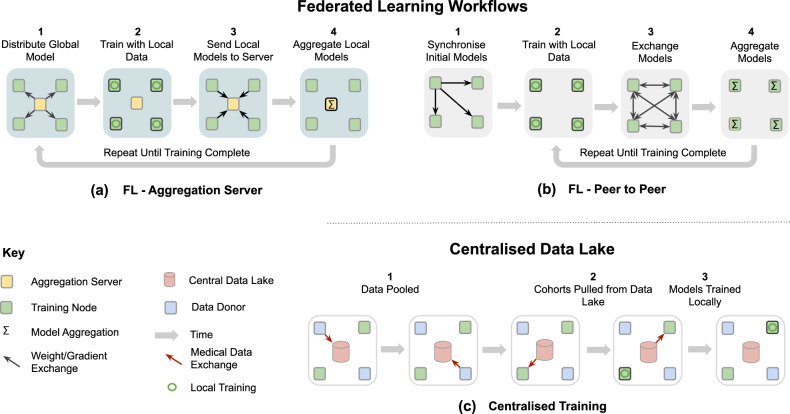
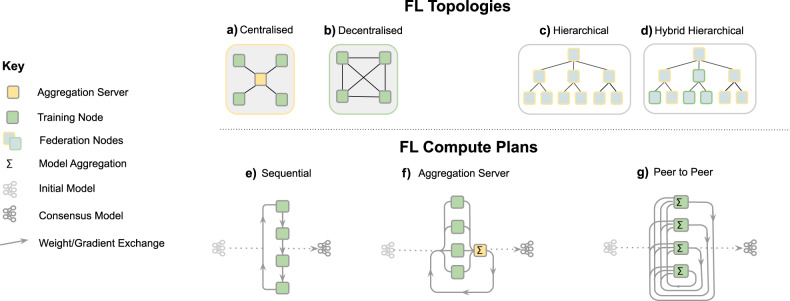
- The text describes FL workflows, including aggregation-server and peer-to-peer topologies, and discusses mechanisms such as FedAvg, FedProx, domain adaptation, and differential privacy at a conceptual level.
Limitations
- The paper explicitly states that FL does not solve all issues inherent to learning on medical data; success still depends on data quality, bias, and standardization.
- It states that FL does not eliminate privacy risks: models can still memorize information, and gradients/model updates may leak private data through inversion or adversarial attacks.
- Evident from the text: this is a perspective article, so it does not report original experimental results, sample sizes, or statistical testing.
Model-written summary. Check it against the paper before relying on it.
Integrity signals
Registry
Cites
Statistics
Figures
Verification
Claims the paper makes
16 Valid · 0 Not valid · 4 Not checked · 19 Own results and interpretations
The cited sources support only part of this claim — read each source’s verdict below.
In the paper
“Modern DL models feature millions of parameters that need to be learned from sufficiently large curated data sets in order to achieve clinical-grade accuracy, while being safe, fair, equitable and generalising well to unseen data2–5.”
§ The future of digital health with federated learning > Introduction
What the sources say
- Not checked — no full text of the sourcecites [2] Wang F Casalino LP Khullar D Deep learning in medicine—promise, progress, and challenges JAMA Intern. Med. 2019 179 293 294 10.1001/jamainternmed.2018.7117 30556825 source
- Not checked — no full text of the sourcecites [3] Chartrand G Deep learning: a primer for radiologists Radiographics 2017 37 2113 2131 10.1148/rg.2017170077 29131760 source
- Partly supportedcites [4] De Fauw J Clinically applicable deep learning for diagnosis and referral in retinal disease Nat. Med. 2018 24 1342 10.1038/s41591-018-0107-6 30104768 sourceExperimental — accuracy not yet measured
Split into 2 atoms — 0 confirmed, 2 partially supported, 0 disputed, 0 misattributed, 0 unverifiable. Expand the claim to see per-atom verdicts.
- Partly supportedcites [5] Sun, C., Shrivastava, A., Singh, S. & Gupta, A. Revisiting unreasonable effectiveness of data in deep learning era. In Proceedings of the IEEE international conference on computer vision, 843–852 (IEEE, 2017). sourceExperimental — accuracy not yet measured
Split into 2 atoms — 0 confirmed, 2 partially supported, 0 disputed, 0 misattributed, 0 unverifiable. Expand the claim to see per-atom verdicts.
plainstates a cause- Asserted: passes — The authors put it forward as true.
- Checkable: passes — It can be checked against evidence.
- Load-bearing: passes — The paper’s conclusions depend on it.
- Based: passes — The paper gives a reason why it holds.
The cited sources support only part of this claim — read each source’s verdict below.
In the paper
“Existing medical data is not fully exploited by ML primarily because it sits in data silos and privacy concerns restrict access to this data.”
§ The future of digital health with federated learning > Abstract
What the sources say
- Partly supportedcites [6] Van Panhuis WG A systematic review of barriers to data sharing in public health BMC Public Health 2014 14 1144 10.1186/1471-2458-14-1144 25377061 PMC4239377 sourceExperimental — accuracy not yet measured
The Background describes routinely collected public-health data as underused, and Results > Legal barriers says privacy concerns can lead to restrictive data-access policies. Results > Technical barriers describes difficulties integrating datasets. The paper does not establish that machine learning is the affected use or that data silos and privacy are the primary reasons medical data is underexploited. (LLM, conf=0.87)
- Partly supportedcites [7] Rocher L Hendrickx JM De Montjoye Y-A Estimating the success of re-identifications in incomplete datasets using generative models Nat. Commun. 2019 10 1 9 10.1038/s41467-019-10933-3 31337762 PMC6650473 sourceExperimental — accuracy not yet measured
The Introduction (page not provided) says medical and other personal data can advance AI, while privacy concerns affect its collection, use, and sharing. It does not say that medical data sits in silos or that silos and privacy restrictions are the primary reasons ML underuses it. (LLM, conf=0.85)
plainstates a cause- Asserted: passes — The authors put it forward as true.
- Checkable: passes — It can be checked against evidence.
- Load-bearing: passes — The paper’s conclusions depend on it.
- Based: passes — The paper gives a reason why it holds.
- Partly supported
The cited sources support only part of this claim — read each source’s verdict below.
In the paper
“The more rounds of local training are performed, the less it is guaranteed that the overall procedure is minimising (Eq. 1)9,12.”
§ The future of digital health with federated learning > Technical considerations > Federated learning definition
What the sources say
- Partly supportedcites [9] McMahan, B., Moore, E., Ramage, D., Hampson, S. & y Arcas, B. A. Communication-efficient learning of deep networks from decentralized data. In Artificial Intelligence and Statistics, 1273–1282. https://scholar.google.de/scholar?hl=de&as_sdt=0%2C5&q=Communicationefficient+learning+of+deep+networks+from+decentralized+data&btnG= (2017). sourceExperimental — accuracy not yet measured
The Experimental Results (p. 7) report that with very many local epochs, FedAvg can plateau or diverge on the Shakespeare LSTM task. But they also report no significant convergence degradation for large numbers of local epochs on the MNIST CNN, so the paper does not establish a general rule that more local training makes minimisation of the global loss less assured. (LLM, conf=0.86)
- Supportedcites [12] Kairouz, P. et al. Advances and open problems in federated learning. arXiv preprint arXiv:1912.04977 (2019). source
Section 3.2.1 states that more local updates increase divergence between client models and slow convergence of the training loss. Section 3.2.2 also reports more restrictive convergence bounds for local updates with non-IID data. Together, these support the claim that increasing local training weakens convergence assurances for the global loss. (LLM, conf=0.86)
plainstates a cause- Asserted: passes — The authors put it forward as true.
- Checkable: passes — It can be checked against evidence.
- Load-bearing: unclear — It is unclear whether the paper’s conclusions depend on it.
- Based: passes — The paper gives a reason why it holds.
- Partly supported
A conclusion the paper draws from its own results — it cites no other source for it, so there is none to check. The quote shows it is in the paper.
In the paper
“By linking healthcare institutions, not restricted to research centres, FL can have direct clinical impact.”
§ The future of digital health with federated learning > Data-driven medicine requires federated efforts > Current FL efforts for digital health
plainstates a possible cause- Asserted: passes — The authors put it forward as true.
- Checkable: passes — It can be checked against evidence.
- Load-bearing: passes — The paper’s conclusions depend on it.
- Based: passes — The paper gives a reason why it holds.
A conclusion the paper draws from its own results — it cites no other source for it, so there is none to check. The quote shows it is in the paper.
In the paper
“FL enables collaborative research for, even competing, companies.”
§ The future of digital health with federated learning > Data-driven medicine requires federated efforts > Current FL efforts for digital health
plainstates a cause- Asserted: passes — The authors put it forward as true.
- Checkable: passes — It can be checked against evidence.
- Load-bearing: unclear — It is unclear whether the paper’s conclusions depend on it.
- Based: passes — The paper gives a reason why it holds.
14 references still to check
A free account verifies the references that are still open.
- Probably not a substantial claim. 19
- It may state two separate claims as one. 32
- The quote only partly states this claim. 1
Claims other papers make about this one
Each is checked against this paper’s own text: does it say what the citing paper says it does?
The source backs part of the claim, not all of it — or backs it for a different population, condition or comparison.
In the citing paper
“This is currently addressed by sharing multi-site data, but such centralization is challenging/infeasible to scale due to various limitations.”
From Federated learning enables big data for rare cancer boundary detection (2022) · cites this paper as [10]
Experimental — accuracy not yet measuredThe source backs part of the claim, not all of it — or backs it for a different population, condition or comparison.
In the citing paper
“However, these methods often come with trade-offs in accuracy and computational efficiency.”
From The role of multimodality in clinical disease diagnosis: advances, challenges, and opportunities (2026) · cites this paper as [34]
Experimental — accuracy not yet measuredThe source backs part of the claim, not all of it — or backs it for a different population, condition or comparison.
In the citing paper
“The experts in healthcare and life sciences can use FL to solve the unique problem of data governance by training algorithms behind the hospital's firewall and only sharing models so that data remain secure [31].”
From A comprehensive survey on federated learning techniques for healthcare informatics (2023) · cites this paper as [31]
Experimental — accuracy not yet measuredThe source backs part of the claim, not all of it — or backs it for a different population, condition or comparison.
In the citing paper
“It also improves patient privacy and reduces low latency during the collaboration of multiple hospitals/entities [7].”
From Handling privacy-sensitive medical data with federated learning: Challenges and future directions (2023) · cites this paper as [7]
Experimental — accuracy not yet measuredThe source backs part of the claim, not all of it — or backs it for a different population, condition or comparison.
In the citing paper
“Enabling privacy protected data sharing across clinical centers is advocated as an essential pathway to promote collaborations internationally yet underexplored so far6,7.”
From Federated deep learning for detecting COVID-19 lung abnormalities in CT: a privacy-preserving multinational validation study (2021) · cites this paper as [7]
Experimental — accuracy not yet measured
27 more claims about this paper
Create a free account to see every claim other papers make about this one.
Citations
Cites
LeCun, Y., Bengio, Y., & Hinton, G. (2015) · Nature · doi:10.1038/nature14539 · Cited by 84,126
Communication-Efficient Learning of Deep Networks from Decentralized Data
McMahan, H. B., Moore, E., Ramage, D., Hampson, S., & Arcas, B. A. Y. (2016) · arXiv · doi:10.48550/arxiv.1602.05629 · Cited by 14,215
Sudlow, C., Gallacher, J., Allen, N., Beral, V., Burton, P., Danesh, J., Downey, P., Elliott, P., Green, J., Landray, M., et al. (2015) · PLOS Medicine · doi:10.1371/journal.pmed.1001779 · Cited by 12,728 · cited 2×
“Substantial, albeit smaller, initiatives include the Human Connectome25, the UK Biobank26, the Cancer Imaging Archive (TCIA)27, NIH CXR828, NIH DeepLesion29, the Cancer Genome Atlas (TCGA)30, the Alzheimer’s Disease Neuroimaging Initiative (ADNI)31, as well as medical grand challenges32 such as the CAMELYON challenge3…”
BackgroundAdvances and Open Problems in Federated Learning
Kairouz, P., McMahan, H. B., Avent, B., Bellet, A., Bennis, M., Bhagoji, A. N., Bonawitz, K., Charles, Z., Cormode, G., Cummings, R., et al. (2019) · arXiv · doi:10.48550/arxiv.1912.04977 · Cited by 7,857
Advances and Open Problems in Federated Learning
Kairouz, P., & McMahan, H. B. (2021) · Foundations and Trends in Machine Learning · doi:10.1561/2200000083 · Cited by 7,772
The multimodal brain tumor image segmentation benchmark (BRATS)
Menze, B. H., Jakab, A., Bauer, S., Kalpathy-Cramer, J., Farahani, K., Kirby, J., Burren, Y., Porz, N., Slotboom, J., Wiest, R., et al. (2015) · IEEE Transactions on Medical Imaging · doi:10.1109/tmi.2014.2377694 · Cited by 6,781
Deep Learning with Differential Privacy
Abadi, M., Chu, A., Goodfellow, I., McMahan, H. B., Mironov, I., Talwar, K., & Zhang, L. (2016) · Proceedings of the 2016 ACM SIGSAC Conference on Computer and Communications Security · doi:10.1145/2976749.2978318 · Cited by 6,578 · cited 2×
“Countermeasures, such as limiting the granularity of the shared model updates and to add specific noise to ensure differential privacy [34, 12, 57] may be needed and is still an active area of research [14].”
BackgroundMethodFederated Machine Learning: Concept and Applications
Yang, Q., Liu, Y., Chen, T., & Tong, Y. (2019) · ACM Transactions on Intelligent Systems and Technology · doi:10.1145/3298981 · Cited by 6,322 · cited 4×
“d FL approaches are still under development. 3 Technical Considerations FL is perhaps best-known from the work of Konecnˇ y` et al. [36], but various other definitions have been proposed in literature [14, 11, 15, 9]. These approaches can be realised via different communication architectures (see Figure 1) and respecti…”
BackgroundInfluentialFederated learning: Challenges, methods, and future directions
Li, T., Sahu, A. K., Talwalkar, A., & Smith, V. (2020) · IEEE Signal Processing Magazine · doi:10.1109/msp.2020.2975749 · Cited by 6,210 · cited 3×
“However, there is a trade-off in terms of performance and these techniques may affect for example the accuracy of the final model [10].”
BackgroundMethodShin, H.-C., Roth, H. R., Gao, M., Lu, L., Xu, Z., Nogues, I., Yao, J., Mollura, D., & Summers, R. M. (2016) · IEEE Transactions on Medical Imaging · doi:10.1109/tmi.2016.2528162 · Cited by 5,759
Self-citation
Cited by
Items 201–300 of 3,132
Federated Learning on Multimodal Data: A Comprehensive Survey
Lin, Y., Gao, Y., Gong, M., Zhang, S., Zhang, Y., & Li, Z. (2023) · Machine Intelligence Research · doi:10.1007/s11633-022-1398-0 · Cited by 97
“In the context of human-computer interaction, a modality is the classification of a single independent channel of sensory input/output between a computer and a human[24].”
BackgroundFair Federated Medical Image Segmentation via Client Contribution Estimation
Jiang, M., Roth, H. R., Li, W., Yang, D. L., Zhao, C. H., Nath, V., Xu, D., Dou, Q., & Xu, Z. (2023) · IEEE Computer Society Conference on Computer Vision and Pattern Recognition/Proceedings - IEEE Computer Society Conference on Computer Vision and Pattern Recognition/Proceedings · doi:10.1109/cvpr52729.2023.01564 · Cited by 138
“Recent development of federated learning (FL) facilitates collaboration for medical applications, given that multiple medical institutions can jointly train a consensus model without sharing raw data [1–6].”
BackgroundSelf-citationPrinciples, applications, and future of artificial intelligence in dermatology
Omiye, J. A., Gui, H., Daneshjou, R., Cai, Z. R., & Muralidharan, V. (2023) · Frontiers in Medicine · doi:10.3389/fmed.2023.1278232 · Cited by 104
“Federated learning (FL) is a concept that enables DL models to be trained on different datasets without the need to leave their original locations (100).”
BackgroundResultIacucci, M., Santacroce, G., Zammarchi, I., Maeda, Y., Del Amor, R., Meseguer, P., Kolawole, B. B., Chaudhari, U., Di Sabatino, A., Danese, S., et al. (2024) · The Lancet Gastroenterology & Hepatology · doi:10.1016/s2468-1253(24)00053-0 · Cited by 73
Friedrich, S., Groß, S., König, I. R., Engelhardt, S., Bahls, M., Heinz, J., Huber, C., Kaderali, L., Kelm, M., Leha, A., et al. (2021) · European Heart Journal - Digital Health · doi:10.1093/ehjdh/ztab054 · Cited by 88
Byzantine-Robust Decentralized Federated Learning
Fang, M., Zhang, Z., Hairi, Khanduri, P., Liu, J., Lu, S., Liu, Y., & Gong, N. Z. (2024) · ACM SIGSAC Conference on Computer and Communications Security (CCS) · doi:10.1145/3658644.3670307 · Cited by 157
Владимировна, Ф. Е., Novikova, E. S., & Shulepov, A. (2022) · Algorithms · doi:10.3390/a15070247 · Cited by 91
Sáinz-Pardo Díaz, J., & López García, Á. (2023) · Neurocomputing · doi:10.1016/j.neucom.2022.11.011 · Cited by 70
“Federated learning is being studied in a wide range of fields [15] such as medical data [16, 17, 18, 19, 20], cybersecurity [21, 22] or Internet of Things [23, 24] among others.”
Gradient Boosting for Health IoT Federated Learning
Wassan, S., Suhail, B., Mubeen, R., Raj, B., Agarwal, U., Khatri, E., Gopinathan, S., & Dhiman, G. (2022) · Sustainability · doi:10.3390/su142416842 · Cited by 85
Bhagat, S. V., & Kanyal, D. (2024) · Cureus · doi:10.7759/cureus.54518 · Cited by 125
“This innovative approach enhances data security and promotes collaboration in large-scale healthcare research endeavors, laying the foundation for more robust and privacy-preserving AI applications [41].”
BackgroundCobo, M., Fernández‐Miranda, P. M., Bastarrika, G., & Iglesias, L. L. (2023) · Scientific Data · doi:10.1038/s41597-023-02641-x · Cited by 89
“…or complex equipment since the biomarkers can be easily extracted with the aid of a conventional computer with a Graphics Processing Unit (GPU) and the validation of radiomics signatures can be performed distributedly to preserve patient privacy, following federated learning approaches 57 .”
MethodSecure Smart Communication Efficiency in Federated Learning: Achievements and Challenges
Pouriyeh, S., Shahid, O., Parizi, R. M., Sheng, Q. Z., Srivastava, G., Zhao, L., & Nasajpour, M. (2022) · Applied Sciences · doi:10.3390/app12188980 · Cited by 214
Cremonesi, F., Planat, V., Kalokyri, V., Kondylakis, H., Sanavia, T., Miguel Mateos Resinas, V., Singh, B., & Uribe, S. (2023) · Journal of Biomedical Informatics · doi:10.1016/j.jbi.2023.104338 · Cited by 69
Federated Learning as a Privacy Solution - An Overview
Khan, M., Glavin, F. G., & Nickles, M. (2023) · Procedia Computer Science · doi:10.1016/j.procs.2022.12.227 · Cited by 84
Amugongo, L. M., Kriebitz, A., Boch, A., & Lütge, C. (2025) · AI and Ethics · doi:10.1007/s43681-023-00331-3 · Cited by 68
“To achieve this, developers should explore various techniques to model training, such as traditional ML (where model training and inference take place at a central server) [75] and decentralized approaches (collaborative training without data leaving the user’s mobile device) [64, 65].”
Ullah, F., Srivastava, G., Xiao, H., Ullah, S., Lin, J. C., & Zhao, Y. (2023) · IEEE Journal of Biomedical and Health Informatics · doi:10.1109/jbhi.2023.3282955 · Cited by 75
“Federated learning (FL) [3] is gaining popularity and is useful for ensuring that data never leaves the servers of each data owner, even for training purposes.”
BackgroundShapleyFL: Robust Federated Learning Based on Shapley Value
Sun, Q., Li, X., Zhang, J., Xiong, L., Liu, W., Liu, J., Qin, Z., & Ren, K. (2023) · ACM SIGKDD Conference on Knowledge Discovery and Data Mining (KDD) · doi:10.1145/3580305.3599500 · Cited by 113
“FL has shown extensive applications in many fields, such as medical care [37], finance [27], and data markets [44].”
BackgroundSurvey of Transfer Learning Approaches in the Machine Learning of Digital Health Sensing Data
Chato, L., & Regentova, E. E. (2023) · Journal of Personalized Medicine · doi:10.3390/jpm13121703 · Cited by 81
Challenges and prospects of visual contactless physiological monitoring in clinical study
Huang, B., Hu, S., Liu, Z., Lin, C., Su, J., Zhao, C., Wang, L., & Wang, W. (2023) · npj Digital Medicine · doi:10.1038/s41746-023-00973-x · Cited by 92
“Recently, federated learning have been widely applied in healthcare and clinical systems 57,58,136 – 138 , and just one VCPM study leverages federated learning at present 63 .”
BackgroundMethodFederated Learning for Healthcare: A Comprehensive Review
Dhade, P., & Shirke, P. (2024) · RAiSE-2023 · doi:10.3390/engproc2023059230 · Cited by 67
Applications of Federated Learning in Mobile Health: Scoping Review
Wang, T., Du, Y. N., Gong, Y., Choo, K. R., & Guo, Y. (2023) · Journal of Medical Internet Research · doi:10.2196/43006 · Cited by 95
“For clinicians and practitioners, using FL-based systems in mHealth can augment their expertise with knowledge from larger populations [50].”
Peketi, D., Chalavadi, V., Mohan, C. K., & Chen, Y. (2023) · International Joint Conference on Neural Networks (IJCNN) · doi:10.1109/ijcnn54540.2023.10191202 · Cited by 75
“Due to its privacy-preserving capability, FL framework is employed in health care image analysis [11], [12] for several tasks such as patient similarity learning [13].”
MethodChallenges for machine learning in clinical translation of big data imaging studies
Dinsdale, N. K., Bluemke, E., Sundaresan, V., Jenkinson, M., Smith, S. M., & Namburete, A. I. L. (2022) · Neuron · doi:10.1016/j.neuron.2022.09.012 · Cited by 90
A Review of Medical Federated Learning: Applications in Oncology and Cancer Research
Chowdhury, A., Kassem, H., Padoy, N., Umeton, R., & Karargyris, A. (2022) · Lecture Notes in Computer Science · doi:10.1007/978-3-031-08999-2_1 · Cited by 65
“Specifically, large-scale projects have been developed for facilitating collaboration of medical institutions around the globe with the aid of Federated Learning, in both academic and industrial areas [21].”
BackgroundDistributed contrastive learning for medical image segmentation
Wu, Y., Zeng, D., Wang, Z., Shi, Y., & Hu, J. (2022) · Medical Image Analysis · doi:10.1016/j.media.2022.102564 · Cited by 96
Eckardt, J., Hahn, W., Röllig, C., Stasik, S., Platzbecker, U., Müller‐Tidow, C., Serve, H. L., Baldus, C. D., Schliemann, C., Schäfer‐Eckart, K., et al. (2024) · npj Digital Medicine · doi:10.1038/s41746-024-01076-x · Cited by 90
“Computational advances in both federated 16 and swarm learning 17 where machine learning models are trained across multiple locations and only either models or weights are shared rather than the data itself provide a viable alternative.”
BackgroundArtificial Intelligence in the NHS: Climate and Emissions✰,✰✰
Bloomfield, P. S., Clutton-Brock, P., Pencheon, E., Magnusson, J., & Karpathakis, K. (2021) · The Journal of Climate Change and Health · doi:10.1016/j.joclim.2021.100056 · Cited by 89
Toward Foundational Deep Learning Models for Medical Imaging in the New Era of Transformer Networks
Willemink, M. J., Roth, H. R., & Sandfort, V. (2022) · Radiology Artificial Intelligence · doi:10.1148/ryai.210284 · Cited by 90
Self-citationZhao, J., Bagchi, S., Avestimehr, S., Chan, K., Chaterji, S., Dimitriadis, D., Li, J., Li, N., Nourian, A., & Roth, H. (2025) · ACM Computing Surveys · doi:10.1145/3724113 · Cited by 63
“This diversity is rooted in demographic variances, regional characteristics, or the intrinsic nature of the collected data.”
Self-citationAdversarial machine learning: a review of methods, tools, and critical industry sectors
Pelekis, S., Koutroubas, T., Blika, A., Berdelis, A., Karakolis, E., Ntanos, C., Spiliotis, E., & Askounis, D. (2025) · Artificial Intelligence Review · doi:10.1007/s10462-025-11147-4 · Cited by 111
A Framework for Edge-Assisted Healthcare Data Analytics using Federated Learning
Hakak, S., Ray, S., Khan, W. Z., & Scheme, E. (2020) · 2020 IEEE International Conference on Big Data (Big Data) · doi:10.1109/bigdata50022.2020.9377873 · Cited by 62
“Recently, Distributed ML and Federated Learning [13] have been proposed that do not require a central data repository.”
BackgroundImage annotation and curation in radiology: an overview for machine learning practitioners
Galbusera, F., & Cina, A. (2024) · European Radiology Experimental · doi:10.1186/s41747-023-00408-y · Cited by 62
“The focus is on the need to standardise image curation and annotation, which would allow for example the implementation of “federated learning”, a paradigm that seeks to address the problem of data governance and privacy by training algorithms without exchanging the data itself [5].”
BackgroundLiu, J. C., Goetz, J., Sen, S., & Tewari, A. (2021) · JMIR mHealth and uHealth · doi:10.2196/23728 · Cited by 60
“A recent paper describes how federated learning can be useful to various stakeholders in the mHealth field [42].”
Multimodal biometric authentication method by federated learning
Coelho, K. K., Tristão, E. T., Nogueira, M., Vieira, A. B., & Nacif, J. A. M. (2023) · Biomedical Signal Processing and Control · doi:10.1016/j.bspc.2023.105022 · Cited by 65
A scoping review of the governance of federated learning in healthcare
Eden, R., Chukwudi, I., Bain, C., Barbieri, S., Callaway, L. K., de Jersey, S., George, Y., Gorse, A., Lawley, M., Marendy, P., et al. (2025) · npj Digital Medicine · doi:10.1038/s41746-025-01836-3 · Cited by 115
“FL is revolutionising healthcare by enabling collaborative ML across institutions while preserving patient privacy 5,11,12 .”
InfluentialFederated Learning in Dentistry: Chances and Challenges
Rischke, R., Schneider, L., Müller, K. R., Samek, W., Schwendicke, F., & Krois, J. (2022) · Journal of Dental Research · doi:10.1177/00220345221108953 · Cited by 85
“However, particularly in health care, aspects related to data privacy and data sharing have been identified as hampering factors (Rieke et al. 2020).”
BackgroundDFU-SIAM a Novel Diabetic Foot Ulcer Classification With Deep Learning
Toofanee, M. S. A., Dowlut, S., Hamroun, M., Tamine, K., Petit, V., Duong, A. K., & Sauveron, D. (2023) · IEEE Access · doi:10.1109/access.2023.3312531 · Cited by 75
“To overcome this barrier, the use of centralized Federated Learning or Peer-to-peer Federated Learning should be explored.”
MethodInfluentialBig data and deep learning for RNA biology
Hwang, H., Jeon, H., Yeo, N., & Baek, D. (2024) · Experimental & Molecular Medicine · doi:10.1038/s12276-024-01243-w · Cited by 74
“Using federated learning, multiple institutions can collaborate without sharing sensitive transcriptome data outside the institution 292,293 .”
BackgroundA survey on federated learning for security and privacy in healthcare applications
Coelho, K. K., Nogueira, M., Vieira, A. B., Silva, E. F., & Nacif, J. A. M. (2023) · Computer Communications · doi:10.1016/j.comcom.2023.05.012 · Cited by 86
Ensemble deep learning for Alzheimer’s disease characterization and estimation
Tanveer, M., Goel, T., Sharma, R., Malik, A. K., Beheshti, I., Ser, J. D., Suganthan, P. N., & Lin, C. (2024) · Nature Mental Health · doi:10.1038/s44220-024-00237-x · Cited by 74
“Federated learning 96 can offer a solution to the high demands of EDL for AD disease characterization and estimation, allowing several remote models in different hospitals and medical centers to leverage each other’s modeled knowledge while guaranteeing the privacy of locally captured medical data.”
Utilizing machine learning for predicting drug release from polymeric drug delivery systems
Aghajanpour, S., Amiriara, H., Esfandyari‐Manesh, M., Ebrahimnejad, P., Jeelani, H., Henschel, A., Singh, H., Dinarvand, R., & Hassan, S. (2025) · Computers in Biology and Medicine · doi:10.1016/j.compbiomed.2025.109756 · Cited by 78
EasyFL: A Low-Code Federated Learning Platform for Dummies
Zhuang, W., Gan, X., Wen, Y., & Zhang, S. (2022) · IEEE Internet of Things Journal · doi:10.1109/jiot.2022.3143842 · Cited by 82
“Some of them are building prototypes and then deploying FL applications [14], [15].”
BackgroundInternational federation of genomic medicine databases using GA4GH standards
Thorogood, A., Rehm, H. L., Goodhand, P., Page, A. J. H., Joly, Y., Baudis, M., Rambla, J., Navarro, A., Nyronen, T. H., Linden, M., et al. (2021) · Cell Genomics · doi:10.1016/j.xgen.2021.100032 · Cited by 58
“The following design considerations and trade-offs, drawn in part from experience in artificial intelligence and digital health contexts, 7,8 provide a guide for the genomics and health community.”
BackgroundHospital patients’ length of stay prediction: A federated learning approach
Rahman, M. M., Kundu, D., Suha, S. A., Siddiqi, U. R., & Dey, S. K. (2022) · Journal of King Saud University - Computer and Information Sciences · doi:10.1016/j.jksuci.2022.07.006 · Cited by 74
Proportionally Fair Hospital Collaborations in Federated Learning of Histopathology Images
Hosseini, S. M., Sikaroudi, M., Babaie, M., & Tizhoosh, H. R. (2023) · IEEE Transactions on Medical Imaging · doi:10.1109/tmi.2023.3234450 · Cited by 70
“However, it appears currently impossible to gather large-scale datasets in one central location in medical domain due to privacy-sensitive data [2].”
BackgroundIdeal algorithms in healthcare: Explainable, dynamic, precise, autonomous, fair, and reproducible
Loftus, T. J., Tighe, P. J., Ozrazgat-Baslanti, T., Davis, J. P., Ruppert, M. M., Ren, Y., Shickel, B., Kamaleswaran, R., Hogan, W. R., Moorman, J. R., et al. (2022) · PLOS Digital Health · doi:10.1371/journal.pdig.0000006 · Cited by 57
“Federated learning offers opportunities to ensure the external validity, generalizability, and reproducibility of algorithms via collaborative machine learning without data sharing [89– 92].”
How NFTs could transform health information exchange
Kostick, K. M., Mandl, K. D., Minssen, T., Cohen, I. G., Gasser, U., Kohane, I. S., & McGuire, A. L. (2022) · Science · doi:10.1126/science.abm2004 · Cited by 65
Corti, C., Cobanaj, M., Marian, F., Dee, E. C., Lloyd, M. R., Marcu, S., Dombrovschi, A., Biondetti, G. P., Batalini, F., Celi, L. A., et al. (2022) · Cancer Treatment Reviews · doi:10.1016/j.ctrv.2022.102410 · Cited by 68
Wu, X., Liu, X., Niu, J., Zhu, G., & Tang, S. (2023) · IEEE/CVF International Conference on Computer Vision (ICCV) · doi:10.1109/iccv51070.2023.01775 · Cited by 96
“It has been applied in many scenarios, such as computer vision [20, 5, 34], finance [21], healthcare [28, 29], etc.”
MethodArtificial General Intelligence for Medical Imaging Analysis
Li, X., Zhao, L., Zhang, L., Wu, Z., Liu, Z., Jiang, H., Cao, C., Xu, S., Li, Y., Dai, H., et al. (2024) · IEEE Reviews in Biomedical Engineering · doi:10.1109/rbme.2024.3493775 · Cited by 117
“As a result, training and utilizing AGI models across institutions are challenging or even impossible (commonly known as “institutional barriers”) [10].”
Liu, Y., Acharya, U. R., & Tan, J. H. (2024) · Computer Methods and Programs in Biomedicine · doi:10.1016/j.cmpb.2024.108571 · Cited by 93
Alsabah, M. Q., Naser, M. A., Albahri, A. S., Albahri, A. S., Alamoodi, A. H., Abdulhussain, S. H., & Alzubaidi, L. (2025) · Artificial Intelligence Review · doi:10.1007/s10462-025-11342-3 · Cited by 116
Federated Learning for Data Analytics in Education
Fachola, C., Tornaría, A., Bermolen, P., Capdehourat, G., Etcheverry, L., & Fariello, M. I. (2023) · Data · doi:10.3390/data8020043 · Cited by 87
Resources for image-based high-throughput phenotyping in crops and data sharing challenges
Danilevicz, M. F., Bayer, P. E., Nestor, B. J., Bennamoun, M., & Edwards, D. (2021) · PLANT PHYSIOLOGY · doi:10.1093/plphys/kiab301 · Cited by 70
Challenges and Opportunities for Global Genomic Surveillance Strategies in the COVID-19 Era
Ling-Hu, T., Rios-Guzman, E., Lorenzo-Redondo, R., Ozer, E. A., & Hultquist, J. F. (2022) · Viruses · doi:10.3390/v14112532 · Cited by 72
ECCbAS: An ECC based authentication scheme for healthcare IoT systems
Servati, M. R., & Safkhani, M. (2023) · Pervasive and Mobile Computing · doi:10.1016/j.pmcj.2023.101753 · Cited by 62
Chikwetu, L., Yu, M., Woldetensae, M. K., Bell, D., Goldenholz, D. M., & Dunn, J. (2023) · The Lancet Digital Health · doi:10.1016/s2589-7500(22)00234-5 · Cited by 92
AI can help to speed up drug discovery — but only if we give it the right data
Mock, M. L., Edavettal, S. C., LANGMEAD, C. J., & Russell, A. J. (2023) · Nature · doi:10.1038/d41586-023-02896-9 · Cited by 65
Review on Federated Learning for digital transformation in healthcare through big data analytics
Babar, M., Qureshi, B., & Koubaa, A. (2024) · Future Generation Computer Systems · doi:10.1016/j.future.2024.05.046 · Cited by 55
Surgical data science – from concepts toward clinical translation
Maier‐Hein, L., Eisenmann, M., Sarıkaya, D., März, K., Collins, T., Malpani, A., Fallert, J., Feußner, H., Giannarou, S., Mascagni, P., et al. (2021) · Medical Image Analysis · doi:10.1016/j.media.2021.102306 · Cited by 516
A comprehensive review of federated learning for COVID‐19 detection
Naz, S., Phan, K. T., & Chen, Y. P. (2021) · International Journal of Intelligent Systems · doi:10.1002/int.22777 · Cited by 68
“44 Privacy concerns demand that medical data be stored in data silos where the sedentary behavior of data prevents ML approaches from unleashing their full potential.”
BackgroundFederated Learning for Diabetic Retinopathy Detection Using Vision Transformers
Chetoui, M., & Akhloufi, M. A. (2023) · BioMedInformatics · doi:10.3390/biomedinformatics3040058 · Cited by 67
“Federated learning (FL) [28–30], a recent development in distributed learning, enables many medical institutions to cooperatively train AI models without data exchange.”
BackgroundFederated Contrastive Learning for Decentralized Unlabeled Medical Images
Dong, N., & Voiculescu, I. D. (2021) · Lecture notes in computer science · doi:10.1007/978-3-030-87199-4_36 · Cited by 96
Moving towards vertically integrated artificial intelligence development
Zhang, J., Budhdeo, S., William, W., Cerrato, P., Shuaib, H., Sood, H., Ashrafian, H., Halamka, J., & Teo, J. T. (2022) · npj Digital Medicine · doi:10.1038/s41746-022-00690-x · Cited by 54
Model compression and privacy preserving framework for federated learning
Zhu, X., Wang, J., Chen, W., & Sato, K. (2022) · Future Generation Computer Systems · doi:10.1016/j.future.2022.10.026 · Cited by 67
Li, N., Lewin, A., Ning, S., Waito, M., Zeller, M. P., Tinmouth, A. T., Shih, A. W. Y., & The Canadian Transfusion Trials Group (2024) · Transfusion · doi:10.1111/trf.18077 · Cited by 72
“9 Given the nascence of FL approaches in healthcare, data stewards and the public will need education and reassur-ance of rigorous safeguarding policies and procedures for patient health information.”
Digital Twins in Personalized Medicine: Bridging Innovation and Clinical Reality
Silva, A., & Vale, N. (2025) · Journal of Personalized Medicine · doi:10.3390/jpm15110503 · Cited by 89
“Cloud-based infrastructures and federated learning platforms are increasingly supporting the computational backbone of DHTs by enabling distributed model training while maintaining data privacy [43].”
InfluentialShiri, I., Sadr, A. V., Akhavan, A., Salimi, Y., Sanaat, A., Amini, M., Razeghi, B., Saberi, A., Arabi, H., Ferdowsi, S., et al. (2022) · European Journal of Nuclear Medicine and Molecular Imaging · doi:10.1007/s00259-022-06053-8 · Cited by 67
“FL techniques enable the collaborative training of machine learning models among multiple parties without exchanging the local data to preserve privacy and solve the concerns of data users and data owners [22–24].”
BackgroundMethodInfluentialFederated Contrastive Learning for Volumetric Medical Image Segmentation
Wu, Y., Zeng, D., Wang, Z., Shi, Y., & Hu, J. (2021) · Lecture notes in computer science · doi:10.1007/978-3-030-87199-4_35 · Cited by 95
“individual medical institutions) collaboratively learn a shared model while keeping private raw data local [20,23,22,8].”
BackgroundShiri, I., Sadr, A. V., Amini, M., Salimi, Y., Sanaat, A., Akhavanallaf, A., Razeghi, B., Ferdowsi, S., Saberi, A., Arabi, H., et al. (2022) · Clinical Nuclear Medicine · doi:10.1097/rlu.0000000000004194 · Cited by 61
FedDP: Dual Personalization in Federated Medical Image Segmentation
Wang, J., Jin, Y., Stoyanov, D. V., & Wang, L. (2023) · IEEE Transactions on Medical Imaging · doi:10.1109/tmi.2023.3299206 · Cited by 73
“F EDERATED learning (FL) is an important topic in medical image computing enabling model training while adhering to local data protection rules [1], [2].”
BackgroundChu, C. P. (2024) · Frontiers in Veterinary Science · doi:10.3389/fvets.2024.1395934 · Cited by 83
“Therefore, robust cybersecurity measures are necessary to protect patient privacy and ensure compliance with legal standards in medical settings (90).”
BackgroundA collective AI via lifelong learning and sharing at the edge
Soltoggio, A., Ben-Iwhiwhu, E., Braverman, V., Eaton, E., Epstein, B., Ge, Y., Halperin, L., How, J., Itti, L., Jacobs, M. A., et al. (2024) · Nature Machine Intelligence · doi:10.1038/s42256-024-00800-2 · Cited by 51
“The application of ML to medical domains has recently benefited from distributed approaches based on federated learning 185 , in particular through enabling multi-institution collaborations 186 .”
Pati, S., Baid, U., Edwards, B., Sheller, M. J., Foley, P., Anthony Reina, G., Thakur, S., Sako, C., Bilello, M., Davatzikos, C., et al. (2022) · Physics in Medicine & Biology · doi:10.1088/1361-6560/ac9449 · Cited by 51
Self-citationFederated Learning in Ocular Imaging: Current Progress and Future Direction
Nguyen, T. X., Ran, A. R., Hu, X., Yang, D., Jiang, M., Dou, Q., & Cheung, C. Y.-L. (2022) · Diagnostics · doi:10.3390/diagnostics12112835 · Cited by 59
Improved Gradient Inversion Attacks and Defenses in Federated Learning
Geng, J., Mou, Y., Li, Q., Li, F., Beyan, O., Decker, S., & Rong, C. (2023) · IEEE Transactions on Big Data · doi:10.1109/tbdata.2023.3239116 · Cited by 80
Challenges of implementing computer-aided diagnostic models for neuroimages in a clinical setting
Leming, M., Bron, E. E., Bruffaerts, R., Ou, Y., Iglesias, J. E., Gollub, R. L., & Im, H. (2023) · npj Digital Medicine · doi:10.1038/s41746-023-00868-x · Cited by 70
“In healthcare particularly, federated learning 106,107 , in which models are trained internally in several different sites for generalizability, has great potential to be an effective method to improve model robustness that also follows data privacy laws.”
BackgroundSecure federated learning for Alzheimer's disease detection
Mitrovska, A., Safari, P., Ritter, K., Shariati, B., & Fischer, J. (2024) · Frontiers in Aging Neuroscience · doi:10.3389/fnagi.2024.1324032 · Cited by 73
Artificial intelligence for retinal diseases
Lim, J. I., Rachitskaya, A. V., Hallak, J., Gholami, S., & Alam, M. N. (2024) · Asia-Pacific Journal of Ophthalmology · doi:10.1016/j.apjo.2024.100096 · Cited by 79
Privacy-Enhancing Technologies in Federated Learning for the Internet of Healthcare Things: A Survey
Mosaiyebzadeh, F., Pouriyeh, S., Parizi, R. M., Sheng, Q. Z., Han, M., Zhao, L., Sannino, G., Ranieri, C. M., Ueyama, J., & Batista, D. M. (2023) · Electronics · doi:10.3390/electronics12122703 · Cited by 51
Updates in deep learning research in ophthalmology
Ng, W. Y., Zhang, S., Wang, Z., Ong, C., Gunasekeran, D. V., Lim, G. Y. S., Zheng, F., Tan, S. C. Y., Tan, G. S. W., Rim, T. H., et al. (2021) · Clinical Science · doi:10.1042/cs20210207 · Cited by 56
Offline Meta-Reinforcement Learning for Active Pantograph Control in High-Speed Railways
Wang, H., Liu, Z., Hu, G., Wang, X., & Han, Z. (2024) · IEEE Transactions on Industrial Informatics · doi:10.1109/tii.2024.3394554 · Cited by 56
“Federated learning is an effective and promising means to achieve terminal controller training and parameter updates [45].”
BackgroundKirienko, M., Sollini, M., Ninatti, G., Loiacono, D., Giacomello, E., Gozzi, N., Amigoni, F., Mainardi, L. T., Lanzi, P. L., & Chiti, A. (2021) · European Journal of Nuclear Medicine and Molecular Imaging · doi:10.1007/s00259-021-05339-7 · Cited by 61
“Finally, federated learning, which parallelly trains local models and aggregates their updates into a “ central ” node, can be efficiently utilized with many different machine learning algorithms [17].”
BackgroundMethodIn the Pursuit of Privacy: The Promises and Predicaments of Federated Learning in Healthcare
Topaloglu, M. Y., Morrell, E. M., Rajendran, S., & Topaloglu, U. (2021) · Frontiers in Artificial Intelligence · doi:10.3389/frai.2021.746497 · Cited by 50
“When two institutions are training a single ML model, there exists a tradeoff between the privacy of the data and the joint effort of model development (Rieke et al., 2020).”
BackgroundInfluentialProtecting Personal Healthcare Record Using Blockchain & Federated Learning Technologies
Aich, S., Sinai, N. K., Kumar, S., Ali, M., Choi, Y. R., Joo, M.-I., & Kim, H.-C. (2022) · 2022 24th International Conference on Advanced Communication Technology (ICACT) · doi:10.23919/icact53585.2022.9728772 · Cited by 49
Study on the Applicability of Digital Twins for Home Remote Motor Rehabilitation
Falkowski, P., Osiak, T., Wilk, J., Prokopiuk, N., Leczkowski, B., Pilat, Z., & Rzymkowski, C. (2023) · Sensors · doi:10.3390/s23020911 · Cited by 60
“However, such procedures are difficult to set [8].”
BackgroundInfluentialTrading Off Privacy, Utility, and Efficiency in Federated Learning
Zhang, X., Kang, Y., Chen, K., Fan, L., & Yang, Q. (2023) · ACM Transactions on Intelligent Systems and Technology · doi:10.1145/3595185 · Cited by 104
“HFL is popular in healthcare and mobile applications [36, 2, 21, 27], while VFL is widely adopted in finance and advertisement [4, 39, 23].”
BackgroundAhsan, M. M., Alam, T. E., Haque, M. A., Ali, M. S., Rifat, R. H., Nafi, A. A. N., Hossain, M. M., & Islam, M. K. (2024) · Informatics in Medicine Unlocked · doi:10.1016/j.imu.2024.101449 · Cited by 69
Nawshin, F., Gad, R., Ünal, D., Al-Ali, A. K., & Suganthan, P. N. (2024) · Computers & Electrical Engineering · doi:10.1016/j.compeleceng.2024.109233 · Cited by 69
Federated learning design and functional models: survey
Ayeelyan, J., Utomo, S., Rouniyar, A., Hsu, H.-C., & Hsiung, P.-A. (2024) · Artificial Intelligence Review · doi:10.1007/s10462-024-10969-y · Cited by 61
“Similarly, the author of [139] presented a picture of the future of digital health and highlighted pertinent challenges with respect to using federated learning.”
The Heart of Transformation: Exploring Artificial Intelligence in Cardiovascular Disease
Chowdhury, M. A., Rizk, R., Chiu, C., Zhang, J., Scholl, J. L., Bosch, T. J., Singh, A. P., Baugh, L. A., McGough, J. S., Santosh, K., et al. (2025) · Biomedicines · doi:10.3390/biomedicines13020427 · Cited by 67
“The risk of exposing personal health information is minimized by processing the data locally and only sharing model updates (i.e., gradients or parameters) [68,69], in contrast to the traditional methods that rely on centralizing data for training [65,70].”
Automated CT-Based Body Composition Analysis: A Golden Opportunity
Pickhardt, P. J., Summers, R. M., & Garrett, J. W. (2021) · Korean Journal of Radiology · doi:10.3348/kjr.2021.0775 · Cited by 52
“Future investigations may incorporate federated learning to improve generalizability across multi-national patient populations [30].”
BackgroundSelf-citationJaved, L., Anjum, A., Yakubu, B. M., Iqbal, M., Moqurrab, S. A., & Srivastava, G. (2022) · Expert Systems · doi:10.1111/exsy.13131 · Cited by 65
“…image analysis providing clinicians with better diagnostic tools, to true precision medicine by assisting in the identification of similar patients, to collaborative and accelerated drug discovery for pharma companies reducing cost and time-to-market (Kaissis et al., 2020; Rieke et al., 2020).”
MethodThe future of MRI in radiation therapy: Challenges and opportunities for the MR community
Goodburn, R. J., Philippens, M. E. P., Lefebvre, T. L., Khalifa, A., Bruijnen, T., Freedman, J. N., Waddington, D. E. J., Younus, E., Aliotta, E., Meliadò, G., et al. (2022) · Magnetic Resonance in Medicine · doi:10.1002/mrm.29450 · Cited by 61
Deep learning-based credit card fraud detection in federated learning
Reddy, V. V. K., Reddy, R. V. K., Munaga, M. S. K., Karnam, B., Maddila, S. K., & Kolli, C. S. (2024) · Expert Systems with Applications · doi:10.1016/j.eswa.2024.124493 · Cited by 76
Alsharif, M. H., Kannadasan, R., Wei, W., Nisar, K. S., & Abdel‐Aty, A. (2024) · Internet of Things · doi:10.1016/j.iot.2024.101251 · Cited by 66
Rajendran, S., Pan, W., Sabuncu, M. R., Chen, Y., Zhou, J., & Wang, F. (2024) · Patterns · doi:10.1016/j.patter.2023.100913 · Cited by 47
“37,38 The integration of multiple modalities has improved the performance of these algorithms across different sites.”
BackgroundFederated learning for molecular discovery
Hanser, T. (2023) · Current Opinion in Structural Biology · doi:10.1016/j.sbi.2023.102545 · Cited by 54
Decentralized Learning in Healthcare: A Review of Emerging Techniques
Shiranthika, C., Saeedi, P., & Bajić, I. V. (2023) · IEEE Access · doi:10.1109/access.2023.3281832 · Cited by 71
“[20] explored how FL may benefit the future”
BackgroundBabar, M. A., Qureshi, B., & Koubâa, A. (2024) · PLoS ONE · doi:10.1371/journal.pone.0302539 · Cited by 71
Metadata
- Authors
- Rieke, N., Hancox, J., Li, W., Milletarì, F., Roth, H. R., Albarqouni, S., Bakas, S., Galtier, M. N., Landman, B. A., Maier-Hein, K., Ourselin, S., Sheller, M., Summers, R. M., Trask, A., Xu, D., Baust, M., & Cardoso, M. J.
- Affiliations
- Technical University of Munich (DE)
- Nvidia (United Kingdom) (GB)
- Nvidia (United States) (US)
- Imperial College London (GB)
- University of Pennsylvania (US)
- Vanderbilt University (US)
- German Cancer Research Center (DE)
- Intel (United States) (US)
- National Institutes of Health (US)
- University of Oxford (GB)
- King's College London (GB)
- Corresponding author
- Rieke, Nicola
- ORCID
- Venue
- npj Digital Medicine
- Published
- 2020-09-14
- Volume
- 3
- Issue
- 1
- Pages
- 119-119
- ISSN
- 2398-6352 (ISSN-L)
- PMC
- PMC7490367
- OpenAlex
- W3012501605
- Semantic Scholar
- b245c5d36702eaae0ff374fad92848024bc99534
- Cited by
- 4,015
- References
- 38
- Citations by year
- 2026: 1453 · 2025: 921 · 2024: 618 · 2023: 473 · 2022: 353 · 2021: 175 · 2020: 18
- FWCI
- 13.36
- Type
- journal article
- Language
- en
- Open access
- gold
- doi.org
- Licence
- cc-by
- creativecommons.org/licenses/by/4.0 (tdm)
- creativecommons.org/licenses/by/4.0 (vor)
- Locations
- npj Digital Medicine (publishedVersion, cc-by)
- PubMed (publishedVersion)
- arXiv (Cornell University) (submittedVersion, other-oa)
- Informationszentrum Lebenswissenschaften (ZB MED) (submittedVersion, cc-by)
- DOAJ (DOAJ: Directory of Open Access Journals) (submittedVersion, cc-by-sa)
- Research Portal (King's College London) (submittedVersion, other-oa)
- mediaTUM – the media and publications repository of the Technical University Munich (Technical University Munich) (submittedVersion, other-oa)
- arXiv (Cornell University)
- Funders
- U.S. Department of Health and Human Services (R01NS042645, U01CA242871)
- Nvidia
- Wellcome Trust
- UK Research and Innovation
- Bpifrance
- Deutscher Akademischer Austauschdienst
- Bundesministerium für Bildung und Forschung
- National Institutes of Health (1s10od023495-01)
- Engineering and Physical Sciences Research Council ([WT203148/Z/16/Z], WT213038/Z/18/Z)
- Centre For Medical Engineering, King’s College London (WT 203148/Z/16/Z)
- National Cancer Institute (U24CA189523, U01CA242871)
- National Institute of Neurological Disorders and Stroke (R01NS042645)
- NIH Clinical Center
- Topics
- Physical Sciences › Computer Science › Artificial Intelligence › Privacy-Preserving Technologies in Data
- Health Sciences › Medicine › Health Informatics › Artificial Intelligence in Healthcare and Education
- Physical Sciences › Computer Science › Artificial Intelligence › Machine Learning in Healthcare
- Keywords
- federated learning, digital health, medical data privacy, data silos, data-driven machine learning, health information access
About these checks
Registry, retraction, Cites and statistics results are computed, not judged, with one exception: a printed reference that no index lists is read once by a model before it counts as a citation error. Claims are extracted by a model and kept only when their quote appears verbatim in the text; each cited source is then checked, with a model’s help, for whether it says what the claim relies on. Those verdicts can be wrong — read the claim’s quote and the cited source before relying on one.
The claim verdicts this report counts are experimental: their accuracy is not yet measured.
A language model drew the claims from the paper on 2026-10-10, under version 3 of the claim definition (model deepseek-v4.1-flash, prompt extract-v3).
A second model labelled each claim on 2026-10-10 (model jev-1.13-20260917, definition revision gold-guideline-v0.2).
Cited sources are checked with a language model’s help (gpt-6-sol and qwen3.8-omni-flash).
Statistics and arithmetic are recomputed, not judged.
Confidence bands are shown only for fields calibrated on our annotated test set. None is calibrated yet, so no band is shown.
What counts as a claim ›How we measure confidence ›How we check this ›
Are you an author, or do you see a problem with this page? Request a review
Data sources
Bibliographic data: Semantic Scholar, OpenAlex, Crossref.
Contains information from the Semantic Scholar Academic Graph Datasets, made available under the ODC Attribution License (ODC-BY 1.0).
Semantic Scholar’s data is described in: Kinney, R., et al. (2023). The Semantic Scholar Open Data Platform. arXiv:2301.10140.
