

Few shot learning for phenotype-driven diagnosis of patients with rare genetic diseases
Open accessPublished version of a preprint
The DOI matches its Crossref record; 127 of the 127 references it cites were found in a registry or an index; 32 of the 49 sources its claims cite were checked for support.
Abstract
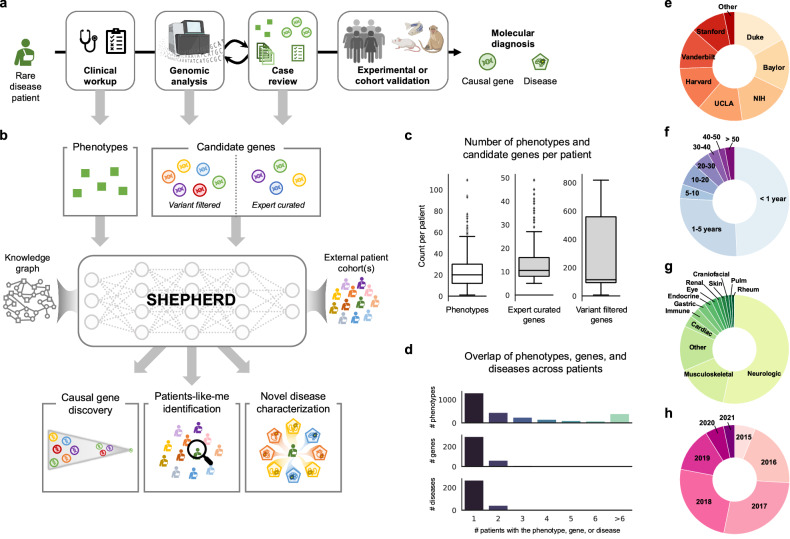
There are over 7000 rare diseases, some affecting 3500 or fewer patients in the United States. Due to clinicians' limited experience with such diseases and the heterogeneity of clinical presentations, ~70% of individuals seeking a diagnosis remain undiagnosed. Deep learning has demonstrated success in aiding the diagnosis of common diseases. However, existing approaches require labeled datasets with thousands of diagnosed patients per disease. We present SHEPHERD, a few-shot learning approach for multi-faceted rare disease diagnosis. SHEPHERD performs deep learning over a knowledge graph enriched with rare disease information and is trained on a dataset of simulated rare disease patients. We demonstrate SHEPHERD's effectiveness across diverse diagnostic tasks, performing causal gene discovery, retrieving "patients-like-me", and characterizing novel disease presentations, using real-world cohorts from the Undiagnosed Diseases Network (N = 465), MyGene2 (N = 146), and the Deciphering Developmental Disorders study (N = 1431). SHEPHERD demonstrates the potential of knowledge-grounded deep learning to accelerate rare disease diagnosis.
Overview
CoChat Summary
TL;DR
SHEPHERD is a few-shot geometric deep learning method that uses a rare disease knowledge graph and simulated patients to perform phenotype-driven causal gene discovery, “patients-like-me” retrieval, and novel disease characterization. Evaluated on real cohorts including 465 Undiagnosed Diseases Network patients, it often ranks causal genes highly and generalizes across sites, diseases, and atypical presentations.
Key findings
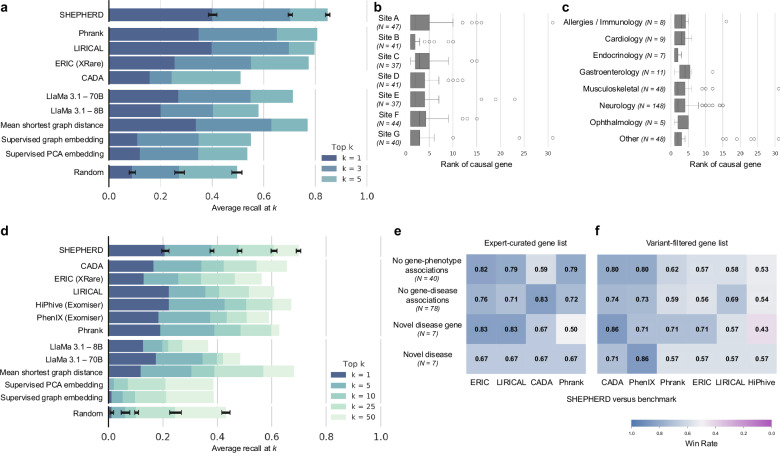
- On UDN EXPERT-CURATED gene lists, SHEPHERD ranked the causal gene first in 40% of patients, with average recall 0.69 at k = 3 and 0.85 at k = 5; on longer VARIANT-FILTERED lists, average recall was 0.21, 0.38, and 0.48 at k = 1, 5, and 10.
- For hard-to-diagnose patients whose phenotype terms were more than two hops from the causal gene in the knowledge graph, SHEPHERD identified the correct causal gene among its top five predictions for 77.8% of patients.
- In hard scenarios, SHEPHERD achieved win rates up to 82% and 83% for patients whose causal genes lacked known phenotype or disease associations, respectively, on EXPERT-CURATED lists, and up to 86% on VARIANT-FILTERED lists for novel disease genes.
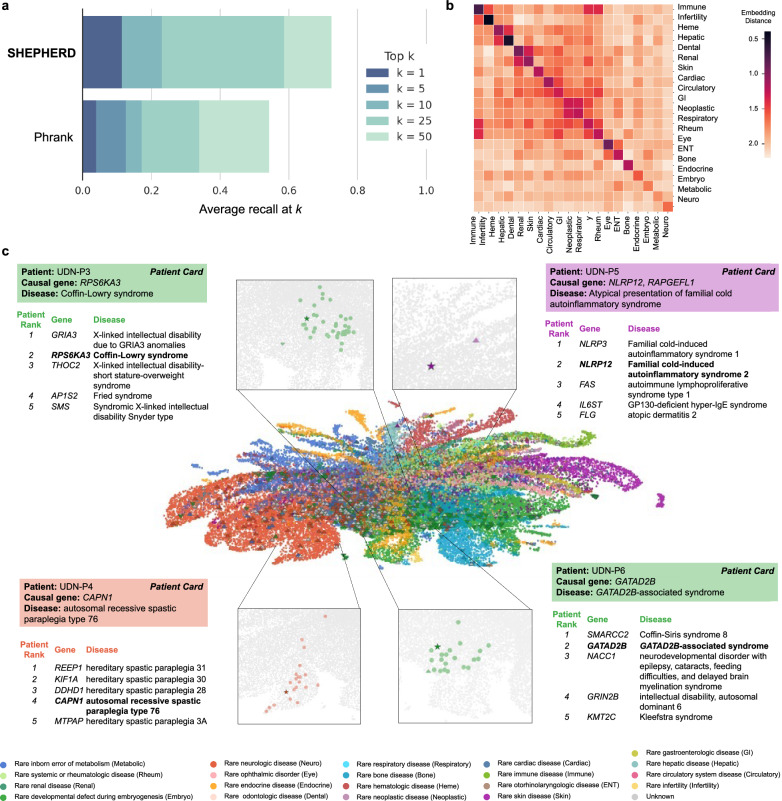
- SHEPHERD’s patient embeddings captured disease similarity (adjusted mutual information = 0.304; p < 0.01) and enabled “patients-like-me” retrieval, ranking a MyGene2 patient with the same causal gene first for 11.5% of UDN patients and achieving recall 0.31, 0.43, 0.49, and 0.53 at k = 5, 10, 25, and 50.
Methods
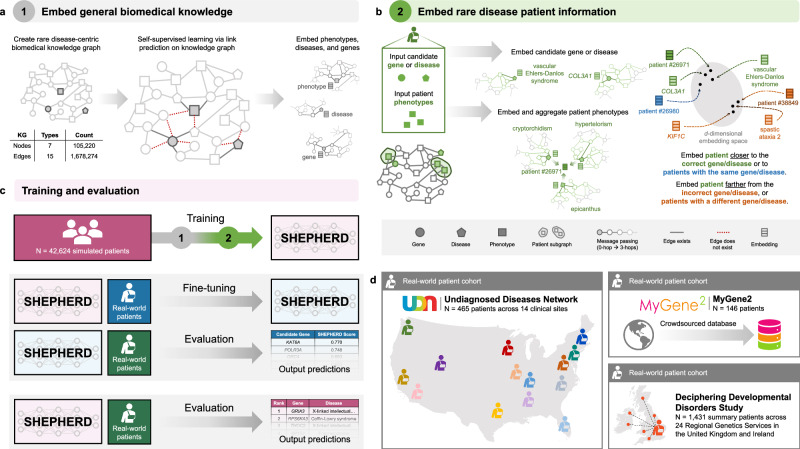
- SHEPHERD uses a rare disease knowledge graph with 105,220 nodes and 1,095,469 edges, built from sources including PrimeKG, HPO, MONDO, Orphanet, DisGeNET, GO, and Reactome.
- It is pretrained via self-supervised link prediction on the graph, then fine-tuned for diagnosis tasks using a graph attention network, patient phenotype subgraphs, and disease-stratified training on 42,624 simulated patients representing 2,132 rare diseases.
- Evaluation used real cohorts: UDN (N = 465), MyGene2 (N = 146), and DDD (N = 1431), with causal gene discovery compared against domain-specific tools, language models, traditional machine learning, network science baselines, and random ranking.
Limitations
- The paper states that continually updating the knowledge graph could improve performance, that still-undiagnosed UDN patients may be more challenging than diagnosed patients tested, and that datasets likely overrepresent individuals of European descent, limiting generalizability.
- The text also makes evident that evaluation is retrospective on already-diagnosed patients and does not assess prospective clinical workflow impact; the authors note prospective evaluation as an important next step.
- The paper states that SHEPHERD relies on structured phenotype terms and a knowledge graph, and suggests extensions such as incorporating variant-level information, negative phenotypes, temporal modeling, and multimodal data.
Model-written summary. Check it against the paper before relying on it.
Integrity signals
Registry
Cites
Statistics
Figures
Verification
Claims the paper makes
20 Valid · 5 Not valid · 6 Not checked · 194 Own results and interpretations
At least one cited source doesn’t support this claim or points to a different paper, and none confirmed it — see the verdicts below.
In the paper
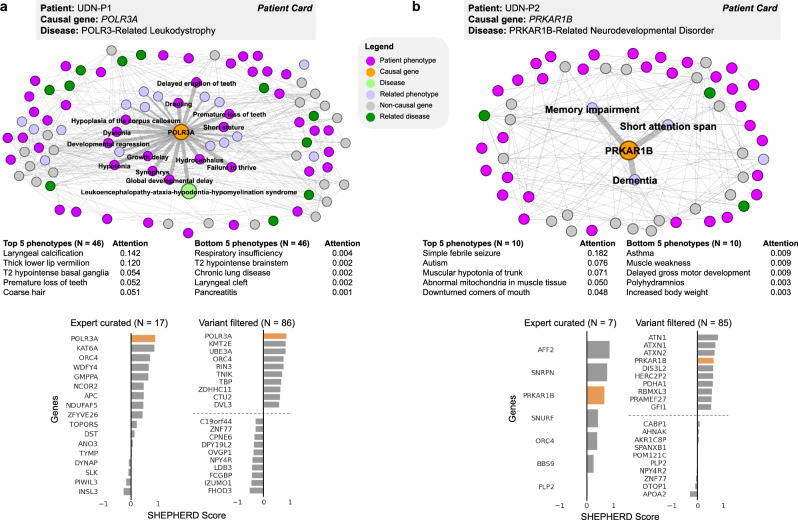
“a gene previously unassociated with any disease61”
§ Few shot learning for phenotype-driven diagnosis of patients with rare genetic diseases > Results > SHEPHERD provides an interpretable characterization of novel diseases
What the sources say
- Disputedcites [61] Ganapathi, M. et al. A homozygous splice variant in atp5po, disrupts mitochondrial complex v function and causes leigh syndrome in two unrelated families. J. Inherit. Metab. Dis.45, 996–1012 (2022). PMC9474623 35621276 sourceExperimental — accuracy not yet measured
The Introduction (page unavailable) says a recent report had already described an affected individual with compound heterozygous ATP5PO variants. This contradicts the claim that ATP5PO had previously been unassociated with any disease. (LLM, conf=0.89)
Checked by a reasoning model — may be wrong.
plain- Asserted: passes — The authors put it forward as true.
- Checkable: passes — It can be checked against evidence.
- Load-bearing: passes — The paper’s conclusions depend on it.
- Based: passes — The paper gives a reason why it holds.
- Disputed
The cited sources support only part of this claim — read each source’s verdict below.
In the paper
“leveraging indirect associations is essential for diagnosing patients with novel or atypical genetic conditions”
§ Few shot learning for phenotype-driven diagnosis of patients with rare genetic diseases > Discussion
What the sources say
- Partly supportedcites [16] Jagadeesh, K. A. et al. Phrank measures phenotype sets similarity to greatly improve Mendelian diagnostic disease prioritization. Genet. Med.21, 464–470 (2019). 29997393 sourceExperimental — accuracy not yet measured
The Methods section on Phrank inputs (p. 3) describes using ontology relationships to infer broader phenotype associations from specific ones, supporting the idea of leveraging indirect associations for diagnostic ranking. But the paper does not establish that doing so is essential for diagnosing novel or atypical conditions; its benchmark section (p. 4) says cases proposing novel causative genes were excluded. (LLM, conf=0.86)
- Not checked — no full text of the sourcecites [18] Köhler, S. et al. Clinical diagnostics in human genetics with semantic similarity searches in ontologies. Am. J. Hum. Genet. 85, 457–464 (2009). 19800049 PMC2756558 source
plainstates a cause- Asserted: passes — The authors put it forward as true.
- Checkable: passes — It can be checked against evidence.
- Load-bearing: passes — The paper’s conclusions depend on it.
- Based: passes — The paper gives a reason why it holds.
- Partly supported
The cited sources support only part of this claim — read each source’s verdict below.
In the paper
“Training on simulated data mitigates concerns regarding privacy breaches, in which specific individuals can be identified from the training data82,83.”
§ Few shot learning for phenotype-driven diagnosis of patients with rare genetic diseases > Discussion
What the sources say
- Partly supportedcites [82] Oprisanu, B., Ganev, G. & De Cristofaro, E. On utility and privacy in synthetic genomic data. In Proceedings of the 29th Network and Distributed System Security Symposium (NDSS, 2022). sourceExperimental — accuracy not yet measured
The Introduction describes synthetic data as a way to minimize the risk of inferring sensitive information about individuals. But Main Findings says synthetic datasets only sometimes offer better protection against membership inference and do not provide robust protection; the claim omits that important limitation. (LLM, conf=0.86)
- Supportedcites [83] Wang, Z., Myles, P. & Tucker, A. Generating and evaluating cross-sectional synthetic electronic healthcare data: preserving data utility and patient privacy. Comput. Intell.37, 819–851 (2021). source
The Introduction says that patient identification is more likely with healthcare data and that a fully synthetic approach can better mitigate this risk. Section 2.2 adds that synthetic data can tackle privacy concerns, while noting that disclosure risk can remain if synthetic outliers match real patients. (LLM, conf=0.91)
plainstates a cause- Asserted: passes — The authors put it forward as true.
- Checkable: passes — It can be checked against evidence.
- Load-bearing: passes — The paper’s conclusions depend on it.
- Based: passes — The paper gives a reason why it holds.
- Partly supported
Every source the paper cites for this claim was checked and supports it.
In the paper
“The simulated patients closely resemble real-world patients found in the UDN.”
§ Few shot learning for phenotype-driven diagnosis of patients with rare genetic diseases > Simulated patients with rare Mendelian disorders
What the sources say
- Supportedcites [48] Alsentzer, E. et al. Simulation of undiagnosed patients with novel genetic conditions. Nat. Commun. 14, 6403 (2023). 37828001 PMC10570269 source
The Results section, “Simulated patients mimic real-world patients,” directly compares disease-matched simulated patients with diagnosed UDN patients. It reports similar numbers of candidate genes and positive phenotype terms, and says the groups cluster together within disease categories. The comparison applies to the 121 UDN patients whose diseases the authors could model. (LLM, conf=0.94)
plainstates an association- Asserted: passes — The authors put it forward as true.
- Checkable: passes — It can be checked against evidence.
- Load-bearing: passes — The paper’s conclusions depend on it.
- Based: passes — The paper gives a reason why it holds.
- Supported
The cited sources support only part of this claim — read each source’s verdict below.
In the paper
“A notable byproduct of training the model on synthetic data is that SHEPHERD’s model can be publicly released without the risk of exposing patient information52.”
§ Few shot learning for phenotype-driven diagnosis of patients with rare genetic diseases > Results > Overview of SHEPHERD algorithm
What the sources say
- Partly supportedcites [52] Chen, R. J., Lu, M. Y., Chen, T. Y., Williamson, D. F. K. & Mahmood, F. Synthetic data in machine learning for medicine and healthcare. Nat. Biomed. Eng.5, 493–497 (2021). PMC9353344 34131324 sourceExperimental — accuracy not yet measured
The Fidelity tests section says synthetic datasets could be freely shared and would substantially lessen patient-privacy concerns. It does not establish that SHEPHERD’s model can be released without risk; the same section warns that publicly available model weights can leak patient information. (LLM, conf=0.84)
plainstates a causen = 40,000- Asserted: passes — The authors put it forward as true.
- Checkable: passes — It can be checked against evidence.
- Load-bearing: unclear — It is unclear whether the paper’s conclusions depend on it.
- Based: passes — The paper gives a reason why it holds.
- Partly supported
122 more claims · 8 with their cited sources checked
Create a free account to see all 225 claims and to verify the 5 references still open.
- It may state two separate claims as one. 63
- Probably not a substantial claim. 43
- The quote only partly states this claim. 1
Claims other papers make about this one
Each is checked against this paper’s own text: does it say what the citing paper says it does?
The source backs part of the claim, not all of it — or backs it for a different population, condition or comparison.
In the citing paper
“Early research has shown that LLMs can generate synthetic patient data to augment real datasets for rare conditions [44].”
From A Review of Multi-Agent AI Systems for Biological and Clinical Data Analysis (2026) · cites this paper as [44]
Experimental — accuracy not yet measured
Self-check
Percentages, sums and reported differences re-computed from the paper’s own numbers.
Each contradiction between two passages listed here was confirmed by an independent check.
Rated minor: it would not touch a result — a value no result rests on, a p-value that stays on the same side of the significance level, or a conflict that is clerical, resolved elsewhere in the paper, or outside its own findings.
In the paper
§ Few shot learning for phenotype-driven diagnosis of patients with rare genetic diseases > Results > Overview of the undiagnosed diseases network patient cohort
“UDN patients have heterogeneous disease presentations: 378 unique genes and 299 unique diseases are represented in the cohort”
§ Few shot learning for phenotype-driven diagnosis of patients with rare genetic diseases > Patients in the Undiagnosed Diseases Network
“The final UDN cohort contains 465 patients representing 319 MONDO diseases and 378 unique causal genes.”
Rated minor: it would not touch a result — a value no result rests on, a p-value that stays on the same side of the significance level, or a conflict that is clerical, resolved elsewhere in the paper, or outside its own findings.
In the paper
§ Few shot learning for phenotype-driven diagnosis of patients with rare genetic diseases > Results > Overview of the undiagnosed diseases network patient cohort
“UDN patients have heterogeneous disease presentations: 378 unique genes and 299 unique diseases are represented in the cohort, and 48% of phenotype terms, 79% of genes, and 83% of diseases are represented in only a single patient (Fig. 1d). This reinforces the need for machine learning models that can learn from sparsely labeled datasets. 11.4% of patients have a diagnosis in common with at least one other patient.”
§ Few shot learning for phenotype-driven diagnosis of patients with rare genetic diseases > Results > Overview of the undiagnosed diseases network patient cohort
“We assemble a cohort of 465 patients in the Undiagnosed Diseases Network (UDN) with molecular diagnoses.”
Rated minor: it would not touch a result — a value no result rests on, a p-value that stays on the same side of the significance level, or a conflict that is clerical, resolved elsewhere in the paper, or outside its own findings.
In the paper
§ Few shot learning for phenotype-driven diagnosis of patients with rare genetic diseases > Patients in the Undiagnosed Diseases Network
“The EXPERT-CURATED and VARIANT-FILTERED candidate gene lists contain 244.3 and 13.3 genes on average, respectively (SD = 244.0 and SD = 8.0).”
§ Few shot learning for phenotype-driven diagnosis of patients with rare genetic diseases > Results > Overview of the undiagnosed diseases network patient cohort
“The two candidate gene lists contain 244.3 and 13.3 genes on average, respectively (SD = 244.0 and SD = 8.0; Fig. 1c).”
Citations
Cites
Richards, S., Aziz, N., Bale, S., Bick, D., Das, S., Gastier-Foster, J., Grody, W. W., Hegde, M., Lyon, E., Spector, E., et al. (2015) · Genetics in Medicine · doi:10.1038/gim.2015.30 · Cited by 32,594 · cited 1×
“TheEXPERT-CURATEDcandidategenelistfor eachpatientincludestheunionofboth(1)disease-associatedandother clinically-relevantgeneslistedonthepatient ’ s clinical sequencing reports (ACMG)guidelines 29,101,102 and(2)genes that were prioritized by UDN clinical teams who handled the patient ’ s case.”
PyTorch: An Imperative Style, High-Performance Deep Learning Library
Paszke, A., Gross, S., Massa, F., Lerer, A., Bradbury, J., Chanan, G., Killeen, T., Lin, Z., Gimelshein, N., Antiga, L., et al. (2019) · arXiv · doi:10.48550/arxiv.1912.01703 · Cited by 31,473
Dermatologist-level classification of skin cancer with deep neural networks
Esteva, A., Kuprel, B., Novoa, R. A., Ko, J., Swetter, S. M., Blau, H. M., & Thrun, S. (2017) · Nature · doi:10.1038/nature21056 · Cited by 14,362
Gephi: An Open Source Software for Exploring and Manipulating Networks
Bastian, M., Heymann, S., & Jacomy, M. (2009) · Proceedings of the International AAAI Conference on Web and Social Media · doi:10.1609/icwsm.v3i1.13937 · Cited by 11,675
High-performance medicine: the convergence of human and artificial intelligence
Topol, E. J. (2019) · Nature Medicine · doi:10.1038/s41591-018-0300-7 · Cited by 10,450
UMAP: Uniform Manifold Approximation and Projection
McInnes, L., Healy, J., Saul, N., & Großberger, L. (2018) · Journal of Open Source Software · doi:10.21105/joss.00861 · Cited by 9,826
Szklarczyk, D., Gable, A. L., Nastou, K. C., Lyon, D., Kirsch, R., Pyysalo, S., Doncheva, N. T., Legeay, M., Fang, T., Bork, P., et al. (2021) · Nucleic Acids Research · doi:10.1093/nar/gkaa1074 · Cited by 8,056 · cited 2×
“…hyperparameters: learning rate ∈ [0.00001,0.00005,0.0001,0.0005,0.001], λ ∈ [0.1,0.9], η ∈ [0.1,0.9], k most infrequently seen genes ∈ [64, 128, 192], number of transformer layers for the phenotype encoder ∈ [0, 3, 6], number of heads in the transformer layers ∈ [4, 8, 16], contribution…”
InfluentialGulshan, V., Peng, L., Coram, M., Stumpe, M. C., Wu, D., Narayanaswamy, A., Venugopalan, S., Widner, K., Madams, T., Cuadros, J., et al. (2016) · JAMA · doi:10.1001/jama.2016.17216 · Cited by 7,697 · cited 1×
“Advances in deep learning have considerably improved diagnostic accuracy in other clinical areas 31 – 40 , achieving near-expert clinical accuracy for common diseases 41 – 43 .”
The Reactome pathway Knowledgebase
Fabregat, A., Sidiropoulos, K., Garapati, P., Gillespie, M., Hausmann, K., Haw, R., Jassal, B., Jupe, S., Korninger, F., McKay, S., et al. (2016) · Nucleic Acids Research · doi:10.1093/nar/gkv1351 · Cited by 5,605
Object Detection With Deep Learning: A Review
Zhao, Z.-Q., Zheng, P., Xu, S.-T., & Wu, X. (2019) · IEEE Transactions on Neural Networks and Learning Systems · doi:10.1109/tnnls.2018.2876865 · Cited by 5,545
Warde-Farley, D., Donaldson, S. L., Comes, O., Zuberi, K., Badrawi, R., Chao, P., Franz, M., Grouios, C., Kazi, F., Lopes, C. T., et al. (2010) · Nucleic Acids Research · doi:10.1093/nar/gkq537 · Cited by 4,835
The Gene Ontology Resource: 20 years and still GOing strong
The Gene Ontology Consortium (2019) · Nucleic Acids Research · doi:10.1093/nar/gky1055 · Cited by 4,747 · cited 1×
“Relationships are extracted from the following data sources: Gene Ontology (GO) 90 , Reactome pathway knowledgebase 91 , DisGeNET 92 , NCBI 93 , Human Phenotype Ontology (HPO) 94 , MONDO disease ontology 95 , and Orphanet 96 .”
CADD: predicting the deleteriousness of variants throughout the human genome
Rentzsch, P., Witten, D., Cooper, G. M., Shendure, J., & Kircher, M. (2019) · Nucleic Acids Research · doi:10.1093/nar/gky1016 · Cited by 3,534 · cited 1×
“…seen genes ∈ [64, 128, 192], number of transformer layers for the phenotype encoder ∈ [0, 3, 6], number of heads in the transformer layers ∈ [4, 8, 16], contribution of the augmented gene embedding ω ∈ [0.1, 0.9], number of K most similar genes to augment the geneembedding ∈ [1, 2,3, 4,5],…”
InfluentialOnline Mendelian Inheritance in Man (OMIM), a knowledgebase of human genes and genetic disorders
Hamosh, A. (2004) · Nucleic Acids Research · doi:10.1093/nar/gki033 · Cited by 3,420
Artificial intelligence in healthcare
Yu, K.-H., Beam, A. L., & Kohane, I. S. (2018) · Nature Biomedical Engineering · doi:10.1038/s41551-018-0305-z · Cited by 2,817
Self-citationClinically applicable deep learning for diagnosis and referral in retinal disease
De Fauw, J., Ledsam, J. R., Romera-Paredes, B., Nikolov, S., Tomasev, N., Blackwell, S., Askham, H., Glorot, X., O’Donoghue, B., Visentin, D., et al. (2018) · Nature Medicine · doi:10.1038/s41591-018-0107-6 · Cited by 2,639
The DisGeNET knowledge platform for disease genomics: 2019 update
Piñero, J., Ramírez-Anguita, J. M., Saüch-Pitarch, J., Ronzano, F., Centeno, E., Sanz, F., & Furlong, L. I. (2019) · Nucleic Acids Research · doi:10.1093/nar/gkz1021 · Cited by 2,639 · cited 2×
“Relationships are extracted from the following data sources: Gene Ontology (GO) 90 , Reactome pathway knowledgebase 91 , DisGeNET 92 , NCBI 93 , Human Phenotype Ontology (HPO) 94 , MONDO disease ontology 95 , and Orphanet 96 .”
The reactome pathway knowledgebase
Jassal, B., Matthews, L., Viteri, G., Gong, C., Lorente, P., Fabregat, A., Sidiropoulos, K., Cook, J., Gillespie, M., Haw, R., et al. (2019) · Nucleic Acids Research · doi:10.1093/nar/gkz1031 · Cited by 2,159
Entrez Gene: gene-centered information at NCBI
Maglott, D., Ostell, J., Pruitt, K. D., & Tatusova, T. (2011) · Nucleic Acids Research · doi:10.1093/nar/gkq1237 · Cited by 2,094
Oughtred, R., Rust, J., Chang, C., Breitkreutz, B., Stark, C., Willems, A., Boucher, L., Leung, G., Kolas, N., Zhang, F., et al. (2021) · Protein Science · doi:10.1002/pro.3978 · Cited by 1,858
Estimating cumulative point prevalence of rare diseases: analysis of the Orphanet database
Nguengang Wakap, S., Lambert, D. M., Olry, A., Rodwell, C., Gueydan, C., Lanneau, V., Murphy, D., Le Cam, Y., & Rath, A. (2020) · European Journal of Human Genetics · doi:10.1038/s41431-019-0508-0 · Cited by 1,752 · cited 3×
“…for the phenotype encoder ∈ [0, 3, 6], number of heads in the transformer layers ∈ [4, 8, 16], contribution of the augmented gene embedding ω ∈ [0.1, 0.9], number of K most similar genes to augment the geneembedding ∈ [1, 2,3, 4,5], andnumberofnodes n tosampleperbatch in ∈ [100, 200, 300, 400].”
InfluentialUncovering disease-disease relationships through the incomplete interactome
Menche, J., Sharma, A., Kitsak, M., Ghiassian, S. D., Vidal, M., Loscalzo, J., & Barabási, A.-L. (2015) · Science · doi:10.1126/science.1257601 · Cited by 1,546
Franz, M., Rodriguez, H., Lopes, C., Zuberi, K., Montojo, J., Bader, G. D., & Morris, Q. (2018) · Nucleic Acids Research · doi:10.1093/nar/gky311 · Cited by 1,413
A reference map of the human binary protein interactome
Luck, K., Kim, D.-K., Lambourne, L., Spirohn, K., Begg, B. E., Bian, W., Brignall, R., Cafarelli, T., Campos-Laborie, F. J., Charloteaux, B., et al. (2020) · Nature · doi:10.1038/s41586-020-2188-x · Cited by 1,197 · cited 1×
“…(MIM:619071), is three hops away from ATP5PO in the physical protein interaction network 67,68 , suggesting that they may be functionally related 69 – 71 or operate together 72,73 to mediate phenotypic features associated with UDN-P9 ’ s disease and hypomyelinating leukodystropy-20.”
The Ensembl gene annotation system
Aken, B. L., Ayling, S., Barrell, D., Clarke, L., Curwen, V., Fairley, S., Fernandez Banet, J., Billis, K., García Girón, C., Hourlier, T., et al. (2016) · Database · doi:10.1093/database/baw093 · Cited by 1,086
Human-computer collaboration for skin cancer recognition
Tschandl, P., Rinner, C., Apalla, Z., Argenziano, G., Codella, N., Halpern, A., Janda, M., Lallas, A., Longo, C., Malvehy, J., et al. (2020) · Nature Medicine · doi:10.1038/s41591-020-0942-0 · Cited by 1,024
Automatic diagnosis of the 12-lead ECG using a deep neural network
Ribeiro, A. H., Ribeiro, M. H., Paixão, G. M. M., Oliveira, D. M., Gomes, P. R., Canazart, J. A., Ferreira, M. P. S., Andersson, C. R., Macfarlane, P. W., Meira, W., et al. (2020) · Nature Communications · doi:10.1038/s41467-020-15432-4 · Cited by 894
Adapted large language models can outperform medical experts in clinical text summarization
Van Veen, D., Van Uden, C., Blankemeier, L., Delbrouck, J.-B., Aali, A., Bluethgen, C., Pareek, A., Polacin, M., Reis, E. P., Seehofnerová, A., et al. (2024) · Nature Medicine · doi:10.1038/s41591-024-02855-5 · Cited by 891
Synthetic data augmentation using GAN for improved liver lesion classification
Frid-Adar, M., Klang, E., Amitai, M., Goldberger, J., & Greenspan, H. (2018) · 2018 IEEE 15th International Symposium on Biomedical Imaging (ISBI 2018) · doi:10.1109/isbi.2018.8363576 · Cited by 860
Multi-Similarity Loss With General Pair Weighting for Deep Metric Learning
Wang, X., Han, X., Huang, W., Dong, D., & Scott, M. R. (2019) · 2019 IEEE/CVF Conference on Computer Vision and Pattern Recognition (CVPR) · doi:10.1109/cvpr.2019.00516 · Cited by 854
A deep learning system for differential diagnosis of skin diseases
Liu, Y., Jain, A., Eng, C., Way, D. H., Lee, K., Bui, P., Kanada, K., de Oliveira Marinho, G., Gallegos, J., Gabriele, S., et al. (2020) · Nature Medicine · doi:10.1038/s41591-020-0842-3 · Cited by 853
Jagadeesh, K. A., Wenger, A. M., Berger, M. J., Guturu, H., Stenson, P. D., Cooper, D. N., Bernstein, J. A., & Bejerano, G. (2016) · Nature Genetics · doi:10.1038/ng.3703 · Cited by 846
Online Mendelian Inheritance in Man (OMIM), a knowledgebase of human genes and genetic disorders
Hamosh, A. (2002) · Nucleic Acids Research · doi:10.1093/nar/30.1.52 · Cited by 762
CovidGAN: Data Augmentation Using Auxiliary Classifier GAN for Improved Covid-19 Detection
Waheed, A., Goyal, M., Gupta, D., Khanna, A., Al-Turjman, F., & Pinheiro, P. R. (2020) · IEEE Access · doi:10.1109/access.2020.2994762 · Cited by 759
Entrez Gene: gene-centered information at NCBI
Maglott, D. (2004) · Nucleic Acids Research · doi:10.1093/nar/gki031 · Cited by 748
Identifying facial phenotypes of genetic disorders using deep learning
Gurovich, Y., Hanani, Y., Bar, O., Nadav, G., Fleischer, N., Gelbman, D., Basel-Salmon, L., Krawitz, P. M., Kamphausen, S. B., Zenker, M., et al. (2019) · Nature Medicine · doi:10.1038/s41591-018-0279-0 · Cited by 739 · cited 2×
“While deep learning approachesexistforimage-baseddiagnosis 10,11 ,therearelimitedapproaches for phenotype-based diagnosis, and none automatically learn phenotypic and/or genotypic features over patient phenotype terms 23 – 28 , Training deep learning models requires high-quality labeled data with…”
Synthetic data in machine learning for medicine and healthcare
Chen, R. J., Lu, M. Y., Chen, T. Y., Williamson, D. F. K., & Mahmood, F. (2021) · Nature Biomedical Engineering · doi:10.1038/s41551-021-00751-8 · Cited by 728
100,000 Genomes Pilot on Rare-Disease Diagnosis in Health Care — Preliminary Report
The 100, 0. G. P. P. I. (2021) · New England Journal of Medicine · doi:10.1056/nejmoa2035790 · Cited by 716
Ribeiro, A. H., Ribeiro, M. H., Paixao, G. M., Oliveira, D. M., Gomes, P. R., Canazart, J. A., Ferreira, M. P. S., Andersson, C. R., Macfarlane, P. W., Meira, W., et al. (2020) · RePEc: Research Papers in Economics · doi:10.5281/zenodo.3625006 · Cited by 715
Expansion of the Human Phenotype Ontology (HPO) knowledge base and resources
Köhler, S., Carmody, L., Vasilevsky, N., Jacobsen, J. O. B., Danis, D., Gourdine, J.-P., Gargano, M., Harris, N. L., Matentzoglu, N., McMurry, J. A., et al. (2019) · Nucleic Acids Research · doi:10.1093/nar/gky1105 · Cited by 677 · cited 14×
“Clinicians annotate each patient with a set of terms from the Human Phenotype Ontology (HPO) using PhenoTips, a tool integrated into the electronic health record that allows for structured phenotyping of patient symptoms 100 .”
InfluentialEvaluation and accurate diagnoses of pediatric diseases using artificial intelligence
Liang, H., Tsui, B. Y., Ni, H., Valentim, C. C. S., Baxter, S. L., Liu, G., Cai, W., Kermany, D. S., Sun, X., Chen, J., et al. (2019) · Nature Medicine · doi:10.1038/s41591-018-0335-9 · Cited by 659
The Genetic Basis of Mendelian Phenotypes: Discoveries, Challenges, and Opportunities
Chong, J. X., Buckingham, K. J., Jhangiani, S. N., Boehm, C., Sobreira, N., Smith, J. D., Harrell, T. M., McMillin, M. J., Wiszniewski, W., Gambin, T., et al. (2015) · The American Journal of Human Genetics · doi:10.1016/j.ajhg.2015.06.009 · Cited by 643
Sharing Health Data for Better Outcomes on PatientsLikeMe
Wicks, P., Massagli, M., Frost, J., Brownstein, C., Okun, S., Vaughan, T., Bradley, R., & Heywood, J. (2010) · Journal of Medical Internet Research · doi:10.2196/jmir.1549 · Cited by 603 · cited 1×
“Another critical consideration for rare disease diagnosis is fi nding patients that share the same disease or causal gene, commonly referred to as “ patients-like-me ” 56 (Fig.1a).”
Clinical Diagnostics in Human Genetics with Semantic Similarity Searches in Ontologies
Köhler, S., Schulz, M. H., Krawitz, P., Bauer, S., Dölken, S., Ott, C. E., Mundlos, C., Horn, D., Mundlos, S., & Robinson, P. N. (2009) · The American Journal of Human Genetics · doi:10.1016/j.ajhg.2009.09.003 · Cited by 590 · cited 1×
“While many existing approaches rely exclusively on known phenotype-gene-disease associations 16,18 , leveraging indirect associations is essential for diagnosing patients with novel or atypical genetic conditions (Supplementary Figs.”
How many rare diseases are there?
Haendel, M., Vasilevsky, N., Unni, D., Bologa, C., Harris, N., Rehm, H., Hamosh, A., Baynam, G., Groza, T., McMurry, J., et al. (2020) · Nature Reviews Drug Discovery · doi:10.1038/d41573-019-00180-y · Cited by 554
Artificial intelligence for diagnosis and Gleason grading of prostate cancer: the PANDA challenge
Bulten, W., Kartasalo, K., Chen, P.-H. C., Ström, P., Pinckaers, H., Nagpal, K., Cai, Y., Steiner, D. F., van Boven, H., Vink, R., et al. (2022) · Nature Medicine · doi:10.1038/s41591-021-01620-2 · Cited by 543
Building a knowledge graph to enable precision medicine
Chandak, P., Huang, K., & Zitnik, M. (2023) · Scientific Data · doi:10.1038/s41597-023-01960-3 · Cited by 522
Grattafiori, A., Dubey, A., Jauhri, A., Pandey, A., Kadian, A., Al-Dahle, A., Letman, A., Mathur, A., Schelten, A., Vaughan, A., et al. (2024) · arXiv · doi:10.48550/arxiv.2407.21783 · Cited by 505
Network-based prediction of protein interactions
Kovács, I. A., Luck, K., Spirohn, K., Wang, Y., Pollis, C., Schlabach, S., Bian, W., Kim, D.-K., Kishore, N., Hao, T., et al. (2019) · Nature Communications · doi:10.1038/s41467-019-09177-y · Cited by 471
The Matchmaker Exchange: A Platform for Rare Disease Gene Discovery
Philippakis, A. A., Azzariti, D. R., Beltran, S., Brookes, A. J., Brownstein, C. A., Brudno, M., Brunner, H. G., Buske, O. J., Carey, K., Doll, C., et al. (2015) · Human Mutation · doi:10.1002/humu.22858 · Cited by 469
Szklarczyk, D., Gable, A. L., Nastou, K. C., Lyon, D., Kirsch, R., Pyysalo, S., Doncheva, N. T., Legeay, M., Fang, T., Bork, P., et al. (2021) · Nucleic Acids Research · doi:10.1093/nar/gkab835 · Cited by 446
Next-generation diagnostics and disease-gene discovery with the Exomiser
Smedley, D., Jacobsen, J. O. B., Jäger, M., Köhler, S., Holtgrewe, M., Schubach, M., Siragusa, E., Zemojtel, T., Buske, O. J., Washington, N. L., et al. (2015) · Nature Protocols · doi:10.1038/nprot.2015.124 · Cited by 445
Multimodal deep learning for Alzheimer's disease dementia assessment
Qiu, S., Miller, M. I., Joshi, P. S., Lee, J. C., Xue, C., Ni, Y., Wang, Y., De Anda-Duran, I., Hwang, P. H., Cramer, J. A., et al. (2022) · Nature Communications · doi:10.1038/s41467-022-31037-5 · Cited by 420
Phenolyzer: phenotype-based prioritization of candidate genes for human diseases
Yang, H., Robinson, P. N., & Wang, K. (2015) · Nature Methods · doi:10.1038/nmeth.3484 · Cited by 405
Improved exome prioritization of disease genes through cross-species phenotype comparison
Robinson, P. N., Köhler, S., Oellrich, A., Sanger Mouse Genetics Project, Wang, K., Mungall, C. J., Lewis, S. E., Washington, N., Bauer, S., Seelow, D., et al. (2014) · Genome Research · doi:10.1101/gr.160325.113 · Cited by 375
Artificial intelligence for diagnosis and Gleason grading of prostate cancer: the PANDA challenge
Wouter, B., Kimmo, K., Cameron, C. P.-H., Peter, S., Hans, P., Kunal, N., Yuannan, C., Steiner, D. F., van Boven, H., Robert, V., et al. (2022) · UTUPub (University of Turku) · Cited by 375
Predicting Protein–Protein Interactions from the Molecular to the Proteome Level
Keskin, O., Tuncbag, N., & Gursoy, A. (2016) · Chemical Reviews · doi:10.1021/acs.chemrev.5b00683 · Cited by 369
Effect of Genetic Diagnosis on Patients with Previously Undiagnosed Disease
Splinter, K., Adams, D. R., Bacino, C. A., Bellen, H. J., Bernstein, J. A., Cheatle-Jarvela, A. M., Eng, C. M., Esteves, C., Gahl, W. A., Hamid, R., et al. (2018) · New England Journal of Medicine · doi:10.1056/nejmoa1714458 · Cited by 359 · cited 3×
“Automated diagnosis pipelines leveraging genotyping and phenotyping methods have improved diagnostic yields across a range of rare diseases 29,30 .”
Self-citationA guide for the diagnosis of rare and undiagnosed disease: beyond the exome
Marwaha, S., Knowles, J. W., & Ashley, E. A. (2022) · Genome Medicine · doi:10.1186/s13073-022-01026-w · Cited by 359
Deep Adversarial Training for Multi-Organ Nuclei Segmentation in Histopathology Images
Mahmood, F., Borders, D., Chen, R. J., Mckay, G. N., Salimian, K. J., Baras, A., & Durr, N. J. (2020) · IEEE Transactions on Medical Imaging · doi:10.1109/tmi.2019.2927182 · Cited by 340
Network biology concepts in complex disease comorbidities
Hu, J. X., Thomas, C. E., & Brunak, S. (2016) · Nature Reviews Genetics · doi:10.1038/nrg.2016.87 · Cited by 328
Steinhaus, R., Proft, S., Schuelke, M., Cooper, D. N., Schwarz, J. M., & Seelow, D. (2021) · Nucleic Acids Research · doi:10.1093/nar/gkab266 · Cited by 324
100,000 Genomes Pilot on Rare-Disease Diagnosis in Health Care - Preliminary Report.
Smedley, D. P., Smedley, D. P., Smith, K. R., Martin, A., Thomas, E. A., McDonagh, E. M., Cipriani, V., Ellingford, J. M., Arno, G., Tucci, A., et al. (2021) · UCL Discovery (University College London) · doi:10.17863/cam.108059 · Cited by 318
The National Institutes of Health Undiagnosed Diseases Program: insights into rare diseases
Gahl, W. A., Markello, T. C., Toro, C., Fajardo, K. F., Sincan, M., Gill, F., Carlson-Donohoe, H., Gropman, A., Pierson, T. M., Golas, G., et al. (2012) · Genetics in Medicine · doi:10.1038/gim.0b013e318232a005 · Cited by 291
Zemojtel, T., Köhler, S., Mackenroth, L., Jäger, M., Hecht, J., Krawitz, P., Graul-Neumann, L., Doelken, S., Ehmke, N., Spielmann, M., et al. (2014) · Science Translational Medicine · doi:10.1126/scitranslmed.3009262 · Cited by 255
PhenoTips: Patient Phenotyping Software for Clinical and Research Use
Girdea, M., Dumitriu, S., Fiume, M., Bowdin, S., Boycott, K. M., Chénier, S., Chitayat, D., Faghfoury, H., Meyn, M. S., Ray, P. N., et al. (2013) · Human Mutation · doi:10.1002/humu.22347 · Cited by 249
A foundation model for clinician-centered drug repurposing
Huang, K., Chandak, P., Wang, Q., Havaldar, S., Vaid, A., Leskovec, J., Nadkarni, G. N., Glicksberg, B. S., Gehlenborg, N., & Zitnik, M. (2024) · Nature Medicine · doi:10.1038/s41591-024-03233-x · Cited by 249 · cited 1×
“…¼ ω (cid:4) exp ð(cid:2) ω (cid:4) j N g jÞ þ 0 : 2 where ω is a hyperparameter for the contribution of the augmented gene embedding, and j N g j is the node degree for gene g to preferentially update the embeddings for genes with lower degree (i.e., genes that are not as well-characterized) 109 .”
Self-citationGestaltMatcher facilitates rare disease matching using facial phenotype descriptors
Hsieh, T.-C., Bar-Haim, A., Moosa, S., Ehmke, N., Gripp, K. W., Pantel, J. T., Danyel, M., Mensah, M. A., Horn, D., Rosnev, S., et al. (2022) · Nature Genetics · doi:10.1038/s41588-021-01010-x · Cited by 233 · cited 1×
“While deep learning approachesexistforimage-baseddiagnosis 10,11 ,therearelimitedapproaches for phenotype-based diagnosis, and none automatically learn phenotypic and/or genotypic features over patient phenotype terms 23 – 28 , Training deep learning models requires high-quality labeled data with…”
Swarm learning for decentralized artificial intelligence in cancer histopathology
Saldanha, O. L., Quirke, P., West, N. P., James, J. A., Loughrey, M. B., Grabsch, H. I., Salto-Tellez, M., Alwers, E., Cifci, D., Ghaffari Laleh, N., et al. (2022) · Nature Medicine · doi:10.1038/s41591-022-01768-5 · Cited by 227
Wang, J., Al-Ouran, R., Hu, Y., Kim, S.-Y., Wan, Y.-W., Wangler, M. F., Yamamoto, S., Chao, H.-T., Comjean, A., Mohr, S. E., et al. (2017) · The American Journal of Human Genetics · doi:10.1016/j.ajhg.2017.04.010 · Cited by 204
Self-citationClinical Practice Guidelines for Rare Diseases: The Orphanet Database
Pavan, S., Rommel, K., Mateo Marquina, M. E., Höhn, S., Lanneau, V., & Rath, A. (2017) · PLOS ONE · doi:10.1371/journal.pone.0170365 · Cited by 191
Shadows of complexity: what biological networks reveal about epistasis and pleiotropy
Tyler, A. L., Asselbergs, F. W., Williams, S. M., & Moore, J. H. (2009) · BioEssays · doi:10.1002/bies.200800022 · Cited by 185 · cited 1×
“This joint modeling of patient phenotypic features is essential for identifying genetic mutations with pleiotropic effects 74 – 76 .”
The Deciphering Developmental Disorders (DDD) study
FIRTH, H. V., WRIGHT, C. F., & Study, F. T. D. (2011) · Developmental Medicine & Child Neurology · doi:10.1111/j.1469-8749.2011.04032.x · Cited by 180 · cited 3×
“2d): (1) the UDN patient cohort (Methods 3); (2) a cohort of 146 patients from MyGene2, an online portal through which families with rare genetic conditions can share their health information to connect with clinicians and other patients 53 (Methods 4); (3) a cohort of 1431 patients derived from the Deciphering Develo…”
InfluentialThe Undiagnosed Diseases Network: Accelerating Discovery about Health and Disease
Ramoni, R. B., Mulvihill, J. J., Adams, D. R., Allard, P., Ashley, E. A., Bernstein, J. A., Gahl, W. A., Hamid, R., Loscalzo, J., McCray, A. T., et al. (2017) · The American Journal of Human Genetics · doi:10.1016/j.ajhg.2017.01.006 · Cited by 179
Self-citationBinding properties and evolution of homodimers in protein-protein interaction networks
Ispolatov, I. (2005) · Nucleic Acids Research · doi:10.1093/nar/gki678 · Cited by 169
Cumulative effects of triadic closure and homophily in social networks
Asikainen, A., Íñiguez, G., Ureña-Carrión, J., Kaski, K. K., & Kivelä, M. (2020) · Science Advances · doi:10.1126/sciadv.aax7310 · Cited by 153
Interpretable Clinical Genomics with a Likelihood Ratio Paradigm
Robinson, P. N., Ravanmehr, V., Jacobsen, J. O. B., Daniš, D., Zhang, X., Carmody, L., Gargano, M. A., Thaxton, C., Karlebach, G., Reese, J., et al. (2020) · The American Journal of Human Genetics · doi:10.1016/j.ajhg.2020.06.021 · Cited by 148
Phen-Gen: combining phenotype and genotype to analyze rare disorders
Javed, A., Agrawal, S., & Ng, P. C. (2014) · Nature Methods · doi:10.1038/nmeth.3046 · Cited by 146
Identification of Protein Interactions Involved in Cellular Signaling
Westermarck, J., Ivaska, J., & Corthals, G. L. (2013) · Molecular & Cellular Proteomics · doi:10.1074/mcp.r113.027771 · Cited by 143 · cited 1×
“…(MIM:619071), is three hops away from ATP5PO in the physical protein interaction network 67,68 , suggesting that they may be functionally related 69 – 71 or operate together 72,73 to mediate phenotypic features associated with UDN-P9 ’ s disease and hypomyelinating leukodystropy-20.”
Evolution of resilience in protein interactomes across the tree of life
Zitnik, M., Sosič, R., Feldman, M. W., & Leskovec, J. (2019) · Proceedings of the National Academy of Sciences · doi:10.1073/pnas.1818013116 · Cited by 130 · cited 1×
“…(MIM:619071), is three hops away from ATP5PO in the physical protein interaction network 67,68 , suggesting that they may be functionally related 69 – 71 or operate together 72,73 to mediate phenotypic features associated with UDN-P9 ’ s disease and hypomyelinating leukodystropy-20.”
An overview of the impact of rare disease characteristics on research methodology
Whicher, D. M., Philbin, S. E., & Aronson, N. (2018) · Orphanet Journal of Rare Diseases · doi:10.1186/s13023-017-0755-5 · Cited by 128
Li, J., Cairns, B. J., Li, J., & Zhu, T. (2023) · npj Digital Medicine · doi:10.1038/s41746-023-00834-7 · Cited by 126
AMELIE speeds Mendelian diagnosis by matching patient phenotype and genotype to primary literature
Birgmeier, J., Haeussler, M., Deisseroth, C. A., Steinberg, E. H., Jagadeesh, K. A., Ratner, A. J., Guturu, H., Wenger, A. M., Diekhans, M. E., Stenson, P. D., et al. (2020) · Science Translational Medicine · doi:10.1126/scitranslmed.aau9113 · Cited by 118 · cited 3×
“Combined oxidative phosphorylation de fi ciency 39 and combined oxidative phosphorylation defect type 26 are associated with neurological presentations of mitochondrial disease, including hypotonia, seizures, and features of Leigh syndrome 66 .”
Gradio: Hassle-Free Sharing and Testing of ML Models in the Wild
Abid, A., Abdalla, A., Ali, A., Khan, D., Alfozan, A., & Zou, J. (2019) · arXiv (Cornell University) · doi:10.48550/arxiv.1906.02569 · Cited by 115
The Undiagnosed Diseases Network of the National Institutes of Health: A National Extension
Gahl, W. A., Wise, A. L., & Ashley, E. A. (2015) · JAMA · doi:10.1001/jama.2015.12249 · Cited by 114
Li, Q., Zhao, K., Bustamante, C. D., Ma, X., & Wong, W. H. (2019) · Genetics in Medicine · doi:10.1038/s41436-019-0439-8 · Cited by 106 · cited 4×
“There are information-theoretic approaches that compare patient phenotype terms to either the phenotype terms associated with each candidate gene (ERIC, which is implemented in XRare 25 ) or to the phenotype terms of all the diseases related to a candidate gene (Phrank 16 and PhenIX, which is implemented in Exomiser 2…”
InfluentialRomio, L., Wright, V., Price, K., Winyard, P. J. D., Donnai, D., Porteous, M. E., Franco, B., Giorgio, G., Malcolm, S., Woolf, A. S., et al. (2003) · Journal of the American Society of Nephrology · doi:10.1097/01.asn.0000054497.48394.d2 · Cited by 103 · cited 1×
“Orofaciodigital syndrome I is caused by a mutation in OFD1 , which is involved in organogenesis and plays a vital role in the normal growth of orofacial and kidney tissues 59,60 .”
Wan, P., Huang, Z., Tang, W., Nie, Y., Pei, D., Deng, S., Chen, J., Zhou, Y., Duan, H., Chen, Q., et al. (2024) · Nature Medicine · doi:10.1038/s41591-024-03148-7 · Cited by 97
PEDIA: prioritization of exome data by image analysis
Hsieh, T.-C., Mensah, M. A., Pantel, J. T., Aguilar, D., Bar, O., Bayat, A., Becerra-Solano, L., Bentzen, H. B., Biskup, S., Borisov, O., et al. (2019) · Genetics in Medicine · doi:10.1038/s41436-019-0566-2 · Cited by 87
Deflating Dataset Bias Using Synthetic Data Augmentation
Jaipuria, N., Zhang, X., Bhasin, R., Arafa, M., Chakravarty, P., Shrivastava, S., Manglani, S., & Murali, V. N. (2020) · 2020 IEEE/CVF Conference on Computer Vision and Pattern Recognition Workshops (CVPRW) · doi:10.1109/cvprw50498.2020.00394 · Cited by 80
Silencing SMOC2 ameliorates kidney fibrosis by inhibiting fibroblast to myofibroblast transformation
Gerarduzzi, C., Kumar, R. K., Trivedi, P., Ajay, A. K., Iyer, A., Boswell, S., Hutchinson, J. N., Waikar, S. S., & Vaidya, V. S. (2017) · JCI Insight · doi:10.1172/jci.insight.90299 · Cited by 79
DeepPVP: phenotype-based prioritization of causative variants using deep learning
Boudellioua, I., Kulmanov, M., Schofield, P. N., Gkoutos, G. V., & Hoehndorf, R. (2019) · BMC Bioinformatics · doi:10.1186/s12859-019-2633-8 · Cited by 79
Aggeler, R., Coons, J., Taylor, S. W., Ghosh, S. S., Garcıáa, J. J., Capaldi, R. A., & Marusich, M. F. (2002) · Journal of Biological Chemistry · doi:10.1074/jbc.m204538200 · Cited by 72
Brautigam, C. A., Wynn, R. M., Chuang, J. L., & Chuang, D. T. (2009) · Journal of Biological Chemistry · doi:10.1074/jbc.m806563200 · Cited by 70 · cited 2×
“…following hyperparameters: learning rate ∈ [0.00001,0.00005,0.0001,0.0005,0.001], λ ∈ [0.1,0.9], η ∈ [0.1,0.9], k most infrequently seen genes ∈ [64, 128, 192], number of transformer layers for the phenotype encoder ∈ [0, 3, 6], number of heads in the transformer layers ∈ [4, 8, 16],…”
InfluentialA Deep Learning Frame-Work for Recognizing Developmental Disorders
Shukla, P., Gupta, T., Saini, A., Singh, P., & Balasubramanian, R. (2017) · 2017 IEEE Winter Conference on Applications of Computer Vision (WACV) · doi:10.1109/wacv.2017.84 · Cited by 67
Wang, Z., Myles, P., & Tucker, A. (2021) · Computational Intelligence · doi:10.1111/coin.12427 · Cited by 65
Rao, A., VG, S., Joseph, T., Kotte, S., Sivadasan, N., & Srinivasan, R. (2018) · BMC Medical Genomics · doi:10.1186/s12920-018-0372-8 · Cited by 57
Jagadeesh, K. A., Birgmeier, J., Guturu, H., Deisseroth, C. A., Wenger, A. M., Bernstein, J. A., & Bejerano, G. (2019) · Genetics in Medicine · doi:10.1038/s41436-018-0072-y · Cited by 56
Hong, D., Zheng, Y.-Y., Xin, Y., Sun, L. J., Yang, H., Lin, M.-Y., Liu, C., Li, B., Zhang, Z., Zhuang, J., et al. (2021) · Orphanet Journal of Rare Diseases · doi:10.1186/s13023-021-01979-y · Cited by 54
Kim, J., Wang, K., Weng, C., & Liu, C. (2024) · The American Journal of Human Genetics · doi:10.1016/j.ajhg.2024.08.010 · Cited by 53
AI-MARRVEL — A Knowledge-Driven AI System for Diagnosing Mendelian Disorders
Mao, D., Liu, C., Wang, L., AI-Ouran, R., Deisseroth, C., Pasupuleti, S., Kim, S. Y., Li, L., Rosenfeld, J. A., Meng, L., et al. (2024) · NEJM AI · doi:10.1056/aioa2300009 · Cited by 51 · cited 2×
“…10,11 ,therearelimitedapproaches for phenotype-based diagnosis, and none automatically learn phenotypic and/or genotypic features over patient phenotype terms 23 – 28 , Training deep learning models requires high-quality labeled data with thousands of diagnosed patients per disease.”
CADA: phenotype-driven gene prioritization based on a case-enriched knowledge graph
Peng, C., Dieck, S., Schmid, A., Ahmad, A., Knaus, A., Wenzel, M., Mehnert, L., Zirn, B., Haack, T. B., Ossowski, S., et al. (2021) · NAR Genomics and Bioinformatics · doi:10.1093/nargab/lqab078 · Cited by 49
A Survey of Gene Prioritization Tools for Mendelian and Complex Human Diseases
Zolotareva, O., & Kleine, M. (2019) · Journal of Integrative Bioinformatics · doi:10.1515/jib-2018-0069 · Cited by 46
Tang, A. S., Oskotsky, T., Havaldar, S., Mantyh, W. G., Bicak, M., Solsberg, C. W., Woldemariam, S., Zeng, B., Hu, Z., Oskotsky, B., et al. (2022) · Nature Communications · doi:10.1038/s41467-022-28273-0 · Cited by 45
Renal insufficiency, a frequent complication with age in oral‐facial‐digital syndrome type I
Saal, S., Faivre, L., Aral, B., Gigot, N., Toutain, A., Van Maldergem, L., Destree, A., Maystadt, I., Cosyns, J., Jouk, P., et al. (2010) · Clinical Genetics · doi:10.1111/j.1399-0004.2009.01290.x · Cited by 36
Reese, J., Chimirri, L., Bridges, Y., Danis, D., Caufield, J. H., Gargano, M. A., Kroll, C., Schmeder, A. W., Liu, F., Wissink, K., et al. (2026) · European Journal of Human Genetics · doi:10.1038/s41431-026-02054-5 · Cited by 34
Time to make rare disease diagnosis accessible to all
Rehm, H. L. (2022) · Nature Medicine · doi:10.1038/s41591-021-01657-3 · Cited by 33
Neural Networks for Classification and Image Generation of Aging in Genetic Syndromes
Duong, D., Hu, P., Tekendo-Ngongang, C., Hanchard, S. E. L., Liu, S., Solomon, B. D., & Waikel, R. L. (2022) · Frontiers in Genetics · doi:10.3389/fgene.2022.864092 · Cited by 28
Kobren, S. N., Baldridge, D., Velinder, M., Krier, J. B., LeBlanc, K., Esteves, C., Pusey, B. N., Züchner, S., Blue, E., Lee, H., et al. (2021) · Genetics in Medicine · doi:10.1038/s41436-020-01084-8 · Cited by 27 · cited 3×
“Once one to fi ve strong candidates are identi fi ed, causality is assessed by searching for genotype-and phenotype-matched individuals in human and animal databases or by introducingcandidatesintomodelorganismstodetermineinvivoimpact 50 .”
Self-citationFlaharty, K. A., Hu, P., Hanchard, S. L., Ripper, M. E., Duong, D., Waikel, R. L., & Solomon, B. D. (2024) · The American Journal of Human Genetics · doi:10.1016/j.ajhg.2024.07.011 · Cited by 26 · cited 1×
“Recent large language model (LLM) approachesfor rare diseases could complement SHEPHERD by leveraging biomedical pre-training and retrieval-augmented generation to support diagnosis from unstructured clinical notes and literature without requiring structured phenotype terms 85 – 87 .”
Morkmued, S., Clauss, F., Schuhbaur, B., Fraulob, V., Mathieu, E., Hemmerlé, J., Clevers, H., Koo, B.-K., Dollé, P., Bloch-Zupan, A., et al. (2020) · Scientific Reports · doi:10.1038/s41598-020-71749-6 · Cited by 25
Personalised analytics for rare disease diagnostics
Anderson, D., Baynam, G., Blackwell, J. M., & Lassmann, T. (2019) · Nature Communications · doi:10.1038/s41467-019-13345-5 · Cited by 24 · cited 2×
“…10,11 ,therearelimitedapproaches for phenotype-based diagnosis, and none automatically learn phenotypic and/or genotypic features over patient phenotype terms 23 – 28 , Training deep learning models requires high-quality labeled data with thousands of diagnosed patients per disease.”
On Utility and Privacy in Synthetic Genomic Data
Oprisanu, B., Ganev, G., & De Cristofaro, E. (2022) · Proceedings 2022 Network and Distributed System Security Symposium · doi:10.14722/ndss.2022.24092 · Cited by 23
Chen, H., Morris, M. A., Rossier, C., Blouin, J.-L., & Antonarakis, S. E. (1995) · Genomics · doi:10.1006/geno.1995.1176 · Cited by 22
PSEA: Phenotype Set Enrichment Analysis—A New Method for Analysis of Multiple Phenotypes
Ried, J. S., Döring, A., Oexle, K., Meisinger, C., Winkelmann, J., Klopp, N., Meitinger, T., Peters, A., Suhre, K., Wichmann, H. ‐., et al. (2012) · Genetic Epidemiology · doi:10.1002/gepi.21617 · Cited by 21 · cited 1×
“This joint modeling of patient phenotypic features is essential for identifying genetic mutations with pleiotropic effects 74 – 76 .”
Tosco‐Herrera, E., Muñoz‐Barrera, A., Jáspez, D., Rubio‐Rodríguez, L. A., Mendoza‐Alvarez, A., Rodriguez‐Perez, H., Jou, J., Iñigo‐Campos, A., Corrales, A., Ciuffreda, L., et al. (2022) · Human Mutation · doi:10.1002/humu.24459 · Cited by 20 · cited 1×
“LIRICAL,XRare,and Exomiserarethestrongestperformingapproachesinapriorcomparisonof geneprioritizationtools 121 , and Exomiser is currently in use at multiple UDN sites 50 .”
Ganapathi, M., Friocourt, G., Gueguen, N., Friederich, M. W., Le Gac, G., Okur, V., Loaëc, N., Ludwig, T., Ka, C., Tanji, K., et al. (2022) · Journal of Inherited Metabolic Disease · doi:10.1002/jimd.12526 · Cited by 18
Self-citationGlasgow, R. I. C., Thompson, K., Barbosa, I. A., He, L., Alston, C. L., Deshpande, C., Simpson, M. A., Morris, A. A. M., Neu, A., Löbel, U., et al. (2017) · neurogenetics · doi:10.1007/s10048-017-0526-4 · Cited by 17 · cited 1×
“Combined oxidative phosphorylation de fi ciency 39 and combined oxidative phosphorylation defect type 26 are associated with neurological presentations of mitochondrial disease, including hypotonia, seizures, and features of Leigh syndrome 66 .”
Mondo disease ontology: Harmonizing disease concepts across the world
Vasilevsky, N., Essaid, S., Matentzoglu, N., Harris, N. L., Haendel, M. A., Robinson, P. N., & Mungall, C. (2020) · eScholarship (California Digital Library) · Cited by 17
Li, J., Cairns, B. J., Li, J., et al. (2022) · Research Square · doi:10.21203/rs.3.rs-1258744/v1 · Cited by 12
Simulation of undiagnosed patients with novel genetic conditions
Alsentzer, E., Finlayson, S. G., Li, M. M., Undiagnosed Diseases Network, Kobren, S. N., & Kohane, I. S. (2023) · Nature Communications · doi:10.1038/s41467-023-41980-6 · Cited by 10 · cited 4×
“We leverage simulated but realistic rare disease patients for training SHEPHERD 48 .”
InfluentialSelf-citationThe National Institutes of Health Undiagnosed Diseases Program: Insights into rare diseases
Gahl, W. A., Markello, T. C., Toro, C., Fajardo, K. V. F., Sincan, M., Gill, F. A., Carlson-Donohoe, H., Gropman, A. L., Pierson, T. M., Golas, G. A., et al. (2011) · Genetics in Medicine · doi:10.1097/gim.0b013e318232a005 · Cited by 10
Reese, J. T., Chimirri, L., Bridges, Y., Danis, D., Caufield, J. H., Gargano, M. A., Kroll, C., Schmeder, A., Liu, F., Wissink, K., et al. (2024) · doi:10.1101/2024.07.22.24310816 · Cited by 8
Zebra-Llama: A Context-Aware Large Language Model for Democratizing Rare Disease Knowledge
Soman, K., Langdon, A., Villouta, C., Agrawal, C., Salta, L., Peetoom, B., Bellucci, G., & Buske, O. J. (2024) · arXiv · doi:10.48550/arxiv.2411.02657 · Cited by 6
InpherNet accelerates monogenic disease diagnosis using patients’ candidate genes’ neighbors
Yoo, B., Birgmeier, J., Bernstein, J. A., & Bejerano, G. (2021) · Genetics in Medicine · doi:10.1038/s41436-021-01238-2 · Cited by 4
Jiang, Y., Wang, J., Zhang, G., Oza, K., Myers, L., Holbert, M. A., & Sweitzer, S. (2014) · Protein Expression and Purification · doi:10.1016/j.pep.2014.02.002 · Cited by 3 · cited 1×
“These diseases ’ causal genes co-localize with ATP5PO 62 – 65 .”
Glasgow, R. I. C., Thompson, K., He, L., Alston, C. L., Barbosa, I. A., Deshpande, C., Simpson, M. A., Neu, A. D., Löbel, U., Prokisch, H., et al. (2017) · Neuromuscular Disorders · doi:10.1016/s0960-8966(17)30283-3 · Cited by 1
Research works printed but not linked: 6
- Brody, S., Alon, U. & Yahav, E. How attentive are graph attention networks? ICLR (2022).
- Yang, B., Yih, W.-t., He, X., Gao, J. & Deng, L. Embedding entities and relations for learning and inference in knowledge bases. ICLR (2015).
- Goldberger, J., Hinton, G. E., Roweis, S. & Salakhutdinov, R. R. Neighbourhood components analysis. In Proc. 18th International Conference on Neural Information Processing Systems 513–520 (MIT Press, 2004).
- Ba, J. L., Kiros, J. R. & Hinton, G. E. Layer normalization. NeurIPS (2016).
- Loffe, S. & Szegedy, C. Batch normalization: Accelerating deep network training by reducing internal covariate shift. In International conference on machine learning, 448–456 (2015).
- Fey, M. & Lenssen, J. E. Fast graph representation learning with PyTorch Geometric. In ICLR Workshop on Representation Learning on Graphs and Manifolds (2019).
Cited by
A foundation model for clinician-centered drug repurposing
Huang, K., Chandak, P., Wang, Q., Havaldar, S., Vaid, A., Leskovec, J., Nadkarni, G. N., Glicksberg, B. S., Gehlenborg, N., & Zitnik, M. (2024) · Nature Medicine · doi:10.1038/s41591-024-03233-x · Cited by 249
“Addressing the needs of these diseases, many of which are complex, neglected or rare, is a clinical priority 2,49 .”
Self-citationBiomni: A general-purpose biomedical ai agent
Huang, K., Zhang, S., Wang, H., Qu, Y., Lu, Y., Roohani, Y., Li, R., Qiu, L., Li, G., Zhang, J., et al. (2025) · doi:10.1101/2025.05.30.656746 · Cited by 125
Rapid genomic sequencing for genetic disease diagnosis and therapy in intensive care units: a review
Kingsmore, S. F., Nofsinger, R. R., & Ellsworth, K. (2024) · npj Genomic Medicine · doi:10.1038/s41525-024-00404-0 · Cited by 104
An agentic system for rare disease diagnosis with traceable reasoning
Zhao, W., Wu, C., Fan, Y., Qiu, P., Zhang, X., Sun, Y., Zhou, X., Zhang, S., Peng, Y., Wang, Y., et al. (2026) · Nature · doi:10.1038/s41586-025-10097-9 · Cited by 62
“DeepRare accesses peer-reviewed literature through: • PubMed database 48 ) 42 , which extracted phenotype-genotype information as of May 2022, limited to patients with confirmed OMIM disease identifiers and single candidate genes to ensure diagnostic accuracy.”
Traylor, D., Kern, K. V., Anderson, E. E., & Henderson, R. (2025) · Cureus · doi:10.7759/cureus.76825 · Cited by 48
Metadata
- Authors
- Alsentzer, E., Li, M. M., Kobren, S. N., Noori, A., Undiagnosed Diseases Network, Kohane, I. S., & Zitnik, M.
- Affiliations
- Harvard University (US)
- Broad Institute (US)
- Venue
- npj Digital Medicine
- Published
- 2025-06-20
- Volume
- 8
- Issue
- 1
- Pages
- 380-380
- ISSN
- 2398-6352 (ISSN-L)
- PMC
- PMC12181314
- OpenAlex
- W4411485357
- Cited by
- 54
- References
- 127
- Citations by year
- 2026: 37 · 2025: 12
- FWCI
- 28.59
- Type
- journal article
- Language
- en
- Open access
- gold
- doi.org
- Licence
- cc-by-nc-nd
- creativecommons.org/licenses/by-nc-nd/4.0 (tdm)
- creativecommons.org/licenses/by-nc-nd/4.0 (vor)
- Locations
- npj Digital Medicine (publishedVersion, cc-by-nc-nd)
- medRxiv (acceptedVersion, cc-by)
- PubMed Central (publishedVersion, cc-by-nc-nd)
- PubMed (publishedVersion)
- DOAJ (DOAJ: Directory of Open Access Journals) (submittedVersion, cc-by-sa)
- Funders
- National Science Foundation (2030459, 2033384)
- AstraZeneca
- Microsoft Research
- Wellcome Trust (WT223718/Z/21/Z)
- European Bioinformatics Institute
- National Institutes of Health (U01TR001395, -0001, U01TR002471)
- U.S. Air Force (FA8702‐15‐D‐0001)
- Harvard Data Science Initiative, Harvard University
- National Human Genome Research Institute (U01HG010233, U01HG007709, U01HG007943, U01HG007703, U01HG007530, U01HG010230, U01HG007674, U01HG010217, U01HG007690, U01HG007942, U01HG007708, U01HG010219, U01HG010215, U01HG007672, T32HG002295)
- National Institute of Neurological Disorders and Stroke (U54NS093793, U54NS108251)
- National Center for Advancing Translational Sciences
- Common Fund (U01HG007530, U01TR001395, U01HG007709, U01HG007690, U01HG007672, U01HG007942, U01HG007708, U01HG007943, U54NS093793, U01 HG007703)
- Topics
- Life Sciences › Biochemistry, Genetics and Molecular Biology › Genetics › Genomics and Rare Diseases
- Physical Sciences › Computer Science › Artificial Intelligence › Machine Learning in Healthcare
- Health Sciences › Medicine › Health Informatics › Artificial Intelligence in Healthcare and Education
- Keywords
- rare genetic disorders, few-shot learning, rare disease diagnosis, knowledge graphs, patient retrieval, Undiagnosed Diseases Network, developmental disorders, phenotypic heterogeneity
About these checks
Registry, retraction, Cites and statistics results are computed, not judged, with one exception: a printed reference that no index lists is read once by a model before it counts as a citation error. Claims are extracted by a model and kept only when their quote appears verbatim in the text; each cited source is then checked, with a model’s help, for whether it says what the claim relies on. Those verdicts can be wrong — read the claim’s quote and the cited source before relying on one.
The claim verdicts this report counts are experimental: their accuracy is not yet measured.
A language model drew the claims from the paper on 2026-10-10, under version 3 of the claim definition (model deepseek-v4.1-flash, prompt extract-v3).
A second model labelled each claim on 2026-10-10 (model jev-1.13-20260917, definition revision gold-guideline-v0.2).
Cited sources are checked with a language model’s help (gpt-6-sol).
Statistics and arithmetic are recomputed, not judged.
Confidence bands are shown only for fields calibrated on our annotated test set. None is calibrated yet, so no band is shown.
What counts as a claim ›How we measure confidence ›How we check this ›
Are you an author, or do you see a problem with this page? Request a review
Data sources
Bibliographic data: Semantic Scholar, OpenAlex, Crossref.
Contains information from the Semantic Scholar Academic Graph Datasets, made available under the ODC Attribution License (ODC-BY 1.0).
Semantic Scholar’s data is described in: Kinney, R., et al. (2023). The Semantic Scholar Open Data Platform. arXiv:2301.10140.
