

Innovation, organizational capabilities, and the born-global firm
Open accessThe DOI matches its Crossref record; 107 of the 107 references it cites were found in a registry or an index; none of the 100 sources its claims cite is checked for support yet.
Overview
CoChat Summary
## TL;DR
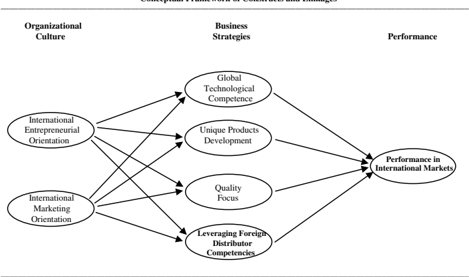
This study argues that born-global firms succeed because early internationalization is supported by an innovative culture and a distinctive set of organizational capabilities. Using qualitative case studies followed by a survey of 203 usable responses, the authors find that several capability links are significant and that these capabilities are associated with performance in international markets.
## Key findings
- The survey analysis found that international entrepreneurial orientation significantly predicted global technological competence with a standardized coefficient of 0.28; the link from international marketing orientation to global technological competence was not significant.
- Unique products development was significantly predicted by both international entrepreneurial orientation (0.19) and international marketing orientation (0.24).
- Quality focus was significantly predicted by both international entrepreneurial orientation (0.23) and international marketing orientation (0.35).
- Leveraging foreign distributor competences was significantly predicted by international marketing orientation (0.26) but not by international entrepreneurial orientation; these strategy variables were also significant drivers of performance in international markets: global technological competence (0.21), unique products development (0.14), quality focus (0.30), and leveraging foreign distributor competences (0.18).
## Methods
- The paper uses a two-phase design: first qualitative interviews/case studies to develop constructs and hypotheses, then a cross-industry field survey to test them.
- The qualitative phase included 33 professionals: 24 senior managers at early internationalizing firms, 6 scholars, and 3 international trade experts; the firms were mostly founded after 1985, sold half or more of their sales abroad, and had entered foreign markets within 3 years of founding.
- The survey was mailed to a random sample of 900 manufacturing firms in the United States founded in 1980 or later and exporting at least 25% of total production; 203 usable surveys were returned (about 23% response rate). The main analysis used LISREL8 path analysis, with exploratory factor analysis and confirmatory factor analysis for scale purification and validity checks.
## Limitations
- The paper states that “little empirical work” had been attempted on born globals and that there had been “almost no empirical research” on the factors driving their superior international performance.
- The study itself is focused on U.S. manufacturing firms that were selected using a 25% export threshold, so the evidence is tied to that sample and entry-mode context; this is evident from the text.
- The paper notes that the survey results are based on self-reported measures from responding firms; this is evident from the questionnaire-based design, though the paper does not frame it explicitly as a limitation.
Model-written summary. Check it against the paper before relying on it.
Integrity signals
Registry
Cites
Statistics
Figures
Verification
Claims the paper makes
0 Valid · 0 Not valid · 53 Not checked · 112 Own results and interpretations
A result the paper reports from its own data — it cites no other source for it, so there is none to check. The quote shows it is in the paper.
In the paper
“Despite the scarce resources typical of young firms, our findings reveal that born-global firms leverage a distinctive mix of orientations and strategies that allow them to succeed in diverse international markets.”
plainstates a cause- Asserted: passes — The authors put it forward as true.
- Checkable: passes — It can be checked against evidence.
- Load-bearing: passes — The paper’s conclusions depend on it.
- Based: passes — The paper gives a reason why it holds.
- Rests on an assumption not shown here.
A result the paper reports from its own data — it cites no other source for it, so there is none to check. The quote shows it is in the paper.
In the paper
“The critical role of marketing prowess overseas was also strongly emphasized by virtually all interviewees in the case studies.”
boosted- Asserted: passes — The authors put it forward as true.
- Checkable: passes — It can be checked against evidence.
- Load-bearing: unclear — It is unclear whether the paper’s conclusions depend on it.
- Based: passes — The paper gives a reason why it holds.
A result the paper states — it cites no source for it, so there is none to check. The quote shows it is in the paper.
In the paper
“Most interviewed firms exhibited strong technological capabilities in their respective product or industry categories.”
plain- Asserted: passes — The authors put it forward as true.
- Checkable: passes — It can be checked against evidence.
- Load-bearing: unclear — It is unclear whether the paper’s conclusions depend on it.
- Based: passes — The paper gives a reason why it holds.
A result the paper reports from its own data — it cites no other source for it, so there is none to check. The quote shows it is in the paper.
In the paper
“In general, the qualitative phase of the study revealed that born globals are likely to be formed by entrepreneurs who pursue foreign ventures with a strong marketing orientation.”
hedgedstates an association- Asserted: passes — The authors put it forward as true.
- Checkable: passes — It can be checked against evidence.
- Load-bearing: passes — The paper’s conclusions depend on it.
- Based: passes — The paper gives a reason why it holds.
A result the paper states — it cites no source for it, so there is none to check. The quote shows it is in the paper.
In the paper
“In contrast, born globals leverage a collection of fundamental intangible knowledge-based capabilities in the cultivation of foreign markets early in their evolution.”
plainstates a cause- Asserted: passes — The authors put it forward as true.
- Checkable: passes — It can be checked against evidence.
- Load-bearing: passes — The paper’s conclusions depend on it.
- Based: unclear — It is unclear why the paper says it holds.
- Rests on an assumption not shown here.
84 more claims
Create a free account to see all 165 claims and to verify the 3 references still open.
- It may state two separate claims as one. 33
- Probably not a substantial claim. 54
Citations
Cites
Evaluating Structural Equation Models with Unobservable Variables and Measurement Error
Fornell, C., & Larcker, D. F. (1981) · Journal of Marketing Research · doi:10.2307/3151312 · Cited by 109,314 · cited 2×
“Composite reliability was calculated using the procedures outlined by Fornell and Larcker (1981).”
MethodInfluentialEvaluating structural equation models with unobservable variables and measurement error
Fornell, C., & Larcker, D. F. (1981) · Journal of Marketing Research · doi:10.1177/002224378101800104 · Cited by 109,190
Firm Resources and Sustained Competitive Advantage
Barney, J. (1991) · Journal of Management · doi:10.1177/014920639101700108 · Cited by 48,334
(1994) · Journal of the American Dietetic Association · doi:10.1016/0002-8223(94)92216-0 · Cited by 45,910
Firm resources and sustained competitive advantage
Barney, J. B. (2004) · Advances in Strategic Management · doi:10.1016/s0742-3322(00)17018-4 · Cited by 38,152
Absorptive Capacity: A New Perspective on Learning and Innovation
Cohen, W. M., & Levinthal, D. A. (1990) · Administrative Science Quarterly · doi:10.2307/2393553 · Cited by 35,728
A resource‐based view of the firm
Wernerfelt, B. (1984) · Strategic Management Journal · doi:10.1002/smj.4250050207 · Cited by 25,635
The Theory of Economic Development
Schumpeter, J., & Backhaus, U. (2006) · The European Heritage in Economics and the Social Sciences · doi:10.1007/0-306-48082-4_3 · Cited by 22,506
An Evolutionary Theory of Economic Change.
Loasby, B. J., Nelson, R. R., & Winter, S. G. (1983) · The Economic Journal · doi:10.2307/2232409 · Cited by 21,366
A Dynamic Theory of Organizational Knowledge Creation
Nonaka, I. (1994) · Organization Science · doi:10.1287/orsc.5.1.14 · Cited by 17,809
Research works printed but not linked: 5
- Nikkei Sangyoo Shimbun (1995) Benchaa Shin Sedai (New Generation Ventures) , Nihon Keizai Shimbun: Tokyo.
- Nunnally, J.C. (1978) Psychometric Theory
- Porter, M.E. (1980) Competitive Strategy , The Free Press: New York.
- Rennie, M. (1993) 'Born global', McKinsey Quarterly (4): 45-52. Rosson, P. and Ford, I.D. (1982) 'Manufacturer-overseas distributor relations and export performance', Journal of International Business Studies 13 (2): 57-72.
- Schumpeter, J. (1939) Business Cycles , Vol. 1 McGraw-Hill: New York.
Cited by
Items 1,401–1,500 of 3,020
Elfawal, A., Ragheb, M. A., & Adel, R. (2021) · The Business & Management Review · doi:10.24052/bmr/v12nu01/art-07 · Cited by 17
“Knight and Cavusgil (2004) examined the capacity in a company for product innovation at the research and development (R&D) level.”
BackgroundVuorio, A., Faroque, A. R., & Kuivalainen, O. (2022) · Small Enterprise Research · doi:10.1080/13215906.2022.2113742 · Cited by 14
“This suggests that early and rapid internationalization is enabled by specific capabilities, which these companies possess (Cavusgil & Knight, 2015; Knight & Cavusgil, 2004).”
BackgroundXiang, Q., Lin, D., & Wang, J. (2022) · Journal of International Management · doi:10.1016/j.intman.2022.100995 · Cited by 10
Li, F., Chen, Y., Liu, L., & Zhuang, M. (2023) · Heliyon · doi:10.1016/j.heliyon.2023.e13911 · Cited by 14
“Born globals, an anomaly in the Uppsala internationalisation model, are defined as business organisations that seek to achieve outstanding international business performance by applying knowledge-based resources to sell products in multiple countries from or shortly after their establishment [34].”
BackgroundMorched, S., Mohamed, E. B., & Jarboui, A. (2023) · Environment Systems & Decisions · doi:10.1007/s10669-023-09905-2 · Cited by 10
Export duration and product innovations: do born globals learn by exporting differently?
Sui, S., Baum, M., & Li, D. (2023) · Multinational Business Review · doi:10.1108/mbr-10-2022-0161 · Cited by 11
Internationalisation patterns of African sharing economy companies: The role of gateway markets
Ochieng, I. A., Thornton, H. C., & Owusu, R. A. (2023) · Journal of Business Research · doi:10.1016/j.jbusres.2023.114297 · Cited by 13
Chung, H. F. L., Sima, H., Ho, M. H.-W., & Pichugin, D. (2024) · Industrial Marketing Management · doi:10.1016/j.indmarman.2024.05.002 · Cited by 11
Chaudhry, S., Crick, D., & Crick, J. M. (2024) · Industrial Marketing Management · doi:10.1016/j.indmarman.2024.06.003 · Cited by 13
Micromultinationals: Transcending Resource Challenges in International Business
Ibeh, K., Borchert, O., & Wheeler, C. (2009) · Palgrave Macmillan UK eBooks · doi:10.1057/9780230237322_6 · Cited by 10
International New Ventures en Chile: tres casos de éxito
Cancino, C. A., & Paz, A. I. L. (2010) · Academia Revista Latinoamericana de Administración · Cited by 26
Mais, I., de Carvalho, L. C., Amal, M., et al. (2010) · LA Referencia (Red Federada de Repositorios Institucionales de Publicaciones Científicas) · Cited by 9
Building the innovation capacity of SMEs in China
Child, J. (2016) · Cambridge University Press eBooks · doi:10.1017/cbo9781316422267.009 · Cited by 13
Guanxi’s Changing Nature: A Chinese Born Global’s Experience
Vissak, T., & Zhang, X. (2016) · Journal of East-West Business · doi:10.1080/10669868.2016.1215661 · Cited by 11
“Thus, because of their youth, they usually lack substantial financial resources (Knight and Cavusgil 2004) and they have not yet had time to acquire sufficient knowledge or experience (Hashai 2011; Casillas and Moreno-Menéndez 2014; Hohenthal, Johanson, and Johanson 2014) or create long-time…”
BackgroundLin, H., & Chang, K.-L. (2017) · Maritime Business Review · doi:10.1108/mabr-09-2016-0025 · Cited by 15
“Firms must possess organizational capabilities that support both early internationalization and subsequent success in international markets because they provide a stable basis for IMD (Knight and Cavusgil, 2004).”
BackgroundChung, J., Yang, H., & Won, J.-H. (2018) · Clothing and Textiles Research Journal · doi:10.1177/0887302x18797468 · Cited by 9
Internationalization of Brazilian High-Tech Startups
Cahen, F. R. (2019) · Springer eBooks · doi:10.1007/978-3-030-10865-6_3 · Cited by 10
Furtado, J. V., Pereira, A. R., Pereira, I. V., & Moreira, A. C. (2019) · Advances in business strategy and competitive advantage book series · doi:10.4018/978-1-5225-8479-7.ch016 · Cited by 9
Will a supplier's origin make a difference to its business customers?
Jacob, F., & Schätzle, S. (2020) · Industrial Marketing Management · doi:10.1016/j.indmarman.2020.01.006 · Cited by 8
Strategy, accountants’ activities and new product development performance
Chia-Ling, L., & Wang, W. (2020) · Advances in Accounting · doi:10.1016/j.adiac.2020.100487 · Cited by 13
Commitment to exporting as an antecedent of organizational skills and firm performance
Gonçalves, T. M. V., Teixeira, M. S., Dias, J. G., Gouveia, S., & Correia, R. J. (2021) · Journal of Business Economics · doi:10.1007/s11573-021-01028-x · Cited by 13
International social ventures: A literature review and guidance for future research
Larsen, N. N., & Hannibal, M. (2021) · Journal of International Entrepreneurship · doi:10.1007/s10843-021-00295-7 · Cited by 11
Internationalization–Innovation Strategy in New Ventures: A Log-linear Analysis
Alves, M. F. R., Bansi, A. C., Kim, S., Oliveira, M. F., & Galina, S. V. R. (2021) · Global Business Review · doi:10.1177/09721509211034058 · Cited by 13
“Knight and Cavusgil (2004) adopted the term ‘born global’ and defined it in terms of ‘business organizations that, from or near their founding, seek superior international business performance from the application of knowledge-based resources to the sale of outputs in multiple countries’ (p. 124).”
Entrepreneurship, innovation, and internationalization: The moderating role of the institutions
Villamizar, S. P., & Peinado, E. S. (2021) · Estudios Gerenciales · doi:10.18046/j.estger.2021.160.4307 · Cited by 15
“Knight and Cavusgil (2004) stipulate that the companies to be prioritized are the born-global firms since they seek superior returns in international business at or near their founding.”
BackgroundInfluence of CEO and Firm Characteristics on SME Internationalization: Evidence From California
Milevoj, E., Beleska‐Spasova, E., & Bommer, W. H. (2021) · Journal of Small Business Strategy · doi:10.53703/001c.29810 · Cited by 13
Geographical breakdown of Polish OFDI – explanatory potential of Uppsala model
Kłysik-Uryszek, A., & Kuna‐Marszałek, A. (2015) · JOURNAL OF INTERNATIONAL STUDIES · doi:10.14254/2071-8330.2015/8-1/13 · Cited by 9
“…ideas of internationalization of enterprises, such as, e.g., network business models (Möller and Rajala 2007; Johanson and Mattsson 1993; Ng and Zain 2006) or models of rms born global (Rennie 1993; Knight and Cavusgil 1996, 2004, 2014; Freeman, Edwards and Schroder 2006; Zhou, Wu and Luo 2007).”
BackgroundBorn globals: taking stock, looking ahead
Dominguinhos, P., & Simões, V. C. (2004) · Portuguese National Funding Agency for Science, Research and Technology (RCAAP Project by FCT) · Cited by 9
ERDİL, T. S. (2012) · Procedia - Social and Behavioral Sciences · doi:10.1016/j.sbspro.2012.09.1107 · Cited by 9
The development of network competence in an internationalized SME
Torkkeli, L., Saarenketo, S., & Nummela, N. (2015) · Edward Elgar Publishing eBooks · doi:10.4337/9781783475483.00026 · Cited by 14
Sekliuckienė, J. (2015) · RePEc: Research Papers in Economics · Cited by 9
Resources, external environment, innovation and performance of insurance companies in Kenya
Ombaka, B. E. (2014) · Karatina University Digital Repository (Karatina University) · Cited by 13
A Resource-Based View of Internationalization in Emerging Economies
Boermans, M. A., & Roelfsema, H. J. (2012) · Palgrave Macmillan UK eBooks · doi:10.1057/9781137032546_2 · Cited by 11
Lavastre, O., Ageron, B., Chaze-Magnan, L., & Spalanzani, A. (2014) · M n gement · doi:10.3917/mana.174.0266 · Cited by 30
“…Hazen et al., 2012), un type d'acteur (les prestataires de services logistiques, Busse et Wallenburg, 2011), un type d'innovation (les produits, Knight et Cavusgil, 2004), un secteur d'activité (les industries high-tech taiwanaises, Lin et al., 2010 ; les industries agroalimentaires, Fortuin…”
COMPROMISO, RECURSOS, EMPRENDIMIENTO EXPORTADOR Y RESULTADOS EMPRESARIALES
García, A. N., Rey-Moreno, M., & Barrera, R. B. (2017) · Revista de Administração de Empresas · doi:10.1590/s0034-759020170203 · Cited by 16
‘Lean Start-Up’ Practices: Initial Internationalization and Evolving Business Models
Crick, J. M., & Crick, D. (2017) · Springer eBooks · doi:10.1007/978-3-319-61385-7_2 · Cited by 9
Calvo, N., & Larrínaga, Ó. V. (2018) · Journal of Business and Industrial Marketing · doi:10.1108/jbim-03-2017-0060 · Cited by 9
van Schijndel, L. (2019) · Journal of Open Innovation Technology Market and Complexity · doi:10.3390/joitmc5020028 · Cited by 10
“, [2,28]) qualifying as Born Globals [29,30] and/or International New Ventures [31], less is known about whether and how an ongoing engagement over time with entrepreneurial ecosystems impacts on the evolution of these start-ups as they scale and mature, in particular whether and how such ongoing engagement plays a ro…”
BackgroundZaki, A. M., El-Gohary, H. O., & Edwards, D. J. (2020) · International Journal of Customer Relationship Marketing and Management · doi:10.4018/ijcrmm.2021010101 · Cited by 13
“…or so-called ‘born global’ (Andersson et al., 2014; Andersson and Evangelista, 2006; Autio et al., 2000; Kumar and Yakhlef, 2014; Kocak, 2009; Knight and Cavusgil, 2004; Zhou et al., 2007); v) Process and pattern of SMEs’ internationalisation (e.g. Kuivalainen et al., 2012; Jones, 1999);…”
BackgroundBuckley, P. J., & Mattos, C. D. (2021) · British Journal of Management · doi:10.1111/1467-8551.12463 · Cited by 13
“Born-global SMEs (Knight and Cavusgil, 2004; Knight and Liesch, 2016; Zander, McDougall-Covin and Rose, 2015) targeting nichemarkets are examples of such propitious conditions.”
BackgroundMagnani, G., & Zucchella, A. (2021) · Sinergie Italian Journal of Management · doi:10.7433/s113.2020.03 · Cited by 8
“Some studies have addressed the importance of product strategies, and particularly that of pursuing product uniqueness (Knight and Cavusgil, 2004), and product innovation (Bell et al., 2004) but they have also highlighted the role of customer focus (Wolff and Pett, 2000).”
BackgroundCultural Intelligence as a Key Construct for Global Talent Management
Bücker, J. J. L. E. (2014) · Management for professionals · doi:10.1007/978-3-319-05125-3_5 · Cited by 11
The accelerated internationalization of born global firms: a knowledge transformation process view
Huang, H. Y., & Hsieh, M. H. (2013) · Journal of Asia Business Studies · doi:10.1108/jabs-03-2013-0015 · Cited by 15
International Entrepreneurship: An Introduction, Framework and Research AgendaPreprint
Hessels, J. (2008) · RePEc: Research Papers in Economics · Cited by 9
Digital innovation, platforms, and global strategy
Logue, D. M., Williamson, P. J., Roberts, A. E., Luo, Y., & Barrett, M. I. (2025) · Information and Organization · doi:10.1016/j.infoandorg.2025.100562 · Cited by 24
Hossain, K., Alam, M. N., Muwazir, M. R., Alsiehemy, A., & Azizan, N. A. (2023) · International Journal of Emerging Markets · doi:10.1108/ijoem-08-2021-1209 · Cited by 15
The internationalization and performance of INVs: Liability or learning advantages of newness?
Khatua, A., Mondal, A., & Dhanda, S. (2024) · Journal of International Entrepreneurship · doi:10.1007/s10843-023-00345-2 · Cited by 8
“…resources, corporate governance as well as industry-level factors or location-specific challenges for the survival and success of INVs (Autio et al. 2000; Knight and Cavusgil 2004; Sapienza et al. 2006; Mudambi and Zahra 2007; Anand et al. 2023; Evers et al. 2023; Saiyed et al. 2021, 2023).”
Forsberg, P., & Hulsink, W. (2024) · Journal of International Entrepreneurship · doi:10.1007/s10843-024-00354-9 · Cited by 16
“…new ventures (McDougall et al. 1994; Oviatt & McDougall 1994; Hennart 2013), which is a broader term that describes how new firms with limited resources exploit opportunities that are beyond their domestic markets to derive a competitive advantage (Knight & Cavusgil 1996, 2004; Rennie 1993).”
Mostafiz, M. I., Gali, N., Hughes, M., Massis, A. D., & Rahman, P. N. A. (2024) · International Journal of Entrepreneurial Behaviour & Research · doi:10.1108/ijebr-12-2023-1238 · Cited by 10
Innovations and long-term international growth in born globals
Andersson, S. (2024) · Industrial Marketing Management · doi:10.1016/j.indmarman.2024.11.016 · Cited by 12
Nirmala, A. R., Sukoco, B. M., Ekowati, D., Nadia, F. N. D., Marjan, Y., & Hasanah, U. (2024) · SAGE Open · doi:10.1177/21582440241302869 · Cited by 10
“In addition, SMEs have large domestic markets (Li et al., 2018), but conventional beliefs indicate that SMEs are vulnerable in the international market due to resource constraints (Knight & Cavusgil, 2004; Love et al., 2016).”
Emerging trends and critical insights in international business research: a hybrid review
Bui, H. N., Phung, N., Le, M. L., & Nguyen, T. H. D. (2025) · Review of International Business and Strategy · doi:10.1108/ribs-07-2024-0089 · Cited by 8
Purpose versus profit: How institutions shape entrepreneurial success across countries
Gerschewski, S., Franzke, S. K., Froese, F. J., & Knight, G. (2025) · International Business Review · doi:10.1016/j.ibusrev.2025.102444 · Cited by 10
Self-citationInnovation Capabilities and Firm Performance: A Meta-analysis of the Schumpeter’s Hypothesis
Lestan, F., & Clausen, T. H. (2026) · Journal of Innovation & Knowledge · doi:10.1016/j.jik.2026.100943 · Cited by 11
Does service intangibility affect entrepreneurial orientation?
Sepulveda, F. L. (2014) · Service Industries Journal · doi:10.1080/02642069.2014.886189 · Cited by 11
“One of the reasons attributed to the rapid growth of INVs is that they offer higher innovativeness and value than competitors (Gabrielsson et al., 2008; Knight & Cavusgil, 2004).”
BackgroundResultInfluentialEtemad, H. (2016) · Journal of International Entrepreneurship · doi:10.1007/s10843-016-0180-1 · Cited by 8
“In a later publication, Knight and Cavusgil (2004) defined Born Globals as Bentrepreneurial start-ups that, from or near their founding, seek to derive a substantial portion of their revenue from the sale of products in international markets^.”
BackgroundThe Roles of International Entrepreneurship and Organizational Innovation in SMEs
Kasemsap, K. (2015) · Advances in business strategy and competitive advantage book series · doi:10.4018/978-1-4666-8348-8.ch024 · Cited by 8
Internationalisierungsprozesse und Finanzstrategien
Guserl, A. (2013) · Peter Lang D eBooks · doi:10.3726/978-3-653-02885-0 · Cited by 7
Forced to go virtual? Distributed cooperation of small software firms
Schönauer, A., Kasper, R., Flecker, J., & Holtgrewe, U. (2013) · Work Organisation Labour & Globalisation · doi:10.13169/workorgalaboglob.7.1.0063 · Cited by 9
PANORAMA DE PESQUISA SOBRE COMPETÊNCIAS DE STARTUPS
de Noronha, M. E. S., Bento, L. F., Rufino, J. P. F., & Rocha, T. V. (2022) · International Journal of Professional Business Review · doi:10.26668/businessreview/2022.v7i2.293 · Cited by 11
Family Firm Internationalisation
Leppäaho, T. C., & Metsola, J. (2019) · Springer eBooks · doi:10.1007/978-3-030-28520-3 · Cited by 8
Ghosh, I., Jana, R. K., & Pramanik, P. (2022) · Benchmarking An International Journal · doi:10.1108/bij-09-2021-0528 · Cited by 8
Tallman, S., & Cuervo-Cazurra, Á. (2021) · Oxford University Press eBooks · doi:10.1093/oso/9780190090883.003.0016 · Cited by 13
Goldenstein, J., Poschmann, P., & Hunoldt, M. (2022) · Journal of Management Studies · doi:10.1111/joms.12858 · Cited by 9
Learning by supplying to climb the value chain: suppliers’ transition from B-to-B to B-to-C
Irfan, I., Au, A. K. M., Khurshid, F., & Chan, F. T. S. (2022) · Supply Chain Management An International Journal · doi:10.1108/scm-12-2021-0551 · Cited by 10
Piao, X., & Choi, M.-C. (2022) · Discrete Dynamics in Nature and Society · doi:10.1155/2022/6151667 · Cited by 12
“Such arguments draw criticism of the RBV in that it does not pay much attention to the process or dynamism influenced by environmental factors [19].”
BackgroundInternational competitiveness readiness, home country institutions and early internationalisation
Li, T. (2022) · Management Decision · doi:10.1108/md-12-2021-1560 · Cited by 8
International high-growth of early internationalizing firms: A feedback loop experience
Meuric, P.-L., & Favre-Bonté, V. (2023) · Journal of Small Business Management · doi:10.1080/00472778.2023.2169705 · Cited by 10
Sani-Elia, I., Perez, D., & Grinstein, A. (2023) · Journal of the Association for Consumer Research · doi:10.1086/724993 · Cited by 10
“Furthermore, global brands have been found to exhibit superior performance compared with reborn-global brands (Knight and Cavusgil 2004).”
BackgroundSMEs' regional diversification: dynamic patterns and home market institutional determinants
Bai, W., Hilmersson, M., Johanson, M., & Oliveira, L. (2023) · International Marketing Review · doi:10.1108/imr-12-2021-0364 · Cited by 11
HGX: the anatomy of high growth exporters
Srhoj, S., Coad, A., & Walde, J. F. (2024) · Small Business Economics · doi:10.1007/s11187-024-00884-5 · Cited by 9
“This subgroup of firms is defined as “entrepreneurial start-ups that, from or near their founding, seek to derive a substantial proportion of their revenue from the sale of products in international markets” (Knight & Cavusgil, 2004; p. 124).”
InfluentialENTREPRENEUR'S ACTUAL BEHAVIORAL CONTROLS, PSYCHIC DISTANCE STIMULI, AND EXPORT MODE CHOICE
DUNG, N. V., & Janssen, F. (2015) · Journal of Developmental Entrepreneurship · doi:10.1142/s1084946715500132 · Cited by 10
Dimitratos, P., & Jones, M. V. (2005) · Palgrave Macmillan UK eBooks · doi:10.1057/9780230379695_4 · Cited by 11
Black Swans or an Emerging Type of Firm? The Case of Borderless Firms
Simões, V. C., da Rocha, Â., de Mello, R. C., et al. (2015) · Progress in international business research · doi:10.1108/s1745-886220150000010006 · Cited by 8
The Relationship Knowledge, Learning, Innovation and Competitive Advantages: A Conceptual Model
Costa, M. D. P. B., & Cabral, J. E. O. (2010) · The International Journal of Technology Knowledge and Society · doi:10.18848/1832-3669/cgp/v06i03/56101 · Cited by 8
“According Knight and Cavusgil (2004) organizational capabilities are the main sources of firms’ performance.”
BackgroundIsmail, N. A. (2017) · International journal of entrepreneurship · Cited by 10
Future agenda for research design in international entrepreneurship
Nummela, N. (2014) · doi:10.4324/9780203517161.ch15 · Cited by 10
Barnard, H. C., & Chamináde, C. (2017) · International Journal of Technological Learning Innovation and Development · doi:10.1504/ijtlid.2017.10008256 · Cited by 8
“Our paper does not provide the first evidence of the internationalisation of nonMNCs: The work on “born globals” (Knight & Cavusgil, 2004) and work arguing that SMEs can benefit from outsourcing (Stal & Cuervo-Cazurra, 2011), both indicate that smaller and stand-alone firms can form global networks.”
BackgroundUzhegova, M., Torkkeli, L., Salojärvi, H., & Saarenketo, S. (2018) · Springer eBooks · doi:10.1007/978-3-319-74129-1_10 · Cited by 12
“An emerging theme is the role of dynamic capabilities in internationalization of SMEs (see Knight & Cavusgil, 2004; Autio et al., 2011; Torkkeli et al., 2012), where marketing strategy in general (Knight, 2000), and marketing-related capabilities in particular (Lee & Hsieh, 2010; Weerawardena et…”
BackgroundKozma, M., & Sass, M. (2019) · Society and Economy · doi:10.1556/204.2019.41.1.3 · Cited by 14
Earliness of SME internationalizationand performance: Analyzing the role of CEO attributes
Santhosh, C. (2019) · Journal of Entrepreneurship in Emerging Economies · doi:10.1108/jeee-11-2018-0132 · Cited by 18
Ibidunni, A. S. (2019) · Managerial and Decision Economics · doi:10.1002/mde.3083 · Cited by 9
Internationalisation Patterns of Polish Family High-Tech Firms
Daszkiewicz, N. (2019) · Entrepreneurial Business and Economics Review · doi:10.15678/eber.2019.070409 · Cited by 8
“Moreover, this article accepted three years as the borderline separating the traditional from the early and rapid internationalisation (Knight & Cavusgil, 2004; Zuchella, Palamara, & Denicolai, 2007, Wach, 2015; Pohlova et al., 2018).”
BackgroundWhat affects the export entrepreneurship of SMEs?
Santhosh, C. (2020) · Review of International Business and Strategy · doi:10.1108/ribs-06-2019-0086 · Cited by 10
Drivers of export competitiveness: new evidences from the manufacturing industry in Malaysia
Zhang, M., & Mia, M. A. (2020) · Journal of the Asia Pacific Economy · doi:10.1080/13547860.2020.1858555 · Cited by 12
“…observed firms’ export propensities and intensities to be positively linked to their ages (e.g., Ngoc and Ramstetter 2009; Golovko and Valentini 2011), others believe that young firms that are ‘born global’ engage more in exporting activities than old ones (Wagner 2015; Knight and Cavusgil 2004).”
BackgroundAssessing industry differences in marketing innovation using multi-level modeling
Persaud, A., Wang, S., & Schillo, R. S. (2021) · Journal of Business and Industrial Marketing · doi:10.1108/jbim-12-2019-0532 · Cited by 13
A vezető szerepe a kis- és közepes vállalkozások sikerességében
Szanyi-Gyenes, X., & Almási, A. (2021) · Vezetéstudomány / Budapest Management Review · doi:10.14267/veztud.2021.03.04 · Cited by 15
“A nemzetköziesedő KKV-k vállalatvezetésének kiemelt szerepe van a vállalati stratégia kialakításában, a működés során a nemzetközi sikerek eléréséhez szükséges képességeik fejlesztésére (Knight & Cavusgil, 2004) helyezik a hangsúlyt.”
Adoption of the 4th Industrial Revolution: evidence from Korean exporters in international markets
Cho, J., Kim, E., & Jeong, I. (2021) · Asian Business & Management · doi:10.1057/s41291-021-00159-x · Cited by 8
Elsahn, Z., & Earl, A. (2022) · Journal of International Management · doi:10.1016/j.intman.2022.100957 · Cited by 10
Born Globals’ Risk Perception and Internationalization in Emerging Markets
Stocker, F., de Mascena, K. M. C., Abib, G., et al. (2022) · Review of Business Management · doi:10.7819/rbgn.v24i2.4171 · Cited by 8
Customer reference marketing in internationalizing SMEs: a service perspective
Tolstoy, D., Hånell, S. M., & Özbek, N. (2022) · Journal of Business and Industrial Marketing · doi:10.1108/jbim-09-2020-0440 · Cited by 8
Martins, I., Gómez‐Araujo, E., & Vaillant, Y. (2015) · Journal of technology management & innovation · doi:10.4067/s0718-27242015000100008 · Cited by 10
“In the SMEs context, the RBV helps to explain how the knowledge and the organizational capabilities are developed and levered up by owner-managers (Knight and Cavusgil, 2004).”
BackgroundMeasuring export readiness using a multiple-item index
Tan, A., Brewer, P., & Liesch, P. W. (2010) · QUT ePrints (Queensland University of Technology) · Cited by 12
Knowledge Intensity and Knowledge Bases in Internationalization Patterns of SMEs in the Food Sector
Testa, S. (2014) · Journal of International Food & Agribusiness Marketing · doi:10.1080/08974438.2012.755723 · Cited by 9
“…& Vermeulen, 1998; Brennan, 2009; Casillas et al., 2009; Eriksson, Knowledge Intensity and Knowledge Bases 69 Johanson, Majkgard, & Sharma, 1997; Knight & Cavusgil, 2004; Luo, 2000; Sapienza, Autio, George, & Zahra, 2006) also in light of the notion that internationalization constitutes a form…”
BackgroundInternational Venturing by Indian IT Firms: A Motive Analysis
Varma, S. (2010) · Journal of Emerging Knowledge on Emerging Markets · doi:10.7885/1946-651x.1008 · Cited by 12
“Lacking in prior experience in the IT industry, they may be classified as “born globals” (Knight and Cavusgil 2004), exhibiting qualities of entrepreneurship not found in other firms.”
BackgroundDrivers and Effects of IT Capability in 'Born-Global' Firms: A Cross-National Study
Sarker, S., Sarker, S., & Zhang, M. (2007) · Journal of the Association for Information Systems · Cited by 8
García, A. N., Cataluña, F. J. R., & Rad, C. J. R. (2014) · Revista Europea de Dirección y Economía de la Empresa · doi:10.1016/j.redee.2013.01.001 · Cited by 18
Effects of network market orientation on new ventures' international performance
Monferrer, D., Blesa, A., Meliá, M. R., Boluda, I. K., & López, N. V. (2012) · International Journal of Business Environment · doi:10.1504/ijbe.2013.050633 · Cited by 8
“Different studies assign a key role to market knowledge in the international progress made by new ventures in that it constitutes a key variable for proactively seeking international opportunities (Acedo and Jones, 2007; Autio, Sapienza and Almeida, 2000; Brennan and Garvey, 2009; Casillas et al., 2009; Gassman and Ke…”
BackgroundInfluentialNetworks' contribution to small-sized firms' internationalization
Aureli, S., & Baldo, M. D. (2012) · Archivio istituzionale della ricerca (Alma Mater Studiorum Università di Bologna) · Cited by 11
Karatepe, O. M., Uner, M. M., & Koçak, A. (2016) · Economic Research-Ekonomska Istraživanja · doi:10.1080/1331677x.2016.1197548 · Cited by 10
“Such born-globals also have specific knowledge and capabilities that give rise to high levels of performance in foreign markets (Knight & Cavusgil, 2004; Knight, Koed Madsen, & Servais, 2004).”
BackgroundMethodInfluentialPathak, S., Muralidharan, E. K., & Laplume, A. O. (2014) · Digital Commons - Michigan Tech (Michigan Technological University) · doi:10.13140/2.1.2446.7842 · Cited by 11
Metadata
- Authors
- Knight, G. A., & Cavusgil, S. T.
- Affiliations
- Florida State University (US)
- Corresponding author
- Knight, Gary A
- ORCID
- Knight, Gary A
- Venue
- Journal of International Business Studies
- Published
- 2004-01-08
- Volume
- 35
- Issue
- 2
- Pages
- 124-141
- ISSN
- 0047-2506 (ISSN-L)
- 1478-6990
- OpenAlex
- W2127709152
- Semantic Scholar
- d24960b5342d0dd3b86be002ab18a80e7b6fb5c9
- Cited by
- 4,295
- References
- 102
- Citations by year
- 2026: 261 · 2025: 233 · 2024: 216 · 2023: 242 · 2022: 227 · 2021: 274 · 2020: 286 · 2019: 260 · 2018: 291 · 2017: 258 · 2016: 290 · 2015: 246 · 2014: 234 · 2013: 215 · 2012: 171
- FWCI
- 115.46
- Type
- journal article
- Language
- en
- Update notices
- correction (2004-07-16)
- Open access
- bronze
- doi.org
- Licence
- www.springer.com/tdm (tdm)
- Locations
- Journal of International Business Studies (publishedVersion)
- Research Explorer (The University of Manchester) (publishedVersion)
- RePEc: Research Papers in Economics (submittedVersion)
- Funders
- Michigan State University
- College of Engineering, Michigan State University
- Topics
- Social Sciences › Business, Management and Accounting › Strategy and Management › International Business and FDI
- Social Sciences › Business, Management and Accounting › Strategy and Management › Innovation and Knowledge Management
- Social Sciences › Communication › International Student and Expatriate Challenges
- Keywords
- born global firms, early internationalization, organizational capabilities, innovation, innovation culture, international business strategy, international success, young firms, internationalization of firms
About these checks
Registry, retraction, Cites and statistics results are computed, not judged, with one exception: a printed reference that no index lists is read once by a model before it counts as a citation error. Claims are extracted by a model and kept only when their quote appears verbatim in the text; each cited source is then checked, with a model’s help, for whether it says what the claim relies on. Those verdicts can be wrong — read the claim’s quote and the cited source before relying on one.
A language model drew the claims from the paper on 2026-10-10, under version 3 of the claim definition (model deepseek-v4.1-flash, prompt extract-v3).
A second model labelled each claim on 2026-10-10 (model jev-1.13-20260917, definition revision gold-guideline-v0.2).
Statistics and arithmetic are recomputed, not judged.
Confidence bands are shown only for fields calibrated on our annotated test set. None is calibrated yet, so no band is shown.
What counts as a claim ›How we measure confidence ›How we check this ›
Are you an author, or do you see a problem with this page? Request a review
Data sources
Bibliographic data: Semantic Scholar, OpenAlex, Crossref.
Contains information from the Semantic Scholar Academic Graph Datasets, made available under the ODC Attribution License (ODC-BY 1.0).
Semantic Scholar’s data is described in: Kinney, R., et al. (2023). The Semantic Scholar Open Data Platform. arXiv:2301.10140.
