

Innovation, organizational capabilities, and the born-global firm
Open accessThe DOI matches its Crossref record; 106 of the 106 references it cites were found in a registry or an index; none of the 100 sources its claims cite is checked for support yet.
Overview
CoChat Summary
## TL;DR
This study argues that born-global firms succeed because early internationalization is supported by an innovative culture and a distinctive set of organizational capabilities. Using qualitative case studies followed by a survey of 203 usable responses, the authors find that several capability links are significant and that these capabilities are associated with performance in international markets.
## Key findings
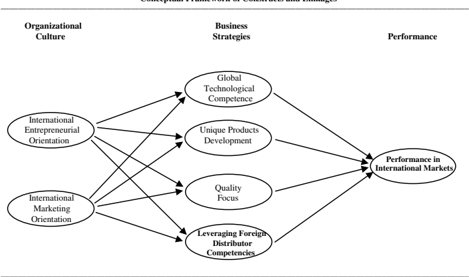
- The survey analysis found that international entrepreneurial orientation significantly predicted global technological competence with a standardized coefficient of 0.28; the link from international marketing orientation to global technological competence was not significant.
- Unique products development was significantly predicted by both international entrepreneurial orientation (0.19) and international marketing orientation (0.24).
- Quality focus was significantly predicted by both international entrepreneurial orientation (0.23) and international marketing orientation (0.35).
- Leveraging foreign distributor competences was significantly predicted by international marketing orientation (0.26) but not by international entrepreneurial orientation; these strategy variables were also significant drivers of performance in international markets: global technological competence (0.21), unique products development (0.14), quality focus (0.30), and leveraging foreign distributor competences (0.18).
## Methods
- The paper uses a two-phase design: first qualitative interviews/case studies to develop constructs and hypotheses, then a cross-industry field survey to test them.
- The qualitative phase included 33 professionals: 24 senior managers at early internationalizing firms, 6 scholars, and 3 international trade experts; the firms were mostly founded after 1985, sold half or more of their sales abroad, and had entered foreign markets within 3 years of founding.
- The survey was mailed to a random sample of 900 manufacturing firms in the United States founded in 1980 or later and exporting at least 25% of total production; 203 usable surveys were returned (about 23% response rate). The main analysis used LISREL8 path analysis, with exploratory factor analysis and confirmatory factor analysis for scale purification and validity checks.
## Limitations
- The paper states that “little empirical work” had been attempted on born globals and that there had been “almost no empirical research” on the factors driving their superior international performance.
- The study itself is focused on U.S. manufacturing firms that were selected using a 25% export threshold, so the evidence is tied to that sample and entry-mode context; this is evident from the text.
- The paper notes that the survey results are based on self-reported measures from responding firms; this is evident from the questionnaire-based design, though the paper does not frame it explicitly as a limitation.
Model-written summary. Check it against the paper before relying on it.
Integrity signals
Registry
Cites
Statistics
Figures
Verification
Claims the paper makes
0 Valid · 0 Not valid · 53 Not checked · 112 Own results and interpretations
A result the paper reports from its own data — it cites no other source for it, so there is none to check. The quote shows it is in the paper.
In the paper
“Despite the scarce resources typical of young firms, our findings reveal that born-global firms leverage a distinctive mix of orientations and strategies that allow them to succeed in diverse international markets.”
plainstates a cause- Asserted: passes — The authors put it forward as true.
- Checkable: passes — It can be checked against evidence.
- Load-bearing: passes — The paper’s conclusions depend on it.
- Based: passes — The paper gives a reason why it holds.
- Rests on an assumption not shown here.
A result the paper reports from its own data — it cites no other source for it, so there is none to check. The quote shows it is in the paper.
In the paper
“The critical role of marketing prowess overseas was also strongly emphasized by virtually all interviewees in the case studies.”
boosted- Asserted: passes — The authors put it forward as true.
- Checkable: passes — It can be checked against evidence.
- Load-bearing: unclear — It is unclear whether the paper’s conclusions depend on it.
- Based: passes — The paper gives a reason why it holds.
A result the paper states — it cites no source for it, so there is none to check. The quote shows it is in the paper.
In the paper
“Most interviewed firms exhibited strong technological capabilities in their respective product or industry categories.”
plain- Asserted: passes — The authors put it forward as true.
- Checkable: passes — It can be checked against evidence.
- Load-bearing: unclear — It is unclear whether the paper’s conclusions depend on it.
- Based: passes — The paper gives a reason why it holds.
A result the paper reports from its own data — it cites no other source for it, so there is none to check. The quote shows it is in the paper.
In the paper
“In general, the qualitative phase of the study revealed that born globals are likely to be formed by entrepreneurs who pursue foreign ventures with a strong marketing orientation.”
hedgedstates an association- Asserted: passes — The authors put it forward as true.
- Checkable: passes — It can be checked against evidence.
- Load-bearing: passes — The paper’s conclusions depend on it.
- Based: passes — The paper gives a reason why it holds.
A result the paper states — it cites no source for it, so there is none to check. The quote shows it is in the paper.
In the paper
“In contrast, born globals leverage a collection of fundamental intangible knowledge-based capabilities in the cultivation of foreign markets early in their evolution.”
plainstates a cause- Asserted: passes — The authors put it forward as true.
- Checkable: passes — It can be checked against evidence.
- Load-bearing: passes — The paper’s conclusions depend on it.
- Based: unclear — It is unclear why the paper says it holds.
- Rests on an assumption not shown here.
84 more claims
Create a free account to see all 165 claims and to verify the 3 references still open.
- It may state two separate claims as one. 33
- Probably not a substantial claim. 54
Citations
Cites
Evaluating Structural Equation Models with Unobservable Variables and Measurement Error
Fornell, C., & Larcker, D. F. (1981) · Journal of Marketing Research · doi:10.2307/3151312 · Cited by 109,314 · cited 2×
“Composite reliability was calculated using the procedures outlined by Fornell and Larcker (1981).”
MethodInfluentialEvaluating structural equation models with unobservable variables and measurement error
Fornell, C., & Larcker, D. F. (1981) · Journal of Marketing Research · doi:10.1177/002224378101800104 · Cited by 109,190
Firm Resources and Sustained Competitive Advantage
Barney, J. (1991) · Journal of Management · doi:10.1177/014920639101700108 · Cited by 48,334
(1994) · Journal of the American Dietetic Association · doi:10.1016/0002-8223(94)92216-0 · Cited by 45,910
Firm resources and sustained competitive advantage
Barney, J. B. (2004) · Advances in Strategic Management · doi:10.1016/s0742-3322(00)17018-4 · Cited by 38,152
Absorptive Capacity: A New Perspective on Learning and Innovation
Cohen, W. M., & Levinthal, D. A. (1990) · Administrative Science Quarterly · doi:10.2307/2393553 · Cited by 35,728
A resource‐based view of the firm
Wernerfelt, B. (1984) · Strategic Management Journal · doi:10.1002/smj.4250050207 · Cited by 25,635
The Theory of Economic Development
Schumpeter, J., & Backhaus, U. (2006) · The European Heritage in Economics and the Social Sciences · doi:10.1007/0-306-48082-4_3 · Cited by 22,506
An Evolutionary Theory of Economic Change.
Loasby, B. J., Nelson, R. R., & Winter, S. G. (1983) · The Economic Journal · doi:10.2307/2232409 · Cited by 21,366
A Dynamic Theory of Organizational Knowledge Creation
Nonaka, I. (1994) · Organization Science · doi:10.1287/orsc.5.1.14 · Cited by 17,809
Research works printed but not linked: 5
- Nikkei Sangyoo Shimbun (1995) Benchaa Shin Sedai (New Generation Ventures) , Nihon Keizai Shimbun: Tokyo.
- Nunnally, J.C. (1978) Psychometric Theory
- Porter, M.E. (1980) Competitive Strategy , The Free Press: New York.
- Rennie, M. (1993) 'Born global', McKinsey Quarterly (4): 45-52. Rosson, P. and Ford, I.D. (1982) 'Manufacturer-overseas distributor relations and export performance', Journal of International Business Studies 13 (2): 57-72.
- Schumpeter, J. (1939) Business Cycles , Vol. 1 McGraw-Hill: New York.
Cited by
Items 1,501–1,600 of 3,020
Samson, A. T., & Mahmood, R. (2015) · Journal of Economics and Behavioral Studies · doi:10.22610/jebs.v7i3(j).584 · Cited by 14
“Even though there have been studies on the relationship between strategic orientations and export performance (Cadogan, Kuivalainen & Sundqvist, 2009; Cadogan et al., 2001; Cadogan, Sundqvist, Puumalainen & Salminen, 2012; Knight & Cavusgil, 2004).”
BackgroundTransnational, Ethnic and Returnee Entrepreneurship: Perspectives on SME Internationalization
Manimala, M. J., Wasdani, K. P., & Vijaygopal, A. (2019) · Entrepreneurship and development in South Asia · doi:10.1007/978-981-10-6298-8_1 · Cited by 10
The Evolving Interplay between Social Media and International Health Security: A Point of View
Conti, K. R., Desai, S., Stawicki, S. P., & Papadimos, T. J. (2021) · IntechOpen eBooks · doi:10.5772/intechopen.93215 · Cited by 10
Sun, W., Ding, Z., & Xu, X. (2021) · Information Technology and Management · doi:10.1007/s10799-021-00322-y · Cited by 10
Financial Literacy and Innovation Performance in SMEs: The Mediating Effect of Risk-Taking
Campos-Valenzuela, M., Martínez, S. L. M., & Diéguez‐Soto, J. (2021) · Advances in finance, accounting, and economics book series · doi:10.4018/978-1-7998-7634-2.ch004 · Cited by 12
Prevalence of the born-global phenomenon in different countries: an integrated perspective
Prieto‐Sánchez, C., & Merino, F. (2022) · Multinational Business Review · doi:10.1108/mbr-09-2021-0120 · Cited by 11
The global expansion of EMNCs: paradoxes and directions for future research
Williamson, P. J. (2014) · Cambridge University Press eBooks · doi:10.1017/cbo9781107587632.012 · Cited by 8
Batas, S., & Liu, L. (2013) · Suzhou-Silicon Valley-Beijing International Innovation Conference · doi:10.1109/siic.2013.6624161 · Cited by 11
Entrepreneurial Marketing Strategies During the Growth of International New Ventures
Hallbäck, J., & Gabrielsson, P. (2011) · Palgrave Macmillan UK eBooks · doi:10.1057/9780230305106_12 · Cited by 9
La vocación global de los nuevos modelos de PYMES: el caso de las empresas "born-globals"
Rialp, A., Criado, J. R., & Knight, G. (2010) · Economía industrial · Cited by 24
Self-citationDrivers of International Development for Born Global Companies founded by Italian EntrepreneursPreprint
Onetti, A., Cannone, G., Costantino, G., & Pisoni, A. (2012) · RePEc: Research Papers in Economics · Cited by 12
Competitive Capabilities of a Technology Born Global
Altshuler, L. (2012) · Lund University Publications (Lund University) · Cited by 29
Born global companies as Market- Driven organisations: an empirical analysis
Mascherpa, S. (2012) · BOA (University of Milano-Bicocca) · Cited by 14
The internationalization of born-global SMEs in Northern Sweden : A network perspective
Wai, H. H., & Noichangkid, P. (2012) · DiVA (Digitala Vetenskapliga Arkivet) · Cited by 10
Vavilov, S., & Manning, S. D. (2024) · Technological Forecasting and Social Change · doi:10.1016/j.techfore.2024.123569 · Cited by 7
Manohar, A., Lioliou, E., Prevezer, M., et al. (2024) · International Journal of Management Reviews · doi:10.1111/ijmr.12378 · Cited by 7
Ding, Z., Chen, Z., & Sheng, H. (2025) · Multinational Business Review · doi:10.1108/mbr-12-2023-0196 · Cited by 7
Unpacking global digital competence in the contemporary international venture
Cahen, F. R., Borini, F. M., Dhanaraj, C., & MORAIS, R. R. D. (2025) · International Business Review · doi:10.1016/j.ibusrev.2025.102414 · Cited by 11
Determinants of SME Internationalisation: An Empirical Assessment of Born Global Firms
Chishty, S. K., Sayari, S., Mohamed, A. H., Inkesar, A., Mallick, M. F., & Khan, N. (2025) · Journal of risk and financial management · doi:10.3390/jrfm18040199 · Cited by 13
“This study builds on the established research on the internationalization of small and medium enterprises (SMEs), particularly born global firms (BGFs), while advancing the understanding of under-researched factors in the Indian context (G. A. Knight & Cavusgil, 2004; Narula, 2012).”
InfluentialRamtiyal, B., Sakka, G., Mehmood, K., Narula, S., & Verma, S. (2025) · International Marketing Review · doi:10.1108/imr-10-2024-0428 · Cited by 11
Canal, E. G., & Guillen, M. F. (2025) · BRQ Business Research Quarterly · doi:10.1177/23409444251382952 · Cited by 18
Firm age, sales growth and survival of internationalized SMEs: does human capital play a role?
Santhosh, C. (2021) · Journal of economic and administrative sciences. · doi:10.1108/jeas-09-2020-0168 · Cited by 7
Early internationalization and subsequent geographic expansion: An extended Penrosean perspective
Kano, H. (2022) · International Business Review · doi:10.1016/j.ibusrev.2022.102074 · Cited by 10
Presutti, M., Fratocchi, L., & Odorici, V. (2023) · The International Journal of Entrepreneurship and Innovation · doi:10.1177/14657503231176138 · Cited by 7
“Similar fi ndings have been provided in Knight and Cavusgil (2004), Gerschewski et al. (2015, 2016), Kuivalainen et al. (2007)).”
Entrepreneurial behavior and strategy: A systematic literature review
Bezerra, C. M. D. S., Ramos, H. R., Shinohara, E. E., Nassif, V. M. J., & de Freitas, A. M. F. (2023) · REGEPE Entrepreneurship and Small Business Journal · doi:10.14211/regepe.esbj.e2396 · Cited by 18
Corporate governance in international new ventures and born global firms
Evers, N., Gerschewski, S., Khan, Z., King, T., Kuivalainen, O., & Puthusserry, P. N. (2023) · International Small Business Journal Researching Entrepreneurship · doi:10.1177/02662426231181531 · Cited by 7
Mushtaq, R., Murtaza, G., Yahiaoui, D., Pereira, V. E., & Talpur, Q. (2023) · Asia Pacific Journal of Management · doi:10.1007/s10490-023-09915-3 · Cited by 8
“There is less cultural and strategic momentum to constrain new strategic ini - tiatives because young firms exhibit greater flexibility and agility, which are essential abilities to succeed globally (Knight & Cavusgil, 2004 ).”
InfluentialZhou, Q. F., Han, H., & Han, J. (2024) · Heliyon · doi:10.1016/j.heliyon.2024.e24489 · Cited by 8
“Risk-taking refers to entrepreneurs seizing opportunities hidden in uncertainty, creating value, daring to take risks, and innovating [21].”
BackgroundEarly, Rapid or Global? Internationalization Speed and SME’s Performance
Romanello, R., Balboni, B., Chiarvesio, M., & Paul, J. (2024) · Global Business Review · doi:10.1177/09721509231221915 · Cited by 9
Exploring the internationalization pathways of luxury SMEs: is there an asset of foreignness?
Milanesi, M., Runfola, A., & Guercini, S. (2024) · International Marketing Review · doi:10.1108/imr-08-2023-0174 · Cited by 7
Crespo, N. F., Crespo, C. F., Silva, G. M., & Barros, B. (2024) · Journal of Innovation & Knowledge · doi:10.1016/j.jik.2024.100584 · Cited by 13
Garg, R. (2012) · AFRICAN JOURNAL OF BUSINESS MANAGEMENT · doi:10.5897/ajbm11.2938 · Cited by 10
“Studies highlight that new venture firms often have a superior capability to perform R and D activities (Knight and Cavusgil, 2004; Manalova, 2003).”
BackgroundInfluentialIdrissi, D. E., Hauch, V., & Loufrani-Fedida, S. (2017) · Revue internationale P M E Économie et gestion de la petite et moyenne entreprise · doi:10.7202/1039787ar · Cited by 14
Yang, D.-J., Wu, J. M., & 楊東震 (2008) · Cited by 9
The Future of Global Organizing
van Tulder, R. J. M., Verbeke, A. C., & Drogendijk, R. H. (2015) · Progress in international business research · doi:10.1108/s1745-8862201510 · Cited by 12
Du, J., Chang, X., & Wu, X. (2018) · Emerging Markets Finance and Trade · doi:10.1080/1540496x.2018.1471682 · Cited by 7
“The effect of speed was not emphasized until the mid-1990s, following the development of international entrepreneurship (Jones and Coviello 2005) or international new ventures (Oviatt and McDougall, 1994; Zahra, 2005) or born-global firms (Knight and Cavusgil, 2004).”
BackgroundEntrepreneuriat féminin et développement international : étude de trois cas
Beddi, H., Fadil, N., & Saadaoui, K. (2019) · Management international · doi:10.7202/1060890ar · Cited by 13
Huang, J., Liu, L., & Lu, R. (2019) · Asia-Pacific Journal of Business Administration · doi:10.1108/apjba-08-2019-0165 · Cited by 12
What Determines Entrepreneurial Orientation of Polish Internationalized Firms?
Wach, K. (2019) · Journal of Management and Financial Sciences · doi:10.33119/jmfs.2017.30.3 · Cited by 9
Guarasa, M. M., & Fischer, B. B. (2020) · Competitiveness Review An International Business Journal incorporating Journal of Global Competitiveness · doi:10.1108/cr-02-2020-0027 · Cited by 10
How do internationalizing firms emerge?
Katz, J. A., Renko, M., & Kundu, S. K. (2021) · Journal of Business Venturing Insights · doi:10.1016/j.jbvi.2021.e00227 · Cited by 7
Ren, G., Peng, M. Y., & Jong, D. (2021) · Frontiers in Psychology · doi:10.3389/fpsyg.2021.619334 · Cited by 12
“Globalization contributes to the occurrence of customers who are better organized, better informed, and more demanding (Knight and Cavusgil, 2004).”
BackgroundInfluentialInnovation as an internationalisation determinant of Brazilian technology-based SMEs
Semensato, B. I., Oliva, F. L., & Roehrich, G. (2022) · Journal of International Entrepreneurship · doi:10.1007/s10843-022-00317-y · Cited by 7
“2004) due to the fact that the products’ added value can result in a larger foreign sales revenue share than the domestic sales revenue share for the firm in question (Bagheri, Mitchelmore, Bamiatzi and Nikolopoulos 2019; Knight and Cavusgil 2004; Martínez-Román et al.”
BackgroundMethodInfluentialAslam, S., Shahid, M., & Aftab, F. (2022) · Journal of Marketing Strategies · doi:10.52633/jms.v4i1.157 · Cited by 9
Abdulhak, I., Menzies, J. L., Paul, J., et al. (2022) · Thunderbird International Business Review · doi:10.1002/tie.22277 · Cited by 7
Portillo, O. H., & Arévalos, E. A. (2023) · Entrepreneurial Business and Economics Review · doi:10.15678/eber.2023.110102 · Cited by 12
Djou, L. D. G., Udin, U., Lukiastuti, F., & Filatrovi, E. W. (2022) · International Journal of Criminology and Sociology · doi:10.6000/1929-4409.2020.09.266 · Cited by 11
“According to new venture internationalization studies, born globals’ entrepreneurial orientation is essential for their success (Knight & Cavusgil, 2004).”
BackgroundAhmad, N., Imm, N. S., Basha, N. K., & Aziz, Y. A. (2023) · Journal International Studies · doi:10.32890/jis2023.19.2.5 · Cited by 10
“The works of Knight and Cavusgil (2004) and Sekaran and Bougie (2009) lend support to our decision to embark on a qualitative study to examine a phenomenon that is still not well understood.”
The Market Orientation of Domestic and International New Ventures
Madsen, T. K., Sørensen, H. E., & Torres-Ortega, R. (2015) · Emerald Group Publishing Limited eBooks · doi:10.1108/s1474-797920140000025002 · Cited by 7
Uma análise sobre a internacionalização de pequenas empresas brasileiras da indústria de software
Cortezia, S. L. D., & de Souza, Y. S. (2011) · DOAJ (DOAJ: Directory of Open Access Journals) · Cited by 7
Jean-Amans, C., & Abdellatif, M. (2014) · Management international · doi:10.7202/1024203ar · Cited by 11
Crick, D. (2009) · Journal of Strategic Marketing · doi:10.1080/09652540903216205 · Cited by 10
“Key individuals have been found to drive overseas market development based on a variety of issues, not least of which is their own perceptions of the value of internationalisation and the risks involved (Cavusgil, 1984 ; Ibeh, 2003 ; Knight & Cavusgil, 2004 ; Leonidou et al, 1998 ).”
BackgroundSasatani, D., & Eastin, I. (2015) · Canadian Journal of Forest Research · doi:10.1139/cjfr-2015-0202 · Cited by 9
“New global trends such as advances in process, logistics, and communication technology can allow small firms to gain an inherent advantage in international business (Knight and Cavusgil 2004).”
BackgroundResultInfluentialOpen Innovation and Internationalization Behavior
Moreno, A. M., & Bueno, J. C. C. (2014) · Palgrave Macmillan US eBooks · doi:10.1057/9781137394507_5 · Cited by 11
Factors Affecting the Timing of the Export Development Process in Spanish Manufacturing Firms
Olivares‐Mesa, A., & Ortega, S. M. S. (2006) · Advances in international marketing · doi:10.1016/s1474-7979(06)17003-9 · Cited by 7
Bals, L., Berry, H., Hartmann, E., & Rättich, G. (2013) · Advances in international management · doi:10.1108/s1571-5027(2013)0000026020 · Cited by 11
Determining the link between internationalization and business performance of SMEs
Mikić, M., Primorac, D., & Kozina, G. (2016) · Tehnicki vjesnik - Technical Gazette · doi:10.17559/tv-20150701204258 · Cited by 7
Ayala, A. H., & Escandón‐Barbosa, D. (2016) · Cuadernos de Administración · doi:10.11144/javeriana.cao29-53.apei · Cited by 18
Entrepreneurship in Israel: Theory and Practice
Almor, T., & Heilbrunn, S. (2013) · Cited by 14
Analyzing Cloud-based Startups: Evidence from a Case Study in Italy
Ferri, L., Maffei, M., Mangia, G., & Tomo, A. (2017) · International Business Research · doi:10.5539/ibr.v10n5p73 · Cited by 9
Co-evolution of innovation cooperation activities and internationalisation through exports
Moreno, A. M. (2018) · Innovation · doi:10.1080/14479338.2018.1502611 · Cited by 14
“…open innovation models (Ferraris et al., 2017) is therefore linked to the current phenomenon of firms’ globalisation and rapid internationalisation (Knight & Cavusgil, 2004; Oviatt & McDougall, 1994; etc.), in which international activity promotes external learning and an openness towards…”
BackgroundNuevos modos de conexión con redes globales de innovación: el caso de Chile
Guimón, J., Cancino, C. A., López, A. L., & Miranda, J. M. (2018) · Perfiles Latinoamericanos · doi:10.18504/pl2754-009-2019 · Cited by 7
Renewable energy market SMEs: antecedents of internationalization
Asemokha, A., Ahi, A., Torkkeli, L., & Saarenketo, S. (2019) · Critical Perspectives on International Business · doi:10.1108/cpoib-05-2018-0043 · Cited by 17
“The case companies also adopted niche strategies and capitalized on their legitimacy, as an important avenue through which they can speed up their internationalization processes and reduce the impact of global competitors (Bloodgood et al., 1996; Madsen and Servais, 1997; Knight and Cavusgil, 2004).”
BackgroundKhurram, W., Jafri, S. K. A., Ikram, A., & Fiaz, M. (2019) · International Conference on Information and Communication Technologies · doi:10.1109/icict47744.2019.9001913 · Cited by 9
Cabral, Â. M. R., Carvalho, F. M. P. D. O., & Ferreira, J. V. (2020) · Information · doi:10.3390/info11120577 · Cited by 14
“Cavusgil and Knight [29] stress that firms following this international process can be found in most industries.”
BackgroundInfluentialJung, J. (2021) · Mathematics · doi:10.3390/math9101106 · Cited by 8
(2020) · International Journal of Small Business and Entrepreneurship Research · doi:10.37745/ijsber.vol8.no4p34-67.2020 · Cited by 14
“…(Montagno et al, 1986); different versions of LISREL, i.e. LISREL 8.5 (Madhoushi et al, 2001), LISREL VI (Davis et al, 1991) and LISREL8 (Knight and Cavusgil, 2004); Rough Set Theory-RST with aid of Software ROSE - Rough Set Data Explorer (Wei-Wen Wu, 2009); ACCESS data base and the…”
InfluentialCarpes, A. D. M., Velter, A. N., Scherer, F. L., & Lütz, C. (2011) · Internext · doi:10.18568/1980-4865.52117-139 · Cited by 10
Building international entrepreneurship through entrepreneurship capital perspective
Jiao, H., & Jeffrey, A. R. (2011) · AFRICAN JOURNAL OF BUSINESS MANAGEMENT · doi:10.5897/ajbm11.962 · Cited by 12
“Using the rationale of resource-based theory, Knight and Cavusgil (2004) suggested that born global firms leverage a collection of fundamental, intangible, knowledge-based capabilities in the cultivation of foreign markets early in their evolution.”
BackgroundMethodSundqvist, S., & Kuivalainen, O. (2009) · Advances in international marketing · doi:10.1108/s1474-7979(2009)0000020007 · Cited by 8
Rohilla, G. (2013) · Brock University Digital Repository (Brock University) · Cited by 10
Regional and global patterns of internationalisation of Finnish MNESPreprint
Lundan, S. M., & Tolvanen, J. (2008) · RePEc: Research Papers in Economics · Cited by 7
Tower, A. P., & Nath, P. (2025) · Journal of International Marketing · doi:10.1177/1069031x241289129 · Cited by 6
“…experience in acquiring and evaluating new information and resources from foreign partners, assimilating and transforming them into organizational capabilities, and ultimately leveraging their new knowledge and resource base to enhance fi rm performance (Hoffmann 2007; Knight and Cavusgil 2004).”
Basu, E.-M., Lindstrand, A., & Fichtel, J. (2025) · Small Business Economics · doi:10.1007/s11187-025-01023-4 · Cited by 8
Mmadubuko, M., Sousa, C., Sadraei, R., & Kaufmann, H. R. (2025) · International Marketing Review · doi:10.1108/imr-04-2025-0173 · Cited by 15
Perera, S. R., Sinha, P., & Gilbert‐Saad, A. (2026) · Journal of International Management · doi:10.1016/j.intman.2026.101339 · Cited by 9
Global Marketing Research: Gains, Gaps, and Guardrails
Lim, W. M., Sethuraman, R., Jain, D. C., Huang, L., Souda, P., & Manrai, A. K. (2026) · Journal of Global Marketing · doi:10.1080/08911762.2025.2610128 · Cited by 7
“…production, and logistics to sell in multiple foreign markets from or near founding, a pattern documented well before today’s platform economy (Knight & Cavusgil, 2004), while more recent evidence from large e-commerce marketplaces likewise indicates that when search, discovery, and…”
Hakeem, A., Raissi, N., & Matoussi, H. (2024) · Journal of International Entrepreneurship · doi:10.1007/s10843-024-00359-4 · Cited by 8
Le, T. T., Le, H. C., Battisti, E., & Janovská, K. (2024) · International Entrepreneurship and Management Journal · doi:10.1007/s11365-024-01006-z · Cited by 8
“To be more precise, Dawit et al. (2020), and Le (2023) are the source of seven items in CSR. Likewise, thirteen items in IEO are modified from Knight and Cavusgil (2004); and Zhou (2007).”
Berisha, G., Lajçi, R., Kallmuenzer, A., & Krasniqi, B. A. (2024) · Journal of Organizational Change Management · doi:10.1108/jocm-06-2024-0315 · Cited by 9
Purbo, O. W., & Walton, M. (2010) · Information Technologies and International Development · Cited by 6
Ghannad, N., & Ljungquist, U. (2012) · International Journal of Entrepreneurial Venturing · doi:10.1504/ijev.2012.046528 · Cited by 8
(2010) · CRC Press eBooks · doi:10.1201/9781439806173-c5 · Cited by 6
Internationalization of Firms and Entrepreneur’s Motivations: A Review and Research Agenda
Ngo, H. T. T., & Igwe, P. A. (2019) · Emerald Group Publishing Limited eBooks · doi:10.1108/978-1-83867-471-720191004 · Cited by 13
Psychic Distances and the Export Success of Born Globals Firms
Zúñiga, B. L., del Castillo, C. C., Vicencio, B. G., et al. (2020) · Revista Mexicana de Economía y Finanzas · doi:10.21919/remef.v15i0.541 · Cited by 6
“…process of internationalization, meaning they initiate their commercial activities immediately in international markets or do so in a period relatively close to their foundation (McDougall, Shane & Oviatt, 1994; Coviello & Munro, 1995; Autio, Sapienza & Almeida, 2000; Knight & Cavusgil, 2004).”
BackgroundFrom Entrepreneurial Intentions to Entrepreneurial Behavior: The Role of Institutional Factors
Aparicio, S., Turró, A., Noguera, M., & Urbano, D. (2020) · Advances in business strategy and competitive advantage book series · doi:10.4018/978-1-7998-5036-6.ch007 · Cited by 13
SMEs’ International Strategic Groups and Top Managers’ Psychological Characteristics
Cabral, Â. M. R., Carvalho, F. M. P. D. O., & Ferreira, J. V. (2020) · Administrative Sciences · doi:10.3390/admsci10040092 · Cited by 10
“This metric is also used in other studies in Europe (e.g., Kontinen and Ojala 2012; Kuivalainen et al. 2012a).”
MethodTeorías de la internacionalización de empresas
Merubia, M. J. (2020) · Illustro · doi:10.36901/illustro.v10i0.220 · Cited by 42
Leick, B., Gretzinger, S., & Makkonen, T. (2021) · Routledge eBooks · doi:10.4324/9781003034001 · Cited by 10
Saarenketo, S., Puumalainen, K., Uzhegova, M., Kuivalainen, O., & Torkkeli, L. (2021) · International Journal of Business and Globalisation · doi:10.1504/ijbg.2021.118681 · Cited by 13
Rasiah, R., Ng, Y. K., & Cheong, K. C. (2023) · Asian Journal of Technology Innovation · doi:10.1080/19761597.2023.2180042 · Cited by 11
Networking and Familiness as Factors Stimulating the Early Internationalization of High-Tech Firms
Daszkiewicz, N., & Wach, K. (2023) · Engineering Economics · doi:10.5755/j01.ee.34.5.33855 · Cited by 6
Astuti, N. C. (2024) · Cogent Business & Management · doi:10.1080/23311975.2024.2361866 · Cited by 15
“…that, from or near their founding, seek to derive a substantial proportion of their revenue from the sale of products in international markets’ (Knight & cavusgil, 2004). according to the literature on BGs, it is widely acknowledged that the progress of digital technology has made it easier…”
Balla, S. (2024) · Corporate and Business Strategy Review · doi:10.22495/cbsrv5i4art3 · Cited by 7
“Strong links between high innovation and the early internationalization of small businesses were also recognized by Knight and Cavusgil (2004).”
BackgroundResultInfluentialEARLY INTERNATIONALIZATION DECISIONS FOR NEW VENTURES: WHAT MATTERS?
Grégoire, D. A., Williams, D. W., & Oviatt, B. M. (2008) · Frontiers of entrepreneurship research · Cited by 9
Sepulveda, F. L. (2010) · High Technology Small Firms Conference and Doctoral Workshop (HTSF) · doi:10.3990/2.268475102 · Cited by 7
Borrell, R. M. J., Rodríguez, F. R., & Relaño, R. G. (2015) · Papers of the Regional Science Association · doi:10.1111/pirs.12172 · Cited by 6
Do innovators perform abroad? Findings from two producer's service sectors
Castro-Lucas, C., Diallo, M. F., Léo, P., et al. (2013) · Service Industries Journal · doi:10.1080/02642069.2013.755173 · Cited by 6
“…industries have for long identified and listed what resources are relevant to successful innovation (Caloghirou, Kastelli, & Tsakanikas, 2004; Knight & Cavusgil, 2004; Love & Roper, 1999): existing R&D department, R&D financial means, technical skills and competence of the personnel, its…”
BackgroundInnovation roles in SME internationalization
Rees, M., & Edwards, R. (2010) · International Conference on Management Science and Engineering (ICMSE) · doi:10.1109/icmse.2010.5719972 · Cited by 10
“When considering Rogers and Shoemaker [13] assertion that the adoption of an innovation is where a new idea, practice, or object replaces the previously held idea, practice or object then these other internationalisation approaches could be innovative too [ 27 ].”
U.S. Policies and Initiatives for CFL Education
Sun, J., & Shouse, R. C. (2015) · Multilingual education · doi:10.1007/978-3-319-21308-8_3 · Cited by 6
Metadata
- Authors
- Knight, G. A., & Cavusgil, S. T.
- Affiliations
- Florida State University (US)
- Corresponding author
- Knight, Gary A
- ORCID
- Knight, Gary A
- Venue
- Journal of International Business Studies
- Published
- 2004-01-08
- Volume
- 35
- Issue
- 2
- Pages
- 124-141
- ISSN
- 0047-2506 (ISSN-L)
- 1478-6990
- OpenAlex
- W2127709152
- Semantic Scholar
- d24960b5342d0dd3b86be002ab18a80e7b6fb5c9
- Cited by
- 3,013
- References
- 102
- Citations by year
- 2026: 121 · 2025: 123 · 2024: 157 · 2023: 154 · 2022: 182 · 2021: 196 · 2020: 189 · 2019: 180 · 2018: 199 · 2017: 172 · 2016: 188 · 2015: 187 · 2014: 178 · 2013: 167 · 2012: 129
- FWCI
- 137.12
- Type
- journal article
- Language
- en
- Update notices
- correction (2004-07-16)
- Open access
- bronze
- doi.org
- Licence
- www.springer.com/tdm (tdm)
- Locations
- Journal of International Business Studies (publishedVersion)
- RePEc: Research Papers in Economics (submittedVersion)
- Funders
- Michigan State University
- College of Engineering, Michigan State University
- Topics
- Social Sciences › Business, Management and Accounting › Strategy and Management › International Business and FDI
- Social Sciences › Business, Management and Accounting › Strategy and Management › Innovation and Knowledge Management
- Social Sciences › Communication › International Student and Expatriate Challenges
- Keywords
- born global firms, early internationalization, organizational capabilities, innovation, innovation culture, international business strategy, international success, young firms, internationalization of firms
About these checks
Registry, retraction, Cites and statistics results are computed, not judged, with one exception: a printed reference that no index lists is read once by a model before it counts as a citation error. Claims are extracted by a model and kept only when their quote appears verbatim in the text; each cited source is then checked, with a model’s help, for whether it says what the claim relies on. Those verdicts can be wrong — read the claim’s quote and the cited source before relying on one.
A language model drew the claims from the paper on 2026-10-10, under version 3 of the claim definition (model deepseek-v4.1-flash, prompt extract-v3).
A second model labelled each claim on 2026-10-10 (model jev-1.13-20260917, definition revision gold-guideline-v0.2).
Statistics and arithmetic are recomputed, not judged.
Confidence bands are shown only for fields calibrated on our annotated test set. None is calibrated yet, so no band is shown.
What counts as a claim ›How we measure confidence ›How we check this ›
Are you an author, or do you see a problem with this page? Request a review
Data sources
Bibliographic data: Semantic Scholar, OpenAlex, Crossref.
Contains information from the Semantic Scholar Academic Graph Datasets, made available under the ODC Attribution License (ODC-BY 1.0).
Semantic Scholar’s data is described in: Kinney, R., et al. (2023). The Semantic Scholar Open Data Platform. arXiv:2301.10140.
