

Innovation, organizational capabilities, and the born-global firm
Open accessThe DOI matches its Crossref record; 106 of the 106 references it cites were found in a registry or an index; none of the 100 sources its claims cite is checked for support yet.
Overview
CoChat Summary
## TL;DR
This study argues that born-global firms succeed because early internationalization is supported by an innovative culture and a distinctive set of organizational capabilities. Using qualitative case studies followed by a survey of 203 usable responses, the authors find that several capability links are significant and that these capabilities are associated with performance in international markets.
## Key findings
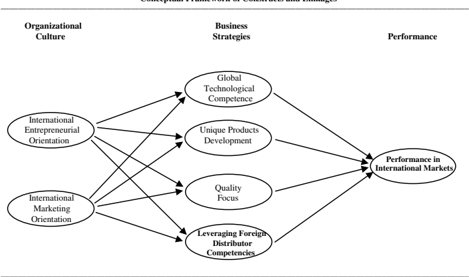
- The survey analysis found that international entrepreneurial orientation significantly predicted global technological competence with a standardized coefficient of 0.28; the link from international marketing orientation to global technological competence was not significant.
- Unique products development was significantly predicted by both international entrepreneurial orientation (0.19) and international marketing orientation (0.24).
- Quality focus was significantly predicted by both international entrepreneurial orientation (0.23) and international marketing orientation (0.35).
- Leveraging foreign distributor competences was significantly predicted by international marketing orientation (0.26) but not by international entrepreneurial orientation; these strategy variables were also significant drivers of performance in international markets: global technological competence (0.21), unique products development (0.14), quality focus (0.30), and leveraging foreign distributor competences (0.18).
## Methods
- The paper uses a two-phase design: first qualitative interviews/case studies to develop constructs and hypotheses, then a cross-industry field survey to test them.
- The qualitative phase included 33 professionals: 24 senior managers at early internationalizing firms, 6 scholars, and 3 international trade experts; the firms were mostly founded after 1985, sold half or more of their sales abroad, and had entered foreign markets within 3 years of founding.
- The survey was mailed to a random sample of 900 manufacturing firms in the United States founded in 1980 or later and exporting at least 25% of total production; 203 usable surveys were returned (about 23% response rate). The main analysis used LISREL8 path analysis, with exploratory factor analysis and confirmatory factor analysis for scale purification and validity checks.
## Limitations
- The paper states that “little empirical work” had been attempted on born globals and that there had been “almost no empirical research” on the factors driving their superior international performance.
- The study itself is focused on U.S. manufacturing firms that were selected using a 25% export threshold, so the evidence is tied to that sample and entry-mode context; this is evident from the text.
- The paper notes that the survey results are based on self-reported measures from responding firms; this is evident from the questionnaire-based design, though the paper does not frame it explicitly as a limitation.
Model-written summary. Check it against the paper before relying on it.
Integrity signals
Registry
Cites
Statistics
Figures
Verification
Claims the paper makes
0 Valid · 0 Not valid · 53 Not checked · 112 Own results and interpretations
A result the paper reports from its own data — it cites no other source for it, so there is none to check. The quote shows it is in the paper.
In the paper
“Despite the scarce resources typical of young firms, our findings reveal that born-global firms leverage a distinctive mix of orientations and strategies that allow them to succeed in diverse international markets.”
plainstates a cause- Asserted: passes — The authors put it forward as true.
- Checkable: passes — It can be checked against evidence.
- Load-bearing: passes — The paper’s conclusions depend on it.
- Based: passes — The paper gives a reason why it holds.
- Rests on an assumption not shown here.
A result the paper reports from its own data — it cites no other source for it, so there is none to check. The quote shows it is in the paper.
In the paper
“The critical role of marketing prowess overseas was also strongly emphasized by virtually all interviewees in the case studies.”
boosted- Asserted: passes — The authors put it forward as true.
- Checkable: passes — It can be checked against evidence.
- Load-bearing: unclear — It is unclear whether the paper’s conclusions depend on it.
- Based: passes — The paper gives a reason why it holds.
A result the paper states — it cites no source for it, so there is none to check. The quote shows it is in the paper.
In the paper
“Most interviewed firms exhibited strong technological capabilities in their respective product or industry categories.”
plain- Asserted: passes — The authors put it forward as true.
- Checkable: passes — It can be checked against evidence.
- Load-bearing: unclear — It is unclear whether the paper’s conclusions depend on it.
- Based: passes — The paper gives a reason why it holds.
A result the paper reports from its own data — it cites no other source for it, so there is none to check. The quote shows it is in the paper.
In the paper
“In general, the qualitative phase of the study revealed that born globals are likely to be formed by entrepreneurs who pursue foreign ventures with a strong marketing orientation.”
hedgedstates an association- Asserted: passes — The authors put it forward as true.
- Checkable: passes — It can be checked against evidence.
- Load-bearing: passes — The paper’s conclusions depend on it.
- Based: passes — The paper gives a reason why it holds.
A result the paper states — it cites no source for it, so there is none to check. The quote shows it is in the paper.
In the paper
“In contrast, born globals leverage a collection of fundamental intangible knowledge-based capabilities in the cultivation of foreign markets early in their evolution.”
plainstates a cause- Asserted: passes — The authors put it forward as true.
- Checkable: passes — It can be checked against evidence.
- Load-bearing: passes — The paper’s conclusions depend on it.
- Based: unclear — It is unclear why the paper says it holds.
- Rests on an assumption not shown here.
84 more claims
Create a free account to see all 165 claims and to verify the 3 references still open.
- It may state two separate claims as one. 33
- Probably not a substantial claim. 54
Citations
Cites
Evaluating Structural Equation Models with Unobservable Variables and Measurement Error
Fornell, C., & Larcker, D. F. (1981) · Journal of Marketing Research · doi:10.2307/3151312 · Cited by 109,314 · cited 2×
“Composite reliability was calculated using the procedures outlined by Fornell and Larcker (1981).”
MethodInfluentialEvaluating structural equation models with unobservable variables and measurement error
Fornell, C., & Larcker, D. F. (1981) · Journal of Marketing Research · doi:10.1177/002224378101800104 · Cited by 109,190
Firm Resources and Sustained Competitive Advantage
Barney, J. (1991) · Journal of Management · doi:10.1177/014920639101700108 · Cited by 48,334
(1994) · Journal of the American Dietetic Association · doi:10.1016/0002-8223(94)92216-0 · Cited by 45,910
Firm resources and sustained competitive advantage
Barney, J. B. (2004) · Advances in Strategic Management · doi:10.1016/s0742-3322(00)17018-4 · Cited by 38,152
Absorptive Capacity: A New Perspective on Learning and Innovation
Cohen, W. M., & Levinthal, D. A. (1990) · Administrative Science Quarterly · doi:10.2307/2393553 · Cited by 35,728
A resource‐based view of the firm
Wernerfelt, B. (1984) · Strategic Management Journal · doi:10.1002/smj.4250050207 · Cited by 25,635
The Theory of Economic Development
Schumpeter, J., & Backhaus, U. (2006) · The European Heritage in Economics and the Social Sciences · doi:10.1007/0-306-48082-4_3 · Cited by 22,506
An Evolutionary Theory of Economic Change.
Loasby, B. J., Nelson, R. R., & Winter, S. G. (1983) · The Economic Journal · doi:10.2307/2232409 · Cited by 21,366
A Dynamic Theory of Organizational Knowledge Creation
Nonaka, I. (1994) · Organization Science · doi:10.1287/orsc.5.1.14 · Cited by 17,809
Research works printed but not linked: 5
- Nikkei Sangyoo Shimbun (1995) Benchaa Shin Sedai (New Generation Ventures) , Nihon Keizai Shimbun: Tokyo.
- Nunnally, J.C. (1978) Psychometric Theory
- Porter, M.E. (1980) Competitive Strategy , The Free Press: New York.
- Rennie, M. (1993) 'Born global', McKinsey Quarterly (4): 45-52. Rosson, P. and Ford, I.D. (1982) 'Manufacturer-overseas distributor relations and export performance', Journal of International Business Studies 13 (2): 57-72.
- Schumpeter, J. (1939) Business Cycles , Vol. 1 McGraw-Hill: New York.
Cited by
Items 1,301–1,400 of 3,020
Pauwels, P., Patterson, P. G., de Ruyter, K., & Wetzels, M. G. M. (2009) · Advances in international marketing · doi:10.1108/s1474-7979(2009)0000020004 · Cited by 15
Lombardo, G. F., Fernández-Ortiz, R., & Cano‐Rubio, M. (2011) · Intangible Capital · doi:10.3926/ic.2011.v7n2.p428-473 · Cited by 12
Impact of export support: a conceptual model for export start-ups1
Catanzaro, A., Messeghem, K., & Sammut, S. (2015) · Management international · doi:10.7202/1030397ar · Cited by 21
“BGFs are able to acquire new knowledge (an internal intangible resource) if they have high learning capability (a dynamic capability) (Knight and Cavusgil, 2004).”
BackgroundInfluentialEconomic crisis and export‐oriented entrepreneurship: Evidence from Greece
Giotopoulos, I., & Vettas, N. (2018) · Managerial and Decision Economics · doi:10.1002/mde.2976 · Cited by 16
The internationalization of port managing bodies in concept and practice
Dooms, M., van der Lugt, L., Parola, F., Satta, G., & Song, D. (2019) · Maritime Policy & Management · doi:10.1080/03088839.2019.1584340 · Cited by 14
“Usually, according to the Uppsala approach, some kind of stage model is used (Johanson and Wiedersheim-Paul 1975; Knight and Cavusgil 2004; Contractor 2007) to explain firm’ internationalization pattern.”
MethodRashid, M. A., Kalyar, M. N., & Shafique, I. (2020) · South Asian Journal of Business Studies · doi:10.1108/sajbs-02-2019-0032 · Cited by 21
Liu, K., Asady, A. A., & Fu, K. (2020) · International Small Business Journal Researching Entrepreneurship · doi:10.1177/0266242620918823 · Cited by 13
“In the contemporary globalised business world, many entrepreneurs cross national borders to foreign host countries in search of entrepreneurial opportunities (Knight and Cavusgil, 2004; Oviatt and McDougall, 1994).”
BackgroundWhy Not Knowledge-Based HRM? Its Direct and Indirect Effect on Innovative Service Offerings
Ahmad, N., Imm, N. S., Aziz, Y. A., & Basha, N. K. (2020) · SAGE Open · doi:10.1177/2158244020983003 · Cited by 16
“Concerning technological capability, the study adapted the measures from Knight and Cavusgil (2004), Jin and Cho (2018), and Zou et al. (2010).”
MethodForeign direct investment and Olympic Games: A systematic literature review
Russo, E., & Figueira, A. R. (2021) · Journal of Convention & Event Tourism · doi:10.1080/15470148.2021.1949418 · Cited by 11
“…financial capital among the different nations, and if before we could only observe the international presence of large corporations, today there is the presence of small and medium-sized enterprises, many of which are already internationalized – the so-called born global (Knight & Cavusgil, 2004).”
BackgroundCho, J., Jeong, I., Kim, E., & Cho, H. E. (2022) · European Journal of Innovation Management · doi:10.1108/ejim-04-2022-0181 · Cited by 13
Uner, M. M., Çiğdemoğlu, C., Wang, Y., YALÇIN, A., & Cavusgil, S. T. (2022) · Review of International Business and Strategy · doi:10.1108/ribs-05-2022-0053 · Cited by 20
Self-citationNavaia, E. C., Moreira, A. C., & Ribau, C. P. (2023) · Economies · doi:10.3390/economies11020044 · Cited by 35
Human resource development and organisational performance: Evidence from Pakistan
Irfan, M., Khurshid, N., Khurshid, J., & Khokhar, A. M. (2023) · SA Journal of Human Resource Management · doi:10.4102/sajhrm.v21i0.2020 · Cited by 28
Lee, K., & Yoon, B. (2014) · R and D Management · doi:10.1111/radm.12082 · Cited by 17
“In fact, many studies have drawn diverse conclusions regarding the innovation levels of SMEs because it is generally assumed that smaller, younger companies are more innovative than large companies (Pavitt et al., 1987; Knight and Cavusgil, 2004; Hausman, 2005; Nunes et al., 2012).”
Monferrer, D., Blesa, A., & Meliá, M. R. (2012) · Economics Research International · doi:10.1155/2012/623685 · Cited by 15
“Furthermore, since this paper sets out to measure international market orientation in INVs, following Knight and Cavusgil [38], all the items refer to the international market.”
BackgroundResultInfluentialLee, H., Lee, K., & Kwak, J. (2012) · Asian Business & Management · doi:10.1057/abm.2012.28 · Cited by 14
“Researchers investigating ‘born global’ firms (Autio et al, 2000; Knight and Cavusgil, 2004) assert that such enterprises head overseas to attain and build FSAs.”
BackgroundResultFootloose and fancy-free: sojourning entrepreneurs in China
Almor, T., & Yeheskel, O. (2013) · Journal of Enterprising Communities People and Places in the Global Economy · doi:10.1108/jec-07-2012-0040 · Cited by 12
“These companies are reported with increasing frequency all over the world (Oviatt & McDougall, 1994, 1997; Freeman, et al., 2010; Knight & Cavusgil 2004).”
BackgroundThe Effect of Information and Communication Technology on Export Performance of Iranian Firms
Ghalandari, K. (2013) · Research Journal of Applied Sciences Engineering and Technology · doi:10.19026/rjaset.5.4431 · Cited by 11
“Larson (1992) focused on this process which had been initiated by one of his studied firms with the aim of providing economical advantage to both parties (Knight and Cavusgil, 2004). Kanter and Corn (1994) argue that success in this initial phase is dependent on the balance between organizational structures and person…”
BackgroundModels of internationalisation: the New Zealand experience
Scott‐Kennel, J. (2013) · International Journal of Business and Globalisation · doi:10.1504/ijbg.2013.052250 · Cited by 11
Conceptualising the Early and Rapid Internationalising Firms
Falahat, M., Migin, M. W., Chuan, C. S., & Kong, P. F. (2015) · Procedia - Social and Behavioral Sciences · doi:10.1016/j.sbspro.2015.11.080 · Cited by 17
Kim, M., Mahoney, J. T., & Tan, D. (2015) · European J of International Management · doi:10.1504/ejim.2015.071513 · Cited by 12
“This extension would likely contribute to the burgeoning research literature on ‘born global’ firms or international entrepreneurship (Fernhaber et al., 2008; Knight and Cavusgil, 2004; Oviatt and McDougall, 1994).”
BackgroundRadulovich, L. P. (2008) · OhioLink ETD Center (Ohio Library and Information Network) · Cited by 20
International Entrepreneurship in Latin America: Lessons from Theory and Practice
Amorós, J. E., Ciravegna, L., Etchebarne, M. S., Felzensztein, C., & Haar, J. (2015) · Palgrave Macmillan UK eBooks · doi:10.1057/9781137409126_4 · Cited by 14
Unveiling International New Ventures’ Success: Employee’s Entrepreneurial Behavior
Hernandez, M. (2019) · Administrative Sciences · doi:10.3390/admsci9030056 · Cited by 17
“Knight and Cavusgil (2004) have argued that promoting an entrepreneurial behavior should be instrumental for the development and enactment of key organizational routines in the INV to succeed in the international markets.”
BackgroundInfluentialHe, J., Chen, H., & Tsai, F.-S. (2020) · Sustainability · doi:10.3390/su12010344 · Cited by 11
“Strategy orientation determines the behavior of the enterprise and is deeply rooted in a set of values that guide the development of an enterprise strategy, which facilitates critical thinking for enterprises that helps them to survive and thrive in an increasingly competitive global market [19].”
BackgroundAn entrepreneurial view of universal work-integrated learning
Dorland, A., Finch, D., Levallet, N., Raby, S. O., Ross, S., & Swiston, A. (2020) · Education + Training · doi:10.1108/et-11-2019-0260 · Cited by 18
Kumar, N., & Yakhlef, A. (2015) · Emerald Group Publishing Limited eBooks · doi:10.1108/s1474-797920140000025003 · Cited by 14
International entrepreneurship of universities: Process-oriented and capabilities perspectives
Sułkowski, Ł., & Patora-Wysocka, Z. (2020) · Entrepreneurial Business and Economics Review · doi:10.15678/eber.2020.080310 · Cited by 15
“The timing dimension refers to activities to be internationalised from their inception, as a result of seeking to derive much of revenues from sales abroad (Aspelund & Moen, 2005) or establishing a startup operating abroad (Knight & Cavusgil, 2004).”
BackgroundSanguineti, F., Majocchi, A., & Cavusgil, S. T. (2021) · International Business Review · doi:10.1016/j.ibusrev.2021.101904 · Cited by 13
Self-citationInnovation in European Academic Libraries – Leadership Perspective
Lembinen, L. (2021) · Journal of Library Administration · doi:10.1080/01930826.2021.1984136 · Cited by 12
“Libraries are like well-established businesses with their systematized routines and habits that are difficult to alter and hinder their innovating capacity (Jantz, 2017a; Knight & Cavusgil, 2004).”
BackgroundEtemad, H. (2021) · Journal of International Entrepreneurship · doi:10.1007/s10843-021-00304-9 · Cited by 14
Digitalisation levels of innovation management practices – pilot study of service SMEs in Poland
Łobacz, K., & Tylżanowski, R. (2022) · Procedia Computer Science · doi:10.1016/j.procs.2022.09.438 · Cited by 11
Reading as a method of inquiry: Representations of the born global
McGaughey, S. L. (2006) · Management International Review · doi:10.1007/s11575-006-0101-y · Cited by 14
Industry Structure Characteristics and International Entrepreneurship in India’s Software Industry
Majumdar, S. K., Vora, D. E., & Nag, A. K. (2010) · The Journal of Entrepreneurship · doi:10.1177/097135571001900202 · Cited by 16
“Research on fi rm age (Autio et al., 2000) or knowledge resources (Knight and Cavusgil, 2004) on born global fi rms’ presence in certain industry segments would be interesting.”
BackgroundInfluentialKong, E., Chadee, D. D., & Raman, R. (2012) · International Journal of Learning and Change · doi:10.1504/ijlc.2012.045853 · Cited by 12
Smaller Firms' Perceived Cost and Attractiveness in International Markets
Suh, T., Bae, M., & Kundu, S. K. (2008) · Journal of Global Marketing · doi:10.1300/j042v21n01_02 · Cited by 14
“This result confirmedthecurrentsituationofsmall firmsin which lack of some tangible resources does not mean staying domestic (Knight and Cavusgil, 2004; Knight et al., 2004; Gabrielsson et al., 2004).”
BackgroundSourcing or selling: the Value Flame at the Base of the Pyramid
Williams, R. L., Omar, M., & Ensor, J. (2011) · Marketing Intelligence & Planning · doi:10.1108/02634501111129220 · Cited by 18
“Any born global firm, regardless of experience or resources, can compete on an international basis ( Knight and Cavusgil, 2004”
BackgroundThe laws of attraction: What attracts innovative start-up firms to partnerships with global MNCs?
Vapola, T. J. (2010) · Journal of International Entrepreneurship · doi:10.1007/s10843-010-0068-4 · Cited by 16
“The base parameters required for all case firms, aligned with Knight and Cavusgil (2004) , are summarized in Table 3.”
MethodGardó, T. F., García, H. C., & Almanzar, M. A. (2017) · CIRIEC-España revista de economía pública social y cooperativa · doi:10.7203/ciriec-e.89.8905 · Cited by 14
What geographical scope works best for rapidly internationalizing SMEs?
Hånell, S. M., & Nordman, E. R. (2018) · Journal of Business and Industrial Marketing · doi:10.1108/jbim-11-2017-0299 · Cited by 16
Global Supply Chain Management and Delivery Performance: a Contingent Perspective
Golini, R., & Kalchschmidt, M. (2011) · Springer eBooks · doi:10.1007/978-1-84996-525-5_16 · Cited by 11
“From one side the shorter the product life cycle the higher the interest in rapidly reaching a global market ( Anderson and Gatignon, 1986 ).”
BackgroundInformation technology capability, organizational culture, and export performance
Zhang, M. (2005) · Research Exchange (Washington State University) · doi:10.7273/000007138 · Cited by 23
Oleksiuk, A., & Rull Quesada, K. (2023) · Central European Management Journal · doi:10.1108/cemj-12-2022-0254 · Cited by 10
Shi, L. H., Smith, J. B., Zou, S., Han, Y., & Tan, K. (2024) · Journal of World Business · doi:10.1016/j.jwb.2024.101550 · Cited by 12
Nave, E., Ferreira, J. J., & Carneiro, J. (2024) · Journal of International Management · doi:10.1016/j.intman.2024.101162 · Cited by 19
Meuric, P.-L. (2024) · International Business Review · doi:10.1016/j.ibusrev.2024.102317 · Cited by 12
Leveraging intersections in management
Aversa, P., Bettinelli, C., Levanti, G., Destri, A. M. L., & Picone, P. M. (2024) · Journal of Management & Governance · doi:10.1007/s10997-024-09710-2 · Cited by 12
Rehman, S. U. (2024) · Business Process Management Journal · doi:10.1108/bpmj-04-2024-0299 · Cited by 18
Post-entry advancement of international service firms in Australia: A longitudinal approach
Shukla, A., & Dow, D. (2010) · Scandinavian Journal of Management · doi:10.1016/j.scaman.2010.06.004 · Cited by 10
A Patulous Progress: International Entrepreneurship Effects on Chinese Born-Global Firm Performance
Ying, Y., Hu, X., Wang, Y., & Ward, P. (2020) · Sustainability · doi:10.3390/su12145508 · Cited by 12
“As such, it provides the foundation for firms to interact with international markets [52].”
BackgroundInfluentialNurhas, I., Geisler, S., & Pawlowski, J. Μ. (2022) · Sustainable Development · doi:10.1002/sd.2338 · Cited by 13
Research on Chinese Born Global Firms’ International Entrepreneurial Mechanism and Development Mode
Zhang, J., & Dai, X. (2013) · International Business Management · doi:10.3968/j.ibm.1923842820130701.1125 · Cited by 10
The Internationalisation Process of the Smaller Firm: An Examination of the Craft Microenterprise
Fillis, I. R. (2008) · The Open Business Journal · doi:10.2174/1874915100801010053 · Cited by 22
“Researchers are now examining the phenomenon of ‘instant’ or ‘born global’ internationalising firms in a number of sectors, from hi-tech industries [32, 54, 55] to the entrepreneurial arts and craft firm.”
BackgroundInfluence of Information Systems Strategic Orientation on SMEs’ Perception of Export Barriers
Rajendran, R. P. (2019) · Entrepreneurship and development in South Asia · doi:10.1007/978-981-10-6298-8_7 · Cited by 11
Born Global Firm Internationalisation: The Influence of Industry Factors
Taylor, M., & Jack, R. G. (2016) · Contemporary Management Research · doi:10.7903/cmr.14892 · Cited by 30
“As the entry mode for born global firms is largely overlooked within the literature, it is important that it be emphasised as a major strategic decision in born global firms’ internationalisation (Hashai, 2011; Knight & Cavusgil, 2004).”
BackgroundMethodResultCowden, B. J., Tang, J., & Bendickson, J. S. (2016) · New England journal of entrepreneurship · doi:10.1108/neje-19-02-2016-b004 · Cited by 17
“On the other hand, other researchers (e.g., Knight & Cavusgil, 2004) have used the idea of administrative heritage to explain why existing firms are not able to adapt to changing needs in a dynamic world.”
BackgroundInternationalization to survive; the case of renewable energy companies in Spain
Manesh, S. M. Z. E., & Rialp, A. (2017) · Competitiveness Review An International Business Journal incorporating Journal of Global Competitiveness · doi:10.1108/cr-09-2015-0076 · Cited by 15
Prior Knowledge and Entrepreneurial Cognition
Shepherd, D. A., & Patzelt, H. (2018) · Springer eBooks · doi:10.1007/978-3-319-71782-1_2 · Cited by 19
“A majority of international entrepreneurship research has focused on new ventures (Zahra and George 2002), particularly on such ventures’ need to address substantial limitations stemming from their newness and smallness as a prerequisite for internationalization (Knight and Cavusgil 2004).”
BackgroundRisk Management as a Success Factor in the International Activity of Spanish Engineering
Lozano-Torró, A., García-Segura, T., Montalbán-Domingo, L., & Pellicer, E. (2019) · Administrative Sciences · doi:10.3390/admsci9010015 · Cited by 13
“…to the capacity for innovation and learning developed by a company and transferred to its subsidiaries or vice versa (Franco Lasús 2011), constituting innovation as a key resource for accessing foreign markets (Cassiman and Golovko 2011; Knight and Cavusgil 2004; Rodríguez and Rodríguez 2005).”
BackgroundSMEs’ Export Performance: The Effect of Learning Orientation and Innovativeness
İsmail, D., Hamid, R. B. A., Senik, Z. C., Othman, A. S., & Juhdi, N. H. (2018) · Jurnal Pengurusan · doi:10.17576/pengurusan-2018-54-01 · Cited by 15
Rialp, A., Manesh, S. M. Z. E., & Moen, Ø. (2019) · Critical Perspectives on International Business · doi:10.1108/cpoib-03-2018-0031 · Cited by 12
Conceptualizing big data practices
Lin, C., Kunnathur, A. S., & Li, L. (2020) · International Journal of Accounting and Information Management · doi:10.1108/ijaim-12-2018-0154 · Cited by 13
Organisational context and behavioural complexity affecting ambidextrous behaviours among SMEs
Poon, W. C., & Mohamad, O. (2020) · International Journal of Organization Theory and Behavior · doi:10.1108/ijotb-03-2019-0037 · Cited by 11
Founder ethnic composition, early internationalization, and new venture performance
Jiang, G., Kotabe, M. “., & Zhang, F. (2020) · Journal of International Entrepreneurship · doi:10.1007/s10843-020-00281-5 · Cited by 10
“It has been argued that internationalization is a crucial path for firm growth particularly when new ventures are constrained within a domestic market (Knight and Cavusgil 2004; Lu and Beamish 2001).”
BackgroundEffects of Exhibitors’ Trade Show Participation on market performance: longitudinal research
Kim, B.-S., Kim, K.-B., Park, C., & Lee, J. (2020) · Asia Pacific Journal of Tourism Research · doi:10.1080/10941665.2020.1851275 · Cited by 16
A born global’s radical, gradual and nonlinear internationalization: A case from Belarus
Vissak, T., & Zhang, X. (2016) · Journal of East European Management Studies · doi:10.5771/0949-6181-2016-2-209 · Cited by 13
Driving Creativity: Extending Knowledge Management into the Multinational Corporation
Gabberty, J. W., & Thomas, J. (2007) · Interdisciplinary Journal of Information Knowledge and Management · doi:10.28945/96 · Cited by 13
“…maintaining , and improving knowledge management systems designed specifically to enhance firmwide creativity by leveraging information technology assets are sparse, and in some cases contradictory (Cairncross, 2002; Carayannis, 1999; Darroch & McNaughton, 2002; Knight & Cavusgil, 2004).”
Papel das relações interorganizacionais e da capacidade de inovação na propensão para exportar
Boehe, D. M., Larentis, F., Toni, D. D., & Mattia, A. Á. (2011) · REAd Revista Eletrônica de Administração (Porto Alegre) · doi:10.1590/s1413-23112011000100004 · Cited by 16
Lecture des entreprises à internationalisation précoce et rapide par le Business Model
Servantie, V., & Verstraete, T. (2013) · Revue de l’Entrepreneuriat · doi:10.3917/entre.113.0055 · Cited by 16
International entrepreneurial culture of Thai SMEs
Baimai, C., & Mukherji, A. (2015) · Journal of global entrepreneurship research · doi:10.1186/s40497-015-0041-8 · Cited by 15
“Strategy is also another important variable that plays a mediating role between entrepreneurial orientation (Atuahene-Gima and Ko, 2001) as well as learning orientation (Julien and Ramangalahy, 2003) market orientation (Knight and Cavusgil, 2004) and firms’ performance.”
BackgroundInfluentialDal-Soto, F., Paiva, E. L., & de Souza, Y. S. (2007) · Revista de Administração de Empresas · doi:10.1590/s0034-75902007000300004 · Cited by 10
Aspelund, A., & Moen, C. F. (2010) · Journal of Management & Governance · doi:10.1007/s10997-010-9144-3 · Cited by 10
Internationalisation of the Korean online game industry: exemplified through the case of NCsoft
Ström, P., & Ernkvist, M. (2012) · International Journal of Technology and Globalisation · doi:10.1504/ijtg.2012.050962 · Cited by 10
“, Johanson and Vahlne, 2003; Knight and Cavusgil, 2004). To be successful it is a question of “discovering, integrating and adapting new business ideas into the structures and networks of the global economy” [Mathews and Zander, (2007), p.”
BackgroundZaki, A. M., Edwards, D. J., & El-Gohary, H. O. (2015) · International Journal of Customer Relationship Marketing and Management · doi:10.4018/ijcrmm.2015100101 · Cited by 12
Internationalisation of Born Globals from The Theoretical Perspective
Daszkiewicz, N. (2015) · Problemy Zarządzania - Management Issues · doi:10.7172/1644-9584.51.5 · Cited by 10
Foreign business ownership and domestic entrepreneurial exports
Thompson, P., & Zang, W. (2016) · Journal of Small Business and Enterprise Development · doi:10.1108/jsbed-10-2015-0138 · Cited by 12
“The stage of business development is negatively associated with exporting (Knight and Cavusgil, 2004).”
BackgroundCooperation and innovation in the internationalisation of knowledge-intensive business services
Rodríguez, A., & Nieto, M. J. (2010) · Progress in international business research · doi:10.1108/s1745-8862(2010)0000005015 · Cited by 21
Capital investment and internationalization
Vithessonthi, C. (2016) · Journal of Economics and Business · doi:10.1016/j.jeconbus.2016.12.003 · Cited by 12
Effect of intergroup-based emotions on attitude towards cross-ethnic products
Oyedele, A., & Hernandez, M. D. (2017) · Journal of Consumer Marketing · doi:10.1108/jcm-01-2015-1282 · Cited by 11
Enhancing the understanding of international new ventures: a service-oriented perspective
Laudien, S. M., & Daxböck, B. (2017) · Management Research Review · doi:10.1108/mrr-07-2015-0169 · Cited by 14
Reverse Innovation Reconceptualised: Much Geo-Economic Ado about Primary Market Shift
Radojević, N. (2018) · Management international · doi:10.7202/1043077ar · Cited by 13
“For example, while the legacy of innovation by default will more likely constrain large MNEs, major obstacles to SMEs could be more attributable to their comparatively tight financial resources (Knight and Cavusgil, 2004; OECD, 2013).”
BackgroundInternational new ventures and firm performance: evidence from India
Fuad, M., & Akbar, M. I. (2018) · European Business Review · doi:10.1108/ebr-07-2016-0099 · Cited by 15
Explaining success perception of Polish international new ventures: Four perspectives
Sikora, T., & Baranowska‐Prokop, E. (2018) · Economics & Sociology · doi:10.14254/2071-789x.2018/11-4/7 · Cited by 13
Cooperation Networks and Embeddedness—The Case of the Portuguese Footwear Sector
Rocha, R., Galvão, A. R., Marques, C. S., et al. (2020) · Sustainability · doi:10.3390/su12229612 · Cited by 10
“Network theory, in turn, helped to understand the basis on which companies develop this process [8,9].”
BackgroundKnowledge integration in international SMEs – The effects on firm innovation and performance
Azari, M. J., Aspelund, A., & Eide, A. E. (2020) · Cogent Business & Management · doi:10.1080/23311975.2020.1849890 · Cited by 15
“…international efforts during the last three years with regard to: Loadings Cronbach’s Alpha Source(s) Achieved market share 0.843 0.919 Madsen (1998), Knight and Cavusgil (2004) Sales Growth 0.856 Sales growth compared to competitors 0.847 Earnings/profitability 0.785 The image the company has…”
BackgroundInfluentialThe Internationalization of SMEs: Strategic Choices Under a Cognitive Approach
Vlačić, B., González‐Loureiro, M., & Eduardsen, J. S. (2019) · Advances in business strategy and competitive advantage book series · doi:10.4018/978-1-5225-8479-7.ch017 · Cited by 16
Knowledge Flows and the Modeling of the Multinational EnterprisePreprint
Adler, N., & Hashai, N. (2007) · SSRN Electronic Journal · Cited by 10
International Dynamic Marketing Capabilities of Emerging-Market Small Business on E-commercePreprint
Kim, K., & Lim, G. G. (2022) · Preprints.org · doi:10.20944/preprints202110.0068.v2 · Cited by 10
“We adopted qualitative study methods to derive findings from under-studied phenomena [33], and to understand processes that could not be disassociated from their context [11, 13, 30, 57].”
MethodHorng, J., Liu, C.-H. S., Chou, S.-F., & Hu, D.-C. (2021) · International Journal of Hospitality & Tourism Administration · doi:10.1080/15256480.2021.2015040 · Cited by 13
Hua, W., Mitchell, R. K., Mitchell, B. T., Mitchell, J., & Israelsen, T. L. (2022) · Journal of Business Venturing · doi:10.1016/j.jbusvent.2022.106260 · Cited by 9
Hashmi, H. B. A., Ooms, W., Voinea, C. L., & Caniëls, M. C. J. (2023) · International Journal of Emerging Markets · doi:10.1108/ijoem-08-2021-1178 · Cited by 15
Idris, M. M. (2024) · ATESTASI Jurnal Ilmiah Akuntansi · doi:10.57178/atestasi.v7i2.878 · Cited by 29
Knocking on Heaven’s Door? Entrepreneurship, Firm Growth, and Health Risks
Partanen, J. P., Tenhiälä, A., Kautonen, T., Jokela, M. M., Lerner, D. A., & McKelvie, A. (2024) · Entrepreneurship Theory and Practice · doi:10.1177/10422587241280079 · Cited by 12
“…as sales growth frequently requires establishing and expanding marketing and distribution networks (Lechner & Dowling, 2003), scaling up manufacturing processes (Arend & Wisner, 2005), and developing new organizational capabilities to expand in international markets (Knight & Cavusgil, 2004).”
Sadraei, R. (2024) · The International Journal of Entrepreneurship and Innovation · doi:10.1177/14657503241294194 · Cited by 17
“SMEs, aiming to enhance returns on their innovations, typically engage in international-isation efforts (Knight and Cavusgil, 2004; Oviatt and McDougall, 1994; Sadraei, et al., 2022).”
Liability of outsidership in multinational enterprises: a review and research agenda
Weerasekera, S., Herath, S. M., & Wijewardena, C. (2025) · Review of International Business and Strategy · doi:10.1108/ribs-08-2024-0093 · Cited by 12
Jalali, H. S. (2025) · Journal of Entrepreneurship in Emerging Economies · doi:10.1108/jeee-12-2024-0590 · Cited by 9
Yang, Y., Chung, H. F. L., Elms, J., & Fletcher, P. (2025) · Industrial Marketing Management · doi:10.1016/j.indmarman.2025.08.001 · Cited by 7
Características de los directivos de las empresas Born Global en Colombia
Escandón‐Barbosa, D., & Ayala, A. H. (2012) · ENTRAMADO · Cited by 17
Product Strategies for Export Ventures: An Empirical Investigation among SMEs in an Emerging Economy
Ayob, A. H., & Dana, L. (2017) · Jurnal Pengurusan · doi:10.17576/pengurusan-2017-50-03 · Cited by 11
Brazilian craft breweries and internationalization in the born global perspective
Stocker, F., Abib, G., Jhunior, R. D. O. S., et al. (2021) · Revista de Gestão · doi:10.1108/rege-01-2021-0014 · Cited by 9
Metadata
- Authors
- Knight, G. A., & Cavusgil, S. T.
- Affiliations
- Florida State University (US)
- Corresponding author
- Knight, Gary A
- ORCID
- Knight, Gary A
- Venue
- Journal of International Business Studies
- Published
- 2004-01-08
- Volume
- 35
- Issue
- 2
- Pages
- 124-141
- ISSN
- 0047-2506 (ISSN-L)
- 1478-6990
- OpenAlex
- W2127709152
- Semantic Scholar
- d24960b5342d0dd3b86be002ab18a80e7b6fb5c9
- Cited by
- 3,013
- References
- 102
- Citations by year
- 2026: 121 · 2025: 123 · 2024: 157 · 2023: 154 · 2022: 182 · 2021: 196 · 2020: 189 · 2019: 180 · 2018: 199 · 2017: 172 · 2016: 188 · 2015: 187 · 2014: 178 · 2013: 167 · 2012: 129
- FWCI
- 137.12
- Type
- journal article
- Language
- en
- Update notices
- correction (2004-07-16)
- Open access
- bronze
- doi.org
- Licence
- www.springer.com/tdm (tdm)
- Locations
- Journal of International Business Studies (publishedVersion)
- RePEc: Research Papers in Economics (submittedVersion)
- Funders
- Michigan State University
- College of Engineering, Michigan State University
- Topics
- Social Sciences › Business, Management and Accounting › Strategy and Management › International Business and FDI
- Social Sciences › Business, Management and Accounting › Strategy and Management › Innovation and Knowledge Management
- Social Sciences › Communication › International Student and Expatriate Challenges
- Keywords
- born global firms, early internationalization, organizational capabilities, innovation, innovation culture, international business strategy, international success, young firms, internationalization of firms
About these checks
Registry, retraction, Cites and statistics results are computed, not judged, with one exception: a printed reference that no index lists is read once by a model before it counts as a citation error. Claims are extracted by a model and kept only when their quote appears verbatim in the text; each cited source is then checked, with a model’s help, for whether it says what the claim relies on. Those verdicts can be wrong — read the claim’s quote and the cited source before relying on one.
A language model drew the claims from the paper on 2026-10-10, under version 3 of the claim definition (model deepseek-v4.1-flash, prompt extract-v3).
A second model labelled each claim on 2026-10-10 (model jev-1.13-20260917, definition revision gold-guideline-v0.2).
Statistics and arithmetic are recomputed, not judged.
Confidence bands are shown only for fields calibrated on our annotated test set. None is calibrated yet, so no band is shown.
What counts as a claim ›How we measure confidence ›How we check this ›
Are you an author, or do you see a problem with this page? Request a review
Data sources
Bibliographic data: Semantic Scholar, OpenAlex, Crossref.
Contains information from the Semantic Scholar Academic Graph Datasets, made available under the ODC Attribution License (ODC-BY 1.0).
Semantic Scholar’s data is described in: Kinney, R., et al. (2023). The Semantic Scholar Open Data Platform. arXiv:2301.10140.
