

Innovation, organizational capabilities, and the born-global firm
Open accessThe DOI matches its Crossref record; 106 of the 106 references it cites were found in a registry or an index; none of the 100 sources its claims cite is checked for support yet.
Overview
CoChat Summary
## TL;DR
This study argues that born-global firms succeed because early internationalization is supported by an innovative culture and a distinctive set of organizational capabilities. Using qualitative case studies followed by a survey of 203 usable responses, the authors find that several capability links are significant and that these capabilities are associated with performance in international markets.
## Key findings
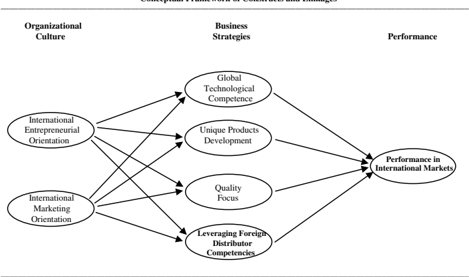
- The survey analysis found that international entrepreneurial orientation significantly predicted global technological competence with a standardized coefficient of 0.28; the link from international marketing orientation to global technological competence was not significant.
- Unique products development was significantly predicted by both international entrepreneurial orientation (0.19) and international marketing orientation (0.24).
- Quality focus was significantly predicted by both international entrepreneurial orientation (0.23) and international marketing orientation (0.35).
- Leveraging foreign distributor competences was significantly predicted by international marketing orientation (0.26) but not by international entrepreneurial orientation; these strategy variables were also significant drivers of performance in international markets: global technological competence (0.21), unique products development (0.14), quality focus (0.30), and leveraging foreign distributor competences (0.18).
## Methods
- The paper uses a two-phase design: first qualitative interviews/case studies to develop constructs and hypotheses, then a cross-industry field survey to test them.
- The qualitative phase included 33 professionals: 24 senior managers at early internationalizing firms, 6 scholars, and 3 international trade experts; the firms were mostly founded after 1985, sold half or more of their sales abroad, and had entered foreign markets within 3 years of founding.
- The survey was mailed to a random sample of 900 manufacturing firms in the United States founded in 1980 or later and exporting at least 25% of total production; 203 usable surveys were returned (about 23% response rate). The main analysis used LISREL8 path analysis, with exploratory factor analysis and confirmatory factor analysis for scale purification and validity checks.
## Limitations
- The paper states that “little empirical work” had been attempted on born globals and that there had been “almost no empirical research” on the factors driving their superior international performance.
- The study itself is focused on U.S. manufacturing firms that were selected using a 25% export threshold, so the evidence is tied to that sample and entry-mode context; this is evident from the text.
- The paper notes that the survey results are based on self-reported measures from responding firms; this is evident from the questionnaire-based design, though the paper does not frame it explicitly as a limitation.
Model-written summary. Check it against the paper before relying on it.
Integrity signals
Registry
Cites
Statistics
Figures
Verification
Claims the paper makes
0 Valid · 0 Not valid · 53 Not checked · 112 Own results and interpretations
A result the paper reports from its own data — it cites no other source for it, so there is none to check. The quote shows it is in the paper.
In the paper
“Despite the scarce resources typical of young firms, our findings reveal that born-global firms leverage a distinctive mix of orientations and strategies that allow them to succeed in diverse international markets.”
plainstates a cause- Asserted: passes — The authors put it forward as true.
- Checkable: passes — It can be checked against evidence.
- Load-bearing: passes — The paper’s conclusions depend on it.
- Based: passes — The paper gives a reason why it holds.
- Rests on an assumption not shown here.
A result the paper reports from its own data — it cites no other source for it, so there is none to check. The quote shows it is in the paper.
In the paper
“The critical role of marketing prowess overseas was also strongly emphasized by virtually all interviewees in the case studies.”
boosted- Asserted: passes — The authors put it forward as true.
- Checkable: passes — It can be checked against evidence.
- Load-bearing: unclear — It is unclear whether the paper’s conclusions depend on it.
- Based: passes — The paper gives a reason why it holds.
A result the paper states — it cites no source for it, so there is none to check. The quote shows it is in the paper.
In the paper
“Most interviewed firms exhibited strong technological capabilities in their respective product or industry categories.”
plain- Asserted: passes — The authors put it forward as true.
- Checkable: passes — It can be checked against evidence.
- Load-bearing: unclear — It is unclear whether the paper’s conclusions depend on it.
- Based: passes — The paper gives a reason why it holds.
A result the paper reports from its own data — it cites no other source for it, so there is none to check. The quote shows it is in the paper.
In the paper
“In general, the qualitative phase of the study revealed that born globals are likely to be formed by entrepreneurs who pursue foreign ventures with a strong marketing orientation.”
hedgedstates an association- Asserted: passes — The authors put it forward as true.
- Checkable: passes — It can be checked against evidence.
- Load-bearing: passes — The paper’s conclusions depend on it.
- Based: passes — The paper gives a reason why it holds.
A result the paper states — it cites no source for it, so there is none to check. The quote shows it is in the paper.
In the paper
“In contrast, born globals leverage a collection of fundamental intangible knowledge-based capabilities in the cultivation of foreign markets early in their evolution.”
plainstates a cause- Asserted: passes — The authors put it forward as true.
- Checkable: passes — It can be checked against evidence.
- Load-bearing: passes — The paper’s conclusions depend on it.
- Based: unclear — It is unclear why the paper says it holds.
- Rests on an assumption not shown here.
84 more claims
Create a free account to see all 165 claims and to verify the 3 references still open.
- It may state two separate claims as one. 33
- Probably not a substantial claim. 54
Citations
Cites
Evaluating Structural Equation Models with Unobservable Variables and Measurement Error
Fornell, C., & Larcker, D. F. (1981) · Journal of Marketing Research · doi:10.2307/3151312 · Cited by 109,314 · cited 2×
“Composite reliability was calculated using the procedures outlined by Fornell and Larcker (1981).”
MethodInfluentialEvaluating structural equation models with unobservable variables and measurement error
Fornell, C., & Larcker, D. F. (1981) · Journal of Marketing Research · doi:10.1177/002224378101800104 · Cited by 109,190
Firm Resources and Sustained Competitive Advantage
Barney, J. (1991) · Journal of Management · doi:10.1177/014920639101700108 · Cited by 48,334
(1994) · Journal of the American Dietetic Association · doi:10.1016/0002-8223(94)92216-0 · Cited by 45,910
Firm resources and sustained competitive advantage
Barney, J. B. (2004) · Advances in Strategic Management · doi:10.1016/s0742-3322(00)17018-4 · Cited by 38,152
Absorptive Capacity: A New Perspective on Learning and Innovation
Cohen, W. M., & Levinthal, D. A. (1990) · Administrative Science Quarterly · doi:10.2307/2393553 · Cited by 35,728
A resource‐based view of the firm
Wernerfelt, B. (1984) · Strategic Management Journal · doi:10.1002/smj.4250050207 · Cited by 25,635
The Theory of Economic Development
Schumpeter, J., & Backhaus, U. (2006) · The European Heritage in Economics and the Social Sciences · doi:10.1007/0-306-48082-4_3 · Cited by 22,506
An Evolutionary Theory of Economic Change.
Loasby, B. J., Nelson, R. R., & Winter, S. G. (1983) · The Economic Journal · doi:10.2307/2232409 · Cited by 21,366
A Dynamic Theory of Organizational Knowledge Creation
Nonaka, I. (1994) · Organization Science · doi:10.1287/orsc.5.1.14 · Cited by 17,809
Research works printed but not linked: 5
- Nikkei Sangyoo Shimbun (1995) Benchaa Shin Sedai (New Generation Ventures) , Nihon Keizai Shimbun: Tokyo.
- Nunnally, J.C. (1978) Psychometric Theory
- Porter, M.E. (1980) Competitive Strategy , The Free Press: New York.
- Rennie, M. (1993) 'Born global', McKinsey Quarterly (4): 45-52. Rosson, P. and Ford, I.D. (1982) 'Manufacturer-overseas distributor relations and export performance', Journal of International Business Studies 13 (2): 57-72.
- Schumpeter, J. (1939) Business Cycles , Vol. 1 McGraw-Hill: New York.
Cited by
Items 301–400 of 3,020
Innovations within knowledge management
Nowacki, R., & Bachnik, K. (2015) · Journal of Business Research · doi:10.1016/j.jbusres.2015.10.020 · Cited by 136
Puthusserry, P. N., Khan, Z., Knight, G., & Miller, K. (2020) · Management International Review · doi:10.1007/s11575-020-00424-9 · Cited by 135
“This suggests that SMEs have unique capabilities and value offerings, however, research to date has failed to fully understand the factors of their success (Knight and Cavusgil 2004; Coviello 2015).”
BackgroundInfluentialSelf-citationTaylor, M., & Jack, R. G. (2012) · International Small Business Journal Researching Entrepreneurship · doi:10.1177/0266242611431992 · Cited by 129
“…of born global firms to discount the familiarity of psychically close markets is that they often possess innovative corporate cultures and exist in knowledge-intensive industries which allow them to prevail over cultural distance (Autio et al., 2000; Bell et al., 2001; Knight and Cavusgil, 2004).”
BackgroundResultInfluentialGerschewski, S., & Xiao, S. S. (2014) · International Business Review · doi:10.1016/j.ibusrev.2014.11.003 · Cited by 124
Knowledge and internationalization of returnee entrepreneurial firms
Bai, W., Johanson, M., & Martín, Ó. M. (2016) · International Business Review · doi:10.1016/j.ibusrev.2016.12.006 · Cited by 112
“…firms’ internationalization is likely to display some common characteristics with the expansion of international new ventures (Jones & Coviello, 2005; Knight & Cavusgil, 2004) because of their possession of entrepreneurial abilities, knowledge and experience with doing business abroad from…”
BackgroundOpen strategy-making with crowds and communities: Comparing Wikimedia and Creative Commons
Dobusch, L., & Kapeller, J. (2017) · Long Range Planning · doi:10.1016/j.lrp.2017.08.005 · Cited by 137
Hughes, M., Cesinger, B., Cheng, C.-F., Schuessler, F., & Kraus, S. (2017) · Industrial Marketing Management · doi:10.1016/j.indmarman.2017.12.001 · Cited by 119
“…factors identified among existing studies to explain BGs’ successful internationalization against their slower counterparts are: international market knowledge (Knight & Cavusgil, 2004), international experience (Harveston, Kedia, & Davis, 2000), and the level of education (Zucchella et al., 2007).”
BackgroundFraccastoro, S., Gabrielsson, M., & Chetty, S. (2020) · Journal of World Business · doi:10.1016/j.jwb.2020.101164 · Cited by 138
The Importance of Digital Transformation in International Business
Pereira, C. S., Durão, N., Moreira, F., & Veloso, B. (2022) · Sustainability · doi:10.3390/su14020834 · Cited by 174
“Knight and Cavusgil [47] argue that it is not enough to have digital technology and the necessary strong strategic market orientation; they also need to have distribution networks and market knowledge, among others, which can be obstacles to the companies and compromise the internationalization…”
BackgroundA Typology of International New Ventures: Empirical Evidence from High-Technology Industries
Baum, M., Schwens, C., & Kabst, R. (2011) · Journal of Small Business Management · doi:10.1111/j.1540-627x.2011.00328.x · Cited by 128
Cavusgil, S. T., Deligonul, S. Z., & Yaprak, A. (2005) · Journal of International Marketing · doi:10.1509/jimk.2005.13.4.1 · Cited by 115
“…on the global market scene of players from a much wider range of countries, including those that are quick to internationalize (i.e., “born global” firms); and the surfacing of marketing opportunities in the developing regions of the world (Knight and Cavusgil 2004; Prahalad and Lieberthal 1998).”
BackgroundSelf-citationKnowledge spillovers and new ventures’ export orientation
Clercq, D. D., Hessels, J., & van Stel, A. J. (2008) · Small Business Economics · doi:10.1007/s11187-008-9132-z · Cited by 126
“As one of their defining characteristic, international new ventures are international at their inception ( Knight and Cavusgil 2004; Oviatt and McDougall 1997).”
BackgroundUsing the wayback machine to mine websites in the social sciences: A methodological resource
Arora, S. K., Li, Y., Youtie, J., & Shapira, P. (2016) · Journal of the Association for Information Science and Technology · doi:10.1002/asi.23503 · Cited by 101
“Alternatively, other research suggests that start-up firms operating in niche markets may go directly to the international market, that is, become “born global,” to find customers or innovation partners (Knight & Cavusgil, 2004; Oviatt & McDougall, 1994, 2005).”
BackgroundMandler, T., Sezen, B., Chen, J., & Özsomer, A. (2021) · Journal of Business Research · doi:10.1016/j.jbusres.2020.12.023 · Cited by 146
International new ventures as “small multinationals”: The importance of marketing capabilities
Meliá, M. R., & Blesa, A. (2011) · Journal of World Business · doi:10.1016/j.jwb.2011.04.015 · Cited by 135
“Limited resources, and the need to guarantee operational flexibility in international markets would lead INVs to establish relationships with independent agents able to facilitate sales in these markets (Zacharakis, 1997; Zheng & Kavul, 2005; Knight & Cavusgil, 2004; Jantunen et al., 2005).”
BackgroundMethodInfluentialLaursen, K., Masciarelli, F., & Prencipe, A. (2012) · Journal of International Business Studies · doi:10.1057/jibs.2012.27 · Cited by 114
“…of empirical research on firms' export behavior that demonstrates the importance of innovation investment, in the form of R&D, as a major driver of firm success in export markets (e.g., Basile, 2001; Cassiman & Golovko, 2011; Fernández & Nieto, 2006; Ito & Pucik, 1993; Knight & Cavusgil, 2004).”
BackgroundCloud computing as a facilitator of SME entrepreneurship
Ross, P. K., & Blumenstein, M. (2014) · Technology Analysis and Strategic Management · doi:10.1080/09537325.2014.951621 · Cited by 127
Pellegrino, J. M., & McNaughton, R. B. (2017) · International Business Review · doi:10.1016/j.ibusrev.2016.12.003 · Cited by 131
Trudgen, R., & Freeman, S. (2014) · Management International Review · doi:10.1007/s11575-014-0210-y · Cited by 137
“To be classified BG in this study, firms needed have internationalised within 3 years of inception and derived at least 25 % of total sales from foreign markets (Knight and Cavusgil 2004).”
BackgroundInfluentialHow Firm Performance Affects Internationalization
Jung, J. C., & Bansal, P. (2009) · Management International Review · doi:10.1007/s11575-009-0014-7 · Cited by 112
Gillis, W. E., Combs, J. G., & Yin, X. (2018) · Journal of Business Venturing · doi:10.1016/j.jbusvent.2018.09.004 · Cited by 129
The internationalization of emerging market business groups: an integrated literature review
Yaprak, A., & Karademir, B. (2010) · International Marketing Review · doi:10.1108/02651331011037548 · Cited by 103
“While a few have followed the paths of born globals ( Knight and Cavusgil, 2004”
BackgroundLearning, unlearning and internationalisation: Evidence from the pre-export phase
Bueno, J. C. C., Acedo, F. J., & Barbero, J. L. (2009) · International Journal of Information Management · doi:10.1016/j.ijinfomgt.2009.07.005 · Cited by 120
Chabowski, B. R., Kekec, P., Morgan, N. A., Hult, G. T. M., Walkowiak, T., & Runnalls, B. A. (2018) · Journal of International Marketing · doi:10.1509/jim.16.0129 · Cited by 108
Crick, J. M., Crick, D., & Chaudhry, S. (2018) · Journal of Business Research · doi:10.1016/j.jbusres.2018.11.033 · Cited by 126
“…pivot strategies of de- and potential reinternationalising is potentially required (Bell et al., 2003; Yayla et al., 2018), unlike much of the existing INV literature that tends to consider a largely forward moving process (Oviatt & McDougall, 1994; Knight & Cavusgil, 2004; Coviello, 2015).”
BackgroundResultCalabrò, A., Campopiano, G., Basco, R., & Pukall, T. J. (2016) · European Management Journal · doi:10.1016/j.emj.2016.04.007 · Cited by 115
The Dynamic Capabilities of Meta‐Multinationals
Lessard, D. R., Teece, D. J., & Leih, S. (2016) · Global Strategy Journal · doi:10.1002/gsj.1126 · Cited by 128
Strategic capability configurations for the internationalization of SMEs: A study in equifinality
Raymond, L., & St‐Pierre, J. (2011) · International Small Business Journal Researching Entrepreneurship · doi:10.1177/0266242610391325 · Cited by 117
When marketing and innovation interact: The case of born-global firms
Efrat, K., Gilboa, S., & Yonatany, M. (2016) · International Business Review · doi:10.1016/j.ibusrev.2016.09.006 · Cited by 112
“…(Dai, Maksimov, Gilbert, & Fernhaber, 2014) and in BGs’ formation in particular (Knight & Cavusgil, 2004), the gap in research regarding the antecedents of innovativeness for BGs calls for further investigation (Cannone & Ughetto, 2014; Kim, Basu, Naidu, & Cavusgil, 2011; Knight & Cavusgil, 2004).”
BackgroundResultInfluentialChouaibi, S., & Chouaibi, J. (2021) · International Journal of Ethics and Systems · doi:10.1108/ijoes-12-2020-0203 · Cited by 122
Knowledge Combination and Knowledge Creation in a Foreign-Market Network
Tolstoy, D. (2009) · Journal of Small Business Management · doi:10.1111/j.1540-627x.2009.00268.x · Cited by 120
Landau, C., Karna, A., Richter, A., & Uhlenbruck, K. (2016) · Global Strategy Journal · doi:10.1002/gsj.1108 · Cited by 138
Meschi, P., Ricard, A., & Moore, E. T. (2017) · Journal of International Management · doi:10.1016/j.intman.2017.01.001 · Cited by 109
Are UK SMEs with active web sites more likely to achieve both innovation and growth?
Thompson, P., Williams, R., & Thomas, B. C. (2013) · Journal of Small Business and Enterprise Development · doi:10.1108/jsbed-05-2012-0067 · Cited by 121
“Younger firms have greater flexibility with their routines less deeply embedded (Knight and Cavusgil, 2004).”
BackgroundThe Psychic Distance Postulate Revised: From Market Selection to Speed of Market Penetration
Arenius, P. M. (2005) · Journal of International Entrepreneurship · doi:10.1007/s10843-005-4203-6 · Cited by 133
Choose Your Friends Carefully: Home-Country Ties and New Venture Internationalization
Prashantham, S., & Birkinshaw, J. (2015) · Management International Review · doi:10.1007/s11575-015-0244-9 · Cited by 123
Drivers and strategies of international new ventures from a Central European transition economy
Nowiński, W., & Rialp, A. (2013) · Journal of East European Management Studies · doi:10.5771/0949-6181-2013-2-191 · Cited by 94
Multicultural marketplaces: New territory for international marketing and consumer research
Demangeot, C., Broderick, A. J., & Craig, C. S. (2015) · International Marketing Review · doi:10.1108/imr-01-2015-0017 · Cited by 128
Oliva, F. L., Teberga, P. M. F., Testi, L. I. O., Kotabe, M. “., Giudice, M. D., Kelle, P., & Cunha, M. P. E. (2021) · Technological Forecasting and Social Change · doi:10.1016/j.techfore.2021.121346 · Cited by 139
Zalan, T. (2018) · Review of International Business and Strategy · doi:10.1108/ribs-08-2017-0069 · Cited by 116
“…Vahlne, 1977) or the network theory perspective (Coviello, 2006; Madsen and Servais, 1997; Oviatt and McDougall, 2005) to incorporate, for example, the resource- and knowledge-based perspective (Knight and Cavusgil, 2004; Rialp et al., 2005; Weerawardena et al., 2007; Cavusgil and Knight, 2015).”
BackgroundNemkova, E. (2017) · Journal of Business Research · doi:10.1016/j.jbusres.2017.04.017 · Cited by 112
“…however, the majority agree that BG firms are those that start internationalization within three years of their domestic establishment and derive at least 25% of sales from international markets (e.g. Knight & Cavusgil, 2004; Kuivalainen, Saarenketo, & Puumalainen, 2012; Madsen, 2013).”
BackgroundWach, K. (2015) · Entrepreneurial Business and Economics Review · doi:10.15678/eber.2015.030202 · Cited by 120
Kuivalainen, O., Puumalainen, K., Sintonen, S., & Kyläheiko, K. (2010) · Journal of International Entrepreneurship · doi:10.1007/s10843-010-0057-7 · Cited by 123
“In order to overcome these problems, many internationalising SMEs do not follow traditional incremental internationalisation models (see e.g., Bell 1995; Knight and Cavusgil 1996, 2004; Moen and Servais 2002; Sapienza et al. 2006; Gabrielsson and Pelkonen 2008).”
BackgroundInfluentialHilmersson, M., Johanson, M., Lundberg, H., & Papaioannou, S. (2016) · Journal of International Marketing · doi:10.1509/jim.16.0013 · Cited by 111
Weerawardena, J., Mort, G. S., & Liesch, P. W. (2017) · Industrial Marketing Management · doi:10.1016/j.indmarman.2017.06.004 · Cited by 111
Social Capital and Indian Micromultinationals
Prashantham, S. (2010) · British Journal of Management · doi:10.1111/j.1467-8551.2010.00720.x · Cited by 118
Strategic orientations and strategies of high technology ventures in two transition economies
Lau, C. M., & Bruton, G. D. (2010) · Journal of World Business · doi:10.1016/j.jwb.2010.07.011 · Cited by 114
“Specifically, if these firms are able to focus on capability development, such as investing in new products, upgrading of existing products, as well as investing in human resources, we would expect them to have much better performance than others (Knight & Cavusgil, 2004; Lin & Chen, 2006).”
BackgroundInternational new ventures: rapid internationalization across different industry contexts
Andersson, S., Evers, N., & Kuivalainen, O. (2014) · European Business Review · doi:10.1108/ebr-05-2014-0040 · Cited by 121
Born global firms’ growth and collaborative entry mode: the role of transnational entrepreneurs
Liu, Y. (2017) · International Marketing Review · doi:10.1108/imr-05-2015-0130 · Cited by 107
“Born global firms are commonly characterised as young, knowledge-intensive organisations that typically sell innovative, self-developed technology-based products to global markets (Almor, 2011; Knight & Cavusgil, 2004; Oviatt & McDougall, 1994).”
International Entrepreneurial Orientation (IEO): A bibliometric overview of scholarly research
Gupta, R. K., Pandey, R., & Sebastian, V. J. (2020) · Journal of Business Research · doi:10.1016/j.jbusres.2020.12.005 · Cited by 111
Baum, M., Schwens, C., & Kabst, R. (2011) · International Small Business Journal Researching Entrepreneurship · doi:10.1177/0266242611428343 · Cited by 117
Antecedents of SME export intensity in a Latin American Market
Bianchi, C., & Wickramasekera, R. (2016) · Journal of Business Research · doi:10.1016/j.jbusres.2016.02.041 · Cited by 113
“Although several studies address the factors that drive SME exports (e.g. Knight & Cavusgil, 2004), scant research considers the export process of SMEs from emerging economies (M. Wright, Filatotchev, Hoskisson & Peng, 2005) and in particular from Latin America (Da Rocha, Cotta de Mello, Pacheco &…”
BackgroundCrick, D., & Crick, J. M. (2014) · European Business Review · doi:10.1108/ebr-12-2012-0073 · Cited by 123
Management dynamics in the knowledge economy
Amelio, S. (2016) · Cited by 88
Becoming a multinational enterprise: Using industry recipes to achieve rapid multinationalization
Monaghan, S., & Tippmann, E. (2018) · Journal of International Business Studies · doi:10.1057/s41267-017-0137-1 · Cited by 104
Country institutional environments and international strategy: A review and analysis of the research
Xu, K., Hitt, M. A., Brock, D., Pisano, V., & Huang, L. (2020) · Journal of International Management · doi:10.1016/j.intman.2020.100811 · Cited by 108
Rapidly internationalizing ventures: how definitions can bridge the gap across contexts
Cesinger, B., Fink, M., Madsen, T. K., & Kraus, S. (2012) · Management Decision · doi:10.1108/00251741211279620 · Cited by 109
Calabrò, A., Mussolino, D., & Huse, M. (2009) · International Journal of Globalisation and Small Business · doi:10.1504/ijgsb.2009.032259 · Cited by 105
“Knight and Cavusgil (2004) found that resource-derived capabilities drive the international expansion of born global firms.”
BackgroundImpact of Digitalization on the Speed of Internationalization
Lee, Y.-Y., Falahat, M., & Sia, B.-K. (2019) · International Business Research · doi:10.5539/ibr.v12n4p1 · Cited by 116
“Innovation is linked with born global phenomenon by Knight and Cavusgil (2004) in the award-winning article – ―Innovation, organizational capabilities, and the born-global firm‖.”
BackgroundInfluentialSCOPE framework for SMEs: A new theoretical lens for success and internationalization
Paul, J. (2020) · European Management Journal · doi:10.1016/j.emj.2020.02.001 · Cited by 123
Harmancioǧlu, N., Grinstein, A., & Goldman, A. (2009) · International Journal of Research in Marketing · doi:10.1016/j.ijresmar.2009.09.005 · Cited by 108
The role of knowledge in internationalization
Brennan, L., & Garvey, D. (2008) · Research in International Business and Finance · doi:10.1016/j.ribaf.2008.03.007 · Cited by 149
A note on Penrosean growth, resource bundles and the Uppsala model of internationalisation
Steen, J. T., & Liesch, P. W. (2007) · Management International Review · doi:10.1007/s11575-007-0011-7 · Cited by 111
The ‘Casino Model’ of internationalization: An alternative Uppsala paradigm
Håkanson, L., & Kappen, P. (2017) · Journal of International Business Studies · doi:10.1057/s41267-017-0113-9 · Cited by 116
Øyna, S., & Alon, I. (2018) · International Studies of Management and Organization · doi:10.1080/00208825.2018.1443737 · Cited by 124
“…(Weerawardena et al. 2007), and multiple scholars have looked into firms’ dependence on various capabilities, such as innovation (Knight and Cavusgil 2004), networking (Mort and Weerawardena 2006), marketing (Knight, Madsen, and Servais 2004), technology (Kim et al. 2011), and…”
BackgroundInfluentialBuccieri, D., Javalgi, R. G., & Jancenelle, V. E. (2020) · International Small Business Journal Researching Entrepreneurship · doi:10.1177/0266242620969682 · Cited by 110
“IE scholars brought forward dynamic capabilities to explain how INVs utilise organisational learning and knowledge to succeed in the absence of significant resource endowments (Knight and Cavusgil, 2004; Weerawardena et al., 2015).”
BackgroundBuckley, P. J., Munjal, S., Enderwick, P., & Forsans, N. (2015) · International Business Review · doi:10.1016/j.ibusrev.2015.04.004 · Cited by 95
Jin, B. E., Jung, S., & Jeong, S. W. (2017) · International Entrepreneurship and Management Journal · doi:10.1007/s11365-017-0457-4 · Cited by 112
Scaling, fast and slow: The internationalization of digital ventures
Stallkamp, M., Hunt, R. A., & Schotter, A. P. J. (2022) · Journal of Business Research · doi:10.1016/j.jbusres.2022.03.070 · Cited by 110
Maturity Model as a Driver for Circular Economy Transformation
Uhrenholt, J. N., Kristensen, J., Rincón, M. C., Adamsen, S., Jensen, S. F., & Wæhrens, B. V. (2022) · Sustainability · doi:10.3390/su14127483 · Cited by 116
Ural, T. (2009) · European Journal of Marketing · doi:10.1108/03090560910923274 · Cited by 120
“Despite the scarce financial, human, and tangible resources, these early internationalizing firms leverage innovativeness, knowledge, and capabilities to achieve considerable foreign market success early in their evolution ( Knight and Cavusgil, 2004”
BackgroundDoes location matter to export performance?
Freeman, J., & Styles, C. W. (2014) · International Marketing Review · doi:10.1108/imr-02-2013-0039 · Cited by 98
Business ecosystem research agenda: more dynamic, more embedded, and more internationalized
Rong, K., Lin, Y., Li, B., Burström, T., Butel, L., & Jiang, Y. (2018) · Asian Business & Management · doi:10.1057/s41291-018-0038-6 · Cited by 115
Innovation and internationalisation processes of firms with new-to-the-world technologies
Kriz, A., & Welch, C. (2018) · Journal of International Business Studies · doi:10.1057/s41267-018-0147-7 · Cited by 122
Post-entry performance of international new ventures: The mediating role of learning orientation
Gerschewski, S., Lew, Y. K., Khan, Z., & Park, B. I. (2018) · International Small Business Journal Researching Entrepreneurship · doi:10.1177/0266242618790321 · Cited by 96
“Despite the key role of learning orientation, with some exceptions (see e.g., Jantunen, Puumalainen, & Saarenketo, 2008), relatively few studies have examined the role of learning orientation and performance implications in the INV context (Knight and Cavusgil, 2004; Coviello, 2015; Knight, 2015).”
InfluentialYu, H., Fletcher, M. A., & Buck, T. (2022) · Journal of International Management · doi:10.1016/j.intman.2022.100947 · Cited by 125
Jafari‐Sadeghi, V., Nkongolo-Bakenda, J.-M., Dana, L., Anderson, R. B., & Biancone, P. (2019) · Journal of International Entrepreneurship · doi:10.1007/s10843-019-00264-1 · Cited by 88
“…(Kiss et al., 2012), the interest in the field of international entrepreneurship (IE) has grown (e.g., Dana, 2017; Dana and Wright, 2009; Etemad, 2005; Hisrich et al., 1996; Jafari Sadeghi and Biancone, 2017a; Knight and Cavusgil, 2004; McDougall and Oviatt, 2003, 2000; Zahra and George, 2002).”
Keskin, H., Ayar, H., Tatoğlu, E., Gölgeci, İ., Kalaycıoğlu, O., & Basaran, H. T. E. (2021) · International Marketing Review · doi:10.1108/imr-09-2019-0227 · Cited by 134
Learning, innovation and firm performance: knowledge management in small firms
Roxas, B., Battisti, M., & Deakins, D. (2014) · Knowledge Management Research & Practice · doi:10.1057/kmrp.2012.66 · Cited by 105
“An innovative firm is likely to gain a competitive edge that is critical to its survival and growth (Damanpour, 1991; Deshpande et al, 1993; Hult et al, 2004; Knight and Cavusgil, 2004).”
BackgroundStrategic directions on innovation management – a conceptual framework
Horn, C., & Brem, A. (2013) · Management Research Review · doi:10.1108/mrr-06-2012-0142 · Cited by 115
“Internationalization is therefore an integral part of a scalable business innovation (Knight and Cavusgil, 2004).”
BackgroundMaturing, Technology-Based, Born-Global Companies: Surviving Through Mergers and Acquisitions
Almor, T., Tarba, S. Y., & Margalit, A. (2014) · Management International Review · doi:10.1007/s11575-014-0212-9 · Cited by 113
“Born-global companies are frequently characterized as having the ability to create innovative, selfdeveloped, technology-based products that are sold internationally from the start of their existence (Bell 1995; Bloodgood et al. 1996; Coviello and Munro 1997; Dana et al. 1999; Knight and Cavusgil 2004; Nordman and Mel…”
BackgroundInfluentialGlavas, C., Mathews, S. W., & Bianchi, C. (2016) · Journal of International Entrepreneurship · doi:10.1007/s10843-016-0191-y · Cited by 107
“Although various Adopted from Knight and Cavusgil (2004), drawing from Miller (1983) Respondents are prompted to consider — these questions in relation to the firms international commitments and activities, in Internet-based environments The firm views the world as their market .75 -”
BackgroundMethodInfluentialSlack, Innovation, and Export Intensity: Implications for Small– and Medium–Sized Enterprises
Kiss, A. N., Fernhaber, S. A., & McDougall, P. P. (2018) · Entrepreneurship Theory and Practice · doi:10.1177/1042258718795318 · Cited by 101
“Such firms are thus more motivated to take advantage of the potential global demand for their products and associated revenues (Fernhaber, McDougall, & Oviatt, 2007; Knight & Cavusgil, 2004; Oviatt & McDougall, 1995).”
BackgroundBorn-Globals and Culturally Proximate Markets
Freeman, S., Hutchings, K., & Chetty, S. (2012) · Management International Review · doi:10.1007/s11575-011-0109-9 · Cited by 103
“2010; Crick and Spence 2005) in terms of rapid pace, location of overseas markets, and readiness to adopt the technology (Knight and Cavusgil 2004).”
BackgroundInfluentialMajocchi, A., D’Angelo, A., Forlani, E., & Buck, T. (2017) · Journal of World Business · doi:10.1016/j.jwb.2017.11.005 · Cited by 93
Antecedents to differentiation strategy in the exporting SME
Knight, G., Moen, Ø., & Madsen, T. K. (2020) · International Business Review · doi:10.1016/j.ibusrev.2020.101740 · Cited by 117
Self-citationCulture, institutions and international strategy
Hitt, M. A., Franklin, V., & Zhu, H. (2006) · Journal of International Management · doi:10.1016/j.intman.2006.02.007 · Cited by 102
Strategic re‐structuring by born‐globals using outward and inward‐oriented activity
Freeman, S., Deligonul, S. Z., & Cavusgil, S. T. (2013) · International Marketing Review · doi:10.1108/02651331311314574 · Cited by 102
“Classification of bornglobals was based on the view that they internationalize soon after their inception (Chetty and Campbell-Hunt, 2004; Madsen and Servais, 1997), within three years (Kuivalainen et al., 2012; Knight and Cavusgil, 2004).”
BackgroundInfluentialSelf-citationNon-technological innovations: Market performance of exporting firms in South America
del Pino, C. P., Felzensztein, C., Zwerg‐Villegas, A. M., & Arias-Bolzmann, L. G. (2016) · Journal of Business Research · doi:10.1016/j.jbusres.2016.03.061 · Cited by 81
“Innovation is essential in order to enter new international markets (Chetty & Stangl, 2010; Gunday et al., 2011; Knight & Cavusgil, 2004).”
BackgroundEffects of geographic dispersion on intra‐firm supply chain performance
Lorentz, H., Töyli, J., Solakivi, T., Hälinen, H.-M., & Ojala, L. M. (2012) · Supply Chain Management An International Journal · doi:10.1108/13598541211269229 · Cited by 80
International entrepreneurial orientation and regional expansion
Boso, N., Oghazi, P., & Hultman, M. (2016) · Entrepreneurship and Regional Development · doi:10.1080/08985626.2016.1255430 · Cited by 99
“As such, we view IEO as a fundamental strategic posture of firms competing in foreign markets (Knight and Cavusgil 2004).”
BackgroundDeterminants of early internationalization of new firms: the case of Chile
Amorós, J. E., Basco, R., & Romaní, G. (2014) · International Entrepreneurship and Management Journal · doi:10.1007/s11365-014-0343-2 · Cited by 100
Small and Medium-sized Enterprises' Internationalization and the Influence of Importing on Exporting
Holmlund, M., Kock, S., & Vanyushyn, V. (2007) · International Small Business Journal Researching Entrepreneurship · doi:10.1177/0266242607080655 · Cited by 119
“…http://isb.sagepub.com [DOI:10.1177/0266242607080655] Vol 25(5): 459–475 isbj Coviello and McAuley, 1999) and so-called born-globals, i.e. fi rms that from or near their founding operate internationally (e.g. Knight and Cavusgil, 2004; Madsen and Servais, 1997; Oviatt and McDougall, 1994).”
InfluentialKundu, S. K., & Renko, M. (2005) · Advances in entrepreneurship, firm emergence, and growth · doi:10.1016/s1074-7540(05)08003-7 · Cited by 81
“In an earlier study by Kundu and Katz (2003), entrepreneurial variables were important in explaining export performance.”
BackgroundUsing Resource–Based Theory to Help Explain Plural Form Franchising
Gillis, W. E., Combs, J. G., & Ketchen, D. J. (2014) · Entrepreneurship Theory and Practice · doi:10.1111/etap.12008 · Cited by 108
The export intensity of venture capital backed companies
Lockett, A., Wright, M., Burrows, A., Scholes, L., & Paton, D. (2008) · Small Business Economics · doi:10.1007/s11187-008-9109-y · Cited by 95
“A small number of firms may begin with an international orientation, i.e. they are born global, but this is not the norm (Knight and Cavusgil, 2004; Wright, Westhead and Ucbasaran, 2007).”
BackgroundClercq, D. D., & Zhou, L. (2014) · Journal of International Marketing · doi:10.1509/jim.13.0131 · Cited by 84
“Ventures that emphasize innovation may also be highly motivated to devote significant resources to international learning activities to reap the benefits that may result from new product introductions (Knight and Cavusgil 2004; Sapienza, De Clercq, and Sandberg 2005).”
BackgroundInfluentialHervé, A., Schmitt, C., & Baldegger, R. (2020) · Technology Innovation Management Review · doi:10.22215/timreview/1343 · Cited by 172
“Firstly, we measured the scale indicator with the percentage of sales derived from foreign market activities to total firm sales revenue (Oviatt & McDougall; 1994; Zahra & George, 2002; Knight & Cavusgil, 2004; Kuivalainen et al., 2007).”
MethodInternalization theory, entrepreneurship and international new ventures
Verbeke, A., Amin Zargarzadeh, M., & Osiyevskyy, O. (2014) · Multinational Business Review · doi:10.1108/mbr-06-2014-0023 · Cited by 77
“FSAs) allowing rapid, early international expansion (e.g. Jones et al., 2011; Knight and Cavusgil, 2004; Zhang et al., 2009).”
BackgroundTransnational entrepreneurship: opportunity identification and venture creation
Lundberg, H., & Rehnfors, A. (2018) · Journal of International Entrepreneurship · doi:10.1007/s10843-018-0228-5 · Cited by 96
“^ Born global firms are often described as highly innovative, with global technology competence (e.g., Freeman et al. 2006; Knight and Cavusgil 2004; Moen and Servais 2002; Rennie 1993).”
Background
Metadata
- Authors
- Knight, G. A., & Cavusgil, S. T.
- Affiliations
- Florida State University (US)
- Corresponding author
- Knight, Gary A
- ORCID
- Knight, Gary A
- Venue
- Journal of International Business Studies
- Published
- 2004-01-08
- Volume
- 35
- Issue
- 2
- Pages
- 124-141
- ISSN
- 0047-2506 (ISSN-L)
- 1478-6990
- OpenAlex
- W2127709152
- Semantic Scholar
- d24960b5342d0dd3b86be002ab18a80e7b6fb5c9
- Cited by
- 3,013
- References
- 102
- Citations by year
- 2026: 121 · 2025: 123 · 2024: 157 · 2023: 154 · 2022: 182 · 2021: 196 · 2020: 189 · 2019: 180 · 2018: 199 · 2017: 172 · 2016: 188 · 2015: 187 · 2014: 178 · 2013: 167 · 2012: 129
- FWCI
- 137.12
- Type
- journal article
- Language
- en
- Update notices
- correction (2004-07-16)
- Open access
- bronze
- doi.org
- Licence
- www.springer.com/tdm (tdm)
- Locations
- Journal of International Business Studies (publishedVersion)
- RePEc: Research Papers in Economics (submittedVersion)
- Funders
- Michigan State University
- College of Engineering, Michigan State University
- Topics
- Social Sciences › Business, Management and Accounting › Strategy and Management › International Business and FDI
- Social Sciences › Business, Management and Accounting › Strategy and Management › Innovation and Knowledge Management
- Social Sciences › Communication › International Student and Expatriate Challenges
- Keywords
- born global firms, early internationalization, organizational capabilities, innovation, innovation culture, international business strategy, international success, young firms, internationalization of firms
About these checks
Registry, retraction, Cites and statistics results are computed, not judged, with one exception: a printed reference that no index lists is read once by a model before it counts as a citation error. Claims are extracted by a model and kept only when their quote appears verbatim in the text; each cited source is then checked, with a model’s help, for whether it says what the claim relies on. Those verdicts can be wrong — read the claim’s quote and the cited source before relying on one.
A language model drew the claims from the paper on 2026-10-10, under version 3 of the claim definition (model deepseek-v4.1-flash, prompt extract-v3).
A second model labelled each claim on 2026-10-10 (model jev-1.13-20260917, definition revision gold-guideline-v0.2).
Statistics and arithmetic are recomputed, not judged.
Confidence bands are shown only for fields calibrated on our annotated test set. None is calibrated yet, so no band is shown.
What counts as a claim ›How we measure confidence ›How we check this ›
Are you an author, or do you see a problem with this page? Request a review
Data sources
Bibliographic data: Semantic Scholar, OpenAlex, Crossref.
Contains information from the Semantic Scholar Academic Graph Datasets, made available under the ODC Attribution License (ODC-BY 1.0).
Semantic Scholar’s data is described in: Kinney, R., et al. (2023). The Semantic Scholar Open Data Platform. arXiv:2301.10140.
