

Innovation, organizational capabilities, and the born-global firm
Open accessThe DOI matches its Crossref record; 106 of the 106 references it cites were found in a registry or an index; none of the 100 sources its claims cite is checked for support yet.
Overview
CoChat Summary
## TL;DR
This study argues that born-global firms succeed because early internationalization is supported by an innovative culture and a distinctive set of organizational capabilities. Using qualitative case studies followed by a survey of 203 usable responses, the authors find that several capability links are significant and that these capabilities are associated with performance in international markets.
## Key findings
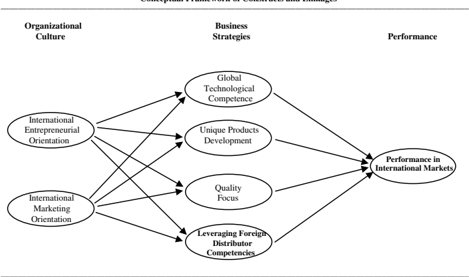
- The survey analysis found that international entrepreneurial orientation significantly predicted global technological competence with a standardized coefficient of 0.28; the link from international marketing orientation to global technological competence was not significant.
- Unique products development was significantly predicted by both international entrepreneurial orientation (0.19) and international marketing orientation (0.24).
- Quality focus was significantly predicted by both international entrepreneurial orientation (0.23) and international marketing orientation (0.35).
- Leveraging foreign distributor competences was significantly predicted by international marketing orientation (0.26) but not by international entrepreneurial orientation; these strategy variables were also significant drivers of performance in international markets: global technological competence (0.21), unique products development (0.14), quality focus (0.30), and leveraging foreign distributor competences (0.18).
## Methods
- The paper uses a two-phase design: first qualitative interviews/case studies to develop constructs and hypotheses, then a cross-industry field survey to test them.
- The qualitative phase included 33 professionals: 24 senior managers at early internationalizing firms, 6 scholars, and 3 international trade experts; the firms were mostly founded after 1985, sold half or more of their sales abroad, and had entered foreign markets within 3 years of founding.
- The survey was mailed to a random sample of 900 manufacturing firms in the United States founded in 1980 or later and exporting at least 25% of total production; 203 usable surveys were returned (about 23% response rate). The main analysis used LISREL8 path analysis, with exploratory factor analysis and confirmatory factor analysis for scale purification and validity checks.
## Limitations
- The paper states that “little empirical work” had been attempted on born globals and that there had been “almost no empirical research” on the factors driving their superior international performance.
- The study itself is focused on U.S. manufacturing firms that were selected using a 25% export threshold, so the evidence is tied to that sample and entry-mode context; this is evident from the text.
- The paper notes that the survey results are based on self-reported measures from responding firms; this is evident from the questionnaire-based design, though the paper does not frame it explicitly as a limitation.
Model-written summary. Check it against the paper before relying on it.
Integrity signals
Registry
Cites
Statistics
Figures
Verification
Claims the paper makes
0 Valid · 0 Not valid · 53 Not checked · 112 Own results and interpretations
A result the paper reports from its own data — it cites no other source for it, so there is none to check. The quote shows it is in the paper.
In the paper
“Despite the scarce resources typical of young firms, our findings reveal that born-global firms leverage a distinctive mix of orientations and strategies that allow them to succeed in diverse international markets.”
plainstates a cause- Asserted: passes — The authors put it forward as true.
- Checkable: passes — It can be checked against evidence.
- Load-bearing: passes — The paper’s conclusions depend on it.
- Based: passes — The paper gives a reason why it holds.
- Rests on an assumption not shown here.
A result the paper reports from its own data — it cites no other source for it, so there is none to check. The quote shows it is in the paper.
In the paper
“The critical role of marketing prowess overseas was also strongly emphasized by virtually all interviewees in the case studies.”
boosted- Asserted: passes — The authors put it forward as true.
- Checkable: passes — It can be checked against evidence.
- Load-bearing: unclear — It is unclear whether the paper’s conclusions depend on it.
- Based: passes — The paper gives a reason why it holds.
A result the paper states — it cites no source for it, so there is none to check. The quote shows it is in the paper.
In the paper
“Most interviewed firms exhibited strong technological capabilities in their respective product or industry categories.”
plain- Asserted: passes — The authors put it forward as true.
- Checkable: passes — It can be checked against evidence.
- Load-bearing: unclear — It is unclear whether the paper’s conclusions depend on it.
- Based: passes — The paper gives a reason why it holds.
A result the paper reports from its own data — it cites no other source for it, so there is none to check. The quote shows it is in the paper.
In the paper
“In general, the qualitative phase of the study revealed that born globals are likely to be formed by entrepreneurs who pursue foreign ventures with a strong marketing orientation.”
hedgedstates an association- Asserted: passes — The authors put it forward as true.
- Checkable: passes — It can be checked against evidence.
- Load-bearing: passes — The paper’s conclusions depend on it.
- Based: passes — The paper gives a reason why it holds.
A result the paper states — it cites no source for it, so there is none to check. The quote shows it is in the paper.
In the paper
“In contrast, born globals leverage a collection of fundamental intangible knowledge-based capabilities in the cultivation of foreign markets early in their evolution.”
plainstates a cause- Asserted: passes — The authors put it forward as true.
- Checkable: passes — It can be checked against evidence.
- Load-bearing: passes — The paper’s conclusions depend on it.
- Based: unclear — It is unclear why the paper says it holds.
- Rests on an assumption not shown here.
84 more claims
Create a free account to see all 165 claims and to verify the 3 references still open.
- It may state two separate claims as one. 33
- Probably not a substantial claim. 54
Citations
Cites
Evaluating Structural Equation Models with Unobservable Variables and Measurement Error
Fornell, C., & Larcker, D. F. (1981) · Journal of Marketing Research · doi:10.2307/3151312 · Cited by 109,314 · cited 2×
“Composite reliability was calculated using the procedures outlined by Fornell and Larcker (1981).”
MethodInfluentialEvaluating structural equation models with unobservable variables and measurement error
Fornell, C., & Larcker, D. F. (1981) · Journal of Marketing Research · doi:10.1177/002224378101800104 · Cited by 109,190
Firm Resources and Sustained Competitive Advantage
Barney, J. (1991) · Journal of Management · doi:10.1177/014920639101700108 · Cited by 48,334
(1994) · Journal of the American Dietetic Association · doi:10.1016/0002-8223(94)92216-0 · Cited by 45,910
Firm resources and sustained competitive advantage
Barney, J. B. (2004) · Advances in Strategic Management · doi:10.1016/s0742-3322(00)17018-4 · Cited by 38,152
Absorptive Capacity: A New Perspective on Learning and Innovation
Cohen, W. M., & Levinthal, D. A. (1990) · Administrative Science Quarterly · doi:10.2307/2393553 · Cited by 35,728
A resource‐based view of the firm
Wernerfelt, B. (1984) · Strategic Management Journal · doi:10.1002/smj.4250050207 · Cited by 25,635
The Theory of Economic Development
Schumpeter, J., & Backhaus, U. (2006) · The European Heritage in Economics and the Social Sciences · doi:10.1007/0-306-48082-4_3 · Cited by 22,506
An Evolutionary Theory of Economic Change.
Loasby, B. J., Nelson, R. R., & Winter, S. G. (1983) · The Economic Journal · doi:10.2307/2232409 · Cited by 21,366
A Dynamic Theory of Organizational Knowledge Creation
Nonaka, I. (1994) · Organization Science · doi:10.1287/orsc.5.1.14 · Cited by 17,809
Research works printed but not linked: 5
- Nikkei Sangyoo Shimbun (1995) Benchaa Shin Sedai (New Generation Ventures) , Nihon Keizai Shimbun: Tokyo.
- Nunnally, J.C. (1978) Psychometric Theory
- Porter, M.E. (1980) Competitive Strategy , The Free Press: New York.
- Rennie, M. (1993) 'Born global', McKinsey Quarterly (4): 45-52. Rosson, P. and Ford, I.D. (1982) 'Manufacturer-overseas distributor relations and export performance', Journal of International Business Studies 13 (2): 57-72.
- Schumpeter, J. (1939) Business Cycles , Vol. 1 McGraw-Hill: New York.
Cited by
Items 901–1,000 of 3,020
Born global firms and accidental internationalists: Has Hennart (2014) opened a can of worms?
Dow, D. (2017) · Review of International Business and Strategy · doi:10.1108/ribs-02-2017-0012 · Cited by 28
Entry market choices and post-entry growth patterns among born globals in consumer goods sectors
Jin, B. E., Chung, J., Yang, H., & Jeong, S. W. (2018) · International Marketing Review · doi:10.1108/imr-11-2015-0243 · Cited by 34
Bıçakcıoğlu‐Peynirci, N., & İpek, İ. (2020) · Journal of Business and Industrial Marketing · doi:10.1108/jbim-04-2019-0147 · Cited by 31
SECURE – a new business model framework for measuring start-up performance
Arshi, T., Rao, T. V., Islam, S. M. N., & Morandé, S. (2020) · Journal of Entrepreneurship in Emerging Economies · doi:10.1108/jeee-02-2020-0043 · Cited by 35
Dadzie, Z., Agyapong, A., & Suglo, A. (2020) · Review of International Business and Strategy · doi:10.1108/ribs-09-2019-0126 · Cited by 40
Entrepreneurs’ Implicit and Explicit Achievement Motives and Their Early International Commitment
Xue, R., Qian, G., Qian, Z., & Li, L. (2021) · Management International Review · doi:10.1007/s11575-020-00436-5 · Cited by 31
Yusr, M. M., Mokhtar, S. S. M., Perumal, S., & Salimon, M. G. (2021) · International Journal of Innovation Science · doi:10.1108/ijis-03-2021-0053 · Cited by 45
The effect of geographic scope on growth and growth variability of SMEs
Fariborzi, H., Osiyevskyy, O., & DaSilva, C. M. (2022) · Journal of World Business · doi:10.1016/j.jwb.2022.101371 · Cited by 28
Mainela, T., Pernu, E., & Puhakka, V. J. (2011) · Journal of Small Business and Enterprise Development · doi:10.1108/14626001111155655 · Cited by 36
“The firms aim for continuous product development through both internal research and development (R&D), leveraging the competences of partners and imitation of innovations of other firms (Knight and Cavusgil, 2004).”
BackgroundAhmad, S. Z. (2014) · Journal of Asia Business Studies · doi:10.1108/jabs-03-2013-0012 · Cited by 32
“The theory holds that such firms are formed by active entrepreneurs who have strong international knowledge and experience, and tend to emerge because of a significant breakthrough in some process or technology (Knight and Cavusgil, 2004; Knight, 1997).”
BackgroundPogrebnyakov, N. (2016) · Management International Review · doi:10.1007/s11575-016-0281-z · Cited by 28
Andersson, S., & Berggren, E. (2016) · Journal of International Entrepreneurship · doi:10.1007/s10843-016-0182-z · Cited by 31
Building brand loyalty in e-commerce of fashion lingerie
Sánchez-Torres, J. A., & Arroyo-Cañada, F.-J. (2017) · Journal of Fashion Marketing and Management · doi:10.1108/jfmm-05-2016-0047 · Cited by 36
Sekliuckienė, J. (2017) · European Business Review · doi:10.1108/ebr-12-2015-0158 · Cited by 36
Qian, G., Li, L., & Qian, Z. (2017) · Management International Review · doi:10.1007/s11575-017-0321-3 · Cited by 25
Entrepreneurial SMEs Surviving in the era of Globalization: Critical Success Factors
Ng, H. S., & Kee, D. M. H. (2017) · Emerald Group Publishing Limited eBooks · doi:10.1108/978-1-78714-501-620171007 · Cited by 33
Linking global value chains and supply chain management: evidence from the electric motors industry
Golini, R., Caniato, F. F. A., & Kalchschmidt, M. G. M. (2016) · Production Planning & Control · doi:10.1080/09537287.2016.1170225 · Cited by 34
“From the distribution side, globalisation requires opening foreign offices, addressing complex institutional factors (Bello, Lohtia, and Sangtani 2004) and developing new capabilities (Knight and Cavusgil 2004; Weerawardena et al. 2007).”
BackgroundVerlag, G., & Etemad, H. (2005) · Cited by 44
Pollution haven or pollution halo? Testing direct and spillover effects of FDI
Xiang, X., Liu, R., & Luo, W. (2024) · China Economic Review · doi:10.1016/j.chieco.2024.102254 · Cited by 28
Li, L., Qian, G., Qian, Z., & Lu, I. R. R. (2018) · International Marketing Review · doi:10.1108/imr-03-2017-0062 · Cited by 30
Oyedele, A., & Fırat, F. A. (2019) · International Marketing Review · doi:10.1108/imr-01-2019-0022 · Cited by 32
Alam, M. N., Masroor, I., & Nabi, M. N. U. (2020) · Review of International Business and Strategy · doi:10.1108/ribs-07-2019-0103 · Cited by 32
Thinking like a specialist or a generalist? Evidence from hidden champions in China
Lei, L., & Wu, X. (2020) · Asian Business & Management · doi:10.1057/s41291-020-00114-2 · Cited by 24
Culture and innovation in the international context: a literature overview
Tian, M., Deng, P., & Bing, W. (2020) · Innovation The European Journal of Social Science Research · doi:10.1080/13511610.2020.1783644 · Cited by 32
“tate the acquisition of knowledge (Knight and Cavusgil 2004); (c) learning culture, Yao et al. (2013) find that a strong learning culture can significantly enhance the effect of knowledge absorption which is beneficial to new product performance.”
BackgroundInfluentialNetwork embeddedness, headquarters entrepreneurial orientation, and MNE international performance
Rivière, M., & Romero-Martínez, A. M. (2021) · International Business Review · doi:10.1016/j.ibusrev.2021.101811 · Cited by 31
Gutiérrez, J. O., Cepeda-Carrión, I., & Alves, H. (2021) · Journal of Knowledge Management · doi:10.1108/jkm-06-2020-0487 · Cited by 32
Your Uber is arriving now: An analysis of platform location decisions through an institutional lens
Punt, M. B., van Kollem, J., Hoekman, J., & Frenken, K. (2021) · Strategic Organization · doi:10.1177/14761270211022254 · Cited by 30
“They are prime examples of today’s innovative, “born-global” startups (Knight and Cavusgil, 2004) capable of entering many local markets in a short period of time.”
BackgroundThe determinants of international new venture performance: a review and future research agenda
Sheng, H., Zhu, Y., Zhang, K., & Ding, Z. (2021) · International Marketing Review · doi:10.1108/imr-12-2019-0295 · Cited by 29
The mediating effect of strategy on entrepreneurial orientation and performance
Budiati, Y., Untoro, W., Wahyudi, L., & Harsono, M. (2021) · Journal of Research in Marketing and Entrepreneurship · doi:10.1108/jrme-05-2020-0048 · Cited by 34
Juergensen, J. J., Narula, R., & Surdu, I. M. (2021) · International Business Review · doi:10.1016/j.ibusrev.2021.101955 · Cited by 32
“…Wright, 2009; Liu, Lu, Filatotchev, Buck & Wright, 2010; Paul, Parthasarathy & Gupta, 2017) as well as young ventures, whose comparably early and rapid ID was largely ascribed to their unique knowledge assets and innovation capabilities (Autio et al., 2000; Coviello, 2015; Knight & Cavusgil, 2004).”
Are born global firms really a “new breed” of exporters? Empirical evidence from an emerging market
Moen, Ø., Falahat, M., & Lee, Y.-Y. (2022) · Journal of International Entrepreneurship · doi:10.1007/s10843-022-00307-0 · Cited by 32
“2008; Knight and Cavusgil 2004; Knight et al.”
BackgroundInfluentialRoh, T., Park, B. I., & Xiao, S. S. (2022) · Journal of Innovation & Knowledge · doi:10.1016/j.jik.2022.100274 · Cited by 33
Hossain, K., Abdullah, A. S. C., Balwi, M. A. W. F. M., Lubis, A., Azizan, N. A., Alam, M. N., & Taha, A. Z. (2022) · Journal of Business and Industrial Marketing · doi:10.1108/jbim-07-2021-0326 · Cited by 43
The Emergence and Success Factors of Fast Internationalizers: Four Cases from Estonia
Vissak, T. (2007) · Journal of East-West Business · doi:10.1300/j097v13n01_02 · Cited by 24
“…been considerable empirical research examining the factors that drive the superior international performance of these young, highly entrepreneurial firms (Autio, 2005; Bell, Crick & Young, 2004; Knight & Cavusgil, 2004) within specific industries, business or geographical clusters (Jones, 2001).”
BackgroundDeterminants of innovation capacity: Empirical evidence from services firms
Madeira, M. J., Simões, J. M. M., Sousa, G. F. S., Moreira, J., & Mainardes, E. W. (2014) · Innovation · doi:10.1080/14479338.2014.11081996 · Cited by 32
“Thus, investments in marketing have encouraged innovation in manufacturing and/or services companies; after all, they seek to occupy spaces not filled by market competition (Knight & Cavusgil, 2004).”
BackgroundThe internationalisation of French new ventures: The case of the Rhone-Alps region
Cabrol, M., & Nlemvo, F. (2008) · European Management Journal · doi:10.1016/j.emj.2008.09.004 · Cited by 30
ENTREPRENEURIAL ORIENTATION IN SMES: RISK-TAKING TO ENTERING INTERNATIONAL MARKETS
Basile, A. (2012) · The Far East Journal of Psychology and Business · Cited by 40
International entrepreneurial firms in Chile: An exploratory profile
Amorós, J. E., Etchebarne, M. S., Zapata, I. T., & Felzensztein, C. (2015) · Journal of Business Research · doi:10.1016/j.jbusres.2015.10.150 · Cited by 31
“The results found strong support for the idea that a combination of some firm capabilities related to innovativeness in product-services, the use of technology and business opportunity recognition has an impact on the degree of internationalization (Knight & Cavusgil, 2004).”
Resultvan Beers, C., & van der Panne, G. (2009) · Small Business Economics · doi:10.1007/s11187-009-9245-z · Cited by 35
“The emergence of so-called born globals, i.e. firms that start exporting at an early age, can explain this (Madsen and Servais 1997; Knight and Cavusgil 2004).9 Belonging to a foreign firm also has an insignificant impact on the probability to export.”
BackgroundThe Effect of SHRM Practices on Innovation Performance: The Mediating Role of Global Capabilities
Zehir, C., Üzmez, A., & Öztürk, H. Y. (2016) · Procedia - Social and Behavioral Sciences · doi:10.1016/j.sbspro.2016.11.088 · Cited by 41
Concentrating Too Hard? Foreign and Corporate Venture Capital Involvement in Syndicates
Park, S., LiPuma, J. A., & Park, S. S. (2019) · Journal of Small Business Management · doi:10.1111/jsbm.12322 · Cited by 33
“CorpTech data, which has been used extensively in management research (Freear and Wetzel 1990; Knight and Kim 2009; Knight and Cavusgil 2004; Sine, Mitsuhashi, and Kirsch 2006; Soh 2003), provided data on the venture characteristics.”
MethodTrust, Commitment and Competitive Advantage in SMEs Export Performance
İsmail, D., Alam, S. S., & Hamid, R. B. A. (2017) · Gadjah Mada International Journal of Business · doi:10.22146/gamaijb.22680 · Cited by 26
Jun, J., Lee, T. M., & Park, C. H. (2019) · Journal of Small Business Management · doi:10.1111/jsbm.12517 · Cited by 30
“This result supports the observation that born-global firms have both innovative cultures and international market orientations (Knight & Cavusgil, 2004).”
ResultBelhoste, N., Bocquet, R., Favre-Bonté, V., et al. (2019) · International Small Business Journal Researching Entrepreneurship · doi:10.1177/0266242619871165 · Cited by 24
Nguyen, Q. A., & Mort, G. S. (2020) · International Entrepreneurship and Management Journal · doi:10.1007/s11365-020-00662-1 · Cited by 29
Internationalization of new ventures: tests of growth and survival
Schueffel, P., Amann, W., & Herbolzheimer†, E. (2011) · Multinational Business Review · doi:10.1108/15253831111190199 · Cited by 35
Torres, J. P., & Kunc, M. H. (2016) · Journal of Wine Research · doi:10.1080/09571264.2016.1144584 · Cited by 31
de Oliveira, R. T., Indulska, M., & Zalan, T. (2020) · Review of International Business and Strategy · doi:10.1108/ribs-06-2020-153 · Cited by 35
Arham, A. F. (2014) · RMIT Research Repository (RMIT University Library) · doi:10.25439/rmt.27332790 · Cited by 48
Dabić, M., Yadav, S., Huck, N., Maley, J. F., & Kiessling, T. S. (2024) · Journal of Small Business Management · doi:10.1080/00472778.2024.2364793 · Cited by 37
“Although research suggests a lack of foreign business knowledge affects the success of early internationalizing SMEs (Knight & Cavusgil, 2004), contra-dictory research suggests that later internationalizing SMEs prior knowledge constrains them from learning about foreign markets (Autio et al.,…”
Saridakis, G., Khan, Z., Knight, G., Idris, B., Mitra, J., & Khan, H. (2024) · Management International Review · doi:10.1007/s11575-024-00550-8 · Cited by 36
“…the acquisition of resources, and the global mentality of the founders are among the factors that have enabled these firms to internationalise more rapidly than their counterparts (e.g., Cavusgil & Knight, 2015; Gerschewski et al., 2015; Knight & Cavusgil, 2004; Mort & Weerawardena, 2006).”
BackgroundSelf-citationInternationalization and relationship marketing: an introduction
Khojastehpour, M., & Johns, R. (2014) · European Business Review · doi:10.1108/ebr-05-2013-0087 · Cited by 43
Internationalization patterns in fashion retail distribution: implications for firm results
Descals, A. M., Frasquet, M., & Molina, M. E. R. (2011) · Service Industries Journal · doi:10.1080/02642069.2011.540754 · Cited by 29
“In this regard, an increasing number of born-global companies decide to internationalize their businesses from the beginning of their activity, regardless of the saturation level in the domestic market (Andersson, Gabrielsson, & Wictor, 2006; Gabrielsson, 2005; Knight & Cavusgil, 2004).”
BackgroundNew ventures in an emerging industry: access to and use of international resources
Bjørgum, Ø., Moen, Ø., & Madsen, T. K. (2013) · International Journal of Entrepreneurship and Small Business · doi:10.1504/ijesb.2013.056281 · Cited by 24
“…(speed) (Knight, 1997; McDougall & Oviatt, 1996), 25 per cent international sales within the first three years after inception (extent and speed) (Knight & Cavusgil, 2004) and having active operations outside their own continent within two years after inception (scope and speed) (Laanti,…”
BackgroundThe birth and development of a born global industry: The case of microelectronics in Norway
Aspelund, A., Azari, M. J., Aglen, A. F., & Graff, S. G. (2017) · Journal of International Entrepreneurship · doi:10.1007/s10843-017-0206-3 · Cited by 28
“In terms of strategy, international entrepreneurs and their firms are risk-seeking and target international markets in quick succession (Knight and Cavusgil 2004; Aspelund et al. 2007; Cannone and Ughetto 2014; Hennart 2014).”
BackgroundRelated and unrelated industry variety and the internationalization of start-ups
Naldi, L., Criaco, G., & Patel, P. C. (2020) · Research Policy · doi:10.1016/j.respol.2020.104050 · Cited by 29
Williams, D. W., & Crook, T. R. (2020) · Journal of Business Venturing Insights · doi:10.1016/j.jbvi.2020.e00210 · Cited by 22
Villanueva-Flores, M., Hernández-Roque, D., Alles, M. D. L. L. F., & Díaz-Fernández, M. (2022) · Journal of Intellectual Capital · doi:10.1108/jic-06-2021-0157 · Cited by 34
Khan, N. A., Ahmed, W., & Waseem, M. (2022) · Review of International Business and Strategy · doi:10.1108/ribs-05-2021-0068 · Cited by 25
Pace of innovation and speed of small and medium-sized enterprise international expansion
Hilmersson, M., Hilmersson, F. P., Chetty, S., & Schweizer, R. (2022) · International Small Business Journal Researching Entrepreneurship · doi:10.1177/02662426221085193 · Cited by 37
University of Kassel, WITTKOP, A., Zulauf, K., et al. (2013) · Management Dynamics in the Knowledge Economy · doi:10.25019/mdke/6.1.01 · Cited by 23
“The impacts of a company’s resources and capabilities are described by the resource-based and the knowledgebased view (Knight & Cavusgil, 2004), as well as by the dynamic capabilities approach (Teece, 2007).”
BackgroundUniversities as Internationalization Catalysts: Reversing Roles in University–Industry Collaboration
Corsi, S., Feranita, F., Hughes, M., & Wilson, A. (2022) · British Journal of Management · doi:10.1111/1467-8551.12676 · Cited by 31
Governance considerations and non-linear international scale-up behaviour among INVs
Crick, J. M., Crick, D., & Chaudhry, S. (2023) · International Small Business Journal Researching Entrepreneurship · doi:10.1177/02662426231175878 · Cited by 28
Angué, K., & Mayrhofer, U. (2011) · Management international · doi:10.7202/045623ar · Cited by 32
Seo, H. M., KIM, M. C., Chang, K.-R., & Kim, T. (2016) · International Journal of Innovation Management · doi:10.1142/s1363919616500262 · Cited by 40
EXPLORING THE BORN GLOBAL CONCEPT IN THE BIOTECHNOLOGY CONTEXT
Brännback, M. E., Carsrud, A. L., & Renko, M. (2007) · Journal of Enterprising Culture · doi:10.1142/s0218495807000058 · Cited by 28
Hunt, R. A., & Ortiz-Hunt, L. (2017) · Management Decision · doi:10.1108/md-07-2016-0475 · Cited by 31
Innovation Capability: The Role of Islamic Work Ethics
Farrukh, M. H. M., Butt, S., & Mansori, S. (2015) · Journal of Asian Business Strategy · doi:10.18488/journal.1006/2015.5.7/1006.7.125.131 · Cited by 35
“Innovation is one the fundamental factors to create distinctive competitive advantage for organizations (Calantone et al., 2002; Knight & Cavusgil, 2004; Günday et al., 2009).”
BackgroundNew product development in foreign customer relationships: a study of international SMEs
Hånell, S. M., Nordman, E. R., & Tolstoy, D. (2017) · Entrepreneurship and Regional Development · doi:10.1080/08985626.2017.1336257 · Cited by 31
“Studies focusing on internationally entrepreneurial SMEs emphasize that the knowledge-based resources of these firms enable them to develop and introduce new products in niche markets on a broad international scale (Knight and Cavusgil 2004; Oviatt and McDougall 1994).”
BackgroundInfluentialParachuting internationalization: a study of four Scandinavian firms entering China
Fang, T., Tung, R. L., Berg, L., & Nematshahi, N. (2017) · Cross Cultural & Strategic Management · doi:10.1108/ccsm-02-2016-0041 · Cited by 30
May, O. S., & Richardson, C. (2019) · Review of International Business and Strategy · doi:10.1108/ribs-02-2018-0023 · Cited by 39
Loane, S., Bell, J., & McNaughton, R. B. (2006) · International Marketing Review · doi:10.1108/02651330610678994 · Cited by 31
Born Globals: (almost) 20 years of research and still not 'grown up'?
Cesinger, B., Danko, A., & Bouncken, R. B. (2012) · International Journal of Entrepreneurship and Small Business · doi:10.1504/ijesb.2012.045203 · Cited by 31
“Other researchers (n = 7; e.g., Gassmann and Keupp, 2007; Knight and Cavusgil, 2004; Knight et al., 2004; Moen, 2002) did not set a precise age limit but defined the founding year.”
BackgroundPlakoyiannaki, E., Paavilainen‐Mäntymäki, E., Hassett, M. E., Liesch, P. W., Andersson, U., & Rose, E. L. (2024) · Journal of World Business · doi:10.1016/j.jwb.2024.101521 · Cited by 23
Contemporary Developments and Perspectives in International Health Security - Volume 1
Stawicki, S. P., Firstenberg, M. S., Galwankar, S. C., Izurieta, R., & Papadimos, T. (2020) · IntechOpen eBooks · doi:10.5772/intechopen.84766 · Cited by 28
Rethinking internationalization processes: toward a circular framework
Romero, E. D., Durst, S., & García, A. N. (2023) · Review of Managerial Science · doi:10.1007/s11846-023-00719-9 · Cited by 38
Jafari‐Sadeghi, V., García-Pérez, A., Vrontis, D., & Bedford, D. (2024) · Journal of Enterprise Information Management · doi:10.1108/jeim-09-2024-636 · Cited by 34
Kuratko, D. F., & Covin, J. G. (2024) · Journal of Business Research · doi:10.1016/j.jbusres.2024.114980 · Cited by 46
Organizational Change Among Emerging Latin American Firms: From “Multilatinas” to Multinationals
Martínez, J. I., Esperança, J. P., & de la Torre, J. R. (2005) · Management Research The Journal of the Iberoamerican Academy of Management · doi:10.1108/15365430580001320 · Cited by 27
Interaction Approach and Liabilities: A Case Analysis of Start-Up Firms
Guercini, S., & Milanesi, M. (2016) · Journal of Business-to-Business Marketing · doi:10.1080/1051712x.2016.1250595 · Cited by 36
“The liability of foreignness is a broad concept that has been studied both with reference to large multinational companies, born global and start-up firms (Bals et al. 2013; Knight and Cavusgil 2004; Zhou, Wu, and Lou 2007).”
BackgroundAaltonen, P. H. M. (2020) · International Business Review · doi:10.1016/j.ibusrev.2020.101664 · Cited by 28
Bueno, J. C. C., Acedo, F. J., & Rodríguez‐Serrano, M. Á. (2020) · BRQ Business Research Quarterly · doi:10.1177/2340944420916333 · Cited by 26
“…unfamiliar markets, involving a learning process that requires time (Eriksson et al., 1997, 2000); International entrepreneurship, however, emerged in response to this view and shows that there are alternative internationalization paths (Knight & Cavusgil, 2004; Oviatt & McDougall, 1994, 2005).”
BackgroundCEOs’ International Work Experience and Compensation
Schmid, S., & Baldermann, S. (2021) · Management International Review · doi:10.1007/s11575-021-00444-z · Cited by 40
Hidden champions as a determinant of regional development: An analysis of german districts
Benz, L., Block, J., & Johann, M. S. (2021) · ZFW – Advances in Economic Geography · doi:10.1515/zfw-2020-0043 · Cited by 29
Performance implications of export assistance: the mediating role of export entrepreneurship
Faroque, A. R., Kuivalainen, O., Ahmed, J. U., Rahman, M., Roy, H., Ali, M. Y., & Mostafiz, M. I. (2021) · International Marketing Review · doi:10.1108/imr-07-2020-0141 · Cited by 32
Role of governance on SME exports and performance
Dubey, V. K., & Das, A. K. (2021) · Journal of Research in Marketing and Entrepreneurship · doi:10.1108/jrme-08-2020-0109 · Cited by 32
What do we know about capabilities and early internationalization? A review and synthesis
Kahiya, E. T., & Warwood, C. (2022) · Review of International Business and Strategy · doi:10.1108/ribs-06-2021-0088 · Cited by 24
International R&D sourcing, innovation and firm age: The advantage of ‘born-international sourcers’
Asimakopoulos, G., Revilla, A. J., & Rodríguez, A. (2022) · Technovation · doi:10.1016/j.technovation.2022.102662 · Cited by 28
Do technology-focused fast internationalizers’ performance measures change as they mature?
Freeman, S., Vissak, T., Nummela, N., & Trudgen, R. (2023) · International Business Review · doi:10.1016/j.ibusrev.2023.102168 · Cited by 24
Mostafiz, M. I., Ahmed, F. U., Ibrahim, F., & Tarba, S. Y. (2023) · International Marketing Review · doi:10.1108/imr-10-2022-0241 · Cited by 33
An Empirical Examination of the Influence of Corporate Vision on Internationalization
Singal, A. K., & Jain, A. K. (2013) · Strategic Change · doi:10.1002/jsc.1937 · Cited by 27
Forms of growth: How SMEs combine forms of growth to achieve high growth
Navarro, J. L. B., Bueno, J. C. C., & Barringer, B. R. (2012) · Journal of Management & Organization · doi:10.5172/jmo.2012.18.1.81 · Cited by 36
Biotech spin-off business models for the internationalization strategy
Białek‐Jaworska, A., & Gabryelczyk, R. (2016) · Baltic Journal of Management · doi:10.1108/bjm-11-2015-0223 · Cited by 29
International franchise presence and intensity level: profile of franchisors operating abroad
Graciá, V. B. (2018) · Management Research Review · doi:10.1108/mrr-01-2017-0011 · Cited by 24
Entrepreneurs’ Features Affecting the Internationalisation of Service SMEs
González-Pérez, M. A., Velez-Ocampo, J. F., & Herrera‐Cano, C. (2018) · Entrepreneurial Business and Economics Review · doi:10.15678/eber.2018.060201 · Cited by 27
“For young firms, as they might face limited financial and tangible resources, knowledge-based internal capabilities are critical resources for early internationalisation, and for performing well outside their domestic market (Knight & Cavusgil, 2004; Kogut & Zander, 1993).”
BackgroundInfluentialLi, T. (2019) · Journal of global entrepreneurship research · doi:10.1186/s40497-019-0185-z · Cited by 26
“The empirical content of the RBV suggests that there is a positive association between an array of entrepreneurial, technological and organisational parameters and businesses going international (Brouthers et al., 2015; Filatotchev et al., 2008; Knight & Cavusgil, 2004).”
BackgroundEtemad, H. (2021) · Journal of International Entrepreneurship · doi:10.1007/s10843-021-00299-3 · Cited by 28
Factors Stimulating Internationalisation of Firms: An Attempted Holistic Synthesis
Belniak, M. (2015) · Entrepreneurial Business and Economics Review · doi:10.15678/eber.2015.030209 · Cited by 39
Role of international precocity in born global firms
Meliá, M. R., Blesa, A., & Monferrer, D. (2011) · International Journal of Technology Transfer and Commercialisation · doi:10.1504/ijttc.2011.040890 · Cited by 24
Linking Management Theory with Poverty Alleviation Efforts Through Market Orchestration
Kistruck, G. M., & Shulist, P. D. (2020) · Journal of Business Ethics · doi:10.1007/s10551-020-04533-1 · Cited by 30
Metadata
- Authors
- Knight, G. A., & Cavusgil, S. T.
- Affiliations
- Florida State University (US)
- Corresponding author
- Knight, Gary A
- ORCID
- Knight, Gary A
- Venue
- Journal of International Business Studies
- Published
- 2004-01-08
- Volume
- 35
- Issue
- 2
- Pages
- 124-141
- ISSN
- 0047-2506 (ISSN-L)
- 1478-6990
- OpenAlex
- W2127709152
- Semantic Scholar
- d24960b5342d0dd3b86be002ab18a80e7b6fb5c9
- Cited by
- 3,013
- References
- 102
- Citations by year
- 2026: 121 · 2025: 123 · 2024: 157 · 2023: 154 · 2022: 182 · 2021: 196 · 2020: 189 · 2019: 180 · 2018: 199 · 2017: 172 · 2016: 188 · 2015: 187 · 2014: 178 · 2013: 167 · 2012: 129
- FWCI
- 137.12
- Type
- journal article
- Language
- en
- Update notices
- correction (2004-07-16)
- Open access
- bronze
- doi.org
- Licence
- www.springer.com/tdm (tdm)
- Locations
- Journal of International Business Studies (publishedVersion)
- RePEc: Research Papers in Economics (submittedVersion)
- Funders
- Michigan State University
- College of Engineering, Michigan State University
- Topics
- Social Sciences › Business, Management and Accounting › Strategy and Management › International Business and FDI
- Social Sciences › Business, Management and Accounting › Strategy and Management › Innovation and Knowledge Management
- Social Sciences › Communication › International Student and Expatriate Challenges
- Keywords
- born global firms, early internationalization, organizational capabilities, innovation, innovation culture, international business strategy, international success, young firms, internationalization of firms
About these checks
Registry, retraction, Cites and statistics results are computed, not judged, with one exception: a printed reference that no index lists is read once by a model before it counts as a citation error. Claims are extracted by a model and kept only when their quote appears verbatim in the text; each cited source is then checked, with a model’s help, for whether it says what the claim relies on. Those verdicts can be wrong — read the claim’s quote and the cited source before relying on one.
A language model drew the claims from the paper on 2026-10-10, under version 3 of the claim definition (model deepseek-v4.1-flash, prompt extract-v3).
A second model labelled each claim on 2026-10-10 (model jev-1.13-20260917, definition revision gold-guideline-v0.2).
Statistics and arithmetic are recomputed, not judged.
Confidence bands are shown only for fields calibrated on our annotated test set. None is calibrated yet, so no band is shown.
What counts as a claim ›How we measure confidence ›How we check this ›
Are you an author, or do you see a problem with this page? Request a review
Data sources
Bibliographic data: Semantic Scholar, OpenAlex, Crossref.
Contains information from the Semantic Scholar Academic Graph Datasets, made available under the ODC Attribution License (ODC-BY 1.0).
Semantic Scholar’s data is described in: Kinney, R., et al. (2023). The Semantic Scholar Open Data Platform. arXiv:2301.10140.
