

Innovation, organizational capabilities, and the born-global firm
Open accessThe DOI matches its Crossref record; 106 of the 106 references it cites were found in a registry or an index; none of the 100 sources its claims cite is checked for support yet.
Overview
CoChat Summary
## TL;DR
This study argues that born-global firms succeed because early internationalization is supported by an innovative culture and a distinctive set of organizational capabilities. Using qualitative case studies followed by a survey of 203 usable responses, the authors find that several capability links are significant and that these capabilities are associated with performance in international markets.
## Key findings
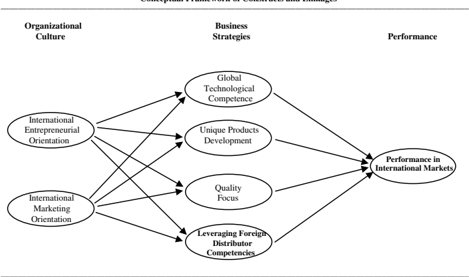
- The survey analysis found that international entrepreneurial orientation significantly predicted global technological competence with a standardized coefficient of 0.28; the link from international marketing orientation to global technological competence was not significant.
- Unique products development was significantly predicted by both international entrepreneurial orientation (0.19) and international marketing orientation (0.24).
- Quality focus was significantly predicted by both international entrepreneurial orientation (0.23) and international marketing orientation (0.35).
- Leveraging foreign distributor competences was significantly predicted by international marketing orientation (0.26) but not by international entrepreneurial orientation; these strategy variables were also significant drivers of performance in international markets: global technological competence (0.21), unique products development (0.14), quality focus (0.30), and leveraging foreign distributor competences (0.18).
## Methods
- The paper uses a two-phase design: first qualitative interviews/case studies to develop constructs and hypotheses, then a cross-industry field survey to test them.
- The qualitative phase included 33 professionals: 24 senior managers at early internationalizing firms, 6 scholars, and 3 international trade experts; the firms were mostly founded after 1985, sold half or more of their sales abroad, and had entered foreign markets within 3 years of founding.
- The survey was mailed to a random sample of 900 manufacturing firms in the United States founded in 1980 or later and exporting at least 25% of total production; 203 usable surveys were returned (about 23% response rate). The main analysis used LISREL8 path analysis, with exploratory factor analysis and confirmatory factor analysis for scale purification and validity checks.
## Limitations
- The paper states that “little empirical work” had been attempted on born globals and that there had been “almost no empirical research” on the factors driving their superior international performance.
- The study itself is focused on U.S. manufacturing firms that were selected using a 25% export threshold, so the evidence is tied to that sample and entry-mode context; this is evident from the text.
- The paper notes that the survey results are based on self-reported measures from responding firms; this is evident from the questionnaire-based design, though the paper does not frame it explicitly as a limitation.
Model-written summary. Check it against the paper before relying on it.
Integrity signals
Registry
Cites
Statistics
Figures
Verification
Claims the paper makes
0 Valid · 0 Not valid · 53 Not checked · 112 Own results and interpretations
A result the paper reports from its own data — it cites no other source for it, so there is none to check. The quote shows it is in the paper.
In the paper
“Despite the scarce resources typical of young firms, our findings reveal that born-global firms leverage a distinctive mix of orientations and strategies that allow them to succeed in diverse international markets.”
plainstates a cause- Asserted: passes — The authors put it forward as true.
- Checkable: passes — It can be checked against evidence.
- Load-bearing: passes — The paper’s conclusions depend on it.
- Based: passes — The paper gives a reason why it holds.
- Rests on an assumption not shown here.
A result the paper reports from its own data — it cites no other source for it, so there is none to check. The quote shows it is in the paper.
In the paper
“The critical role of marketing prowess overseas was also strongly emphasized by virtually all interviewees in the case studies.”
boosted- Asserted: passes — The authors put it forward as true.
- Checkable: passes — It can be checked against evidence.
- Load-bearing: unclear — It is unclear whether the paper’s conclusions depend on it.
- Based: passes — The paper gives a reason why it holds.
A result the paper states — it cites no source for it, so there is none to check. The quote shows it is in the paper.
In the paper
“Most interviewed firms exhibited strong technological capabilities in their respective product or industry categories.”
plain- Asserted: passes — The authors put it forward as true.
- Checkable: passes — It can be checked against evidence.
- Load-bearing: unclear — It is unclear whether the paper’s conclusions depend on it.
- Based: passes — The paper gives a reason why it holds.
A result the paper reports from its own data — it cites no other source for it, so there is none to check. The quote shows it is in the paper.
In the paper
“In general, the qualitative phase of the study revealed that born globals are likely to be formed by entrepreneurs who pursue foreign ventures with a strong marketing orientation.”
hedgedstates an association- Asserted: passes — The authors put it forward as true.
- Checkable: passes — It can be checked against evidence.
- Load-bearing: passes — The paper’s conclusions depend on it.
- Based: passes — The paper gives a reason why it holds.
A result the paper states — it cites no source for it, so there is none to check. The quote shows it is in the paper.
In the paper
“In contrast, born globals leverage a collection of fundamental intangible knowledge-based capabilities in the cultivation of foreign markets early in their evolution.”
plainstates a cause- Asserted: passes — The authors put it forward as true.
- Checkable: passes — It can be checked against evidence.
- Load-bearing: passes — The paper’s conclusions depend on it.
- Based: unclear — It is unclear why the paper says it holds.
- Rests on an assumption not shown here.
84 more claims
Create a free account to see all 165 claims and to verify the 3 references still open.
- It may state two separate claims as one. 33
- Probably not a substantial claim. 54
Citations
Cites
Evaluating Structural Equation Models with Unobservable Variables and Measurement Error
Fornell, C., & Larcker, D. F. (1981) · Journal of Marketing Research · doi:10.2307/3151312 · Cited by 109,314 · cited 2×
“Composite reliability was calculated using the procedures outlined by Fornell and Larcker (1981).”
MethodInfluentialEvaluating structural equation models with unobservable variables and measurement error
Fornell, C., & Larcker, D. F. (1981) · Journal of Marketing Research · doi:10.1177/002224378101800104 · Cited by 109,190
Firm Resources and Sustained Competitive Advantage
Barney, J. (1991) · Journal of Management · doi:10.1177/014920639101700108 · Cited by 48,334
(1994) · Journal of the American Dietetic Association · doi:10.1016/0002-8223(94)92216-0 · Cited by 45,910
Firm resources and sustained competitive advantage
Barney, J. B. (2004) · Advances in Strategic Management · doi:10.1016/s0742-3322(00)17018-4 · Cited by 38,152
Absorptive Capacity: A New Perspective on Learning and Innovation
Cohen, W. M., & Levinthal, D. A. (1990) · Administrative Science Quarterly · doi:10.2307/2393553 · Cited by 35,728
A resource‐based view of the firm
Wernerfelt, B. (1984) · Strategic Management Journal · doi:10.1002/smj.4250050207 · Cited by 25,635
The Theory of Economic Development
Schumpeter, J., & Backhaus, U. (2006) · The European Heritage in Economics and the Social Sciences · doi:10.1007/0-306-48082-4_3 · Cited by 22,506
An Evolutionary Theory of Economic Change.
Loasby, B. J., Nelson, R. R., & Winter, S. G. (1983) · The Economic Journal · doi:10.2307/2232409 · Cited by 21,366
A Dynamic Theory of Organizational Knowledge Creation
Nonaka, I. (1994) · Organization Science · doi:10.1287/orsc.5.1.14 · Cited by 17,809
Research works printed but not linked: 5
- Nikkei Sangyoo Shimbun (1995) Benchaa Shin Sedai (New Generation Ventures) , Nihon Keizai Shimbun: Tokyo.
- Nunnally, J.C. (1978) Psychometric Theory
- Porter, M.E. (1980) Competitive Strategy , The Free Press: New York.
- Rennie, M. (1993) 'Born global', McKinsey Quarterly (4): 45-52. Rosson, P. and Ford, I.D. (1982) 'Manufacturer-overseas distributor relations and export performance', Journal of International Business Studies 13 (2): 57-72.
- Schumpeter, J. (1939) Business Cycles , Vol. 1 McGraw-Hill: New York.
Cited by
Items 701–800 of 3,020
Managerial assessments of export performance: What do they reflect?
Madsen, T. K., & Moen, Ø. (2017) · International Business Review · doi:10.1016/j.ibusrev.2017.09.005 · Cited by 42
Rivière, M., Bass, A. E., & Andersson, U. (2020) · Global Strategy Journal · doi:10.1002/gsj.1389 · Cited by 53
Constraints facing small western firms in transitional markets
Freeman, S., & Reid, I. (2006) · European Business Review · doi:10.1108/09555340610663728 · Cited by 50
International business & family business: Potential dialogue between disciplines
Bueno, J. C. C., & Moreno, A. M. (2017) · European Journal of Family Business · doi:10.1016/j.ejfb.2017.08.001 · Cited by 50
“New approaches have arisen in recent decades in relation to international activities, such as the emergence of born-global firms and international new ventures, the role of networks, etc. (Coviello, 2015; Jones, Coviello, & Tang, 2011; Knight & Cavusgil, 2004; Oviatt & McDougall, 1994, 2005).”
BackgroundFirm performance over innovation cycle: evidence from a small European economy
Baláž, V., Jeck, T., & Balog, M. (2023) · Journal of Innovation and Entrepreneurship · doi:10.1186/s13731-023-00298-9 · Cited by 59
“An imperfectly imitable resource is an asset (or bundle of relevant valuable and rare resources) that competing firms cannot acquire at acceptable costs (Knight & Cavusgil, 2004, p. 126, Kozlenkova et al., 2014, p. 12).”
BackgroundCiszewska‐Mlinarič, M., Obłój, K., & Wąsowska, A. (2016) · Journal of East European Management Studies · doi:10.5771/0949-6181-2016-3-275 · Cited by 38
Prange, C. I., & Bruyaka, O. (2016) · Cross Cultural & Strategic Management · doi:10.1108/ccsm-07-2014-0079 · Cited by 50
“…(Jones & Coviello, 2005), which study the internationalization process of born global firms, i.e. firms that seek superior international business performance by entering foreign markets at an accelerated speed, bypassing the domestic market (Knight & Cavusgil, 2004; Oviatt & McDougall, 1994).”
BackgroundThe Internationalization of African Small and Medium Enterprises (SMEs): A South-North Pattern
Misati, E., Walumbwa, F. O., Lahiri, S., & Kundu, S. K. (2017) · Africa Journal of Management · doi:10.1080/23322373.2016.1275940 · Cited by 46
“Thus, the three SMEs were selected because they exhibit an innovative international entrepreneurial and marketing orientation (Knight & Cavusgil, 2004) and because they have successfully internationalized beyond Africa.”
BackgroundInternationalisation and its determinants:A hierarchical approach
Li, T. (2018) · International Business Review · doi:10.1016/j.ibusrev.2018.01.009 · Cited by 47
“Study from Knight and Cavusgil (2004) proposed that unique product and technology advantages contribute to the internationalisation of young firms.”
BackgroundInformation diversity and innovation for born-globals
Hull, C. E., Tang, Z., Tang, J., & Yang, J. (2019) · Asia Pacific Journal of Management · doi:10.1007/s10490-019-09651-7 · Cited by 42
A shift in perspective? The role of emotional branding in shaping born globals’ performance
Efrat, K., & Asseraf, Y. (2019) · International Business Review · doi:10.1016/j.ibusrev.2019.101589 · Cited by 51
Harel, R., Schwartz, D., & Kaufmann, D. (2020) · Review of Managerial Science · doi:10.1007/s11846-020-00409-w · Cited by 51
How do demographics and basic traits of an entrepreneur impact the internationalization of firms?
Wach, K., & Głodowska, A. (2021) · Oeconomia Copernicana · doi:10.24136/oc.2021.014 · Cited by 46
“Various researchers stress the fact that it is important to young firms in particular, as they do not have other resources such as financial or tangible resources at their disposal (Knight & Cavusgil, 2004; Jones et al., 2011).”
BackgroundWho Inhabits a Business Ecosystem? The Technospecies as a Unifying Concept
Weber, M. L., & Hine, M. J. (2015) · Technology Innovation Management Review · doi:10.22215/timreview/896 · Cited by 57
Knockaert, M., & Vanacker, T. R. (2011) · Small Business Economics · doi:10.1007/s11187-011-9378-8 · Cited by 57
The market orientation-innovation-success relationship: The role of internationalization strategy
Boluda, I. K., & López, N. V. (2011) · Innovation · doi:10.5172/impp.2011.13.1.36 · Cited by 59
“Poon, J. P. H. and MacPherson, A. (2005) Innovation strategies of Asian firms in the United States, Journal of Engineering and Technology Management 22(4): 255–273.”
BackgroundInfluentialMarket orientation and internationalisation in small software firms
Ruokonen, M., Nummela, N., Puumalainen, K., & Saarenketo, S. (2008) · European Journal of Marketing · doi:10.1108/03090560810903682 · Cited by 38
“state, the managers of small firms have a unique opportunity to seek competitive advantage through their market orientation since they are in a better position to reinforce firm-wide market-oriented norms (see also Knight and Cavusgil, 2004”
BackgroundTarek, B. H., Ghodbane, A., & Sami, A. (2016) · Competition & Change · doi:10.1177/1024529416657494 · Cited by 45
Prospective collaborative sensemaking for identifying the potential impact of emerging technologies
Gattringer, R., Damm, F., Kranewitter, P., & Wiener, M. (2021) · Creativity and Innovation Management · doi:10.1111/caim.12432 · Cited by 56
“The data analysis was designed as a multistage research project (Knight & Cavusgil, 2004), consisting of four stages.”
MethodESG and Corporate Performance: A Review
Zhan, S. (2023) · SHS Web of Conferences · doi:10.1051/shsconf/202316901064 · Cited by 71
“One of the key elements that gives businesses a distinct competitive advantage is innovation (Calantone et al. 2002; Knight and Cavusgil 2004; Xie et al. 2018).”
BackgroundLEAN AND GLOBAL TECHNOLOGY START-UPS: LINKING THE TWO RESEARCH STREAMS
Tanev, S., Rasmussen, E. S., Zijdemans, E., Lemminger, R., & Svendsen, L. L. (2015) · International Journal of Innovation Management · doi:10.1142/s1363919615400083 · Cited by 49
Export stimulation of micro- and small locally owned firms from emerging environments: New evidence
Williams, D. A. (2008) · Journal of International Entrepreneurship · doi:10.1007/s10843-008-0022-x · Cited by 38
“However, given the rise in “born globals” and “international new ventures” ( Knight and Cavusgil 2004; Oviatt and McDougall 1994), their exits doubt regarding this assumption.”
BackgroundGender heterogeneity, entrepreneurial orientation and international diversification
Zimmerman, M. A., & Brouthers, K. D. (2012) · International Journal of Gender and Entrepreneurship · doi:10.1108/17566261211202963 · Cited by 53
Perspectives on strategic internationalization: Developing capabilities for renewal
Rivière, M., & Suder, G. G. S. (2015) · International Business Review · doi:10.1016/j.ibusrev.2015.10.004 · Cited by 49
“…know that networking of firms internationally (Frost & Zhou, 2005) in addition facilitates the imitation of innovation of other firms, which is in literature is known as one of the main sources of innovation and evidenced particularly in early internationalization (Knight & Cavusgil 2004).”
BackgroundInfluentialThe entrepreneurial ecosystem and born globals: the Estonian context
Velt, H., Torkkeli, L., & Saarenketo, S. (2018) · Journal of Enterprising Communities People and Places in the Global Economy · doi:10.1108/jec-08-2017-0056 · Cited by 45
Internationalization and performance of Korean SMEs: the moderating role of competitive strategy
Cho, J., & Lee, J. (2018) · Asian Business & Management · doi:10.1057/s41291-018-0036-8 · Cited by 46
Hannibal, M. (2020) · Journal of International Entrepreneurship · doi:10.1007/s10843-019-00267-y · Cited by 40
“Yet the ability to develop unique products tailored to local markets has been argued to be one of the key characteristics of early internationalizing firms and in particular “born globals” (Knight 2000; Knight and Cavusgil 2004).”
BackgroundOn the internationalization of Turkish hospital chains: A dynamic capabilities perspective
Uner, M. M., Çetin, B., & Cavusgil, S. T. (2020) · International Business Review · doi:10.1016/j.ibusrev.2020.101693 · Cited by 50
Self-citationInnovation adaptation and post-entry growth in international new ventures
Hidalgo, E. R., Edeh, J. N., & Acedo, F. J. (2021) · European Research on Management and Business Economics · doi:10.1016/j.iedeen.2021.100169 · Cited by 44
Munjal, S., Bhasin, N., Nandrajog, D., & Kundu, S. K. (2022) · Journal of Business Research · doi:10.1016/j.jbusres.2022.03.027 · Cited by 55
International SMEs from emerging markets—Insights from the Colombian textile and apparel industry
González-Pérez, M. A., Manotas, E. C., & Ciravegna, L. (2016) · Journal of International Entrepreneurship · doi:10.1007/s10843-016-0170-3 · Cited by 42
Equity commitment under uncertainty: A hierarchical model of real option entry mode choices
Wooster, R. B., Blanco, L. R., & Sawyer, W. C. (2015) · International Business Review · doi:10.1016/j.ibusrev.2015.07.006 · Cited by 37
Hult, G. T. M., Morgeson, F. V., Sharma, U., & Fornell, C. (2022) · Journal of International Business Studies · doi:10.1057/s41267-022-00546-2 · Cited by 69
“…seek superior international business performance from the application of knowledge-based resources to the sale of outputs in multiple countries’’ (Knight & Cavusgil, 2004, p. 124), that are becoming more common in the current hyperconnected era (Zander, McDougall-Covin, & Rose, 2015), the…”
BackgroundInternationalization, institutional pressures in foreign markets, and environmental sustainability
Amer, E. (2022) · Journal of International Management · doi:10.1016/j.intman.2022.100974 · Cited by 58
Do, H., Nguyen, B., & Shipton, H. J. (2023) · Journal of International Management · doi:10.1016/j.intman.2023.101014 · Cited by 51
The role of resources: micro‐firms internationalization in the French context
Hermel, P., & Khayat, I. (2011) · Journal of Small Business and Enterprise Development · doi:10.1108/14626001111127089 · Cited by 51
“The emergence of born-global firms, mostly in the last decade, has challenged these traditional theories and encouraged literature in the field of international entrepreneurship ( Knight and Cavusgil, 1996, 2004”
BackgroundRESOURCES AND FAILURE OF SMEs: ANOTHER LOOK
Williams, D. A. (2014) · Journal of Developmental Entrepreneurship · doi:10.1142/s1084946714500071 · Cited by 68
“The emerging literature on Born Globals (Knight and Cavusgil, 2004) and International New Venture (Oviatt and McDougall, 1994) has shown this is quite possible.”
BackgroundNascent entrepreneurs’ personality attributes and the international dimension of new ventures
Muñoz‐Bullón, F., Sánchez-Bueno, M. J., & Vos-Saz, A. (2013) · International Entrepreneurship and Management Journal · doi:10.1007/s11365-013-0284-1 · Cited by 49
Conceptualizing Innovation in Born-Global Firms
Zijdemans, E., & Tanev, S. (2014) · Technology Innovation Management Review · doi:10.22215/timreview/826 · Cited by 36
“According to Knight and Cavusgil (2004), the early internationalization of a firm and its potential success in a foreign market are functions of its internal capabilities.”
BackgroundOrganisational capabilities and the long-term survival of new technology-based firms
Löfsten, H. (2016) · European Business Review · doi:10.1108/ebr-04-2015-0041 · Cited by 51
TEMPUS FUGIT: A Hermeneutic Approach to the Internationalisation Process
Hurmerinta, L., Paavilainen‐Mäntymäki, E., & Hassett, M. E. (2016) · Management International Review · doi:10.1007/s11575-016-0303-x · Cited by 47
“Studies on firms that deviate from the pattern suggested in traditional internationalisation models, most notably born globals (e.g., Knight and Cavusgil 2004) and international new ventures (e.g., Oviatt and McDougall 1994), have brought the concepts of speed and rapidity into the limelight.”
BackgroundMaturing born globals and their acquisitive behaviour
Øyna, S., Almor, T., Elango, B., & Tarba, S. Y. (2017) · International Business Review · doi:10.1016/j.ibusrev.2017.12.002 · Cited by 47
Financial Sector Development, Openness, and Entrepreneurship: Panel Regression Analysis
Bayar, Y., Gavriletea, M. D., & UÇAR, Z. (2018) · Sustainability · doi:10.3390/su10103493 · Cited by 48
“[26] considered workers’ mobility to be a mechanism that could help entrepreneurial activity by transferring skilled workers from foreign to local firms or using these skills through entrepreneurship [29].”
BackgroundLearning in international new ventures: A systematic review
Tuomisalo, T., & Leppäaho, T. C. (2018) · International Business Review · doi:10.1016/j.ibusrev.2018.11.005 · Cited by 44
Competitive intelligence embeddedness: Drivers and performance consequences
Markovich, A., Efrat, K., Raban, D. R., & Souchon, A. L. (2019) · European Management Journal · doi:10.1016/j.emj.2019.04.003 · Cited by 54
Evers, N., Gliga, G., & Rialp, A. (2019) · Journal of International Entrepreneurship · doi:10.1007/s10843-019-00259-y · Cited by 39
Zhou, L., Xu, S.-R., Xu, H. Y., & Barnes, B. R. (2019) · International Business Review · doi:10.1016/j.ibusrev.2019.101614 · Cited by 41
Gerschewski, S., Scott‐Kennel, J., & Rose, E. L. (2020) · World Economy · doi:10.1111/twec.12928 · Cited by 67
“Koh (1991) finds that the use of an export channel strategy that includes a separate export unit is associated with higher perceived export profitability.”
BackgroundRahman, M., Hack‐Polay, D., Shafique, S., & Igwe, P. A. (2021) · International Journal of Emerging Markets · doi:10.1108/ijoem-02-2021-0236 · Cited by 59
Odorici, V., & Presutti, M. (2013) · Journal of International Entrepreneurship · doi:10.1007/s10843-013-0112-2 · Cited by 47
“In particular, learning and market orientations have emerged relatively recently as potentially important dimensions of strategic orientation that might explain the phenomenon of BG startups (Sharmak and Blomstermo 2003; Knight and Cavusgil 2004).”
BackgroundInfluentialWho’s Hiding in the Shadows? Organized Crime and Informal Entrepreneurship in 39 Economies
Mallon, M. R., & Fainshmidt, S. (2020) · Journal of Management · doi:10.1177/0149206320978821 · Cited by 43
“Although criminal organizations may engage in a myriad of illegal practices, extortion racketeering is “the defining activity of organized crime” (Konrad & Skaperdas, 1998: 462).”
BackgroundLiability of informality and firm participation in global value chains
Colovic, A., Misganaw, B. A., & Assefa, D. Z. (2021) · Journal of World Business · doi:10.1016/j.jwb.2021.101279 · Cited by 40
Export barriers for SMEs in emerging countries: A configurational approach
Bertrand, O., Betschinger, M., & Brea‐Solís, H. (2022) · Journal of Business Research · doi:10.1016/j.jbusres.2022.05.045 · Cited by 49
SME Internationalization and Export Performance: A Systematic Review with Bibliometric Analysis
Calheiros-Lobo, N., Ferreira, J. V., & Au‐Yong‐Oliveira, M. (2023) · Sustainability · doi:10.3390/su15118473 · Cited by 95
“Its research helped to change the focus of research from gradual internationalization to the accelerated pace of these young companies and the factors that enable these firms to internationalize quickly [211,212].”
BackgroundJean, R. “., Kim, D., Sinkovics, R. R., & Çavuşgil, E. (2024) · Journal of Business Research · doi:10.1016/j.jbusres.2023.114449 · Cited by 60
Yener, M. I., Doğruoğlu, B., & Ergun, S. (2014) · Procedia - Social and Behavioral Sciences · doi:10.1016/j.sbspro.2014.09.002 · Cited by 35
Fernández‐Olmos, M., & Vial, I. D. (2012) · European Management Journal · doi:10.1016/j.emj.2012.04.001 · Cited by 42
Dancing as fast as they can: Israeli high‐tech firms and the Great Recession of 2008
Almor, T. (2011) · Thunderbird International Business Review · doi:10.1002/tie.20401 · Cited by 46
Needed B2B marketing capabilities: Insights from the USA and emerging Latin America
Cortez, R. M., & Johnston, W. J. (2017) · International Business Review · doi:10.1016/j.ibusrev.2017.10.008 · Cited by 46
Rafiki, A., Nasution, M. D. T. P., Rossanty, Y., & Sari, P. B. (2021) · Journal of Science and Technology Policy Management · doi:10.1108/jstpm-03-2020-0059 · Cited by 81
Almodóvar, P., Briones, J. S., & Silverman, B. S. (2013) · The Journal of Technology Transfer · doi:10.1007/s10961-013-9324-9 · Cited by 43
The internationalization of engineering consulting from a strategy tripod perspective
Krull, E., Smith, P., & Ge, G. L. (2012) · Service Industries Journal · doi:10.1080/02642069.2012.662758 · Cited by 60
“This view of internationalization has been challenged by the emergence of ‘born global’ firms (Knight & Cavusgil, 2004; Rennie, 1993).”
SMEs' Networking Capability and International Performance
Kenny, B., & Fahy, J. (2011) · Advances in business marketing & purchasing/Advances in business marketing and purchasing · doi:10.1108/s1069-0964(2011)0000017006 · Cited by 55
Zulu-Chisanga, S., Boso, N., Adeola, O., & Oghazi, P. (2016) · Journal of Small Business Strategy · Cited by 70
Types of foreign networks and internationalization performance of Korean SMEs
Jeong, S. W. (2016) · Multinational Business Review · doi:10.1108/mbr-08-2015-0039 · Cited by 55
Rezaei, M., Sadraei, R., Jafari‐Sadeghi, V., & Vrontis, D. (2023) · Asia Pacific Journal of Management · doi:10.1007/s10490-023-09896-3 · Cited by 43
“Knight and Cavusgil (2004) concluded that internationalisation requires innovation, and global firms must be more creative than local firms.”
Blomkvist, K., Kappen, P., & Zander, I. (2016) · Journal of World Business · doi:10.1016/j.jwb.2016.10.003 · Cited by 40
The Impact of Company Resources and Capabilities on Global New Product Program Performance
de Brentani, U., & Kleinschmidt, E. J. (2015) · Project Management Journal · doi:10.1002/pmj.21470 · Cited by 46
“They reduce distance among geographically and culturally dispersed facilities by translating company objectives and values for NPD participants worldwide and by pulling together elements of an internationally dispersed NPD program and team (Knight & Cavusgil, 2004; McDonough, Kahn, & Barczak, 2001).”
BackgroundChoice of markets for initial export activities: Differences between early and late exporters
Gallego, Á., & Bueno, J. C. C. (2014) · International Business Review · doi:10.1016/j.ibusrev.2014.03.004 · Cited by 41
Bortoluzzi, G., Kadić‐Maglajlić, S., Arslanagić-Kalajdžić, M., & Balboni, B. (2018) · International Marketing Review · doi:10.1108/imr-11-2015-0258 · Cited by 49
“Through the routinisation of organisational activities, a firm ’ s capabilities become embedded into organisational memory, producing a distinctive configuration of resources that support the achievement of a competitive advantage (Knight and Cavusgil, 2004).”
BackgroundTypologies of internationalisation pathways of SMEs: what is new?
Coudounaris, D. N. (2018) · Review of International Business and Strategy · doi:10.1108/ribs-12-2017-0119 · Cited by 34
How do mature born globals create customer value to achieve international growth?
Andersson, S., Awuah, G. B., Aagerup, U., & Wictor, I. (2020) · International Marketing Review · doi:10.1108/imr-11-2018-0340 · Cited by 47
Subáreas de internacionalización de emprendimientos: una revisión bibliográfica
Meneses, J. P. A., Robledo, S., & Angarita, M. Z. S. (2020) · Económicas CUC · doi:10.17981/econcuc.42.1.2021.org.7 · Cited by 34
“Estos autores convergen en que estas organizaciones son concebidas bajo modelos disruptivos y orientadas a la intensificación del conocimiento para la inter nacionalización de sus bienes y servicios (Knight & Cavusgil, 2004).”
BackgroundTaylor, M., Jack, R. G., Madsen, T. K., & Alam, M. A. (2021) · Journal of Business Research · doi:10.1016/j.jbusres.2021.04.050 · Cited by 42
Ahsan, M., & Musteen, M. (2021) · International Business Review · doi:10.1016/j.ibusrev.2021.101912 · Cited by 42
Li, L., Li, D., Goerzen, A., & Shi, W. (2018) · Journal of World Business · doi:10.1016/j.jwb.2018.07.001 · Cited by 50
Iddris, F. (2024) · Journal of Applied Research in Higher Education · doi:10.1108/jarhe-09-2023-0424 · Cited by 60
The geographical dimension of innovation collaboration: Networking and innovation in Norway
Fitjar, R. D., & Rodríguez‐Pose, A. (2013) · Urban Studies · doi:10.1177/0042098013510567 · Cited by 46
Untangling the relationship between new venture internationalization and performance
Fernhaber, S. A. (2013) · Journal of International Entrepreneurship · doi:10.1007/s10843-013-0104-2 · Cited by 39
Using Case Research to Reconstruct Concepts: A Methodology and Illustration
Welch, C., Rumyantseva, M., & Hewerdine, L. J. (2015) · Organizational Research Methods · doi:10.1177/1094428115596435 · Cited by 53
“%) invoked the definitions proposed by Knight and Cavusgil (1996, 2004) and/or Oviatt and McDougall (1994).7 These seminal definitions specify, in total, seven attributes: (a) early commencement of internationalization (i.e., precocity), (b) competitive advantage/performance as the motive, (c) use…”
BackgroundInfluentialWalheiser, D., Schwens, C., Steinberg, P. J., & Cadogan, J. W. (2021) · Journal of Business Research · doi:10.1016/j.jbusres.2020.12.021 · Cited by 39
Chung, H. F. L., & Ho, M. H.-W. (2021) · European Journal of Marketing · doi:10.1108/ejm-04-2019-0309 · Cited by 47
Where Do Born Globals Come from? A Neoconfigurational Institutional Theory
Fainshmidt, S., Smith, A., & Aguilera, R. V. (2021) · Organization Science · doi:10.1287/orsc.2021.1497 · Cited by 36
Hennart, J. (2022) · Journal of International Business Studies · doi:10.1057/s41267-022-00523-9 · Cited by 47
“The existence of born global firms (e.g., Knight & Cavusgil, 2004) has shown, however, that this model is not a universal one, and that some firms are using other internationalization strategies.”
BackgroundInternationalization of Digital Innovations: A Rapidly Evolving Research Stream
Shaheer, N. A., Kim, K.-J., & Li, S. (2022) · Journal of International Management · doi:10.1016/j.intman.2022.100970 · Cited by 44
Fan, Z., Wang, Y., & Ying, Z. (2023) · Journal of Business-to-Business Marketing · doi:10.1080/1051712x.2023.2175633 · Cited by 49
“Export performance refers to the scales of various scholars, such as Knight and Cavusgil (2004), and Solano Acosta, Herrero Crespo, and Collado Agudo (2018), among others.”
BackgroundInternationalisation of Korean performing arts
Fillis, I. R., & Lee, B. (2011) · European Journal of Marketing · doi:10.1108/03090561111120055 · Cited by 34
“Its emerging innovative organisational forms such as the instant international and the born global challenge long held perceptions of how both high and low technology organisations internationalise (Knight and Cavusgil 2004; Rialp et al. 2005).”
BackgroundShould Small, Young Technology–Based Firms Internalize Transactions in Their Internationalization?
Li, L., Qian, G., & Qian, Z. (2013) · Entrepreneurship Theory and Practice · doi:10.1111/etap.12081 · Cited by 33
“Empirical studies confirm that knowledge internalization is a major force driving early internationalization of SYTEFs (e.g., Gabrielsson, Gabrielsson, & Seppala, 2012; Knight & Cavusgil, 2004).”
BackgroundInfluentialDeligonul, S. Z., Kim, D., Roath, A. S., & Çavuşgil, E. (2006) · Journal of Business Research · doi:10.1016/j.jbusres.2005.11.004 · Cited by 35
Internationalisation and innovation in the knowledge-intensive business services
Doloreux, D., & Laperrière, A. (2013) · Service Business · doi:10.1007/s11628-013-0211-0 · Cited by 41
Mesa, A. O., & Suárez, M. K. C. (2006) · International Journal of Globalisation and Small Business · doi:10.1504/ijgsb.2006.012183 · Cited by 33
Network competence in Finnish SMEs: implications for growth
Torkkeli, L., Kuivalainen, O., Saarenketo, S., & Puumalainen, K. (2016) · Baltic Journal of Management · doi:10.1108/bjm-02-2015-0032 · Cited by 58
No manager is an island: culture in sensemaking of business networking
Ivanova-Gongne, M., & Torkkeli, L. (2018) · Journal of Business and Industrial Marketing · doi:10.1108/jbim-07-2016-0154 · Cited by 39
Emerging market multinationals and the concept of ownership advantages
Williamson, P. J., & Wan, F. (2018) · International Journal of Emerging Markets · doi:10.1108/ijoem-08-2017-0319 · Cited by 40
Clark, D. R., & Pidduck, R. J. (2023) · Journal of Small Business Management · doi:10.1080/00472778.2022.2149761 · Cited by 40
“Of the four born global papers, two 4 (Ferguson et al., 2021; Taylor et al., 2021) used the out-of-date Knight and Cavusgil (2004) criteria for identifying a born global—one ironically titled “Getting the Facts Right on Born Globals.””
BackgroundMethodInfluentialYuan, X., Shin, S., He, X., & Kim, S. Y. (2016) · Asian Business & Management · doi:10.1057/abm.2015.17 · Cited by 41
“One major source of innovation is internal R&D drawing on the firm’s accumulated knowledge (Knight and Cavusgil, 2004).”
BackgroundThe role of organisational culture in the internationalisation of new ventures
Kumar, N., & Sharma, D. D. (2018) · International Marketing Review · doi:10.1108/imr-09-2014-0299 · Cited by 46
Gil-Barragán, J. M., Martínez, J. A. B., & Más‐Verdú, F. (2020) · European Business Review · doi:10.1108/ebr-11-2018-0191 · Cited by 48
Yavuz, R. I. (2021) · Journal of Small Business Management · doi:10.1080/00472778.2021.1913596 · Cited by 35
“For example, some researchers define INVs as firms that began exporting at the outset (e.g., Knight & Cavusgil, 2004) while some others use two years (e.g., Knight & Cavusgil, 1996), three years (e.g., Knight & Cavusgil, 2004; Kuemmerle, 2002), five years (e.g., Pitt & Kannemeyer, 2000), and six…”
BackgroundCrespo, N. F., Simões, V. C., & Fontes, M. (2021) · European Management Journal · doi:10.1016/j.emj.2021.07.009 · Cited by 36
Metadata
- Authors
- Knight, G. A., & Cavusgil, S. T.
- Affiliations
- Florida State University (US)
- Corresponding author
- Knight, Gary A
- ORCID
- Knight, Gary A
- Venue
- Journal of International Business Studies
- Published
- 2004-01-08
- Volume
- 35
- Issue
- 2
- Pages
- 124-141
- ISSN
- 0047-2506 (ISSN-L)
- 1478-6990
- OpenAlex
- W2127709152
- Semantic Scholar
- d24960b5342d0dd3b86be002ab18a80e7b6fb5c9
- Cited by
- 3,013
- References
- 102
- Citations by year
- 2026: 121 · 2025: 123 · 2024: 157 · 2023: 154 · 2022: 182 · 2021: 196 · 2020: 189 · 2019: 180 · 2018: 199 · 2017: 172 · 2016: 188 · 2015: 187 · 2014: 178 · 2013: 167 · 2012: 129
- FWCI
- 137.12
- Type
- journal article
- Language
- en
- Update notices
- correction (2004-07-16)
- Open access
- bronze
- doi.org
- Licence
- www.springer.com/tdm (tdm)
- Locations
- Journal of International Business Studies (publishedVersion)
- RePEc: Research Papers in Economics (submittedVersion)
- Funders
- Michigan State University
- College of Engineering, Michigan State University
- Topics
- Social Sciences › Business, Management and Accounting › Strategy and Management › International Business and FDI
- Social Sciences › Business, Management and Accounting › Strategy and Management › Innovation and Knowledge Management
- Social Sciences › Communication › International Student and Expatriate Challenges
- Keywords
- born global firms, early internationalization, organizational capabilities, innovation, innovation culture, international business strategy, international success, young firms, internationalization of firms
About these checks
Registry, retraction, Cites and statistics results are computed, not judged, with one exception: a printed reference that no index lists is read once by a model before it counts as a citation error. Claims are extracted by a model and kept only when their quote appears verbatim in the text; each cited source is then checked, with a model’s help, for whether it says what the claim relies on. Those verdicts can be wrong — read the claim’s quote and the cited source before relying on one.
A language model drew the claims from the paper on 2026-10-10, under version 3 of the claim definition (model deepseek-v4.1-flash, prompt extract-v3).
A second model labelled each claim on 2026-10-10 (model jev-1.13-20260917, definition revision gold-guideline-v0.2).
Statistics and arithmetic are recomputed, not judged.
Confidence bands are shown only for fields calibrated on our annotated test set. None is calibrated yet, so no band is shown.
What counts as a claim ›How we measure confidence ›How we check this ›
Are you an author, or do you see a problem with this page? Request a review
Data sources
Bibliographic data: Semantic Scholar, OpenAlex, Crossref.
Contains information from the Semantic Scholar Academic Graph Datasets, made available under the ODC Attribution License (ODC-BY 1.0).
Semantic Scholar’s data is described in: Kinney, R., et al. (2023). The Semantic Scholar Open Data Platform. arXiv:2301.10140.
