

Innovation, organizational capabilities, and the born-global firm
Open accessThe DOI matches its Crossref record; 106 of the 106 references it cites were found in a registry or an index; none of the 100 sources its claims cite is checked for support yet.
Overview
CoChat Summary
## TL;DR
This study argues that born-global firms succeed because early internationalization is supported by an innovative culture and a distinctive set of organizational capabilities. Using qualitative case studies followed by a survey of 203 usable responses, the authors find that several capability links are significant and that these capabilities are associated with performance in international markets.
## Key findings
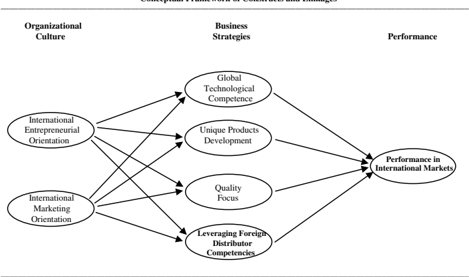
- The survey analysis found that international entrepreneurial orientation significantly predicted global technological competence with a standardized coefficient of 0.28; the link from international marketing orientation to global technological competence was not significant.
- Unique products development was significantly predicted by both international entrepreneurial orientation (0.19) and international marketing orientation (0.24).
- Quality focus was significantly predicted by both international entrepreneurial orientation (0.23) and international marketing orientation (0.35).
- Leveraging foreign distributor competences was significantly predicted by international marketing orientation (0.26) but not by international entrepreneurial orientation; these strategy variables were also significant drivers of performance in international markets: global technological competence (0.21), unique products development (0.14), quality focus (0.30), and leveraging foreign distributor competences (0.18).
## Methods
- The paper uses a two-phase design: first qualitative interviews/case studies to develop constructs and hypotheses, then a cross-industry field survey to test them.
- The qualitative phase included 33 professionals: 24 senior managers at early internationalizing firms, 6 scholars, and 3 international trade experts; the firms were mostly founded after 1985, sold half or more of their sales abroad, and had entered foreign markets within 3 years of founding.
- The survey was mailed to a random sample of 900 manufacturing firms in the United States founded in 1980 or later and exporting at least 25% of total production; 203 usable surveys were returned (about 23% response rate). The main analysis used LISREL8 path analysis, with exploratory factor analysis and confirmatory factor analysis for scale purification and validity checks.
## Limitations
- The paper states that “little empirical work” had been attempted on born globals and that there had been “almost no empirical research” on the factors driving their superior international performance.
- The study itself is focused on U.S. manufacturing firms that were selected using a 25% export threshold, so the evidence is tied to that sample and entry-mode context; this is evident from the text.
- The paper notes that the survey results are based on self-reported measures from responding firms; this is evident from the questionnaire-based design, though the paper does not frame it explicitly as a limitation.
Model-written summary. Check it against the paper before relying on it.
Integrity signals
Registry
Cites
Statistics
Figures
Verification
Claims the paper makes
0 Valid · 0 Not valid · 53 Not checked · 112 Own results and interpretations
A result the paper reports from its own data — it cites no other source for it, so there is none to check. The quote shows it is in the paper.
In the paper
“Despite the scarce resources typical of young firms, our findings reveal that born-global firms leverage a distinctive mix of orientations and strategies that allow them to succeed in diverse international markets.”
plainstates a cause- Asserted: passes — The authors put it forward as true.
- Checkable: passes — It can be checked against evidence.
- Load-bearing: passes — The paper’s conclusions depend on it.
- Based: passes — The paper gives a reason why it holds.
- Rests on an assumption not shown here.
A result the paper reports from its own data — it cites no other source for it, so there is none to check. The quote shows it is in the paper.
In the paper
“The critical role of marketing prowess overseas was also strongly emphasized by virtually all interviewees in the case studies.”
boosted- Asserted: passes — The authors put it forward as true.
- Checkable: passes — It can be checked against evidence.
- Load-bearing: unclear — It is unclear whether the paper’s conclusions depend on it.
- Based: passes — The paper gives a reason why it holds.
A result the paper states — it cites no source for it, so there is none to check. The quote shows it is in the paper.
In the paper
“Most interviewed firms exhibited strong technological capabilities in their respective product or industry categories.”
plain- Asserted: passes — The authors put it forward as true.
- Checkable: passes — It can be checked against evidence.
- Load-bearing: unclear — It is unclear whether the paper’s conclusions depend on it.
- Based: passes — The paper gives a reason why it holds.
A result the paper reports from its own data — it cites no other source for it, so there is none to check. The quote shows it is in the paper.
In the paper
“In general, the qualitative phase of the study revealed that born globals are likely to be formed by entrepreneurs who pursue foreign ventures with a strong marketing orientation.”
hedgedstates an association- Asserted: passes — The authors put it forward as true.
- Checkable: passes — It can be checked against evidence.
- Load-bearing: passes — The paper’s conclusions depend on it.
- Based: passes — The paper gives a reason why it holds.
A result the paper states — it cites no source for it, so there is none to check. The quote shows it is in the paper.
In the paper
“In contrast, born globals leverage a collection of fundamental intangible knowledge-based capabilities in the cultivation of foreign markets early in their evolution.”
plainstates a cause- Asserted: passes — The authors put it forward as true.
- Checkable: passes — It can be checked against evidence.
- Load-bearing: passes — The paper’s conclusions depend on it.
- Based: unclear — It is unclear why the paper says it holds.
- Rests on an assumption not shown here.
84 more claims
Create a free account to see all 165 claims and to verify the 3 references still open.
- It may state two separate claims as one. 33
- Probably not a substantial claim. 54
Citations
Cites
Evaluating Structural Equation Models with Unobservable Variables and Measurement Error
Fornell, C., & Larcker, D. F. (1981) · Journal of Marketing Research · doi:10.2307/3151312 · Cited by 109,314 · cited 2×
“Composite reliability was calculated using the procedures outlined by Fornell and Larcker (1981).”
MethodInfluentialEvaluating structural equation models with unobservable variables and measurement error
Fornell, C., & Larcker, D. F. (1981) · Journal of Marketing Research · doi:10.1177/002224378101800104 · Cited by 109,190
Firm Resources and Sustained Competitive Advantage
Barney, J. (1991) · Journal of Management · doi:10.1177/014920639101700108 · Cited by 48,334
(1994) · Journal of the American Dietetic Association · doi:10.1016/0002-8223(94)92216-0 · Cited by 45,910
Firm resources and sustained competitive advantage
Barney, J. B. (2004) · Advances in Strategic Management · doi:10.1016/s0742-3322(00)17018-4 · Cited by 38,152
Absorptive Capacity: A New Perspective on Learning and Innovation
Cohen, W. M., & Levinthal, D. A. (1990) · Administrative Science Quarterly · doi:10.2307/2393553 · Cited by 35,728
A resource‐based view of the firm
Wernerfelt, B. (1984) · Strategic Management Journal · doi:10.1002/smj.4250050207 · Cited by 25,635
The Theory of Economic Development
Schumpeter, J., & Backhaus, U. (2006) · The European Heritage in Economics and the Social Sciences · doi:10.1007/0-306-48082-4_3 · Cited by 22,506
An Evolutionary Theory of Economic Change.
Loasby, B. J., Nelson, R. R., & Winter, S. G. (1983) · The Economic Journal · doi:10.2307/2232409 · Cited by 21,366
A Dynamic Theory of Organizational Knowledge Creation
Nonaka, I. (1994) · Organization Science · doi:10.1287/orsc.5.1.14 · Cited by 17,809
Research works printed but not linked: 5
- Nikkei Sangyoo Shimbun (1995) Benchaa Shin Sedai (New Generation Ventures) , Nihon Keizai Shimbun: Tokyo.
- Nunnally, J.C. (1978) Psychometric Theory
- Porter, M.E. (1980) Competitive Strategy , The Free Press: New York.
- Rennie, M. (1993) 'Born global', McKinsey Quarterly (4): 45-52. Rosson, P. and Ford, I.D. (1982) 'Manufacturer-overseas distributor relations and export performance', Journal of International Business Studies 13 (2): 57-72.
- Schumpeter, J. (1939) Business Cycles , Vol. 1 McGraw-Hill: New York.
Cited by
Items 801–900 of 3,020
Li, X., Wang, Y., Yang, M. M.-H., & Tang, Y. (2021) · International Marketing Review · doi:10.1108/imr-07-2020-0169 · Cited by 43
Born Globals From the Resource-Based Theory: a Case Study in Colombia
Tabares, A., Álvarez, C., & Urbano, D. (2015) · Journal of technology management & innovation · doi:10.4067/s0718-27242015000200011 · Cited by 53
“Some dynamic and newly established firms are becoming international at founding or very shortly thereafter challenging the validity of the traditional perspective (Knight and Cavusgil, 2004) in which a firm follows a specific-regular, slow and evolutionary process to get markets overseas.”
BackgroundMethodResultInfluentialFirst geographic expansion of startup firms: Initial size and entry timing effects
Chung, H., Chen, C., & Hsieh, T.-J. (2007) · Journal of Business Research · doi:10.1016/j.jbusres.2006.10.021 · Cited by 33
The Internationalization of Born-Digital Companies
Vadana, I.-I., Torkkeli, L., Kuivalainen, O., & Saarenketo, S. (2019) · The Academy of International Business · doi:10.1007/978-3-030-03931-8_10 · Cited by 58
Nation branding and sustainable competitiveness of nations
Lee, K. M. (2009) · doi:10.3990/1.9789036528030 · Cited by 69
“At the same time, it has been interpreted as the concept of both challenging the competitive pressure and expanding market opportunities on a global basis (Knight & Cavusgil, 2004; Kotabe & Helsen, 2000; Porter, 1998; Barney, 1991).”
BackgroundChebbi, H., Selma, M. B., Bouzinab, K., Papadopoulos, A., Labouze-Nasica, A., & Desmarteau, R. H. (2022) · Review of International Business and Strategy · doi:10.1108/ribs-12-2021-0174 · Cited by 48
Global scaling by SMEs: Role of innovation and technology
Osano, H. M. (2023) · Journal of the International Council for Small Business · doi:10.1080/26437015.2023.2201896 · Cited by 39
“…as prime factors that determine the speed of international involvement (Autio & Sapienza, 2000; Cohen & Levinthal, 1990; Harveston et al., 2000; Knight & Cavusgil, 1996, 2004; Madsen & Servais, 1997; McDougall et al., 2003; Moen & Servais, 2002; Oviatt & McDougall, 1997, 2005; Rennie, 1993;…”
Rong, C., Espinosa‐Cristia, J. F., Marian, M. L., Alzuman, A., & Comite, U. (2024) · International Entrepreneurship and Management Journal · doi:10.1007/s11365-024-01059-0 · Cited by 61
“The competencies that organizations require to obtain a competitive edge in the mar-ketplace are referred to as organizational innovation capabilities (Knight & Cavusgil, 2004).”
Internationalisation: A co-evolutionary perspective
Pajunen, K., & Maunula, M. (2008) · Scandinavian Journal of Management · doi:10.1016/j.scaman.2008.02.001 · Cited by 40
Learning about foreign markets: A study of Czech SMEs
Musteen, M., & Datta, D. K. (2010) · Journal of International Entrepreneurship · doi:10.1007/s10843-010-0067-5 · Cited by 37
Tarek, B. H., Zouhayer, M., & Ghodbane, A. (2017) · Journal of the Knowledge Economy · doi:10.1007/s13132-017-0489-6 · Cited by 40
Su, Y., Fan, D., & Rao‐Nicholson, R. (2017) · The International Journal of Human Resource Management · doi:10.1080/09585192.2017.1359793 · Cited by 40
“The probable reason might be that the born-global firms are young start-ups that seek international business from or near their inception (Knight & Cavusgil, 2004).”
BackgroundJeong, S. W., Jin, B. E., & Jung, S. (2019) · Asia Pacific Journal of Marketing and Logistics · doi:10.1108/apjml-08-2018-0326 · Cited by 51
Williams, C., & Spielmann, N. (2019) · International Business Review · doi:10.1016/j.ibusrev.2019.05.002 · Cited by 39
The role of government policies in explaining the internationalization of Chinese firms
Zhang, C., Zheng, W., Hong, J., & Kafouros, M. I. (2021) · Journal of Business Research · doi:10.1016/j.jbusres.2021.11.056 · Cited by 43
Freixanet, J., & Federo, R. (2022) · Management International Review · doi:10.1007/s11575-022-00485-y · Cited by 35
Internationalisation patterns of border firms: speed and embeddedness perspectives
Jørgensen, E. J. B. (2014) · International Marketing Review · doi:10.1108/imr-09-2012-0147 · Cited by 44
Cabrera, A. M. G., Soto, M. G. G., & Ortega, S. M. S. (2017) · International Entrepreneurship and Management Journal · doi:10.1007/s11365-017-0451-x · Cited by 39
“2000), especially in the early phases of their development (Jin et al. 2015; Knight and Cavusgil 2004).”
BackgroundInfluentialAhmed, F. U., & Brennan, L. (2019) · Journal of International Entrepreneurship · doi:10.1007/s10843-019-00250-7 · Cited by 43
Jean, R. J. “. (2014) · International Business Review · doi:10.1016/j.ibusrev.2014.03.009 · Cited by 31
Appiah, E. K., Gabrielsson, P., & Rialp-Criado, À. (2025) · Journal of business research · doi:10.1016/j.jbusres.2024.115043 · Cited by 25
Altshuler, L. (2014) · Journal of International Entrepreneurship · doi:10.1007/s10843-014-0133-5 · Cited by 35
“The assumption is that the integration of unique human knowledge of different individuals serves as the basis for organizational capabilities of knowledge-intensive INVs, the capabilities which in turn serve as the basis for the firms’ competitive advantage (Knight and Cavusgil 2004).”
BackgroundInfluentialKuivalainen, O., & Sundqvist, S. (2007) · Journal of Euromarketing · doi:10.1300/j037v16n01_05 · Cited by 32
From global start-ups to the borderless firm: Why and how to build a worldwide value system
da Rocha, Â., Simões, V. C., de Mello, R. C., & Carneiro, J. (2017) · Journal of International Entrepreneurship · doi:10.1007/s10843-017-0200-9 · Cited by 35
Hosseini, M., Dadfar, H., & Brege, S. (2018) · Journal of International Entrepreneurship · doi:10.1007/s10843-018-0235-6 · Cited by 43
“…al. 2012; Zhou et al. 2009) or no significant connection (e.g. Jantunen et al. 2005) between EO and international performance; the majority of EO empirical studies (e.g. Glavas et al. 2017; Knight 2000; Knight and Cavusgil 2004; Liu et al. 2011; Thanos et al. 2017) confirm a positive relationship.”
BackgroundResultInfluentialOrganisational Learning in Startup Development and International Growth
Sekliuckienė, J., Vaitkienė, R., & Vainauskienė, V. (2018) · Entrepreneurial Business and Economics Review · doi:10.15678/eber.2018.060407 · Cited by 43
“Born global enterprises are those that in the first three years of their activity entered foreign markets, and their export volume in foreign markets constituted more than 25% of all sales (Knight & Cavusgil, 2004).”
BackgroundCiszewska‐Mlinarič, M., Wójcik, P., & Obłój, K. (2019) · Journal of Business Research · doi:10.1016/j.jbusres.2019.03.002 · Cited by 38
Inouye, T. M., Joshi, A. M., Hemmatian, I., & Robinson, J. A. (2019) · Global Strategy Journal · doi:10.1002/gsj.1359 · Cited by 35
Tobiassen, A. E., & Pettersen, I. B. (2022) · Journal of Business and Industrial Marketing · doi:10.1108/jbim-12-2020-0534 · Cited by 38
Born Globals: A New Generation of Small Polish Businesses
Przybylska, K. (2010) · Gospodarka Narodowa · doi:10.33119/gn/101163 · Cited by 35
Behyan, M., Mohamad, O., & Omar, A. (2015) · Journal of Business and Industrial Marketing · doi:10.1108/jbim-05-2012-0091 · Cited by 42
Tabares, S., Anzo, E., & Estrada, L. M. (2014) · Estudios Gerenciales · doi:10.1016/j.estger.2014.04.001 · Cited by 37
International Performance Antecedents in Emerging Market SMEs: Evidence from China
Zhang, M., Knight, G., & Tansuhaj, P. S. (2014) · Journal of Global Marketing · doi:10.1080/08911762.2013.875242 · Cited by 32
“If such businesses are similar to SMEs from the advanced economies (Cavusgil & Knight, 2009; Knight & Cavusgil, 2004; Peng, Wei, & Duan, 2013), they should be characterized by a particular col- lection of orientations and strategies that help engender internationalization and effective…”
BackgroundMethodInfluentialSelf-citationKiss, A. N., Fernhaber, S. A., & McDougall, P. P. (2017) · Entrepreneurship Theory and Practice · doi:10.1111/etap.12276 · Cited by 29
RetractedThe role of management accounting in international entrepreneurship
Mitter, C., & Hiebl, M. R. W. (2017) · Journal of Accounting & Organizational Change · doi:10.1108/jaoc-02-2016-0006 · Cited by 39
“…that firms invest significant amounts of time and other resources in international entrepreneurship and that such resources and capabilities are important factors for international entrepreneurship (e.g., Cavusgil and Knight, 2015; Keupp and Gassmann, 2009; Knight and Cavusgil, 2004; Peng, 2001).”
BackgroundBai, W., Liu, R., & Zhou, L. (2020) · Journal of International Management · doi:10.1016/j.intman.2020.100733 · Cited by 35
Retrospective and prospective learning: Accelerating the internationalization process
Fletcher, M. A., Harris, S., & Richey, R. G., Jr. (2021) · Journal of World Business · doi:10.1016/j.jwb.2021.101191 · Cited by 34
Prieto‐Sánchez, C., & Merino, F. (2021) · Global Strategy Journal · doi:10.1002/gsj.1398 · Cited by 37
International opportunity development of born global firms: the role of institutions
Romanello, R., Karami, M., Gerschewski, S., Evers, N., & He, C. X. (2021) · Critical Perspectives on International Business · doi:10.1108/cpoib-02-2020-0013 · Cited by 34
A systematic international entrepreneurship review and future research agenda
Nave, E., & Ferreira, J. J. (2022) · Cross Cultural & Strategic Management · doi:10.1108/ccsm-11-2021-0204 · Cited by 38
Challenges for entrepreneurial innovation: Startups as tools for a better knowledge-based economy
Pricopoaia, O., Busila, A. V., Cristache, N., Susanu, I. O., & Matiș, C. (2023) · International Entrepreneurship and Management Journal · doi:10.1007/s11365-023-00923-9 · Cited by 44
“Trust allows for open communication, information sharing, and collaborative problem-solving, all of which are required for successful cooperation and creativity (Knight & Cavusgil, 2004).”
Seggie, S. H., & Griffith, D. A. (2008) · International Marketing Review · doi:10.1108/02651330810877207 · Cited by 42
“The literature defines born globals as those firms that are able to quickly move through the internationalization process (engaging in multiple market activities within the first three years) (Freeman et al., 2006; Knight and Cavusgil, 1996, 2004; Kropp et al., 2006; Madsen and Servais, 1997).”
BackgroundModerators on international diversification of advanced emerging market firms
Tsai, H.-T. (2013) · Journal of Business Research · doi:10.1016/j.jbusres.2013.04.006 · Cited by 34
Roudini, A., & Osman, M. H. M. (2012) · iBusiness · doi:10.4236/ib.2012.42015 · Cited by 45
“International entrepreneurship is as one of the important stand researches in entrepreneurship on the role of organizational capabilities of the firm performance that has been induced and renewed [5,51-54].”
BackgroundThe resource dynamics of early internationalising Indian IT firms
Kumar, N. (2012) · Journal of International Entrepreneurship · doi:10.1007/s10843-012-0092-7 · Cited by 37
“Born global firms operate internationally right from an early stage of their development, although they lack the resources that characterise most businesses operating internationally (Oviatt and McDougall 1994; Knight and Cavusgil 2004).”
BackgroundFirms' capability portfolios throughout international expansion: A latent class approach
Haapanen, L., Juntunen, M., & Juntunen, J. (2016) · Journal of Business Research · doi:10.1016/j.jbusres.2016.03.065 · Cited by 31
Bai, W., Johanson, M., & Martín, Ó. M. (2019) · Journal of International Marketing · doi:10.1177/1069031x19852961 · Cited by 34
“Accordingly, our study provides new insights into the paradox view of business relationships (Gao, Ren, and Miao 2018) by encapsulating the pursuit of both international and domestic business relationships for product development (Knight and Cavusgil 2004).”
BackgroundInfluentialLiPuma, J. A. (2006) · International Entrepreneurship and Management Journal · doi:10.1007/s11365-006-8687-x · Cited by 29
“CorpTech has previously been used for sample selection (e.g., Harveston et al., 2000; Knight and Cavusgil, 2004), identification of firm size (Simonin, 1999) and verification of sample representativeness (Soh, 2003).”
MethodFernhaber, S. A., & McDougall, P. P. (2005) · Advances in entrepreneurship, firm emergence, and growth · doi:10.1016/s1074-7540(05)08005-0 · Cited by 43
The overarching role of international marketing: Relevance and centrality in research and practice
Samiee, S., Katsikeas, C. S., & Hult, G. T. M. (2021) · Journal of International Business Studies · doi:10.1057/s41267-021-00433-2 · Cited by 30
Zahoor, N., Tarba, S. Y., Arslan, A., Ahammad, M. F., Mostafiz, M. I., & Battisti, E. (2023) · Asia Pacific Journal of Management · doi:10.1007/s10490-023-09926-0 · Cited by 32
“The post-entry performance refers to the extent to which an EINV attains performance objectives within the first three years of initial venturing (Knight & Cavusgil, 2004).”
Hewerdine, L. J., Rumyantseva, M., & Welch, C. (2014) · International Marketing Review · doi:10.1108/imr-11-2012-0194 · Cited by 28
Peng, Y.-P., & Lin, K.-H. (2017) · Baltic Journal of Management · doi:10.1108/bjm-09-2016-0199 · Cited by 37
Paths and geographic scope of international expansion across industries
Oh, C. H., Kim, M., & Shin, J. (2019) · International Business Review · doi:10.1016/j.ibusrev.2018.12.002 · Cited by 36
Lee, J. Y., Choi, B. C., Ghauri, P. N., & Park, B. I. (2020) · Journal of Business Research · doi:10.1016/j.jbusres.2020.06.052 · Cited by 37
Consumption convergence across countries: measurement, antecedents, and consequences
Ozturk, A., Cavusgil, S. T., & Ozturk, O. C. (2020) · Journal of International Business Studies · doi:10.1057/s41267-020-00334-w · Cited by 34
Self-citationEtemad, H., Gurǎu, C., & Dana, L. (2021) · Journal of International Entrepreneurship · doi:10.1007/s10843-021-00292-w · Cited by 36
International business studies: Are we really so uniquely complex?
Aguinis, H., & Gabriel, K. P. (2021) · Journal of International Business Studies · doi:10.1057/s41267-021-00462-x · Cited by 32
Research and innovation and the role of competition in family owned and managed firms
Yin, Y., Crowley, F., Doran, J., et al. (2022) · International Journal of Entrepreneurial Behaviour & Research · doi:10.1108/ijebr-12-2021-1031 · Cited by 28
Ström, P., & Wahlqvist, E. (2010) · Tijdschrift voor Economische en Sociale Geografie · doi:10.1111/j.1467-9663.2009.00586.x · Cited by 29
Tolstoy, D. (2010) · International Entrepreneurship and Management Journal · doi:10.1007/s11365-010-0148-x · Cited by 35
“To remain competitive in foreign markets, firms must continually question current network positions and search for new input for knowledge combinations ( Knight and Cavusgil 2004 ).”
BackgroundMarket orientation and product strategies in small internationalising software companies
Ruokonen, M. (2008) · The Journal of High Technology Management Research · doi:10.1016/j.hitech.2007.12.002 · Cited by 36
Zawislak, P. A., Zen, A. C., Fracasso, E. M., Reichert, F. M., & Pufal, N. A. (2013) · RAI revista de administração e inovação · doi:10.5773/rai.v1i1.1105 · Cited by 56
“And several authors have studied innovation following an approach focused on the firm context (Nelson, 1991; Dosi, 1992; Teece et al., 1997; Dosi et al., 2000; Knight and Cavusgil, 2004; Wang, 2008; and Figueiredo, 2010).”
BackgroundXiao, H., Mamun, A. A., Masukujjaman, M., & Yang, Q. Y. (2023) · Humanities and Social Sciences Communications · doi:10.1057/s41599-023-02308-3 · Cited by 38
Hu, L., Filipescu, D. A., & Pergelova, A. (2024) · International Marketing Review · doi:10.1108/imr-09-2023-0252 · Cited by 57
Conceptualizing the Process of Opportunity Identification in International Entrepreneurship Research
Peiris, I. K., Akoorie, M. E. M., & Sinha, P. (2015) · Springer eBooks · doi:10.1007/978-81-322-2086-2_8 · Cited by 30
Naidoo, V., & Wu, T. Y. S. (2014) · Journal of Business and Industrial Marketing · doi:10.1108/jbim-07-2013-0153 · Cited by 36
Innovation in the Management of SMEs in the Service Sector in Poland
Nowacki, R., & Staniewski, M. W. (2012) · RePEc: Research Papers in Economics · Cited by 33
Etemad, H. (2017) · Journal of International Entrepreneurship · doi:10.1007/s10843-017-0204-5 · Cited by 27
“The over-ridding theme of this issue of the Journal is, therefore, a foray into the reasons for persistence and the evolutionary pattern of institutions such as INVs, Born Globals (Knight and Cavusgil 2004) and other entrepreneurial organizations that need to compete, locally and internationally, with large and powerf…”
BackgroundIs There a Lean Future for Global Startups?
Tanev, S. (2017) · Technology Innovation Management Review · doi:10.22215/timreview/1072 · Cited by 53
“…startups that, from or near their founding, seek to derive a substantial proportion of their revenue from the sale of products in international markets” (Knight & Cavusgil, 2004) or “young companies that derive a significant portion of their revenue from international sales” (Cavusgil & Knight,…”
BackgroundAdditive Manufacturing in SMEs: Empirical Evidences from Italy
Marzi, G., Zollo, L., Boccardi, A., & Ciappei, C. (2018) · International Journal of Innovation and Technology Management · doi:10.1142/s0219877018500074 · Cited by 35
“The Innovation Process Management scholars traditionally stress how innovativeness is crucial for firms’ performance and survival (Damanpour, 1991; Smith et al., 2005; Knight and Cavusgil, 2004).”
BackgroundCerrato, D., & Fernhaber, S. A. (2018) · International Small Business Journal Researching Entrepreneurship · doi:10.1177/0266242618783309 · Cited by 33
“For example, Knight and Cavusgil (2004) arbitrarily set a cut-off of 25%, while Zahra et al. (2000) use a less restrictive 5% cut-off.”
BackgroundMethodInfluentialHandrito, R. P., Slabbinck, H., & Vanderstraeten, J. (2020) · Cross Cultural & Strategic Management · doi:10.1108/ccsm-03-2019-0068 · Cited by 40
“…language barriers, differences in economic policies and regulation, and complex logistics processes are all sources of risk and uncertainty that are inherently connected to a business crossing geographical boundaries (Knight & Cavusgil, 2004; Ruzzier et al., 2006; Welch & Luostarinen, 1988).”
BackgroundShe, Q., Yu, Y., & Wu, K. (2020) · Emerging Markets Finance and Trade · doi:10.1080/1540496x.2020.1854720 · Cited by 40
Donbesuur, F., Zahoor, N., & Boso, N. (2021) · International Business Review · doi:10.1016/j.ibusrev.2021.101968 · Cited by 33
Sadeghi, A., Aliasghar, O., & Bouguerra, A. (2022) · Journal of International Management · doi:10.1016/j.intman.2022.100982 · Cited by 39
Catanzaro, A., Messeghem, K., & Sammut, S. (2013) · Revue de l’Entrepreneuriat · doi:10.3917/entre.113.0033 · Cited by 27
The role of independent intermediaries: The case of small and medium-sized exporters
Madsen, T. K., Moen, Ø., & Hammervold, R. (2011) · International Business Review · doi:10.1016/j.ibusrev.2011.06.003 · Cited by 28
Almor, T. (2013) · International Studies of Management and Organization · doi:10.2753/imo0020-8825430203 · Cited by 39
“…defined as business organizations that, at or near their founding, seek superior international business performance from the application of (knowledge-based) resources to the sale of outputs in multiple countries (Gabrielsson and Kirpalani 2004; Knight and Cavusgil 2004; Oviatt and McDougall 1994).”
BackgroundInfluentialMeliá, M. R., & Blesa, A. (2016) · International Entrepreneurship and Management Journal · doi:10.1007/s11365-016-0410-y · Cited by 34
An Investigation into the Implications of Islamic Work Ethic (IWE) in the Workplace
Yeşil, S., ., O. D., & Dogan, O. (2012) · Journal of Economics and Behavioral Studies · doi:10.22610/jebs.v4i11.362 · Cited by 43
“Innovation and Innovation Capability: Innovation is mostly regarded as essential to the success of organizations of all types (Calantone et al. 2002: Günday et al. 2009; Knight and Cavusgil, 2004).”
BackgroundGanvir, M. B., & Dwivedi, N. (2017) · International Journal of Emerging Markets · doi:10.1108/ijoem-12-2014-0207 · Cited by 34
Entrepreneurial orientation elements in the Polish international new ventures
Kowalik, I., Danik, L., & Sikora, T. (2017) · Baltic Journal of Management · doi:10.1108/bjm-03-2016-0070 · Cited by 32
A resource dependency framework for innovation and internationalization of family businesses
Singh, R., & Kota, H. B. (2017) · Journal of Entrepreneurship in Emerging Economies · doi:10.1108/jeee-04-2016-0013 · Cited by 39
Loufrani-Fedida, S., Hauch, V., & Idrissi, D. E. (2018) · International Business Review · doi:10.1016/j.ibusrev.2018.09.001 · Cited by 35
Stojčić, N., Dabić, M., & Musteen, M. (2024) · International Business Review · doi:10.1016/j.ibusrev.2024.102258 · Cited by 37
Epistemological foundations of international entrepreneurship
Martin, S. L., & Javalgi, R. G. (2018) · International Entrepreneurship and Management Journal · doi:10.1007/s11365-018-0517-4 · Cited by 31
“2008; Martin and Javalgi 2016; Oviatt and McDougall 1994); and other names have also been used for identifying these firms such as: born globals (e.g., Cavusgil and Knight 2015; Knight and Cavusgil 2004; Martin et al. 2017; Vanninen et al. 2017; Zander et al. 2015), global start-ups (e.”
BackgroundInfluentialİsmail, D., & Alam, S. S. (2019) · The South East Asian Journal of Management · doi:10.21002/seam.v13i1.9872 · Cited by 28
Manotas, E. C., & González-Pérez, M. A. (2020) · Competitiveness Review An International Business Journal incorporating Journal of Global Competitiveness · doi:10.1108/cr-03-2019-0028 · Cited by 35
Gull, N., Asghar, M., Ahmed, Q. A., Muhammad, A. R., Jameel, A. S., & Ali, S.-E. (2021) · Vilakshan – XIMB Journal of Management · doi:10.1108/xjm-06-2020-0009 · Cited by 34
Hultman, M., Iveson, A., & Oghazi, P. (2021) · Journal of Business Research · doi:10.1016/j.jbusres.2021.03.043 · Cited by 30
Davy, E., Hansen, U. E., & Nygaard, I. (2021) · Energy Research & Social Science · doi:10.1016/j.erss.2021.102145 · Cited by 33
Unveiling the black box of IJV innovativeness: The role of explicit and tacit knowledge transfer
Park, C., Ghauri, P. N., Lee, J. Y., & Golmohammadi, I. (2022) · Journal of International Management · doi:10.1016/j.intman.2022.100956 · Cited by 33
Calvo, N., Amor, A. M., & Larrínaga, Ó. V. (2022) · Technological Forecasting and Social Change · doi:10.1016/j.techfore.2022.122069 · Cited by 33
Innovation and Internationalization of Young Entrepreneurial Firms
Lamotte, O., & Colovic, A. (2014) · Management international · doi:10.7202/1022222ar · Cited by 35
“Second, the development of unique products allows firms to serve niche markets and to attain superior levels of performance in international markets (Knight and Cavusgil, 2004).”
Social media adoption by exporters: The export-dependence moderating role
Alarcón‐del‐Amo, M., Rialp, A., & Criado, J. R. (2016) · Spanish Journal of Marketing - ESIC · doi:10.1016/j.sjme.2016.07.002 · Cited by 32
Arte, P. (2017) · International Journal of Entrepreneurial Behaviour & Research · doi:10.1108/ijebr-07-2017-0210 · Cited by 37
Buccieri, D., Javalgi, R. G., & Çavuşgil, E. (2022) · International Business Review · doi:10.1016/j.ibusrev.2022.102100 · Cited by 35
Dynamic improvisation capabilities as a learning mechanism in early internationalizing firms
Chetty, S., Gabrielsson, P., & Gabrielsson, M. (2024) · Journal of World Business · doi:10.1016/j.jwb.2024.101531 · Cited by 34
The role of competitive strategies on export market selection by SMEs in an emerging economy
Ayob, A. H., & Senik, Z. C. (2015) · International Journal of Business and Globalisation · doi:10.1504/ijbg.2015.067436 · Cited by 44
“Thus, cost-focus and differentiation-focus strategies have emerged as distinct strategies (Appiah-Adu and Singh, 1998; Knight and Cavusgil, 2004; Porter, 1980, 1985).”
Background
Metadata
- Authors
- Knight, G. A., & Cavusgil, S. T.
- Affiliations
- Florida State University (US)
- Corresponding author
- Knight, Gary A
- ORCID
- Knight, Gary A
- Venue
- Journal of International Business Studies
- Published
- 2004-01-08
- Volume
- 35
- Issue
- 2
- Pages
- 124-141
- ISSN
- 0047-2506 (ISSN-L)
- 1478-6990
- OpenAlex
- W2127709152
- Semantic Scholar
- d24960b5342d0dd3b86be002ab18a80e7b6fb5c9
- Cited by
- 3,013
- References
- 102
- Citations by year
- 2026: 121 · 2025: 123 · 2024: 157 · 2023: 154 · 2022: 182 · 2021: 196 · 2020: 189 · 2019: 180 · 2018: 199 · 2017: 172 · 2016: 188 · 2015: 187 · 2014: 178 · 2013: 167 · 2012: 129
- FWCI
- 137.12
- Type
- journal article
- Language
- en
- Update notices
- correction (2004-07-16)
- Open access
- bronze
- doi.org
- Licence
- www.springer.com/tdm (tdm)
- Locations
- Journal of International Business Studies (publishedVersion)
- RePEc: Research Papers in Economics (submittedVersion)
- Funders
- Michigan State University
- College of Engineering, Michigan State University
- Topics
- Social Sciences › Business, Management and Accounting › Strategy and Management › International Business and FDI
- Social Sciences › Business, Management and Accounting › Strategy and Management › Innovation and Knowledge Management
- Social Sciences › Communication › International Student and Expatriate Challenges
- Keywords
- born global firms, early internationalization, organizational capabilities, innovation, innovation culture, international business strategy, international success, young firms, internationalization of firms
About these checks
Registry, retraction, Cites and statistics results are computed, not judged, with one exception: a printed reference that no index lists is read once by a model before it counts as a citation error. Claims are extracted by a model and kept only when their quote appears verbatim in the text; each cited source is then checked, with a model’s help, for whether it says what the claim relies on. Those verdicts can be wrong — read the claim’s quote and the cited source before relying on one.
A language model drew the claims from the paper on 2026-10-10, under version 3 of the claim definition (model deepseek-v4.1-flash, prompt extract-v3).
A second model labelled each claim on 2026-10-10 (model jev-1.13-20260917, definition revision gold-guideline-v0.2).
Statistics and arithmetic are recomputed, not judged.
Confidence bands are shown only for fields calibrated on our annotated test set. None is calibrated yet, so no band is shown.
What counts as a claim ›How we measure confidence ›How we check this ›
Are you an author, or do you see a problem with this page? Request a review
Data sources
Bibliographic data: Semantic Scholar, OpenAlex, Crossref.
Contains information from the Semantic Scholar Academic Graph Datasets, made available under the ODC Attribution License (ODC-BY 1.0).
Semantic Scholar’s data is described in: Kinney, R., et al. (2023). The Semantic Scholar Open Data Platform. arXiv:2301.10140.
