

Innovation, organizational capabilities, and the born-global firm
Open accessThe DOI matches its Crossref record; 106 of the 106 references it cites were found in a registry or an index; none of the 100 sources its claims cite is checked for support yet.
Overview
CoChat Summary
## TL;DR
This study argues that born-global firms succeed because early internationalization is supported by an innovative culture and a distinctive set of organizational capabilities. Using qualitative case studies followed by a survey of 203 usable responses, the authors find that several capability links are significant and that these capabilities are associated with performance in international markets.
## Key findings
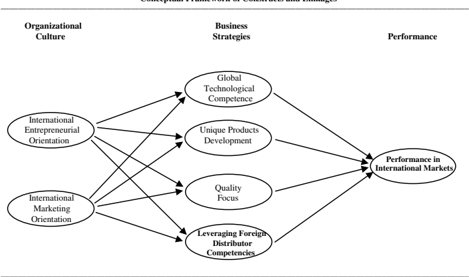
- The survey analysis found that international entrepreneurial orientation significantly predicted global technological competence with a standardized coefficient of 0.28; the link from international marketing orientation to global technological competence was not significant.
- Unique products development was significantly predicted by both international entrepreneurial orientation (0.19) and international marketing orientation (0.24).
- Quality focus was significantly predicted by both international entrepreneurial orientation (0.23) and international marketing orientation (0.35).
- Leveraging foreign distributor competences was significantly predicted by international marketing orientation (0.26) but not by international entrepreneurial orientation; these strategy variables were also significant drivers of performance in international markets: global technological competence (0.21), unique products development (0.14), quality focus (0.30), and leveraging foreign distributor competences (0.18).
## Methods
- The paper uses a two-phase design: first qualitative interviews/case studies to develop constructs and hypotheses, then a cross-industry field survey to test them.
- The qualitative phase included 33 professionals: 24 senior managers at early internationalizing firms, 6 scholars, and 3 international trade experts; the firms were mostly founded after 1985, sold half or more of their sales abroad, and had entered foreign markets within 3 years of founding.
- The survey was mailed to a random sample of 900 manufacturing firms in the United States founded in 1980 or later and exporting at least 25% of total production; 203 usable surveys were returned (about 23% response rate). The main analysis used LISREL8 path analysis, with exploratory factor analysis and confirmatory factor analysis for scale purification and validity checks.
## Limitations
- The paper states that “little empirical work” had been attempted on born globals and that there had been “almost no empirical research” on the factors driving their superior international performance.
- The study itself is focused on U.S. manufacturing firms that were selected using a 25% export threshold, so the evidence is tied to that sample and entry-mode context; this is evident from the text.
- The paper notes that the survey results are based on self-reported measures from responding firms; this is evident from the questionnaire-based design, though the paper does not frame it explicitly as a limitation.
Model-written summary. Check it against the paper before relying on it.
Integrity signals
Registry
Cites
Statistics
Figures
Verification
Claims the paper makes
0 Valid · 0 Not valid · 53 Not checked · 112 Own results and interpretations
A result the paper reports from its own data — it cites no other source for it, so there is none to check. The quote shows it is in the paper.
In the paper
“Despite the scarce resources typical of young firms, our findings reveal that born-global firms leverage a distinctive mix of orientations and strategies that allow them to succeed in diverse international markets.”
plainstates a cause- Asserted: passes — The authors put it forward as true.
- Checkable: passes — It can be checked against evidence.
- Load-bearing: passes — The paper’s conclusions depend on it.
- Based: passes — The paper gives a reason why it holds.
- Rests on an assumption not shown here.
A result the paper reports from its own data — it cites no other source for it, so there is none to check. The quote shows it is in the paper.
In the paper
“The critical role of marketing prowess overseas was also strongly emphasized by virtually all interviewees in the case studies.”
boosted- Asserted: passes — The authors put it forward as true.
- Checkable: passes — It can be checked against evidence.
- Load-bearing: unclear — It is unclear whether the paper’s conclusions depend on it.
- Based: passes — The paper gives a reason why it holds.
A result the paper states — it cites no source for it, so there is none to check. The quote shows it is in the paper.
In the paper
“Most interviewed firms exhibited strong technological capabilities in their respective product or industry categories.”
plain- Asserted: passes — The authors put it forward as true.
- Checkable: passes — It can be checked against evidence.
- Load-bearing: unclear — It is unclear whether the paper’s conclusions depend on it.
- Based: passes — The paper gives a reason why it holds.
A result the paper reports from its own data — it cites no other source for it, so there is none to check. The quote shows it is in the paper.
In the paper
“In general, the qualitative phase of the study revealed that born globals are likely to be formed by entrepreneurs who pursue foreign ventures with a strong marketing orientation.”
hedgedstates an association- Asserted: passes — The authors put it forward as true.
- Checkable: passes — It can be checked against evidence.
- Load-bearing: passes — The paper’s conclusions depend on it.
- Based: passes — The paper gives a reason why it holds.
A result the paper states — it cites no source for it, so there is none to check. The quote shows it is in the paper.
In the paper
“In contrast, born globals leverage a collection of fundamental intangible knowledge-based capabilities in the cultivation of foreign markets early in their evolution.”
plainstates a cause- Asserted: passes — The authors put it forward as true.
- Checkable: passes — It can be checked against evidence.
- Load-bearing: passes — The paper’s conclusions depend on it.
- Based: unclear — It is unclear why the paper says it holds.
- Rests on an assumption not shown here.
84 more claims
Create a free account to see all 165 claims and to verify the 3 references still open.
- It may state two separate claims as one. 33
- Probably not a substantial claim. 54
Citations
Cites
Evaluating Structural Equation Models with Unobservable Variables and Measurement Error
Fornell, C., & Larcker, D. F. (1981) · Journal of Marketing Research · doi:10.2307/3151312 · Cited by 109,314 · cited 2×
“Composite reliability was calculated using the procedures outlined by Fornell and Larcker (1981).”
MethodInfluentialEvaluating structural equation models with unobservable variables and measurement error
Fornell, C., & Larcker, D. F. (1981) · Journal of Marketing Research · doi:10.1177/002224378101800104 · Cited by 109,190
Firm Resources and Sustained Competitive Advantage
Barney, J. (1991) · Journal of Management · doi:10.1177/014920639101700108 · Cited by 48,334
(1994) · Journal of the American Dietetic Association · doi:10.1016/0002-8223(94)92216-0 · Cited by 45,910
Firm resources and sustained competitive advantage
Barney, J. B. (2004) · Advances in Strategic Management · doi:10.1016/s0742-3322(00)17018-4 · Cited by 38,152
Absorptive Capacity: A New Perspective on Learning and Innovation
Cohen, W. M., & Levinthal, D. A. (1990) · Administrative Science Quarterly · doi:10.2307/2393553 · Cited by 35,728
A resource‐based view of the firm
Wernerfelt, B. (1984) · Strategic Management Journal · doi:10.1002/smj.4250050207 · Cited by 25,635
The Theory of Economic Development
Schumpeter, J., & Backhaus, U. (2006) · The European Heritage in Economics and the Social Sciences · doi:10.1007/0-306-48082-4_3 · Cited by 22,506
An Evolutionary Theory of Economic Change.
Loasby, B. J., Nelson, R. R., & Winter, S. G. (1983) · The Economic Journal · doi:10.2307/2232409 · Cited by 21,366
A Dynamic Theory of Organizational Knowledge Creation
Nonaka, I. (1994) · Organization Science · doi:10.1287/orsc.5.1.14 · Cited by 17,809
Research works printed but not linked: 5
- Nikkei Sangyoo Shimbun (1995) Benchaa Shin Sedai (New Generation Ventures) , Nihon Keizai Shimbun: Tokyo.
- Nunnally, J.C. (1978) Psychometric Theory
- Porter, M.E. (1980) Competitive Strategy , The Free Press: New York.
- Rennie, M. (1993) 'Born global', McKinsey Quarterly (4): 45-52. Rosson, P. and Ford, I.D. (1982) 'Manufacturer-overseas distributor relations and export performance', Journal of International Business Studies 13 (2): 57-72.
- Schumpeter, J. (1939) Business Cycles , Vol. 1 McGraw-Hill: New York.
Cited by
Items 201–300 of 3,020
Informal institutions and international entrepreneurship
Muralidharan, E. K., & Pathak, S. (2016) · International Business Review · doi:10.1016/j.ibusrev.2016.07.006 · Cited by 175
“Born Globals (BGs) are young entrepreneurial start-up firms that start international business, mainly exporting, soon after their founding (Knight & Cavusgil, 2004).”
BackgroundBack to basics: Behavioral theory and internationalization
Surdu, I. M., Greve, H. R., & Benito, G. R. G. (2020) · Journal of International Business Studies · doi:10.1057/s41267-020-00388-w · Cited by 171
Venturing from Emerging Economies
Yamakawa, Y., Khavul, S., Peng, M. W., & DEEDS, D. L. (2013) · Strategic Entrepreneurship Journal · doi:10.1002/sej.1158 · Cited by 163
Jin, B. E., & Cho, H. J. (2018) · Journal of Business and Industrial Marketing · doi:10.1108/jbim-02-2017-0043 · Cited by 188
Li, P. P. (2010) · Journal of International Management · doi:10.1016/j.intman.2009.05.003 · Cited by 165
“Despite the consensus that multinational enterprises (MNE) have been the primary driver behind the trend toward globalization (Dicken, 2007), the new species of MNE, including MNE from the emerging economies (BCG, 2007; UNCTAD, 2006) and “born-global”MNE (Oviatt and McDougall, 1994) have not been adequately studied (K…”
BackgroundInfluentialThe overestimated role of strategic orientations for international performance in smaller firms
Frishammar, J., & Andersson, S. (2008) · Journal of International Entrepreneurship · doi:10.1007/s10843-008-0031-9 · Cited by 187
“Internationalization is thus an innovative entrepreneurial act (Andersson 2000; Casson 2000; Knight and Cavusgil 2004 ).”
BackgroundMethodResultInfluentialShepherd, D. A., & Patzelt, H. (2018) · Springer eBooks · doi:10.1007/978-3-319-71782-1 · Cited by 229
Bounded entrepreneurship and internationalisation of indigenous Chinese private-owned firms
Liu, X., Xiao, W., & Huang, X. (2008) · International Business Review · doi:10.1016/j.ibusrev.2008.02.014 · Cited by 176
“…Coviello, 2006) or social capital (Yli-Renko et al. 2002), entrepreneurship (Anderson, 2000), international entrepreneurial/marketing orientation (Knight and Cavusgil, 2004), resourcebased views (Westhead and Wright, 2001; Dhanaraj and Beamish, 2003), clustering (Maitland et al. 2005) and…”
BackgroundConceptualizing Innovation in Higher Education
Tierney, W. G., & Lanford, M. (2016) · Higher education · doi:10.1007/978-3-319-26829-3_1 · Cited by 238
Strategic ambidexterity and performance in international new ventures
Han, M., & Celly, N. (2008) · Canadian Journal of Administrative Sciences / Revue Canadienne des Sciences de l Administration · doi:10.1002/cjas.84 · Cited by 182
Prior conditions and early international commitment: the mediating role of domestic mindset
Nadkarni, S., & Pérez, P. D. (2007) · Journal of International Business Studies · doi:10.1057/palgrave.jibs.8400248 · Cited by 161
Innovation quantity or quality? The role of political connections
Liu, S., Du, J., Zhang, W., Tian, X., & Kou, G. (2021) · Emerging Markets Review · doi:10.1016/j.ememar.2021.100819 · Cited by 149
SMEs' internationalisation patterns: descriptives, dynamics and determinants
Olejnik, E., & Swoboda, B. S. (2012) · International Marketing Review · doi:10.1108/02651331211260340 · Cited by 201
Configurations of effectuation, causation, and bricolage: implications for firm growth paths
An, W., Rüling, C.-C., Zheng, X., & Zhang, J. (2019) · Small Business Economics · doi:10.1007/s11187-019-00155-8 · Cited by 175
A comparative investigation into the internationalisation of Canadian and UK high‐tech SMEs
Spence, M. M., & Crick, D. (2006) · International Marketing Review · doi:10.1108/02651330610703436 · Cited by 182
Evers, N., Andersson, S., & Hannibal, M. (2012) · Journal of International Marketing · doi:10.1509/jim.12.0077 · Cited by 171
“A large body of literature has investigated firms that experience rapid international market growth soon after their inception (Andersson and Wictor 2003; Knight and Cavusgil 2004; Oviatt and McDougall 1994).”
BackgroundInternational new ventures: The cross-border nexus of individuals and opportunities
Gregorio, D. D., Musteen, M., & Thomas, D. E. (2008) · Journal of World Business · doi:10.1016/j.jwb.2007.11.013 · Cited by 161
“Due to variation in endowments of foundational resources, defined as the resources, knowledge and capabilities that are the basis of new ventures’ initial strategy ( Knight & Cavusgil, 2004 ), ventures which emerge to exploit primarily the former type of opportunities are likely to exhibit different qualities and foll…”
BackgroundLee, Y. Y., & Falahat, M. (2019) · Technology Innovation Management Review · doi:10.22215/timreview/1281 · Cited by 200
Roxas, B., & Chadee, D. D. (2013) · Tourism Management · doi:10.1016/j.tourman.2012.10.016 · Cited by 179
Linking knowledge, entry timing and internationalization strategy
Tuppura, A., Saarenketo, S., Puumalainen, K., Jantunen, A., & Kyläheiko, K. (2008) · International Business Review · doi:10.1016/j.ibusrev.2008.02.003 · Cited by 164
Stability vs. flexibility: The effect of regulatory institutions on opportunity type
Young, S. L., Welter, C., & Conger, M. (2017) · Journal of International Business Studies · doi:10.1057/s41267-017-0095-7 · Cited by 169
SME Networks and International Performance: Unveiling the Significance of Foreign Market Entry Mode
Stoian, M.-C., Criado, J. R., & Dimitratos, P. (2016) · Journal of Small Business Management · doi:10.1111/jsbm.12241 · Cited by 168
“Similarly, Lu and Beamish (2001) find that a viable strategy for overcoming the constraints in resources and capabilities, which typically hinder the international development of SMEs, is entering alliances with partners with local knowledge.”
BackgroundMicro-multinational or not? International entrepreneurship, networking and learning effects
Dimitratos, P., Amorós, J. E., Etchebarne, M. S., & Felzensztein, C. (2013) · Journal of Business Research · doi:10.1016/j.jbusres.2013.07.010 · Cited by 154
“These firms operate in a unique innovative culture that allows them to succeed in diverse international markets (Knight & Cavusgil, 2004).”
BackgroundNetwork resource combinations in the international venturing of small biotech firms
Tolstoy, D., & Agndal, H. (2009) · Technovation · doi:10.1016/j.technovation.2009.06.004 · Cited by 156
International entrepreneurship and the internationalization phenomenon: taking stock, looking ahead
Zucchella, A. (2021) · International Business Review · doi:10.1016/j.ibusrev.2021.101800 · Cited by 162
Lu, J., Xu, B., & Liu, X. (2009) · Management International Review · doi:10.1007/s11575-009-0004-9 · Cited by 159
Buckley, P. J. (2015) · Journal of World Business · doi:10.1016/j.jwb.2015.08.012 · Cited by 191
A latent class analysis of small firms’ internationalization patterns
Baum, M., Schwens, C., & Kabst, R. (2015) · Journal of World Business · doi:10.1016/j.jwb.2015.03.001 · Cited by 163
Hollender, L., Zapkau, F. B., & Schwens, C. (2016) · International Business Review · doi:10.1016/j.ibusrev.2016.07.003 · Cited by 180
Freixanet, J., & Renart, G. (2020) · Journal of World Business · doi:10.1016/j.jwb.2020.101110 · Cited by 169
Jones, M. V., & Casulli, L. (2014) · Entrepreneurship Theory and Practice · doi:10.1111/etap.12060 · Cited by 170
“…worth considering that INVs are noted predominantly in studies of knowledge intensive industries (Bell, 1995; Coviello & Munro, 1997; Jones, 1999; Knight & Cavusgil, 2004; Madsen & Servais, 1997) in which the complexities of technologies and technological processes as well as prior training of…”
BackgroundEntrepreneurship and poverty reduction: A case study of Yiwu, China
Si, S., Yu, X., Wu, A., Chen, S., Chen, S., & Su, Y. (2014) · Asia Pacific Journal of Management · doi:10.1007/s10490-014-9395-7 · Cited by 145
“The whole process of using the entrepreneurial process to create wealth was assumed to be easy to attempt under conditions of uncertainty (Knight & Cavusgil, 2004).”
MethodThe evolving role of organisational and personal networks in international market venturing
Eberhard, M., & Craig, J. B. L. (2012) · Journal of World Business · doi:10.1016/j.jwb.2012.07.022 · Cited by 162
Understanding the links among innovation performance, market performance and financial performance
Gök, O., & Peker, S. (2016) · Review of Managerial Science · doi:10.1007/s11846-016-0198-8 · Cited by 166
Bianchi, C., Glavas, C., & Mathews, S. W. (2017) · Journal of Small Business and Enterprise Development · doi:10.1108/jsbed-09-2016-0142 · Cited by 195
Prange, C. I., & Pinho, J. C. (2017) · International Business Review · doi:10.1016/j.ibusrev.2017.04.004 · Cited by 172
Product and process innovation in manufacturing firms: a 30-year bibliometric analysis
Marzi, G., Dabić, M., Daim, T. U., & Garces, E. (2017) · Scientometrics · doi:10.1007/s11192-017-2500-1 · Cited by 155
Internationalisation and risk: Literature review, integrative framework and research agenda
Eduardsen, J. S., & Marinova, S. T. (2020) · International Business Review · doi:10.1016/j.ibusrev.2020.101688 · Cited by 176
Casprini, E., Dabić, M., Kotlar, J., & Pucci, T. (2020) · International Business Review · doi:10.1016/j.ibusrev.2020.101715 · Cited by 150
Factors enhancing the choice of higher resource commitment entry modes in international new ventures
Meliá, M. R., Blesa, A., & Monferrer, D. (2011) · International Business Review · doi:10.1016/j.ibusrev.2011.07.007 · Cited by 198
Routine microprocesses and capability learning in international new ventures
Prashantham, S., & Floyd, S. W. (2012) · Journal of International Business Studies · doi:10.1057/jibs.2012.13 · Cited by 141
Williams, D. W., & Grégoire, D. A. (2014) · Journal of International Business Studies · doi:10.1057/jibs.2014.52 · Cited by 140
Freixanet, J., Braojos, J., Rialp, A., & Criado, J. R. (2020) · The International Journal of Entrepreneurship and Innovation · doi:10.1177/1465750320922320 · Cited by 173
“IEO refers to the behavioral elements of top management’s global orientation, which are related to its propensity for proactive behavior, risk-taking, and innovativeness (Knight and Cavusgil, 2004).”
BackgroundMethodInternational entrepreneurship research versus international business research: A false dichotomy?
Verbeke, A., & Ciravegna, L. (2018) · Journal of International Business Studies · doi:10.1057/s41267-018-0154-8 · Cited by 123
“Two influential IE articles have been bestowed with the JIBS Decade Award, namely Oviatt and McDougall (1994) and Knight and Cavusgil (2004). Both articles suggested the need for new theory to explain the empirical phenomenon of ‘early internationalization’.”
BackgroundInfluentialInternational Entrepreneurial Culture and Growth of International New Ventures
Gabrielsson, M., Gabrielsson, P., & Dimitratos, P. (2014) · Management International Review · doi:10.1007/s11575-014-0213-8 · Cited by 155
“It is a fundamental aspect of the entrepreneurialness of the firm (Knight and Cavusgil 2004).”
BackgroundInternational Digital Competence
Cahen, F. R., & Borini, F. M. (2019) · Journal of International Management · doi:10.1016/j.intman.2019.100691 · Cited by 194
What’s so special about born globals, their entrepreneurs or their business model?
Hennart, J., Majocchi, A., & Hagen, B. (2021) · Journal of International Business Studies · doi:10.1057/s41267-021-00427-0 · Cited by 160
Opportunities for marketing researchers in international entrepreneurship
Styles, C. W., & Seymour, R. (2006) · International Marketing Review · doi:10.1108/02651330610660056 · Cited by 155
All Things Great and Small: Organizational Size, Boundaries of the Firm, and a Changing Environment
Josefy, M. A., Kuban, S., Ireland, R. D., & Hitt, M. A. (2015) · Academy of Management Annals · doi:10.1080/19416520.2015.1027086 · Cited by 173
SMES INNOVATION CAPABILITIES AND EXPORT PERFORMANCE: AN ENTREPRENEURIAL ORIENTATION VIEW
Ribau, C. P., Moreira, A. C., & Raposo, M. L. B. (2017) · Journal of Business Economics and Management · doi:10.3846/16111699.2017.1352534 · Cited by 168
Zailani, S. H. M., Iranmanesh, M., Nikbin, D., & Jumadi, H. (2014) · Asian Journal of Technology Innovation · doi:10.1080/19761597.2014.973167 · Cited by 136
“In addition, large and well-established firms have resources for adopting new technology (Knight and Cavusgil 2004) and the OS cannot be a concern for adopting green technology in these types of firms.”
BackgroundIs international entrepreneurship a field? A bibliometric analysis of the literature (1989–2015)
Servantie, V., Cabrol, M., Guieu, G., & Boissin, J. (2016) · Journal of International Entrepreneurship · doi:10.1007/s10843-015-0162-8 · Cited by 174
“…interests, from the specific study of international new ventures (Oviatt and McDougall 1994) or born global firms (Andersson and Wictor 2003; Knight and Cavusgil 2004) to consider various types of firms that exhibit entrepreneurial behaviour abroad, regardless of the type of international…”
BackgroundMethodInfluentialStoian, M.-C., Dimitratos, P., & Plakoyiannaki, E. (2018) · Journal of World Business · doi:10.1016/j.jwb.2018.06.001 · Cited by 153
Kahiya, E. T. (2013) · Journal of International Entrepreneurship · doi:10.1007/s10843-013-0102-4 · Cited by 169
Munodawafa, R. T., & Johl, S. K. (2019) · Sustainability · doi:10.3390/su11216067 · Cited by 152
“Therefore, resources and capabilities are indispensable to the strategy, innovativeness and performance of organizations [94].”
BackgroundSharma, P., Cheng, L. T. W., & Leung, T. Y. (2019) · Journal of Business Research · doi:10.1016/j.jbusres.2019.08.037 · Cited by 156
Caloghirou, Y. D., Giotopoulos, I., Κοντόλαιμου, Α., Korra, E., & Τσακανίκας, Ά. (2021) · Research Policy · doi:10.1016/j.respol.2020.104195 · Cited by 142
The innovativeness of Born-Globals and customer orientation: Learning from Indian Born-Globals
Kim, D., Basu, C., Naidu, G. M., & Çavuşgil, E. (2010) · Journal of Business Research · doi:10.1016/j.jbusres.2010.09.008 · Cited by 152
“Born-Globals are relatively small in size and new to the marketplace (Knight and Cavusgil, 2004).”
BackgroundMethodInfluentialThe importance of the internet in international business‐to‐business markets
Moen, Ø., Madsen, T. K., & Aspelund, A. (2008) · International Marketing Review · doi:10.1108/02651330810904053 · Cited by 152
The influence of innovation orientation on the internationalisation of SMEs in the service sector
Meliá, M. R., Blesa, A., & Dobón, S. R. (2009) · Service Industries Journal · doi:10.1080/02642060802342679 · Cited by 143
“Later studies have confirmed this relation (see, e.g. Knight & Cavusgil, 2004; Oviatt & McDougall, 2005; Zahra, 2005).”
ResultExplaining intermittent exporting: Exit and conditional re-entry in export markets
Bernini, M., Du, J., & Love, J. H. (2016) · Journal of International Business Studies · doi:10.1057/s41267-016-0015-2 · Cited by 130
“The literature on internationalisation is dominated by two theoretical approaches: the process approach and the international entrepreneurship (or ‘born global’) approach (Johanson and Vahlne, 1977, 2009; Knight and Cavusgil 2004; Jones and Coviello 2005).”
MethodThe new generation of millennial entrepreneurs: A review and call for research
Liu, J., Zhu, Y., Serapio, M. G., & Cavusgil, S. T. (2019) · International Business Review · doi:10.1016/j.ibusrev.2019.05.001 · Cited by 177
Self-citationSwoboda, B. S., & Olejnik, E. (2016) · Journal of Small Business Management · doi:10.1111/jsbm.12135 · Cited by 144
Cuervo-Cazurra, Á. (2010) · Journal of World Business · doi:10.1016/j.jwb.2010.10.003 · Cited by 152
Retail digitalization: Implications for physical stores
Hagberg, J., Jönsson, A., & Egels‐Zandén, N. (2017) · Journal of Retailing and Consumer Services · doi:10.1016/j.jretconser.2017.08.005 · Cited by 193
“We are already witnessing interesting new collaborations between traditional retailers and what, in this context, we might refer to as “the born e-commercers” (inspired by the literature on born globals and represented by researchers such as Knight and Cavusgil, 2004).”
BackgroundSocial trust and angel investors' decisions: A multilevel analysis across nations
Ding, Z., Au, K. Y.-F., & Chiang, F. F. T. (2014) · Journal of Business Venturing · doi:10.1016/j.jbusvent.2014.08.003 · Cited by 138
Morgan‐Thomas, A., & Jones, M. V. (2009) · International Small Business Journal Researching Entrepreneurship · doi:10.1177/0266242608098347 · Cited by 160
KRAUS, S., BREM, A., SCHUESSLER, M., SCHUESSLER, F., & NIEMAND, T. (2017) · International Journal of Innovation Management · doi:10.1142/s1363919617500050 · Cited by 114
Chatterjee, S., Moody, G., Lowry, P. B., Chakraborty, S., & Hardin, A. (2015) · Journal of Management Information Systems · doi:10.1080/07421222.2015.1099180 · Cited by 113
The effect of network competence and environmental hostility on the internationalization of SMEs
Torkkeli, L., Puumalainen, K., Saarenketo, S., & Kuivalainen, O. (2012) · Journal of International Entrepreneurship · doi:10.1007/s10843-011-0083-0 · Cited by 155
Wei, Y., Zheng, N., Liu, X., & Lu, J. (2013) · International Business Review · doi:10.1016/j.ibusrev.2013.06.001 · Cited by 115
“Future studies should examine the impact of entry barriers, such as tariffs imposed on host country industries.”
BackgroundMethodInfluentialNetwork development and firm growth: A resource-based study of B2B Born Globals
Sepulveda, F. L., & Gabrielsson, M. (2013) · Industrial Marketing Management · doi:10.1016/j.indmarman.2013.01.001 · Cited by 150
“Born Global (BG) firms are recognized for their early internationalization and fast growth, whichmarkedly sets them apart from the other types of new ventures (Knight & Cavusgil, 2004).”
InfluentialWhat Does Really Matter in the Internationalization of Small and Medium-Sized Family Businesses?
Calabrò, A., Brogi, M., & Torchia, M. (2015) · Journal of Small Business Management · doi:10.1111/jsbm.12165 · Cited by 111
Cross-border acquisitions by Indian multinationals: Asset exploitation or asset augmentation?
Buckley, P. J., Munjal, S., Enderwick, P., & Forsans, N. (2015) · International Business Review · doi:10.1016/j.ibusrev.2015.10.006 · Cited by 126
“Technological resources help the firm to upgrade products, improve operational efficiency, and develop innovative capabilities (Knight & Cavusgil, 2004).”
BackgroundThe positive role of global leaders in enhancing multicultural team innovation
Lisak, A., Erez, M., Sui, Y., & Lee, C. (2016) · Journal of International Business Studies · doi:10.1057/s41267-016-0002-7 · Cited by 177
Bembom, M., & Schwens, C. (2018) · European Management Journal · doi:10.1016/j.emj.2018.03.003 · Cited by 138
Zhang, M., Sarker, S., & Sarker, S. (2012) · Information Systems Journal · doi:10.1111/j.1365-2575.2012.00404.x · Cited by 138
“International entrepreneurial orientation refers to the firm’s overall innovativeness and pro-activeness in the pursuit of international opportunities (Knight & Cavusgil, 2004).”
BackgroundMethodInfluentialFletcher, M. A., Zhao, Y., Plakoyiannaki, E., & Buck, T. (2018) · International Business Review · doi:10.1016/j.ibusrev.2017.12.004 · Cited by 154
The role of spirituality in Islamic business networks: The case of internationalizing Turkish SMEs
Kurt, Y., Sinkovics, N., Sinkovics, R. R., & Yamin, M. (2019) · Journal of World Business · doi:10.1016/j.jwb.2019.101034 · Cited by 138
“Networks are an important concept in internationalization research, particularly in studies focusing on SMEs, born-globals and international new ventures (Coviello, 2006; Knight & Cavusgil, 2004; Manolova, Manev, & Gyoshev, 2010; Sinkovics, Kurt, & Sinkovics, 2018; Zhou, Wei-ping, & Xueming, 2007).”
The role of information technology in corporate strategy of small and medium enterprises
Nieto, M. J., & Fernández, Z. (2005) · Journal of International Entrepreneurship · doi:10.1007/s10843-006-7854-z · Cited by 153
“This approach adds new elements to the analysis, such as the importance of concrete resources ( Knight and Cavusgil, 2004; Madsen and Servais, 1997) and the usefulness of networks (Johanson and Vahlne, 2003).”
BackgroundEarly internationalization and performance of small high‐tech “born‐globals”
Li, L., Qian, G., & Qian, Z. (2012) · International Marketing Review · doi:10.1108/02651331211260377 · Cited by 147
“International new venture approach suggests that small firms’ early internationalization be driven by, among other factors, their efforts to leverage their capabilities in organizational learning and innovation (e.g. Filatotchev and Piesse, 2009; Knight and Cavusgil, 2004; McDougall and Oviatt, 2000).”
BackgroundQualitative Insights into the International New Venture Creation Process
Evangelista, F. U. (2005) · Journal of International Entrepreneurship · doi:10.1007/s10843-005-4204-5 · Cited by 147
Joo, H.-Y., Seo, Y. W., & Min, H. (2018) · International Journal of Production Research · doi:10.1080/00207543.2018.1430902 · Cited by 135
“Questions assessing the environmental performance were based on the earlier studies conducted by Zhu, Sarkis, and Geng (2004), and Zhu and Sarkis (2007), while questions assessing the export performance were developed based on the study by Knight and Cavusgil (2004).”
MethodMiočević, D., & Morgan, R. E. (2018) · International Marketing Review · doi:10.1108/imr-12-2015-0270 · Cited by 163
Qin, F., Wright, M., & Gao, J. (2017) · Journal of Business Venturing · doi:10.1016/j.jbusvent.2017.08.003 · Cited by 117
“Although resources have been extensively studied in the context of venture entry (e.g. Knight and Cavusgil, 2004), the discussion on speed of venture entry is scant.”
BackgroundExplaining performance determinants: A knowledge based view of international new ventures
Martin, S. L., & Javalgi, R. G. (2019) · Journal of Business Research · doi:10.1016/j.jbusres.2019.02.041 · Cited by 137
Geographic Diversification and the Survival of Born-Globals
Patel, P. C., Criaco, G., & Naldi, L. (2016) · Journal of Management · doi:10.1177/0149206316635251 · Cited by 133
“…process, typically 2010 Journal of Management / May 2018 championed by founders or managers” (Cavusgil & Knight, 2015: 4), and they seek to derive a substantial proportion of their revenue from exports (Cavusgil & Knight, 2015; Coviello, 2015; Knight & Cavusgil, 2004; Zander et al., 2015).”
Early internationalizing firms: 2004–2018
Romanello, R., & Chiarvesio, M. (2019) · Journal of International Entrepreneurship · doi:10.1007/s10843-018-0241-8 · Cited by 130
Zhang, M., & Tansuhaj, P. S. (2007) · Multinational Business Review · doi:10.1108/1525383x200700012 · Cited by 135
Organizational creativity as a crucial resource for building international business competence
de Vasconcellos, S. L., Garrido, I. L., & Parente, R. (2018) · International Business Review · doi:10.1016/j.ibusrev.2018.11.003 · Cited by 133
“Such firms have a proactive organizational culture that helps them develop the resources to achieve superior results in international markets (Knight & Cavusgil, 2004).”
BackgroundInfluentialThe role of domestic and cross-border venture capital investors in the growth of portfolio companies
Devigne, D., Vanacker, T. R., Manigart, S., & Paeleman, I. (2011) · Small Business Economics · doi:10.1007/s11187-011-9383-y · Cited by 137
“High-tech companies often have a narrow product scope based on a technology that may quickly become obsolete and for which the domestic market size is limited (Coviello and Munro 1995; Knight and Cavusgil 2004; Litvak 1990; Lutz and George 2010; McDougall et al. 1994; Sapienza et al. 2006).”
Açıkdilli, G., Mintu-Wimsatt, A. T., Kara, A., & Spillan, J. E. (2020) · The Journal of Marketing Theory and Practice · doi:10.1080/10696679.2020.1809461 · Cited by 144
Almor, T., & Hashai, N. (2004) · Journal of International Management · doi:10.1016/j.intman.2004.08.002 · Cited by 137
Born‐Global SMEs, Performance, and Dynamic Absorptive Capacity: Evidence from Spanish Firms
Rodríguez‐Serrano, M. Á., & Armario, E. M. (2019) · Journal of Small Business Management · doi:10.1111/jsbm.12319 · Cited by 131
“The majority of works that have emerged on born-global SMEs consider entrepreneurial orientation as a key element, both in early internationalization of these firms as in their performance (e.g., Jones and Coviello 2005; Knight and Cavusgil 2004; McDougall, Shane, and Oviatt 1994; Zahra 2005).”
BackgroundResultInfluentialUsing reputation for corporate sustainability to tackle banks digitalization challenges
Forcadell, F. J., Aracil, E., & Mellina, F. Ú. (2020) · Business Strategy and the Environment · doi:10.1002/bse.2494 · Cited by 142
Born globals trough knowledge-based dynamic capabilities and network market orientation
Monferrer, D., Blesa, A., & Meliá, M. R. (2014) · BRQ Business Research Quarterly · doi:10.1016/j.brq.2014.04.001 · Cited by 134
“…of new firms insofar as it constitutes a key variable for the proactive search for international opportunities (Autio et al., 2000; Andersson, 2004; Knight and Cavusgil, 2004; Sapienza et al., 2006; Acedo and Jones, 2007; Gassmann and Keupp, 2007; Weerawardena et al., 2007; Zhou, 2007; Armario et…”
BackgroundLuiz, J. M., Stringfellow, D., & Jefthas, A. (2017) · Global Strategy Journal · doi:10.1002/gsj.1143 · Cited by 116
“EMNEs are either skipping some of the Uppsala model steps or engaging in them sooner than the model would predict (Contractor, Kumar, and Kundu, 2007; Knight and Cavusgil, 2004).”
BackgroundAlbort-Morant, G., Leal‐Rodríguez, A. L., Fernández-Rodríguez, V., & Ariza‐Montes, A. (2017) · European Research on Management and Business Economics · doi:10.1016/j.iedeen.2017.06.004 · Cited by 145
“12 891 Kogut and Zander (1996) What firms do? Coordination, identity, and learning Conceptual 13 774 Benner and Tushman (2003) Exploitation, exploration, and process management: the productivity dilemma”
BackgroundInfluentialGlobal scaling as a logic of multinationalization
Reuber, A. R., Tippmann, E., & Monaghan, S. (2021) · Journal of International Business Studies · doi:10.1057/s41267-021-00417-2 · Cited by 139
Multinationality-Performance Relationship: A Meta-analysis
Yang, Y. G., & Driffield, N. L. (2011) · Management International Review · doi:10.1007/s11575-011-0095-y · Cited by 128
“Significance levels: *p < 0.10; **p < 0.05; ***p < 0.01 Knight and Cavusgil (2004), highlight the importance of innovation in these firms in a US context.”
BackgroundInfluential
Metadata
- Authors
- Knight, G. A., & Cavusgil, S. T.
- Affiliations
- Florida State University (US)
- Corresponding author
- Knight, Gary A
- ORCID
- Knight, Gary A
- Venue
- Journal of International Business Studies
- Published
- 2004-01-08
- Volume
- 35
- Issue
- 2
- Pages
- 124-141
- ISSN
- 0047-2506 (ISSN-L)
- 1478-6990
- OpenAlex
- W2127709152
- Semantic Scholar
- d24960b5342d0dd3b86be002ab18a80e7b6fb5c9
- Cited by
- 3,013
- References
- 102
- Citations by year
- 2026: 121 · 2025: 123 · 2024: 157 · 2023: 154 · 2022: 182 · 2021: 196 · 2020: 189 · 2019: 180 · 2018: 199 · 2017: 172 · 2016: 188 · 2015: 187 · 2014: 178 · 2013: 167 · 2012: 129
- FWCI
- 137.12
- Type
- journal article
- Language
- en
- Update notices
- correction (2004-07-16)
- Open access
- bronze
- doi.org
- Licence
- www.springer.com/tdm (tdm)
- Locations
- Journal of International Business Studies (publishedVersion)
- RePEc: Research Papers in Economics (submittedVersion)
- Funders
- Michigan State University
- College of Engineering, Michigan State University
- Topics
- Social Sciences › Business, Management and Accounting › Strategy and Management › International Business and FDI
- Social Sciences › Business, Management and Accounting › Strategy and Management › Innovation and Knowledge Management
- Social Sciences › Communication › International Student and Expatriate Challenges
- Keywords
- born global firms, early internationalization, organizational capabilities, innovation, innovation culture, international business strategy, international success, young firms, internationalization of firms
About these checks
Registry, retraction, Cites and statistics results are computed, not judged, with one exception: a printed reference that no index lists is read once by a model before it counts as a citation error. Claims are extracted by a model and kept only when their quote appears verbatim in the text; each cited source is then checked, with a model’s help, for whether it says what the claim relies on. Those verdicts can be wrong — read the claim’s quote and the cited source before relying on one.
A language model drew the claims from the paper on 2026-10-10, under version 3 of the claim definition (model deepseek-v4.1-flash, prompt extract-v3).
A second model labelled each claim on 2026-10-10 (model jev-1.13-20260917, definition revision gold-guideline-v0.2).
Statistics and arithmetic are recomputed, not judged.
Confidence bands are shown only for fields calibrated on our annotated test set. None is calibrated yet, so no band is shown.
What counts as a claim ›How we measure confidence ›How we check this ›
Are you an author, or do you see a problem with this page? Request a review
Data sources
Bibliographic data: Semantic Scholar, OpenAlex, Crossref.
Contains information from the Semantic Scholar Academic Graph Datasets, made available under the ODC Attribution License (ODC-BY 1.0).
Semantic Scholar’s data is described in: Kinney, R., et al. (2023). The Semantic Scholar Open Data Platform. arXiv:2301.10140.
