

Innovation, organizational capabilities, and the born-global firm
Open accessThe DOI matches its Crossref record; 106 of the 106 references it cites were found in a registry or an index; none of the 100 sources its claims cite is checked for support yet.
Overview
CoChat Summary
## TL;DR
This study argues that born-global firms succeed because early internationalization is supported by an innovative culture and a distinctive set of organizational capabilities. Using qualitative case studies followed by a survey of 203 usable responses, the authors find that several capability links are significant and that these capabilities are associated with performance in international markets.
## Key findings
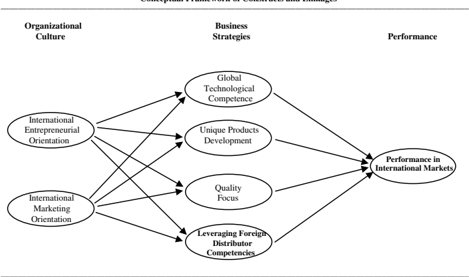
- The survey analysis found that international entrepreneurial orientation significantly predicted global technological competence with a standardized coefficient of 0.28; the link from international marketing orientation to global technological competence was not significant.
- Unique products development was significantly predicted by both international entrepreneurial orientation (0.19) and international marketing orientation (0.24).
- Quality focus was significantly predicted by both international entrepreneurial orientation (0.23) and international marketing orientation (0.35).
- Leveraging foreign distributor competences was significantly predicted by international marketing orientation (0.26) but not by international entrepreneurial orientation; these strategy variables were also significant drivers of performance in international markets: global technological competence (0.21), unique products development (0.14), quality focus (0.30), and leveraging foreign distributor competences (0.18).
## Methods
- The paper uses a two-phase design: first qualitative interviews/case studies to develop constructs and hypotheses, then a cross-industry field survey to test them.
- The qualitative phase included 33 professionals: 24 senior managers at early internationalizing firms, 6 scholars, and 3 international trade experts; the firms were mostly founded after 1985, sold half or more of their sales abroad, and had entered foreign markets within 3 years of founding.
- The survey was mailed to a random sample of 900 manufacturing firms in the United States founded in 1980 or later and exporting at least 25% of total production; 203 usable surveys were returned (about 23% response rate). The main analysis used LISREL8 path analysis, with exploratory factor analysis and confirmatory factor analysis for scale purification and validity checks.
## Limitations
- The paper states that “little empirical work” had been attempted on born globals and that there had been “almost no empirical research” on the factors driving their superior international performance.
- The study itself is focused on U.S. manufacturing firms that were selected using a 25% export threshold, so the evidence is tied to that sample and entry-mode context; this is evident from the text.
- The paper notes that the survey results are based on self-reported measures from responding firms; this is evident from the questionnaire-based design, though the paper does not frame it explicitly as a limitation.
Model-written summary. Check it against the paper before relying on it.
Integrity signals
Registry
Cites
Statistics
Figures
Verification
Claims the paper makes
0 Valid · 0 Not valid · 53 Not checked · 112 Own results and interpretations
A result the paper reports from its own data — it cites no other source for it, so there is none to check. The quote shows it is in the paper.
In the paper
“Despite the scarce resources typical of young firms, our findings reveal that born-global firms leverage a distinctive mix of orientations and strategies that allow them to succeed in diverse international markets.”
plainstates a cause- Asserted: passes — The authors put it forward as true.
- Checkable: passes — It can be checked against evidence.
- Load-bearing: passes — The paper’s conclusions depend on it.
- Based: passes — The paper gives a reason why it holds.
- Rests on an assumption not shown here.
A result the paper reports from its own data — it cites no other source for it, so there is none to check. The quote shows it is in the paper.
In the paper
“The critical role of marketing prowess overseas was also strongly emphasized by virtually all interviewees in the case studies.”
boosted- Asserted: passes — The authors put it forward as true.
- Checkable: passes — It can be checked against evidence.
- Load-bearing: unclear — It is unclear whether the paper’s conclusions depend on it.
- Based: passes — The paper gives a reason why it holds.
A result the paper states — it cites no source for it, so there is none to check. The quote shows it is in the paper.
In the paper
“Most interviewed firms exhibited strong technological capabilities in their respective product or industry categories.”
plain- Asserted: passes — The authors put it forward as true.
- Checkable: passes — It can be checked against evidence.
- Load-bearing: unclear — It is unclear whether the paper’s conclusions depend on it.
- Based: passes — The paper gives a reason why it holds.
A result the paper reports from its own data — it cites no other source for it, so there is none to check. The quote shows it is in the paper.
In the paper
“In general, the qualitative phase of the study revealed that born globals are likely to be formed by entrepreneurs who pursue foreign ventures with a strong marketing orientation.”
hedgedstates an association- Asserted: passes — The authors put it forward as true.
- Checkable: passes — It can be checked against evidence.
- Load-bearing: passes — The paper’s conclusions depend on it.
- Based: passes — The paper gives a reason why it holds.
A result the paper states — it cites no source for it, so there is none to check. The quote shows it is in the paper.
In the paper
“In contrast, born globals leverage a collection of fundamental intangible knowledge-based capabilities in the cultivation of foreign markets early in their evolution.”
plainstates a cause- Asserted: passes — The authors put it forward as true.
- Checkable: passes — It can be checked against evidence.
- Load-bearing: passes — The paper’s conclusions depend on it.
- Based: unclear — It is unclear why the paper says it holds.
- Rests on an assumption not shown here.
84 more claims
Create a free account to see all 165 claims and to verify the 3 references still open.
- It may state two separate claims as one. 33
- Probably not a substantial claim. 54
Citations
Cites
Evaluating Structural Equation Models with Unobservable Variables and Measurement Error
Fornell, C., & Larcker, D. F. (1981) · Journal of Marketing Research · doi:10.2307/3151312 · Cited by 109,314 · cited 2×
“Composite reliability was calculated using the procedures outlined by Fornell and Larcker (1981).”
MethodInfluentialEvaluating structural equation models with unobservable variables and measurement error
Fornell, C., & Larcker, D. F. (1981) · Journal of Marketing Research · doi:10.1177/002224378101800104 · Cited by 109,190
Firm Resources and Sustained Competitive Advantage
Barney, J. (1991) · Journal of Management · doi:10.1177/014920639101700108 · Cited by 48,334
(1994) · Journal of the American Dietetic Association · doi:10.1016/0002-8223(94)92216-0 · Cited by 45,910
Firm resources and sustained competitive advantage
Barney, J. B. (2004) · Advances in Strategic Management · doi:10.1016/s0742-3322(00)17018-4 · Cited by 38,152
Absorptive Capacity: A New Perspective on Learning and Innovation
Cohen, W. M., & Levinthal, D. A. (1990) · Administrative Science Quarterly · doi:10.2307/2393553 · Cited by 35,728
A resource‐based view of the firm
Wernerfelt, B. (1984) · Strategic Management Journal · doi:10.1002/smj.4250050207 · Cited by 25,635
The Theory of Economic Development
Schumpeter, J., & Backhaus, U. (2006) · The European Heritage in Economics and the Social Sciences · doi:10.1007/0-306-48082-4_3 · Cited by 22,506
An Evolutionary Theory of Economic Change.
Loasby, B. J., Nelson, R. R., & Winter, S. G. (1983) · The Economic Journal · doi:10.2307/2232409 · Cited by 21,366
A Dynamic Theory of Organizational Knowledge Creation
Nonaka, I. (1994) · Organization Science · doi:10.1287/orsc.5.1.14 · Cited by 17,809
Research works printed but not linked: 5
- Nikkei Sangyoo Shimbun (1995) Benchaa Shin Sedai (New Generation Ventures) , Nihon Keizai Shimbun: Tokyo.
- Nunnally, J.C. (1978) Psychometric Theory
- Porter, M.E. (1980) Competitive Strategy , The Free Press: New York.
- Rennie, M. (1993) 'Born global', McKinsey Quarterly (4): 45-52. Rosson, P. and Ford, I.D. (1982) 'Manufacturer-overseas distributor relations and export performance', Journal of International Business Studies 13 (2): 57-72.
- Schumpeter, J. (1939) Business Cycles , Vol. 1 McGraw-Hill: New York.
Cited by
Items 501–600 of 3,020
Francioni, B., Vissak, T., & Musso, F. (2016) · International Business Review · doi:10.1016/j.ibusrev.2016.05.003 · Cited by 85
Lillo, F. G., Claver‐Cortés, E., Marco‐Lajara, B., & García, M. Ú. (2019) · International Business Review · doi:10.1016/j.ibusrev.2019.02.001 · Cited by 65
Family CEO and board service: Turning the tide for export scope in family SMEs
Bauweraerts, J., Sciascia, S., Naldi, L., & Mazzola, P. (2019) · International Business Review · doi:10.1016/j.ibusrev.2019.05.003 · Cited by 67
“International business research has long emphasized the importance of exports for the growth of small and medium-sized firms (SMEs), considering the geographic scope of exports as central to their competitiveness (Johanson & Vahlne, 1977, 2009; Knight & Cavusgil, 2004).”
BackgroundProblemistic search and international entrepreneurship
Wennberg, K. J., & Holmquist, C. (2008) · European Management Journal · doi:10.1016/j.emj.2008.09.007 · Cited by 74
“…including into our measure of internationalization occasion when firms start licensing and receive as well as conduct foreign direct investment (cf. Knight & Cavusgil, 2004) as well as occasion when firms engage in financial co-operation or formal alliances with domestic partners in order to…”
When are emerging market multinationals more risk taking?
Luo, Y., & Bu, J. (2018) · Global Strategy Journal · doi:10.1002/gsj.1310 · Cited by 70
Falahat, M., Lee, Y.-Y., Soto‐Acosta, P., & Ramayah, T. (2021) · International Entrepreneurship and Management Journal · doi:10.1007/s11365-020-00738-y · Cited by 73
Park, T., & Rhee, J. (2012) · Management Decision · doi:10.1108/00251741211261971 · Cited by 73
Organizing time: Internationalization narratives of executive managers
Middleton, S. A., Liesch, P. W., & Steen, J. T. (2010) · International Business Review · doi:10.1016/j.ibusrev.2010.07.007 · Cited by 70
Internationalisation of the firm theories: a schematic synthesis
Ribau, C. P., Moreira, A. C., & Raposo, M. L. B. (2015) · International Journal of Business and Globalisation · doi:10.1504/ijbg.2015.072535 · Cited by 76
Make at home or abroad? Manufacturing reshoring through a GPN lens: A Norwegian case study
Lund, H. B., & Steén, M. (2020) · Geoforum · doi:10.1016/j.geoforum.2020.04.015 · Cited by 79
“Born global firms refer to firms that internationalize from the off-set or near founding rather than in a more incremental and stepwise manner after first growing in the home location (Knight and Cavusgil, 2004).”
BackgroundEntrepreneurial cognition and behavior in the discovery and creation of international opportunities
Oyson, M. J., & Whittaker, H. (2015) · Journal of International Entrepreneurship · doi:10.1007/s10843-015-0156-6 · Cited by 85
Internationalization of Chinese SMEs: The role of networks and global value chains
Su, F. P., Khan, Z., Lew, Y. K., Park, B. I., & Choksy, U. S. (2020) · BRQ Business Research Quarterly · doi:10.1177/2340944420916339 · Cited by 78
“However, the model has been criticized for its failure to explain the international trajectory of certain types of organizations, such as born-global firms who internationalize at an early stage or from inception (Andersen, 1993; Knight & Cavusgil, 2004).”
BackgroundFalahat, M., Soto‐Acosta, P., & Ramayah, T. (2021) · International Marketing Review · doi:10.1108/imr-02-2021-0053 · Cited by 68
The Determinants of Internationalization: Evidence from the Wine Industry
Fernández‐Olmos, M. (2011) · Applied Economic Perspectives and Policy · doi:10.1093/aepp/ppr017 · Cited by 92
New venture adaptation in international markets: A goal orientation theory perspective
Domurath, A., Coviello, N. E., Patzelt, H., & Ganal, B. (2019) · Journal of World Business · doi:10.1016/j.jwb.2019.101019 · Cited by 72
Opening the box of subsidies: which is more effective for innovation?
Liu, S., Du, J., Zhang, W., & Tian, X. (2021) · Eurasian economic review : · doi:10.1007/s40821-020-00178-2 · Cited by 59
Big Data Analytics Capabilities and Eco-Innovation: A Study of Energy Companies
Munodawafa, R. T., & Johl, S. K. (2019) · Sustainability · doi:10.3390/su11154254 · Cited by 68
“The resources of a firm not only incorporate assets [86], but also includes information, knowledge, and firm processes [87,88].”
BackgroundPark, B., & Xiao, S. (2021) · Journal of Business Research · doi:10.1016/j.jbusres.2021.08.014 · Cited by 49
Zhang, X., Ma, X., Wang, Y., & Wang, Y. (2014) · International Small Business Journal Researching Entrepreneurship · doi:10.1177/0266242613503356 · Cited by 74
“, 2012) so, for example, small firms are disadvantaged in resource acquisition (Knight and Cavusgil, 2004; Lu and Beamish, 2001) limiting their ability to operate efficiently and compete in international markets (Calof, 1993, 1994; Tolstoy, 2012).”
BackgroundThe incremental expansion of Born Internationals: A comparison of new and old Born Internationals
Johanson, M., & Martín, Ó. M. (2014) · International Business Review · doi:10.1016/j.ibusrev.2014.10.006 · Cited by 81
“Actually only four out of 24 (Knight & Cavusgil, 2004; Knight et al., 2004; Kuivalainen et al., 2007; Zhou et al., 2007) study performance, but they concentrate on export performance.”
BackgroundThe interaction between environment and strategic orientation in born globals’ choice of entry mode
Efrat, K., & Shoham, A. (2013) · International Marketing Review · doi:10.1108/imr-10-2012-0171 · Cited by 79
Internationalisation and technological innovation: Empirical evidence on their mutual relationship
Filipescu, D. A., Rialp, A., & Criado, J. R. (2009) · Advances in international marketing · doi:10.1108/s1474-7979(2009)0000020008 · Cited by 76
Bai, W., Lind, C. H., & Johanson, M. (2016) · Entrepreneurship and Regional Development · doi:10.1080/08985626.2016.1234003 · Cited by 72
Service innovation and internationalization in SMEs: antecedents and profitability outcomes
Vuorio, A., Torkkeli, L., & Sainio, L. (2020) · Journal of International Entrepreneurship · doi:10.1007/s10843-019-00266-z · Cited by 92
“Innovative organizational culture is linked to rapid entry into foreign markets (Knight and Cavusgil 2004; Jones and Coviello 2005; Chetty and Stangl 2010; Onetti et al. 2012).”
BackgroundResultInfluentialThe impact of market orientation on the internationalisation of SMEs
Fernandes, C., Ferreira, J. J., Lobo, C. A., & Raposo, M. L. B. (2020) · Review of International Business and Strategy · doi:10.1108/ribs-09-2019-0120 · Cited by 86
Linking knowledge and internationalization in small and medium-sized enterprises in the ICT sector
Saarenketo, S., Puumalainen, K., Kyläheiko, K., & Kuivalainen, O. (2008) · Technovation · doi:10.1016/j.technovation.2007.12.003 · Cited by 79
The battleship strategy: The complementing role of born globals in MNC’s new opportunity creation
Vapola, T. J., Tossavainen, P. J., & Gabrielsson, M. (2008) · Journal of International Entrepreneurship · doi:10.1007/s10843-007-0018-y · Cited by 66
Syvänen, S., & Valentini, C. (2020) · Journal of Communication Management · doi:10.1108/jcom-11-2019-0145 · Cited by 56
“Particularly, the routinization of organizational activities facilitates the retention of capabilities into organizational memory, which, in turn, provokes a distinctive configuration of organizational resources (Knight and Cavusgil, 2004).”
BackgroundInfluentialCapabilities and Performance of Early Internationalizing Firms: A Systematic Literature Review
Jie, S., Harms, R., Groen, A. J., & Jones, P. K. (2021) · Journal of Small Business Management · doi:10.1080/00472778.2021.1955124 · Cited by 71
“Such capabilities facilitate EIFs in identifying and acquiring necessary resources, including entrepreneurial and management knowledge (Knight & Cavusgil, 2004).”
BackgroundInfluentialGrego, M., Magnani, G., & Denicolai, S. (2023) · Journal of Business Research · doi:10.1016/j.jbusres.2023.114359 · Cited by 101
Influential factors for SME internationalization: Evidence from Malaysia
Senik, Z. C., Isa, R. M., Scott‐Ladd, B., & Entrekin, L. (2010) · Murdoch University Research Portal · Cited by 104
Innovation and export performance: do young and mature innovative firms differ?
Gkypali, A., Rafailidis, A., & Tsekouras, K. D. (2015) · Eurasian economic review : · doi:10.1007/s40821-015-0030-4 · Cited by 70
Small firm internationalization, innovation, and growth
Boermans, M. A., & Roelfsema, H. J. (2015) · International Economics and Economic Policy · doi:10.1007/s10368-014-0310-y · Cited by 107
Lillo, F. G., Claver‐Cortés, E., Marco‐Lajara, B., & García, M. Ú. (2016) · Management International Review · doi:10.1007/s11575-016-0308-5 · Cited by 70
Exploration and Firm Performance: The Moderating Impact of Competitive Strategy
Su, Z., Guo, H., & Sun, W. (2017) · British Journal of Management · doi:10.1111/1467-8551.12218 · Cited by 69
Soontornthum, T., Cui, L., Lu, V. N., & Su, J. (2020) · Management International Review · doi:10.1007/s11575-020-00425-8 · Cited by 62
“Thus, our study suggests the typical born-global approach (Knight and Cavusgil 2004) may not always be an appropriate strategy, particularly if the SMEs do not possess a sufficient level of historical transactional relationships with their GVC partners.”
BackgroundOkun, D. A. (2018) · Springer proceedings in complexity · doi:10.1007/978-3-319-89875-9_4 · Cited by 58
The link between intellectual capital and business performance: a mediation chain approach
Campos, S., Dias, J. G., Teixeira, M. S., & Correia, R. J. (2020) · Journal of Intellectual Capital · doi:10.1108/jic-12-2019-0302 · Cited by 78
Zahoor, N., Khan, Z., Meyer, M. S., & Laker, B. (2022) · Journal of Business Research · doi:10.1016/j.jbusres.2022.113367 · Cited by 81
Ajayi, B. (2016) · Journal of Entrepreneurship and Innovation in Emerging Economies · doi:10.1177/2393957515619720 · Cited by 89
“Other studies confirm that unique product development is positively related with international performance (Knight & Cavusgil, 2004).”
BackgroundDrivers of internationalization success: a conjoint choice experiment on German SME managers
Kraus, S., Mitter, C., Eggers, F., & Stieg, P. (2016) · Review of Managerial Science · doi:10.1007/s11846-016-0201-4 · Cited by 94
Stoyanov, S. P., Woodward, R. S., & Stoyanova, V. P. (2017) · Management International Review · doi:10.1007/s11575-017-0336-9 · Cited by 62
“The majority of research on international entrepreneurship examines three main types of businesses: ‘‘born global’’ companies, which internationalize at the moment of, or soon after, start-up (Madsen and Servais 1997; Knight and Cavusgil 2004; Lu and Beamish 2001); ‘‘born-again global’’ companies that internationalize…”
BackgroundComplementarity of R&D and productivity in SME export behavior
Falk, M., & de Lemos, F. F. (2018) · Journal of Business Research · doi:10.1016/j.jbusres.2018.11.018 · Cited by 86
Sraha, G., Raman, R., Crick, D., & Crick, J. M. (2020) · Journal of Business and Industrial Marketing · doi:10.1108/jbim-05-2019-0197 · Cited by 64
Karami, M., Ojala, A., & Saarenketo, S. (2020) · Journal of Small Business Management · doi:10.1080/00472778.2020.1824529 · Cited by 79
Innovation implementation in Asia-Pacific countries: a review and research agenda
Singh, S., Paul, J., & Dhir, S. (2021) · Asia Pacific Business Review · doi:10.1080/13602381.2021.1859748 · Cited by 55
International trade, exit and entry: A cross-country and industry analysis
Colantone, I., & Sleuwaegen, L. E. (2010) · Journal of International Business Studies · doi:10.1057/jibs.2009.105 · Cited by 66
Das, A. K., & Dey, S. (2021) · Journal of Manufacturing Technology Management · doi:10.1108/jmtm-04-2020-0161 · Cited by 69
Financial performance and global start-ups: the impact of knowledge management practices
Battisti, E., Alfiero, S., Quaglia, R., & Yahiaoui, D. (2022) · Journal of International Management · doi:10.1016/j.intman.2022.100938 · Cited by 65
Value creation of an internationalizing entrepreneurial firm: The business model perspective
Sainio, L., Saarenketo, S., Nummela, N., & Eriksson, T. (2011) · Journal of Small Business and Enterprise Development · doi:10.1108/14626001111155709 · Cited by 76
“An internationalizing entrepreneurial firm must be able to leverage its foreign distributor or downstream partner competences to maximize its performance outcomes abroad and overcome the uncertainty and risk of foreign markets ( Knight and Cavusgil, 2004”
BackgroundFrom outsider to insider: Opportunity development in foreign market networks
Holm, D. B., Johanson, M., & Kao, P. T. (2015) · Journal of International Entrepreneurship · doi:10.1007/s10843-015-0154-8 · Cited by 75
The Effects of Internationalization on Innovation: Firm-Level Evidence for Transition Economies
Boermans, M. A., & Roelfsema, H. J. (2014) · Open Economies Review · doi:10.1007/s11079-014-9334-8 · Cited by 69
What becomes of International New Ventures? A coevolutionary approach
Zettinig, P., & Benson‐Rea, M. (2008) · European Management Journal · doi:10.1016/j.emj.2008.09.009 · Cited by 77
Domurath, A., & Patzelt, H. (2016) · Entrepreneurship Theory and Practice · doi:10.1111/etap.12164 · Cited by 75
Local Firms and Global Reach: Business Air Travel and the Irish Software Cluster
Wickham, J., & Vecchi, A. (2008) · European Planning Studies · doi:10.1080/09654310802049315 · Cited by 53
“Such firms were thus “born global” (Knight & Cavusgil, 2004).”
BackgroundBai, W., Holmström-Lind, C., & Johanson, M. (2018) · Scandinavian Journal of Management · doi:10.1016/j.scaman.2017.12.001 · Cited by 62
“Although Knight and Cavusgil (2004) adopt a capability-based view to explain the international success of entrepreneurial firms, they give scant attention to specific network activities (Sullivan Mort & Weerawardena, 2006).”
BackgroundMejri, K., MacVaugh, J. A., & Tsagdis, D. (2018) · Industrial Marketing Management · doi:10.1016/j.indmarman.2017.12.018 · Cited by 70
“Internationalizing SMEs face smallness, newness, foreignness, and outsidership liabilities (Almodóvar & Rugman, 2015; Buckley, 1989; Johanson & Vahlne, 2009; Knight & Cavusgil, 2004; Oviatt & McDougall, 1994).”
Carayannis, E. G., Açıkdilli, G., & Zıemnowıcz, C. (2019) · Journal of the Knowledge Economy · doi:10.1007/s13132-019-00599-z · Cited by 59
Crick, J. M., & Crick, D. (2021) · Journal of International Marketing · doi:10.1177/1069031x20988260 · Cited by 54
Faroque, A. R., Torkkeli, L., Sultana, H., & Rahman, M. (2022) · Industrial Marketing Management · doi:10.1016/j.indmarman.2021.12.013 · Cited by 64
Cross-Border Learning, Technological Turbulence and Firm Performance
Pérez‐Nordtvedt, L., Mukherjee, D., & Kedia, B. L. (2014) · Management International Review · doi:10.1007/s11575-014-0224-5 · Cited by 55
“For instance, technological competence and product development are critical to the performance in international markets of born-global firms (Knight and Cavusgil 2004).”
BackgroundAn ambidextrous learning model for the internationalization of firms from emerging economies
Keen, C., & Wu, Y. (2011) · Journal of International Entrepreneurship · doi:10.1007/s10843-011-0081-2 · Cited by 66
Glaister, A. J., Liu, Y., Sahadev, S., & Gomes, E. (2014) · Management International Review · doi:10.1007/s11575-014-0215-6 · Cited by 68
“BGs are therefore defined as firms that almost from inception seek superior international business performance from the application of (knowledge-based) resources to the sale of outputs in multiple countries (Knight and Cavusgil 2004; Gabrielsson et al. 2008).”
BackgroundInfluentialCoopérations internationales en R&D : les effets de la distance sur le choix du pays des partenaires
Angué, K., & Mayrhofer, U. (2010) · M n gement · doi:10.3917/mana.131.0002 · Cited by 80
Odlin, D., & Benson‐Rea, M. (2017) · International Business Review · doi:10.1016/j.ibusrev.2017.01.003 · Cited by 64
“Gaining competitive advantage and improving competitive performance motivates internationalization (McDougall, 1989) and was a key attribute in the seminal definitions of Born Globals (Knight & Cavusgil, 1996, 2004) and International New Ventures (Oviatt & McDougall, 1994).”
BackgroundPersistence in exporting: Cumulative and punctuated learning effects
Love, J. H., & Máñez, J. A. (2018) · International Business Review · doi:10.1016/j.ibusrev.2018.08.003 · Cited by 61
Exporting to escape and learn: Vietnamese manufacturers in global value chains
de Oliveira, R. T., Nguyen, T. T., Liesch, P. W., Verreynne, M., & Indulska, M. (2021) · Journal of World Business · doi:10.1016/j.jwb.2021.101227 · Cited by 62
Coopetition and international entrepreneurship: the influence of a competitor orientation
Crick, J. M., & Crick, D. (2022) · International Journal of Entrepreneurial Behaviour & Research · doi:10.1108/ijebr-06-2021-0519 · Cited by 65
Clercq, D. D., Sapienza, H. J., & Zhou, L. (2014) · International Business Review · doi:10.1016/j.ibusrev.2014.03.001 · Cited by 63
Stayton, J., & Mangematin, V. (2016) · Journal of International Entrepreneurship · doi:10.1007/s10843-016-0183-y · Cited by 78
Inertia and Managerial Intentionality: Extending the Uppsala Model
Dow, D., Liesch, P. W., & Welch, L. S. (2017) · Management International Review · doi:10.1007/s11575-017-0340-0 · Cited by 72
“However, in contrast, other studies have found little or no support for the market progression postulate, or have identified a substantial number of firms that do not appear to conform to the predicted behaviors (Knight and Cavusgil 2004; Sullivan and Bauerschmidt 1990).”
BackgroundResultDeterminants of export performance: differences between service and manufacturing SMEs
Lejpras, A. (2018) · Service Business · doi:10.1007/s11628-018-0376-7 · Cited by 56
“…detect a positive sign or even a negative relation, emphasizing the growing role of born-globals—firms that engage in foreign activity soon after founding—in the business world (Autio et al. 2000; Baronchelli and Cassia 2014; Cavusgil and Knight 2015; Knight and Cavusgil 2004; Kundu and Katz 2003).”
Going home and helping out? Returnees as propagators of CSR in an emerging economy
Han, Q., Jennings, P. D., Liu, R., & Jennings, P. D. (2019) · Journal of International Business Studies · doi:10.1057/s41267-018-00210-8 · Cited by 59
“It’s a new game out there”: e-commerce in internationalising retail SMEs
Hånell, S. M., Nordman, E. R., Tolstoy, D., & Özbek, N. (2019) · International Marketing Review · doi:10.1108/imr-03-2018-0107 · Cited by 88
“New technological solutions for e-commerce enabled the exploitation of cheaper marketing opportunities across the world (Knight and Cavusgil, 2004; Oviatt and McDougall, 1997), thereby enabling manufacturing firms to internationalise on a broad scale despite their lack of resources.”
BackgroundHilmersson, M., & Johanson, M. (2020) · International Small Business Journal Researching Entrepreneurship · doi:10.1177/0266242620909029 · Cited by 55
“By building on evolutionary economics (Nelson and Winter, 1982) and the resource-based view (Barney, 1991), Knight and Cavusgil (2004) argue that the integration of experiential knowledge is the essence of capability development.”
BackgroundLearning in SME Internationalization: A New Perspective on Learning From Success versus Failure
Lee, J. Y., Jiménez, A., & Devinney, T. M. (2020) · Management International Review · doi:10.1007/s11575-020-00422-x · Cited by 44
“Building on the popular work of McKinsey dating from 1993, Knight and Cavusgil (2004) provided a more structured born global firm framework which describes young and entrepreneurial firms’ early and rapid internationalization phenomenon within the context of existing IB theory.”
Cerrato, D., & Piva, M. (2015) · Management International Review · doi:10.1007/s11575-015-0255-6 · Cited by 65
Core Values and Beliefs: A Study of Leading Innovative Organizations
Manohar, S. S., & Pandit, S. R. (2013) · Journal of Business Ethics · doi:10.1007/s10551-013-1926-5 · Cited by 102
How do employee training and knowledge stocks affect product innovation?
Caloghirou, Y. D., Giotopoulos, I., Korra, E., & Τσακανίκας, Ά. (2017) · Economics of Innovation and New Technology · doi:10.1080/10438599.2017.1362796 · Cited by 61
“Guan and Ma (2003) and Knight and Cavusgil (2004) demonstrate that firms achieving to penetrate in cross-border markets exploit their knowledge and internal capabilities, despite possible lack of financial capital and tangible resources.”
BackgroundAfsharghasemi, A., Zain, M., Sambasivan, M., & Ng, S. S. I. (2013) · Journal of Business Administration Research · doi:10.5430/jbar.v2n2p13 · Cited by 57
Strategy development in international markets: a two tier approach
Solberg, C. A., & Durrieu, F. (2008) · International Marketing Review · doi:10.1108/02651330810904071 · Cited by 52
“On the other hand, the competitive advantage associated with the competence developed with a focus strategy, may also encourage the company to embark on a more gregarious internationalisation strategy (Knight and Cavusgil, 2004).”
BackgroundManagerial Competence, Relationship Quality and Competitive Advantage among SME Exporters
Ismail, M. D., Domil, A. K. A., & Isa, A. M. (2014) · Procedia - Social and Behavioral Sciences · doi:10.1016/j.sbspro.2014.02.422 · Cited by 50
“To overcome the limitation of resources SMEs look for cooperative relationship with foreign partners (Knight & Cavusgil, 2004; Lages, Silva, & Styles, 2009).”
BackgroundImages of Entrepreneurship: Exploring Root Metaphors and Expanding Upon Them
Lundmark, E., Krzeminska, A., & Shepherd, D. A. (2017) · Entrepreneurship Theory and Practice · doi:10.1177/1042258717734369 · Cited by 61
Running faster and jumping higher? Survival and growth in international manufacturing new ventures
Puig, F., González‐Loureiro, M., & Ghauri, P. N. (2018) · International Small Business Journal Researching Entrepreneurship · doi:10.1177/0266242618777792 · Cited by 66
“Some studies on the INV phenomenon considered that this timing should be less than or equal to, two years (Moen and Servais, 2002), while others stipulated three, (Knight and Cavusgil, 2004).”
BackgroundMethodBorn global: the influence of international orientation on export performance
Escandón‐Barbosa, D., Criado, J. R., Fuerst, S., Orejuela, A. R., & Aristizábal, G. C. (2019) · Heliyon · doi:10.1016/j.heliyon.2019.e02688 · Cited by 72
Internationalising high–tech SMEs: Advancing a new perspective of open innovation
Simba, A., Tajeddin, M., Farashahi, M., Dana, L., & Maleki, A. (2023) · Technological Forecasting and Social Change · doi:10.1016/j.techfore.2023.123145 · Cited by 62
Teixeira, A. A. C., & Coimbra, C. M. S. P. (2014) · Journal of International Entrepreneurship · doi:10.1007/s10843-014-0132-6 · Cited by 63
“Moreover, the international entrepreneurial orientation of young firms tends to be positively related to unique product development and to fostering global technological competence (Knight and Cavusgil 2004).”
BackgroundPrevalence and longitudinal trends of early internationalisation patterns among Canadian SMEs
Sui, S., Yu, Z., & Baum, M. (2012) · International Marketing Review · doi:10.1108/02651331211260368 · Cited by 60
“First, a considerable proportion of early internationalizers (firms that venture abroad at or close to their creation) would be Born Global firms that pursue an accelerated internationalization in multiple geographic regions (Knight and Cavusgil, 2004).”
BackgroundIsmail, N. A., & Kuivalainen, O. (2015) · Journal of International Entrepreneurship · doi:10.1007/s10843-015-0160-x · Cited by 65
The internationalisation strategies of Chinese firms: Lenovo and BOE
Liu, X., & Buck, T. (2009) · Journal of Chinese Economic and Business Studies · doi:10.1080/14765280902847627 · Cited by 49
“In particular, many ‘born global’ start-ups have been able to export and use other forms of internationalisation almost from their inception (Knight and Cavusgil 2004), rather than evolving slowly through the full process of incremental foreign expansion.”
BackgroundAn exploratory study of Canadian international new venture firms' development in overseas markets
Spence, M. M., & Crick, D. (2009) · Qualitative Market Research An International Journal · doi:10.1108/13522750910948798 · Cited by 62
Matanda, M. J., Ndubisi, N. O., & Jie, F. (2014) · Journal of Small Business Management · doi:10.1111/jsbm.12134 · Cited by 61
Antonini, C., & Argilés-Bosch, J. M. (2016) · Journal of Cleaner Production · doi:10.1016/j.jclepro.2016.04.009 · Cited by 51
“On the contrary, smaller farms benefit from a different array of advantages such as flexibility (You, 1995); quicker response to changes (Knight and Cavusgil, 2004) and a higher tendency to try out creative solutions using and/or reusing constrained resources (Baker and Nelson, 2005).”
BackgroundVedula, S., & Matusik, S. F. (2017) · Strategic Entrepreneurship Journal · doi:10.1002/sej.1247 · Cited by 56
Extreme luxury fashion: business model and internationalization process
Guercini, S., & Milanesi, M. (2017) · International Marketing Review · doi:10.1108/imr-08-2015-0183 · Cited by 54
Antecedent and outcomes of innovation-based growth strategies for exporting SMEs
Azari, M. J., Madsen, T. K., & Moen, Ø. (2017) · Journal of Small Business and Enterprise Development · doi:10.1108/jsbed-08-2016-0125 · Cited by 64
A systematic literature review of big data adoption in internationalization
Dam, N. A. K., Dinh, T. L., & Menvielle, W. (2019) · Journal of Marketing Analytics · doi:10.1057/s41270-019-00054-7 · Cited by 63
“…(Wamba et al. 2017), founders or senior managers (Wu and Zhou 2018), stakeholders (Xu et al. 2016), foreign distributors and inter-mediaries (Knight and Cavusgil 2004), and even suppliers and customers (Johanson and Vahlne 2009) for co-creating values from designing to consuming products or…”
BackgroundAhmed, F. U., & Brennan, L. (2019) · Asia Pacific Journal of Management · doi:10.1007/s10490-019-09646-4 · Cited by 58
COVID-19 in Management Studies: A Systematic Literature Review
Piccarozzi, M., Silvestri, C., & Morganti, P. (2021) · Sustainability · doi:10.3390/su13073791 · Cited by 61
From international new ventures to MNCs: Crossing the chasm effect on internationalization paths
Qing-hai, L., & Deng, P. (2016) · Journal of Business Research · doi:10.1016/j.jbusres.2016.07.002 · Cited by 54
Metadata
- Authors
- Knight, G. A., & Cavusgil, S. T.
- Affiliations
- Florida State University (US)
- Corresponding author
- Knight, Gary A
- ORCID
- Knight, Gary A
- Venue
- Journal of International Business Studies
- Published
- 2004-01-08
- Volume
- 35
- Issue
- 2
- Pages
- 124-141
- ISSN
- 0047-2506 (ISSN-L)
- 1478-6990
- OpenAlex
- W2127709152
- Semantic Scholar
- d24960b5342d0dd3b86be002ab18a80e7b6fb5c9
- Cited by
- 3,013
- References
- 102
- Citations by year
- 2026: 121 · 2025: 123 · 2024: 157 · 2023: 154 · 2022: 182 · 2021: 196 · 2020: 189 · 2019: 180 · 2018: 199 · 2017: 172 · 2016: 188 · 2015: 187 · 2014: 178 · 2013: 167 · 2012: 129
- FWCI
- 137.12
- Type
- journal article
- Language
- en
- Update notices
- correction (2004-07-16)
- Open access
- bronze
- doi.org
- Licence
- www.springer.com/tdm (tdm)
- Locations
- Journal of International Business Studies (publishedVersion)
- RePEc: Research Papers in Economics (submittedVersion)
- Funders
- Michigan State University
- College of Engineering, Michigan State University
- Topics
- Social Sciences › Business, Management and Accounting › Strategy and Management › International Business and FDI
- Social Sciences › Business, Management and Accounting › Strategy and Management › Innovation and Knowledge Management
- Social Sciences › Communication › International Student and Expatriate Challenges
- Keywords
- born global firms, early internationalization, organizational capabilities, innovation, innovation culture, international business strategy, international success, young firms, internationalization of firms
About these checks
Registry, retraction, Cites and statistics results are computed, not judged, with one exception: a printed reference that no index lists is read once by a model before it counts as a citation error. Claims are extracted by a model and kept only when their quote appears verbatim in the text; each cited source is then checked, with a model’s help, for whether it says what the claim relies on. Those verdicts can be wrong — read the claim’s quote and the cited source before relying on one.
A language model drew the claims from the paper on 2026-10-10, under version 3 of the claim definition (model deepseek-v4.1-flash, prompt extract-v3).
A second model labelled each claim on 2026-10-10 (model jev-1.13-20260917, definition revision gold-guideline-v0.2).
Statistics and arithmetic are recomputed, not judged.
Confidence bands are shown only for fields calibrated on our annotated test set. None is calibrated yet, so no band is shown.
What counts as a claim ›How we measure confidence ›How we check this ›
Are you an author, or do you see a problem with this page? Request a review
Data sources
Bibliographic data: Semantic Scholar, OpenAlex, Crossref.
Contains information from the Semantic Scholar Academic Graph Datasets, made available under the ODC Attribution License (ODC-BY 1.0).
Semantic Scholar’s data is described in: Kinney, R., et al. (2023). The Semantic Scholar Open Data Platform. arXiv:2301.10140.
