

Innovation, organizational capabilities, and the born-global firm
Open accessThe DOI matches its Crossref record; 106 of the 106 references it cites were found in a registry or an index; none of the 100 sources its claims cite is checked for support yet.
Overview
CoChat Summary
## TL;DR
This study argues that born-global firms succeed because early internationalization is supported by an innovative culture and a distinctive set of organizational capabilities. Using qualitative case studies followed by a survey of 203 usable responses, the authors find that several capability links are significant and that these capabilities are associated with performance in international markets.
## Key findings
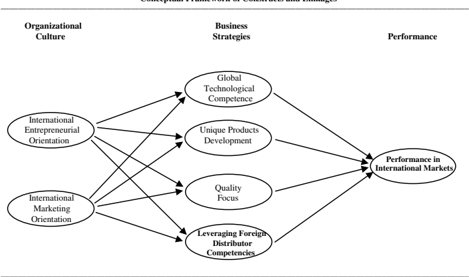
- The survey analysis found that international entrepreneurial orientation significantly predicted global technological competence with a standardized coefficient of 0.28; the link from international marketing orientation to global technological competence was not significant.
- Unique products development was significantly predicted by both international entrepreneurial orientation (0.19) and international marketing orientation (0.24).
- Quality focus was significantly predicted by both international entrepreneurial orientation (0.23) and international marketing orientation (0.35).
- Leveraging foreign distributor competences was significantly predicted by international marketing orientation (0.26) but not by international entrepreneurial orientation; these strategy variables were also significant drivers of performance in international markets: global technological competence (0.21), unique products development (0.14), quality focus (0.30), and leveraging foreign distributor competences (0.18).
## Methods
- The paper uses a two-phase design: first qualitative interviews/case studies to develop constructs and hypotheses, then a cross-industry field survey to test them.
- The qualitative phase included 33 professionals: 24 senior managers at early internationalizing firms, 6 scholars, and 3 international trade experts; the firms were mostly founded after 1985, sold half or more of their sales abroad, and had entered foreign markets within 3 years of founding.
- The survey was mailed to a random sample of 900 manufacturing firms in the United States founded in 1980 or later and exporting at least 25% of total production; 203 usable surveys were returned (about 23% response rate). The main analysis used LISREL8 path analysis, with exploratory factor analysis and confirmatory factor analysis for scale purification and validity checks.
## Limitations
- The paper states that “little empirical work” had been attempted on born globals and that there had been “almost no empirical research” on the factors driving their superior international performance.
- The study itself is focused on U.S. manufacturing firms that were selected using a 25% export threshold, so the evidence is tied to that sample and entry-mode context; this is evident from the text.
- The paper notes that the survey results are based on self-reported measures from responding firms; this is evident from the questionnaire-based design, though the paper does not frame it explicitly as a limitation.
Model-written summary. Check it against the paper before relying on it.
Integrity signals
Registry
Cites
Statistics
Figures
Verification
Claims the paper makes
0 Valid · 0 Not valid · 53 Not checked · 112 Own results and interpretations
A result the paper reports from its own data — it cites no other source for it, so there is none to check. The quote shows it is in the paper.
In the paper
“Despite the scarce resources typical of young firms, our findings reveal that born-global firms leverage a distinctive mix of orientations and strategies that allow them to succeed in diverse international markets.”
plainstates a cause- Asserted: passes — The authors put it forward as true.
- Checkable: passes — It can be checked against evidence.
- Load-bearing: passes — The paper’s conclusions depend on it.
- Based: passes — The paper gives a reason why it holds.
- Rests on an assumption not shown here.
A result the paper reports from its own data — it cites no other source for it, so there is none to check. The quote shows it is in the paper.
In the paper
“The critical role of marketing prowess overseas was also strongly emphasized by virtually all interviewees in the case studies.”
boosted- Asserted: passes — The authors put it forward as true.
- Checkable: passes — It can be checked against evidence.
- Load-bearing: unclear — It is unclear whether the paper’s conclusions depend on it.
- Based: passes — The paper gives a reason why it holds.
A result the paper states — it cites no source for it, so there is none to check. The quote shows it is in the paper.
In the paper
“Most interviewed firms exhibited strong technological capabilities in their respective product or industry categories.”
plain- Asserted: passes — The authors put it forward as true.
- Checkable: passes — It can be checked against evidence.
- Load-bearing: unclear — It is unclear whether the paper’s conclusions depend on it.
- Based: passes — The paper gives a reason why it holds.
A result the paper reports from its own data — it cites no other source for it, so there is none to check. The quote shows it is in the paper.
In the paper
“In general, the qualitative phase of the study revealed that born globals are likely to be formed by entrepreneurs who pursue foreign ventures with a strong marketing orientation.”
hedgedstates an association- Asserted: passes — The authors put it forward as true.
- Checkable: passes — It can be checked against evidence.
- Load-bearing: passes — The paper’s conclusions depend on it.
- Based: passes — The paper gives a reason why it holds.
A result the paper states — it cites no source for it, so there is none to check. The quote shows it is in the paper.
In the paper
“In contrast, born globals leverage a collection of fundamental intangible knowledge-based capabilities in the cultivation of foreign markets early in their evolution.”
plainstates a cause- Asserted: passes — The authors put it forward as true.
- Checkable: passes — It can be checked against evidence.
- Load-bearing: passes — The paper’s conclusions depend on it.
- Based: unclear — It is unclear why the paper says it holds.
- Rests on an assumption not shown here.
84 more claims
Create a free account to see all 165 claims and to verify the 3 references still open.
- It may state two separate claims as one. 33
- Probably not a substantial claim. 54
Citations
Cites
Evaluating Structural Equation Models with Unobservable Variables and Measurement Error
Fornell, C., & Larcker, D. F. (1981) · Journal of Marketing Research · doi:10.2307/3151312 · Cited by 109,314 · cited 2×
“Composite reliability was calculated using the procedures outlined by Fornell and Larcker (1981).”
MethodInfluentialEvaluating structural equation models with unobservable variables and measurement error
Fornell, C., & Larcker, D. F. (1981) · Journal of Marketing Research · doi:10.1177/002224378101800104 · Cited by 109,190
Firm Resources and Sustained Competitive Advantage
Barney, J. (1991) · Journal of Management · doi:10.1177/014920639101700108 · Cited by 48,334
(1994) · Journal of the American Dietetic Association · doi:10.1016/0002-8223(94)92216-0 · Cited by 45,910
Firm resources and sustained competitive advantage
Barney, J. B. (2004) · Advances in Strategic Management · doi:10.1016/s0742-3322(00)17018-4 · Cited by 38,152
Absorptive Capacity: A New Perspective on Learning and Innovation
Cohen, W. M., & Levinthal, D. A. (1990) · Administrative Science Quarterly · doi:10.2307/2393553 · Cited by 35,728
A resource‐based view of the firm
Wernerfelt, B. (1984) · Strategic Management Journal · doi:10.1002/smj.4250050207 · Cited by 25,635
The Theory of Economic Development
Schumpeter, J., & Backhaus, U. (2006) · The European Heritage in Economics and the Social Sciences · doi:10.1007/0-306-48082-4_3 · Cited by 22,506
An Evolutionary Theory of Economic Change.
Loasby, B. J., Nelson, R. R., & Winter, S. G. (1983) · The Economic Journal · doi:10.2307/2232409 · Cited by 21,366
A Dynamic Theory of Organizational Knowledge Creation
Nonaka, I. (1994) · Organization Science · doi:10.1287/orsc.5.1.14 · Cited by 17,809
Research works printed but not linked: 5
- Nikkei Sangyoo Shimbun (1995) Benchaa Shin Sedai (New Generation Ventures) , Nihon Keizai Shimbun: Tokyo.
- Nunnally, J.C. (1978) Psychometric Theory
- Porter, M.E. (1980) Competitive Strategy , The Free Press: New York.
- Rennie, M. (1993) 'Born global', McKinsey Quarterly (4): 45-52. Rosson, P. and Ford, I.D. (1982) 'Manufacturer-overseas distributor relations and export performance', Journal of International Business Studies 13 (2): 57-72.
- Schumpeter, J. (1939) Business Cycles , Vol. 1 McGraw-Hill: New York.
Cited by
Items 601–700 of 3,020
Antecedents of International Opportunity Recognition in Born Global Firms
Kraus, S., Niemand, T., Angelsberger, M., Mas‐Tur, A., & Roig‐Tierno, N. (2017) · Journal of Promotion Management · doi:10.1080/10496491.2017.1294869 · Cited by 60
“Born global firms operating internationally in the early ages of their lifecycle are appearing in considerable amounts worldwide (Bouncken, Muench, & Kraus, 2015; Knight & Cavusgil, 2004).”
BackgroundInfluentialExport intention in developing countries: A configuration approach to managerial success factors
Haddoud, M. Y., Jones, P. K., & Newbery, R. (2020) · Journal of Small Business Management · doi:10.1111/jsbm.12470 · Cited by 67
“Instead, the internationalisation of such firms is triggered by managerial entrepreneurial attitudes in terms of risk tolerance and proactiveness (Knight and Cavusgil, 2004; Frynas and Mellahi, 2015).”
BackgroundJardon, C. M., & Martínez‐Cobas, X. (2019) · Sustainability · doi:10.3390/su11123491 · Cited by 64
“The efficacy of this learning requires unlearning of old and already embedded routines [61].”
BackgroundSørensen, H. E., & Madsen, T. K. (2012) · International Marketing Review · doi:10.1108/02651331211242647 · Cited by 65
Knowledge flows and the modelling of the multinational enterprise
Adler, N., & Hashai, N. (2007) · Journal of International Business Studies · doi:10.1057/palgrave.jibs.8400284 · Cited by 61
“This result demonstrates nicely how relatively resource-scarce firms approaching small-sized markets utilise other firms’ resources to gain worldwide presence (Oviatt and McDougall, 1994; Madhok, 1997; Knight and Cavusgil, 2004).”
BackgroundInternational business and the migrant-owned enterprise
Czinkota, M., Khan, Z., & Knight, G. (2020) · Journal of Business Research · doi:10.1016/j.jbusres.2020.07.049 · Cited by 59
Self-citationKleinschmidt, E. J., de Brentani, U., & Salomo, S. (2010) · Creativity and Innovation Management · doi:10.1111/j.1467-8691.2010.00568.x · Cited by 48
Les entreprises à internationalisation rapide et précoce : revue de littérature
Servantie, V. (2007) · Revue de l’Entrepreneuriat · doi:10.3917/entre.061.0002 · Cited by 67
Antecedents and consequences of export entrepreneurship
García, A. N., Calvo‐Mora, A., & Rey‐Moreno, M. (2015) · Journal of Business Research · doi:10.1016/j.jbusres.2015.01.047 · Cited by 63
“International experience possession reduces the export risks and barriers that firms perceive, increases firms' orientation toward foreign markets, and drives entrepreneurial spirit (Knight & Cavusgil, 2004).”
BackgroundPark, S., LiPuma, J. A., & Prange, C. I. (2014) · International Small Business Journal Researching Entrepreneurship · doi:10.1177/0266242614526609 · Cited by 57
Zainol, F. A., & Daud, W. N. W. (2011) · International Business Management · doi:10.3968/j.ibm.1923842820110201.020 · Cited by 71
“Likert scales were used to minimize executive response time and effort (Knight and Cavusgil, 2004).”
MethodMa, Z., Zhu, J., Meng, Y., & Ying, T. (2018) · International Journal of Entrepreneurial Behaviour & Research · doi:10.1108/ijebr-07-2017-0246 · Cited by 55
Innovation and internationalization in family SMEs: analyzing the role of family involvement
Alayo, M., Iturralde, T., & Maseda, A. (2021) · European Journal of Innovation Management · doi:10.1108/ejim-07-2020-0302 · Cited by 54
Papa, A., Mazzucchelli, A., Ballestra, L. V., & Usai, A. (2021) · International Marketing Review · doi:10.1108/imr-03-2021-0109 · Cited by 59
The impact of industry 4.0 on the 2017 version of the Uppsala model
Bhatti, W. A., Vahlne, J., Glowik, M., & Larimo, J. A. (2022) · International Business Review · doi:10.1016/j.ibusrev.2022.101996 · Cited by 62
Navarro-García, A., Ledesma-Chaves, P., Gil-Cordero, E., & De-Juan-Vigaray, M. D. (2024) · Technological forecasting & social change · doi:10.1016/j.techfore.2023.123001 · Cited by 58
Social networks and the internationalization of Chinese entrepreneurs
Xie, Y. H., & Amine, L. S. (2009) · Global Business and Organizational Excellence · doi:10.1002/joe.20299 · Cited by 47
High performance work systems and export performance
Martín‐Tapia, I., Correa, J. A. A., & Guthrie, J. P. (2009) · The International Journal of Human Resource Management · doi:10.1080/09585190802707417 · Cited by 60
“Successful exporting firms have been found to require a higher capability for innovation and knowledge creation (Knight and Cavusgil 2004 ), for the development of competencies specific to exporting (Piercy et al.”
BackgroundAn empirical investigation of the antecedents and performance outcomes of export innovativeness
Makri, K., Theodosiou, M., & Katsikea, E. S. (2016) · International Business Review · doi:10.1016/j.ibusrev.2016.12.004 · Cited by 60
“Fourth, exporting firms can leverage their innovations by exploiting business opportunities that may exist in different export-markets (Hortinha, Lages, & Lages, 2011; Knight & Cavusgil, 2004).”
BackgroundService advantage built on service capabilities: An empirical inquiry of international new ventures
Martin, S. L., Javalgi, R. G., & Ciravegna, L. (2018) · Journal of Business Research · doi:10.1016/j.jbusres.2018.01.024 · Cited by 52
Exporting by experiential knowledge: a study of emerging market micro firms
Tiwari, S. K., & Korneliussen, T. (2018) · International Marketing Review · doi:10.1108/imr-01-2016-0002 · Cited by 54
Ahsan, M., & Fernhaber, S. A. (2018) · Journal of International Management · doi:10.1016/j.intman.2018.07.002 · Cited by 55
Innovation, internationalisation and the performance of microbusinesses
Henley, A., & Song, M. J. (2019) · International Small Business Journal Researching Entrepreneurship · doi:10.1177/0266242619893938 · Cited by 62
“capabilities to create new knowledge leading to better performance, especially in competitive or challenging environments such as international markets (Knight and Cavusgil, 2004).”
BackgroundTrade Shows and SME Internationalisation: Networking for Performance
Gerschewski, S., Evers, N., Nguyen, A. T., & Froese, F. J. (2020) · Management International Review · doi:10.1007/s11575-020-00421-y · Cited by 66
Unpacking the emergence of born global founders: A careers perspective
Pidduck, R. J., Shaffer, M. A., Zhang, Y., & Clark, D. R. (2020) · Journal of Small Business Management · doi:10.1080/00472778.2020.1816432 · Cited by 50
“In comparison, Knight and Cavusgil (2004) specified that born globals “from or near their founding, seek superior international business performance from the application of knowledge-based resources to the sale of outputs in multiple countries” (p. 124).”
BackgroundOperating characteristics, risk, and performance of born‐global firms
Gleason, K. C., Madura, J., & Wiggenhorn, J. M. (2006) · International Journal of Managerial Finance · doi:10.1108/17439130610657331 · Cited by 62
Strategic capabilities in exporting: an examination of the performance of Mexican firms
Rodriguez, C. M., Wise, J. A., & Martińez, C. R. (2013) · Management Decision · doi:10.1108/md-10-2012-0766 · Cited by 56
Internationalisation of born global firms: Evidence from Malaysia
Kaur, S., & Sandhu, M. S. (2013) · Journal of the Asia Pacific Economy · doi:10.1080/13547860.2013.818426 · Cited by 65
“Findings are consistent with the literature on early and accelerated internationalisation processes that have attributed high importance to the role of the entrepreneur and EO (Knight and Cavusgil 2004; Jones and Coviello 2005; Mtigwe 2005).”
BackgroundMethodResultBorn global acquirers from Indian IT: an exploratory case study
Varma, S. (2011) · International Journal of Emerging Markets · doi:10.1108/17468801111170356 · Cited by 55
“Variously described as “global start-ups”, “born globals”, or “international new ventures” (Rennie, 1993; Oviatt and McDougall, 1994, 1995, 1997, 1999; Bloodgood et al., 1996; Kohn, 1997; Madsen and Servais, 1997; Knight and Cavusgil, 2004; also Rialp and Rialp, 2003) these are firms that almost bypass internationaliz…”
BackgroundBranding capability of technology born globals
Altshuler, L., & Tarnovskaya, V. V. (2010) · Journal of Brand Management · doi:10.1057/bm.2010.47 · Cited by 63
“While Knight et al. (2004) discuss a firm’s marketing competence.”
Vissak, T., & Zhang, X. (2014) · Journal of International Entrepreneurship · doi:10.1007/s10843-014-0128-2 · Cited by 62
Born Global Firms: Evolution of a Contemporary Phenomenon
Knight, G. (2015) · Emerald Group Publishing Limited eBooks · doi:10.1108/s1474-797920140000025001 · Cited by 72
Self-citationThe Effect of Social Media Adoption on Exporting Firms’ Performance
Alarcón‐del‐Amo, M., Rialp, A., & Criado, J. R. (2015) · Emerald Group Publishing Limited eBooks · doi:10.1108/s1474-797920140000025007 · Cited by 58
Dynamic capabilities in media management research. A literature review
Murschetz, P. C., Omidi, A., Oliver, J., Saraji, M. K., & Javed, S. (2020) · Journal of strategy and management · doi:10.1108/jsma-01-2019-0010 · Cited by 59
“…collective activity through which the organization systematically generates and modifies its operating routines in pursuit of improved effectiveness” 6 Knight & Cavusgil, 2004, p. 127 “Reflecting the ability of managers to renew the firm’s competences so as to achieve congruence with the…”
BackgroundDrivers of export entrepreneurship
García, A. N. (2015) · International Business Review · doi:10.1016/j.ibusrev.2015.05.007 · Cited by 47
Satyanarayana, K., Chandrashekar, D., Sukumar, A., & Jafari‐Sadeghi, V. (2022) · International Journal of Entrepreneurial Behaviour & Research · doi:10.1108/ijebr-07-2021-0530 · Cited by 53
Dynamic managerial capability portfolios in early internationalising firms
Vuorio, A., & Torkkeli, L. (2022) · International Business Review · doi:10.1016/j.ibusrev.2022.102049 · Cited by 56
Logistics salience impact on logistics capabilities and performance
Ralston, P. M., Grawe, S. J., & Daugherty, P. J. (2013) · The International Journal of Logistics Management · doi:10.1108/ijlm-10-2012-0113 · Cited by 66
“While unique logistics capabilities have the potential to improve logistics performance (Knight and Cavusgil, 2004), each capability needs to be analyzed on its own merits.”
BackgroundInternational entrepreneurship in SMEs: a study of influencing factors in the textile industry
Gil-Pechuán, I., Expósito‐Langa, M., & Tomás‐Miquel, J. (2012) · International Entrepreneurship and Management Journal · doi:10.1007/s11365-012-0242-3 · Cited by 56
Managerial characteristics and entrepreneurial internationalization: A study of Tunisian SMEs
Omri, W., & Bécuwe, A. (2014) · Journal of International Entrepreneurship · doi:10.1007/s10843-013-0119-8 · Cited by 54
Empirical Assessment of Internationalization Strategies for Small and Medium Construction Companies
Jung, W., Han, S. H., Park, H.-D., & Kim, D. Y. (2010) · Journal of Construction Engineering and Management · doi:10.1061/(asce)co.1943-7862.0000237 · Cited by 51
The Born Global Entrepreneur In Emerging Economies
Persinger, E. S., Çivi, E., & Vostina, S. W. (2011) · International Business & Economics Research Journal (IBER) · doi:10.19030/iber.v6i3.3355 · Cited by 53
“As Knight and Cavusgil ( 2004), Born Globals are emerging in substantial numbers worldwide, and likely reflect an emergent paradigm, with the potential to become a leading species in the ecosystem of international trade.”
BackgroundCountry-level investigation of innovation investment in manufacturing: Paired fsQCA of two models
Beynon, M. J., Jones, P. K., & Pickernell, D. G. (2016) · Journal of Business Research · doi:10.1016/j.jbusres.2016.04.145 · Cited by 46
“Firm ability to sustain innovation and create knowledge leads to improved capabilities and performance (Knight & Cavusgil, 2004).”
BackgroundHendriks, G., Slangen, A., & Heugens, P. P. M. A. R. (2017) · Journal of Management Studies · doi:10.1111/joms.12314 · Cited by 54
“International new ventures (INVs), on the other hand, are internationally oriented from the outset and therefore usually have a substantially lower domestic footprint (Oviatt and McDougall, 1994; Knight and Cavusgil, 2004; Prashantham & Dhanaraj, 2010).”
International Marketing Research: A State-of-the-Art Review and the Way Forward
Leonidou, L. C., Katsikeas, C. S., Samiee, S., & Aykol, B. (2017) · Springer eBooks · doi:10.1007/978-3-319-61385-7_1 · Cited by 50
“In descending order, the five most cited international marketing articles in the period under review were the following: Knight and Cavusgil (2004), focusing on the role of innovation and organizational capabilities in the development of born-global firms (2055 citations); Madsen and Servais…”
BackgroundEntrepreneurial marketing and born global internationalisation in China
Andersson, S., Evers, N., & Gliga, G. (2018) · Qualitative Market Research An International Journal · doi:10.1108/qmr-11-2016-0115 · Cited by 62
“Born global ventures are quintessentially an important type of IE firm (Andersson and Wictor, 2003; Knight and Cavusgil, 2004; Crick, 2009).”
BackgroundConsolidating and advancing knowledge on the post-entry performance of international new ventures
Ibeh, K., Jones, M. V., & Kuivalainen, O. (2018) · International Small Business Journal Researching Entrepreneurship · doi:10.1177/0266242618793926 · Cited by 53
“This resonates with extant literature on the role of capabilities in entrepreneurial internationalisation (Knight and Cavusgil, 2004), and on the ‘learning advantages of newness’ (e.g. Autio et al., 2000), learning orientation (Jantunen et al., 2008), imprinting (e.g. Bruneel et al., 2010; Sapienza…”
BackgroundInfluentialInternationalization challenges for SMEs: evidence and theoretical extension
Chandra, A., Paul, J., & Chavan, M. (2020) · European Business Review · doi:10.1108/ebr-08-2019-0164 · Cited by 69
Lafuente, E., Vaillant, Y., Alvarado, M., Mora-Esquivel, R., & Vendrell-Herrero, F. (2020) · International Business Review · doi:10.1016/j.ibusrev.2020.101765 · Cited by 53
Non-linear internationalization and the Uppsala model – On the importance of individuals
Schweizer, R., & Vahlne, J. (2021) · Journal of Business Research · doi:10.1016/j.jbusres.2021.11.025 · Cited by 80
Be international or be innovative? Be both? The role of the entrepreneurial profile
Denicolai, S., Hagen, B., & Pisoni, A. (2015) · Journal of International Entrepreneurship · doi:10.1007/s10843-015-0143-y · Cited by 59
Perceived resource deficiency and internationalization of small- and medium-sized firms
Xie, Y. H., & Suh, T. (2014) · Journal of International Entrepreneurship · doi:10.1007/s10843-014-0121-9 · Cited by 62
Digital Transformation in International Trade: Opportunities, Challenges, and Policy Implications
Mirzaye, S., & Mohiuddin, M. (2025) · Journal of Risk and Financial Management · doi:10.3390/jrfm18080421 · Cited by 86
Coopetition and the marketing/entrepreneurship interface in an international arena
Crick, J. M., Crick, D., & Ferrigno, G. (2023) · International Journal of Entrepreneurial Behaviour & Research · doi:10.1108/ijebr-01-2022-0099 · Cited by 50
Rumyantseva, M., & Welch, C. (2023) · Journal of International Business Studies · doi:10.1057/s41267-023-00613-2 · Cited by 63
“Knight and Cavusgil’s (1996) study does not have Journal of International Business Studies an explicit theoretical framing, but in later work they draw explicitly on the resource-based view (Knight & Cavusgil, 2004).”
BackgroundSchueffel, P., Baldegger, R., & Amann, W. (2014) · Multinational Business Review · doi:10.1108/mbr-06-2014-0029 · Cited by 64
Location choice and the internationalization sequence
Yeoh, P. (2011) · International Marketing Review · doi:10.1108/02651331111132866 · Cited by 43
“Early studies suggest that accelerated internationalizers often compete using a global niche strategy ( Knight and Cavusgil, 2004”
BackgroundFactores que influyen en el desarrollo exportador de las pymes en Colombia
Escandón‐Barbosa, D., & Ayala, A. H. (2014) · Estudios Gerenciales · doi:10.1016/j.estger.2014.04.006 · Cited by 112
The Critical Role of Relationship Quality in Small- and Medium-Sized Enterprise Internationalization
Kuhlmeier, D. B., & Knight, G. (2010) · Journal of Global Marketing · doi:10.1080/08911760903439636 · Cited by 55
“Smaller firms generally have far fewer of the tangible assets, as well as financial and human resources, that favor the internationalization of large multinational enterprises (eg, Knight & Cavusgil, 2004 ).”
BackgroundSelf-citationExport performance: multiple predictors and multiple measures approach
Kahiya, E. T., & Dean, D. (2014) · Asia Pacific Journal of Marketing and Logistics · doi:10.1108/apjml-11-2012-0119 · Cited by 53
D’Angelo, A., & Buck, T. (2018) · International Business Review · doi:10.1016/j.ibusrev.2018.11.002 · Cited by 43
Yan, J., & Williams, D. W. (2020) · Journal of Business Venturing · doi:10.1016/j.jbusvent.2020.106020 · Cited by 60
Mostafiz, M. I., Sambasivan, M., & Goh, S. K. (2020) · International Journal of Emerging Markets · doi:10.1108/ijoem-09-2019-0732 · Cited by 59
Persistence and Learning: Success Factors of Taiwanese Firms in International Markets
Johnson, J., Yin, E., & Tsai, H.-T. (2009) · Journal of International Marketing · doi:10.1509/jimk.17.3.39 · Cited by 54
“It also produces greater effectiveness and efficiency in the production processes (Knight and Cavusgil 2004), enabling firms to serve the specialized needs of market niches at low cost.”
BackgroundAnalyzing internationalization configurations of SME's: The purchaser's perspective
Knudsen, M. P., & Servais, P. (2007) · Journal of Purchasing and Supply Management · doi:10.1016/j.pursup.2007.06.002 · Cited by 42
Managerial secrecy and intellectual asset protection in SMEs: The role of institutional environment
Delerue, H., & Lejeune, A. (2010) · Journal of International Management · doi:10.1016/j.intman.2010.10.002 · Cited by 50
Motivators of SME initial export choice and the European Union regional effect in manufacturing
Stouraitis, V., Harun, M. H. M., & Kyritsis, M. (2017) · International Journal of Entrepreneurial Behaviour & Research · doi:10.1108/ijebr-05-2015-0120 · Cited by 55
“…on large multinationals is still much larger than on SMEs (Chellilah et al., 2010; Hilmersson, 2014). incremental learning), originated by Johanson and Vahlne (1977; 1990), and the international new ventures or ‘born global’ approach (Knight and Cavusgil, 2004; Oviatt and McDougall, 1994 ).”
BackgroundWu, A., & Zhou, L. (2018) · Journal of International Marketing · doi:10.1509/jim.16.0123 · Cited by 54
“…international legitimacy, strategic flexibility Earliness of internationalization, a temporal dimen-sion of the initiation of internationalization, has beenthe cornerstone of scholarship on international new ventures (Oviatt and McDougall 1994) and born-global firms (Knight and Cavusgil 2004).”
BackgroundBirru, W. T., Runhaar, P. R., Zaalberg, R., Lans, T., & Mulder, M. (2018) · Journal of Small Business Management · doi:10.1111/jsbm.12403 · Cited by 49
The timing of internationalization – Drivers and outcomes
Ciravegna, L., Kundu, S. K., Kuivalainen, O., & Lopez, L. E. (2018) · Journal of Business Research · doi:10.1016/j.jbusres.2018.08.006 · Cited by 53
“The first set draws upon the resource-based view of the firm to explain when and the implications of firms going abroad and mainly link to the strategy and international business literature (Cavusgil & Knight, 2015; Hennart, 2014; Knight & Cavusgil, 2004).”
BackgroundGetting the facts right on born globals
Ferguson, S., Henrekson, M., & Johannesson, L. (2019) · Small Business Economics · doi:10.1007/s11187-019-00216-y · Cited by 67
International springboard as an entrepreneurial act
Maksimov, V. R., & Luo, Y. (2020) · Journal of World Business · doi:10.1016/j.jwb.2020.101176 · Cited by 49
Kusi, S. Y., Gabrielsson, P., & Kontkanen, M. (2021) · International Business Review · doi:10.1016/j.ibusrev.2021.101867 · Cited by 54
Internationalization pathways and the performance of SMEs
Fernández‐Olmos, M., & Vial, I. D. (2015) · European Journal of Marketing · doi:10.1108/ejm-06-2012-0365 · Cited by 53
Early internationalization: A transaction cost economics and structural embeddedness perspective
Schwens, C., & Kabst, R. (2009) · Journal of International Entrepreneurship · doi:10.1007/s10843-009-0043-0 · Cited by 55
“been enhancing our understanding on early internationalization (e.g., McDougall 1989; Rennie 1993; Oviatt and McDougall 1994, 1997; Bell 1995; Madsen and Servais 1997; Jones 1999; Knight 2000; Servais and Rasmussen 2000; Zahra et al. 2000; Dimitratos and Plakoyiannaki 2003; Sharma and Blomstermo 2003; Knight and Cavus…”
BackgroundA Taxonomy of Strategic Postures of International SMEs
Hagen, B., Zucchella, A., Larimo, J. A., & Dimitratos, P. (2017) · European Management Review · doi:10.1111/emre.12109 · Cited by 55
“…types, e.g. new product development, manufacturing efficiency, and various strategic orientations have been shown to affect international competitiveness and international performance in SMEs (eg Luostarinen and Gabrielsson, 2002; Knight, 2001; Knight and Cavusgil, 2004; Armario et al., 2008).”
InfluentialThe Roles of Leadership, Vision, and Empowerment in Born Global Companies
Chhotray, S., Sivertsson, O., & Tell, J. (2017) · Journal of International Entrepreneurship · doi:10.1007/s10843-017-0201-8 · Cited by 64
“…BGs typically describe the phenomenon of internationalization (Crick 2009), comparisons with domestic ventures (Oviatt et al. 2003), marketing (Mort et al. 1 Knight and Cavusgil (2004) define BGs as business organizations that, from or near their founding, seek superior international business…”
BackgroundInfluentialGulanowski, D., Papadopoulos, N. G., & Plante, L. (2018) · Review of International Business and Strategy · doi:10.1108/ribs-09-2017-0077 · Cited by 63
Åkerman, N. (2015) · Journal of International Entrepreneurship · doi:10.1007/s10843-015-0152-x · Cited by 53
Blesa, A., Monferrer, D., Nauwelaerts, Y., & Meliá, M. R. (2008) · Journal of International Entrepreneurship · doi:10.1007/s10843-008-0026-6 · Cited by 56
“1993; Vorhies and Morgan 2005; Rasheed 2005), and also in international new ventures (Zahra and Garvis 2000a,b; Knight and Cavusgil 2004).”
BackgroundMethodResultInfluentialBueno, J. C. C., Moreno, A. M., & Acedo, F. J. (2011) · International Business Review · doi:10.1016/j.ibusrev.2011.05.008 · Cited by 48
The first export order: a marketing innovation revisited
Crick, D., & Crick, J. M. (2015) · Journal of Strategic Marketing · doi:10.1080/0965254x.2014.1001870 · Cited by 40
“…to those firms that internationalise quickly, e.g. for first mover status in limited niches and may be either an ‘international new venture’ or ‘born global’ in nature regarding their speed, scale and scope of activities (Hewerdine & Welch, 2013; Knight & Cavusgil, 2004; Oviatt & McDougall, 1994).”
BackgroundNaldi, L., Achtenhagen, L., & Davidsson, P. (2015) · Journal of Small Business Management · doi:10.1111/jsbm.12087 · Cited by 51
Kundu, S. C., & Rani, S. (2007) · International Journal of Management and Enterprise Development · doi:10.1504/ijmed.2008.015908 · Cited by 49
“Other studies highlighted the critical role of innovative culture as well as knowledge and capabilities in the success of entrepreneurial firm (McDougall and Oviatt, 2000; Garcia-Morales et al., 2006; Herath et al., 2006; Knight and Cavusgil, 2004; Wickramasinghe and Sharma, 2005).”
BackgroundShan, J., & JOLLY, D. R. (2013) · Canadian Journal of Administrative Sciences / Revue Canadienne des Sciences de l Administration · doi:10.1002/cjas.1256 · Cited by 53
1. INTERNATIONAL ENTREPRENEURSHIP:TOWARDS A THEORY OF SME INTERNATIONALIZATION
Schulz, A., & Borghoff, T. (2009) · Cited by 71
Publicly funded business advisory services and entrepreneurial internationalization
Cumming, D. J., Fischer, E. M., & Peridis, T. (2014) · International Small Business Journal Researching Entrepreneurship · doi:10.1177/0266242614537849 · Cited by 51
“The benefits of internationalization have been explored in both the practitioner and academic literatures (Knight and Cavusgil, 2004; McKinsey & Company, 1999).”
The Influence of Organizational Culture on Employees’ Performance: Evidence from Oman
Malaysia, U. U., Isa, M. F. M., Ugheoke, S. O., Malaysia, U. U., Noor, W. S. W. M., & Malaysia, U. U. (2016) · Journal of Entrepreneurship and Business · doi:10.17687/jeb.0402.01 · Cited by 44
Zhang, M., Gao, Q., & Cho, H. (2017) · Journal of International Entrepreneurship · doi:10.1007/s10843-016-0196-6 · Cited by 53
Business model innovation of international new ventures: An empirical study in a Swedish context
Abrahamsson, J., Boter, H., & Vanyushyn, V. (2018) · Journal of International Entrepreneurship · doi:10.1007/s10843-018-0238-3 · Cited by 54
Joo, H.-Y., & Suh, H. (2017) · Sustainability · doi:10.3390/su9111980 · Cited by 49
“The scale for export performance is from Knight and Cavusgil (2004) [54].”
BackgroundRodríguez-Ruiz, F., Almodóvar, P., & Nguyen, Q. T. K. (2019) · Multinational Business Review · doi:10.1108/mbr-01-2018-0003 · Cited by 59
Behavioral elements in foreign direct investments
Aharoni, Y. (2010) · Advances in international management · doi:10.1108/s1571-5027(2010)00000230011 · Cited by 49
Pan, L., Fu, X., & Li, Y. (2023) · Electronic Commerce Research · doi:10.1007/s10660-022-09539-7 · Cited by 39
“An entrepreneurial orientation endows firms with the ability to explore opportunities in foreign markets and maintain competitiveness [106].”
BackgroundTower, A. P., Hewett, K., & Saboo, A. R. (2020) · Journal of Business Research · doi:10.1016/j.jbusres.2020.09.048 · Cited by 51
Ojala, A., Fraccastoro, S., & Gabrielsson, M. (2023) · Global Strategy Journal · doi:10.1002/gsj.1483 · Cited by 48
Developing Absorptive Capacity through e-Business: The Case of International SMEs
Raymond, L., Bergeron, F., Croteau, A., & St‐Pierre, J. (2015) · Journal of Small Business Management · doi:10.1111/jsbm.12192 · Cited by 52
International franchise expansion of service chains: insights from the Spanish market
Graciá, V. B., & Cerviño, J. (2012) · Service Industries Journal · doi:10.1080/02642069.2012.662489 · Cited by 45
“These types of companies have recently begun to stimulate research interest (see, e.g. Anderson, Gabrielsson, & Wictor, 2006; Gabrielsson, 2005; Knight & Cavusgil, 2004; López, Kundu, & Ciravegna, 2009), although few studies on the topic have been completed so far.”
Mac, L., & Evangelista, F. U. (2016) · Journal of Global Marketing · doi:10.1080/08911762.2016.1196285 · Cited by 43
“The central proposition of these studies has been that market orientation and entrepreneurship are organizational resources (Hult & Ketchen, 2001; Knight & Cavusgil, 2004) or strategic orientations (Noble, Sinha, & Kumar, 2002; Zhou, Yim, & Tse, 2005) that enhance firm performance.”
BackgroundZhou, Y., Lu, L., & Chang, X. (2016) · Cross Cultural & Strategic Management · doi:10.1108/ccsm-07-2014-0085 · Cited by 44
Metadata
- Authors
- Knight, G. A., & Cavusgil, S. T.
- Affiliations
- Florida State University (US)
- Corresponding author
- Knight, Gary A
- ORCID
- Knight, Gary A
- Venue
- Journal of International Business Studies
- Published
- 2004-01-08
- Volume
- 35
- Issue
- 2
- Pages
- 124-141
- ISSN
- 0047-2506 (ISSN-L)
- 1478-6990
- OpenAlex
- W2127709152
- Semantic Scholar
- d24960b5342d0dd3b86be002ab18a80e7b6fb5c9
- Cited by
- 3,013
- References
- 102
- Citations by year
- 2026: 121 · 2025: 123 · 2024: 157 · 2023: 154 · 2022: 182 · 2021: 196 · 2020: 189 · 2019: 180 · 2018: 199 · 2017: 172 · 2016: 188 · 2015: 187 · 2014: 178 · 2013: 167 · 2012: 129
- FWCI
- 137.12
- Type
- journal article
- Language
- en
- Update notices
- correction (2004-07-16)
- Open access
- bronze
- doi.org
- Licence
- www.springer.com/tdm (tdm)
- Locations
- Journal of International Business Studies (publishedVersion)
- RePEc: Research Papers in Economics (submittedVersion)
- Funders
- Michigan State University
- College of Engineering, Michigan State University
- Topics
- Social Sciences › Business, Management and Accounting › Strategy and Management › International Business and FDI
- Social Sciences › Business, Management and Accounting › Strategy and Management › Innovation and Knowledge Management
- Social Sciences › Communication › International Student and Expatriate Challenges
- Keywords
- born global firms, early internationalization, organizational capabilities, innovation, innovation culture, international business strategy, international success, young firms, internationalization of firms
About these checks
Registry, retraction, Cites and statistics results are computed, not judged, with one exception: a printed reference that no index lists is read once by a model before it counts as a citation error. Claims are extracted by a model and kept only when their quote appears verbatim in the text; each cited source is then checked, with a model’s help, for whether it says what the claim relies on. Those verdicts can be wrong — read the claim’s quote and the cited source before relying on one.
A language model drew the claims from the paper on 2026-10-10, under version 3 of the claim definition (model deepseek-v4.1-flash, prompt extract-v3).
A second model labelled each claim on 2026-10-10 (model jev-1.13-20260917, definition revision gold-guideline-v0.2).
Statistics and arithmetic are recomputed, not judged.
Confidence bands are shown only for fields calibrated on our annotated test set. None is calibrated yet, so no band is shown.
What counts as a claim ›How we measure confidence ›How we check this ›
Are you an author, or do you see a problem with this page? Request a review
Data sources
Bibliographic data: Semantic Scholar, OpenAlex, Crossref.
Contains information from the Semantic Scholar Academic Graph Datasets, made available under the ODC Attribution License (ODC-BY 1.0).
Semantic Scholar’s data is described in: Kinney, R., et al. (2023). The Semantic Scholar Open Data Platform. arXiv:2301.10140.
