

Innovation, organizational capabilities, and the born-global firm
Open accessThe DOI matches its Crossref record; 106 of the 106 references it cites were found in a registry or an index; none of the 100 sources its claims cite is checked for support yet.
Overview
CoChat Summary
## TL;DR
This study argues that born-global firms succeed because early internationalization is supported by an innovative culture and a distinctive set of organizational capabilities. Using qualitative case studies followed by a survey of 203 usable responses, the authors find that several capability links are significant and that these capabilities are associated with performance in international markets.
## Key findings
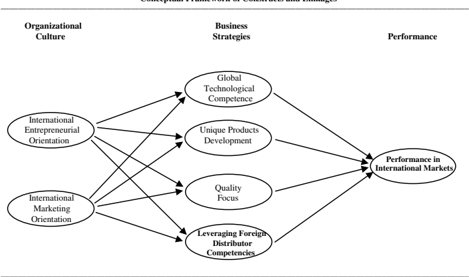
- The survey analysis found that international entrepreneurial orientation significantly predicted global technological competence with a standardized coefficient of 0.28; the link from international marketing orientation to global technological competence was not significant.
- Unique products development was significantly predicted by both international entrepreneurial orientation (0.19) and international marketing orientation (0.24).
- Quality focus was significantly predicted by both international entrepreneurial orientation (0.23) and international marketing orientation (0.35).
- Leveraging foreign distributor competences was significantly predicted by international marketing orientation (0.26) but not by international entrepreneurial orientation; these strategy variables were also significant drivers of performance in international markets: global technological competence (0.21), unique products development (0.14), quality focus (0.30), and leveraging foreign distributor competences (0.18).
## Methods
- The paper uses a two-phase design: first qualitative interviews/case studies to develop constructs and hypotheses, then a cross-industry field survey to test them.
- The qualitative phase included 33 professionals: 24 senior managers at early internationalizing firms, 6 scholars, and 3 international trade experts; the firms were mostly founded after 1985, sold half or more of their sales abroad, and had entered foreign markets within 3 years of founding.
- The survey was mailed to a random sample of 900 manufacturing firms in the United States founded in 1980 or later and exporting at least 25% of total production; 203 usable surveys were returned (about 23% response rate). The main analysis used LISREL8 path analysis, with exploratory factor analysis and confirmatory factor analysis for scale purification and validity checks.
## Limitations
- The paper states that “little empirical work” had been attempted on born globals and that there had been “almost no empirical research” on the factors driving their superior international performance.
- The study itself is focused on U.S. manufacturing firms that were selected using a 25% export threshold, so the evidence is tied to that sample and entry-mode context; this is evident from the text.
- The paper notes that the survey results are based on self-reported measures from responding firms; this is evident from the questionnaire-based design, though the paper does not frame it explicitly as a limitation.
Model-written summary. Check it against the paper before relying on it.
Integrity signals
Registry
Cites
Statistics
Figures
Verification
Claims the paper makes
0 Valid · 0 Not valid · 53 Not checked · 112 Own results and interpretations
A result the paper reports from its own data — it cites no other source for it, so there is none to check. The quote shows it is in the paper.
In the paper
“Despite the scarce resources typical of young firms, our findings reveal that born-global firms leverage a distinctive mix of orientations and strategies that allow them to succeed in diverse international markets.”
plainstates a cause- Asserted: passes — The authors put it forward as true.
- Checkable: passes — It can be checked against evidence.
- Load-bearing: passes — The paper’s conclusions depend on it.
- Based: passes — The paper gives a reason why it holds.
- Rests on an assumption not shown here.
A result the paper reports from its own data — it cites no other source for it, so there is none to check. The quote shows it is in the paper.
In the paper
“The critical role of marketing prowess overseas was also strongly emphasized by virtually all interviewees in the case studies.”
boosted- Asserted: passes — The authors put it forward as true.
- Checkable: passes — It can be checked against evidence.
- Load-bearing: unclear — It is unclear whether the paper’s conclusions depend on it.
- Based: passes — The paper gives a reason why it holds.
A result the paper states — it cites no source for it, so there is none to check. The quote shows it is in the paper.
In the paper
“Most interviewed firms exhibited strong technological capabilities in their respective product or industry categories.”
plain- Asserted: passes — The authors put it forward as true.
- Checkable: passes — It can be checked against evidence.
- Load-bearing: unclear — It is unclear whether the paper’s conclusions depend on it.
- Based: passes — The paper gives a reason why it holds.
A result the paper reports from its own data — it cites no other source for it, so there is none to check. The quote shows it is in the paper.
In the paper
“In general, the qualitative phase of the study revealed that born globals are likely to be formed by entrepreneurs who pursue foreign ventures with a strong marketing orientation.”
hedgedstates an association- Asserted: passes — The authors put it forward as true.
- Checkable: passes — It can be checked against evidence.
- Load-bearing: passes — The paper’s conclusions depend on it.
- Based: passes — The paper gives a reason why it holds.
A result the paper states — it cites no source for it, so there is none to check. The quote shows it is in the paper.
In the paper
“In contrast, born globals leverage a collection of fundamental intangible knowledge-based capabilities in the cultivation of foreign markets early in their evolution.”
plainstates a cause- Asserted: passes — The authors put it forward as true.
- Checkable: passes — It can be checked against evidence.
- Load-bearing: passes — The paper’s conclusions depend on it.
- Based: unclear — It is unclear why the paper says it holds.
- Rests on an assumption not shown here.
84 more claims
Create a free account to see all 165 claims and to verify the 3 references still open.
- It may state two separate claims as one. 33
- Probably not a substantial claim. 54
Citations
Cites
Evaluating Structural Equation Models with Unobservable Variables and Measurement Error
Fornell, C., & Larcker, D. F. (1981) · Journal of Marketing Research · doi:10.2307/3151312 · Cited by 109,314 · cited 2×
“Composite reliability was calculated using the procedures outlined by Fornell and Larcker (1981).”
MethodInfluentialEvaluating structural equation models with unobservable variables and measurement error
Fornell, C., & Larcker, D. F. (1981) · Journal of Marketing Research · doi:10.1177/002224378101800104 · Cited by 109,190
Firm Resources and Sustained Competitive Advantage
Barney, J. (1991) · Journal of Management · doi:10.1177/014920639101700108 · Cited by 48,334
(1994) · Journal of the American Dietetic Association · doi:10.1016/0002-8223(94)92216-0 · Cited by 45,910
Firm resources and sustained competitive advantage
Barney, J. B. (2004) · Advances in Strategic Management · doi:10.1016/s0742-3322(00)17018-4 · Cited by 38,152
Absorptive Capacity: A New Perspective on Learning and Innovation
Cohen, W. M., & Levinthal, D. A. (1990) · Administrative Science Quarterly · doi:10.2307/2393553 · Cited by 35,728
A resource‐based view of the firm
Wernerfelt, B. (1984) · Strategic Management Journal · doi:10.1002/smj.4250050207 · Cited by 25,635
The Theory of Economic Development
Schumpeter, J., & Backhaus, U. (2006) · The European Heritage in Economics and the Social Sciences · doi:10.1007/0-306-48082-4_3 · Cited by 22,506
An Evolutionary Theory of Economic Change.
Loasby, B. J., Nelson, R. R., & Winter, S. G. (1983) · The Economic Journal · doi:10.2307/2232409 · Cited by 21,366
A Dynamic Theory of Organizational Knowledge Creation
Nonaka, I. (1994) · Organization Science · doi:10.1287/orsc.5.1.14 · Cited by 17,809
Research works printed but not linked: 5
- Nikkei Sangyoo Shimbun (1995) Benchaa Shin Sedai (New Generation Ventures) , Nihon Keizai Shimbun: Tokyo.
- Nunnally, J.C. (1978) Psychometric Theory
- Porter, M.E. (1980) Competitive Strategy , The Free Press: New York.
- Rennie, M. (1993) 'Born global', McKinsey Quarterly (4): 45-52. Rosson, P. and Ford, I.D. (1982) 'Manufacturer-overseas distributor relations and export performance', Journal of International Business Studies 13 (2): 57-72.
- Schumpeter, J. (1939) Business Cycles , Vol. 1 McGraw-Hill: New York.
Cited by
Items 401–500 of 3,020
Weerawardena, J., Salunke, S., Knight, G., Mort, G. S., & Liesch, P. W. (2019) · Industrial Marketing Management · doi:10.1016/j.indmarman.2019.05.012 · Cited by 93
Self-citationThe Impact of COVID-19 on Small Businesses’ Performance and Innovation
Harel, R. (2021) · Global Business Review · doi:10.1177/09721509211039145 · Cited by 113
“These structured processes are composed of regular and consistently practised patterns of individual and business behaviours that institutionalize and organize knowledge through activity and conduct in the business (Knight & Cavusgil, 2004).”
Getting to global: An evolutionary perspective of brand expansion in international markets
Townsend, J. D., Yeniyurt, S., & Talay, M. B. (2008) · Journal of International Business Studies · doi:10.1057/jibs.2008.87 · Cited by 98
“The approach developed by Kogut and Singh (1988) was utilized to compute cultural distance between the target market and home country from Hofstede’s (1991) cultural scores.”
MethodSekiguchi, T., Froese, F. J., & Iguchi, C. (2016) · Asian Business & Management · doi:10.1057/abm.2016.5 · Cited by 86
“Moreover, in today’s globalized world, new firms could become ‘born-global firms’ that are internationally oriented from the outset (Knight and Cavusgil, 2004).”
BackgroundCatanzaro, A., Messeghem, K., & Sammut, S. (2018) · Journal of Small Business Management · doi:10.1111/jsbm.12489 · Cited by 107
Born globals, the choice of globalization strategy, and the market's perception of performance
Gleason, K. C., & Wiggenhorn, J. M. (2007) · Journal of World Business · doi:10.1016/j.jwb.2007.04.007 · Cited by 98
Zainol, F. A., & Ayadurai, S. (2011) · Cited by 130
Born Globals—Is there fire behind the smoke?
Choquette, E., Rask, M., Sala, D., & Schröder, P. J. H. (2016) · International Business Review · doi:10.1016/j.ibusrev.2016.10.005 · Cited by 105
“Note, that our included performance indicators thus reflect those from the seminal work of G. A. Knight and Cavusgil (2004).”
ResultA Review of Global Competitiveness Research: Past Advances and Future Directions
Chabowski, B. R., & Mena, J. A. (2017) · Journal of International Marketing · doi:10.1509/jim.16.0053 · Cited by 96
The antecedents of early internationalization: A configurational perspective
Ciravegna, L., Kuivalainen, O., Kundu, S. K., & López, L. E. (2018) · International Business Review · doi:10.1016/j.ibusrev.2018.05.002 · Cited by 94
Lampe, J., Kraft, P. S., & Bausch, A. (2019) · Entrepreneurship Theory and Practice · doi:10.1177/1042258719851217 · Cited by 97
High-Growth SME Support Initiatives in Nine Countries: Analysis, Categorization, and Recommendations
Autio, E., Kronlund, M., & Kovalainen, A. (2007) · Cited by 121
Clercq, D. D., Thongpapanl, N., & Voronov, M. (2015) · Journal of Business Ethics · doi:10.1007/s10551-015-3004-7 · Cited by 89
“Innovation-oriented firms experience fewer restrictions on their decision making (Knight and Cavusgil 2004), which increases the range of possible ways to obtain support for sustainable practices from network partners and leverage network relationships into sustainable practices (Bansal and Hunter…”
BackgroundAn Assessment of the Use of Structural Equation Modeling in International Business Research
Hult, G. T. M., Ketchen, D. J., Cui, A. S., Prud’homme, A. M., Seggie, S. H., Stanko, M. A., Xu, A. S., & Cavusgil, S. T. (2006) · Research methodology in strategy and management · doi:10.1016/s1479-8387(06)03012-8 · Cited by 92
Self-citationSedziniauskienė, R., Sekliuckienė, J., & Zucchella, A. (2019) · Management International Review · doi:10.1007/s11575-019-00395-6 · Cited by 93
“2000) but mostly it is within three years of founding (Knight and Cavusgil 2004; Kuivalainen et al.”
BackgroundFirm capabilities and export performance of small firms: A meta-analytical review
Gupta, P., & Chauhan, S. (2020) · European Management Journal · doi:10.1016/j.emj.2020.12.003 · Cited by 99
A network model approach to enhance knowledge sharing for internationalization readiness of SMEs
Magni, D., Chierici, R., Fait, M., & Lefebvre, K. (2021) · International Marketing Review · doi:10.1108/imr-03-2021-0110 · Cited by 111
Advancing the entrepreneurial orientation construct: the role of passion and perseverance
Gerschewski, S., Lindsay, V. J., & Rose, E. L. (2016) · Review of International Business and Strategy · doi:10.1108/ribs-08-2016-0042 · Cited by 100
“The second IEO approach adjusts the traditional EO scales to account for the international operations of born globals, by including items such as “export markets” and “international business” (Knight and Cavusgil, 2004; Ibeh and Young, 2001), thus conceptualising IEO as a subcategory of EO.”
BackgroundMethodInfluentialInternationalization Strategies of Chinese It Service Suppliers1
Su, N. (2013) · MIS Quarterly · doi:10.25300/misq/2013/37.1.08 · Cited by 93
Firm Internationalization from a Network-Centric Complex-Systems Perspective
Chandra, Y., & Wilkinson, I. (2017) · Journal of World Business · doi:10.1016/j.jwb.2017.06.001 · Cited by 103
“The NCCSI perspective can shed light on why fi rms go international early or fast, or enter various countries in no apparent order (Knight & Cavusgil, 2004; McDougall, Shane, & Oviatt, 1994), pull out from international markets (Benito & Welch, 1994a; Chandra, 2017), re-internationalize (Welch &…”
Jean, R. “., & Sinkovics, R. R. (2010) · International Marketing Review · doi:10.1108/02651331011037520 · Cited by 92
“This is consistent with the notion that innovation capability is one of the most important organizational capabilities for small suppliers to successfully challenge incumbents and compete in international market (Knight and Cavusgil, 2004).”
BackgroundInfluentialRyu, D., Baek, K. H., & Yoon, J. (2021) · Sustainability · doi:10.3390/su13063418 · Cited by 116
“Strategic alliances can help overcome weaknesses in internationalization by supplementing strategic assets through acquiring knowledge and information about international markets [18].”
BackgroundMethodSpeed of Internationalization: Mutual Effects of Individual‐ and Company‐ Level Antecedents
Li, L., Qian, G., & Qian, Z. (2015) · Global Strategy Journal · doi:10.1002/gsj.1103 · Cited by 82
Yaprak, A., Yosun, T., & Çetindamar, D. (2017) · International Business Review · doi:10.1016/j.ibusrev.2017.07.001 · Cited by 90
Leveraging global sources of knowledge for business model innovation
von Delft, S., Kortmann, S., Gelhard, C., & Pisani, N. (2018) · Long Range Planning · doi:10.1016/j.lrp.2018.08.003 · Cited by 97
“Instead of leveraging internal knowledge sources, global connectivity to supply chain partners such as customers, suppliers, vendors, and distributors provides “born-global” firms (Knight and Cavusgil, 2004) with opportunities to create new forms of collaboration and redefine entire supply chains.”
BackgroundMudalige, D. M., Ismail, N. A., & Malek, M. A. (2018) · Journal of International Entrepreneurship · doi:10.1007/s10843-018-0239-2 · Cited by 104
Bamgbade, J. A., Nawi, M. N. M., Kamaruddeen, A. M., Adeleke, A. Q., & Salimon, M. G. (2019) · International Journal of Construction Management · doi:10.1080/15623599.2019.1634666 · Cited by 96
“Building on prior literature (Knight and Cavusgil 2004), this study argues that innovative-oriented ability to create, adopt and implement new business systems are necessary practices for other capabilities like customer satisfaction, flexible product design and diversity, and quality orientation.”
BackgroundMcCormick, M. E., & Somaya, D. (2020) · Global Strategy Journal · doi:10.1002/gsj.1368 · Cited by 87
Lee, J. Y., Yang, Y. S., Ghauri, P. N., & Park, B. I. (2022) · Journal of International Management · doi:10.1016/j.intman.2022.100950 · Cited by 116
Development of firm export market oriented behavior: Evidence from an emerging economy
Chi, T., & Sun, Y. (2012) · International Business Review · doi:10.1016/j.ibusrev.2012.05.003 · Cited by 83
Manolova, T. S., Manev, I. M., & Gyoshev, B. S. (2013) · International Small Business Journal Researching Entrepreneurship · doi:10.1177/0266242613482482 · Cited by 89
“…et al., 2000; Hashai, 2011; Knight and Cavusgil, 2004; Zahra et al., 2000), rely on intangible assets in the process of their internationalization (Knight and Cavusgil, 2004), benefit from the learning advantages of newness (Autio et al., 2000), and extensively leverage their domestic and…”
BackgroundInfluentialReflections on international marketing: destructive regeneration and multinational firms
Cavusgil, S. T., & Çavuşgil, E. (2011) · Journal of the Academy of Marketing Science · doi:10.1007/s11747-011-0287-9 · Cited by 95
“almost from inception—are beating the odds in several ways (Knight and Cavusgil 2004; Oviatt and McDougall 1994).”
BackgroundInfluentialSelf-citationCock, R. D., Andries, P., & Clarysse, B. (2020) · Journal of World Business · doi:10.1016/j.jwb.2020.101163 · Cited by 91
The strategic orientations of rapidly internationalizing software companies
Ruokonen, M., & Saarenketo, S. (2009) · European Business Review · doi:10.1108/09555340910925166 · Cited by 92
“Thus, a market-oriented mindset is a prerequisite if companies are to utilize the tools and processes that facilitate market-information processing and dissemination (Knight and Cavusgil, 2004).”
BackgroundInfluentialYoon, J., Kim, K. J., & Dedahanov, A. T. (2018) · Sustainability · doi:10.3390/su10061709 · Cited by 89
“In addition, there are four constructs in international entrepreneurial orientation, namely the internationalization vision [23], proactive behavior [2], and innovative and risk-taking behavior for successful internationalization [24].”
BackgroundAhmed, F. U., & Brennan, L. (2019) · International Marketing Review · doi:10.1108/imr-03-2018-0108 · Cited by 101
Falahat, M., Lee, Y. Y., Ramayah, T., & Soto‐Acosta, P. (2020) · Journal of International Management · doi:10.1016/j.intman.2020.100779 · Cited by 92
Xin, Y., Khan, R. U., Dagar, V., & Fang, Q. (2022) · Resources Policy · doi:10.1016/j.resourpol.2022.103169 · Cited by 111
Foreign direct investment via M&A and domestic entrepreneurship: blessing or curse?
Danakol, S. H., Estrin, S., Reynolds, P. D., & Weitzel, U. (2016) · Small Business Economics · doi:10.1007/s11187-016-9792-z · Cited by 91
“They may also choose to exploit these skills through entrepreneurship (Knight and Cavusgil, 2004).”
BackgroundRisk bias and the link between motivation and new venture post-entry international growth
Kiss, A. N., Williams, D. W., & Houghton, S. M. (2013) · International Business Review · doi:10.1016/j.ibusrev.2013.02.007 · Cited by 81
Customer involvement and service firm internationalization performance: An integrative framework
Zhang, X., Zhong, W., & Makino, S. (2014) · Journal of International Business Studies · doi:10.1057/jibs.2014.57 · Cited by 75
Small, young, and exporters: New evidence on the determinants of firm growth
Grazzi, M., & Moschella, D. (2017) · Journal of Evolutionary Economics · doi:10.1007/s00191-017-0523-7 · Cited by 87
Amin, M. (2015) · J for International Business and Entrepreneurship Development · doi:10.1504/jibed.2015.070797 · Cited by 112
“…performance because they have a greater understanding of customer needs and wants, and abroader market environment than their competitors (Hult et al., 2004; Jaworski and Kohli, 1993; Khalili et al., 2013; Knight and Cavusgil, 2004; Kraus et al., 2012; Kreiser et al., 2013; Lin et al., 2008).”
BackgroundMarketing innovation: a resource‐based view of international and local firms
Gupta, S., & Malhotra, N. K. (2013) · Marketing Intelligence & Planning · doi:10.1108/02634501311312026 · Cited by 104
Entrepreneurship and innovativeness of small and medium-sized construction enterprises
Staniewski, M. W., Nowacki, R., & Awruk, K. (2016) · International Entrepreneurship and Management Journal · doi:10.1007/s11365-016-0385-8 · Cited by 82
“The impact of the manager/owner in this regard will be stronger in small companies because there is less bureaucracy in these enterprises, their organizational structure is flat, they are less varied (Forbes and Milliken 1999), they have a flexible organizational culture, they have fewer formal systems and procedures…”
BackgroundInternational Strategy and Institutional Environments
Hitt, M. A. (2016) · Cross Cultural & Strategic Management · doi:10.1108/ccsm-11-2015-0168 · Cited by 108
Liability of ecosystem integration and internationalisation of digital firms
Rong, K., Kang, Z., & Williamson, P. J. (2022) · Journal of International Management · doi:10.1016/j.intman.2022.100939 · Cited by 94
Gabrielsson, M., & Pelkonen, T. (2008) · Journal of International Entrepreneurship · doi:10.1007/s10843-008-0020-z · Cited by 97
Khavul, S., Peterson, M., Mullens, D., & Rasheed, A. A. (2010) · Journal of International Marketing · doi:10.1509/jimk.18.4.22 · Cited by 79
“…that focuses on internationalizers exclusively, a tradition that spans both marketing and management (e.g., Burgel and Murray 2000; Fan and Phan 2007; Knight and Cavusgil 2004; Kuemmerle 2002; Mudambi and Zahra 2007; Oviatt and McDougall 1994; Sapienza et al. 2006; Zahra, Ireland, and Hitt 2000).”
BackgroundYeniyurt, S., Townsend, J. D., Cavusgil, S. T., & Ghauri, P. N. (2008) · Journal of International Business Studies · doi:10.1057/jibs.2008.62 · Cited by 93
Self-citationVolchek, D., Jantunen, A., & Saarenketo, S. (2013) · Journal of International Entrepreneurship · doi:10.1007/s10843-013-0115-z · Cited by 92
Are born globals really born globals? The case of academic spin-offs with long development periods
Pettersen, I. B., & Tobiassen, A. E. (2012) · Journal of International Entrepreneurship · doi:10.1007/s10843-012-0086-5 · Cited by 82
“Research on born globals has grown substantially since the early 1990s (Knight and Cavusgil 2004; Zahra 2005; Rialp et al. 2005).”
BackgroundInfluentialInternationalization of Chinese Entrepreneurial Firms
Alon, I., Yeheskel, O., Lerner, M., & Zhang, W. (2013) · Thunderbird International Business Review · doi:10.1002/tie.21566 · Cited by 81
Partanen, J. P., Kauppila, O., Sepulveda, F. L., & Gabrielsson, M. (2018) · Strategic Entrepreneurship Journal · doi:10.1002/sej.1296 · Cited by 87
“Second, they had to have internationalized within three years of inception (Knight and Cavusgil, 2004) by having at least 25% of their total sales coming from foreign sources.”
BackgroundGlavas, C., Mathews, S. W., & Russell‐Bennett, R. (2018) · International Marketing Review · doi:10.1108/imr-02-2017-0041 · Cited by 90
Petrou, A. P., Hadjielias, Ε., Thanos, I. C., & Dimitratos, P. (2020) · International Business Review · doi:10.1016/j.ibusrev.2020.101735 · Cited by 93
Managing New Product Development Teams in a Globally Dispersed NPD Program
Salomo, S., Keinschmidt, E. J., & de Brentani, U. (2010) · Journal of Product Innovation Management · doi:10.1111/j.1540-5885.2010.00764.x · Cited by 79
“They translate company objectives and values to the different players worldwide participating in NPD and pull together the elements of a globally dispersed NPD effort (Graber, 1996; Knight and Cavusgil, 2004).”
BackgroundSchwens, C., & Kabst, R. (2010) · International Business Review · doi:10.1016/j.ibusrev.2010.06.003 · Cited by 91
The role of the entrepreneur in identifying international expansion as a strategic opportunity
Santos‐Álvarez, V., & Merino, T. G. (2010) · International Journal of Information Management · doi:10.1016/j.ijinfomgt.2010.03.008 · Cited by 90
Internationalisation speed and technological patterns: A panel data study on Spanish SMEs
Hidalgo, E. R., Acedo, F. J., & González-Rodríguez, M. R. (2011) · Technovation · doi:10.1016/j.technovation.2011.06.008 · Cited by 81
“, 2005), the literature that has analysed this type of firm tends toward the belief that this behaviour is most likely to occur in technology-intensive sectors (Knight and Cavusgil, 2004; Weerawardena et al., 2007).”
BackgroundMNE ties and new venture internationalization: Exploratory insights from India
Prashantham, S., & Dhanaraj, C. (2014) · Asia Pacific Journal of Management · doi:10.1007/s10490-014-9391-y · Cited by 79
Radulovich, L. P., Javalgi, R. G., & Scherer, R. F. (2018) · International Marketing Review · doi:10.1108/imr-06-2016-0130 · Cited by 94
New venture internationalization: The role of venture capital types and reputation
Park, S., & LiPuma, J. A. (2019) · Journal of World Business · doi:10.1016/j.jwb.2019.101025 · Cited by 106
“Knowledge can also foster the development of unique products, which allow new ventures to serve particular international markets and increase their market share and sales (Knight & Cavusgil, 2004).”
BackgroundVijande, M. L. S., Sánchez, J. Á. L., Loredo, E., Rudd, J. M., & Mielgo, N. L. (2022) · Journal of Innovation & Knowledge · doi:10.1016/j.jik.2022.100174 · Cited by 97
“Therefore, innovativeness as input has been defined as an internal environment favourable for innovation (Rubera & Kirca, 2012); that is, innovativeness represents openness to new ideas as a trait of a firm’s culture (Hult, Hurley & Knight, 2004).”
BackgroundProfessional service firms entering emerging markets: the role of network relationships
Freeman, S., & Sandwell, M. (2008) · Journal of Services Marketing · doi:10.1108/08876040810871165 · Cited by 85
“The “widespread diffusion of e-mail, the Internet, and related technologies has made internationalisation a more viable and cost-effective option” ( Knight and Cavusgil, 2004”
BackgroundShearmur, R., Doloreux, D., & Laperrière, A. (2014) · International Business Review · doi:10.1016/j.ibusrev.2014.10.004 · Cited by 94
Exploring the antecedents of born-global companies’ international development
Baronchelli, G., & Cassia, F. (2011) · International Entrepreneurship and Management Journal · doi:10.1007/s11365-011-0197-9 · Cited by 86
“…and managers’ previous international experience with foreign markets (Oviatt and McDougall, 1995); product innovation and firm’s innovativeness (Knight and Cavusgil, 2004); access to network links (McDougall et al 1994, Madsen and Servais, 1997; Chetty & Cumpbell-Hunt 2004; Zain and Ng…”
BackgroundInfluentialZhang, M. Y., & Dodgson, M. (2007) · Journal of World Business · doi:10.1016/j.jwb.2007.04.005 · Cited by 79
How the founders’ general and specific human capital drives export activities of start-ups
Stucki, T. (2016) · Research Policy · doi:10.1016/j.respol.2016.02.010 · Cited by 91
Maksimov, V. R., Wang, S. L., & Luo, Y. (2017) · Journal of World Business · doi:10.1016/j.jwb.2017.06.002 · Cited by 73
Puthusserry, P. N., Khan, Z., Nair, S., & KING, T. L. (2021) · British Journal of Management · doi:10.1111/1467-8551.12502 · Cited by 85
“This is especially evident in born global and emerging market firms, which have been shown to bypass some initial stages of the process model; quickly adopting rapid internationalization strategies – even to high-PD countries (Child and Rodrigues, 2005; Knight and Cavusgil, 2004).”
BackgroundManolopoulos, D., Chatzopoulou, E., & Kottaridi, C. (2018) · International Business Review · doi:10.1016/j.ibusrev.2018.02.011 · Cited by 80
Exploring the intersection of transnational, ethnic, and migration entrepreneurship
Honig, B. (2019) · Journal of Ethnic and Migration Studies · doi:10.1080/1369183x.2018.1559993 · Cited by 68
“This can be seen from petty traders (Freeman 1997; Marques, Santos, and Araújo 2001) all the way to transnational and born global firms (Knight and Cavusgil 2004) that may demand migratory labour in order to maintain adequate human capital for their research and development, as exhibited by the…”
BackgroundReverse innovation: a conceptual framework
Malodia, S., Gupta, S., & Jaiswal, A. (2019) · Journal of the Academy of Marketing Science · doi:10.1007/s11747-019-00703-4 · Cited by 82
“The theories of the firm suggest that firms adopt business strategies such as globalization with the ultimate aim of attaining sustainable growth along with building innovation capabilities and organizational learning (Anderson 1982; Knight and Cavusgil 2004).”
BackgroundCrespo, N. F., Crespo, C. F., Silva, G. M., & Nicola, M. B. (2023) · Technological Forecasting and Social Change · doi:10.1016/j.techfore.2022.122283 · Cited by 80
Stoian, M.-C., Tardios, J. A., & Samdanis, M. (2024) · International Business Review · doi:10.1016/j.ibusrev.2023.102239 · Cited by 113
Jones, G. G., & Pitelis, C. N. (2015) · Journal of International Management · doi:10.1016/j.intman.2015.07.003 · Cited by 79
“Important among these is the role of path dependence-based, but also importantly the managerial intentionality-based (Knight & Cavusgil, 2004) cross-border creation and co-creation of the context within which theory has been traditionally developed.”
BackgroundResultInfluentialMichailova, S., & Wilson, H. I. M. (2008) · Journal of World Business · doi:10.1016/j.jwb.2007.11.002 · Cited by 109
Entrepreneurial orientation, export channel selection, and export performance of SMEs
Kalinić, I., & Brouthers, K. D. (2021) · International Business Review · doi:10.1016/j.ibusrev.2021.101901 · Cited by 91
The dynamic capabilities perspective of strategic management: a co-citation analysis
Fernandes, C., Ferreira, J. J., Raposo, M. L. B., Estevão, C. M. S., Peris‐Ortiz, M., & Rueda‐Armengot, C. (2017) · Scientometrics · doi:10.1007/s11192-017-2397-8 · Cited by 103
“Knight and Cavusgil (2004) study the globally born as pioneers of internationalization adopters—that is, companies that expand into foreign and international markets show how business talent outperforms.”
BackgroundInfluentialFaroque, A. R., Morrish, S., & Ferdous, A. S. (2017) · Journal of Business and Industrial Marketing · doi:10.1108/jbim-06-2015-0113 · Cited by 83
Turkina, E. (2017) · Journal of Small Business & Entrepreneurship · doi:10.1080/08276331.2017.1402154 · Cited by 63
“In contrast, born-global firms view the world as their marketplace and quickly take steps to expand abroad (Knight and Cavusgil 2004).”
BackgroundHosseini, S., Fallon, G., Weerakkody, V., & Sivarajah, U. (2018) · International Journal of Information Management · doi:10.1016/j.ijinfomgt.2018.11.011 · Cited by 75
Corporate Relocation in Venture Capital Finance
Cumming, D. J., Fleming, G. A., & Schwienbacher, A. (2009) · Entrepreneurship Theory and Practice · doi:10.1111/j.1540-6520.2009.00337.x · Cited by 76
“Recent international business studies have focused on determining whether some companies are “born global” (Andersson, 2004; Knight & Cavusgil, 1996, 2004; Madsen & Servais, 1997; Oviatt & McDougall, 1995; Rialp, Rialp, & Knight, 2005).”
Colombo, M. G., Piva, E., Quas, A., & Rossi‐Lamastra, C. (2020) · Long Range Planning · doi:10.1016/j.lrp.2020.102026 · Cited by 78
Innovation and export performance: a meta-analytic review and theoretical integration
Bıçakcıoğlu‐Peynirci, N., Hizarci‐Payne, A. K., Özgen, Ö., & Madran, C. (2019) · European Journal of Innovation Management · doi:10.1108/ejim-06-2019-0149 · Cited by 85
Ecosystem Readiness: Blockchain Adoption is Driven Externally
Lustenberger, M., Malešević, S., & Spychiger, F. (2021) · Frontiers in Blockchain · doi:10.3389/fbloc.2021.720454 · Cited by 93
“A further study was published by Knight and Cavusgil (2004), who showed that younger companies implement product innovations in order to break into a market.”
BackgroundTies That Bind: Ethnic Ties and New Venture Internationalization
Prashantham, S., Dhanaraj, C., & Kumar, K. (2015) · Long Range Planning · doi:10.1016/j.lrp.2015.02.005 · Cited by 78
Clegg, J. L., Lin, H. M., Voss, H., Yen, I.-F., & Shih, Y.-T. (2016) · International Business Review · doi:10.1016/j.ibusrev.2016.01.010 · Cited by 70
Allied Academies International Conference
Vegas, L. (2009) · Cited by 62
Putting qualitative international business research in context(s)
Reuber, A. R., & Fischer, E. M. (2021) · Journal of International Business Studies · doi:10.1057/s41267-021-00478-3 · Cited by 86
Bargoni, A., Jabeen, F., Santoro, G., & Ferraris, A. (2023) · International Marketing Review · doi:10.1108/imr-07-2022-0156 · Cited by 80
Does relationship psychic distance matter for the learning processes of internationalizing SMEs?
Nordman, E. R., & Tolstoy, D. (2013) · International Business Review · doi:10.1016/j.ibusrev.2013.08.010 · Cited by 61
Cort, K. T., Griffith, D. A., & White, D. S. (2007) · International Marketing Review · doi:10.1108/02651330710727169 · Cited by 83
“Thisdesignwasusedgiven the criticismsof the limitations of both the stage approach to internationalization (Andersen, 1993; Buckley, 1996; Knight and Cavusgil, 2004; O’Farrell et al., 1998; Oviatt and McDougall, 1994) as well as the concern that the standard stage model may be inappropriate for service firms (Bell, 19…”
BackgroundInfluentialA global brand management roadmap
Özsomer, A., Batra, R., Chattopadhyay, A., & Hofstede, F. T. (2012) · International Journal of Research in Marketing · doi:10.1016/j.ijresmar.2012.01.001 · Cited by 78
“These born globals (Knight & Cavusgil, 2004) such as Google, Facebook, Linked-in, Groupon have started small but have achieved global recognition, awareness and availability in a very short time.”
BackgroundTurning point: when born globals enter post-entry stage
Romanello, R., & Chiarvesio, M. (2016) · Journal of International Entrepreneurship · doi:10.1007/s10843-016-0192-x · Cited by 64
“On average, the companies in this study entered foreign markets and rapidly achieved more than 70 % export share within 2 years from their foundation, in line with the most adopted BG operational definition (Knight and Cavusgil 2004).”
BackgroundResultInfluentialThe influence of exploration and exploitation on born globals’ speed of internationalization
Lin, S., & Si, S. (2018) · Management Decision · doi:10.1108/md-08-2017-0735 · Cited by 69
Corporate Social Responsibility as a Strategic Opportunity for Small Firms during Economic Crises
Abadía, J. M. M., Gallardo‐Vázquez, D., & Hernández, M. I. S. (2019) · Journal of Small Business Management · doi:10.1111/jsbm.12450 · Cited by 91
Magnani, G., & Zucchella, A. (2018) · International Marketing Review · doi:10.1108/imr-02-2017-0042 · Cited by 85
Laurell, H., Achtenhagen, L., & Andersson, S. (2016) · International Entrepreneurship and Management Journal · doi:10.1007/s11365-016-0398-3 · Cited by 77
Metadata
- Authors
- Knight, G. A., & Cavusgil, S. T.
- Affiliations
- Florida State University (US)
- Corresponding author
- Knight, Gary A
- ORCID
- Knight, Gary A
- Venue
- Journal of International Business Studies
- Published
- 2004-01-08
- Volume
- 35
- Issue
- 2
- Pages
- 124-141
- ISSN
- 0047-2506 (ISSN-L)
- 1478-6990
- OpenAlex
- W2127709152
- Semantic Scholar
- d24960b5342d0dd3b86be002ab18a80e7b6fb5c9
- Cited by
- 3,013
- References
- 102
- Citations by year
- 2026: 121 · 2025: 123 · 2024: 157 · 2023: 154 · 2022: 182 · 2021: 196 · 2020: 189 · 2019: 180 · 2018: 199 · 2017: 172 · 2016: 188 · 2015: 187 · 2014: 178 · 2013: 167 · 2012: 129
- FWCI
- 137.12
- Type
- journal article
- Language
- en
- Update notices
- correction (2004-07-16)
- Open access
- bronze
- doi.org
- Licence
- www.springer.com/tdm (tdm)
- Locations
- Journal of International Business Studies (publishedVersion)
- RePEc: Research Papers in Economics (submittedVersion)
- Funders
- Michigan State University
- College of Engineering, Michigan State University
- Topics
- Social Sciences › Business, Management and Accounting › Strategy and Management › International Business and FDI
- Social Sciences › Business, Management and Accounting › Strategy and Management › Innovation and Knowledge Management
- Social Sciences › Communication › International Student and Expatriate Challenges
- Keywords
- born global firms, early internationalization, organizational capabilities, innovation, innovation culture, international business strategy, international success, young firms, internationalization of firms
About these checks
Registry, retraction, Cites and statistics results are computed, not judged, with one exception: a printed reference that no index lists is read once by a model before it counts as a citation error. Claims are extracted by a model and kept only when their quote appears verbatim in the text; each cited source is then checked, with a model’s help, for whether it says what the claim relies on. Those verdicts can be wrong — read the claim’s quote and the cited source before relying on one.
A language model drew the claims from the paper on 2026-10-10, under version 3 of the claim definition (model deepseek-v4.1-flash, prompt extract-v3).
A second model labelled each claim on 2026-10-10 (model jev-1.13-20260917, definition revision gold-guideline-v0.2).
Statistics and arithmetic are recomputed, not judged.
Confidence bands are shown only for fields calibrated on our annotated test set. None is calibrated yet, so no band is shown.
What counts as a claim ›How we measure confidence ›How we check this ›
Are you an author, or do you see a problem with this page? Request a review
Data sources
Bibliographic data: Semantic Scholar, OpenAlex, Crossref.
Contains information from the Semantic Scholar Academic Graph Datasets, made available under the ODC Attribution License (ODC-BY 1.0).
Semantic Scholar’s data is described in: Kinney, R., et al. (2023). The Semantic Scholar Open Data Platform. arXiv:2301.10140.
