

Innovation, organizational capabilities, and the born-global firm
Open accessThe DOI matches its Crossref record; 106 of the 106 references it cites were found in a registry or an index; none of the 100 sources its claims cite is checked for support yet.
Overview
CoChat Summary
## TL;DR
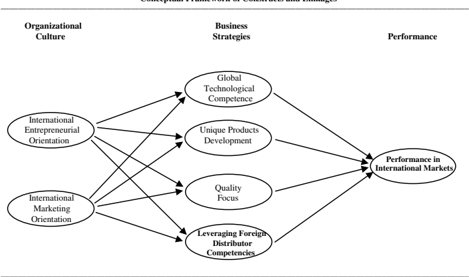
This study argues that born-global firms succeed because early internationalization is supported by an innovative culture and a distinctive set of organizational capabilities. Using qualitative case studies followed by a survey of 203 usable responses, the authors find that several capability links are significant and that these capabilities are associated with performance in international markets.
## Key findings
- The survey analysis found that international entrepreneurial orientation significantly predicted global technological competence with a standardized coefficient of 0.28; the link from international marketing orientation to global technological competence was not significant.
- Unique products development was significantly predicted by both international entrepreneurial orientation (0.19) and international marketing orientation (0.24).
- Quality focus was significantly predicted by both international entrepreneurial orientation (0.23) and international marketing orientation (0.35).
- Leveraging foreign distributor competences was significantly predicted by international marketing orientation (0.26) but not by international entrepreneurial orientation; these strategy variables were also significant drivers of performance in international markets: global technological competence (0.21), unique products development (0.14), quality focus (0.30), and leveraging foreign distributor competences (0.18).
## Methods
- The paper uses a two-phase design: first qualitative interviews/case studies to develop constructs and hypotheses, then a cross-industry field survey to test them.
- The qualitative phase included 33 professionals: 24 senior managers at early internationalizing firms, 6 scholars, and 3 international trade experts; the firms were mostly founded after 1985, sold half or more of their sales abroad, and had entered foreign markets within 3 years of founding.
- The survey was mailed to a random sample of 900 manufacturing firms in the United States founded in 1980 or later and exporting at least 25% of total production; 203 usable surveys were returned (about 23% response rate). The main analysis used LISREL8 path analysis, with exploratory factor analysis and confirmatory factor analysis for scale purification and validity checks.
## Limitations
- The paper states that “little empirical work” had been attempted on born globals and that there had been “almost no empirical research” on the factors driving their superior international performance.
- The study itself is focused on U.S. manufacturing firms that were selected using a 25% export threshold, so the evidence is tied to that sample and entry-mode context; this is evident from the text.
- The paper notes that the survey results are based on self-reported measures from responding firms; this is evident from the questionnaire-based design, though the paper does not frame it explicitly as a limitation.
Model-written summary. Check it against the paper before relying on it.
Integrity signals
Registry
Cites
Statistics
Figures
Verification
Claims the paper makes
0 Valid · 0 Not valid · 53 Not checked · 112 Own results and interpretations
A result the paper reports from its own data — it cites no other source for it, so there is none to check. The quote shows it is in the paper.
In the paper
“Despite the scarce resources typical of young firms, our findings reveal that born-global firms leverage a distinctive mix of orientations and strategies that allow them to succeed in diverse international markets.”
plainstates a cause- Asserted: passes — The authors put it forward as true.
- Checkable: passes — It can be checked against evidence.
- Load-bearing: passes — The paper’s conclusions depend on it.
- Based: passes — The paper gives a reason why it holds.
- Rests on an assumption not shown here.
A result the paper reports from its own data — it cites no other source for it, so there is none to check. The quote shows it is in the paper.
In the paper
“The critical role of marketing prowess overseas was also strongly emphasized by virtually all interviewees in the case studies.”
boosted- Asserted: passes — The authors put it forward as true.
- Checkable: passes — It can be checked against evidence.
- Load-bearing: unclear — It is unclear whether the paper’s conclusions depend on it.
- Based: passes — The paper gives a reason why it holds.
A result the paper states — it cites no source for it, so there is none to check. The quote shows it is in the paper.
In the paper
“Most interviewed firms exhibited strong technological capabilities in their respective product or industry categories.”
plain- Asserted: passes — The authors put it forward as true.
- Checkable: passes — It can be checked against evidence.
- Load-bearing: unclear — It is unclear whether the paper’s conclusions depend on it.
- Based: passes — The paper gives a reason why it holds.
A result the paper reports from its own data — it cites no other source for it, so there is none to check. The quote shows it is in the paper.
In the paper
“In general, the qualitative phase of the study revealed that born globals are likely to be formed by entrepreneurs who pursue foreign ventures with a strong marketing orientation.”
hedgedstates an association- Asserted: passes — The authors put it forward as true.
- Checkable: passes — It can be checked against evidence.
- Load-bearing: passes — The paper’s conclusions depend on it.
- Based: passes — The paper gives a reason why it holds.
A result the paper states — it cites no source for it, so there is none to check. The quote shows it is in the paper.
In the paper
“In contrast, born globals leverage a collection of fundamental intangible knowledge-based capabilities in the cultivation of foreign markets early in their evolution.”
plainstates a cause- Asserted: passes — The authors put it forward as true.
- Checkable: passes — It can be checked against evidence.
- Load-bearing: passes — The paper’s conclusions depend on it.
- Based: unclear — It is unclear why the paper says it holds.
- Rests on an assumption not shown here.
84 more claims
Create a free account to see all 165 claims and to verify the 3 references still open.
- It may state two separate claims as one. 33
- Probably not a substantial claim. 54
Citations
Cites
Evaluating Structural Equation Models with Unobservable Variables and Measurement Error
Fornell, C., & Larcker, D. F. (1981) · Journal of Marketing Research · doi:10.2307/3151312 · Cited by 109,314 · cited 2×
“Composite reliability was calculated using the procedures outlined by Fornell and Larcker (1981).”
MethodInfluentialEvaluating structural equation models with unobservable variables and measurement error
Fornell, C., & Larcker, D. F. (1981) · Journal of Marketing Research · doi:10.1177/002224378101800104 · Cited by 109,190
Firm Resources and Sustained Competitive Advantage
Barney, J. (1991) · Journal of Management · doi:10.1177/014920639101700108 · Cited by 48,334
(1994) · Journal of the American Dietetic Association · doi:10.1016/0002-8223(94)92216-0 · Cited by 45,910
Firm resources and sustained competitive advantage
Barney, J. B. (2004) · Advances in Strategic Management · doi:10.1016/s0742-3322(00)17018-4 · Cited by 38,152
Absorptive Capacity: A New Perspective on Learning and Innovation
Cohen, W. M., & Levinthal, D. A. (1990) · Administrative Science Quarterly · doi:10.2307/2393553 · Cited by 35,728
A resource‐based view of the firm
Wernerfelt, B. (1984) · Strategic Management Journal · doi:10.1002/smj.4250050207 · Cited by 25,635
The Theory of Economic Development
Schumpeter, J., & Backhaus, U. (2006) · The European Heritage in Economics and the Social Sciences · doi:10.1007/0-306-48082-4_3 · Cited by 22,506
An Evolutionary Theory of Economic Change.
Loasby, B. J., Nelson, R. R., & Winter, S. G. (1983) · The Economic Journal · doi:10.2307/2232409 · Cited by 21,366
A Dynamic Theory of Organizational Knowledge Creation
Nonaka, I. (1994) · Organization Science · doi:10.1287/orsc.5.1.14 · Cited by 17,809
Research works printed but not linked: 5
- Nikkei Sangyoo Shimbun (1995) Benchaa Shin Sedai (New Generation Ventures) , Nihon Keizai Shimbun: Tokyo.
- Nunnally, J.C. (1978) Psychometric Theory
- Porter, M.E. (1980) Competitive Strategy , The Free Press: New York.
- Rennie, M. (1993) 'Born global', McKinsey Quarterly (4): 45-52. Rosson, P. and Ford, I.D. (1982) 'Manufacturer-overseas distributor relations and export performance', Journal of International Business Studies 13 (2): 57-72.
- Schumpeter, J. (1939) Business Cycles , Vol. 1 McGraw-Hill: New York.
Cited by
Items 101–200 of 3,020
Calabrò, A., & Mussolino, D. (2013) · Journal of Management & Governance · doi:10.1007/s10997-011-9180-7 · Cited by 230
“, they are born global, but this is not the norm (Knight and Cavusgil 2004; Wright et al. 2007)].”
BackgroundCoeurderoy, R., & Murray, G. (2008) · Journal of International Business Studies · doi:10.1057/palgrave.jibs.8400369 · Cited by 222
“The complexity and intangibility of the technological component of the product or service by its very ambiguity exacerbates the contractual hazard for NTBFs (Knight and Cavusgil, 2004).”
Ren, S., Eisingerich, A. B., & Tsai, H.-T. (2015) · International Business Review · doi:10.1016/j.ibusrev.2014.11.006 · Cited by 223
“R&D capability in particular has emerged as a central theme in the international new ventures and rapid internationalization literature and is seen as a strategically important source of competitive advantage (Filatotchev & Piesse, 2009; Golovko & Valentini, 2011; Knight & Cavusgil, 2004).”
BackgroundLaanti, R., Gabrielsson, M., & Gabrielsson, P. (2007) · Industrial Marketing Management · doi:10.1016/j.indmarman.2006.10.003 · Cited by 221
“Also, Knight and Cavusgil (2004) believe that there is still a need for future research to deepen our understanding of born globals.”
BackgroundWeerawardena, J., Mort, G. S., Salunke, S., Knight, G., & Liesch, P. W. (2015) · Journal of the Academy of Marketing Science · doi:10.1007/s11747-014-0382-9 · Cited by 222
Self-citationFernhaber, S. A., Gilbert, B. A., & McDougall, P. P. (2008) · Journal of International Business Studies · doi:10.1057/palgrave.jibs.8400342 · Cited by 221
“Strong technological capabilities are important for new venture internationalization, as they equip firms to develop routines that enable them to reconfigure new knowledge into their operations (Knight & Cavusgil, 2004).”
BackgroundInternationalization Orientation in SMEs: The Mediating Role of Technological Innovation
Bagheri, M., Mitchelmore, S., Bamiatzi, V., & Nikolopoulos, K. (2019) · Journal of International Management · doi:10.1016/j.intman.2018.08.002 · Cited by 219
“Acknowledging the need to further investigate this multi-directional relationship between internationalization and innovation (Damijan et al., 2010; Damijan and Kostevc, 2015; Knight and Cavusgil, 2004; Ren et al., 2015), particularly in the SME context which has been rather neglected in the relevant literature, we ex…”
BackgroundInfluentialBoso, N., Cadogan, J. W., & Story, V. M. (2013) · International Small Business Journal: Researching Entrepreneurship · doi:10.1177/0266242611400469 · Cited by 217
“, 2004), and should not be confused with export product innovativeness, which is a cultural and entrepreneurial behavioural issue (Hult and Ketchen, 2001; Knight and Cavusgil, 2004; Lumpkin and Dess, 1996).”
BackgroundInfluentialPeiris, I. K., Akoorie, M. E. M., & Sinha, P. (2012) · Journal of International Entrepreneurship · doi:10.1007/s10843-012-0096-3 · Cited by 214
“…(2004) Karagozoglu and Lindell (1998) Karra et al. (2008) Keen and Wu (2011) Keupp and Gassmann (2009) Kiss and Danis (2008, 2010) Knight (2000) Knight and Cavusgil (2004) Knudsen and Madsen (2002) Kocak and Abimbola 2009 Kontinen and Ojala (2010, 2011) Kropp et al. (2006) Kuemmerle (2002)…”
BackgroundInfluentialAntecedents and implications of disruptive innovation: Evidence from China
Wan, F., Williamson, P. J., & Yin, E. (2015) · Technovation · doi:10.1016/j.technovation.2014.05.012 · Cited by 209
Dominguez, N., & Mayrhofer, U. (2017) · International Business Review · doi:10.1016/j.ibusrev.2017.03.010 · Cited by 213
International entrepreneurship: The pursuit of entrepreneurial opportunities across national borders
Reuber, A. R., Knight, G. A., Liesch, P. W., & Zhou, L. (2018) · Journal of International Business Studies · doi:10.1057/s41267-018-0149-5 · Cited by 211
“A decade on, a paper by Knight and Cavusgil (2004) described the capabilities of such ‘‘born global’’ firms, and received the 2014 Journal of International Business Studies Decade Award.”
BackgroundSelf-citationCiravegna, L., Lopez, L., & Kundu, S. (2014) · Journal of Business Research · doi:10.1016/j.jbusres.2013.07.011 · Cited by 211
Capabilities, innovation and competitive advantage
Weerawardena, J., & Mavondo, F. T. (2011) · Industrial Marketing Management · doi:10.1016/j.indmarman.2011.10.012 · Cited by 209
“…we find the ‘rigid’ view is still popular among researchers particularly those pursuing empirical estimation using cross-sectional designs (e.g. Knight & Cavusgil, 2004; Nasution & Mavondo, 2008; Vorhies & Morgan, 2005) and a substantial number of researchers using case study method (e.g.…”
BackgroundEffects of firm resources on growth in multinationality
Tseng, C.-H., Tansuhaj, P., Hallagan, W., & McCullough, J. (2007) · Journal of International Business Studies · doi:10.1057/palgrave.jibs.8400305 · Cited by 208
“- that is, firm heterogeneity and resource immobility - are just as germane to an international context as they are to the domestic milieu (e.g., Ekeledo and Sivakumar, 2004; Knight and Cavusgil, 2004; Tan and Mahoney, 2005).”
BackgroundGabrielsson, P., & Gabrielsson, M. (2013) · Industrial Marketing Management · doi:10.1016/j.indmarman.2013.07.011 · Cited by 207
“Here the concept refers to proactive, innovative, and risk-taking firm behavior that contributes to successful entry (Knight & Cavusgil, 2004; Lumpkin & Dess, 1996; Miller, 1983).”
BackgroundResultInfluentialTechnology Innovation Management Review
McPhee, C., & Bailetti, T. (2012) · Cited by 208
Technology, innovation and knowledge: The importance of ideas and international connectivity
Andersson, U., Dasí, À., Mudambi, R., & Pedersen, T. (2016) · Journal of World Business · doi:10.1016/j.jwb.2015.08.017 · Cited by 205
“…to the substantial debate about the role that experiential knowledge (Eriksson, Johanson, Majkgard, & Sharma, 1997) and international entrepreneurial orientation (Knight & Cavusgil, 2004) play in the internationalization process of the firm (Johanson & Vahlne, 1977; Oviatt & McDougall, 1994).”
BackgroundDo Chinese government subsidies affect firm value?
Lee, E., Walker, M., & Zeng, C. C. (2014) · Accounting Organizations and Society · doi:10.1016/j.aos.2014.02.002 · Cited by 214
The effects of entrepreneurial marketing on born global performance
Kocak, A., & Abimbola, T. (2009) · International Marketing Review · doi:10.1108/02651330910971977 · Cited by 202
The internationalisation of born global and international new venture SMEs
Crick, D. (2009) · International Marketing Review · doi:10.1108/02651330910971986 · Cited by 203
The development of international e-commerce in retail SMEs: An effectuation perspective
Tolstoy, D., Nordman, E. R., Hånell, S. M., & Özbek, N. (2021) · Journal of World Business · doi:10.1016/j.jwb.2020.101165 · Cited by 202
Entrepreneurship, export orientation, and economic growth
Hessels, J., & van Stel, A. (2011) · Small Business Economics · doi:10.1007/s11187-009-9233-3 · Cited by 200
“The idea is that internationalization results in innovativeness, knowledge, and capabilities that increase the new venture’s probability for growth and for success in foreign markets (Autio et al. 2000; Knight and Cavusgil 2004).”
BackgroundKarra, N., Phillips, N., & Tracey, P. (2008) · Long Range Planning · doi:10.1016/j.lrp.2008.05.002 · Cited by 197
SME international business models: The role of context and experience
Child, J., Hsieh, L., Elbanna, S., Karmowska, J., Marinova, S., Puthusserry, P., Tsai, T., Narooz, R., & Zhang, Y. (2017) · Journal of World Business · doi:10.1016/j.jwb.2017.05.004 · Cited by 200
“The international new venture literature assumes that early internationalization among SMEs is a phenomenon typical of high-tech industries oriented towards innovation rather than of traditional industries (Knight & Cavusgil, 2004; Onetti et al., 2012; Zander, McDougall-Covin, & Rose, 2015).”
BackgroundExploring the Role of Industry Structure in New Venture Internationalization
Fernhaber, S. A., McDougall, P. P., & Oviatt, B. M. (2007) · Entrepreneurship Theory and Practice · doi:10.1111/j.1540-6520.2007.00186.x · Cited by 198
“Instead, the definition is typically viewed as more descriptive and examines firms that internationalize within their first few years of existence (Knight & Cavusgil, 2004; Shrader et al., 2000; Zahra, Ireland, & Hitt, 2000).”
Foreign Location Choice: Review and Extensions
Kim, J. U., & Aguilera, R. V. (2016) · International Journal of Management Reviews · doi:10.1111/ijmr.12064 · Cited by 195
“Interestingly, foreign-location choice studies on born-global firms and international new ventures (Knight and Cavusgil 2004; Oviatt and Mcdougall 1994) demonstrate that these firms are particularly sensitive to regulatory environments related to intellectual property rights protection (Coeurderoy…”
Geographical pathways for SME internationalization: insights from an Italian sample
D'Angelo, A., Majocchi, A., Zucchella, A., & Buck, T. (2013) · International Marketing Review · doi:10.1108/02651331311314538 · Cited by 196
The CAGE around cyberspace? How digital innovations internationalize in a virtual world
Shaheer, N. A., & Li, S. (2020) · Journal of Business Venturing · doi:10.1016/j.jbusvent.2018.08.002 · Cited by 195
Debellis, F., Rondi, E., Plakoyiannaki, E., & De Massis, A. (2021) · Journal of World Business · doi:10.1016/j.jwb.2020.101144 · Cited by 196
“However, we identified other studies (Kontinen & Ojala, 2010, 2012) highlighting that FFs may also follow a “born global” approach (Knight & Cavusgil, 2004), internationalizing rapidly and soon after inception, or a “born again global” approach (Bell, McNaughton, & Young, 2001), i.e. suddenly…”
Technological Innovation and Exports: Unpacking Their Reciprocal Causality
Filipescu, D. A., Prashantham, S., Rialp, A., & Rialp, J. (2013) · Journal of International Marketing · doi:10.1509/jim.12.0099 · Cited by 195
“In addition, Knight and Cavusgil (2004) argue that innovation, knowledge, and capabilities are central themes of research on international strategy and performance of the firm.”
BackgroundKnowledge acquisition and the foreign development of high-tech start-ups: A social capital approach
Presutti, M., Boari, C., & Fratocchi, L. (2007) · International Business Review · doi:10.1016/j.ibusrev.2006.12.004 · Cited by 194
An Opportunity-Based View of Rapid Internationalization
Chandra, Y., Styles, C., & Wilkinson, I. F. (2012) · Journal of International Marketing · doi:10.1509/jim.10.0147 · Cited by 193
“…way born globals have been defined, which in most cases refers to the age of the firm—that is, firms entering international markets less than six years after inception (Zahra, Ireland, and Hitt 2000)—and those earning not less than 25% of revenues from foreign markets (Knight and Cavusgil 2004).”
BackgroundStrategic Entrepreneurial Internationalization: A Normative Framework
Autio, E. (2017) · Strategic Entrepreneurship Journal · doi:10.1002/sej.1261 · Cited by 193
Shin, J., Mollah, M. A., & Choi, J. (2023) · Sustainability · doi:10.3390/su15032027 · Cited by 198
“Thus, identifying processes that can be modified or improved using digital technology is possible [48,49].”
Internationalization patterns of small and medium‐sized enterprises
Kuivalainen, O., Sundqvist, S., Saarenketo, S., & McNaughton, R. (2012) · International Marketing Review · doi:10.1108/02651331211260331 · Cited by 193
Kuivalainen, O., Saarenketo, S., & Puumalainen, K. (2012) · European Management Journal · doi:10.1016/j.emj.2012.01.001 · Cited by 193
Martin, S. L., Javalgi, R. (. G., & Ciravegna, L. (2020) · Journal of Business Research · doi:10.1016/j.jbusres.2019.09.044 · Cited by 193
Zahoor, N., Al‐Tabbaa, O., Khan, Z., & Wood, G. (2020) · International Journal of Management Reviews · doi:10.1111/ijmr.12238 · Cited by 189
“Overall, using international entrepreneurship theory, previous research suggests that the entrepreneurial characteristics of managers and the entrepreneurial behavior of the firm allow SMEs to rapidly internationalize and achieve international growth (Cavusgil and Knight 2015; Knight and Cavusgil 2004).”
ResultBorn globals: A cross-country survey on high-tech start-ups
Cannone, G., & Ughetto, E. (2013) · International Business Review · doi:10.1016/j.ibusrev.2013.05.003 · Cited by 259
Hortinha, P., Lages, C., & Lages, L. F. (2011) · Journal of International Marketing · doi:10.1509/jimk.19.3.36 · Cited by 189
Sequencing the expansion of geographic scope and foreign operations by “born global” firms
Hashai, N. (2011) · Journal of International Business Studies · doi:10.1057/jibs.2011.31 · Cited by 184
“Born global firms are not only similar in terms of their resource constraints and technological intensity (Filatotchev et al., 2009; Knight & Cavusgil, 2004), but also mostly share a market-seeking motivation for internationalization, where they build on unique technological knowledge to…”
BackgroundResultInfluentialA co-citation bibliometric analysis of strategic management research
Ferreira, J. J. M., Fernandes, C. I., & Ratten, V. (2016) · Scientometrics · doi:10.1007/s11192-016-2008-0 · Cited by 187
“…0.148 0.772 0.214 0.109 68 Hitt and Tyler (1991) 1 0.438 0.034 0.150 0.666 0.242 0.117 71 Burgelman (1983) 3 0.041 0.018 0.101 0.457 0.036 0.056 52 Knight and Cavusgil (2004) 1 0.323 0.027 0.111 0.232 0.921 0.108 14 Oviatt and Mcdougall (1994) 1 0.180 0.018 0.077 0.206 0.912 0.059 58 Zahra and…”
InfluentialZhou, L., Wu, A., & Barnes, B. R. (2012) · Journal of International Marketing · doi:10.1509/jim.12.0076 · Cited by 185
“Notably, Knight and Cavusgil (2004) conceive entrepreneurial and market orientation as shaping a born-global firm’s ability to produce innovative and knowledge-intensive products for targeting niche segments in global markets.”
BackgroundEffects of alliances, time, and network cohesion on the initiation of foreign sales by new ventures
Yu, J., Gilbert, B. A., & Oviatt, B. M. (2011) · Strategic Management Journal · doi:10.1002/smj.884 · Cited by 184
‘New-wave’ global firms: Web 2.0 and SME internationalisation
Bell, J., & Loane, S. (2010) · Journal of Marketing Management · doi:10.1080/02672571003594648 · Cited by 183
“…the speed to new markets include the international orientation of management, the availability of human and financial resources, the existence of networks, and the ability of the firm to leverage external resources (Coviello & McAuley, 1999; Knight & Cavusgil, 2004; Rialp, Rialp, & Knight, 2005).”
BackgroundViewing global strategy through a microfoundations lens
Contractor, F., Foss, N. J., Kundu, S., & Lahiri, S. (2019) · Global Strategy Journal · doi:10.1002/gsj.1329 · Cited by 188
Institutional quality and internationalization of emerging market firms: Focusing on Chinese SMEs
Deng, P., & Zhang, S. (2018) · Journal of Business Research · doi:10.1016/j.jbusres.2018.07.014 · Cited by 182
Jean, R.-J. “., Kim, D., & Cavusgil, E. (2020) · Journal of World Business · doi:10.1016/j.jwb.2019.101021 · Cited by 181
All Things Great and Small: Organizational Size, Boundaries of the Firm, and a Changing Environment
Josefy, M., Kuban, S., Ireland, R. D., & Hitt, M. A. (2015) · Academy of Management Annals · doi:10.5465/19416520.2015.1027086 · Cited by 181
Roza, M., Van den Bosch, F. A. J., & Volberda, H. W. (2011) · International Business Review · doi:10.1016/j.ibusrev.2011.02.002 · Cited by 180
Understanding business model in the Internet of Things industry
Metallo, C., Agrifoglio, R., Schiavone, F., & Mueller, J. (2018) · Technological Forecasting and Social Change · doi:10.1016/j.techfore.2018.01.020 · Cited by 180
Felzensztein, C., Ciravegna, L., Robson, P., & Amorós, J. E. (2015) · Journal of Small Business Management · doi:10.1111/jsbm.12188 · Cited by 175
Khan, Z., & Lew, Y. K. (2018) · International Business Review · doi:10.1016/j.ibusrev.2017.06.001 · Cited by 176
“…of INVs that operate and serve internationally has been one of the key subjects of interest across the globe (e.g., Autio, George & Alexy, 2011; Coviello &Munro, 1997; Knight & Cavusgil, 2004; McDougall, Shane &Oviatt, 1994; McDougall et al., 1994; Mudambi & Zahra, 2007; Oviatt &McDougall, 2005).”
BackgroundJosefy, M. A., Harrison, J. S., Sirmon, D. G., & Carnes, C. (2017) · Academy of Management Annals · doi:10.5465/annals.2015.0148 · Cited by 174
Digitalization and SMEs’ Export Management: Impacts on Resources and Capabilities
Dethine, B., Enjolras, M., & Monticolo, D. (2020) · Technology Innovation Management Review · doi:10.22215/timreview/1344 · Cited by 174
Glavas, C., & Mathews, S. (2014) · International Business Review · doi:10.1016/j.ibusrev.2013.04.001 · Cited by 172
Zhang, M., Tansuhaj, P., & McCullough, J. (2009) · Journal of International Entrepreneurship · doi:10.1007/s10843-009-0042-1 · Cited by 173
Entrepreneurial growth: The role of international knowledge acquisition as moderated by firm age
Naldi, L., & Davidsson, P. (2014) · Journal of Business Venturing · doi:10.1016/j.jbusvent.2013.08.003 · Cited by 169
Dimitratos, P., Voudouris, I., Plakoyiannaki, E., & Nakos, G. (2012) · International Business Review · doi:10.1016/j.ibusrev.2011.08.001 · Cited by 169
Amin, M., Thurasamy, R., Aldakhil, A. M., & Kaswuri, A. H. B. (2016) · Nankai Business Review International · doi:10.1108/nbri-08-2015-0019 · Cited by 170
Does bribery in the home country promote or dampen firm exports?
Lee, S., & Weng, D. H. (2013) · Strategic Management Journal · doi:10.1002/smj.2075 · Cited by 167
Toward a Knowledge-Based Conceptualization of Internationalization
Prashantham, S. (2005) · Journal of International Entrepreneurship · doi:10.1007/s10843-005-0304-5 · Cited by 168
“As stated by Knight and Cavusgil (2004, p. 126) , “The idiosyncratic knowledge base acquired by following pathways gives rise to organizational capabilities”.”
BackgroundZhou, L., & Wu, A. (2014) · Journal of World Business · doi:10.1016/j.jwb.2013.10.001 · Cited by 168
“In addition, strategic orientations (such as, international entrepreneurial orientation and international market orientation) are arguably important variables to be included into our research model (Knight & Cavusgil, 2004).”
BackgroundInfluentialInternet and SMEs' internationalization: The role of platform and website
Jean, R.-J. “., & Kim, D. (2020) · Journal of International Management · doi:10.1016/j.intman.2019.100690 · Cited by 170
Dib, L. A., da Rocha, A., & da Silva, J. F. (2010) · Journal of International Entrepreneurship · doi:10.1007/s10843-010-0044-z · Cited by 167
“These results are consistent with theoretical propositions and empirical findings in the literature (e.g., Knight 1997; Autio et al. 2000; Dimitratos and Plakoyiannaki 2003; Etemad 2004; Knight and Cavusgil 2004; Gabrielsson 2005; Mort and Weerawardena 2006; Nieto and Fernández 2006; Zheng and Khavul 2005).”
BackgroundResultInfluentialInternational commitment, post-entry growth and survival of international new ventures
Sleuwaegen, L., & Onkelinx, J. (2014) · Journal of Business Venturing · doi:10.1016/j.jbusvent.2013.01.001 · Cited by 167
Ali, G. A., Hilman, H., & Gorondutse, A. H. (2020) · Benchmarking: An International Journal · doi:10.1108/bij-08-2019-0391 · Cited by 167
Slevin, D. P., & Terjesen, S. A. (2011) · Entrepreneurship Theory and Practice · doi:10.1111/j.1540-6520.2011.00483.x · Cited by 165
“His subsequent work (Knight & Cavusgil, 2004) measures IEO with 12 items.”
BackgroundCiravegna, L., Majano, S. B., & Zhan, G. (2014) · Journal of Business Research · doi:10.1016/j.jbusres.2013.06.002 · Cited by 166
“…new ventures, for example, discusses which firms should be defined “born global” or “born regional”, and also degrees of “born globalness” by looking at export speed, intensity and geographic scope (Crick, 2009; Knight & Cavusgil, 2004; Kuivalainen, Sundqvist, & Servais, 2007; Lopez et al., 2009).”
BackgroundHughes, M., Martin, S. L., Morgan, R. E., & Robson, M. J. (2010) · Journal of International Marketing · doi:10.1509/jimk.18.4.1 · Cited by 166
Achieving Superior Financial Performance in China: Differentiation, Cost Leadership, or Both?
Li, C. B., & Li, J. J. (2008) · Journal of International Marketing · doi:10.1509/jimk.16.3.1 · Cited by 167
Ownership, strategic orientation and internationalization in emerging markets
Liu, Y., Li, Y., & Xue, J. (2011) · Journal of World Business · doi:10.1016/j.jwb.2010.07.012 · Cited by 165
Loane, S., Bell, J. D., & McNaughton, R. (2007) · Journal of World Business · doi:10.1016/j.jwb.2007.06.009 · Cited by 163
Tang, Y. K. (2011) · International Small Business Journal: Researching Entrepreneurship · doi:10.1177/0266242610369748 · Cited by 163
“On the other hand, flexibility to learn and adapt is often cited as a competitive advantage of smaller firms (Knight and Cavusgil, 2004; Oviatt and McDougall, 1997).”
BackgroundThe Economic Impact of Entrepreneurship: Comparing International Datasets
Cumming, D., Johan, S., & Zhang, M. (2014) · Corporate Governance: An International Review · doi:10.1111/corg.12058 · Cited by 181
Uner, M. M., Koçak, A., Çavuşgil, E., & Cavusgil, S. T. (2013) · International Business Review · doi:10.1016/j.ibusrev.2012.12.005 · Cited by 172
“This stream of research (also known as ‘international new ventures’) was introduced more recently (Knight & Cavusgil, 1996, 2004; Oviatt & McDougall, 1994).”
BackgroundSelf-citationOrientations and capabilities of born global firms from emerging markets
Falahat, M., Knight, G., & Alon, I. (2018) · International Marketing Review · doi:10.1108/imr-01-2017-0021 · Cited by 159
Self-citationJiang, G., Kotabe, M., Zhang, F., Hao, A. W., Paul, J., & Wang, C. L. (2020) · International Business Review · doi:10.1016/j.ibusrev.2019.101662 · Cited by 160
Martin, S. L., Javalgi, R. G., & Cavusgil, E. (2017) · International Business Review · doi:10.1016/j.ibusrev.2016.11.006 · Cited by 158
Andersson, S., & Evers, N. (2015) · Journal of International Entrepreneurship · doi:10.1007/s10843-015-0149-5 · Cited by 211
“Other subjective attributes were global mind-set of the founder (Knight and Cavusgil 2004).”
BackgroundResultSME internationalization research: Mapping the state of the art
Ribau, C. P., Moreira, A. C., & Raposo, M. L. B. (2016) · Canadian Journal of Administrative Sciences / Revue Canadienne des Sciences de l Administration · doi:10.1002/cjas.1419 · Cited by 206
Exporting and innovation performance: Analysis of the annual Small Business Survey in the UK
Higón, D. A., & Driffield, N. L. (2011) · International Small Business Journal Researching Entrepreneurship · doi:10.1177/0266242610369742 · Cited by 190
“There is an extensive literature concerned with the relationship between exporting behaviour and innovation, much of this employs data from either bespoke surveys designed for the purpose, or the Community Innovation Survey (CIS), see for example Lefebvre and Lefebvre (2001), Roper and Love (2002), or most recently La…”
BackgroundInfluentialInternational Entrepreneurship and Geographic Location
Fernhaber, S. A., Gilbert, B. A., & McDougall, P. P. (2014) · Palgrave Macmillan UK eBooks · doi:10.1057/9781137472311.0007 · Cited by 161
Internationalization barriers of SMEs from developing countries: a review and research agenda
Chandra, A., Paul, J., & Chavan, M. (2020) · International Journal of Entrepreneurial Behaviour & Research · doi:10.1108/ijebr-03-2020-0167 · Cited by 211
Elango, B., & Sethi, S. P. (2007) · Management International Review · doi:10.1007/s11575-007-0021-5 · Cited by 182
Joensuu‐Salo, S., Sorama, K., Viljamaa, A., & Varamäki, E. (2018) · Administrative Sciences · doi:10.3390/admsci8030031 · Cited by 220
“Marketing capability in particular (Pham et al. 2017) but also market orientation affect export performance, the latter providing the basis for a firm’s commitment to external markets (Knight and Cavusgil 2004).”
BackgroundHsieh, L., Child, J., Narooz, R., Elbanna, S., Karmowska, J., Marinova, S. T., Puthusserry, P. N., Tsai, T., & Zhang, Y. (2018) · International Business Review · doi:10.1016/j.ibusrev.2018.09.004 · Cited by 195
Papa, A., Chierici, R., Ballestra, L. V., Meissner, D., & Orhan, M. A. (2020) · Journal of Knowledge Management · doi:10.1108/jkm-04-2020-0300 · Cited by 171
“Moreover, it might be interesting to extend our analysis to also consider variables related to management (such as homogeneity of dynamic capabilities and absorptive capacity) and organization aspects (such as formal vs informal collaboration modes and intra vs inter-organizational networks) (Castaneda et al., 2018; K…”
BackgroundBusiness Model Replication for Early and Rapid Internationalisation
Dunford, R., Palmer, I., & Benveniste, J. (2010) · Long Range Planning · doi:10.1016/j.lrp.2010.06.004 · Cited by 150
The future of international business research on corporate globalization that never was…
Verbeke, A., Coeurderoy, R., & Matt, T. (2018) · Journal of International Business Studies · doi:10.1057/s41267-018-0192-2 · Cited by 149
Hallbäck, J., & Gabrielsson, P. (2013) · International Business Review · doi:10.1016/j.ibusrev.2013.02.006 · Cited by 198
Dau, L. A. (2013) · Journal of International Business Studies · doi:10.1057/jibs.2013.5 · Cited by 163
Commentary: A Framework for Managing the Familiness and Agency Advantages in Family Firms
Habbershon, T. G. (2006) · Entrepreneurship Theory and Practice · doi:10.1111/j.1540-6520.2006.00158.x · Cited by 147
Entrepreneurial orientation and international commitment
Meliá, M. R., Menguzzato, M., & Peinado, L. S. (2007) · Journal of International Entrepreneurship · doi:10.1007/s10843-007-0016-0 · Cited by 175
“This relationship has been corroborated in the case of INVs (Ripolles et al. 1999; McDougall and Oviatt 2000; Knight and Cavusgill 2004 ).”
BackgroundResultInfluentialBorn global firms: The differences between their short- and long-term performance drivers
Efrat, K., & Shoham, A. (2012) · Journal of World Business · doi:10.1016/j.jwb.2012.01.015 · Cited by 189
Reuber, A. R., Dimitratos, P., & Kuivalainen, O. (2017) · Journal of International Business Studies · doi:10.1057/s41267-017-0070-3 · Cited by 172
“A decade later, Knight and Cavusgil (2004) examined the capabilities of early internationalizing firms – which they labelled “born globals” – and this also inspired a large body of research and a JIBS Decade Award in 2014.”
BackgroundOn industrial knowledge bases, commercial opportunities and global innovation network linkages
Herstad, S. J., Aslesen, H. W., & Ebersberger, B. (2013) · Research Policy · doi:10.1016/j.respol.2013.08.003 · Cited by 187
Rapid internationalization and long-term performance: The knowledge link
García-García, R., Canal, E. G., & Guillen, M. F. (2016) · Journal of World Business · doi:10.1016/j.jwb.2016.09.005 · Cited by 167
“…dramatically in the last two decades (e.g., Acedo and Jones, 2007; Chang, 2007; Coviello, 2015; Guillén and García-Canal, 2009; Jørgensen, 2014; Knight and Cavusgil, 2004; Knight and Liesch, 2016; Li, Qian, and Qian, 2015; Mohr and Batsakis, 2014; Oviatt and McDougall, 2005; Vermeulen and…”
Backgroundde Brentani, U., Kleinschmidt, E. J., & Salomo, S. (2010) · Journal of Product Innovation Management · doi:10.1111/j.1540-5885.2010.00707.x · Cited by 172
“Studies show that a strong global innovation culture is associated with superior performance in NPD (de Brentani and Kleinschmidt, 2004; Knight and Cavusgil, 2004).”
BackgroundInfluential
Metadata
- Authors
- Knight, G. A., & Cavusgil, S. T.
- Affiliations
- Florida State University (US)
- Corresponding author
- Knight, Gary A
- ORCID
- Knight, Gary A
- Venue
- Journal of International Business Studies
- Published
- 2004-01-08
- Volume
- 35
- Issue
- 2
- Pages
- 124-141
- ISSN
- 0047-2506 (ISSN-L)
- 1478-6990
- OpenAlex
- W2127709152
- Semantic Scholar
- d24960b5342d0dd3b86be002ab18a80e7b6fb5c9
- Cited by
- 3,013
- References
- 102
- Citations by year
- 2026: 121 · 2025: 123 · 2024: 157 · 2023: 154 · 2022: 182 · 2021: 196 · 2020: 189 · 2019: 180 · 2018: 199 · 2017: 172 · 2016: 188 · 2015: 187 · 2014: 178 · 2013: 167 · 2012: 129
- FWCI
- 137.12
- Type
- journal article
- Language
- en
- Update notices
- correction (2004-07-16)
- Open access
- bronze
- doi.org
- Licence
- www.springer.com/tdm (tdm)
- Locations
- Journal of International Business Studies (publishedVersion)
- RePEc: Research Papers in Economics (submittedVersion)
- Funders
- Michigan State University
- College of Engineering, Michigan State University
- Topics
- Social Sciences › Business, Management and Accounting › Strategy and Management › International Business and FDI
- Social Sciences › Business, Management and Accounting › Strategy and Management › Innovation and Knowledge Management
- Social Sciences › Communication › International Student and Expatriate Challenges
- Keywords
- born global firms, early internationalization, organizational capabilities, innovation, innovation culture, international business strategy, international success, young firms, internationalization of firms
About these checks
Registry, retraction, Cites and statistics results are computed, not judged, with one exception: a printed reference that no index lists is read once by a model before it counts as a citation error. Claims are extracted by a model and kept only when their quote appears verbatim in the text; each cited source is then checked, with a model’s help, for whether it says what the claim relies on. Those verdicts can be wrong — read the claim’s quote and the cited source before relying on one.
A language model drew the claims from the paper on 2026-10-10, under version 3 of the claim definition (model deepseek-v4.1-flash, prompt extract-v3).
A second model labelled each claim on 2026-10-10 (model jev-1.13-20260917, definition revision gold-guideline-v0.2).
Statistics and arithmetic are recomputed, not judged.
Confidence bands are shown only for fields calibrated on our annotated test set. None is calibrated yet, so no band is shown.
What counts as a claim ›How we measure confidence ›How we check this ›
Are you an author, or do you see a problem with this page? Request a review
Data sources
Bibliographic data: Semantic Scholar, OpenAlex, Crossref.
Contains information from the Semantic Scholar Academic Graph Datasets, made available under the ODC Attribution License (ODC-BY 1.0).
Semantic Scholar’s data is described in: Kinney, R., et al. (2023). The Semantic Scholar Open Data Platform. arXiv:2301.10140.
