

The biomass distribution on Earth
Open accessThe DOI matches its Crossref record; 263 of the 263 references it cites were found in a registry or an index; 11 of the 41 sources its claims cite were checked for support.
Abstract
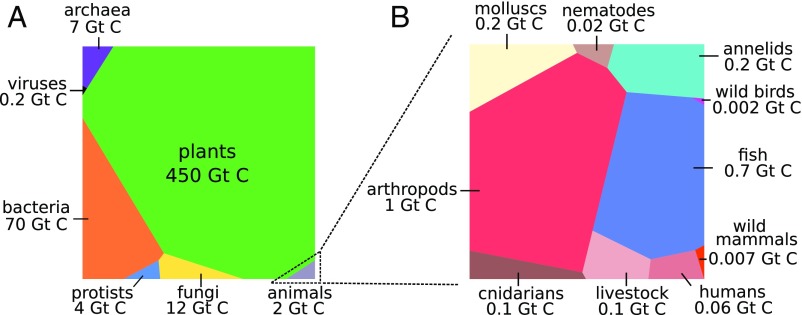
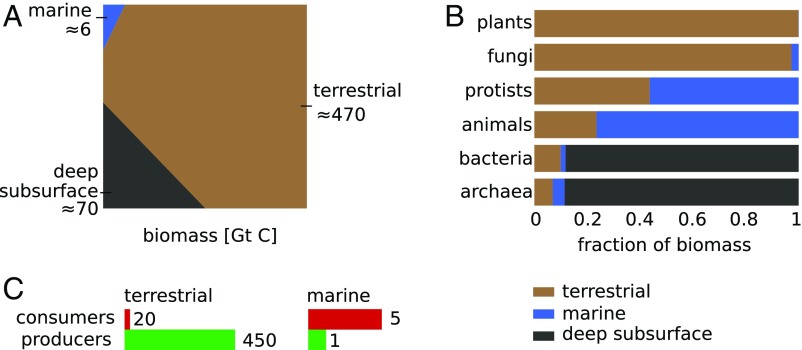
A census of the biomass on Earth is key for understanding the structure and dynamics of the biosphere. However, a global, quantitative view of how the biomass of different taxa compare with one another is still lacking. Here, we assemble the overall biomass composition of the biosphere, establishing a census of the ≈550 gigatons of carbon (Gt C) of biomass distributed among all of the kingdoms of life. We find that the kingdoms of life concentrate at different locations on the planet; plants (≈450 Gt C, the dominant kingdom) are primarily terrestrial, whereas animals (≈2 Gt C) are mainly marine, and bacteria (≈70 Gt C) and archaea (≈7 Gt C) are predominantly located in deep subsurface environments. We show that terrestrial biomass is about two orders of magnitude higher than marine biomass and estimate a total of ≈6 Gt C of marine biota, doubling the previous estimated quantity. Our analysis reveals that the global marine biomass pyramid contains more consumers than producers, thus increasing the scope of previous observations on inverse food pyramids. Finally, we highlight that the mass of humans is an order of magnitude higher than that of all wild mammals combined and report the historical impact of humanity on the global biomass of prominent taxa, including mammals, fish, and plants.
Overview
CoChat Summary
TL;DR
The paper assembles a global census of biomass across all kingdoms of life, estimating Earth’s total biomass at ≈550 Gt C, dominated by plants. It also compares biomass across environments and trophic modes, highlighting large uncertainties and human impacts on the biosphere.
Key findings
- Total global biomass is ≈550 Gt C, with plants ≈450 Gt C (≈80%), bacteria ≈70 Gt C (≈15%), fungi ≈12 Gt C, archaea ≈7 Gt C, protists ≈4 Gt C, animals ≈2 Gt C, and viruses ≈0.2 Gt C.
- Land biomass (≈470 Gt C) is about two orders of magnitude higher than marine biomass (≈6 Gt C); the deep subsurface holds ≈15% of total biomass, chiefly bacteria and archaea.
- In the ocean, ≈1 Gt C of primary producers supports ≈5 Gt C of consumer biomass, an inverted standing biomass distribution; marine biomass is ≈70% microbes, mainly bacteria and protists.
- Human-associated biomass is large relative to wild vertebrates: humans ≈0.06 Gt C, livestock ≈0.1 Gt C, wild mammals ≈0.007 Gt C, domesticated poultry ≈0.005 Gt C versus wild birds ≈0.002 Gt C; total plant biomass has declined approximately twofold relative to pre-human civilization.
Methods
- The authors synthesize hundreds of studies and generate estimates for major taxonomic groups, reporting biomass as gigatons of carbon (Gt C) and using a kingdom-level framework plus viruses.
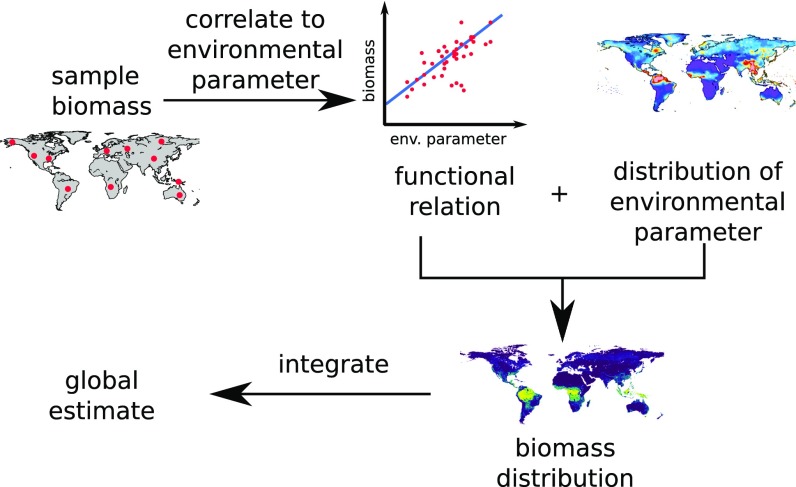
- For many taxa, local biomass samples are extrapolated globally by correlating biomass density with environmental parameters known at global scale; best estimates often use a geometric mean of independent estimates.
- Uncertainty is reported as multiplicative fold-change projections akin to 95% confidence intervals, incorporating intrastudy, interstudy, and intermethod variation; data and code are open-sourced.
Limitations
- The paper states that most datasets rely on fragmentary sampling, causing large uncertainties; sampling is scarce in the deep ocean (usually deeper than 200 m) and deep soil (usually deeper than 1 m), and some estimates may be biased by sampling toward high-abundance areas.
- The paper states that deep subsurface environments have particularly high uncertainty and unknown systematic biases, including unresolved distribution of biomass between aquifer fluids and rocks and among microbial taxa.
- The paper states that current and prehuman vertebrate biomass estimates are only a crude first step, amphibians remain poorly characterized, and parasite biomass is not resolved from hosts; evident from the text, kingdom-level grouping was chosen because much data lack finer taxonomic detail, and some uncertainty projections rely on analogous taxa or expert consultation.
Model-written summary. Check it against the paper before relying on it.
Integrity signals
Registry
Cites
Statistics
Figures
Verification
Claims the paper makes
9 Valid · 7 Not valid · 16 Not checked · 53 Own results and interpretations
Every source the paper cites for this claim was checked and supports it.
In the paper
“The biomass of amphibians, which are experiencing a dramatic population decline (42), remains poorly characterized.”
§ The biomass distribution on Earth > Discussion
What the sources say
- Supportedcites [42] Wake DB Vredenburg VT 2008 Colloquium paper: Are we in the midst of the sixth mass extinction? A view from the world of amphibians Proc Natl Acad Sci USA 105 11466 11473 18695221 PMC2556420 source
The citation is attached to the clause about amphibian population decline, not the separate statement that their biomass is poorly characterized. The passage reporting the Global Amphibian Assessment (labeled Abstract in our copy) says that 43% of amphibian species have declining populations. (LLM, conf=0.92)
plain- Asserted: passes — The authors put it forward as true.
- Checkable: passes — It can be checked against evidence.
- Load-bearing: unclear — It is unclear whether the paper’s conclusions depend on it.
- Based: passes — The paper gives a reason why it holds.
- Supported
Every source the paper cites for this claim was checked and supports it.
In the paper
“In the case of prokaryotes, some major improvements were recently realized, with global estimates of marine deep subsurface prokaryote biomass reduced by about two orders of magnitude due to an increased diversity of sampling locations (7).”
§ The biomass distribution on Earth > Discussion
What the sources say
- Supportedcites [7] Kallmeyer J Pockalny R Adhikari RR Smith DC D’Hondt S 2012 Global distribution of microbial abundance and biomass in subseafloor sediment Proc Natl Acad Sci USA 109 16213 16216 22927371 PMC3479597 source
The Discussion reports a revised subseafloor microbial biomass estimate of 4.1 Pg C versus a previous estimate of 303 Pg C—about a 74-fold reduction. It also identifies a more geographically diverse sampling database, including low-abundance ocean gyres, as a reason the new estimate is lower. The paper identifies other contributing factors as well. (LLM, conf=0.88)
plainstates a cause- Asserted: passes — The authors put it forward as true.
- Checkable: passes — It can be checked against evidence.
- Load-bearing: unclear — It is unclear whether the paper’s conclusions depend on it.
- Based: passes — The paper gives a reason why it holds.
- Supported
The sources with a verdict support this claim; the rest weren’t checked yet, have no full text we could read, or their verdicts aren’t rated yet.
In the paper
“Such inverted biomass distributions can occur when primary producers have a rapid turnover of biomass [on the order of days (34)], while consumer biomass turns over much more slowly [a few years in the case of mesopelagic fish (35)].”
§ The biomass distribution on Earth > Results > The Distribution of Biomass Across Environments and Trophic Modes.
What the sources say
- Supportedcites [34] Zubkov MV 2014 Faster growth of the major prokaryotic versus eukaryotic CO2 fixers in the oligotrophic ocean Nat Commun 5 3776 24777140 PMC4015317 source
The Results (Comparison of the growth rates of the CO2 fixers; page unavailable) report growth rates of 0.1–0.6 per day for the studied oceanic primary producers, consistent with biomass turnover on the order of days. The few-years estimate for mesopelagic fish is assigned to a different citation, not this source. (LLM, conf=0.91)
- Not checked — no full text of the sourcecites [35] Catul V Gauns M Karuppasamy PK 2011 A review on mesopelagic fishes belonging to family Myctophidae Rev Fish Biol Fish 21 339 354 source
plainstates a possible cause- Asserted: passes — The authors put it forward as true.
- Checkable: passes — It can be checked against evidence.
- Load-bearing: passes — The paper’s conclusions depend on it.
- Based: passes — The paper gives a reason why it holds.
- Supported
The cited sources support only part of this claim — read each source’s verdict below.
In the paper
“Combining data from independent sources such as these enables a robust assessment of the total plant biomass (17).”
§ The biomass distribution on Earth > Results > The Uncertainty Associated with Global Biomass Estimates.
What the sources say
- Partly supportedcites [17] Erb K-H 2017 Unexpectedly large impact of forest management and grazing on global vegetation biomass Nature 553 73 76 29258288 PMC5756473 sourceExperimental — accuracy not yet measured
The Methods describe combining multiple datasets and types of evidence to estimate global vegetation biomass stocks. But the paper also says global stocks remain uncertain, reports uncertainty ranges around 35% of the median estimate, and describes more robust estimates as a future prospect. It therefore supports the use of independent sources for an assessment, but not the unqualified characterization of that assessment as robust. (LLM, conf=0.84)
plainstates a cause- Asserted: passes — The authors put it forward as true.
- Checkable: passes — It can be checked against evidence.
- Load-bearing: passes — The paper’s conclusions depend on it.
- Based: passes — The paper gives a reason why it holds.
- Partly supported
A result the paper states — it cites no source for it, so there is none to check. The quote shows it is in the paper.
In the paper
“Plant biomass includes ≈70% stems and tree trunks, which are mostly woody, and thus relatively metabolically inert.”
§ The biomass distribution on Earth > Results > The Biomass Distribution of the Biosphere by Kingdom.
plain- Asserted: passes — The authors put it forward as true.
- Checkable: passes — It can be checked against evidence.
- Load-bearing: unclear — It is unclear whether the paper’s conclusions depend on it.
- Based: passes — The paper gives a reason why it holds.
27 more claims
Create a free account to see all 85 claims and to verify the 2 references still open.
- It may state two separate claims as one. 32
- Probably not a substantial claim. 28
Claims other papers make about this one
Each is checked against this paper’s own text: does it say what the citing paper says it does?
The cited source doesn’t support the claim as written.
In the citing paper
“and less than 10% that of the world ' s current human population ( 52 ).”
From Pervasive human-driven decline of life on Earth points to the need for transformative change (2019) · cites this paper as [52]
Checked by a reasoning model — may be wrong.
Experimental — accuracy not yet measuredThe cited source says what the claim attributes to it.
In the citing paper
“Approximately 450 Gt of C is bound up in terrestrial biota, primarily in plants (86), while only ~6 Gt of C is found in ocean biota (87).”
From Earth beyond six of nine planetary boundaries (2023) · cites this paper as [87]
The cited source says what the claim attributes to it.
In the citing paper
“The amount of metabolic energy available to a biosphere powered by O 2 is vast, such that the O 2 -rich ocean-atmosphere system of the modern Earth supports staggering levels of standing biomass (Bar-On et al. 2018), energy flow (Falkowski et al. 2008), and ecological complexity (Steele 1974).”
From The History of Ocean Oxygenation (2022) · cites this paper as Bar-On et al. 2018
In the citing paper
“Global populations of domestic ruminants (cattle, sheep, and goats) (Ripple et al. 2013) poultry, and pigs (Bennett et al. 2018) used to feed the growing human population now exceed 100 million tons of carbon (Bar-On et al. 2018), and livestock populations are growing rapidly.”
From Scientists’ warning to humanity on the freshwater biodiversity crisis (2021) · cites this paper as Bar-On et al. 2018
Citations
Cites
The worldwide leaf economics spectrum
Wright, I. J., Reich, P. B., Westoby, M., Ackerly, D. D., Baruch, Z., Bongers, F., Cavender-Bares, J., Chapin, T., Cornelissen, J. H. C., Diemer, M., et al. (2004) · Nature · doi:10.1038/nature02403 · Cited by 9,021 · cited 1×
“We then convert the total area of leaves to an estimate of the total dry mass of leaves by using the Glopnet database (24), which measured leaf mass per area (LMA) for ≈2500 plant species.”
MethodA large and persistent carbon sink in the world’s forests
Pan, Y., Birdsey, R. A., Fang, J., Houghton, R., Kauppi, P. E., Kurz, W. A., Phillips, O. L., Shvidenko, A., Lewis, S. L., Canadell, J. G., et al. (2011) · Science · doi:10.1126/science.1201609 · Cited by 8,458
Soil Sampling and Methods of Analysis
(2007) · CRC Press eBooks · doi:10.1201/9781420005271 · Cited by 6,469
Primary production of the biosphere: Integrating terrestrial and oceanic components
Field, C. B., Behrenfeld, M. J., Randerson, J. T., & Falkowski, P. (1998) · Science · doi:10.1126/science.281.5374.237 · Cited by 6,371
Prokaryotes: The unseen majority
Whitman, W. B., Coleman, D. C., & Wiebe, W. J. (1998) · Proceedings of the National Academy of Sciences · doi:10.1073/pnas.95.12.6578 · Cited by 4,871
Global effects of land use on local terrestrial biodiversity
Newbold, T., Hudson, L. N., Hill, S. L. L., Contu, S., Lysenko, I., Senior, R. A., Börger, L., Bennett, D. J., Choimes, A., Collen, B., et al. (2015) · Nature · doi:10.1038/nature14324 · Cited by 4,352
Belowground biodiversity and ecosystem functioning
Bardgett, R. D., & van der Putten, W. H. (2014) · Nature · doi:10.1038/nature13855 · Cited by 3,990 · cited 4×
“This was recommended by experts in the field for estimation of arbuscular mycorrhizal fungi abundance (117).”
BackgroundInfluentialMangroves among the most carbon-rich forests in the tropics
Donato, D. C., Kauffman, J. B., Murdiyarso, D., Kurnianto, S., Stidham, M., & Kanninen, M. (2011) · Nature Geoscience · doi:10.1038/ngeo1123 · Cited by 3,374
Poorter, H., Niklas, K. J., Reich, P. B., Oleksyn, J., Poot, P., & Mommer, L. (2012) · New Phytologist · doi:10.1111/j.1469-8137.2011.03952.x · Cited by 3,163 · cited 1×
“The first relies on a meta-analysis of the biomass allocation to different plant compartments across biomes (19).”
BackgroundA global analysis of root distributions for terrestrial biomes
Jackson, R. B., Canadell, J., Ehleringer, J. R., Mooney, H. A., Sala, O. E., & Schulze, E. D. (1996) · Oecologia · doi:10.1007/bf00333714 · Cited by 3,071 · cited 4×
“assumed the distribution of microbial biomass with depth follows the biomass density versus depth profile of root biomass (21).”
BackgroundMethodInfluential
Research works printed but not linked: 1
- Chapman AD 2009 Numbers of Living Species in Australia and the World Australian Biological Resources Study Canberra, Australia
Cited by
Items 1,101–1,200 of 3,743
Characterizing the Piezosphere: The Effects of Decompression on Microbial Growth Dynamics
Cario, A., Oliver, G. C., & Rogers, K. L. (2022) · Frontiers in Microbiology · doi:10.3389/fmicb.2022.867340 · Cited by 17
Adinugroho, W. C., Prasetyo, L. B., Kusmana, C., Krisnawati, H., Weston, C. J., & Volkova, L. (2022) · Sustainability · doi:10.3390/su14126964 · Cited by 21
Cogliati, M., Arıkan-Akdağlı, S., Barac, A. M., Bostănaru, A.-C., Brito, S., Çerikçioğlu, N., Efstratiou, M. A., Ergin, Ç., Esposto, M. C., Frenkel, M., et al. (2022) · The Science of The Total Environment · doi:10.1016/j.scitotenv.2022.160132 · Cited by 20
Zhu, X., Hou, J., Li, M., et al. (2023) · Ecological Indicators · doi:10.1016/j.ecolind.2023.110167 · Cited by 16
Bioenergetics: the evolutionary basis of progressive kidney disease
Chevalier, R. L. (2023) · Physiological Reviews · doi:10.1152/physrev.00029.2022 · Cited by 20
Liquid scintillation counting at the limit of detection in biogeosciences
Schubert, F., & Kallmeyer, J. (2023) · Frontiers in Microbiology · doi:10.3389/fmicb.2023.1194848 · Cited by 16
“Albeit extremely low microbial abundance and activity, the deep subsurface harbors ~15% of the world’s living biomass due to its sheer volume (Kallmeyer et al., 2012; Bar-On et al., 2018; Magnabosco et al., 2018).”
BackgroundMerkel, B., Trathan, P. N., Thorpe, S. E., Murphy, E. J., Pehlke, H., Teschke, K., & Griffith, G. P. (2023) · ICES Journal of Marine Science · doi:10.1093/icesjms/fsad110 · Cited by 16
Hu, Y., Nie, Y., Liu, Z., Wu, G., & Fan, W. (2023) · Remote Sensing · doi:10.3390/rs15174194 · Cited by 23
Identification and cultivation of anaerobic bacterial scavengers of dead cells
Hirakata, Y., Mei, R., Morinaga, K., Katayama, T., Tamaki, H., Meng, X., Watari, T., Yamaguchi, T., Hatamoto, M., & Nobu, M. K. (2023) · The ISME Journal · doi:10.1038/s41396-023-01538-2 · Cited by 19
Formation of tannic acid-calcium polymeric network in pore solution: Characterization and kinetics
Li, S., Liu, X., Wang, S., et al. (2023) · Journal of Building Engineering · doi:10.1016/j.jobe.2023.108121 · Cited by 16
Sand mining in BRICS economies: Tragedy of the commons or fortune in the making?
Ganie, J. A., & Bhat, M. Y. (2023) · Journal of Cleaner Production · doi:10.1016/j.jclepro.2023.140122 · Cited by 24
Life, its definition, origin, evolution, and four-dimensional hierarchical structure
Mikhailovsky, G. E. (2024) · Biosystems · doi:10.1016/j.biosystems.2024.105158 · Cited by 15
Food Loss, Food Waste, and Sustainability in Food Supply Chains
Akkerman, R., & Cruijssen, F. (2024) · Springer series in supply chain management · doi:10.1007/978-3-031-45565-0_9 · Cited by 29
Pan-Genome Provides Insights into Vibrio Evolution and Adaptation to Deep-Sea Hydrothermal Vents
Bosi, E., Taviani, E., Avesani, A., Doni, L., Auguste, M., Oliveri, C., Leonessi, M., Martínez-Urtaza, J., Vetriani, C., & Vezzulli, L. (2024) · Genome Biology and Evolution · doi:10.1093/gbe/evae131 · Cited by 19
“…harsh conditions, i.e. lack of light, low temperatures, and elevated pressure, the deep-sea environment represents one of the largest Earth’s biomes (Bar-On et al. 2018), harboring a vast number of microbes whose metabolic capabilities play a significant role in biogeochemical cycles (Rousk and…”
BackgroundThe global distribution and climate resilience of marine heterotrophic prokaryotes
Heneghan, R., Holloway, J., Gasol, J. M., Herndl, G. J., Morán, X. A. G., & Galbraith, E. D. (2024) · Nature Communications · doi:10.1038/s41467-024-50635-z · Cited by 21
“These observations have been used to estimate total global marine prokaryotic abundance and biomass 3,9,11 – 13 and for assessments of prokaryotic community structure over smaller scales 12,14 – 16 .”
Zhang, Y., Cao, Y., Jiang, W., Ma, Q., Shin, J., Sun, H., Cui, J., Chen, Y., Giraldo, J. P., Strano, M. S., et al. (2024) · Advanced Materials · doi:10.1002/adma.202409356 · Cited by 23
Arabani, M., & Farkhondeh, J. (2024) · Results in Engineering · doi:10.1016/j.rineng.2024.102758 · Cited by 16
Pinna, D., Pezzuolo, A., Cogato, A., Pornaro, C., Macolino, S., & Marinello, F. (2024) · Smart Agricultural Technology · doi:10.1016/j.atech.2024.100571 · Cited by 24
Post-Anthropocene Conservation
Watson, M. J., & Watson, D. M. (2019) · Trends in Ecology & Evolution · doi:10.1016/j.tree.2019.10.006 · Cited by 20
“-Second, a cautionary projection: alongside domesticated species, invasive species aremost likely topersist [14].”
BackgroundRadomska, M. (2020) · Australian Feminist Studies · doi:10.1080/08164649.2020.1802697 · Cited by 31
“Simultaneously, researchers (e.g. Bar-On, Phillips, and Milo 2018) draw attention to the drastic decrease in both animal and plant species linked to the rise of human civilisation (including the disappearance of 83% of wild mammals ‘ from before ’ ).”
BackgroundGenoud, A. P., Torsiello, J., Belson, M., et al. (2020) · Ecological Informatics · doi:10.1016/j.ecoinf.2020.101186 · Cited by 16
Zapién-Campos, R., Sieber, M., & Traulsen, A. (2020) · PLoS Computational Biology · doi:10.1371/journal.pcbi.1008392 · Cited by 14
“Although microbes are ubiquitous in nature [25], including the human body [26], it remains to be answered which microbes not only transit from the environment to the hosts but also persist in or on them.”
BackgroundSalikin, N. H., Nappi, J., Majzoub, M. E., & Egan, S. (2020) · Microorganisms · doi:10.3390/microorganisms8121963 · Cited by 19
Ecology of the Anthropocene signals hope for consciously managing the planetary ecosystem
Lehman, C. L., Loberg, S., Wilson, M. L., & Gorham, E. (2021) · Proceedings of the National Academy of Sciences · doi:10.1073/pnas.2024150118 · Cited by 20
“Given that Earth is finite, all ever-expanding biological populations—plants, humans, and other animals—ultimately face an inevitable depletion of space, resources, or other limiting factors.”
InfluentialBiodiversity for resilience—What is needed for allergic children
Haahtela, T. (2022) · Pediatric Allergy and Immunology · doi:10.1111/pai.13779 · Cited by 17
Seeber, P. A., von Hippel, B., Kauserud, H., Löber, U., Stoof‐Leichsenring, K. R., Herzschuh, U., & Epp, L. S. (2022) · Environmental DNA · doi:10.1002/edn3.315 · Cited by 18
Cho, S.-H., Lee, E., Ko, S.-R., Jin, S., Song, Y., Ahn, C., Oh, H., Cho, S., & Cho, S. (2020) · Journal of Microbiology and Biotechnology · doi:10.4014/jmb.1911.11006 · Cited by 16
“Moreover, ~70% of all marine biomass has been estimated to be composed of microorganisms [2].”
BackgroundHave natural disasters created opportunities to initiate Big Cat Tourism in South America?
Tortato, F. R., Hoogesteijn, R., & Elbroch, L. M. (2020) · Biotropica · doi:10.1111/btp.12777 · Cited by 16
Goyal, M. K., Rakkasagi, S., Surampalli, R. Y., Zhang, T. C., Saikumar, E., Gupta, A., Dubey, S., & U-tapao, C. (2024) · Technology in Society · doi:10.1016/j.techsoc.2024.102723 · Cited by 16
Biomass-Derived Carbon-Based Nanomaterials: Current Research, Trends, and Challenges
Lesch, R., Visser, E. D., Seroka, N. S., & Khotseng, L. E. (2025) · JOURNAL OF RENEWABLE MATERIALS · doi:10.32604/jrm.2025.02025-0026 · Cited by 21
Sun, J., Guo, L., Sun, X., Gao, M., Zhang, J., Liang, L., Liu, Y., Hou, L., & Yuan, C. (2020) · ACS Applied Energy Materials · doi:10.1021/acsaem.0c01196 · Cited by 15
Sebastián, M., Forn, I., Auladell, A., Gómez‐Letona, M., Sala, M. M., Gasol, J. M., & Marrasé, C. (2020) · Environmental Microbiology · doi:10.1111/1462-2920.15292 · Cited by 15
Investment in science can mitigate the negative impacts of land use on declining primate populations
Zhao, X., Li, X., Garber, P. A., Qi, X., Xiang, Z., Liu, X., Lian, Z., & Li, M. (2021) · American Journal of Primatology · doi:10.1002/ajp.23302 · Cited by 15
“, 2017), it is estimated that only 4% of the remaining mammalian biomass worldwide is composed of wild animals (Bar‐On et al., 2018).”
BackgroundSivan, P., Gandla, M. L., Derba‐Maceluch, M., Jönsson, L. J., Mellerowicz, E. J., & Winestrand, S. (2021) · Frontiers in Plant Science · doi:10.3389/fpls.2021.704960 · Cited by 14
Sæbø, J. S., Socolar, J. B., Sánchez, E. P., Woodcock, P., Bousfield, C. G., Uribe, C. A. M., Edwards, D. P., & Haugaasen, T. (2022) · Environmental Research Letters · doi:10.1088/1748-9326/ac62ae · Cited by 15
The Dasgupta Review and the Problem of Anthropocentrism
Treich, N. (2022) · Environmental and Resource Economics · doi:10.1007/s10640-022-00663-4 · Cited by 22
Kageyama, T., & Toju, H. (2022) · Frontiers in Ecology and Evolution · doi:10.3389/fevo.2022.959945 · Cited by 19
“Bacteria, fungi, and nematodes occupy a large amount of biomass in the soil, playing pivotal ecosystem functions (Fierer et al., 2007; Bardgett and van der Putten, 2014; Nielsen et al., 2015; Wall et al., 2015; Bahram et al., 2018; Bar-On et al., 2018; Flemming and Wuertz, 2019; van den Hoogen et al., 2019).”
BackgroundZoonoses from animal meat and milk
Pradhan, A. K., & Karanth, S. (2022) · Elsevier eBooks · doi:10.1016/b978-0-12-819470-6.00029-9 · Cited by 17
Wang, W., Li, C., Dodd, M. S., Algeo, T. J., Zhang, Z., Cheng, M., & Hou, M. (2022) · Precambrian Research · doi:10.1016/j.precamres.2022.106947 · Cited by 15
Yang, E.-F., Karunarathna, S. C., Tibpromma, S., Stephenson, S. L., Promputtha, I., Elgorban, A. M., Al-Rejaie, S. S., & Chomnunti, P. (2023) · Agronomy · doi:10.3390/agronomy13010169 · Cited by 17
Linking PM10 and PM2.5 Pollution Concentration through Tree Coverage in Urban Areas
Sierra-Porta, D., Solano‐Correa, Y. T., Tarazona-Alvarado, M., & Nuñez, L. A. (2023) · CLEAN - Soil Air Water · doi:10.1002/clen.202200222 · Cited by 19
Escamez, S., Robinson, K. M., Luomaranta, M., Gandla, M. L., Mähler, N., Yassin, Z., Grahn, T., Scheepers, G., Stener, L.-G., Jansson, S., et al. (2023) · Biotechnology for Biofuels and Bioproducts · doi:10.1186/s13068-023-02315-1 · Cited by 17
“Introduction Lignocellulosic woody biomass represents the majority of biomass on land [2].”
BackgroundZhang, G., Shi, L., Liu, C., Mao, R., Xia, B., Huang, Z. L., Wei, X., Wu, L., Zheng, Y., Wei, G., et al. (2023) · Environmental Microbiome · doi:10.1186/s40793-023-00516-7 · Cited by 16
“Background The phyllosphere is the aerial parts of plants, and accounts for approximately 60% of the total biomass on Earth, providing habitats for diverse microorganisms such as bacteria and fungi [5, 71].”
BackgroundMicrobiome predators in changing soils
Hu, S., Li, G., de Gea, A. B., Teunissen, J., Geisen, S., Wilschut, R. A., Schwelm, A., & Wang, Y. (2023) · Environmental Microbiology · doi:10.1111/1462-2920.16461 · Cited by 18
Hyperarid soil microbial community response to simulated rainfall
Demergasso, C. S., Neilson, J. W., Tebes-Cayo, C., Véliz, R., Ayma, D., Laubitz, D., Barberán, A., Chong, G., & Maier, R. M. (2023) · Frontiers in Microbiology · doi:10.3389/fmicb.2023.1202266 · Cited by 27
Increasing soil protist diversity alters tomato plant biomass in a stress-dependent manner
de Gea, A. B., Li, G., Chen, J. O., Wu, W., Kohra, A., Aslan, S. K., & Geisen, S. (2023) · Soil Biology and Biochemistry · doi:10.1016/j.soilbio.2023.109179 · Cited by 17
Implications of dietary carbon incorporation in fish carbonates for the global carbon cycle
Oehlert, A. M., Garza, J., Nixon, S., Frank, L., Folkerts, E. J., Stieglitz, J. D., Lu, C., Heuer, R. M., Benetti, D. D., del Campo, J., et al. (2024) · The Science of The Total Environment · doi:10.1016/j.scitotenv.2024.169895 · Cited by 16
Global Justice and the Biodiversity Crisis: Conservation in a World of Inequality
Armstrong, C. (2024) · doi:10.1093/9780191888090.001.0001 · Cited by 31
Molecular mechanisms and therapeutic application of extracellular vesicles from plants
Azizi, F., Khabbazi, S. K., Raimondo, S., & Dalirfardouei, R. (2024) · Molecular Biology Reports · doi:10.1007/s11033-024-09379-8 · Cited by 19
“…of life with approximately 374,000 accepted spe - cies [9] as well as ca. 450 gigatonnes of carbon estimating biomass in the global ecosystem [10], research on plant EVs had been neglected until 2009, when Regente and colleagues identified them in sunflower extracellular (apoplas - tic)…”
A new interpretation of Pikaia reveals the origins of the chordate body plan
Mussini, G., Smith, M. P., Vinther, J., Rahman, I. A., Murdock, D. J. E., Harper, D. A. T., & Dunn, F. S. (2024) · Current Biology · doi:10.1016/j.cub.2024.05.026 · Cited by 17
Origin of copper dissolution under electrocatalytic reduction conditions involving amines
Guan, Y., Kümper, J., Mürtz, S. D., et al. (2024) · Chemical Science · doi:10.1039/d4sc01944j · Cited by 15
Pillay, R., Watson, J. E. M., Hansen, A. J., Burns, P., Virnig, A. L. S., Supples, C., Armenteras, D., González-del-Pliego, P., Aragon-Osejo, J., A. Jantz, P., et al. (2024) · Proceedings of the National Academy of Sciences · doi:10.1073/pnas.2413325121 · Cited by 17
“…in other understudied taxonomic groups such as trees and ants have recently been described ( 26 , 27 ), comparable data on range maps and habitat associations remain unavailable for the majority of invertebrates and vascular plants that dominate tropical species diversity and biomass ( 28 , 29 ).”
Contribution of fungal biomass to persistent soil carbon across natural ecosystems
Wang, X., Yu, G., Kuzyakov, Y. V., Yin, B.-H., Kappler, A. A., & Liu, C. (2025) · Science China Earth Sciences · doi:10.1007/s11430-024-1474-2 · Cited by 19
Noronha, M. D. O., Zanini, R. R., & Souza, A. M. (2019) · Environmental Science and Pollution Research · doi:10.1007/s11356-019-06241-4 · Cited by 17
Derba‐Maceluch, M., Amini, F., Donev, E. N., Pawar, P. M.-A., Michaud, L., Johansson, U., Albrectsen, B. R., & Mellerowicz, E. J. (2020) · Frontiers in Plant Science · doi:10.3389/fpls.2020.00651 · Cited by 16
Cai, J., Zheng, W., Luo, M., et al. (2021) · Process Safety and Environmental Protection · doi:10.1016/j.psep.2021.01.022 · Cited by 15
Pan, X., Mei, S., Huang, G., Ji, X., Liu, W., & Yu, H. (2021) · ACS ES&T Engineering · doi:10.1021/acsestengg.1c00047 · Cited by 15
Santos, A. A., Sender, L. M., Wappler, T., Engel, M. S., & Diez, J. B. (2021) · Palaeogeography Palaeoclimatology Palaeoecology · doi:10.1016/j.palaeo.2021.110655 · Cited by 16
Reaction characteristics and mechanisms of sorbitol fast pyrolysis
Hu, B., Guo, X., Li, Y., et al. (2021) · Journal of Fuel Chemistry and Technology · doi:10.1016/s1872-5813(21)60150-0 · Cited by 15
Carbon Sequestration Potential in the Restoration of Highly Eutrophic Shallow Lakes
Skwierawski, A. (2022) · International Journal of Environmental Research and Public Health · doi:10.3390/ijerph19106308 · Cited by 19
Nanoscale resolution of microbial fiber degradation in action
Tatlı, M., Moraïs, S., Tovar-Herrera, O. E., Bomble, Y. J., Bayer, E. A., Medalia, O., & Mizrahi, I. (2022) · eLife · doi:10.7554/elife.76523 · Cited by 15
Mapping and characterizing social-ecological land systems of South America
Zarbá, L., Rodríguez, M. P., Boillat, S., Levers, C., Gasparri, I., Aide, T. M., Álvarez-Berríos, N. L., Anderson, L. O., Aráoz, E., Arima, E. Y., et al. (2022) · Ecology and Society · doi:10.5751/es-13066-270227 · Cited by 25
“El grupo de especialistas consistió en 21 investigadores de diferentes perfiles, filiaciones, disciplinas, perfil técnico, género y nacionalidades, con una extensa experiencia local y regional, cubriendo la diversidad territorial y geográfica de Sudamérica.”
BackgroundInfluentialMarčiulynas, A., Marčiulynienė, D., Mishcherikova, V., Franić, I., Lynikienė, J., Gedminas, A., & Menkis, A. (2022) · Forests · doi:10.3390/f13071103 · Cited by 17
Critical Phenomena in the Temperature-Pressure-Crowding Phase Diagram of a Protein
Gasic, A. G., Boob, M. M., Prigozhin, M. B., Homouz, D., Daugherty, C. M., Gruebele, M., & Cheung, M. S. (2019) · Physical Review X · doi:10.1103/physrevx.9.041035 · Cited by 25
Janowiecki, M. A., Clifton, E. M., Avalos, A., & Vargo, E. L. (2019) · Insectes Sociaux · doi:10.1007/s00040-019-00727-7 · Cited by 16
Biomass as a renewable energy source
Тркуља, В., Lеvić, Ј., Pržulј, N., & Маndić, D. (2023) · Edicija Održivi razvoj i upravljanje prirodnim resursima Republike Srpske. · doi:10.7251/eoru2306001t · Cited by 15
Different processes shape prokaryotic and picoeukaryotic assemblages in the sunlit ocean microbiomePreprint
Logares, R., Deutschmann, I. M., Giner, C. R., Krabberød, A. K., Schmidt, T., Rubinat-Ripoll, L., Mestre, M., Salazar, G., Ruiz‐González, C., Sebastián, M., et al. (2018) · bioRxiv (Cold Spring Harbor Laboratory) · doi:10.1101/374298 · Cited by 19
“Prokaryotes represent an 466 important fraction of the total microbial biomass in the ocean (84, 85), and they have 467 fundamental roles for ecosystem function (1, 2).”
BackgroundA Sympoietic View of Life: Gaia as a Holobiont CommunityPreprint
Gilbert, S. F. (2023) · Preprints.org · doi:10.20944/preprints202309.1072.v1 · Cited by 15
Nitrogen-doped hierarchically porous carbon derived from biomass for efficient capture of iodine
Fu, W., Hu, G., Song, W., et al. (2024) · Applied Surface Science · doi:10.1016/j.apsusc.2024.161664 · Cited by 14
Structure, Modification Pattern, and Conformation of Hemicellulose in Plant Biomass
Yoshimi, Y., Tryfona, T., & Dupree, P. (2024) · Journal of Applied Glycoscience · doi:10.5458/jag.7201301 · Cited by 26
Harris, R. L., & Schuerger, A. C. (2025) · Scientific Reports · doi:10.1038/s41598-025-86145-1 · Cited by 17
“…estimated that the modern atmospheric composition of Mars could support, through downward diffusion, a maximum steady-state subsurface biomass of 10 27 cells 58 , which is two to three orders of magnitude smaller than recent estimates of prokaryotic biomass in Earth’s continental subsurface 59,60 .”
Global diversity and energy of animals shaping the Earth’s surface
Harvey, G. L., Khan, Z., Albertson, L. K., Coombes, M. A., Johnson, M. F., Rice, S. P., & VILES, H. A. (2025) · Proceedings of the National Academy of Sciences · doi:10.1073/pnas.2415104122 · Cited by 19
“We used existing recent estimates of global biomass for nonmarine animals (24), wild terrestrial mammals (25), and ants (family Formicidae) (26) and estimated the proportion of that biomass associated with species we know to be zoogeomorphic agents ( Materials and Methods ).”
InfluentialLong-term culture of chicken tracheal organoids for the purpose of avian influenza virus research
de Bruin, A. C. M., Lamers, M. M., Haagmans, B. L., Leijten, L. M. E., Fouchier, R. A. M., & Richard, M. (2025) · Virology Journal · doi:10.1186/s12985-025-02714-w · Cited by 16
“The global demand for poultry products has skyrock-eted to the point that the estimated biomass of poultry is about threefold that of wild birds [5].”
Towards edge processing of images from insect camera traps
Bjerge, K., Karstoft, H., & Høye, T. T. (2025) · Remote Sensing in Ecology and Conservation · doi:10.1002/rse2.70007 · Cited by 19
“Insects make up the most diverse group of animals with more than a million described species, and insects constitute approximately half of total animal biomass (Bar-On et al., 2018).”
Marine Viruses and Their Role in Marine Ecosystems and Carbon Cycling
Mojica, K. D. A., & Brussaard, C. P. D. (2025) · Annual Review of Marine Science · doi:10.1146/annurev-marine-040324-020244 · Cited by 16
On the growth and form of bacterial colonies
Porter, R. L., Trenado-Yuste, C., Martínez-Calvo, A., Su, M., Wingreen, N. S., Datta, S. S., & Huang, K. C. (2025) · Nature Reviews Physics · doi:10.1038/s42254-025-00849-x · Cited by 27
Shuai, P., Hsieh, J. A., Kao, C., Hu, C.-W., Wang, R., Kuo, S., Yen, M., Liou, P., Ho, Y.-C., Chu, C.-C., et al. (2025) · The Plant Cell · doi:10.1093/plcell/koaf253 · Cited by 21
Food Systems for Sustainable Terrestrial Ecosystems (SDG 15)
Måren, I. E. (2018) · Food Ethics · doi:10.1007/s41055-018-00032-2 · Cited by 18
Catalytic Processes For Lignin Valorization into Fuels and Chemicals (Aromatics)
Ventura, M. J., Domine, M. E., & Chávez-Sifontes, M. (2019) · Current Catalysis · doi:10.2174/2211544708666190124112830 · Cited by 16
“Carbon-neutral and nonedible starting material represents an attractive source of chemicals or fuels, such as lignocellulosic biomass, produced in huge quantities from forestry and agricultural activity worldwide[3].”
BackgroundExtremophilic fungi at the interface of climate change
Joshi, S. M., Bajpai, A., & Johri, B. N. (2020) · Elsevier eBooks · doi:10.1016/b978-0-12-821925-6.00001-0 · Cited by 17
Vegan Men: Towards Greater Care for (Non)Human Others, Earth and Self
Aavik, K. (2021) · Springer eBooks · doi:10.1007/978-3-030-54486-7_15 · Cited by 21
Impacts of the Land Tenure System on Sustainable Land Use in Ethiopia
Azadi, H., Moghaddam, S. M., Mahmoudi, H., Burkart, S., Dadi, D., Teklemariam, D., Lodin, M., & Lebailly, P. (2016) · MDPI eBooks · doi:10.3390/books978-3-03897-879-4-11 · Cited by 13
Svensson, J. S., Bubnicki, J. W., Angelstam, P. K., Mikusiński, G., & Jonsson, B. G. (2022) · Regional Environmental Change · doi:10.1007/s10113-022-01881-8 · Cited by 20
Applying the Prigogine view of dissipative systems to the major transitions in evolution
de Castro, C., & McShea, D. W. (2022) · Paleobiology · doi:10.1017/pab.2022.7 · Cited by 22
“…prokaryotes and termite mounds or vertebrates, there are four or fi ve orders of magnitude difference in generation time and about nine orders of magnitude difference in population size (although the total biomass of plants exceeds that of prokaryotes by one order of magnitude) (Bar-On et al. 2018).”
Zhao, Y. Y., Zhu, S., Fan, X., et al. (2022) · The Science of The Total Environment · doi:10.1016/j.scitotenv.2022.157776 · Cited by 14
Hernández, B., Vlachos, D. G., & Ierapetritou, M. (2022) · ACS Sustainable Chemistry & Engineering · doi:10.1021/acssuschemeng.2c05323 · Cited by 15
Delivering impactful solutions for the bioeconomy
Hankamer, B. D., Pregelj, L., O’Kane, S., Hussey, K. E., & Hine, D. C. (2023) · Trends in Plant Science · doi:10.1016/j.tplants.2023.02.007 · Cited by 15
Prasetyo, A. P., Cusa, M., Murray, J. M., Agung, F., Muttaqin, E., Mariani, S., & McDevitt, A. D. (2023) · iScience · doi:10.1016/j.isci.2023.107065 · Cited by 14
“Within the last 50 years, animal species have declined by an average of almost 70% due to continued and increasing anthropogenic stressors.(1,2) Shark and ray populations (hereafter referred to as ‘‘elasmobranchs’’) have one of the highest extinction risks across the animal kingdom due to fishing pressure, whether tar…”
BackgroundCaterpillars Detoxify Diterpenoid from Nepeta stewartiana by the Molting Hormone Gene CYP306A1
Liu, J., Hua, J., Wang, Y., Guo, X., & Luo, S. (2023) · Journal of Agricultural and Food Chemistry · doi:10.1021/acs.jafc.3c02779 · Cited by 14
Hébert, C. (2023) · Springer eBooks · doi:10.1007/978-3-031-11553-0_3 · Cited by 22
Contextualizing the ecology of plant–plant interactions and constructive networks
Losapio, G. (2023) · AoB Plants · doi:10.1093/aobpla/plad035 · Cited by 20
Past changes in and present status of the coastal carbon cycle
Rixen, T. (2023) · Cambridge Prisms Coastal Futures · doi:10.1017/cft.2023.20 · Cited by 16
“This still represents ~10% of the global living biomass carbon reservoir, with a size of 410 – 480 Pg C (Bar-On et al., 2018; Spawn et al., 2020).”
Gil‐Tapetado, D., López-Collar, D., Gómez, J. F., Mañani-Pérez, J., Cabrero-Sañudo, F. J., & Muñoz, J. (2023) · PLoS ONE · doi:10.1371/journal.pone.0291270 · Cited by 18
“Although monitoring and analyzing spatial distributions may be more complicated in less showy or more poorly recorded taxonomic groups, such as insects, these groups account for most of the “unseen” or “hidden” biodiversity (Delso et Among insects, butter�ies and dragon�ies are used as…”
Economic trade-offs of harvesting the ocean twilight zone: An ecosystem services approach
Prellezo, R., Corrales, X., Andonegi, E., Bald, C., Fernandes, J. A., Iñarra, B., Irigoien, X., Martin, A. P., Murillas, A., & Taşdemir, D. (2024) · Ecosystem Services · doi:10.1016/j.ecoser.2024.101633 · Cited by 15
Bark extractives as sources of carbon-efficient functional precursors and materials
Niu, X., He, Y., Musl, O., Bautista, G. F. M., Xie, Q., Wu, Y., Guo, J., & Rojas, O. J. (2024) · The Innovation Materials · doi:10.59717/j.xinn-mater.2024.100074 · Cited by 20
Guan, Y., Kümper, J., Kumari, S., Heiming, N., Mürtz, S. D., Steinmann, S. N., Palkovits, S., Palkovits, R., & Sautet, P. (2025) · ACS Applied Materials & Interfaces · doi:10.1021/acsami.4c14134 · Cited by 14
Akter, S., Mahmud, U., Shoumik, B. A. A., & Khan, M. Z. (2025) · Archives of Microbiology · doi:10.1007/s00203-025-04285-4 · Cited by 20
Ballmann, P., Lightfoot, J. D., Müller, M., Dröge, S., & Prade, R. A. (2019) · Microbial Cell Factories · doi:10.1186/s12934-019-1243-5 · Cited by 15
Mullin, S. W., Wanger, G., Kruger, B. R., Sackett, J., Hamilton-Brehm, S. D., Bhartia, R., Amend, J. P., Moser, D. P., & Orphan, V. J. (2020) · Frontiers in Microbiology · doi:10.3389/fmicb.2020.536535 · Cited by 16
Lizzi, D., Mattiello, A., Piani, B., Gava, E., Fellet, G., & Marchiol, L. (2021) · Nanomaterials · doi:10.3390/nano11010229 · Cited by 15
“The global biomass on Earth is dominated by plants, which are the primary producers in terrestrial and water ecosystems and represent about 80% of the biota [6].”
Metadata
- Authors
- Bar-On, Y. M., Phillips, R., & Milo, R.
- Affiliations
- Department of Plant and Environmental Sciences, Weizmann Institute of Science, 76100 Rehovot, Israel;
- California Institute of Technology (US)
- Weizmann Institute of Science (IL)
- Corresponding author
- Milo, Ron
- Venue
- Proceedings of the National Academy of Sciences
- Publisher
- National Academy of Sciences
- Published
- 2018-05-21
- Volume
- 115
- Issue
- 25
- Pages
- 6506-6511
- ISSN
- 0027-8424 (ISSN-L)
- 1091-6490
- PMC
- PMC6016768
- OpenAlex
- W2804910112
- Cited by
- 3,723
- References
- 263
- Citations by year
- 2026: 349 · 2025: 450 · 2024: 589 · 2023: 617 · 2022: 498 · 2021: 498 · 2020: 419 · 2019: 246 · 2018: 49
- FWCI
- 239.98
- Type
- journal article
- Language
- en
- Open access
- hybrid
- doi.org
- Licence
- Locations
- Proceedings of the National Academy of Sciences (publishedVersion, cc-by-nc-nd)
- Europe PMC (PubMed Central) (publishedVersion, cc-by-nc-nd)
- PubMed Central (publishedVersion, cc-by-nc-nd)
- PubMed (publishedVersion)
- CaltechAUTHORS (California Institute of Technology) (submittedVersion, cc-by-nc-nd)
- Funders
- National Institutes of Health (5r35gm118043-07)
- National Institute of General Medical Sciences (R35 GM118043)
- Topics
- Physical Sciences › Environmental Science › Nature and Landscape Conservation › Ecology and Vegetation Dynamics Studies
- Physical Sciences › Environmental Science › Global and Planetary Change › Earth Systems and Cosmic Evolution
- Life Sciences › Agricultural and Biological Sciences › Soil Science › Soil Carbon and Nitrogen Dynamics
- Keywords
- biomass allocation, biomass carbon, terrestrial biomass, marine biomass, bacteria, archaea, food pyramid, wild mammals, fish biomass, plant biomass
- MeSH terms
- Animals, Archaea, Bacteria, Carbon, Humans, Plants, Ecosystem, Biomass, Earth, Planet, Biota
About these checks
Registry, retraction, Cites and statistics results are computed, not judged, with one exception: a printed reference that no index lists is read once by a model before it counts as a citation error. Claims are extracted by a model and kept only when their quote appears verbatim in the text; each cited source is then checked, with a model’s help, for whether it says what the claim relies on. Those verdicts can be wrong — read the claim’s quote and the cited source before relying on one.
The claim verdicts this report counts are experimental: their accuracy is not yet measured.
A language model drew the claims from the paper on 2026-10-10, under version 3 of the claim definition (model deepseek-v4.1-flash, prompt extract-v3).
A second model labelled each claim on 2026-10-10 (model jev-1.13-20260917, definition revision gold-guideline-v0.2).
Cited sources are checked with a language model’s help (gpt-6-sol).
Statistics and arithmetic are recomputed, not judged.
Confidence bands are shown only for fields calibrated on our annotated test set. None is calibrated yet, so no band is shown.
What counts as a claim ›How we measure confidence ›How we check this ›
Are you an author, or do you see a problem with this page? Request a review
Data sources
Bibliographic data: Semantic Scholar, OpenAlex, Crossref.
Contains information from the Semantic Scholar Academic Graph Datasets, made available under the ODC Attribution License (ODC-BY 1.0).
Semantic Scholar’s data is described in: Kinney, R., et al. (2023). The Semantic Scholar Open Data Platform. arXiv:2301.10140.
