

The biomass distribution on Earth
Open accessThe DOI matches its Crossref record; 263 of the 263 references it cites were found in a registry or an index; 11 of the 41 sources its claims cite were checked for support.
Abstract
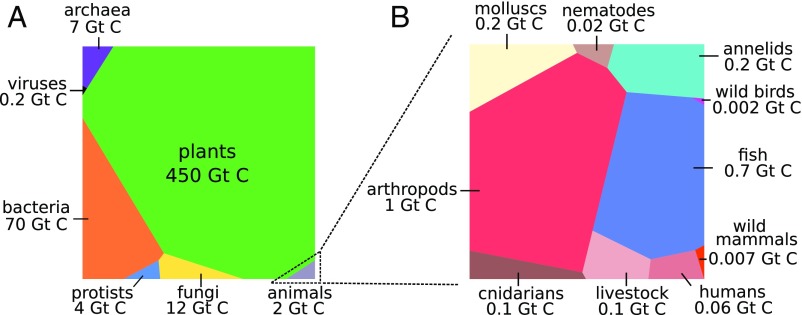
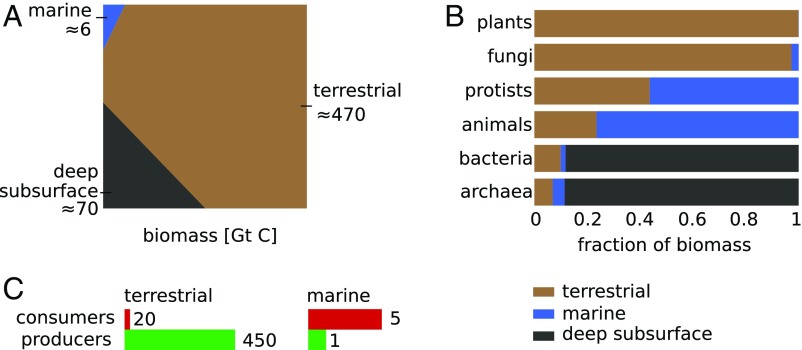
A census of the biomass on Earth is key for understanding the structure and dynamics of the biosphere. However, a global, quantitative view of how the biomass of different taxa compare with one another is still lacking. Here, we assemble the overall biomass composition of the biosphere, establishing a census of the ≈550 gigatons of carbon (Gt C) of biomass distributed among all of the kingdoms of life. We find that the kingdoms of life concentrate at different locations on the planet; plants (≈450 Gt C, the dominant kingdom) are primarily terrestrial, whereas animals (≈2 Gt C) are mainly marine, and bacteria (≈70 Gt C) and archaea (≈7 Gt C) are predominantly located in deep subsurface environments. We show that terrestrial biomass is about two orders of magnitude higher than marine biomass and estimate a total of ≈6 Gt C of marine biota, doubling the previous estimated quantity. Our analysis reveals that the global marine biomass pyramid contains more consumers than producers, thus increasing the scope of previous observations on inverse food pyramids. Finally, we highlight that the mass of humans is an order of magnitude higher than that of all wild mammals combined and report the historical impact of humanity on the global biomass of prominent taxa, including mammals, fish, and plants.
Overview
CoChat Summary
TL;DR
The paper assembles a global census of biomass across all kingdoms of life, estimating Earth’s total biomass at ≈550 Gt C, dominated by plants. It also compares biomass across environments and trophic modes, highlighting large uncertainties and human impacts on the biosphere.
Key findings
- Total global biomass is ≈550 Gt C, with plants ≈450 Gt C (≈80%), bacteria ≈70 Gt C (≈15%), fungi ≈12 Gt C, archaea ≈7 Gt C, protists ≈4 Gt C, animals ≈2 Gt C, and viruses ≈0.2 Gt C.
- Land biomass (≈470 Gt C) is about two orders of magnitude higher than marine biomass (≈6 Gt C); the deep subsurface holds ≈15% of total biomass, chiefly bacteria and archaea.
- In the ocean, ≈1 Gt C of primary producers supports ≈5 Gt C of consumer biomass, an inverted standing biomass distribution; marine biomass is ≈70% microbes, mainly bacteria and protists.
- Human-associated biomass is large relative to wild vertebrates: humans ≈0.06 Gt C, livestock ≈0.1 Gt C, wild mammals ≈0.007 Gt C, domesticated poultry ≈0.005 Gt C versus wild birds ≈0.002 Gt C; total plant biomass has declined approximately twofold relative to pre-human civilization.
Methods
- The authors synthesize hundreds of studies and generate estimates for major taxonomic groups, reporting biomass as gigatons of carbon (Gt C) and using a kingdom-level framework plus viruses.
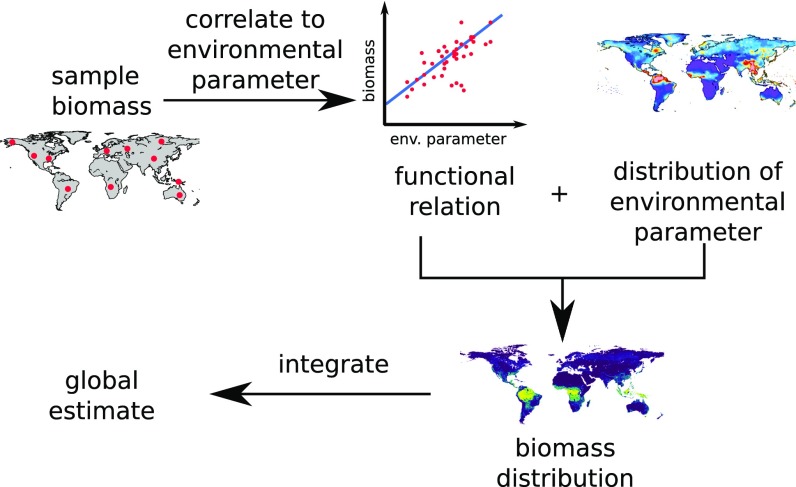
- For many taxa, local biomass samples are extrapolated globally by correlating biomass density with environmental parameters known at global scale; best estimates often use a geometric mean of independent estimates.
- Uncertainty is reported as multiplicative fold-change projections akin to 95% confidence intervals, incorporating intrastudy, interstudy, and intermethod variation; data and code are open-sourced.
Limitations
- The paper states that most datasets rely on fragmentary sampling, causing large uncertainties; sampling is scarce in the deep ocean (usually deeper than 200 m) and deep soil (usually deeper than 1 m), and some estimates may be biased by sampling toward high-abundance areas.
- The paper states that deep subsurface environments have particularly high uncertainty and unknown systematic biases, including unresolved distribution of biomass between aquifer fluids and rocks and among microbial taxa.
- The paper states that current and prehuman vertebrate biomass estimates are only a crude first step, amphibians remain poorly characterized, and parasite biomass is not resolved from hosts; evident from the text, kingdom-level grouping was chosen because much data lack finer taxonomic detail, and some uncertainty projections rely on analogous taxa or expert consultation.
Model-written summary. Check it against the paper before relying on it.
Integrity signals
Registry
Cites
Statistics
Figures
Verification
Claims the paper makes
9 Valid · 7 Not valid · 16 Not checked · 53 Own results and interpretations
Every source the paper cites for this claim was checked and supports it.
In the paper
“The biomass of amphibians, which are experiencing a dramatic population decline (42), remains poorly characterized.”
§ The biomass distribution on Earth > Discussion
What the sources say
- Supportedcites [42] Wake DB Vredenburg VT 2008 Colloquium paper: Are we in the midst of the sixth mass extinction? A view from the world of amphibians Proc Natl Acad Sci USA 105 11466 11473 18695221 PMC2556420 source
The citation is attached to the clause about amphibian population decline, not the separate statement that their biomass is poorly characterized. The passage reporting the Global Amphibian Assessment (labeled Abstract in our copy) says that 43% of amphibian species have declining populations. (LLM, conf=0.92)
plain- Asserted: passes — The authors put it forward as true.
- Checkable: passes — It can be checked against evidence.
- Load-bearing: unclear — It is unclear whether the paper’s conclusions depend on it.
- Based: passes — The paper gives a reason why it holds.
- Supported
Every source the paper cites for this claim was checked and supports it.
In the paper
“In the case of prokaryotes, some major improvements were recently realized, with global estimates of marine deep subsurface prokaryote biomass reduced by about two orders of magnitude due to an increased diversity of sampling locations (7).”
§ The biomass distribution on Earth > Discussion
What the sources say
- Supportedcites [7] Kallmeyer J Pockalny R Adhikari RR Smith DC D’Hondt S 2012 Global distribution of microbial abundance and biomass in subseafloor sediment Proc Natl Acad Sci USA 109 16213 16216 22927371 PMC3479597 source
The Discussion reports a revised subseafloor microbial biomass estimate of 4.1 Pg C versus a previous estimate of 303 Pg C—about a 74-fold reduction. It also identifies a more geographically diverse sampling database, including low-abundance ocean gyres, as a reason the new estimate is lower. The paper identifies other contributing factors as well. (LLM, conf=0.88)
plainstates a cause- Asserted: passes — The authors put it forward as true.
- Checkable: passes — It can be checked against evidence.
- Load-bearing: unclear — It is unclear whether the paper’s conclusions depend on it.
- Based: passes — The paper gives a reason why it holds.
- Supported
The sources with a verdict support this claim; the rest weren’t checked yet, have no full text we could read, or their verdicts aren’t rated yet.
In the paper
“Such inverted biomass distributions can occur when primary producers have a rapid turnover of biomass [on the order of days (34)], while consumer biomass turns over much more slowly [a few years in the case of mesopelagic fish (35)].”
§ The biomass distribution on Earth > Results > The Distribution of Biomass Across Environments and Trophic Modes.
What the sources say
- Supportedcites [34] Zubkov MV 2014 Faster growth of the major prokaryotic versus eukaryotic CO2 fixers in the oligotrophic ocean Nat Commun 5 3776 24777140 PMC4015317 source
The Results (Comparison of the growth rates of the CO2 fixers; page unavailable) report growth rates of 0.1–0.6 per day for the studied oceanic primary producers, consistent with biomass turnover on the order of days. The few-years estimate for mesopelagic fish is assigned to a different citation, not this source. (LLM, conf=0.91)
- Not checked — no full text of the sourcecites [35] Catul V Gauns M Karuppasamy PK 2011 A review on mesopelagic fishes belonging to family Myctophidae Rev Fish Biol Fish 21 339 354 source
plainstates a possible cause- Asserted: passes — The authors put it forward as true.
- Checkable: passes — It can be checked against evidence.
- Load-bearing: passes — The paper’s conclusions depend on it.
- Based: passes — The paper gives a reason why it holds.
- Supported
The cited sources support only part of this claim — read each source’s verdict below.
In the paper
“Combining data from independent sources such as these enables a robust assessment of the total plant biomass (17).”
§ The biomass distribution on Earth > Results > The Uncertainty Associated with Global Biomass Estimates.
What the sources say
- Partly supportedcites [17] Erb K-H 2017 Unexpectedly large impact of forest management and grazing on global vegetation biomass Nature 553 73 76 29258288 PMC5756473 sourceExperimental — accuracy not yet measured
The Methods describe combining multiple datasets and types of evidence to estimate global vegetation biomass stocks. But the paper also says global stocks remain uncertain, reports uncertainty ranges around 35% of the median estimate, and describes more robust estimates as a future prospect. It therefore supports the use of independent sources for an assessment, but not the unqualified characterization of that assessment as robust. (LLM, conf=0.84)
plainstates a cause- Asserted: passes — The authors put it forward as true.
- Checkable: passes — It can be checked against evidence.
- Load-bearing: passes — The paper’s conclusions depend on it.
- Based: passes — The paper gives a reason why it holds.
- Partly supported
A result the paper states — it cites no source for it, so there is none to check. The quote shows it is in the paper.
In the paper
“Plant biomass includes ≈70% stems and tree trunks, which are mostly woody, and thus relatively metabolically inert.”
§ The biomass distribution on Earth > Results > The Biomass Distribution of the Biosphere by Kingdom.
plain- Asserted: passes — The authors put it forward as true.
- Checkable: passes — It can be checked against evidence.
- Load-bearing: unclear — It is unclear whether the paper’s conclusions depend on it.
- Based: passes — The paper gives a reason why it holds.
27 more claims
Create a free account to see all 85 claims and to verify the 2 references still open.
- It may state two separate claims as one. 32
- Probably not a substantial claim. 28
Claims other papers make about this one
Each is checked against this paper’s own text: does it say what the citing paper says it does?
The cited source doesn’t support the claim as written.
In the citing paper
“and less than 10% that of the world ' s current human population ( 52 ).”
From Pervasive human-driven decline of life on Earth points to the need for transformative change (2019) · cites this paper as [52]
Checked by a reasoning model — may be wrong.
Experimental — accuracy not yet measuredThe cited source says what the claim attributes to it.
In the citing paper
“Approximately 450 Gt of C is bound up in terrestrial biota, primarily in plants (86), while only ~6 Gt of C is found in ocean biota (87).”
From Earth beyond six of nine planetary boundaries (2023) · cites this paper as [87]
The cited source says what the claim attributes to it.
In the citing paper
“The amount of metabolic energy available to a biosphere powered by O 2 is vast, such that the O 2 -rich ocean-atmosphere system of the modern Earth supports staggering levels of standing biomass (Bar-On et al. 2018), energy flow (Falkowski et al. 2008), and ecological complexity (Steele 1974).”
From The History of Ocean Oxygenation (2022) · cites this paper as Bar-On et al. 2018
In the citing paper
“Global populations of domestic ruminants (cattle, sheep, and goats) (Ripple et al. 2013) poultry, and pigs (Bennett et al. 2018) used to feed the growing human population now exceed 100 million tons of carbon (Bar-On et al. 2018), and livestock populations are growing rapidly.”
From Scientists’ warning to humanity on the freshwater biodiversity crisis (2021) · cites this paper as Bar-On et al. 2018
Citations
Cites
The worldwide leaf economics spectrum
Wright, I. J., Reich, P. B., Westoby, M., Ackerly, D. D., Baruch, Z., Bongers, F., Cavender-Bares, J., Chapin, T., Cornelissen, J. H. C., Diemer, M., et al. (2004) · Nature · doi:10.1038/nature02403 · Cited by 9,021 · cited 1×
“We then convert the total area of leaves to an estimate of the total dry mass of leaves by using the Glopnet database (24), which measured leaf mass per area (LMA) for ≈2500 plant species.”
MethodA large and persistent carbon sink in the world’s forests
Pan, Y., Birdsey, R. A., Fang, J., Houghton, R., Kauppi, P. E., Kurz, W. A., Phillips, O. L., Shvidenko, A., Lewis, S. L., Canadell, J. G., et al. (2011) · Science · doi:10.1126/science.1201609 · Cited by 8,458
Soil Sampling and Methods of Analysis
(2007) · CRC Press eBooks · doi:10.1201/9781420005271 · Cited by 6,469
Primary production of the biosphere: Integrating terrestrial and oceanic components
Field, C. B., Behrenfeld, M. J., Randerson, J. T., & Falkowski, P. (1998) · Science · doi:10.1126/science.281.5374.237 · Cited by 6,371
Prokaryotes: The unseen majority
Whitman, W. B., Coleman, D. C., & Wiebe, W. J. (1998) · Proceedings of the National Academy of Sciences · doi:10.1073/pnas.95.12.6578 · Cited by 4,871
Global effects of land use on local terrestrial biodiversity
Newbold, T., Hudson, L. N., Hill, S. L. L., Contu, S., Lysenko, I., Senior, R. A., Börger, L., Bennett, D. J., Choimes, A., Collen, B., et al. (2015) · Nature · doi:10.1038/nature14324 · Cited by 4,352
Belowground biodiversity and ecosystem functioning
Bardgett, R. D., & van der Putten, W. H. (2014) · Nature · doi:10.1038/nature13855 · Cited by 3,990 · cited 4×
“This was recommended by experts in the field for estimation of arbuscular mycorrhizal fungi abundance (117).”
BackgroundInfluentialMangroves among the most carbon-rich forests in the tropics
Donato, D. C., Kauffman, J. B., Murdiyarso, D., Kurnianto, S., Stidham, M., & Kanninen, M. (2011) · Nature Geoscience · doi:10.1038/ngeo1123 · Cited by 3,374
Poorter, H., Niklas, K. J., Reich, P. B., Oleksyn, J., Poot, P., & Mommer, L. (2012) · New Phytologist · doi:10.1111/j.1469-8137.2011.03952.x · Cited by 3,163 · cited 1×
“The first relies on a meta-analysis of the biomass allocation to different plant compartments across biomes (19).”
BackgroundA global analysis of root distributions for terrestrial biomes
Jackson, R. B., Canadell, J., Ehleringer, J. R., Mooney, H. A., Sala, O. E., & Schulze, E. D. (1996) · Oecologia · doi:10.1007/bf00333714 · Cited by 3,071 · cited 4×
“assumed the distribution of microbial biomass with depth follows the biomass density versus depth profile of root biomass (21).”
BackgroundMethodInfluential
Research works printed but not linked: 1
- Chapman AD 2009 Numbers of Living Species in Australia and the World Australian Biological Resources Study Canberra, Australia
Cited by
Items 1,001–1,100 of 3,743
Kearns, L. E., Bohaty, S. M., Edgar, K. M., Nogué, S., & Ezard, T. H. G. (2021) · Frontiers in Ecology and Evolution · doi:10.3389/fevo.2021.679722 · Cited by 19
“37% made up by animals (Bar-On et al., 2018), meaning flora is more accessible for research.”
BackgroundEvolution, the Immune System, and the Health Consequences of Socioeconomic Inequality
Rook, G. A. W. (2022) · mSystems · doi:10.1128/msystems.01438-21 · Cited by 25
Martin, W. F., & Allen, J. F. (2018) · Cell · doi:10.1016/j.cell.2018.06.034 · Cited by 23
“Current estimates have it that land plants comprise 80% of the Earth's current biomass (Bar-On et al. 2018), a proportion that may have been reached rapidly soon after plants colonized land, a niche which at first was without competitors.”
Wang, H., Yang, X., Chen, Q., Su, J., Mulla, S. I., Rashid, A., Hu, A., & Yu, C. (2019) · The Science of The Total Environment · doi:10.1016/j.scitotenv.2019.135937 · Cited by 22
Three enzymes governed the rise of O2 on Earth
Mrnjavac, N., Degli Esposti, M., Mizrahi, I., Martin, W. F., & Allen, J. F. (2024) · Biochimica et Biophysica Acta (BBA) - Bioenergetics · doi:10.1016/j.bbabio.2024.149495 · Cited by 18
“Today land plants comprise over 80 % of the total biomass carbon on Earth [110], almost all of that carbon is cellulose.”
BackgroundCamenzind, T., Haslwimmer, H., Rillig, M. C., Rueß, L., Finn, D., Tebbe, C. C., Hempel, S., & Marhan, S. (2024) · Soil Ecology Letters · doi:10.1007/s42832-024-0243-5 · Cited by 23
“Their ratios are discussed as a promising microbial trait to be included in biogeochemical models (He et al., 2021), also because of widely accessible datasets (Bar-On et al., 2018; Crowther et al., 2019; Yu et al., 2022).”
Sinclair, C. A., Garcia, T. S., & Eagles‐Smith, C. A. (2024) · Environmental Science & Technology · doi:10.1021/acs.est.4c05920 · Cited by 23
Lignin-derived thermosets and vitrimers: Bridging the gap between renewable and recyclable materials
Adjaoud, A., Brosse, N., & Verge, P. (2024) · Materials Today Chemistry · doi:10.1016/j.mtchem.2024.102342 · Cited by 21
Teiba, I. I., El-Bilawy, E. H., Abouelsaad, I. A., Shehata, A. I., Alhoshy, M., Habib, Y. J., Abu‐Elala, N. M., El-Khateeb, N. M. M., Belal, E. B., & Hussain, W. A. M. (2024) · Environmental Science and Pollution Research · doi:10.1007/s11356-024-35520-y · Cited by 22
“Marine microorganisms, particularly bacteria, represent one of the most abundant and diverse life forms in ocean ecosys‑ tems, comprising approximately 70% of the total marine bio‑ mass (Bar‑”
Xie, J., Sun, X., Xia, Y., Tao, L., Tan, T., Zhang, N., Xun, W., Zhang, R., Kovács, Á. T., Xu, Z., et al. (2024) · Biofilm · doi:10.1016/j.bioflm.2024.100239 · Cited by 24
EukFunc : A Holistic Eukaryotic Functional Reference for Automated Profiling of Soil Eukaryotes
Lentendu, G., Singer, D., Agatha, S., Bahram, M., Hannula, S. E., Helder, J., Tedersoo, L., Traunspurger, W., Geisen, S., & Lara, E. (2025) · Molecular Ecology Resources · doi:10.1111/1755-0998.14118 · Cited by 26
“Together, these taxa represented ca. 95% of all eukaryotic reads in a study encompassing soils from all of Europe (Köninger et al. 2023), and are supposed to constitute a major part of eukaryotic biomass in soil (Bar-On et al. 2018).”
Lv, S., Wu, Z., Yang, J., Zhao, W., Gao, A., Gao, W., Yu, Y., & Zhang, S. (2025) · Renewable and Sustainable Energy Reviews · doi:10.1016/j.rser.2025.116480 · Cited by 26
The role of maize cultivation on European hare abundance
Mayer, M., & Sunde, P. (2020) · Agriculture Ecosystems & Environment · doi:10.1016/j.agee.2020.106909 · Cited by 20
A Matter of Life and Death: Alternative Stable States in Trees, From Xylem to Ecosystems
Hammond, W. M. (2020) · Frontiers in Forests and Global Change · doi:10.3389/ffgc.2020.560409 · Cited by 20
“This extensive secondary woody tissue functions in mechanical support—responsible for trees being the tallest, and also the largest (by volume) organisms on the planet (Hacke and Sperry, 2015), leading to their dominance in global estimates of biomass (Bar-On et al., 2018).”
BackgroundHydrodynamics and direction change of tumbling bacteria
Dvoriashyna, M., & Lauga, E. (2021) · PLoS ONE · doi:10.1371/journal.pone.0254551 · Cited by 18
“Many of us are surprised at first when we realise that bacteria represent the major component of the world’s biomass [1].”
BackgroundDeclining fungal diversity in Arctic freshwaters along a permafrost thaw gradient
Kluge, M., Wauthy, M., Clemmensen, K. E., Wurzbacher, C., Hawkes, J. A., Einarsdóttir, K., Rautio, M., Stenlid, J., & Peura, S. (2021) · Global Change Biology · doi:10.1111/gcb.15852 · Cited by 22
“…about the fungi in aquatic environments is sparse, global estimates suggest that the amount of carbon cycled via fungi is as large as the amount cycled through the bacteria (Bar-On et al., 2018), highlighting the urgency to study the fungal communities and their interactions with the environment.”
Rademacher, T., Seyednasrollah, B., Basler, D., Cheng, J., Mandra, T., Miller, E. W., Lin, Z., Orwig, D. A., Pederson, N., Pfister, H., et al. (2021) · Methods in Ecology and Evolution · doi:10.1111/2041-210x.13717 · Cited by 18
Logistic model outperforms allometric regression to estimate biomass of xerophytic shrubs
Ma, J., Yuan, C., Zhou, J., Li, Y., Gao, G., & Fu, B. (2021) · Ecological Indicators · doi:10.1016/j.ecolind.2021.108278 · Cited by 20
dos Santos, J. D. N., João, S. A., Martín, J., Vicente, F., Reyes, F., & Lage, O. M. (2022) · Microorganisms · doi:10.3390/microorganisms10071471 · Cited by 21
“3 gigatons of carbon [2] and are thought to have a higher diversity than all the organisms existing in tropical rainforests [5].”
BackgroundBracke, M. B. M., Boumans, I. J. M. M., Nijland, H. J., & Bokkers, E. A. M. (2022) · animal · doi:10.1016/j.animal.2022.100694 · Cited by 28
Xylan glucuronic acid side chains fix suberin‐like aliphatic compounds to wood cell walls
Derba‐Maceluch, M., Mitra, M., Hedenström, M., Liu, X., Gandla, M. L., Barbut, F. R., Abreu, I. N., Donev, E. N., Urbancsok, J., Möritz, T., et al. (2023) · New Phytologist · doi:10.1111/nph.18712 · Cited by 18
The smallest in the deepest: the enigmatic role of viruses in the deep biosphere
Cai, L., Weinbauer, M. G., Xie, L., & Zhang, R. (2023) · National Science Review · doi:10.1093/nsr/nwad009 · Cited by 20
“According to themost recent census, the deep biosphere hosts an estimated >7 × 1030 viruses, rivalling the estimated totals in aquatic systems, shallow sediments, and soil [19,20].”
BackgroundInfluentialLiao, H., Zhong, L., Deng, Y., Chen, H., Liao, G., Xiao, Y., Cheng, B., & Lei, S. (2023) · Applied Surface Science · doi:10.1016/j.apsusc.2023.157010 · Cited by 19
Experimental warming leads to convergent succession of grassland archaeal community
Zhang, Y., Ning, D., Wu, L., Yuan, M., Zhou, X., Guo, X. Y., Hu, Y., Jian, S., Yang, Z., Han, S., et al. (2023) · Nature Climate Change · doi:10.1038/s41558-023-01664-x · Cited by 18
García‐Moreno, J. (2023) · BioScience · doi:10.1093/biosci/biad074 · Cited by 24
“At the same time, the human population and that of domestic animals have exploded, to the point that the biomass of people and livestock combined outweigh that of all terrestrial vertebrates (Bar-On et al. 2018 ).”
BackgroundHomo heterogenus: Variability in early Pleistocene Homo environments
Foister, T. I. F., Žliobaitė, I., Wilson, O. E., Fortelius, M., & Tallavaara, M. (2023) · Evolutionary Anthropology Issues News and Reviews · doi:10.1002/evan.22005 · Cited by 21
Qiu, M., Liu, Y., Tian, F., Wang, S., & Fu, B. (2024) · The Science of The Total Environment · doi:10.1016/j.scitotenv.2024.174377 · Cited by 20
‘Valuing Life Itself’: On Radical Environmental Activists’ Post-Anthropocentric Worldviews
Alberro, H. (2020) · Environmental Values · doi:10.3197/096327120x15752810324093 · Cited by 29
“Others have documented a twofold decline in plant biomass – through deforestation, largely in the interests of large-scale agriculture and timber extraction – since the start of human civilisation (Bar-On et al. 2018, 3).”
BackgroundOliver, G. C., Cario, A., & Rogers, K. L. (2020) · Frontiers in Microbiology · doi:10.3389/fmicb.2020.01023 · Cited by 20
“Finally, as a majority of bacterial and archaeal cells inhabit high-pressure environments (e.g., Whitman et al., 1998; Jebbar et al., 2015; Bar-On et al., 2018), further HHP batch cultivation performed on other extremophiles is necessary to expand our understanding of how microorganisms regulate…”
BackgroundGabriel, A. W., Madelrieux, S., & Lescoat, P. (2020) · Ecological Economics · doi:10.1016/j.ecolecon.2020.106765 · Cited by 28
Makarieva, A. M., Nefiodov, A. V., & Li, B.-L. (2020) · Entropy · doi:10.3390/e22091025 · Cited by 20
“6 In columns 6 and 7, energy consumption of plant biomass is considered with energy content K = 4× 10⁶ J kg−1 and global store of the order of 1015 kg [46] assuming most land ecosystems are disturbed; fires consume 2 GtC yr−1 [47], which constitutes 4% of primary productivity on land 56 GtC yr−1 [48] (7× 10¹³ W), whic…”
BackgroundInfluentialA global class reunion with multiple groups feasting on the declining insect smorgasbord
Vesterinen, E. J., Kaunisto, K., & Lilley, T. M. (2020) · Scientific Reports · doi:10.1038/s41598-020-73609-9 · Cited by 19
Quantifying Contemporary Organic Carbon Stocks of the Baltic Sea Ecosystem
Scheffold, M. I. E., & Hense, I. (2020) · Frontiers in Marine Science · doi:10.3389/fmars.2020.571956 · Cited by 21
Sörenson, E., Capo, É., Farnelid, H., Lindehoff, E., & Legrand, C. (2021) · Frontiers in Microbiology · doi:10.3389/fmicb.2021.607601 · Cited by 22
Wei, F., Ito, K., Sakata, K., Asakura, T., Date, Y., & Kikuchi, J. (2021) · Scientific Reports · doi:10.1038/s41598-021-83194-0 · Cited by 19
Wale, M., & Yesuf, S. (2021) · International Journal of Tropical Insect Science · doi:10.1007/s42690-021-00600-w · Cited by 29
“Not only does the species richness of arthropods vastly exceed that of vascular plants and vertebrates put together, the genetic diversity is several orders of magnitude higher (shorter generation time) and the biomass of arthropods alone within natural ecosystems exceeds that of vertebrates (Bar-on et al. 2018).”
BackgroundWells, H. B. M., Porensky, L. M., Veblen, K. E., Riginos, C., Stringer, L. C., Dougill, A. J., Namoni, M., Ekadeli, J., & Young, T. P. (2022) · Ecological Applications · doi:10.1002/eap.2520 · Cited by 17
“Cattle and other livestock graze more than a quarter of the Earth’s land surface (Steinfeld et al., 2006) and are estimated to comprise >90% of the world’s non-human mammalian biomass (Bar-On et al., 2018).”
BackgroundZhang, G., Wei, F., Chen, Z., Wang, Y., Jiao, S., Yang, J., Chen, Y., Liu, C., Huang, Z. L., Dong, L., et al. (2022) · The Science of The Total Environment · doi:10.1016/j.scitotenv.2022.154583 · Cited by 20
Managing Wildlife in a Changing World
Kideghesho, J. R. (2020) · IntechOpen eBooks · doi:10.5772/intechopen.81141 · Cited by 18
Why panmictic bacteria are rarePreprint
Yang, C., Cui, Y., Didelot, X., Yang, R., & Falush, D. (2018) · bioRxiv (Cold Spring Harbor Laboratory) · doi:10.1101/385336 · Cited by 18
Elements of a Planetary Emergency: Environment of Peace (Part 1)
Smith, D. J. B., Bell, N., Faller, J., Galaz, V., Norström, A. V., Pattison, C., & Queiroz, C. (2022) · doi:10.55163/mdeb4357 · Cited by 20
“Recent estimates suggest that in terms of biomass, 60 per cent of all mammals living on the planet are livestock, 36 per cent are humans and only 4 per cent are wild species (BarOn et al. 2018).”
BackgroundHsieh, S., Plotnick, R. E., & Bush, A. M. (2022) · Paleobiology · doi:10.1017/pab.2021.46 · Cited by 18
“In the present day, the preponderance of theworld’s animal biomass is estimated to be in arthropods (though nematodes lead by numerical abundance; Bar-On et al. 2018; Van Den Hoogen et al. 2019).”
BackgroundInfluentialPerspectives in modelling ecological interaction networks for sustainable ecosystem management
Quévreux, P., Brose, U., Galiana, N., Potapov, A., Thébault, É., Travers‐Trolet, M., Wollrab, S., & Jabot, F. (2024) · Journal of Applied Ecology · doi:10.1111/1365-2664.14584 · Cited by 22
Saleem, S., Rather, J. A., Ahmed, S., Mushtaq, S., Ahmed, R., & Malik, I. H. (2024) · Rangeland Ecology & Management · doi:10.1016/j.rama.2024.06.001 · Cited by 19
The plant ecology of nature‐based solutions for people, biodiversity and climate
Buckley, Y. M., Austin, A. T., Bardgett, R. D., Catford, J. A., Hector, A., Iler, A. M., & Mariotte, P. (2024) · Journal of Ecology · doi:10.1111/1365-2745.14441 · Cited by 24
“However, as the primary producers in ecosystems and the dominant life form on earth (Bar-On et al., 2018 ), plants lie at the heart of NbS, and plant ecology, by extension, lies at the heart of understanding how and why NbS work. general challenges and opportunities that, we hope, will lead to new…”
Kowalczyk, D., Kazimierczak, W., Zięba, E., Lis, M., & Wawrzkiewicz, M. (2024) · Molecules · doi:10.3390/molecules29245998 · Cited by 22
Global estimates of the storage and transit time of water through vegetation
Felton, A. J., Fisher, J. B., Hufkens, K., Purdy, A. J., Spawn, S., Duloisy, L. F., & Goldsmith, G. R. (2025) · Nature Water · doi:10.1038/s44221-024-00365-9 · Cited by 26
Microbial ecology of serpentinite-hosted ecosystems
Colman, D. R., Templeton, A. S., Spear, J. R., & Boyd, E. S. (2025) · The ISME Journal · doi:10.1093/ismejo/wraf029 · Cited by 24
“The discovery of serpentinizing systems as microbial habitats coincided with a renewed interest in subsurface environments as globally significant reservoirs of microbial diversity and biomass [28–30].”
Genetic engineering in diatoms: advances and prospects
Li, Y., Deng, L., Walker, E. J. L., Karas, B. J., & Möck, T. (2025) · The Plant Journal · doi:10.1111/tpj.70102 · Cited by 20
“With only about 0.1% of the total global plant biomass, diatoms contribute over 20% of the world’s primary productivity (Bar-On et al., 2018; Leblanc et al., 2012; Malviya et al., 2016).”
InfluentialSmall snails, high productivity? Larval output of parasites from an abundant host
Rosenkranz, M., Lagrue, C., Poulin, R., et al. (2018) · Freshwater Biology · doi:10.1111/fwb.13189 · Cited by 17
Browsers and Grazers Drive the Dynamics of Ecosystems
Gordon, I. J., & Prins, H. H. T. (2019) · Ecological studies · doi:10.1007/978-3-030-25865-8_16 · Cited by 20
Peters, R. L., von Arx, G., Nievergelt, D., Ibrom, A., Stillhard, J., Trotsiuk, V., Mazurkiewicz, A., & Babst, F. (2020) · Tree Physiology · doi:10.1093/treephys/tpaa002 · Cited by 17
“Plants dominate the global biomass within the biosphere (Bar-On et al. 2018), with forests being particularly effective in sequestering and storing atmospheric carbon (Pan et al.”
BackgroundPatterns of virus growth across the diversity of life
Jin, T., & Yin, J. (2021) · Integrative Biology · doi:10.1093/intbio/zyab001 · Cited by 16
Yan, B., Rabbani, G., Lee, N. H. S., et al. (2021) · Aquatic Microbial Ecology · doi:10.3354/ame01976 · Cited by 17
Carbon cycle in tropical peatlands and coastal seas
Rixen, T., Wit, F., Hutahaean, A. A., Schlüter, A., Baum, A., Klemme, A., Müller, M., Pranowo, W. S., Samiaji, J., & Warneke, T. (2021) · Elsevier eBooks · doi:10.1016/b978-0-12-815050-4.00011-0 · Cited by 25
Reinke, H., König, H. J., Keuling, O., Kuemmerle, T., & Kiffner, C. (2021) · Ecology and Evolution · doi:10.1002/ece3.8347 · Cited by 20
Transformation Literacy: Pathways to Regenerative Civilizations
Künkel, P., & Ragnarsdottir, K. V. (2022) · Springer eBooks · doi:10.1007/978-3-030-93254-1 · Cited by 43
Plant Seeds Commonly Host Bacillus spp., Potential Antagonists of Phytopathogens
Newcombe, G., Marlin, M., Barge, E. G., Heitmann, S. J., Ridout, M. E., & Busby, P. E. (2022) · Microbial Ecology · doi:10.1007/s00248-022-02024-6 · Cited by 18
“Seeds are the means of reproduction for most land plants, and land plants comprise more than 80% of living biomass on Earth [1].”
BackgroundHigh-Pressure Microfluidics for Ultra-Fast Microbial Phenotyping
Cario, A., Larzillière, M., Nguyen, O., Alain, K., & Marre, S. (2022) · Frontiers in Microbiology · doi:10.3389/fmicb.2022.866681 · Cited by 17
Thermal sensitivity and seasonal change in the gut microbiome of a desert ant, Cephalotes rohweri
McMunn, M. S., Hudson, A. I., Zemenick, A. T., Egerer, M., Bennett, L., Philpott, S. M., & Vannette, R. L. (2022) · FEMS Microbiology Ecology · doi:10.1093/femsec/fiac062 · Cited by 19
Optimizing fisheries for blue carbon management: Why size matters
Falciani, J. E., Grigoratou, M., & Pershing, A. J. (2022) · Limnology and Oceanography · doi:10.1002/lno.12249 · Cited by 21
Digital suffering: why it’s a problem and how to prevent it
Saad, B., & Bradley, A. J. (2022) · Inquiry · doi:10.1080/0020174x.2022.2144442 · Cited by 39
Burks, G., Yao, L., Kalutantirige, F. C., Gray, K. J., Bello, E., Rajagopalan, S., Bialik, S. B., Barrick, J. E., Alleyne, M., Chen, Q., et al. (2022) · Biomacromolecules · doi:10.1021/acs.biomac.2c01035 · Cited by 17
Leaves are a Source of Biogenic Persistent Free Radicals
Vejerano, E. P., & Ahn, J. (2023) · Environmental Science & Technology Letters · doi:10.1021/acs.estlett.3c00277 · Cited by 16
Liu, X., Zhang, S., Wang, M., & Wang, J. (2023) · Chinese Chemical Letters · doi:10.1016/j.cclet.2023.108723 · Cited by 25
Adinugroho, W. C., Krisnawati, H., Imanuddin, R., Siregar, C. A., Weston, C. J., & Volkova, L. (2023) · Trees Forests and People · doi:10.1016/j.tfp.2023.100425 · Cited by 23
Overcoming plant blindness: are the future teachers ready?
Bobo‐Pinilla, J., Marcos-Walias, J., Iglesias, J. D., & Reinoso, R. (2023) · Journal of Biological Education · doi:10.1080/00219266.2023.2255197 · Cited by 35
“…plants are the main factor of environmental sustainability (Cardinale et al. 2012; Thorogood 2020), they accumulate 80% of the planet’s biomass (Bar-On, Phillips, and Milo 2018) and play an essential role in mitigating the effects of climate change, among other things, by regulating the…”
Momper, L., Casar, C. P., & Osburn, M. R. (2023) · Environmental Microbiology · doi:10.1111/1462-2920.16543 · Cited by 25
Iron coatings on carbonate rocks shape the attached bacterial aquifer community
Sharma, A., Taubert, M., Pérez-Carrascal, O. M., Lehmann, R. G., Ritschel, T., Totsche, K. U., Lazar, C. S., & Küsel, K. (2024) · The Science of The Total Environment · doi:10.1016/j.scitotenv.2024.170384 · Cited by 18
Parmar, D. S., Rosado-Rosa, J. M., Shrout, J. D., & Sweedler, J. V. (2024) · Methods · doi:10.1016/j.ymeth.2024.01.014 · Cited by 22
“Bacteria have evolved to thrive in nearly all environments on this planet and account for over three-quarters of all species of life on Earth and a significant portion of biomass by taxa [1].”
BackgroundSánchez-Ruiz, M. I., Santillana, E., Linde, D., Romero, A., Martínez, Á. T., & Ruiz-Dueñas, F. J. (2024) · Biotechnology for Biofuels and Bioproducts · doi:10.1186/s13068-024-02517-1 · Cited by 20
“Plant biomass constitutes the most abundant organic carbon source in land ecosystems [1].”
BackgroundEvolving circuitries in plant signaling cascades
Zegers, J. M. S., Irisarri, I., de Vries, S., & de Vries, J. (2024) · Journal of Cell Science · doi:10.1242/jcs.261712 · Cited by 19
Duckweed Evolution: from Land back to Water
Fang, Y., Tian, X., Jin, Y., Du, A., Ding, Y., Liao, Z., He, K., Zhao, Y., Guo, L., Xiao, Y., et al. (2025) · Genomics Proteomics & Bioinformatics · doi:10.1093/gpbjnl/qzaf074 · Cited by 21
“Meanwhile, land plants account for 82% of the total biomass in the biosphere [7].”
The palaeontological record of the Anthropocene
Williams, M., Zalasiewicz, J., Waters, C. N., Himson, S. J., Summerhayes, C. P., Barnosky, A. D., & Leinfelder, R. (2018) · Geology Today · doi:10.1111/gto.12246 · Cited by 17
Getting to baselines for human nature, development, and wellbeing.
Narvaez, D. F., & Witherington, D. C. (2018) · Archives of Scientific Psychology · doi:10.1037/arc0000053 · Cited by 19
Schoeman, A. L., Kruger, N., Secondi, J., & du Preez, L. H. (2018) · Biological Invasions · doi:10.1007/s10530-018-1902-1 · Cited by 20
“In the Anthropocene, the world’s biota is experiencing modification at unprecedented rates (Bar-On et al. 2018; Ceballos et al. 2017).”
BackgroundSustainability: A flawed concept for fisheries management?
Stafford, R. (2019) · Elementa Science of the Anthropocene · doi:10.1525/elementa.346 · Cited by 25
“In a recent study, the amount of respiring biomass in the oceans has been estimated at five times that of photosynthetic biomass, with fish making up ~35% of the animal biomass in the ocean (Bar-On et al., 2018).”
BackgroundInfluentialRole of the ocean in climate stabilization
Scott-Buechler, C. M., & Greene, C. H. (2019) · Elsevier eBooks · doi:10.1016/b978-0-12-816229-3.00006-5 · Cited by 20
Towards a physically motivated planetary accounting framework
Barbosa, M., Bertolami, O., & Francisco, F. (2020) · The Anthropocene Review · doi:10.1177/2053019620909659 · Cited by 28
“Estimates indicate that the amount of living biomass has dropped from 750 × 1012 kg in 1800, to 660 × 1012 kg in 1900, and to 550 × 1012 kg in 2000 [13, 14].”
BackgroundGuerrero, L. C., Silva-Mendoza, J., Toxqui-Terán, A., Vega-Becerra, O. E., Salinas-Montelongo, J. A., & Pérez‐Camacho, O. (2020) · Carbohydrate Polymers · doi:10.1016/j.carbpol.2020.117463 · Cited by 20
Crustaceans in a changing world
Wacker, A., & Harzsch, S. (2021) · Zoology · doi:10.1016/j.zool.2021.125921 · Cited by 21
Lozano, C., Lee, C., Wattiez, R., Lebaron, P., & Surget, S. M. (2021) · The Science of The Total Environment · doi:10.1016/j.scitotenv.2021.148431 · Cited by 20
“Marine bacteria prevail in the biomass 15 and the support of major functions in marine ecosystems 16 .”
Managing host-parasite interactions in humans and wildlife in times of global change
Wells, K., & Flynn, R. J. (2022) · Parasitology Research · doi:10.1007/s00436-022-07649-7 · Cited by 28
Jones, S. K., Monjeau, A. J., Pérez-Guzmán, K., & Harrison, P. A. (2023) · Sustainability Science · doi:10.1007/s11625-023-01290-8 · Cited by 27
Prăvălie, R., Niculiță, M., Roșca, B., Patriche, C. V., Dumitrașcu, M., Marin, G., Niță, I.-A., Bandoc, G., & Birsan, M. (2023) · Stochastic Environmental Research and Risk Assessment · doi:10.1007/s00477-022-02359-z · Cited by 19
“The Earth’s vegetation biomass is critical in the global carbon cycle and in controlling climate change, storing 450–650 Pg C (petagrams or billion tonnes of carbon) (Bar-On et al. 2018; Erb et al. 2018; Lal 2018; Friedling-stein et al. 2020).”
BackgroundPaleozoic diversification of terrestrial chitin-degrading bacterial lineages
Gruen, D. S., Wolfe, J. M., & Fournier, G. P. (2019) · BMC Evolutionary Biology · doi:10.1186/s12862-019-1357-8 · Cited by 20
“While global estimates for the contribution of arthropod biomass, and thus chitin, to the environment over time are lacking, arthropods nonetheless make up the largest pool of animal biomass today [21].”
BackgroundForest Carbon Stock and Fluxes: Distribution, Biogeochemical Cycles, and Measurement Techniques
Mukul, S. A., Halim, M. A., & Herbohn, J. (2020) · Encyclopedia of the UN sustainable development goals · doi:10.1007/978-3-319-71065-5_23-1 · Cited by 34
Erb, T. J. (2023) · Cold Spring Harbor Perspectives in Biology · doi:10.1101/cshperspect.a041669 · Cited by 22
Waters, C. N., Turner, S. D., An, Z., Barnosky, A. D., Cearreta, A., Cundy, A. B., Fairchild, I. J., Fiałkiewicz-Kozieł, B., Gałuszka, A., Grinevald, J., et al. (2024) · EarthArXiv (California Digital Library) · doi:10.31223/x5mq3c · Cited by 29
Nutrient retention by predators undermines predator coexistence on one prey
Klauschies, T., & Gaedke, U. (2020) · Theoretical Ecology · doi:10.1007/s12080-019-00440-y · Cited by 16
Biomass allocation and carbon storage in the major cereal crops: A meta‐analysis
Ngidi, A., Shimelis, H., Chaplot, V. A. M., Shamuyarira, K. W., & Figlan, S. (2024) · Crop Science · doi:10.1002/csc2.21294 · Cited by 16
Sarma, S., Thakur, N., Varshney, N., Jha, H. C., & Sarma, T. K. (2024) · Communications Chemistry · doi:10.1038/s42004-024-01353-6 · Cited by 23
Wei, K., Sun, Y., Cartmill, A. D., López, I. F., Ma, C., & Zhang, Q. (2025) · Industrial Crops and Products · doi:10.1016/j.indcrop.2025.120776 · Cited by 19
Delineating the technosphere: definition, categorization, and characteristics
Galbraith, E. D., Faisal, A.-A., Matitia, T., Fajzel, W., Hatton, I. A., Haberl, H., Krausmann, F., & Wiedenhofer, D. (2025) · Earth System Dynamics · doi:10.5194/esd-16-979-2025 · Cited by 26
Hsieh, J. A., Liou, P., Lin, C.-C., Dai, X., Hu, C.-W., Wang, I.-F., Dang, J.-F., Ho, Y.-C., Cheng, K., Xu, W., et al. (2025) · Developmental Cell · doi:10.1016/j.devcel.2025.06.038 · Cited by 28
Wang, Q., Liu, Y.-F., Wu, X., Zhou, L., Yang, S., Meckenstock, R. U., Gu, J., & Mu, B. (2025) · Environmental Science & Technology · doi:10.1021/acs.est.5c02983 · Cited by 23
Human-animal relations in the capitalocene: environmental impacts and alternatives
Stuart, D., & Gunderson, R. (2019) · Environmental Sociology · doi:10.1080/23251042.2019.1666784 · Cited by 27
“In terms of percentages of total mammal biomass, humans account for 36 percent, domesticated livestock for 60 percent, and wild mammals account for 4 percent (Bar-On, Phillips, and Milo 2018).”
BackgroundMethodInfluentialTariq, M., Newberry, F., Haagmans, R., Booth, C., Wileman, T., Hoyles, L., Clokie, M. R. J., Ebdon, J., & Carding, S. R. (2020) · Frontiers in Microbiology · doi:10.3389/fmicb.2020.583378 · Cited by 17
“They are estimated to be numerically the most abundant biological entity on earth numbering at least 1031 (Hendrix et al., 1999; Bar-On et al., 2018).”
BackgroundSultana, S. N., Park, H., Choi, S. H., et al. (2021) · Plants · doi:10.3390/plants10122714 · Cited by 16
“Approximately 310,000 plant species grow in various regions worldwide, accounting for nearly 80% of the world’s biomass [1,2].”
BackgroundJoye, S. B., Bowles, M. W., & Ziervogel, K. (2022) · The microbiomes of humans, animals, plants, and the environment · doi:10.1007/978-3-030-90383-1_15 · Cited by 26
Metadata
- Authors
- Bar-On, Y. M., Phillips, R., & Milo, R.
- Affiliations
- Department of Plant and Environmental Sciences, Weizmann Institute of Science, 76100 Rehovot, Israel;
- California Institute of Technology (US)
- Weizmann Institute of Science (IL)
- Corresponding author
- Milo, Ron
- Venue
- Proceedings of the National Academy of Sciences
- Publisher
- National Academy of Sciences
- Published
- 2018-05-21
- Volume
- 115
- Issue
- 25
- Pages
- 6506-6511
- ISSN
- 0027-8424 (ISSN-L)
- 1091-6490
- PMC
- PMC6016768
- OpenAlex
- W2804910112
- Cited by
- 3,723
- References
- 263
- Citations by year
- 2026: 349 · 2025: 450 · 2024: 589 · 2023: 617 · 2022: 498 · 2021: 498 · 2020: 419 · 2019: 246 · 2018: 49
- FWCI
- 239.98
- Type
- journal article
- Language
- en
- Open access
- hybrid
- doi.org
- Licence
- Locations
- Proceedings of the National Academy of Sciences (publishedVersion, cc-by-nc-nd)
- Europe PMC (PubMed Central) (publishedVersion, cc-by-nc-nd)
- PubMed Central (publishedVersion, cc-by-nc-nd)
- PubMed (publishedVersion)
- CaltechAUTHORS (California Institute of Technology) (submittedVersion, cc-by-nc-nd)
- Funders
- National Institutes of Health (5r35gm118043-07)
- National Institute of General Medical Sciences (R35 GM118043)
- Topics
- Physical Sciences › Environmental Science › Nature and Landscape Conservation › Ecology and Vegetation Dynamics Studies
- Physical Sciences › Environmental Science › Global and Planetary Change › Earth Systems and Cosmic Evolution
- Life Sciences › Agricultural and Biological Sciences › Soil Science › Soil Carbon and Nitrogen Dynamics
- Keywords
- biomass allocation, biomass carbon, terrestrial biomass, marine biomass, bacteria, archaea, food pyramid, wild mammals, fish biomass, plant biomass
- MeSH terms
- Animals, Archaea, Bacteria, Carbon, Humans, Plants, Ecosystem, Biomass, Earth, Planet, Biota
About these checks
Registry, retraction, Cites and statistics results are computed, not judged, with one exception: a printed reference that no index lists is read once by a model before it counts as a citation error. Claims are extracted by a model and kept only when their quote appears verbatim in the text; each cited source is then checked, with a model’s help, for whether it says what the claim relies on. Those verdicts can be wrong — read the claim’s quote and the cited source before relying on one.
The claim verdicts this report counts are experimental: their accuracy is not yet measured.
A language model drew the claims from the paper on 2026-10-10, under version 3 of the claim definition (model deepseek-v4.1-flash, prompt extract-v3).
A second model labelled each claim on 2026-10-10 (model jev-1.13-20260917, definition revision gold-guideline-v0.2).
Cited sources are checked with a language model’s help (gpt-6-sol).
Statistics and arithmetic are recomputed, not judged.
Confidence bands are shown only for fields calibrated on our annotated test set. None is calibrated yet, so no band is shown.
What counts as a claim ›How we measure confidence ›How we check this ›
Are you an author, or do you see a problem with this page? Request a review
Data sources
Bibliographic data: Semantic Scholar, OpenAlex, Crossref.
Contains information from the Semantic Scholar Academic Graph Datasets, made available under the ODC Attribution License (ODC-BY 1.0).
Semantic Scholar’s data is described in: Kinney, R., et al. (2023). The Semantic Scholar Open Data Platform. arXiv:2301.10140.
