

Active learning narrows achievement gaps for underrepresented students in undergraduate science, technology, engineering, and math
Open accessThe DOI matches its Crossref record; 72 of the 75 references it cites were found in a registry or an index, and 3 are not checked yet; 19 of the 44 sources its claims cite were checked for support.
Abstract
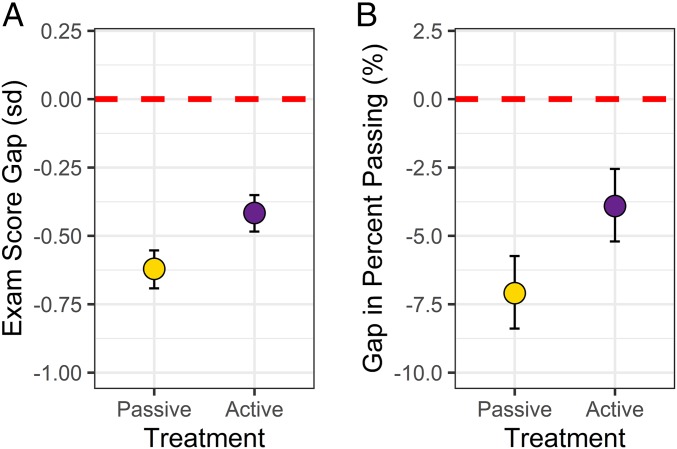
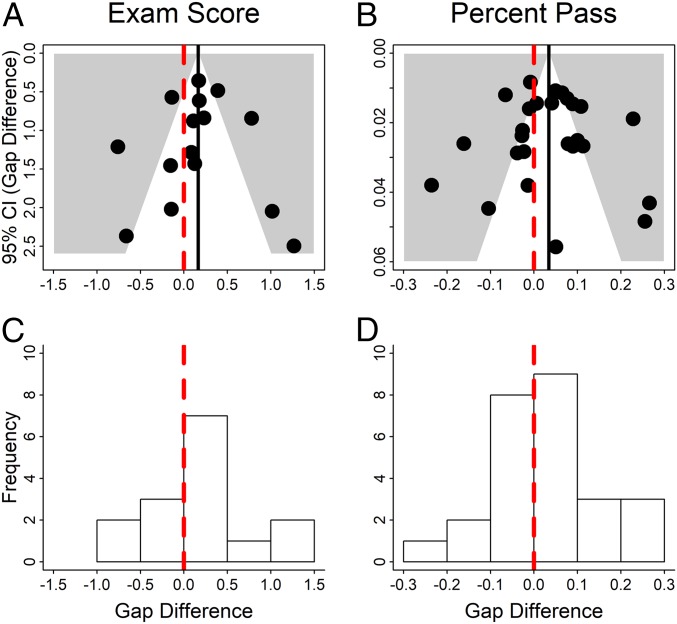
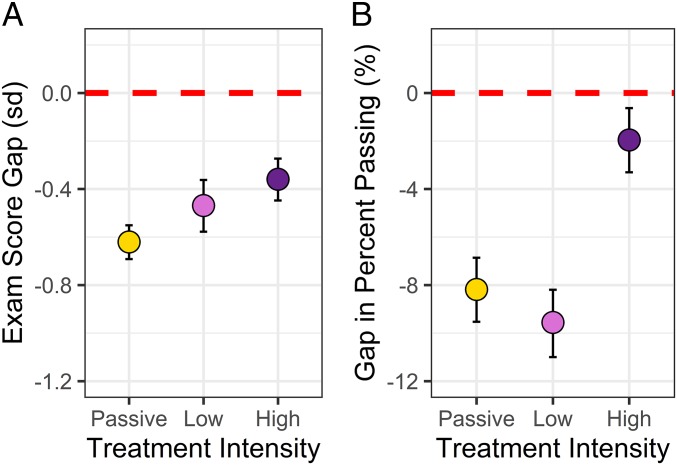
We tested the hypothesis that underrepresented students in active-learning classrooms experience narrower achievement gaps than underrepresented students in traditional lecturing classrooms, averaged across all science, technology, engineering, and mathematics (STEM) fields and courses. We conducted a comprehensive search for both published and unpublished studies that compared the performance of underrepresented students to their overrepresented classmates in active-learning and traditional-lecturing treatments. This search resulted in data on student examination scores from 15 studies (9,238 total students) and data on student failure rates from 26 studies (44,606 total students). Bayesian regression analyses showed that on average, active learning reduced achievement gaps in examination scores by 33% and narrowed gaps in passing rates by 45%. The reported proportion of time that students spend on in-class activities was important, as only classes that implemented high-intensity active learning narrowed achievement gaps. Sensitivity analyses showed that the conclusions are robust to sampling bias and other issues. To explain the extensive variation in efficacy observed among studies, we propose the heads-and-hearts hypothesis, which holds that meaningful reductions in achievement gaps only occur when course designs combine deliberate practice with inclusive teaching. Our results support calls to replace traditional lecturing with evidence-based, active-learning course designs across the STEM disciplines and suggest that innovations in instructional strategies can increase equity in higher education.
Verified 2026-11-22 · 3 references not checked yet
Overview
CoChat Summary
TL;DR
This systematic review and individual-participant-data meta-analysis found that active learning reduced achievement gaps for underrepresented/minoritized students in undergraduate STEM courses. Across the analyzed studies, gaps in exam scores and passing rates were smaller in active-learning than in traditional lecturing, with the largest gap reductions seen in high-intensity active learning.
Key findings
- In identical or formally equivalent exams, the standardized achievement gap between MGS and non-MGS students was −0.62 SDs in traditional lecturing and −0.42 SDs with active learning, a 33% reduction in the gap.
- For passing rates, the gap was −7.1% with traditional lecturing and −3.9% with active learning, a 45% reduction in the gap.
- Gap reductions were stronger with high-intensity active learning: exam-score gaps were −0.48 SDs for low-intensity vs −0.36 SDs for high-intensity; passing-rate gaps were −9.6% for low-intensity vs −2.0% for high-intensity.
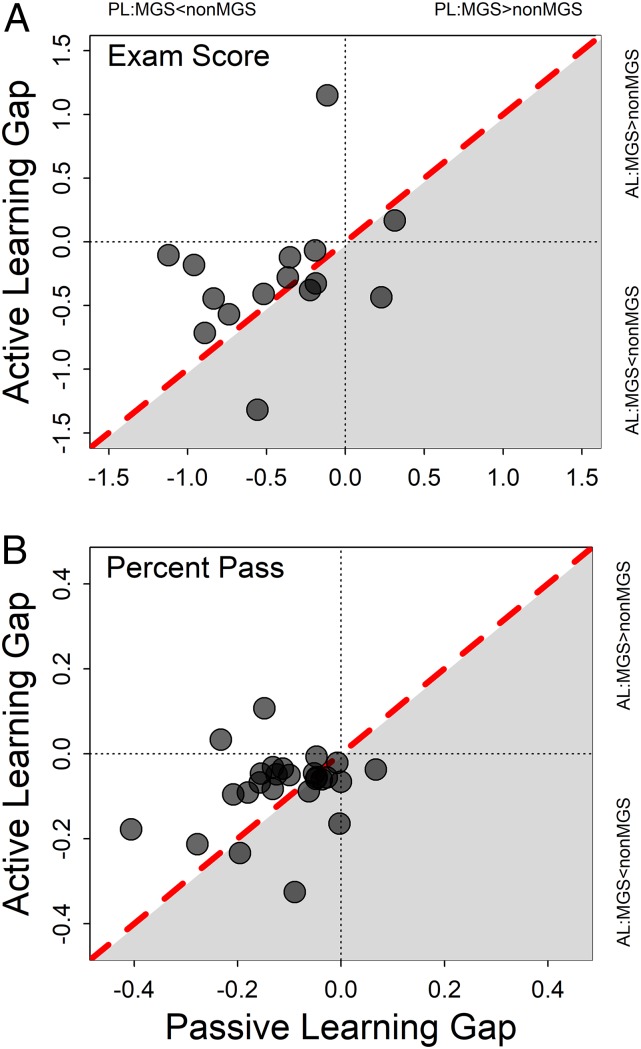
- In the study-level breakdown, 10 of 15 studies with exam-score data showed disproportionate gains for MGS students under active learning, and 15 of 26 studies with failure-rate data showed disproportionate reductions in failure rates for MGS students.
Methods
- Systematic review plus individual-participant-data (IPD) meta-analysis comparing undergraduate STEM courses taught with traditional lecturing vs active learning in the same course and institution.
- Literature search covered studies published or completed from January 1, 2010 to June 30, 2016; the final analysis included 41 studies with disaggregated data by MGS status.
- Final datasets: 9,238 student records from 15 studies for exam scores and 44,606 student records from 26 studies for failure rates; analyses used hierarchical Bayesian multilevel models with section random effects and sensitivity analyses.
Limitations
- The paper states that the conclusions are “tempered by the limitations of the study’s sample size”: only 41 studies had data for students from MGS, which also made moderator analyses hard to interpret.
- The paper says data on the type of active learning were “poorly resolved” because studies often did not report quantitative details of course interventions.
- The paper notes possible sampling bias in instructor/institution type, overrepresentation of research-intensive institutions, and underrepresentation of teaching-intensive institutions and community colleges.
- Evident from the text: the meta-analysis depends on studies that met specific coding and data-sharing criteria, so the findings may not generalize to STEM courses or settings not represented in the included studies.
Model-written summary. Check it against the paper before relying on it.
Integrity signals
Registry
Cites
Statistics
Figures
Verification
Claims the paper makes
16 Valid · 1 Not valid · 10 Not checked · 59 Own results and interpretations
The cited sources support only part of this claim — read each source’s verdict below.
In the paper
“Course grades in most STEM courses are largely driven by performance on examinations, even in active-learning courses that offer many nonexam points (39).”
§ Active learning narrows achievement gaps for underrepresented students in undergraduate science, technology, engineering, and math > Discussion
What the sources say
- Partly supportedcites [39] Freeman S., Haak D., Wenderoth M. P., Increased course structure improves performance in introductory biology. CBE Life Sci. Educ. 10, 175– 186 (2011). 21633066 PMC3105924 sourceExperimental — accuracy not yet measured
The Methods section (“Exam Impact on Final Course Grade”; page unavailable) says the authors intended exams to remain the primary determinant of grades even when many nonexam points were available. Table 4 in the Results shows that exam points strongly predicted final grades across the introductory biology sections studied. The paper does not establish that this holds in most STEM courses. (LLM, conf=0.88)
plainstates an association- Asserted: passes — The authors put it forward as true.
- Checkable: passes — It can be checked against evidence.
- Load-bearing: passes — The paper’s conclusions depend on it.
- Based: passes — The paper gives a reason why it holds.
- Partly supported
The cited sources support only part of this claim — read each source’s verdict below.
In the paper
“All students benefit from classroom cultures that promote self-efficacy, identity as a scientist, and sense of belonging in STEM (58)”
§ Active learning narrows achievement gaps for underrepresented students in undergraduate science, technology, engineering, and math > Discussion
What the sources say
- Partly supportedcites [58] Trujillo G., Tanner K. D., Considering the role of affect in learning: Monitoring students’ self-efficacy, sense of belonging, and science identity. CBE Life Sci. Educ. 13, 6– 15 (2014). 24591497 PMC3940464 sourceExperimental — accuracy not yet measured
The paper’s sections on self-efficacy, sense of belonging, and science identity link each to student learning or persistence, and its discussion of teaching considers how classroom experiences shape these factors. Its focus is undergraduate biology, however; it does not establish that all students benefit from such classroom cultures across STEM. The indexed passages provide section labels but no page numbers. (LLM, conf=0.82)
plainstates a cause- Asserted: passes — The authors put it forward as true.
- Checkable: passes — It can be checked against evidence.
- Load-bearing: unclear — It is unclear whether the paper’s conclusions depend on it.
- Based: passes — The paper gives a reason why it holds.
- Partly supported
The cited sources support only part of this claim — read each source’s verdict below.
In the paper
“students in active-learning course designs that reduced or eliminated achievement gaps have reported an increased sense of community and self-efficacy compared to their peers in the lecture-intensive version of the same course (22, 23).”
§ Active learning narrows achievement gaps for underrepresented students in undergraduate science, technology, engineering, and math > Discussion
What the sources say
- Partly supportedcites [22] Eddy S. L., Hogan K. A., Getting under the hood: How and for whom does increasing course structure work? CBE Life Sci. Educ. 13, 453– 468 (2014). 25185229 PMC4152207 sourceExperimental — accuracy not yet measured
In Methods and Results (Study 3, Factor 2; page unavailable), students in the moderate-structure course were twice as likely to report a stronger sense of classroom community than those in the low-structure course. The Introduction mentions self-reported self-efficacy in prior active-learning research, but says that research did not compare students in versions of the same course. This paper therefore does not support the claimed same-course self-efficacy comparison. (LLM, conf=0.88)
- Not matchedcites [23] Ballen C. J., Wieman C., Salehi S., Searle J. B., Zamudio K. R., Enhancing diversity in undergraduate science: Self-efficacy drives performance gains with active learning. CBE Life Sci. Ed. 16, ar56 (2017). PMC5749958 29054921
We don’t have this paper’s reference list.
plainstates an association- Asserted: passes — The authors put it forward as true.
- Checkable: passes — It can be checked against evidence.
- Load-bearing: unclear — It is unclear whether the paper’s conclusions depend on it.
- Based: passes — The paper gives a reason why it holds.
- Partly supported
Every source the paper cites for this claim was checked and supports it.
In the paper
“Our data on type of active learning are also poorly resolved, because publications still routinely fail to report quantitative data on the nature of course interventions, such as records from classroom observation tools (e.g., ref. 61 and SI Appendix, Table S12).”
§ Active learning narrows achievement gaps for underrepresented students in undergraduate science, technology, engineering, and math > Discussion
What the sources say
- Supportedcites [61] Eddy S. L., Converse M., Wenderoth M. P., PORTAAL: A classroom observation tool assessing evidence-based teaching practices for active learning in large science, technology, engineering, and mathematics classes. CBE Life Sci. Educ. 14, ar23 (2015). PMC4477739 26033871 source
The citation appears as an example of a classroom observation tool, not as evidence that publications routinely omit quantitative intervention data. The Abstract identifies PORTAAL as a classroom observation tool for assessing active-learning practices, which supports that use of the citation. (LLM, conf=0.91)
plainstates a cause- Asserted: passes — The authors put it forward as true.
- Checkable: passes — It can be checked against evidence.
- Load-bearing: unclear — It is unclear whether the paper’s conclusions depend on it.
- Based: passes — The paper gives a reason why it holds.
- Supported
Every source the paper cites for this claim was checked and supports it.
In the paper
“larger gaps are correlated with faculty who have a fixed mindset, which interprets intelligence as innate and immutable and is therefore exclusion or selection-oriented (44).”
§ Active learning narrows achievement gaps for underrepresented students in undergraduate science, technology, engineering, and math > Discussion
What the sources say
- Supportedcites [44] Canning E. A., Muenks K., Green D. J., Murphy M. C., STEM faculty who believe ability is fixed have larger achievement racial achievement gaps and inspire less student motivation in their classes. Sci. Adv. 5, eaau4734 (2019). 30793027 PMC6377274 source
The Results report that racial achievement gaps in STEM courses were nearly twice as large with fixed- versus growth-mindset faculty. The Introduction defines a fixed mindset as treating intelligence and ability as innate and largely unchangeable, and describes judging students as low-ability and encouraging them to drop difficult courses—supporting the paraphrase 'exclusion or selection-oriented.' (LLM, conf=0.88)
plainstates an association- Asserted: passes — The authors put it forward as true.
- Checkable: passes — It can be checked against evidence.
- Load-bearing: unclear — It is unclear whether the paper’s conclusions depend on it.
- Based: passes — The paper gives a reason why it holds.
- Supported
30 more claims
Create a free account to see all 86 claims and every source verdict.
- It may state two separate claims as one. 30
- Probably not a substantial claim. 36
Claims other papers make about this one
Each is checked against this paper’s own text: does it say what the citing paper says it does?
The source backs part of the claim, not all of it — or backs it for a different population, condition or comparison.
In the citing paper
“These perceptions, along with a likely reduction in stress and anxiety (see Figure 4), could benefit students from underrepresented groups and may thus reduce the achievement gap among underrepresented minorities”
From Two-Stage Final Exams: An Assessment Strategy for Enhanced Collaborative Learning and Reduced Student Stress (2026) · cites this paper as Theobald et al., 2020
Experimental — accuracy not yet measured
Citations
Cites
Preferred Reporting Items for Systematic Reviews and Meta-Analyses: the PRISMA statement
Moher, D., Liberati, A., Tetzlaff, J., Altman, D. G., & for the PRISMA Group (2009) · BMJ · doi:10.1136/bmj.b2535 · Cited by 83,823
Preferred reporting items for systematic reviews and meta-analyses: the PRISMA Statement.
(2009) · PubMed Central · Cited by 44,859
Preferred reporting items for systematic reviews and meta-analyses: The PRISMA statement
Moher, D., Liberati, A., Tetzlaff, J., Altman, D. G., & the PRISMA Group* (2009) · Annals of Internal Medicine · doi:10.7326/0003-4819-151-4-200908180-00135 · Cited by 37,554
PRISMA-P Group, Moher, D., Shamseer, L., Clarke, M., Ghersi, D., Liberati, A., Petticrew, M., Shekelle, P., & Stewart, L. A. (2015) · Systematic Reviews · doi:10.1186/2046-4053-4-1 · Cited by 26,223 · cited 2×
“The protocol for this study, presented in the PRISMA-P format (66) and including annotations regarding modifications that occurred during the course of the research, is available in SI Appendix, SI Materials and Methods.”
Capital in the Twenty-First Century
Piketty, T. (2014) · doi:10.4159/9780674369542 · Cited by 14,437
Data Analysis Using Regression and Multilevel/Hierarchical Models
Gelman, A., & Hill, J. (2006) · doi:10.1017/cbo9780511790942 · Cited by 13,597
Active learning increases student performance in science, engineering, and mathematics
Freeman, S., Eddy, S. L., McDonough, M., Smith, M. K., Okoroafor, N., Jordt, H., & Wenderoth, M. P. (2014) · Proceedings of the National Academy of Sciences · doi:10.1073/pnas.1319030111 · Cited by 9,787 · cited 6×
“Can interventions in courses themselves—meaning, changes in how science is taught—reduce achievement gaps and promote retention in STEM? A recent metaanalysis concluded that, on average, active learning in STEM leads to higher examination scores and lower failure rates for all students, compared to all students in the…”
InfluentialSelf-citation(2000) · Cited by 9,198
A threat in the air: How stereotypes shape intellectual identity and performance
Steele, C. M. (1997) · American Psychologist · doi:10.1037/0003-066x.52.6.613 · Cited by 6,770 · cited 1×
“Equally important, inclusive teaching emphasizes treating students with dignity and respect (52), communicating confidence in students’ ability to meet high standards (53), and demonstrating a genuine interest in students’ intellectual and personal growth and success (54, 55).”
BackgroundGeneral methods for monitoring convergence of iterative simulations
Brooks, S. P., & Gelman, A. (1998) · Journal of Computational and Graphical Statistics · doi:10.1080/10618600.1998.10474787 · Cited by 6,045
Research works printed but not linked: 9
- Reardon S. F., “The widening achievement gap between the rich and the poor: New evidence and possible explanations” in Whither Opportunity? Duncan G. J., Murnane R. J., Eds. (Russell Sage Foundation, New York, 2011), pp. 91– 115.
- National Student Clearinghouse Research Center, High School Benchmarks 2019: National College Progression Rates (National Student Clearinghouse, Herndon, VA, 2019).
- Chen X., STEM Attrition: College Students’ Paths Into and Out of STEM Fields (National Center for Education Statistics, Washington, DC, 2013).
- Vygotsky L. S., Mind in Society (Harvard University Press, Cambridge, MA, 1978).
- Kaufmann E., Reips U.-D., Merki K. M., Avoiding methodological biases in meta-analysis. Z. Psychol. 224, 157– 167 (2016).
- Ginder S. A., Kelly-Reid J. E., Mann F. B., Enrollment and Employees in Postsecondary Institutions, Fall 2015 (National Center for Education Statistics, Washington, DC, 2017).
- Reed J. G., Baxter P. M., Using Reference Databases. The Handbook of Research Synthesis and Meta-Analysis, Cooper H., Hedges L. V., Valentine J. C., Eds. (Russell Sage Foundation, New York, 2009), pp. 73– 101.
- Rothstein H., Hopewell S., Grey Literature. The Handbook of Research Synthesis and Meta-Analysis, Cooper H., Hedges L. V., Valentine J. C., Eds. (Russell Sage Foundation, New York, 2009), pp. 103– 125.
- White H. D., Scientific Communication and Literature Retrieval. The Handbook of Research Synthesis and Meta-Analysis, Cooper H., Hedges L. V., Valentine J. C., Eds. (Russell Sage Foundation, New York, 2009), pp. 51– 71.
Cited by
Items 1,001–1,100 of 1,369
Understanding Obstacles in the STEM Career Pipeline through System Dynamics Modeling
Appel, D. C., Winsor, C., Tillinghast, R. C., & Mansouri, M. (2022) · IEEE Integrated STEM Education Conference (ISEC) · doi:10.1109/isec54952.2022.10025044 · Cited by 2
The Impact of Teacher Leaders in STEM Education
Torres, K. M., & Statti, A. L. C. (2022) · Advances in educational technologies and instructional design book series · doi:10.4018/978-1-6684-5920-1.ch004 · Cited by 1
Application of Voice Personal Assistants in the Context of Smart University
Ochoa-Orihuel, J. (2022) · Repositorio Institucional de la Universidad de Burgos (University of Burgos) · doi:10.36443/10259/7454
Samy, M. (2023) · Advances in educational technologies and instructional design book series · doi:10.4018/978-1-6684-4050-6.ch002
Robertson, O. M., Recido, J. L., & Clarke, L. (2022) · QMiP Bulletin · doi:10.53841/bpsqmip.2022.1.34.30
Стаднічук, О. М., Фтемов, Ю. О., Karshen, A., Nados, V., & Кропивницька, Л. М. (2023) · Military Technical Collection · doi:10.33577/2312-4458.28.2023.124-132 · Cited by 3
Development of dry lab curriculum for high enrollment introductory biology courses
Barry, R., Mahavongtrakul, M., & Bohlson, S. (2023) · Advances in Biology Laboratory Education · doi:10.37590/able.v43.art20
Morena, M. A., & Smith, M. D. (2023) · PRIMUS · doi:10.1080/10511970.2023.2229811
“Other studies have demonstrated that active learning provides a more equitable form of instruction, as evidenced by the elimination of the gender gap that historically disfavors female students [21], and by the reduction in the achievement gap that disproportionately discourages underrepresented students from pursuing…”
BackgroundGepner, P., Wybraniak-Kujawa, M., Krawiec, J., et al. (2023) · Lecture notes in computer science · doi:10.1007/978-3-031-36030-5_55
“Based on the method described above, there is evidence that problem-solving based learning improves student achievement from 50% to 68% [14].”
Aloyo, E. (2023) · Public Affairs Quarterly · doi:10.5406/21520542.37.2.01
Campbell, E. C., Christensen, K. M., Nuwer, M., Ahuja, A., Boram, O., Miller, R., Liu, J., Osuna, I., & Riser, S. C. (2023) · doi:10.22541/essoar.168839439.99576639/v1
An Innovative Framework for the Design of Higher Education STEM Induction Programmes
Rodgers, A. S., Agg, C., Gironacci, E., Collingwood, J. F., & Popham, T. (2023) · Advances in higher education and professional development book series · doi:10.4018/978-1-6684-8198-1.ch004
METODOLOGIAS ATIVAS NO ENSINO: UM ESTUDO BIBLIOMÉTRICO
Bernardes, R. C., Correia, J. D. D. E., Inhambicuara, C. R., de Oliveira, R., Bleinat, D. B. S., Vaz, A. C. R., & Bau, D. R. (2023) · Revista Ibero-Americana de Humanidades, Ciências e Educação · doi:10.51891/rease.v9i6.10410
Students' Perception of Kahoot Media Utilization in Arabic Language Learning
Agil, S., Intes, A., & Guilin, X. (2023) · Journal International of Lingua and Technology · doi:10.55849/jiltech.v1i3.182 · Cited by 1
Hark, A. T., & Washco, L. E. (2023) · CourseSource · doi:10.24918/cs.2023.33
Assessing Self-Efficacy Growth in Innovation Skills Using a Developmental PerspectivePreprint
Bhatti, H. A. (2023) · EdArXiv (OSF Preprints) · doi:10.35542/osf.io/6bdf4
Yoon, J., Hyun, K. K., Naz, F., & Saha, T. (2023) · Journal of Engineering Education/Journal of engineering education transformations/Journal of engineering education transformation · doi:10.16920/jeet/2023/v37i1/23129
THE ART AND SCIENCE OF WOOD: FROM PYROGRAPHY TO TERMITES AND WOOD DECOMPOSITION
Walitalo, J. (2023) · Digital Commons - Michigan Tech (Michigan Technological University) · doi:10.37099/mtu.dc.etdr/1635 · Cited by 1
Sedlacek, Q. C., Amador, L., Beasley, E., Malech, K., Vigil, V., Haeger, H. A., Gray, C. V., & Slown, C. D. (2023) · Online Learning · doi:10.24059/olj.v27i3.3214 · Cited by 2
Schettig, E., Kelly, D., Ernst, J. V., & Clark, A. C. (2023) · Journal of Technology Education · doi:10.21061/jte.v34i1.a.3 · Cited by 1
“Active learning can increase students’ final course grades in classes aside from engineering, such as in Calculus courses (Miller et al., 2021) and can also narrow achievement gaps in passing rates of underrepresented students (Theobald et al., 2020).”
BackgroundBalfour, R. J. (2023) · NWU self-directed learning series · doi:10.4102/aosis.2023.bk426.10
Self-directed multimodal assessment of virtual excursions: Affordances for student agency
Lubbe, A. (2023) · NWU self-directed learning series · doi:10.4102/aosis.2023.bk426.07
Impact of Covid-19 Pandemic on Experienced Introductory STEM Instructors’ Teaching Practices
Boesdorfer, S. B. (2023) · Journal of STEM Teacher Education · doi:10.61403/2158-6594.1511 · Cited by 1
“There are numerous efforts, supported by research, to change teaching practices in higher education to be more active and inclusive of all students in the Science, Technology, Engineering and Mathematics (STEM) disciplines (Dewsbury et al., 2022; Freeman et al., 2014; Theobald et al., 2020).”
Background(2023) · Journal of STEM Teacher Education · doi:10.61403/2158-6594.1520
“There are numerous efforts, supported by research, to change teaching practices in higher education to be more active and inclusive of all students in the Science, Technology, Engineering and Mathematics (STEM) disciplines (Dewsbury et al., 2022; Freeman et al., 2014; Theobald et al., 2020).”
BackgroundJúnior, P. R. W. (2023) · Digital Library of Theses and Dissertations (Universidade de São Paulo) · doi:10.11606/d.3.2023.tde-26102023-110949
Analysis of the college teachers’ classroom teaching charm based on gender
Wei, F., & Wang, Y. (2023) · SHS Web of Conferences · doi:10.1051/shsconf/202317902011 · Cited by 1
Jin, Y., Liu, Y., Jia, Y. M., & Jiang, C. (2023) · International Conference on Digital Technology in Education (ICDTE) · doi:10.1145/3626686.3626687
“Table 1 summaries the definitions and characteristics of the six various teaching methods [7-12].”
BackgroundAmora, L. A., & Quirap, E. A. (2023) · International Journal of Research Publications · doi:10.47119/ijrp10013911220235810
Facilitating EFL Students' Active Learning Through Digital Portfolio Development
Dayag, J. D., & Abdalla, M. (2023) · European Journal of Theoretical and Applied Sciences · doi:10.59324/ejtas.2023.1(6).72 · Cited by 2
Ivers, A.-M., & O’Mahony, T. (2023) · International Journal for Cross-Disciplinary Subjects in Education · doi:10.20533/ijcdse.2042.6364.2023.0589
Sorisho, S., Matias‐Gomez, L., Baithey, M. A., et al. (2024) · Journal of Microbiology and Biology Education · doi:10.1128/jmbe.00157-23
Tourlakis, M. E. (2024) · Elsevier eBooks · doi:10.1016/b978-0-12-817218-6.00015-2
Marzocchi, A. S. (2024) · Journal of Women and Minorities in Science and Engineering · doi:10.1615/jwomenminorscieneng.2024048856
Lee, Y., Evenhouse, D., Berger, E., Rhoads, J. F., DeBoer, J. J., & Rynearson, A. M. (2024) · ASEE Annual Conference & Exposition · doi:10.18260/1-2--41276 · Cited by 1
Human-Swarm Interaction Robotics as Context for Training Diverse Undergraduate Researchers
Curtis, R., Gross, J. N., Dooty, E. N., et al. (2024) · ASEE Annual Conference & Exposition · doi:10.18260/1-2--40432
Approaching Math as a Tool for Engineering: A Bridge into College Engineering
Bielefeldt, A. R., Godrick, D. A., Tisdale, J. K., & Davis, M. (2024) · ASEE Rocky Mountain Section Conference · doi:10.18260/1-2-1112-44946
Incorporating Makerspace Design and Fabrication Activities into Engineering Design Graphics
Edwards, J., & Twardock, R. (2024) · ASEE Annual Conference & Exposition · doi:10.18260/1-2--43644
WIP: Toward a Free-Body Diagram Mobile Application
Sloboda, A. R., Wodin-Schwartz, S., LeChasseur, K., & deWinter, J. (2024) · ASEE Annual Conference & Exposition · doi:10.18260/1-2--44103 · Cited by 1
The CS POGIL Activity Writing Program
Hu, H. H., Shepherd, T. D., Kussmaul, C., et al. (2024) · ASEE Annual Conference & Exposition · doi:10.18260/1-2--44068
Mini-Lab Activities to Stimulate Students’ Conceptual Learning
Youssef, A., Balawi, S., & Pharr, M. (2024) · ASEE Annual Conference & Exposition · doi:10.18260/1-2--43925
Post-Pandemic Student Reception of Flipped Classrooms in Civil Engineering Education
Lingwall, B. N., & Andrea Surovek (2024) · ASEE Annual Conference & Exposition · doi:10.18260/1-2--43910 · Cited by 1
Edwards, J., Pizano, A. C., & Petersen, B. (2024) · ASEE Annual Conference & Exposition · doi:10.18260/1-2--42778 · Cited by 2
Faculty Use of Active Learning in Community Colleges
Chasen, A., Marlor, L. K., Finelli, C., Borrego, M. J., Husman, J. E., Prince, M., & Graham, M. (2024) · ASEE Annual Conference & Exposition · doi:10.18260/1-2--43701 · Cited by 1
The resiliency of urban community college students: Implications for practice
Campagna, M. (2023) · New Directions for Community Colleges · doi:10.1002/cc.20603 · Cited by 1
True, J., & Abreu, E. (2024) · Evolution Education and Outreach · doi:10.1186/s12052-024-00195-z
“In particular, active learning courses, and those that also focus on misconceptions, have been shown to improve course outcomes for underrepresented students in STEM courses (Theobald et al. 2020; Nehm et al. 2022).”
Henslee, E. A., Luthy, K., Crowe, W. N., & Gray, L. J. (2024) · ASEE Annual Conference & Exposition · doi:10.18260/1-2--37417
Harpine, E. C. (2024) · Springer eBooks · doi:10.1007/978-3-031-51378-7_2
Harpine, E. C. (2024) · Springer eBooks · doi:10.1007/978-3-031-51378-7_6
Evolution of an introductory undergraduate biology course through collaborative action research
Kazempour, M., Amirshokoohi, A., & Goudsouzian, L. K. (2024) · Interdisciplinary Journal of Environmental and Science Education · doi:10.29333/ijese/14339
“…instruction include enhanced student performance, improved affect, decreased failure rates, and development of conceptual understanding and scientific thinking skills (Ballen et al., 2017; Eddy & Hogan, 2014; Crouch & Mazur, 2001; Freeman et al., 2014; Haak et al., 2011; Theobald et al., 2020).”
Utilisation of Android Learning Video Application in Improving Student Achievement
Nur, R., Wahyuni, E., Gusniasari, R., Guilin, X., & Salim, Y. (2023) · World Psychology · doi:10.55849/wp.v2i3.581
“It will produce constructive responses about the use of video with android to improve student achievement in learning (Rose, 2020; Sundarasen et al., 2020; Theobald et al., 2020).”
BackgroundKoch, A. K., Foote, S. M., Smith, B. D., et al. (2024) · Journal of American History · doi:10.1093/jahist/jaad356
Experiential Learning Utilizing Class and Lab Demos in a Material Science and Manufacturing Course
Balawi, S., & Pharr, M. (2024) · doi:10.18260/1-2--45380
Bridging Gaps in Elementary English Classroom Management: A Gamification Perspective
Yang, Z., & Kongjit, C. (2024) · Joint International Conference on Digital Arts, Media and Technology with ECTI Northern Section Conference on Electrical, Electronics, Computer and Telecommunications Engineering (ECTI DAMT & NCON) · doi:10.1109/ectidamtncon60518.2024.10479990
“[17]The integration of gamification into education emerges as a promising approach with the potential to enhance student engagement and motivation and address classroom management challenges effectively.”
BackgroundWallis, K. (2024) · ASEE Gulf Southwest Section Conference · doi:10.18260/1-2--45387
Zhao, X., Chowdhury, S., & Chowdhury, T. (2024) · ASEE Southeast Section Conference · doi:10.18260/1-2--45537
Towards practical learning using air quality monitors
Calvert, C., & Warren, J. P. (2024) · MSOR Connections · doi:10.21100/msor.v22i2.1478
Liu, X., Lu, C., Zhu, H., Wang, X., Jia, S., Zhang, Y., Wen, H., & Wang, Y. (2022) · Figshare · doi:10.6084/m9.figshare.19470580
Idea Spinner and Clickable_image: Enriching Students Inter-activeness
Patil, S. S., & Patil, V. S. (2024) · Journal of Engineering Education/Journal of engineering education transformations/Journal of engineering education transformation · doi:10.16920/jeet/2024/v37is2/24032
Malenda, R. F., Talbott, S., & Walck, S. N. (2024) · The journal of college science teaching · doi:10.1080/0047231x.2024.2338696
Large Scale “Flipped Classroom” Course Transformation
Kerrigan, J. (2024) · Advances in educational marketing, administration, and leadership book series · doi:10.4018/978-1-6684-9904-7.ch001
Enhancing the academic self- efficacy of Black and Hispanic high school students in STEM
Martins, A. (2024) · Digital Repository Service (Northeastern University) · doi:10.17760/d20649877 · Cited by 1
Jin, J. Y. (2024) · Frontiers in Educational Research · doi:10.25236/fer.2024.070529
Birney, L., Evans, B. R., Mojica, E. E., Scharff, C., Kong, J., & Solanki, V. (2024) · Journal of Curriculum and Teaching · doi:10.5430/jct.v13n2p361
Contextualizing Plans: Aligning Students Goals and Plans During Game-Based Inquiry Science Learning
Wiedbusch, M. D., Dever, D. A., Goslen, A., Carpenter, D., Marano, C., Smith, K., & Azevedo, R. (2024) · Lecture notes in computer science · doi:10.1007/978-3-031-61685-3_9 · Cited by 1
Tripepi, M., & Schapiro, H. M. (2024) · Journal of Microbiology and Biology Education · doi:10.1128/jmbe.00036-24
Fancy Fliers: Understanding Financial Reporting Pressure
Gissel, J. L., & Scheetz, A. M. (2024) · Issues in Accounting Education · doi:10.2308/issues-2023-045
STEM faculty perception of student resistance as a source of faculty's self‐efficacy
Husman, J. E., Graham, M., Prince, M., Marlor, L. K., Finelli, C., Borrego, M. J., Chasen, A., & Smith, M. J. (2026) · Journal of Engineering Education · doi:10.2139/ssrn.4861915
Assessing Interactions between Students and Learning Assistants in in-Person vs. Online Environments
Caldwell, D. E., Talbot, R. M., III, Purtell, A., & Moore, M. E. (2024) · The journal of college science teaching · doi:10.1080/0047231x.2024.2362971
Mascarenhas, C. M., Ronkainen, N. J., Smith, L. A., & Ziliak, E. M. (2024) · ACS symposium series · doi:10.1021/bk-2024-1470.ch006
Rahmayani, M., & Asrizal, A. (2024) · JPI (Jurnal Pendidikan Indonesia) · doi:10.23887/jpiundiksha.v13i1.65177 · Cited by 4
“Physics education is built on the notion of active learning, which allows pupils to maximize their potential (Baepler et al., 2014; Theobald et al., 2020).”
BackgroundBoury, N. M., van den Bogaard, M., Wlezien, E., Peters, N. T., & Wise, R. P. (2024) · CourseSource · doi:10.24918/cs.2024.15
Alemdağ, C., & Turan, K. M. (2024) · CBÜ Beden Eğitimi ve Spor Bilimleri Dergisi · doi:10.33459/cbubesbd.1470433
Faculty come Change Agent tra cambiamenti e sfide: il caso dell'Università Patavina
Tino, C., & Fedeli, M. (2024) · EXCELLENCE AND INNOVATION IN LEARNING AND TEACHING · doi:10.3280/exioa1-2024oa18031
(WIP) PBL: Building the Connection between Theory and Practice using Integrated Projects
Lynch, A. C., & Brooking, G. (2024) · ASEE Midwest Section Conference · doi:10.18260/1-2-1115.1132-46358
Effect of a short compulsory course on teachers’ active learning practices
Andreasen, K., Lundberg, M., Pålsson, S., & Tîmneanu, N. (2024) · Innovations in Education and Teaching International · doi:10.1080/14703297.2024.2383374 · Cited by 1
“Active learning has also been shown to narrow the achievement gap of underrepresented students compared to other students (Theobald et al., 2020).”
Baura, G., Fils‐Aime, F., Deichstetter, N. R., & Dunderdale, J. (2024) · ASEE Annual Conference & Exposition · doi:10.18260/1-2--46550 · Cited by 3
Work in Progress: Redesigning the First-Year Engineering and Computer Science Experience
Dziallas, S., Mueller, D., Gulati, S., et al. (2024) · ASEE Annual Conference & Exposition · doi:10.18260/1-2--48510
Charoenphol, P., & Bandyopadhyay, A. (2024) · ASEE Annual Conference & Exposition · doi:10.18260/1-2--48484
Reflections on a “Math Disaster”: the Role of Instructor Confusion in the Classroom
Grundy, L. S. (2024) · ASEE Annual Conference & Exposition · doi:10.18260/1-2--47931
Graduate Student Perceptions of Community Building as a Precursor to Active Learning
Goodman, S. A., & Atieh, E. L. (2024) · ASEE Annual Conference & Exposition · doi:10.18260/1-2--47511 · Cited by 1
Fostering Curiosity among Industrial Engineering Undergraduates through Experiment-Centric Pedagogy
Abiodun, P. O., Pandey, V., & Owolabi, O. A. (2024) · ASEE Annual Conference & Exposition · doi:10.18260/1-2--47473
McDonald, S., Huntington, B., & Allen, H. A. (2024) · Open Scholarship of Teaching and Learning · doi:10.56230/osotl.108 · Cited by 10
Learning to Serve from Service Courses
Mayes-Tang, S. (2024) · Canadian Journal of Science Mathematics and Technology Education · doi:10.1007/s42330-024-00326-0
“…2022); “high-impact educational practices” (Kuh, 2008; Ribera et al., 2015); calls at the beginning of the millennium to re-focus learning goals on the “challenges of a complex and volatile world” (LEAP, 2008, p. 2); and supporting active learning in the classroom (e.g., Theobald et al., 2020).”
Wee Possum’s Theorem of Active Learning
Stone, B. B., & Guthrie, K. (2024) · The American Biology Teacher · doi:10.1525/abt.2024.86.6.340
“Smart, talented, and likable though they may be, not all students engage in active learning opportunities that are created to help them (Allsop et al., 2020; Freeman et al., 2014; Theobald et al., 2020).”
Gehrtz, J., Hagman, J. E., & Barron, V. (2024) · The Journal of Mathematical Behavior · doi:10.1016/j.jmathb.2024.101187 · Cited by 3
Improving Online Childbirth Education: A Role for Active Learning
Weaver, J. M. (2024) · The Journal of Perinatal Education · doi:10.1891/jpe-2023-0020
Preparing for Identity-Related Tensions in Active Learning STEM Classrooms
Packard, B. W., & Sang, H. C. (2024) · The journal of college science teaching · doi:10.1080/0047231x.2024.2402385 · Cited by 1
States, N. E., Bruno, C., Martin, K., & Cole, R. S. (2024) · The journal of college science teaching · doi:10.1080/0047231x.2024.2398386 · Cited by 1
The Dawn of the Algorithmic Researcher
(2024) · Advances in knowledge acquisition, transfer, and management book series/Advances in knowledge acquisition, transfer and management book series · doi:10.4018/979-8-3693-6905-0.ch001
Stancheva, R., Cantonati, M., Manoylov, K. M., Furey, P. C., Cahoon, A. B., Jones, R. C., Gillevet, P., Amsler, C. D., Wehr, J. D., Salerno, J. L., et al. (2024) · Journal of Phycology · doi:10.1111/jpy.13507 · Cited by 5
Hornbuckle, B. K., Valai, A., McCombs, A., & Griffin, E. (2024) · Journal of Science Education and Technology · doi:10.1007/s10956-024-10163-3
Improving the Success of STEM Students
(2024) · Advances in educational marketing, administration, and leadership book series · doi:10.4018/979-8-3693-3427-0.ch007
Hands-on fluidized bed classroom implementation and assessment
Durak, Z., Thiessen, D. B., Ajeigbe, O. J., Adesope, O., & Wie, B. V. (2024) · Education for Chemical Engineers · doi:10.1016/j.ece.2024.10.001 · Cited by 1
Changing the Equation: Faculty Mindsets in Teaching Sciences
Faulconer, E. (2024) · Journal of College Science Teaching · doi:10.1080/0047231x.2024.2418841
Peşman, H., Güler, T., Arı, Ü., & Erdoğan, F. (2024) · Bartın University Journal of Faculty of Education · doi:10.14686/buefad.1367630 · Cited by 2
Teacher perception about Google Sites integrated GeoSMART approach in geography learning
Nofrion, ., R., Utomo, E. P., et al. (2024) · E3S Web of Conferences · doi:10.1051/e3sconf/202460002021
Serrano, F., & Martínez‐Carmona, M. (2024) · Ápice Revista de Educación Científica · doi:10.17979/arec.2024.8.2.10670
McAnally, K., Barron, H. A., Woodruff, I., Beaster‐Jones, L., Menke, E., & Kranzfelder, P. (2024) · Frontiers in Education · doi:10.3389/feduc.2024.1418689 · Cited by 1
Worksheet Alone Versus Activity and Worksheet Impact on Student Learning in General Chemistry
Abouelmagd, A. M., & Thomas, C. L. (2024) · Journal of Chemical Education · doi:10.1021/acs.jchemed.4c00918
Metadata
- Authors
- Theobald, E. J., Hill, M. J., Tran, E., Agrawal, S., Arroyo, E. N., Behling, S., Chambwe, N., Cintrón, D. L., Cooper, J. D., Dunster, G., Grummer, J. A., Hennessey, K., Hsiao, J., Iranon, N., Jones, L., Jordt, H., Keller, M., Lacey, M. E., Littlefield, C. E., Lowe, A., Newman, S., Okolo, V., Olroyd, S., Peecook, B. R., Pickett, S. B., Slager, D. L., Caviedes-Solis, I. W., Stanchak, K. E., Sundaravardan, V., Valdebenito, C., Williams, C. R., Zinsli, K., & Freeman, S.
- Affiliations
- University of Washington (US)
- Institute for Systems Biology (US)
- Shoreline Community College (US)
- Corresponding author
- Theobald, Elli J.
- Freeman, Scott
- ORCID
- Theobald, Elli J.
- Agrawal, Sweta
- Behling, Shawn
- Chambwe, Nyasha
- Cintrón, Dianne Laboy
- Cooper, Jacob D.
- Dunster, Gideon
- Grummer, Jared A.
- Hennessey, Kelly
- Hsiao, Jennifer
- Jones, Leonard
- Jordt, Hannah
- Littlefield, Caitlin E.
- Lowe, Alexander
- Olroyd, Savannah
- Peecook, Brandon R.
- Pickett, Sarah B.
- Slager, David L.
- Caviedes-Solis, Itzue W.
- Stanchak, Kathryn E.
- Williams, Claire R.
- Zinsli, Kaitlin
- Freeman, Scott
- Venue
- Proceedings of the National Academy of Sciences
- Publisher
- National Academy of Sciences
- Published
- 2020-03-09
- Volume
- 117
- Issue
- 12
- Pages
- 6476-6483
- ISSN
- 0027-8424 (ISSN-L)
- 1091-6490
- PMC
- PMC7104254
- OpenAlex
- W3009483010
- Cited by
- 1,387
- References
- 75
- Citations by year
- 2026: 210 · 2025: 222 · 2024: 272 · 2023: 236 · 2022: 233 · 2021: 154 · 2020: 60
- FWCI
- 258.89
- Type
- journal article
- Language
- en
- Open access
- hybrid
- doi.org
- Licence
- Locations
- Proceedings of the National Academy of Sciences (publishedVersion, cc-by-nc-nd)
- Europe PMC (PubMed Central) (publishedVersion, cc-by-nc-nd)
- PubMed Central (publishedVersion, cc-by-nc-nd)
- PubMed (publishedVersion)
- Funders
- University of Washington College of Arts and Sciences (NA)
- Topics
- Social Sciences › Education › Innovative Teaching Methods
- Social Sciences › Education › Higher Education Research Studies
- Social Sciences › Psychology › Developmental and Educational Psychology › Innovative Teaching and Learning Methods
- Keywords
- active learning, achievement gap, underrepresented students, STEM education, traditional lecturing, course design, student failure rates, test scores, higher education equity, inclusive pedagogy, deliberate practice
- MeSH terms
- Achievement, Educational Measurement, Engineering, Humans, Mathematics, Minority Groups, Science, Students, Technology, United States, Universities, Problem-Based Learning
About these checks
Registry, retraction, Cites and statistics results are computed, not judged, with one exception: a printed reference that no index lists is read once by a model before it counts as a citation error. Claims are extracted by a model and kept only when their quote appears verbatim in the text; each cited source is then checked, with a model’s help, for whether it says what the claim relies on. Those verdicts can be wrong — read the claim’s quote and the cited source before relying on one.
The claim verdicts this report counts are experimental: their accuracy is not yet measured.
A language model drew the claims from the paper on 2026-10-10, under version 3 of the claim definition (model deepseek-v4.1-flash, prompt extract-v3).
A second model labelled each claim on 2026-10-10 (model jev-1.13-20260917, definition revision gold-guideline-v0.2).
Cited sources are checked with a language model’s help (gpt-6-sol).
Statistics and arithmetic are recomputed, not judged.
Confidence bands are shown only for fields calibrated on our annotated test set. None is calibrated yet, so no band is shown.
What counts as a claim ›How we measure confidence ›How we check this ›
Are you an author, or do you see a problem with this page? Request a review
Data sources
Bibliographic data: Semantic Scholar, OpenAlex, Crossref.
Contains information from the Semantic Scholar Academic Graph Datasets, made available under the ODC Attribution License (ODC-BY 1.0).
Semantic Scholar’s data is described in: Kinney, R., et al. (2023). The Semantic Scholar Open Data Platform. arXiv:2301.10140.
