

Active learning narrows achievement gaps for underrepresented students in undergraduate science, technology, engineering, and math
Open accessThe DOI matches its Crossref record; 72 of the 75 references it cites were found in a registry or an index, and 3 are not checked yet; 19 of the 44 sources its claims cite were checked for support.
Abstract
We tested the hypothesis that underrepresented students in active-learning classrooms experience narrower achievement gaps than underrepresented students in traditional lecturing classrooms, averaged across all science, technology, engineering, and mathematics (STEM) fields and courses. We conducted a comprehensive search for both published and unpublished studies that compared the performance of underrepresented students to their overrepresented classmates in active-learning and traditional-lecturing treatments. This search resulted in data on student examination scores from 15 studies (9,238 total students) and data on student failure rates from 26 studies (44,606 total students). Bayesian regression analyses showed that on average, active learning reduced achievement gaps in examination scores by 33% and narrowed gaps in passing rates by 45%. The reported proportion of time that students spend on in-class activities was important, as only classes that implemented high-intensity active learning narrowed achievement gaps. Sensitivity analyses showed that the conclusions are robust to sampling bias and other issues. To explain the extensive variation in efficacy observed among studies, we propose the heads-and-hearts hypothesis, which holds that meaningful reductions in achievement gaps only occur when course designs combine deliberate practice with inclusive teaching. Our results support calls to replace traditional lecturing with evidence-based, active-learning course designs across the STEM disciplines and suggest that innovations in instructional strategies can increase equity in higher education.
Verified 2026-11-22 · 3 references not checked yet
Overview
CoChat Summary
TL;DR
This systematic review and individual-participant-data meta-analysis found that active learning reduced achievement gaps for underrepresented/minoritized students in undergraduate STEM courses. Across the analyzed studies, gaps in exam scores and passing rates were smaller in active-learning than in traditional lecturing, with the largest gap reductions seen in high-intensity active learning.
Key findings
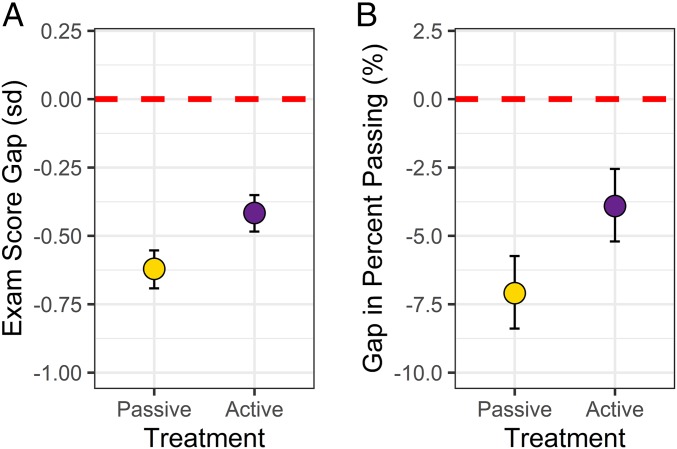
- In identical or formally equivalent exams, the standardized achievement gap between MGS and non-MGS students was −0.62 SDs in traditional lecturing and −0.42 SDs with active learning, a 33% reduction in the gap.
- For passing rates, the gap was −7.1% with traditional lecturing and −3.9% with active learning, a 45% reduction in the gap.
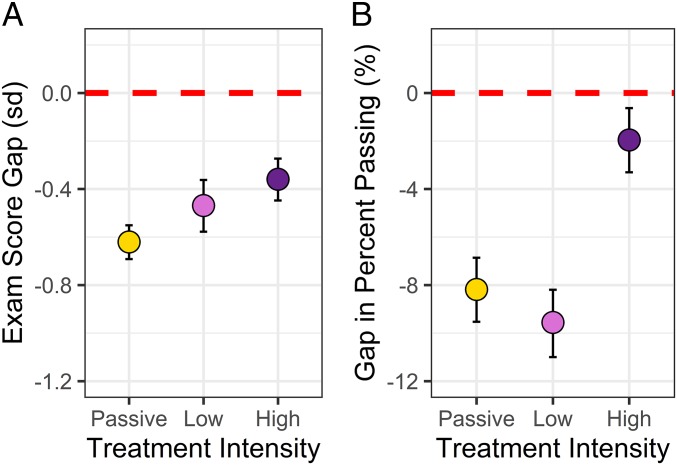
- Gap reductions were stronger with high-intensity active learning: exam-score gaps were −0.48 SDs for low-intensity vs −0.36 SDs for high-intensity; passing-rate gaps were −9.6% for low-intensity vs −2.0% for high-intensity.
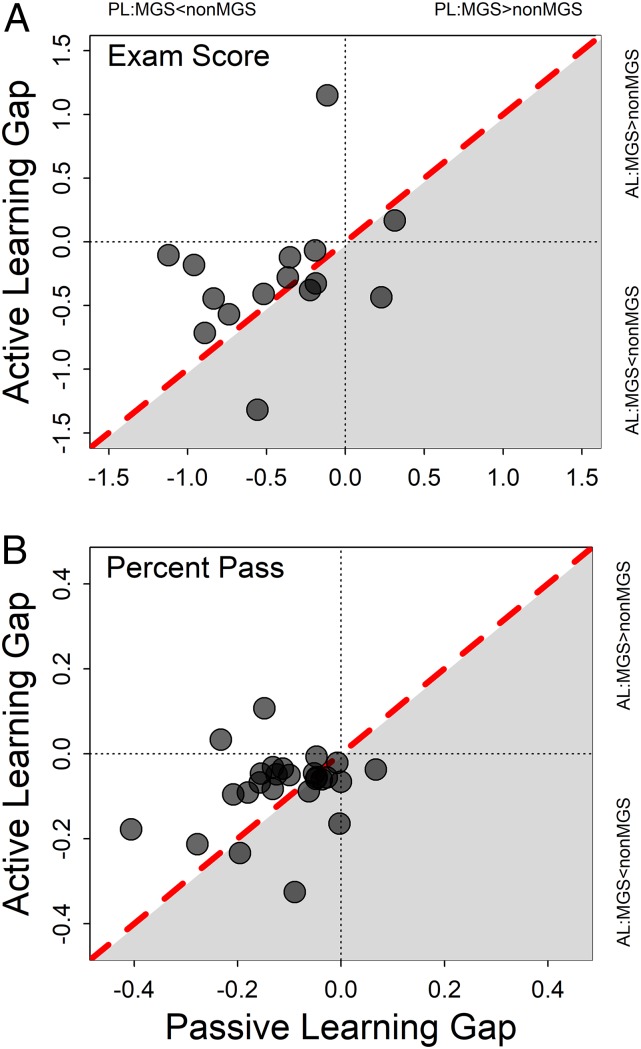
- In the study-level breakdown, 10 of 15 studies with exam-score data showed disproportionate gains for MGS students under active learning, and 15 of 26 studies with failure-rate data showed disproportionate reductions in failure rates for MGS students.
Methods
- Systematic review plus individual-participant-data (IPD) meta-analysis comparing undergraduate STEM courses taught with traditional lecturing vs active learning in the same course and institution.
- Literature search covered studies published or completed from January 1, 2010 to June 30, 2016; the final analysis included 41 studies with disaggregated data by MGS status.
- Final datasets: 9,238 student records from 15 studies for exam scores and 44,606 student records from 26 studies for failure rates; analyses used hierarchical Bayesian multilevel models with section random effects and sensitivity analyses.
Limitations
- The paper states that the conclusions are “tempered by the limitations of the study’s sample size”: only 41 studies had data for students from MGS, which also made moderator analyses hard to interpret.
- The paper says data on the type of active learning were “poorly resolved” because studies often did not report quantitative details of course interventions.
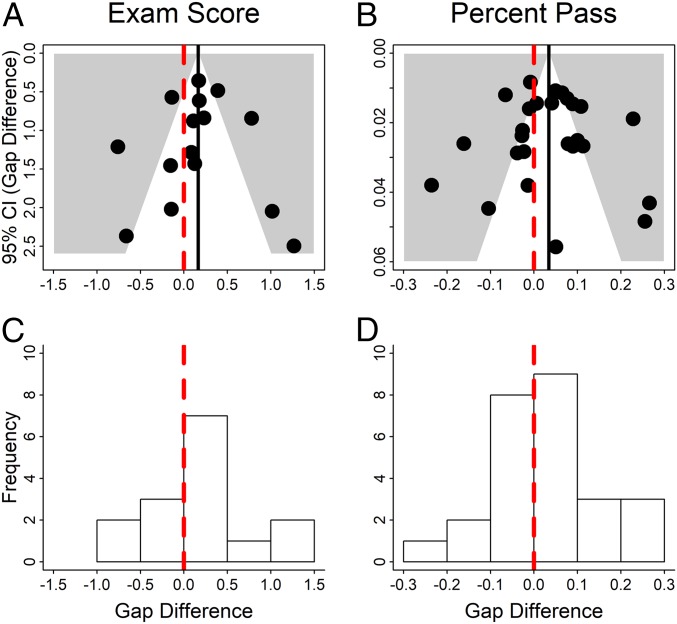
- The paper notes possible sampling bias in instructor/institution type, overrepresentation of research-intensive institutions, and underrepresentation of teaching-intensive institutions and community colleges.
- Evident from the text: the meta-analysis depends on studies that met specific coding and data-sharing criteria, so the findings may not generalize to STEM courses or settings not represented in the included studies.
Model-written summary. Check it against the paper before relying on it.
Integrity signals
Registry
Cites
Statistics
Figures
Verification
Claims the paper makes
16 Valid · 1 Not valid · 10 Not checked · 59 Own results and interpretations
The cited sources support only part of this claim — read each source’s verdict below.
In the paper
“Course grades in most STEM courses are largely driven by performance on examinations, even in active-learning courses that offer many nonexam points (39).”
§ Active learning narrows achievement gaps for underrepresented students in undergraduate science, technology, engineering, and math > Discussion
What the sources say
- Partly supportedcites [39] Freeman S., Haak D., Wenderoth M. P., Increased course structure improves performance in introductory biology. CBE Life Sci. Educ. 10, 175– 186 (2011). 21633066 PMC3105924 sourceExperimental — accuracy not yet measured
The Methods section (“Exam Impact on Final Course Grade”; page unavailable) says the authors intended exams to remain the primary determinant of grades even when many nonexam points were available. Table 4 in the Results shows that exam points strongly predicted final grades across the introductory biology sections studied. The paper does not establish that this holds in most STEM courses. (LLM, conf=0.88)
plainstates an association- Asserted: passes — The authors put it forward as true.
- Checkable: passes — It can be checked against evidence.
- Load-bearing: passes — The paper’s conclusions depend on it.
- Based: passes — The paper gives a reason why it holds.
- Partly supported
The cited sources support only part of this claim — read each source’s verdict below.
In the paper
“All students benefit from classroom cultures that promote self-efficacy, identity as a scientist, and sense of belonging in STEM (58)”
§ Active learning narrows achievement gaps for underrepresented students in undergraduate science, technology, engineering, and math > Discussion
What the sources say
- Partly supportedcites [58] Trujillo G., Tanner K. D., Considering the role of affect in learning: Monitoring students’ self-efficacy, sense of belonging, and science identity. CBE Life Sci. Educ. 13, 6– 15 (2014). 24591497 PMC3940464 sourceExperimental — accuracy not yet measured
The paper’s sections on self-efficacy, sense of belonging, and science identity link each to student learning or persistence, and its discussion of teaching considers how classroom experiences shape these factors. Its focus is undergraduate biology, however; it does not establish that all students benefit from such classroom cultures across STEM. The indexed passages provide section labels but no page numbers. (LLM, conf=0.82)
plainstates a cause- Asserted: passes — The authors put it forward as true.
- Checkable: passes — It can be checked against evidence.
- Load-bearing: unclear — It is unclear whether the paper’s conclusions depend on it.
- Based: passes — The paper gives a reason why it holds.
- Partly supported
The cited sources support only part of this claim — read each source’s verdict below.
In the paper
“students in active-learning course designs that reduced or eliminated achievement gaps have reported an increased sense of community and self-efficacy compared to their peers in the lecture-intensive version of the same course (22, 23).”
§ Active learning narrows achievement gaps for underrepresented students in undergraduate science, technology, engineering, and math > Discussion
What the sources say
- Partly supportedcites [22] Eddy S. L., Hogan K. A., Getting under the hood: How and for whom does increasing course structure work? CBE Life Sci. Educ. 13, 453– 468 (2014). 25185229 PMC4152207 sourceExperimental — accuracy not yet measured
In Methods and Results (Study 3, Factor 2; page unavailable), students in the moderate-structure course were twice as likely to report a stronger sense of classroom community than those in the low-structure course. The Introduction mentions self-reported self-efficacy in prior active-learning research, but says that research did not compare students in versions of the same course. This paper therefore does not support the claimed same-course self-efficacy comparison. (LLM, conf=0.88)
- Not matchedcites [23] Ballen C. J., Wieman C., Salehi S., Searle J. B., Zamudio K. R., Enhancing diversity in undergraduate science: Self-efficacy drives performance gains with active learning. CBE Life Sci. Ed. 16, ar56 (2017). PMC5749958 29054921
We don’t have this paper’s reference list.
plainstates an association- Asserted: passes — The authors put it forward as true.
- Checkable: passes — It can be checked against evidence.
- Load-bearing: unclear — It is unclear whether the paper’s conclusions depend on it.
- Based: passes — The paper gives a reason why it holds.
- Partly supported
Every source the paper cites for this claim was checked and supports it.
In the paper
“Our data on type of active learning are also poorly resolved, because publications still routinely fail to report quantitative data on the nature of course interventions, such as records from classroom observation tools (e.g., ref. 61 and SI Appendix, Table S12).”
§ Active learning narrows achievement gaps for underrepresented students in undergraduate science, technology, engineering, and math > Discussion
What the sources say
- Supportedcites [61] Eddy S. L., Converse M., Wenderoth M. P., PORTAAL: A classroom observation tool assessing evidence-based teaching practices for active learning in large science, technology, engineering, and mathematics classes. CBE Life Sci. Educ. 14, ar23 (2015). PMC4477739 26033871 source
The citation appears as an example of a classroom observation tool, not as evidence that publications routinely omit quantitative intervention data. The Abstract identifies PORTAAL as a classroom observation tool for assessing active-learning practices, which supports that use of the citation. (LLM, conf=0.91)
plainstates a cause- Asserted: passes — The authors put it forward as true.
- Checkable: passes — It can be checked against evidence.
- Load-bearing: unclear — It is unclear whether the paper’s conclusions depend on it.
- Based: passes — The paper gives a reason why it holds.
- Supported
Every source the paper cites for this claim was checked and supports it.
In the paper
“larger gaps are correlated with faculty who have a fixed mindset, which interprets intelligence as innate and immutable and is therefore exclusion or selection-oriented (44).”
§ Active learning narrows achievement gaps for underrepresented students in undergraduate science, technology, engineering, and math > Discussion
What the sources say
- Supportedcites [44] Canning E. A., Muenks K., Green D. J., Murphy M. C., STEM faculty who believe ability is fixed have larger achievement racial achievement gaps and inspire less student motivation in their classes. Sci. Adv. 5, eaau4734 (2019). 30793027 PMC6377274 source
The Results report that racial achievement gaps in STEM courses were nearly twice as large with fixed- versus growth-mindset faculty. The Introduction defines a fixed mindset as treating intelligence and ability as innate and largely unchangeable, and describes judging students as low-ability and encouraging them to drop difficult courses—supporting the paraphrase 'exclusion or selection-oriented.' (LLM, conf=0.88)
plainstates an association- Asserted: passes — The authors put it forward as true.
- Checkable: passes — It can be checked against evidence.
- Load-bearing: unclear — It is unclear whether the paper’s conclusions depend on it.
- Based: passes — The paper gives a reason why it holds.
- Supported
30 more claims
Create a free account to see all 86 claims and every source verdict.
- It may state two separate claims as one. 30
- Probably not a substantial claim. 36
Claims other papers make about this one
Each is checked against this paper’s own text: does it say what the citing paper says it does?
The source backs part of the claim, not all of it — or backs it for a different population, condition or comparison.
In the citing paper
“These perceptions, along with a likely reduction in stress and anxiety (see Figure 4), could benefit students from underrepresented groups and may thus reduce the achievement gap among underrepresented minorities”
From Two-Stage Final Exams: An Assessment Strategy for Enhanced Collaborative Learning and Reduced Student Stress (2026) · cites this paper as Theobald et al., 2020
Experimental — accuracy not yet measured
Citations
Cites
Preferred Reporting Items for Systematic Reviews and Meta-Analyses: the PRISMA statement
Moher, D., Liberati, A., Tetzlaff, J., Altman, D. G., & for the PRISMA Group (2009) · BMJ · doi:10.1136/bmj.b2535 · Cited by 83,823
Preferred reporting items for systematic reviews and meta-analyses: the PRISMA Statement.
(2009) · PubMed Central · Cited by 44,859
Preferred reporting items for systematic reviews and meta-analyses: The PRISMA statement
Moher, D., Liberati, A., Tetzlaff, J., Altman, D. G., & the PRISMA Group* (2009) · Annals of Internal Medicine · doi:10.7326/0003-4819-151-4-200908180-00135 · Cited by 37,554
PRISMA-P Group, Moher, D., Shamseer, L., Clarke, M., Ghersi, D., Liberati, A., Petticrew, M., Shekelle, P., & Stewart, L. A. (2015) · Systematic Reviews · doi:10.1186/2046-4053-4-1 · Cited by 26,223 · cited 2×
“The protocol for this study, presented in the PRISMA-P format (66) and including annotations regarding modifications that occurred during the course of the research, is available in SI Appendix, SI Materials and Methods.”
Capital in the Twenty-First Century
Piketty, T. (2014) · doi:10.4159/9780674369542 · Cited by 14,437
Data Analysis Using Regression and Multilevel/Hierarchical Models
Gelman, A., & Hill, J. (2006) · doi:10.1017/cbo9780511790942 · Cited by 13,597
Active learning increases student performance in science, engineering, and mathematics
Freeman, S., Eddy, S. L., McDonough, M., Smith, M. K., Okoroafor, N., Jordt, H., & Wenderoth, M. P. (2014) · Proceedings of the National Academy of Sciences · doi:10.1073/pnas.1319030111 · Cited by 9,787 · cited 6×
“Can interventions in courses themselves—meaning, changes in how science is taught—reduce achievement gaps and promote retention in STEM? A recent metaanalysis concluded that, on average, active learning in STEM leads to higher examination scores and lower failure rates for all students, compared to all students in the…”
InfluentialSelf-citation(2000) · Cited by 9,198
A threat in the air: How stereotypes shape intellectual identity and performance
Steele, C. M. (1997) · American Psychologist · doi:10.1037/0003-066x.52.6.613 · Cited by 6,770 · cited 1×
“Equally important, inclusive teaching emphasizes treating students with dignity and respect (52), communicating confidence in students’ ability to meet high standards (53), and demonstrating a genuine interest in students’ intellectual and personal growth and success (54, 55).”
BackgroundGeneral methods for monitoring convergence of iterative simulations
Brooks, S. P., & Gelman, A. (1998) · Journal of Computational and Graphical Statistics · doi:10.1080/10618600.1998.10474787 · Cited by 6,045
Research works printed but not linked: 9
- Reardon S. F., “The widening achievement gap between the rich and the poor: New evidence and possible explanations” in Whither Opportunity? Duncan G. J., Murnane R. J., Eds. (Russell Sage Foundation, New York, 2011), pp. 91– 115.
- National Student Clearinghouse Research Center, High School Benchmarks 2019: National College Progression Rates (National Student Clearinghouse, Herndon, VA, 2019).
- Chen X., STEM Attrition: College Students’ Paths Into and Out of STEM Fields (National Center for Education Statistics, Washington, DC, 2013).
- Vygotsky L. S., Mind in Society (Harvard University Press, Cambridge, MA, 1978).
- Kaufmann E., Reips U.-D., Merki K. M., Avoiding methodological biases in meta-analysis. Z. Psychol. 224, 157– 167 (2016).
- Ginder S. A., Kelly-Reid J. E., Mann F. B., Enrollment and Employees in Postsecondary Institutions, Fall 2015 (National Center for Education Statistics, Washington, DC, 2017).
- Reed J. G., Baxter P. M., Using Reference Databases. The Handbook of Research Synthesis and Meta-Analysis, Cooper H., Hedges L. V., Valentine J. C., Eds. (Russell Sage Foundation, New York, 2009), pp. 73– 101.
- Rothstein H., Hopewell S., Grey Literature. The Handbook of Research Synthesis and Meta-Analysis, Cooper H., Hedges L. V., Valentine J. C., Eds. (Russell Sage Foundation, New York, 2009), pp. 103– 125.
- White H. D., Scientific Communication and Literature Retrieval. The Handbook of Research Synthesis and Meta-Analysis, Cooper H., Hedges L. V., Valentine J. C., Eds. (Russell Sage Foundation, New York, 2009), pp. 51– 71.
Cited by
Items 701–800 of 1,369
Wiles, B., & Levesque‐Bristol, C. (2023) · School Science and Mathematics · doi:10.1111/ssm.12590 · Cited by 6
Higher Education, Active Learning, Co-Creation, Innovation, and Contribution to Regional Development
Barbedo, I., Almeida‐de‐Souza, J., Cabo, P., Rodrigues, P. M. M., Costa, C. S., & Pereira, F. A. (2023) · Advances in higher education and professional development book series · doi:10.4018/978-1-6684-6701-5.ch018 · Cited by 2
Lewis, B. L., Supriya, K., Read, G., Dixie, K. L. I., Friscia, A. R., & Kennison, R. L. (2023) · Astronomy Education Journal · doi:10.32374/aej.2023.3.1.049ra · Cited by 6
Ботузова, Ю. В., Iievliev, O., Okipniak, I., Yandola, K., & Charkina, T. (2023) · Cadernos de Educação Tecnologia e Sociedade · doi:10.14571/brajets.v16.n2.386-398 · Cited by 10
Pedagogy of play in a virtual excursion to foster self-directed learning in health care students
Pool, J., Heymans, Y., Koch, R., & Mokwatsi, G. G. (2023) · NWU self-directed learning series · doi:10.4102/aosis.2023.bk426.09 · Cited by 3
Kruger, C., & Mdakane, M. (2023) · NWU self-directed learning series · doi:10.4102/aosis.2023.bk426.05 · Cited by 2
Design principles of inquiry-oriented tasks in integral calculus
Turkey, H. E., Kottegoda, Y., & Siriwardena, L. (2023) · International Journal of Mathematical Education in Science and Technology · doi:10.1080/0020739x.2023.2257699 · Cited by 2
“…own learning have been shown to have many positive outcomes such as increasing student learning and conceptual understanding, their confidence and persistence, as well as reduce achievement gaps (e.g. CBMS, 2016; Freeman et al., 2014; Kogan & Laursen, 2014; PCAST, 2012; Theobald et al., 2020).”
BackgroundThe Effects of COVID-19 on Student Achievement Gap: A Literature Review
Dopwell, M. C. B., Ipesa-Balogun, H., & Rahaman, M. (2023) · Educational communications and technology: issues and innovations · doi:10.1007/978-3-031-37697-9_15 · Cited by 3
The Effect of Self-Efficacy and Learning Innovation on Teacher Performance
Hambali, H., Nurlaili, N., Marzuki, M., Hayati, H., & Ashlan, S. (2023) · Al-Hijr Journal of Adulearn World · doi:10.55849/alhijr.v2i1.536 · Cited by 4
Reimagining undergraduate teaching in materials science and engineering
Choy, J., Peltz, K., Sayers, Z., Spaldin, N. A., & Wells, M. A. (2023) · Nature Reviews Materials · doi:10.1038/s41578-023-00621-6 · Cited by 6
Leslie, H. S., & Johnson-Leslie, N. A.-M. (2023) · Journal of Higher Education Theory and Practice · doi:10.33423/jhetp.v23i18.6622 · Cited by 6
Johnson, R. C., Gallegos, N., Hampton, H., Caffey, D., Bailey, K., Vigil, E., Culbreath-Byrd, T., Jenkins, D., & Freeman, A. (2023) · The Journal of STEM Outreach · doi:10.15695/jstem/v6i2.04 · Cited by 4
Student Advice for Success in High Structure Science and Engineering Courses
Shaffer, J. F., & Ringsby, A. (2024) · The journal of college science teaching · doi:10.1080/0047231x.2024.2316380 · Cited by 2
A Pilot Study of Supporting GTA Professional Development and Educator Identity in Engineering
Akçayır, G., McFeetors, P. J., Kim, M., et al. (2024) · Journal of Research in Science Mathematics and Technology Education · doi:10.31756/jrsmte.722 · Cited by 2
“…‘delivery’ methods toward consideration of student needs and learning styles has consistently brought about better student outcomes in post-secondary classrooms, including for those underrepresented groups that may traditionally be excluded from STEM disciplines (Theobald et al., 2020).”
BackgroundBitting, K. S., Ryker, K. D., & Teasdale, R. (2024) · Journal of Geoscience Education · doi:10.1080/10899995.2024.2359318 · Cited by 3
“…students for demographic information, so we cannot speak to potential equity gaps in student interest that are likely due to prevailing instructional norms in STEM (Dewsbury et al., 2022; Theobald et al., 2020) and differential impacts of COVID on different groups (e.g., Hammerstein et al., 2021).”
Student Ratings of Instruction: Updating Measures to Reflect Recent Scholarship
Dyer, K. D., & Donnelly-Hermosillo, D. F. (2024) · Research in Higher Education · doi:10.1007/s11162-024-09804-8 · Cited by 2
“We now know, for instance, that students prefer classes in which they can passively listen, even though they learn more in classes that require active participation (Freeman et al., 2014; McKeachie, 1997; Theobald et al., 2020).”
The Integration of Artificial Intelligence towards Interactive Based Higher Education System Design
Sulaymanova, S., Boboyeva, Z., & Ozodbek, S. (2024) · International Conference on Advance Computing and Innovative Technologies in Engineering (ICACITE) · doi:10.1109/icacite60783.2024.10617254 · Cited by 5
Crank, R., & Spence, J. (2024) · Journal of Adult and Continuing Education · doi:10.1177/14779714241275872 · Cited by 4
“…student-centred and constructivist, focussed on practices that encourage and support students in their own learning and knowledge construction, and when combined with inclusive teaching practices, active learning can improve underrepresented student achievement (Theobald et al., 2020).”
Woodbury, J., & Offerdahl, E. G. (2024) · CBE—Life Sciences Education · doi:10.1187/cbe.24-02-0090 · Cited by 2
Kowalski, E. M., Koleci, C., & McDonald, K. J. (2024) · Education Sciences · doi:10.3390/educsci14090943 · Cited by 5
Marzocchi, A. S., Stone-Johnstone, A., Kurianski, K. M., & Soto, R. C. (2024) · Education Sciences · doi:10.3390/educsci14091001 · Cited by 3
Archie, T., Wise, S. B., Robalino, J., Chmiel, M., & Laursen, S. L. (2024) · CBE—Life Sciences Education · doi:10.1187/cbe.24-02-0095 · Cited by 3
Factors Affecting Students’ Likelihood to Access Feedback
Christiansen, C., Calvert, C., & Morris, C. (2024) · Educational Researcher · doi:10.3102/0013189x241285416 · Cited by 3
“Previous research has also found poor performance as the main reason why students of all backgrounds drop out of STEM degrees (Theobald et al., 2020).”
Milner, A. E., Hache, R. E., Oliver, S., Sarfan, L. D., Spencer, J. M., Cogan, A. B., Jiang, Y., Agnew, E. R., Zieve, G. G., Martin, J. L., et al. (2024) · Trials · doi:10.1186/s13063-024-08468-0 · Cited by 2
Lofton, M. E., Moore, T. N., Woelmer, W. M., Thomas, R. Q., & Carey, C. C. (2024) · BioScience · doi:10.1093/biosci/biae089 · Cited by 5
Morais, M. M., de Oliveira, J. S., Fichberg, I., et al. (2024) · Interdisciplinary Journal of Environmental and Science Education · doi:10.29333/ijese/15476 · Cited by 2
“Knowledge acquisition is foundational to effective environmental education programs (Theobald et al., 2020).”
BackgroundIn the Mix: A Workshop Merging Computational Chemistry and Electrochemistry Alongside Data Science
Duke, R., Sweet, A. K., Stumme, N. C., Ordikhani-Seyedlar, R., Chattopadhyay, S., Yang, C.-H., Yang, H.-J., Perera, A. S., Green, L., Endres, K., et al. (2024) · Journal of Chemical Education · doi:10.1021/acs.jchemed.4c00727 · Cited by 2
Impacts of Value Alignment for Pursuing Graduate Chemistry Research
Xia, K. T., Bumann, S., Yates, B., Toste, F. D., Francis, M. B., & Baranger, A. M. (2024) · Journal of Chemical Education · doi:10.1021/acs.jchemed.4c00299 · Cited by 3
Meaders, C. L., Mendez, L., Aguilar, A. G., Rivera, A. M., Vasquez, I., Mueller, L. O., & Owens, M. T. (2024) · CBE—Life Sciences Education · doi:10.1187/cbe.24-05-0151 · Cited by 6
“We also do not have information on how instructors taught the chemistry material in their lectures, which is important because active learning–based teaching strategies can narrow equity gaps (Theobald et al. , 2020).”
SAStutorials.org – online tutorials on small-angle scattering data analysis
Larsen, A. H., Jacobsen, J. B., Graewert, M. A., Grøndahl, L. B., Svaneborg, C., Sebastiani, F., Kikhney, A., Tyler, A. I. I., Kihara, S., Lytje, K., et al. (2025) · Journal of Applied Crystallography · doi:10.1107/s1600576725001062 · Cited by 3
Cen, X., Kight, M., Lee, R., Kranzfelder, P., Lo, S. M., Maloy, J. P., & Owens, M. T. (2025) · CBE—Life Sciences Education · doi:10.1187/cbe.24-08-0207 · Cited by 3
Khan, M. S. H., & Hasan, M. (2025) · Springer eBooks · doi:10.1007/978-981-96-0722-8_8 · Cited by 2
Teaching Materials Science: Multi-Tiered Learning at a Soccer-Themed Science Camp in Brazil
Beech, H. K., Fransen, K. A., Santiago, T. S. A., et al. (2025) · Journal of Chemical Education · doi:10.1021/acs.jchemed.4c01180 · Cited by 2
Navlekar, A. S., Baker, N., Ghaemmaghami, M., Obasi, I., Onubogu, S., O'pry, C. G., Posey, R. G., Tan, J., Walulu, K., Reid, J. W., et al. (2025) · Journal of Microbiology and Biology Education · doi:10.1128/jmbe.00008-25 · Cited by 4
Active Literacy Learning Through a Flipped Classroom Model in Teacher Preparation Programs
Philippakos, Z. A. T., Quinn, M. F., Voggt, A. P., & Park, Y. (2025) · Literacy Research and Instruction · doi:10.1080/19388071.2025.2515962 · Cited by 3
“Research has demonstrated the power of active learning to support university students’ outcomes in various disciplines (e.g., in STEM: Freeman et al., 2014; in nursing: Shin et al., 2015) and narrow disparities often experienced by students from underrepresented groups (e.g., Theobald et al., 2020).”
Mariani, R., & Devany, E. (2025) · Journal of Microbiology and Biology Education · doi:10.1128/jmbe.00055-25 · Cited by 2
Kreps, A., Dailey, K., & Cole, R. S. (2025) · Chemistry Education Research and Practice · doi:10.1039/d5rp00225g · Cited by 3
Kihaga, H., Dahl, B., Kitta, S. R., & Likinjiye, M. (2025) · Social Sciences & Humanities Open · doi:10.1016/j.ssaho.2025.101744 · Cited by 9
The Power of Peer Experiences: Shifts in Science Motivation and Impacts on Performance
Premo, J., Davis, W. B., & Wyatt, B. N. (2025) · CBE—Life Sciences Education · doi:10.1187/cbe.24-07-0199 · Cited by 3
“Theobald et al. (2020) found high-intensity active learning in college STEM classrooms narrowed the achievement gap between overrepresented students and underrepresented students in STEM (including FGS).”
Kortz, K. M. (2025) · Journal of Geoscience Education · doi:10.1080/10899995.2025.2555159 · Cited by 3
“The variety of ways students could participate in their learning and demonstrate knowledge may have decreased the inequities perpetuated by traditional, lecture-based STEM instruction (Gouvea, 2021; Theobald et al., 2020).”
Fuchs, S., Vasudevan, V. S., & Butcher, J. T. (2025) · Biomedical Engineering Education · doi:10.1007/s43683-025-00195-5 · Cited by 5
“In contrast, embracing inductive, active learning teaching methods—such as case-based learning, group work approaches—has shown to foster active student engagement, collaboration, and accountability [32, 33].”
Nassou, Y. (2025) · Scientia. Technology, science and society. · doi:10.59324/stss.2025.2(10).03 · Cited by 3
Ahead of his time: Joseph Grinnell, natural history, and inclusion and equity in STEM
Ribble, D. O. (2022) · Therya · doi:10.12933/therya-22-1104 · Cited by 3
Zubair, A. R., & Olawale, A. J. (2022) · Global Journal of Engineering and Technology Advances · doi:10.30574/gjeta.2022.12.1.0105 · Cited by 2
Trends in the Use of Google Meet Apps for Arabic Language Learning during the COVID-19 Pandemic
Tomas, M., Thomas, V., & Luciani, C. (2023) · Journal International of Lingua and Technology · doi:10.55849/jiltech.v2i1.247 · Cited by 3
Keeping chemical engineering education relevant
Zydney, A. L. (2021) · AIChE Journal · doi:10.1002/aic.17203 · Cited by 2
A low-cost computational approach to analyze spiking activity in cockroach sensory neurons
Torres, D. J., Romero, A., Colgan, W., et al. (2021) · AJP Advances in Physiology Education · doi:10.1152/advan.00034.2020 · Cited by 2
“(1) note that underrepresented students learn better when a “high-quality” active component of a class is used.”
BackgroundHenslee, E. A., Lowman, L. E. L., Gross, M. D., & McCauley, A. (2024) · ASEE Annual Conference & Exposition · doi:10.18260/1-2--37747 · Cited by 4
Kitchen Matters: Virtual materials science outreach through food and cooking
Yang, M., Farruggio, C. C., Baidoo, J. E., et al. (2021) · Matter · doi:10.1016/j.matt.2021.06.005 · Cited by 2
Sommers, A. S., Johnson, K. G., Jakopovic, P. M., Rivera, J., Grandgenett, N. F., Conrad, J. A., Tapprich, W. E., & Cutucache, C. E. (2021) · Frontiers in Education · doi:10.3389/feduc.2021.575188 · Cited by 3
“best-practices in undergraduate STEM education are shown to improve learning outcomes and retention in PEERs (Theobald et al., 2020).”
BackgroundInfluentialCassambai, S., Bridge, H., Gill, P. K., Shobaloju, S., Sgamma, T., & Rushworth, J. V. (2022) · Essays in Biochemistry · doi:10.1042/ebc20210051 · Cited by 4
Creagar, M., Wakefield, N., Smith, W., Apkarian, N., & Voigt, M. (2022) · Investigations in Mathematics Learning · doi:10.1080/19477503.2022.2060023 · Cited by 4
“Many studies to date have compared active learning strategies to lecture models of instruction (Freeman et al., 2014; Stains et al., 2018; Theobald et al., 2020).”
BackgroundVorteile durch aktives Lernen bei Schülerinnen und Schülern
Opitz, B., & Ruggeri, A. (2022) · Lernen und Lernstörungen · doi:10.1024/2235-0977/a000375 · Cited by 6
A guide to pedagogical research for scientists from a biological sciences background
Lacey, M. M., & Efthimiou, G. (2022) · Access Microbiology · doi:10.1099/acmi.0.000416 · Cited by 2
Self-citationJunk, D. J., & Berger, N. A. (2022) · The Journal of STEM Outreach · doi:10.15695/jstem/v5i2.05 · Cited by 4
“…them to research experiences and helping them to develop strategies, focusing on active learning styles (Ballen et al., 2017; Freeman et al., 2014; Theobald, 2020) to provide them with tools and guidance to excite and interest middle, high school, and undergraduate students to explore careers and…”
BackgroundRobnett, R. D., Ballen, C. J., Fagbodun, S., Lane, A. K., McCoy, S. J., Robinson, L., Weems, E. I., & Cotner, S. H. (2022) · PLoS ONE · doi:10.1371/journal.pone.0273301 · Cited by 5
“Compelling evidence suggests that active learning improves performance and retention outcomes [11], especially for students traditionally underrepresented in STEM disciplines on the basis of their ethnic background, gender, and family history in higher education [12].”
BackgroundActively Engaging Large Classes in Tanzanian Universities
Mwakabenga, R. J. (2022) · Utafiti · doi:10.1163/26836408-15020069 · Cited by 2
A gut microbiome tactile teaching tool and guided-inquiry activity promotes student learning
Shoaf, P. T., French, K. S., Clifford, N. J., McKenney, E. A., & Ott, L. E. (2022) · Frontiers in Microbiology · doi:10.3389/fmicb.2022.966289 · Cited by 5
“Considering the mounting evidence that active learning pedagogies are especially efficacious for historically underrepresented populations in STEM (Beichner et al., 2007; Gordy et al., 2020; Kressler and Kressler, 2020; Theobald et al., 2020), the finding that PEER and women students experienced lower learning gains f…”
BackgroundInfluentialWoodbury, J., Arneson, J. B., Anderson, J., Collins, L., Cavagnetto, A. R., Davis, W., & Offerdahl, E. G. (2022) · CourseSource · doi:10.24918/cs.2022.43 · Cited by 1
Nix, C. A., Nottolini, I., Caranto, J. D., Gerasimova, Y. V., Kolpashchikov, D. M., & Saitta, E. K. H. (2022) · International Journal of Higher Education · doi:10.5430/ijhe.v11n6p114 · Cited by 2
Introducing Immunology Research Literature to Understand B-cell Receptor Gene Expression
Morgan, D. E. (2022) · CourseSource · doi:10.24918/cs.2022.36 · Cited by 2
Use of a Role-Playing Activity To Increase Student Understanding of Bacterial Gene Regulation
Sampath, V. (2023) · Journal of Microbiology and Biology Education · doi:10.1128/jmbe.00006-23 · Cited by 8
Online Instructor Clusters: Implementation Frequency of Instructional Activities
Inan, F. A., & Bolliger, D. U. (2023) · Education and Information Technologies · doi:10.1007/s10639-023-11721-9 · Cited by 3
“Pedagogical beliefs are an important construct because they influence instructors’ practices in the classroom, which in turn can impact students’ behaviors and learning (Connell et al., 2016; Kay & Pasarica, 2019; Theobald et al., 2020; Trigwell et al., 1999).”
BackgroundBirney, L., Evans, B. R., Solanki, V., Mojica, E. E., Scharff, C., & Kong, J. (2023) · Journal of Curriculum and Teaching · doi:10.5430/jct.v12n3p207 · Cited by 4
Hidayat, R., & Nurliah, N. (2023) · Journal International of Lingua and Technology · doi:10.55849/jiltech.v2i2.459 · Cited by 4
Inclusive Pedagogy Strategies to Introduce High Schoolers to Systems Biology
Watts, K. M., & Richardson, W. (2023) · Biomedical Engineering Education · doi:10.1007/s43683-023-00127-1 · Cited by 4
“It is well established that the majority of students benefit from a more active learning environment than traditional lectures [11, 12].”
Aivar, M. P. (2024) · Visual Cognition · doi:10.1080/13506285.2023.2250519 · Cited by 3
“…have shown that, compared to traditional lecturing, active learning activities significantly increase overall grades, independently of the kind of assessment (Freeman et al., 2014), and reduce achievement gaps for underrepresented minorities and low-income students (Theobald et al., 2020).”
An Adaptive Learning Engineering Mechanics Curricular Sequence
Saul, K. R., Howard, A., Webster, Z., & Spencer, D. (2024) · ASEE Annual Conference & Exposition · doi:10.18260/1-2--40509 · Cited by 4
Miroyan, M., Weng, S., Shah, R., et al. (2024) · ACM Technical Symposium on Computer Science Education (SIGCSE) · doi:10.1145/3626252.3630838 · Cited by 2
Active Learning and Integrated Assessment: Minerva’s Approach to Teaching Future Skills
Gahl, M. K., Ahuja, A., Ribeiro, R. H., Averett, M., & Genone, J. (2024) · Zukunft der Hochschulbildung · doi:10.1007/978-3-658-42948-5_22 · Cited by 2
Otero-Diaz, M., & Salazar, M. L. (2024) · ASEE Pacific Southwest Section Meeting · doi:10.18260/1-2--38235 · Cited by 3
The Do-It-Yourself Electrocardiogram
Haase, E., O’Hara, R., & Maybhate, A. (2022) · Biomedical Engineering Education · doi:10.1007/s43683-021-00061-0 · Cited by 2
Sathe, N. A., Ovelman, C., Ospina, N. S., Dewidar, O., Terhune, E., Francis, D., Welch, V. A., Heyn, P. C., Duque, T. G., & Viswanathan, M. (2024) · SSRN Electronic Journal · doi:10.2139/ssrn.4735939 · Cited by 2
A Mixed-Methods Research Design to Advance Inclusive and Equitable TeachingPreprint
Soicher, R. N., Baker, A. R., & Thomas, R. C. (2024) · doi:10.35542/osf.io/23ybn · Cited by 2
Ganong, C. N. (2021) · Journal of Microbiology and Biology Education · doi:10.1128/jmbe.v22i1.2185 · Cited by 2
Vandegrift, E. V. H., & Withers, M. H. (2022) · Disaster risk reduction · doi:10.1007/978-981-19-1193-4_7 · Cited by 2
Rollwagen‐Bollens, G., Kibota, T. T., & Crosby, C. (2022) · Journal of Microbiology and Biology Education · doi:10.1128/jmbe.00102-22 · Cited by 2
Erebholo, F. (2023) · Journal of College Student Retention Research Theory & Practice · doi:10.1177/15210251231175081 · Cited by 1
“Theobald et al. (2020) found that AL helps underrepresented minority undergraduate students close achievement gaps in the fi elds of science, technology, engineering, and math (STEM) while a meta-analysis by Freeman et al. (2014) revealed that students in an AL intervention classroom obtained, on…”
Structured Modules to Promote Students’ Readiness for Capstone Projects
Suh, G.-Y. K., & Ahrar, S. (2023) · Biomedical Engineering Education · doi:10.1007/s43683-023-00118-2 · Cited by 1
“Specifically, a recent comprehensive examination of many education studies suggested the efficacy of deliberate practice when combined with inclusive teaching to narrow the achievement gap [20].”
Jenkins, L. D. (2023) · CourseSource · doi:10.24918/cs.2023.25 · Cited by 1
Chow, A. N., Harrington, P. D., & Leung, F.-S. (2023) · Teaching Mathematics and its Applications An International Journal of the IMA · doi:10.1093/teamat/hrad005 · Cited by 1
Koocharoenpisal, N. (2023) · Anatolian Journal of Education · doi:10.29333/aje.2023.8214a · Cited by 6
Firneno, T. J., Welsh, G. T., Nimlos, P. J., & Larson, E. L. (2023) · Evolution Education and Outreach · doi:10.1186/s12052-023-00192-8 · Cited by 6
“There is considerable evidence that hands-on activities are more effective than traditional lectures because (1) students become active participants in their own learning (Alters and Nelson 2002; Freeman et al. 2014; Gardner and Bel-land 2012; Hake 1998; Nelson 2008; Smith et al. 2005) and (2) hands-on activities tend…”
BackgroundInfluentialMiller, E., & Withers, M. D. (2023) · Frontiers in Education · doi:10.3389/feduc.2023.1177033 · Cited by 1
Threats to Education: Research on the Use of Chatgpt
Morales, U., Joanan, S., & Julia, H. (2023) · Journal Emerging Technologies in Education · doi:10.55849/jete.v1i1.187 · Cited by 2
King, A. L., Bell-Huff, C. L., Airhihenbuwa, C. O., Ogletree, S. L., & Wright, C. (2024) · AJP Advances in Physiology Education · doi:10.1152/advan.00123.2023 · Cited by 2
The Influence of Learning Assistants on Faculty Use of Student-Centered Instruction
Hill, C. J., Barrasso, A. P., & Spilios, K. E. (2024) · The journal of college science teaching · doi:10.1080/0047231x.2024.2316375 · Cited by 4
Equitable Instructor Assessment Changes Amid COVID-19 Pandemic
Lamb, T., Driessen, E. P., Beatty, A. E., Youngblood, R. M., Esco, A., Cotner, S. H., Creech, C., Drake, A. G., Fagbodun, S., Hobbs, K. S., et al. (2024) · The journal of college science teaching · doi:10.1080/0047231x.2024.2316387 · Cited by 2
“R” U ready?: a case study using R to analyze changes in gene expression during evolution
Pomeroy, A. E., Bixler, A., Chen, S. H., Kerr, J., Levine, T. D., & Ryder, E. F. (2024) · Frontiers in Education · doi:10.3389/feduc.2024.1379910 · Cited by 1
Ward, L. W., Hoang, J., Croatt, M. P., Walsh, J. L., & Popova, M. (2024) · Frontiers in Education · doi:10.3389/feduc.2024.1371132 · Cited by 1
How university mathematics instructors form groups and how students experience them
Küchle, V. A. B., Smith, J. P., Hwang, J. J., & Menon, R. (2024) · International Journal of Mathematical Education in Science and Technology · doi:10.1080/0020739x.2024.2369651 · Cited by 2
“Broad support now exists for using active learning methods in university mathematics and science courses, where lecture has long been the dominant instructional activity (Deslau-riers et al., 2019; Freeman et al., 2014; Prince,2004; Theobald et al., 2020).”
Social platforms as Tools for Inclusive Pedagogy: Case of Perusall for Collaborative Reading
Ateh, C. M. (2024) · Annals of Social Sciences & Management studies · doi:10.19080/asm.2024.10.555788 · Cited by 2
Fajeriadi, H., Zaini, M., Dharmono, D., Nugroho, B. A., Fahmi, F., & Fitriani, A. (2024) · JPBI (Jurnal Pendidikan Biologi Indonesia) · doi:10.22219/jpbi.v10i2.32255 · Cited by 8
“Students' activities in the learning process influence their learning achievement (Ebele & Olofu, 2017; Tokan & Imakulata, 2019; Theobald et al., 2020).”
Inclusive Teaching Practices in Engineering: A Systematic Review of Articles from 2018 to 2023
Singh, R., & Kittur, J. (2024) · ASEE Annual Conference & Exposition · doi:10.18260/1-2--47602 · Cited by 4
From the Other Side: Supervisor Perspectives on Paid Versus Unpaid Sport Management Internships
Madsen, R. M., Grappendorf, H., Parker, H. M., et al. (2024) · Sport Management Education Journal · doi:10.1123/smej.2023-0016 · Cited by 1
Newman, S., McKinley, K., & Theisen, R. M. (2024) · The journal of college science teaching · doi:10.1080/0047231x.2024.2410749 · Cited by 1
Self-citationLearning on a Limb: An outreach module to engage high school students in orthopaedics
Panebianco, C. J., Azar, T., Duffy, M. P., Nijsure, M. P., Sharp, E., Tamburro, M. K., Hast, M. W., Shore, E. M., Mauck, R. L., Soslowsky, L. J., et al. (2024) · Journal of Orthopaedic Research® · doi:10.1002/jor.26010 · Cited by 2
Type of Active Learning Implementation in Science Education: A Systematic Review
Ridani, M., & Arianingrum, R. (2024) · Indonesian Journal Of Educational Research and Review · doi:10.23887/ijerr.v7i2.65623 · Cited by 8
“Students' learning is greatly influenced by active learning through activities, which also has a favorable impact on their mastery of the material (Celik, 2018; Theobald et al., 2020).”
Jacques-Fricke, B. T. (2024) · Developmental Biology · doi:10.1016/j.ydbio.2024.12.015 · Cited by 2
Sørensen, A., & Lagestad, P. (2024) · Physical Education of Students · doi:10.15561/20755279.2024.0601 · Cited by 2
Metadata
- Authors
- Theobald, E. J., Hill, M. J., Tran, E., Agrawal, S., Arroyo, E. N., Behling, S., Chambwe, N., Cintrón, D. L., Cooper, J. D., Dunster, G., Grummer, J. A., Hennessey, K., Hsiao, J., Iranon, N., Jones, L., Jordt, H., Keller, M., Lacey, M. E., Littlefield, C. E., Lowe, A., Newman, S., Okolo, V., Olroyd, S., Peecook, B. R., Pickett, S. B., Slager, D. L., Caviedes-Solis, I. W., Stanchak, K. E., Sundaravardan, V., Valdebenito, C., Williams, C. R., Zinsli, K., & Freeman, S.
- Affiliations
- University of Washington (US)
- Institute for Systems Biology (US)
- Shoreline Community College (US)
- Corresponding author
- Theobald, Elli J.
- Freeman, Scott
- ORCID
- Theobald, Elli J.
- Agrawal, Sweta
- Behling, Shawn
- Chambwe, Nyasha
- Cintrón, Dianne Laboy
- Cooper, Jacob D.
- Dunster, Gideon
- Grummer, Jared A.
- Hennessey, Kelly
- Hsiao, Jennifer
- Jones, Leonard
- Jordt, Hannah
- Littlefield, Caitlin E.
- Lowe, Alexander
- Olroyd, Savannah
- Peecook, Brandon R.
- Pickett, Sarah B.
- Slager, David L.
- Caviedes-Solis, Itzue W.
- Stanchak, Kathryn E.
- Williams, Claire R.
- Zinsli, Kaitlin
- Freeman, Scott
- Venue
- Proceedings of the National Academy of Sciences
- Publisher
- National Academy of Sciences
- Published
- 2020-03-09
- Volume
- 117
- Issue
- 12
- Pages
- 6476-6483
- ISSN
- 0027-8424 (ISSN-L)
- 1091-6490
- PMC
- PMC7104254
- OpenAlex
- W3009483010
- Cited by
- 1,387
- References
- 75
- Citations by year
- 2026: 210 · 2025: 222 · 2024: 272 · 2023: 236 · 2022: 233 · 2021: 154 · 2020: 60
- FWCI
- 258.89
- Type
- journal article
- Language
- en
- Open access
- hybrid
- doi.org
- Licence
- Locations
- Proceedings of the National Academy of Sciences (publishedVersion, cc-by-nc-nd)
- Europe PMC (PubMed Central) (publishedVersion, cc-by-nc-nd)
- PubMed Central (publishedVersion, cc-by-nc-nd)
- PubMed (publishedVersion)
- Funders
- University of Washington College of Arts and Sciences (NA)
- Topics
- Social Sciences › Education › Innovative Teaching Methods
- Social Sciences › Education › Higher Education Research Studies
- Social Sciences › Psychology › Developmental and Educational Psychology › Innovative Teaching and Learning Methods
- Keywords
- active learning, achievement gap, underrepresented students, STEM education, traditional lecturing, course design, student failure rates, test scores, higher education equity, inclusive pedagogy, deliberate practice
- MeSH terms
- Achievement, Educational Measurement, Engineering, Humans, Mathematics, Minority Groups, Science, Students, Technology, United States, Universities, Problem-Based Learning
About these checks
Registry, retraction, Cites and statistics results are computed, not judged, with one exception: a printed reference that no index lists is read once by a model before it counts as a citation error. Claims are extracted by a model and kept only when their quote appears verbatim in the text; each cited source is then checked, with a model’s help, for whether it says what the claim relies on. Those verdicts can be wrong — read the claim’s quote and the cited source before relying on one.
The claim verdicts this report counts are experimental: their accuracy is not yet measured.
A language model drew the claims from the paper on 2026-10-10, under version 3 of the claim definition (model deepseek-v4.1-flash, prompt extract-v3).
A second model labelled each claim on 2026-10-10 (model jev-1.13-20260917, definition revision gold-guideline-v0.2).
Cited sources are checked with a language model’s help (gpt-6-sol).
Statistics and arithmetic are recomputed, not judged.
Confidence bands are shown only for fields calibrated on our annotated test set. None is calibrated yet, so no band is shown.
What counts as a claim ›How we measure confidence ›How we check this ›
Are you an author, or do you see a problem with this page? Request a review
Data sources
Bibliographic data: Semantic Scholar, OpenAlex, Crossref.
Contains information from the Semantic Scholar Academic Graph Datasets, made available under the ODC Attribution License (ODC-BY 1.0).
Semantic Scholar’s data is described in: Kinney, R., et al. (2023). The Semantic Scholar Open Data Platform. arXiv:2301.10140.
