

Active learning narrows achievement gaps for underrepresented students in undergraduate science, technology, engineering, and math
Open accessThe DOI matches its Crossref record; 72 of the 75 references it cites were found in a registry or an index, and 3 are not checked yet; 19 of the 44 sources its claims cite were checked for support.
Abstract
We tested the hypothesis that underrepresented students in active-learning classrooms experience narrower achievement gaps than underrepresented students in traditional lecturing classrooms, averaged across all science, technology, engineering, and mathematics (STEM) fields and courses. We conducted a comprehensive search for both published and unpublished studies that compared the performance of underrepresented students to their overrepresented classmates in active-learning and traditional-lecturing treatments. This search resulted in data on student examination scores from 15 studies (9,238 total students) and data on student failure rates from 26 studies (44,606 total students). Bayesian regression analyses showed that on average, active learning reduced achievement gaps in examination scores by 33% and narrowed gaps in passing rates by 45%. The reported proportion of time that students spend on in-class activities was important, as only classes that implemented high-intensity active learning narrowed achievement gaps. Sensitivity analyses showed that the conclusions are robust to sampling bias and other issues. To explain the extensive variation in efficacy observed among studies, we propose the heads-and-hearts hypothesis, which holds that meaningful reductions in achievement gaps only occur when course designs combine deliberate practice with inclusive teaching. Our results support calls to replace traditional lecturing with evidence-based, active-learning course designs across the STEM disciplines and suggest that innovations in instructional strategies can increase equity in higher education.
Verified 2026-11-22 · 3 references not checked yet
Overview
CoChat Summary
TL;DR
This systematic review and individual-participant-data meta-analysis found that active learning reduced achievement gaps for underrepresented/minoritized students in undergraduate STEM courses. Across the analyzed studies, gaps in exam scores and passing rates were smaller in active-learning than in traditional lecturing, with the largest gap reductions seen in high-intensity active learning.
Key findings
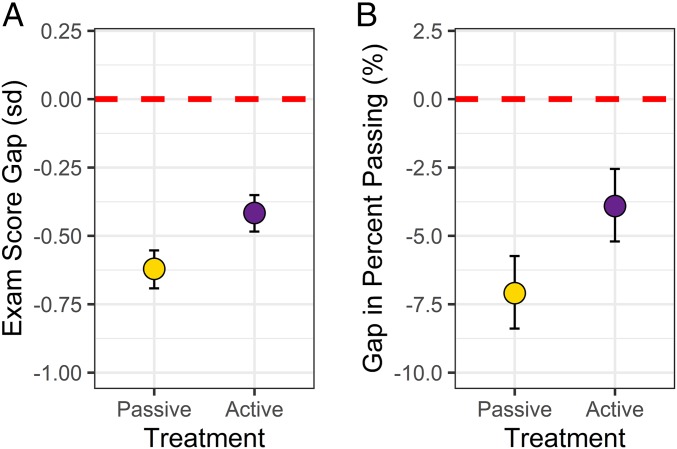
- In identical or formally equivalent exams, the standardized achievement gap between MGS and non-MGS students was −0.62 SDs in traditional lecturing and −0.42 SDs with active learning, a 33% reduction in the gap.
- For passing rates, the gap was −7.1% with traditional lecturing and −3.9% with active learning, a 45% reduction in the gap.
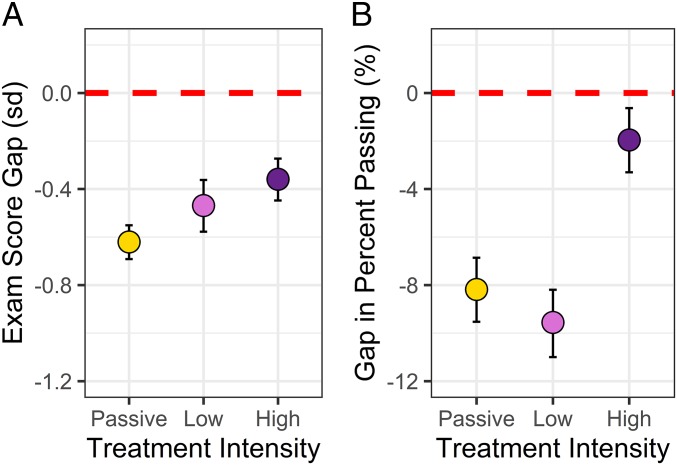
- Gap reductions were stronger with high-intensity active learning: exam-score gaps were −0.48 SDs for low-intensity vs −0.36 SDs for high-intensity; passing-rate gaps were −9.6% for low-intensity vs −2.0% for high-intensity.
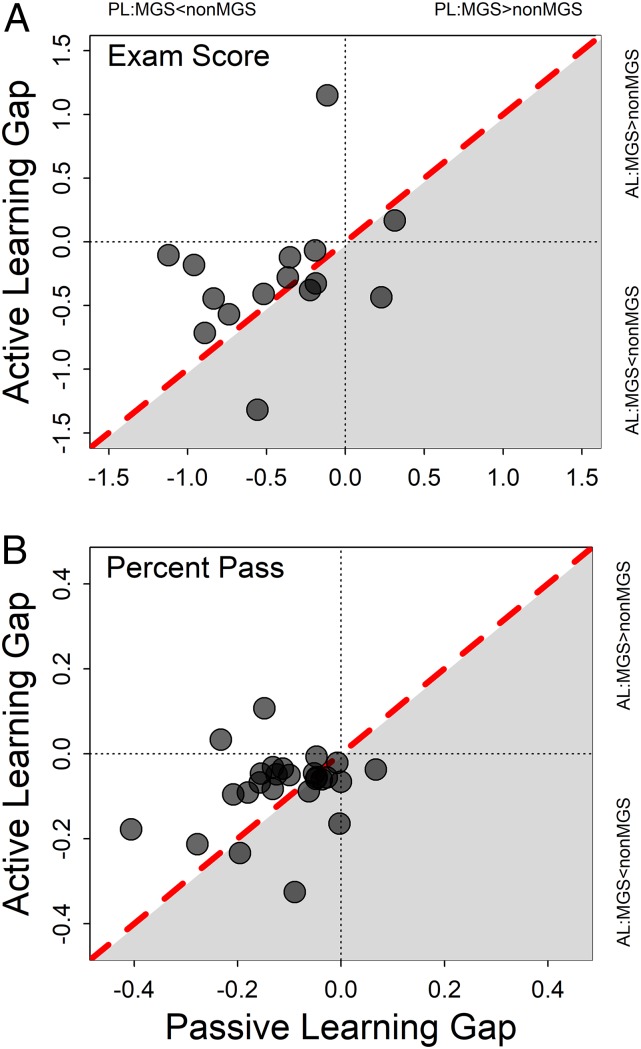
- In the study-level breakdown, 10 of 15 studies with exam-score data showed disproportionate gains for MGS students under active learning, and 15 of 26 studies with failure-rate data showed disproportionate reductions in failure rates for MGS students.
Methods
- Systematic review plus individual-participant-data (IPD) meta-analysis comparing undergraduate STEM courses taught with traditional lecturing vs active learning in the same course and institution.
- Literature search covered studies published or completed from January 1, 2010 to June 30, 2016; the final analysis included 41 studies with disaggregated data by MGS status.
- Final datasets: 9,238 student records from 15 studies for exam scores and 44,606 student records from 26 studies for failure rates; analyses used hierarchical Bayesian multilevel models with section random effects and sensitivity analyses.
Limitations
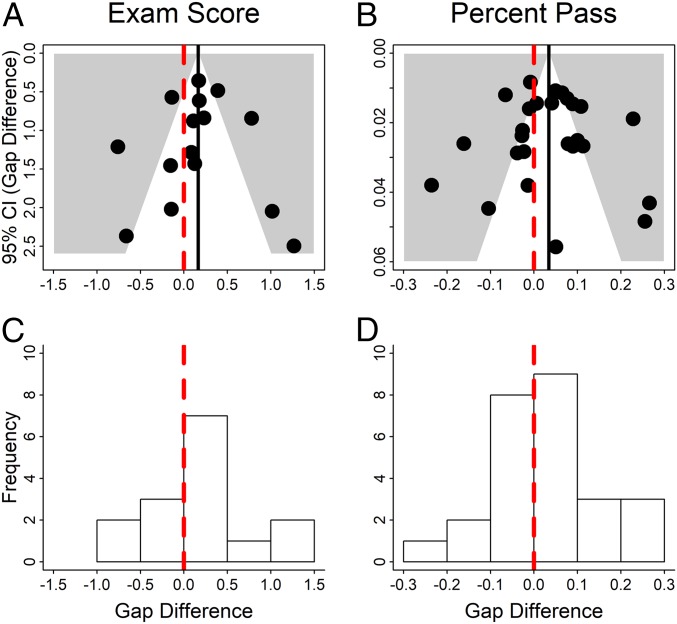
- The paper states that the conclusions are “tempered by the limitations of the study’s sample size”: only 41 studies had data for students from MGS, which also made moderator analyses hard to interpret.
- The paper says data on the type of active learning were “poorly resolved” because studies often did not report quantitative details of course interventions.
- The paper notes possible sampling bias in instructor/institution type, overrepresentation of research-intensive institutions, and underrepresentation of teaching-intensive institutions and community colleges.
- Evident from the text: the meta-analysis depends on studies that met specific coding and data-sharing criteria, so the findings may not generalize to STEM courses or settings not represented in the included studies.
Model-written summary. Check it against the paper before relying on it.
Integrity signals
Registry
Cites
Statistics
Figures
Verification
Claims the paper makes
16 Valid · 1 Not valid · 10 Not checked · 59 Own results and interpretations
The cited sources support only part of this claim — read each source’s verdict below.
In the paper
“Course grades in most STEM courses are largely driven by performance on examinations, even in active-learning courses that offer many nonexam points (39).”
§ Active learning narrows achievement gaps for underrepresented students in undergraduate science, technology, engineering, and math > Discussion
What the sources say
- Partly supportedcites [39] Freeman S., Haak D., Wenderoth M. P., Increased course structure improves performance in introductory biology. CBE Life Sci. Educ. 10, 175– 186 (2011). 21633066 PMC3105924 sourceExperimental — accuracy not yet measured
The Methods section (“Exam Impact on Final Course Grade”; page unavailable) says the authors intended exams to remain the primary determinant of grades even when many nonexam points were available. Table 4 in the Results shows that exam points strongly predicted final grades across the introductory biology sections studied. The paper does not establish that this holds in most STEM courses. (LLM, conf=0.88)
plainstates an association- Asserted: passes — The authors put it forward as true.
- Checkable: passes — It can be checked against evidence.
- Load-bearing: passes — The paper’s conclusions depend on it.
- Based: passes — The paper gives a reason why it holds.
- Partly supported
The cited sources support only part of this claim — read each source’s verdict below.
In the paper
“All students benefit from classroom cultures that promote self-efficacy, identity as a scientist, and sense of belonging in STEM (58)”
§ Active learning narrows achievement gaps for underrepresented students in undergraduate science, technology, engineering, and math > Discussion
What the sources say
- Partly supportedcites [58] Trujillo G., Tanner K. D., Considering the role of affect in learning: Monitoring students’ self-efficacy, sense of belonging, and science identity. CBE Life Sci. Educ. 13, 6– 15 (2014). 24591497 PMC3940464 sourceExperimental — accuracy not yet measured
The paper’s sections on self-efficacy, sense of belonging, and science identity link each to student learning or persistence, and its discussion of teaching considers how classroom experiences shape these factors. Its focus is undergraduate biology, however; it does not establish that all students benefit from such classroom cultures across STEM. The indexed passages provide section labels but no page numbers. (LLM, conf=0.82)
plainstates a cause- Asserted: passes — The authors put it forward as true.
- Checkable: passes — It can be checked against evidence.
- Load-bearing: unclear — It is unclear whether the paper’s conclusions depend on it.
- Based: passes — The paper gives a reason why it holds.
- Partly supported
The cited sources support only part of this claim — read each source’s verdict below.
In the paper
“students in active-learning course designs that reduced or eliminated achievement gaps have reported an increased sense of community and self-efficacy compared to their peers in the lecture-intensive version of the same course (22, 23).”
§ Active learning narrows achievement gaps for underrepresented students in undergraduate science, technology, engineering, and math > Discussion
What the sources say
- Partly supportedcites [22] Eddy S. L., Hogan K. A., Getting under the hood: How and for whom does increasing course structure work? CBE Life Sci. Educ. 13, 453– 468 (2014). 25185229 PMC4152207 sourceExperimental — accuracy not yet measured
In Methods and Results (Study 3, Factor 2; page unavailable), students in the moderate-structure course were twice as likely to report a stronger sense of classroom community than those in the low-structure course. The Introduction mentions self-reported self-efficacy in prior active-learning research, but says that research did not compare students in versions of the same course. This paper therefore does not support the claimed same-course self-efficacy comparison. (LLM, conf=0.88)
- Not matchedcites [23] Ballen C. J., Wieman C., Salehi S., Searle J. B., Zamudio K. R., Enhancing diversity in undergraduate science: Self-efficacy drives performance gains with active learning. CBE Life Sci. Ed. 16, ar56 (2017). PMC5749958 29054921
We don’t have this paper’s reference list.
plainstates an association- Asserted: passes — The authors put it forward as true.
- Checkable: passes — It can be checked against evidence.
- Load-bearing: unclear — It is unclear whether the paper’s conclusions depend on it.
- Based: passes — The paper gives a reason why it holds.
- Partly supported
Every source the paper cites for this claim was checked and supports it.
In the paper
“Our data on type of active learning are also poorly resolved, because publications still routinely fail to report quantitative data on the nature of course interventions, such as records from classroom observation tools (e.g., ref. 61 and SI Appendix, Table S12).”
§ Active learning narrows achievement gaps for underrepresented students in undergraduate science, technology, engineering, and math > Discussion
What the sources say
- Supportedcites [61] Eddy S. L., Converse M., Wenderoth M. P., PORTAAL: A classroom observation tool assessing evidence-based teaching practices for active learning in large science, technology, engineering, and mathematics classes. CBE Life Sci. Educ. 14, ar23 (2015). PMC4477739 26033871 source
The citation appears as an example of a classroom observation tool, not as evidence that publications routinely omit quantitative intervention data. The Abstract identifies PORTAAL as a classroom observation tool for assessing active-learning practices, which supports that use of the citation. (LLM, conf=0.91)
plainstates a cause- Asserted: passes — The authors put it forward as true.
- Checkable: passes — It can be checked against evidence.
- Load-bearing: unclear — It is unclear whether the paper’s conclusions depend on it.
- Based: passes — The paper gives a reason why it holds.
- Supported
Every source the paper cites for this claim was checked and supports it.
In the paper
“larger gaps are correlated with faculty who have a fixed mindset, which interprets intelligence as innate and immutable and is therefore exclusion or selection-oriented (44).”
§ Active learning narrows achievement gaps for underrepresented students in undergraduate science, technology, engineering, and math > Discussion
What the sources say
- Supportedcites [44] Canning E. A., Muenks K., Green D. J., Murphy M. C., STEM faculty who believe ability is fixed have larger achievement racial achievement gaps and inspire less student motivation in their classes. Sci. Adv. 5, eaau4734 (2019). 30793027 PMC6377274 source
The Results report that racial achievement gaps in STEM courses were nearly twice as large with fixed- versus growth-mindset faculty. The Introduction defines a fixed mindset as treating intelligence and ability as innate and largely unchangeable, and describes judging students as low-ability and encouraging them to drop difficult courses—supporting the paraphrase 'exclusion or selection-oriented.' (LLM, conf=0.88)
plainstates an association- Asserted: passes — The authors put it forward as true.
- Checkable: passes — It can be checked against evidence.
- Load-bearing: unclear — It is unclear whether the paper’s conclusions depend on it.
- Based: passes — The paper gives a reason why it holds.
- Supported
30 more claims
Create a free account to see all 86 claims and every source verdict.
- It may state two separate claims as one. 30
- Probably not a substantial claim. 36
Claims other papers make about this one
Each is checked against this paper’s own text: does it say what the citing paper says it does?
The source backs part of the claim, not all of it — or backs it for a different population, condition or comparison.
In the citing paper
“These perceptions, along with a likely reduction in stress and anxiety (see Figure 4), could benefit students from underrepresented groups and may thus reduce the achievement gap among underrepresented minorities”
From Two-Stage Final Exams: An Assessment Strategy for Enhanced Collaborative Learning and Reduced Student Stress (2026) · cites this paper as Theobald et al., 2020
Experimental — accuracy not yet measured
Citations
Cites
Preferred Reporting Items for Systematic Reviews and Meta-Analyses: the PRISMA statement
Moher, D., Liberati, A., Tetzlaff, J., Altman, D. G., & for the PRISMA Group (2009) · BMJ · doi:10.1136/bmj.b2535 · Cited by 83,823
Preferred reporting items for systematic reviews and meta-analyses: the PRISMA Statement.
(2009) · PubMed Central · Cited by 44,859
Preferred reporting items for systematic reviews and meta-analyses: The PRISMA statement
Moher, D., Liberati, A., Tetzlaff, J., Altman, D. G., & the PRISMA Group* (2009) · Annals of Internal Medicine · doi:10.7326/0003-4819-151-4-200908180-00135 · Cited by 37,554
PRISMA-P Group, Moher, D., Shamseer, L., Clarke, M., Ghersi, D., Liberati, A., Petticrew, M., Shekelle, P., & Stewart, L. A. (2015) · Systematic Reviews · doi:10.1186/2046-4053-4-1 · Cited by 26,223 · cited 2×
“The protocol for this study, presented in the PRISMA-P format (66) and including annotations regarding modifications that occurred during the course of the research, is available in SI Appendix, SI Materials and Methods.”
Capital in the Twenty-First Century
Piketty, T. (2014) · doi:10.4159/9780674369542 · Cited by 14,437
Data Analysis Using Regression and Multilevel/Hierarchical Models
Gelman, A., & Hill, J. (2006) · doi:10.1017/cbo9780511790942 · Cited by 13,597
Active learning increases student performance in science, engineering, and mathematics
Freeman, S., Eddy, S. L., McDonough, M., Smith, M. K., Okoroafor, N., Jordt, H., & Wenderoth, M. P. (2014) · Proceedings of the National Academy of Sciences · doi:10.1073/pnas.1319030111 · Cited by 9,787 · cited 6×
“Can interventions in courses themselves—meaning, changes in how science is taught—reduce achievement gaps and promote retention in STEM? A recent metaanalysis concluded that, on average, active learning in STEM leads to higher examination scores and lower failure rates for all students, compared to all students in the…”
InfluentialSelf-citation(2000) · Cited by 9,198
A threat in the air: How stereotypes shape intellectual identity and performance
Steele, C. M. (1997) · American Psychologist · doi:10.1037/0003-066x.52.6.613 · Cited by 6,770 · cited 1×
“Equally important, inclusive teaching emphasizes treating students with dignity and respect (52), communicating confidence in students’ ability to meet high standards (53), and demonstrating a genuine interest in students’ intellectual and personal growth and success (54, 55).”
BackgroundGeneral methods for monitoring convergence of iterative simulations
Brooks, S. P., & Gelman, A. (1998) · Journal of Computational and Graphical Statistics · doi:10.1080/10618600.1998.10474787 · Cited by 6,045
Research works printed but not linked: 9
- Reardon S. F., “The widening achievement gap between the rich and the poor: New evidence and possible explanations” in Whither Opportunity? Duncan G. J., Murnane R. J., Eds. (Russell Sage Foundation, New York, 2011), pp. 91– 115.
- National Student Clearinghouse Research Center, High School Benchmarks 2019: National College Progression Rates (National Student Clearinghouse, Herndon, VA, 2019).
- Chen X., STEM Attrition: College Students’ Paths Into and Out of STEM Fields (National Center for Education Statistics, Washington, DC, 2013).
- Vygotsky L. S., Mind in Society (Harvard University Press, Cambridge, MA, 1978).
- Kaufmann E., Reips U.-D., Merki K. M., Avoiding methodological biases in meta-analysis. Z. Psychol. 224, 157– 167 (2016).
- Ginder S. A., Kelly-Reid J. E., Mann F. B., Enrollment and Employees in Postsecondary Institutions, Fall 2015 (National Center for Education Statistics, Washington, DC, 2017).
- Reed J. G., Baxter P. M., Using Reference Databases. The Handbook of Research Synthesis and Meta-Analysis, Cooper H., Hedges L. V., Valentine J. C., Eds. (Russell Sage Foundation, New York, 2009), pp. 73– 101.
- Rothstein H., Hopewell S., Grey Literature. The Handbook of Research Synthesis and Meta-Analysis, Cooper H., Hedges L. V., Valentine J. C., Eds. (Russell Sage Foundation, New York, 2009), pp. 103– 125.
- White H. D., Scientific Communication and Literature Retrieval. The Handbook of Research Synthesis and Meta-Analysis, Cooper H., Hedges L. V., Valentine J. C., Eds. (Russell Sage Foundation, New York, 2009), pp. 51– 71.
Cited by
Items 1,101–1,200 of 1,369
Building Engineering Identity Through Mentorship Vision Boards
Jonahs, A., & Olumo, A. (2024) · Proceedings of the Canadian Engineering Education Association (CEEA) · doi:10.24908/pceea.2024.18516 · Cited by 1
Akçayır, G., Wang, X., Jin, Q., Rose, K., Basaraba, K., Buchanan, D., Jamieson, M. V., Kim, M., & McFeetors, P. J. (2024) · Proceedings of the Canadian Engineering Education Association (CEEA) · doi:10.24908/pceea.2024.18526
Choeroni, C., Anwar, K., & Nugroho, B. T. A. (2024) · Al-Fikri Jurnal Studi dan Penelitian Pendidikan Islam · doi:10.30659/jspi.7.2.83-93
PICA: A Data-Driven Synthesis of Peer Instruction and Continuous Assessment
Geinitz, S. (2025) · Communications in computer and information science · doi:10.1007/978-3-031-74627-7_1
Bridging the gap: pathway programs for inclusion and persistence in microbiology
Archana, A., Arkin, A. P., Dukes, F., Mageeney, C. M., Mukundan, H., & Mutalik, V. K. (2025) · Trends in Microbiology · doi:10.1016/j.tim.2024.12.007
vanEs, C. L., Meaders, C. L., & Smith, M. K. (2025) · Journal of Statistics and Data Science Education · doi:10.1080/26939169.2025.2455193
Oktaviani, L., Marzuki, M., & Aulia, U. Y. (2024) · Mimbar Ilmu · doi:10.23887/mi.v29i2.73644
“With appropriate adjustments and the use of technology (Ravi et al., 2021; Theobald et al., 2020), Pancasila education can become more effective and engaging for students, thereby achieving national educational goals more effectively and positively impacting student learning outcomes with the use…”
李, 梦. (2025) · Advances in Psychology · doi:10.12677/ap.2025.152071
Dunbar, H., Loder, R., Coleman-Plourde, H., & Dwyer, H. (2025) · Social Sciences · doi:10.3390/socsci14020115 · Cited by 1
The Role of Future Technology in the Preparation of Prospective Teachers
Ritonga, M., Ritonga, S., Mudinillah, A., Julhadi, J., & Putra, I. E. (2025) · Studies in computational intelligence · doi:10.1007/978-3-031-80334-5_16 · Cited by 3
Hernandez, J. L., Branch, E., & Sobhi, H. F. (2025) · Biomedical Engineering Education · doi:10.1007/s43683-025-00177-7
“Active learning—which focuses on student engagement as compared to traditional passive learn-ing—has been shown to increase student performance in exams and decrease failure rates [11, 12].”
Wolff, S. M., Hilpert, J. C., Bernacki, M. L., Greene, J. A., & Strong, C. L. (2025) · Frontiers in Psychology · doi:10.3389/fpsyg.2025.1414563 · Cited by 1
“Instructors are increasingly integrating active learning designs into their courses (Eddy and Hogan, 2014; Theobald et al., 2020), requiring students to acquire, rehearse, and evaluate knowledge through diverse activities, including reading, assignments, videos, and collaboration (Lombardi et al.,…”
D’Agostino, E., Mikush, C., Nepveux, D. M., & Hooper, B. R. (2025) · Annals of Epidemiology · doi:10.1016/j.annepidem.2025.03.009
Dynamic Duo: Enhancing Collaborative Learning Through Strategic Student Pairings
Geinitz, S. (2025) · Lecture notes in networks and systems · doi:10.1007/978-3-031-85652-5_3
Villarreal, C. G. (2024) · University of North Texas Digital Library (University of North Texas) · doi:10.12794/metadc2415925
STEM Teaching Tools on Climate Education: A Situational Audit on Climate Pedagogy
Bandara, A. M. S. M. R. S. G., Silva, D. A. M. D., Udayangani, H. K. N., Sellapperuma, S. P., & Galahitigama, H. (2025) · Springer eBooks · doi:10.1007/978-3-031-75826-3_15
Adaptors’ and innovators’ failure tolerance and innovative tendencies in design-based learning
Sockalingam, N., Liu, S. Y., Huang, Q., Kaur, A., & Willems, T. (2025) · Thinking Skills and Creativity · doi:10.1016/j.tsc.2025.101832 · Cited by 1
Xu, X., Dai, A., & Tan, L. (2025) · Collaborative Network for Engineering and Computing Diversity Conference (CoNECD) · doi:10.18260/1-2--54063
Li, X., van den Bogaard, M., Marlor, L. K., Carroll, L. J., & Finelli, C. (2025) · Research Square · doi:10.21203/rs.3.rs-6285934/v1
THE IMPACT OF TEACHER PROFESSIONAL DEVELOPMENT ON SCIENCE ACHIEVEMENT: INSIGHTS FROM UAE TIMSS 2015
(2024) · RIMAK International Journal of Humanities and Social Sciences · doi:10.47832/2717-8293.32.21 · Cited by 2
Wati, E. E., Prayogi, S., Syarifuddin, S., et al. (2023) · Multi Discere Journal · doi:10.36312/mj.v2i1.2737
Litster, M. (2025) · Edward Elgar Publishing eBooks · doi:10.4337/9781035321629.00009
Inclusive teaching strategies are not widely used by male physics instructors
Rabby, M. S., & Henderson, C. (2025) · Physical Review Physics Education Research · doi:10.1103/96y2-cyf2 · Cited by 1
Hodgins, A., Beres, M., Tahir, M., & Cobigo, V. (2025) · Journal of Intellectual Disabilities · doi:10.1177/17446295251345968
Laybourn, P. J., Kalet, B. T., & Sholders, A. J. (2025) · Biochemistry and Molecular Biology Education · doi:10.1002/bmb.21913
“Over the past several decades a growing body of literature has illustrated the effectiveness of active-learning pedagogical approaches in enhancing learning gains in a variety of STEM disciplines [1–3].”
Jackson, M. A., Liu, H., Moon, S., Doherty, J. H., & Wenderoth, M. P. (2025) · bioRxiv (Cold Spring Harbor Laboratory) · doi:10.1101/2025.06.13.659643
Ditta, A. S., Signorini, A., Williams, M., Johns, E. R., Aebersold, A., Zimmerman, J., Eastman, S., Sato, B. K., & Kranzfelder, P. (2025) · To improve the academy · doi:10.3998/tia.6826
A syllabus analysis tool to advance inclusive and equitable teaching
Thomas, R. C., Soicher, R. N., Baker, A. R., & BuGhanem, L. (2025) · To improve the academy · doi:10.3998/tia.7209
Fuentes, M. A., Castellanos, J., Madsen, J. W., Chavez‐Korell, S., & Boulon, F. (2025) · IGI Global eBooks · doi:10.4018/979-8-3373-2955-0.ch001
Dimapilis, N., & Andal, E. Z. (2025) · Psychology and Education A Multidisciplinary Journal · doi:10.70838/pemj.410803
Ai Tutors vs. Tenacious Myths: Evidence from Personalised Dialogue Interventions in EducationPreprint
Corbett, B. J., & Tangen, J. M. (2025) · SSRN Electronic Journal · doi:10.2139/ssrn.5342794
Active Learning Promotion: Students’ Resistance Versus Students Embracement
Viegas, C., Lima, N., Fidalgo, A. V. D. S., & Alves, G. R. (2025) · Lecture notes in educational technology · doi:10.1007/978-981-96-5658-5_106
Panzik, J. E., Flom, T., Pinnavaia, V. M., Natoli, A. M., Notley, S. F., & Light, C. J. (2025) · Journal of Microbiology and Biology Education · doi:10.1128/jmbe.00007-25 · Cited by 1
“UTAs may be critical in helping to increase learning and persistence in STEM (22, 23) by uniquely creating an environment conducive to collaborative, peer learning (24).”
Forgetting by any other name: The effect of instruction framing on item-method directed forgetting
Taylor, T. L., & Hourihan, K. L. (2025) · Quarterly Journal of Experimental Psychology · doi:10.1177/17470218251364812 · Cited by 1
“Instead, perceived difficulty of the R-default task compared to the F-default task might have made the R-default task seem more threatening – as might happen, for example, if participants equate achievement with intelligence (e.g. Theobald et al., 2020).”
Ibrahim, A. F. A., McKellar, S. E., Yates, J. F., & Shah, P. (2025) · Frontiers in Education · doi:10.3389/feduc.2025.1465832 · Cited by 1
Active Learning Strategies in a First-Year Engineering Materials Course
Reeves, J. P. W., & Chorlton, B. (2025) · Proceedings of the Canadian Engineering Education Association (CEEA) · doi:10.24908/pceea.2025.19652
Analysis of the Content and Efficacy of Limo Rhizome: A Herbal Blend That Is Beneficial for Health
Septia, A. A., Rhani, N. A., & Ridho, I. N. (2024) · Jurnal Inovasi dan Pengembangan Hasil Pengabdian Masyarakat · doi:10.61650/jip-dimas.v2i2.625 · Cited by 1
Teaching biology using memoirs of scientists, public health officials, doctors, and patients
Cheng, A., & Rokop, M. E. (2025) · Journal of Microbiology and Biology Education · doi:10.1128/jmbe.00092-25 · Cited by 1
Keen, S. L., Albu, E., Rundin, J. S., Hodgens, T., & Motika, M. (2025) · Journal of Biological Education · doi:10.1080/00219266.2025.2523348
“…strategies for student success and reasons for student failure in gateway STEM classes (Ballen et al. 2017; Canning et al. 2019; Freeman et al. 2014; Freeman, Haak, and Wenderoth 2011; Salehi et al. 2019; Theobald et al. 2020) but have rarely addressed complex terminology as a source of difficulty.”
Introducing comparative immunology through the lens of scaling biology
Downs, C. J., & Elliott, S. (2025) · Frontiers in Education · doi:10.3389/feduc.2025.1602537
Enhancing Learning Through Activities: Student Perceptions in Design of Experiments
Joao, I. M., & Silva, J. M. (2025) · International Conference of the Portuguese Society for Engineering Education (CISPEE) · doi:10.1109/cispee64787.2025.11124152
“Emerging pedagogical approaches, particularly active learning strategies, have shown promise in addressing these gaps by fostering deeper engagement and evidencing effectiveness in improving student learning [2].”
Cuervo-Basurto, A., Tran, H. H., Berger, E., et al. (2025) · ASEE Annual Conference & Exposition · doi:10.18260/1-2--56309
Vadillo, A., Rubio, H., Bustos, A., et al. (2025) · International Journal of Mechanical Engineering Education · doi:10.1177/03064190251371151
Tammas‐Williams, S., & Brown, A. (2025) · Springer eBooks · doi:10.1007/978-3-031-94547-2_18
Hands-On Activities in Upper-Level Mechanics Courses
Grady, M. E., & Goble, C. (2025) · Conference proceedings of the Society for Experimental Mechanics · doi:10.1007/978-3-031-85833-8_6
Shillington, K. J., Lo, S. M., & Hobbie, L. J. (2025) · Frontiers in Education · doi:10.3389/feduc.2025.1636446
Andreev, A., Bagriichuk, O., Duda, Y., et al. (2025) · Bulletin of Luhansk Taras Shevchenko National University Pedagogical Sciences · doi:10.12958/3083-6514-2025-2-187-196
Adams, G. M., McNeilly, J. R., & McCarren, E. M. (2025) · The journal of college science teaching · doi:10.1080/0047231x.2025.2555889
Davis, C. P. (2025) · Frontiers in Education · doi:10.3389/feduc.2025.1611781
Blackmon, T., Chasen, A., Josiam, M., Andrews, M., Borrego, M. J., Prince, M. J., Husman, J. E., & Finelli, C. (2025) · The journal of college science teaching · doi:10.1080/0047231x.2025.2551491 · Cited by 2
Menagarishvili, O., Burnett, R. E., & Frazee, A. (2025) · Technical Communication Quarterly · doi:10.1080/10572252.2025.2561651
The Role of Personality Traits in Responses to Active Learning
Bledsoe, R. S., & Richardson, D. S. (2025) · Active Learning in Higher Education · doi:10.1177/14697874251372404 · Cited by 1
Palka, M. V., Clarkston, B. E., & Steinwand, B. (2025) · Journal of Microbiology and Biology Education · doi:10.1128/jmbe.00160-25 · Cited by 1
“…positive outcomes in the affective domain of learning (e.g., self-efficacy) while dispro portionally benefiting students identifying from groups historically disadvantaged in traditional classrooms (i.e., PEERs and first-generation university students) by reducing achievement gaps (40, 51, 52).”
Active Learning for Reducing Gender Gaps in Undergraduate Computing and Data Science
Chodrow, P. S., Lee, H., Lao, N., & Monardo, V. (2025) · Association for Women in Mathematics series · doi:10.1007/978-3-031-87804-6_15
Sánchez‐Márquez, J., García, V., Fernández, M., & Zorrilla, D. (2025) · Research in Science Education · doi:10.1007/s11165-025-10299-1 · Cited by 1
“Active learning strategies (Prince, 2004; Theobald et al., 2020) foster engagement and long-term retention by encouraging students to actively participate in problem-solving and decision-making processes, as reflected in the structure of the instruc - tional guide.”
Active and passive explicit instruction in question‐formulating in higher education
Sasson, I., & Tifferet, S. (2025) · The Curriculum Journal · doi:10.1002/curj.70004 · Cited by 2
Dugan, A. S., Monteiro, K. A., & Achilli, T.-M. (2025) · Journal of Microbiology and Biology Education · doi:10.1128/jmbe.00038-25
Rissler, H. (2025) · New Directions for Community Colleges · doi:10.1002/cc.70020 · Cited by 3
“Studies have shown the impact of instructional strategies and curricular choices, including active learning and culturally responsive pedagogy, on student success outcomes (Stanich et al. 2018; Theobald et al. 2020).”
Dumas, T., & James, A. (2025) · Urban Education · doi:10.1177/00420859251382195
“Regarding the second mode — student autonomy of learning — our fi ndings align with existing demonstrating the cognitive and academic bene fi ts of active learning, particularly for students of color (Theobald et al., 2020).”
Empowering Learning: The Role of Inquiry-Based Learning in Enhancing Mathematics Achievement
Khasawneh, E. (2025) · Education and human development · doi:10.5772/intechopen.1010331 · Cited by 1
Whiteboards as a Tool for Active Learning: Insights from an Undergraduate Information Science Course
Alon, L., Sung, S., & Friebroon‐Yesharim, M. (2025) · Proceedings of the Association for Information Science and Technology · doi:10.1002/pra2.1306
“These approaches have been shown to promote critical thinking, enhance engagement, and foster inclusivity, particularly among diverse student populations (Alon et al., 2023b; Theobald et al., 2020).”
Pardo, H. L. B., Rueda, K. D. A., Miranda, J. W. P., Yambay, G. M. G., & Enriquez, V. M. C. (2025) · Revista Multidisciplinar Epistemología de las Ciencias · doi:10.71112/0b3xsw58 · Cited by 1
Initial Analysis of Student Team Response Data from a Web Platform for Guided Inquiry Learning
Kussmaul, C., Butler, K., Moog, R. S., et al. (2025) · Lecture notes in educational technology · doi:10.1007/978-981-95-1734-3_32
Open-Ended Questions: Enhancing Writing and Learning Processes
Fisher, J. (2025) · Journal of Applied Learning in Higher Education · doi:10.57186/jalhe_2025_a7p75-94
Sanchez‐Marsetti, C. M., Ahn, J., Dao, E., López, A., & Eichler, J. F. (2025) · Chemistry Education Research and Practice · doi:10.1039/d5rp00328h
Jamison, C. S. E., Shoemaker, K. A., & Huang-Saad, A. Y. (2025) · Studies in Engineering Education · doi:10.21061/see.165
Brown, T. M. (2025) · College Mathematics Journal · doi:10.1080/07468342.2025.2560795
“Theobald et al. [ 6 ] write that as a teaching strategy, along with inclusive teaching techniques, active learning tends to be effective with under-served demographics and helps close achievement gaps within these groups.”
STEAM-BASED LEARNING TECHNOLOGIES IN THE PROFESSIONAL DEVELOPMENT OF FUTURE BIOLOGY TEACHERSPreprint
Quvatov, A., & Shakhnoza, D. (2025) · SSRN Electronic Journal · doi:10.2139/ssrn.5683884
Dalrymple, S. E., Bose, D., & Shadle, S. E. (2024) · Emerald Group Publishing Limited eBooks · doi:10.1108/979-8-88730-446-520251002
Brame, C. J., Catania, E. H., Friedman, K. L., Johnson, H. J., Watkins, J., Badgandi, H., Claiborne, L. L., Clements, K. A., Creanza, N., Gilpin, J., et al. (2024) · Emerald Group Publishing Limited eBooks · doi:10.1108/979-8-88730-446-520251017
Johnson, K. G., Jakopovic, P. M., Ksir, A. E., Rault, P. X., von Reness, C., & White, N. (2024) · Emerald Group Publishing Limited eBooks · doi:10.1108/979-8-88730-446-520251010
Student Perceptions on the Use of Journal Clubs for Enhancing Academic Literacy
Morgan, N., & Jones, M. A. (2025) · Active Learning in Higher Education · doi:10.1177/14697874251388982 · Cited by 1
Briones, J. R. M., Quintana, A., Vivero, R. E. O., & Lara, A. R. (2025) · MENTOR revista de investigación educativa y deportiva · doi:10.56200/mried.v4i1.11202
Grier, L. K. (2023) · Emerald Group Publishing Limited eBooks · doi:10.1108/979-8-88730-177-820251010 · Cited by 1
Increasing learning, confidence, and retention in the immunology classroom with LEGO
Yphantides, B., Bruns, H. A., Justement, L. B., Loyd, C., & Greenlee‐Wacker, M. C. (2025) · ImmunoHorizons · doi:10.1093/immhor/vlag043
Ciriaco, L. A. G. (2025) · Pedagogical Constellation · doi:10.69821/constellations.v4i2.133 · Cited by 2
Graph theoretical methods for understanding student social interactions in physics classrooms
Davis, N. D., & Burkholder, E. W. (2025) · Physical Review Physics Education Research · doi:10.1103/7jkm-zcmb
Next Frontiers for Community College Innovation: Strengthening Pathways to Post-Completion Success
Jenkins, D., Lahr, H., Klempin, S. C., & Fink, J. E. (2025) · Change The Magazine of Higher Learning · doi:10.1080/00091383.2025.2568355
Cross-Institutional FLCS that Support Equity-Based Pedagogy and Student Success
Bayraktar, B., Kim, C., Fisler, J., & Heather, K. (2024) · Emerald Group Publishing Limited eBooks · doi:10.1108/979-8-88730-449-620251020 · Cited by 1
Riantoni, C., Maison, M., & Pathoni, H. (2025) · Indonesian Journal of Science and Mathematics Education · doi:10.24042/ijsme.v8i2.28832 · Cited by 1
Leles, A., Cardoso, J. R., Puga, S. G., Silva, A. M. D., & Cruz, E. G. V. (2025) · World Engineering Education Forum - Global Engineering Deans Council (WEEF-GEDC) · doi:10.1109/weef-gedc66748.2025.11256471
“These aim to place students as protagonists in the educational journey and promote meaningful competency-based learning [3], [4].”
Messaoui, A., & Roebroeck, É. (2024) · Questions vives recherches en éducation · doi:10.4000/14w9z
Clemens, J. L., & Hansen, M. A. (2025) · Journal of Political Science Education · doi:10.1080/15512169.2025.2598539
Additional file 1 of Adapting the CACAO model to support higher education STEM teaching reform
Viskupic, K. M., Earl, B., & Shadle, S. E. (2022) · Figshare · doi:10.6084/m9.figshare.18482262
Liu, X.-Y., Lu, C., Zhu, H., Wang, X., Jia, S., Zhang, Y., Wen, H., & Wang, Y.-F. (2022) · Figshare · doi:10.6084/m9.figshare.19470574
Biswas, S., Benabentos, R., Brewe, E. T., Potvin, G., Edward, J. K., Kravec, M. E., & Kramer, L. H. (2022) · Figshare · doi:10.6084/m9.figshare.19759908
Liu, X.-Y., Lu, C., Zhu, H., Wang, X., Jia, S., Zhang, Y., Wen, H., & Wang, Y.-F. (2022) · Figshare · doi:10.6084/m9.figshare.19470565
Kleinschmit, A. J., Rosenwald, A., Ryder, E. F., Donovan, S., Murdoch, B., Grandgenett, N. F., Pauley, M., Triplett, E., Tapprich, W. E., & Morgan, W. R. (2024) · Figshare · doi:10.6084/m9.figshare.26570458
Additional file 1 of Designing and delivering bioinformatics project-based learning in East Africa
Kibet, C. K., Entfellner, J.-B. D., Jjingo, D., de Villiers, E. P., de Villiers, S., Wambui, K., Kinyanjui, S., & Masiga, D. (2024) · Figshare · doi:10.6084/m9.figshare.26706300
Liu, X.-Y., Lu, C., Zhu, H., Wang, X., Jia, S., Zhang, Y., Wen, H., & Wang, Y.-F. (2022) · Figshare · doi:10.6084/m9.figshare.19470562
Additional file 2 of Designing and delivering bioinformatics project-based learning in East Africa
Kibet, C. K., Entfellner, J.-B. D., Jjingo, D., de Villiers, E. P., de Villiers, S., Wambui, K., Kinyanjui, S., & Masiga, D. (2024) · Figshare · doi:10.6084/m9.figshare.26706303
Liu, X.-Y., Lu, C., Zhu, H., Wang, X., Jia, S., Zhang, Y., Wen, H., & Wang, Y.-F. (2022) · Figshare · doi:10.6084/m9.figshare.19470568
Denaro, K., Kranzfelder, P., Owens, M. T., Sato, B. K., Zuckerman, A. L., Hardesty, R. A., Signorini, A., Aebersold, A., Verma, M., & Lo, S. M. (2022) · Figshare · doi:10.6084/m9.figshare.20400819
Biswas, S., Benabentos, R., Brewe, E. T., Potvin, G., Edward, J. K., Kravec, M. E., & Kramer, L. H. (2022) · Figshare · doi:10.6084/m9.figshare.19759902
Additional file 4 of Designing and delivering bioinformatics project-based learning in East Africa
Kibet, C. K., Entfellner, J.-B. D., Jjingo, D., de Villiers, E. P., de Villiers, S., Wambui, K., Kinyanjui, S., & Masiga, D. (2024) · Figshare · doi:10.6084/m9.figshare.26706309
Andrews, T. C., Speer, N. M., & Shultz, G. V. (2022) · Figshare · doi:10.6084/m9.figshare.21351052
Liu, X.-Y., Lu, C., Zhu, H., Wang, X., Jia, S., Zhang, Y., Wen, H., & Wang, Y.-F. (2022) · Figshare · doi:10.6084/m9.figshare.19470571
Liu, X.-Y., Lu, C., Zhu, H., Wang, X., Jia, S., Zhang, Y., Wen, H., & Wang, Y.-F. (2022) · Figshare · doi:10.6084/m9.figshare.19470559
Additional file 3 of Designing and delivering bioinformatics project-based learning in East Africa
Kibet, C. K., Entfellner, J.-B. D., Jjingo, D., de Villiers, E. P., de Villiers, S., Wambui, K., Kinyanjui, S., & Masiga, D. (2024) · Figshare · doi:10.6084/m9.figshare.26706306
Metadata
- Authors
- Theobald, E. J., Hill, M. J., Tran, E., Agrawal, S., Arroyo, E. N., Behling, S., Chambwe, N., Cintrón, D. L., Cooper, J. D., Dunster, G., Grummer, J. A., Hennessey, K., Hsiao, J., Iranon, N., Jones, L., Jordt, H., Keller, M., Lacey, M. E., Littlefield, C. E., Lowe, A., Newman, S., Okolo, V., Olroyd, S., Peecook, B. R., Pickett, S. B., Slager, D. L., Caviedes-Solis, I. W., Stanchak, K. E., Sundaravardan, V., Valdebenito, C., Williams, C. R., Zinsli, K., & Freeman, S.
- Affiliations
- University of Washington (US)
- Institute for Systems Biology (US)
- Shoreline Community College (US)
- Corresponding author
- Theobald, Elli J.
- Freeman, Scott
- ORCID
- Theobald, Elli J.
- Agrawal, Sweta
- Behling, Shawn
- Chambwe, Nyasha
- Cintrón, Dianne Laboy
- Cooper, Jacob D.
- Dunster, Gideon
- Grummer, Jared A.
- Hennessey, Kelly
- Hsiao, Jennifer
- Jones, Leonard
- Jordt, Hannah
- Littlefield, Caitlin E.
- Lowe, Alexander
- Olroyd, Savannah
- Peecook, Brandon R.
- Pickett, Sarah B.
- Slager, David L.
- Caviedes-Solis, Itzue W.
- Stanchak, Kathryn E.
- Williams, Claire R.
- Zinsli, Kaitlin
- Freeman, Scott
- Venue
- Proceedings of the National Academy of Sciences
- Publisher
- National Academy of Sciences
- Published
- 2020-03-09
- Volume
- 117
- Issue
- 12
- Pages
- 6476-6483
- ISSN
- 0027-8424 (ISSN-L)
- 1091-6490
- PMC
- PMC7104254
- OpenAlex
- W3009483010
- Cited by
- 1,387
- References
- 75
- Citations by year
- 2026: 210 · 2025: 222 · 2024: 272 · 2023: 236 · 2022: 233 · 2021: 154 · 2020: 60
- FWCI
- 258.89
- Type
- journal article
- Language
- en
- Open access
- hybrid
- doi.org
- Licence
- Locations
- Proceedings of the National Academy of Sciences (publishedVersion, cc-by-nc-nd)
- Europe PMC (PubMed Central) (publishedVersion, cc-by-nc-nd)
- PubMed Central (publishedVersion, cc-by-nc-nd)
- PubMed (publishedVersion)
- Funders
- University of Washington College of Arts and Sciences (NA)
- Topics
- Social Sciences › Education › Innovative Teaching Methods
- Social Sciences › Education › Higher Education Research Studies
- Social Sciences › Psychology › Developmental and Educational Psychology › Innovative Teaching and Learning Methods
- Keywords
- active learning, achievement gap, underrepresented students, STEM education, traditional lecturing, course design, student failure rates, test scores, higher education equity, inclusive pedagogy, deliberate practice
- MeSH terms
- Achievement, Educational Measurement, Engineering, Humans, Mathematics, Minority Groups, Science, Students, Technology, United States, Universities, Problem-Based Learning
About these checks
Registry, retraction, Cites and statistics results are computed, not judged, with one exception: a printed reference that no index lists is read once by a model before it counts as a citation error. Claims are extracted by a model and kept only when their quote appears verbatim in the text; each cited source is then checked, with a model’s help, for whether it says what the claim relies on. Those verdicts can be wrong — read the claim’s quote and the cited source before relying on one.
The claim verdicts this report counts are experimental: their accuracy is not yet measured.
A language model drew the claims from the paper on 2026-10-10, under version 3 of the claim definition (model deepseek-v4.1-flash, prompt extract-v3).
A second model labelled each claim on 2026-10-10 (model jev-1.13-20260917, definition revision gold-guideline-v0.2).
Cited sources are checked with a language model’s help (gpt-6-sol).
Statistics and arithmetic are recomputed, not judged.
Confidence bands are shown only for fields calibrated on our annotated test set. None is calibrated yet, so no band is shown.
What counts as a claim ›How we measure confidence ›How we check this ›
Are you an author, or do you see a problem with this page? Request a review
Data sources
Bibliographic data: Semantic Scholar, OpenAlex, Crossref.
Contains information from the Semantic Scholar Academic Graph Datasets, made available under the ODC Attribution License (ODC-BY 1.0).
Semantic Scholar’s data is described in: Kinney, R., et al. (2023). The Semantic Scholar Open Data Platform. arXiv:2301.10140.
