

Active learning narrows achievement gaps for underrepresented students in undergraduate science, technology, engineering, and math
Open accessThe DOI matches its Crossref record; 72 of the 75 references it cites were found in a registry or an index, and 3 are not checked yet; 19 of the 44 sources its claims cite were checked for support.
Abstract
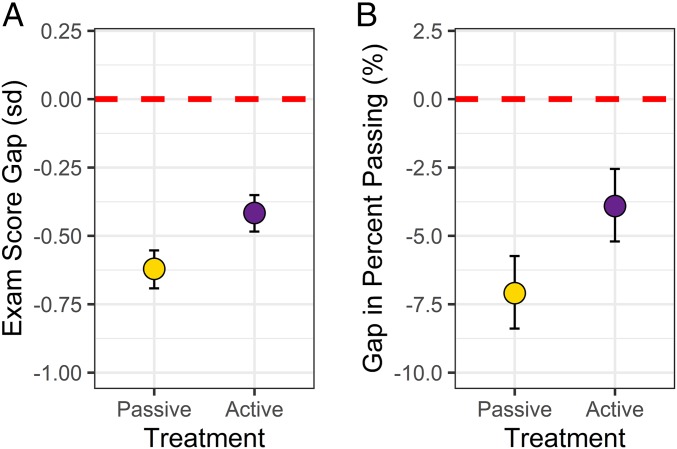
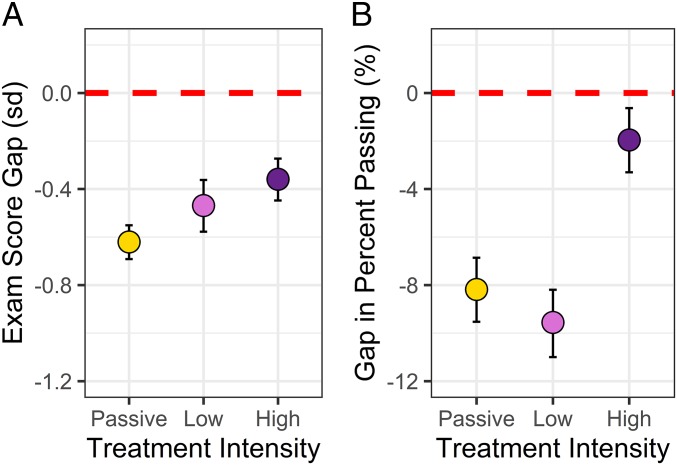
We tested the hypothesis that underrepresented students in active-learning classrooms experience narrower achievement gaps than underrepresented students in traditional lecturing classrooms, averaged across all science, technology, engineering, and mathematics (STEM) fields and courses. We conducted a comprehensive search for both published and unpublished studies that compared the performance of underrepresented students to their overrepresented classmates in active-learning and traditional-lecturing treatments. This search resulted in data on student examination scores from 15 studies (9,238 total students) and data on student failure rates from 26 studies (44,606 total students). Bayesian regression analyses showed that on average, active learning reduced achievement gaps in examination scores by 33% and narrowed gaps in passing rates by 45%. The reported proportion of time that students spend on in-class activities was important, as only classes that implemented high-intensity active learning narrowed achievement gaps. Sensitivity analyses showed that the conclusions are robust to sampling bias and other issues. To explain the extensive variation in efficacy observed among studies, we propose the heads-and-hearts hypothesis, which holds that meaningful reductions in achievement gaps only occur when course designs combine deliberate practice with inclusive teaching. Our results support calls to replace traditional lecturing with evidence-based, active-learning course designs across the STEM disciplines and suggest that innovations in instructional strategies can increase equity in higher education.
Verified 2026-11-22 · 3 references not checked yet
Overview
CoChat Summary
TL;DR
This systematic review and individual-participant-data meta-analysis found that active learning reduced achievement gaps for underrepresented/minoritized students in undergraduate STEM courses. Across the analyzed studies, gaps in exam scores and passing rates were smaller in active-learning than in traditional lecturing, with the largest gap reductions seen in high-intensity active learning.
Key findings
- In identical or formally equivalent exams, the standardized achievement gap between MGS and non-MGS students was −0.62 SDs in traditional lecturing and −0.42 SDs with active learning, a 33% reduction in the gap.
- For passing rates, the gap was −7.1% with traditional lecturing and −3.9% with active learning, a 45% reduction in the gap.
- Gap reductions were stronger with high-intensity active learning: exam-score gaps were −0.48 SDs for low-intensity vs −0.36 SDs for high-intensity; passing-rate gaps were −9.6% for low-intensity vs −2.0% for high-intensity.
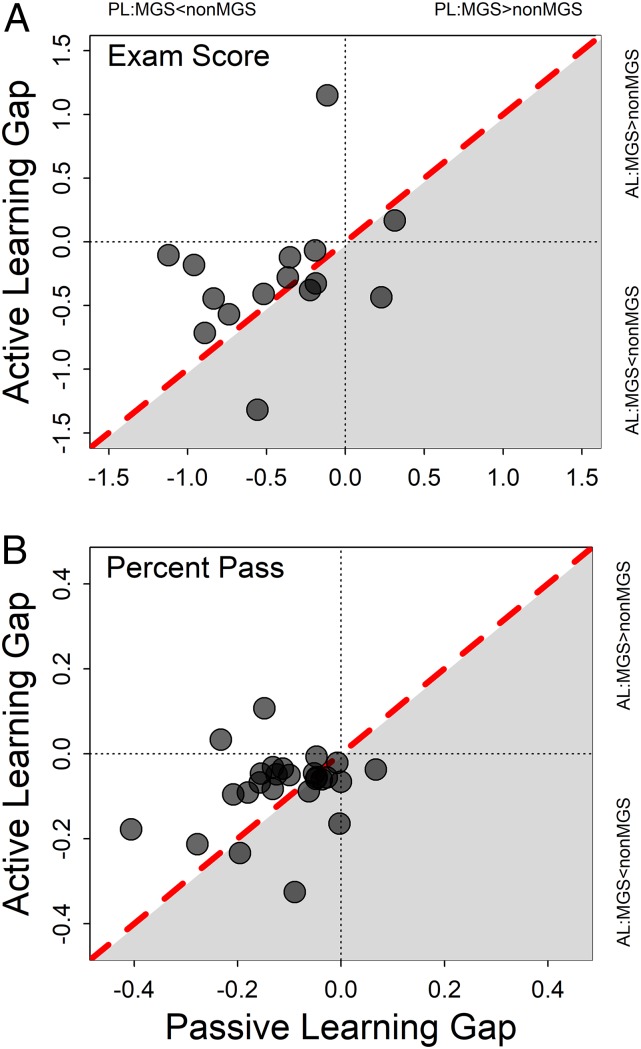
- In the study-level breakdown, 10 of 15 studies with exam-score data showed disproportionate gains for MGS students under active learning, and 15 of 26 studies with failure-rate data showed disproportionate reductions in failure rates for MGS students.
Methods
- Systematic review plus individual-participant-data (IPD) meta-analysis comparing undergraduate STEM courses taught with traditional lecturing vs active learning in the same course and institution.
- Literature search covered studies published or completed from January 1, 2010 to June 30, 2016; the final analysis included 41 studies with disaggregated data by MGS status.
- Final datasets: 9,238 student records from 15 studies for exam scores and 44,606 student records from 26 studies for failure rates; analyses used hierarchical Bayesian multilevel models with section random effects and sensitivity analyses.
Limitations
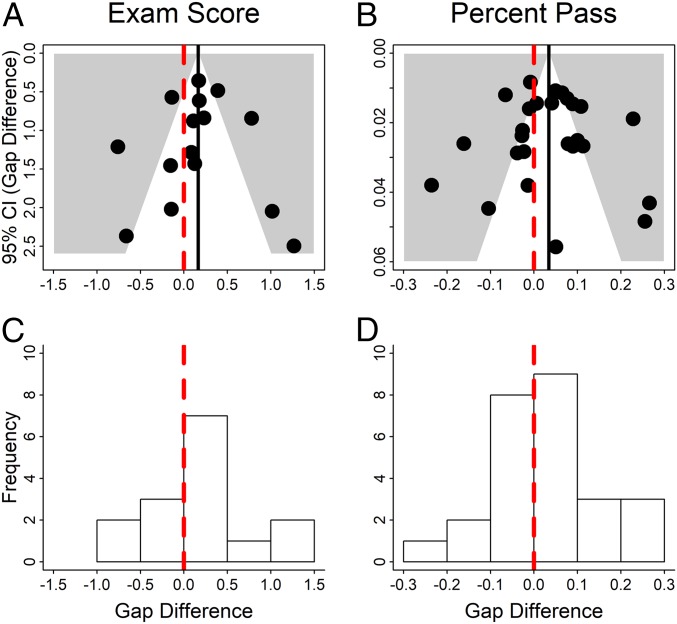
- The paper states that the conclusions are “tempered by the limitations of the study’s sample size”: only 41 studies had data for students from MGS, which also made moderator analyses hard to interpret.
- The paper says data on the type of active learning were “poorly resolved” because studies often did not report quantitative details of course interventions.
- The paper notes possible sampling bias in instructor/institution type, overrepresentation of research-intensive institutions, and underrepresentation of teaching-intensive institutions and community colleges.
- Evident from the text: the meta-analysis depends on studies that met specific coding and data-sharing criteria, so the findings may not generalize to STEM courses or settings not represented in the included studies.
Model-written summary. Check it against the paper before relying on it.
Integrity signals
Registry
Cites
Statistics
Figures
Verification
Claims the paper makes
16 Valid · 1 Not valid · 10 Not checked · 59 Own results and interpretations
The cited sources support only part of this claim — read each source’s verdict below.
In the paper
“Course grades in most STEM courses are largely driven by performance on examinations, even in active-learning courses that offer many nonexam points (39).”
§ Active learning narrows achievement gaps for underrepresented students in undergraduate science, technology, engineering, and math > Discussion
What the sources say
- Partly supportedcites [39] Freeman S., Haak D., Wenderoth M. P., Increased course structure improves performance in introductory biology. CBE Life Sci. Educ. 10, 175– 186 (2011). 21633066 PMC3105924 sourceExperimental — accuracy not yet measured
The Methods section (“Exam Impact on Final Course Grade”; page unavailable) says the authors intended exams to remain the primary determinant of grades even when many nonexam points were available. Table 4 in the Results shows that exam points strongly predicted final grades across the introductory biology sections studied. The paper does not establish that this holds in most STEM courses. (LLM, conf=0.88)
plainstates an association- Asserted: passes — The authors put it forward as true.
- Checkable: passes — It can be checked against evidence.
- Load-bearing: passes — The paper’s conclusions depend on it.
- Based: passes — The paper gives a reason why it holds.
- Partly supported
The cited sources support only part of this claim — read each source’s verdict below.
In the paper
“All students benefit from classroom cultures that promote self-efficacy, identity as a scientist, and sense of belonging in STEM (58)”
§ Active learning narrows achievement gaps for underrepresented students in undergraduate science, technology, engineering, and math > Discussion
What the sources say
- Partly supportedcites [58] Trujillo G., Tanner K. D., Considering the role of affect in learning: Monitoring students’ self-efficacy, sense of belonging, and science identity. CBE Life Sci. Educ. 13, 6– 15 (2014). 24591497 PMC3940464 sourceExperimental — accuracy not yet measured
The paper’s sections on self-efficacy, sense of belonging, and science identity link each to student learning or persistence, and its discussion of teaching considers how classroom experiences shape these factors. Its focus is undergraduate biology, however; it does not establish that all students benefit from such classroom cultures across STEM. The indexed passages provide section labels but no page numbers. (LLM, conf=0.82)
plainstates a cause- Asserted: passes — The authors put it forward as true.
- Checkable: passes — It can be checked against evidence.
- Load-bearing: unclear — It is unclear whether the paper’s conclusions depend on it.
- Based: passes — The paper gives a reason why it holds.
- Partly supported
The cited sources support only part of this claim — read each source’s verdict below.
In the paper
“students in active-learning course designs that reduced or eliminated achievement gaps have reported an increased sense of community and self-efficacy compared to their peers in the lecture-intensive version of the same course (22, 23).”
§ Active learning narrows achievement gaps for underrepresented students in undergraduate science, technology, engineering, and math > Discussion
What the sources say
- Partly supportedcites [22] Eddy S. L., Hogan K. A., Getting under the hood: How and for whom does increasing course structure work? CBE Life Sci. Educ. 13, 453– 468 (2014). 25185229 PMC4152207 sourceExperimental — accuracy not yet measured
In Methods and Results (Study 3, Factor 2; page unavailable), students in the moderate-structure course were twice as likely to report a stronger sense of classroom community than those in the low-structure course. The Introduction mentions self-reported self-efficacy in prior active-learning research, but says that research did not compare students in versions of the same course. This paper therefore does not support the claimed same-course self-efficacy comparison. (LLM, conf=0.88)
- Not matchedcites [23] Ballen C. J., Wieman C., Salehi S., Searle J. B., Zamudio K. R., Enhancing diversity in undergraduate science: Self-efficacy drives performance gains with active learning. CBE Life Sci. Ed. 16, ar56 (2017). PMC5749958 29054921
We don’t have this paper’s reference list.
plainstates an association- Asserted: passes — The authors put it forward as true.
- Checkable: passes — It can be checked against evidence.
- Load-bearing: unclear — It is unclear whether the paper’s conclusions depend on it.
- Based: passes — The paper gives a reason why it holds.
- Partly supported
Every source the paper cites for this claim was checked and supports it.
In the paper
“Our data on type of active learning are also poorly resolved, because publications still routinely fail to report quantitative data on the nature of course interventions, such as records from classroom observation tools (e.g., ref. 61 and SI Appendix, Table S12).”
§ Active learning narrows achievement gaps for underrepresented students in undergraduate science, technology, engineering, and math > Discussion
What the sources say
- Supportedcites [61] Eddy S. L., Converse M., Wenderoth M. P., PORTAAL: A classroom observation tool assessing evidence-based teaching practices for active learning in large science, technology, engineering, and mathematics classes. CBE Life Sci. Educ. 14, ar23 (2015). PMC4477739 26033871 source
The citation appears as an example of a classroom observation tool, not as evidence that publications routinely omit quantitative intervention data. The Abstract identifies PORTAAL as a classroom observation tool for assessing active-learning practices, which supports that use of the citation. (LLM, conf=0.91)
plainstates a cause- Asserted: passes — The authors put it forward as true.
- Checkable: passes — It can be checked against evidence.
- Load-bearing: unclear — It is unclear whether the paper’s conclusions depend on it.
- Based: passes — The paper gives a reason why it holds.
- Supported
Every source the paper cites for this claim was checked and supports it.
In the paper
“larger gaps are correlated with faculty who have a fixed mindset, which interprets intelligence as innate and immutable and is therefore exclusion or selection-oriented (44).”
§ Active learning narrows achievement gaps for underrepresented students in undergraduate science, technology, engineering, and math > Discussion
What the sources say
- Supportedcites [44] Canning E. A., Muenks K., Green D. J., Murphy M. C., STEM faculty who believe ability is fixed have larger achievement racial achievement gaps and inspire less student motivation in their classes. Sci. Adv. 5, eaau4734 (2019). 30793027 PMC6377274 source
The Results report that racial achievement gaps in STEM courses were nearly twice as large with fixed- versus growth-mindset faculty. The Introduction defines a fixed mindset as treating intelligence and ability as innate and largely unchangeable, and describes judging students as low-ability and encouraging them to drop difficult courses—supporting the paraphrase 'exclusion or selection-oriented.' (LLM, conf=0.88)
plainstates an association- Asserted: passes — The authors put it forward as true.
- Checkable: passes — It can be checked against evidence.
- Load-bearing: unclear — It is unclear whether the paper’s conclusions depend on it.
- Based: passes — The paper gives a reason why it holds.
- Supported
30 more claims
Create a free account to see all 86 claims and every source verdict.
- It may state two separate claims as one. 30
- Probably not a substantial claim. 36
Claims other papers make about this one
Each is checked against this paper’s own text: does it say what the citing paper says it does?
The source backs part of the claim, not all of it — or backs it for a different population, condition or comparison.
In the citing paper
“These perceptions, along with a likely reduction in stress and anxiety (see Figure 4), could benefit students from underrepresented groups and may thus reduce the achievement gap among underrepresented minorities”
From Two-Stage Final Exams: An Assessment Strategy for Enhanced Collaborative Learning and Reduced Student Stress (2026) · cites this paper as Theobald et al., 2020
Experimental — accuracy not yet measured
Citations
Cites
Preferred Reporting Items for Systematic Reviews and Meta-Analyses: the PRISMA statement
Moher, D., Liberati, A., Tetzlaff, J., Altman, D. G., & for the PRISMA Group (2009) · BMJ · doi:10.1136/bmj.b2535 · Cited by 83,823
Preferred reporting items for systematic reviews and meta-analyses: the PRISMA Statement.
(2009) · PubMed Central · Cited by 44,859
Preferred reporting items for systematic reviews and meta-analyses: The PRISMA statement
Moher, D., Liberati, A., Tetzlaff, J., Altman, D. G., & the PRISMA Group* (2009) · Annals of Internal Medicine · doi:10.7326/0003-4819-151-4-200908180-00135 · Cited by 37,554
PRISMA-P Group, Moher, D., Shamseer, L., Clarke, M., Ghersi, D., Liberati, A., Petticrew, M., Shekelle, P., & Stewart, L. A. (2015) · Systematic Reviews · doi:10.1186/2046-4053-4-1 · Cited by 26,223 · cited 2×
“The protocol for this study, presented in the PRISMA-P format (66) and including annotations regarding modifications that occurred during the course of the research, is available in SI Appendix, SI Materials and Methods.”
Capital in the Twenty-First Century
Piketty, T. (2014) · doi:10.4159/9780674369542 · Cited by 14,437
Data Analysis Using Regression and Multilevel/Hierarchical Models
Gelman, A., & Hill, J. (2006) · doi:10.1017/cbo9780511790942 · Cited by 13,597
Active learning increases student performance in science, engineering, and mathematics
Freeman, S., Eddy, S. L., McDonough, M., Smith, M. K., Okoroafor, N., Jordt, H., & Wenderoth, M. P. (2014) · Proceedings of the National Academy of Sciences · doi:10.1073/pnas.1319030111 · Cited by 9,787 · cited 6×
“Can interventions in courses themselves—meaning, changes in how science is taught—reduce achievement gaps and promote retention in STEM? A recent metaanalysis concluded that, on average, active learning in STEM leads to higher examination scores and lower failure rates for all students, compared to all students in the…”
InfluentialSelf-citation(2000) · Cited by 9,198
A threat in the air: How stereotypes shape intellectual identity and performance
Steele, C. M. (1997) · American Psychologist · doi:10.1037/0003-066x.52.6.613 · Cited by 6,770 · cited 1×
“Equally important, inclusive teaching emphasizes treating students with dignity and respect (52), communicating confidence in students’ ability to meet high standards (53), and demonstrating a genuine interest in students’ intellectual and personal growth and success (54, 55).”
BackgroundGeneral methods for monitoring convergence of iterative simulations
Brooks, S. P., & Gelman, A. (1998) · Journal of Computational and Graphical Statistics · doi:10.1080/10618600.1998.10474787 · Cited by 6,045
Research works printed but not linked: 9
- Reardon S. F., “The widening achievement gap between the rich and the poor: New evidence and possible explanations” in Whither Opportunity? Duncan G. J., Murnane R. J., Eds. (Russell Sage Foundation, New York, 2011), pp. 91– 115.
- National Student Clearinghouse Research Center, High School Benchmarks 2019: National College Progression Rates (National Student Clearinghouse, Herndon, VA, 2019).
- Chen X., STEM Attrition: College Students’ Paths Into and Out of STEM Fields (National Center for Education Statistics, Washington, DC, 2013).
- Vygotsky L. S., Mind in Society (Harvard University Press, Cambridge, MA, 1978).
- Kaufmann E., Reips U.-D., Merki K. M., Avoiding methodological biases in meta-analysis. Z. Psychol. 224, 157– 167 (2016).
- Ginder S. A., Kelly-Reid J. E., Mann F. B., Enrollment and Employees in Postsecondary Institutions, Fall 2015 (National Center for Education Statistics, Washington, DC, 2017).
- Reed J. G., Baxter P. M., Using Reference Databases. The Handbook of Research Synthesis and Meta-Analysis, Cooper H., Hedges L. V., Valentine J. C., Eds. (Russell Sage Foundation, New York, 2009), pp. 73– 101.
- Rothstein H., Hopewell S., Grey Literature. The Handbook of Research Synthesis and Meta-Analysis, Cooper H., Hedges L. V., Valentine J. C., Eds. (Russell Sage Foundation, New York, 2009), pp. 103– 125.
- White H. D., Scientific Communication and Literature Retrieval. The Handbook of Research Synthesis and Meta-Analysis, Cooper H., Hedges L. V., Valentine J. C., Eds. (Russell Sage Foundation, New York, 2009), pp. 51– 71.
Cited by
Items 601–700 of 1,369
Visualizing Inequities: A Step Toward Equitable Student Outcomes
Tatapudy, S., Potter, R., Bostrom, L., Colgan, A., Self, C. J., Smith, J. L., Xu, S., & Theobald, E. J. (2024) · CBE—Life Sciences Education · doi:10.1187/cbe.24-02-0086 · Cited by 6
Self-citationKorisky, A., Davidesco, I., Abu, O. B., Levy, O., Abrahami, K., Geri, O., & Golumbic, E. Z. (2024) · Mind Brain and Education · doi:10.1111/mbe.12432 · Cited by 9
Biwer, F., Taban, G., & de Bruin, A. B. H. (2025) · European Journal of Engineering Education · doi:10.1080/03043797.2025.2458117 · Cited by 9
“Active learning has been shown to decrease achievement gaps and lower attrition rates in engineering courses and the STEM area (Freeman et al. 2014; Theobald et al. 2020).”
Practice it to ace it: students writing practice questions for tests
Choi, Y., Jenkins, L. D., & Crowther, G. J. (2025) · AJP Advances in Physiology Education · doi:10.1152/advan.00172.2024 · Cited by 4
Carroll, L. J., DesJardins, S. L., & Finelli, C. (2025) · Research in Higher Education · doi:10.1007/s11162-024-09820-8 · Cited by 5
“For example, they can use active learning in class (Theobald et al., 2020) and encourage or assign similar activities, such as problem-solving, self-quizzing, and developing concept maps, outside of class (Dolin, 2022).”
Sedlacek, Q. C., Villa, A. M., Friend, M., Perez, G. A., Dozier, S. J., Haeger, H. A., Lomelí, K., & Mejia, J. A. (2025) · Educational Psychology Review · doi:10.1007/s10648-025-10021-7 · Cited by 8
Edwards, B. A., Granados, A., Mohammed, T. F., Aini, R. Q., Cooper, K. M., Barnes, M. E., & Brownell, S. E. (2025) · CBE—Life Sciences Education · doi:10.1187/cbe.24-10-0249 · Cited by 3
“…transitioning away from traditional lecture and toward active learning, and this style of learning has been proven to be effective, on average, at improving student performance (Freeman et al. , 2014) and reducing achievement gaps for people of color (Theobald et al. , 2020; Yannier et al. , 2021).”
Lowering barriers to active learning: a novel approach for online instructional environments
Rhodes, A. E. (2021) · AJP Advances in Physiology Education · doi:10.1152/advan.00009.2021 · Cited by 7
A new resource to help instructors incorporate active learning into analytical chemistry courses
Kovarik, M. L., Robinson, J. K., & Wenzel, T. J. (2022) · Analytical and Bioanalytical Chemistry · doi:10.1007/s00216-022-04077-5 · Cited by 5
Fischer, C., Nguyen, H., Estrella, G., & Collins, P. (2022) · PLoS ONE · doi:10.1371/journal.pone.0267188 · Cited by 7
“A recent meta-analysis reported that active learning in STEM courses reduced the achievement gap for minority and lowincome by 33% in their examination grades and reduced the gap in pass rates by 45% [36].”
BackgroundWork in Progress: An Ecosystems Metaphor for Propagation
Nolen, S. B., & Koretsky, M. (2020) · ASEE Annual Conference & Exposition · doi:10.18260/1-2--35606 · Cited by 5
McQueen, H. A., & Colegrave, N. (2022) · International Journal of STEM Education · doi:10.1186/s40594-022-00360-0 · Cited by 7
“Indeed, a meta-analysis of such studies has revealed that active learning provides a disproportionate advantage to traditionally low-scoring student groups across STEM disciplines (Theobald et al., 2020).”
Games for the Inorganic Chemistry Classroom
Thammavongsy, Z., & Radlauer, M. R. (2022) · Inorganic Chemistry · doi:10.1021/acs.inorgchem.2c02544 · Cited by 3
Dulai, K. S., Kranzfelder, P., Signorini, A., Pusey, T. S., Valencia, A. P., Urbina, C., & Oviedo, N. J. (2022) · CBE—Life Sciences Education · doi:10.1187/cbe.21-08-0199 · Cited by 5
“, 2014) and narrowing the achievement gap for underrepresented students in STEM fields (Gavassa et al., 2019; Theobald et al., 2020).”
BackgroundCharles, E. S., Lenton, K., Adams, R., et al. (2022) · doi:10.1117/12.2632373 · Cited by 3
“Inquiry-Based (IB) instruction is a form of active learning [1, 2], situated within the context of investigating authentic problems [3-5].”
BackgroundNdembera, R., Ray, H. E., Shah, L., & Rushton, G. T. (2022) · Journal of Geoscience Education · doi:10.1080/10899995.2022.2138067 · Cited by 4
“It has been widely accepted that teachers are central to improving K-12 education systems (Darling-Hammond & Youngs, 2002; Harris & Sass, 2011; Toh et al., 2007).”
BackgroundThe increasing relevance of immunobiology within a connected animal science curriculum
Meade, K. G. (2023) · Translational Animal Science · doi:10.1093/tas/txad007 · Cited by 3
Dreyfus, T., Apkarian, N., Rasmussen, C. L., et al. (2023) · International Journal of Research in Undergraduate Mathematics Education · doi:10.1007/s40753-022-00211-x · Cited by 3
“There is evidence from meta-analyses that active learning approaches (which include inquiry-oriented classrooms and many other pedagogies) have advantages for learning outcomes, in particular at the tertiary level (Freeman et al., 2014; Theobald et al., 2020).”
A Network Model for Connecting Mathematics Faculty in Communities of Practice: Where is the Value?
Jakopovic, P. M., & Johnson, K. G. (2023) · Innovative Higher Education · doi:10.1007/s10755-023-09650-z · Cited by 5
“Instructors using evidence-based instructional practices, including teaching with inquiry (TWI), have increased the knowledge, skills, behaviors, and motivation of their students (Abramovich et al., 2019; Freeman et al., 2014; Laursen et al., 2014; Theobald et al., 2020).”
BackgroundOlawoyin, R., & Ogutu, J. (2023) · Journal of Safety Research · doi:10.1016/j.jsr.2023.06.003 · Cited by 6
Perceived Barriers to Equitable Participation in the Learning Assistant Program
Kattoum, R. N., Abbood, I., Huff, K. E., & Baillie, M. T. (2023) · Journal of Chemical Education · doi:10.1021/acs.jchemed.2c00635 · Cited by 5
Kamarrudin, H., Talib, O., Kamarudin, N., & Ismail, N. (2023) · Malaysian Journal of Social Sciences and Humanities (MJSSH) · doi:10.47405/mjssh.v8i6.2342 · Cited by 6
Koron, J., Gallant, S. K., & Spiess, P. C. (2023) · Journal of Chemical Education · doi:10.1021/acs.jchemed.2c00934 · Cited by 3
Green, R. E., Dayer, A. A., & Johnson, A. E. M. (2023) · Citizen Science Theory and Practice · doi:10.5334/cstp.507 · Cited by 4
Siddall, A., Williams, A. A., Sanders, J., Denton, J. A., Madden, D., Schollar, J., & Bryk, J. (2023) · Access Microbiology · doi:10.1099/acmi.0.000596.v3 · Cited by 3
“Notably, practical synthetic biology exemplified by building novel biological constructs from compatible genetic parts, favour active learning approaches in teaching, which were shown to improve students’ academic attainment [22, 23].”
BackgroundAdkins-Jablonsky, S. J., Brasfield, K., Tran, T., Morris, J., & Raut, S. A. (2023) · Journal of Research in Science Mathematics and Technology Education · doi:10.31756/jrsmte.633 · Cited by 3
“The percentage of students who receive Ds or Fs or withdraw from introductory biology courses (known as the DFW rate) ranges from 20 to 30% at universities across the United States (Bell, 2018; Freeman et al., 2014; Ueckert et al., 2011; Theobald et al., 2020).”
BackgroundBennett, A. B., Uhing, K., Williams, M., & Kress, N. E. (2023) · International Journal of Mathematical Education in Science and Technology · doi:10.1080/0020739x.2023.2255183 · Cited by 4
“In light of efforts to incorporate AL and EIT in the same spaces, there is an associated need to research these ideas, and the relationship between them, more deeply (e.g. Reinholz et al., 2020; Theobald et al.,2020 ).”
BackgroundReflections on the Teaching Symposium at the Microbiology Society Annual Conference 2023
Lacey, M. M., Jones, K. L., Gostić, M., et al. (2023) · Access Microbiology · doi:10.1099/acmi.0.000676.v3 · Cited by 3
“Many of the speakers in the morning session embedded active learning [9] in their practice.”
BackgroundSelf-citationStudent belonging in STEM courses that use group work
Emigh, P. J., Krishna, S., Liao, J., Kita, K., Casey, J. R., & Nissen, J. (2023) · Physics Education Research Conference (PERC) · doi:10.1119/perc.2023.pr.emigh · Cited by 4
“Such instruction may [23, 24] or may not [25] achieve improved equity.”
BackgroundResultHarnessing H5P for Asynchronous Active Learning
Bui, N., & Brooks, C. (2023) · ASCILITE Publications · doi:10.14742/apubs.2023.572 · Cited by 4
Weigel, E., & Angra, A. (2023) · The journal of college science teaching · doi:10.1080/0047231x.2023.12290635 · Cited by 4
A study of Well-being among College of Engineering Graduate Students
Wang, Y., & Clark, C. A. C. (2024) · ASEE Annual Conference & Exposition · doi:10.18260/1-2--40710 · Cited by 3
Exploring Magic Interactions for Collaboration in Virtual Reality Learning Factory
Hartleb, T., Kim, H., Zhao, R., Aqlan, F., & Yang, H. Y. (2024) · ASEE Annual Conference & Exposition · doi:10.18260/1-2--43621 · Cited by 7
“This approach promotes self-reflection and helps students develop the essential skills needed for professional careers [1] Additionally, active learning approaches have decreased failure rates, increased grades [1] [2], and narrowed gaps for underrepresented students [3].”
BackgroundLandis, E. C. (2024) · Journal of Chemical Education · doi:10.1021/acs.jchemed.4c00110 · Cited by 3
Student-Generated Analogies for Learning about Information Flow
Newman, D. L., Uminski, C., & Wright, L. K. (2024) · CourseSource · doi:10.24918/cs.2024.14 · Cited by 3
“The lesson is an example of high intensity active learning, which has been shown to narrow achievement gaps for underrepresented students (21).”
BackgroundDistributed Active Learning (DAL): An Approach to Reduce Class Size in Large Enrollment Courses
Clark, T. M., Ricciardo, R. A., & Turner, D. A. (2024) · Journal of Chemical Education · doi:10.1021/acs.jchemed.4c00108 · Cited by 3
Analyzing Student's Motivation Towards Science Learning in Junior High School
Nuraysha, A. D., Winarno, N., Fadly, W., Hakim, L., & Emiliannur, E. (2024) · Jurnal Penelitian Pendidikan IPA · doi:10.29303/jppipa.v10i7.7297 · Cited by 21
“Based on students' statements, this implies that teachers have an important role as providers of knowledge or concepts for students as stated by Theobald et al. (2020) that active learning strategies include structured activities that foster student engagement, and the teacher's role involves that…”
BackgroundA Comparative Study of Two Active Learning Approaches for General Chemistry
Tran, L. A., Clements, K. A., Obenland, C. A., Kincaid, K., Munson, A. H., & Hutchinson, J. S. (2024) · Journal of Chemical Education · doi:10.1021/acs.jchemed.4c00638 · Cited by 8
Huggett, K. N., Smith, G. A., Hsieh, P. H., & Ownby, A. R. (2025) · Academic Medicine · doi:10.1097/acm.0000000000005967 · Cited by 5
Chantanahom, P., Rungsiyakull, C., Sukapattee, M., Chaijareenont, P., & Rungsiyakull, P. (2025) · BMC Medical Education · doi:10.1186/s12909-025-06703-z · Cited by 5
Calculating the Precision of Student-Generated Datasets Using RStudio
Chiarelli, J. A., Hilaire, M. A. S., Baldock, B. L., Franco, J., Theberge, S. M., & Fernandez, A. L. (2025) · Journal of Chemical Education · doi:10.1021/acs.jchemed.4c00870 · Cited by 6
Experience Report: Physical Models of Java Inheritance
Lewis, C. M., Hernández, M., Kuo, A., McDowell, H., & Roller, N. (2025) · ACM Technical Symposium on Computer Science Education (SIGCSE) · doi:10.1145/3641554.3701871 · Cited by 3
Enhancing CS Education with LAs Using AI-Empowered AIELA Program
Ramasamy, V., Kulpinski, E., Beaupre, T., Antreassian, A., Jeong, Y., Clarke, P., Aiello, A., & Ray, C. (2024) · IEEE Frontiers in Education Conference (FIE) · doi:10.1109/fie61694.2024.10893294 · Cited by 7
“Active learning has been shown to enhance student performance on assessments and concept inventories in Science, Technology, Engineering, and Mathematics (STEM) class-rooms [25], [43].”
A Scoring Algorithm for the Early Prediction of Academic Risk in STEM Courses
Poturić, V. Č., Čandrlić, S., & Dražić, I. (2025) · Algorithms · doi:10.3390/a18040177 · Cited by 8
“Theobald et al. [16] indicated that active learning strategies employed early in the course can help close achievement gaps, supporting the notion that early prediction is critical to student success.”
Fernández-Escandón, R. L., Estébanez, R. P., & Estébanez, M. P. (2025) · Educational Point · doi:10.71176/edup/16225 · Cited by 6
“The significant improvement in students’ oral expression abilities aligns with findings from a study by Theobald et al. (2020), which observed that active learning strategies can reduce achievement gaps in undergraduate science courses, benefiting all students, including those from underrepresented…”
Nursing Continuing Professional Development and Active Learning Strategies
Roy, J., & Graebe, J. A. (2025) · The Journal of Continuing Education in Nursing · doi:10.3928/00220124-20250321-02 · Cited by 4
Community college biology students' understanding of Vision and Change core concepts
Courtney, N. A., Smith, M. K., & Esparza, D. (2025) · Journal of Microbiology and Biology Education · doi:10.1128/jmbe.00211-24 · Cited by 7
Backer, P. R., Chierichetti, M., Sullivan-Green, L. E., & Rosenfeld, L. (2024) · ASEE Annual Conference & Exposition · doi:10.18260/1-2--37427 · Cited by 4
Mentorship Using DEIR Principles: A Case in Developing Chemistry-Related Student Research
Rukmini, E., Emenike, M. E., & Angelina, H. (2021) · Journal of Chemical Education · doi:10.1021/acs.jchemed.1c00386 · Cited by 3
Economy Studies: A Guide to Rethinking Economics Education
de Muijnck, S., & Tieleman, J. (2021) · Amsterdam University Press eBooks · doi:10.1515/9789048552801 · Cited by 21
Adams, R., & Charles, E. S. (2022) · Optical Engineering · doi:10.1117/1.oe.61.8.081805 · Cited by 3
Resources to bring diversity, equity, inclusion, and respect into analytical chemistry classrooms
Lucy, C. A., Ries, K. R., & Mensinger, Z. L. (2022) · Analytical and Bioanalytical Chemistry · doi:10.1007/s00216-022-04345-4 · Cited by 3
“Students who strongly self-identify as scientists are more likely to persist in their STEM career [9].”
BackgroundInfluentialCOVID-19 Has Exacerbated Inequities That Hamper Physician Workforce Diversification
Woodruff, J. N., McDade, W. A., Nakae, S., & Vela, M. B. (2022) · JAMA Network Open · doi:10.1001/jamanetworkopen.2022.38566 · Cited by 4
An Analysis of the Observable Behaviors of Undergraduate drop-in Mathematics Tutors
Johns, C., Mills, M., & Ryals, M. (2022) · International Journal of Research in Undergraduate Mathematics Education · doi:10.1007/s40753-022-00197-6 · Cited by 5
“Within the classroom context, research suggests that active learning increases performance, decreases failure rates, and decreases the achievement gap for marginalized students (Freeman et al., 2014; Theobald et al., 2020).”
BackgroundUsing Technology to Enhance Student Engagement in STEM Subjects in Higher Education
Chakabwata, W. (2022) · Advances in educational technologies and instructional design book series · doi:10.4018/978-1-6684-5920-1.ch009 · Cited by 4
McGee, R. E., Walker, E. R., McBride, C. M., Nehl, E. J., Rice, W. S., Wise, N. E., Jones-Harrell, C., & Lang, D. L. (2023) · Pedagogy in Health Promotion · doi:10.1177/23733799231186637 · Cited by 3
“Collaborative learning encourages student autonomy (Hill et al., 2020), and as a form of active learning has the potential to create more equitable learning outcomes (Theobald et al., 2020).”
BackgroundOnline Neuroscience Instruction: Insights, Lessons Learned, and Moving Forward
Wee, B. E. F. (2022) · Journal of Undergraduate Neuroscience Education · doi:10.59390/pqjq5721 · Cited by 3
“We are more aware of the need for accessibility and inclusion (Penner, 2018; Theobald et al. 2020).”
BackgroundLooking to the Future of Analytical Chemistry Education: A New Resource to Help Instructors
Wenzel, T. J., Kovarik, M. L., & Robinson, J. K. (2022) · ACS Measurement Science Au · doi:10.1021/acsmeasuresciau.2c00014 · Cited by 4
Tiny Earth CURE improves student persistence in sciencePreprint
Miller, S., Aldana, C. C., Du, W., Lee, H., Maldonado, N., Sandoval, P. J., Vong, J., Young, G. R., Handelsman, J., Broderick, N. A., et al. (2023) · bioRxiv (Cold Spring Harbor Laboratory) · doi:10.1101/2023.06.21.543782 · Cited by 3
“Active learning has long been known to enhance the performance and retention of all students and is especially beneficial to students from HECs (Freeman et al., 2014; Haak et al., 2011; Hake, 1998; Hood et al., 2020; Schwartz et al., 2011; Theobald et al., 2020).”
BackgroundEslit, E. R. (2023) · Preprints.org · doi:10.20944/preprints202309.0777.v1 · Cited by 2
Active learning through flexible collaborative exams: Improving assessments across disciplines
Callaghan, K., Kestin, G., Klales, A., McCarty, L., & Deslauriers, L. (2026) · Active Learning in Higher Education · doi:10.1177/14697874251344293 · Cited by 2
“…recognized that research-based educational strategies that promote engagement and collaboration among peers substantially enhance both learning outcomes and student attitudes (Crouch & Mazur, 2001; Deslauriers et al., 2011, 2019; Freeman et al., 2014; Smith et al., 2009; Theobald et al., 2020).”
Kirkwood-Watts, D. L., Bremers, E. K., Robinson, E. A., Brazeal, K. R., & Couch, B. A. (2022) · Journal of Microbiology and Biology Education · doi:10.1128/jmbe.00038-22 · Cited by 3
Promoting active learning in STEM subjects
Rinneheimo, K.-M., Kinnari-Korpela, H., Velichová, D., et al. (2022) · doi:10.5821/conference-9788412322262.1472 · Cited by 2
“Several research studies have advocated active learning methods in teaching and learning STEM subjects (see e.g. Freeman et al. (2014), Theobald et al. (2020) and Prince (2004)).”
BackgroundHughes, D., Keim, S., & Fontes, J. D. (2023) · Medical Science Educator · doi:10.1007/s40670-023-01842-8 · Cited by 4
“Additionally, it has also been reported recently that active learning might help narrow achievement gaps for students with backgrounds underrepresented in STEM fields [40, 41] and in medical school pipeline programs [42, 43].”
BackgroundPiard, J., & Moyon, M. (2024) · Didactique · doi:10.37571/2024.0206 · Cited by 4
Tancontian, A., Abina, I. L., & Evardo, O. J. (2024) · Journal of interdisciplinary perspectives · doi:10.69569/jip.2024.0087 · Cited by 3
Barker, M., Mutawe, B., Simons, K., McDowell, N., & Wiggins, B. L. (2024) · The journal of college science teaching · doi:10.1080/0047231x.2024.2363120 · Cited by 2
Denaro, K., Molinaro, M., Fiorini, S., Matz, R. L., Mead, C., Motika, M., Tarchinski, N. A., Medinaceli, M. V., Byrd, W. C., Koester, B. P., et al. (2024) · CBE—Life Sciences Education · doi:10.1187/cbe.24-02-0051 · Cited by 4
“While active learning approaches have been shown to reduce achievement gaps for minoritized students (Theobald et al. , 2020), it has been shown that adoption of student-centered instructional practices vary across discipline and institution (Stains et al. , 2018).”
Examining Digital Curricular Enhancements to First-Year Seminars and Effects on College Success
Bernacki, M. L., Gianoutsos, D., & Cogliano, M. (2025) · Innovative Higher Education · doi:10.1007/s10755-025-09783-3 · Cited by 3
“These transitions to active learning designs have been found to benefit all learners, and to even ameliorate achievement gaps (Theobald et al., 2020).”
Do course syllabi reflect observed teaching practices in undergraduate geoscience courses?
Czajka, C. D., Teasdale, R., Ryker, K. D., & Viskupic, K. M. (2025) · Journal of Geoscience Education · doi:10.1080/10899995.2025.2489922 · Cited by 2
Latulipe, C., Rosen, A. L., Rorrer, A. S., Tadimalla, S. Y., Nowrin, S., Fiore, J., Mejias, M., Kwatny, G., Payton, J., & Maher, M. L. (2025) · ACM Conference on Innovation and Technology in Computer Science Education (ITiCSE) · doi:10.1145/3724363.3729082 · Cited by 3
Investigating dimensions of instructor trust using the words of undergraduate STEM students
Zhang, K., Gill, J. C., Zhang, T., Crowley, L., Bennie, J., Wagner, H., Bauer, M., Hanauer, D. I., Chen, X., & Graham, M. J. (2025) · Frontiers in Education · doi:10.3389/feduc.2025.1617067 · Cited by 3
Castillo-Cruz, B., González-Espada, W. J., Vedrine-Pauléus, J., & Casillas-Martínez, L. (2025) · Journal of Chemical Education · doi:10.1021/acs.jchemed.5c00123 · Cited by 8
Campilongo, G. B., Tonzar-Santos, G., Verginio, M. E. D. S., & Lellis‐Santos, C. (2025) · Education Sciences · doi:10.3390/educsci15081005 · Cited by 8
“…have shown that the intensive use of active learning strategies can help reduce educational inequalities by significantly narrowing the achievement gaps between under-represented students and their peers in science, technology, engineering, and mathematics (STEM) courses (Theobald et al., 2020).”
Khajeloo, M., & Couch, B. A. (2025) · Innovative Higher Education · doi:10.1007/s10755-025-09842-9 · Cited by 3
“…instructional strategies, including active and inclusive teaching practices, have been highlighted as means to enhance student achievement and persistence in STEM majors, particularly for students from minoritized backgrounds (Azizi et al., 2023; Freeman et al., 2014; Theobald et al., 2020).”
Emekako, R., Ayob, N., Esiefarienrhe, B. M., Chukwuere, J. E., Chesa, E., & Winkelmes, M. (2025) · Journal of Education and Learning Technology · doi:10.38159/jelt.2025694 · Cited by 4
DeCaro, M. S., Golway, K., Bego, C. R., Derkson, S. N., & Hieb, J. (2025) · Journal for STEM Education Research · doi:10.1007/s41979-025-00159-y · Cited by 3
Gqoli, N., & Baidoo, J. (2025) · E-Journal of Humanities Arts and Social Sciences · doi:10.38159/ehass.202561031 · Cited by 9
“32 Understanding these key dimensions is crucial for developing effective AI-enhanced mathematical instruction that promotes intellectual growth and emotional engagement.”
Use of Active Methodologies in Basic Education: An Umbrella Review
López, A. M., Sevillano, M. Á. P., & Sorzio, P. (2025) · Education Sciences · doi:10.3390/educsci15111536 · Cited by 13
Pedraja-Rejas, L., Vega, P. L., & Huanca, P. R. (2025) · Behavioral Sciences · doi:10.3390/bs16010011 · Cited by 8
“Extensive evidence demonstrates that active learning, structured feedback, and collaborative pedagogies can likewise enhance autonomy, competence, and motivation (Burgess et al., 2020; Theobald et al., 2020; Wisniewski et al., 2020).”
Morán-Soto, G., Ulloa, L. H. A., & Peña, O. I. G. (2026) · European Journal of Engineering Education · doi:10.1080/03043797.2025.2607635 · Cited by 4
Sankar, G. (2026) · Journal of Chemical Education · doi:10.1021/acs.jchemed.5c01265 · Cited by 5
Jamal, A. N., Liu, N., & Li, Y. (2026) · Frontiers in Medicine · doi:10.3389/fmed.2026.1705623 · Cited by 5
Combining Active Learning Methodologies in a STEM-Related Course: A Case Study
Roig, P. J., Alcaraz, S., Gilly, K., Bernad, C., & Juiz, C. (2026) · Education Sciences · doi:10.3390/educsci16050740 · Cited by 2
Novkovic, D., Kompen, R. T., & Petchamé, J. (2026) · Review of Education · doi:10.1002/rev3.70158 · Cited by 3
Chapman, L. Y., & McCONNELL, D. A. (2021) · Journal of Geoscience Education · doi:10.1080/10899995.2021.1940467 · Cited by 2
“…methods have the potential to improve learning and student performance (Handelsman et al., 2007; Pollock & Finkelstein, 2008; Singer et al., 2012), reduce the achievement gap (Eddy & Hogan, 2014; Haak et al., 2011; Theobald et al., 2020), and decrease attrition rates (Freeman et al., 2014).”
MethodRoadmap to glory: scaffolding real analysis for deeper learning
Huber, T., Sifuentes, J., & Wilson, A. T. (2021) · International Journal of Mathematical Education in Science and Technology · doi:10.1080/0020739x.2021.1988741 · Cited by 2
“Adaptation of active learningmethods is an effective evidence-based strategy to increase student learning (Theobald et al., 2020).”
BackgroundInfluentialA DEI Task Force within a Mechanical Engineering Department
Roberts, D. P., & Carpick, R. W. (2024) · doi:10.18260/1-2--38419 · Cited by 2
Harrington, R. E., Thijssen, J. H. J., & Hardy, J. (2022) · Physical Review Physics Education Research · doi:10.1103/physrevphyseducres.18.010114 · Cited by 3
Wilson, K. D. (2022) · Teaching of Psychology · doi:10.1177/00986283211060324 · Cited by 2
“Finally, the opportunity to engage in course-based research leads to greater diversity and in-clusivity in STEM disciplines (Bangera & Brownell, 2014; Barlow & Villarejo, 2004; Jones et al., 2010; Nagda et al., 1998; Rodenbusch et al., 2016; Theobald et al., 2020).”
BackgroundWomen in science: a Brazilian experience through immersive narratives in 360° videos
Galvão, D. S., Biazzi, R. B., de Morais, G. C., & Miranda, C. R. (2022) · International Journal of Science Education Part B · doi:10.1080/21548455.2022.2076293 · Cited by 2
Shifts in Power Relations across Group Work Activities for Gas Laws
Britter, M., Donnelly-Hermosillo, D. F., & Gulacar, O. (2022) · Journal of Chemical Education · doi:10.1021/acs.jchemed.2c00177 · Cited by 2
Effectiveness of Transparency in Learning and Teaching (TILT) in Chemistry Courses
Medawala, W., & Nugawela, D. (2022) · Advances in educational technologies and instructional design book series · doi:10.4018/978-1-7998-9549-7.ch006 · Cited by 2
Liszka, J. J., Card, R. F., Clark, P., et al. (2022) · Journal of the Scholarship of Teaching and Learning · doi:10.14434/josotl.v22i2.31645 · Cited by 2
Mieg, H. A., & Haberstroh, S. (2022) · Cambridge University Press eBooks · doi:10.1017/9781108869508.003 · Cited by 4
Cortes, K., Reid, J. W., Fallin, R., Hao, J., Shah, L., Ray, H., & Rushton, G. T. (2022) · CBE - Life Sciences Education · doi:10.1187/cbe.21-08-0220 · Cited by 2
“Research-based instructional strategies have been evidenced to help narrow achievement gaps related to gender and race (Theobald et al. , 2020).”
Wissman, K. T. (2023) · International Journal of Technology in Education and Science · doi:10.46328/ijtes.422 · Cited by 5
Inclusive-Equity Rubric and its Evaluation of Introductory Biology Course Syllabi
Meadows, L. A., Bernard, M., Clabaugh-Howell, K., Duke, J., Irvin, L., Mayo, L., & Holt, E. A. (2023) · College Teaching · doi:10.1080/87567555.2023.2201670 · Cited by 3
“For example, recent literature suggests that active, or more LC, pedagogies narrow academic outcome gaps between minoritized and dominant student groups (Dewsbury et al. 2022; Theobald et al. 2020; Haak et al. 2011).”
Stanga, J. P., Nash, T. R., & Pannell, M. D. (2023) · The American Biology Teacher · doi:10.1525/abt.2023.85.5.252 · Cited by 2
Farmer-centered pesticide risk reduction education in Senegal: A novel, participatory approach
Halbleib, M. L., & Dinsdale, B. (2023) · Journal of International Agricultural and Extension Education · doi:10.4148/2831-5960.1127 · Cited by 5
“Since the completion of the above program, research on adult education has increasingly validated the efficacy and necessity of learner-centered approaches (Deslauriers et al., 2019; Theobald et al., 2020).”
Metadata
- Authors
- Theobald, E. J., Hill, M. J., Tran, E., Agrawal, S., Arroyo, E. N., Behling, S., Chambwe, N., Cintrón, D. L., Cooper, J. D., Dunster, G., Grummer, J. A., Hennessey, K., Hsiao, J., Iranon, N., Jones, L., Jordt, H., Keller, M., Lacey, M. E., Littlefield, C. E., Lowe, A., Newman, S., Okolo, V., Olroyd, S., Peecook, B. R., Pickett, S. B., Slager, D. L., Caviedes-Solis, I. W., Stanchak, K. E., Sundaravardan, V., Valdebenito, C., Williams, C. R., Zinsli, K., & Freeman, S.
- Affiliations
- University of Washington (US)
- Institute for Systems Biology (US)
- Shoreline Community College (US)
- Corresponding author
- Theobald, Elli J.
- Freeman, Scott
- ORCID
- Theobald, Elli J.
- Agrawal, Sweta
- Behling, Shawn
- Chambwe, Nyasha
- Cintrón, Dianne Laboy
- Cooper, Jacob D.
- Dunster, Gideon
- Grummer, Jared A.
- Hennessey, Kelly
- Hsiao, Jennifer
- Jones, Leonard
- Jordt, Hannah
- Littlefield, Caitlin E.
- Lowe, Alexander
- Olroyd, Savannah
- Peecook, Brandon R.
- Pickett, Sarah B.
- Slager, David L.
- Caviedes-Solis, Itzue W.
- Stanchak, Kathryn E.
- Williams, Claire R.
- Zinsli, Kaitlin
- Freeman, Scott
- Venue
- Proceedings of the National Academy of Sciences
- Publisher
- National Academy of Sciences
- Published
- 2020-03-09
- Volume
- 117
- Issue
- 12
- Pages
- 6476-6483
- ISSN
- 0027-8424 (ISSN-L)
- 1091-6490
- PMC
- PMC7104254
- OpenAlex
- W3009483010
- Cited by
- 1,387
- References
- 75
- Citations by year
- 2026: 210 · 2025: 222 · 2024: 272 · 2023: 236 · 2022: 233 · 2021: 154 · 2020: 60
- FWCI
- 258.89
- Type
- journal article
- Language
- en
- Open access
- hybrid
- doi.org
- Licence
- Locations
- Proceedings of the National Academy of Sciences (publishedVersion, cc-by-nc-nd)
- Europe PMC (PubMed Central) (publishedVersion, cc-by-nc-nd)
- PubMed Central (publishedVersion, cc-by-nc-nd)
- PubMed (publishedVersion)
- Funders
- University of Washington College of Arts and Sciences (NA)
- Topics
- Social Sciences › Education › Innovative Teaching Methods
- Social Sciences › Education › Higher Education Research Studies
- Social Sciences › Psychology › Developmental and Educational Psychology › Innovative Teaching and Learning Methods
- Keywords
- active learning, achievement gap, underrepresented students, STEM education, traditional lecturing, course design, student failure rates, test scores, higher education equity, inclusive pedagogy, deliberate practice
- MeSH terms
- Achievement, Educational Measurement, Engineering, Humans, Mathematics, Minority Groups, Science, Students, Technology, United States, Universities, Problem-Based Learning
About these checks
Registry, retraction, Cites and statistics results are computed, not judged, with one exception: a printed reference that no index lists is read once by a model before it counts as a citation error. Claims are extracted by a model and kept only when their quote appears verbatim in the text; each cited source is then checked, with a model’s help, for whether it says what the claim relies on. Those verdicts can be wrong — read the claim’s quote and the cited source before relying on one.
The claim verdicts this report counts are experimental: their accuracy is not yet measured.
A language model drew the claims from the paper on 2026-10-10, under version 3 of the claim definition (model deepseek-v4.1-flash, prompt extract-v3).
A second model labelled each claim on 2026-10-10 (model jev-1.13-20260917, definition revision gold-guideline-v0.2).
Cited sources are checked with a language model’s help (gpt-6-sol).
Statistics and arithmetic are recomputed, not judged.
Confidence bands are shown only for fields calibrated on our annotated test set. None is calibrated yet, so no band is shown.
What counts as a claim ›How we measure confidence ›How we check this ›
Are you an author, or do you see a problem with this page? Request a review
Data sources
Bibliographic data: Semantic Scholar, OpenAlex, Crossref.
Contains information from the Semantic Scholar Academic Graph Datasets, made available under the ODC Attribution License (ODC-BY 1.0).
Semantic Scholar’s data is described in: Kinney, R., et al. (2023). The Semantic Scholar Open Data Platform. arXiv:2301.10140.
