

Active learning narrows achievement gaps for underrepresented students in undergraduate science, technology, engineering, and math
Open accessThe DOI matches its Crossref record; 72 of the 75 references it cites were found in a registry or an index, and 3 are not checked yet; 19 of the 44 sources its claims cite were checked for support.
Abstract
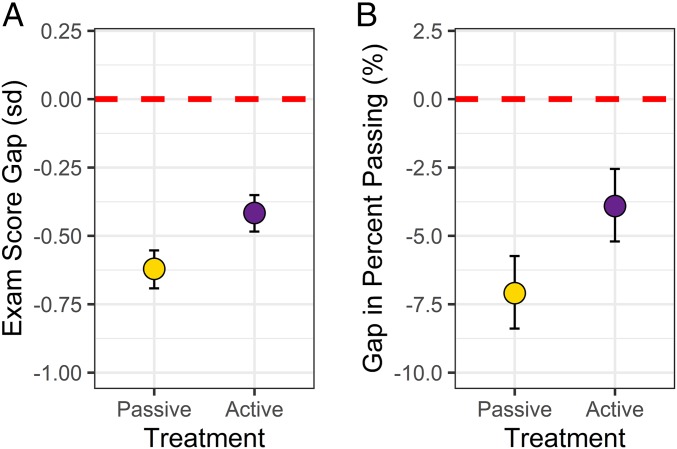
We tested the hypothesis that underrepresented students in active-learning classrooms experience narrower achievement gaps than underrepresented students in traditional lecturing classrooms, averaged across all science, technology, engineering, and mathematics (STEM) fields and courses. We conducted a comprehensive search for both published and unpublished studies that compared the performance of underrepresented students to their overrepresented classmates in active-learning and traditional-lecturing treatments. This search resulted in data on student examination scores from 15 studies (9,238 total students) and data on student failure rates from 26 studies (44,606 total students). Bayesian regression analyses showed that on average, active learning reduced achievement gaps in examination scores by 33% and narrowed gaps in passing rates by 45%. The reported proportion of time that students spend on in-class activities was important, as only classes that implemented high-intensity active learning narrowed achievement gaps. Sensitivity analyses showed that the conclusions are robust to sampling bias and other issues. To explain the extensive variation in efficacy observed among studies, we propose the heads-and-hearts hypothesis, which holds that meaningful reductions in achievement gaps only occur when course designs combine deliberate practice with inclusive teaching. Our results support calls to replace traditional lecturing with evidence-based, active-learning course designs across the STEM disciplines and suggest that innovations in instructional strategies can increase equity in higher education.
Verified 2026-11-22 · 3 references not checked yet
Overview
CoChat Summary
TL;DR
This systematic review and individual-participant-data meta-analysis found that active learning reduced achievement gaps for underrepresented/minoritized students in undergraduate STEM courses. Across the analyzed studies, gaps in exam scores and passing rates were smaller in active-learning than in traditional lecturing, with the largest gap reductions seen in high-intensity active learning.
Key findings
- In identical or formally equivalent exams, the standardized achievement gap between MGS and non-MGS students was −0.62 SDs in traditional lecturing and −0.42 SDs with active learning, a 33% reduction in the gap.
- For passing rates, the gap was −7.1% with traditional lecturing and −3.9% with active learning, a 45% reduction in the gap.
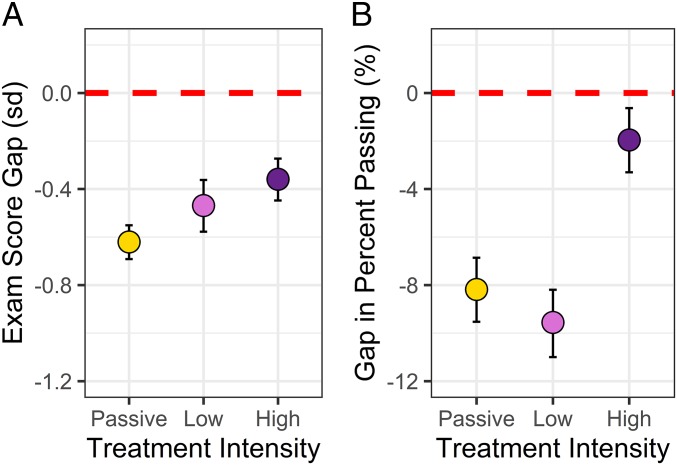
- Gap reductions were stronger with high-intensity active learning: exam-score gaps were −0.48 SDs for low-intensity vs −0.36 SDs for high-intensity; passing-rate gaps were −9.6% for low-intensity vs −2.0% for high-intensity.
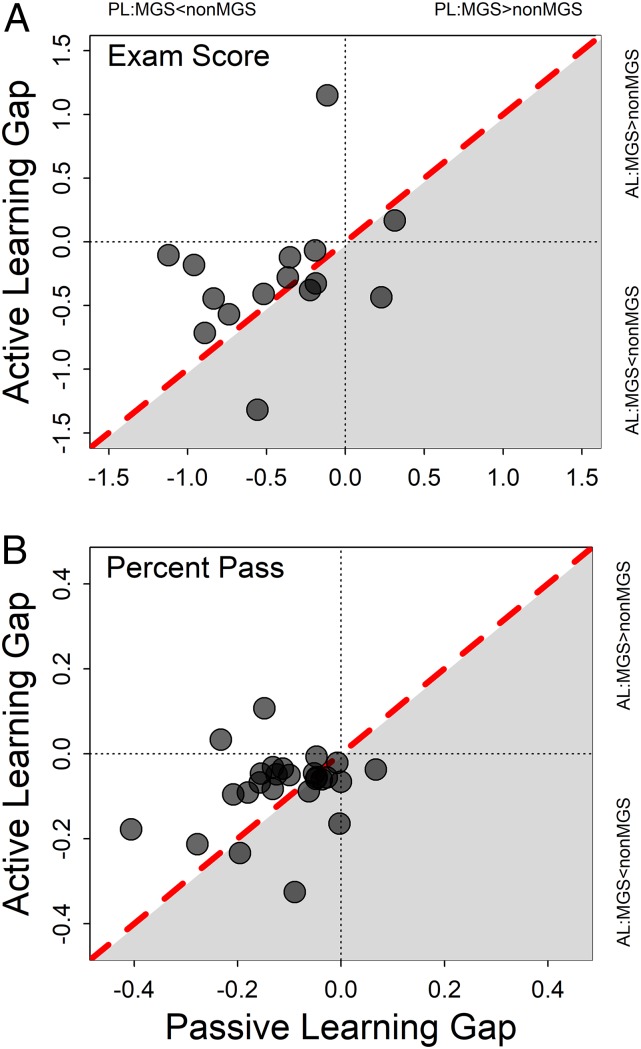
- In the study-level breakdown, 10 of 15 studies with exam-score data showed disproportionate gains for MGS students under active learning, and 15 of 26 studies with failure-rate data showed disproportionate reductions in failure rates for MGS students.
Methods
- Systematic review plus individual-participant-data (IPD) meta-analysis comparing undergraduate STEM courses taught with traditional lecturing vs active learning in the same course and institution.
- Literature search covered studies published or completed from January 1, 2010 to June 30, 2016; the final analysis included 41 studies with disaggregated data by MGS status.
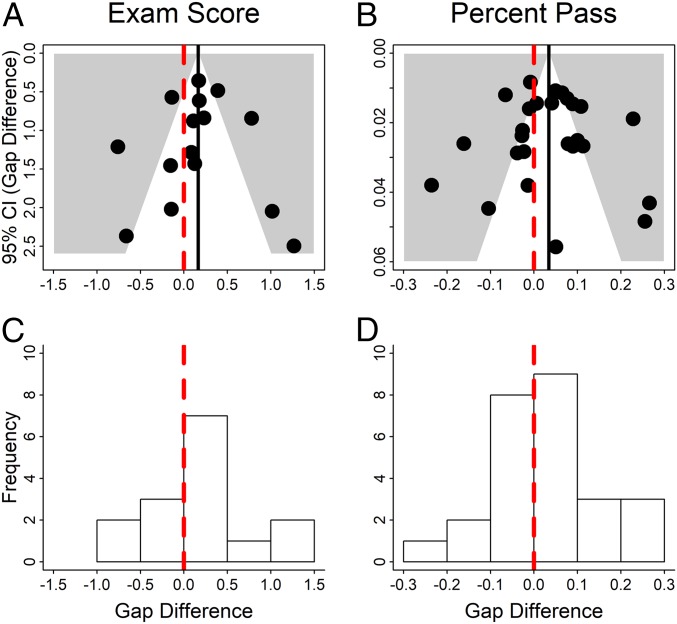
- Final datasets: 9,238 student records from 15 studies for exam scores and 44,606 student records from 26 studies for failure rates; analyses used hierarchical Bayesian multilevel models with section random effects and sensitivity analyses.
Limitations
- The paper states that the conclusions are “tempered by the limitations of the study’s sample size”: only 41 studies had data for students from MGS, which also made moderator analyses hard to interpret.
- The paper says data on the type of active learning were “poorly resolved” because studies often did not report quantitative details of course interventions.
- The paper notes possible sampling bias in instructor/institution type, overrepresentation of research-intensive institutions, and underrepresentation of teaching-intensive institutions and community colleges.
- Evident from the text: the meta-analysis depends on studies that met specific coding and data-sharing criteria, so the findings may not generalize to STEM courses or settings not represented in the included studies.
Model-written summary. Check it against the paper before relying on it.
Integrity signals
Registry
Cites
Statistics
Figures
Verification
Claims the paper makes
16 Valid · 1 Not valid · 10 Not checked · 59 Own results and interpretations
The cited sources support only part of this claim — read each source’s verdict below.
In the paper
“Course grades in most STEM courses are largely driven by performance on examinations, even in active-learning courses that offer many nonexam points (39).”
§ Active learning narrows achievement gaps for underrepresented students in undergraduate science, technology, engineering, and math > Discussion
What the sources say
- Partly supportedcites [39] Freeman S., Haak D., Wenderoth M. P., Increased course structure improves performance in introductory biology. CBE Life Sci. Educ. 10, 175– 186 (2011). 21633066 PMC3105924 sourceExperimental — accuracy not yet measured
The Methods section (“Exam Impact on Final Course Grade”; page unavailable) says the authors intended exams to remain the primary determinant of grades even when many nonexam points were available. Table 4 in the Results shows that exam points strongly predicted final grades across the introductory biology sections studied. The paper does not establish that this holds in most STEM courses. (LLM, conf=0.88)
plainstates an association- Asserted: passes — The authors put it forward as true.
- Checkable: passes — It can be checked against evidence.
- Load-bearing: passes — The paper’s conclusions depend on it.
- Based: passes — The paper gives a reason why it holds.
- Partly supported
The cited sources support only part of this claim — read each source’s verdict below.
In the paper
“All students benefit from classroom cultures that promote self-efficacy, identity as a scientist, and sense of belonging in STEM (58)”
§ Active learning narrows achievement gaps for underrepresented students in undergraduate science, technology, engineering, and math > Discussion
What the sources say
- Partly supportedcites [58] Trujillo G., Tanner K. D., Considering the role of affect in learning: Monitoring students’ self-efficacy, sense of belonging, and science identity. CBE Life Sci. Educ. 13, 6– 15 (2014). 24591497 PMC3940464 sourceExperimental — accuracy not yet measured
The paper’s sections on self-efficacy, sense of belonging, and science identity link each to student learning or persistence, and its discussion of teaching considers how classroom experiences shape these factors. Its focus is undergraduate biology, however; it does not establish that all students benefit from such classroom cultures across STEM. The indexed passages provide section labels but no page numbers. (LLM, conf=0.82)
plainstates a cause- Asserted: passes — The authors put it forward as true.
- Checkable: passes — It can be checked against evidence.
- Load-bearing: unclear — It is unclear whether the paper’s conclusions depend on it.
- Based: passes — The paper gives a reason why it holds.
- Partly supported
The cited sources support only part of this claim — read each source’s verdict below.
In the paper
“students in active-learning course designs that reduced or eliminated achievement gaps have reported an increased sense of community and self-efficacy compared to their peers in the lecture-intensive version of the same course (22, 23).”
§ Active learning narrows achievement gaps for underrepresented students in undergraduate science, technology, engineering, and math > Discussion
What the sources say
- Partly supportedcites [22] Eddy S. L., Hogan K. A., Getting under the hood: How and for whom does increasing course structure work? CBE Life Sci. Educ. 13, 453– 468 (2014). 25185229 PMC4152207 sourceExperimental — accuracy not yet measured
In Methods and Results (Study 3, Factor 2; page unavailable), students in the moderate-structure course were twice as likely to report a stronger sense of classroom community than those in the low-structure course. The Introduction mentions self-reported self-efficacy in prior active-learning research, but says that research did not compare students in versions of the same course. This paper therefore does not support the claimed same-course self-efficacy comparison. (LLM, conf=0.88)
- Not matchedcites [23] Ballen C. J., Wieman C., Salehi S., Searle J. B., Zamudio K. R., Enhancing diversity in undergraduate science: Self-efficacy drives performance gains with active learning. CBE Life Sci. Ed. 16, ar56 (2017). PMC5749958 29054921
We don’t have this paper’s reference list.
plainstates an association- Asserted: passes — The authors put it forward as true.
- Checkable: passes — It can be checked against evidence.
- Load-bearing: unclear — It is unclear whether the paper’s conclusions depend on it.
- Based: passes — The paper gives a reason why it holds.
- Partly supported
Every source the paper cites for this claim was checked and supports it.
In the paper
“Our data on type of active learning are also poorly resolved, because publications still routinely fail to report quantitative data on the nature of course interventions, such as records from classroom observation tools (e.g., ref. 61 and SI Appendix, Table S12).”
§ Active learning narrows achievement gaps for underrepresented students in undergraduate science, technology, engineering, and math > Discussion
What the sources say
- Supportedcites [61] Eddy S. L., Converse M., Wenderoth M. P., PORTAAL: A classroom observation tool assessing evidence-based teaching practices for active learning in large science, technology, engineering, and mathematics classes. CBE Life Sci. Educ. 14, ar23 (2015). PMC4477739 26033871 source
The citation appears as an example of a classroom observation tool, not as evidence that publications routinely omit quantitative intervention data. The Abstract identifies PORTAAL as a classroom observation tool for assessing active-learning practices, which supports that use of the citation. (LLM, conf=0.91)
plainstates a cause- Asserted: passes — The authors put it forward as true.
- Checkable: passes — It can be checked against evidence.
- Load-bearing: unclear — It is unclear whether the paper’s conclusions depend on it.
- Based: passes — The paper gives a reason why it holds.
- Supported
Every source the paper cites for this claim was checked and supports it.
In the paper
“larger gaps are correlated with faculty who have a fixed mindset, which interprets intelligence as innate and immutable and is therefore exclusion or selection-oriented (44).”
§ Active learning narrows achievement gaps for underrepresented students in undergraduate science, technology, engineering, and math > Discussion
What the sources say
- Supportedcites [44] Canning E. A., Muenks K., Green D. J., Murphy M. C., STEM faculty who believe ability is fixed have larger achievement racial achievement gaps and inspire less student motivation in their classes. Sci. Adv. 5, eaau4734 (2019). 30793027 PMC6377274 source
The Results report that racial achievement gaps in STEM courses were nearly twice as large with fixed- versus growth-mindset faculty. The Introduction defines a fixed mindset as treating intelligence and ability as innate and largely unchangeable, and describes judging students as low-ability and encouraging them to drop difficult courses—supporting the paraphrase 'exclusion or selection-oriented.' (LLM, conf=0.88)
plainstates an association- Asserted: passes — The authors put it forward as true.
- Checkable: passes — It can be checked against evidence.
- Load-bearing: unclear — It is unclear whether the paper’s conclusions depend on it.
- Based: passes — The paper gives a reason why it holds.
- Supported
30 more claims
Create a free account to see all 86 claims and every source verdict.
- It may state two separate claims as one. 30
- Probably not a substantial claim. 36
Claims other papers make about this one
Each is checked against this paper’s own text: does it say what the citing paper says it does?
The source backs part of the claim, not all of it — or backs it for a different population, condition or comparison.
In the citing paper
“These perceptions, along with a likely reduction in stress and anxiety (see Figure 4), could benefit students from underrepresented groups and may thus reduce the achievement gap among underrepresented minorities”
From Two-Stage Final Exams: An Assessment Strategy for Enhanced Collaborative Learning and Reduced Student Stress (2026) · cites this paper as Theobald et al., 2020
Experimental — accuracy not yet measured
Citations
Cites
Preferred Reporting Items for Systematic Reviews and Meta-Analyses: the PRISMA statement
Moher, D., Liberati, A., Tetzlaff, J., Altman, D. G., & for the PRISMA Group (2009) · BMJ · doi:10.1136/bmj.b2535 · Cited by 83,823
Preferred reporting items for systematic reviews and meta-analyses: the PRISMA Statement.
(2009) · PubMed Central · Cited by 44,859
Preferred reporting items for systematic reviews and meta-analyses: The PRISMA statement
Moher, D., Liberati, A., Tetzlaff, J., Altman, D. G., & the PRISMA Group* (2009) · Annals of Internal Medicine · doi:10.7326/0003-4819-151-4-200908180-00135 · Cited by 37,554
PRISMA-P Group, Moher, D., Shamseer, L., Clarke, M., Ghersi, D., Liberati, A., Petticrew, M., Shekelle, P., & Stewart, L. A. (2015) · Systematic Reviews · doi:10.1186/2046-4053-4-1 · Cited by 26,223 · cited 2×
“The protocol for this study, presented in the PRISMA-P format (66) and including annotations regarding modifications that occurred during the course of the research, is available in SI Appendix, SI Materials and Methods.”
Capital in the Twenty-First Century
Piketty, T. (2014) · doi:10.4159/9780674369542 · Cited by 14,437
Data Analysis Using Regression and Multilevel/Hierarchical Models
Gelman, A., & Hill, J. (2006) · doi:10.1017/cbo9780511790942 · Cited by 13,597
Active learning increases student performance in science, engineering, and mathematics
Freeman, S., Eddy, S. L., McDonough, M., Smith, M. K., Okoroafor, N., Jordt, H., & Wenderoth, M. P. (2014) · Proceedings of the National Academy of Sciences · doi:10.1073/pnas.1319030111 · Cited by 9,787 · cited 6×
“Can interventions in courses themselves—meaning, changes in how science is taught—reduce achievement gaps and promote retention in STEM? A recent metaanalysis concluded that, on average, active learning in STEM leads to higher examination scores and lower failure rates for all students, compared to all students in the…”
InfluentialSelf-citation(2000) · Cited by 9,198
A threat in the air: How stereotypes shape intellectual identity and performance
Steele, C. M. (1997) · American Psychologist · doi:10.1037/0003-066x.52.6.613 · Cited by 6,770 · cited 1×
“Equally important, inclusive teaching emphasizes treating students with dignity and respect (52), communicating confidence in students’ ability to meet high standards (53), and demonstrating a genuine interest in students’ intellectual and personal growth and success (54, 55).”
BackgroundGeneral methods for monitoring convergence of iterative simulations
Brooks, S. P., & Gelman, A. (1998) · Journal of Computational and Graphical Statistics · doi:10.1080/10618600.1998.10474787 · Cited by 6,045
Research works printed but not linked: 9
- Reardon S. F., “The widening achievement gap between the rich and the poor: New evidence and possible explanations” in Whither Opportunity? Duncan G. J., Murnane R. J., Eds. (Russell Sage Foundation, New York, 2011), pp. 91– 115.
- National Student Clearinghouse Research Center, High School Benchmarks 2019: National College Progression Rates (National Student Clearinghouse, Herndon, VA, 2019).
- Chen X., STEM Attrition: College Students’ Paths Into and Out of STEM Fields (National Center for Education Statistics, Washington, DC, 2013).
- Vygotsky L. S., Mind in Society (Harvard University Press, Cambridge, MA, 1978).
- Kaufmann E., Reips U.-D., Merki K. M., Avoiding methodological biases in meta-analysis. Z. Psychol. 224, 157– 167 (2016).
- Ginder S. A., Kelly-Reid J. E., Mann F. B., Enrollment and Employees in Postsecondary Institutions, Fall 2015 (National Center for Education Statistics, Washington, DC, 2017).
- Reed J. G., Baxter P. M., Using Reference Databases. The Handbook of Research Synthesis and Meta-Analysis, Cooper H., Hedges L. V., Valentine J. C., Eds. (Russell Sage Foundation, New York, 2009), pp. 73– 101.
- Rothstein H., Hopewell S., Grey Literature. The Handbook of Research Synthesis and Meta-Analysis, Cooper H., Hedges L. V., Valentine J. C., Eds. (Russell Sage Foundation, New York, 2009), pp. 103– 125.
- White H. D., Scientific Communication and Literature Retrieval. The Handbook of Research Synthesis and Meta-Analysis, Cooper H., Hedges L. V., Valentine J. C., Eds. (Russell Sage Foundation, New York, 2009), pp. 51– 71.
Cited by
Items 401–500 of 1,369
Objective Tests in Automated Grading of Computer Science Courses: An Overview
Lujak, M., Slavkovik, M., Lebis, A., Vermeulen, M., & Doniec, A. (2022) · Learning and analytics in intelligent systems · doi:10.1007/978-3-031-04662-9_12 · Cited by 9
Funk, R., Uhing, K., Williams, M., & Smith, W. (2022) · SN Social Sciences · doi:10.1007/s43545-022-00565-8 · Cited by 10
“Yet, this is not the case: lecture-based instruction can exacerbate opportunity gaps (Theobald et al. 2020).”
BackgroundChapman, K. E., Davidson, M. E., Azuka, N., & Liberatore, M. W. (2023) · Computer Applications in Engineering Education · doi:10.1002/cae.22614 · Cited by 9
Integrating evidence-based teaching practices into the Mammalogy classroom
Patrick, L. E., Duggan, J., & Dizney, L. J. (2023) · Journal of Mammalogy · doi:10.1093/jmammal/gyad011 · Cited by 8
Challenges and opportunities to build quantitative self-confidence in biologists
Cuddington, K. M., Abbott, K. C., Adler, F. R., Aydeniz, M., Dale, R., Gross, L. J., Hastings, A., Hobson, E. A., Karatayev, V. A., Killion, A. K., et al. (2023) · BioScience · doi:10.1093/biosci/biad015 · Cited by 15
How LT principles can improve diversity, inclusiveness, and student interest
Hoover, G. A., & Washington, E. (2024) · The Journal of Economic Education · doi:10.1080/00220485.2024.2309369 · Cited by 9
The Literature Discussion: A Signature Pedagogy for Chemistry
Reisner, B. A., & Stewart, J. L. (2020) · ACS symposium series · doi:10.1021/bk-2020-1370.ch002 · Cited by 9
Brawner, C. E., Orr, M., Brent, R., & Mobley, C. (2020) · IEEE Frontiers in Education Conference (FIE) · doi:10.1109/fie44824.2020.9273823 · Cited by 8
“The authors of a recent study [28] collected data on exam scores and failure rates in courses that were taught by instructors using traditional lecturing and active learning techniques.”
BackgroundMake or Take: An Active Learning Game of Organic Synthesis
Therriault, C. S., & Kantorowski, E. J. (2021) · Journal of Chemical Education · doi:10.1021/acs.jchemed.0c01460 · Cited by 8
Kornegay, M., Arafin, M. T., & Kornegay, K. (2024) · ASEE Annual Conference & Exposition · doi:10.18260/1-2--37048 · Cited by 7
Muñiz, M. N., Kiraz, C. I. A., & Emenike, M. E. (2021) · Journal of Chemical Education · doi:10.1021/acs.jchemed.1c00387 · Cited by 10
Wojdak, K., Smith, M. K., Orndorf, H. C., & Ramirez, M. L. (2024) · Teaching & Learning Inquiry The ISSOTL Journal · doi:10.20343/teachlearninqu.12.20 · Cited by 11
“…those who are first in their families to attend college and students who identify with persons historically excluded because of their ethnicity and race (Ballen et al. 2017; Bauer et al. 2020; Beichner et al. 2007; Eddy and Hogan 2014; Haak et al. 2011; Theobald et al. 2020; Wilton et al. 2019).”
BackgroundYork, A. M., Miller, K. G., Cahill, M. J., Bernstein, M. A., Barber, A. M., Blomgren, H. E., & Frey, R. F. (2024) · CBE—Life Sciences Education · doi:10.1187/cbe.23-04-0055 · Cited by 9
“…of opinions or problem-solving strategies, 3) promote a safe environment where students can make mistakes through fostering a growth-mindset culture, or 4) communicate their confidence in the student’s ability to reach high standards (Tanner, 2013; Theobald et al. , 2020; White et al. , 2021).”
BackgroundEwell, S. N., Harvey, A., Clark, A. D., Maloney, M. E., Stevison, L. S., & Ballen, C. J. (2024) · Journal of Research in Science Teaching · doi:10.1002/tea.21996 · Cited by 7
Influences on Mathematics Achievement in Rural Schools: A Nested Study of Underprivileged Learners
Mafugu, T. (2024) · Interchange · doi:10.1007/s10780-024-09533-y · Cited by 15
“Theobald et al. (2020) also showed that the under-represented minor - ity seemed to have a higher dropout rate than other groups, and they also needed intensive support in STEM subjects.”
Self-Testing and Follow-Through of Learning Strategies Supports Student Success
Hazlett, Z. S., Jimenez, P. C., & Knight, J. (2025) · CBE—Life Sciences Education · doi:10.1187/cbe.24-04-0128 · Cited by 11
“Recent large-scale studies have revealed that PEER and historically underserved students can experience lower performance in science courses (Freeman et al. , 2014; Theobald et al. , 2020) and lower graduation rates in college STEM degrees compared with their peers (Chang et al. , 2014).”
Clements, K. A., Vallone, K. T., Clements, T. P., Catania, E. H., Claiborne, L. L., Friedman, K. L., Graham, T. R., Johnson, H. J., Starko, S., Todd, T. D., et al. (2025) · CBE—Life Sciences Education · doi:10.1187/cbe.24-07-0179 · Cited by 13
“In some introductory STEM courses that incorporate LAs, reduced achievement gaps have been observed for students from marginalized groups relative to their peers, which aligns with effects observed in the broader active learning literature (White et al. , 2016; Theobald et al. , 2020).”
Zhong, W. H., Al-Shaibani, G. K. S., & Li, G. (2025) · SAGE Open · doi:10.1177/21582440251365435 · Cited by 12
“For instance, Theobald et al. (2020) showed that active learning methods significantly reduced equity gaps among underrepresented groups in STEM disciplines.”
Valstar, S., Krause-Levy, S., Salguero, A., Porter, L., & Griswold, W. G. (2021) · ACM Conference on Innovation and Technology in Computer Science Education (ITiCSE) · doi:10.1145/3430665.3456337 · Cited by 10
“The gap between the performance of students from represented populations relative to underrepresented populations has been described in STEM education studies, particularly in publications that aim to narrow the achievement gap using active learning techniques [11, 26].”
BackgroundHester, S. D., Southard, K. M., Kim, Y. A., Cox, J., Elfring, L. K., Blowers, P., & Talanquer, V. (2021) · College Teaching · doi:10.1080/87567555.2021.1996323 · Cited by 9
Bhattacharya, N., Langhout, R. D., Vaccarino‐Ruiz, S. S., Jackson, N., Woolfe, M., Matta, W., Zúñiga, B. R., Rowe, Z., & Gibo, L. (2021) · American Journal of Community Psychology · doi:10.1002/ajcp.12573 · Cited by 10
Awareness and Implementation of Evidence-Based Learning Strategies Among STEM Faculty
Wissman, K. T., & Leontyev, A. (2024) · The journal of college science teaching · doi:10.1080/0047231x.2024.2363118 · Cited by 7
Alabama’s attack on DEI hinders STEM teaching
Ballen, C. J., Adams, P. E., Burkholder, E. W., Costello, R. A., Fagbodun, S., Henning, J. A., & Ntam, M. (2024) · Science · doi:10.1126/science.adq2367 · Cited by 6
Cen, X., Lee, R. J., Contreras, C., Owens, M. T., & Maloy, J. P. (2024) · Journal of Microbiology and Biology Education · doi:10.1128/jmbe.00073-24 · Cited by 12
“Based on previous literature indicating that more active learning leads to better outcomes for students, with these differences in the amount of student thinking and discussion, one might also expect large differences in exam performance between each instructor’s students (11).”
InfluentialFink, A. D. D., Allen, T. S., Arriola, P. E., Barea-Rodríguez, E. J., Jacob, N. P., Kelrick, M. I., Otto, J., Reiness, C. G., & Washington, J. M. (2024) · Journal of Microbiology and Biology Education · doi:10.1128/jmbe.00052-24 · Cited by 9
“(PEERs) remain intractable (10) despite evidence that these gaps can be reduced by utilizing appropriate pedagogies (6, 8).”
Martella, A. M., Swisher, M., & Mayer, R. E. (2024) · Contemporary Educational Psychology · doi:10.1016/j.cedpsych.2024.102316 · Cited by 11
Student perceptions of the usefulness of core concepts when reasoning in physiology
Cole, E. J., & Doherty, J. H. (2024) · AJP Advances in Physiology Education · doi:10.1152/advan.00198.2024 · Cited by 7
Charting a new vision: lessons on Vision & Change from a network of biology educators
Hsu, J. L., Misra, A., Wolyniak, M. J., Goller, C., Mathews, S. L., Swamy, U., Newman, D. L., & Moore, M. E. (2025) · Journal of Microbiology and Biology Education · doi:10.1128/jmbe.00172-24 · Cited by 7
“…impact students of different identities (21–24), assess programmatic and structural changes that reduce opportunity gaps among various groups of students (e.g., 25, 26) and establish professional development programs that promote diversity, equity, and inclusion within the professoriate (27, 28).”
Metodologías activas y desarrollo del pensamiento crítico en estudiantes universitarios
Oltramonti, R., Casanova-Villalba, C. I., Tuitice-Tobar, R. A., & Herrera-Sánchez, M. J. (2025) · Revista Científica Enfoques del Conocimiento · doi:10.55813/gaea/revistacec/v2/n2/33 · Cited by 8
“Nota: La tabla sintetiza la participación estudiantil desde una perspectiva cognitiva, destacando su relación con las metodologías activas, el razonamiento argumentativo y la equidad académica en estudiantes universitarios, con base en los aportes de Theobald et al. (2020) (Autores, 2026).”
InfluentialGamified Active Learning and Its Potential for Social Change
Marin, S., Lee, V., & Landers, R. N. (2021) · Springer eBooks · doi:10.1007/978-3-030-68207-1_11 · Cited by 10
AIChE Virtual Communities of Practice _ Supporting Faculty during the COVID-19 Pandemic
Lepek, D. (2021) · Chemical Engineering Education · doi:10.18260/2-1-370.660-125282 · Cited by 8
Yoon, J., Ko, Y., & Lee, H. (2021) · Asia-Pacific Science Education · doi:10.1163/23641177-bja10031 · Cited by 6
Reimagining the Introductory Math Curriculum for Life Sciences Students
O’Leary, E. S., Sayson, H. W., Shapiro, C. A., Garfinkel, A., Conley, W. J., Levis‐Fitzgerald, M., Eagan, M. K., & Valkenburgh, B. V. (2021) · CBE—Life Sciences Education · doi:10.1187/cbe.20-11-0252 · Cited by 16
“Thus, there is still room to improve the pedagogy and classroom climate in the contextualized math courses, such as by integrating more active learning and inclusive teaching during lectures (Dasgupta and Asgari, 2004; Walton et al. , 2015; Theobald et al. , 2020).”
Implementing Hands-On Molecular and Synthetic Biology Education Using Cell-Free Technology
Huang, A., Bryan, B., Kraves, S., Alvarez-Saavedra, E., & Stark, J. C. (2022) · Methods in molecular biology · doi:10.1007/978-1-0716-1998-8_25 · Cited by 5
Taylor, L., Doehler, K., VanKrevelen, R., et al. (2022) · Teaching Statistics · doi:10.1111/test.12303 · Cited by 6
From pandemic to endemic pedagogy: Being CLEAR in our teaching
Felten, P. (2022) · New Directions for Teaching and Learning · doi:10.1002/tl.20481 · Cited by 12
“…– particularly related to race, ethnicity, and first-generation student status – in US higher education (Quaye et al., 2020) despite compelling evidence that active learning pedagogies and high-impact practices can narrow or eliminate achievement gaps (Finley & McNair, 2013; Theobald et al., 2020).”
BackgroundSandrone, S., & Ntonia, I. (2022) · BMC Medical Education · doi:10.1186/s12909-022-03758-0 · Cited by 6
“It narrows achievement gaps for underrepresented students and can promote equity in higher education [29, 30], maximises their learning online [31], increases students’ satisfaction with individual and group activities [32].”
BackgroundLowell, S. Y., McMillen, S., Lightburn, A., Desjardins, J. L., & Riley, E. A. (2022) · Teaching and Learning in Communication Sciences & Disorders · doi:10.30707/tlcsd6.3.1664996985.103746 · Cited by 7
Rissanen, A., Hoang, J. G., & Spila, M. V. (2023) · Journal of Applied Research in Higher Education · doi:10.1108/jarhe-09-2020-0313 · Cited by 15
Gerringer, M. E., Ismail, Y., Cannon, K. A., Hernández, A. C., Peralta, F. G., Bohen, R., Cartwright, J. C., Feasley, A., Fregosi, L., Lehman, H., et al. (2023) · Frontiers in Marine Science · doi:10.3389/fmars.2022.1033274 · Cited by 14
“Research experiences also provide chances for active learning, which have been shown to lessen opportunity gaps between students from identity groups that have been overrepresented in the sciences and those who belong to historically excluded identity groups in STEM fields (Theobald et al., 2020).”
BackgroundClark, R. M., Kaw, A. K., & Guldiken, R. (2023) · International Journal of Mechanical Engineering Education · doi:10.1177/03064190231164719 · Cited by 14
“Pedagogical innovations such as those being considered by this research have previously been associated with equity in undergraduate STEM education; therefore, we aimed to investigate whether reflection activity may be associated with enhanced equity as well.(18) Demographic data were therefore collected from the part…”
BackgroundResultInfluentialSoobrian, B. N., King, A. J., Bui, J. C., Weber, A. Z., Bell, A. T., & Houle, F. A. (2023) · Journal of Chemical Education · doi:10.1021/acs.jchemed.3c00085 · Cited by 7
Development of a Week-Long Mathematics Intervention for Incoming Chemistry Graduate Students
Clune, R., Das, A., Jasrasaria, D., Rossomme, E. C., Cohen, O., & Baranger, A. M. (2023) · Journal of Chemical Education · doi:10.1021/acs.jchemed.2c00915 · Cited by 9
Engaging Students through Active Learning Strategies in a Medicinal Chemistry Course
Viswanathan, R., & Krishnamurthy, N. (2023) · Journal of Chemical Education · doi:10.1021/acs.jchemed.3c00647 · Cited by 11
ВИКОРИСТАННЯ ТЕХНОЛОГІЙ ШТУЧНОГО ІНТЕЛЕКТУ В ПРОЦЕСІ НАВЧАННЯ І ВИКЛАДАННЯ У ВИЩІЙ ОСВІТІ
Kabatska, O. V., Shamshin, A., & Подковирофф, Н. (2023) · Вісник науки та освіти · doi:10.52058/2786-6165-2023-11(17)-719-735 · Cited by 16
Price Gregory, N., & Bussey, T. R. (2023) · Journal of Business Venturing Insights · doi:10.1016/j.jbvi.2023.e00448 · Cited by 10
Tripp, B., Cozzens, S., Hrycyk, C., Tanner, K. D., & Schinske, J. N. (2024) · CBE—Life Sciences Education · doi:10.1187/cbe.23-05-0074 · Cited by 10
“…Regarding Content Coverage Numerous lines of scholarship have contributed evidence surrounding how we teach (e.g., active learning, Freeman et al. , 2014; Theobald et al. , 2020) and who we teach (e.g., how science education impacts different groups of students, Dewsbury and Brame, 2019).”
BackgroundRealizing the Promise of Professional Learning for Teaching, Equity, and Change
Eynon, B., Iuzzini, J., Keith, H., et al. (2024) · Change The Magazine of Higher Learning · doi:10.1080/00091383.2024.2297637 · Cited by 6
Low-cost desktop learning factory to support the teaching of artificial intelligence
Orozco, E., Cárdenas, P. C., López, J. A., et al. (2024) · HardwareX · doi:10.1016/j.ohx.2024.e00528 · Cited by 6
Rodriguez, J.-M. G., Lazenby, K., Scharlott, L. J., Hunter, K. H., & Becker, N. M. (2020) · Journal of Chemical Education · doi:10.1021/acs.jchemed.0c00321 · Cited by 6
TESOT: a teaching modality targeting the learning obstacles in global medical education
Wang, X., Liu, X., Jia, S., Jiao, R., Zhang, Y., Tang, L., Ni, X., Zhu, H. F., Zhang, F., Parpura, V., et al. (2021) · AJP Advances in Physiology Education · doi:10.1152/advan.00191.2020 · Cited by 10
“Therefore, teachers should apply a modality that combines the advantages of both TCA learning and SCA learning (15) while considering different learning obstacles and style preferences.”
BackgroundMethodInfluentialLet's talk teaching: Progressive pedagogy in anthropology courses
Kissel, M., & Blum, S. D. (2021) · American Journal of Human Biology · doi:10.1002/ajhb.23706 · Cited by 9
Gouet, C., Rodríguez, D. S., Maulén, W. R., Almarza, A. R., & Bunster, D. O. (2022) · Tapuya Latin American Science Technology and Society · doi:10.1080/25729861.2022.2117492 · Cited by 7
“Active learning experiences have proven especially effective for minorities and underrepresented groups (Freeman et al. 2014; Theobald et al. 2020), and citizen science can also help to cope with this situation(1) (see Peltola and Arpin 2018).”
BackgroundInfluentialBeyond Compliance: Growth as the Guiding Value in Undergraduate Medical Education
Woodruff, J. N., Lee, W. W., Vela, M. B., & Davidson, A. I. (2023) · Academic Medicine · doi:10.1097/acm.0000000000005190 · Cited by 7
Leveraging public data to offer online inquiry opportunities
Thompson, S. K., Kirkpatrick, C. A., Kramer, M., & Cotner, S. H. (2020) · Ecology and Evolution · doi:10.1002/ece3.6706 · Cited by 6
“While adoption of these practices has been far from universal (Stains et al., 2018), there is strong evidence that integrating these student-focused approaches results in better learning outcomes (Freeman et al., 2007, 2014; Theobald et al., 2020).”
Inclusion in Neuroscience Through High Impact Courses.
Penner, M., Sathy, V., & Hogan, K. (2021) · Neuroscience Letters · doi:10.1016/j.neulet.2021.135740 · Cited by 4
Tiny Earth: A Big Idea for STEM Education and Antibiotic DiscoveryPreprint
Hurley, A. I., Chevrette, M. G., Acharya, D. D., et al. (2020) · Preprints.org · doi:10.20944/preprints202011.0250.v1 · Cited by 6
Building Back More Equitable STEM Education: Teach Science by Engaging Students in Doing SciencePreprint
Elgin, S. C. R., Hays, S., Mingo, V., Shaffer, C. D., & Williams, J. (2021) · bioRxiv (Cold Spring Harbor Laboratory) · doi:10.1101/2021.06.01.446616 · Cited by 9
“These strategies also help close the performance gap for historically excluded students (Theobald et al., 2020).”
BackgroundDisrupting Algorithmic Culture: Redefining the Human(ities)
Hutson, J., & Plate, D. (2023) · Advances in educational technologies and instructional design book series · doi:10.4018/979-8-3693-0074-9.ch001 · Cited by 8
de Lima, J., Isaac, S., & Kovacs, H. (2024) · European Journal of Engineering Education · doi:10.1080/03043797.2024.2346332 · Cited by 9
“This shows that student assistants can play an important role in developing inclusive educational practices – which in turn have been shown to improve student learning outcomes (Hardebolle et al. 2022; Preszler 2009; Theobald et al. 2020).”
Heng, W., Ho, M. H., Mah, X. H., Lim, J. J., Syamsury, N. H. B. A., Haagensen, E. J., Ong, E. L. C., & Hubbard, P. S. (2025) · Medical Education · doi:10.1111/medu.15611 · Cited by 11
“15,16 However, active learning may not be inclusive for students with disabilities if appropriate accommodations are not implemented.”
Affriyenni, Y., Georgiou, H., & Finkelstein, N. D. (2025) · Physical Review Physics Education Research · doi:10.1103/wvjk-8y8k · Cited by 8
Kajan, K., Abbasi, N., & Loizou, C. (2025) · Education Sciences · doi:10.3390/educsci15091185 · Cited by 12
AI tutors vs. tenacious myths: Evidence from personalised dialogue interventions in education
Corbett, B. J., & Tangen, J. M. (2025) · Computers in Human Behavior · doi:10.1016/j.chb.2025.108828 · Cited by 11
Bustamante, V. P., Blomgren, H. E., Walker, D. K., Edwards, J. D., & Frey, R. F. (2024) · Physical Review Physics Education Research · doi:10.1103/physrevphyseducres.20.020112 · Cited by 5
Kreps, A., Brown, I., Wenzel, T. J., & Cole, R. S. (2024) · Journal of Chemical Education · doi:10.1021/acs.jchemed.4c00783 · Cited by 10
Nissen, J., Dusen, B. V., & Kukday, S. S. (2024) · Journal of Research in Science Teaching · doi:10.1002/tea.22000 · Cited by 11
Douin, T. A., DeCaro, M. S., Hieb, J., Chastain, R. J., & Fuselier, L. (2024) · Cogent Education · doi:10.1080/2331186x.2024.2437884 · Cited by 8
“Research suggests that these courses would benefit dramatically from adopting student-centered learning practices (Theobald et al., 2020).”
Xia, K. T., Toste, F. D., Francis, M. B., & Baranger, A. M. (2025) · Chemical Science · doi:10.1039/d4sc03261f · Cited by 9
“10,11 The largest gap in retention of minoritized students tends to occur between graduate school and postdoctoral studies, 8 highlighting retention in graduate degree programs as a key concern.”
Clapson, M. L., Davy, E. C., Durfy, C. S., Schechtel, S., & Scott, S. S. (2025) · Journal of Chemical Education · doi:10.1021/acs.jchemed.4c01039 · Cited by 5
Kaw, A. K., Yalçin, A., & Clark, R. M. (2025) · Computer Applications in Engineering Education · doi:10.1002/cae.70007 · Cited by 7
Student‐led field studies of herbivory: Hands‐on experiences for remote (or in‐person) learning
Berke, S. K., & Clark, R. M. (2021) · Invertebrate Biology · doi:10.1111/ivb.12320 · Cited by 6
“And yet the evidence is clear that students— especially students from low- income households and underrepresented groups— learn most effectively when given opportunities for hands- on, inquiry- based learning (Theobald et al., 2020).”
BackgroundThriving Online: A Guide for Busy Educators
Kay, R. H., Hunter, W. J., Lauricella, S., Craig, C. D., Mann, A., Dwyer-Kuntz, T., Hughes, J. M., Petrarca, D., Power, R., Bahula, T., et al. (2022) · University of Ontario Insitute of Technology eBooks · doi:10.51357/tmsm9420 · Cited by 10
Söbke, H. (2022) · Education Sciences · doi:10.3390/educsci12050297 · Cited by 5
Ralph, M. C., Schneider, B. B., Benson, D. R., & Ward, D. (2022) · Active Learning in Higher Education · doi:10.1177/14697874221118866 · Cited by 7
“Theobald et al. (2020) also showed active learning can reduce the marginalizing impacts of exclusionary mechanisms that lead to lower observed measures of performance for historically minoritized groups.”
BackgroundOquendo, P. M., VanWyngaarden, K., & Cutucache, C. E. (2022) · The Qualitative Report · doi:10.46743/2160-3715/2022.5674 · Cited by 7
“Findings from Theobald et al. (2020) show engaging in active learning activities while in college support the development and retention of undergraduate students.”
BackgroundRomo, J. A., & Rokop, M. E. (2022) · Journal of Microbiology and Biology Education · doi:10.1128/jmbe.00123-22 · Cited by 7
The Promise of Labor-Based Grading Contracts for the Teaching of Psychology and Neuroscience
Mena, J. A., & Stevenson, J. R. (2022) · Teaching of Psychology · doi:10.1177/00986283221119783 · Cited by 7
“…in their learning by giving them the freedom to select course topics and make contributions to the learning community increases the sense of belonging and academic success, especially for historically marginalized students (Freeman et al., 2014; Mena et al., in press; Theobald et al., 2020).”
Bullet screen in pre-clinical undergraduate pharmacology education: a survey study
Chen, Y., Qi, H. Y., Yu, Q., Li, J., Zhu, L., Wang, H., Gao, X., & Jiang, G. (2022) · BMC Medical Education · doi:10.1186/s12909-022-03906-6 · Cited by 7
A Half Century of Student Data Reveals the Professional Impacts of a Biology Field Course
Hernández, L. M. A., Mittan, C., Lamb, T., Holmes, K. D., McDonald, C. A., Zamudio, K. R., & Ballen, C. J. (2022) · BioScience · doi:10.1093/biosci/biac103 · Cited by 7
Davies, R., Wolk-Stanley, J., Yuan, V., & Contino, J. (2023) · Journal of Geoscience Education · doi:10.1080/10899995.2023.2186762 · Cited by 6
“It engaged multiple science practices and active learning opportunities shown to benefit all students, particularly those from non-dominant backgrounds (Freeman et al., 2014; Theobald et al., 2020).”
Feasibility of teaching experimental physics during Covid-19 pandemic
Franco, M. K. K. D., Serbena, J. P. M., Filho, N. P. M., et al. (2023) · Physics Education · doi:10.1088/1361-6552/acbf1d · Cited by 5
McKinney, E. H., Green, S., Heppard, K. A., & Wu, J. J. (2023) · Communications of the Association for Information Systems · doi:10.17705/1cais.05239 · Cited by 3
Cognitive discourse during a group quiz activity in a blended learning organic chemistry course
Ballard, J., Gamage, S., Winfield, L. L., & Mooring, S. R. (2023) · Chemistry Teacher International · doi:10.1515/cti-2023-0007 · Cited by 9
Lubbe, A., Awad, A., Bunt, B. J., Kruger, C., Mokwatsi, G. G., Chahine, I., Pool, J., Beer, J. J. D., White, L., Mdakane, M., et al. (2023) · NWU self-directed learning series · doi:10.4102/aosis.2023.bk426 · Cited by 10
Highlighting the Contributions of Marginalized Chemists in the Chemistry Curriculum
Chowdhury, I.-Z., Sharif, A., Howell, L. A., & Sheriff, T. S. (2023) · Journal of Chemical Education · doi:10.1021/acs.jchemed.2c00771 · Cited by 8
Mobile learning for science education: meta-analysis of K-12 research
Garzón, J., & Λαμπρόπουλος, Γ. (2023) · Interactive Learning Environments · doi:10.1080/10494820.2023.2280973 · Cited by 16
“Active learning methodologies favor science learning (Freeman et al., 2014; Theobald et al., 2020).”
Denaro, K., Nizkorodov, S. A., & Holton, A. J. (2023) · Journal of Chemical Education · doi:10.1021/acs.jchemed.3c00365 · Cited by 6
Panebianco, C. J., Nijsure, M. P., Berlew, E. E., Jeong, A. L., & Boerckel, J. D. (2023) · Biomedical Engineering Education · doi:10.1007/s43683-023-00130-6 · Cited by 5
“Moreover, we employed active learning strategies because a majority of our cohort identified as under-represented minorities (URM) and active learning helps narrow achievement gaps for students from underrepresented groups [27, 43].”
Investigating the Impact of Active Learning in Large Coordinated Calculus Courses
Fuchs, S., & Sahmbi, G. (2024) · International Journal of Research in Undergraduate Mathematics Education · doi:10.1007/s40753-024-00234-6 · Cited by 7
“Indeed, Theobald et al. (2020)’s work suggests that the effective use of active learning can be particularly impactful for underrepresented groups in post-secondary STEM programs.”
Buffalari, D. M. (2022) · Journal of Undergraduate Neuroscience Education · doi:10.59390/vohj7109 · Cited by 17
“…beneficial strategy when engaging in active learning techniques, though some are exploring this question (Weir et al., 2019) Some active learning methods involve substantial redesign of the course (McConnell et al., 2017; Theobald et al., 2020) or extensive use of technology or other resources.”
BackgroundInfluentialMcCarren, E. M., Adams, G. M., & McNeilly, J. R. (2024) · Journal of Chemical Education · doi:10.1021/acs.jchemed.4c00042 · Cited by 5
The use of role-play in the learning of medical terminology for online and face-to-face courses
del Moral, B. L. M., VanPutte, C. L., & McCracken, B. A. (2024) · AJP Advances in Physiology Education · doi:10.1152/advan.00273.2023 · Cited by 10
Understanding how professional development opportunities affect open educational resource sharing
Flowers, S., Hazlett, Z. S., Ramirez, M. L., Treibergs, K. A., Vinson, E. L., Smith, M. K., & Knight, J. (2024) · Frontiers in Education · doi:10.3389/feduc.2024.1422383 · Cited by 9
“The lessons and techniques described in the articles employ evidence-based, active learning strategies known to decrease failure rates, increase student learning, and provide equitable opportunities for underrepresented students (Eddy and Hogan, 2014; Freeman et al., 2014; Theobald et al., 2020).”
BackgroundAn Experiment in Active Learning: The Effects of Teams
Ludwig, J. (2021) · International Journal of Educational Methodology · doi:10.12973/ijem.7.2.353 · Cited by 12
‘Empathy Is Really Important’: Improving Undergraduate STEM Education through a Community of Care
Fernández, E. M., Fraboni, M. C., Valad, J., Avila, S., Edmond, A., & Singleman, C. (2021) · Emerald Group Publishing Limited eBooks · doi:10.1108/978-1-83982-250-620211015 · Cited by 8
Yoshinobu, S., Jones, M. G., Hayward, C. N., Schumacher, C., & Laursen, S. L. (2022) · PRIMUS · doi:10.1080/10511970.2022.2072427 · Cited by 9
“At the same time, research has highlighted ways that active learning environments can be more equitable than lecture-based courses yet simultaneously foster new experiences of inequity, in ways we don’t currently understand [17,29,39,51].”
BackgroundUrizar, G. G., & Miller, K. (2022) · Psychology Learning & Teaching · doi:10.1177/14757257221090643 · Cited by 5
“…outcomes among college students across diverse backgrounds, majors, and health courses (Armstrong-Mensah et al., 2019; McBride et al., 2020; Theobald et al., 2020), particularly as they relate to improving student understanding, problem-solving and critical thinking skills, as well as…”
BackgroundSung, S., Alon, L., Cho, J. Y., & Kizilcec, R. F. (2022) · Proceedings of the Association for Information Science and Technology · doi:10.1002/pra2.659 · Cited by 5
“…designed for a diverse set of courses; second, to better understand achievement gaps predominantly identified as challenges in STEM education (Theobald et al., 2020); and third, to initiate a conversation in the information science community on how to develop assessments that are useful for…”
BackgroundBower, R., Hager, J., Cherniakov, C., Gupta, S., & Cipolli, W. (2022) · The American Statistician · doi:10.1080/00031305.2022.2141858 · Cited by 7
“Instructors can then “bake” the applications into an active learning environment where students conduct critical analyses, which help narrow achievement gaps in STEM (Theobald et al. 2020).”
Background
Metadata
- Authors
- Theobald, E. J., Hill, M. J., Tran, E., Agrawal, S., Arroyo, E. N., Behling, S., Chambwe, N., Cintrón, D. L., Cooper, J. D., Dunster, G., Grummer, J. A., Hennessey, K., Hsiao, J., Iranon, N., Jones, L., Jordt, H., Keller, M., Lacey, M. E., Littlefield, C. E., Lowe, A., Newman, S., Okolo, V., Olroyd, S., Peecook, B. R., Pickett, S. B., Slager, D. L., Caviedes-Solis, I. W., Stanchak, K. E., Sundaravardan, V., Valdebenito, C., Williams, C. R., Zinsli, K., & Freeman, S.
- Affiliations
- University of Washington (US)
- Institute for Systems Biology (US)
- Shoreline Community College (US)
- Corresponding author
- Theobald, Elli J.
- Freeman, Scott
- ORCID
- Theobald, Elli J.
- Agrawal, Sweta
- Behling, Shawn
- Chambwe, Nyasha
- Cintrón, Dianne Laboy
- Cooper, Jacob D.
- Dunster, Gideon
- Grummer, Jared A.
- Hennessey, Kelly
- Hsiao, Jennifer
- Jones, Leonard
- Jordt, Hannah
- Littlefield, Caitlin E.
- Lowe, Alexander
- Olroyd, Savannah
- Peecook, Brandon R.
- Pickett, Sarah B.
- Slager, David L.
- Caviedes-Solis, Itzue W.
- Stanchak, Kathryn E.
- Williams, Claire R.
- Zinsli, Kaitlin
- Freeman, Scott
- Venue
- Proceedings of the National Academy of Sciences
- Publisher
- National Academy of Sciences
- Published
- 2020-03-09
- Volume
- 117
- Issue
- 12
- Pages
- 6476-6483
- ISSN
- 0027-8424 (ISSN-L)
- 1091-6490
- PMC
- PMC7104254
- OpenAlex
- W3009483010
- Cited by
- 1,387
- References
- 75
- Citations by year
- 2026: 210 · 2025: 222 · 2024: 272 · 2023: 236 · 2022: 233 · 2021: 154 · 2020: 60
- FWCI
- 258.89
- Type
- journal article
- Language
- en
- Open access
- hybrid
- doi.org
- Licence
- Locations
- Proceedings of the National Academy of Sciences (publishedVersion, cc-by-nc-nd)
- Europe PMC (PubMed Central) (publishedVersion, cc-by-nc-nd)
- PubMed Central (publishedVersion, cc-by-nc-nd)
- PubMed (publishedVersion)
- Funders
- University of Washington College of Arts and Sciences (NA)
- Topics
- Social Sciences › Education › Innovative Teaching Methods
- Social Sciences › Education › Higher Education Research Studies
- Social Sciences › Psychology › Developmental and Educational Psychology › Innovative Teaching and Learning Methods
- Keywords
- active learning, achievement gap, underrepresented students, STEM education, traditional lecturing, course design, student failure rates, test scores, higher education equity, inclusive pedagogy, deliberate practice
- MeSH terms
- Achievement, Educational Measurement, Engineering, Humans, Mathematics, Minority Groups, Science, Students, Technology, United States, Universities, Problem-Based Learning
About these checks
Registry, retraction, Cites and statistics results are computed, not judged, with one exception: a printed reference that no index lists is read once by a model before it counts as a citation error. Claims are extracted by a model and kept only when their quote appears verbatim in the text; each cited source is then checked, with a model’s help, for whether it says what the claim relies on. Those verdicts can be wrong — read the claim’s quote and the cited source before relying on one.
The claim verdicts this report counts are experimental: their accuracy is not yet measured.
A language model drew the claims from the paper on 2026-10-10, under version 3 of the claim definition (model deepseek-v4.1-flash, prompt extract-v3).
A second model labelled each claim on 2026-10-10 (model jev-1.13-20260917, definition revision gold-guideline-v0.2).
Cited sources are checked with a language model’s help (gpt-6-sol).
Statistics and arithmetic are recomputed, not judged.
Confidence bands are shown only for fields calibrated on our annotated test set. None is calibrated yet, so no band is shown.
What counts as a claim ›How we measure confidence ›How we check this ›
Are you an author, or do you see a problem with this page? Request a review
Data sources
Bibliographic data: Semantic Scholar, OpenAlex, Crossref.
Contains information from the Semantic Scholar Academic Graph Datasets, made available under the ODC Attribution License (ODC-BY 1.0).
Semantic Scholar’s data is described in: Kinney, R., et al. (2023). The Semantic Scholar Open Data Platform. arXiv:2301.10140.
