

Active learning narrows achievement gaps for underrepresented students in undergraduate science, technology, engineering, and math
Open accessThe DOI matches its Crossref record; 72 of the 75 references it cites were found in a registry or an index, and 3 are not checked yet; 19 of the 44 sources its claims cite were checked for support.
Abstract
We tested the hypothesis that underrepresented students in active-learning classrooms experience narrower achievement gaps than underrepresented students in traditional lecturing classrooms, averaged across all science, technology, engineering, and mathematics (STEM) fields and courses. We conducted a comprehensive search for both published and unpublished studies that compared the performance of underrepresented students to their overrepresented classmates in active-learning and traditional-lecturing treatments. This search resulted in data on student examination scores from 15 studies (9,238 total students) and data on student failure rates from 26 studies (44,606 total students). Bayesian regression analyses showed that on average, active learning reduced achievement gaps in examination scores by 33% and narrowed gaps in passing rates by 45%. The reported proportion of time that students spend on in-class activities was important, as only classes that implemented high-intensity active learning narrowed achievement gaps. Sensitivity analyses showed that the conclusions are robust to sampling bias and other issues. To explain the extensive variation in efficacy observed among studies, we propose the heads-and-hearts hypothesis, which holds that meaningful reductions in achievement gaps only occur when course designs combine deliberate practice with inclusive teaching. Our results support calls to replace traditional lecturing with evidence-based, active-learning course designs across the STEM disciplines and suggest that innovations in instructional strategies can increase equity in higher education.
Verified 2026-11-22 · 3 references not checked yet
Overview
CoChat Summary
TL;DR
This systematic review and individual-participant-data meta-analysis found that active learning reduced achievement gaps for underrepresented/minoritized students in undergraduate STEM courses. Across the analyzed studies, gaps in exam scores and passing rates were smaller in active-learning than in traditional lecturing, with the largest gap reductions seen in high-intensity active learning.
Key findings
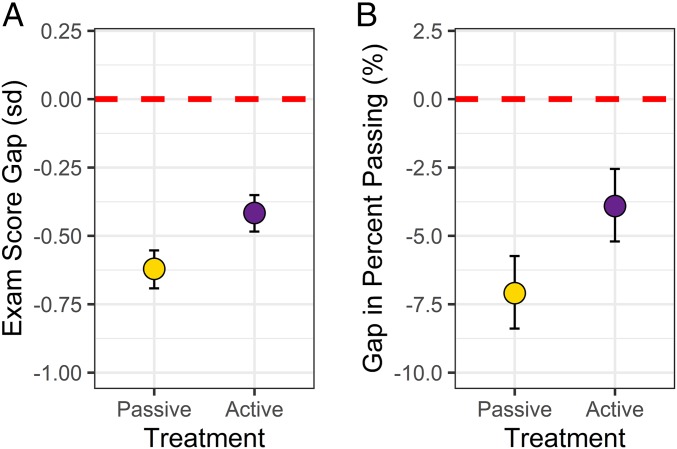
- In identical or formally equivalent exams, the standardized achievement gap between MGS and non-MGS students was −0.62 SDs in traditional lecturing and −0.42 SDs with active learning, a 33% reduction in the gap.
- For passing rates, the gap was −7.1% with traditional lecturing and −3.9% with active learning, a 45% reduction in the gap.
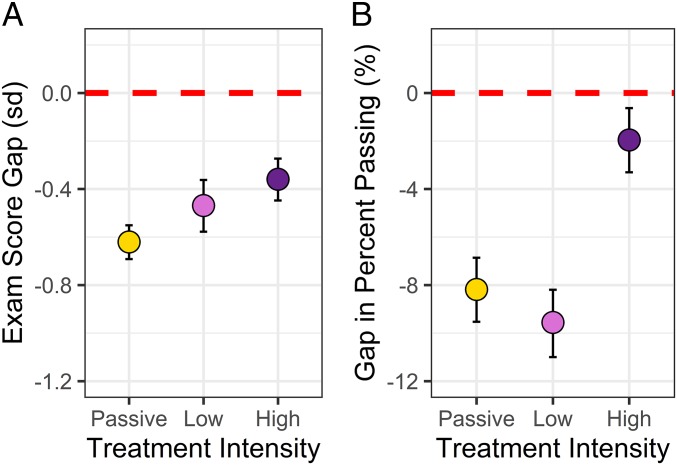
- Gap reductions were stronger with high-intensity active learning: exam-score gaps were −0.48 SDs for low-intensity vs −0.36 SDs for high-intensity; passing-rate gaps were −9.6% for low-intensity vs −2.0% for high-intensity.
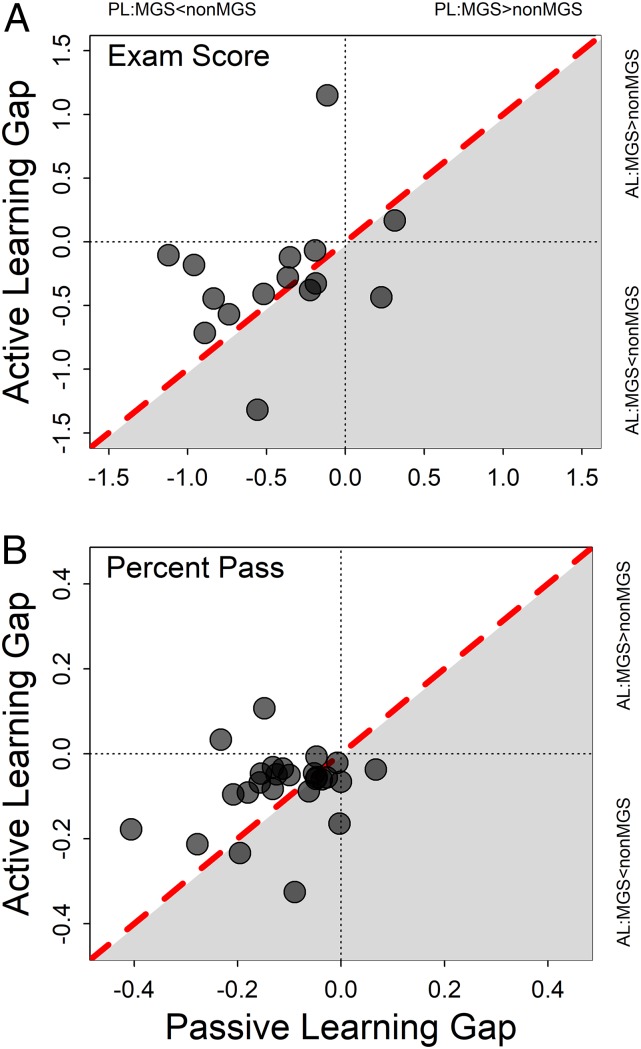
- In the study-level breakdown, 10 of 15 studies with exam-score data showed disproportionate gains for MGS students under active learning, and 15 of 26 studies with failure-rate data showed disproportionate reductions in failure rates for MGS students.
Methods
- Systematic review plus individual-participant-data (IPD) meta-analysis comparing undergraduate STEM courses taught with traditional lecturing vs active learning in the same course and institution.
- Literature search covered studies published or completed from January 1, 2010 to June 30, 2016; the final analysis included 41 studies with disaggregated data by MGS status.
- Final datasets: 9,238 student records from 15 studies for exam scores and 44,606 student records from 26 studies for failure rates; analyses used hierarchical Bayesian multilevel models with section random effects and sensitivity analyses.
Limitations
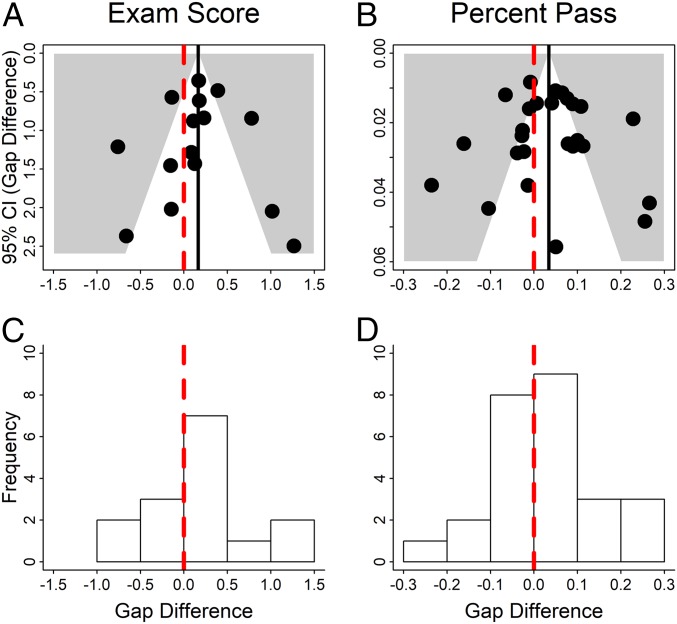
- The paper states that the conclusions are “tempered by the limitations of the study’s sample size”: only 41 studies had data for students from MGS, which also made moderator analyses hard to interpret.
- The paper says data on the type of active learning were “poorly resolved” because studies often did not report quantitative details of course interventions.
- The paper notes possible sampling bias in instructor/institution type, overrepresentation of research-intensive institutions, and underrepresentation of teaching-intensive institutions and community colleges.
- Evident from the text: the meta-analysis depends on studies that met specific coding and data-sharing criteria, so the findings may not generalize to STEM courses or settings not represented in the included studies.
Model-written summary. Check it against the paper before relying on it.
Integrity signals
Registry
Cites
Statistics
Figures
Verification
Claims the paper makes
16 Valid · 1 Not valid · 10 Not checked · 59 Own results and interpretations
The cited sources support only part of this claim — read each source’s verdict below.
In the paper
“Course grades in most STEM courses are largely driven by performance on examinations, even in active-learning courses that offer many nonexam points (39).”
§ Active learning narrows achievement gaps for underrepresented students in undergraduate science, technology, engineering, and math > Discussion
What the sources say
- Partly supportedcites [39] Freeman S., Haak D., Wenderoth M. P., Increased course structure improves performance in introductory biology. CBE Life Sci. Educ. 10, 175– 186 (2011). 21633066 PMC3105924 sourceExperimental — accuracy not yet measured
The Methods section (“Exam Impact on Final Course Grade”; page unavailable) says the authors intended exams to remain the primary determinant of grades even when many nonexam points were available. Table 4 in the Results shows that exam points strongly predicted final grades across the introductory biology sections studied. The paper does not establish that this holds in most STEM courses. (LLM, conf=0.88)
plainstates an association- Asserted: passes — The authors put it forward as true.
- Checkable: passes — It can be checked against evidence.
- Load-bearing: passes — The paper’s conclusions depend on it.
- Based: passes — The paper gives a reason why it holds.
- Partly supported
The cited sources support only part of this claim — read each source’s verdict below.
In the paper
“All students benefit from classroom cultures that promote self-efficacy, identity as a scientist, and sense of belonging in STEM (58)”
§ Active learning narrows achievement gaps for underrepresented students in undergraduate science, technology, engineering, and math > Discussion
What the sources say
- Partly supportedcites [58] Trujillo G., Tanner K. D., Considering the role of affect in learning: Monitoring students’ self-efficacy, sense of belonging, and science identity. CBE Life Sci. Educ. 13, 6– 15 (2014). 24591497 PMC3940464 sourceExperimental — accuracy not yet measured
The paper’s sections on self-efficacy, sense of belonging, and science identity link each to student learning or persistence, and its discussion of teaching considers how classroom experiences shape these factors. Its focus is undergraduate biology, however; it does not establish that all students benefit from such classroom cultures across STEM. The indexed passages provide section labels but no page numbers. (LLM, conf=0.82)
plainstates a cause- Asserted: passes — The authors put it forward as true.
- Checkable: passes — It can be checked against evidence.
- Load-bearing: unclear — It is unclear whether the paper’s conclusions depend on it.
- Based: passes — The paper gives a reason why it holds.
- Partly supported
The cited sources support only part of this claim — read each source’s verdict below.
In the paper
“students in active-learning course designs that reduced or eliminated achievement gaps have reported an increased sense of community and self-efficacy compared to their peers in the lecture-intensive version of the same course (22, 23).”
§ Active learning narrows achievement gaps for underrepresented students in undergraduate science, technology, engineering, and math > Discussion
What the sources say
- Partly supportedcites [22] Eddy S. L., Hogan K. A., Getting under the hood: How and for whom does increasing course structure work? CBE Life Sci. Educ. 13, 453– 468 (2014). 25185229 PMC4152207 sourceExperimental — accuracy not yet measured
In Methods and Results (Study 3, Factor 2; page unavailable), students in the moderate-structure course were twice as likely to report a stronger sense of classroom community than those in the low-structure course. The Introduction mentions self-reported self-efficacy in prior active-learning research, but says that research did not compare students in versions of the same course. This paper therefore does not support the claimed same-course self-efficacy comparison. (LLM, conf=0.88)
- Not matchedcites [23] Ballen C. J., Wieman C., Salehi S., Searle J. B., Zamudio K. R., Enhancing diversity in undergraduate science: Self-efficacy drives performance gains with active learning. CBE Life Sci. Ed. 16, ar56 (2017). PMC5749958 29054921
We don’t have this paper’s reference list.
plainstates an association- Asserted: passes — The authors put it forward as true.
- Checkable: passes — It can be checked against evidence.
- Load-bearing: unclear — It is unclear whether the paper’s conclusions depend on it.
- Based: passes — The paper gives a reason why it holds.
- Partly supported
Every source the paper cites for this claim was checked and supports it.
In the paper
“Our data on type of active learning are also poorly resolved, because publications still routinely fail to report quantitative data on the nature of course interventions, such as records from classroom observation tools (e.g., ref. 61 and SI Appendix, Table S12).”
§ Active learning narrows achievement gaps for underrepresented students in undergraduate science, technology, engineering, and math > Discussion
What the sources say
- Supportedcites [61] Eddy S. L., Converse M., Wenderoth M. P., PORTAAL: A classroom observation tool assessing evidence-based teaching practices for active learning in large science, technology, engineering, and mathematics classes. CBE Life Sci. Educ. 14, ar23 (2015). PMC4477739 26033871 source
The citation appears as an example of a classroom observation tool, not as evidence that publications routinely omit quantitative intervention data. The Abstract identifies PORTAAL as a classroom observation tool for assessing active-learning practices, which supports that use of the citation. (LLM, conf=0.91)
plainstates a cause- Asserted: passes — The authors put it forward as true.
- Checkable: passes — It can be checked against evidence.
- Load-bearing: unclear — It is unclear whether the paper’s conclusions depend on it.
- Based: passes — The paper gives a reason why it holds.
- Supported
Every source the paper cites for this claim was checked and supports it.
In the paper
“larger gaps are correlated with faculty who have a fixed mindset, which interprets intelligence as innate and immutable and is therefore exclusion or selection-oriented (44).”
§ Active learning narrows achievement gaps for underrepresented students in undergraduate science, technology, engineering, and math > Discussion
What the sources say
- Supportedcites [44] Canning E. A., Muenks K., Green D. J., Murphy M. C., STEM faculty who believe ability is fixed have larger achievement racial achievement gaps and inspire less student motivation in their classes. Sci. Adv. 5, eaau4734 (2019). 30793027 PMC6377274 source
The Results report that racial achievement gaps in STEM courses were nearly twice as large with fixed- versus growth-mindset faculty. The Introduction defines a fixed mindset as treating intelligence and ability as innate and largely unchangeable, and describes judging students as low-ability and encouraging them to drop difficult courses—supporting the paraphrase 'exclusion or selection-oriented.' (LLM, conf=0.88)
plainstates an association- Asserted: passes — The authors put it forward as true.
- Checkable: passes — It can be checked against evidence.
- Load-bearing: unclear — It is unclear whether the paper’s conclusions depend on it.
- Based: passes — The paper gives a reason why it holds.
- Supported
30 more claims
Create a free account to see all 86 claims and every source verdict.
- It may state two separate claims as one. 30
- Probably not a substantial claim. 36
Claims other papers make about this one
Each is checked against this paper’s own text: does it say what the citing paper says it does?
The source backs part of the claim, not all of it — or backs it for a different population, condition or comparison.
In the citing paper
“These perceptions, along with a likely reduction in stress and anxiety (see Figure 4), could benefit students from underrepresented groups and may thus reduce the achievement gap among underrepresented minorities”
From Two-Stage Final Exams: An Assessment Strategy for Enhanced Collaborative Learning and Reduced Student Stress (2026) · cites this paper as Theobald et al., 2020
Experimental — accuracy not yet measured
Citations
Cites
Preferred Reporting Items for Systematic Reviews and Meta-Analyses: the PRISMA statement
Moher, D., Liberati, A., Tetzlaff, J., Altman, D. G., & for the PRISMA Group (2009) · BMJ · doi:10.1136/bmj.b2535 · Cited by 83,823
Preferred reporting items for systematic reviews and meta-analyses: the PRISMA Statement.
(2009) · PubMed Central · Cited by 44,859
Preferred reporting items for systematic reviews and meta-analyses: The PRISMA statement
Moher, D., Liberati, A., Tetzlaff, J., Altman, D. G., & the PRISMA Group* (2009) · Annals of Internal Medicine · doi:10.7326/0003-4819-151-4-200908180-00135 · Cited by 37,554
PRISMA-P Group, Moher, D., Shamseer, L., Clarke, M., Ghersi, D., Liberati, A., Petticrew, M., Shekelle, P., & Stewart, L. A. (2015) · Systematic Reviews · doi:10.1186/2046-4053-4-1 · Cited by 26,223 · cited 2×
“The protocol for this study, presented in the PRISMA-P format (66) and including annotations regarding modifications that occurred during the course of the research, is available in SI Appendix, SI Materials and Methods.”
Capital in the Twenty-First Century
Piketty, T. (2014) · doi:10.4159/9780674369542 · Cited by 14,437
Data Analysis Using Regression and Multilevel/Hierarchical Models
Gelman, A., & Hill, J. (2006) · doi:10.1017/cbo9780511790942 · Cited by 13,597
Active learning increases student performance in science, engineering, and mathematics
Freeman, S., Eddy, S. L., McDonough, M., Smith, M. K., Okoroafor, N., Jordt, H., & Wenderoth, M. P. (2014) · Proceedings of the National Academy of Sciences · doi:10.1073/pnas.1319030111 · Cited by 9,787 · cited 6×
“Can interventions in courses themselves—meaning, changes in how science is taught—reduce achievement gaps and promote retention in STEM? A recent metaanalysis concluded that, on average, active learning in STEM leads to higher examination scores and lower failure rates for all students, compared to all students in the…”
InfluentialSelf-citation(2000) · Cited by 9,198
A threat in the air: How stereotypes shape intellectual identity and performance
Steele, C. M. (1997) · American Psychologist · doi:10.1037/0003-066x.52.6.613 · Cited by 6,770 · cited 1×
“Equally important, inclusive teaching emphasizes treating students with dignity and respect (52), communicating confidence in students’ ability to meet high standards (53), and demonstrating a genuine interest in students’ intellectual and personal growth and success (54, 55).”
BackgroundGeneral methods for monitoring convergence of iterative simulations
Brooks, S. P., & Gelman, A. (1998) · Journal of Computational and Graphical Statistics · doi:10.1080/10618600.1998.10474787 · Cited by 6,045
Research works printed but not linked: 9
- Reardon S. F., “The widening achievement gap between the rich and the poor: New evidence and possible explanations” in Whither Opportunity? Duncan G. J., Murnane R. J., Eds. (Russell Sage Foundation, New York, 2011), pp. 91– 115.
- National Student Clearinghouse Research Center, High School Benchmarks 2019: National College Progression Rates (National Student Clearinghouse, Herndon, VA, 2019).
- Chen X., STEM Attrition: College Students’ Paths Into and Out of STEM Fields (National Center for Education Statistics, Washington, DC, 2013).
- Vygotsky L. S., Mind in Society (Harvard University Press, Cambridge, MA, 1978).
- Kaufmann E., Reips U.-D., Merki K. M., Avoiding methodological biases in meta-analysis. Z. Psychol. 224, 157– 167 (2016).
- Ginder S. A., Kelly-Reid J. E., Mann F. B., Enrollment and Employees in Postsecondary Institutions, Fall 2015 (National Center for Education Statistics, Washington, DC, 2017).
- Reed J. G., Baxter P. M., Using Reference Databases. The Handbook of Research Synthesis and Meta-Analysis, Cooper H., Hedges L. V., Valentine J. C., Eds. (Russell Sage Foundation, New York, 2009), pp. 73– 101.
- Rothstein H., Hopewell S., Grey Literature. The Handbook of Research Synthesis and Meta-Analysis, Cooper H., Hedges L. V., Valentine J. C., Eds. (Russell Sage Foundation, New York, 2009), pp. 103– 125.
- White H. D., Scientific Communication and Literature Retrieval. The Handbook of Research Synthesis and Meta-Analysis, Cooper H., Hedges L. V., Valentine J. C., Eds. (Russell Sage Foundation, New York, 2009), pp. 51– 71.
Cited by
Items 1,201–1,300 of 1,369
Additional file 2 of Adapting the CACAO model to support higher education STEM teaching reform
Viskupic, K. M., Earl, B., & Shadle, S. E. (2022) · Figshare · doi:10.6084/m9.figshare.18482265
León, C. G. B., Tello, M. E. B., Haro, I. M. R., & Yanchatipan, C. B. C. (2025) · Revista Ciencia Innovadora · doi:10.64422/rci.v3n3.2025.57 · Cited by 1
Rohimah, S. M., Nurfaidah, S. S., & Indriyani, Y. (2024) · Literate International Journal of Social Science and Humanities · doi:10.52005/literate.v3i1.48 · Cited by 1
Brake, B., & Bick, N. (2025) · Journal of Political Science Education · doi:10.1080/15512169.2025.2598552
RetractedLeveling Up Fitness Education: Engaging Your Audience with Active Learning
Kovacs, S. J. (2025) · ACSMʼs Health & Fitness Journal · doi:10.1249/fit.0000000000001124
Ma, Y., Li, X. L., & Dong, Y. (2025) · SAGE Open · doi:10.1177/21582440251408260 · Cited by 1
“Theobald et al. (2020) conducted Bayesian regression analyses on exam score data from 15 studies (9,238 students) and failure rate data from 26 studies (44,606 students), concluding that only evidence-based active learning course designs can close academic performance gaps.”
Making connections: teaching and learning bioelectrochemistry
McEvoy, J. P. (2025) · JBIC Journal of Biological Inorganic Chemistry · doi:10.1007/s00775-025-02131-y
Percepciones de educadores sobre la neurociencia en estrategias didácticas
Álvarez, G. L. C., Caballero, P. R. M. N., Parodi, K. V., et al. (2025) · PSIQUEMAG/ Revista Científica Digital de Psicología · doi:10.18050/psiquemag.v14i2.4068
ZUBAIRU, Z. (2026) · Federal University Gusau Faculty of Education Journal · doi:10.64348/zije.2025214
Choi, Y. H., Alexander, T. M., & Neisler, J. (2026) · doi:10.12688/verixiv.2642.1
Maisva, T., Hall, S. E., & Wiles, J. R. (2026) · The journal of college science teaching · doi:10.1080/0047231x.2025.2599741
Choi, Y. H., & Hinton, V. P. (2026) · doi:10.12688/verixiv.2643.1
Isaac, S., de Lima, J., Jalali, Y., Rossi, V., Schmid, S., Popescu, Ș. G., Tozadore, D. C., & Zufferey, J. D. (2026) · Frontiers in Education · doi:10.3389/feduc.2025.1688568
Suresh, M. A. (2025) · 2022 IEEE Frontiers in Education Conference (FIE) · doi:10.1109/fie63693.2025.11328544
“…imply deeper or broader understanding of concepts 4) Linking grades to learning outcomes Apart from assessment, active learning is a pedagogical approach that can improve class engagement, help ensure course objectives are met and enable students to take an active role in their learning [16] [18].”
Pro-Game: Single-machine sequencing simulator
Palma-Mendoza, J. A., Salinas-Navarro, D. E., & Arana-Solares, I. (2025) · IEEE International Conference on Teaching, Assessment, and Learning for Engineering · doi:10.1109/tale66047.2025.11346669
“[7].”
Oral examination as a tool for mastery learning in undergraduate microbiology
James, A., & Widener, C. (2026) · FEMS Microbiology Letters · doi:10.1093/femsle/fnag010 · Cited by 1
“Previous research has highlighted that structured activities designed to improve performance over time lead to reductions in achievement gaps between students (Freeman et al. 2011 , Theobald et al. 2020 ).”
Kaya, N. B., Sezgin, M. E., Salar, H. C., & ÇAM, E. (2026) · Hacettepe University Journal of Education · doi:10.16986/hunefd.1734263
Dutton, S. B. B., & Larimore, J. L. (2025) · Journal of Undergraduate Neuroscience Education · doi:10.59390/001c.155318 · Cited by 1
“Moreover, research suggests that women may face distinct barriers in online education (Corwin et al., 2021; Theobald et al., 2020), including lower engagement (Sung & Huang, 2024), reduced confidence (Landrum, 2020), and challenges in access to technology (McIntyre et al., 2025).”
Crowder, C. J., Komperda, R., Bliss-Roche, K., & Raker, J. R. (2026) · Chemistry Education Research and Practice · doi:10.1039/d5rp00447k · Cited by 3
Mapisa, B. Z. (2025) · E-Journal of Humanities Arts and Social Sciences · doi:10.38159/ehass.20256157
Dajani, I. A., Esteban, M. C., & Châari, A. (2026) · BMC Medical Education · doi:10.1186/s12909-026-08736-4
Farrow, C. B., Wetzel, E. M., Leathem, T., & Mcgoey, K. (2026) · New Directions for Teaching and Learning · doi:10.1002/tl.70028
“Multiple studies have demonstrated links between active learning to improved learning outcomes across multiple disciplines, including science, computer, engineering, math, and liberal arts (Freeman et al. 2014 ; Prince 2004 ; Theobald et al. 2020 ).”
Student Experience and Wellbeing
Felten, P. (2026) · Rastros Rostros · doi:10.16925/2382-4921.2026.01.04
A BIBLIOMETRIC PERSPECTIVE ON STUDENT MOTIVATION AND INTEREST IN MATHEMATICS
Zaki, N. I. M., Mustapa, S., & Ahmad, S. (2025) · International Journal of Modern Education · doi:10.35631/ijmoe.728053
TECHNOLOGY-ENHANCED TECHNIQUES FOR LEARNING MATHEMATICS: A BIBLIOMETRIC PERSPECTIVE
Abu, Z., Abdollah, B., & Zaki, N. I. M. (2025) · International Journal of Modern Education · doi:10.35631/ijmoe.728056 · Cited by 3
Göçer, V., & Şenel, E. A. (2026) · SSRN Electronic Journal · doi:10.2139/ssrn.6231886
Sato, B. K., Ditta, A. S., Denaro, K., Maloy, J. P., McMurran, M., Saichaie, K., & Wilton, M. (2026) · Change The Magazine of Higher Learning · doi:10.1080/00091383.2026.2596571 · Cited by 1
“…can be contextualized in the capacity-building framework is widespread faculty intransigence to the adoption of evidence-based instructional techniques despite significant research demonstrating their positive impacts on student academic performance (Freeman et al., 2014; Theobald et al., 2020).”
Byrne, J. P., Powell, D., & Russell, L. M. (2026) · SSRN Electronic Journal · doi:10.2139/ssrn.6300100
David, A., Eguta, K., & Gargar, K. A. (2026) · Schrödinger Journal of Physics Education · doi:10.37251/sjpe.v7i1.2826
Active and Engaging Learning From a Classroom Management Perspective
Divoll, K. (2026) · Emerald Group Publishing Limited eBooks · doi:10.1108/978-1-80592-825-620261002
Cross-regional acculturative stress and mental well-being among undergraduate students in China
Zhang, W., Wang, P., Chen, C., Ye, B., & Shao, J. (2026) · International Journal of Intercultural Relations · doi:10.1016/j.ijintrel.2026.102413 · Cited by 1
Kouassi, J.-M., Nair, T., & Pohlschröder, M. (2026) · Research Square · doi:10.21203/rs.3.rs-9031942/v1
Waugh, A. H., Green, K. E., & Andrews, T. C. (2026) · CBE—Life Sciences Education · doi:10.1187/cbe.25-09-0196
“…learn fundamental concepts, foster the development of scientific thinking skills, and begin to repay educational debt owed to students from historically and currently marginalized groups (Haak et al. , 2011; Freeman et al. , 2014; Eddy and Hogan, 2014; Ballen et al. , 2017; Theobald et al. , 2020).”
Kubasek, L., & Rossiter, L. M. (2026) · Journal of Chemical Education · doi:10.1021/acs.jchemed.5c00232
Ramankulov, S. J., Çoruh, A., Нуризинова, М., Rizakhojayeva, G., Kelesbayev, K., & Khikmatulla, S. (2026) · Frontiers in Education · doi:10.3389/feduc.2026.1774470 · Cited by 1
Mualip, N. (2026) · Research Square · doi:10.21203/rs.3.rs-9150869/v1
Humanizing Linear Algebra at Scale with Team-Based Inquiry Learning
Kostiuk, J. (2026) · PRIMUS · doi:10.1080/10511970.2026.2626699 · Cited by 1
“These findings are consistent with the existing literature on TBIL and high-intensity active learning more broadly and are further evidence of the success of this particular implementation [24,31].”
Jackson, M. A., Liu, H., Moon, S., Doherty, J. H., & Wenderoth, M. P. (2026) · PLoS ONE · doi:10.1371/journal.pone.0327269 · Cited by 5
Morris, E. J., Jensen, M. H., Rivas, B. A., et al. (2026) · The Physics Teacher · doi:10.1119/5.0198325
Jackson, B. D., Robinson, B. H., Madison, M. J., & Andrews, T. C. (2026) · CBE—Life Sciences Education · doi:10.1187/cbe.25-09-0199 · Cited by 1
“For example, though active learning is associated with increased learning gains (Freeman et al. , 2014), those benefits vary by social identity, though who benefits most varies by study (Theobald et al. , 2020; Setren et al. , 2021).”
Using Active Learning Strategies to Develop Writing Skills for Students in Iraqi Universities
Ajaj, I. E. (2025) · Journal of Tikrit University for Humanities · doi:10.25130/jtuh.32.9.2.2025.25
Costello, R. A., Amin, R., Driessen, E. P., Kjelvik, M. K., Schultheis, E. H., Youngblood, R. M., Zemenick, A. T., Weber, M. G., & Ballen, C. J. (2026) · BioScience · doi:10.1093/biosci/biag029 · Cited by 1
Jesus, M. M. D., Hobbs, K. S., Adams, P. E., Ammamoo, E., Costello, R. A., Cotner, S. H., Creech, C., Driessen, E. P., Hammarlund, S. P., Foster‐Hartnett, D., et al. (2026) · CBE—Life Sciences Education · doi:10.1187/cbe.25-07-0154
“Active learning approaches have been shown to reduce barriers that hinder performance and affective outcomes for students with some minoritized identities (e.g., see Haak et al. , 2011; Eddy et al. , 2015; Ballen et al. , 2017a; Theobald et al. , 2020).”
Extending Learning After the Semester: Outcomes from Multiple Mathematics Courses
Fuller, E. J., Merkin, R., & Hower, J. (2026) · PRIMUS · doi:10.1080/10511970.2026.2626980
“In [30] and the range of implementations in [42], researchers and practitioners leveraged active learning approaches [19, 31, 37, 44] to engage students and foster sustainable independent learning.”
Qualitative evaluation of engineering teaching assistants’ current mentorship capabilities
Ewert, N. G., & Kittur, J. (2026) · European Journal of Engineering Education · doi:10.1080/03043797.2026.2655789
Reasoning over recall: a six-step tutorial for muscle actions and innervations in functional anatomy
Gyorkos, A. M. (2026) · AJP Advances in Physiology Education · doi:10.1152/advan.00235.2025
Do institutions value peer-reviewed open educational resources? Insights from biology lesson authors
MacNeill, B. N., Olson, A. N., Foltz, A. E., Robles, J. E., Stetzer, M. R., Couch, B. A., & Smith, M. K. (2026) · Journal of Microbiology and Biology Education · doi:10.1128/jmbe.00327-25 · Cited by 1
“The report advocates for instructors to use evidence-based instructional practices, such as active-learning exercises, which have consistently been shown to improve student performance compared to traditional lecture-based instruction (26–30).”
Raker, J. R., Pentecost, T. C., & Murphy, K. L. (2026) · Frontiers in Education · doi:10.3389/feduc.2026.1808297
Tugwell, O. O., & Uro, E. E. (2026) · Advances in computational intelligence and robotics book series · doi:10.4018/407441
Catherall‐Ostler, A. M., & Elliott, P. (2026) · Journal of Biological Education · doi:10.1080/00219266.2026.2652865
Bennie, J., Withers, M. D., Chen, X., Panos, J., Zhang, K., Morgan, M., Yeh, P., Zhang, T., & Graham, M. (2026) · College Teaching · doi:10.1080/87567555.2026.2656669
Applied Multivariate Analysis with PythonPreprint
Szulczyk, K. (2026) · SSRN Electronic Journal · doi:10.2139/ssrn.6578998
Engaging Student Attention with Active Learning and Creative Projects in Parasitology Courses
Anaya, C., & Shea, J. F. (2026) · Journal of Parasitology · doi:10.1645/25-12 · Cited by 1
Pichardo, Y. S. (2026) · Revista perspectivas/Perspectiva · doi:10.22463/25909215.5484
Wells, K. M., Eubig, P. A., Livingston, M. L., Bush, B. M., Scarpaci, A., Schultz, J., Stanescu, R. M., & Ovid, D. (2026) · AJP Advances in Physiology Education · doi:10.1152/advan.00285.2025
Williams, A. E., & Denaro, K. (2026) · CBE—Life Sciences Education · doi:10.1187/cbe.25-04-0074 · Cited by 1
“There is significant support for peer interaction during class time in biology and other STEM disciplines (Michael, 2006; Prince and Felder, 2006; Freeman et al. , 2007; Bishop and Verleger, 2013; Theobald et al. , 2020).”
Kaur, R. (2026) · IGI Global eBooks · doi:10.4018/979-8-3373-7102-3.ch008
Mendonça, B. K. P. G., de Carvalho, L. V. B., Brito, M. D. A., et al. (2026) · Revista Sociedade Científica · doi:10.61411/rsc2026133319
Schutz, K., Wolff, L., Pandey, S., Bruns, H. A., Condry, D. L. J., Justement, L. B., Kleinschmit, A. J., Lal, A., Sletten, S., Sparks-Thissen, R. L., et al. (2026) · Frontiers in Education · doi:10.3389/feduc.2025.1639366
A Special Issue Introduction: Educational Applications of Cognitive Psychology
Little, J. L., & Bjork, E. L. (2026) · Behavioral Sciences · doi:10.3390/bs16050713
Downey, F., & O’Mahony, T. (2026) · International Journal of Disability Development and Education · doi:10.1080/1034912x.2026.2666499
Prasetya, A. T., haryani, S., Wardani, S., et al. (2026) · Chemistry Teacher International · doi:10.1515/cti-2025-0053
Ullum, M. B., Rahmawati, Y., & Amin, F. (2026) · JKTP Jurnal Kajian Teknologi Pendidikan · doi:10.17977/um038v9i22026p179-191 · Cited by 1
Diffractive Ethnography in Practice: Understanding the Intra-Actions of Educational Complexity
Bremert, H., & Talbot, D. (2026) · International Journal of Qualitative Methods · doi:10.1177/16094069261441989 · Cited by 1
Choi, Y. H., Alexander, T. M., & Neisler, J. (2026) · College Teaching · doi:10.1080/87567555.2026.2668376
Educational policies can strengthen climate coalitions
Bradley, M., Chazottes, R., Garside, S., & Lopez-Uroz, N. (2026) · Proceedings of the National Academy of Sciences · doi:10.1073/pnas.2533821123
“In education research, active learning, which engages students more directly in the learning process, has been shown to be an effective technique to improve student performance (15) and narrow achievement gaps for underrepresented students (16).”
Koch, B. T., Chrapliwy, N., Ng, M., & Newpher, T. M. (2026) · International Journal of Educational Methodology · doi:10.12973/ijem.12.2.99 · Cited by 1
Porter, Z. J., Karunaratne, N. S., Sinnayah, P., Klein, R., & Exintaris, B. (2026) · Currents in Pharmacy Teaching and Learning · doi:10.1016/j.cptl.2026.102680 · Cited by 1
Zepeda, C. D., Rosemond, S. N., Johnson, H. J., Clements, T. P., Albarran, M., Lee, G., Watson, M., & Brame, C. J. (2026) · CBE—Life Sciences Education · doi:10.1187/cbe.26-02-0025
“These courses are often perceived as competitive spaces that do not foster motivation or confidence, and they result in lower grades, higher drop/fail/withdraw rates, and lower satisfaction compared with non-STEM introductory courses (Seymour and Hunter, 2019; Tomkin and West, 2022).”
InfluentialTeaching Bayesian Estimation Through Interactive Learning: Interactive and AI-Enhanced Approaches
Ekici, O. (2026) · Advances in computational intelligence and robotics book series · doi:10.4018/979-8-3373-6259-5.ch002
Chávez, M. K. B., Anchundia, J. V. M., Moracén, E. I. M., et al. (2026) · Arandu-UTIC. · doi:10.69639/arandu.v13i2.2163
Chirikure, T., Sibanda, D., Ndlovu, B. P., et al. (2025) · Africa Education Review · doi:10.1080/18146627.2026.2641499
“Contemporary STEM education research increasingly recognises that effective pedagogies integrate elements from both traditions (Portillo-Blanco et al. 2024; Theobald et al. 2020).”
Worthington, D., Popichak, K. A., Hines, A. M., Fainelli, S., & McLean, J. (2026) · Journal of Microbiology and Biology Education · doi:10.1128/jmbe.00056-26
Olmstead, A. R., Montecinos, A. M., Castro, H., Atkinson, T., Close, E. W., Fitzgerald-Russell, M. L., Hedge, K., & Kerr, A. (2026) · CBE—Life Sciences Education · doi:10.1187/cbe.25-04-0066 · Cited by 1
“…inequities pertaining to STEM students’ success in their academic pursuits and limits student success overall, and that active learning can combat these inequities and lead to greater success for all students (e.g., Freeman et al. , 2014; Kober, 2015; Laursen, 2019; Theobald et al. , 2020).”
Ecuadorian and Canadian Student Perception of a Neuroscience Course-Based Virtual Exchange Project
Wong, M., Turgut, N., Rios, C. A. H., Yakubov, R., Marsden, E., Garcés, M. S., & Leegsma, P. (2026) · Teaching & Learning Inquiry The ISSOTL Journal · doi:10.20343/teachlearninqu.14.26
“…including better achievement and engagement, and increased intrinsic motivation and a sense of belonging (Freeman, Eddy, McDonough, Smith, Okoroafor, Jordt, and Wenderoth 2014; Salinas and Garr 2009; Theobald et al. 2020; Wong 2024; Wong, Al-saqqar, Nash, Al-Humuzi, Dottori, and Secord 2024).”
Assessment, feedback, and grading practices and philosophies of introductory biology instructors
Lemons, M. L., Dewsbury, B. M., Wheeler, L. B., et al. (2026) · Journal of Microbiology and Biology Education · doi:10.1128/jmbe.00261-25
Dung, T. T., Vinh, H. X., Tuan, L. D. A., An, L. P. N., & Khanh, N. P. (2026) · International Journal of Research and Review · doi:10.52403/ijrr.20260538
Dugan, A. S., Meza, K. S., Borges, W., & Lawrence, S. (2026) · FEMS Microbiology Letters · doi:10.1093/femsle/fnag065
Socratic Method: A Student‐Centered Approach to Teaching Statistics
Amin, Z. H. (2026) · Teaching Statistics · doi:10.1002/test.70044
Liu, M., & Baylon, J. (2026) · QualiSearch Journal of Educational Research and Practice · doi:10.66437/qjerp.v2i5.001
Muppala, S. P., Khazaeinejad, P., & Butt, E. (2026) · Education Sciences · doi:10.3390/educsci16060857 · Cited by 1
Mathew, S. S. (2026) · IntechOpen eBooks · doi:10.5772/intechopen.1015825
Implementation of SCALE-UP in First-Year Chemistry at an HBCU
Erebholo, F., Chakafana, G., Holder, C. A., Hahn, I. F., Ndip, E. M. N., Njoki, P. N., Whittington, D., & Asojo, O. A. (2026) · Journal of Higher Education Theory and Practice · doi:10.33423/46rmbb85
“In contrast, previous research has shown that active learning improves exam performance, benefits underrepresented students, reduces failure rates, and closes achievement gaps in STEM (Freeman et al., 2014; Harris et al., 2020; Theobald et al., 2020).”
Moving Beyond Deficit: DisCrit and Disability Justice in STEM Postsecondary Education
Torres, L. E., Yeh, C., Tan, P., Reinholz, D. L., & Payan, R. (2026) · Critical studies of education · doi:10.1007/978-981-96-9136-4_5
Ganta, D., Ynalvez, M. A., & Luna, H. (2026) · Journal of Latinos and Education · doi:10.1080/15348431.2026.2684423
“Likewise, Shortlidge et al. (2024) showed that STEM intervention programs enhance persistence through community affirmation, and Theobald et al. (2020) found that active-learning strategies can immediately buffer disengagement.”
InfluentialShihadih, D. S., Baez, E., Asgari, M., Berl, J., Chouinard, A. J., Gutzler, S. J., Heinrich, K. K., Riordan, E., Lee, S. W., & Shortlidge, E. E. (2026) · Journal of Microbiology and Biology Education · doi:10.1128/jmbe.00064-26
“These efforts are in line with existing literature advocating for the use of EBTPs (46–49), the development of TA-TPD programming with a diversity of offerings (11, 50, 51), and specifically addressing beliefs about student-centered teaching practices (16, 52–54), all to facilitate a shift in TA…”
Haptics: Adding the Sense of Touch to Feel the Magnetic Force in Undergrad Physics Courses
Robledo-Rella, V., Neri, L., García-Castelán, R. M. G., Noguez, J., & González-Nucamendi, A. (2026) · IEEE World Engineering Education Conference (EDUNINE) · doi:10.1109/edunine62390.2026.11546753
Popa, N. L., & Assante, G. M. (2026) · Journal of Applied Research in Higher Education · doi:10.1108/jarhe-11-2025-0926 · Cited by 1
Bello, M. V. F., Ray, S., & Martyn, K. (2026) · Food Science and Nutrition Cases · doi:10.1079/fsncases.2026.0009
Effectiveness of mind mapping in undergraduate nursing education: A quasi-experimental study
Mesk, Z. M., Qtait, M. T., Alqaissi, N. M., Amro, A., Asafrah, M., zeedat, F., zeedat, H., Daoud, M., Asafrah, D., & hmedat, N. (2026) · SAGE Open Medicine · doi:10.1177/20503121261462854
“14 Motivation is also important in nursing education because it influences engagement, persistence, and self-regulated learning.”
Khotimah, F. F., Tabroni, & Azim, P. (2026) · Women Education and Social Welfare · doi:10.70211/wesw.v3i2.526
Assessment and Evaluation in STEM Education in the Age of AI
Cuhadar, I., Yalvaç, B., & Akkır, A. (2026) · Maarif global education series · doi:10.1007/978-981-95-9023-0_7 · Cited by 1
Bridging the Gap: Faculty-Led Recognition of Prior Military Learning in Higher Education
Spencer, R. G. (2026) · Adult Learning · doi:10.1177/10451595261464570
An Exploratory Analysis of Inclusive Teaching Practices Conveyed by Course Syllabi
Li, X. V., & Rosson, M. B. (2026) · IEEE Global Engineering Education Conference (EDUCON) · doi:10.1109/educon67543.2026.11574169
Xu, S., Velasco, V., Hill, M. J., Tran, E. T., Agrawal, S., Arroyo, E. N., Behling, S., Chambwe, N., Cintrón, D. L., Cooper, J. D., et al. (2026) · Education Sciences · doi:10.3390/educsci16071044 · Cited by 13
Self-citationMaking college work: lessons from a bridge program for incoming students
Lin, E. X., Lisberg, A. E., Levas, S., & Hidayat, D. G. (2026) · Frontiers in Education · doi:10.3389/feduc.2026.1813008
Muztaba, R., Muztaba, R., Herpratiwi, Sowiyah, Riniarti, M., Andriyani, R., & Yusuf, A. A. (2026) · Jurnal Penelitian Pendidikan IPA · doi:10.29303/jppipa.v12i6.14499
“…and have been shown to improve student engagement, conceptual understanding, and learning outcomes (Contrino et al., 2024; Cooper et al., 2018; Deslauriers et al., 2019; Fedeli & Taylor, 2023; Freeman et al., 2014; Li et al., 2024; Medina Vásquez et al., 2025; Theobald et al., 2020; Wang, 2024).”
Özoğul, G., Zheng, X., Min, W., Lee, S., Esiason, J., Carpenter, D., & Lester, J. C. (2026) · European Journal of STEM Education · doi:10.20897/ejsteme/18919
“…across all STEM disciplines (Freeman et al., 2014; Villegas-Ch et al., 2025), and these active learning strategies contribute to narrowing achievement gaps for underrepresented STEM students, helping to create a more equitable learning environment (Ortiz Moreno et al., 2025; Theobald et al., 2020).”
Yang, K. Y. (2026) · IGI Global eBooks · doi:10.4018/979-8-2600-1811-8.ch005
Metadata
- Authors
- Theobald, E. J., Hill, M. J., Tran, E., Agrawal, S., Arroyo, E. N., Behling, S., Chambwe, N., Cintrón, D. L., Cooper, J. D., Dunster, G., Grummer, J. A., Hennessey, K., Hsiao, J., Iranon, N., Jones, L., Jordt, H., Keller, M., Lacey, M. E., Littlefield, C. E., Lowe, A., Newman, S., Okolo, V., Olroyd, S., Peecook, B. R., Pickett, S. B., Slager, D. L., Caviedes-Solis, I. W., Stanchak, K. E., Sundaravardan, V., Valdebenito, C., Williams, C. R., Zinsli, K., & Freeman, S.
- Affiliations
- University of Washington (US)
- Institute for Systems Biology (US)
- Shoreline Community College (US)
- Corresponding author
- Theobald, Elli J.
- Freeman, Scott
- ORCID
- Theobald, Elli J.
- Agrawal, Sweta
- Behling, Shawn
- Chambwe, Nyasha
- Cintrón, Dianne Laboy
- Cooper, Jacob D.
- Dunster, Gideon
- Grummer, Jared A.
- Hennessey, Kelly
- Hsiao, Jennifer
- Jones, Leonard
- Jordt, Hannah
- Littlefield, Caitlin E.
- Lowe, Alexander
- Olroyd, Savannah
- Peecook, Brandon R.
- Pickett, Sarah B.
- Slager, David L.
- Caviedes-Solis, Itzue W.
- Stanchak, Kathryn E.
- Williams, Claire R.
- Zinsli, Kaitlin
- Freeman, Scott
- Venue
- Proceedings of the National Academy of Sciences
- Publisher
- National Academy of Sciences
- Published
- 2020-03-09
- Volume
- 117
- Issue
- 12
- Pages
- 6476-6483
- ISSN
- 0027-8424 (ISSN-L)
- 1091-6490
- PMC
- PMC7104254
- OpenAlex
- W3009483010
- Cited by
- 1,387
- References
- 75
- Citations by year
- 2026: 210 · 2025: 222 · 2024: 272 · 2023: 236 · 2022: 233 · 2021: 154 · 2020: 60
- FWCI
- 258.89
- Type
- journal article
- Language
- en
- Open access
- hybrid
- doi.org
- Licence
- Locations
- Proceedings of the National Academy of Sciences (publishedVersion, cc-by-nc-nd)
- Europe PMC (PubMed Central) (publishedVersion, cc-by-nc-nd)
- PubMed Central (publishedVersion, cc-by-nc-nd)
- PubMed (publishedVersion)
- Funders
- University of Washington College of Arts and Sciences (NA)
- Topics
- Social Sciences › Education › Innovative Teaching Methods
- Social Sciences › Education › Higher Education Research Studies
- Social Sciences › Psychology › Developmental and Educational Psychology › Innovative Teaching and Learning Methods
- Keywords
- active learning, achievement gap, underrepresented students, STEM education, traditional lecturing, course design, student failure rates, test scores, higher education equity, inclusive pedagogy, deliberate practice
- MeSH terms
- Achievement, Educational Measurement, Engineering, Humans, Mathematics, Minority Groups, Science, Students, Technology, United States, Universities, Problem-Based Learning
About these checks
Registry, retraction, Cites and statistics results are computed, not judged, with one exception: a printed reference that no index lists is read once by a model before it counts as a citation error. Claims are extracted by a model and kept only when their quote appears verbatim in the text; each cited source is then checked, with a model’s help, for whether it says what the claim relies on. Those verdicts can be wrong — read the claim’s quote and the cited source before relying on one.
The claim verdicts this report counts are experimental: their accuracy is not yet measured.
A language model drew the claims from the paper on 2026-10-10, under version 3 of the claim definition (model deepseek-v4.1-flash, prompt extract-v3).
A second model labelled each claim on 2026-10-10 (model jev-1.13-20260917, definition revision gold-guideline-v0.2).
Cited sources are checked with a language model’s help (gpt-6-sol).
Statistics and arithmetic are recomputed, not judged.
Confidence bands are shown only for fields calibrated on our annotated test set. None is calibrated yet, so no band is shown.
What counts as a claim ›How we measure confidence ›How we check this ›
Are you an author, or do you see a problem with this page? Request a review
Data sources
Bibliographic data: Semantic Scholar, OpenAlex, Crossref.
Contains information from the Semantic Scholar Academic Graph Datasets, made available under the ODC Attribution License (ODC-BY 1.0).
Semantic Scholar’s data is described in: Kinney, R., et al. (2023). The Semantic Scholar Open Data Platform. arXiv:2301.10140.
