

Active learning narrows achievement gaps for underrepresented students in undergraduate science, technology, engineering, and math
Open accessThe DOI matches its Crossref record; 72 of the 75 references it cites were found in a registry or an index, and 3 are not checked yet; 19 of the 44 sources its claims cite were checked for support.
Abstract
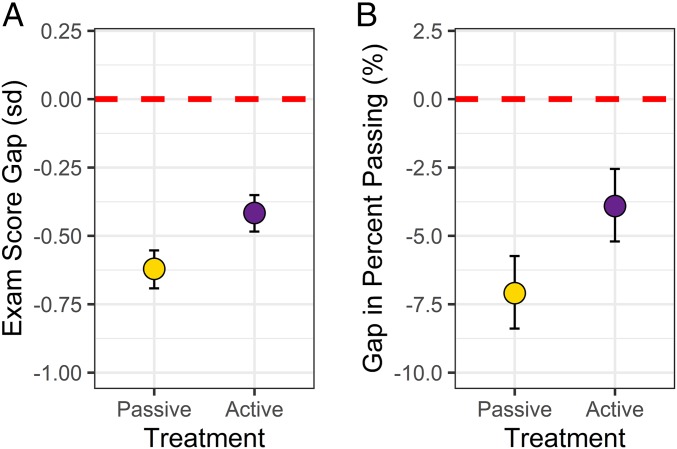
We tested the hypothesis that underrepresented students in active-learning classrooms experience narrower achievement gaps than underrepresented students in traditional lecturing classrooms, averaged across all science, technology, engineering, and mathematics (STEM) fields and courses. We conducted a comprehensive search for both published and unpublished studies that compared the performance of underrepresented students to their overrepresented classmates in active-learning and traditional-lecturing treatments. This search resulted in data on student examination scores from 15 studies (9,238 total students) and data on student failure rates from 26 studies (44,606 total students). Bayesian regression analyses showed that on average, active learning reduced achievement gaps in examination scores by 33% and narrowed gaps in passing rates by 45%. The reported proportion of time that students spend on in-class activities was important, as only classes that implemented high-intensity active learning narrowed achievement gaps. Sensitivity analyses showed that the conclusions are robust to sampling bias and other issues. To explain the extensive variation in efficacy observed among studies, we propose the heads-and-hearts hypothesis, which holds that meaningful reductions in achievement gaps only occur when course designs combine deliberate practice with inclusive teaching. Our results support calls to replace traditional lecturing with evidence-based, active-learning course designs across the STEM disciplines and suggest that innovations in instructional strategies can increase equity in higher education.
Verified 2026-11-22 · 3 references not checked yet
Overview
CoChat Summary
TL;DR
This systematic review and individual-participant-data meta-analysis found that active learning reduced achievement gaps for underrepresented/minoritized students in undergraduate STEM courses. Across the analyzed studies, gaps in exam scores and passing rates were smaller in active-learning than in traditional lecturing, with the largest gap reductions seen in high-intensity active learning.
Key findings
- In identical or formally equivalent exams, the standardized achievement gap between MGS and non-MGS students was −0.62 SDs in traditional lecturing and −0.42 SDs with active learning, a 33% reduction in the gap.
- For passing rates, the gap was −7.1% with traditional lecturing and −3.9% with active learning, a 45% reduction in the gap.
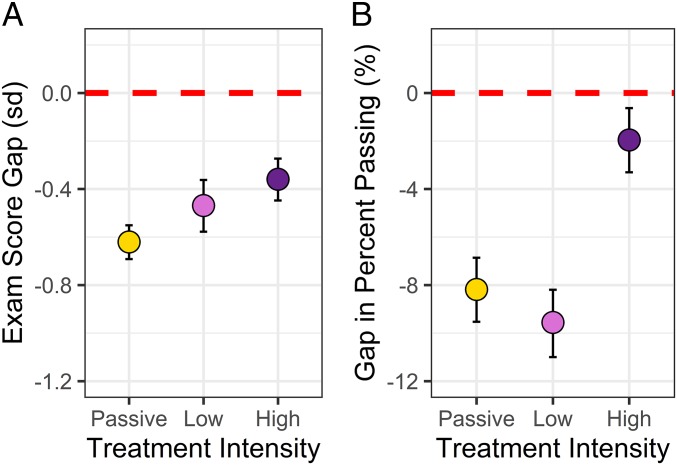
- Gap reductions were stronger with high-intensity active learning: exam-score gaps were −0.48 SDs for low-intensity vs −0.36 SDs for high-intensity; passing-rate gaps were −9.6% for low-intensity vs −2.0% for high-intensity.
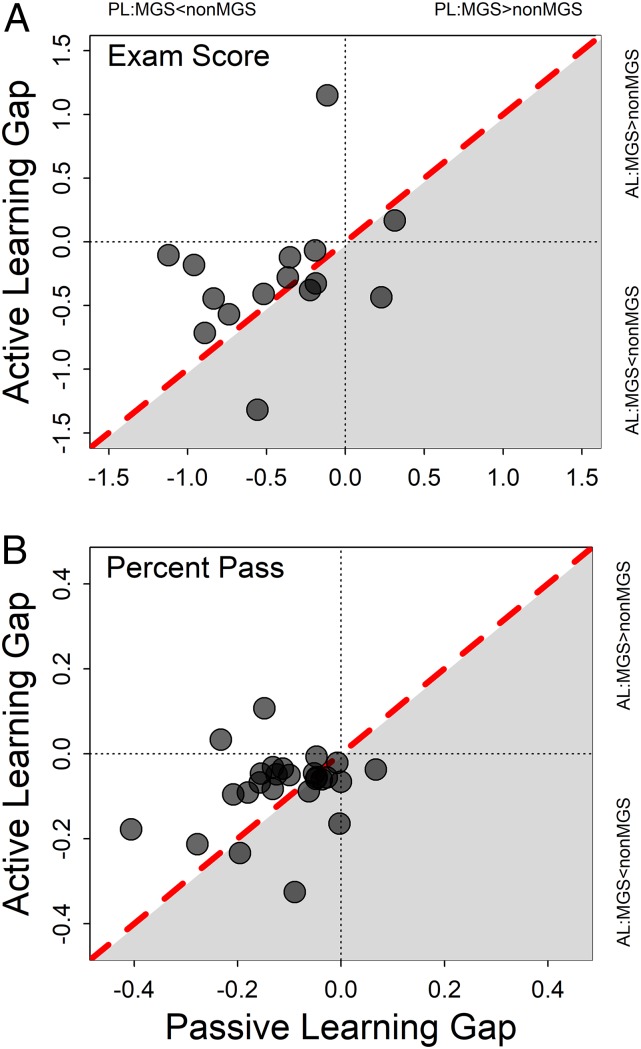
- In the study-level breakdown, 10 of 15 studies with exam-score data showed disproportionate gains for MGS students under active learning, and 15 of 26 studies with failure-rate data showed disproportionate reductions in failure rates for MGS students.
Methods
- Systematic review plus individual-participant-data (IPD) meta-analysis comparing undergraduate STEM courses taught with traditional lecturing vs active learning in the same course and institution.
- Literature search covered studies published or completed from January 1, 2010 to June 30, 2016; the final analysis included 41 studies with disaggregated data by MGS status.
- Final datasets: 9,238 student records from 15 studies for exam scores and 44,606 student records from 26 studies for failure rates; analyses used hierarchical Bayesian multilevel models with section random effects and sensitivity analyses.
Limitations
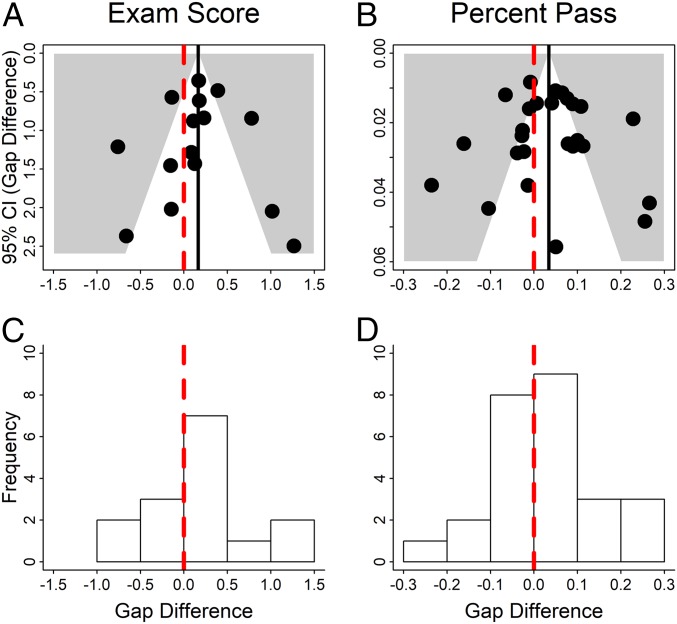
- The paper states that the conclusions are “tempered by the limitations of the study’s sample size”: only 41 studies had data for students from MGS, which also made moderator analyses hard to interpret.
- The paper says data on the type of active learning were “poorly resolved” because studies often did not report quantitative details of course interventions.
- The paper notes possible sampling bias in instructor/institution type, overrepresentation of research-intensive institutions, and underrepresentation of teaching-intensive institutions and community colleges.
- Evident from the text: the meta-analysis depends on studies that met specific coding and data-sharing criteria, so the findings may not generalize to STEM courses or settings not represented in the included studies.
Model-written summary. Check it against the paper before relying on it.
Integrity signals
Registry
Cites
Statistics
Figures
Verification
Claims the paper makes
16 Valid · 1 Not valid · 10 Not checked · 59 Own results and interpretations
The cited sources support only part of this claim — read each source’s verdict below.
In the paper
“Course grades in most STEM courses are largely driven by performance on examinations, even in active-learning courses that offer many nonexam points (39).”
§ Active learning narrows achievement gaps for underrepresented students in undergraduate science, technology, engineering, and math > Discussion
What the sources say
- Partly supportedcites [39] Freeman S., Haak D., Wenderoth M. P., Increased course structure improves performance in introductory biology. CBE Life Sci. Educ. 10, 175– 186 (2011). 21633066 PMC3105924 sourceExperimental — accuracy not yet measured
The Methods section (“Exam Impact on Final Course Grade”; page unavailable) says the authors intended exams to remain the primary determinant of grades even when many nonexam points were available. Table 4 in the Results shows that exam points strongly predicted final grades across the introductory biology sections studied. The paper does not establish that this holds in most STEM courses. (LLM, conf=0.88)
plainstates an association- Asserted: passes — The authors put it forward as true.
- Checkable: passes — It can be checked against evidence.
- Load-bearing: passes — The paper’s conclusions depend on it.
- Based: passes — The paper gives a reason why it holds.
- Partly supported
The cited sources support only part of this claim — read each source’s verdict below.
In the paper
“All students benefit from classroom cultures that promote self-efficacy, identity as a scientist, and sense of belonging in STEM (58)”
§ Active learning narrows achievement gaps for underrepresented students in undergraduate science, technology, engineering, and math > Discussion
What the sources say
- Partly supportedcites [58] Trujillo G., Tanner K. D., Considering the role of affect in learning: Monitoring students’ self-efficacy, sense of belonging, and science identity. CBE Life Sci. Educ. 13, 6– 15 (2014). 24591497 PMC3940464 sourceExperimental — accuracy not yet measured
The paper’s sections on self-efficacy, sense of belonging, and science identity link each to student learning or persistence, and its discussion of teaching considers how classroom experiences shape these factors. Its focus is undergraduate biology, however; it does not establish that all students benefit from such classroom cultures across STEM. The indexed passages provide section labels but no page numbers. (LLM, conf=0.82)
plainstates a cause- Asserted: passes — The authors put it forward as true.
- Checkable: passes — It can be checked against evidence.
- Load-bearing: unclear — It is unclear whether the paper’s conclusions depend on it.
- Based: passes — The paper gives a reason why it holds.
- Partly supported
The cited sources support only part of this claim — read each source’s verdict below.
In the paper
“students in active-learning course designs that reduced or eliminated achievement gaps have reported an increased sense of community and self-efficacy compared to their peers in the lecture-intensive version of the same course (22, 23).”
§ Active learning narrows achievement gaps for underrepresented students in undergraduate science, technology, engineering, and math > Discussion
What the sources say
- Partly supportedcites [22] Eddy S. L., Hogan K. A., Getting under the hood: How and for whom does increasing course structure work? CBE Life Sci. Educ. 13, 453– 468 (2014). 25185229 PMC4152207 sourceExperimental — accuracy not yet measured
In Methods and Results (Study 3, Factor 2; page unavailable), students in the moderate-structure course were twice as likely to report a stronger sense of classroom community than those in the low-structure course. The Introduction mentions self-reported self-efficacy in prior active-learning research, but says that research did not compare students in versions of the same course. This paper therefore does not support the claimed same-course self-efficacy comparison. (LLM, conf=0.88)
- Not matchedcites [23] Ballen C. J., Wieman C., Salehi S., Searle J. B., Zamudio K. R., Enhancing diversity in undergraduate science: Self-efficacy drives performance gains with active learning. CBE Life Sci. Ed. 16, ar56 (2017). PMC5749958 29054921
We don’t have this paper’s reference list.
plainstates an association- Asserted: passes — The authors put it forward as true.
- Checkable: passes — It can be checked against evidence.
- Load-bearing: unclear — It is unclear whether the paper’s conclusions depend on it.
- Based: passes — The paper gives a reason why it holds.
- Partly supported
Every source the paper cites for this claim was checked and supports it.
In the paper
“Our data on type of active learning are also poorly resolved, because publications still routinely fail to report quantitative data on the nature of course interventions, such as records from classroom observation tools (e.g., ref. 61 and SI Appendix, Table S12).”
§ Active learning narrows achievement gaps for underrepresented students in undergraduate science, technology, engineering, and math > Discussion
What the sources say
- Supportedcites [61] Eddy S. L., Converse M., Wenderoth M. P., PORTAAL: A classroom observation tool assessing evidence-based teaching practices for active learning in large science, technology, engineering, and mathematics classes. CBE Life Sci. Educ. 14, ar23 (2015). PMC4477739 26033871 source
The citation appears as an example of a classroom observation tool, not as evidence that publications routinely omit quantitative intervention data. The Abstract identifies PORTAAL as a classroom observation tool for assessing active-learning practices, which supports that use of the citation. (LLM, conf=0.91)
plainstates a cause- Asserted: passes — The authors put it forward as true.
- Checkable: passes — It can be checked against evidence.
- Load-bearing: unclear — It is unclear whether the paper’s conclusions depend on it.
- Based: passes — The paper gives a reason why it holds.
- Supported
Every source the paper cites for this claim was checked and supports it.
In the paper
“larger gaps are correlated with faculty who have a fixed mindset, which interprets intelligence as innate and immutable and is therefore exclusion or selection-oriented (44).”
§ Active learning narrows achievement gaps for underrepresented students in undergraduate science, technology, engineering, and math > Discussion
What the sources say
- Supportedcites [44] Canning E. A., Muenks K., Green D. J., Murphy M. C., STEM faculty who believe ability is fixed have larger achievement racial achievement gaps and inspire less student motivation in their classes. Sci. Adv. 5, eaau4734 (2019). 30793027 PMC6377274 source
The Results report that racial achievement gaps in STEM courses were nearly twice as large with fixed- versus growth-mindset faculty. The Introduction defines a fixed mindset as treating intelligence and ability as innate and largely unchangeable, and describes judging students as low-ability and encouraging them to drop difficult courses—supporting the paraphrase 'exclusion or selection-oriented.' (LLM, conf=0.88)
plainstates an association- Asserted: passes — The authors put it forward as true.
- Checkable: passes — It can be checked against evidence.
- Load-bearing: unclear — It is unclear whether the paper’s conclusions depend on it.
- Based: passes — The paper gives a reason why it holds.
- Supported
30 more claims
Create a free account to see all 86 claims and every source verdict.
- It may state two separate claims as one. 30
- Probably not a substantial claim. 36
Claims other papers make about this one
Each is checked against this paper’s own text: does it say what the citing paper says it does?
The source backs part of the claim, not all of it — or backs it for a different population, condition or comparison.
In the citing paper
“These perceptions, along with a likely reduction in stress and anxiety (see Figure 4), could benefit students from underrepresented groups and may thus reduce the achievement gap among underrepresented minorities”
From Two-Stage Final Exams: An Assessment Strategy for Enhanced Collaborative Learning and Reduced Student Stress (2026) · cites this paper as Theobald et al., 2020
Experimental — accuracy not yet measured
Citations
Cites
Preferred Reporting Items for Systematic Reviews and Meta-Analyses: the PRISMA statement
Moher, D., Liberati, A., Tetzlaff, J., Altman, D. G., & for the PRISMA Group (2009) · BMJ · doi:10.1136/bmj.b2535 · Cited by 83,823
Preferred reporting items for systematic reviews and meta-analyses: the PRISMA Statement.
(2009) · PubMed Central · Cited by 44,859
Preferred reporting items for systematic reviews and meta-analyses: The PRISMA statement
Moher, D., Liberati, A., Tetzlaff, J., Altman, D. G., & the PRISMA Group* (2009) · Annals of Internal Medicine · doi:10.7326/0003-4819-151-4-200908180-00135 · Cited by 37,554
PRISMA-P Group, Moher, D., Shamseer, L., Clarke, M., Ghersi, D., Liberati, A., Petticrew, M., Shekelle, P., & Stewart, L. A. (2015) · Systematic Reviews · doi:10.1186/2046-4053-4-1 · Cited by 26,223 · cited 2×
“The protocol for this study, presented in the PRISMA-P format (66) and including annotations regarding modifications that occurred during the course of the research, is available in SI Appendix, SI Materials and Methods.”
Capital in the Twenty-First Century
Piketty, T. (2014) · doi:10.4159/9780674369542 · Cited by 14,437
Data Analysis Using Regression and Multilevel/Hierarchical Models
Gelman, A., & Hill, J. (2006) · doi:10.1017/cbo9780511790942 · Cited by 13,597
Active learning increases student performance in science, engineering, and mathematics
Freeman, S., Eddy, S. L., McDonough, M., Smith, M. K., Okoroafor, N., Jordt, H., & Wenderoth, M. P. (2014) · Proceedings of the National Academy of Sciences · doi:10.1073/pnas.1319030111 · Cited by 9,787 · cited 6×
“Can interventions in courses themselves—meaning, changes in how science is taught—reduce achievement gaps and promote retention in STEM? A recent metaanalysis concluded that, on average, active learning in STEM leads to higher examination scores and lower failure rates for all students, compared to all students in the…”
InfluentialSelf-citation(2000) · Cited by 9,198
A threat in the air: How stereotypes shape intellectual identity and performance
Steele, C. M. (1997) · American Psychologist · doi:10.1037/0003-066x.52.6.613 · Cited by 6,770 · cited 1×
“Equally important, inclusive teaching emphasizes treating students with dignity and respect (52), communicating confidence in students’ ability to meet high standards (53), and demonstrating a genuine interest in students’ intellectual and personal growth and success (54, 55).”
BackgroundGeneral methods for monitoring convergence of iterative simulations
Brooks, S. P., & Gelman, A. (1998) · Journal of Computational and Graphical Statistics · doi:10.1080/10618600.1998.10474787 · Cited by 6,045
Research works printed but not linked: 9
- Reardon S. F., “The widening achievement gap between the rich and the poor: New evidence and possible explanations” in Whither Opportunity? Duncan G. J., Murnane R. J., Eds. (Russell Sage Foundation, New York, 2011), pp. 91– 115.
- National Student Clearinghouse Research Center, High School Benchmarks 2019: National College Progression Rates (National Student Clearinghouse, Herndon, VA, 2019).
- Chen X., STEM Attrition: College Students’ Paths Into and Out of STEM Fields (National Center for Education Statistics, Washington, DC, 2013).
- Vygotsky L. S., Mind in Society (Harvard University Press, Cambridge, MA, 1978).
- Kaufmann E., Reips U.-D., Merki K. M., Avoiding methodological biases in meta-analysis. Z. Psychol. 224, 157– 167 (2016).
- Ginder S. A., Kelly-Reid J. E., Mann F. B., Enrollment and Employees in Postsecondary Institutions, Fall 2015 (National Center for Education Statistics, Washington, DC, 2017).
- Reed J. G., Baxter P. M., Using Reference Databases. The Handbook of Research Synthesis and Meta-Analysis, Cooper H., Hedges L. V., Valentine J. C., Eds. (Russell Sage Foundation, New York, 2009), pp. 73– 101.
- Rothstein H., Hopewell S., Grey Literature. The Handbook of Research Synthesis and Meta-Analysis, Cooper H., Hedges L. V., Valentine J. C., Eds. (Russell Sage Foundation, New York, 2009), pp. 103– 125.
- White H. D., Scientific Communication and Literature Retrieval. The Handbook of Research Synthesis and Meta-Analysis, Cooper H., Hedges L. V., Valentine J. C., Eds. (Russell Sage Foundation, New York, 2009), pp. 51– 71.
Cited by
Items 501–600 of 1,369
Su, K.-D. (2022) · Journal of Baltic Science Education · doi:10.33225/jbse/22.21.1069 · Cited by 14
Teaching for a Digital World: Foundations, Practices, and Possibilities
Mccool, L. B., & Mitchell, A. (2023) · Business and Professional Communication Quarterly · doi:10.1177/23294906231157084 · Cited by 9
Kickbusch, S., Dawes, L. A., Kelly, N., & Nickels, K. (2022) · The Australian journal of teacher education · doi:10.14221/ajte.2022v47n9.5 · Cited by 6
Edry, M., Sasson, I., & Dori, Y. J. (2023) · Education Sciences · doi:10.3390/educsci13050441 · Cited by 8
Torres, D., Pulukuri, S. V., & Abrams, B. (2023) · Journal of Chemical Education · doi:10.1021/acs.jchemed.3c00193 · Cited by 5
Moreira, P., & Talanquer, V. (2024) · Chemistry Education Research and Practice · doi:10.1039/d3rp00198a · Cited by 7
States, N. E., Lovig, C., Martin, K., Nennig, H. T., & Cole, R. S. (2023) · Journal of Chemical Education · doi:10.1021/acs.jchemed.3c00750 · Cited by 8
Morra, C. N., Adkins-Jablonsky, S. J., & Raut, S. A. (2021) · Journal of Microbiology and Biology Education · doi:10.1128/jmbe.v22i1.2511 · Cited by 8
Sudiansyah, S., Kurnianto, D., & Ahmad Yani, T. (2022) · Jurnal Basicedu · doi:10.31004/basicedu.v6i3.2716 · Cited by 5
Casas, P. F. I. (2025) · Technology Knowledge and Learning · doi:10.1007/s10758-025-09845-7 · Cited by 9
“Active learning includes any type of classroom activity that encourages students to learn, not just by listening to the teacher, reading a book, and memorizing notes (Bonwell & Eison, 1991; Theobald et al., 2020).”
Robinson, J. M., Seymour, R. J., Jin, S., & Whiteman, R. S. (2025) · Education Sciences · doi:10.3390/educsci15050523 · Cited by 5
Carmona-Galindo, V. D., Ung, H., Zeng, M. D., Broussard, C., Taranenko, E., Daneshbod, Y., Chappell, D., & Lorenz, T. (2025) · Knowledge · doi:10.3390/knowledge5030018 · Cited by 7
“For multilingual learners, first-generation college students, and others navigating unequal access to textbooks, tutoring, or study groups, this course can present significant barriers to persistence in STEM fields [76,78].”
Teaching Methods, Learning and Development: A 15-Year Research Perspective by Educational Stages
Aguilar-Moya, R., Diamanti, R., & Melero-Fuentes, D. (2025) · Education Sciences · doi:10.3390/educsci15091213 · Cited by 19
Self-regulated learning in STEM: non-academics matter
Azizi, M., & Dewsbury, B. M. (2025) · Journal of Microbiology and Biology Education · doi:10.1128/jmbe.00166-25 · Cited by 7
Beer, J. J. D. (2023) · NWU self-directed learning series · doi:10.4102/aosis.2023.bk426.02 · Cited by 4
Petersen, N. T., Mentz, E., & Beer, J. J. D. (2023) · NWU self-directed learning series · doi:10.4102/aosis.2023.bk426.03 · Cited by 5
Bano, R., Ibrahim, A. A., Wrona, J., Back, L. T., & Ryu, M. (2024) · Journal of Chemical Education · doi:10.1021/acs.jchemed.3c01134 · Cited by 5
Connor, M. C., & Raker, J. R. (2024) · Chemistry Education Research and Practice · doi:10.1039/d3rp00194f · Cited by 9
Weatherton, M., Schussler, E. E., Brigati, J. R., Ferguson, H., Boyd, I., & England, B. J. (2024) · CBE—Life Sciences Education · doi:10.1187/cbe.24-02-0092 · Cited by 7
“This is consistent with the potential advantages of appropriately-enacted active learning for students (Freeman et al. , 2014; Theobald et al. , 2020), but should be interpreted with caution given reports of active learning increasing anxiety for some students (Cooper et al. , 2018; Cooper and…”
Bøe, M. V., Lauvland, A., & Henriksen, E. K. (2024) · Science Education · doi:10.1002/sce.21912 · Cited by 16
Brush, S. S. (2024) · Journal of Chemical Education · doi:10.1021/acs.jchemed.3c01026 · Cited by 8
Maries, A., Li, Y., & Singh, C. (2024) · Reports on Progress in Physics · doi:10.1088/1361-6633/ad91c4 · Cited by 20
“A meta-analysis of studies on reducing achievement gaps in undergraduate STEM revealed that using research-based instructional strategies reduced achievement gaps but did not eliminate them [255].”
Are Traditional Chemistry Courses Male-Gendered?
Talanquer, V. (2024) · Journal of Chemical Education · doi:10.1021/acs.jchemed.4c00780 · Cited by 5
McNeil, W. S. (2025) · Journal of Chemical Education · doi:10.1021/acs.jchemed.4c00852 · Cited by 5
Relational Teaching and Just Energy Transitions: A Case Study from a Native-Serving Institution
Hilimire, K., Larkins, M. L., Clausen, R. J., & Williams, J. (2025) · Case Studies in the Environment · doi:10.1525/cse.2025.2455669 · Cited by 5
Mathematics education and technology: Bibliometric analysis and systematic review (2000-2024)
Navarro-Ibarra, L. A., Salazar, O. C., Michel, L. L. A., & Valenzuela-Ochoa, J. M. (2025) · Eurasia Journal of Mathematics Science and Technology Education · doi:10.29333/ejmste/16072 · Cited by 16
“The fifth article that makes up the trunk of the tree is the study by Theobald et al. (2020) where the performance of underrepresented and overrepresented students is compared with education using active learning and traditional teaching.”
Implementation of Active Learning in BPM Education
Grzesiak, M. (2024) · Decision Making in Manufacturing and Services · doi:10.7494/dmms.2024.si.6696 · Cited by 4
“Later research that was conducted by Theobald et al. (2020) among students of science, technology, engineering, and mathematics showed that active learning allowed students to achieve better exam results.”
Conceptualization and Enactment of Equity in Active Learning: STEM Instructors’ Perspectives
Choi, Y. H., Theobald, E. J., & Eddy, S. L. (2025) · Journal for STEM Education Research · doi:10.1007/s41979-025-00153-4 · Cited by 6
Self-citationHagos, T. (2026) · Chemistry Education Research and Practice · doi:10.1039/d5rp00216h · Cited by 16
Treibergs, K. A., Stetzer, M. R., Olson, A. N., Schmid, K. M., Adjei-Opong, T., Onimode, R., Noyes, K., Eldermire, E., Couch, B. A., & Smith, M. K. (2025) · CBE—Life Sciences Education · doi:10.1187/cbe.25-04-0068 · Cited by 8
“…and McTighe, 2005) and active learning (2020; Freeman et al. , 2014 ), the latter of which has been shown to improve learning outcomes and contribute to the success of students (Armbruster et al. , 2009; Haak et al. , 2011; Freeman et al. , 2014; Deslauriers et al. , 2019; Theobald et al. , 2020).”
Recommendations for an inclusive undergraduate plant science classroom
Butler, K. J., Collins, C. A., & Robison, J. D. (2021) · The Plant Cell · doi:10.1093/plcell/koab167 · Cited by 5
Nelson, L. P. (2021) · Journal of Higher Education Theory and Practice · doi:10.33423/jhetp.v21i9.4600 · Cited by 7
Cowan, C. C., Brady, M. E., Arvizu, J., Reece, A. J., Weinman, B., & Zivot, M. T. (2022) · Journal of College Student Retention Research Theory & Practice · doi:10.1177/15210251221093749 · Cited by 6
Ismail, M. H. (2022) · ASM Science Journal · doi:10.32802/asmscj.2022.1112 · Cited by 12
The Three Sisters of Agriculture: An Active Learning Activity on Symbiotic Nitrogen Fixation
Prüß, B. M. (2022) · CourseSource · doi:10.24918/cs.2022.40 · Cited by 4
Kay, A. D., Lager, Z., Bhebheza, L., & Heinen‐Kay, J. L. (2023) · Ecology and Evolution · doi:10.1002/ece3.9721 · Cited by 4
“…from camera traps in the field (Burger et al., 2021) or in zoos (Hahn- Klimroth et al., 2021), citizen science contributions (Oberbauer et al., 2021), or targeted footage of wild (Bain et al., 2021), domesticated (Grigg et al., 2021; Vega et al., 2010), or laboratory animals (Kimura et al., 2014).”
BackgroundHow Do I Get People to Use My Ideas?
Hovey, C. L., Bunde, D. P., Butler, Z. J., & Taylor, C. (2023) · ACM Technical Symposium on Computer Science Education (SIGCSE) · doi:10.1145/3545945.3569779 · Cited by 5
“When properly implemented, student-centered teaching practices1 are more effective than traditional teaching in fostering student engagement, learning, support, and persistence among a greater diversity of students [5, 15, 20, 34].”
BackgroundPilato, J., Peterson, E. G., & Anderson, A. (2023) · Teaching and Teacher Education · doi:10.1016/j.tate.2023.104226 · Cited by 9
Jackson, M. A., & Wenderoth, M. P. (2024) · To improve the academy · doi:10.3998/tia.3447 · Cited by 7
Sloane, J. D., Wheeler, L. B., & Manson, J. S. (2023) · PLoS ONE · doi:10.1371/journal.pone.0289680 · Cited by 8
Agnès, F., Leduc, D., & Locker, M. (2023) · Revue internationale de pédagogie de l’enseignement supérieur · doi:10.4000/ripes.5176 · Cited by 4
Reisner, B. A., Kinkaid, M. M., Pratt, J. M., Bentley, A. K., Stewart, J. L., Smith, S. R., Raker, J. R., & Lin, S. (2024) · Journal of Chemical Education · doi:10.1021/acs.jchemed.3c00823 · Cited by 4
Inclusion May Not Lead to Belonging: The Case for Student-Centered Classrooms
Wong, M. (2024) · College Teaching · doi:10.1080/87567555.2024.2307884 · Cited by 5
“Importantly, student-centered pedagogy has not only been shown to improve academic performance but it has also been shown to reduce the achievement gap between minori-tized and dominant student groups (Salinas and Garr 2009; Theobald et al. 2020; Freeman et al. 2014).”
Participatory Governance in the Computer Science Theory Classroom
Randolph, T. (2024) · ACM Technical Symposium on Computer Science Education (SIGCSE) · doi:10.1145/3626252.3630904 · Cited by 8
Embracing interactive teaching methods
Chasteen, S. V., Prather, E. E., & Scherr, R. E. (2024) · Physics Today · doi:10.1063/pt.bsuj.pghf · Cited by 6
Increasing equity in science requires better ethics training: A course by trainees, for trainees
Patel, R. A., Ungar, R. A., Pyke, A. L., Adimoelja, A., Chakraborty, M., Cotter, D. J., Freund, M. K., Goddard, P. C., Gomez‐Stafford, J., Greenwald, E., et al. (2024) · Cell Genomics · doi:10.1016/j.xgen.2024.100554 · Cited by 9
“48 In doing so, we discussed both the risks and ben-efits associated with the use of race and ancestry in genetic research, giving students the tools to independently critique their usage and evaluate the societal implications.”
Kerrigan, J., & Kwaik, J. (2024) · College Teaching · doi:10.1080/87567555.2024.2399624 · Cited by 8
“Theobald et al. (2020) found that active learning interventions reduced achievement gaps in exam scores and passing rates by 33 and 45%, respectively, for underrepresented students in STEM disciplines.”
Versatile video assignment improves undergraduates’ learning and confidence
Cardace, A., Hefferon, K. L., Levina, A., Angert, E. R., Buckley, D. H., Miller, W., Sanfilippo, L., Silva, T., & Aslan, C. (2024) · Active Learning in Higher Education · doi:10.1177/14697874241287208 · Cited by 7
“…learning, undergraduate, video assignment Recent publications about active learning classify the active learning strategies that are currently in use (Allsop et al., 2020) and provide evidence of both academic (Theobald et al., 2020) and affective benefits (Lombardi et al., 2021) for students.”
Exploring Active Learning Strategies in Science among Senior High School STEM Learners and Teachers
Yunzal, A. N., Rallos, A. G., Nanud, M. N. D., Ondoy, M. L., Ares, J. M., & Picardal, M. T. (2024) · Science education international · doi:10.33828/sei.v35.i4.8 · Cited by 15
Perspectiva crítica de la innovación educativa desde las metodologías activas de aprendizaje
Alfieri, R. D. J., Mora, V. D. J. F., & Rojas, A. D. G. (2025) · Sophía · doi:10.17163/soph.n38.2025.07 · Cited by 15
Tadimalla, S. Y., Maher, M. L., Rorrer, A. S., Dorodchi, M., Mejias, M., & Najjar, N. A. (2025) · ACM Technical Symposium on Computer Science Education (SIGCSE) · doi:10.1145/3641554.3701930 · Cited by 4
Implementing an Undergraduate Learning Assistant Program Tailored for Remote Instruction
Martín, M. E., & Davidyan, A. (2021) · Journal of Microbiology and Biology Education · doi:10.1128/jmbe.v22i1.2463 · Cited by 5
Wyssenbach, T., Zeballos, M., Loosli, S., & Schwaninger, A. (2021) · Virtual Reality · doi:10.1007/s10055-021-00540-3 · Cited by 5
Drawing-to-Learn: Active and Culturally Relevant Pedagogy for Biology
Edlund, A. F., & Balgopal, M. M. (2021) · Frontiers in Communication · doi:10.3389/fcomm.2021.739813 · Cited by 10
Brief Training and Intensive Mentoring Guide Postdoctoral Scholars to Student-Centered Instruction
Price, R., Self, C. J., Young, W. C., Klein, E. R., Al‐Noori, S., Ma, E. Y., & DeMarais, A. A. (2021) · CBE—Life Sciences Education · doi:10.1187/cbe.21-03-0083 · Cited by 4
Waynant, K., George, A. A., & Hartzell, P. L. (2022) · Journal of Chemical Education · doi:10.1021/acs.jchemed.1c00997 · Cited by 4
The Learning Sciences in the 2020s: Implications for Schools and Beyond
Sawyer, R. K. (2022) · Cambridge University Press eBooks · doi:10.1017/9781108888295.040 · Cited by 9
Rivera, M. A. J., Ambrosino, C. M., Manning, M. M., Soon, S. L., Rii, Y. M., & Gorospe, K. D. (2022) · Oceanography · doi:10.5670/oceanog.2022.204 · Cited by 6
From the Front lines of active learning: Lessons learned from those who are trying
Marzocchi, A. S., & Soto, R. C. (2022) · International Journal of Research in Undergraduate Mathematics Education · doi:10.1007/s40753-022-00176-x · Cited by 6
“Further, there is emerging evidence that, when coupled with equity-minded teaching practices, active learning could help close equity gaps in mathematics and other STEM disciplines (Kogan & Laursen, 2014; Laursen et al., 2014; Theobald et al., 2020).”
BackgroundMethodInfluentialTeasdale, R., & Aird, H. M. (2022) · Journal of Geoscience Education · doi:10.1080/10899995.2022.2081462 · Cited by 7
“…instructors were familiar with use of in-class activities as part of our instructional practices, both have also been observed using “student centered” teaching practices (e.g. more reformed instructional practices than “teacher-centered,” according to the RTOP protocol; Teasdale et al., 2020).”
MethodThe two envelopes method for active learning
Flugelman, M. Y., Glueck, R. M., Aronson, D., et al. (2022) · PubMed · doi:10.3205/zma001551 · Cited by 4
“Ein besseres Verständnis des Lernprozesses und die Erkenntnis, dass die Lehrmethoden der modernen Technik angepasst werden muss, haben ebenso wie psychologische und soziale Veränderungen der Medizin, der Studierenden und der Gesellschaft dazu geführt, dass aktives Lernen in medizinischen Fakultäten zu einem führenden…”
BackgroundInfluentialWu, G., & Wu, K. (2022) · Journal of Biological Education · doi:10.1080/00219266.2022.2147575 · Cited by 6
“Numerous studies have shown that the best learning occurs at the time that students actively participate in knowledge construction (Orsmond and Zvauya 2015; Theobald et al. 2020).”
Teaching and Learning of Vertex Coloring Using an Inquiry-Based Approach
Radmehr, F., Tohidinasab, K., & Tavakoli, M. (2023) · PRIMUS · doi:10.1080/10511970.2023.2170505 · Cited by 5
Equipment Repositories for Accessibility: A Model for Improving Access in Field Science
Devitz, A.-C. (2023) · Integrative and Comparative Biology · doi:10.1093/icb/icad024 · Cited by 4
Development of Arabic E-Book Media Based on Flip PDF Professional Application for Students
Morales, U., Joanan, S., & Julia, H. (2023) · Journal International of Lingua and Technology · doi:10.55849/jiltech.v2i1.243 · Cited by 6
Esparza, D., Hernandez, A., & Olimpo, J. T. (2023) · CBE—Life Sciences Education · doi:10.1187/cbe.22-03-0054 · Cited by 4
Celebrating Diverse Voices in Neuroscience: Introducing Project DiViNe
Frenzel, K. E., & Harrington, I. A. (2022) · Journal of Undergraduate Neuroscience Education · doi:10.59390/axfd9450 · Cited by 5
Applying UDL to Online Active Learning
Rogers, S., & Gronseth, S. (2021) · The Journal of Applied Instructional Design · doi:10.59668/223.3748 · Cited by 4
“Further, there is evidence that active learning reduces failure rates for unprepared students because they have the potential to build student learning skills as part of the activity design (Freeman et al., 2011; Styers et al., 2018; Theobald et al., 2020).”
BackgroundChiyón, I., Quevedo, V., Vegas, S., & Feijóo, J. C. M. (2021) · International Symposium on Accreditation of Engineering and Computing Education (ICACIT) · doi:10.1109/icacit53544.2021.9612504 · Cited by 6
Tørris, C., Gjølstad, E., Morseth, M. S., Debesay, J., & Almendingen, K. (2022) · Education Sciences · doi:10.3390/educsci12100670 · Cited by 8
“A recent systematic review found that active learning reduces achievement gaps in examination scores and passing rates when compared to traditional lecturing [64].”
Participating in an Online Working Group and Reforming Instruction: the Case of Dr. DM
Fortune, N., & Keene, K. A. (2021) · International Journal of Research in Undergraduate Mathematics Education · doi:10.1007/s40753-020-00126-5 · Cited by 8
Sustaining the Adoption of Active Learning
Cole, R. S. (2022) · ACS symposium series · doi:10.1021/bk-2022-1409.ch016 · Cited by 6
Unified Voice and Group Agency: Developing Teams to Transform Engineering EducationPreprint
Margherio, C., Swan, A. L., Williams, J. M., Litzler, E., Andrijcic, E., & Mohan, S. (2021) · OSF Preprints (OSF Preprints) · doi:10.31219/osf.io/umksx · Cited by 4
Evolution of a self‐renewing, participant‐centered workshop series in BMB assessment
Tyler, L., Kennelly, P. J., Engelman, S., Block, K. F., Bobenko, J. C., Catalano, J., Jones, J. A., Kanipes‐Spinks, M. I., Lim, Y. M., Loertscher, J., et al. (2024) · Biochemistry and Molecular Biology Education · doi:10.1002/bmb.21789 · Cited by 3
Gough, L., Miranda, R. J., Hemm, M. R., Norman, L. L., & Jara, B. (2025) · Journal of Microbiology and Biology Education · doi:10.1128/jmbe.00215-24 · Cited by 5
“However, studies show that faculty employing active learning practices may reduce student equity and opportunity gaps correlated with factors such as race, ethnicity, or socioeconomic status (5–8).”
Bridging the gap: Leveraging simulation expertise to improve active learning environments
Hughes, M. D., Chen, T. H., Schoen, J. C., Lamberta, M., Cassara, M., Hock, S. M., Beattie, L. K., Stapleton, S., Moss, H. C., Heiferman, J., et al. (2025) · AEM Education and Training · doi:10.1002/aet2.70021 · Cited by 3
Campa-Bousoño, C., & García-Pérez, Á. (2025) · Education Sciences · doi:10.3390/educsci15050570 · Cited by 4
Bloch, R. R., Noyes, K., Bautista, N., & Restini, C. B. A. (2025) · Medical Science Educator · doi:10.1007/s40670-025-02432-6 · Cited by 5
“As demonstrated through educational investigations, data on pharmacology education research aligns with positive results from other basic science disciplines regarding the impact of active learning on students, including engagement and rates of passing [34, 35].”
Using anti-DEI policies to dismantle education: A new front in a really old battle
Ballen, C. J., McGlynn, T. P., & Zamudio, K. R. (2025) · PLoS Biology · doi:10.1371/journal.pbio.3003256 · Cited by 3
“…that active learning strategies, such as small group work, mini-lectures, and in-class activities, disrupt educational inequities that systematically disadvantaged capable but academically underprepared students [5], while at the same time leading to more effective learning for all students [6].”
Teachers as facilitators and innovators in 21st-century STEM education
Gavrilas, L., & Kotsis, K. Τ. (2025) · Contemporary Mathematics and Science Education · doi:10.30935/conmaths/17245 · Cited by 9
“Although these strategies can yield profound benefits, such as deeper conceptual understanding and heightened engagement, they require careful scaffolding, ongoing professional development, and supportive school structures (Freeman et al., 2014; Furtak et al., 2012; Theobald et al., 2020).”
DeVries, J. M., Orona, G. A., & Arum, R. (2025) · Assessment & Evaluation in Higher Education · doi:10.1080/02602938.2025.2571223 · Cited by 7
“For instance, inquiry-based learning and project-focused learning are valued in STEMM classrooms (Freeman et al. 2014; Theobald et al. 2020), and higher education STEMM courses are associated with higher student intellectual humility (DeVries, Orona, and Arum 2025).”
French, M. B., Miliotis, H., Laposa, R. R., et al. (2025) · AJP Advances in Physiology Education · doi:10.1152/advan.00138.2025 · Cited by 3
Patil, U., Terada, M., & Nelson-Hurwitz, D. C. (2025) · Frontiers in Public Health · doi:10.3389/fpubh.2025.1681199 · Cited by 3
Martella, A. M., Lawson, A. P., Martella, R. C., LaBonte, K., Zhao, F., Delgado, C. Y., Munns, M. E., LeRoy, A. W., Gluck, J. A., & Mayer, R. E. (2025) · Journal of Computer Assisted Learning · doi:10.1002/jcal.70165 · Cited by 8
Martin, P. P., Kubsch, M., Yik, B. J., Burlingham, B. T., & Graulich, N. (2025) · Science Education · doi:10.1002/sce.70042 · Cited by 7
Active Learning in Open Digital Textbooks: Designing for Learner Engagement and Motivation using H5P
Huff, T., & Tseng, D. C. Y. (2025) · TechTrends · doi:10.1007/s11528-025-01144-3 · Cited by 3
“Active learning strategies, widely endorsed in academic research, demonstrably improve student engagement, motivation, and learning outcomes (Freeman et al., 2014; Prince, 2013; Theobald et al., 2020).”
Díaz, L., & Carmona-Galindo, V. D. (2026) · Education Sciences · doi:10.3390/educsci16010168 · Cited by 4
“Active learning strategies, in particular, have been shown to improve outcomes for all students while narrowing achievement gaps for historically underrepresented groups in STEM (Theobald et al., 2020).”
Walker, K. I., & McComas, W. F. (2026) · Active Learning in Higher Education · doi:10.1177/14697874261424920 · Cited by 3
Reimagining chemistry education for a sustainable future
Tobias, R. A., Nemerovski, A. N., Collins, M. A., Bella, S., Louthain, E. G., Sojka, A. A., Ryu, A., & Morin, J. B. (2026) · RSC Sustainability · doi:10.1039/d5su00963d · Cited by 4
Recursos digitais bem-sucedidos para aprimorar as aulas de língua inglesa
Perna, C. B. L., Silva, A. D. C., & Delgado, H. O. K. (2021) · Ilha do Desterro A Journal of English Language Literatures in English and Cultural Studies · doi:10.5007/2175-8026.2021.e80739 · Cited by 4
Learning problem solving to manage school-life challenges: The impact on student success in college
Burke, A., & STEWART, S. L. (2022) · Active Learning in Higher Education · doi:10.1177/14697874221112879 · Cited by 20
“Results also show that these programs are often comparatively more beneficial for underrepresented and struggling students (Beichner et al., 2007; Freeman et al., 2007; Haak et al., 2011; Theobald et al., 2020).”
BackgroundTeaching of Magnetism Unit Topics Via Active Learning Applications
Büyükbayraktar, F. N., & Dilber, R. (2022) · Participatory Educational Research · doi:10.17275/per.22.140.9.6 · Cited by 7
Meuler, M., Lee, J., Foutch, K., Al‐Khayat, N., Boukouzis, K., Christensen, P., Crooks, C., Hassanain, L. M., Karimi, P., Kim, G. V., et al. (2023) · Frontiers in Education · doi:10.3389/feduc.2023.1165239 · Cited by 6
Self-citationNicholus, G., Muwonge, C. M., & Nzabahimana, J. (2023) · Physics Education · doi:10.1088/1361-6552/acfebb · Cited by 6
Usman, A., Eurika, N., & Priantari, I. (2023) · Jurnal Pendidikan Sains Indonesia · doi:10.24815/jpsi.v11i4.33040 · Cited by 3
“This is in line with research by Theobald et al. (2020) and Ting et al. (2023), which states that science and technology-based learning can improve student learning achievement, especially for students with low academic abilities.”
ResultPotes-Duque, F. B., & Jiménez-Contreras, J. J. (2023) · INNOVA Research Journal · doi:10.33890/innova.v8.n3.1.2023.2319 · Cited by 3
DeWeese, D. E., Nardo, J. E., Applebaum, I., Sundrani, S. C., Zur, A., Waymouth, R. M., Poehlmann, J. S., & Salehi, S. (2023) · Journal of Chemical Education · doi:10.1021/acs.jchemed.3c01020 · Cited by 7
Kim, J., Pai, G., & Yahya, S. A. (2023) · Journal of Chemical Education · doi:10.1021/acs.jchemed.3c00783 · Cited by 3
Hillier, C., Singh, D., & Campbell, T. G. (2024) · International Journal of Science and Mathematics Education · doi:10.1007/s10763-024-10460-8 · Cited by 3
“Overall, current research largely advocates for instructional practices that promote inquiry, hands-on learning, problem-solving, collaboration, and active engagement (Kırıcı & Bakırcı, 2021; Kim et al., 2022; Spencer & Walker, 2011; Struyf et al., 2019; Theobald et al., 2020).”
Barrera, S., Sajadi, S., Holmes, M., & Jacobson, S. (2024) · The Journal of Economic Perspectives · doi:10.1257/jep.38.3.163 · Cited by 5
Metadata
- Authors
- Theobald, E. J., Hill, M. J., Tran, E., Agrawal, S., Arroyo, E. N., Behling, S., Chambwe, N., Cintrón, D. L., Cooper, J. D., Dunster, G., Grummer, J. A., Hennessey, K., Hsiao, J., Iranon, N., Jones, L., Jordt, H., Keller, M., Lacey, M. E., Littlefield, C. E., Lowe, A., Newman, S., Okolo, V., Olroyd, S., Peecook, B. R., Pickett, S. B., Slager, D. L., Caviedes-Solis, I. W., Stanchak, K. E., Sundaravardan, V., Valdebenito, C., Williams, C. R., Zinsli, K., & Freeman, S.
- Affiliations
- University of Washington (US)
- Institute for Systems Biology (US)
- Shoreline Community College (US)
- Corresponding author
- Theobald, Elli J.
- Freeman, Scott
- ORCID
- Theobald, Elli J.
- Agrawal, Sweta
- Behling, Shawn
- Chambwe, Nyasha
- Cintrón, Dianne Laboy
- Cooper, Jacob D.
- Dunster, Gideon
- Grummer, Jared A.
- Hennessey, Kelly
- Hsiao, Jennifer
- Jones, Leonard
- Jordt, Hannah
- Littlefield, Caitlin E.
- Lowe, Alexander
- Olroyd, Savannah
- Peecook, Brandon R.
- Pickett, Sarah B.
- Slager, David L.
- Caviedes-Solis, Itzue W.
- Stanchak, Kathryn E.
- Williams, Claire R.
- Zinsli, Kaitlin
- Freeman, Scott
- Venue
- Proceedings of the National Academy of Sciences
- Publisher
- National Academy of Sciences
- Published
- 2020-03-09
- Volume
- 117
- Issue
- 12
- Pages
- 6476-6483
- ISSN
- 0027-8424 (ISSN-L)
- 1091-6490
- PMC
- PMC7104254
- OpenAlex
- W3009483010
- Cited by
- 1,387
- References
- 75
- Citations by year
- 2026: 210 · 2025: 222 · 2024: 272 · 2023: 236 · 2022: 233 · 2021: 154 · 2020: 60
- FWCI
- 258.89
- Type
- journal article
- Language
- en
- Open access
- hybrid
- doi.org
- Licence
- Locations
- Proceedings of the National Academy of Sciences (publishedVersion, cc-by-nc-nd)
- Europe PMC (PubMed Central) (publishedVersion, cc-by-nc-nd)
- PubMed Central (publishedVersion, cc-by-nc-nd)
- PubMed (publishedVersion)
- Funders
- University of Washington College of Arts and Sciences (NA)
- Topics
- Social Sciences › Education › Innovative Teaching Methods
- Social Sciences › Education › Higher Education Research Studies
- Social Sciences › Psychology › Developmental and Educational Psychology › Innovative Teaching and Learning Methods
- Keywords
- active learning, achievement gap, underrepresented students, STEM education, traditional lecturing, course design, student failure rates, test scores, higher education equity, inclusive pedagogy, deliberate practice
- MeSH terms
- Achievement, Educational Measurement, Engineering, Humans, Mathematics, Minority Groups, Science, Students, Technology, United States, Universities, Problem-Based Learning
About these checks
Registry, retraction, Cites and statistics results are computed, not judged, with one exception: a printed reference that no index lists is read once by a model before it counts as a citation error. Claims are extracted by a model and kept only when their quote appears verbatim in the text; each cited source is then checked, with a model’s help, for whether it says what the claim relies on. Those verdicts can be wrong — read the claim’s quote and the cited source before relying on one.
The claim verdicts this report counts are experimental: their accuracy is not yet measured.
A language model drew the claims from the paper on 2026-10-10, under version 3 of the claim definition (model deepseek-v4.1-flash, prompt extract-v3).
A second model labelled each claim on 2026-10-10 (model jev-1.13-20260917, definition revision gold-guideline-v0.2).
Cited sources are checked with a language model’s help (gpt-6-sol).
Statistics and arithmetic are recomputed, not judged.
Confidence bands are shown only for fields calibrated on our annotated test set. None is calibrated yet, so no band is shown.
What counts as a claim ›How we measure confidence ›How we check this ›
Are you an author, or do you see a problem with this page? Request a review
Data sources
Bibliographic data: Semantic Scholar, OpenAlex, Crossref.
Contains information from the Semantic Scholar Academic Graph Datasets, made available under the ODC Attribution License (ODC-BY 1.0).
Semantic Scholar’s data is described in: Kinney, R., et al. (2023). The Semantic Scholar Open Data Platform. arXiv:2301.10140.
