

Active learning narrows achievement gaps for underrepresented students in undergraduate science, technology, engineering, and math
Open accessThe DOI matches its Crossref record; 72 of the 75 references it cites were found in a registry or an index, and 3 are not checked yet; 19 of the 44 sources its claims cite were checked for support.
Abstract
We tested the hypothesis that underrepresented students in active-learning classrooms experience narrower achievement gaps than underrepresented students in traditional lecturing classrooms, averaged across all science, technology, engineering, and mathematics (STEM) fields and courses. We conducted a comprehensive search for both published and unpublished studies that compared the performance of underrepresented students to their overrepresented classmates in active-learning and traditional-lecturing treatments. This search resulted in data on student examination scores from 15 studies (9,238 total students) and data on student failure rates from 26 studies (44,606 total students). Bayesian regression analyses showed that on average, active learning reduced achievement gaps in examination scores by 33% and narrowed gaps in passing rates by 45%. The reported proportion of time that students spend on in-class activities was important, as only classes that implemented high-intensity active learning narrowed achievement gaps. Sensitivity analyses showed that the conclusions are robust to sampling bias and other issues. To explain the extensive variation in efficacy observed among studies, we propose the heads-and-hearts hypothesis, which holds that meaningful reductions in achievement gaps only occur when course designs combine deliberate practice with inclusive teaching. Our results support calls to replace traditional lecturing with evidence-based, active-learning course designs across the STEM disciplines and suggest that innovations in instructional strategies can increase equity in higher education.
Verified 2026-11-22 · 3 references not checked yet
Overview
CoChat Summary
TL;DR
This systematic review and individual-participant-data meta-analysis found that active learning reduced achievement gaps for underrepresented/minoritized students in undergraduate STEM courses. Across the analyzed studies, gaps in exam scores and passing rates were smaller in active-learning than in traditional lecturing, with the largest gap reductions seen in high-intensity active learning.
Key findings
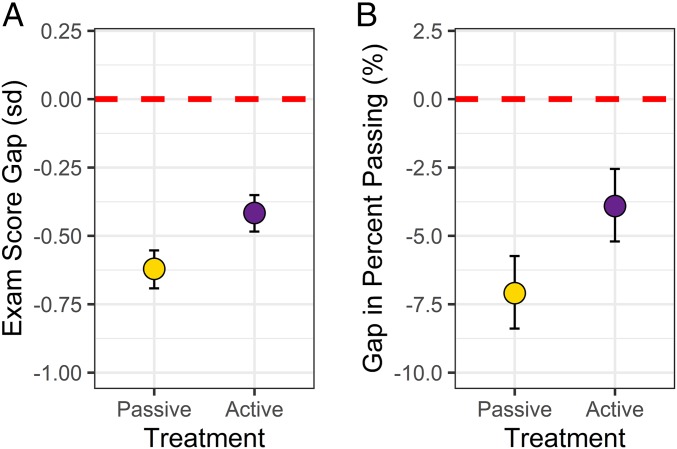
- In identical or formally equivalent exams, the standardized achievement gap between MGS and non-MGS students was −0.62 SDs in traditional lecturing and −0.42 SDs with active learning, a 33% reduction in the gap.
- For passing rates, the gap was −7.1% with traditional lecturing and −3.9% with active learning, a 45% reduction in the gap.
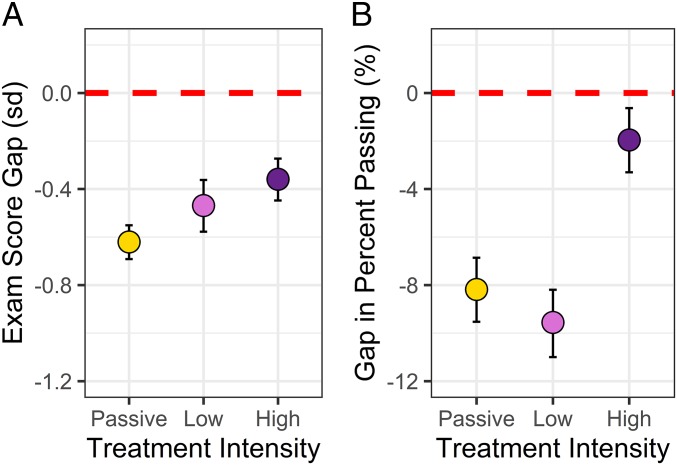
- Gap reductions were stronger with high-intensity active learning: exam-score gaps were −0.48 SDs for low-intensity vs −0.36 SDs for high-intensity; passing-rate gaps were −9.6% for low-intensity vs −2.0% for high-intensity.
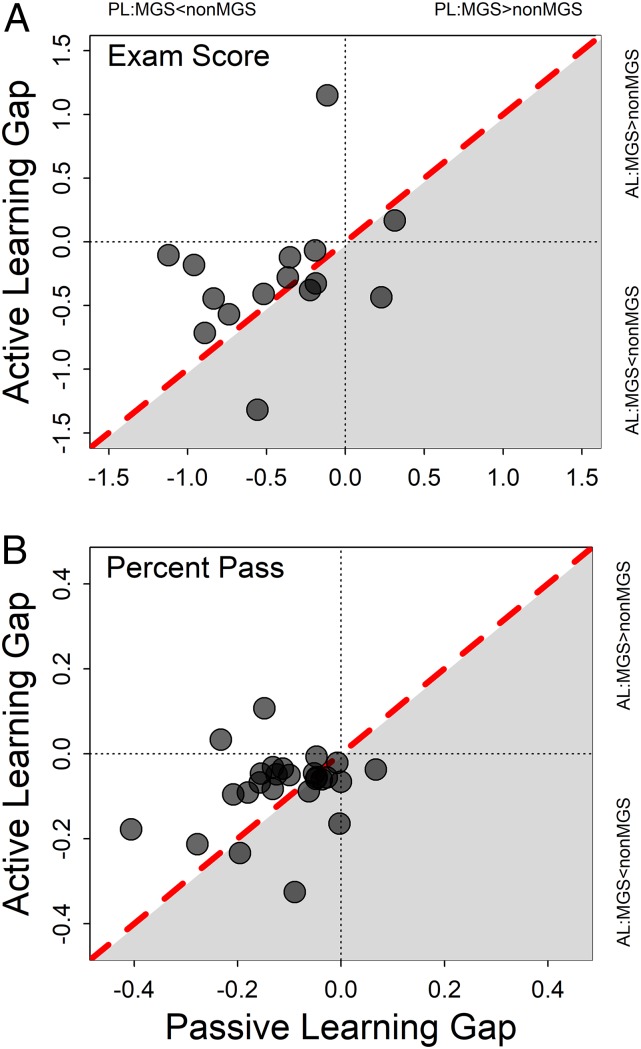
- In the study-level breakdown, 10 of 15 studies with exam-score data showed disproportionate gains for MGS students under active learning, and 15 of 26 studies with failure-rate data showed disproportionate reductions in failure rates for MGS students.
Methods
- Systematic review plus individual-participant-data (IPD) meta-analysis comparing undergraduate STEM courses taught with traditional lecturing vs active learning in the same course and institution.
- Literature search covered studies published or completed from January 1, 2010 to June 30, 2016; the final analysis included 41 studies with disaggregated data by MGS status.
- Final datasets: 9,238 student records from 15 studies for exam scores and 44,606 student records from 26 studies for failure rates; analyses used hierarchical Bayesian multilevel models with section random effects and sensitivity analyses.
Limitations
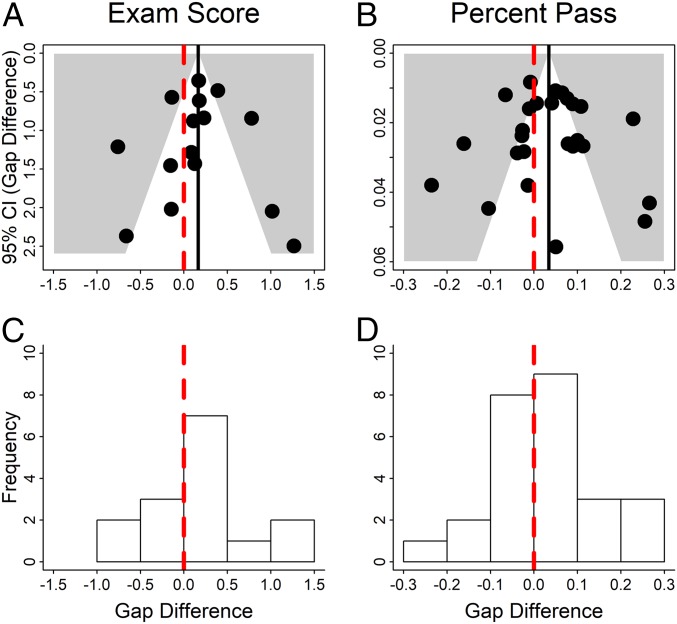
- The paper states that the conclusions are “tempered by the limitations of the study’s sample size”: only 41 studies had data for students from MGS, which also made moderator analyses hard to interpret.
- The paper says data on the type of active learning were “poorly resolved” because studies often did not report quantitative details of course interventions.
- The paper notes possible sampling bias in instructor/institution type, overrepresentation of research-intensive institutions, and underrepresentation of teaching-intensive institutions and community colleges.
- Evident from the text: the meta-analysis depends on studies that met specific coding and data-sharing criteria, so the findings may not generalize to STEM courses or settings not represented in the included studies.
Model-written summary. Check it against the paper before relying on it.
Integrity signals
Registry
Cites
Statistics
Figures
Verification
Claims the paper makes
16 Valid · 1 Not valid · 10 Not checked · 59 Own results and interpretations
The cited sources support only part of this claim — read each source’s verdict below.
In the paper
“Course grades in most STEM courses are largely driven by performance on examinations, even in active-learning courses that offer many nonexam points (39).”
§ Active learning narrows achievement gaps for underrepresented students in undergraduate science, technology, engineering, and math > Discussion
What the sources say
- Partly supportedcites [39] Freeman S., Haak D., Wenderoth M. P., Increased course structure improves performance in introductory biology. CBE Life Sci. Educ. 10, 175– 186 (2011). 21633066 PMC3105924 sourceExperimental — accuracy not yet measured
The Methods section (“Exam Impact on Final Course Grade”; page unavailable) says the authors intended exams to remain the primary determinant of grades even when many nonexam points were available. Table 4 in the Results shows that exam points strongly predicted final grades across the introductory biology sections studied. The paper does not establish that this holds in most STEM courses. (LLM, conf=0.88)
plainstates an association- Asserted: passes — The authors put it forward as true.
- Checkable: passes — It can be checked against evidence.
- Load-bearing: passes — The paper’s conclusions depend on it.
- Based: passes — The paper gives a reason why it holds.
- Partly supported
The cited sources support only part of this claim — read each source’s verdict below.
In the paper
“All students benefit from classroom cultures that promote self-efficacy, identity as a scientist, and sense of belonging in STEM (58)”
§ Active learning narrows achievement gaps for underrepresented students in undergraduate science, technology, engineering, and math > Discussion
What the sources say
- Partly supportedcites [58] Trujillo G., Tanner K. D., Considering the role of affect in learning: Monitoring students’ self-efficacy, sense of belonging, and science identity. CBE Life Sci. Educ. 13, 6– 15 (2014). 24591497 PMC3940464 sourceExperimental — accuracy not yet measured
The paper’s sections on self-efficacy, sense of belonging, and science identity link each to student learning or persistence, and its discussion of teaching considers how classroom experiences shape these factors. Its focus is undergraduate biology, however; it does not establish that all students benefit from such classroom cultures across STEM. The indexed passages provide section labels but no page numbers. (LLM, conf=0.82)
plainstates a cause- Asserted: passes — The authors put it forward as true.
- Checkable: passes — It can be checked against evidence.
- Load-bearing: unclear — It is unclear whether the paper’s conclusions depend on it.
- Based: passes — The paper gives a reason why it holds.
- Partly supported
The cited sources support only part of this claim — read each source’s verdict below.
In the paper
“students in active-learning course designs that reduced or eliminated achievement gaps have reported an increased sense of community and self-efficacy compared to their peers in the lecture-intensive version of the same course (22, 23).”
§ Active learning narrows achievement gaps for underrepresented students in undergraduate science, technology, engineering, and math > Discussion
What the sources say
- Partly supportedcites [22] Eddy S. L., Hogan K. A., Getting under the hood: How and for whom does increasing course structure work? CBE Life Sci. Educ. 13, 453– 468 (2014). 25185229 PMC4152207 sourceExperimental — accuracy not yet measured
In Methods and Results (Study 3, Factor 2; page unavailable), students in the moderate-structure course were twice as likely to report a stronger sense of classroom community than those in the low-structure course. The Introduction mentions self-reported self-efficacy in prior active-learning research, but says that research did not compare students in versions of the same course. This paper therefore does not support the claimed same-course self-efficacy comparison. (LLM, conf=0.88)
- Not matchedcites [23] Ballen C. J., Wieman C., Salehi S., Searle J. B., Zamudio K. R., Enhancing diversity in undergraduate science: Self-efficacy drives performance gains with active learning. CBE Life Sci. Ed. 16, ar56 (2017). PMC5749958 29054921
We don’t have this paper’s reference list.
plainstates an association- Asserted: passes — The authors put it forward as true.
- Checkable: passes — It can be checked against evidence.
- Load-bearing: unclear — It is unclear whether the paper’s conclusions depend on it.
- Based: passes — The paper gives a reason why it holds.
- Partly supported
Every source the paper cites for this claim was checked and supports it.
In the paper
“Our data on type of active learning are also poorly resolved, because publications still routinely fail to report quantitative data on the nature of course interventions, such as records from classroom observation tools (e.g., ref. 61 and SI Appendix, Table S12).”
§ Active learning narrows achievement gaps for underrepresented students in undergraduate science, technology, engineering, and math > Discussion
What the sources say
- Supportedcites [61] Eddy S. L., Converse M., Wenderoth M. P., PORTAAL: A classroom observation tool assessing evidence-based teaching practices for active learning in large science, technology, engineering, and mathematics classes. CBE Life Sci. Educ. 14, ar23 (2015). PMC4477739 26033871 source
The citation appears as an example of a classroom observation tool, not as evidence that publications routinely omit quantitative intervention data. The Abstract identifies PORTAAL as a classroom observation tool for assessing active-learning practices, which supports that use of the citation. (LLM, conf=0.91)
plainstates a cause- Asserted: passes — The authors put it forward as true.
- Checkable: passes — It can be checked against evidence.
- Load-bearing: unclear — It is unclear whether the paper’s conclusions depend on it.
- Based: passes — The paper gives a reason why it holds.
- Supported
Every source the paper cites for this claim was checked and supports it.
In the paper
“larger gaps are correlated with faculty who have a fixed mindset, which interprets intelligence as innate and immutable and is therefore exclusion or selection-oriented (44).”
§ Active learning narrows achievement gaps for underrepresented students in undergraduate science, technology, engineering, and math > Discussion
What the sources say
- Supportedcites [44] Canning E. A., Muenks K., Green D. J., Murphy M. C., STEM faculty who believe ability is fixed have larger achievement racial achievement gaps and inspire less student motivation in their classes. Sci. Adv. 5, eaau4734 (2019). 30793027 PMC6377274 source
The Results report that racial achievement gaps in STEM courses were nearly twice as large with fixed- versus growth-mindset faculty. The Introduction defines a fixed mindset as treating intelligence and ability as innate and largely unchangeable, and describes judging students as low-ability and encouraging them to drop difficult courses—supporting the paraphrase 'exclusion or selection-oriented.' (LLM, conf=0.88)
plainstates an association- Asserted: passes — The authors put it forward as true.
- Checkable: passes — It can be checked against evidence.
- Load-bearing: unclear — It is unclear whether the paper’s conclusions depend on it.
- Based: passes — The paper gives a reason why it holds.
- Supported
30 more claims
Create a free account to see all 86 claims and every source verdict.
- It may state two separate claims as one. 30
- Probably not a substantial claim. 36
Claims other papers make about this one
Each is checked against this paper’s own text: does it say what the citing paper says it does?
The source backs part of the claim, not all of it — or backs it for a different population, condition or comparison.
In the citing paper
“These perceptions, along with a likely reduction in stress and anxiety (see Figure 4), could benefit students from underrepresented groups and may thus reduce the achievement gap among underrepresented minorities”
From Two-Stage Final Exams: An Assessment Strategy for Enhanced Collaborative Learning and Reduced Student Stress (2026) · cites this paper as Theobald et al., 2020
Experimental — accuracy not yet measured
Citations
Cites
Preferred Reporting Items for Systematic Reviews and Meta-Analyses: the PRISMA statement
Moher, D., Liberati, A., Tetzlaff, J., Altman, D. G., & for the PRISMA Group (2009) · BMJ · doi:10.1136/bmj.b2535 · Cited by 83,823
Preferred reporting items for systematic reviews and meta-analyses: the PRISMA Statement.
(2009) · PubMed Central · Cited by 44,859
Preferred reporting items for systematic reviews and meta-analyses: The PRISMA statement
Moher, D., Liberati, A., Tetzlaff, J., Altman, D. G., & the PRISMA Group* (2009) · Annals of Internal Medicine · doi:10.7326/0003-4819-151-4-200908180-00135 · Cited by 37,554
PRISMA-P Group, Moher, D., Shamseer, L., Clarke, M., Ghersi, D., Liberati, A., Petticrew, M., Shekelle, P., & Stewart, L. A. (2015) · Systematic Reviews · doi:10.1186/2046-4053-4-1 · Cited by 26,223 · cited 2×
“The protocol for this study, presented in the PRISMA-P format (66) and including annotations regarding modifications that occurred during the course of the research, is available in SI Appendix, SI Materials and Methods.”
Capital in the Twenty-First Century
Piketty, T. (2014) · doi:10.4159/9780674369542 · Cited by 14,437
Data Analysis Using Regression and Multilevel/Hierarchical Models
Gelman, A., & Hill, J. (2006) · doi:10.1017/cbo9780511790942 · Cited by 13,597
Active learning increases student performance in science, engineering, and mathematics
Freeman, S., Eddy, S. L., McDonough, M., Smith, M. K., Okoroafor, N., Jordt, H., & Wenderoth, M. P. (2014) · Proceedings of the National Academy of Sciences · doi:10.1073/pnas.1319030111 · Cited by 9,787 · cited 6×
“Can interventions in courses themselves—meaning, changes in how science is taught—reduce achievement gaps and promote retention in STEM? A recent metaanalysis concluded that, on average, active learning in STEM leads to higher examination scores and lower failure rates for all students, compared to all students in the…”
InfluentialSelf-citation(2000) · Cited by 9,198
A threat in the air: How stereotypes shape intellectual identity and performance
Steele, C. M. (1997) · American Psychologist · doi:10.1037/0003-066x.52.6.613 · Cited by 6,770 · cited 1×
“Equally important, inclusive teaching emphasizes treating students with dignity and respect (52), communicating confidence in students’ ability to meet high standards (53), and demonstrating a genuine interest in students’ intellectual and personal growth and success (54, 55).”
BackgroundGeneral methods for monitoring convergence of iterative simulations
Brooks, S. P., & Gelman, A. (1998) · Journal of Computational and Graphical Statistics · doi:10.1080/10618600.1998.10474787 · Cited by 6,045
Research works printed but not linked: 9
- Reardon S. F., “The widening achievement gap between the rich and the poor: New evidence and possible explanations” in Whither Opportunity? Duncan G. J., Murnane R. J., Eds. (Russell Sage Foundation, New York, 2011), pp. 91– 115.
- National Student Clearinghouse Research Center, High School Benchmarks 2019: National College Progression Rates (National Student Clearinghouse, Herndon, VA, 2019).
- Chen X., STEM Attrition: College Students’ Paths Into and Out of STEM Fields (National Center for Education Statistics, Washington, DC, 2013).
- Vygotsky L. S., Mind in Society (Harvard University Press, Cambridge, MA, 1978).
- Kaufmann E., Reips U.-D., Merki K. M., Avoiding methodological biases in meta-analysis. Z. Psychol. 224, 157– 167 (2016).
- Ginder S. A., Kelly-Reid J. E., Mann F. B., Enrollment and Employees in Postsecondary Institutions, Fall 2015 (National Center for Education Statistics, Washington, DC, 2017).
- Reed J. G., Baxter P. M., Using Reference Databases. The Handbook of Research Synthesis and Meta-Analysis, Cooper H., Hedges L. V., Valentine J. C., Eds. (Russell Sage Foundation, New York, 2009), pp. 73– 101.
- Rothstein H., Hopewell S., Grey Literature. The Handbook of Research Synthesis and Meta-Analysis, Cooper H., Hedges L. V., Valentine J. C., Eds. (Russell Sage Foundation, New York, 2009), pp. 103– 125.
- White H. D., Scientific Communication and Literature Retrieval. The Handbook of Research Synthesis and Meta-Analysis, Cooper H., Hedges L. V., Valentine J. C., Eds. (Russell Sage Foundation, New York, 2009), pp. 51– 71.
Cited by
Items 201–300 of 1,369
Experiential education of deaf and hard of hearing students in the lab with non-signing advisors
Gehret, A. U., Michel, L., & Trussell, J. W. (2021) · International Journal of Inclusive Education · doi:10.1080/13603116.2021.1879948 · Cited by 19
“Despite these hurdles, interventions such as enhanced active learning in STEM courses have shown to reduce gaps for URM and low-income groups (Theobald et al. 2020).”
BackgroundEsparza, D., Lynch-Arroyo, R. L., & Olimpo, J. T. (2022) · Frontiers in Education · doi:10.3389/feduc.2021.754097 · Cited by 31
“Active learning increases students’ conceptual understanding in science, technology, engineering, and mathematics (STEM) courses whilst decreasing the achievement gap between minoritized students and their nonminoritized peers (Freeman et al., 2014; Olimpo and Esparza, 2020; Theobald et al., 2020).”
BackgroundTwo Active Learning Models of Protein Dynamics for Use in Undergraduate Biochemistry Courses
Theisen, K. E. (2022) · Journal of Chemical Education · doi:10.1021/acs.jchemed.1c00025 · Cited by 16
Characterizing Mindset-Related Challenges in Undergraduate Chemistry Courses
Santos, D. L., & Mooring, S. R. (2022) · Journal of Chemical Education · doi:10.1021/acs.jchemed.2c00270 · Cited by 23
Designing novel activities before instruction: Use of contrasting cases and a rich dataset
Bego, C. R., Chastain, R. J., & DeCaro, M. S. (2022) · British Journal of Educational Psychology · doi:10.1111/bjep.12555 · Cited by 23
Sevian, H., King-Meadows, T. D., Caushi, K., Kakhoidze, T., & Karch, J. M. (2023) · JACS Au · doi:10.1021/jacsau.3c00192 · Cited by 16
Karaer, G., Hand, B. M., & French, B. F. (2023) · Thinking Skills and Creativity · doi:10.1016/j.tsc.2023.101443 · Cited by 27
McLaughlin, S., Amir, H., Garrido, N., Turnbull, C., Rouncefield‐Swales, A., Swadźba‐Kwaśny, M., & Morgan, K. (2024) · Journal of Chemical Education · doi:10.1021/acs.jchemed.3c01184 · Cited by 33
Chase, L., McMurray, M. S., Stavnezer, A. J., Buffalari, D. M., Fernandes, J. J., Lom, B., & Morrison, M. E. (2020) · PubMed Central · Cited by 20
Inclusive Instructional Practices: Course Design, Implementation, and Discourse
Salehi, S., Ballen, C. J., Trujillo, G., & Wieman, C. (2021) · Frontiers in Education · doi:10.3389/feduc.2021.602639 · Cited by 20
Johnson, K. G., Jakopovic, P. M., & von Renesse, C. (2021) · Journal for STEM Education Research · doi:10.1007/s41979-021-00061-3 · Cited by 20
“STEM instructor effectiveness, particularly the use of evidence-based teaching methods (e.g., active learning, inquiry), has been shown to increase the knowledge, skills, and habits of students (Freeman et al., 2014; Laursen et al., 2014; Theobald et al., 2020).”
BackgroundWriting a review article: what to do with my literature review
Graulich, N., Lewis, S. E., Kahveci, A., Nyachwaya, J. M., & Lawrie, G. (2021) · Chemistry Education Research and Practice · doi:10.1039/d1rp90006d · Cited by 11
Gonsar, N., Patrick, L. E., & Cotner, S. H. (2021) · Disciplinary and Interdisciplinary Science Education Research · doi:10.1186/s43031-021-00035-w · Cited by 18
Instructor facilitation mediates students’ negative perceptions of active learning instruction
Park, E. S., Harlow, A. N., AghaKouchak, A., Baldi, B., Burley, N. T., Buswell, N. T., Crooks, R. N., Denenberg, D., Ditto, P. H., Edwards, K., et al. (2021) · PLoS ONE · doi:10.1371/journal.pone.0261706 · Cited by 18
“In contrast, racial performance gaps in active learning instruction relative to lecture-based instruction may decrease as racially minoritized students are given more feedback on their learning and are provided with scaffolded time on tasks [10].”
BackgroundInfluentialPark, E. S., & Xu, D. (2022) · Journal of Research on Educational Effectiveness · doi:10.1080/19345747.2022.2151954 · Cited by 32
“…association between active learning and student performance outcomes, and has generally identified positive effects of active learning instruction relative to lecture-intensive instruction (e.g., Deslauriers et al., 2011, 2019; Freeman et al., 2014; Ruiz-Primo et al., 2011; Theobald et al., 2020).”
BackgroundBradley, L. J., Meyer, K. E., Robertson, T. C., Kerr, M. S., Maddux, S. D., Heck, A. J., Reeves, R., & Handler, E. (2023) · Anatomical Sciences Education · doi:10.1002/ase.2276 · Cited by 21
Motivating Active Learning in Physical Education: Critical Thinking
Hidayat, C., Lengkana, A. S., Rohyana, A., Purwanto, D., Razali, R., & Rosalina, M. (2023) · European Journal of Educational Research · doi:10.12973/eu-jer.12.2.1137 · Cited by 40
Lelapary, H. L., Rachmawati, R., Zani, B. N., & Maharjan, K. (2023) · Journal International of Lingua and Technology · doi:10.55849/jiltech.v2i1.439 · Cited by 56
Muteti, C. Z., Jacob, B. I., & Mutambuki, J. M. (2023) · Chemistry Education Research and Practice · doi:10.1039/d3rp00103b · Cited by 19
Hew, K. F., & Huang, W. (2023) · Future in Educational Research · doi:10.1002/fer3.9 · Cited by 32
Park, E. S., Wilton, M., Lo, S. M., Buswell, N. T., Suarez, N. A., & Sato, B. K. (2024) · Research in Higher Education · doi:10.1007/s11162-023-09769-0 · Cited by 17
“These approaches promote student equity by shifting the onus of differential student performance away from individual deficiencies and assigning solutions to educational approaches that address systemic racism (Theobald et al., 2020).”
Creating the University of the Future: A Global View on Future Skills and Future Higher Education
Ehlers, U.-D., & Eigbrecht, L. (2024) · Zukunft der Hochschulbildung · doi:10.1007/978-3-658-42948-5 · Cited by 48
Nationally endorsed learning objectives to improve course design in introductory biology
Hennessey, K. M., & Freeman, S. (2024) · PLoS ONE · doi:10.1371/journal.pone.0308545 · Cited by 17
“An important next frontier for continued improvement in student performance—a requirement for the U.S. to meet current and projected needs for qualified STEM professionals [3]—is to align improvements in active learning exercises and other evidence-based practices with specific learning objectives…”
BackgroundSelf-citationHawkins, W. C., Goddard, K., & Favero, C. B. (2021) · CBE—Life Sciences Education · doi:10.1187/cbe.20-06-0117 · Cited by 20
“To retain students from historically minoritized groups in STEM, it is imperative that we make the course experience more welcoming, less isolating, and confidence boosting (Malcolm and Feder, 2016; Martinez-Acosta and Favero, 2018; Theobald et al., 2020).”
BackgroundThe effectiveness of interactive online tutorials in first-year large biology course
Rissanen, A., & Costello, J. (2021) · Journal of Applied Research in Higher Education · doi:10.1108/jarhe-09-2020-0312 · Cited by 23
Adapting the CACAO model to support higher education STEM teaching reform
Viskupic, K. M., Earl, B., & Shadle, S. E. (2022) · International Journal of STEM Education · doi:10.1186/s40594-021-00325-9 · Cited by 23
Musengimana, J., Kampire, E., & Ntawiha, P. (2022) · Journal of Baltic Science Education · doi:10.33225/jbse/22.21.140 · Cited by 21
“Research indicated that student achievement in science learning improves dramatically if students are active participants in constructing their knowledge (Freeman et al., 2014; Theobald et al., 2020).”
BackgroundImpact of social media distraction on student evaluation of teacher effectiveness
Nema, P., Srivastava, R., Bhalla, R. G., & Chakarboty, A. (2023) · International Journal of Educational Management · doi:10.1108/ijem-10-2022-0389 · Cited by 29
Jantzer, J., Kirkman, T. W., & Furniss, K. L. (2021) · Journal of Microbiology and Biology Education · doi:10.1128/jmbe.00176-21 · Cited by 16
“Much of STEM attrition occurs during or at the end of the introductory course sequence and can be linked to poor performance in the introductory courses (18, 40).”
BackgroundGreenall, R. F., & Bailey, E. G. (2022) · CBE—Life Sciences Education · doi:10.1187/cbe.21-12-0340 · Cited by 14
“Active-learning practices have also been shown to close achievement gaps for other underserved groups, not just Indigenous students (Theobald et al., 2020).”
BackgroundStudent interaction discourse moves: characterizing and visualizing student discourse patterns
Nennig, H. T., States, N. E., Montgomery, M. T., Spurgeon, S. G., & Cole, R. S. (2023) · Disciplinary and Interdisciplinary Science Education Research · doi:10.1186/s43031-022-00068-9 · Cited by 22
“…instructional approaches in Science, Technology, Engineering, and Mathematics (STEM) classrooms designed to help students construct their own understanding and take ownership of their learning (Freeman et al., 2014; National Research Council, 2015; Olson & Riordan, 2012; Theobald et al., 2020).”
BackgroundLourakis, E., & Petridis, K. (2023) · Education Sciences · doi:10.3390/educsci13020126 · Cited by 22
Preparing future STEM faculty through flexible teaching professional development
Goldberg, B. B., Bruff, D., Greenler, R., Barnicle, K., Green, N. H., Campbell, L., Laursen, S. L., Ford, M., Serafini, A., Mack, C. E., et al. (2023) · PLoS ONE · doi:10.1371/journal.pone.0276349 · Cited by 21
Stromholt, S., Wiggins, B. L., & der Mehden, B. M. V. (2023) · Journal for STEM Education Research · doi:10.1007/s41979-023-00109-6 · Cited by 25
Group work enhances student performance in biology: A meta-analysis
Driessen, E. P., Wilson, A. E., Hall, I. P., Brewer, P., Odom, S., Ramsey, S. B., Wood, S., & Ballen, C. J. (2024) · BioScience · doi:10.1093/biosci/biae001 · Cited by 19
Donia, D., Scibetta, E. V., Tagliatesta, P., et al. (2021) · Journal of Chemical Education · doi:10.1021/acs.jchemed.0c01205 · Cited by 14
Zuckerman, A. L., Hardesty, R. A., Denaro, K., Lo, S. M., & Owens, M. T. (2021) · Journal of Microbiology and Biology Education · doi:10.1128/jmbe.v22i1.2293 · Cited by 16
Student engagement and learning outcomes in the model United Nations
Jesuit, D. K., & Strachan, J. C. (2021) · Journal of University Teaching and Learning Practice · doi:10.53761/1.18.8.11 · Cited by 21
“The benefits of active learning approaches through the use of higher order interactive tasks are now widely acknowledged (Drinkwater et al., 2017) and are effective across many subject areas including science, engineering, technology, and mathematics (STEM) (e.g., Theobald et al., 2020).”
BackgroundPickett, S. B., Nielson, C., Marshall, H., Tanner, K. D., & Coley, J. D. (2022) · Journal of Microbiology and Biology Education · doi:10.1128/jmbe.00220-21 · Cited by 23
“Beyond exploring variations on the implementation of a refutation text reading intervention, few studies have addressed the efficacy of a refutation reading relative to forms of live instruction, such as demonstrations and active learning, that can be used to promote metacognition (50) and significantly increase learn…”
BackgroundSelf-citationArchie, T., Hayward, C. N., Yoshinobu, S., & Laursen, S. L. (2022) · PLoS ONE · doi:10.1371/journal.pone.0267097 · Cited by 34
Hardebolle, C., Verma, H., Tormey, R., & Deparis, S. (2022) · Journal of Engineering Education · doi:10.1002/jee.20467 · Cited by 20
“A recent meta-analysis by Theobald et al. (2020) identifies that active and interactive teaching approaches promote inclusivity within STEM education, produce more equitable educational outcomes, and in particular, reduce the achievement gap among different groups of students.”
InfluentialPercent grade scale amplifies racial or ethnic inequities in introductory physics
Paul, C., & Webb, D. J. (2022) · Physical Review Physics Education Research · doi:10.1103/physrevphyseducres.18.020103 · Cited by 18
Establishing a new standard of care for calculus using trials with randomized student allocation
Kramer, L., Fuller, E. J., Watson, C., Castillo, A., Durán, P., & Potvin, G. (2023) · Science · doi:10.1126/science.ade9803 · Cited by 29
Severe, E., Stalnaker, J., Hubbard, A., Hafen, C. H., & Bailey, E. G. (2024) · PLOS ONE · doi:10.1371/journal.pone.0297771 · Cited by 14
Jackson, M. A., Moon, S., Doherty, J. H., & Wenderoth, M. P. (2022) · International Journal of STEM Education · doi:10.1186/s40594-022-00340-4 · Cited by 22
“Implementing evidence-based teaching practices for more than 67% of class time was also found to significantly narrow differences in performance between students from minoritized and nonminoritized groups (Theobald et al., 2020).”
BackgroundUndergraduate R Programming Anxiety in Ecology: Persistent Gender Gaps and Coping Strategies
Forrester, C. C., Schwikert, S. R., Foster, J., & Corwin, L. A. (2022) · CBE—Life Sciences Education · doi:10.1187/cbe.21-05-0133 · Cited by 29
“…of Science [AAAS], 2011; Theobald et al. , 2020), and while these offer clear benefits in terms of cognitive gains (Freeman et al. , 2014; Theobald et al. , 2020), they also can result in increased student anxiety while learning via fear of negative evaluation by one’s instructors or…”
BackgroundCirillo, M., Berk, D., LaRochelle, R., Bieda, K. N., & Arbaugh, F. (2022) · International Journal of Research in Undergraduate Mathematics Education · doi:10.1007/s40753-022-00191-y · Cited by 22
“…opportunities can improve students’ learning and increase retention (e.g., Freeman et al., 2014; Watkins & Mazur, 2013) as well as reduce achievement gaps between male and female students and for underrep-resented students (Kogan & Laursen, 2014; Laursen et al., 2014; Theobald et al., 2020).”
A Spatial Dynamic Factor Repeat Sales Model for Real Estate
Francke, M., Rolheiser, L., & de Minne, A. V. (2022) · The Journal of Real Estate Finance and Economics · doi:10.1007/s11146-023-09957-w · Cited by 14
“Recent literature in the field of Bayesian modeling has adapted the LOO-IC as the method of choice to measure fit (see for example Dainese et al., 2019; Dehning et al., 2020; Theobald et al., 2020, among many others).”
Student perceptions of inclusive pedagogy in undergraduate STEM classrooms
Valdez, C. J., & Kelp, N. (2023) · Journal of Microbiology and Biology Education · doi:10.1128/jmbe.00097-23 · Cited by 22
Cooper, M. M., Caballero, M. D., Carmel, J. H., Duffy, E. M., Ebert‐May, D., Fata-Hartley, C. L., Herrington, D. G., Laverty, J. T., Nelson, P. C., Posey, L. A., et al. (2024) · PLoS ONE · doi:10.1371/journal.pone.0295887 · Cited by 28
Pedagogical Reform in an Introductory Chemistry Course and the Importance of Curricular Alignment
James, N. M., & LaDue, N. (2021) · Journal of Chemical Education · doi:10.1021/acs.jchemed.1c00688 · Cited by 19
Wright, L. K., Cortez, P. M., Franzen, M. A., et al. (2021) · Biochemistry and Molecular Biology Education · doi:10.1002/bmb.21583 · Cited by 13
Online Orbital Explorer and BingOrbital Game for Inquiry-Based Activities
Li, X., Muñiz, M. N., Chun, K., Tai, J., Guerra, F., & York, D. M. (2022) · Journal of Chemical Education · doi:10.1021/acs.jchemed.1c01277 · Cited by 17
Wiklund-Hörnqvist, C., Stillesjö, S., Andersson, M., Jonsson, B., & Nyberg, L. (2022) · Frontiers in Psychology · doi:10.3389/fpsyg.2021.797395 · Cited by 12
“Recent meta-analytic reviews have demonstrated that active learning methods reduce the achievement gap between academic success and failure (Freeman et al., 2014; Theobald et al., 2020).”
BackgroundBulut, M. A., Adıgüzel, T., & Kaya, M. H. (2025) · Innovations in Education and Teaching International · doi:10.1080/14703297.2025.2532056 · Cited by 19
“Empirical studies consistently demonstrate that active learning improves academic performance and is more effective than traditional lectures (Theobald et al., 2020).”
Meiliati, R., Djodding, I. M., Aswin, A., Salido, A., Husain, D. S., Tahir, T., & Hidayati, U. (2025) · Social Sciences & Humanities Open · doi:10.1016/j.ssaho.2025.102345 · Cited by 33
Nieuwoudt, J. E. (2023) · Student Success · doi:10.5204/ssj.2660 · Cited by 12
“Importantly, academic performance is increased through evidence-based improvements in active learning curriculum design (Theobald et al., 2020), not by merely shortening the delivery model.”
Busch, C. A., Cooper, K. M., & Brownell, S. E. (2023) · PLoS ONE · doi:10.1371/journal.pone.0287795 · Cited by 13
Barriers instructors experience in adopting active learning: Instrument development
Carroll, L. J., Reeping, D. P., Finelli, C., Prince, M. J., Husman, J. E., Graham, M., & Borrego, M. J. (2023) · Journal of Engineering Education · doi:10.1002/jee.20557 · Cited by 30
Ghosh, A., Cohen, K. A., Jans, L. K., Busch, C. A., McDanal, R., Yang, Y., Cooper, K. M., & Schleider, J. L. (2023) · JMIR Mental Health · doi:10.2196/48926 · Cited by 19
Alé-Ruiz, R., Abad, F. M., & Moral-Marcos, M. T. D. (2023) · Education and Information Technologies · doi:10.1007/s10639-023-12358-4 · Cited by 27
“…offer possibilities for immediate feedback, time-based student progress reports and the application of short-and long-term reward mechanisms that motivate student progress and self-regulation in their learning (Hernández Rivero et al., 2021; Lucieer et al., 2016; Theobald et al., 2020).”
Techniques adopted in teaching students organic chemistry course for several years
Sukmawati, W. (2020) · Jurnal Inovasi Pendidikan IPA · doi:10.21831/jipi.v6i2.38094 · Cited by 33
Martella, A. M., Yatcilla, J., Park, H., Marchand‐Martella, N. E., & Martella, R. C. (2021) · SN Social Sciences · doi:10.1007/s43545-021-00235-1 · Cited by 17
Porzecanski, A. L., Bravo, A., Groom, M. J., Dávalos, L. M., Bynum, N., Abraham, B. J., Cigliano, J. A., Griffiths, C. S., Stokes, D. L., Cawthorn, M., et al. (2021) · Case Studies in the Environment · doi:10.1525/cse.2021.1536396 · Cited by 18
Technology, Equity, and Inclusion in the Virtual Education Space
Taylor, C., Dewsbury, B. M., & Brame, C. J. (2022) · Methods in physiology · doi:10.1007/978-3-030-95633-2_2 · Cited by 17
Ilyas, M., Meiyani, E., Ma’rufi, M., & Kaewhanam, P. (2022) · Frontiers in Education · doi:10.3389/feduc.2022.966687 · Cited by 30
“Effective learning methods are used in the learning process in today’s era, wherein teachers have various selections of learning methods they can use on the students in order to effectively and efficiently achieve the learning objectives (Carlson et al., 2016; Theobald et al., 2020).”
BackgroundMethodInfluentialImproving models for student retention and graduation using Markov chains
Tedeschi, M. N., Hose, T. M., Mehlman, E. K., Franklin, S., & Wong, T. E. (2023) · PLoS ONE · doi:10.1371/journal.pone.0287775 · Cited by 19
Connor, M. C., & Raker, J. R. (2023) · Journal of Chemical Education · doi:10.1021/acs.jchemed.3c00484 · Cited by 12
Towards meaningful diversity, equity and inclusion in physics learning environments
Maries, A., & Singh, C. (2024) · Nature Physics · doi:10.1038/s41567-024-02391-6 · Cited by 22
“For example, in a metaanalysis of stud ies on reducing achievement gaps in undergraduate STEM, Theobald et al. found that use of evidencebased active learning led to a reduction in achievement gaps, but not a removal 112 .”
Re-flipping in the Remote Classroom: The Surprising Uptake of Video-Recorded Worked Examples
Koretsky, M. (2020) · Journal of Chemical Education · doi:10.1021/acs.jchemed.0c00711 · Cited by 15
On COVID-19, cognitive bias, and open access
Berenbaum, M. R. (2021) · Proceedings of the National Academy of Sciences · doi:10.1073/pnas.2026319118 · Cited by 13
Campanyà, C., Fonseca, D., Amo, D., Audí, N. M., & Peña, E. (2021) · Sustainability · doi:10.3390/su13115826 · Cited by 13
Ripoll, V., Godino‐Ojer, M., & Calzada-Funes, J. (2023) · Education for Chemical Engineers · doi:10.1016/j.ece.2023.01.006 · Cited by 19
Individual-Centred Approaches to Accessibility in STEM Education
Davey, T., Luces, J. V. S., & Davenport, R. (2021) · Education Sciences · doi:10.3390/educsci11100652 · Cited by 16
Racial and gender achievement gaps in an economics classroom
Bottan, D., McKee, D., Orlov, G., & McDougall, A. (2022) · International Review of Economics Education · doi:10.1016/j.iree.2022.100239 · Cited by 25
Crowther, G. J., Adjapong, E., & Jenkins, L. D. (2023) · AJP Advances in Physiology Education · doi:10.1152/advan.00006.2023 · Cited by 18
Elder, S., Wittman, H. K., & Giang, A. (2023) · Elementa Science of the Anthropocene · doi:10.1525/elementa.2022.00091 · Cited by 17
The Overlooked Impact of Faculty on Engineering Education
Cutler, S. L., & Strong, A. (2023) · Routledge eBooks · doi:10.4324/9781003287483-17 · Cited by 16
DeCaro, M. S., Isaacs, R. A., Bego, C. R., & Chastain, R. J. (2023) · Frontiers in Education · doi:10.3389/feduc.2023.1215975 · Cited by 22
Zubair, M. U., Khan, M. A., Hassan, M. U., Ahmed, K., & Aziz, T. (2024) · Sustainability · doi:10.3390/su16146010 · Cited by 31
Zakariya, Y. F., & Adegoke, N. A. (2024) · Frontiers in Education · doi:10.3389/feduc.2024.1367076 · Cited by 39
Roche, T., Wilson, E., Goode, E., & McKenzie, J. (2024) · Higher Education Research & Development · doi:10.1080/07294360.2024.2424157 · Cited by 22
“…to significantly narrow achievement gaps between under-represented and other students in science, technology, engineering and mathematics (STEM) subjects (Theobald et al., 2020), as well as across diverse cohorts in immersive scheduling models (Jackson et al., 2022; Samarawickrema & Cleary, 2021).”
Byrne, L. B., Rauschert, E. S. J., Rodgers, V. L., Bowser, G., Casper, A. M., Dewsbury, B. M., Morales, N. A., Vance‐Chalcraft, H. D., & Weber, L. M. (2025) · Bulletin of the Ecological Society of America · doi:10.1002/bes2.2233 · Cited by 17
Changing Attitudes toward Organic Chemistry via a Digital Multiplayer Game
Teo, J., Sharma, P., Kon, M. W. R., Han, J. Y., Tan, T. L. Y., Teh, Y. L., Yap, J. Y. G., Lam, Y., & Fung, F. M. (2025) · Journal of Chemical Education · doi:10.1021/acs.jchemed.4c01237 · Cited by 14
Beneroso, D., & Erans, M. (2020) · European Journal of Engineering Education · doi:10.1080/03043797.2020.1865879 · Cited by 14
“2014), and has been evidenced to offer disproportionate benefits for students from underrepresented minorities (Theobald et al. 2020).”
BackgroundHandayani, E. S., Yuberti, Y., Saregar, A., et al. (2021) · Journal of Physics Conference Series · doi:10.1088/1742-6596/1796/1/012100 · Cited by 11
“The STEM approach discipline is expected to increase equality in higher education [13].”
BackgroundLearning organizational behaviors and leadership through reflective journal writing
Choi, S., Tian, X., & Stumph, C. F. (2022) · The International Journal of Management Education · doi:10.1016/j.ijme.2022.100612 · Cited by 15
Experience Report: Standards-Based Grading at Scale in Algorithms
Chen, L., Grochow, J. A., Layer, R. M., & Levet, M. (2022) · ACM Conference on Innovation and Technology in Computer Science Education (ITiCSE) · doi:10.1145/3502718.3524750 · Cited by 15
“While our goal was not to assess the benefits of active learning, it is worth noting that the gains amongst these students appear consistent with existing evidence on the effectiveness of active learning in increasing student learning and performance [6, 14, 28, 31].”
MethodResultTørris, C., Meyer, M. E., Sandbekken, I. H., Halvorsrud, H., & Molin, M. (2022) · Education Sciences · doi:10.3390/educsci12070467 · Cited by 14
Post-COVID Changes to Assessment Practices: A Case Study of Undergraduate STEM Recitations
Kerrigan, J., Cochran, G. L., Tabanli, S., Charnley, M., & Mulvey, S. (2022) · Journal of Educational Technology Systems · doi:10.1177/00472395221118392 · Cited by 16
Characteristics of interactive classrooms that first year students find helpful
Vroom, K., Gehrtz, J., Apkarian, N., Elizondo, T. A., Ellis, B. M., & Hagman, J. E. (2022) · International Journal of STEM Education · doi:10.1186/s40594-022-00354-y · Cited by 19
Creech, C., Just, J., Hammarlund, S. P., Rolle, C. E., Gonsar, N., Olson, A. N., Campbell, N., Mennes, K., Adoradio, C., Soneral, P. A. G., et al. (2022) · CBE—Life Sciences Education · doi:10.1187/cbe.21-09-0249 · Cited by 13
What College Biology Students Know about How Vaccines Work
Kahlon, G., Waheed, F., & Owens, M. T. (2022) · CBE—Life Sciences Education · doi:10.1187/cbe.20-12-0294 · Cited by 11
“continuing-generation college student) because previous education literature has shown “opportunity gaps” in biology performance along these axes (Eddy et al., 2014; Harackiewicz et al., 2014; Theobald et al., 2020).”
BackgroundBunce, D. M., Schroeder, M. J., Prak, D. J. L., Teichert, M. A., Dillner, D. K., McDonnell, L. R., Midgette, D. P., & Komperda, R. (2023) · Journal of Chemical Education · doi:10.1021/acs.jchemed.2c00928 · Cited by 19
Sebesta, A. J., & Speth, E. B. (2023) · PLoS ONE · doi:10.1371/journal.pone.0287313 · Cited by 19
“An abundance of evidence shows that learner-centered instructional practices support student learning, engagement, and achievement in STEM [22, 28] and often benefit historically underserved students the most [29–31].”
Araya, J. A. Z., Fernández, E. A., & Guillén-Oviedo, H. (2021) · Revista Educación · doi:10.15517/revedu.v46i1.43494 · Cited by 11
“(Traducción personal, eobald et al., 2020, p. 6476).”
Diversity and inclusion in engineering and computing: A scoping review of recent FIE papers
Bego, C. R., & Nwokeji, J. C. (2021) · IEEE Frontiers in Education Conference (FIE) · doi:10.1109/fie49875.2021.9637461 · Cited by 10
Zakariya, Y. F., Midttun, Ø., Nyberg, S. O., & Gjesteland, T. (2022) · Mathematics · doi:10.3390/math10132164 · Cited by 18
Tracing Undergraduate Science Learners’ Digital Cognitive Strategy Use and Relation to Performance
Mefferd, K., & Bernacki, M. L. (2023) · Journal of Science Education and Technology · doi:10.1007/s10956-022-10018-9 · Cited by 16
“This design approach has been theorized (Chi & Wylie, 2014) and observed (Theobald et al., 2020) to better support the students who enroll in such courses but struggle to learn effectively and ultimately leave their STEM major.”
BackgroundMethodDesigning and delivering bioinformatics project-based learning in East Africa
Kibet, C. K., Entfellner, J.-B. D., Jjingo, D., de Villiers, E. P., de Villiers, S., Wambui, K., Kinyanjui, S., & Masiga, D. K. (2024) · BMC Bioinformatics · doi:10.1186/s12859-024-05680-2 · Cited by 14
“Contact groups can be added to a channel, which allows for quick meeting invites and chats that last beyond the meeting.”
Background
Metadata
- Authors
- Theobald, E. J., Hill, M. J., Tran, E., Agrawal, S., Arroyo, E. N., Behling, S., Chambwe, N., Cintrón, D. L., Cooper, J. D., Dunster, G., Grummer, J. A., Hennessey, K., Hsiao, J., Iranon, N., Jones, L., Jordt, H., Keller, M., Lacey, M. E., Littlefield, C. E., Lowe, A., Newman, S., Okolo, V., Olroyd, S., Peecook, B. R., Pickett, S. B., Slager, D. L., Caviedes-Solis, I. W., Stanchak, K. E., Sundaravardan, V., Valdebenito, C., Williams, C. R., Zinsli, K., & Freeman, S.
- Affiliations
- University of Washington (US)
- Institute for Systems Biology (US)
- Shoreline Community College (US)
- Corresponding author
- Theobald, Elli J.
- Freeman, Scott
- ORCID
- Theobald, Elli J.
- Agrawal, Sweta
- Behling, Shawn
- Chambwe, Nyasha
- Cintrón, Dianne Laboy
- Cooper, Jacob D.
- Dunster, Gideon
- Grummer, Jared A.
- Hennessey, Kelly
- Hsiao, Jennifer
- Jones, Leonard
- Jordt, Hannah
- Littlefield, Caitlin E.
- Lowe, Alexander
- Olroyd, Savannah
- Peecook, Brandon R.
- Pickett, Sarah B.
- Slager, David L.
- Caviedes-Solis, Itzue W.
- Stanchak, Kathryn E.
- Williams, Claire R.
- Zinsli, Kaitlin
- Freeman, Scott
- Venue
- Proceedings of the National Academy of Sciences
- Publisher
- National Academy of Sciences
- Published
- 2020-03-09
- Volume
- 117
- Issue
- 12
- Pages
- 6476-6483
- ISSN
- 0027-8424 (ISSN-L)
- 1091-6490
- PMC
- PMC7104254
- OpenAlex
- W3009483010
- Cited by
- 1,387
- References
- 75
- Citations by year
- 2026: 210 · 2025: 222 · 2024: 272 · 2023: 236 · 2022: 233 · 2021: 154 · 2020: 60
- FWCI
- 258.89
- Type
- journal article
- Language
- en
- Open access
- hybrid
- doi.org
- Licence
- Locations
- Proceedings of the National Academy of Sciences (publishedVersion, cc-by-nc-nd)
- Europe PMC (PubMed Central) (publishedVersion, cc-by-nc-nd)
- PubMed Central (publishedVersion, cc-by-nc-nd)
- PubMed (publishedVersion)
- Funders
- University of Washington College of Arts and Sciences (NA)
- Topics
- Social Sciences › Education › Innovative Teaching Methods
- Social Sciences › Education › Higher Education Research Studies
- Social Sciences › Psychology › Developmental and Educational Psychology › Innovative Teaching and Learning Methods
- Keywords
- active learning, achievement gap, underrepresented students, STEM education, traditional lecturing, course design, student failure rates, test scores, higher education equity, inclusive pedagogy, deliberate practice
- MeSH terms
- Achievement, Educational Measurement, Engineering, Humans, Mathematics, Minority Groups, Science, Students, Technology, United States, Universities, Problem-Based Learning
About these checks
Registry, retraction, Cites and statistics results are computed, not judged, with one exception: a printed reference that no index lists is read once by a model before it counts as a citation error. Claims are extracted by a model and kept only when their quote appears verbatim in the text; each cited source is then checked, with a model’s help, for whether it says what the claim relies on. Those verdicts can be wrong — read the claim’s quote and the cited source before relying on one.
The claim verdicts this report counts are experimental: their accuracy is not yet measured.
A language model drew the claims from the paper on 2026-10-10, under version 3 of the claim definition (model deepseek-v4.1-flash, prompt extract-v3).
A second model labelled each claim on 2026-10-10 (model jev-1.13-20260917, definition revision gold-guideline-v0.2).
Cited sources are checked with a language model’s help (gpt-6-sol).
Statistics and arithmetic are recomputed, not judged.
Confidence bands are shown only for fields calibrated on our annotated test set. None is calibrated yet, so no band is shown.
What counts as a claim ›How we measure confidence ›How we check this ›
Are you an author, or do you see a problem with this page? Request a review
Data sources
Bibliographic data: Semantic Scholar, OpenAlex, Crossref.
Contains information from the Semantic Scholar Academic Graph Datasets, made available under the ODC Attribution License (ODC-BY 1.0).
Semantic Scholar’s data is described in: Kinney, R., et al. (2023). The Semantic Scholar Open Data Platform. arXiv:2301.10140.
