

Active learning narrows achievement gaps for underrepresented students in undergraduate science, technology, engineering, and math
Open accessThe DOI matches its Crossref record; 72 of the 75 references it cites were found in a registry or an index, and 3 are not checked yet; 19 of the 44 sources its claims cite were checked for support.
Abstract
We tested the hypothesis that underrepresented students in active-learning classrooms experience narrower achievement gaps than underrepresented students in traditional lecturing classrooms, averaged across all science, technology, engineering, and mathematics (STEM) fields and courses. We conducted a comprehensive search for both published and unpublished studies that compared the performance of underrepresented students to their overrepresented classmates in active-learning and traditional-lecturing treatments. This search resulted in data on student examination scores from 15 studies (9,238 total students) and data on student failure rates from 26 studies (44,606 total students). Bayesian regression analyses showed that on average, active learning reduced achievement gaps in examination scores by 33% and narrowed gaps in passing rates by 45%. The reported proportion of time that students spend on in-class activities was important, as only classes that implemented high-intensity active learning narrowed achievement gaps. Sensitivity analyses showed that the conclusions are robust to sampling bias and other issues. To explain the extensive variation in efficacy observed among studies, we propose the heads-and-hearts hypothesis, which holds that meaningful reductions in achievement gaps only occur when course designs combine deliberate practice with inclusive teaching. Our results support calls to replace traditional lecturing with evidence-based, active-learning course designs across the STEM disciplines and suggest that innovations in instructional strategies can increase equity in higher education.
Verified 2026-11-22 · 3 references not checked yet
Overview
CoChat Summary
TL;DR
This systematic review and individual-participant-data meta-analysis found that active learning reduced achievement gaps for underrepresented/minoritized students in undergraduate STEM courses. Across the analyzed studies, gaps in exam scores and passing rates were smaller in active-learning than in traditional lecturing, with the largest gap reductions seen in high-intensity active learning.
Key findings
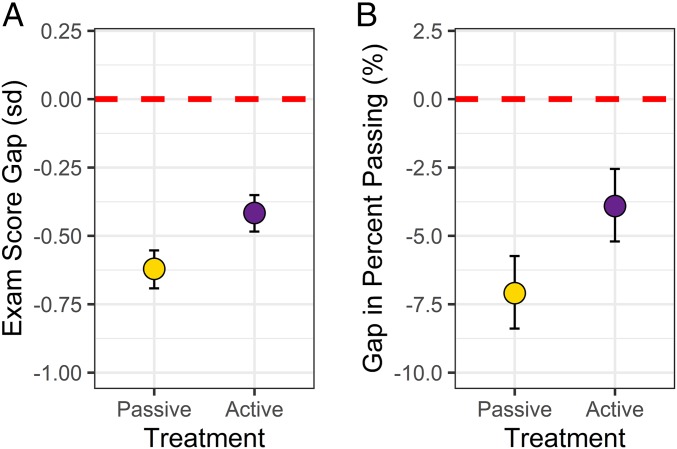
- In identical or formally equivalent exams, the standardized achievement gap between MGS and non-MGS students was −0.62 SDs in traditional lecturing and −0.42 SDs with active learning, a 33% reduction in the gap.
- For passing rates, the gap was −7.1% with traditional lecturing and −3.9% with active learning, a 45% reduction in the gap.
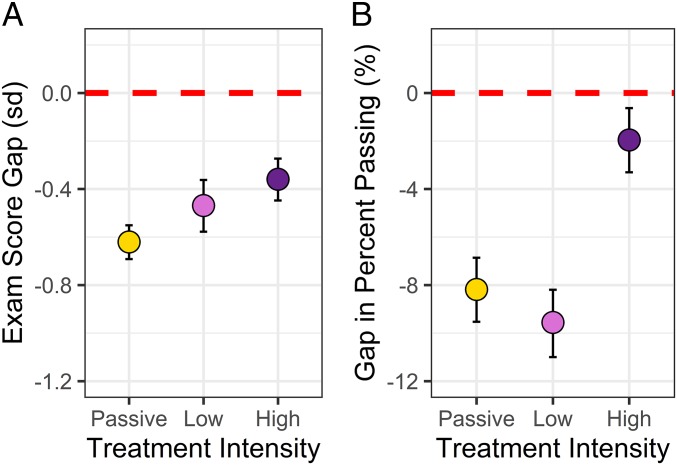
- Gap reductions were stronger with high-intensity active learning: exam-score gaps were −0.48 SDs for low-intensity vs −0.36 SDs for high-intensity; passing-rate gaps were −9.6% for low-intensity vs −2.0% for high-intensity.
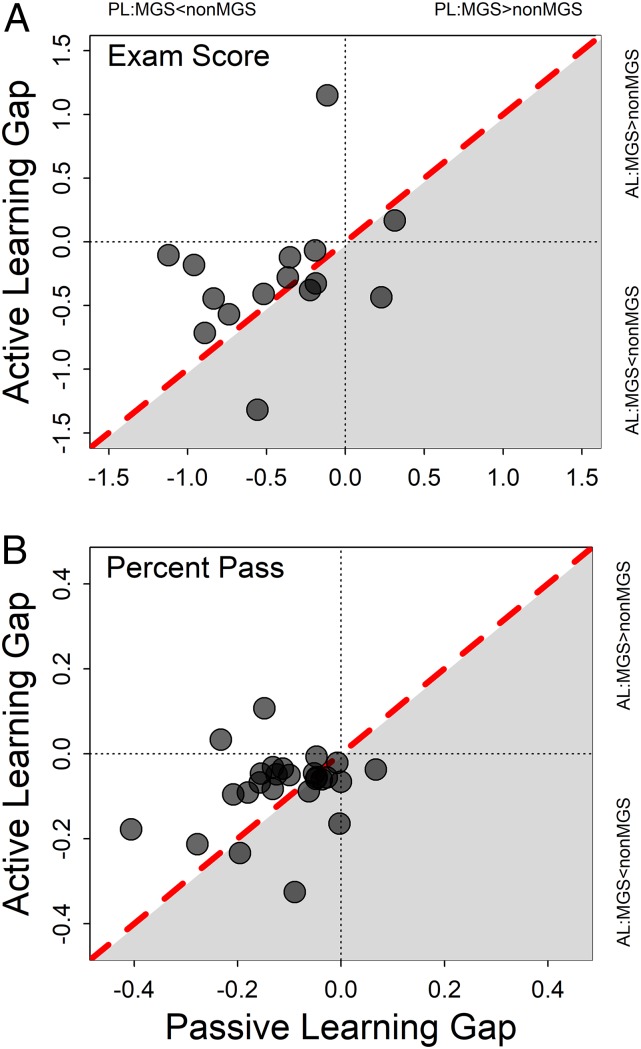
- In the study-level breakdown, 10 of 15 studies with exam-score data showed disproportionate gains for MGS students under active learning, and 15 of 26 studies with failure-rate data showed disproportionate reductions in failure rates for MGS students.
Methods
- Systematic review plus individual-participant-data (IPD) meta-analysis comparing undergraduate STEM courses taught with traditional lecturing vs active learning in the same course and institution.
- Literature search covered studies published or completed from January 1, 2010 to June 30, 2016; the final analysis included 41 studies with disaggregated data by MGS status.
- Final datasets: 9,238 student records from 15 studies for exam scores and 44,606 student records from 26 studies for failure rates; analyses used hierarchical Bayesian multilevel models with section random effects and sensitivity analyses.
Limitations
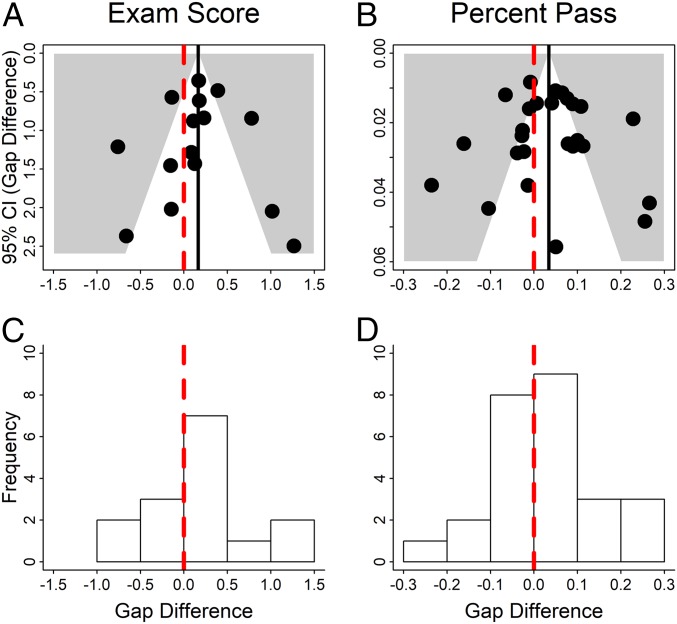
- The paper states that the conclusions are “tempered by the limitations of the study’s sample size”: only 41 studies had data for students from MGS, which also made moderator analyses hard to interpret.
- The paper says data on the type of active learning were “poorly resolved” because studies often did not report quantitative details of course interventions.
- The paper notes possible sampling bias in instructor/institution type, overrepresentation of research-intensive institutions, and underrepresentation of teaching-intensive institutions and community colleges.
- Evident from the text: the meta-analysis depends on studies that met specific coding and data-sharing criteria, so the findings may not generalize to STEM courses or settings not represented in the included studies.
Model-written summary. Check it against the paper before relying on it.
Integrity signals
Registry
Cites
Statistics
Figures
Verification
Claims the paper makes
16 Valid · 1 Not valid · 10 Not checked · 59 Own results and interpretations
The cited sources support only part of this claim — read each source’s verdict below.
In the paper
“Course grades in most STEM courses are largely driven by performance on examinations, even in active-learning courses that offer many nonexam points (39).”
§ Active learning narrows achievement gaps for underrepresented students in undergraduate science, technology, engineering, and math > Discussion
What the sources say
- Partly supportedcites [39] Freeman S., Haak D., Wenderoth M. P., Increased course structure improves performance in introductory biology. CBE Life Sci. Educ. 10, 175– 186 (2011). 21633066 PMC3105924 sourceExperimental — accuracy not yet measured
The Methods section (“Exam Impact on Final Course Grade”; page unavailable) says the authors intended exams to remain the primary determinant of grades even when many nonexam points were available. Table 4 in the Results shows that exam points strongly predicted final grades across the introductory biology sections studied. The paper does not establish that this holds in most STEM courses. (LLM, conf=0.88)
plainstates an association- Asserted: passes — The authors put it forward as true.
- Checkable: passes — It can be checked against evidence.
- Load-bearing: passes — The paper’s conclusions depend on it.
- Based: passes — The paper gives a reason why it holds.
- Partly supported
The cited sources support only part of this claim — read each source’s verdict below.
In the paper
“All students benefit from classroom cultures that promote self-efficacy, identity as a scientist, and sense of belonging in STEM (58)”
§ Active learning narrows achievement gaps for underrepresented students in undergraduate science, technology, engineering, and math > Discussion
What the sources say
- Partly supportedcites [58] Trujillo G., Tanner K. D., Considering the role of affect in learning: Monitoring students’ self-efficacy, sense of belonging, and science identity. CBE Life Sci. Educ. 13, 6– 15 (2014). 24591497 PMC3940464 sourceExperimental — accuracy not yet measured
The paper’s sections on self-efficacy, sense of belonging, and science identity link each to student learning or persistence, and its discussion of teaching considers how classroom experiences shape these factors. Its focus is undergraduate biology, however; it does not establish that all students benefit from such classroom cultures across STEM. The indexed passages provide section labels but no page numbers. (LLM, conf=0.82)
plainstates a cause- Asserted: passes — The authors put it forward as true.
- Checkable: passes — It can be checked against evidence.
- Load-bearing: unclear — It is unclear whether the paper’s conclusions depend on it.
- Based: passes — The paper gives a reason why it holds.
- Partly supported
The cited sources support only part of this claim — read each source’s verdict below.
In the paper
“students in active-learning course designs that reduced or eliminated achievement gaps have reported an increased sense of community and self-efficacy compared to their peers in the lecture-intensive version of the same course (22, 23).”
§ Active learning narrows achievement gaps for underrepresented students in undergraduate science, technology, engineering, and math > Discussion
What the sources say
- Partly supportedcites [22] Eddy S. L., Hogan K. A., Getting under the hood: How and for whom does increasing course structure work? CBE Life Sci. Educ. 13, 453– 468 (2014). 25185229 PMC4152207 sourceExperimental — accuracy not yet measured
In Methods and Results (Study 3, Factor 2; page unavailable), students in the moderate-structure course were twice as likely to report a stronger sense of classroom community than those in the low-structure course. The Introduction mentions self-reported self-efficacy in prior active-learning research, but says that research did not compare students in versions of the same course. This paper therefore does not support the claimed same-course self-efficacy comparison. (LLM, conf=0.88)
- Not matchedcites [23] Ballen C. J., Wieman C., Salehi S., Searle J. B., Zamudio K. R., Enhancing diversity in undergraduate science: Self-efficacy drives performance gains with active learning. CBE Life Sci. Ed. 16, ar56 (2017). PMC5749958 29054921
We don’t have this paper’s reference list.
plainstates an association- Asserted: passes — The authors put it forward as true.
- Checkable: passes — It can be checked against evidence.
- Load-bearing: unclear — It is unclear whether the paper’s conclusions depend on it.
- Based: passes — The paper gives a reason why it holds.
- Partly supported
Every source the paper cites for this claim was checked and supports it.
In the paper
“Our data on type of active learning are also poorly resolved, because publications still routinely fail to report quantitative data on the nature of course interventions, such as records from classroom observation tools (e.g., ref. 61 and SI Appendix, Table S12).”
§ Active learning narrows achievement gaps for underrepresented students in undergraduate science, technology, engineering, and math > Discussion
What the sources say
- Supportedcites [61] Eddy S. L., Converse M., Wenderoth M. P., PORTAAL: A classroom observation tool assessing evidence-based teaching practices for active learning in large science, technology, engineering, and mathematics classes. CBE Life Sci. Educ. 14, ar23 (2015). PMC4477739 26033871 source
The citation appears as an example of a classroom observation tool, not as evidence that publications routinely omit quantitative intervention data. The Abstract identifies PORTAAL as a classroom observation tool for assessing active-learning practices, which supports that use of the citation. (LLM, conf=0.91)
plainstates a cause- Asserted: passes — The authors put it forward as true.
- Checkable: passes — It can be checked against evidence.
- Load-bearing: unclear — It is unclear whether the paper’s conclusions depend on it.
- Based: passes — The paper gives a reason why it holds.
- Supported
Every source the paper cites for this claim was checked and supports it.
In the paper
“larger gaps are correlated with faculty who have a fixed mindset, which interprets intelligence as innate and immutable and is therefore exclusion or selection-oriented (44).”
§ Active learning narrows achievement gaps for underrepresented students in undergraduate science, technology, engineering, and math > Discussion
What the sources say
- Supportedcites [44] Canning E. A., Muenks K., Green D. J., Murphy M. C., STEM faculty who believe ability is fixed have larger achievement racial achievement gaps and inspire less student motivation in their classes. Sci. Adv. 5, eaau4734 (2019). 30793027 PMC6377274 source
The Results report that racial achievement gaps in STEM courses were nearly twice as large with fixed- versus growth-mindset faculty. The Introduction defines a fixed mindset as treating intelligence and ability as innate and largely unchangeable, and describes judging students as low-ability and encouraging them to drop difficult courses—supporting the paraphrase 'exclusion or selection-oriented.' (LLM, conf=0.88)
plainstates an association- Asserted: passes — The authors put it forward as true.
- Checkable: passes — It can be checked against evidence.
- Load-bearing: unclear — It is unclear whether the paper’s conclusions depend on it.
- Based: passes — The paper gives a reason why it holds.
- Supported
30 more claims
Create a free account to see all 86 claims and every source verdict.
- It may state two separate claims as one. 30
- Probably not a substantial claim. 36
Claims other papers make about this one
Each is checked against this paper’s own text: does it say what the citing paper says it does?
The source backs part of the claim, not all of it — or backs it for a different population, condition or comparison.
In the citing paper
“These perceptions, along with a likely reduction in stress and anxiety (see Figure 4), could benefit students from underrepresented groups and may thus reduce the achievement gap among underrepresented minorities”
From Two-Stage Final Exams: An Assessment Strategy for Enhanced Collaborative Learning and Reduced Student Stress (2026) · cites this paper as Theobald et al., 2020
Experimental — accuracy not yet measured
Citations
Cites
Preferred Reporting Items for Systematic Reviews and Meta-Analyses: the PRISMA statement
Moher, D., Liberati, A., Tetzlaff, J., Altman, D. G., & for the PRISMA Group (2009) · BMJ · doi:10.1136/bmj.b2535 · Cited by 83,823
Preferred reporting items for systematic reviews and meta-analyses: the PRISMA Statement.
(2009) · PubMed Central · Cited by 44,859
Preferred reporting items for systematic reviews and meta-analyses: The PRISMA statement
Moher, D., Liberati, A., Tetzlaff, J., Altman, D. G., & the PRISMA Group* (2009) · Annals of Internal Medicine · doi:10.7326/0003-4819-151-4-200908180-00135 · Cited by 37,554
PRISMA-P Group, Moher, D., Shamseer, L., Clarke, M., Ghersi, D., Liberati, A., Petticrew, M., Shekelle, P., & Stewart, L. A. (2015) · Systematic Reviews · doi:10.1186/2046-4053-4-1 · Cited by 26,223 · cited 2×
“The protocol for this study, presented in the PRISMA-P format (66) and including annotations regarding modifications that occurred during the course of the research, is available in SI Appendix, SI Materials and Methods.”
Capital in the Twenty-First Century
Piketty, T. (2014) · doi:10.4159/9780674369542 · Cited by 14,437
Data Analysis Using Regression and Multilevel/Hierarchical Models
Gelman, A., & Hill, J. (2006) · doi:10.1017/cbo9780511790942 · Cited by 13,597
Active learning increases student performance in science, engineering, and mathematics
Freeman, S., Eddy, S. L., McDonough, M., Smith, M. K., Okoroafor, N., Jordt, H., & Wenderoth, M. P. (2014) · Proceedings of the National Academy of Sciences · doi:10.1073/pnas.1319030111 · Cited by 9,787 · cited 6×
“Can interventions in courses themselves—meaning, changes in how science is taught—reduce achievement gaps and promote retention in STEM? A recent metaanalysis concluded that, on average, active learning in STEM leads to higher examination scores and lower failure rates for all students, compared to all students in the…”
InfluentialSelf-citation(2000) · Cited by 9,198
A threat in the air: How stereotypes shape intellectual identity and performance
Steele, C. M. (1997) · American Psychologist · doi:10.1037/0003-066x.52.6.613 · Cited by 6,770 · cited 1×
“Equally important, inclusive teaching emphasizes treating students with dignity and respect (52), communicating confidence in students’ ability to meet high standards (53), and demonstrating a genuine interest in students’ intellectual and personal growth and success (54, 55).”
BackgroundGeneral methods for monitoring convergence of iterative simulations
Brooks, S. P., & Gelman, A. (1998) · Journal of Computational and Graphical Statistics · doi:10.1080/10618600.1998.10474787 · Cited by 6,045
Research works printed but not linked: 9
- Reardon S. F., “The widening achievement gap between the rich and the poor: New evidence and possible explanations” in Whither Opportunity? Duncan G. J., Murnane R. J., Eds. (Russell Sage Foundation, New York, 2011), pp. 91– 115.
- National Student Clearinghouse Research Center, High School Benchmarks 2019: National College Progression Rates (National Student Clearinghouse, Herndon, VA, 2019).
- Chen X., STEM Attrition: College Students’ Paths Into and Out of STEM Fields (National Center for Education Statistics, Washington, DC, 2013).
- Vygotsky L. S., Mind in Society (Harvard University Press, Cambridge, MA, 1978).
- Kaufmann E., Reips U.-D., Merki K. M., Avoiding methodological biases in meta-analysis. Z. Psychol. 224, 157– 167 (2016).
- Ginder S. A., Kelly-Reid J. E., Mann F. B., Enrollment and Employees in Postsecondary Institutions, Fall 2015 (National Center for Education Statistics, Washington, DC, 2017).
- Reed J. G., Baxter P. M., Using Reference Databases. The Handbook of Research Synthesis and Meta-Analysis, Cooper H., Hedges L. V., Valentine J. C., Eds. (Russell Sage Foundation, New York, 2009), pp. 73– 101.
- Rothstein H., Hopewell S., Grey Literature. The Handbook of Research Synthesis and Meta-Analysis, Cooper H., Hedges L. V., Valentine J. C., Eds. (Russell Sage Foundation, New York, 2009), pp. 103– 125.
- White H. D., Scientific Communication and Literature Retrieval. The Handbook of Research Synthesis and Meta-Analysis, Cooper H., Hedges L. V., Valentine J. C., Eds. (Russell Sage Foundation, New York, 2009), pp. 51– 71.
Cited by
Items 101–200 of 1,369
Shields, G. C. (2020) · International Journal of Quantum Chemistry · doi:10.1002/qua.26274 · Cited by 33
Evaluating the role of student preference in physics lab group equity
Holmes, N. G., Heath, G., Hubenig, K., Jeon, S., Kalender, Z. Y., Stump, E. M., & Sayre, E. C. (2022) · Physical Review Physics Education Research · doi:10.1103/physrevphyseducres.18.010106 · Cited by 40
Identifying systemic inequity in higher education and opportunities for improvement
Denaro, K., Dennin, K., Dennin, M. B., & Sato, B. K. (2022) · PLoS ONE · doi:10.1371/journal.pone.0264059 · Cited by 46
Chai, H., Hu, T., & Niu, G. (2022) · Education and Information Technologies · doi:10.1007/s10639-022-11319-7 · Cited by 49
“Inspired by recent active learning approach (e.g., Lamon et al., 2020; Theobald et al., 2020), many scholars have incorporated proactive personality as an important predictor into the research on academic success in traditional and online learning environments (Chen et al.”
BackgroundMethodBusch, C. A., Wiesenthal, N. J., Mohammed, T. F., Anderson, S., Barstow, M., Custalow, C., Gajewski, J., Garcia, K., Gilabert, C. K., Hughes, J., et al. (2023) · CBE—Life Sciences Education · doi:10.1187/cbe.22-10-0195 · Cited by 43
“…transition from traditional lecture to active learning (American Association for the Advancement of Science, 2011, 2015) because of the overwhelming evidence that students learn more and fail less in active learning compared with traditional lecture (Freeman et al. , 2014; Theobald et al. , 2020).”
Mondragón, N. I., Arizti, N. B., Yarritu, I., Zarrazquin, I., & Pérez, K. A. (2023) · Higher Education · doi:10.1007/s10734-023-01149-y · Cited by 63
“…2017; Khalaf & Mohammed Zin, 2018; Martínez Valdivia et al., 2023) and the effect on students (Guo et al., 2020; Schneider & Preckel, 2017; Theobald et al., 2020), including teachers’ knowledge of the methodologies themselves (Stentiford & Kout-souris, 2021), but little research has been…”
Fu, P., Gao, C., Chen, X., Zhang, Z., Chen, J., & Yang, D. (2024) · Scientific Reports · doi:10.1038/s41598-024-79776-3 · Cited by 51
Educational technologies on sexually transmitted infections for incarcerated women
Carvalho, I. D. S., Guedes, T. G., Bezerra, S. M. M. D. S., Alves, F. A. P., Leal, L. P., & Linhares, F. M. P. (2020) · Revista Latino-Americana de Enfermagem · doi:10.1590/1518-8345.4365.3392 · Cited by 35
Denaro, K., Sato, B. K., Harlow, A. N., Aebersold, A., & Verma, M. (2021) · CBE—Life Sciences Education · doi:10.1187/cbe.20-04-0077 · Cited by 40
Alkhouri, J. S., Donham, C., Pusey, T. S., Signorini, A., Stivers, A. H., & Kranzfelder, P. (2021) · BioScience · doi:10.1093/biosci/biab077 · Cited by 34
Exploring Inequities in a Traditional and a Reformed General Chemistry Course
Tashiro, J., & Talanquer, V. (2021) · Journal of Chemical Education · doi:10.1021/acs.jchemed.1c00821 · Cited by 32
Vyas, V. S., & Reid, S. A. (2023) · Journal of Chemical Education · doi:10.1021/acs.jchemed.2c01121 · Cited by 27
A National Snapshot of Introductory Chemistry Instructors and Their Instructional Practices
Wang, Y., Apkarian, N., Dancy, M., Henderson, C., Johnson, E., Raker, J. R., & Stains, M. (2024) · Journal of Chemical Education · doi:10.1021/acs.jchemed.4c00040 · Cited by 31
Boedeker, P., Schlingmann, T. R., Kailin, J. A., Nair, A., Foldes, C. A., Rowley, D. R., Salciccioli, K. B., Maag, R., Moreno, N. P., & Ismail, N. J. (2024) · Medical Science Educator · doi:10.1007/s40670-024-02219-1 · Cited by 55
“These results align with prior findings that active learning can close achievement gaps, while benefiting all learners, and are specific to the increasingly common approach of integrating small-group active learning exercises into large-group lectures [16, 17].”
Rodriguez, J.-M. G., & Towns, M. H. (2021) · Chemistry Education Research and Practice · doi:10.1039/d1rp00041a · Cited by 34
Artificial Intelligence applied to teaching and learning processes
Cano, C. A. G., & Troya, A. L. C. (2023) · LatIA · doi:10.62486/latia20232 · Cited by 52
How are undergraduate STEM instructors leveraging student thinking?
Gehrtz, J., Brantner, M., & Andrews, T. C. (2022) · International Journal of STEM Education · doi:10.1186/s40594-022-00336-0 · Cited by 37
Morrison, M. E., Lom, B., Buffalari, D. M., Chase, L., Fernandes, J. J., McMurray, M. S., & Stavnezer, A. J. (2020) · PubMed Central · Cited by 32
Emery, N. C., Maher, J. M., & Ebert‐May, D. (2021) · PLoS ONE · doi:10.1371/journal.pone.0250760 · Cited by 39
Sarvary, M. A., Castelli, F. R., & Asgari, M. (2022) · Journal of Microbiology and Biology Education · doi:10.1128/jmbe.00289-21 · Cited by 33
Whitcomb, K. M., Maries, A., & Singh, C. (2022) · Research in Science Education · doi:10.1007/s11165-022-10068-4 · Cited by 50
Graham, M., Jacobson, K., Husman, J. E., Prince, M., Finelli, C., Andrews, M., & Borrego, M. J. (2023) · International Journal of Science Education · doi:10.1080/09500693.2023.2196643 · Cited by 30
Why Students Struggle in Undergraduate Biology: Sources and Solutions
Tracy, C. B., Driessen, E. P., Beatty, A. E., Lamb, T., Pruett, J. E., Botello, J. D., Brittain, C., Ford, Í. C., Josefson, C. C., Klabacka, R. L., et al. (2022) · CBE—Life Sciences Education · doi:10.1187/cbe.21-09-0289 · Cited by 37
“For example, instructors who use evidence-based and equitable teaching strategies can decrease performance gaps in undergraduate STEM courses (Freeman et al. , 2007; Ballen et al. , 2017; Cotner and Ballen, 2017; Salehi et al. , 2020; Theobald et al. , 2020).”
Hunter, K. H., Rodriguez, J.-M. G., & Becker, N. M. (2021) · Chemistry Education Research and Practice · doi:10.1039/d0rp00290a · Cited by 37
An Introduction to the Learning Sciences
Sawyer, R. K. (2022) · Cambridge University Press eBooks · doi:10.1017/9781108888295.002 · Cited by 50
Promoting Achievement for Community College STEM Students through Equity-Minded Practices
Varty, A. K. (2022) · CBE—Life Sciences Education · doi:10.1187/cbe.21-09-0237 · Cited by 24
“A meta-analysis of 41 studies found that active learning reduced achievement differences between URM and other students, including narrowing the gaps in course pass rates by 45% and exam scores by 33% (Theobald et al., 2020).”
BackgroundMethodInfluentialNarrowing Achievement Gaps in General Chemistry Courses with and without In-Class Active Learning
Clark, T. M. (2023) · Journal of Chemical Education · doi:10.1021/acs.jchemed.2c00973 · Cited by 30
Casey, J. R., Supriya, K., Shaked, S., Caram, J. R., Russell, A. A., & Courey, A. J. (2023) · Journal of Chemical Education · doi:10.1021/acs.jchemed.2c01253 · Cited by 28
Attributing equity gaps to course structure in introductory physics
Webb, D., & Paul, C. (2023) · Physical Review Physics Education Research · doi:10.1103/physrevphyseducres.19.020126 · Cited by 26
Talent denied: Equity and excellence gaps in STEMM
Ziegler, A., & Stoeger, H. (2023) · Annals of the New York Academy of Sciences · doi:10.1111/nyas.15083 · Cited by 30
Mondragon‐Estrada, E., Kirschning, I., Nolazco‐Flores, J. A., & Camacho-Zúñiga, C. (2023) · Frontiers in Education · doi:10.3389/feduc.2023.1250461 · Cited by 52
Using an engagement lens to model active learning in the geosciences
LaDue, N., McNeal, P., Ryker, K. D., John, K. S., & Kraft, K. J. V. D. H. (2021) · Journal of Geoscience Education · doi:10.1080/10899995.2021.1913715 · Cited by 31
“Extant studies usually leverage more than one dimension of engagement, but outcome measures often focus on learning gains, which are measured in the form of course grades, DFW rates, or gains on concept inventories (Freeman et al., 2014; Theobald et al., 2020).”
BackgroundHow an Early, Inclusive Field Course can Build Persistence in Ecology and Evolutionary Biology
Race, A. I., Beltran, R. S., & Zavaleta, E. S. (2021) · Integrative and Comparative Biology · doi:10.1093/icb/icab121 · Cited by 31
Assessing the impact of metacognitive postreflection exercises on problem-solving skillfulness
Reinhard, A., Felleson, A., Turner, P. C., & Green, M. (2022) · Physical Review Physics Education Research · doi:10.1103/physrevphyseducres.18.010109 · Cited by 36
“mance, and normalized gains on concept inventories [1, 8– 11]; and disproportionately benefit students from underrepresented groups [12, 13].”
BackgroundDenaro, K., Kranzfelder, P., Owens, M. T., Sato, B. K., Zuckerman, A. L., Hardesty, R. A., Signorini, A., Aebersold, A., Verma, M., & Lo, S. M. (2022) · International Journal of STEM Education · doi:10.1186/s40594-022-00365-9 · Cited by 30
“Even though widespread and immediate implementation of active-learning strategies should be a high priority in undergraduate STEM education (Theobald et al., 2020), adoption remains low, and most courses are still taught using traditional, lecture-based instruction (Stains et al.”
BackgroundInfluentialLahdenperä, J., & Nieminen, J. H. (2020) · International Journal of Research in Undergraduate Mathematics Education · doi:10.1007/s40753-020-00118-5 · Cited by 42
A Call for Data-Driven Networks to Address Equity in the Context of Undergraduate Biology
Thompson, S. K., Hebert, S. L., Berk, S., Brunelli, R., Creech, C., Drake, A. G., Fagbodun, S., García‐Ojeda, M. E., Hall, C. L., Harshman, J. T., et al. (2020) · CBE—Life Sciences Education · doi:10.1187/cbe.20-05-0085 · Cited by 30
“…committed efforts show promise in promoting historically under-served groups (Wilson et al. , 2012; Hernandez et al. , 2013; Snyder et al. , 2016; Theobald et al. , 2020), deliberate evaluation across multiple institutional contexts will rigorously assess when change occurs (or not) and inform…”
Assessing the impact of visualization media on engagement in an active learning environment
Stanciulescu, A., Castronovo, F., & Oliver, J. (2022) · International Journal of Mathematical Education in Science and Technology · doi:10.1080/0020739x.2022.2044530 · Cited by 46
“Furthermore, recent findings from STEM education literature report that ‘active learning benefits all students, but offer disproportionate benefits for individuals from underrepresented groups’ (Theobald et al., 2020, p. 6476).”
BackgroundTaggart, J., & Wheeler, L. B. (2023) · Active Learning in Higher Education · doi:10.1177/14697874231193938 · Cited by 58
Clements, K. A., Zepeda, C. D., Hilbun, A. L., Todd, T. D., Clements, T. P., Johnson, H. J., Watkins, J., Friedman, K. L., & Brame, C. J. (2023) · Journal of Chemical Education · doi:10.1021/acs.jchemed.2c01224 · Cited by 31
Supporting students to engage with case studies: a model of engagement principles
Toogood, C. (2023) · Educational Review · doi:10.1080/00131911.2023.2281227 · Cited by 24
“The first two principles of Real-life, and Applicable also connect to learner engagement, through feelings, emotion and connection, which support deeper engagement, active learning, and inclusivity (Auster & Wylie, 2006; Mesny, 2013; Theobald et al., 2020).”
Ovid, D., Rice, M. M., Luna, J. V., Tabayoyong, K., Lajevardi, P., & Tanner, K. D. (2021) · CBE—Life Sciences Education · doi:10.1187/cbe.21-06-0153 · Cited by 29
“There is extensive research on how such strategies support equitable student performance in science classrooms (Freeman et al. , 2014; Theobald et al. , 2020), As shown in Figure 7A, the most prevalent categories of student memories of Instructor Talk perceived as promoting a positive learning…”
BackgroundExplanation and Facilitation Strategies Reduce Student Resistance to Active Learning
Andrews, M., Prince, M., Finelli, C., Graham, M., Borrego, M. J., & Husman, J. E. (2021) · College Teaching · doi:10.1080/87567555.2021.1987183 · Cited by 37
Baldock, B. L., DiNaro, J. L., & Fernandez, A. L. (2021) · Journal of Chemical Education · doi:10.1021/acs.jchemed.1c00851 · Cited by 28
The Role of Mobile Technology in Improving Accessibility and Quality of Learning
Husnita, L., Rahayuni, A., Fusfitasari, Y., Siswanto, E., & Rintaningrum, R. (2023) · al-fikrah Jurnal Manajemen Pendidikan · doi:10.31958/jaf.v11i2.10548 · Cited by 68
Integrating Research into the Undergraduate Curriculum: 1. Early Research Experiences and Training.
Buffalari, D. M., Fernandes, J. J., Chase, L., Lom, B., McMurray, M. S., Morrison, M. E., & Stavnezer, A. J. (2020) · PubMed Central · Cited by 37
Active Learning at a Community College
Barron, D. M. (2022) · ACS symposium series · doi:10.1021/bk-2022-1409.ch004 · Cited by 21
Dancy, M., Henderson, C., Apkarian, N., Johnson, E., Stains, M., Raker, J. R., & Lau, A. (2024) · Physical Review Physics Education Research · doi:10.1103/physrevphyseducres.20.010119 · Cited by 42
Using an Inclusive Curriculum Framework to Address an Awarding Gap in a First-Year Chemistry Module
Williams, N. A. (2021) · Journal of Chemical Education · doi:10.1021/acs.jchemed.1c00362 · Cited by 24
Jackson, J., Almos, H., Karibian, N., Lieb, C., Butts‐Wilmsmeyer, C. J., & Aranda, M. L. (2022) · Journal of Microbiology and Biology Education · doi:10.1128/jmbe.00233-21 · Cited by 24
Kovarik, M. L., Robinson, J. K., & Wenzel, T. J. (2022) · ACS symposium series · doi:10.1021/bk-2022-1409.ch001 · Cited by 26
Implementing a flipped classroom approach in remote instruction
Heiss, E. M., & Oxley, S. P. (2021) · Analytical and Bioanalytical Chemistry · doi:10.1007/s00216-020-03147-w · Cited by 30
Suárez, F., Feijóo, J. C. M., Chiyón, I., & Alberti, M. G. (2021) · Sustainability · doi:10.3390/su132112290 · Cited by 28
“Thus, the flipped teaching model is suitable to accomplish the learner-centered experience as it can focus on a broader spectrum of competence achievements, including functional writing and transmission skills [35], and increase student active learning, social interaction [36], and performance [20,37].”
Aluko, H. A., Aluko, A., Offiah, G. A., Ogunjimi, F., Aluko, A. O., Alalade, F. M., Ukeje, I. O., & Nwani, C. H. (2025) · International journal of organizational analysis · doi:10.1108/ijoa-07-2024-4632 · Cited by 42
Peck, F. A. (2020) · PRIMUS · doi:10.1080/10511970.2020.1781721 · Cited by 29
“IBME (and other forms of active learning [35]) may be particularly powerful for members of traditionally oppressed groups [115, 74], and can be a powerful tool for anti-deficit teaching [113] (but that potential is not automatically realized [60]).”
BackgroundVyas, V. S., Kemp, B. J., & Reid, S. A. (2021) · International Journal of Science Education · doi:10.1080/09500693.2021.1874071 · Cited by 22
“Research shows that active learning strategies can benefit all students, yet hold particular benefits for at-risk students (Freeman et al., 2014; Theobald et al., 2020).”
BackgroundWilliams, M., Apkarian, N., Uhing, K., Martinez, A. E., Rasmussen, C. L., & Smith, W. (2021) · International Journal of Research in Undergraduate Mathematics Education · doi:10.1007/s40753-021-00153-w · Cited by 23
Duncan, V. L., Holt, E. A., & Keenan, S. M. (2023) · Frontiers in Education · doi:10.3389/feduc.2023.1154652 · Cited by 30
Thinking and Learning in Nested Systems: The Classroom Level
Talanquer, V., Cole, R. S., & Rushton, G. T. (2024) · Journal of Chemical Education · doi:10.1021/acs.jchemed.3c00839 · Cited by 22
Class integration of ChatGPT and learning analytics for higher education
Civit, M., Escalona, M. J., Cuadrado, F., & de Cózar, S. R. (2024) · Expert Systems · doi:10.1111/exsy.13703 · Cited by 29
Reflections on Course-Based Undergraduate Research in Organic and Biochemistry during COVID-19
Deveau, A. M., Wang, Y., & Small, D. J. (2020) · Journal of Chemical Education · doi:10.1021/acs.jchemed.0c00787 · Cited by 20
Hernández, L. M. A., Zamudio, K. R., Drake, A. G., & Smith, M. K. (2020) · Ecology and Evolution · doi:10.1002/ece3.6863 · Cited by 22
Undergraduates’ lived experience of project-/problem-based learning in introductory biology
Webster, A., Metcalf, A., Kelly, L. J., Bisesi, A. T., Marnik-Said, M., Colbeck, C. L., Marine, R. J., Vinces, M., Campbell, A. E., & Allen, T. S. (2022) · AJP Advances in Physiology Education · doi:10.1152/advan.00042.2021 · Cited by 28
Brancaccio-Taras, L., Awong-Taylor, J., Linden, M. L., Marley, K., Reiness, C. G., & Uzman, J. A. (2022) · Journal of Microbiology and Biology Education · doi:10.1128/jmbe.00057-22 · Cited by 25
Jenkins, E., Nardo, J. E., & Salehi, S. (2022) · PLOS ONE · doi:10.1371/journal.pone.0278453 · Cited by 19
Bernacki, M. L., Cogliano, M., Kuhlmann, S. L., Utz, J. C., Strong, C. L., Hilpert, J. C., & Greene, J. A. (2023) · Metacognition and Learning · doi:10.1007/s11409-023-09356-9 · Cited by 30
“Such scaffolding could fur - ther ameliorate the concerns students have about engaging in active learning (Shekhar et al., 2020), and increase the consistency of the benefits that active learning has been observed to provide to learners (Theobald et al., 2020).”
BackgroundMartella, A. M., Martella, R. C., Yatcilla, J., Newson, A., Shannon, E. N., & Voorhis, C. (2023) · Educational Psychology Review · doi:10.1007/s10648-023-09826-1 · Cited by 34
“…than 25%), comparisons become more difficult because class size may affect the effectiveness of groups discussions, lecture engagement, responding to instructor questions, etc., leading to the introduction of a potential confound based on the impact of the size of classes (Theobald et al., 2020).”
BackgroundInfluentialThe Genetic Code Kit: An Open-Source Cell-Free Platform for Biochemical and Biotechnology Education
Williams, L. C., Gregorio, N. E., So, B., Kao, W. Y., Kiste, A. L., Patel, P. A., Watts, K. R., & Oza, J. P. (2020) · Frontiers in Bioengineering and Biotechnology · doi:10.3389/fbioe.2020.00941 · Cited by 24
Doolittle, P. E., & Byrnes, M. K. (2023) · Wiley eBooks · doi:10.1002/9781119852865.ch3 · Cited by 23
Knight, J. K., Weaver, D. C., Peffer, M. E., & Hazlett, Z. S. (2022) · CBE—Life Sciences Education · doi:10.1187/cbe.21-12-0341 · Cited by 18
“, 2015), and minoritized students are also underrepresented (Theobald et al., 2020).”
BackgroundBeimel, D., Tsoury, A., & Barnett‐Itzhaki, Z. (2024) · Frontiers in Education · doi:10.3389/feduc.2024.1432054 · Cited by 34
Choi, Y. H., Theobald, E. J., Velasco, V., & Eddy, S. L. (2025) · International Journal of STEM Education · doi:10.1186/s40594-025-00526-6 · Cited by 27
Self-citationSbeglia, G. C., Goodridge, J. A., Gordon, L. H., & Nehm, R. H. (2021) · CBE—Life Sciences Education · doi:10.1187/cbe.20-11-0259 · Cited by 20
“Researchers would also benefit from having a valid measure of early reform-based progress that is distinct from student learning outcomes, because the low frequency of reform-based practices may not always be associated with improved student outcomes (e.g., Connell et al., 2016; Theobald et al., 2020), though they cou…”
BackgroundInfluentialMiller, D., Deshler, J. M., McEldowney, T., Stewart, J., Fuller, E. J., Pascal, M., & Michaluk, L. (2021) · Frontiers in Education · doi:10.3389/feduc.2021.667918 · Cited by 29
“…Treisman ’ s ESP methods (Asera, 2001) showed that URM students could achieve grade distributions equal to or greater than the class as a whole (15 ± 20), while more recent studies show that if his methods are not diluted, the results are equally positive (Lee et al., 2018; Theobald et al., 2020).”
BackgroundResultInfluentialStudents’ learning behavior in digital education for radiation oncology
Vorwerk, H., & Engenhart‐Cabillic, R. (2021) · Strahlentherapie und Onkologie · doi:10.1007/s00066-021-01858-2 · Cited by 20
“The reason for this procedure was that passively learned knowledge can be deepened much better and saved permanently through active application [18, 19].”
BackgroundSchultheis, E. H., Kjelvik, M. K., Snowden, J., Mead, L. S., & Stuhlsatz, M. A. M. (2022) · International Journal of Science and Mathematics Education · doi:10.1007/s10763-022-10295-1 · Cited by 24
“A recent review found active learning helped narrow achievement gaps for students in underrepresented groups, but found large variability across classrooms and that it only impacted students in class-rooms when teachers implemented at the highest levels (Theobald et al., 2020).”
BackgroundRozhenkova, V., Snow, L. E., Sato, B. K., Lo, S. M., & Buswell, N. T. (2023) · International Journal of STEM Education · doi:10.1186/s40594-023-00440-9 · Cited by 28
“…and other evidence-based teaching practices, are being considered in numerous venues ranging from formal peer reviewed research (e.g., Borda et al., 2020; Freeman et al., 2014; Nguyen et al., 2021; Theobald et al., 2020) to opinion pieces in popular press (e.g., McMurtrie, 2019; Supiano, 2022).”
BackgroundSchwarz, C. E., DeGlopper, K. S., Esselman, B. J., & Stowe, R. L. (2024) · Journal of Chemical Education · doi:10.1021/acs.jchemed.3c01127 · Cited by 19
Ji, L., Tahri, D., & Qiang, F. (2024) · Journal of Intelligence · doi:10.3390/jintelligence12060059 · Cited by 43
“…own questions and find answers through research, problem-solving, and critical thinking (Tang et al. 2022); it also creates an empowering and supportive environment that is characterized by a strong teacher-student relationship based on trust, empathy, and understanding (Theobald et al. 2020).”
BackgroundZhu, Y. (2021) · International Journal of Science Education · doi:10.1080/09500693.2021.2007552 · Cited by 31
“, 2016; Ryan & Reid, 2016) and active learning (Freeman et al., 2014; Haak et al., 2011; Taraban et al., 2007; Theobald et al., 2020).”
BackgroundMcCarthy, K. S., Crossley, S. A., Meyers, K., Boser, U., Allen, L. K., Chaudhri, V. K., Collins‐Thompson, K., D’Mello, S. K., Choudhury, M. D., Garg, K., et al. (2022) · Technology Mind and Behavior · doi:10.1037/tmb0000063 · Cited by 23
Humanizing STEM education: an ecological systems framework for educating the whole student
Yao, C. W., Greenhoot, A. F., Mack, K. M., Myrick, C., Poolaw, J., Powell, L. C., & Yarger, L. K. (2023) · Frontiers in Education · doi:10.3389/feduc.2023.1175871 · Cited by 28
Crawford, L. K., Carmona, K. A., & Kumar, R. (2024) · Pedagogy in Health Promotion · doi:10.1177/23733799241234065 · Cited by 47
Wilton, M., Maloy, J. P., Beaster‐Jones, L., Sato, B. K., Lo, S. M., & Grunspan, D. Z. (2024) · CBE—Life Sciences Education · doi:10.1187/cbe.24-03-0102 · Cited by 22
“…been repeatedly demonstrated to promote student academic equity amongst a diversity of undergraduate students (Haak et al. , 2011; Stein-feld and Maisel, 2012; Eddy and Hogan, 2014; Freeman et al. , 2014; Ballen et al. , 2017; Gavassa et al. , 2019; McNair et al. , 2020; Theobald et al. , 2020).”
BackgroundA Mixed-Methods Research Design to Advance Inclusive and Equitable Teaching
Soicher, R. N., Baker, A. R., & Thomas, R. C. (2024) · Innovative Higher Education · doi:10.1007/s10755-024-09741-5 · Cited by 62
“…and robust evidence that inclusive and equitable teaching practices support positive student outcomes (Dewsbury et al., 2022; Salehi et al., 2019; Theobald et al., 2020), widespread implementation of these practices is still lagging in post‑ secondary education (Brownell & Tanner, 2012; Kezar,…”
BackgroundRehman, N., Huang, X., Mahmood, A., Abbasi, M. S., Qin, J., & Wu, W. (2025) · Humanities and Social Sciences Communications · doi:10.1057/s41599-025-05584-3 · Cited by 44
“In STEM education, RBV underscores the critical role of resources such as funding, technology, and training in achieving effective STEM education implementation (Theobald et al. 2020).”
Breaking the Binary: Conceptions of Sex and Gender in Undergraduate Science
Mercer-Mapstone, L. D., Bajan, S., Banas, K., Morphett, A., & McGrath, K. C. Y. (2021) · Teaching & Learning Inquiry The ISSOTL Journal · doi:10.20343/teachlearninqu.9.2.6 · Cited by 23
Inquiry-Based Activities and Games That Engage Students in Learning Atomic Orbitals
Li, X., Muñiz, M. N., Chun, K., Tai, J., Guerra, F., & York, D. M. (2022) · Journal of Chemical Education · doi:10.1021/acs.jchemed.1c01023 · Cited by 22
Conceptualizations of active learning in departments engaged in instructional change efforts
Williams, M., Uhing, K., Bennett, A. B., Voigt, M., Funk, R., Smith, W., & Donsig, A. P. (2022) · Active Learning in Higher Education · doi:10.1177/14697874221131300 · Cited by 19
“Despite clear evidence that active learning strategies can improve student outcomes (e.g. Freeman et al., 2014; Theobald et al., 2020), there is a lag in widespread adoption of active learning in undergraduate education (e.g. Lane et al., 2020; Stains et al., 2018).”
Yik, B. J., Raker, J. R., Apkarian, N., Stains, M., Henderson, C., Dancy, M., & Johnson, E. (2022) · Frontiers in Education · doi:10.3389/feduc.2022.1016415 · Cited by 25
“Active learning in undergraduate science, technology, engineering, and mathematics (STEM) courses has been demonstrated to enhance student outcomes (Springer et al., 1999; Lorenzo et al., 2006; Haak et al., 2011; Ruiz-Primo et al., 2011; Freeman et al., 2014; Rahman and Lewis, 2019; Theobald et al., 2020).”
BackgroundExploring social and cognitive engagement in small groups through a community of learners (CoL) lens
Nennig, H. T., States, N. E., Macrie-Shuck, M., Fateh, S., Kırbulut, Z. D., Cole, R. S., Rushton, G. T., Shah, L., & Talanquer, V. (2023) · Chemistry Education Research and Practice · doi:10.1039/d3rp00071k · Cited by 26
Alderfer, S. A., McMillan, R., Murphy, K., & Kelp, N. (2023) · Frontiers in Education · doi:10.3389/feduc.2023.1173661 · Cited by 24
Sørensen, A., Lagestad, P., & Mikalsen, H. K. (2023) · Education Sciences · doi:10.3390/educsci13090965 · Cited by 51
The Ungrading Learning Theory We Have Is Not the Ungrading Learning Theory We Need
Sorensen-Unruh, C. (2024) · CBE—Life Sciences Education · doi:10.1187/cbe.24-01-0031 · Cited by 28
“They have specific significance for STEM higher education instructors, specifically in biology, because the final grades we assign to students in gateway classes have direct impact on their future chosen fields (Shultz et al. , 2015; Theobald et al. , 2020; White et al. , 2021).”
BackgroundAdapting guided inquiry learning worksheets for emergency remote learning
Howley, I. K. (2020) · Information and Learning Sciences · doi:10.1108/ils-04-2020-0086 · Cited by 27
Counteracting Systemic Bias in the Lab, Field, and Classroom
Cooperdock, E. H. G., Chen, C. Y., Guevara, V. E., & Metcalf, J. R. (2021) · AGU Advances · doi:10.1029/2020av000353 · Cited by 18
Salehi, S., Berk, S., Brunelli, R., Cotner, S. H., Creech, C., Drake, A. G., Fagbodun, S., Hall, C. L., Hebert, S. L., Hewlett, J., et al. (2021) · CBE—Life Sciences Education · doi:10.1187/cbe.21-01-0012 · Cited by 23
“To address student performance barriers in introductory biology courses, recent research in biology education focuses on best practices for evidence-based teaching strategies that improve student academic performance (Offerdahl et al., 2011; Freeman et al., 2014; Theobald et al., 2020).”
BackgroundEvidence-based teaching practices correlate with increased exam performance in biology
Moon, S., Jackson, M. A., Doherty, J. H., & Wenderoth, M. P. (2021) · PLoS ONE · doi:10.1371/journal.pone.0260789 · Cited by 22
phylogatR : Phylogeographic data aggregation and repurposing
Pelletier, T. A., Parsons, D. J., Decker, S. K., Crouch, S., Franz, E., Ohrstrom, J., & Carstens, B. C. (2022) · Molecular Ecology Resources · doi:10.1111/1755-0998.13673 · Cited by 25
“Incorporating authentic research into classroom instruction provides inclusive learning experiences for all students and leads to better learning outcomes (Theobald et al. 2020).”
BackgroundSzozda, A., Lalani, Z., Behroozi, S., Mahaffy, P. G., & Flynn, A. B. (2024) · Journal of Chemical Education · doi:10.1021/acs.jchemed.4c00080 · Cited by 20
Metadata
- Authors
- Theobald, E. J., Hill, M. J., Tran, E., Agrawal, S., Arroyo, E. N., Behling, S., Chambwe, N., Cintrón, D. L., Cooper, J. D., Dunster, G., Grummer, J. A., Hennessey, K., Hsiao, J., Iranon, N., Jones, L., Jordt, H., Keller, M., Lacey, M. E., Littlefield, C. E., Lowe, A., Newman, S., Okolo, V., Olroyd, S., Peecook, B. R., Pickett, S. B., Slager, D. L., Caviedes-Solis, I. W., Stanchak, K. E., Sundaravardan, V., Valdebenito, C., Williams, C. R., Zinsli, K., & Freeman, S.
- Affiliations
- University of Washington (US)
- Institute for Systems Biology (US)
- Shoreline Community College (US)
- Corresponding author
- Theobald, Elli J.
- Freeman, Scott
- ORCID
- Theobald, Elli J.
- Agrawal, Sweta
- Behling, Shawn
- Chambwe, Nyasha
- Cintrón, Dianne Laboy
- Cooper, Jacob D.
- Dunster, Gideon
- Grummer, Jared A.
- Hennessey, Kelly
- Hsiao, Jennifer
- Jones, Leonard
- Jordt, Hannah
- Littlefield, Caitlin E.
- Lowe, Alexander
- Olroyd, Savannah
- Peecook, Brandon R.
- Pickett, Sarah B.
- Slager, David L.
- Caviedes-Solis, Itzue W.
- Stanchak, Kathryn E.
- Williams, Claire R.
- Zinsli, Kaitlin
- Freeman, Scott
- Venue
- Proceedings of the National Academy of Sciences
- Publisher
- National Academy of Sciences
- Published
- 2020-03-09
- Volume
- 117
- Issue
- 12
- Pages
- 6476-6483
- ISSN
- 0027-8424 (ISSN-L)
- 1091-6490
- PMC
- PMC7104254
- OpenAlex
- W3009483010
- Cited by
- 1,387
- References
- 75
- Citations by year
- 2026: 210 · 2025: 222 · 2024: 272 · 2023: 236 · 2022: 233 · 2021: 154 · 2020: 60
- FWCI
- 258.89
- Type
- journal article
- Language
- en
- Open access
- hybrid
- doi.org
- Licence
- Locations
- Proceedings of the National Academy of Sciences (publishedVersion, cc-by-nc-nd)
- Europe PMC (PubMed Central) (publishedVersion, cc-by-nc-nd)
- PubMed Central (publishedVersion, cc-by-nc-nd)
- PubMed (publishedVersion)
- Funders
- University of Washington College of Arts and Sciences (NA)
- Topics
- Social Sciences › Education › Innovative Teaching Methods
- Social Sciences › Education › Higher Education Research Studies
- Social Sciences › Psychology › Developmental and Educational Psychology › Innovative Teaching and Learning Methods
- Keywords
- active learning, achievement gap, underrepresented students, STEM education, traditional lecturing, course design, student failure rates, test scores, higher education equity, inclusive pedagogy, deliberate practice
- MeSH terms
- Achievement, Educational Measurement, Engineering, Humans, Mathematics, Minority Groups, Science, Students, Technology, United States, Universities, Problem-Based Learning
About these checks
Registry, retraction, Cites and statistics results are computed, not judged, with one exception: a printed reference that no index lists is read once by a model before it counts as a citation error. Claims are extracted by a model and kept only when their quote appears verbatim in the text; each cited source is then checked, with a model’s help, for whether it says what the claim relies on. Those verdicts can be wrong — read the claim’s quote and the cited source before relying on one.
The claim verdicts this report counts are experimental: their accuracy is not yet measured.
A language model drew the claims from the paper on 2026-10-10, under version 3 of the claim definition (model deepseek-v4.1-flash, prompt extract-v3).
A second model labelled each claim on 2026-10-10 (model jev-1.13-20260917, definition revision gold-guideline-v0.2).
Cited sources are checked with a language model’s help (gpt-6-sol).
Statistics and arithmetic are recomputed, not judged.
Confidence bands are shown only for fields calibrated on our annotated test set. None is calibrated yet, so no band is shown.
What counts as a claim ›How we measure confidence ›How we check this ›
Are you an author, or do you see a problem with this page? Request a review
Data sources
Bibliographic data: Semantic Scholar, OpenAlex, Crossref.
Contains information from the Semantic Scholar Academic Graph Datasets, made available under the ODC Attribution License (ODC-BY 1.0).
Semantic Scholar’s data is described in: Kinney, R., et al. (2023). The Semantic Scholar Open Data Platform. arXiv:2301.10140.
