

The echo chamber effect on social media
Open accessThe DOI matches its Crossref record; 68 of the 69 references it cites were found in a registry or an index; 16 of the 38 sources its claims cite were checked for support.
Abstract
Significance: We explore the key differences between the main social media platforms and how they are likely to influence information spreading and the formation of echo chambers. To assess the different dynamics, we perform a comparative analysis on more than 100 million pieces of content concerning controversial topics (e.g., gun control, vaccination, abortion) from Gab, Facebook, Reddit, and Twitter. The analysis focuses on two main dimensions: 1) homophily in the interaction networks and 2) bias in the information diffusion toward like-minded peers. Our results show that the aggregation in homophilic clusters of users dominates online dynamics. However, a direct comparison of news consumption on Facebook and Reddit shows higher segregation on Facebook.
Overview
CoChat Summary
TL;DR
This paper compares echo-chamber dynamics across Gab, Facebook, Reddit, and Twitter using more than 100 million pieces of content and more than 1 million active users. It finds homophilic clustering dominates online dynamics, with Facebook and Twitter showing stronger segregation and like-minded information diffusion than Reddit and Gab, and Facebook showing higher news-consumption segregation than Reddit.
Key findings
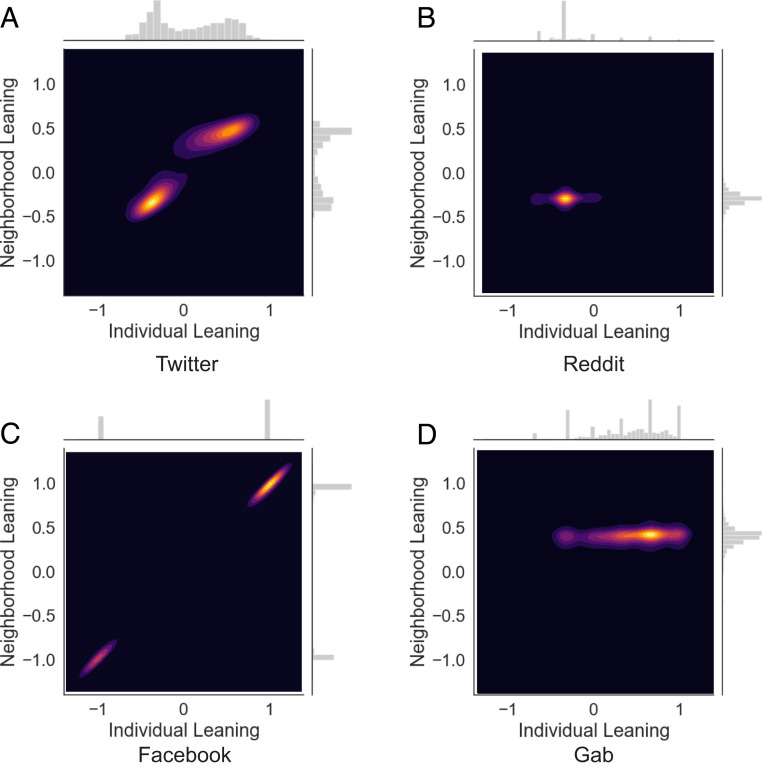
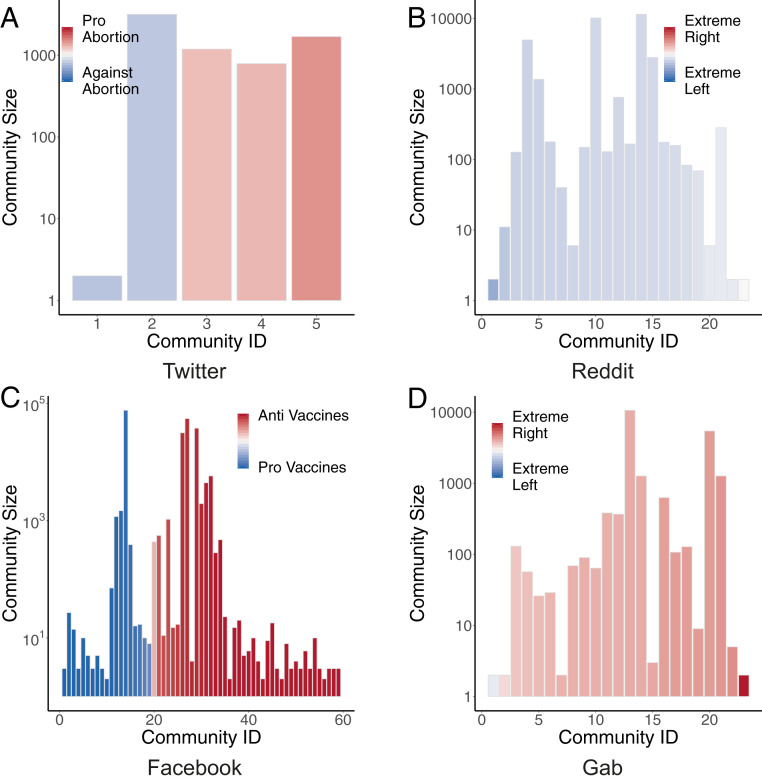
- Across the four platforms, “aggregation in homophilic clusters of users dominates online dynamics,” but platforms differ: Facebook and Twitter show homophilic clustering, while Reddit and Gab form a single community biased left or right rather than two opposing clusters.
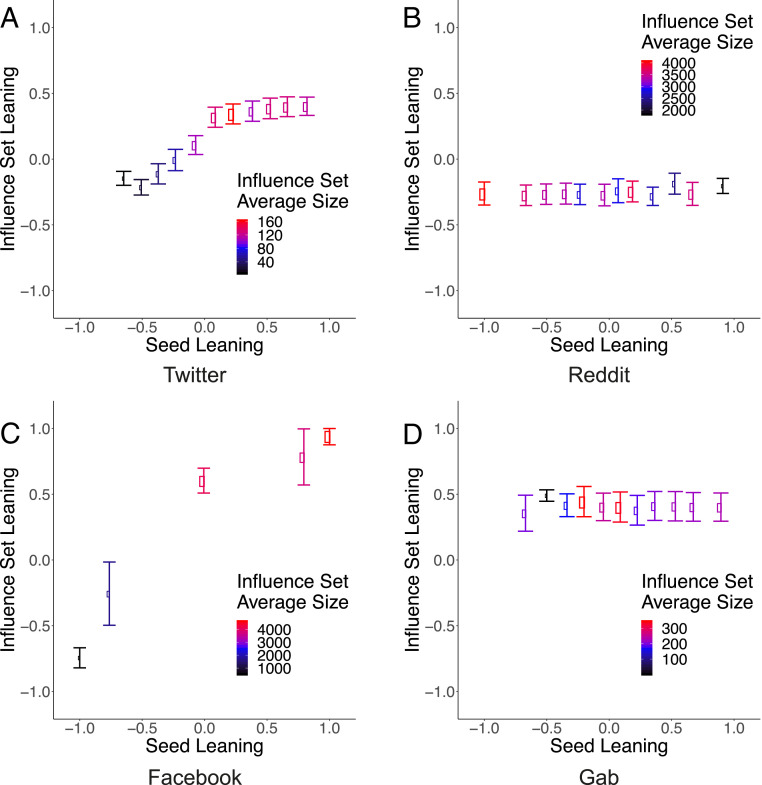
- Information diffusion is biased toward like-minded users on Facebook and Twitter, where the average leaning of a user’s influence set approximates the seed user’s leaning; on Reddit and Gab, the average leaning of the influence set does not depend on the seed user’s leaning.
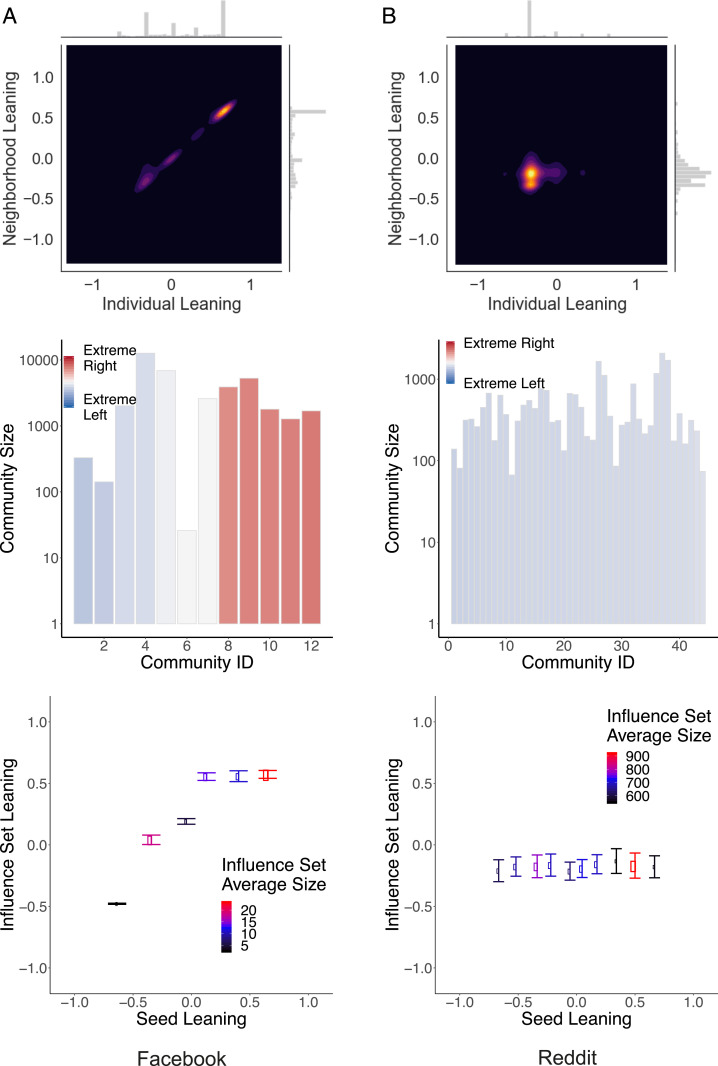
- In a direct comparison on news consumption, Facebook shows higher segregation than Reddit across all three measures: user-neighbor leaning correlation, community leaning, and SIR influence-set leaning.
- The study analyzes more than 100 million unique pieces of content and more than 1 million active users, with news outlets labeled using 2,190 media sources from Media Bias/Fact Check.
Methods
- Comparative analysis of Gab, Facebook, Reddit, and Twitter datasets on controversial topics including gun control, Obamacare, abortion, vaccines, science versus conspiracy, and news; main selected datasets were Abortion (Twitter), Vaccines (Facebook), Politics (Reddit), and Gab as a whole.
- Echo chambers were operationalized through two dimensions: homophily in interaction networks and bias in information diffusion toward like-minded peers. User leaning was inferred from linked news outlets, likes, or content, and interaction networks were built from follows, comments, cocomments, submissions, or replies depending on platform.
- Analyses included correlation between user leaning and average neighbor leaning, Louvain community detection, and SIR simulations to measure influence sets; SIR recovery rate was fixed at ν = 0.2, with dataset-specific infection ratios.
Limitations
- The paper states that the next envisioned step is to address the temporal dimension of echo chambers and how platform-specific social feedback mechanisms impact their formation.
- Evident from the text: leaning coverage varies strongly by platform, from 0.90–1.00 for Twitter/Facebook datasets to 0.15–0.20 for Reddit and 0.13 for Gab, so leaning-based conclusions for Reddit and Gab rest on a small classified fraction of users.
- Evident from the text: datasets differ by platform and topic, and the direct cross-platform comparison on a common topic is limited to news consumption on Facebook and Reddit; the authors also note that Reddit/Gab results could mean either no echo-chamber effect or observation inside a single echo chamber.
Model-written summary. Check it against the paper before relying on it.
Integrity signals
Registry
Cites
Statistics
Figures
Verification
Claims the paper makes
8 Valid · 1 Not valid · 7 Not checked · 38 Own results and interpretations
The cited sources support only part of this claim — read each source’s verdict below.
In the paper
“Selective exposure (19) and confirmation bias (20) (i.e., the tendency to seek information adhering to preexisting opinions) may explain the emergence of echo chambers on social media (1, 17, 21, 22).”
§ The echo chamber effect on social media > Abstract
What the sources say
- Supportedcites [1] M. Del Vicario, The spreading of misinformation online. Proc. Natl. Acad. Sci. U.S.A. 113, 554– 559 (2016). 26729863 PMC4725489 source
The Abstract says selective exposure generates homogeneous clusters, which it calls echo chambers. The Results and Discussion section says users select content matching a narrative and suggests confirmation bias determines echo-chamber formation. Page numbers are not provided in our copy. (LLM, conf=0.94)
- Partly supportedcites [17] K. Garimella, G. De Francisci Morales, A. Gionis, M. Mathioudakis, “ The effect of collective attention on controversial debates on social media” in WebSci ’17: 9th International ACM Web Science Conference (Association for Computing Machinery, New York, NY, 2017), pp. 43– 52. sourceExperimental — accuracy not yet measured
The Introduction reports that users mostly interact within their own side and endorse opinions from that side’s core. Related Work reports that users spread information faster when it agrees with their position. These passages are consistent with selective exposure, but the paper does not identify confirmation bias or establish that either tendency causes echo chambers to emerge. (LLM, conf=0.82)
- Supportedcites [21] M. Del Vicario, Echo chambers: Emotional contagion and group polarization on Facebook. Sci. Rep. 6, 37825 (2016). 27905402 PMC5131349 source
The Abstract says social-media disintermediation encourages users to select information that fits their beliefs (confirmation bias) and form like-minded groups (echo chambers). The Conclusions likewise describe Facebook as suited to the emergence of echo chambers. This supports the proposed explanation, without claiming it is the only cause. (LLM, conf=0.93)
- Supportedcites [22] A. Bessi, Science vs conspiracy: Collective narratives in the age of misinformation. PloS One 10, e0118093 (2015). 25706981 PMC4338055 source
The Introduction (page unavailable) says users consuming opposing information tend to form isolated clusters and describes polarized users whose likes are almost exclusively on one category of pages. The Conclusions (page unavailable) link information evaluation to existing beliefs. Together, these passages support the hedged explanation that selective exposure and confirmation bias may contribute to echo chambers. (LLM, conf=0.86)
hedgedstates a possible cause- Asserted: passes — The authors put it forward as true.
- Checkable: passes — It can be checked against evidence.
- Load-bearing: passes — The paper’s conclusions depend on it.
- Based: passes — The paper gives a reason why it holds.
- Supported
The cited sources support only part of this claim — read each source’s verdict below.
In the paper
“Our attention span remains limited (9, 10), and feed algorithms might limit our selection process by suggesting contents similar to the ones we are usually exposed to (11–13).”
§ The echo chamber effect on social media > Abstract
What the sources say
- Not checked — no full text of the sourcecites [11] A. L. Schmidt, Anatomy of news consumption on Facebook. Proc. Natl. Acad. Sci. U.S.A. 114, 3035– 3039 (2017). 28265082 PMC5373354 source
- Partly supportedcites [12] M. Cinelli, The COVID-19 social media infodemic. Sci. Rep. 10, 16598 (2020). 33024152 PMC7538912 sourceExperimental — accuracy not yet measured
The Introduction (page not provided) says algorithms take users’ preferences and attitudes into account when promoting content, and that users tend to seek information aligned with their worldviews. It does not say that feed algorithms suggest content similar to what users have previously seen or thereby limit their selection. (LLM, conf=0.82)
- Not checked — no full text of the sourcecites [13] E. Bakshy, S. Messing, L. A. Adamic, Exposure to ideologically diverse news and opinion on Facebook. Science 348, 1130– 1132 (2015). 25953820 source
hedgedstates a possible cause- Asserted: passes — The authors put it forward as true.
- Checkable: passes — It can be checked against evidence.
- Load-bearing: passes — The paper’s conclusions depend on it.
- Based: passes — The paper gives a reason why it holds.
Every source the paper cites for this claim was checked and supports it.
In the paper
“Online polarization, for instance, may foster misinformation spreading (1, 8).”
§ The echo chamber effect on social media > Abstract
What the sources say
- Supportedcites [1] M. Del Vicario, The spreading of misinformation online. Proc. Natl. Acad. Sci. U.S.A. 113, 554– 559 (2016). 26729863 PMC4725489 source
The Significance section says that homogeneity and polarization are main determinants of rumor-cascade size. The Conclusions also link polarized communities with the proliferation of narratives fueled by unsubstantiated rumors, supporting the hedged claim that online polarization may foster misinformation spreading. (LLM, conf=0.91)
- Supportedcites [8] M. D. Vicario, W. Quattrociocchi, A. Scala, F. Zollo, Polarization and fake news: Early warning of potential misinformation targets. ACM Trans. Web 13, 1– 22 (2019). source
The Introduction states that misinformation spreading on social media is directly related to increasing user polarization and segregation. This supports the citing sentence’s hedged claim that online polarization may foster misinformation spreading. (LLM, conf=0.94)
hedgedstates a possible cause- Asserted: passes — The authors put it forward as true.
- Checkable: passes — It can be checked against evidence.
- Load-bearing: unclear — It is unclear whether the paper’s conclusions depend on it.
- Based: passes — The paper gives a reason why it holds.
- Supported
Every source the paper cites for this claim was checked and supports it.
In the paper
“In network terms, this translates into a node i with a given leaning xi more likely to be connected with nodes with a leaning close to xi (18).”
§ The echo chamber effect on social media > Comparative Analysis > Polarization and Homophily in the Interaction Networks.
What the sources say
- Supportedcites [18] W. Cota, S. C. Ferreira, R. Pastor-Satorras, M. Starnini, Quantifying echo chamber effects in information spreading over political communication networks. EPJ Data Sci. 8, 35 (2019). source
The paper’s “Topological evidence of echo chambers” section says that a node with political position Pᵢ is connected with nodes whose positions are close to Pᵢ. It also reports a strong correlation between users’ positions and their neighbors’ average positions, supporting the citing sentence’s probabilistic paraphrase. (LLM, conf=0.94)
hedgedstates an association- Asserted: passes — The authors put it forward as true.
- Checkable: passes — It can be checked against evidence.
- Load-bearing: passes — The paper’s conclusions depend on it.
- Based: passes — The paper gives a reason why it holds.
- Supported
A result the paper reports from its own data — it cites no other source for it, so there is none to check. The quote shows it is in the paper.
In the paper
“Furthermore, the almost total absence of communities with leaning very close to 0 confirms the polarized state of the systems.”
§ The echo chamber effect on social media > Comparative Analysis > Polarization and Homophily in the Interaction Networks.
boostedstates a cause- Asserted: passes — The authors put it forward as true.
- Checkable: passes — It can be checked against evidence.
- Load-bearing: passes — The paper’s conclusions depend on it.
- Based: passes — The paper gives a reason why it holds.
- Rests on 4 assumptions not shown here.
32 more claims
Create a free account to see all 54 claims and to verify the 2 references still open.
- It may state two separate claims as one. 9
- Probably not a substantial claim. 9
Claims other papers make about this one
Each is checked against this paper’s own text: does it say what the citing paper says it does?
The source backs part of the claim, not all of it — or backs it for a different population, condition or comparison.
In the citing paper
“engagement with political content online is generally associated with high levels of ingroup bias; that is, it is far more likely to be shared within the political ingroup than in the outgroup (18, 19, 16).”
From Troll and divide: the language of online polarization (2022) · cites this paper as [16]
Experimental — accuracy not yet measuredThe source backs part of the claim, not all of it — or backs it for a different population, condition or comparison.
In the citing paper
“This challenge is reflected in research on”
From Machine culture (2023) · cites this paper as [142]
Experimental — accuracy not yet measuredThe source backs part of the claim, not all of it — or backs it for a different population, condition or comparison.
In the citing paper
“Thus, combating social media's echo chamber effect through an active exposure to diverse perspectives and networks also represents a viable individual-level strategy for addressing the deepfake problem (Cinelli et al., 2021; Gillani et al., 2018).”
From Deepfakes: Deceptions, mitigations, and opportunities (2023) · cites this paper as Cinelli et al., 2021
Experimental — accuracy not yet measuredThe source backs part of the claim, not all of it — or backs it for a different population, condition or comparison.
In the citing paper
“Even without being designed to shift opinions, it has been found that algorithms may contribute to political polarization by reinforcing divisive opinions [9, 24, 32].”
From Co-Writing with Opinionated Language Models Affects Users’ Views (2023) · cites this paper as [32]
Experimental — accuracy not yet measuredThe source backs part of the claim, not all of it — or backs it for a different population, condition or comparison.
In the citing paper
“On Reddit, studies find minimal evidence of echo chambers due to platform features encouraging cross-cutting exposure [17,61,63].”
From A systematic review of echo chamber research: comparative analysis of conceptualizations, operationalizations, and varying outcomes (2025) · cites this paper as [17]
Experimental — accuracy not yet measured
5 more claims about this paper
Create a free account to see every claim other papers make about this one.
Citations
Cites
Fast unfolding of communities in large networks
Blondel, V. D., Guillaume, J.-L., Lambiotte, R., & Lefebvre, E. (2008) · Journal of Statistical Mechanics: Theory and Experiment · doi:10.1088/1742-5468/2008/10/p10008 · Cited by 21,424 · cited 1×
“We detected communities by applying the Louvain algorithm (41), removing singleton communities with only one user.”
MethodThe spread of true and false news online
Vosoughi, S., Roy, D., & Aral, S. (2018) · Science · doi:10.1126/science.aap9559 · Cited by 8,847 · cited 1×
“A recent study (7) limited to Twitter claimed that fake news travels faster than real news.”
BackgroundConfirmation Bias: A Ubiquitous Phenomenon in Many Guises
Nickerson, R. S. (1998) · Review of General Psychology · doi:10.1037/1089-2680.2.2.175 · Cited by 7,267 · cited 1×
“Selective exposure (19) and confirmation bias (20) (i.e., the tendency to seek information adhering to preexisting opinions) may explain the emergence of echo chambers on social media (1, 17, 21, 22).”
BackgroundInfectious Diseases of Humans: Dynamics and Control
Anderson, R. M., & May, R. M. (1991) · doi:10.1093/oso/9780198545996.001.0001 · Cited by 6,179
Lazer, D. M. J., Baum, M. A., Benkler, Y., Berinsky, A. J., Greenhill, K. M., Menczer, F., Metzger, M. J., Nyhan, B., Pennycook, G., Rothschild, D., et al. (2018) · Science · doi:10.1126/science.aao2998 · Cited by 4,160
Degroot, M. H. (1974) · Journal of the American Statistical Association · doi:10.1080/01621459.1974.10480137 · Cited by 4,004 · cited 1×
“For instance, if opinions are assumed to be embedded in a onedimensional space (38), x ∈ [−1,+1] without loss of generality, as usual for controversial topics, then polarization is characterized by two well-separated peaks in P(x ), for positive and negative opinions.”
BackgroundExposure to ideologically diverse news and opinion on Facebook
Bakshy, E., Messing, S., & Adamic, L. A. (2015) · Science · doi:10.1126/science.aaa1160 · Cited by 3,245 · cited 2×
“Our attention span remains limited (9, 10), and feed algorithms might limit our selection process by suggesting contents similar to the ones we are usually exposed to (11–13).”
BackgroundThe spreading of misinformation online
Del Vicario, M., Bessi, A., Zollo, F., Petroni, F., Scala, A., Caldarelli, G., Stanley, H. E., & Quattrociocchi, W. (2016) · Proceedings of the National Academy of Sciences · doi:10.1073/pnas.1517441113 · Cited by 2,407 · cited 2×
“, the tendency to seek information adhering to preexisting opinions) may explain the emergence of echo chambers on social media (1, 17, 21, 22).”
BackgroundSelf-citationThe COVID-19 social media infodemic
Cinelli, M., Quattrociocchi, W., Galeazzi, A., Valensise, C. M., Brugnoli, E., Schmidt, A. L., Zola, P., Zollo, F., & Scala, A. (2020) · Scientific Reports · doi:10.1038/s41598-020-73510-5 · Cited by 2,313
Self-citationFilter Bubbles, Echo Chambers, and Online News Consumption
Flaxman, S., Goel, S., & Rao, J. M. (2016) · Public Opinion Quarterly · doi:10.1093/poq/nfw006 · Cited by 1,992
Research works printed but not linked: 2
- R. M. Anderson, R. M. May, Infectious Diseases in Humans (Oxford University Press, Oxford, United Kingdom, 1992).
- M. Cinelli, G. De Francisci Morales, A. Galeazzi, W. Quattrociocchi, M. Starnini, The echo chamber effect on social media. Open Science Framework. https://osf.io/x92br/?view_only=cdcc87d30e404e01b6ae316db15e3375. Deposited 22 January 2021. PMC7936330 33622786
Cited by
Items 1,701–1,800 of 2,063
Oyewale, C. T., Osei, E., Gyasi, S. K., Boahene, U. O., & Adeyemi, F. A. (2026) · Lecture notes in networks and systems · doi:10.1007/978-3-032-14197-2_29 · Cited by 1
Human-Centered and Participatory AI Auditing
Deng, W. H., Holstein, K., & Eslami, M. (2026) · Springer eBooks · doi:10.1007/978-981-97-8440-0_102-1 · Cited by 1
Unveiling Factors Impacting Social Media Reshare in Racism Discourse
Kim, Y., Park, E. H., & Kim, J. (2026) · Information Systems Frontiers · doi:10.1007/s10796-025-10665-4
“…of focuses (see Table 3), including the detection of hate group activities (Bodrunova et al., 2017; Chau & Xu, 2007) and hate speech activities (Cinelli et al., 2021; Evkoski et al., 2021); factors increasing racial hate crimes (Chan et al., 2016 ); and anti-racism movements including Black…”
From Inclusion to Contention: Analyzing DEI and “Woke” Narratives on Reddit
Locatelli, M. S., da Costa, A. S., Thomé, V., Vasconcelos, M., & Almeida, V. (2026) · Lecture notes in computer science · doi:10.1007/978-3-032-13821-7_22 · Cited by 1
Politicization During the 2024 United States Presidential Elections
Locatelli, M. S., Miranda, M. P., Meira, W., et al. (2026) · Lecture notes in computer science · doi:10.1007/978-3-032-13821-7_9
Disinformation Contagion: Integrating Data-Driven Insights with Theoretical Model
Agarwal, N. (2026) · Lecture notes in computer science · doi:10.1007/978-3-032-13821-7_21
A Consent-Driven Model for Reducing Echo Chambers in Social Media
Korem, N., Shrot, T., & Daltrophe, H. (2026) · Lecture notes in computer science · doi:10.1007/978-3-032-13821-7_24 · Cited by 1
Duplicating Deceit: Inauthentic Behavior Among Indian Misinformation Duplicators on X/Twitter
Shafin, A. A., & Cărbunar, B. (2026) · Lecture notes in computer science · doi:10.1007/978-3-032-13821-7_30
Measuring Social Media Polarization Using Large Language Models and Heuristic Rules
Chowdhury, J. M., Rashid, R., & Terejanu, G. (2026) · Lecture notes in computer science · doi:10.1007/978-3-032-14107-1_35 · Cited by 3
Examining Reddit scholarly research: a comprehensive bibliometric analysis and research agenda
Mostafa, M. M., & Moustafa, A. M. (2026) · Global Knowledge, Memory and Communication · doi:10.1108/gkmc-07-2024-0478 · Cited by 2
Thinking against the wind: Narratives, information, and reasoning ability
Jiang, S., Wang, S., & Wei, Q. (2026) · European Economic Review · doi:10.1016/j.euroecorev.2026.105267
Agbeve, A. S., Niyomugabo, C., Hakizimana, C., et al. (2026) · doi:10.2196/preprints.91422
Danger ahead! How Canadians respond to information about the risks of eating meat
Pottage, R. E., Lynes, J., & Mollaei, S. (2026) · Frontiers in Sustainable Food Systems · doi:10.3389/fsufs.2026.1656344 · Cited by 1
Brockmann, H., Drews, W., Fierro, P., Frese, J., & Triana, D. (2026) · Computational social sciences · doi:10.1007/978-3-032-01373-6_6 · Cited by 1
Attri, P. S., Ramya, S. M., Glozer, S., & Soundararajan, V. (2026) · Business & Society · doi:10.1177/00076503261415776
Thai, M. L., & Lowder, E. M. (2026) · American Journal of Criminal Justice · doi:10.1007/s12103-025-09882-z · Cited by 1
“Echo chambers refer to environments where an individual is surrounded by peers and media sources that have similar atti - tudes towards an issue (Cinelli et al., 2021 ).”
Flooding-induced fragmentation in an adaptive bounded confidence model
Douven, I. (2026) · Physica A Statistical Mechanics and its Applications · doi:10.1016/j.physa.2026.131374
Self-representation, online identity, and visual framing of Spanish members of parliament on X
Serra, J. G. B., Aznar, J. S., & Comabella-Costa, M. (2026) · Frontiers in Communication · doi:10.3389/fcomm.2026.1715887
“…dynamic may be indicative of a tendency among Spanish MPs to engage in homophilic interactions (Plotkowiak and Stanoevska-Slabeva, 2013) inside filter bubbles and echo chambers on social media (Cinelli et al., 2021), thus avoiding interaction with rival parties and reinforcing their own discourse.”
Tang, G., Eaton, S. E., & Cai, W. (2026) · British Educational Research Journal · doi:10.1002/berj.70130 · Cited by 4
Design for Hope: Cultivating Deliberate Hope in the Face of Complex Societal Challenges
Kim, J., Liu, J., Popowski, L., Pyle, C., Arif, A., Hayes, G. R., Hiniker, A., Ju, W. G., Mueller, F., Shen, H., et al. (2025) · Maryland Shared Open Access Repository (USMAI Consortium) · doi:10.13016/m2bqcn-8dh2 · Cited by 1
DSP: A Statistically-Principled Structural Polarization Measure
Preti, G., Riondato, M., Gionis, A., & De Francisci Morales, G. (2026) · Proceedings of the Nineteenth ACM International Conference on Web Search and Data Mining · doi:10.1145/3773966.3777942 · Cited by 3
AI, Social Media, and the Marginalization of Indian Muslims: A Case Study of Instagram
Fahad, A., & Abad, M. (2026) · Oxford University Press eBooks · doi:10.1093/9780198945253.003.0125
Panagiotopoulos, P. D., Maialetti, M., Носова, Б., & Astara, O.-E. (2026) · Elsevier eBooks · doi:10.1016/b978-0-443-44133-2.00014-4
The impact of artificial intelligence on human memory and intelligence
Saba, L. (2026) · Elsevier eBooks · doi:10.1016/b978-0-443-44728-0.00013-5
Schnellenbach, J. (2026) · International studies in entrepreneurship · doi:10.1007/978-3-032-15512-2_5 · Cited by 2
Vaezi, A., Ashby, T., Kadir, S., Schweitzer, M. D., Hadeh, A., Sen, P., Seeram, V. K., & Mirsaeidi, M. S. (2026) · ATS Scholar · doi:10.1093/atsscholar/aapag001 · Cited by 2
Pasquini, D., Vocca, P., & Amati, G. (2025) · International Conference on Social Networks Analysis, Management and Security (SNAMS) · doi:10.1109/snams67467.2025.11391134
“Such environments also facilitate the spread of misinformation through social reinforcement, where rumors spread in cascades, reinforcing or amplifying beliefs [13], [14].”
InfluentialHuitema, I. R., Bouma, K. J. A., & Riveni, M. (2026) · Studies in computational intelligence · doi:10.1007/978-3-032-16723-1_22
Sonny, M., Benny, V., & Lakshmi, K. (2026) · Social Sciences & Humanities Open · doi:10.1016/j.ssaho.2026.102586 · Cited by 1
Beyond the Screen: Western Pro-China Influencers and Electoral Implications
Yuan, S. (2026) · Politics and Development of Contemporary China. · doi:10.1007/978-3-032-11686-4_5
Zhang, H. (2026) · Chaos Solitons & Fractals · doi:10.1016/j.chaos.2026.118128
Multi-Granular Hate Detection in Online Rivalries: An Analysis of Sectarian Football Communities
Chauhan, A., Bano, S., Hajar, M. S., et al. (2025) · International Conference on Social Networks Analysis, Management and Security · doi:10.1109/snams67467.2025.11391190
Twitter (X) as a Catalyst for Change: Digital Dilemma in Destabilizing Hasina’s Wajed's Government
Saleem, K., Ansari, N. A., & Ghafoor, I. (2026) · Qlantic journal of social sciences. · doi:10.55737/qjss.vii-i.26472
Francis, T. (2026) · Roczniki Nauk Społecznych · doi:10.18290/rns2026.0007
“Social media enable civic exchange and real-time debate (Casero-Ripollés, 2018; Vlasiuk, 2023) but also amplify mis-leading content and intensify social division through algorithmic recommendation and rapid dissemination (Aïmeur et al., 2023; Cinelli et al., 2021).”
Algorithmic Segmentation of the Electorate: New Clustering Practices in Political Consulting
P'yanov, M. P. (2026) · Право и политика · doi:10.7256/2454-0706.2026.2.78365
Liu, Y., Liu, Y., Jin, Z., Kirillin, M., Tang, M., & Zhang, Y. (2026) · Chaos Solitons & Fractals · doi:10.1016/j.chaos.2026.118074 · Cited by 1
Education for Digital Citizenship and Civic Responsibility
Vetrivel, S. C., Saravanan, T. P., Rajavel, N., & Arun, V. P. (2026) · IGI Global eBooks · doi:10.4018/979-8-3373-5581-8.ch002 · Cited by 1
A Study of Instagram's Role in Shaping Narratives During Nigeria's 2023 Presidential Election
Akintayo, J. B., Adetola, A. S., & Ayantuga-Odule, P. M. (2026) · IGI Global eBooks · doi:10.4018/979-8-3373-5581-8.ch008
Remote electronic voting in public digital space: an analysis of tonality and underlying narratives
Андреевич, Л. И. (2026) · Digital sociology · doi:10.26425/2658-347x-2025-8-4-64-73
Ladd, S. (2026) · Technology Pedagogy and Education · doi:10.1080/1475939x.2026.2628599
Karami, A., Kordzadeh, N., & Harn, S. (2026) · European Journal of Information Systems · doi:10.1080/0960085x.2026.2620412 · Cited by 2
“This dynamic contributes to polarization and the persistence of mis-information, as dissenting views remain underrepresented or absent (Cinelli et al., 2021).”
Eichler, H., Uth, B., Ötting, H. L., & Kokoschka, V. (2026) · Digital Journalism · doi:10.1080/21670811.2026.2636906 · Cited by 2
Misinformation on cardiovascular disease spreads through social networks: a scoping review
Bhandari, B., Zafra‐Tanaka, J. H., Mahapatra, P., Njelekela, M. A., Ramalingam, S., Pavlovska, I., & Gonzalez-Rivas, J. P. (2026) · BMJ Public Health · doi:10.1136/bmjph-2025-003225
“45 Social psychological mechanisms such as confirmation bias and the illusory truth effect further sustain misinformation; individuals tend to favour information that aligns with their prior attitudes and perceive repeated claims as more credible, even when false.”
Sabbah, A., & Abadleh, A. (2026) · Infection Control and Hospital Epidemiology · doi:10.1017/ice.2026.10423
“5,6,8 During the COVID-19 outbreak, misinformation pertaining to vaccination, wearing masks, and treatments led to a significant indirect influence in people ’ s adherence.”
Cognitive Dissonance, Collective Narratives, and Moral Polarization in the Israel–Palestine Conflict
Kahan, E. (2026) · Journal of Global Peace and Conflict · doi:10.15640/jgpc.v13p1
Influence of Agent Social and Network Segregation on Fake News Diffusion
Kitagawa, Y., & Akiyama, E. (2025) · IEEE International Conference on Big Data (BigData) · doi:10.1109/bigdata66926.2025.11402069
Mohammadmosaferi, K. K., Bertani, A., Louf, T., & Gallotti, R. (2026) · EPJ Data Science · doi:10.1140/epjds/s13688-026-00628-3
Baucom, C., Allah, I., Beaugris, J., Bogen, C., Brown, R., Cheek, J., Higgins, K., Kendall, E., Prince, C., Sakina, U., et al. (2025) · IEEE ... International Conference on Data Mining workshops · doi:10.1109/icdmw69685.2025.00365
“Specifically for gun policy, prior stance datasets have included the “guns” topic as a generic target [21], offering little granularity to the level of analysis required for this domain.”
‘I was looking for a place to vent and despair’: Becoming Men in the Digital Age
Smith, D. S. (2026) · Springer eBooks · doi:10.1007/978-3-032-16385-1_4
Сергеевна, Б. Р. (2026) · Europe Asia Studies · doi:10.1080/09668136.2026.2631726
“In the context of social media, bonding capital can lead to ‘echo chambers’, where connections are formed between people with similar ideas (Pariser 2011; Cinelli et al .”
Lu, J., & Ki, E. (2026) · SSRN Electronic Journal · doi:10.2139/ssrn.6402377
Epistemic Drift in Mind-Model Systems
Søgaard, A., Rajcic, N., & Scott, A. E. (2026) · Minds and Machines · doi:10.1007/s11023-026-09772-1 · Cited by 3
Hayvon, J. C. (2026) · Loisir et Société / Society and Leisure · doi:10.1080/07053436.2026.2635840 · Cited by 1
“While the digital realm may be viewed as providing unparalleled access to diversity of content, this assumption has been disproven by growing scholarship on echo chambers (Cinelli et al. , 2021) and other similar scholarly concepts.”
POST-TRUTH, SOSYAL MEDYA VE DEZENFORMASYONLA MÜCADELE MERKEZİ
BAHÇIVAN, S. (2026) · Dokuz Eylül Üniversitesi Sosyal Bilimler Enstitüsü Dergisi · doi:10.16953/deusosbil.1519107 · Cited by 1
Merchán, J. M., & Motos, C. R. (2026) · Online Journal of Communication and Media Technologies · doi:10.30935/ojcmt/18142 · Cited by 4
Teodoro, J. D., McGlynn, B., & Baird, J. (2026) · Environmental Science & Policy · doi:10.1016/j.envsci.2026.104355 · Cited by 2
Practitioner-oriented Conceptualization of the three VSD Investigation Types
van Grondelle, J., Smit, K., Slingerland, E., & Versendaal, J. (2025) · International Conference on Software and e-Business (ICSEB) · doi:10.1145/3789037.3789045
“The first, technology-as-problem , consists of harms or value tensions that originate in or are caused by the use of technology itself (for example, algorithmic bias in hiring systems [34] or social media features that amplify misinformation and polarization [35]).”
A Novel Dynamic Epidemic Model for Successive Opinion Diffusion in Social Networks
Han, B., Renckens, F., Cao, C., & Schotten, H. D. (2025) · Globecom · doi:10.1109/globecom59602.2025.11432819
“One typical example of such phenomena is the well-known “echo chamber” effect [2], where individuals with similar opinions tend to form a closed group and reinforce each other’s opinions, leading to the polarization and division of the society.”
Qiu, J., Hou, M., Liufu, Y., Junxing, Y., & Xiao, F. (2026) · Digital Health · doi:10.1177/20552076261435374
Retributive Impulses in Online Cancel Culture: The Role of Echo Chambers and Individual DifferencesPreprint
McLean, J. C., Gogan, T. D., & Sivasubramaniam, D. (2026) · Research Square · doi:10.21203/rs.3.rs-8883436/v1
The social dilemma of online segregation: A dynamical model of platform choice
Banisch, S., Jacob, D., Willaert, T., & Olbrich, E. (2026) · Rationality and Society · doi:10.1177/10434631261428850 · Cited by 3
“Efforts to reduce the visibility of extreme content on larger platforms, for instance, might push certain user groups toward alternative platforms, further entrenching ideological divides online (Cinelli et al., 2021).”
Opinion Manipulator Identification Based on Semantic Mutation and Abnormal Propagation Analysis
Gao, Z. (2025) · International Conference on Electronic Communication, Computer Science and Technology (ECCST) · doi:10.1109/eccst68196.2025.11441181
“Semantic mutations are often accompanied by abnormal changes in propagation structures[8].”
Echo Chambers in the Classroom: Social Media and the Formation of Academic Echo Chambers
Bamigbola, A. A., & Onifade, C. O. (2026) · Emerald Group Publishing Limited eBooks · doi:10.1108/978-1-80592-965-920261007
师, 文., & 卢, 佳. (2025) · Global Journal of Media Studies · doi:10.26599/gjms.2025.9330071
Dezhboro, A., Ramírez-Márquez, J. E., & Krstikj, A. (2026) · Risk Analysis · doi:10.1111/risa.70214 · Cited by 8
“Network-only approaches (Conover et al., 2011 ; Cinelli et al., 2021 ) identify polarized communities but cannot determine what divides them.”
InfluentialNavigating the Political, Ethical, and Epistemological Landscape of Foundation Models
Durán, J. M., Maas, J., & Jonker, C. M. (2026) · Springer eBooks · doi:10.1007/978-3-031-61050-9_29-1 · Cited by 1
The Network Effect of Shared Grievances: Measuring Collective Concern of Tariff Policy
Bhattacharya, S., & Agarwal, N. K. (2026) · Studies in computational intelligence · doi:10.1007/978-3-032-16645-6_17
Stable Boundaries of Opinion Dynamics in Heterogeneous Spatial Complex Networks
Bierwirth, M., & Lengler, J. (2026) · Entropy · doi:10.3390/e28040401
Competing feedback channels drive phase transitions in collective emotion
Wu, J., & Liu, Z. (2026) · Chaos Solitons & Fractals · doi:10.1016/j.chaos.2026.118303
Kruikemeier, S., & Vliegenthart, R. (2026) · Media International Australia · doi:10.1177/1329878x261436572
“Much of the literature has stressed the potential risks of algorithmically curated news environments, such as echo chambers, misinformation, and selective exposure (e.g., Cinelli et al., 2021; Lorenz-Spreen et al., 2023).”
Luo, Y., & Jiang, H. (2026) · Palgrave practical guides in communication. · doi:10.1007/978-3-032-13222-2_4
Li, X., Lee, Y., & Kim, B. (2026) · Information Communication & Society · doi:10.1080/1369118x.2026.2653097
Happtitude in Action: Emotional Engagement and the Digital Transformation of Political Communication
Verma, S., Bhalla, P., Zafar, S., Kamboj, B., & Monga, S. (2026) · Emerald Group Publishing Limited eBooks · doi:10.1108/978-1-83708-712-920261006
Stevens, C. (2022) · theses.fr (ABES) · doi:10.70675/0227abb4z1b53z41c7zacd6z1982b681205d · Cited by 1
Chomel, V. (2022) · theses.fr (ABES) · doi:10.70675/9ee41aa0ze5d3z436ezb779zd17f5ee3e142 · Cited by 1
La philosophie computationnelle : pour une reprise en main épistémique du monde numérique
Etienne, H. (2022) · theses.fr (ABES) · doi:10.70675/d2cbaf0dz1dcdz44daz9c9cz45bb5d3c64fd · Cited by 1
Hwang, T., & Shin, S. (2026) · Social Sciences · doi:10.3390/socsci15040241
Navigating complexity : essais on learning and decision making in the networked era
Dalpra, L. (2024) · theses.fr (ABES) · doi:10.70675/35c4d1ecz1d99z4314zb046z6699e8709dc2
Senad, A., Gudkova, O., & Sarikakis, K. (2026) · Ius gentium · doi:10.1007/978-3-032-17654-7_17
Les Evangéliques dans l'espace public au Guatemala : emprise, acteurs, alliances
Maire, T. (2025) · theses.fr (ABES) · doi:10.70675/7eb56ae5z4f24z4bcbzad79z0a884befde2f
Enjeux éthiques de l'apprentissage automatique et du Big Data : une perspective herméneutique
Demichelis, R. (2023) · theses.fr (ABES) · doi:10.70675/c644fb5azca2bz4644zbed6z0e4f6b41dfe0 · Cited by 1
Unraveling Citizen Division and Polarization during Elections
Lizama, C. C. N. (2023) · theses.fr (ABES) · doi:10.70675/0cd00729zc623z42fbzaeb4zc854b1bb574c
PolicySim: An LLM-Based Agent Social Simulation Sandbox for Proactive Policy Optimization
Huang, R. L., Tang, N., Xu, J., Cao, Y., Tu, Q., Guo, S., Zheng, B., Liu, H. J., & Yang, Y. (2026) · International World Wide Web Conference (WWW) · doi:10.1145/3774904.3792555 · Cited by 20
Chen, X., Hudabai, R., Tang, S., Chen, H., Cao, Y., Chen, B., Zhou, W., & Hong, H. (2026) · Research Square · doi:10.21203/rs.3.rs-8997024/v1
Lange, M., Martinasek, M. P., & Heckert, N. (2026) · Frontiers in Public Health · doi:10.3389/fpubh.2026.1738207 · Cited by 1
“Individualized digital environments are created by these algorithm-driven ecosystems, which are difficult to control or replicate in survey-based research, thereby affecting the ecological validity of the study (62).”
Partition Diversity in Complex Networks
Mangold, L. (2025) · theses.fr (ABES) · doi:10.70675/65c3485bz7da2z4fd6z91fcz90db3ecec3bb
Platforms, journalism and the amplification of terror: an ecological account
Walsh, J. P. (2026) · Information Communication & Society · doi:10.1080/1369118x.2026.2642846 · Cited by 3
Individual in online polarization: Development of the online polarized aggression scale (OPAS)
Li, H., Zhou, Z., Cui, X., & Zhao, N. (2026) · Personality and Individual Differences · doi:10.1016/j.paid.2026.113815
Silence and Noise: Self-censorship and Opinion Expression on Social Media
Wang, X., Carpenetti, E., Desmarais, B. S. C. E. M., & Rajtmajer, S. M. (2026) · Proceedings of the ACM on Human-Computer Interaction · doi:10.1145/3817000
“These phenomena describe how users are increasingly exposed to homogeneous viewpoints that reinforce their existing beliefs, either due to network structure [11, 24, 39] or algorithmic design [14, 70].”
InfluentialLu, Z., Lim, G., & Yin, M. (2026) · CHI Conference on Human Factors in Computing Systems · doi:10.1145/3772318.3790442 · Cited by 3
“These environments can create an illusion that one’s personal views reflect broader public consensus, thereby reinforcing conformity [25].”
Griffiths, L., & Ismagilova, E. (2026) · IFIP advances in information and communication technology · doi:10.1007/978-3-032-16775-0_8
Simulating Public Opinion Propagation on Social Media Using Large Language Model-based Agents
Zheng, W., & Tang, X. (2026) · Journal of Systems Science and Systems Engineering · doi:10.1007/s11518-026-5726-8 · Cited by 3
Cerri, A., Boni, M., Giamundo, D. M., Biondi‐Zoccai, G., Mereta, F., CESARONI, R., Bac, M. D., & Versaci, F. (2026) · Minerva Medica · doi:10.23736/s0026-4806.26.09871-x
Bajwa, R. S., & Yunus, A. (2026) · IGI Global eBooks · doi:10.4018/979-8-3373-5896-3.ch001
Mahiwal, A., Khan, S. U., Khan, S., & Sachdev, M. (2026) · IGI Global eBooks · doi:10.4018/979-8-3373-6566-4.ch009 · Cited by 1
Witczak, O., Dewalska–Opitek, A., & Szejniuk, A. (2026) · Journal of Modern Science · doi:10.13166/jms/218202 · Cited by 1
A review of contemporary autonomy: ethics, authority, and the fragility of the late modern subject
Madeira, L., & Águas, C. (2026) · Medicine Health Care and Philosophy · doi:10.1007/s11019-026-10351-5 · Cited by 1
“Algorithmic amplification further magnifies conflict by prioritizing content that produces outrage and spread rapidly, which in turn encourages categorical condemnation and reduces the space for revision, context, or forgiveness (Brady et al. 2017; Crockett 2017; Cinelli et al. 2021).”
Chen, G. M., & Yao, S. (2026) · News Research Journal · doi:10.1177/30497841261440467
“Echo chambers—environments where like-minded people coalesce so misin-formed opinions get reinforced—amplify this problem by reinforcing selective exposure and separating audiences into divergent realities (Cinelli et al., 2021).”
Metadata
- Authors
- Cinelli, M., De Francisci Morales, G., Galeazzi, A., Quattrociocchi, W., & Starnini, M.
- Affiliations
- Ca' Foscari University of Venice (IT)
- Institute for Scientific Interchange (ISI) Foundation, 10126 Torino, Italy;
- University of Brescia (IT)
- University of Oslo (NO)
- Institute for Scientific Interchange (IT)
- Corresponding author
- Quattrociocchi, Walter
- ORCID
- Venue
- Proceedings of the National Academy of Sciences
- Publisher
- National Academy of Sciences
- Published
- 2021-02-23
- Volume
- 118
- Issue
- 9
- ISSN
- 0027-8424 (ISSN-L)
- 1091-6490
- PMC
- PMC7936330
- OpenAlex
- W3133423348
- Cited by
- 2,092
- References
- 62
- Citations by year
- 2026: 488 · 2025: 516 · 2024: 387 · 2023: 351 · 2022: 256 · 2021: 90
- FWCI
- 375.62
- Type
- journal article
- Language
- en
- Open access
- hybrid
- doi.org
- Licence
- Locations
- Proceedings of the National Academy of Sciences (publishedVersion, cc-by)
- PubMed Central (publishedVersion, cc-by)
- PubMed (publishedVersion)
- UPCommons institutional repository (Universitat Politècnica de Catalunya) (submittedVersion, cc-by)
- IRIS Research product catalog (Sapienza University of Rome) (submittedVersion)
- Padua Research Archive (University of Padova) (submittedVersion, cc-by)
- Topics
- Social Sciences › Sociology and Political Science › Misinformation and Its Impacts
- Social Sciences › Communication › Social Media and Politics
- Physical Sciences › Physics and Astronomy › Statistical and Nonlinear Physics › Complex Network Analysis Techniques
- Keywords
- echo chambers, social media, homophily, information dissemination, algorithmic curation, controversial issues, Facebook, Twitter, Reddit, Gab, news consumption
- MeSH terms
- Abortion, Legal, Gun Violence, Communication, Humans, Politics, Social Change, Vaccination, Bias, Information Dissemination, Narration, Patient Protection and Affordable Care Act, Social Networking, Social Media
About these checks
Registry, retraction, Cites and statistics results are computed, not judged, with one exception: a printed reference that no index lists is read once by a model before it counts as a citation error. Claims are extracted by a model and kept only when their quote appears verbatim in the text; each cited source is then checked, with a model’s help, for whether it says what the claim relies on. Those verdicts can be wrong — read the claim’s quote and the cited source before relying on one.
The claim verdicts this report counts are experimental: their accuracy is not yet measured.
A language model drew the claims from the paper on 2026-10-10, under version 3 of the claim definition (model deepseek-v4.1-flash, prompt extract-v3).
A second model labelled each claim on 2026-10-10 (model jev-1.13-20260917, definition revision gold-guideline-v0.2).
Cited sources are checked with a language model’s help (gpt-6-sol).
Statistics and arithmetic are recomputed, not judged.
Confidence bands are shown only for fields calibrated on our annotated test set. None is calibrated yet, so no band is shown.
What counts as a claim ›How we measure confidence ›How we check this ›
Are you an author, or do you see a problem with this page? Request a review
Data sources
Bibliographic data: Semantic Scholar, OpenAlex, Crossref.
Contains information from the Semantic Scholar Academic Graph Datasets, made available under the ODC Attribution License (ODC-BY 1.0).
Semantic Scholar’s data is described in: Kinney, R., et al. (2023). The Semantic Scholar Open Data Platform. arXiv:2301.10140.
