

The echo chamber effect on social media
Open accessThe DOI matches its Crossref record; 68 of the 69 references it cites were found in a registry or an index; 16 of the 38 sources its claims cite were checked for support.
Abstract
Significance: We explore the key differences between the main social media platforms and how they are likely to influence information spreading and the formation of echo chambers. To assess the different dynamics, we perform a comparative analysis on more than 100 million pieces of content concerning controversial topics (e.g., gun control, vaccination, abortion) from Gab, Facebook, Reddit, and Twitter. The analysis focuses on two main dimensions: 1) homophily in the interaction networks and 2) bias in the information diffusion toward like-minded peers. Our results show that the aggregation in homophilic clusters of users dominates online dynamics. However, a direct comparison of news consumption on Facebook and Reddit shows higher segregation on Facebook.
Overview
CoChat Summary
TL;DR
This paper compares echo-chamber dynamics across Gab, Facebook, Reddit, and Twitter using more than 100 million pieces of content and more than 1 million active users. It finds homophilic clustering dominates online dynamics, with Facebook and Twitter showing stronger segregation and like-minded information diffusion than Reddit and Gab, and Facebook showing higher news-consumption segregation than Reddit.
Key findings
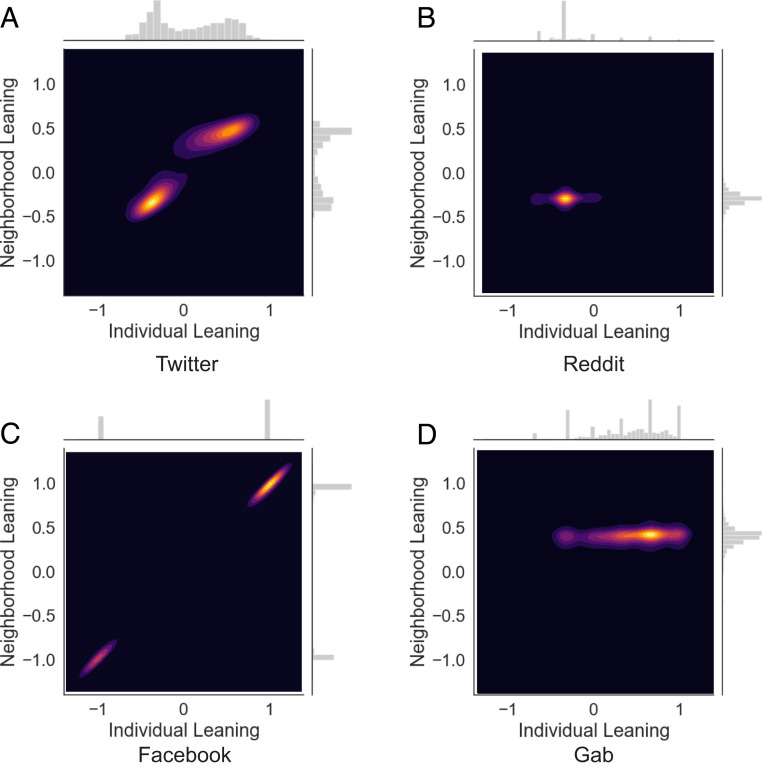
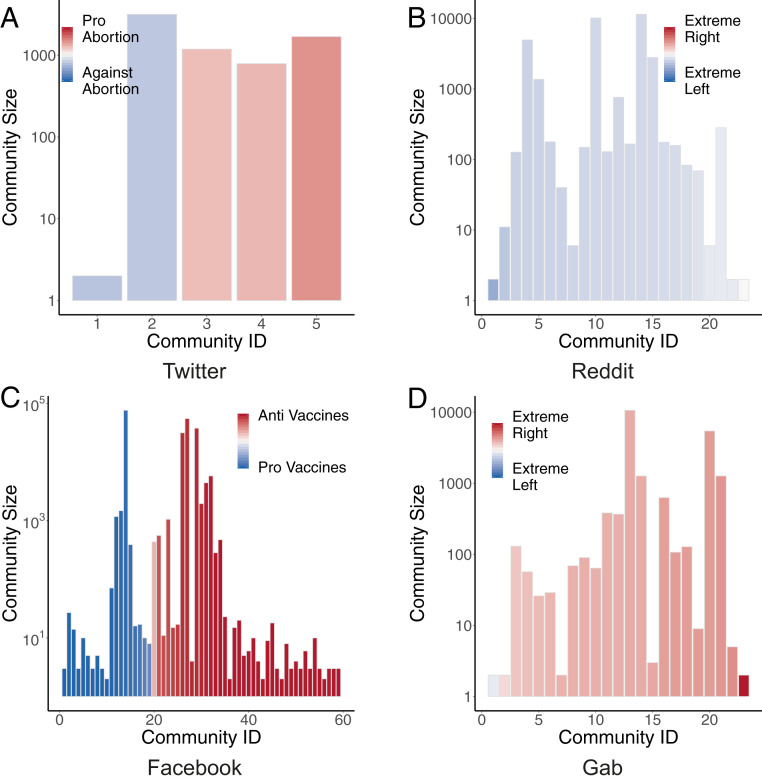
- Across the four platforms, “aggregation in homophilic clusters of users dominates online dynamics,” but platforms differ: Facebook and Twitter show homophilic clustering, while Reddit and Gab form a single community biased left or right rather than two opposing clusters.
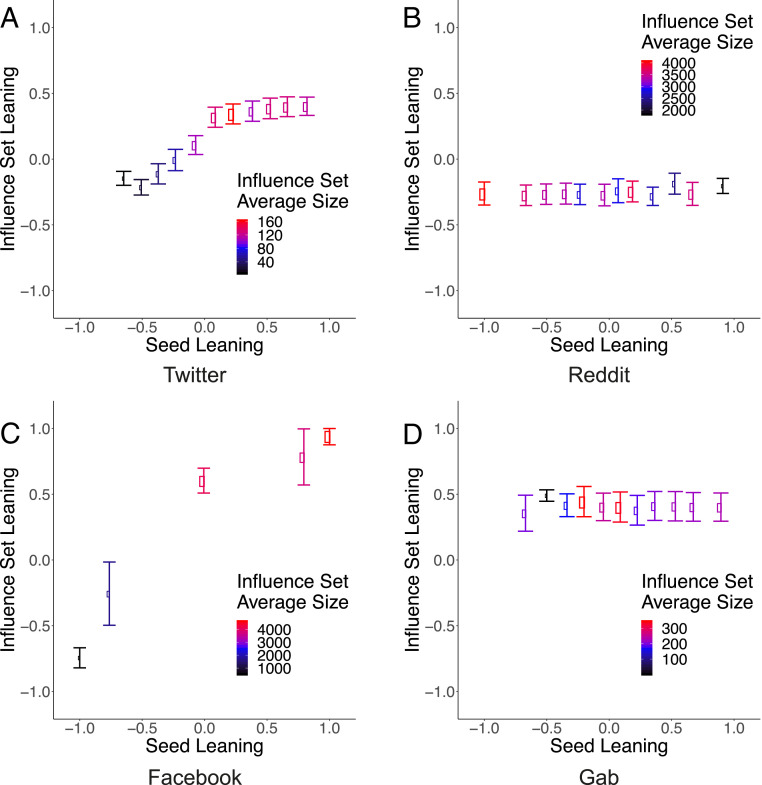
- Information diffusion is biased toward like-minded users on Facebook and Twitter, where the average leaning of a user’s influence set approximates the seed user’s leaning; on Reddit and Gab, the average leaning of the influence set does not depend on the seed user’s leaning.
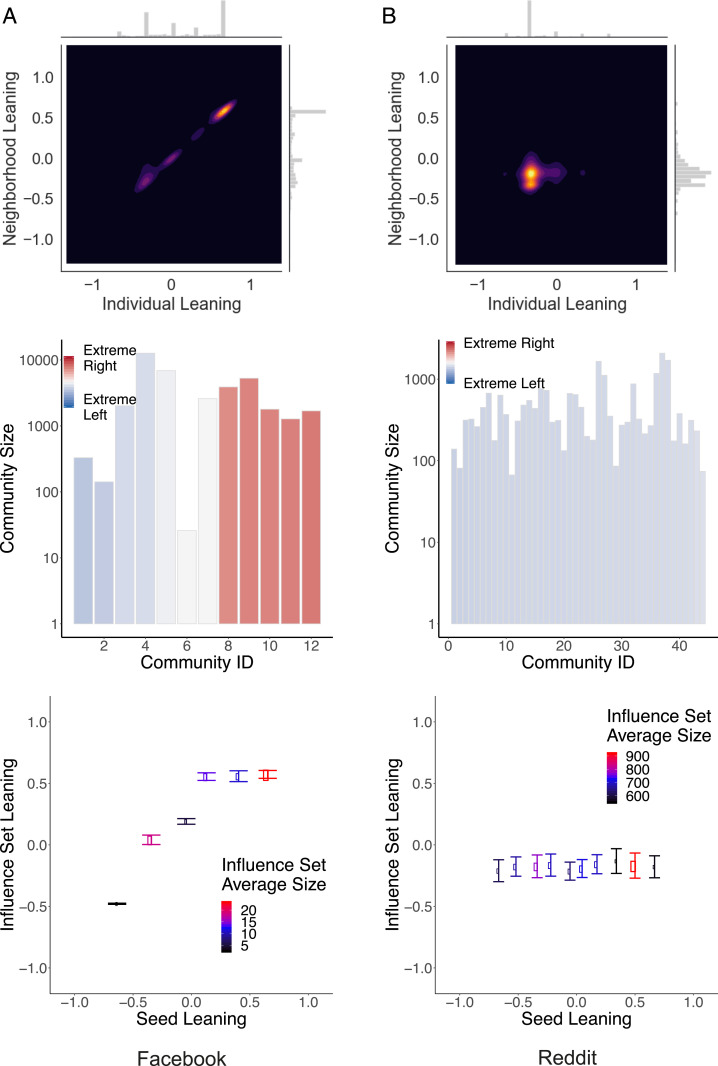
- In a direct comparison on news consumption, Facebook shows higher segregation than Reddit across all three measures: user-neighbor leaning correlation, community leaning, and SIR influence-set leaning.
- The study analyzes more than 100 million unique pieces of content and more than 1 million active users, with news outlets labeled using 2,190 media sources from Media Bias/Fact Check.
Methods
- Comparative analysis of Gab, Facebook, Reddit, and Twitter datasets on controversial topics including gun control, Obamacare, abortion, vaccines, science versus conspiracy, and news; main selected datasets were Abortion (Twitter), Vaccines (Facebook), Politics (Reddit), and Gab as a whole.
- Echo chambers were operationalized through two dimensions: homophily in interaction networks and bias in information diffusion toward like-minded peers. User leaning was inferred from linked news outlets, likes, or content, and interaction networks were built from follows, comments, cocomments, submissions, or replies depending on platform.
- Analyses included correlation between user leaning and average neighbor leaning, Louvain community detection, and SIR simulations to measure influence sets; SIR recovery rate was fixed at ν = 0.2, with dataset-specific infection ratios.
Limitations
- The paper states that the next envisioned step is to address the temporal dimension of echo chambers and how platform-specific social feedback mechanisms impact their formation.
- Evident from the text: leaning coverage varies strongly by platform, from 0.90–1.00 for Twitter/Facebook datasets to 0.15–0.20 for Reddit and 0.13 for Gab, so leaning-based conclusions for Reddit and Gab rest on a small classified fraction of users.
- Evident from the text: datasets differ by platform and topic, and the direct cross-platform comparison on a common topic is limited to news consumption on Facebook and Reddit; the authors also note that Reddit/Gab results could mean either no echo-chamber effect or observation inside a single echo chamber.
Model-written summary. Check it against the paper before relying on it.
Integrity signals
Registry
Cites
Statistics
Figures
Verification
Claims the paper makes
8 Valid · 1 Not valid · 7 Not checked · 38 Own results and interpretations
The cited sources support only part of this claim — read each source’s verdict below.
In the paper
“Selective exposure (19) and confirmation bias (20) (i.e., the tendency to seek information adhering to preexisting opinions) may explain the emergence of echo chambers on social media (1, 17, 21, 22).”
§ The echo chamber effect on social media > Abstract
What the sources say
- Supportedcites [1] M. Del Vicario, The spreading of misinformation online. Proc. Natl. Acad. Sci. U.S.A. 113, 554– 559 (2016). 26729863 PMC4725489 source
The Abstract says selective exposure generates homogeneous clusters, which it calls echo chambers. The Results and Discussion section says users select content matching a narrative and suggests confirmation bias determines echo-chamber formation. Page numbers are not provided in our copy. (LLM, conf=0.94)
- Partly supportedcites [17] K. Garimella, G. De Francisci Morales, A. Gionis, M. Mathioudakis, “ The effect of collective attention on controversial debates on social media” in WebSci ’17: 9th International ACM Web Science Conference (Association for Computing Machinery, New York, NY, 2017), pp. 43– 52. sourceExperimental — accuracy not yet measured
The Introduction reports that users mostly interact within their own side and endorse opinions from that side’s core. Related Work reports that users spread information faster when it agrees with their position. These passages are consistent with selective exposure, but the paper does not identify confirmation bias or establish that either tendency causes echo chambers to emerge. (LLM, conf=0.82)
- Supportedcites [21] M. Del Vicario, Echo chambers: Emotional contagion and group polarization on Facebook. Sci. Rep. 6, 37825 (2016). 27905402 PMC5131349 source
The Abstract says social-media disintermediation encourages users to select information that fits their beliefs (confirmation bias) and form like-minded groups (echo chambers). The Conclusions likewise describe Facebook as suited to the emergence of echo chambers. This supports the proposed explanation, without claiming it is the only cause. (LLM, conf=0.93)
- Supportedcites [22] A. Bessi, Science vs conspiracy: Collective narratives in the age of misinformation. PloS One 10, e0118093 (2015). 25706981 PMC4338055 source
The Introduction (page unavailable) says users consuming opposing information tend to form isolated clusters and describes polarized users whose likes are almost exclusively on one category of pages. The Conclusions (page unavailable) link information evaluation to existing beliefs. Together, these passages support the hedged explanation that selective exposure and confirmation bias may contribute to echo chambers. (LLM, conf=0.86)
hedgedstates a possible cause- Asserted: passes — The authors put it forward as true.
- Checkable: passes — It can be checked against evidence.
- Load-bearing: passes — The paper’s conclusions depend on it.
- Based: passes — The paper gives a reason why it holds.
- Supported
The cited sources support only part of this claim — read each source’s verdict below.
In the paper
“Our attention span remains limited (9, 10), and feed algorithms might limit our selection process by suggesting contents similar to the ones we are usually exposed to (11–13).”
§ The echo chamber effect on social media > Abstract
What the sources say
- Not checked — no full text of the sourcecites [11] A. L. Schmidt, Anatomy of news consumption on Facebook. Proc. Natl. Acad. Sci. U.S.A. 114, 3035– 3039 (2017). 28265082 PMC5373354 source
- Partly supportedcites [12] M. Cinelli, The COVID-19 social media infodemic. Sci. Rep. 10, 16598 (2020). 33024152 PMC7538912 sourceExperimental — accuracy not yet measured
The Introduction (page not provided) says algorithms take users’ preferences and attitudes into account when promoting content, and that users tend to seek information aligned with their worldviews. It does not say that feed algorithms suggest content similar to what users have previously seen or thereby limit their selection. (LLM, conf=0.82)
- Not checked — no full text of the sourcecites [13] E. Bakshy, S. Messing, L. A. Adamic, Exposure to ideologically diverse news and opinion on Facebook. Science 348, 1130– 1132 (2015). 25953820 source
hedgedstates a possible cause- Asserted: passes — The authors put it forward as true.
- Checkable: passes — It can be checked against evidence.
- Load-bearing: passes — The paper’s conclusions depend on it.
- Based: passes — The paper gives a reason why it holds.
Every source the paper cites for this claim was checked and supports it.
In the paper
“Online polarization, for instance, may foster misinformation spreading (1, 8).”
§ The echo chamber effect on social media > Abstract
What the sources say
- Supportedcites [1] M. Del Vicario, The spreading of misinformation online. Proc. Natl. Acad. Sci. U.S.A. 113, 554– 559 (2016). 26729863 PMC4725489 source
The Significance section says that homogeneity and polarization are main determinants of rumor-cascade size. The Conclusions also link polarized communities with the proliferation of narratives fueled by unsubstantiated rumors, supporting the hedged claim that online polarization may foster misinformation spreading. (LLM, conf=0.91)
- Supportedcites [8] M. D. Vicario, W. Quattrociocchi, A. Scala, F. Zollo, Polarization and fake news: Early warning of potential misinformation targets. ACM Trans. Web 13, 1– 22 (2019). source
The Introduction states that misinformation spreading on social media is directly related to increasing user polarization and segregation. This supports the citing sentence’s hedged claim that online polarization may foster misinformation spreading. (LLM, conf=0.94)
hedgedstates a possible cause- Asserted: passes — The authors put it forward as true.
- Checkable: passes — It can be checked against evidence.
- Load-bearing: unclear — It is unclear whether the paper’s conclusions depend on it.
- Based: passes — The paper gives a reason why it holds.
- Supported
Every source the paper cites for this claim was checked and supports it.
In the paper
“In network terms, this translates into a node i with a given leaning xi more likely to be connected with nodes with a leaning close to xi (18).”
§ The echo chamber effect on social media > Comparative Analysis > Polarization and Homophily in the Interaction Networks.
What the sources say
- Supportedcites [18] W. Cota, S. C. Ferreira, R. Pastor-Satorras, M. Starnini, Quantifying echo chamber effects in information spreading over political communication networks. EPJ Data Sci. 8, 35 (2019). source
The paper’s “Topological evidence of echo chambers” section says that a node with political position Pᵢ is connected with nodes whose positions are close to Pᵢ. It also reports a strong correlation between users’ positions and their neighbors’ average positions, supporting the citing sentence’s probabilistic paraphrase. (LLM, conf=0.94)
hedgedstates an association- Asserted: passes — The authors put it forward as true.
- Checkable: passes — It can be checked against evidence.
- Load-bearing: passes — The paper’s conclusions depend on it.
- Based: passes — The paper gives a reason why it holds.
- Supported
A result the paper reports from its own data — it cites no other source for it, so there is none to check. The quote shows it is in the paper.
In the paper
“Furthermore, the almost total absence of communities with leaning very close to 0 confirms the polarized state of the systems.”
§ The echo chamber effect on social media > Comparative Analysis > Polarization and Homophily in the Interaction Networks.
boostedstates a cause- Asserted: passes — The authors put it forward as true.
- Checkable: passes — It can be checked against evidence.
- Load-bearing: passes — The paper’s conclusions depend on it.
- Based: passes — The paper gives a reason why it holds.
- Rests on 4 assumptions not shown here.
32 more claims
Create a free account to see all 54 claims and to verify the 2 references still open.
- It may state two separate claims as one. 9
- Probably not a substantial claim. 9
Claims other papers make about this one
Each is checked against this paper’s own text: does it say what the citing paper says it does?
The source backs part of the claim, not all of it — or backs it for a different population, condition or comparison.
In the citing paper
“engagement with political content online is generally associated with high levels of ingroup bias; that is, it is far more likely to be shared within the political ingroup than in the outgroup (18, 19, 16).”
From Troll and divide: the language of online polarization (2022) · cites this paper as [16]
Experimental — accuracy not yet measuredThe source backs part of the claim, not all of it — or backs it for a different population, condition or comparison.
In the citing paper
“This challenge is reflected in research on”
From Machine culture (2023) · cites this paper as [142]
Experimental — accuracy not yet measuredThe source backs part of the claim, not all of it — or backs it for a different population, condition or comparison.
In the citing paper
“Thus, combating social media's echo chamber effect through an active exposure to diverse perspectives and networks also represents a viable individual-level strategy for addressing the deepfake problem (Cinelli et al., 2021; Gillani et al., 2018).”
From Deepfakes: Deceptions, mitigations, and opportunities (2023) · cites this paper as Cinelli et al., 2021
Experimental — accuracy not yet measuredThe source backs part of the claim, not all of it — or backs it for a different population, condition or comparison.
In the citing paper
“Even without being designed to shift opinions, it has been found that algorithms may contribute to political polarization by reinforcing divisive opinions [9, 24, 32].”
From Co-Writing with Opinionated Language Models Affects Users’ Views (2023) · cites this paper as [32]
Experimental — accuracy not yet measuredThe source backs part of the claim, not all of it — or backs it for a different population, condition or comparison.
In the citing paper
“On Reddit, studies find minimal evidence of echo chambers due to platform features encouraging cross-cutting exposure [17,61,63].”
From A systematic review of echo chamber research: comparative analysis of conceptualizations, operationalizations, and varying outcomes (2025) · cites this paper as [17]
Experimental — accuracy not yet measured
5 more claims about this paper
Create a free account to see every claim other papers make about this one.
Citations
Cites
Fast unfolding of communities in large networks
Blondel, V. D., Guillaume, J.-L., Lambiotte, R., & Lefebvre, E. (2008) · Journal of Statistical Mechanics: Theory and Experiment · doi:10.1088/1742-5468/2008/10/p10008 · Cited by 21,424 · cited 1×
“We detected communities by applying the Louvain algorithm (41), removing singleton communities with only one user.”
MethodThe spread of true and false news online
Vosoughi, S., Roy, D., & Aral, S. (2018) · Science · doi:10.1126/science.aap9559 · Cited by 8,847 · cited 1×
“A recent study (7) limited to Twitter claimed that fake news travels faster than real news.”
BackgroundConfirmation Bias: A Ubiquitous Phenomenon in Many Guises
Nickerson, R. S. (1998) · Review of General Psychology · doi:10.1037/1089-2680.2.2.175 · Cited by 7,267 · cited 1×
“Selective exposure (19) and confirmation bias (20) (i.e., the tendency to seek information adhering to preexisting opinions) may explain the emergence of echo chambers on social media (1, 17, 21, 22).”
BackgroundInfectious Diseases of Humans: Dynamics and Control
Anderson, R. M., & May, R. M. (1991) · doi:10.1093/oso/9780198545996.001.0001 · Cited by 6,179
Lazer, D. M. J., Baum, M. A., Benkler, Y., Berinsky, A. J., Greenhill, K. M., Menczer, F., Metzger, M. J., Nyhan, B., Pennycook, G., Rothschild, D., et al. (2018) · Science · doi:10.1126/science.aao2998 · Cited by 4,160
Degroot, M. H. (1974) · Journal of the American Statistical Association · doi:10.1080/01621459.1974.10480137 · Cited by 4,004 · cited 1×
“For instance, if opinions are assumed to be embedded in a onedimensional space (38), x ∈ [−1,+1] without loss of generality, as usual for controversial topics, then polarization is characterized by two well-separated peaks in P(x ), for positive and negative opinions.”
BackgroundExposure to ideologically diverse news and opinion on Facebook
Bakshy, E., Messing, S., & Adamic, L. A. (2015) · Science · doi:10.1126/science.aaa1160 · Cited by 3,245 · cited 2×
“Our attention span remains limited (9, 10), and feed algorithms might limit our selection process by suggesting contents similar to the ones we are usually exposed to (11–13).”
BackgroundThe spreading of misinformation online
Del Vicario, M., Bessi, A., Zollo, F., Petroni, F., Scala, A., Caldarelli, G., Stanley, H. E., & Quattrociocchi, W. (2016) · Proceedings of the National Academy of Sciences · doi:10.1073/pnas.1517441113 · Cited by 2,407 · cited 2×
“, the tendency to seek information adhering to preexisting opinions) may explain the emergence of echo chambers on social media (1, 17, 21, 22).”
BackgroundSelf-citationThe COVID-19 social media infodemic
Cinelli, M., Quattrociocchi, W., Galeazzi, A., Valensise, C. M., Brugnoli, E., Schmidt, A. L., Zola, P., Zollo, F., & Scala, A. (2020) · Scientific Reports · doi:10.1038/s41598-020-73510-5 · Cited by 2,313
Self-citationFilter Bubbles, Echo Chambers, and Online News Consumption
Flaxman, S., Goel, S., & Rao, J. M. (2016) · Public Opinion Quarterly · doi:10.1093/poq/nfw006 · Cited by 1,992
Research works printed but not linked: 2
- R. M. Anderson, R. M. May, Infectious Diseases in Humans (Oxford University Press, Oxford, United Kingdom, 1992).
- M. Cinelli, G. De Francisci Morales, A. Galeazzi, W. Quattrociocchi, M. Starnini, The echo chamber effect on social media. Open Science Framework. https://osf.io/x92br/?view_only=cdcc87d30e404e01b6ae316db15e3375. Deposited 22 January 2021. PMC7936330 33622786
Cited by
Items 2,001–2,063 of 2,063
The listening gap is real — how AI might help teachers bridge it
Parker-Shandal, C. (2026) · doi:10.64628/aam.uaavrn9a9
Vucenovic, N. D. (2026) · Journal of Language Aggression and Conflict · doi:10.1075/jlac.00156.vuc
Temporal Social Influence Design for Polarized Evolving OpinionsPreprint
Kooshkaki, A. R., Mohebbi, A., & Bolouki, S. (2026) · SSRN Electronic Journal · doi:10.2139/ssrn.7428621
Chen, X., Zhang, W., & Shao, Q. (2026) · Journal of theoretical and applied electronic commerce research · doi:10.3390/jtaer21090312 · Cited by 1
Public information sharing during public health emergencies: an adaptive-network evolutionary game
Ma, Y., & Feng, W. (2026) · Frontiers in Public Health · doi:10.3389/fpubh.2026.1942698
“The attention-economy result is consistent with research on false-information diffusion, echo chambers, and the amplification of emotionally salient content (7, 8, 30, 31), but adds a network-level qualification: high connectivity can coexist with very poor information quality.”
Autism and ADHD social media short-form video content: A systematic review protocol
Karasavva, V., & Mikami, A. Y. (2026) · PLoS ONE · doi:10.1371/journal.pone.0357837
“This can be compounded by confirmation bias, whereby individuals preferentially engage with information that aligns with their existing beliefs while discounting contradictory evidence, creating an echo-chamber [18].”
Angelis, C. D. (2026) · Revista de ciencias sociales. · doi:10.61303/0718-3631.v35i57.605
Pei, Y., Guo, B., Wang, N., Zhao, K., & Yu, Z. (2026) · Communications in computer and information science · doi:10.1007/978-981-92-3994-8_23
Future Trends Within Online Communities and Implications of Technological Changes
Riva, G. (2026) · Springer eBooks · doi:10.1007/978-3-031-52643-5_250-1
Leverage points in cities: a blueprint for action
Spanò, F., & Zucaro, A. (2026) · Frontiers in Sustainable Cities · doi:10.3389/frsc.2026.1889308
Multilingual and Context-Aware Hate Speech Detection and Mitigation Using AI
jain, K., Gupta, H. A., Joshi, K., Sharma, A. K., & Pathak, S. (2026) · Lecture notes in networks and systems · doi:10.1007/978-3-032-19303-2_11
The Role of Artificial Intelligence, Social Media, and Environmental Voting Behavior
Antony, D. K. P. P., & Priya, R. J. (2026) · Advances in computational intelligence and robotics book series · doi:10.4018/979-8-2600-1413-4.ch006
Cyber-physical-social system and social governance in the digital-intelligent era
Wang, Z., Huang, D., Zhu, X., Jun, H. A. O., Cai, S., Yang, X., Liu, Z., Fang, W. A. N. G., JianPing, L. I., & lu:, L. (2026) · Scientia Sinica Informationis · doi:10.1360/ssi-2026-0207
Selbstdiagnosen psychischer Störungen – Chancen und Risiken für die psychotherapeutische Praxis
Berge, L.-M., Miller, L., & Schuchardt, K. (2026) · Die Psychotherapie · doi:10.1007/s00278-026-00872-y
Educating AI Through Socratic Dialogue and AI TastingPreprint
Yamamura, E. (2026) · SSRN Electronic Journal · doi:10.2139/ssrn.7467933
Communicative Roles and Structural Fragmentation in LPDP Scholarship Discourse on Platform X
Azizah, F., Tristina, N., Elisabeth Satya Wacana Patricia, S., Nuraeni, R., & Cahyani, A. I. (2026) · Language, Technology, and Social Media. · doi:10.70211/ltsm.3026-7196.531
“Topic-network classification describes how interaction is organized [19], whereas an echo-chamber interpretation requires evidence about the information and viewpoints circulating within that structure [15] – [18].”
Kondratov, E., Gaete-Salgado, C., & Aira, T. (2026) · Journal of Information Policy · doi:10.5325/jinfopoli.16.2026.0014
Interaction-induced knowledge narrowing risk in LLM systems
Rutherford, D., & Wu, N. (2026) · Discover Artificial Intelligence · doi:10.1007/s44163-026-02101-6
Zhang, J., Cao, J., Wang, Z., et al. (2026) · Journal of International Money and Finance · doi:10.1016/j.jimonfin.2026.103679
Blog-reading histories as networks: A proof-of-concept prediction of high parenting stress
Yokotani, K., Takano, M., Abe, N., & Kato, T. A. (2026) · Computers in Human Behavior Reports · doi:10.1016/j.chbr.2026.101331
Identifying Social Networks on X: A Multi-network Approach for Inference of Community Structures
Bezerra, J. F. R., Kozierkiewicz, A., Pietranik, M., et al. (2026) · Lecture notes in computer science · doi:10.1007/978-3-032-36871-3_5
何绍森, Li, J., Yang, R., Wu, Z., & Lu, H. (2026) · Behavioral Sciences · doi:10.3390/bs16091697
“…echo chambers are characterized by information homogeneity and circulation within like‑ minded clusters, while differences in information distribution mechanisms and network structures across platforms shape the diversity of information users encounter (Bakshy et al., 2015; Cinelli et al., 2021).”
Algorithmic systems, human agency and the future of platform research
Hosseinmardi, H., Dutta, U., Rothschild, D. M., & Watts, D. J. (2026) · Nature Computational Science · doi:10.1038/s43588-026-01038-1
“Scholars often utilize third-party ratings (for instance, Media Bias/Fact Check, AllSides), which assign scores to entire publications based on editorial practices, audience perceptions or expert review 5 .”
Digital Misinformation and the Crisis of Conscience Formation
Ramos, J., Cruess, S. M., & Holt, J. (2026) · The Linacre Quarterly · doi:10.1177/00243639261487051
Covasso, S., Paoletti, G., Lorrot, M., Dugué, S., Cardin, S., Puppo, C., Chosidow, A., & Raffetin, A. (2026) · PLoS ONE · doi:10.1371/journal.pone.0357185
From Iowa to Wisconsin: Donald Trump’s Use of Truth Social in the 2024 Republican Primaries
Gabaldón, M. P., Varea, B. N., & Terrazas, M. M. C. (2026) · Revista Latina de Comunicación Social · doi:10.4185/rlcs-2027-2713
“…communication strategy is bolstered by the very structure of Truth Social, which contributes to the creation of an "echo chamber" where — as analyzed in the Theoretical Framework — narratives are collectively accepted, leaving very limited room for divergent perspectives (Cinelli et al. 2021).”
Xu, W., Agarwal, V., Alkasham, H. B. A., et al. (2026) · Journal of Knowledge Management · doi:10.1108/jkm-05-2026-0903
Gagliardi, L. (2026) · Patient Education and Counseling · doi:10.1016/j.pec.2026.110318
Sosyal Medya Haberlerinde Teyit Trendi: Grok, Bu Doğru mu?
Akbayır, M., & AKBAYIR, A. (2026) · İstanbul Gelişim Üniversitesi Sosyal Bilimler Dergisi · doi:10.17336/igusbd.1709299
On the Vulnerability of Community Notes to Participation Concentration
Nudo, J., Nemmi, E. N., Loru, E., Mei, A., Quattrociocchi, W., & Cinelli, M. (2026) · Lecture notes in computer science · doi:10.1007/978-3-032-38695-3_24
Self-citationPhilipo, A. G., Ding, J., Sarwatt, D. S., & Ning, H. (2026) · Information Fusion · doi:10.1016/j.inffus.2026.104820
Religa, P., Mickael, M.-E., Łazarczyk, M., Kubick, N., Horbańczuk, J. O., Tsegaye, B., Sacharczuk, M., & Atanasov, A. G. (2026) · Frontiers in Research Metrics and Analytics · doi:10.3389/frma.2026.1912970
Kucharczyk, S., Sarek, F., Józwik, K., Rak, Z., Ignatowska, Z., Wielogórska, A. M., Kamecki, A., & Dzień, K. (2026) · International Journal of Innovative Technologies in Social Science · doi:10.31435/ijitss.3(51).2026.6351
Fear, Blame, and Deservingness: The Moral Economy of AI-Labor Anxiety on Reddit
Iordache, A., Rughiniş, C., Rughinis, R. V., & Țurcanu, D. (2026) · Social Sciences · doi:10.3390/socsci15100663
Yıldırmaz, A. (2026) · International Journal Of Eurasia Social Sciences · doi:10.70736/ijoess.2365
“Cinelli et al. (2021), in their analysis on large-scale platforms, demonstrated that algorithms reinforce ideological homogeneity and selective exposure.”
Hong, F., Xia, S., & Zhang, C. (2026) · Perspectives on Politics · doi:10.1017/s1537592726105751
Alsararatee, H. H., & Allam, A. A. (2026) · British Journal of Hospital Medicine · doi:10.31083/bjhm51991
P., S. C., & Shukla, R. (2026) · Frontiers in Sociology · doi:10.3389/fsoc.2026.1940431
Iordache, M., Coman, C., Dalban, C. M., Bătrânu-Pințea, V., Șerbănescu, R.-M., & Cojocaru, I. (2026) · Journalism and Media · doi:10.3390/journalmedia7040200
Temporally Robust Misinformation Spreader Detection via Behavioral Fingerprinting
Jadhav, A., Barhate, Y., Sable, D., Aghav, C., Shinde, S., & Buchade, A. (2026) · International Conference on Computing Communication Control and automation · doi:10.1109/iccubea69821.2026.11701812
Recurrence dynamics of information cocoons in short-video recommender systems
Tang, L. (2026) · Physica A Statistical Mechanics and its Applications · doi:10.1016/j.physa.2026.132086
The Representation of Digital Disinformation in Young Adults' Minds: A Metaphorical Review
Yıldırmaz, A. (2026) · Abant İzzet Baysal Üniversitesi Eğitim Fakültesi Dergisi · doi:10.17240/aibuefd.2026..-1830150
Modelling the feedback-driven dynamics of news coverage and engagement on social media
Sangiorgio, E., Marco, N. D., Loru, E., Cinelli, M., Cerqueti, R., & Quattrociocchi, W. (2026) · Proceedings of the Royal Society A Mathematical Physical and Engineering Sciences · doi:10.1098/rspa.2026.0159
Self-citationA New Divide: Changes in Sentiment Polarity During Finnish Parliamentary Elections
Nieminen, E., Isotalus, P., Strandberg, K., & Pullinen, H. (2026) · International Journal of Politics Culture and Society · doi:10.1007/s10767-026-09609-w
The influence of social media exposure on pro-environmental behavior
Ertz, M., Dagbo, A. D. E., & Kazemipour, A. (2026) · International Journal of Sustainable Development & World Ecology · doi:10.1080/13504509.2026.2738671
Risk and protective factors associated with misinformation susceptibility in young adulthood
Snijders, A. L., Simpson-Kent, I. L., Roozenbeek, J., van Duijvenvoorde, A. C. K., Blankenstein, N., & Ma, I. (2026) · Computers in Human Behavior Reports · doi:10.1016/j.chbr.2026.101367
Almakaty, S. S. (2026) · Journalism and Media · doi:10.3390/journalmedia7040203 · Cited by 2
Lewis, R., Niederkrotenthaler, T., Robinson, J., Sala, L. L., Mitchell, R. H. B., & Sinyor, M. (2026) · Crisis · doi:10.1027/0227-5910/a001073
Beyond Misinformation: Social Media and the Sculpting of Epistemic Agency
Flores, C. (2026) · Philosophy and Phenomenological Research · doi:10.1111/phpr.70166 · Cited by 1
Almpani, S., Loucopoulos, P., & Plithas, A. (2026) · Requirements Engineering · doi:10.1007/s00766-026-00473-w
“Hostile narra - tives spread through social networks, recommendation path - ways, echo chambers, and reinforcing feedback [ 68–70 ].”
A Brief Review of Vaccine History, Hesitancy, and Education Today
Youssef, A. S., Gupta, A. S., Gollamudi, S., & Moore, K. T. (2026) · The Journal of Clinical Pharmacology · doi:10.1002/jcph.70302
Beyond information: human and emotional dimensions of echo chambers
Malaeb, L. (2026) · Journal of Information Communication and Ethics in Society · doi:10.1108/jices-10-2025-0306
Xanthidis, D., Amin, A. J. M., Xanthidou, O. K., Salhab, M., Altigani, A., & Alhammadi, A. Y. A. (2026) · WSEAS Transactions on Information Science and Applications archive · doi:10.37394/23209.2026.23.53
Joint Agency and Co-creativity in Shared Diminished Reality
Vuarnesson, L., Laroche, J., & Bachrach, A. (2026) · SN Computer Science · doi:10.1007/s42979-026-05346-1
Role of Hindi Digital Media in Urban Youth's Eco-Behaviour: Content Analysis of Viral Campaigns
Tahilramani, D. A. (2026) · International Journal of Communication Development · doi:10.65301/ijcd.2026.17.1.6
From Interaction Topology to Realized Context: Diagnosing Exposure in LLM-Agent Social Simulation
Xu, Y., Han, X., & Ma, C. (2026) · ACM Turing Celebration Conference - China (ACM TURC) · doi:10.1145/3833142.3833202
Artificial Intelligence and Inequalities: Risks and Opportunities for Social Statistics
Grimaccia, E. (2026) · Springer eBooks · doi:10.1007/978-3-032-30873-3_38
From feeds to fury: how social media news use fuels radicalism and contentious politics
Ahmed, S., Deng, R., & Rasul, M. E. (2026) · Journal of Information Technology & Politics · doi:10.1080/19331681.2026.2743658
Ma’rof, A. A., Isa, H. H. M., & Kamaruddin, M. S. (2026) · IGI Global eBooks · doi:10.4018/979-8-2600-4659-3.ch011
Campaign-Level Behavioral Archetypes Transfer Across Political Campaigns
Amure, R., & Agarwal, N. (2026) · Lecture notes in computer science · doi:10.1007/978-3-032-40581-4_22
Interaction Diversity in News Ecosystems: Accounting for Organizational Structure and Ownership
Carragher, P., & Carley, K. M. (2026) · Lecture notes in computer science · doi:10.1007/978-3-032-40581-4_16
Metadata
- Authors
- Cinelli, M., De Francisci Morales, G., Galeazzi, A., Quattrociocchi, W., & Starnini, M.
- Affiliations
- Ca' Foscari University of Venice (IT)
- Institute for Scientific Interchange (ISI) Foundation, 10126 Torino, Italy;
- University of Brescia (IT)
- University of Oslo (NO)
- Institute for Scientific Interchange (IT)
- Corresponding author
- Quattrociocchi, Walter
- ORCID
- Venue
- Proceedings of the National Academy of Sciences
- Publisher
- National Academy of Sciences
- Published
- 2021-02-23
- Volume
- 118
- Issue
- 9
- ISSN
- 0027-8424 (ISSN-L)
- 1091-6490
- PMC
- PMC7936330
- OpenAlex
- W3133423348
- Cited by
- 2,092
- References
- 62
- Citations by year
- 2026: 488 · 2025: 516 · 2024: 387 · 2023: 351 · 2022: 256 · 2021: 90
- FWCI
- 375.62
- Type
- journal article
- Language
- en
- Open access
- hybrid
- doi.org
- Licence
- Locations
- Proceedings of the National Academy of Sciences (publishedVersion, cc-by)
- PubMed Central (publishedVersion, cc-by)
- PubMed (publishedVersion)
- UPCommons institutional repository (Universitat Politècnica de Catalunya) (submittedVersion, cc-by)
- IRIS Research product catalog (Sapienza University of Rome) (submittedVersion)
- Padua Research Archive (University of Padova) (submittedVersion, cc-by)
- Topics
- Social Sciences › Sociology and Political Science › Misinformation and Its Impacts
- Social Sciences › Communication › Social Media and Politics
- Physical Sciences › Physics and Astronomy › Statistical and Nonlinear Physics › Complex Network Analysis Techniques
- Keywords
- echo chambers, social media, homophily, information dissemination, algorithmic curation, controversial issues, Facebook, Twitter, Reddit, Gab, news consumption
- MeSH terms
- Abortion, Legal, Gun Violence, Communication, Humans, Politics, Social Change, Vaccination, Bias, Information Dissemination, Narration, Patient Protection and Affordable Care Act, Social Networking, Social Media
About these checks
Registry, retraction, Cites and statistics results are computed, not judged, with one exception: a printed reference that no index lists is read once by a model before it counts as a citation error. Claims are extracted by a model and kept only when their quote appears verbatim in the text; each cited source is then checked, with a model’s help, for whether it says what the claim relies on. Those verdicts can be wrong — read the claim’s quote and the cited source before relying on one.
The claim verdicts this report counts are experimental: their accuracy is not yet measured.
A language model drew the claims from the paper on 2026-10-10, under version 3 of the claim definition (model deepseek-v4.1-flash, prompt extract-v3).
A second model labelled each claim on 2026-10-10 (model jev-1.13-20260917, definition revision gold-guideline-v0.2).
Cited sources are checked with a language model’s help (gpt-6-sol).
Statistics and arithmetic are recomputed, not judged.
Confidence bands are shown only for fields calibrated on our annotated test set. None is calibrated yet, so no band is shown.
What counts as a claim ›How we measure confidence ›How we check this ›
Are you an author, or do you see a problem with this page? Request a review
Data sources
Bibliographic data: Semantic Scholar, OpenAlex, Crossref.
Contains information from the Semantic Scholar Academic Graph Datasets, made available under the ODC Attribution License (ODC-BY 1.0).
Semantic Scholar’s data is described in: Kinney, R., et al. (2023). The Semantic Scholar Open Data Platform. arXiv:2301.10140.
