

The echo chamber effect on social media
Open accessThe DOI matches its Crossref record; 68 of the 69 references it cites were found in a registry or an index; 16 of the 38 sources its claims cite were checked for support.
Abstract
Significance: We explore the key differences between the main social media platforms and how they are likely to influence information spreading and the formation of echo chambers. To assess the different dynamics, we perform a comparative analysis on more than 100 million pieces of content concerning controversial topics (e.g., gun control, vaccination, abortion) from Gab, Facebook, Reddit, and Twitter. The analysis focuses on two main dimensions: 1) homophily in the interaction networks and 2) bias in the information diffusion toward like-minded peers. Our results show that the aggregation in homophilic clusters of users dominates online dynamics. However, a direct comparison of news consumption on Facebook and Reddit shows higher segregation on Facebook.
Overview
CoChat Summary
TL;DR
This paper compares echo-chamber dynamics across Gab, Facebook, Reddit, and Twitter using more than 100 million pieces of content and more than 1 million active users. It finds homophilic clustering dominates online dynamics, with Facebook and Twitter showing stronger segregation and like-minded information diffusion than Reddit and Gab, and Facebook showing higher news-consumption segregation than Reddit.
Key findings
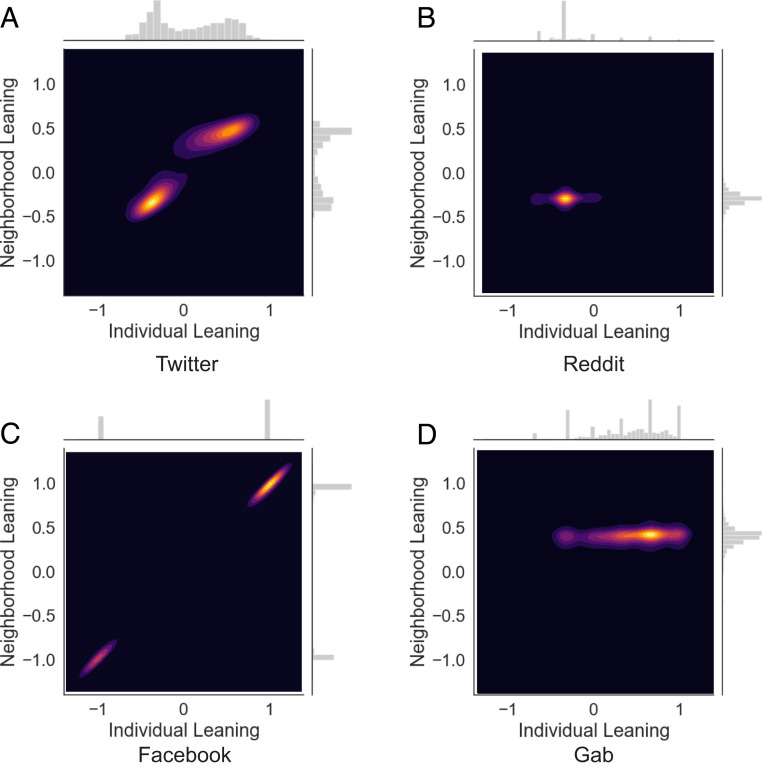
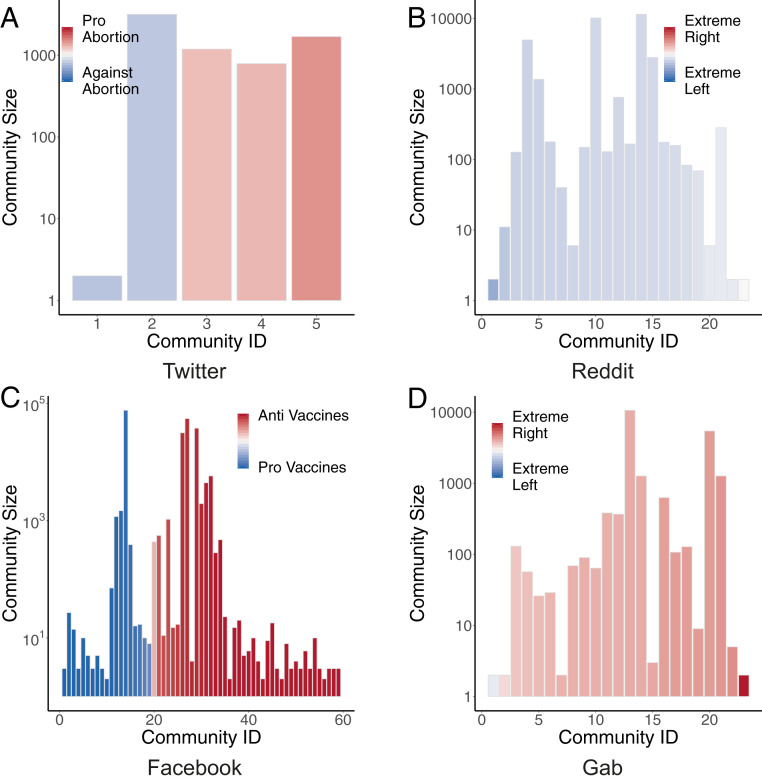
- Across the four platforms, “aggregation in homophilic clusters of users dominates online dynamics,” but platforms differ: Facebook and Twitter show homophilic clustering, while Reddit and Gab form a single community biased left or right rather than two opposing clusters.
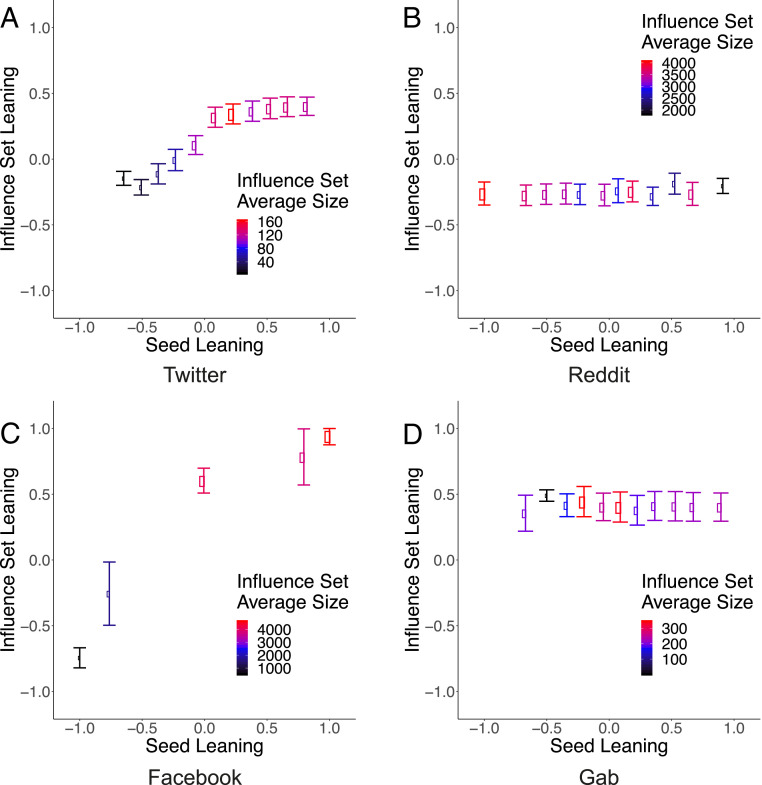
- Information diffusion is biased toward like-minded users on Facebook and Twitter, where the average leaning of a user’s influence set approximates the seed user’s leaning; on Reddit and Gab, the average leaning of the influence set does not depend on the seed user’s leaning.
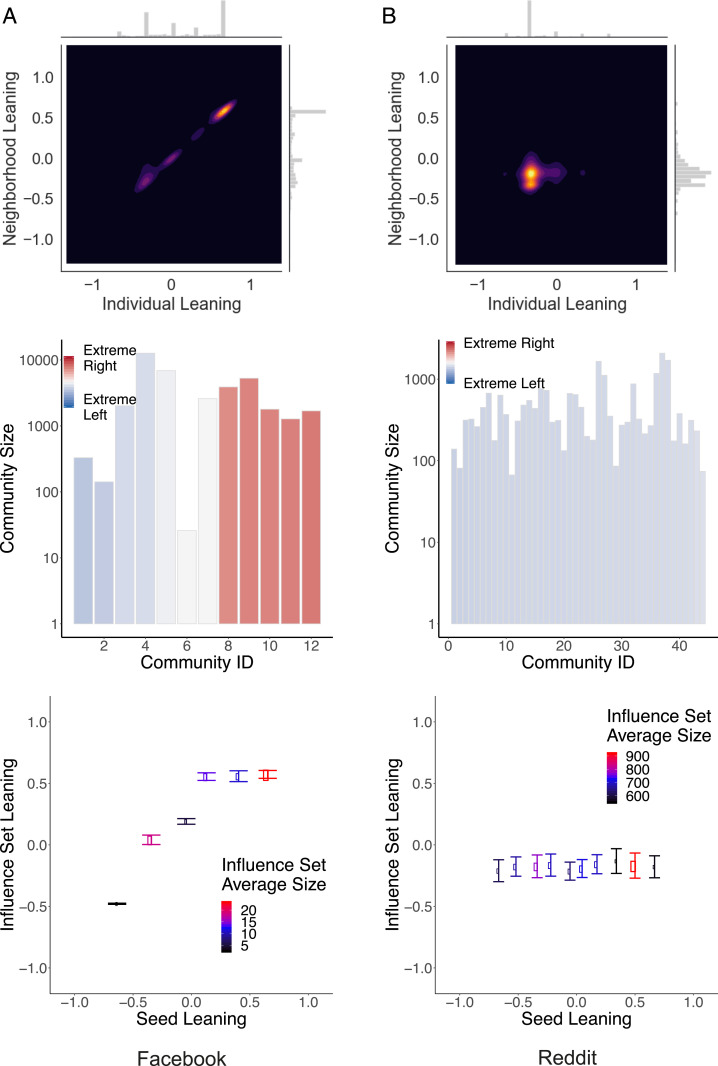
- In a direct comparison on news consumption, Facebook shows higher segregation than Reddit across all three measures: user-neighbor leaning correlation, community leaning, and SIR influence-set leaning.
- The study analyzes more than 100 million unique pieces of content and more than 1 million active users, with news outlets labeled using 2,190 media sources from Media Bias/Fact Check.
Methods
- Comparative analysis of Gab, Facebook, Reddit, and Twitter datasets on controversial topics including gun control, Obamacare, abortion, vaccines, science versus conspiracy, and news; main selected datasets were Abortion (Twitter), Vaccines (Facebook), Politics (Reddit), and Gab as a whole.
- Echo chambers were operationalized through two dimensions: homophily in interaction networks and bias in information diffusion toward like-minded peers. User leaning was inferred from linked news outlets, likes, or content, and interaction networks were built from follows, comments, cocomments, submissions, or replies depending on platform.
- Analyses included correlation between user leaning and average neighbor leaning, Louvain community detection, and SIR simulations to measure influence sets; SIR recovery rate was fixed at ν = 0.2, with dataset-specific infection ratios.
Limitations
- The paper states that the next envisioned step is to address the temporal dimension of echo chambers and how platform-specific social feedback mechanisms impact their formation.
- Evident from the text: leaning coverage varies strongly by platform, from 0.90–1.00 for Twitter/Facebook datasets to 0.15–0.20 for Reddit and 0.13 for Gab, so leaning-based conclusions for Reddit and Gab rest on a small classified fraction of users.
- Evident from the text: datasets differ by platform and topic, and the direct cross-platform comparison on a common topic is limited to news consumption on Facebook and Reddit; the authors also note that Reddit/Gab results could mean either no echo-chamber effect or observation inside a single echo chamber.
Model-written summary. Check it against the paper before relying on it.
Integrity signals
Registry
Cites
Statistics
Figures
Verification
Claims the paper makes
8 Valid · 1 Not valid · 7 Not checked · 38 Own results and interpretations
The cited sources support only part of this claim — read each source’s verdict below.
In the paper
“Selective exposure (19) and confirmation bias (20) (i.e., the tendency to seek information adhering to preexisting opinions) may explain the emergence of echo chambers on social media (1, 17, 21, 22).”
§ The echo chamber effect on social media > Abstract
What the sources say
- Supportedcites [1] M. Del Vicario, The spreading of misinformation online. Proc. Natl. Acad. Sci. U.S.A. 113, 554– 559 (2016). 26729863 PMC4725489 source
The Abstract says selective exposure generates homogeneous clusters, which it calls echo chambers. The Results and Discussion section says users select content matching a narrative and suggests confirmation bias determines echo-chamber formation. Page numbers are not provided in our copy. (LLM, conf=0.94)
- Partly supportedcites [17] K. Garimella, G. De Francisci Morales, A. Gionis, M. Mathioudakis, “ The effect of collective attention on controversial debates on social media” in WebSci ’17: 9th International ACM Web Science Conference (Association for Computing Machinery, New York, NY, 2017), pp. 43– 52. sourceExperimental — accuracy not yet measured
The Introduction reports that users mostly interact within their own side and endorse opinions from that side’s core. Related Work reports that users spread information faster when it agrees with their position. These passages are consistent with selective exposure, but the paper does not identify confirmation bias or establish that either tendency causes echo chambers to emerge. (LLM, conf=0.82)
- Supportedcites [21] M. Del Vicario, Echo chambers: Emotional contagion and group polarization on Facebook. Sci. Rep. 6, 37825 (2016). 27905402 PMC5131349 source
The Abstract says social-media disintermediation encourages users to select information that fits their beliefs (confirmation bias) and form like-minded groups (echo chambers). The Conclusions likewise describe Facebook as suited to the emergence of echo chambers. This supports the proposed explanation, without claiming it is the only cause. (LLM, conf=0.93)
- Supportedcites [22] A. Bessi, Science vs conspiracy: Collective narratives in the age of misinformation. PloS One 10, e0118093 (2015). 25706981 PMC4338055 source
The Introduction (page unavailable) says users consuming opposing information tend to form isolated clusters and describes polarized users whose likes are almost exclusively on one category of pages. The Conclusions (page unavailable) link information evaluation to existing beliefs. Together, these passages support the hedged explanation that selective exposure and confirmation bias may contribute to echo chambers. (LLM, conf=0.86)
hedgedstates a possible cause- Asserted: passes — The authors put it forward as true.
- Checkable: passes — It can be checked against evidence.
- Load-bearing: passes — The paper’s conclusions depend on it.
- Based: passes — The paper gives a reason why it holds.
- Supported
The cited sources support only part of this claim — read each source’s verdict below.
In the paper
“Our attention span remains limited (9, 10), and feed algorithms might limit our selection process by suggesting contents similar to the ones we are usually exposed to (11–13).”
§ The echo chamber effect on social media > Abstract
What the sources say
- Not checked — no full text of the sourcecites [11] A. L. Schmidt, Anatomy of news consumption on Facebook. Proc. Natl. Acad. Sci. U.S.A. 114, 3035– 3039 (2017). 28265082 PMC5373354 source
- Partly supportedcites [12] M. Cinelli, The COVID-19 social media infodemic. Sci. Rep. 10, 16598 (2020). 33024152 PMC7538912 sourceExperimental — accuracy not yet measured
The Introduction (page not provided) says algorithms take users’ preferences and attitudes into account when promoting content, and that users tend to seek information aligned with their worldviews. It does not say that feed algorithms suggest content similar to what users have previously seen or thereby limit their selection. (LLM, conf=0.82)
- Not checked — no full text of the sourcecites [13] E. Bakshy, S. Messing, L. A. Adamic, Exposure to ideologically diverse news and opinion on Facebook. Science 348, 1130– 1132 (2015). 25953820 source
hedgedstates a possible cause- Asserted: passes — The authors put it forward as true.
- Checkable: passes — It can be checked against evidence.
- Load-bearing: passes — The paper’s conclusions depend on it.
- Based: passes — The paper gives a reason why it holds.
Every source the paper cites for this claim was checked and supports it.
In the paper
“Online polarization, for instance, may foster misinformation spreading (1, 8).”
§ The echo chamber effect on social media > Abstract
What the sources say
- Supportedcites [1] M. Del Vicario, The spreading of misinformation online. Proc. Natl. Acad. Sci. U.S.A. 113, 554– 559 (2016). 26729863 PMC4725489 source
The Significance section says that homogeneity and polarization are main determinants of rumor-cascade size. The Conclusions also link polarized communities with the proliferation of narratives fueled by unsubstantiated rumors, supporting the hedged claim that online polarization may foster misinformation spreading. (LLM, conf=0.91)
- Supportedcites [8] M. D. Vicario, W. Quattrociocchi, A. Scala, F. Zollo, Polarization and fake news: Early warning of potential misinformation targets. ACM Trans. Web 13, 1– 22 (2019). source
The Introduction states that misinformation spreading on social media is directly related to increasing user polarization and segregation. This supports the citing sentence’s hedged claim that online polarization may foster misinformation spreading. (LLM, conf=0.94)
hedgedstates a possible cause- Asserted: passes — The authors put it forward as true.
- Checkable: passes — It can be checked against evidence.
- Load-bearing: unclear — It is unclear whether the paper’s conclusions depend on it.
- Based: passes — The paper gives a reason why it holds.
- Supported
Every source the paper cites for this claim was checked and supports it.
In the paper
“In network terms, this translates into a node i with a given leaning xi more likely to be connected with nodes with a leaning close to xi (18).”
§ The echo chamber effect on social media > Comparative Analysis > Polarization and Homophily in the Interaction Networks.
What the sources say
- Supportedcites [18] W. Cota, S. C. Ferreira, R. Pastor-Satorras, M. Starnini, Quantifying echo chamber effects in information spreading over political communication networks. EPJ Data Sci. 8, 35 (2019). source
The paper’s “Topological evidence of echo chambers” section says that a node with political position Pᵢ is connected with nodes whose positions are close to Pᵢ. It also reports a strong correlation between users’ positions and their neighbors’ average positions, supporting the citing sentence’s probabilistic paraphrase. (LLM, conf=0.94)
hedgedstates an association- Asserted: passes — The authors put it forward as true.
- Checkable: passes — It can be checked against evidence.
- Load-bearing: passes — The paper’s conclusions depend on it.
- Based: passes — The paper gives a reason why it holds.
- Supported
A result the paper reports from its own data — it cites no other source for it, so there is none to check. The quote shows it is in the paper.
In the paper
“Furthermore, the almost total absence of communities with leaning very close to 0 confirms the polarized state of the systems.”
§ The echo chamber effect on social media > Comparative Analysis > Polarization and Homophily in the Interaction Networks.
boostedstates a cause- Asserted: passes — The authors put it forward as true.
- Checkable: passes — It can be checked against evidence.
- Load-bearing: passes — The paper’s conclusions depend on it.
- Based: passes — The paper gives a reason why it holds.
- Rests on 4 assumptions not shown here.
32 more claims
Create a free account to see all 54 claims and to verify the 2 references still open.
- It may state two separate claims as one. 9
- Probably not a substantial claim. 9
Claims other papers make about this one
Each is checked against this paper’s own text: does it say what the citing paper says it does?
The source backs part of the claim, not all of it — or backs it for a different population, condition or comparison.
In the citing paper
“engagement with political content online is generally associated with high levels of ingroup bias; that is, it is far more likely to be shared within the political ingroup than in the outgroup (18, 19, 16).”
From Troll and divide: the language of online polarization (2022) · cites this paper as [16]
Experimental — accuracy not yet measuredThe source backs part of the claim, not all of it — or backs it for a different population, condition or comparison.
In the citing paper
“This challenge is reflected in research on”
From Machine culture (2023) · cites this paper as [142]
Experimental — accuracy not yet measuredThe source backs part of the claim, not all of it — or backs it for a different population, condition or comparison.
In the citing paper
“Thus, combating social media's echo chamber effect through an active exposure to diverse perspectives and networks also represents a viable individual-level strategy for addressing the deepfake problem (Cinelli et al., 2021; Gillani et al., 2018).”
From Deepfakes: Deceptions, mitigations, and opportunities (2023) · cites this paper as Cinelli et al., 2021
Experimental — accuracy not yet measuredThe source backs part of the claim, not all of it — or backs it for a different population, condition or comparison.
In the citing paper
“Even without being designed to shift opinions, it has been found that algorithms may contribute to political polarization by reinforcing divisive opinions [9, 24, 32].”
From Co-Writing with Opinionated Language Models Affects Users’ Views (2023) · cites this paper as [32]
Experimental — accuracy not yet measuredThe source backs part of the claim, not all of it — or backs it for a different population, condition or comparison.
In the citing paper
“On Reddit, studies find minimal evidence of echo chambers due to platform features encouraging cross-cutting exposure [17,61,63].”
From A systematic review of echo chamber research: comparative analysis of conceptualizations, operationalizations, and varying outcomes (2025) · cites this paper as [17]
Experimental — accuracy not yet measured
5 more claims about this paper
Create a free account to see every claim other papers make about this one.
Citations
Cites
Fast unfolding of communities in large networks
Blondel, V. D., Guillaume, J.-L., Lambiotte, R., & Lefebvre, E. (2008) · Journal of Statistical Mechanics: Theory and Experiment · doi:10.1088/1742-5468/2008/10/p10008 · Cited by 21,424 · cited 1×
“We detected communities by applying the Louvain algorithm (41), removing singleton communities with only one user.”
MethodThe spread of true and false news online
Vosoughi, S., Roy, D., & Aral, S. (2018) · Science · doi:10.1126/science.aap9559 · Cited by 8,847 · cited 1×
“A recent study (7) limited to Twitter claimed that fake news travels faster than real news.”
BackgroundConfirmation Bias: A Ubiquitous Phenomenon in Many Guises
Nickerson, R. S. (1998) · Review of General Psychology · doi:10.1037/1089-2680.2.2.175 · Cited by 7,267 · cited 1×
“Selective exposure (19) and confirmation bias (20) (i.e., the tendency to seek information adhering to preexisting opinions) may explain the emergence of echo chambers on social media (1, 17, 21, 22).”
BackgroundInfectious Diseases of Humans: Dynamics and Control
Anderson, R. M., & May, R. M. (1991) · doi:10.1093/oso/9780198545996.001.0001 · Cited by 6,179
Lazer, D. M. J., Baum, M. A., Benkler, Y., Berinsky, A. J., Greenhill, K. M., Menczer, F., Metzger, M. J., Nyhan, B., Pennycook, G., Rothschild, D., et al. (2018) · Science · doi:10.1126/science.aao2998 · Cited by 4,160
Degroot, M. H. (1974) · Journal of the American Statistical Association · doi:10.1080/01621459.1974.10480137 · Cited by 4,004 · cited 1×
“For instance, if opinions are assumed to be embedded in a onedimensional space (38), x ∈ [−1,+1] without loss of generality, as usual for controversial topics, then polarization is characterized by two well-separated peaks in P(x ), for positive and negative opinions.”
BackgroundExposure to ideologically diverse news and opinion on Facebook
Bakshy, E., Messing, S., & Adamic, L. A. (2015) · Science · doi:10.1126/science.aaa1160 · Cited by 3,245 · cited 2×
“Our attention span remains limited (9, 10), and feed algorithms might limit our selection process by suggesting contents similar to the ones we are usually exposed to (11–13).”
BackgroundThe spreading of misinformation online
Del Vicario, M., Bessi, A., Zollo, F., Petroni, F., Scala, A., Caldarelli, G., Stanley, H. E., & Quattrociocchi, W. (2016) · Proceedings of the National Academy of Sciences · doi:10.1073/pnas.1517441113 · Cited by 2,407 · cited 2×
“, the tendency to seek information adhering to preexisting opinions) may explain the emergence of echo chambers on social media (1, 17, 21, 22).”
BackgroundSelf-citationThe COVID-19 social media infodemic
Cinelli, M., Quattrociocchi, W., Galeazzi, A., Valensise, C. M., Brugnoli, E., Schmidt, A. L., Zola, P., Zollo, F., & Scala, A. (2020) · Scientific Reports · doi:10.1038/s41598-020-73510-5 · Cited by 2,313
Self-citationFilter Bubbles, Echo Chambers, and Online News Consumption
Flaxman, S., Goel, S., & Rao, J. M. (2016) · Public Opinion Quarterly · doi:10.1093/poq/nfw006 · Cited by 1,992
Research works printed but not linked: 2
- R. M. Anderson, R. M. May, Infectious Diseases in Humans (Oxford University Press, Oxford, United Kingdom, 1992).
- M. Cinelli, G. De Francisci Morales, A. Galeazzi, W. Quattrociocchi, M. Starnini, The echo chamber effect on social media. Open Science Framework. https://osf.io/x92br/?view_only=cdcc87d30e404e01b6ae316db15e3375. Deposited 22 January 2021. PMC7936330 33622786
Cited by
Items 1,401–1,500 of 2,063
(2023) · Oxford University Press eBooks · doi:10.1093/oso/9780192870070.002.0005
Redesigning Governments through Algorithmic Systems
Mendonça, R. F., Filgueiras, F. D. B., & Almeida, V. A. F. (2023) · Oxford University Press eBooks · doi:10.1093/oso/9780192870070.003.0005 · Cited by 2
Final Remarks: A Needed Agenda
Mendonça, R. F., Filgueiras, F. D. B., & Almeida, V. A. F. (2023) · Oxford University Press eBooks · doi:10.1093/oso/9780192870070.003.0008
Polarisation and Disinformation Content from Spanish Political Actors on Twitter / XPreprint
Said-Hung, E. M., Arribas, M. A. M., & Martínez, J. M. (2023) · SSRN Electronic Journal · doi:10.2139/ssrn.4665894
Marković, J., & Novaković, N. (2023) · Narodna umjetnost : hrvatski časopis za etnologiju i folkloristiku · doi:10.15176/vol60no213
Social Media: Not the Influencer We Thought it Was?Preprint
Cox, M., Cocks, B., Temple, E. C., & Watt, S. (2023) · SSRN Electronic Journal · doi:10.2139/ssrn.4677361
PÓS-VERDADE E ASPECTOS EPISTÊMICOS DAS MÍDIAS SOCIAIS:
de Medeiros, B. B. (2023) · Sapere Aude · doi:10.5752/p.2177-6342.2023v14n28p492-522 · Cited by 4
Yeni Medyada Kanaat Önderleri, Görüş Arayanlar Ve Yankı Odaları
ULAŞ, T. (2023) · Özgür Yayınları eBooks · doi:10.58830/ozgur.pub403 · Cited by 1
Understanding resistance to knowledge and change
Becker, P. (2024) · Elsevier eBooks · doi:10.1016/b978-0-323-95640-6.00009-9
Análisis del consumo y de la credibilidad informativa en estudiantes chilenos de Periodismo
Bustamante-Pavez, G., Bianchini, G. E., Lazcano-Peña, D., & Pavez, I. (2024) · Cuadernos info · doi:10.7764/cdi.57.65507 · Cited by 9
Hamidy, E. (2024) · Human-Centric Intelligent Systems · doi:10.1007/s44230-023-00053-z · Cited by 2
“The belief that recommendations narrow the scope of possible choices and push users towards like-minded channels and content, has caused a renewed interest in the concept of echo chambers (recently summarised in debates by sources [7 and 8]), which still remains a topic of debate in research [9].”
Mesbah, H. (2023) · Maǧallaẗ Ǧāmiʿaẗ Miṣr Lil Dirāsāt Al-Insāniyyaẗ /Maǧallaẗ Ǧāmiʿaẗ Miṣr Lil Dirāsāt Al-Insāniyyaẗ · doi:10.21608/mjoms.2023.336915
Brandenstein, N., Montag, C., & Sindermann, C. (2024) · doi:10.31219/osf.io/nzp25
Seitz, P., Eisenegger, M., & Bergman, M. M. (2023) · MDPI eBooks · doi:10.3390/books978-3-0365-1347-8
Great Divisions: The Evolution of Polarization During the Man-made Emergency of January 6, 2021.
Bhatt, P., Vemprala, N., Valecha, R., Hariharan, G., & Rao, H. R. (2023) · Hawaii International Conference on System Sciences (HICSS) · doi:10.24251/hicss.2023.297
Self-Supervised Rumor Detection with Augmented Variational Graphs
Liu, L., Chen, J., Liu, Y., & Zhou, F. (2023) · Globecom · doi:10.1109/globecom54140.2023.10437137
“In contrast to user privacy settings, the Sub Graph approach simulates the Echo Chamber Effect (Experiment 3 in the TABLE), which refers to phenomenon where individuals are primarily exposed to information that aligns with their existing beliefs [27].”
BackgroundPhippen, A. (2024) · Elsevier eBooks · doi:10.1016/b978-0-323-95689-5.00094-8 · Cited by 1
A Small Clue Made of Fragmented Pieces
Lee, M., Min, J., Lee, J., Kwak, C., & Choi, H. S. (2024) · Communications of the ACM · doi:10.1145/3624714 · Cited by 1
Biostatistical Analysis on the Generation Mechanism of Neutral Consensus and Opinion Polarization
Zhao, B. (2024) · Open Access Journal of Data Science and Artificial Intelligence · doi:10.23880/oajda-16000115
Wardhana, A. W. P., Tiara, A. T. L., Sugihartati, R., Asmiyanto, T., & Wibowo, M. P. (2024) · Jurnal Abdi Insani · doi:10.29303/abdiinsani.v11i1.1468 · Cited by 1
“Internet dan teknologi pendukungnya memungkinkan penciptaan ruang digital yang berfungsi sebagai suatu eco chamber , yakni sebuah ruang diskusi bertemunya berbagai wacana yang menciptakan interaksi dari berbagai pihak (Zhu et al ., 2021; Cinelli et al. , 2021).”
BackgroundPoliticisation of Science and Health Topics
Stein, R. A., & Ometa, O. (2024) · Springer eBooks · doi:10.1007/978-3-031-49084-2_21
Guyot, A., Gillet, A., Leclercq, É., & Cullot, N. (2024) · Revue ouverte d’ingénierie des systèmes d’information · doi:10.21494/iste.op.2024.1137 · Cited by 1
Roos, C. A., van der Linden, L., & Krahmer, E. (2024) · doi:10.31234/osf.io/f62sg
Wen, P., Wu, J., Wu, Y., & Fu, Y. (2024) · SSRN Electronic Journal · doi:10.2139/ssrn.4792907
Impact of NGOs' Undercover Videos on Citizens' Emotions and Pro-Social BehaviorsPreprint
Espinosa, R., Borau, S., & Treich, N. (2024) · SSRN Electronic Journal · doi:10.2139/ssrn.4778679
How Elites Invigorate Emotionality and Extremity in Digital Networks
Au, A. (2024) · Social Science Computer Review · doi:10.1177/08944393241247427
“Indeed, the tightly packed clusters and high proportion of retweets indicate a striking level of rigidity in the boundaries between these groups as well as their conformity to ideological agendas laid forth by their respective elites, much like echo chambers (Cinelli et al., 2021).”
Quantifying Opinion Rejection: A Method to Detect Social Media Echo Chambers
Perera, K., & Karunasekera, S. A. (2024) · Lecture notes in computer science · doi:10.1007/978-981-97-2266-2_5 · Cited by 4
Melián, I. (2024) · Revista de la Facultad de Derecho de México · doi:10.22201/fder.24488933e.2024.288.87687
Frozen discourse: how screenshots hinder depolarization on social media
Harel, T. O. (2024) · Information Communication & Society · doi:10.1080/1369118x.2024.2346530 · Cited by 1
Leveraging content producer networks and user perception to detect online discursive communities
Guarino, S., Mounim, A., Caldarelli, G., & Saracco, F. (2026) · Scientific Reports · doi:10.1038/s41598-026-39477-5 · Cited by 6
Deans-Browne, C., Băitanu, A., Dubinska, Y., & Singmann, H. (2024) · PsyArXiv (OSF Preprints) · doi:10.31234/osf.io/j2xn3
Psicología de las masas y democratización digital de la información
Reali, F. (2024) · Desde el Jardín de Freud · doi:10.15446/djf.n22.112850
CONSPIRACY THEORIES AND DISINFORMATION AS TOOLS FOR UNDERMINING NATIONAL SECURITY
Životić, I., & Obradović, D. (2024) · SCIENCE International Journal · doi:10.35120/sciencej0302075z · Cited by 1
Rodríguez, J. L. E., & de la Rosa, G. M. (2023) · Anagramas - Rumbos y sentidos de la comunicación · doi:10.22395/angr.v22n43a25
Matsui, A., Miyazaki, K., & Murayama, T. (2024) · Proceedings of the International AAAI Conference on Web and Social Media · doi:10.1609/icwsm.v18i1.31370 · Cited by 3
“On most social media platforms, recommendation algorithms can impact information consumption, particularly with regard to political information, as has been observed across various platforms (Lutz et al. 2021; Husz´ar et al. 2022; Cinelli et al. 2021).”
BackgroundMeasuring Political Activity How Online and Offline Political Activities Connect
Túry-Angyal, E. (2024) · CUB Ph.D. Dissertations (Corvinus University of Budapest) · doi:10.14267/phd.2024034
Hauntings in Twenty-First Century Fiction
BREWSTER, V. (2024) · doi:10.23889/suthesis.66730
(2024) · Kwartalnik Historii Nauki i Techniki · doi:10.4467/0023589xkhnt.24.2
Mapping the Risk of Spreading Fake-News Via Wisdom-of-The-Crowd & MrPPreprint
t'Serstevens, F., Cerina, R., & Piccillo, G. (2024) · SSRN Electronic Journal · doi:10.2139/ssrn.4868717
Kambouris, M. E., Bakas, S., Manoussopoulos, Y. N., Velegraki, A., & Patrinos, G. P. (2024) · Advanced sciences and technologies for security applications · doi:10.1007/978-3-031-60019-7_9
Echo Chambers: Choosing Interlocutors and MessagesPreprint
Meng, D., & Wang, S. (2024) · SSRN Electronic Journal · doi:10.2139/ssrn.4879019
Menilik Komik Shingeki no Kyojin melalui Kacamata Masyarakat Simulasi Baudrillard
Yuwono, A. I., & Anindita, R. M. (2024) · Jurnal ILMU KOMUNIKASI · doi:10.24002/jik.v21i1.6361
O IMPACTO DAS BOLHAS DIGITAIS NO COMPORTAMENTO HUMANO
Taha, J., & Garcia, M. R. (2024) · Psicologia Argumento · doi:10.7213/psicolargum.42.117.ao11
Alhassan, A. Y. (2024) · Journal of Urban Affairs · doi:10.1080/07352166.2024.2368813
“In the decision-making process, personal commitment plays a crucial role in motivating individuals to go beyond their legally required duties (Cinelli et al., 2021).”
Folio thinking and digital literacy: Integrating social media and ePortfolios
Reynolds, C., Pirie, M. S., & Taylor, S. (2024) · New Directions for Teaching and Learning · doi:10.1002/tl.20613
The Evolution of Information Seeking Practices and Technologies and the Future of the Library
Wan, S. Y. (2024) · Elsevier eBooks · doi:10.1016/b978-0-323-95689-5.00238-8
Sustainability labelling in Fashion: Manipulating consumer engagement
Petrocchi, E. (2024) · Fashion Highlight · doi:10.36253/fh-2706 · Cited by 1
Eu Decido Meu Consumo? Reflexão Sobre Papel das Plataformas na Objetivação dos Consumidores
Sampaio, A. C. A., & Leão, A. L. M. D. S. (2024) · Revista Interdisciplinar de Marketing · doi:10.4025/rimar.v14i1.70894
Polarization dynamics: a study of individuals shifting between political communities on social media
Albanese, F., Feuerstein, E., & Balenzuela, P. (2024) · Journal of Physics Complexity · doi:10.1088/2632-072x/ad679d · Cited by 2
“These communities have been found in multiple platforms [3, 4] and contexts such as the 2010 U.S. congressional midterm elections [5], the climate change debate [6] or the 2011 parliament elections in Germany [7].”
Building careers through an interdisciplinary approach
Borbély-Pecze, T. B. (2024) · Opus et Educatio · doi:10.3311/ope.592
E, B. (2024) · African Journal of Social Sciences and Humanities Research · doi:10.52589/ajsshr-xpfcvdec
Bots Election: Unveiling the complex network of social botnetsPreprint
Bigdeli, P., Moradi, P., & Jafari, G. (2024) · Research Square · doi:10.21203/rs.3.rs-4773878/v1 · Cited by 1
Conceptualising online consumer counterpublics
Rosenthal, B. M., & Airoldi, M. (2024) · Journal of Marketing Management · doi:10.1080/0267257x.2024.2394114 · Cited by 2
“…of homogeneous gatheringsfor instance, through echo chambers, which are ‘an epistemic environment in which participants encounter beliefs and opinions that coincide with their own’ (Diaz Ruiz & Nilsson, 2023, p. 18; Nguyen, 2020), framing and reinforcing shared narratives (Cinelli et al., 2021).”
Chen, Y., Kmetty, Z., Íñiguez, G., et al. (2024) · doi:10.31235/osf.io/mv24c
Brandenstein, N., Montag, C., & Sindermann, C. (2024) · Social Science Computer Review · doi:10.1177/08944393241279418 · Cited by 3
“…are more often than not connected on social media and, consequently, are also more likely to form homogeneous opinion networks (e.g., Aiello et al., 2012; Cinelli et al., 2021; Figeac & Favre, 2023; Khanam et al., 2023; Lee & Brusilovsky, 2010; McPherson et al., 2001; Pallavicini et al., 2017).”
Jing, Z. (2024) · Computer Science and Information Systems · doi:10.2298/csis240418062j
“Studies have shown that social media is more sensitive to new events than traditional media [1-3].”
(2024) · Advances in educational marketing, administration, and leadership book series · doi:10.4018/979-8-3693-5827-6.ch008
Price of Censorship of a Policy Removing Misinformation in a Social Network
Petithomme, J., Touati, C., & Bravard, C. (2024) · Allerton Conference on Communication, Control, and Computing · doi:10.1109/allerton63246.2024.10735296
“Therefore, unlike Acemoglu et al. [10], we consider a population with symmetric beliefs about θ , similar to what might occur in an echo chamber (see Cinelli et al. [4]).”
BackgroundXu, Y., Liu, X., Yuan, J., et al. (2024) · SSRN Electronic Journal · doi:10.2139/ssrn.4978360
Karagiorgakis, A., & Aaron, K. (2024) · The American Journal of Psychology · doi:10.5406/19398298.137.1.03 · Cited by 1
Sivakumar, A., Winter, K., & Rasidi, P. P. (2024) · Lecture notes in computer science · doi:10.1007/978-3-031-52082-2_5
Friedrich, P., & Mesquita, T. (2024) · Wiley eBooks · doi:10.1002/9781119518297.eowe00316 · Cited by 1
(2024) · V&R unipress eBooks · doi:10.14220/9783737017718.73
A Simplicity Bubble Problem and Zemblanity in Digitally Intermediated Societies
Abrahão, F. S., Cavassane, R. P., Winter, M., Rodrigues, M. V., & D’Ottaviano, Í. M. L. (2024) · Studies in applied philosophy, epistemology and rational ethics · doi:10.1007/978-3-031-69300-7_20 · Cited by 2
Li, Z. (2024) · MOspace Institutional Repository (University of Missouri) · doi:10.32469/10355/105959
SynthSearch: An information retrieval system visualizing diverse perspectives based on dialectics
Yada, T., Terai, A., & Osawa, E. (2024) · Joint International Conference on Soft Computing and Intelligent Systems and International Symposium on Advanced Intelligent Systems (SCIS&ISIS) · doi:10.1109/scisisis61014.2024.10759931
Echo Chambers Detection Through Echo Chambers Equilibrium
Mahmoudi, A. (2024) · Lecture notes in computer science · doi:10.1007/978-3-031-78093-6_8 · Cited by 1
da Silva, M., Gattás, V. L., & Luna, E. J. D. A. (2024) · Revista do Instituto de Medicina Tropical de São Paulo · doi:10.1590/s1678-9946202466068
“Investing in consistent, targeted pro-vaccine communication strategies, including direct public engagement via trained digital influencers, is essential to counter disinformation and build trust, especially in vaccine-hesitant communities 33 - 35 .”
The Polarization of Public Opinion on Weibo about Public Affairs of People’s Livelihood in China
Chen, Z., Liu, Y., Ren, S., & Zeng, Y. (2024) · SHS Web of Conferences · doi:10.1051/shsconf/202420704010
“The group polarization theory further states that the Echo chamber effect strengthens the existing viewpoints in the group and leads to polarization [3].”
Guiding the Scroll: How to Effectively Regulate Reproductive Health Information on social media?Preprint
Pandey, D., Inukollu, P. R., Alla, M., Sirisha, V., Pothiyil, D. I., & Nair, R. V. (2024) · Research Square · doi:10.21203/rs.3.rs-5298702/v1
Conrad, M., & Tabor, W. (2024) · Collective Intelligence · doi:10.1177/26339137241303908
“Individuals will prioritize their own well-being above that of the group, and coordination efforts may result in polarization of the group (Cinelli et al., 2021; DiFonzo et al., 2013; Eschert and Simon, 2019; Hewstone et al., 2002; McPherson et al., 2001; Neal, 2020; Sieber and Ziegler, 2019;…”
Degache, A., Louvel, S., Abrial, S., et al. (2024) · PLoS ONE · doi:10.1371/journal.pone.0311934
“Adding to internet sites, the echo chamber of social media—with potential aggregation in homophilic clusters of users that dominate online [24]—probably intervenes in public attitudes to biotechnologies, and also deserves scholarly attention.”
Deng, C. (2024) · Journal of Education Humanities and Social Sciences · doi:10.54097/7wtse884 · Cited by 1
“Moreover, if people are exposed to a single information environment for a long time, their judgment ability will be weakened and they may easily believe false or misleading information [9].”
Neighborhood mismatch and visits
Lim, J. Z., & Shen, L. (2026) · Regional Science and Urban Economics · doi:10.2139/ssrn.5074990
An evidence-accumulating drift–diffusion model of competing information spread on networks
Corsin, J., Zino, L., & Ye, M. (2025) · Chaos Solitons & Fractals · doi:10.1016/j.chaos.2024.115935 · Cited by 1
“…, any agent who has spent a lot of time partaking in an information cascade only has a negligible probability to ever revert to not sharing (or sharing opposite information) — a phenomenon which could be related to echo chambers, often observed in real-world social networks [54] Stance continuity.”
Tahsin, F., Henderson, W. J., Dickes, L., Holcomb, L. A., Charron, E. M., Mayo, R. M., Sherrill, W. W., & Hudson, J. A. (2025) · Journal of Drug Issues · doi:10.1177/00220426241311005
Understanding Online Platform Usage of Extremist Groups via Graph Analytics
Hossain, T., Akbaş, E., Lemieux, A. E., et al. (2024) · IEEE International Conference on Big Data (BigData) · doi:10.1109/bigdata62323.2024.10825898
VELICHKOVSKYI, R. V. (2024) · Epistemological Studies in Philosophy Social and Political Sciences · doi:10.15421/342451
Quantifying Attraction to Extreme Opinions in Online Debates
Perra, D., Failla, A., & Rossetti, G. (2025) · Lecture notes in computer science · doi:10.1007/978-3-031-78980-9_26 · Cited by 3
Perception and Mobilization of “Truth”: January 6, 2021, Stop the Steal, and Social Media
Hoffman, L. H., Leslie, W., & Ifeanyichukwu, E. A. (2025) · Presidential Studies Quarterly · doi:10.1111/psq.12897 · Cited by 4
The COVID-19 Infodemic: A Survey (Preprint)Preprint
Al-Qahtani, A. F., Abbas, H., Cresci, S., & Pietro, R. D. (2025) · doi:10.2196/preprints.71318
Avrupa Birliği’nin Dezenformasyonla Mücadele Stratejisi (2018-2024)
Filiz, Ş., & Bayraklı, E. (2025) · TRT Akademi · doi:10.37679/trta.1599468
Metodología y Caracterización del Criptodiscurso de Odio entre Partidos Políticos
Izquierdo, J. H., Sanz, I. R., & Prieto, P. B. (2025) · VISUAL REVIEW International Visual Culture Review / Revista Internacional de Cultura Visual · doi:10.62161/revvisual.v17.5309
Thinking against the Wind: Narratives and Reasoning AbilityPreprint
Jiang, S., Wang, S., & Wei, Q. (2025) · SSRN Electronic Journal · doi:10.2139/ssrn.5062447
Queering Italy: A Queer Vision of Today's Italy in the Streaming Platforms' Serial Landscape
Delpanno, G. (2025) · Cinema & cie/Cinéma & Cie · doi:10.54103/2036-461x/27282
Li, X., Vaghi, E., Pasi, G., Coulson, N., Simoni, A. D., Viviani, M., & AD HOC Group (2025) · Journal of Medical Internet Research · doi:10.2196/56038 · Cited by 2
Pamirzad, Q. H., Chen, Q., & Nabil, N. A. (2025) · SSRN Electronic Journal · doi:10.2139/ssrn.5146310
Mapping Twitter Activity in the 2019 Ukrainian Political Landscape
Arouna, A., Livadariu, I., & Langguth, J. (2024) · International Conference on Social Networks Analysis, Management and Security · doi:10.1109/snams64316.2024.10883806
“According to [5], an echo-chamber can be characterised by two main dimensions: a) homophily in the interaction networks and 2) bias in the information diffusion towards like-minded peers.”
Mariač, D., Noumen, N. M. N., Monsur, A. A., et al. (2024) · doi:10.57005/ab.2024.4.7
Najdowski, C. J., Wilcox, S. A., Brace, J. K., & Anderson, M. (2025) · Translational Issues in Psychological Science · doi:10.1037/tps0000395 · Cited by 3
Exploring Digital Disparities in Third Age Mobile Use in China: The Invisible Hand of AlgorithmsPreprint
Guo, C., Murti, D. C. W., Ma, E., & Zhang, L. (2025) · SSRN Electronic Journal · doi:10.2139/ssrn.5163633
Design of commercial environment space based on digital media technology
Yin, S. (2025) · Applied Mathematics and Nonlinear Sciences · doi:10.2478/amns-2025-0111
Support group formation for users with depression in social networks
Yang, X., Li, G., & Noorian, Z. (2025) · Expert Systems with Applications · doi:10.1016/j.eswa.2025.127107 · Cited by 1
Cultural Dominance on Social Media: Experiences of Namibian and Nigerian Young Adults Online
Akinmoyeje, B., Toyama, K., & Hamunyela, S. L. (2024) · International Conference on Information and Communication Technologies and Development (ICTD) · doi:10.1145/3700794.3700809
“…power of arms or law [15, 16], still exists: The algorithmic control that social media companies exert on salient content is by now well-understood [11, 33, 39]; platforms based in a handful of countries have near-total control over their revenue-earning programs and content moderation policies…”
O'Brien, H. L. (2025) · Synthesis lectures on information concepts, retrieval, and services · doi:10.1007/978-3-031-80916-3_4
Echoes on the Internet: Dissecting Social Media Silos through Behavioral and Personality MarkersPreprint
Gao, L. (2025) · Research Square · doi:10.21203/rs.3.rs-5519950/v1
Metadata
- Authors
- Cinelli, M., De Francisci Morales, G., Galeazzi, A., Quattrociocchi, W., & Starnini, M.
- Affiliations
- Ca' Foscari University of Venice (IT)
- Institute for Scientific Interchange (ISI) Foundation, 10126 Torino, Italy;
- University of Brescia (IT)
- University of Oslo (NO)
- Institute for Scientific Interchange (IT)
- Corresponding author
- Quattrociocchi, Walter
- ORCID
- Venue
- Proceedings of the National Academy of Sciences
- Publisher
- National Academy of Sciences
- Published
- 2021-02-23
- Volume
- 118
- Issue
- 9
- ISSN
- 0027-8424 (ISSN-L)
- 1091-6490
- PMC
- PMC7936330
- OpenAlex
- W3133423348
- Cited by
- 2,092
- References
- 62
- Citations by year
- 2026: 488 · 2025: 516 · 2024: 387 · 2023: 351 · 2022: 256 · 2021: 90
- FWCI
- 375.62
- Type
- journal article
- Language
- en
- Open access
- hybrid
- doi.org
- Licence
- Locations
- Proceedings of the National Academy of Sciences (publishedVersion, cc-by)
- PubMed Central (publishedVersion, cc-by)
- PubMed (publishedVersion)
- UPCommons institutional repository (Universitat Politècnica de Catalunya) (submittedVersion, cc-by)
- IRIS Research product catalog (Sapienza University of Rome) (submittedVersion)
- Padua Research Archive (University of Padova) (submittedVersion, cc-by)
- Topics
- Social Sciences › Sociology and Political Science › Misinformation and Its Impacts
- Social Sciences › Communication › Social Media and Politics
- Physical Sciences › Physics and Astronomy › Statistical and Nonlinear Physics › Complex Network Analysis Techniques
- Keywords
- echo chambers, social media, homophily, information dissemination, algorithmic curation, controversial issues, Facebook, Twitter, Reddit, Gab, news consumption
- MeSH terms
- Abortion, Legal, Gun Violence, Communication, Humans, Politics, Social Change, Vaccination, Bias, Information Dissemination, Narration, Patient Protection and Affordable Care Act, Social Networking, Social Media
About these checks
Registry, retraction, Cites and statistics results are computed, not judged, with one exception: a printed reference that no index lists is read once by a model before it counts as a citation error. Claims are extracted by a model and kept only when their quote appears verbatim in the text; each cited source is then checked, with a model’s help, for whether it says what the claim relies on. Those verdicts can be wrong — read the claim’s quote and the cited source before relying on one.
The claim verdicts this report counts are experimental: their accuracy is not yet measured.
A language model drew the claims from the paper on 2026-10-10, under version 3 of the claim definition (model deepseek-v4.1-flash, prompt extract-v3).
A second model labelled each claim on 2026-10-10 (model jev-1.13-20260917, definition revision gold-guideline-v0.2).
Cited sources are checked with a language model’s help (gpt-6-sol).
Statistics and arithmetic are recomputed, not judged.
Confidence bands are shown only for fields calibrated on our annotated test set. None is calibrated yet, so no band is shown.
What counts as a claim ›How we measure confidence ›How we check this ›
Are you an author, or do you see a problem with this page? Request a review
Data sources
Bibliographic data: Semantic Scholar, OpenAlex, Crossref.
Contains information from the Semantic Scholar Academic Graph Datasets, made available under the ODC Attribution License (ODC-BY 1.0).
Semantic Scholar’s data is described in: Kinney, R., et al. (2023). The Semantic Scholar Open Data Platform. arXiv:2301.10140.
