

The echo chamber effect on social media
Open accessThe DOI matches its Crossref record; 68 of the 69 references it cites were found in a registry or an index; 16 of the 38 sources its claims cite were checked for support.
Abstract
Significance: We explore the key differences between the main social media platforms and how they are likely to influence information spreading and the formation of echo chambers. To assess the different dynamics, we perform a comparative analysis on more than 100 million pieces of content concerning controversial topics (e.g., gun control, vaccination, abortion) from Gab, Facebook, Reddit, and Twitter. The analysis focuses on two main dimensions: 1) homophily in the interaction networks and 2) bias in the information diffusion toward like-minded peers. Our results show that the aggregation in homophilic clusters of users dominates online dynamics. However, a direct comparison of news consumption on Facebook and Reddit shows higher segregation on Facebook.
Overview
CoChat Summary
TL;DR
This paper compares echo-chamber dynamics across Gab, Facebook, Reddit, and Twitter using more than 100 million pieces of content and more than 1 million active users. It finds homophilic clustering dominates online dynamics, with Facebook and Twitter showing stronger segregation and like-minded information diffusion than Reddit and Gab, and Facebook showing higher news-consumption segregation than Reddit.
Key findings
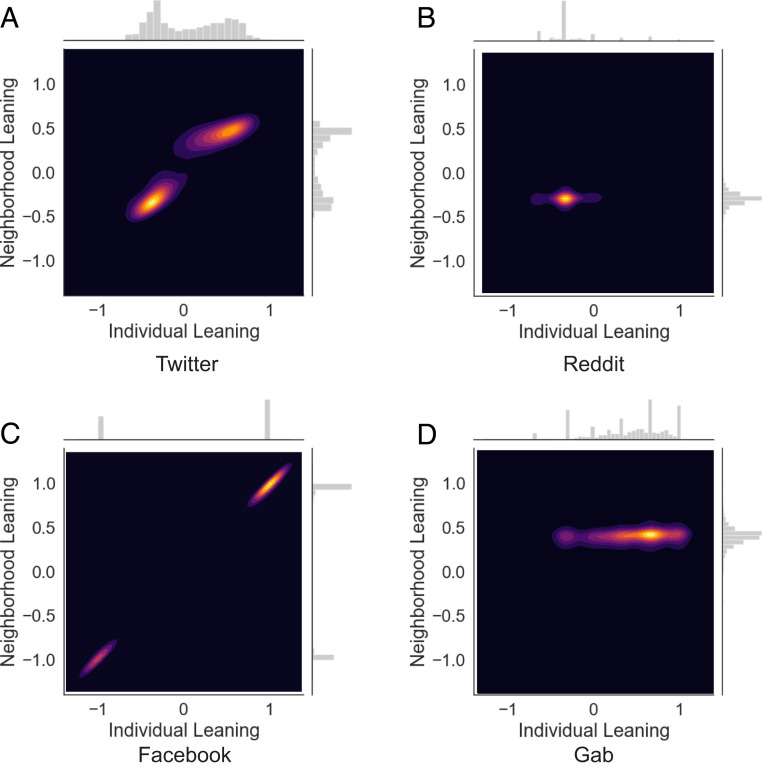
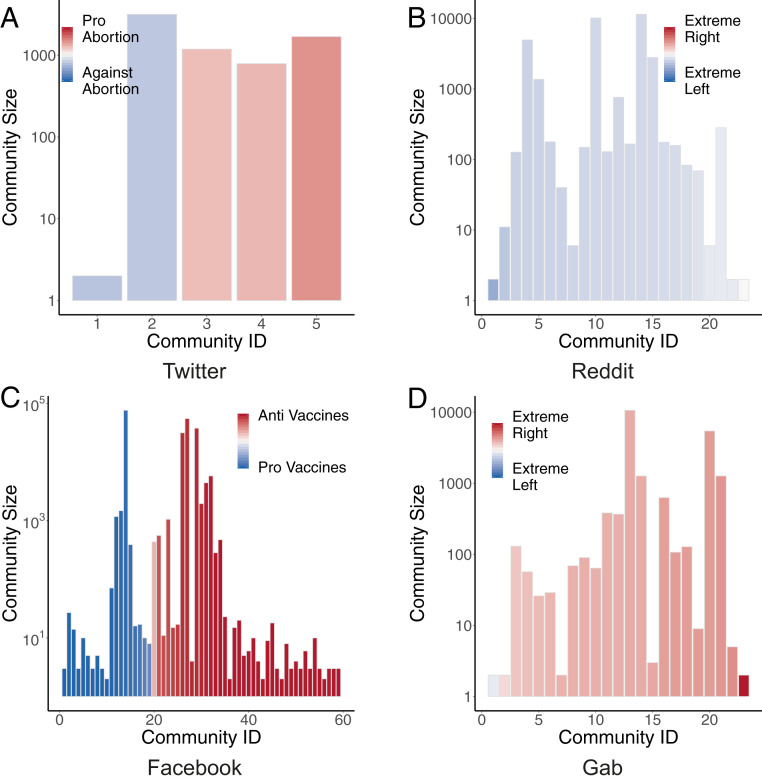
- Across the four platforms, “aggregation in homophilic clusters of users dominates online dynamics,” but platforms differ: Facebook and Twitter show homophilic clustering, while Reddit and Gab form a single community biased left or right rather than two opposing clusters.
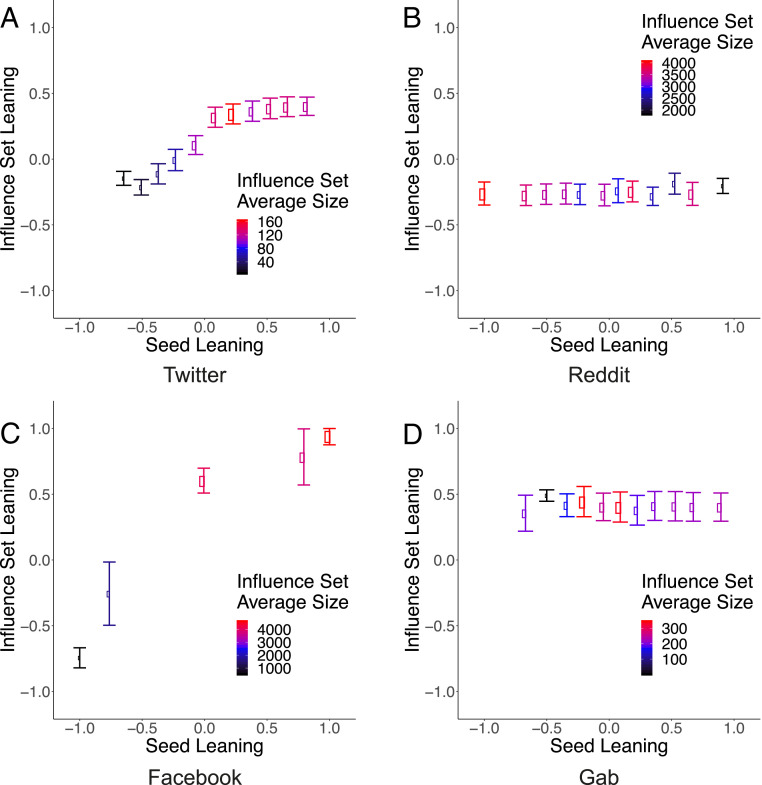
- Information diffusion is biased toward like-minded users on Facebook and Twitter, where the average leaning of a user’s influence set approximates the seed user’s leaning; on Reddit and Gab, the average leaning of the influence set does not depend on the seed user’s leaning.
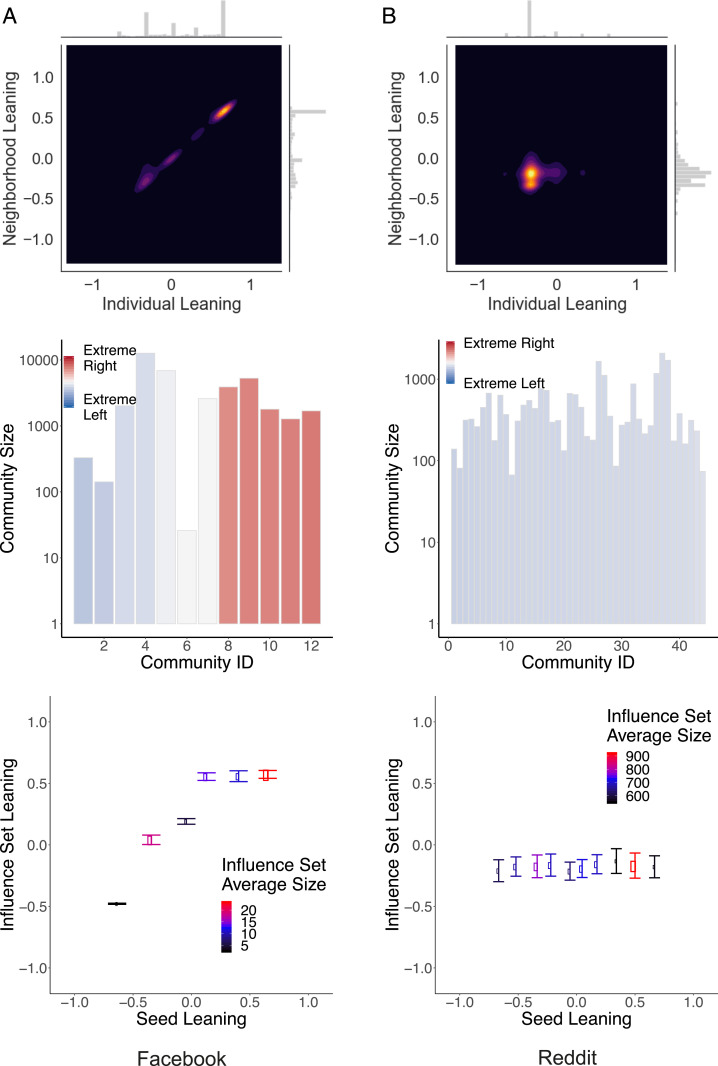
- In a direct comparison on news consumption, Facebook shows higher segregation than Reddit across all three measures: user-neighbor leaning correlation, community leaning, and SIR influence-set leaning.
- The study analyzes more than 100 million unique pieces of content and more than 1 million active users, with news outlets labeled using 2,190 media sources from Media Bias/Fact Check.
Methods
- Comparative analysis of Gab, Facebook, Reddit, and Twitter datasets on controversial topics including gun control, Obamacare, abortion, vaccines, science versus conspiracy, and news; main selected datasets were Abortion (Twitter), Vaccines (Facebook), Politics (Reddit), and Gab as a whole.
- Echo chambers were operationalized through two dimensions: homophily in interaction networks and bias in information diffusion toward like-minded peers. User leaning was inferred from linked news outlets, likes, or content, and interaction networks were built from follows, comments, cocomments, submissions, or replies depending on platform.
- Analyses included correlation between user leaning and average neighbor leaning, Louvain community detection, and SIR simulations to measure influence sets; SIR recovery rate was fixed at ν = 0.2, with dataset-specific infection ratios.
Limitations
- The paper states that the next envisioned step is to address the temporal dimension of echo chambers and how platform-specific social feedback mechanisms impact their formation.
- Evident from the text: leaning coverage varies strongly by platform, from 0.90–1.00 for Twitter/Facebook datasets to 0.15–0.20 for Reddit and 0.13 for Gab, so leaning-based conclusions for Reddit and Gab rest on a small classified fraction of users.
- Evident from the text: datasets differ by platform and topic, and the direct cross-platform comparison on a common topic is limited to news consumption on Facebook and Reddit; the authors also note that Reddit/Gab results could mean either no echo-chamber effect or observation inside a single echo chamber.
Model-written summary. Check it against the paper before relying on it.
Integrity signals
Registry
Cites
Statistics
Figures
Verification
Claims the paper makes
8 Valid · 1 Not valid · 7 Not checked · 38 Own results and interpretations
The cited sources support only part of this claim — read each source’s verdict below.
In the paper
“Selective exposure (19) and confirmation bias (20) (i.e., the tendency to seek information adhering to preexisting opinions) may explain the emergence of echo chambers on social media (1, 17, 21, 22).”
§ The echo chamber effect on social media > Abstract
What the sources say
- Supportedcites [1] M. Del Vicario, The spreading of misinformation online. Proc. Natl. Acad. Sci. U.S.A. 113, 554– 559 (2016). 26729863 PMC4725489 source
The Abstract says selective exposure generates homogeneous clusters, which it calls echo chambers. The Results and Discussion section says users select content matching a narrative and suggests confirmation bias determines echo-chamber formation. Page numbers are not provided in our copy. (LLM, conf=0.94)
- Partly supportedcites [17] K. Garimella, G. De Francisci Morales, A. Gionis, M. Mathioudakis, “ The effect of collective attention on controversial debates on social media” in WebSci ’17: 9th International ACM Web Science Conference (Association for Computing Machinery, New York, NY, 2017), pp. 43– 52. sourceExperimental — accuracy not yet measured
The Introduction reports that users mostly interact within their own side and endorse opinions from that side’s core. Related Work reports that users spread information faster when it agrees with their position. These passages are consistent with selective exposure, but the paper does not identify confirmation bias or establish that either tendency causes echo chambers to emerge. (LLM, conf=0.82)
- Supportedcites [21] M. Del Vicario, Echo chambers: Emotional contagion and group polarization on Facebook. Sci. Rep. 6, 37825 (2016). 27905402 PMC5131349 source
The Abstract says social-media disintermediation encourages users to select information that fits their beliefs (confirmation bias) and form like-minded groups (echo chambers). The Conclusions likewise describe Facebook as suited to the emergence of echo chambers. This supports the proposed explanation, without claiming it is the only cause. (LLM, conf=0.93)
- Supportedcites [22] A. Bessi, Science vs conspiracy: Collective narratives in the age of misinformation. PloS One 10, e0118093 (2015). 25706981 PMC4338055 source
The Introduction (page unavailable) says users consuming opposing information tend to form isolated clusters and describes polarized users whose likes are almost exclusively on one category of pages. The Conclusions (page unavailable) link information evaluation to existing beliefs. Together, these passages support the hedged explanation that selective exposure and confirmation bias may contribute to echo chambers. (LLM, conf=0.86)
hedgedstates a possible cause- Asserted: passes — The authors put it forward as true.
- Checkable: passes — It can be checked against evidence.
- Load-bearing: passes — The paper’s conclusions depend on it.
- Based: passes — The paper gives a reason why it holds.
- Supported
The cited sources support only part of this claim — read each source’s verdict below.
In the paper
“Our attention span remains limited (9, 10), and feed algorithms might limit our selection process by suggesting contents similar to the ones we are usually exposed to (11–13).”
§ The echo chamber effect on social media > Abstract
What the sources say
- Not checked — no full text of the sourcecites [11] A. L. Schmidt, Anatomy of news consumption on Facebook. Proc. Natl. Acad. Sci. U.S.A. 114, 3035– 3039 (2017). 28265082 PMC5373354 source
- Partly supportedcites [12] M. Cinelli, The COVID-19 social media infodemic. Sci. Rep. 10, 16598 (2020). 33024152 PMC7538912 sourceExperimental — accuracy not yet measured
The Introduction (page not provided) says algorithms take users’ preferences and attitudes into account when promoting content, and that users tend to seek information aligned with their worldviews. It does not say that feed algorithms suggest content similar to what users have previously seen or thereby limit their selection. (LLM, conf=0.82)
- Not checked — no full text of the sourcecites [13] E. Bakshy, S. Messing, L. A. Adamic, Exposure to ideologically diverse news and opinion on Facebook. Science 348, 1130– 1132 (2015). 25953820 source
hedgedstates a possible cause- Asserted: passes — The authors put it forward as true.
- Checkable: passes — It can be checked against evidence.
- Load-bearing: passes — The paper’s conclusions depend on it.
- Based: passes — The paper gives a reason why it holds.
Every source the paper cites for this claim was checked and supports it.
In the paper
“Online polarization, for instance, may foster misinformation spreading (1, 8).”
§ The echo chamber effect on social media > Abstract
What the sources say
- Supportedcites [1] M. Del Vicario, The spreading of misinformation online. Proc. Natl. Acad. Sci. U.S.A. 113, 554– 559 (2016). 26729863 PMC4725489 source
The Significance section says that homogeneity and polarization are main determinants of rumor-cascade size. The Conclusions also link polarized communities with the proliferation of narratives fueled by unsubstantiated rumors, supporting the hedged claim that online polarization may foster misinformation spreading. (LLM, conf=0.91)
- Supportedcites [8] M. D. Vicario, W. Quattrociocchi, A. Scala, F. Zollo, Polarization and fake news: Early warning of potential misinformation targets. ACM Trans. Web 13, 1– 22 (2019). source
The Introduction states that misinformation spreading on social media is directly related to increasing user polarization and segregation. This supports the citing sentence’s hedged claim that online polarization may foster misinformation spreading. (LLM, conf=0.94)
hedgedstates a possible cause- Asserted: passes — The authors put it forward as true.
- Checkable: passes — It can be checked against evidence.
- Load-bearing: unclear — It is unclear whether the paper’s conclusions depend on it.
- Based: passes — The paper gives a reason why it holds.
- Supported
Every source the paper cites for this claim was checked and supports it.
In the paper
“In network terms, this translates into a node i with a given leaning xi more likely to be connected with nodes with a leaning close to xi (18).”
§ The echo chamber effect on social media > Comparative Analysis > Polarization and Homophily in the Interaction Networks.
What the sources say
- Supportedcites [18] W. Cota, S. C. Ferreira, R. Pastor-Satorras, M. Starnini, Quantifying echo chamber effects in information spreading over political communication networks. EPJ Data Sci. 8, 35 (2019). source
The paper’s “Topological evidence of echo chambers” section says that a node with political position Pᵢ is connected with nodes whose positions are close to Pᵢ. It also reports a strong correlation between users’ positions and their neighbors’ average positions, supporting the citing sentence’s probabilistic paraphrase. (LLM, conf=0.94)
hedgedstates an association- Asserted: passes — The authors put it forward as true.
- Checkable: passes — It can be checked against evidence.
- Load-bearing: passes — The paper’s conclusions depend on it.
- Based: passes — The paper gives a reason why it holds.
- Supported
A result the paper reports from its own data — it cites no other source for it, so there is none to check. The quote shows it is in the paper.
In the paper
“Furthermore, the almost total absence of communities with leaning very close to 0 confirms the polarized state of the systems.”
§ The echo chamber effect on social media > Comparative Analysis > Polarization and Homophily in the Interaction Networks.
boostedstates a cause- Asserted: passes — The authors put it forward as true.
- Checkable: passes — It can be checked against evidence.
- Load-bearing: passes — The paper’s conclusions depend on it.
- Based: passes — The paper gives a reason why it holds.
- Rests on 4 assumptions not shown here.
32 more claims
Create a free account to see all 54 claims and to verify the 2 references still open.
- It may state two separate claims as one. 9
- Probably not a substantial claim. 9
Claims other papers make about this one
Each is checked against this paper’s own text: does it say what the citing paper says it does?
The source backs part of the claim, not all of it — or backs it for a different population, condition or comparison.
In the citing paper
“engagement with political content online is generally associated with high levels of ingroup bias; that is, it is far more likely to be shared within the political ingroup than in the outgroup (18, 19, 16).”
From Troll and divide: the language of online polarization (2022) · cites this paper as [16]
Experimental — accuracy not yet measuredThe source backs part of the claim, not all of it — or backs it for a different population, condition or comparison.
In the citing paper
“This challenge is reflected in research on”
From Machine culture (2023) · cites this paper as [142]
Experimental — accuracy not yet measuredThe source backs part of the claim, not all of it — or backs it for a different population, condition or comparison.
In the citing paper
“Thus, combating social media's echo chamber effect through an active exposure to diverse perspectives and networks also represents a viable individual-level strategy for addressing the deepfake problem (Cinelli et al., 2021; Gillani et al., 2018).”
From Deepfakes: Deceptions, mitigations, and opportunities (2023) · cites this paper as Cinelli et al., 2021
Experimental — accuracy not yet measuredThe source backs part of the claim, not all of it — or backs it for a different population, condition or comparison.
In the citing paper
“Even without being designed to shift opinions, it has been found that algorithms may contribute to political polarization by reinforcing divisive opinions [9, 24, 32].”
From Co-Writing with Opinionated Language Models Affects Users’ Views (2023) · cites this paper as [32]
Experimental — accuracy not yet measuredThe source backs part of the claim, not all of it — or backs it for a different population, condition or comparison.
In the citing paper
“On Reddit, studies find minimal evidence of echo chambers due to platform features encouraging cross-cutting exposure [17,61,63].”
From A systematic review of echo chamber research: comparative analysis of conceptualizations, operationalizations, and varying outcomes (2025) · cites this paper as [17]
Experimental — accuracy not yet measured
5 more claims about this paper
Create a free account to see every claim other papers make about this one.
Citations
Cites
Fast unfolding of communities in large networks
Blondel, V. D., Guillaume, J.-L., Lambiotte, R., & Lefebvre, E. (2008) · Journal of Statistical Mechanics: Theory and Experiment · doi:10.1088/1742-5468/2008/10/p10008 · Cited by 21,424 · cited 1×
“We detected communities by applying the Louvain algorithm (41), removing singleton communities with only one user.”
MethodThe spread of true and false news online
Vosoughi, S., Roy, D., & Aral, S. (2018) · Science · doi:10.1126/science.aap9559 · Cited by 8,847 · cited 1×
“A recent study (7) limited to Twitter claimed that fake news travels faster than real news.”
BackgroundConfirmation Bias: A Ubiquitous Phenomenon in Many Guises
Nickerson, R. S. (1998) · Review of General Psychology · doi:10.1037/1089-2680.2.2.175 · Cited by 7,267 · cited 1×
“Selective exposure (19) and confirmation bias (20) (i.e., the tendency to seek information adhering to preexisting opinions) may explain the emergence of echo chambers on social media (1, 17, 21, 22).”
BackgroundInfectious Diseases of Humans: Dynamics and Control
Anderson, R. M., & May, R. M. (1991) · doi:10.1093/oso/9780198545996.001.0001 · Cited by 6,179
Lazer, D. M. J., Baum, M. A., Benkler, Y., Berinsky, A. J., Greenhill, K. M., Menczer, F., Metzger, M. J., Nyhan, B., Pennycook, G., Rothschild, D., et al. (2018) · Science · doi:10.1126/science.aao2998 · Cited by 4,160
Degroot, M. H. (1974) · Journal of the American Statistical Association · doi:10.1080/01621459.1974.10480137 · Cited by 4,004 · cited 1×
“For instance, if opinions are assumed to be embedded in a onedimensional space (38), x ∈ [−1,+1] without loss of generality, as usual for controversial topics, then polarization is characterized by two well-separated peaks in P(x ), for positive and negative opinions.”
BackgroundExposure to ideologically diverse news and opinion on Facebook
Bakshy, E., Messing, S., & Adamic, L. A. (2015) · Science · doi:10.1126/science.aaa1160 · Cited by 3,245 · cited 2×
“Our attention span remains limited (9, 10), and feed algorithms might limit our selection process by suggesting contents similar to the ones we are usually exposed to (11–13).”
BackgroundThe spreading of misinformation online
Del Vicario, M., Bessi, A., Zollo, F., Petroni, F., Scala, A., Caldarelli, G., Stanley, H. E., & Quattrociocchi, W. (2016) · Proceedings of the National Academy of Sciences · doi:10.1073/pnas.1517441113 · Cited by 2,407 · cited 2×
“, the tendency to seek information adhering to preexisting opinions) may explain the emergence of echo chambers on social media (1, 17, 21, 22).”
BackgroundSelf-citationThe COVID-19 social media infodemic
Cinelli, M., Quattrociocchi, W., Galeazzi, A., Valensise, C. M., Brugnoli, E., Schmidt, A. L., Zola, P., Zollo, F., & Scala, A. (2020) · Scientific Reports · doi:10.1038/s41598-020-73510-5 · Cited by 2,313
Self-citationFilter Bubbles, Echo Chambers, and Online News Consumption
Flaxman, S., Goel, S., & Rao, J. M. (2016) · Public Opinion Quarterly · doi:10.1093/poq/nfw006 · Cited by 1,992
Research works printed but not linked: 2
- R. M. Anderson, R. M. May, Infectious Diseases in Humans (Oxford University Press, Oxford, United Kingdom, 1992).
- M. Cinelli, G. De Francisci Morales, A. Galeazzi, W. Quattrociocchi, M. Starnini, The echo chamber effect on social media. Open Science Framework. https://osf.io/x92br/?view_only=cdcc87d30e404e01b6ae316db15e3375. Deposited 22 January 2021. PMC7936330 33622786
Cited by
Items 1,801–1,900 of 2,063
Consumer Protection Towards AI in Global Markets and Digital Commerce
Lima, V., Marcão, R. P., Martinho, F. I. F., & Santos, V. (2026) · IGI Global eBooks · doi:10.4018/979-8-3373-3461-5.ch011
The Role of AI and Social Media Literacy in Promoting Sustainable Interaction With Green Brands
Oweis, M. G., & الرافعي, م. م. (2026) · Advances in computational intelligence and robotics book series · doi:10.4018/979-8-2600-1348-9.ch008
The Alarming Rise of Cyber Attacks and Online Harassment in a Hyperconnected Era: Digital Shadows
Sharma, P., Sharma, B., Kaur, A., & Kaur, G. (2026) · IGI Global eBooks · doi:10.4018/979-8-3373-4903-9.ch007
Continuous growth of social polarization for scale-free networks
Pan, B., & Liu, J. (2026) · Chaos An Interdisciplinary Journal of Nonlinear Science · doi:10.1063/5.0322613
Women’s mobilization and antifeminist discursive framings in Portugal’s far right
Roque, S., Santos, R., & Garraio, J. (2026) · Frontiers in Political Science · doi:10.3389/fpos.2026.1787098
Kavahru, A., Solo, M., Pienyu, P., Sangtam, A. L., & Pongen, A. (2026) · Integrated Journal for Research in Arts and Humanities · doi:10.55544/ijrah.6.2.31
Kim, S. (2026) · Asian Communication Research · doi:10.20879/acr.2026.23.005
Majid, M. N., & Suhaili, M. (2025) · Khazanah Journal of Islamic Education and Science · doi:10.61815/khazanah.v1i2.871 · Cited by 1
Unicoon: Hypergraph-based Multi-Agent Simulation of Information Cocoons
Wei, C., Tu, Y., & Wang, Y. (2026) · International World Wide Web Conference (WWW) · doi:10.1145/3774904.3792486 · Cited by 1
Osorio, A. V. E., González, M. E. B., & Moncayo, N. A. A. (2026) · doi:10.17163/abyaups.171.2
Zhao, X., Wang, X. J., Dai, Y., & Wang, L. (2026) · Online Information Review · doi:10.1108/oir-07-2025-0524
Waymer, D., & Heath, R. L. (2026) · Public Relations Inquiry · doi:10.1177/2046147x261446943
Technology-enhanced information-seeking behavior among students on Facebook and TikTok in Vietnam
Nguyen, K. T., & Hafiar, H. (2026) · Online Journal of Communication and Media Technologies · doi:10.30935/ojcmt/18490
Temporal stability and cross-topic re-emergence of ideological divides on X
Riedl, J., Drews, W., Dafnos, A., & Neumeier, A. (2026) · Information Communication & Society · doi:10.1080/1369118x.2026.2659287 · Cited by 3
Perales, M. R., & Bosch, I. C. (2026) · Prisma social · doi:10.65598/rps.6012
Riazi, B., de Carvalho, A. F. P., & Culén, A. L. (2026) · Computer Supported Cooperative Work (CSCW) · doi:10.1007/s10606-026-09541-9
Communicating Maternity Risks Using Social Media in England and Australia
Byrom, S., a, M. S., Dahlen, H. G., & Rack, J. (2026) · Critical studies in risk and uncertainty · doi:10.1007/978-3-032-02731-3_15
The extended community of diet culture around eating disorders: a network analysis of reddit forums
Qiu, J., Levinson, C. A., Kropko, J., Henry, T. R., & Gates, A. J. (2026) · Applied Network Science · doi:10.1007/s41109-026-00787-2
“These ED-focused online communities provide a rich, though complex, window into the psychological and behavioral experiences of those experiencing and recovering from ED (Wang et al. 2017, 2018; Moessner et al. 2018; Zhou et al. 2020; Arseniev-Koehler et al. 2016; Cinelli et al. 2021).”
GMM Clustering of Social Cognition on Youth Behavior and University Education in the New Media Era
Zhang, Q. (2026) · doi:10.1145/3801359.3801416
“These affordances can empower youth creativity and civic engagement, while also increasing exposure to fragmented information streams, echo-chamber dynamics, and value polarization [2].”
Himelboim, I., & Baid, M. (2026) · Big Data and Cognitive Computing · doi:10.3390/bdcc10050143
“Algorithms that prioritize engagement often amplify divisive posts, boosting extremism [32].”
AI Beyond Control: Algorithmic Hegemony in the Age of Chimera
Andoniou, C. (2026) · Smart innovation, systems and technologies · doi:10.1007/978-3-032-20121-8_30
Decision-Making Algorithms and Meaning in Life: A Framework for Future Research
Rüther, M. (2026) · Springer eBooks · doi:10.1007/978-3-032-15112-4_44 · Cited by 1
Sojka, A., Paradés, M., & Medrano, J. D. (2026) · Journal of Information Technology & Politics · doi:10.1080/19331681.2026.2666559
Nguyen, P., & Yang, Z. (2026) · Journal of Cross-Cultural Psychology · doi:10.1177/00220221261448127
“In addition, platform-level dynamics, such as algorithmic curation that prioritizes content generating strong engagement, can intensify polarized discourse by disproportionately amplifying extreme viewpoints (Cinelli et al., 2021).”
Agarwal, N. K., & Bhuiyan, M. M. I. (2026) · Social Network Analysis and Mining · doi:10.1007/s13278-026-01605-4 · Cited by 2
Weitzl, W., Sengupta, S., & Filieri, R. (2026) · Electronic Commerce Research · doi:10.1007/s10660-026-10132-5 · Cited by 1
Truth, Trust, and Technology: Political Communication in the Era of Synthetic MediaPreprint
Garajamirli, N. (2026) · Research Square · doi:10.21203/rs.3.rs-9473319/v1
Duraivel, S., Rajendran, L., Vasudevan, S., & Piazza, A. (2026) · PLoS ONE · doi:10.1371/journal.pone.0345135
Liu, Z., Wu, H., Fang, X., Liu, G., Li, H., Jing, Z., & Zhang, H. (2026) · Information Processing & Management · doi:10.1016/j.ipm.2026.104887
Mathematical Modeling of Opinion Dynamics under Algorithmic Amplifications: A Bifurcation Analysis
Bakim, S. (2026) · Black Sea Journal of Engineering and Science · doi:10.34248/bsengineering.1882307
Human-Centered and Participatory AI Auditing
Deng, W. H., Holstein, K., & Eslami, M. (2026) · Springer eBooks · doi:10.1007/978-981-95-3658-0_102 · Cited by 1
İnternet Haber Sitelerinde HPV Aşısı ve Rahim Ağzı Kanseri Haberleri Üzerine Bir İçerik Analizi
Çiçeklioğlu, A. Ş., & Aksu, A. (2026) · Iğdır üniversitesi sosyal bilimler dergisi · doi:10.54600/igdirsosbilder.1662995
Emotion Impact and Contagion Mechanism of Misinformation: A Network‐Based Risk Analysis
Chen, Q. (2026) · Risk Analysis · doi:10.1111/risa.70265
“…networks has shown that cohesive, homogeneous communities can nonetheless be anchored by a limited number of cross-cutting or bridging ties, which connect otherwise segregated groups and facilitate information diffusion across clusters (Cinelli et al. 2021 ; Del Vicario et al. 2016 ).”
Koudelková, P. (2026) · Cogent Arts and Humanities · doi:10.1080/23311983.2026.2666438
Kropczynski, J., Akter, M., Asadi, A. R., Alzughbi, H., Park, J., Lipford, H. R., & Wiśniewski, P. (2026) · Proceedings of the ACM on Human-Computer Interaction · doi:10.1145/3788054 · Cited by 2
Jang, K., & Baek, Y. M. (2026) · Behaviour and Information Technology · doi:10.1080/0144929x.2026.2675625
I Don’t Believe Misinformation, But I Might Share It: Inoculation Effects in Messenger Communication
Ancina, A., Zumbrägel, J., & Krämer, N. C. (2026) · Social Media + Society · doi:10.1177/20563051261449194
“Messenger services intensify these risks: misinformation circulates widely with few verification affor-dances and may be reinforced (Bovet & Grindrod, 2022; Cinelli et al., 2021; Galhardi et al., 2020).”
Gómez‐Romero, J., Cantón-Correa, J., Fajardo, W., & Molina-Solana, M. (2026) · EPJ Data Science · doi:10.1140/epjds/s13688-026-00667-w
Resilience: Muting and Resisting Conspiracy Theories
Rao, H., & Greve, H. R. (2026) · Oxford University Press eBooks · doi:10.1093/9780197772324.003.0009
Topic Modeling and Word Embedding
Rao, H., & Greve, H. R. (2026) · Oxford University Press eBooks · doi:10.1093/9780197772324.005.0001
Linguistic Patterns in Online Conspiracy Theory
Rao, H., & Greve, H. R. (2026) · Oxford University Press eBooks · doi:10.1093/9780197772324.003.0001
Opportunities for Future Research
Rao, H., & Greve, H. R. (2026) · Oxford University Press eBooks · doi:10.1093/9780197772324.003.0010
Flores, J. D. (2026) · Frontiers in Political Science · doi:10.3389/fpos.2026.1779500
Cultural Toolkit: Conspiracy Theorists as Echolocators
Rao, H., & Greve, H. R. (2026) · Oxford University Press eBooks · doi:10.1093/9780197772324.003.0005
From Mindsets and Algorithms to a Cultural Toolkit
Rao, H., & Greve, H. R. (2026) · Oxford University Press eBooks · doi:10.1093/9780197772324.003.0004
Why Do Online Conspiracy Theories Matter?
Rao, H., & Greve, H. R. (2026) · Oxford University Press eBooks · doi:10.1093/9780197772324.003.0002
Rao, H., & Greve, H. R. (2026) · Oxford University Press eBooks · doi:10.1093/9780197772324.002.0001
Online Conspiracy Theorizing as Conversational Coordination
Rao, H., & Greve, H. R. (2026) · Oxford University Press eBooks · doi:10.1093/9780197772324.003.0008
Fake News, Rumors, Folk Theories: A Neglect of Language
Rao, H., & Greve, H. R. (2026) · Oxford University Press eBooks · doi:10.1093/9780197772324.003.0003
Online Conspiracy Rabbit Hole as a Semantic Cascade
Rao, H., & Greve, H. R. (2026) · Oxford University Press eBooks · doi:10.1093/9780197772324.003.0006
Rao, H., & Greve, H. R. (2026) · Oxford University Press eBooks · doi:10.1093/9780197772324.002.0006
How We Studied Conspiracy Theories
Rao, H., & Greve, H. R. (2026) · Oxford University Press eBooks · doi:10.1093/9780197772324.005.0002
Rao, H., & Greve, H. R. (2026) · Oxford University Press eBooks · doi:10.1093/9780197772324.002.0007
Ctrl+Alt+Doubt: Decoding the Language of Online Conspiracy Talk
Rao, H., & Greve, H. R. (2026) · doi:10.1093/9780197772324.001.0001
Linguistic Signature of Superspreaders
Rao, H., & Greve, H. R. (2026) · Oxford University Press eBooks · doi:10.1093/9780197772324.003.0007
Rozvoj mediálnej gramotnosti profesionálov v pomáhajúcich profesiách
Sládkayová, M. B. (2026) · Belianum. Vydavateľstvo Univerzity Mateja Bela v Banskej Bystrici eBooks · doi:10.24040/2026.9788055723266
Dreaming with MAKOTO: Co-Designing an "Older Adult" Voice Assistant Intervention for Implicit Ageism
Seaborn, K., Watanabe, M., Fabre, É., Riesch, P., Nam, S., Mandai, Y., & Kojima, M. (2026) · Participatory Design Conference · doi:10.1145/3796624.3796648
“For example, biases can be exploited to spread misinformation or drive compulsive behaviour in social media [9, 12].”
Mukherjee, S. K. (2026) · Home Health Care Management & Practice · doi:10.1177/10848223261446606
Role of Media in the Revival of Islam: Navigating Official and Unofficial Islam in Uzbekistan
Fozilova, D. (2026) · New Directions in Islam · doi:10.1007/978-981-95-8224-2_6 · Cited by 1
Khan, M., Sheehy, B., & Arnold, B. (2026) · Platforms · doi:10.3390/platforms4020009 · Cited by 1
“Misinformation diffusion is understood here as a structural outcome of platform-mediated attention dynamics rather than solely a function of message content or individual cognition [36–38].”
Wu, D., Wang, C., Zhang, C., & Li, Y. (2026) · BMC Psychology · doi:10.1186/s40359-026-04558-7 · Cited by 1
“D between while suppressing visible intra-group disagreement [8].”
ViMET-R: Auditing Activity-Level Bias in YouTube Shorts Recommendations
Poudel, D., & Agarwal, N. (2026) · Studies in computational intelligence · doi:10.1007/978-3-032-16649-4_6
Pogrebna, G., & Hills, T. T. (2026) · Cambridge University Press eBooks · doi:10.1017/9781108939010.035
Henz, P. (2026) · Cambridge University Press eBooks · doi:10.1017/9781108939010.021
Teaching Open-Mindedness in an Algorithmic Age
Trudel, S. M., & Winter, E. L. (2026) · Springer eBooks · doi:10.1007/978-3-032-15911-3_9
Proactive Misinformation Forecasting via Incremental Topic Detection and Sentiment Polarization
Comito, C., Socievole, A., & Zumpano, E. (2026) · International World Wide Web Conference (WWW) · doi:10.1145/3774905.3794646
Pogrebna, G., & Hills, T. T. (2026) · Cambridge University Press eBooks · doi:10.1017/9781108939010.015
Vecchio, M. D. (2026) · Cambridge University Press eBooks · doi:10.1017/9781108939010.043
Where do I go now? Migrants' emotional responses to online racism and hate speech in Chile
Sibrian, N., Alfaro, A., & Zúñiga, V. (2026) · Frontiers in Communication · doi:10.3389/fcomm.2026.1827635 · Cited by 1
Multiscale modeling of opinion dynamics phenomena with external influence through drift term
Coco, M., & Menale, M. (2026) · The European Physical Journal Plus · doi:10.1140/epjp/s13360-026-07848-6
“The spreading of fake news [2–4] and the polarization effects [2, 5, 6] have been seen with their consequences.”
Duan, J., Yan, H., Qi, S., & Wu, C. (2026) · SSRN Electronic Journal · doi:10.2139/ssrn.6852763
Dow, C. V., Morelli, B., Son, J. W., Andersland, M. D., Koompah, D., Whelan, J. P., & Pfund, R. A. (2026) · International Gambling Studies · doi:10.1080/14459795.2026.2681973
“Personalized information environments common to social media platforms can foster ‘echo chambers,’ in which users are primarily exposed to like-minded perspectives, limiting engagement with diverse viewpoints and reinforcing shared narratives (Cinelli et al., 2021).”
Vaccine Perception on Digital Platforms: Topic Modeling of YouTube Comments
Sert, U., Ersoy, E., Tosun, Ö., & Hatıpoğlu, I. (2026) · Computers · doi:10.3390/computers15060360
Liu), T. L. (., & Wu, Y. (2026) · Discourse & Communication · doi:10.1177/17504813261447676
“…and it reflects why recent critical scholars of social media and online communication caution that platform algorithms, even in the absence of malicious recommendation routines, can still tilt public attention towards communication marked by expressive extremity (Cinelli et al., 2021).”
Digital empathy in online communication: A systematic literature review
Dewi, W. N. A., Purwanto, E., & Mulawarman, M. (2026) · Counsenesia Indonesian Journal Of Guidance and Counseling · doi:10.36728/cijgc.v7i1.6566 · Cited by 3
“…effect can exacerbate communication dynamics on social media, particularly when individuals engage in controversial or emotional discussions(Cinelli et al., 2021)Furthermore, the phenomenon of online disinhibition is often linked to the rise in cyberbullying cases on digital platforms.”
ElFadl, A. H., Alshakhsi, S. A. A., Ali, R., & Yankouskaya, A. (2026) · PeerJ Computer Science · doi:10.7717/peerj-cs.3547
Shadowban, Silenciamento e Exclusão Algorítmica
de Sá, R. L., & Priuli, R. M. (2026) · Revista Interdisciplinar em Estudos de Linguagem · doi:10.67204/riel.v4i8.3033
Torwane, N. A., Ha, D. H., Lalloo, R., Ludlow, K., Manchery, N., & Do, L. (2026) · Journal of Public Health Dentistry · doi:10.1111/jphd.70061
NARRATIVES OF THE SELF IN THE DIGITAL AGE: MEDIA, TECHNOLOGY, AND THE CONSTRUCTION OF WELL-BEING
-, K. A. P., Tripathi, S., & Pal, A. (2026) · ShodhKosh Journal of Visual and Performing Arts · doi:10.29121/shodhkosh.v7.i15s.2026.8582
Vaassen, C. E., Broek, T. A. V. D., Aaldering, H., & Beersma, B. (2026) · Computers in Human Behavior Reports · doi:10.1016/j.chbr.2026.101062
Nguyen, Q. (2026) · Physica A Statistical Mechanics and its Applications · doi:10.1016/j.physa.2026.131965
Huang, M., Xiao, Y., He, W., Mou, X., & Li, Q. (2026) · IEEE Transactions on Big Data · doi:10.1109/tbdata.2026.3702367
“Within this ecosystem, the propagation of a rumor event often begins with a single source topic that subsequently splin-ters into multiple derivative branches [5], [6], and the information from these different branches creates complex resonance effects with the source information [1], [7], [8], [9].”
LGBTQ laws and public opinion change
Huang, Y. (2026) · Nature Human Behaviour · doi:10.1038/s41562-026-02424-5
Rebolledo, G. S., & Ayora, J. S. M. (2026) · Revista Latinoamericana de Opinión Pública · doi:10.14201/rlop.32300
Rad, M. S. (2026) · Journal of Social and Political Psychology · doi:10.5964/jspp.16905
Chelius, C., Zeitlin, A. B., Hecht, C., Patel, A. I., Hecht, K., Pedroza-Tobías, A., & Grummon, A. H. (2026) · Journal of Nutrition Education and Behavior · doi:10.1016/j.jneb.2026.04.016
Propagation-augmented generation: Debunk misinformation via social propagation simulation
Si, J., Teng, Y., Zhao, X., Wu, X., Lü, W., & Zhou, D. (2026) · Neurocomputing · doi:10.1016/j.neucom.2026.134298
Rethinking the Future of Technology-Based Behavioral Addictions
Kuş, Ö. A. (2026) · IGI Global eBooks · doi:10.4018/979-8-3373-6665-4.ch001
Setiawan, G., Arifin, P. A., & Nawangsari, N. A. F. (2026) · Indigenous Jurnal Ilmiah Psikologi · doi:10.23917/indigenous.v11i2.16231
“Digital media respond by maintaining anxiety through the information they present (Cinelli et al., 2021; Vismara et al., 2020).”
Philipo, A. G., Ding, J., Sarwatt, D. S., et al. (2026) · SSRN Electronic Journal · doi:10.2139/ssrn.6963097
Detecting Echo Chambers on Reddit Using Sentiment Analysis
Paul-Kamara, M., & Yang, B. (2026) · International Conference on Innovations in Computational Intelligence (ICICI) · doi:10.1109/icici68867.2026.11565050
“As mentioned in [3], two key quantifiable features of an echo chamber are a homogeneous interaction network, where users interact with others who share similar opinions, and bias in the information source towards preexisting beliefs.”
Almeida, A. (2026) · Popular Communication · doi:10.1080/15405702.2026.2690280
“…regardless of age, education, or the topics addressed, demonstrating a broad capacity for dissemination and influence across different platforms and media environments (Aral, 2020; Cinelli et al., 2021; Dellarmelin & Rabot, 2021; Gorman & McLean, 2003; Prooijen et al., 2022; Thompson, 1995).”
Digital Health Misinformation and HPV Vaccine Awareness Among U.S. Adults: A National HINTS AnalysisPreprint
Gao, J., Windett, J. H., Ademu, L., Zhi, L., Idris, M. A., Griffin, B. C., Zhang, Y., & Radford, B. J. (2026) · medRxiv · doi:10.64898/2026.06.19.26356030
Wang, X., Liu, Y., Wu, S., Zhao, Z., Hu, Y., Li, W., & Bai, Q. (2026) · Neurocomputing · doi:10.1016/j.neucom.2026.134333 · Cited by 5
EntroBot: Entropy-Based Modeling of Account Behavior for Social Bot Detection
Jiang, S.-Y., Xie, Y., Xu, X.-K., & Lü, L. (2026) · IEEE Transactions on Computational Social Systems · doi:10.1109/tcss.2026.3695076
“DigitalObject Identifier 10.1109/TCSS.2026.3695076 on the dissemination and circulation of public information [1], [2], [3], [4], [5], [6], [7], [8].”
InfluentialMitsui, C., & Kawamura, Y. (2026) · Computers in Human Behavior Artificial Humans · doi:10.1016/j.chbah.2026.100331 · Cited by 1
Lu, Y., & Shi, L. (2026) · Journal of Research in Crime and Delinquency · doi:10.1177/00224278261456756
A Methodology to Assess Polarization on Social Media
Dey, D., Alashhy, M., Bhaumik, D., & Weltevreden, J. (2026) · ACM Conference on Fairness, Accountability, and Transparency (FAccT) · doi:10.1145/3805689.3812263
“As a result, the information ecosystem becomes uneven: while some users receive high-quality information, for others information received is inaccurate or polarizing in nature [29].”
Hakim, E. A., Syintia, T. D., Sintia, R., et al. (2026) · Indonesian Journal of Innovation Multidisipliner Research · doi:10.69693/ijim.v4i2.1084
“Keberhasilan konten-konten tersebut mendapatkan eksposur tinggi di For You Page (FYP) membuktikan mekanisme algoritma TikTok yang, menurut Cinelli et al. (2021) secara sistematis memprioritaskan konten dengan tingkat interaksi tinggi.”
InfluentialThe Dynamic Interplay of Branded Hashtag Adoption, Social Media Ties, and User Interest
Wang, H. D., Li, Y., & Yang, H. (2026) · SAGE Open · doi:10.1177/21582440261455140
“This finding supports the concept of identity reinforcement, which suggests consumers are motivated to participate in identity-consistent activities, and complements research on social media echo chambers (Cinelli et al., 2021).”
Influential
Metadata
- Authors
- Cinelli, M., De Francisci Morales, G., Galeazzi, A., Quattrociocchi, W., & Starnini, M.
- Affiliations
- Ca' Foscari University of Venice (IT)
- Institute for Scientific Interchange (ISI) Foundation, 10126 Torino, Italy;
- University of Brescia (IT)
- University of Oslo (NO)
- Institute for Scientific Interchange (IT)
- Corresponding author
- Quattrociocchi, Walter
- ORCID
- Venue
- Proceedings of the National Academy of Sciences
- Publisher
- National Academy of Sciences
- Published
- 2021-02-23
- Volume
- 118
- Issue
- 9
- ISSN
- 0027-8424 (ISSN-L)
- 1091-6490
- PMC
- PMC7936330
- OpenAlex
- W3133423348
- Cited by
- 2,092
- References
- 62
- Citations by year
- 2026: 488 · 2025: 516 · 2024: 387 · 2023: 351 · 2022: 256 · 2021: 90
- FWCI
- 375.62
- Type
- journal article
- Language
- en
- Open access
- hybrid
- doi.org
- Licence
- Locations
- Proceedings of the National Academy of Sciences (publishedVersion, cc-by)
- PubMed Central (publishedVersion, cc-by)
- PubMed (publishedVersion)
- UPCommons institutional repository (Universitat Politècnica de Catalunya) (submittedVersion, cc-by)
- IRIS Research product catalog (Sapienza University of Rome) (submittedVersion)
- Padua Research Archive (University of Padova) (submittedVersion, cc-by)
- Topics
- Social Sciences › Sociology and Political Science › Misinformation and Its Impacts
- Social Sciences › Communication › Social Media and Politics
- Physical Sciences › Physics and Astronomy › Statistical and Nonlinear Physics › Complex Network Analysis Techniques
- Keywords
- echo chambers, social media, homophily, information dissemination, algorithmic curation, controversial issues, Facebook, Twitter, Reddit, Gab, news consumption
- MeSH terms
- Abortion, Legal, Gun Violence, Communication, Humans, Politics, Social Change, Vaccination, Bias, Information Dissemination, Narration, Patient Protection and Affordable Care Act, Social Networking, Social Media
About these checks
Registry, retraction, Cites and statistics results are computed, not judged, with one exception: a printed reference that no index lists is read once by a model before it counts as a citation error. Claims are extracted by a model and kept only when their quote appears verbatim in the text; each cited source is then checked, with a model’s help, for whether it says what the claim relies on. Those verdicts can be wrong — read the claim’s quote and the cited source before relying on one.
The claim verdicts this report counts are experimental: their accuracy is not yet measured.
A language model drew the claims from the paper on 2026-10-10, under version 3 of the claim definition (model deepseek-v4.1-flash, prompt extract-v3).
A second model labelled each claim on 2026-10-10 (model jev-1.13-20260917, definition revision gold-guideline-v0.2).
Cited sources are checked with a language model’s help (gpt-6-sol).
Statistics and arithmetic are recomputed, not judged.
Confidence bands are shown only for fields calibrated on our annotated test set. None is calibrated yet, so no band is shown.
What counts as a claim ›How we measure confidence ›How we check this ›
Are you an author, or do you see a problem with this page? Request a review
Data sources
Bibliographic data: Semantic Scholar, OpenAlex, Crossref.
Contains information from the Semantic Scholar Academic Graph Datasets, made available under the ODC Attribution License (ODC-BY 1.0).
Semantic Scholar’s data is described in: Kinney, R., et al. (2023). The Semantic Scholar Open Data Platform. arXiv:2301.10140.
